
BAAM AI Blog
Writing Marketing Copy: How to Create Words That Sell
Marketing copy isn’t just “words on a page.” It’s the deliberate use of language to connect with a specific audience, trigger interest, and motivate readers to take action, whether that’s clicking a link, signing up...
Marketing copy isn’t just “words on a page.” It’s the deliberate use of language to connect with a specific audience, trigger interest, and motivate readers to take action, whether that’s clicking a link, signing up for a newsletter, or making a purchase. Marketing copy appears in ads, websites, social posts, emails, and virtually every customer touchpoint where persuasion matters. The goal is to move people from curiosity to conversion with clarity and purpose.
Good copy matters because customers often decide in seconds whether what you’re saying resonates with them. If your words don’t immediately connect with their needs, interest, or emotions, you lose them. Marketing copy helps brands stand out in crowded markets, clarify value, and make compelling offers impossible to ignore.
Why Marketing Copy Matters
To write marketing copy that genuinely influences behavior, we must start with why it matters. Marketing copy is essential because it:
Because customers are bombarded with messages every day, your copy must be clear, relevant, and tailored to exactly who you’re trying to reach. This focus increases engagement and conversion.
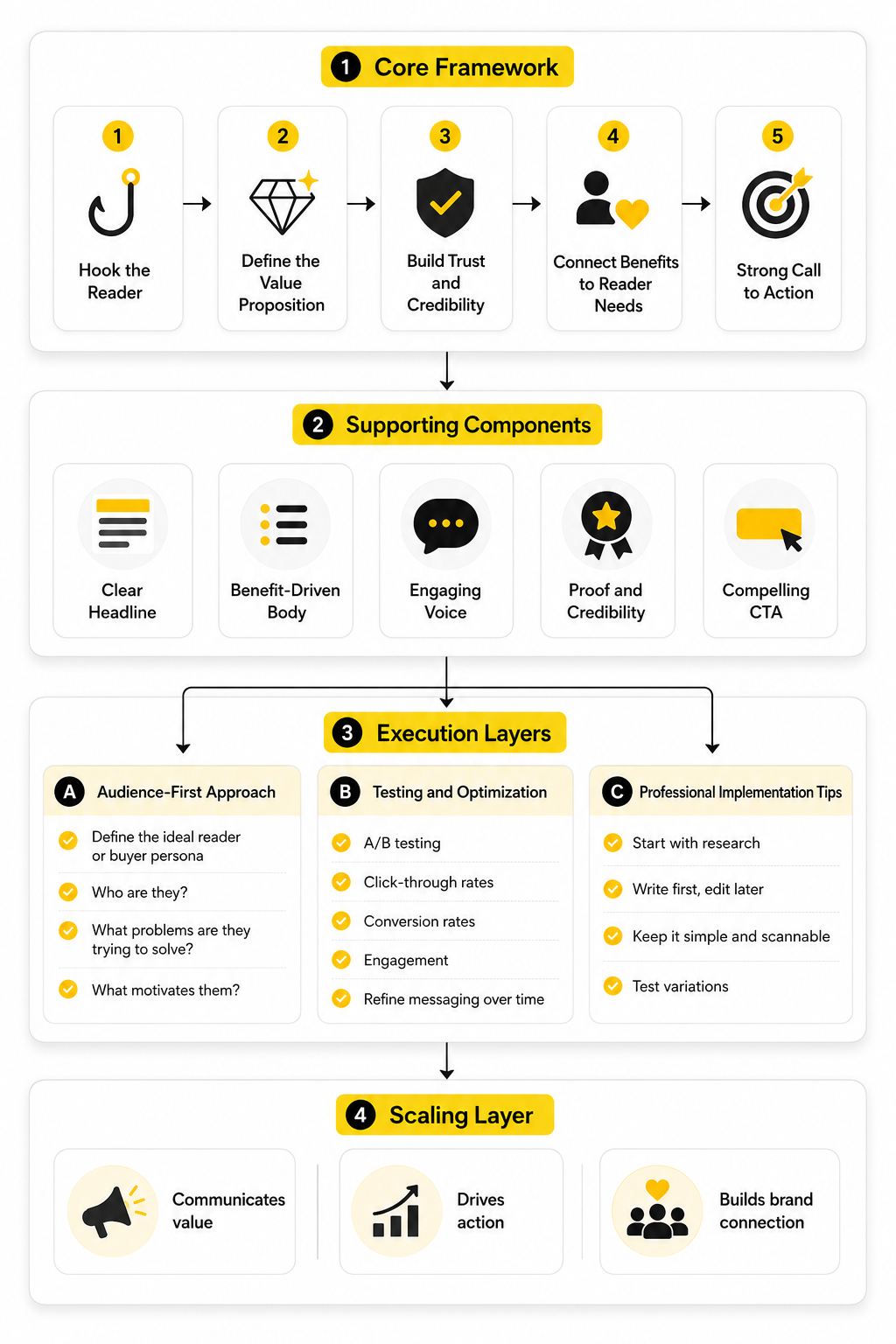
Overview of an Effective Copy Framework
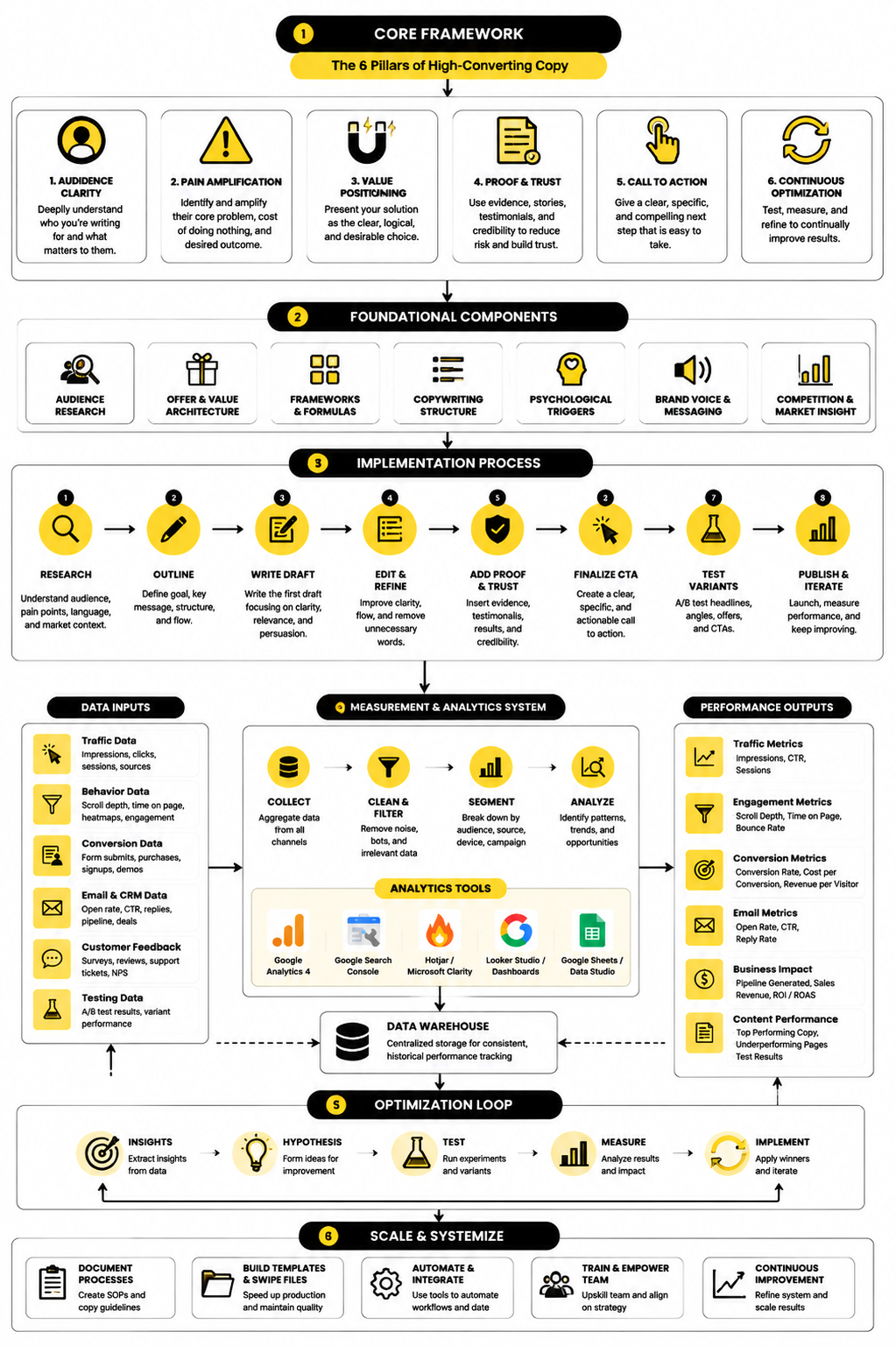
A reliable framework helps you structure your marketing copy so it captures attention and drives action. While there are many models like AIDA (Attention, Interest, Desire, Action) or PAS (Problem, Agitate, Solution), the core idea remains consistent: start with the audience, focus on value, and close with a clear next step.
Here’s a simple framework you can use:
Your opening must grab attention immediately. This could be a bold claim, a surprising fact, or a question that speaks to a real pain point.
Clearly explain what you’re offering and why it matters to the reader. This is where relevance meets clarity.
Use proof points like testimonials, data, or endorsements to reassure the reader that your offer is worth their attention.
Translate features into outcomes - why does this matter to the audience’s life or work?
Tell the reader exactly what to do next and, when appropriate, add urgency or incentives to prompt immediate response.
This framework keeps your copy focused and purposeful - essential for creating marketing copy that performs.
Core Components of High‑Converting Copy
Every piece of marketing copy should include these core elements:
These components work together to guide the reader from interest to action seamlessly.
Audience‑First Approach
To write effective marketing copy, you must know your audience deeply. This isn’t guesswork - it’s research. Understanding your audience’s desires, challenges, and language is the foundation of persuasive copy.
Start by defining your ideal reader or buyer persona:
When your copy speaks directly to your audience’s real motivations, it feels personal, relevant, and persuasive - driving higher engagement and better results.
Testing and Optimization
Great copy isn’t finished once written - it evolves. Testing different versions of your copy (A/B testing) helps you identify what resonates best with your audience. Pay attention to metrics like click‑through rates, conversion rates, and engagement to refine your messaging over time.
Small changes, like tweaking a headline or CTA, can have a significant impact on performance. Optimization is an ongoing process that improves results and informs future copy decisions.
Professional Implementation Tips
Here are practical steps professional copywriters use to create impactful marketing copy:
These habits help ensure your marketing copy isn’t just well‑written - it’s effective.
Audience‑First Approach
To make your marketing copy truly effective, you must go beyond surface‑level messaging and deeply understand the people you’re speaking to. Strong audience research isn’t optional - it’s the foundation that shapes every word you write so that it resonates with real humans, not just “readers.” Researchers and marketers universally emphasize that knowing your audience allows you to adopt the language, tone, and benefits that matter most to them, which directly impacts engagement and conversion outcomes.
Start by defining detailed personas for your ideal customers. Personas aren’t vague stereotypes; they’re semi‑fictional profiles built from real data about your audience’s demographics, motivations, challenges, and decision triggers. When you tailor copy to a persona’s specific desires and hesitations, your messaging feels personal, obvious, and relevant - which increases the likelihood readers will engage.
Audience research should pull from multiple sources: customer interviews, surveys, analytics, and even social listening to catch the actual language your market uses. This depth helps you speak with your audience rather than at them - a shift that elevates marketing copy from generic to persuasive.
Testing and Optimization
Even the most carefully crafted marketing copy should be treated as a starting point, not a final product. Testing is how you learn what actually works with your audience rather than what you think will work. In practice, this means running controlled experiments where you compare different versions of your copy to see which drives better engagement, clicks, or conversions.
One of the most common and effective methods is A/B testing, where you change a single element - like a headline, call‑to‑action (CTA), or value message - and measure how each variation performs with real users. By isolating one variable at a time, you can attribute performance changes to specific wording or positioning changes, giving you meaningful insights into what resonates.
In addition to A/B testing, structured copy testing and messaging research can uncover not just which version performs better but why. Pre‑launch messaging tests with small audience samples reveal preferences and comprehension before you escalate to full campaigns, reducing risk and improving ROI.
Professional Implementation Tips
When professionals write marketing copy, they follow disciplined habits that ensure clarity and effectiveness:
By combining deep audience understanding with systematic testing and disciplined execution, your marketing copy evolves from good to highly effective - speaking to the right people in the right way and driving measurable results.
Implementation: A Practical Step‑by‑Step Process for Writing Marketing Copy
To make writing marketing copy actionable, you need a clear, repeatable process you can follow every time you sit down to write. A structured approach removes guesswork, keeps your messaging aligned with business goals, and helps you produce copy that actually converts real people - not just looks pretty on a page.
Step 1: Start With a Clear Brief
Before you write a single sentence, define your objective and audience in concrete terms. What is the one action you want a reader to take? Who specifically are you talking to, and what problem are they trying to solve? A clear brief becomes the north star for every word you choose. Research shows that targeted audience and purpose definition dramatically improves persuasiveness and conversion outcomes.
Step 2: Do Deep Audience and Context Research
Great marketing copy isn’t written on assumptions - it’s grounded in insight. Use surveys, customer interviews, analytics, and reviews to understand real customer language, pain points, and decision motivators. This phase fuels the rest of your writing with specific insights instead of vague guesses, which professional copywriters consistently rank as one of the most important steps in the process.
Step 3: Map Your Core Message Hierarchy
Organize what you want to communicate before you draft anything. This includes your:
Laying this out upfront ensures your copy has a logical flow and that nothing important gets buried.
Step 4: Choose Your Copy Framework
Frameworks like AIDA (Attention, Interest, Desire, Action), PAS (Problem, Agitate, Solution), or FAB (Features, Advantages, Benefits) give structure to your draft and help you guide the reader through a persuasive journey. Using a proven framework reduces rewrite time and increases clarity - especially on landing pages and ads where every word counts.
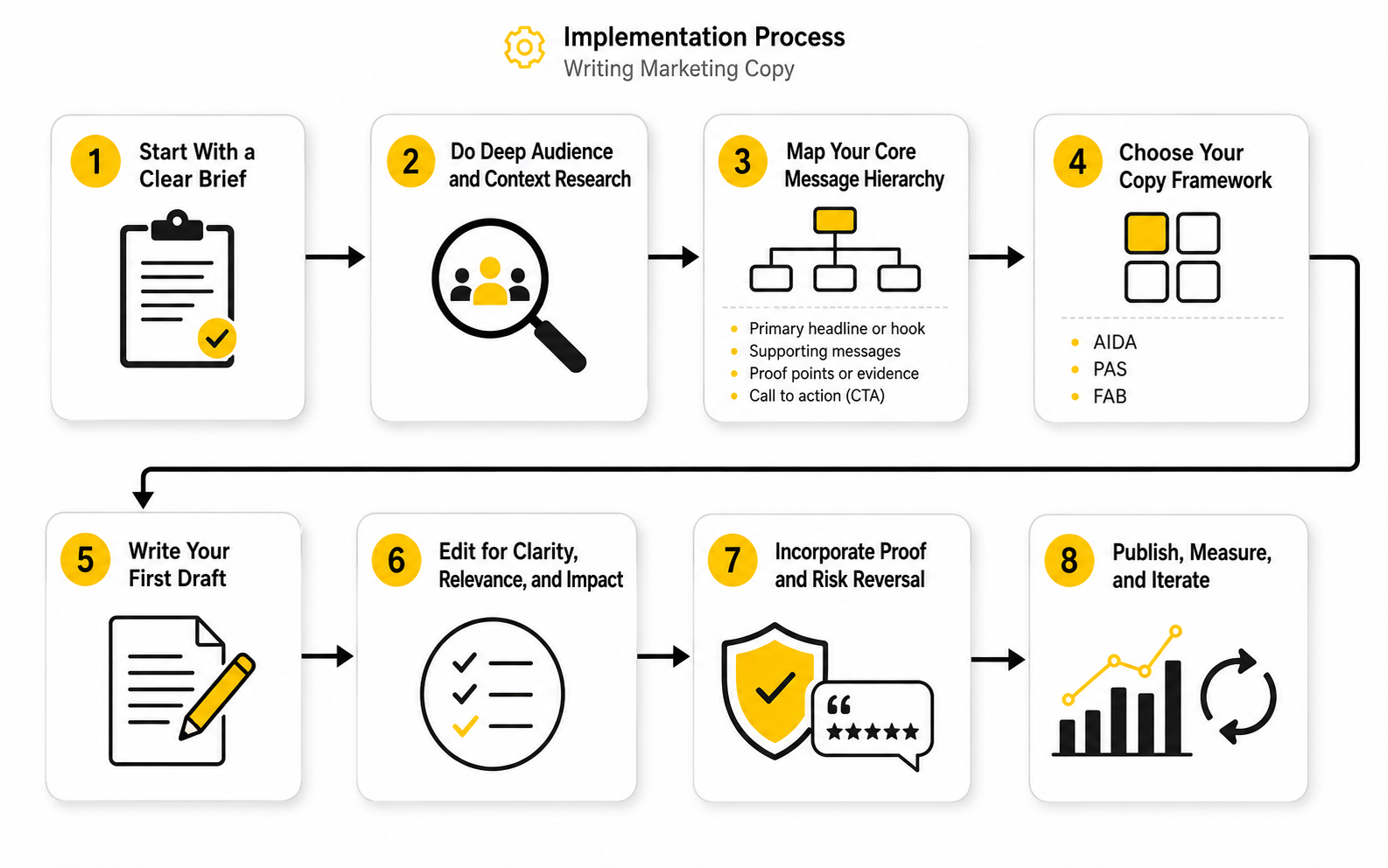
Step 5: Write Your First Draft
With your message map and framework in place, write your initial draft. Don’t edit as you go - focus on getting the ideas down. Many professional writers treat this as “structured brainstorming”: they fill the sections from their map first, then refine. This approach keeps momentum high and prevents self‑editing from blocking progress.
Step 6: Edit for Clarity, Relevance, and Impact
Once your rough draft is on the page, the real work begins. Tighten language, remove fluff, and replace generic phrases with specific outcomes your audience cares about. Make sure every sentence drives toward the action you defined in your brief. Aim for clarity and simplicity - effective copy is easy to scan and even easier to understand.
Step 7: Incorporate Proof and Risk Reversal
Readers trust copy backed by evidence. Where possible, weave in social proof (testimonials, case results), data points, or guarantees that reduce perceived risk. This doesn’t just make your offer more credible - it shortens the path from interest to conversion.
Step 8: Publish, Measure, and Iterate
After your copy goes live, your work isn’t done. Track performance metrics like click‑throughs, conversions, or time on page and compare them to your goals. Use A/B tests to try alternative headlines, CTAs, or messaging angles. Iteration based on real audience response is what turns solid copy into high‑performing copy over time.
This process turns writing marketing copy from a creative shot in the dark into a disciplined workflow that delivers measurable outcomes, keeps your messaging aligned with buyer needs, and continually improves results.
Data and Metrics That Reveal How Your Marketing Copy Performs
When you’re writing marketing copy, the numbers you track are more than dashboards - they’re signals that tell you whether your words are truly influencing behavior. Data without interpretation is noise, but the right metrics help you understand what’s working, what isn’t, and why.
Key Performance Metrics Every Copywriter Should Know
Measuring copy effectiveness isn’t about collecting every number you can see - it’s about focusing on the metrics that connect directly to audience engagement and business outcomes:
These metrics work together to paint a full picture: CTR tells you if readers start to engage, engagement signals show whether they stay and consume, and conversion rate shows whether they take action.
Benchmarks Help You Understand What “Good” Really Means
Numbers only matter when you compare them to a baseline - otherwise you don’t know if you’re winning or losing. Benchmarks vary widely by channel, traffic source, and offer type, but here are some grounded ranges you can use as a starting point:
Benchmarks don’t replace your own historical data, but they help you judge whether a result is truly strong, average, or underperforming relative to the market and your traffic.
What the Numbers Mean - And What You Should Do
Metrics are only useful if they prompt action:
Tracking these trends over time - rather than obsessing over a single number - lets you identify true patterns and make strategic improvements instead of chasing vanity metrics.
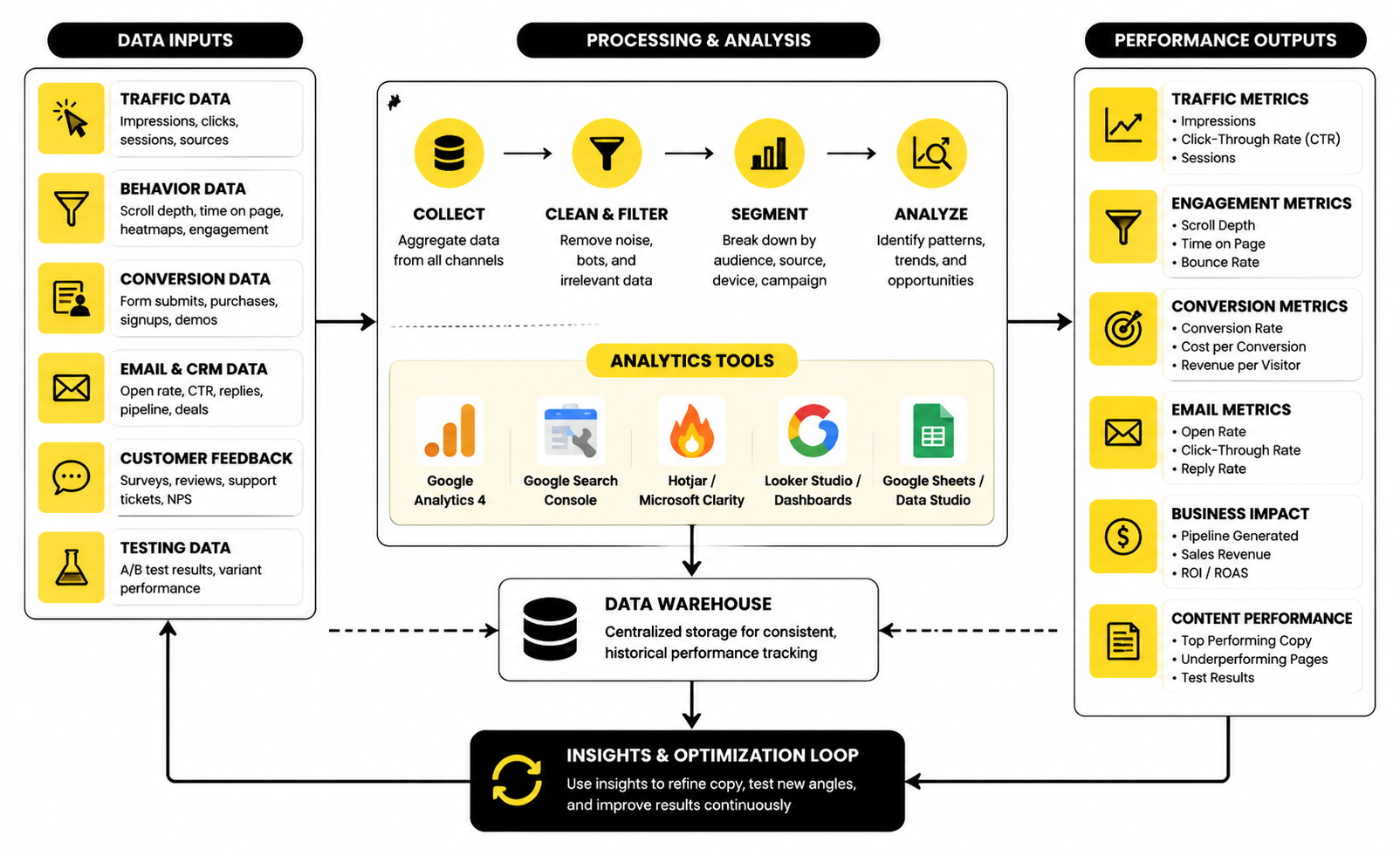
Using Data to Improve Your Copy Over Time
The most effective copywriters don’t just report numbers - they interpret them in context:
When you blend thoughtful measurement with disciplined optimization, writing marketing copy becomes a performance discipline - not just a creative task. The data stops being just numbers and starts being your roadmap to messages that meaningfully move people.
Advanced Strategies for Scaling and Optimizing Marketing Copy
As your marketing efforts grow, writing marketing copy evolves from a single campaign activity into a strategic asset. Scaling copy introduces new considerations, tradeoffs, and risks that can dramatically impact performance if not managed carefully.
Balancing Personalization and Efficiency
One of the most common challenges when scaling copy is maintaining relevance while producing content efficiently. Personalized messaging drives higher engagement, but crafting entirely bespoke copy for each segment quickly becomes unsustainable. Advanced marketers leverage dynamic content, modular copy frameworks, and AI-assisted writing tools like GoHighLevel AI or Replo to maintain personalization at scale. These systems allow you to swap headlines, calls to action, and benefits depending on audience segment without rewriting entire campaigns.
Navigating Strategic Tradeoffs
Scaling copy often requires prioritizing which messages receive the most attention. For example, emphasizing short-term conversion might conflict with long-term brand positioning. Professionals weigh tradeoffs by aligning each campaign with specific objectives: lead generation, brand awareness, retention, or upselling. Establishing clear metrics for each objective ensures that you don’t compromise long-term value for short-term gains. (ClickFunnels)
Risk Management in Copy Scaling
Expanding messaging across multiple channels and audiences increases the risk of inconsistent brand voice, diluted messaging, or legal and compliance issues. Maintaining a centralized copy repository, version control, and approval workflow mitigates these risks. Tools like Systeme.io help teams coordinate messaging while keeping every variation aligned with brand standards.
Optimizing for Multichannel Consistency
When scaling, each channel - email, social, paid ads, and landing pages - has unique audience behaviors and constraints. High-performing teams create channel-specific copy playbooks that preserve core messaging while optimizing for format and engagement nuances. This strategy reduces rewrite overhead and ensures a consistent narrative across touchpoints. (GoHighLevel)
Leveraging Advanced Analytics for Strategic Decisions
At scale, analyzing copy performance requires segmenting data by audience, channel, and campaign type. Advanced marketers use predictive analytics to anticipate which messages will resonate, applying these insights to future campaigns. This approach moves copywriting from reactive iteration to proactive strategy, creating a sustainable competitive advantage. (Guideless)
Continuous Learning and Feedback Loops
Finally, scaling effectively means implementing feedback loops that feed real-world performance data back into the copywriting process. Metrics like engagement trends, conversion paths, and drop-off points inform both strategic and tactical adjustments. Teams that institutionalize these loops see accelerated improvements in copy effectiveness and efficiency over time.
By approaching scaling thoughtfully, balancing personalization with efficiency, managing risks, and leveraging data strategically, writing marketing copy becomes a repeatable, measurable, and high-impact growth lever.
What is the biggest mistake people make when writing marketing copy?
The most common mistake is leading with features instead of benefits. Readers care about what your product or service does for them, not just what it is. Focusing on outcomes makes your copy more compelling and relevant.
How long should effective marketing copy be?
There’s no fixed length - it depends on the channel and audience. Short, punchy copy works well for ads and social posts, while longer form can be appropriate on landing pages or emails where you need to explain value and overcome objections.
Can anyone learn to write effective marketing copy?
Yes. Improving your skill is about understanding your audience, practicing frameworks like AIDA or PAS, and refining based on feedback. Many professional copywriters started with little experience and improved through deliberate practice and measurement.
How do I know if my marketing copy is working?
Measure it with clear performance metrics, especially click‑through and conversion rates. Tracking engagement and behavior on your page reveals whether your copy moves people toward your goal.
What role does SEO play in writing marketing copy?
SEO helps your copy get found, but it shouldn’t compromise clarity or persuasive impact. Use relevant keywords naturally, then write primarily to persuade, not just to rank.
How often should I update my copy?
Update your copy when performance metrics stagnate, when your offer changes, or when audience language evolves. Regular testing and optimization keep your messaging fresh and effective.
Should I personalize my marketing copy?
Personalization increases relevance and can boost engagement, particularly in emails and segmented campaigns. However, avoid forced personalization that feels artificial; use meaningful data to tailor messages thoughtfully.
What’s the difference between features and benefits?
Features describe what your product is or what it has. Benefits explain what it does for the customer. Great copy translates features into clear benefits that matter to your audience.
Is it better to write short or long headlines?
The best length depends on context and audience. Short headlines can grab attention quickly, while slightly longer ones can communicate a stronger value proposition. Test both to see what resonates with your specific audience.
How do I handle writer’s block when creating marketing copy?
Start with your audience’s problem and your most persuasive benefit. Using templates or frameworks like AIDA can jump‑start your thinking. Draft without editing, then refine - this process reduces pressure and improves clarity.
Build a stronger local presence with BAAM AI
Turn your website, Google profile, social channels, and AI visibility into one growth engine
Most businesses do not need more random marketing activity. They need a consistent presence system that helps the right people find them, trust them, and take action. BAAM AI brings strategy, local SEO, website updates, Google Maps visibility, social content, AI-search readiness, media production, and reporting into one practical monthly engine.
If you want your marketing to keep working after the campaign ends, start with a free BAAM AI presence audit. See how your business shows up today and where the fastest visibility wins are at BAAM AI.