
BAAM AI Blog
Why Most Sales Copy Fails Before the Offer
Most weak sales copy does not fail because the writer forgot a clever headline formula. It fails because the message starts in the wrong place. The copy talks about the product before the reader feels understood.
Why Most Sales Copy Fails Before the Offer
Most weak sales copy does not fail because the writer forgot a clever headline formula. It fails because the message starts in the wrong place. The copy talks about the product before the reader feels understood.
Good sales copy begins with the buyer’s current reality. What are they trying to fix? What have they already tried? What do they secretly worry will happen if nothing changes?
That is why “clear” usually beats “creative.” A clever line may get attention, but clarity creates momentum. The reader should instantly know who the offer is for, what problem it solves, and why it matters now.
The Reader Is Not Looking For Your Product Yet
Most people do not wake up wanting your funnel, software, coaching program, course, agency service, or ecommerce product. They wake up wanting a result. They want more leads, fewer abandoned carts, faster follow-up, better retention, more booked calls, or less chaos.
That means your sales copy should not open by explaining features. It should open by entering the conversation already happening in the reader’s head. When the copy reflects their pain accurately, they feel like the offer was built for them.
This is also where lazy AI-generated copy falls apart. It says things like “build your potential” or “take your business to the next level,” but those lines do not prove you understand the buyer. Specificity does.
Specific Pain Beats Big Promises
A big promise can work, but only when the pain underneath it feels real. “Grow faster” is vague. “Stop losing warm leads because your follow-up happens three days too late” is much stronger.
The second version creates a scene. The reader can picture the missed opportunity, the delayed reply, the lead going cold, and the frustration of knowing the sale was probably there. That is the kind of detail that makes sales copy feel personal without sounding manipulative.
Before writing any section, ask yourself what the buyer is tired of dealing with. Then write toward that. The more accurately you describe the problem, the less pressure you need to put on the pitch.
Build The Message Around Buyer Awareness
Buyer awareness is one of the most useful ways to structure sales copy because not every reader needs the same argument. Some people already know they need a solution. Others only know they have a frustrating problem.
If you treat every reader like they are ready to buy today, your copy becomes too aggressive. If you treat every reader like they need a full education, your copy becomes too slow. The goal is to match the message to the reader’s stage.
This matters even more when you are sending traffic from ads, email, social media, SEO, or creator content. A cold visitor needs more context. A warm subscriber may only need proof, pricing clarity, and a strong reason to act.
Problem-Aware Readers Need Recognition
Problem-aware readers know something is wrong, but they may not know the best way to fix it. They are not searching for your exact product yet. They are searching for relief.
For this group, sales copy should spend more time naming the symptoms. Talk about the bottleneck, the cost of inaction, and the frustration of trying workarounds that do not solve the root issue. Make them feel seen before you introduce the mechanism.
This is where a softer CTA can work well. Instead of pushing straight to purchase, guide them to a demo, checklist, quiz, consultation, or comparison. If you use a funnel builder like ClickFunnels, this stage is often where a simple lead capture page does more work than a hard-sell checkout page.
Solution-Aware Readers Need Differentiation
Solution-aware readers already know the category. They know they might need email automation, landing pages, CRM, chat automation, social scheduling, or sales pipeline software. What they do not know is why they should choose you.
For these readers, vague benefits are not enough. You need to show your mechanism, your process, your proof, and your edge. The copy should answer, “Why this instead of the other options I have already seen?”
This is where comparisons, feature explanations, and proof points become useful. For example, if the offer involves automated follow-up, a platform like GoHighLevel naturally fits because the buyer is already thinking about pipelines, messages, booking, and sales workflows.
Product-Aware Readers Need Reduced Friction
Product-aware readers are close. They know your product exists. They may have visited the page before, clicked an email, watched a webinar, or compared pricing.
At this stage, your sales copy should remove doubt. Make the next step obvious, explain what happens after they click, and handle the objections that still create hesitation. Do not bury the CTA under another wall of persuasion.
This is where details matter. Pricing clarity, onboarding steps, guarantees, support expectations, and use cases can make the difference between “maybe later” and “yes, this makes sense now.”
Write The Offer Before You Write The Page
A lot of people try to fix weak sales copy by rewriting the headline. That helps only if the offer is already strong. If the offer is confusing, no headline can fully save it.
The offer is the core deal you are presenting to the reader. It includes the result, the product, the price, the bonus, the risk reversal, the urgency, and the reason to believe. Sales copy simply communicates that deal in the clearest possible way.
So before writing the page, define the offer in one plain sentence. If you cannot explain it clearly to a busy person in ten seconds, the page will probably feel messy too.
Make The Outcome Concrete
People buy outcomes, but they need those outcomes described in concrete terms. “Save time” is not enough. “Cut manual follow-up from two hours a day to a few automated workflows” is better.
The concrete version feels more believable because it shows where the value comes from. It also helps the reader imagine the offer inside their real life or business. That mental picture is powerful.
This applies to every niche. A course should explain the skill or transformation. A service should explain the deliverable and business impact. A tool should explain the workflow it improves.
Make The Mechanism Easy To Understand
The mechanism is how your offer creates the result. It could be a framework, software workflow, onboarding process, template library, service method, or campaign system. Without a mechanism, your promise sounds like every other promise.
Strong sales copy explains the mechanism without making it complicated. You are not trying to impress the reader with technical language. You are trying to make them think, “That actually makes sense.”
For example, if your offer helps creators turn comments into conversations, then a tool like ManyChat fits naturally because the mechanism is automated messaging from social engagement. The copy should not just say “grow your audience.” It should explain how the conversation starts, how the lead is captured, and what happens next.
Make The Risk Feel Smaller
Every purchase carries risk in the buyer’s mind. They may worry it will not work, they will not use it, the setup will be hard, the quality will disappoint them, or the timing is wrong. Ignoring those doubts does not make them disappear.
Good sales copy brings the right objections into the open. Then it answers them calmly. This can be done with guarantees, demos, screenshots, onboarding explanations, customer proof, FAQs, or simple expectation-setting.
The key is not to over-defend. If the copy feels desperate, trust drops. If it feels clear, specific, and fair, the reader relaxes.
Turn The Offer Into A Working Sales Copy Structure
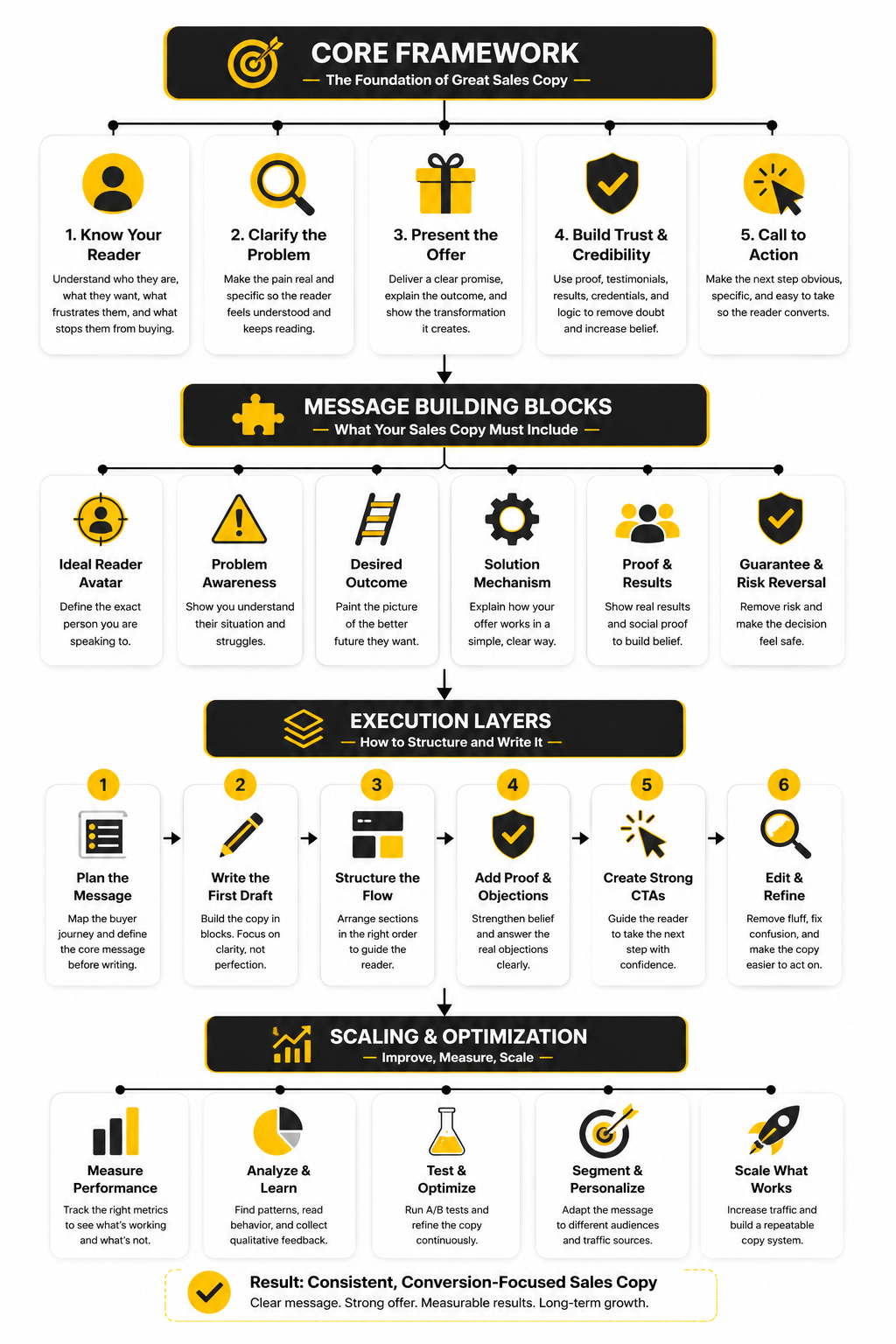
Once the offer is clear, the next job is execution. This is where sales copy becomes a working page, email, funnel, ad, or script instead of a loose collection of persuasive lines. You are not trying to “write something nice.” You are building a sequence that moves the reader from attention to trust to action.
The easiest way to do that is to stop writing from top to bottom at first. Start by mapping the buyer’s decision. What must they understand before the CTA feels natural? What doubt must be removed before they believe the promise? What proof must appear before the price feels reasonable?
Start With The Core Page Flow
A strong sales page usually follows a simple emotional and logical path. First, it confirms the reader is in the right place. Then it names the problem, explains the cost of staying stuck, introduces the offer, proves the mechanism, reduces risk, and asks for action.
That does not mean every page needs to be long. A low-ticket template, simple software trial, or free lead magnet can use a shorter version of the same structure. A premium service, coaching offer, or full funnel build usually needs more room because the buyer has more questions.
The point is order. If you ask for the sale before the reader understands the value, the CTA feels early. If you explain every feature before they care about the problem, the page feels heavy.
Build The First Draft In Blocks
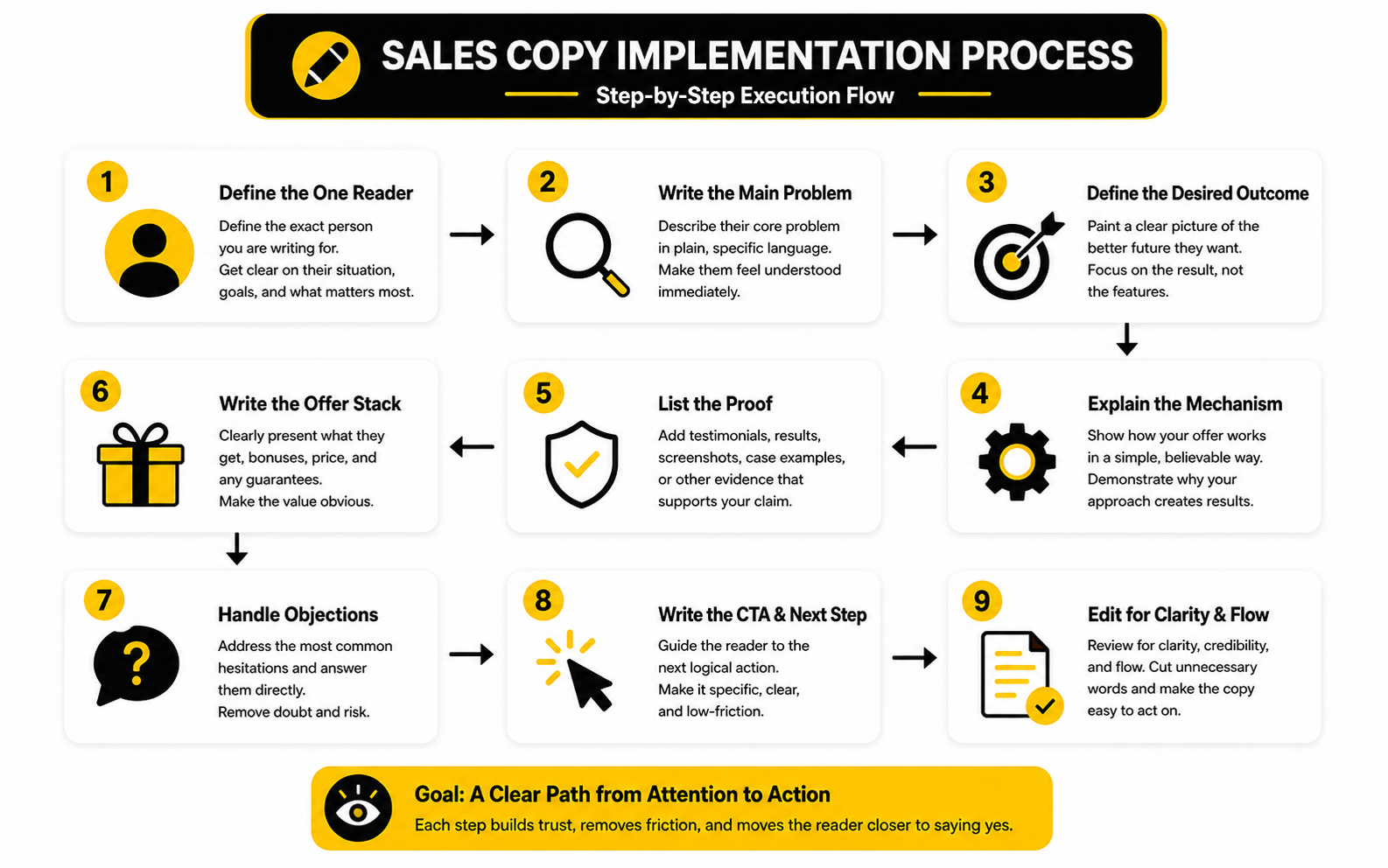
Do not try to write perfect sentences immediately. Build the page in blocks first, then polish. This keeps the process practical and stops you from getting trapped rewriting the headline for two hours while the rest of the page stays empty.
Use this simple draft order:
This is also where a page builder can save time because you can structure the copy visually as you write. For funnel pages, ClickFunnels is useful when the sales copy needs to connect directly to opt-ins, checkout pages, upsells, and follow-up. For ecommerce landing pages, Replo makes more sense when the copy needs to live inside a fast, conversion-focused storefront experience.
Match Each Section To One Job
Every section of your sales copy should have one job. The headline should create instant relevance. The opening should make the reader feel understood. The offer section should make the value obvious.
This sounds basic, but it fixes a lot of messy copy. Many pages fail because every section tries to do everything at once. The headline explains the product, the intro sells the offer, the feature section handles objections, and the CTA introduces new information too late.
Cleaner copy separates the jobs. One section creates attention. One section builds desire. One section proves the claim. One section asks for the action.
Write The Page From The Reader’s Point Of View
The best execution rule is simple: write in the order the buyer needs to hear things, not the order you want to say them. Business owners often want to start with their method, story, credentials, or feature list. Buyers usually want to know whether the offer solves their problem.
That is why the first draft should sound more like a guided conversation than a brochure. Each section should answer the next natural question in the reader’s mind. When the flow is right, the page feels easy to read because the reader never has to work hard to understand why the next section exists.
Use Voice-Of-Customer Language
Strong sales copy borrows the buyer’s language without copying private conversations or inventing quotes. Look at reviews, support tickets, sales calls, survey responses, community posts, and search queries. You are looking for repeated phrases, emotional patterns, and practical objections.
Do not just collect nice testimonials. Look for the messy language people use before they buy. That is where you find the real pain, the real urgency, and the real reasons they hesitate.
Then translate those patterns into clean copy. The goal is not to sound raw for the sake of it. The goal is to make the page feel like it understands the buyer better than a generic competitor does.
Turn Features Into Decision Points
Features matter, but only when the reader understands why they should care. “Automation” is a feature. “Follow up with new leads before they forget why they contacted you” is a decision point.
Do this for every major feature in the offer. Ask what it helps the buyer do, avoid, save, improve, or finally finish. Then write the benefit in language that connects to the buyer’s day-to-day reality.
For example, a CRM feature is not just a CRM feature. For an agency, it may mean fewer lost leads, cleaner client reporting, and a clearer pipeline. That is why GoHighLevel fits naturally when the sales copy is aimed at service businesses that need landing pages, booking, follow-up, and pipeline management in one workflow.
Make The CTA Feel Like The Next Logical Step
A CTA should not feel like a sudden demand. It should feel like the obvious next step after the argument you just built. That means the button copy, nearby microcopy, and surrounding section all need to reduce friction.
Bad CTA copy says “Submit” and expects the reader to care. Better CTA copy tells the reader what happens next. “Start building your funnel,” “Book your strategy call,” or “Get the template” gives the click a clear purpose.
The small text around the CTA matters too. Tell people whether they need a credit card, how long setup takes, what they receive after clicking, or what happens after booking. Tiny clarifications can remove surprisingly big hesitation.
Edit Sales Copy Like A Conversion Asset
Editing is not just proofreading. Editing is where you remove confusion, tighten the argument, and make the page easier to act on. This is the part many people skip, and it shows.
Read the copy once for clarity, once for credibility, once for flow, and once for action. Each pass has a different job. If you try to fix everything in one pass, you will miss obvious problems.
Cut Anything That Does Not Move The Buyer Forward
Every sentence should earn its place. If it does not clarify the problem, strengthen the desire, explain the offer, prove the claim, answer an objection, or guide action, it probably needs to go. This is especially true in the opening sections.
Long copy is not the problem. Unnecessary copy is the problem. A long page can convert well when every section builds momentum, but a short page can still feel exhausting if it is vague.
Be ruthless here. Remove filler phrases like “in today’s fast-paced world,” “important solution,” and “designed to help you succeed.” They sound polished, but they rarely add meaning.
Replace Hype With Proof
Hype makes claims louder. Proof makes claims safer to believe. Good sales copy does not need to scream when the evidence is clear.
Use specific proof where you have it. That can include real testimonials, product screenshots, demos, before-and-after assets, customer results, transparent process details, third-party reviews, or a simple explanation of why the mechanism works. Just do not invent proof to make the page stronger.
If the offer is new and you do not have results yet, use proof of process instead. Show the steps, the deliverables, the thinking, and the support structure. New offers can still feel credible when the path to value is clear.
Read It Out Loud Before Publishing
This final step sounds almost too simple, but it works. Read the sales copy out loud and you will immediately hear where the rhythm breaks. You will notice awkward transitions, bloated sentences, repeated ideas, and sections that sound more like filler than persuasion.
If a sentence feels hard to say, it is probably hard to read. If a section feels boring out loud, it probably feels boring on the page too. Fix those moments before you send traffic.
The best sales copy feels smooth without feeling slick. It sounds like a confident person explaining a strong offer clearly. That is the standard.
Statistics And Data
Measurement is where sales copy stops being a guessing game. You can have a clean headline, a strong offer, and a polished page, but the market still gets the final vote. The numbers show where people pay attention, where they hesitate, and where they quietly leave.
The mistake is treating analytics like a scoreboard only. A conversion rate tells you what happened, but it does not automatically tell you why it happened. Your job is to connect the number to the buyer’s behavior, then decide what to test next.
Track The Few Numbers That Actually Matter
You do not need twenty dashboards to improve sales copy. You need a small set of numbers that match the page’s job. A lead capture page should be judged by opt-in rate and lead quality, while a sales page should be judged by checkout starts, completed purchases, revenue per visitor, and follow-up conversion.
For ecommerce, cart behavior matters because many buyers show intent before disappearing. The average documented online cart abandonment rate sits around 70% in Baymard’s long-running checkout research, which means the copy around shipping, trust, returns, payment, and checkout friction can matter as much as the hero section.
For landing pages, broad benchmarks can be useful, but only as context. A large Unbounce benchmark reported a 6.6% median landing page conversion rate across its dataset, yet your real benchmark depends on traffic source, offer type, price, industry, and buyer intent. A cold paid ad click and a warm email subscriber should not be measured with the same expectations.
Build A Simple Copy Measurement System
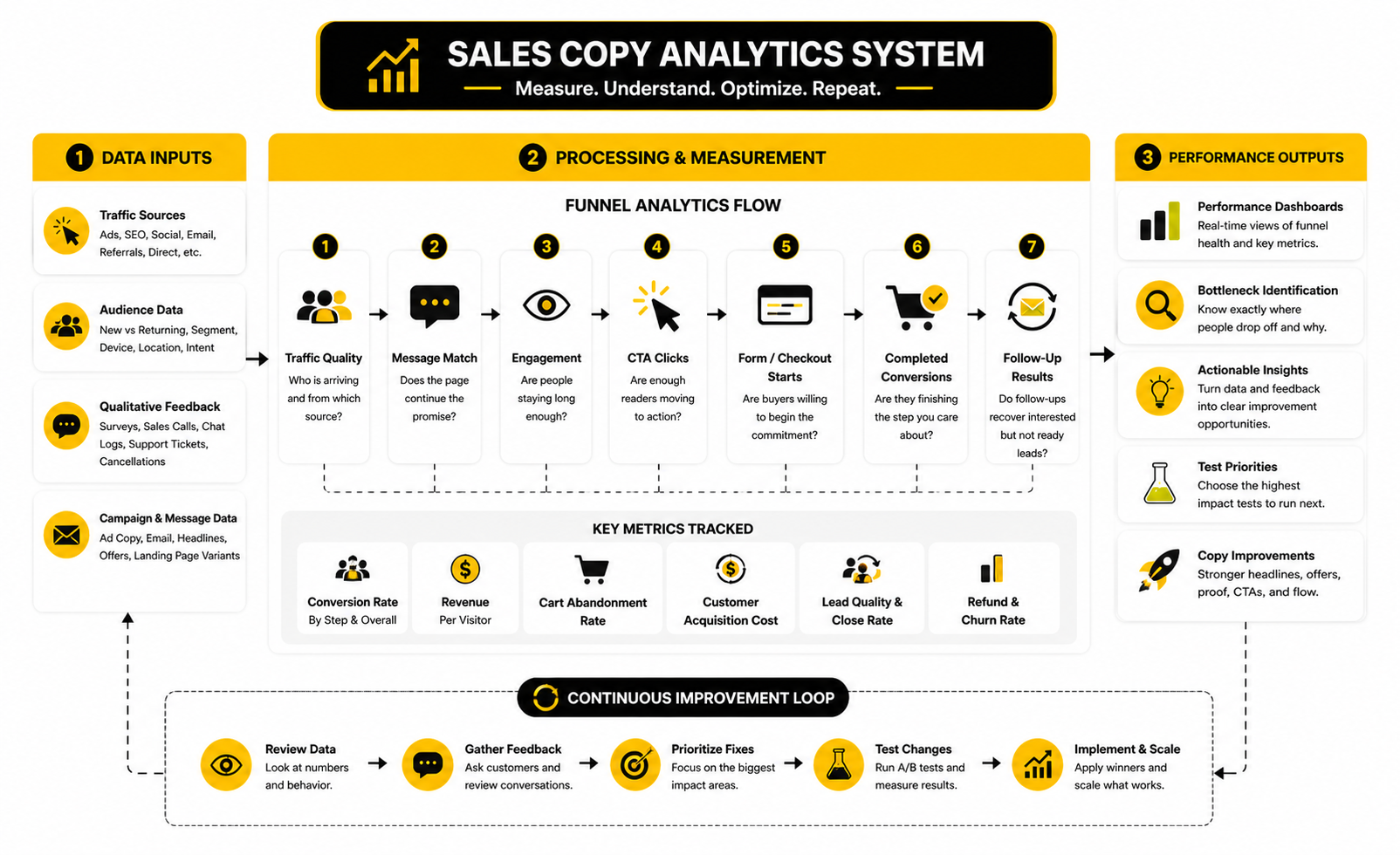
The cleanest system is to measure one step at a time. Do not only look at the final sale. Break the journey into smaller decisions so you can see where the sales copy is helping and where it is leaking attention.
Use this basic measurement flow:
This system makes the data useful because each number points to a different type of fix. Low engagement usually means the opening is weak, unclear, or mismatched to the traffic. Strong CTA clicks with weak checkout completion often means the offer created interest, but the purchase step introduced doubt.
Read Conversion Rates In Context
A conversion rate is never just a conversion rate. A 3% conversion rate can be excellent for an expensive, cold-traffic offer and terrible for a free checklist sent to a warm email list. Context decides whether the number is good or bad.
This is why you should segment performance before rewriting everything. Separate paid traffic from organic traffic, mobile from desktop, new visitors from returning visitors, and cold audiences from warm audiences. The same sales copy can look broken in one segment and strong in another.
Email has the same problem. Open rate can show subject-line strength, but it does not prove the sales copy worked. Click rate, reply quality, booked calls, purchases, and revenue per send usually tell you more about whether the message created action.
Know What Each Metric Is Really Telling You
Every metric has a job, but none of them tells the whole truth alone. Time on page can suggest interest, but it can also mean the page is confusing. A high click-through rate can suggest strong desire, but it can also mean the CTA promised something the next page failed to deliver.
Use metrics as clues, not verdicts. If people leave quickly, inspect the headline, first screen, page speed, and message match. If people scroll but do not click, inspect the offer section, proof, CTA placement, and objection handling.
For funnel builds, tools like ClickFunnels can help connect page steps, checkout behavior, and follow-up in one flow. For service businesses and agencies, GoHighLevel is useful when the copy journey continues through forms, calendars, pipelines, email, SMS, and sales conversations.
Turn Data Into Better Tests
The point of analytics is not to admire the dashboard. The point is to choose better tests. Bad testing starts with random changes. Good testing starts with a clear diagnosis.
If the headline is not earning attention, test a sharper promise, a more specific audience callout, or a stronger problem statement. If the offer section gets attention but not clicks, test the pricing explanation, value stack, guarantee, proof, or CTA copy. If checkout starts are high but purchases are low, test friction reducers like clearer payment details, trust signals, checkout copy, or abandoned-cart follow-up.
Do not test tiny wording changes before fixing obvious strategic problems. A button color test will not save an offer people do not understand. Start with the biggest likely bottleneck, then work down to smaller optimizations once the core message is solid.
Watch Qualitative Signals Too
Numbers tell you where to look. Qualitative feedback tells you what buyers are thinking. That is why survey answers, sales call notes, live chat logs, cancellation reasons, support tickets, and customer interviews should feed directly into your sales copy.
Look for repeated questions. If five prospects ask whether the offer works for beginners, your page should probably answer that before the CTA. If buyers keep asking what happens after payment, your next-step copy is too vague.
This is where tools like Fillout can help collect clean feedback before or after purchase. For conversations at scale, Chatbase can support a buyer-facing assistant that answers common questions and shows you which objections keep coming back.
Use Benchmarks Without Becoming Average
Benchmarks are useful because they keep you grounded. They help you see whether a number is wildly low, roughly normal, or already strong enough to focus somewhere else. But benchmarks should never become the ceiling.
Your best benchmark is your own previous performance. If your page moved from 2% to 3%, that is a 50% lift in relative terms, even if another industry report says someone else averages higher. What matters is whether the copy is improving the economics of your funnel.
So track the numbers, but do not worship them. Sales copy is not written for dashboards. It is written for buyers, and the dashboard simply tells you whether buyers are responding.
Advanced Sales Copy Decisions
Once the basics are working, the next challenge is not writing more copy. It is knowing what to emphasize, what to remove, and where the message needs to change for different buyers. This is where sales copy becomes strategic instead of just persuasive.
Advanced copy is not louder. It is more controlled. It knows which promise to lead with, which objection to handle early, and which details to save until the reader is ready for them.
Balance Conversion With Trust
It is possible to write sales copy that gets clicks but weakens trust. Overstated urgency, vague income claims, exaggerated scarcity, and pressure-heavy CTAs can create short-term movement while damaging the brand. That tradeoff is rarely worth it.
Trust compounds. If readers feel respected, they are more likely to come back, open the next email, book a call later, or recommend the offer to someone else. If they feel pushed, they may click once and never return.
The more carefully move is to make the offer clear, the reason to act honest, and the next step low-friction. Confidence sells better than pressure when the offer is strong.
Adapt The Message To The Traffic Source
The same sales copy will not work equally well for every traffic source. Someone arriving from a search result is usually looking for a specific answer. Someone clicking from social may need more context because they were interrupted mid-scroll.
Email traffic is different again. A subscriber may already know the brand, so the page can move faster. Cold paid traffic usually needs stronger message match because the visitor is still deciding whether the click was worth it.
This is why campaign-level copy matters. The ad, email, post, landing page, checkout page, and follow-up should feel like one connected conversation. If each step uses different language, the buyer feels friction even if the offer is good.
Segment Without Making The Funnel Complicated
Segmentation can improve sales copy, but only when it creates a better buying experience. Do not build five funnels just because you can. Build separate paths when different buyers genuinely need different promises, proof, objections, or next steps.
A beginner and an advanced buyer may need different copy. An agency owner and ecommerce founder may need different examples. A buyer comparing tools needs a different argument than someone who has never used the category before.
Simple segmentation can be enough. A quiz, form, email tag, or landing page variant can route people toward the most relevant message. Tools like Fillout can help capture intent cleanly, while GoHighLevel can connect that intent to follow-up workflows, pipelines, and booked calls.
Scale The Message Before Scaling Spend
Scaling traffic exposes weak sales copy fast. A page that works with warm subscribers may fall apart when cold audiences arrive. That does not always mean the offer is bad; it may mean the copy assumes too much trust too early.
Before increasing ad spend, make sure the page can handle colder attention. Strengthen the opening, clarify the promise, add proof near key decision points, and make the CTA feel safer. The colder the traffic, the more the copy must earn belief step by step.
This also applies to follow-up. If leads are coming in but not converting, the problem may not be the landing page. It may be the email sequence, SMS timing, sales call script, or booking flow that happens after the click.
Know When Short Copy Is Better
Long sales copy is useful when the buyer needs education, proof, and objection handling. But long copy is not automatically better. If the offer is simple, low-risk, or already well understood, too much explanation can create friction.
Short copy works best when the reader already wants the thing and only needs a clear reason to act now. A free download, trial, simple ecommerce product, or direct booking page can often win with fewer sections. The copy should remove doubt, not create a lecture.
The decision is not “short versus long.” The real decision is how much information the buyer needs before taking the next step. Give them enough, then stop.
Know When Long Copy Is Necessary
Long copy becomes useful when the price is higher, the category is unfamiliar, the buyer has strong skepticism, or the transformation requires commitment. In those cases, short copy can feel incomplete. The reader may like the promise but still not feel safe enough to act.
Longer pages give you space to build the argument properly. You can explain the problem, show the mechanism, prove the offer, answer objections, compare alternatives, and reduce risk. That depth can make the CTA feel more natural.
But long copy must stay organized. Use headings, short paragraphs, clear transitions, and repeated CTAs at logical points. People scan online, so the page should be easy to understand even when the reader is moving quickly.
Protect The Brand Voice As You Optimize
Optimization can accidentally make every brand sound the same. You test clearer headlines, stronger CTAs, more direct benefits, and sharper proof. That is good, but if you are not careful, the copy starts to sound like a generic funnel template.
Brand voice matters because it creates recognition. It tells the reader there is a real person or team behind the offer. It also makes the sales copy harder to copy because competitors can imitate structure more easily than personality.
Keep the voice human. Use plain language, but do not sand off every edge. The best copy feels clear and commercially sharp without losing the brand’s point of view.
Use AI Carefully, Not Lazily
AI can help with sales copy, but it should not replace judgment. It can summarize research, generate headline angles, turn features into benefit drafts, and create first-pass variations. That is useful.
The risk is generic output. AI often writes clean sentences that sound plausible but do not contain buyer insight. If you publish that without editing, your copy may look professional while saying almost nothing specific.
Use AI as a drafting assistant, then add the real work: customer language, proof, positioning, offer clarity, and sharper editing. For teams that want AI inside broader sales and marketing workflows, GoHighLevel AI can be useful when the copy connects to follow-up, conversations, and pipeline activity rather than sitting in a document.
Avoid Claims You Cannot Defend
The fastest way to weaken sales copy is to make claims the business cannot support. If the copy promises speed, the product must deliver speed. If it promises simplicity, onboarding should actually feel simple. If it promises premium support, the support experience has to match.
This matters legally, ethically, and commercially. Buyers remember gaps between promise and reality. A strong page can create the sale, but the product experience decides whether that sale turns into retention, referrals, or refunds.
So keep the copy ambitious but honest. Sell the real value clearly. Do not create a fantasy version of the offer just because it sounds more exciting.
Build A Copy System, Not A One-Off Page
The best teams do not treat sales copy as a one-time project. They build a reusable message system. That system includes the core promise, buyer segments, objections, proof assets, CTA language, email angles, ad hooks, and follow-up messages.
This makes everything easier. New campaigns become faster to launch because the team is not starting from a blank page every time. Testing also becomes cleaner because you can see which message angle is improving instead of changing everything randomly.
A good copy system still evolves. As customers ask new questions, competitors shift, pricing changes, and traffic sources expand, the message should be updated. Sales copy is a living asset, not a file you publish once and forget.
Bring The Whole Sales Copy System Together
At this point, sales copy should not feel like a single page anymore. It should feel like a complete system that connects the buyer’s problem, the offer, the page structure, the follow-up, the proof, and the measurement loop. That is how you move from “writing copy” to building a selling asset.
The final layer is alignment. The ad promise should match the landing page. The landing page should match the checkout or booking step. The follow-up should continue the same conversation instead of starting over with a different angle.
When the system is aligned, the buyer does not feel dragged through a funnel. They feel guided. Every step answers the next natural question, reduces the next real objection, and makes the next action easier to take.
Keep Improving The Message After Launch
Publishing is not the finish line. It is the first real test. Once the page is live, the market will show you which parts of the sales copy create movement and which parts need work.
Review the data and the customer feedback together. If the numbers show a drop-off and the feedback explains the hesitation, you have a clear next test. That is much better than guessing.
The best copywriters and marketers keep a running list of message improvements. They save customer phrases, objection patterns, stronger proof, new use cases, better CTA language, and clearer explanations. Over time, that library becomes a competitive advantage.
What Is Sales Copy?
Sales copy is writing designed to persuade a specific reader to take a specific action. That action could be buying a product, booking a call, joining a list, starting a trial, or requesting a quote. Good sales copy does not just describe an offer; it helps the reader understand why the offer matters to them now.
Why Is Sales Copy Important?
Sales copy matters because it turns attention into action. Traffic alone does not create revenue if the message is unclear, weak, or disconnected from the buyer’s needs. Strong copy helps the reader understand the problem, believe the offer, and take the next step with less hesitation.
What Makes Sales Copy Effective?
Effective sales copy is clear, specific, believable, and relevant. It speaks to the reader’s real problem, explains the desired outcome, proves the offer can help, and makes the CTA feel natural. It also avoids vague hype because vague hype does not build trust.
How Long Should Sales Copy Be?
Sales copy should be as long as the buyer needs and no longer. A simple free lead magnet may only need a short landing page, while a high-ticket service may need a longer page with proof, objections, process details, and risk reversal. Length is not the goal; complete persuasion is the goal.
What Is The Difference Between Copywriting And Content Writing?
Copywriting is usually written to drive a direct action. Content writing is usually written to educate, attract, nurture, or build authority. The two overlap, but sales copy is more focused on conversion and decision-making.
Should I Write Sales Copy Before Building The Funnel?
Yes, at least the core message should come first. If you build the funnel before clarifying the offer, you may end up designing pages around a weak or confusing message. Define the buyer, promise, mechanism, proof, objections, and CTA before you worry about page polish.
How Do I Know If My Sales Copy Is Working?
Look at the behavior the copy is supposed to create. For a landing page, review opt-ins, CTA clicks, lead quality, and follow-up conversion. For a sales page, review checkout starts, completed purchases, revenue per visitor, refund patterns, and objections from buyers who did not convert.
What Is The Biggest Mistake In Sales Copy?
The biggest mistake is talking about the product before the reader feels understood. Features matter, but they only become persuasive when the reader sees how they connect to their problem and desired outcome. Start with the buyer’s reality, then introduce the offer.
Can AI Write Good Sales Copy?
AI can help draft, organize, and brainstorm sales copy, but it still needs human strategy. The best results come when you feed AI real buyer research, clear positioning, proof, objections, and offer details. Without those inputs, AI tends to produce generic copy that sounds fine but does not sell strongly.
How Often Should Sales Copy Be Updated?
Update sales copy whenever the offer changes, the traffic source changes, buyer objections shift, performance drops, or new proof becomes available. You do not need to rewrite everything constantly. Small, focused updates based on data and customer feedback are usually better than random overhauls.
What Metrics Matter Most For Sales Copy?
The most important metrics depend on the page’s job. For lead generation, focus on opt-in rate and lead quality. For direct sales, focus on revenue per visitor, checkout starts, completed purchases, and refund behavior. For booked calls, focus on form completion, calendar bookings, show-up rate, and close rate.
How Do I Make Sales Copy Sound Less Pushy?
Make the message clearer instead of louder. Explain the problem honestly, show the value, answer objections, and let the CTA feel like a useful next step. Pushy copy usually appears when the offer is unclear or the writer tries to create pressure instead of trust.
Should Every Sales Page Have Testimonials?
Testimonials help when they are real, specific, and relevant to the buyer’s concern. A vague compliment is less useful than a detailed customer quote that explains the problem, decision, experience, and result. If you do not have testimonials yet, use proof of process, demos, screenshots, or transparent delivery details.
What Tools Help With Sales Copy Implementation?
The right tool depends on the workflow. ClickFunnels can help when your sales copy needs funnel pages, checkout steps, upsells, and follow-up. GoHighLevel can help service businesses connect pages, forms, calendars, pipelines, email, SMS, and sales conversations in one system.
What Should I Do Before Publishing Sales Copy?
Read it from the buyer’s point of view. Check whether the first screen is clear, the offer is easy to understand, the proof supports the claim, the CTA is obvious, and the next step feels safe. Then read it out loud because awkward copy almost always sounds awkward before it performs poorly.
Build a stronger local presence with BAAM AI
Turn your website, Google profile, social channels, and AI visibility into one growth engine
Most businesses do not need more random marketing activity. They need a consistent presence system that helps the right people find them, trust them, and take action. BAAM AI brings strategy, local SEO, website updates, Google Maps visibility, social content, AI-search readiness, media production, and reporting into one practical monthly engine.
If you want your marketing to keep working after the campaign ends, start with a free BAAM AI presence audit. See how your business shows up today and where the fastest visibility wins are at BAAM AI.