
BAAM AI Blog
Why Most Sale Emails Fail Before the Offer Is Even Seen
Most sale emails do not fail because the discount is too small. They fail because the email gives the reader no reason to care before asking for the click. A vague subject line, a generic “limited time only” opener...
Affiliate disclosure: this article may include compensated links. Recommendations should still be evaluated against your use case, budget, and current provider terms.
Should you choose this tool?
this tool is worth considering when the use case, budget, and implementation effort match what you actually need to do next.
teams that want a practical tool decision without reading another generic feature list
Check this toolWhy Most Sale Emails Fail Before the Offer Is Even Seen
Most sale emails do not fail because the discount is too small. They fail because the email gives the reader no reason to care before asking for the click. A vague subject line, a generic “limited time only” opener, and a product grid with no context can make even a strong offer feel like noise.
That matters because inbox competition is brutal. Brevo’s 2025 benchmark data shows email still produces measurable engagement across regions, with EMEA campaigns averaging a 33.21% open rate and 4.05% click-through rate, while North America averages a 29.42% open rate and 3.38% click-through rate in its benchmark set: Brevo email marketing benchmarks. Those numbers are useful, but they also show the real challenge. Getting opened is only step one; getting acted on is where the money is.
A good sale email has to do three things quickly. It has to make the offer clear, make the relevance obvious, and make the next step easy. Miss one of those, and the reader may still open the email, but they will not move.
The Real Job of a Sale Email
The job of a sale email is not to “announce a promotion.” That is too passive. The job is to help the right person understand why this offer is worth acting on now.
That is a subtle difference, but it changes the whole email. Instead of leading with “20% off everything,” you lead with the problem, desire, category, or buying moment that makes the discount meaningful. A skincare brand might frame the sale around restocking daily essentials. A SaaS company might frame it around locking in a lower annual price before a deadline. A creator selling templates might frame it around finishing a project faster this week.
This is why lazy sale emails feel flat. They assume the discount does all the work. Strong sale emails treat the discount as proof, urgency, or a final nudge - not the entire message.
Start With the Buyer’s Situation, Not the Promotion
Before writing any sale emails, define what the reader is probably thinking when the email lands. Are they comparing options? Waiting for a lower price? Replacing something they already use? Buying a gift? Trying to solve an urgent business problem?
Once you know the buying situation, the copy becomes sharper. You can speak to the real reason someone would click instead of shouting about a discount. This keeps the message from sounding like every other promotion in the inbox.
For example, “Save 25% today” is clear, but it is generic. “Restock your bestsellers before the price goes back up” gives the reader a specific reason to act. The discount still matters, but now it is attached to a practical decision.
Match the Offer to the Stage of Awareness
Not every subscriber needs the same sale message. Someone who visited a pricing page yesterday needs a different email than someone who joined your list six months ago and has never clicked. When you send the same sale email to everyone, you make the offer weaker for your best prospects and too sudden for your coldest ones.
A warmer subscriber can handle direct copy. They already know the product, so the email can focus on the deadline, bonus, discount, or reason to buy now. A colder subscriber needs more context, like what the product does, who it is for, and why this specific offer is a good entry point.
This is where segmentation matters. Salesforce’s recent marketing research highlights how central personalization and data have become for modern marketers, with the latest report based on insights from nearly 4,500 marketing leaders worldwide: Salesforce State of Marketing. You do not need enterprise-level complexity to use that idea. Even basic segments like new subscribers, recent buyers, cart abandoners, inactive subscribers, and high-intent leads can make sale emails feel much more relevant.
The Main Types of Sale Emails
Most campaigns become easier to plan when you stop thinking in terms of “send a promo” and start thinking in terms of email types. Each type has a different job. Mixing them together usually creates bloated emails that say too much and persuade too little.
Launch Sale Emails
Launch sale emails work when something new is being introduced with a reason to buy early. That might be a new product, a new service package, a seasonal collection, or a new digital offer. The sale gives people a reason to act during the launch window instead of waiting.
The mistake is making the email only about the discount. A launch sale email should still explain what is new, who it is for, and what problem it solves. The promotion should feel like a reward for acting early, not a desperate attempt to create demand.
Flash Sale Emails
Flash sale emails rely on speed. They work best when the offer is simple, the audience already understands the product, and the deadline is real. If the reader needs a lot of education before buying, a flash sale will usually underperform.
Keep these emails short and direct. Put the offer high in the email, explain the reason for the sale if there is one, and make the call to action impossible to miss. Do not bury the deadline in paragraph four.
Seasonal Sale Emails
Seasonal sale emails are tied to moments people already understand. Black Friday, Cyber Monday, back-to-school, summer travel, tax season, end-of-year planning, and holiday gifting all give the reader a natural buying frame. That makes the email easier to write because the context is already familiar.
The risk is blending into the noise. During major seasonal periods, everyone is sending sale emails. Your advantage comes from specificity: who the offer is for, what category is discounted, what problem it solves, and why your version is easier or better than the alternatives.
Cart Recovery Sale Emails
Cart recovery emails are different because the customer has already shown intent. They do not need a broad pitch. They need help finishing the decision.
This can be a reminder, a reassurance email, a shipping or returns clarification, a review-focused email, or a small incentive if that fits your margin. BigCommerce describes abandoned cart emails as one of the highest-converting automated ecommerce flows when they are treated as a revenue channel rather than an afterthought: BigCommerce abandoned cart email guide. The key is to remove friction instead of sounding annoyed that they did not buy.
Re-Engagement Sale Emails
Re-engagement sale emails are for people who have gone quiet. The offer may bring them back, but only if the email acknowledges the gap in a natural way. Pretending they are highly engaged usually makes the message feel disconnected.
These emails should be simple and honest. Remind the reader what they joined for, give them a strong reason to return, and make the offer easy to understand. If they still do not engage after a short reactivation sequence, it may be better to suppress them than keep damaging deliverability.
How to Structure Sale Emails That Get Clicked
A strong sale email does not need to be long. It needs to be ordered well. The reader should understand the value before they are asked to click, but they should not have to work through a wall of copy to get there.
Start with a subject line that makes the reason to open clear. Then use the opening line to connect the offer to the reader’s situation. After that, explain the offer in plain language, add one or two supporting reasons to believe, and close with a direct call to action.
A simple structure looks like this:
This structure works because it respects how people read sale emails. They scan first. Then they decide whether the message deserves attention. If the offer is hard to understand, the email loses before the product even gets a chance.
Write Subject Lines That Sell the Open Honestly
The subject line should create curiosity, urgency, or clear value without tricking the reader. Tricks may lift opens once, but they train people not to trust you. That hurts every future sale email.
Good subject lines usually come from one of five angles: the offer, the deadline, the product category, the customer goal, or the reason behind the sale. “Ends tonight: 25% off annual plans” is offer plus urgency. “Your cart is still here - now with free shipping” is reminder plus incentive. “The templates people keep asking for are 30% off” is product interest plus social context.
Avoid fake personal replies, fake account warnings, and dramatic urgency you cannot back up. The goal is not just an open. The goal is an open from someone who is now more likely to click.
Build the Sale Email Campaign Before You Write the Copy
The fastest way to improve sale emails is to stop starting with the email. Start with the campaign. The email is only one piece of the buying path, and if the offer, landing page, deadline, segmentation, and follow-up are messy, even great copy will struggle.
Before writing, define the exact outcome you want. Are you trying to clear inventory, increase first-time purchases, reactivate old leads, push annual plans, fill a workshop, or drive repeat orders? Each goal needs a different angle, and that angle should guide the offer, subject line, CTA, and follow-up sequence.
This is also where you should decide what the email is allowed to do. One email can introduce the sale, explain why it matters, and drive a click. It should not try to explain your entire brand, every product feature, every testimonial, and every possible objection at once.
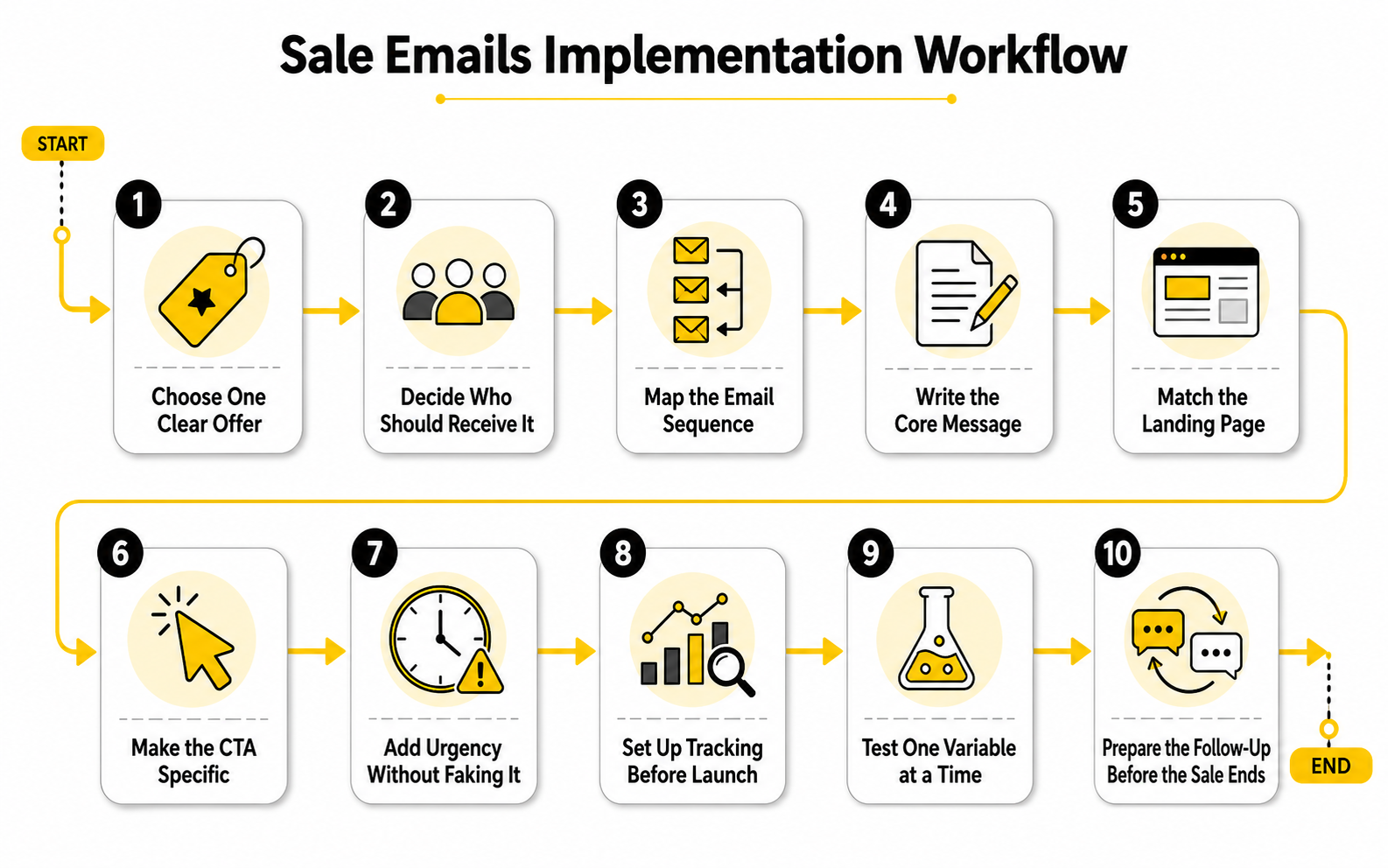
Step 1: Choose One Clear Offer
A sale email needs one dominant offer. Not five offers. Not a discount, a bundle, a free gift, a quiz, a webinar, and a new product announcement all fighting for attention.
The best offer is easy to understand in one sentence. “Get 25% off annual plans until Friday” is clear. “Buy two, get one free on bestselling skincare sets” is clear. “Join the workshop and get the implementation templates included” is clear.
Once the offer is chosen, remove anything that weakens it. If you are using a funnel builder like ClickFunnels or an all-in-one CRM like GoHighLevel, make sure the page headline, checkout copy, order bump, and confirmation page all match the same offer. The email should not promise one thing while the landing page makes the reader figure it out again.
Step 2: Decide Who Should Receive the Email
The right audience can make an average email work. The wrong audience can make a strong email look broken. This is especially true with sale emails because not every subscriber has the same level of intent.
Start with the obvious groups. New subscribers may need a softer introduction. Recent buyers may need a cross-sell, not the same product they just purchased. Cart abandoners may need reassurance. Inactive subscribers may need a stronger reason to pay attention again.
If your email platform supports behavior-based segmentation, use it. Brevo’s benchmark data shows how much performance varies by region and campaign context, which is a useful reminder that list quality and relevance matter more than generic averages: Brevo email marketing benchmarks. For smaller lists, you do not need complicated rules. Even separating buyers, non-buyers, warm leads, and inactive contacts is enough to make sale emails feel more personal.
Step 3: Map the Email Sequence
A proper sale campaign usually needs more than one email. One message can work for a tiny flash sale, but most campaigns perform better when the reader gets multiple chances to understand the offer. The trick is to give each email a job instead of repeating the same message with a different subject line.
A simple sale email sequence can look like this:
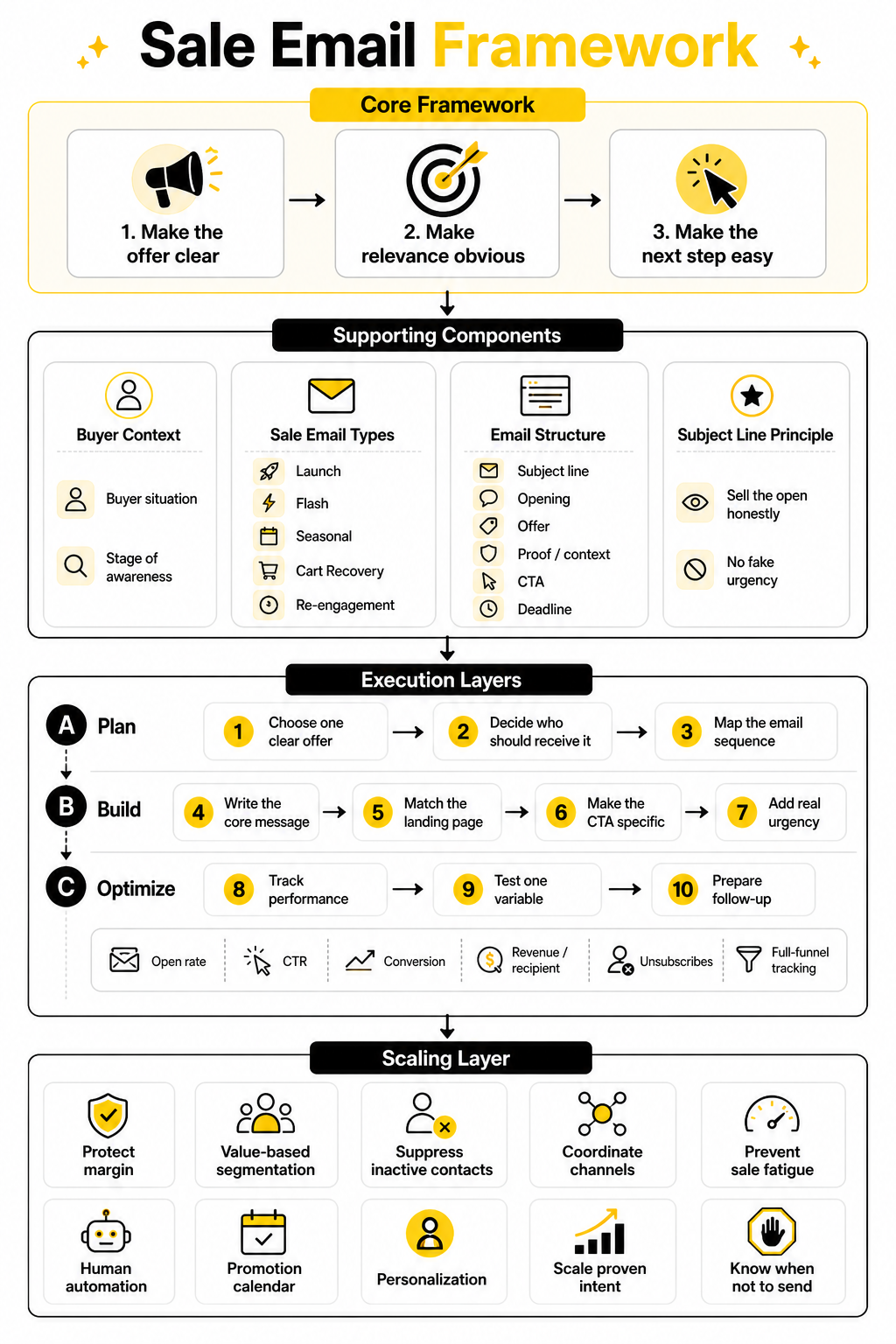
This sequence works because it mirrors how people actually decide. Some subscribers are ready on day one. Others need to see the value, think about timing, check the price, or come back when the deadline becomes real.
Step 4: Write the Core Message Before the Subject Lines
Do not start by writing 20 subject lines. Start by writing the core message of the campaign in plain English. If you cannot explain why the sale matters in two or three sentences, the subject lines will probably become clickbait.
The core message should answer three questions. What is the offer? Who is it for? Why should they act now instead of later? Once that is clear, the subject line becomes much easier to write because you are pulling from a real angle instead of guessing.
For example, the core message might be: “This sale helps small ecommerce teams upgrade their checkout flow before the next campaign without paying full price.” That gives you several honest subject line directions: the deadline, the checkout improvement, the savings, or the campaign preparation angle. It also keeps the copy focused.
Step 5: Build the Landing Page Around the Same Promise
A sale email should not send people to a confusing page. The page has to continue the same thought the email started. If the email talks about saving time, the page should not suddenly lead with technical specs. If the email promotes a limited bundle, the page should not make the reader hunt for the bundle.
This is where many campaigns leak money. The email gets the click, but the landing page creates friction. The reader has to scroll too much, compare too many options, or wonder whether they landed in the right place.
For ecommerce pages, tools like Replo can help teams build dedicated campaign pages instead of relying only on default product pages. For service businesses, GoHighLevel can keep the form, calendar, CRM, and follow-up in one flow. The point is not the tool itself. The point is that the click should land on a page that makes the next step obvious.
Step 6: Make the CTA Specific
A weak CTA makes the reader do extra thinking. “Learn more” is fine for educational content, but it is usually too soft for sale emails. If someone is ready to act, the CTA should tell them exactly what happens next.
Use CTA copy that matches the offer. “Shop the sale,” “Claim the discount,” “Get the bundle,” “Reserve your seat,” “Start your trial,” and “Upgrade before Friday” are all clearer than vague alternatives. The best CTA is not clever. It is obvious.
You can still use a secondary text link if the email is longer, but avoid giving people too many competing paths. Every extra CTA should support the same conversion goal. If one link sends readers to a blog post, another to pricing, another to a webinar, and another to a product page, you no longer have a sale email. You have a menu.
Step 7: Add Urgency Without Faking It
Urgency works when it is real. A true deadline, limited quantity, expiring bonus, seasonal window, or price change gives people a valid reason to decide now. Fake urgency damages trust because subscribers learn that your “last chance” emails are not actually the last chance.
Use urgency as a decision aid, not a scare tactic. Tell readers when the sale ends, what changes after the deadline, and what they need to do before then. Keep it plain.
This is especially important in automated sale emails. If you are using a platform like Systeme.io or Moosend, make sure countdown logic, coupon expiry, and follow-up timing match what the reader sees. Automation should make the experience tighter, not more misleading.
Step 8: Set Up Tracking Before Launch
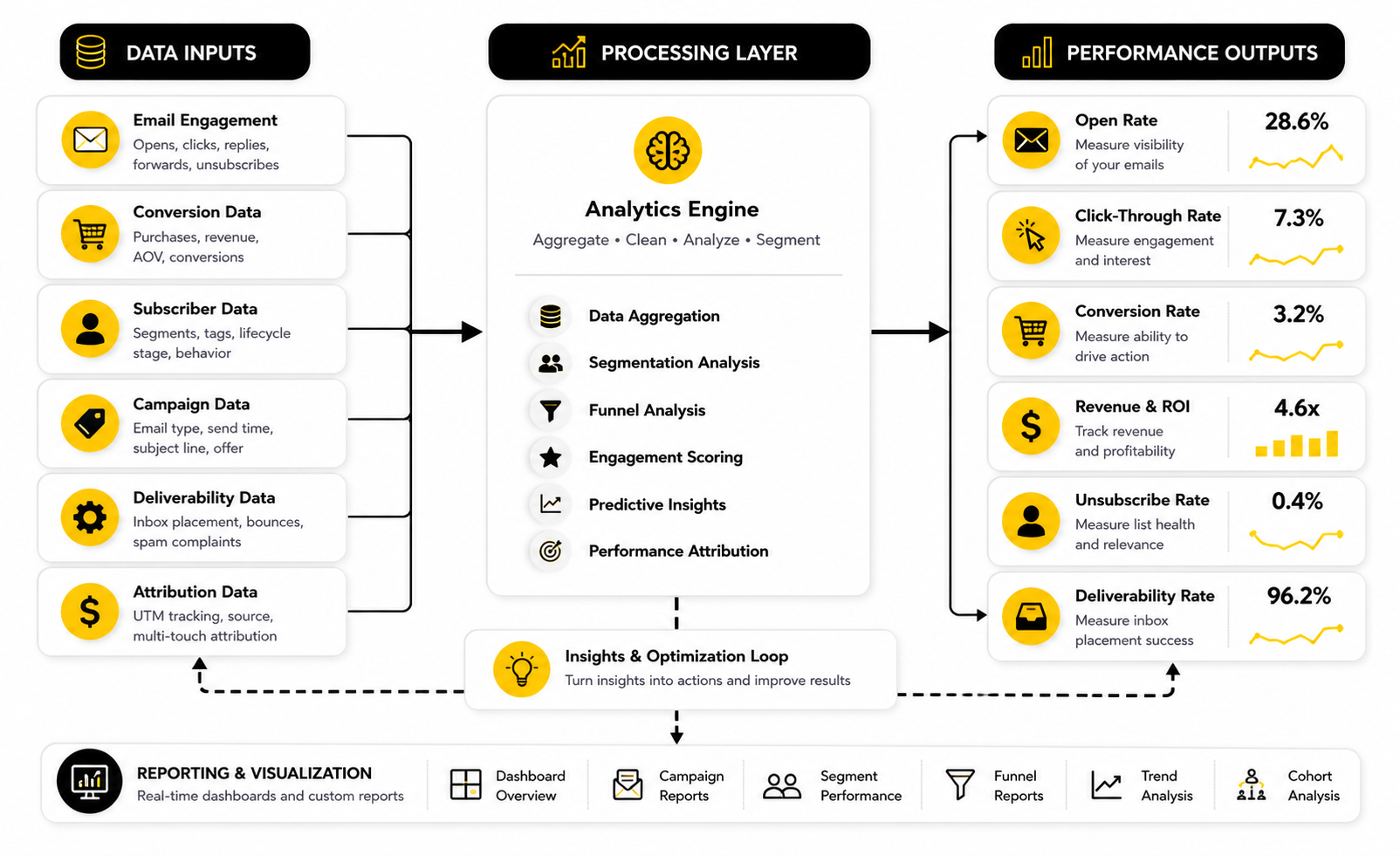
Do not wait until after the campaign to wonder what happened. Before sending sale emails, decide what you are measuring. Opens can show subject line interest, but clicks, conversion rate, revenue per recipient, average order value, unsubscribe rate, and spam complaints tell you much more about campaign quality.
At minimum, track each email separately. The announcement email, reminder email, objection email, and final deadline email should not all be blended into one result. You need to know which message created attention, which message created clicks, and which message created sales.
This also helps you improve the next campaign. Omnisend’s ecommerce report highlights how automated messages such as abandoned cart, welcome, and browse abandonment emails can drive a large share of automated orders: Omnisend ecommerce marketing report. That is the lesson to take seriously. The money is not only in sending more email. It is in knowing which email deserves to be improved, automated, or retired.
Step 9: Test One Variable at a Time
Testing is useful only when the result teaches you something. If you change the subject line, offer, layout, CTA, send time, and audience all at once, you may get a better result, but you will not know why. That makes the test hard to repeat.
Start with high-impact variables. Test the offer angle before testing button wording. Test audience segments before testing tiny design changes. Test deadline framing before testing whether an emoji belongs in the subject line.
For most sale emails, the best first tests are practical. Try discount versus bonus. Try product-led subject line versus outcome-led subject line. Try a short direct email versus a slightly longer email that handles hesitation. These tests help you understand buyer motivation, not just surface-level preferences.
Step 10: Prepare the Follow-Up Before the Sale Ends
The end of the sale is not the end of the campaign. Buyers need confirmation, onboarding, delivery details, or next steps. Non-buyers may need a different path, especially if they clicked several times but did not purchase.
Create the post-sale flow before launch. Buyers should be removed from the remaining promo emails or moved into a customer sequence. High-intent non-buyers can receive a softer follow-up later, but do not keep hammering them with expired offers.
This is where sale emails become part of a real revenue system. The campaign brings attention and urgency. The follow-up turns that attention into retention, repeat purchases, referrals, or future conversions. That is how you stop treating every sale like a one-off event and start building a list that gets more valuable over time.
Statistics and Data
Sale emails should be measured like revenue assets, not content assets. That means you are not looking for the prettiest open rate or the most dramatic spike in clicks. You are looking for the numbers that explain whether the campaign created profitable action without damaging the list.
Benchmarks are useful, but only when you use them correctly. A benchmark tells you whether your numbers are roughly healthy, not whether your offer was good. Your real goal is to compare each campaign against your own list history, your own margins, and your own customer behavior.
The Metrics That Actually Matter
Open rate still has some value, but it is no longer the main scorecard. Privacy changes have made opens less reliable as a buying signal, so treat them as directional. If a sale email gets a weak open rate, your subject line, sender name, timing, or list quality may need attention, but the open alone does not tell you whether the campaign made money.
Click-through rate is more useful because it shows whether the message created enough interest to move people from inbox to page. Brevo’s 2025 benchmark data shows regional email click-through rates around 4.05% in EMEA and 3.38% in North America, which gives you a rough reference point for campaign engagement: Brevo email marketing benchmarks. If your sale emails get opens but not clicks, the issue is usually relevance, offer clarity, or CTA strength.
Conversion rate is where the campaign becomes real. A click without a purchase, booking, signup, or checkout start is only intent. If clicks are healthy but conversions are weak, the problem is probably on the landing page, checkout, price framing, product-market fit, or trust layer.
Read Open Rate Carefully
A high open rate can look exciting, but it can also hide a weak campaign. If 45% of your list opens and almost nobody clicks, the subject line did its job while the email failed to create desire. That is not a win.
A low open rate is not always a disaster either. A smaller, more targeted segment might produce fewer opens but more revenue per recipient. This is common with sale emails sent to high-intent audiences like cart abandoners, pricing-page visitors, or past buyers.
The more carefully move is to compare open rate against click rate and revenue. If opens rise while clicks fall, you may have created curiosity without buying intent. If opens fall but revenue rises, your segmentation may be getting tighter and more profitable.
Track Clicks by Intent, Not Just Volume
A click is not always equal to another click. Someone clicking “Shop the sale” is showing different intent than someone clicking a policy link, a blog post, or a footer navigation link. If you only look at total clicks, you can easily overestimate performance.
For sale emails, separate primary CTA clicks from secondary clicks. The primary CTA should show how many people moved toward the offer. Secondary clicks can reveal useful questions, but they should not be treated like the main conversion signal.
This is why a clean email structure matters. If the email has one main action, the data is easier to read. If the email has seven links with seven different purposes, the report becomes noisy and less useful.
Revenue Per Recipient Is the Cleanest Sale Email Metric
Revenue per recipient is one of the most practical metrics for sale emails because it connects performance to list size. It answers a simple question: for every person you sent this email to, how much revenue did the campaign create? That makes it easier to compare a small targeted campaign against a large broadcast.
The formula is simple. Take total attributed revenue from the email and divide it by the number of delivered recipients. If an email makes $5,000 from 10,000 delivered emails, the revenue per recipient is $0.50.
This number keeps you honest. A campaign with a lower click rate can still be better if it generates more revenue per recipient. A campaign with a beautiful click rate can still be weak if the clicks do not turn into orders.
Use Benchmarks as Guardrails, Not Goals
Benchmarks can help you spot problems, but they should not become your strategy. MailerLite’s 2025 benchmark report compares open rate, click rate, click-to-open rate, and unsubscribe rate across industries and regions: MailerLite email benchmarks. That kind of data is useful because it shows that performance varies heavily by audience, market, and campaign type.
But chasing a generic benchmark can push you in the wrong direction. A luxury brand with a smaller list and higher average order value may not need the same click rate as a low-cost impulse-buy store. A B2B service offer may have fewer conversions but much higher revenue per customer.
Use benchmarks to ask better questions. Are your clicks unusually low for your category? Are unsubscribes spiking after every sale? Are automated flows outperforming broadcasts? Those questions lead to decisions, not vanity reporting.
Separate Broadcasts From Automated Sale Emails
Broadcast sale emails and automated sale emails should not be judged the same way. A broadcast goes to a larger audience at one time, usually around a campaign deadline or seasonal event. An automated email is triggered by behavior, which means the timing is often much more relevant.
That difference shows up in performance. Omnisend’s 2025 ecommerce report highlights that automated messages drove a meaningful share of email-generated orders while making up a much smaller share of total sends: Omnisend ecommerce marketing report. The lesson is straightforward: triggered relevance often beats volume.
For sale emails, this means your abandoned cart, browse abandonment, back-in-stock, winback, and post-purchase cross-sell flows deserve separate analysis. Do not average them together with one-off campaigns. Each flow has a different intent level, so each one needs its own baseline.
Watch Unsubscribes and Complaints Closely
Revenue is important, but list health matters too. If a sale email makes money today while causing a large unsubscribe spike, heavy spam complaints, or poor deliverability later, the campaign may be more expensive than it looks. The damage does not always show up immediately.
Unsubscribes are not automatically bad. Some people are not a fit, and letting them leave cleanly is better than keeping disengaged contacts forever. The warning sign is when unsubscribes jump because your offer frequency, targeting, or tone feels aggressive.
Spam complaints are more serious. Google and Yahoo’s sender requirements made authentication, low complaint rates, and easy unsubscribing even more important for bulk senders, so promotional email performance now depends on trust as much as copy: Google email sender guidelines. If sale emails create complaints, reduce frequency, tighten segmentation, and make the value clearer before sending more.
Measure the Whole Funnel
The email report is only the first layer. A sale email can look strong in your email platform and still fail in the funnel. That happens when people click, reach the page, and then leave because the offer is unclear, the checkout is slow, or the price does not match expectations.
Track the full path from delivered email to purchase. You want to see delivered emails, opens, primary CTA clicks, landing page sessions, add-to-carts, checkout starts, purchases, average order value, and refund rate. If you sell calls or services, track form submissions, calendar bookings, show-up rate, close rate, and revenue.
This is where tools matter. If you are using GoHighLevel, keep the pipeline stages clean so you can see which sale emails create booked appointments and closed deals. If you are using ClickFunnels, make sure the funnel steps and order forms are tracked clearly so you can see where buyers drop off.
Diagnose Problems From the Data
Every weak campaign leaves clues. You just need to know which number points to which problem. Do not rewrite everything blindly when one part of the system is broken.
If opens are low, test the subject line, sender name, preview text, send time, or list segment. If clicks are low but opens are healthy, sharpen the offer, email angle, CTA, or product positioning. If clicks are healthy but conversions are low, fix the landing page, checkout, pricing, proof, guarantee, or page speed.
If unsubscribes are high, look at audience fit and frequency. If revenue is low but engagement looks fine, check whether the offer has enough margin, urgency, or product demand. If refund rate rises after a sale, you may be overpromising in the email or attracting the wrong buyers.
Compare Campaigns by Segment
Averages can hide the truth. Your overall sale email might look average, while one segment performs brilliantly and another segment drags the numbers down. That is why segment-level reporting is essential.
Break down performance by buyers versus non-buyers, new subscribers versus older subscribers, engaged versus inactive contacts, and high-intent behavior versus general list members. You may find that recent buyers click less but spend more, or that inactive subscribers produce cheap opens but weak revenue.
Once you see those patterns, your next campaign becomes easier to improve. You can send stronger deadline emails to warm leads, softer reactivation emails to cold subscribers, and more specific cross-sells to customers. That is how sale emails become more carefully instead of louder.
Set a Simple Reporting Rhythm
You do not need a 40-tab dashboard to improve sale emails. You need a repeatable reporting rhythm that shows what happened, why it happened, and what you will change next. Keep it simple enough that you actually use it after every campaign.
Review fast signals within the first 24 hours. These include deliverability, opens, clicks, early sales, checkout issues, coupon problems, and unsubscribe spikes. Then review final revenue and segment performance after the sale ends.
After that, write down three things: what worked, what failed, and what to test next. This small habit compounds quickly. The next sale email becomes stronger because you are not starting from opinion - you are starting from evidence.
Advanced Sale Email Strategy
Once the basics are working, sale emails become less about writing “better promos” and more about managing tradeoffs. More urgency can create more revenue, but it can also create fatigue. Bigger discounts can lift conversion, but they can also train buyers to wait. More automation can scale follow-up, but it can also make the experience feel mechanical if the logic is lazy.
This is the level where you stop asking, “How do we send another sale?” and start asking, “What kind of buying behavior are we creating?” That question matters because your list learns from every campaign. If every email screams discount, subscribers will eventually treat full price like a suggestion.
The goal is not to avoid sales. The goal is to run sale emails in a way that protects margin, trust, deliverability, and long-term customer value.
Do Not Let Discounts Become Your Positioning
Discounts are useful. They reduce friction, create urgency, and give hesitant buyers a reason to move. But if every major campaign depends on a discount, the discount starts replacing the brand’s actual value.
That is dangerous because it changes how people evaluate the offer. Instead of asking whether the product solves their problem, they start asking whether the price will drop again next week. Once that happens, your sale emails may still create short-term revenue, but they quietly weaken full-price demand.
A stronger approach is to rotate the reason to act. Sometimes the reason is a discount. Sometimes it is a limited bonus, a bundle, a seasonal use case, early access, a deadline, a product update, or a practical implementation angle. The offer still needs to be compelling, but it should not always be “we made it cheaper.”
Protect Margin Before You Chase Conversion
A high conversion rate can still be bad business. If the sale destroys your margin, increases support costs, attracts refund-prone buyers, or cannibalizes full-price purchases, the campaign may look good in the email report and weak in the financials. This is where marketers need to think like operators.
Before launching a promotion, calculate the real economics. Include the discount, transaction fees, shipping, fulfillment, ad retargeting, affiliate payouts, support load, refunds, and the likelihood of repeat purchase. A sale that works for a subscription product with strong retention may be terrible for a low-margin physical product with expensive fulfillment.
This is also why the same sale email strategy should not be copied across every business. A creator selling digital templates has different economics than a supplement brand, a SaaS company, a local agency, or an ecommerce store with seasonal inventory. The copy may look similar on the surface, but the offer math underneath should be completely different.
Segment by Value, Not Just Behavior
Basic segmentation looks at actions: opened, clicked, bought, abandoned cart, visited product page, or went inactive. That is useful, but advanced segmentation also looks at value. A repeat buyer with high average order value should not always receive the same sale emails as a coupon-only buyer who purchases once a year.
Value-based segmentation helps you avoid over-discounting your best customers. If someone already buys regularly, they may respond better to early access, bundles, loyalty perks, or product recommendations than a blunt discount. Save aggressive offers for segments where the discount is truly needed to change behavior.
This also helps with list quality. Highly engaged customers can receive more specific messages. Cold subscribers may need lower frequency, clearer reactivation, or eventual suppression. Treating every contact equally sounds simple, but it is rarely profitable.
Use Suppression as a Growth Tool
Suppression feels uncomfortable because it means sending fewer emails. But sometimes fewer sends create better results. If a segment has ignored your last several sale emails, sending more of the same message usually does not fix the problem.
Suppression protects deliverability, keeps engagement rates cleaner, and reduces the risk of spam complaints. Google’s sender guidance tells bulk senders to keep user-reported spam rates below 0.1% and avoid reaching 0.3% or higher, which makes list quality a serious business issue, not a technical footnote: Google email sender guidelines. When inbox providers see that people consistently ignore or complain about your email, your future campaigns can suffer.
Use suppression rules carefully. You might pause subscribers who have not opened or clicked in 90 to 180 days, depending on your buying cycle. You can also create a re-engagement sequence before suppressing them, but do not keep blasting promotions to people who have clearly stopped caring.
Coordinate Email With Other Channels
Sale emails work better when they are not carrying the whole campaign alone. The same promotion can be supported by SMS, retargeting, organic social, chat automation, landing pages, sales calls, or direct outreach. The key is coordination, not duplication.
For example, email can explain the offer and handle objections, while SMS can send a short deadline reminder. A landing page can show the full product details, while retargeting can bring back people who clicked but did not buy. If you use chat or DM automation, ManyChat can help connect social engagement with follow-up flows when that fits the campaign.
But do not turn every channel into a megaphone for the same message. Repetition can help, but copy-paste repetition feels lazy. Each channel should move the buyer forward in the way that channel does best.
Watch for Sale Fatigue
Sale fatigue happens when subscribers stop believing the moment matters. They have seen too many “last chance” emails, too many fake deadlines, and too many promotions that feel almost identical. Eventually, urgency stops working because the audience no longer trusts it.
The warning signs are usually clear. Opens may slowly decline, clicks become concentrated among the same discount-driven buyers, unsubscribes rise during promo windows, and full-price sales soften between campaigns. If that pattern shows up, the problem is not one bad email. The problem is the rhythm of the whole program.
Fixing sale fatigue requires restraint. Send fewer weak promotions, create stronger reasons for each campaign, and give the list more value between offers. Educational emails, product-use emails, customer success content, buyer guides, and behind-the-scenes updates can rebuild attention so your next sale email lands with more weight.
Make Automation Feel Human
Automation is powerful because it lets you respond to behavior at the right moment. But automation becomes a problem when it ignores context. A customer who just bought should not receive a “still thinking about it?” email for the same product an hour later.
Review every automation from the subscriber’s point of view. What happens if they buy midway through the sequence? What happens if they click three times but do not purchase? What happens if they already own the product? These details matter because bad automation makes the brand feel careless.
Use automation for relevance, not laziness. Tools like GoHighLevel, Brevo, and Moosend can help manage flows, but the strategy still has to come from you. The tool sends the email; it does not understand the customer unless you design the logic properly.
Build a Promotion Calendar With Breathing Room
A promotion calendar keeps sale emails from becoming random. It helps you plan seasonal pushes, product launches, inventory moments, reactivation campaigns, and customer-only offers without overwhelming the list. More importantly, it gives you space between promotions so each one has a real reason to exist.
Plan major sales first. Then add smaller targeted campaigns around specific segments or behaviors. After that, fill the gaps with non-sale content that supports future buying decisions.
This gives you more control over frequency. Instead of sending a sale because revenue is slow this week, you can look at the calendar and choose the right lever. Maybe the answer is a cart recovery improvement. Maybe it is a customer education email. Maybe it is a stronger offer for one specific segment, not a full-list discount.
Personalization Should Change the Message, Not Just the Name
Putting someone’s first name in a subject line is not real personalization. Real personalization changes the relevance of the email. It changes the product shown, the angle used, the objection handled, or the timing of the message.
For sale emails, useful personalization might be based on purchase history, viewed categories, plan type, lifecycle stage, location, or engagement level. A customer who bought beginner templates should not get the same message as someone who viewed advanced consulting services. A lead who booked a demo but did not close should not receive the same copy as a fresh subscriber.
The point is not to be creepy. The point is to be useful. If the data helps you send a more relevant offer, use it. If the data only makes the email feel invasive, leave it out.
Be Careful With AI-Written Sale Emails
AI can help brainstorm angles, summarize customer objections, generate subject line variations, and speed up first drafts. That is useful. But sale emails still need human judgment because the risky parts are not just grammar or structure.
The risky parts are promise, positioning, urgency, compliance, offer math, and brand trust. AI can easily write copy that sounds persuasive but overstates the benefit, invents urgency, or makes the promotion feel more generic than it should. That is not a small issue when the email is tied directly to revenue.
Use AI as a drafting assistant, not the strategist. Feed it real customer research, real offer details, real objections, and real constraints. Then edit hard. The final email should sound like your brand, not like a polished template with a discount attached.
Scale What Proves Buyer Intent
When a campaign works, do not immediately send more emails to everyone. First, find the part that proved buyer intent. Was it a segment, an offer, a product category, a subject line angle, a deadline, or a specific objection-handling email?
Then scale that piece carefully. Turn a strong one-off email into an automation. Turn a high-performing buyer segment into a dedicated campaign. Turn a proven offer angle into a landing page test. This is how you grow without burning the list.
Omnisend’s 2025 ecommerce report shows why this matters: welcome, abandoned cart, and browse abandonment automations made up 87% of automated orders in its dataset, showing how powerful behavior-triggered intent can be when the timing is right: Omnisend ecommerce marketing report. That does not mean every business should copy the same flows blindly. It means the best sale emails often come from moments where the buyer has already shown interest.
Know When Not to Send a Sale Email
Sometimes the best sale email is the one you do not send. If the offer is weak, the list is tired, the landing page is not ready, or the economics do not work, forcing a campaign can create more harm than revenue. Discipline matters.
There are better alternatives than discounting when the timing is wrong. You can send a buying guide, a product comparison, a customer education email, a waitlist invite, a survey, or a content piece that builds demand for the next campaign. These emails may not create an immediate spike, but they can make the next sale stronger.
This is the expert move most brands avoid. They want the short-term hit, so they keep pushing offers. The more carefully play is to protect attention, build trust, and only use sale emails when there is a clear reason for the reader to act.
Bring the Whole Sale Email System Together
The strongest sale emails are not isolated promotions. They are part of a system that connects the offer, audience, message, landing page, checkout, automation, tracking, and follow-up. When those pieces work together, every campaign becomes easier to diagnose and improve.
This is where most brands either level up or stay stuck. They keep rewriting subject lines when the real issue is segmentation. They keep changing templates when the landing page is the leak. They keep sending bigger discounts when the actual problem is that the offer is not matched to the buyer’s moment.
A good sale email system makes the next step obvious for the reader and the next improvement obvious for the marketer. That is the standard. If the reader understands why to act and you understand what to improve next time, the campaign is doing its job.
What are sale emails?
Sale emails are promotional emails designed to move subscribers toward a purchase, booking, upgrade, or other revenue action. They usually include an offer, a reason to act, and a clear call to action. The best sale emails do more than announce a discount; they connect the offer to a specific buying moment.
How long should a sale email be?
A sale email should be as long as it needs to be and no longer. A flash sale to warm buyers may only need a few short paragraphs, while a higher-ticket offer may need more explanation, proof, and objection handling. The key is not word count; it is whether every line helps the reader understand the offer and take the next step.
How many sale emails should I send during one campaign?
Most campaigns work best with a short sequence rather than one lonely email. A simple campaign might include an announcement, a value-focused email, an objection-handling email, and a final deadline reminder. The right number depends on the offer, campaign length, audience warmth, and how often your subscribers already hear from you.
What is a good open rate for sale emails?
A good open rate depends on the industry, list quality, region, and campaign type. Benchmarks from platforms like MailerLite and Brevo can give you context, but your own past campaigns are more useful. If your open rate is rising but clicks and revenue are not, the subject line may be creating attention without enough buying intent.
What is a good click-through rate for sale emails?
A good click-through rate is one that produces profitable action, not just traffic. Brevo’s benchmark data shows click-through rates vary by market and region, so use external numbers as guardrails instead of hard goals: Brevo email marketing benchmarks. If clicks are low, improve the offer clarity, CTA, email angle, and audience targeting before blaming the design.
Should every sale email include a discount?
No. A discount is only one type of offer. You can also use bonuses, bundles, early access, free shipping, extended trials, implementation help, loyalty perks, or limited availability. If every sale email depends on a discount, subscribers may start waiting for lower prices instead of buying when they need the product.
How do I write better subject lines for sale emails?
Start with the real reason someone should open. That might be the deadline, the category, the outcome, the discount, the bonus, or the buying situation. Avoid fake urgency and misleading curiosity because they can increase opens while reducing trust, clicks, and long-term performance.
How do I stop sale emails from sounding pushy?
Make the email useful before it becomes urgent. Explain who the offer is for, what problem it helps solve, and why the timing matters. Pushy sale emails usually feel pushy because they ask for action before creating enough relevance.
Should I send sale emails to inactive subscribers?
You can, but do it carefully. Inactive subscribers should usually receive a re-engagement message or a more selective offer instead of the same aggressive campaign sent to warm buyers. Google’s sender guidance tells bulk senders to keep spam complaints below 0.1% and avoid reaching 0.3% or higher, so repeatedly emailing people who no longer engage can create deliverability risk: Google email sender guidelines.
What should I test first in sale emails?
Test the big things first. Offer angle, audience segment, deadline framing, and landing page match usually matter more than button color or tiny wording changes. A test should teach you something you can use again, not just produce a random winner.
Are automated sale emails better than broadcasts?
Automated sale emails often perform better because they are triggered by behavior. A cart abandonment email, browse abandonment email, or back-in-stock email reaches someone closer to a buying decision than a broad campaign sent to the full list. Omnisend’s 2025 ecommerce report shows that abandoned cart, welcome, and browse abandonment emails made up 87% of automated orders in its dataset: Omnisend ecommerce marketing report.
What tools can help with sale email campaigns?
You need tools that support the full path, not just the email send. Brevo and Moosend can support email automation, while ClickFunnels, Systeme.io, and GoHighLevel can help connect pages, funnels, forms, pipelines, and follow-up. The right tool depends on whether you sell products, services, subscriptions, appointments, or digital offers.
How do I know if my sale email strategy is working?
Look beyond open rate. Track primary CTA clicks, conversion rate, revenue per recipient, unsubscribe rate, spam complaints, average order value, refunds, and repeat purchase behavior. If revenue rises while list health stays strong, your sale emails are probably moving in the right direction.
What is the biggest mistake brands make with sale emails?
The biggest mistake is treating the discount as the strategy. A discount can help, but it cannot fix a weak audience match, unclear offer, bad landing page, poor timing, or broken follow-up. Strong sale emails work because the whole campaign makes sense, not because the subject line shouts louder.
Build a stronger local presence with BAAM AI
Turn your website, Google profile, social channels, and AI visibility into one growth engine
Most businesses do not need more random marketing activity. They need a consistent presence system that helps the right people find them, trust them, and take action. BAAM AI brings strategy, local SEO, website updates, Google Maps visibility, social content, AI-search readiness, media production, and reporting into one practical monthly engine.
If you want your marketing to keep working after the campaign ends, start with a free BAAM AI presence audit. See how your business shows up today and where the fastest visibility wins are at BAAM AI.