
BAAM AI Blog
Who Jason Capital Is Really For
Jason Capital copywriting appeals to a very specific type of person.
Who Jason Capital Is Really For
Jason Capital copywriting appeals to a very specific type of person.
It is not mainly for someone who wants to write cute brand captions, polish corporate brochures, or sound clever for the sake of sounding clever. His style sits much closer to direct response copywriting, email selling, high-ticket offers, and the psychology of getting a reader to take action now instead of “thinking about it.”
That is why beginners often get pulled into his world. The promise is simple and attractive: learn a practical skill, write words that sell, and use that skill to make money without needing a huge audience, a fancy degree, or years of agency experience.
But that promise needs context.
Copywriting is not magic. It is not “type a few persuasive lines and collect checks.” The people who get the most from Jason Capital’s approach are usually the ones willing to study buyer psychology, write a lot, get rejected, improve from feedback, and treat copy like sales in written form.
That matters because the keyword here is not just Jason Capital copywriting. The real topic is whether his way of teaching copywriting fits the type of business, career, or offer you are trying to build.
The Core Idea Behind Jason Capital Copywriting
The main idea behind Jason Capital copywriting is that words should move people.
Not entertain them forever. Not educate them into a coma. Not make the writer look smart.
Move them.
That is the difference between content and copy. Content can inform, attract, and build trust over time. Copy has a more direct job: make the reader click, reply, book, buy, apply, register, or take the next step.
Jason Capital’s public material often leans into this direct-response worldview. His positioning around email income, high-income skills, and persuasion is built around the idea that copywriting is valuable because businesses need revenue, not just “better writing.”
That is a useful lens for beginners.
A lot of new copywriters obsess over style too early. They want the perfect sentence, the clever hook, the elegant metaphor, or the big “writer” identity. But in direct response, the market does not reward elegance by itself. It rewards clarity, relevance, timing, and persuasion.
So the first lesson is simple: copy is not judged by how impressed people are when they read it. It is judged by what they do after they read it.
Why Email Is Such A Big Part Of His Copywriting World
Email fits Jason Capital’s style because it is direct, personal, and measurable.
You are not waiting for an algorithm to maybe show your post to the right person. You are landing in someone’s inbox with a subject line, a promise, a point of view, and a reason to act. That makes email one of the cleanest places to practice direct response copywriting.
It also exposes weak writing fast.
If the subject line is boring, people do not open. If the first line is vague, people stop reading. If the offer is unclear, people do not click. If the copy creates curiosity but never earns trust, people ignore the pitch.
That is why email copywriting is such a useful training ground. It forces you to become sharper. Every part of the message has a job.
The subject line has to create enough curiosity or relevance to earn the open. The opening has to prove the email is worth reading. The body has to build desire or urgency without sounding desperate. The call to action has to feel like the obvious next step.
This is also where a lot of people misunderstand Jason Capital copywriting. They think the lesson is “write hype.” It is not. Hype might get attention once, but it burns trust quickly.
The better lesson is this: write with intent. Know who you are talking to, what they want, what they doubt, what they have tried before, and what needs to become clear before they can say yes.
The Psychology Piece Matters More Than The Templates
Templates can help, but they are not the skill.
A template is just a structure. It can show you where to put the hook, the pain point, the proof, the offer, and the call to action. But if you do not understand the person reading, the template will still feel empty.
This is where Jason Capital’s emphasis on persuasion becomes useful.
Good copy starts before the writing. It starts with the market. What does the reader already believe? What are they afraid of admitting? What do they secretly want? What objections are they too polite to say out loud? What would make them feel stupid for not acting?
Those questions are uncomfortable, but they are the work.
Most bad copy fails because it talks about the product too soon. It lists features before the reader feels understood. It explains the mechanism before the problem feels urgent. It asks for action before trust has been created.
Strong copy does the opposite.
It enters the conversation already happening in the reader’s mind. It makes the reader feel seen. It creates a bridge between the pain they recognize and the outcome they want. Then it presents the offer as the cleanest next step.
That is why copywriting is closer to sales than writing class. The page is just the medium. The real skill is understanding desire.
What Beginners Can Learn From His Style
The biggest practical lesson beginners can take from Jason Capital copywriting is directness.
Say the thing. Make the point. Give the reader a reason to care.
A lot of beginner copy sounds like it is trying not to offend anyone. It uses soft phrases, long introductions, and vague benefits. The result is copy that feels polite but forgettable.
Direct response copy cannot afford that.
You need to name the problem clearly. You need to explain the cost of staying where the reader is. You need to show the desired outcome in specific language. You need to make the next step obvious.
That does not mean being aggressive. It means being clear.
For example, weak copy says:
Stronger copy says:
The second set works better because it is concrete. It gives the reader something to picture. It connects the offer to a business outcome.
That is the kind of practical shift people often look for when they search for Jason Capital copywriting. They are not just looking for a biography. They want to know how his style changes the way you write.
The High-Income Skill Angle
Jason Capital often talks about copywriting as a high-income skill.
That phrase gets attention because it suggests leverage. Instead of trading time for low-value tasks, you learn a skill tied directly to revenue. Businesses will always care about leads, appointments, customers, retention, and sales, so a person who can improve those outcomes has real value.
There is truth in that.
A copywriter who can write emails that generate replies, landing pages that convert, ads that attract qualified buyers, or sales pages that turn interest into purchases is solving a business problem. That is very different from being “good with words.”
But there is a trap here too.
Calling copywriting a high-income skill does not automatically make every copywriter high-income. The income comes from skill, positioning, proof, offer selection, sales ability, and consistency. A beginner with no samples, no process, and no niche cannot expect expert-level fees just because they learned a framework.
So the practical way to understand the high-income skill angle is this:
Copywriting can become highly valuable when it is connected to measurable business outcomes. The closer your copy is to revenue, the easier it becomes to justify higher fees.
That is why email funnels, sales pages, webinar funnels, lead generation campaigns, and appointment-setting sequences tend to matter more than generic writing tasks. They sit closer to the money.
Where Tools Fit Into The Copywriting Process
Copywriting is still the core skill, but tools can make execution easier.
For example, a business using GoHighLevel can build funnels, manage leads, automate follow-up, and connect copy to an actual sales process. That matters because even strong copy underperforms when the backend is messy. If leads are not tracked, followed up with, or segmented properly, the copy is doing more work than it should.
The same idea applies to landing pages. A copywriter can write a strong offer, but the page still needs to load well, look credible, and make the action easy. Tools like ClickFunnels, systeme.io, or Replo can help turn the copy into a working funnel instead of a document sitting in Google Docs.
This is important because beginners often separate copy from implementation.
They write the email but do not think about the list. They write the sales page but do not think about the traffic source. They write the call to action but do not think about what happens after the click.
That is a mistake.
Good copy is part of a system. The better you understand that system, the more valuable your copy becomes.
How To Implement The Jason Capital Copywriting Approach
The easiest way to apply Jason Capital copywriting is to stop thinking like a writer first.
Think like a salesperson who has to earn attention, create belief, and make the next step feel obvious. That shift changes everything because you are no longer asking, “Does this sound good?” You are asking, “Does this make the right person want to act?”
Implementation starts with sequence, not sentences. Before you write the hook, subject line, sales page, or CTA, you need to know where the reader is coming from and what they need to believe before they move forward. That is the part most beginners skip, and it is usually why their copy feels busy but does not convert.
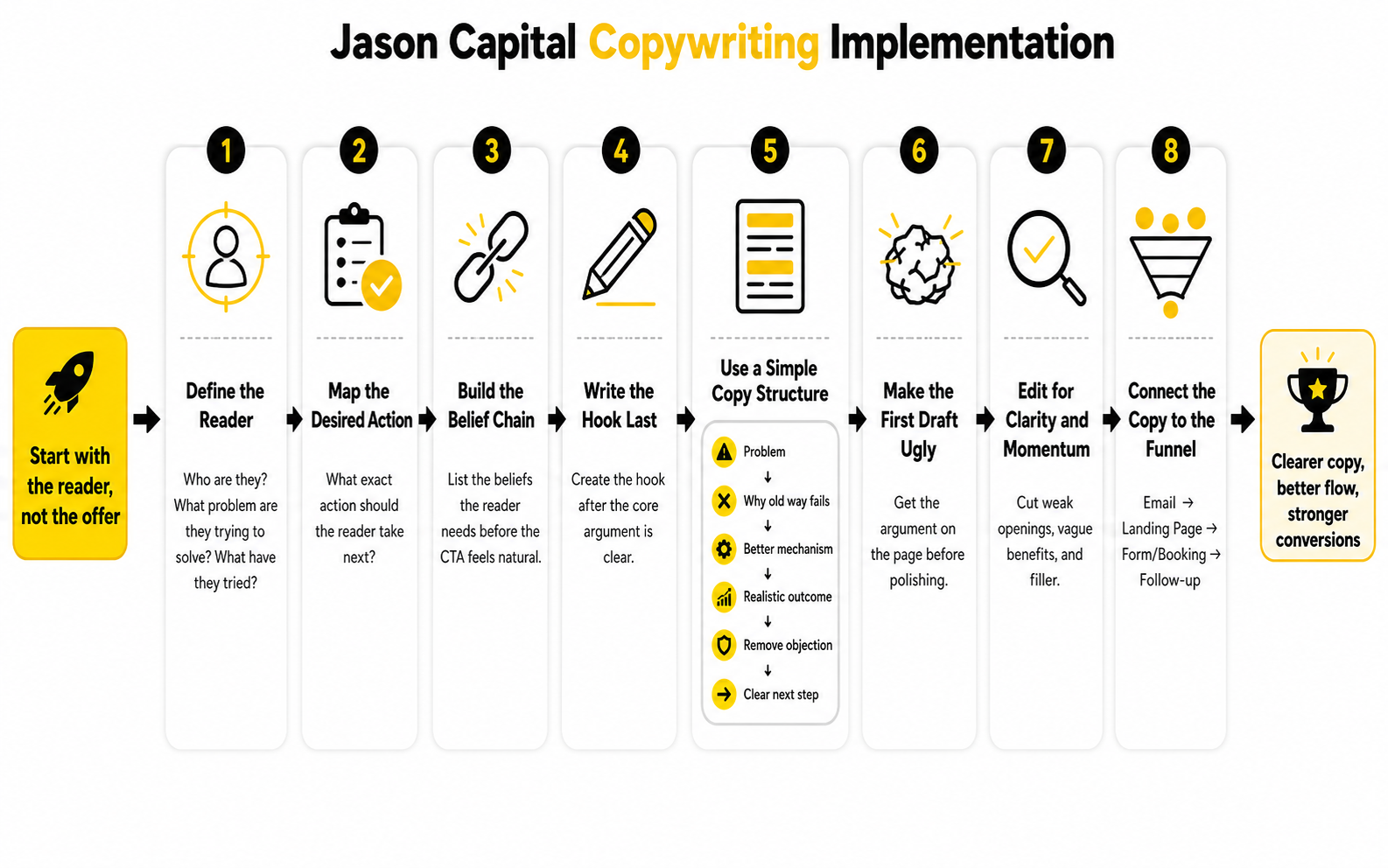
Step 1: Define The Reader Before You Write
Start with the reader, not the offer.
Who are they? What problem are they actively trying to solve? What have they already tried? What are they tired of hearing? What would make them feel understood in the first 10 seconds?
This is where your copy becomes specific. A vague reader creates vague writing. A clear reader gives you sharper angles, better hooks, stronger objections, and more natural calls to action.
For Jason Capital copywriting, this matters because the style depends on direct emotional relevance. You are not writing for “business owners” or “people who want success.” You are writing for a person with a real frustration, a real desired outcome, and a real reason they have not acted yet.
Step 2: Map The Desired Action
Once you know the reader, define the action.
Not the dream outcome. Not the broad marketing goal. The exact action you want the reader to take after reading the copy.
That action might be:
This is important because different actions require different levels of persuasion. Asking someone to click a free guide needs less proof than asking them to apply for a paid program. Asking someone to book a sales call requires more trust, more clarity, and a stronger reason to act now.
Step 3: Build The Belief Chain
A belief chain is the path the reader needs to walk before the call to action feels natural.
Most copywriters jump straight from problem to pitch. That can work when the reader is already hot, but it usually fails when the reader has doubts, skepticism, or competing options. A stronger approach is to build belief one step at a time.
For example, before someone buys a copywriting course, they may need to believe:
That is the job of the copy. You are not just presenting an offer. You are removing friction from the decision.
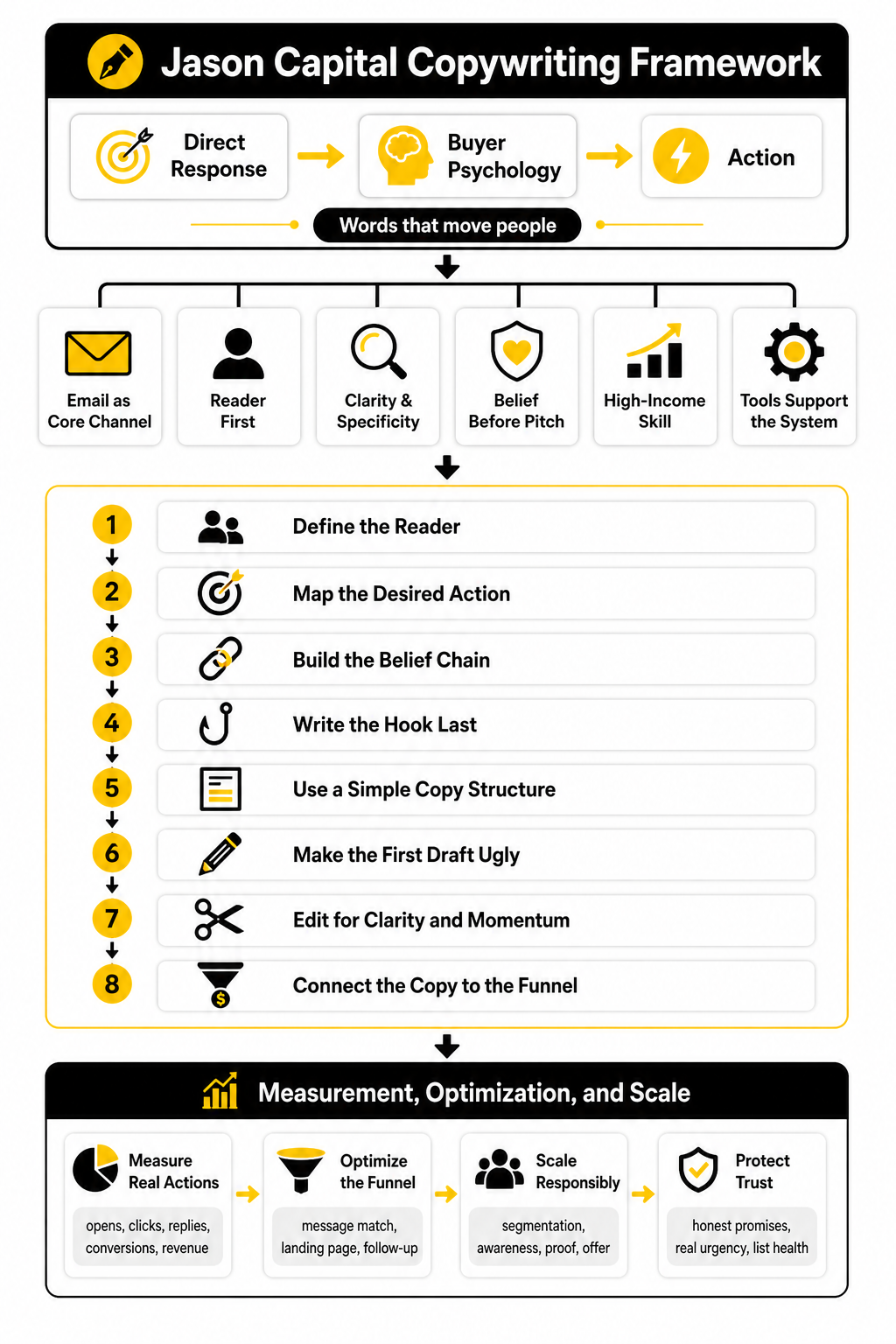
Step 4: Write The Hook Last
This sounds backwards, but it works.
Beginners often start with the hook because it feels like the most exciting part. The problem is that you cannot write a strong hook until you know the reader, the offer, the objection, and the action. Otherwise, the hook becomes clever but disconnected.
Write the core argument first. Know what you are trying to prove. Know what emotional shift the reader needs to experience. Then write the hook that pulls them into that exact argument.
In email, the hook might start with the subject line and first sentence. On a landing page, it might be the headline and subheadline. In a sales message, it might be the opening claim that makes the reader think, “That is exactly what I am dealing with.”
Step 5: Use A Simple Copy Structure
You do not need a complicated framework to make this practical.
A clean structure is enough:
This structure works because it follows how people actually make decisions. They do not buy because you listed ten features. They act because the problem feels urgent, the solution feels believable, and the next step feels low-friction.
This is also where tools can help. If you are building the follow-up around the copy, GoHighLevel can keep the lead journey organized from opt-in to appointment. If you are turning the message into a page, ClickFunnels or systeme.io can help you build the funnel without turning the project into a development job.
Step 6: Make The First Draft Ugly
The first draft is not supposed to be beautiful.
It is supposed to exist.
This is where a lot of people get stuck with Jason Capital copywriting or any direct response method. They try to write the polished version immediately, so every sentence becomes a fight. That slows everything down and usually makes the copy sound stiff.
Write the messy version first. Say what you mean. Get the argument onto the page. Then edit for clarity, pressure, flow, specificity, and trust.
A useful first draft asks:
Once those answers are on the page, the copy becomes much easier to improve.
Step 7: Edit For Clarity And Momentum
Editing is where the copy starts to feel sharp.
The goal is not to make the writing sound fancy. The goal is to remove anything that slows the reader down. Every line should either increase attention, deepen desire, reduce doubt, or move the reader toward action.
Cut weak openings. Replace vague benefits with specific outcomes. Remove filler phrases. Make the call to action unmistakable. If a sentence does not help the reader understand, believe, or act, it probably does not belong.
This is one of the most useful habits from the Jason Capital copywriting mindset. You are not protecting your words. You are protecting the reader’s attention.
Step 8: Connect The Copy To The Funnel
Copy becomes more valuable when it is connected to a real customer journey.
An email by itself can create interest, but the funnel decides what happens next. A strong subject line gets the open. A strong body earns the click. A strong landing page turns that click into a lead, sale, or booking. A strong follow-up sequence prevents the opportunity from going cold.
That is why implementation matters so much. You can write a great email and still lose money if the page is confusing, the form is too long, the offer is unclear, or the follow-up never happens. The copy and the system have to work together.
For a simple implementation stack, you might use Fillout for lead forms, Cal.com for scheduling, and Brevo for email campaigns. The exact tools matter less than the principle: the message needs a path, and the reader should never wonder what to do next.
A Practical Copywriting Workflow You Can Use
Here is a simple workflow you can use before writing any email, landing page, or sales message.
This process is simple, but it is not shallow. It forces you to think before you write. It also prevents the most common beginner mistake: opening a blank document and hoping a persuasive message appears.
The more you repeat this workflow, the faster you get. Over time, you start seeing patterns in markets, objections, hooks, and offers. That is when copywriting stops feeling like guesswork and starts becoming a repeatable skill.
Statistics And Data
The data side of Jason Capital copywriting is not about collecting random numbers to look smart.
It is about knowing whether your message is creating movement. If the copy gets attention but no clicks, the promise may be interesting but the offer is weak. If people click but do not book, buy, or reply, the page or next step is probably creating friction.
This is where direct response becomes brutally useful. You are not guessing forever. You write, publish, measure, adjust, and repeat until the numbers show you what the market actually responds to.
The Metrics That Matter Most
The first mistake is treating every metric like it matters equally.
It does not.
For email copy, the usual performance signals are:
Open rate can still be useful, but it should not be treated as the final truth. Apple’s Mail Privacy Protection can make opens less reliable because emails may be preloaded before a real human reads them, which means open rate can look healthier than actual engagement. That is why serious measurement should lean more heavily on clicks, replies, booked calls, purchases, and revenue.
For Jason Capital copywriting, this matters because the whole point is action. A subject line that gets opens is nice. A message that produces replies, calls, sales, or qualified leads is better.
Benchmarks Are A Starting Point, Not A Scorecard
Benchmarks help you avoid flying blind, but they are not commandments.
Email performance changes by industry, list quality, offer type, audience temperature, deliverability, traffic source, and relationship strength. A cold list will behave differently from a buyer list. A daily content newsletter will behave differently from a high-ticket sales sequence. A B2B appointment funnel will behave differently from an ecommerce promotion.
That is why benchmarks should be used as directional context. For example, Brevo’s email marketing benchmarks show how widely email metrics can vary across industries and regions. The useful lesson is not “copy this exact number.” The useful lesson is that your numbers need to be judged against context.
If your open rate is below your industry range, your subject lines, sender reputation, or list quality may need work. If your opens are solid but clicks are weak, your email body may not be creating enough desire or curiosity. If clicks are strong but conversions are poor, the issue may be the landing page, offer, price, form, or sales process.
What Open Rate Actually Tells You
Open rate mostly tells you whether the email earned enough attention to be noticed.
That makes it useful at the top of the funnel. If nobody opens, the rest of the copy never gets a chance. Your subject line, preview text, sender name, and list relationship are doing the heavy lifting here.
But open rate is also noisy.
Privacy changes, inbox behavior, image loading, and automated scanning can distort what you see. So a high open rate should never make you lazy. It should make you ask the next question: did the reader do anything after opening?
That is where many beginners get fooled. They celebrate opens while ignoring clicks, replies, and conversions. In real direct response, an open is only the first door.
What Clicks Tell You
Clicks show whether the message created enough interest for the reader to move.
This is a much stronger signal than an open because it requires more intent. The reader saw the message, understood enough of the promise, and decided the next step was worth their time. That means your angle, body copy, and CTA are starting to work.
But clicks still need interpretation.
A high click-through rate with low conversion can mean the email promise is stronger than the landing page. It can mean the call to action is attracting curiosity but not buying intent. It can also mean the wrong people are clicking because the copy is too broad.
That is why you should never optimize one number in isolation. If you improve clicks while lowering lead quality, you did not improve the funnel. You just created more noise.
What Conversion Rate Really Means
Conversion rate is where the copy meets reality.
This is the number that shows whether attention turned into a result. Depending on the funnel, that result might be a purchase, booked call, completed form, trial signup, webinar registration, or qualified reply. It is the clearest sign that your message, offer, audience, and next step are aligned.
But conversion rate is not only a copywriting metric.
A weak conversion rate can come from unclear pricing, slow pages, bad design, poor traffic quality, weak proof, confusing forms, lack of follow-up, or a mismatch between the email and the page. Baymard’s checkout research, for example, shows that large ecommerce sites can potentially gain a major conversion lift from better checkout UX, which is a useful reminder that persuasion does not stop at the written pitch.
So when a Jason Capital copywriting-style email gets clicks but not sales, do not rewrite the subject line first. Look at the whole path. The problem may be after the click.
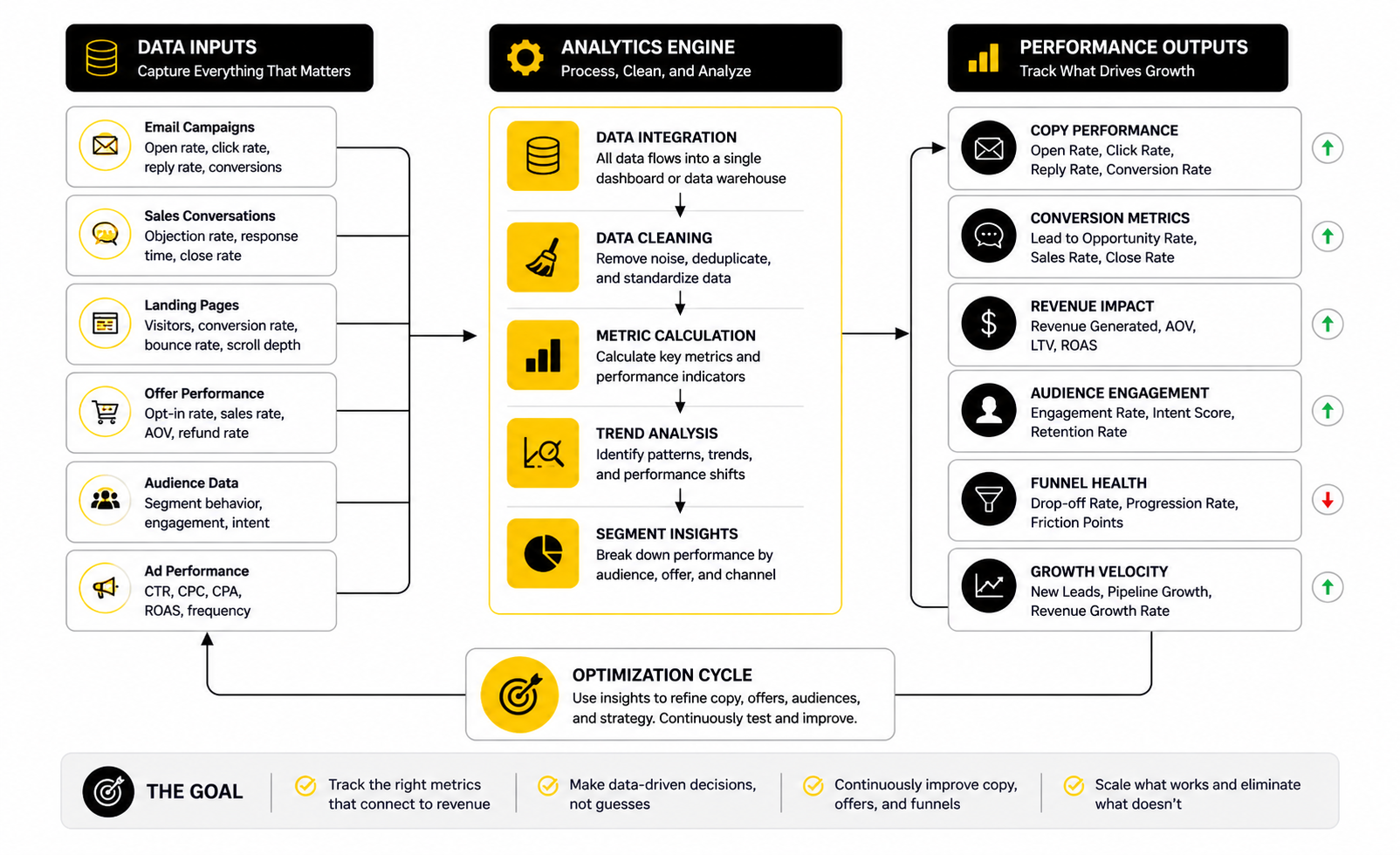
The Simple Analytics System
You do not need a complicated dashboard to measure copy properly.
You need a clean chain from message to outcome.
Track it like this:
This system keeps you honest. It also tells you where to fix the funnel instead of blindly rewriting everything.
If deliverability is weak, fix authentication, list hygiene, and sending behavior. If opens are weak, test the subject line, preview text, sender name, and audience segment. If clicks are weak, improve the email argument. If conversions are weak, fix the offer, page, proof, friction, and follow-up.
Deliverability Is Part Of Copy Performance
Deliverability sounds technical, but it affects copy directly.
If your emails land in spam, your best subject line does not matter. If your complaint rate rises, inbox providers get signals that people do not want your messages. If your list is full of dead addresses, your sender reputation can suffer before the copy even has a chance.
This became even more important after Gmail and Yahoo tightened sender requirements for bulk senders. Google’s sender guidance includes authentication, easy unsubscribe, and user-reported spam-rate requirements, which means copywriters and marketers have to care about trust, relevance, and list quality from the start.
That is a good thing.
It forces better marketing. If your copy overpromises, tricks people into opening, or pushes too aggressively to the wrong audience, the data eventually pushes back. High-pressure copy may create short-term clicks, but it can damage the list that future campaigns depend on.
What To Test First
Do not test tiny details before the big pieces are right.
Changing one word in a button will not save a weak offer. Testing three subject lines will not fix a list that does not trust you. Tweaking the CTA will not solve a landing page that does not match the email promise.
Start with the biggest leverage points:
This is where Jason Capital copywriting becomes practical instead of theoretical. You are not trying to find the “perfect” sentence. You are trying to identify the piece of the persuasion chain that is holding back the result.
How To Read Bad Numbers Without Panicking
Bad numbers are not a personal insult.
They are feedback.
If nobody opens, the market did not see enough relevance or curiosity. If people open but do not click, the email did not build enough desire or belief. If people click but do not convert, the next step did not feel convincing, safe, or worth the effort.
That is useful.
A weak campaign tells you where the friction is. A strong campaign tells you what to repeat. A surprising campaign tells you what the market may care about more than you expected.
The worst thing you can do is ignore the data because you like the copy. The second worst thing is overreacting to one campaign before you have enough signal. Look for patterns, not emotional drama.
The Numbers Should Drive Better Decisions
Measurement only matters if it changes what you do next.
If a subject line gets strong opens but weak clicks, keep the attention angle but rewrite the body. If a landing page gets traffic but no conversions, check message match, proof, friction, and offer clarity. If unsubscribes spike, review audience fit, email frequency, and whether the promise in the subject line matches the actual message.
This is also where tools can make the work cleaner. A platform like GoHighLevel can help connect forms, pipelines, email follow-up, and appointment tracking so you can see more than surface-level engagement. Brevo can also make sense when the focus is email campaigns, segmentation, and performance tracking.
The tool is not the strategy, though.
The strategy is simple: write with intent, measure the real action, and improve the part of the journey that is creating the most friction. That is how copywriting becomes a business asset instead of just a writing exercise.
Advanced Considerations Before You Scale
Once the basics are working, the next challenge is control.
Jason Capital copywriting is often presented through the lens of speed, persuasion, and income potential, but scaling copy is not just about writing more emails or pushing harder. The bigger the campaign gets, the more every weak point becomes expensive. A vague offer, a sloppy claim, a poor-fit audience, or an over-aggressive follow-up sequence can damage trust faster at scale than it ever would in a small test.
That is why advanced copywriting is less about clever lines and more about judgment. You need to know when to increase pressure, when to reduce friction, when to segment, when to rewrite the offer, and when to stop pushing because the market is giving you a clear no.
The Biggest Risk Is Overpromising
Direct response copy works because it makes the outcome feel desirable and urgent.
The danger is taking that too far.
If the promise becomes bigger than the product can realistically support, the copy may create short-term sales while building long-term refunds, complaints, chargebacks, and reputation problems. That is not a copywriting win. That is just borrowing trust from the future and paying it back with interest.
This matters even more in niches like wealth, business opportunities, health, coaching, and high-ticket education. Claims need to be clear, fair, and supportable. The FTC’s updated guidance on endorsements and testimonials makes the same basic point from a compliance angle: marketing claims, reviews, and testimonials should not mislead people about what they can generally expect.
So the practical rule is simple: make the offer exciting, but keep the promise honest.
Persuasion Should Not Become Pressure
There is a line between persuasive and manipulative.
Persuasive copy helps the reader understand the problem, believe in the solution, and take a useful next step. Manipulative copy hides information, exaggerates certainty, manufactures false urgency, or pushes the reader into a decision they would not make with full context.
That line matters because strong copy can move people.
If you use that skill carelessly, you may get clicks, but you lose trust. And once trust is gone, every future campaign gets harder. People stop opening. They stop believing. They unsubscribe, ignore, or complain.
The better approach is to use pressure only when it is real. A deadline should be a real deadline. Limited seats should mean limited seats. A bonus should actually expire when you say it expires. This is not just ethics. It is good business.
Segment Before You Scale
Scaling the same message to everyone is one of the fastest ways to weaken performance.
A cold prospect does not need the same copy as a warm lead. A buyer does not need the same proof as someone who has never heard of you. A high-ticket lead with a specific pain should not receive the same generic pitch as a broad newsletter subscriber.
Segmentation lets the copy feel more personal without becoming fake.
For example, you can segment by:
This is where the Jason Capital copywriting mindset becomes more strategic. The goal is not to shout louder. The goal is to match the message to the reader’s level of awareness.
Match Copy To Awareness Level
Not every reader is equally ready to buy.
Some people know they have a problem but do not know the solution. Some know the solution category but do not know why your offer is different. Some already want the offer but need proof, urgency, or a lower-friction next step.
That is why awareness level changes the copy.
A problem-aware reader may need education and agitation before the offer makes sense. A solution-aware reader may need mechanism, differentiation, and proof. A product-aware reader may need urgency, risk reversal, testimonials, pricing clarity, or a reason to act now.
This is a major difference between beginner and expert copy. Beginners write one pitch. Experts adjust the argument based on what the reader already believes.
Build Proof Before You Push Harder
Weak copy often tries to compensate for weak proof by adding more intensity.
That rarely works.
If readers do not believe the promise, louder language will not fix it. You need proof that makes the claim easier to trust. That proof can come from product demos, screenshots, customer results, credible explanations, transparent processes, before-and-after comparisons, third-party validation, or a clear breakdown of how the mechanism works.
But proof has to be handled carefully. Do not invent numbers. Do not imply typical results when you only have outliers. Do not use testimonials in a way that makes the average buyer expect an outcome you cannot support.
A strong proof system makes copy calmer because the evidence does more of the work. That is what you want.
Scale The Offer, Not Just The Copy
Sometimes the copy is not the bottleneck.
Sometimes the offer is.
If every email needs extreme persuasion to get a modest response, the market may not want the offer badly enough. If people click but do not buy, the price, guarantee, proof, delivery method, or perceived effort may be off. If qualified leads keep asking the same question, the offer may not be clear enough.
This is where many copywriters get trapped. They keep rewriting headlines when they should be improving the offer.
Better copy can reveal a good offer. It cannot permanently rescue a weak one. So before scaling a campaign, ask whether the offer is easy to understand, easy to desire, and easy to say yes to.
Watch The Long-Term Health Of The List
A campaign can look profitable while quietly damaging the list.
That happens when short-term revenue becomes the only metric. You push more promotions, increase frequency, add urgency, and squeeze harder. Revenue may rise for a while, but engagement drops, unsubscribes climb, replies get worse, and deliverability starts to suffer.
Email platforms and inbox providers are increasingly sensitive to user signals. Google’s sender requirements tell bulk senders to keep user-reported spam rates below 0.1% and avoid reaching 0.3% or higher, which is a practical reminder that list trust is not a soft metric. It directly affects whether your emails get seen.
So advanced copywriting means managing tension. You want revenue now, but you also want a list that still opens, clicks, replies, and buys later. If your copy burns the relationship, it is not scalable.
Use Automation Without Sounding Automated
Automation is powerful, but bad automation makes copy feel dead.
The problem is not the tool. The problem is sending the same message to every person regardless of behavior, context, or timing. When automation ignores the reader’s actions, it stops feeling helpful and starts feeling lazy.
A more carefully system responds to behavior.
If someone clicks but does not book, the next message can address the likely hesitation. If someone attends a webinar but does not buy, the follow-up can recap the core mechanism and handle objections. If someone starts a form but does not finish, the message can remove friction and make the next step easier.
Tools like GoHighLevel, Brevo, and Moosend can help with this, but the logic still has to come from you. Automation should make the conversation more relevant, not more robotic.
Be Careful With AI-Assisted Copy
AI can speed up research, outlining, rewriting, ideation, and variation testing.
But it can also make your copy sound generic if you let it do the thinking.
The danger is not that AI writes badly every time. The danger is that it often writes smoothly without understanding the market deeply enough. It can produce clean paragraphs that feel right but say nothing new, make unsupported claims, or miss the emotional reason a buyer actually acts.
Use AI for leverage, not laziness.
Let it help you generate angles, compare headlines, simplify messy drafts, or turn a customer interview into a list of objections. But do not outsource the core thinking. You still need to understand the buyer, the offer, the proof, and the friction in the funnel.
When To Use A Stronger Angle
A stronger angle is useful when the market is aware but indifferent.
That means they know the problem exists, but they do not feel urgency. They have heard similar promises before. They may agree with the message, but agreement does not create action.
In that case, the copy needs more tension.
You can create that tension by showing the hidden cost of delay, reframing the problem, challenging a false belief, or revealing why the old solution keeps failing. This is where Jason Capital copywriting often gets its punch: it does not politely describe the problem. It makes the reader feel the cost of staying the same.
But stronger does not mean reckless. The angle should be sharper because it is more true, not because it is more dramatic.
When To Lower The Pressure
Sometimes the better move is to make the copy calmer.
This is especially true when the offer is expensive, complex, risky, or trust-sensitive. High-ticket buyers often need confidence more than hype. B2B buyers may need clarity, proof, internal justification, and a lower-friction way to start.
In those situations, aggressive urgency can backfire.
The copy should still be direct, but the tone may need to feel more consultative. Instead of pushing for an immediate purchase, the better next step may be a call, audit, demo, application, calculator, or diagnostic. The goal is still action, but the action should match the risk level of the decision.
That is expert-level restraint.
Turn Copy Into A Repeatable Asset
The highest value of copywriting is not one winning email.
It is building a library of messages, angles, objections, proof points, hooks, and offers that can be reused across the business. A winning email can become a landing page section. A strong objection-handling paragraph can become a sales call talking point. A high-performing subject line angle can become an ad concept.
This is how copy compounds.
Instead of starting from zero every time, you build a persuasion bank. You track what worked, why it worked, where it worked, and which audience responded. Over time, your copy gets faster because your thinking gets sharper.
That is the mature version of Jason Capital copywriting. Not just writing punchy messages, but building a system that turns market insight into revenue again and again.
The Strategic Tradeoff
The central tradeoff is simple.
More aggressive copy can create faster action, but it can also increase skepticism, refunds, complaints, and list fatigue if the promise is not supported. Softer copy can preserve trust, but it may fail to create enough urgency for people to move. The job is not to choose one forever. The job is to match the pressure to the audience, offer, proof, and stage of the funnel.
That is why copywriting is never just about words.
It is strategy under pressure. It is understanding what the buyer needs to believe, what the business can honestly promise, and what the funnel can actually deliver. When those three things line up, the copy does not need to scream.
It just needs to be clear enough, relevant enough, and persuasive enough to make the next step feel obvious.
The Final System
At this point, the real lesson should be obvious.
Jason Capital copywriting is not just about writing sharper emails, stronger hooks, or better calls to action. Those things matter, but they are only pieces of the bigger system. The full system is reader insight, offer clarity, persuasive structure, measurement, ethical pressure, automation, and constant improvement.
When those pieces work together, copy stops being a random task. It becomes a business lever. You can use it to attract better leads, qualify buyers, improve follow-up, strengthen sales pages, recover lost opportunities, and turn attention into revenue.
That is the difference between someone who “writes copy” and someone who understands copy as part of a complete growth engine.
How To Keep Improving Your Copy
The fastest way to improve is to build a feedback loop.
Write the copy, publish it, measure the behavior, and study what happened. Do not only look at the numbers you like. Look at where people dropped off, where they hesitated, where they clicked, where they replied, and where they ignored the message completely.
Then turn that feedback into a better version.
This is where the Jason Capital copywriting mindset is useful because it keeps you focused on action. You are not writing for applause. You are writing to create a measurable shift in belief, emotion, and behavior.
A simple improvement loop looks like this:
That discipline matters. Random rewriting creates random results. Focused iteration creates skill.
The Copywriting Standards That Actually Matter
There are a lot of opinions in copywriting.
Some people love long copy. Some love short copy. Some want story-based emails. Some want blunt sales messages. Some obsess over frameworks, while others write from instinct.
Most of that debate is less important than it sounds.
The better standard is simple: does the copy help the right person take the right next step for the right reason?
If the answer is yes, the copy is doing its job. If the answer is no, it needs work.
Good copy should be:
That is the standard worth using. Not whether the copy sounds like Jason Capital. Not whether it follows a template perfectly. Not whether another copywriter thinks it is clever.
Where Beginners Should Start
If you are new, do not start by trying to write a massive sales page.
Start smaller.
Write emails. Write short landing page sections. Rewrite weak CTAs. Practice turning vague benefits into specific outcomes. Study real offers and ask why someone would act now instead of later.
The goal is not to become a genius in one weekend. The goal is to build the muscle of seeing the buyer’s problem clearly and expressing the next step in a way that feels obvious.
A beginner should focus on:
That is enough to build momentum. Once those basics work, you can move into more advanced funnels, segmentation, sales pages, webinars, paid traffic, and high-ticket campaigns.
What is Jason Capital copywriting?
Jason Capital copywriting refers to the direct-response style and persuasion-focused approach associated with Jason Capital’s training, emails, and public positioning around high-income skills. The core idea is that copy should move people toward action, not just sound polished. It usually fits best with email marketing, offers, funnels, high-ticket sales, and practical buyer psychology.
Is Jason Capital copywriting good for beginners?
Yes, it can be useful for beginners because it forces them to write with clarity and intent. A beginner quickly learns that copy is not about sounding clever. It is about understanding the reader, making a relevant promise, handling objections, and asking for one clear action.
Is copywriting still a high-income skill?
Copywriting can still be a high-income skill when it is tied to measurable business outcomes. Businesses pay more when the writing helps generate leads, sales, appointments, retention, or revenue. The skill becomes more valuable when you understand strategy, offers, funnels, analytics, and sales psychology instead of only writing nice sentences.
What makes Jason Capital copywriting different from normal content writing?
Normal content writing often focuses on education, awareness, entertainment, or brand presence. Jason Capital copywriting sits closer to direct response, where every line is supposed to earn attention, build desire, reduce doubt, and move the reader toward a decision. The difference is not just tone. The difference is the goal.
Does Jason Capital copywriting only work for email?
No, the principles can apply to emails, landing pages, ads, sales pages, webinar scripts, social posts, follow-up messages, and sales call assets. Email is a strong training ground because the feedback is fast and measurable. But the deeper skill is persuasion, and that can be used across many parts of a funnel.
How do I practice this style of copywriting?
Start by choosing one reader, one problem, one offer, and one action. Write a short message that explains the problem clearly, shows why the old way is not working, introduces a better path, handles one major objection, and gives one call to action. Then edit the copy until every sentence helps the reader understand, believe, or act.
What is the biggest mistake beginners make?
The biggest mistake is writing before thinking. Beginners often open a blank document and try to create a perfect hook immediately. Better copy starts with research, buyer awareness, objections, offer clarity, proof, and the exact action you want the reader to take.
Should I use templates?
Templates can help, but they are not the skill. A template gives you structure, but it cannot replace market understanding. If you use a template without knowing the reader’s pain, desire, skepticism, and awareness level, the copy will still feel generic.
How do I know if my copy is working?
Look at behavior. For email, that means clicks, replies, booked calls, purchases, qualified leads, unsubscribes, complaints, and revenue per subscriber. Open rate can be useful, but it should not be the only metric because privacy changes and inbox behavior can distort it.
What should I test first?
Test the big levers before small details. Start with the audience segment, offer angle, core promise, headline or subject line, opening section, proof, objection handling, and call to action. Do not waste time testing tiny button wording if the offer, message, or audience match is weak.
Can AI help with Jason Capital copywriting?
AI can help with brainstorming, outlining, rewriting, summarizing customer research, generating headline variations, and improving rough drafts. But it should not replace the thinking. The strongest copy still comes from understanding the market, the offer, the objections, the proof, and the emotional reason someone acts.
Is stronger copy always better?
No. Stronger copy is useful when the reader needs urgency, tension, or a sharper reason to act. But if the offer is expensive, complex, or trust-sensitive, calmer and more consultative copy may perform better. Good copy matches the pressure to the audience, offer, and stage of the funnel.
How do I avoid sounding manipulative?
Be clear, honest, and specific. Use urgency only when it is real. Do not exaggerate outcomes, hide important details, or imply that rare results are typical. Persuasive copy should help the reader make a better decision, not pressure them into a decision they would regret.
What tools help with implementation?
The tools depend on the funnel. GoHighLevel can help connect funnels, forms, pipelines, follow-up, and appointment tracking. ClickFunnels and systeme.io can help turn offers into working funnels. Brevo and Moosend can help when email campaigns and segmentation are the focus.
What is the best way to use this if I want clients?
Use it to create proof. Pick a niche, write sample emails or funnel sections, explain the strategy behind them, and show how the copy connects to business outcomes. Clients do not only want someone who can write. They want someone who can understand their offer, improve the message, and help create measurable results.
Build a stronger local presence with BAAM AI
Turn your website, Google profile, social channels, and AI visibility into one growth engine
Most businesses do not need more random marketing activity. They need a consistent presence system that helps the right people find them, trust them, and take action. BAAM AI brings strategy, local SEO, website updates, Google Maps visibility, social content, AI-search readiness, media production, and reporting into one practical monthly engine.
If you want your marketing to keep working after the campaign ends, start with a free BAAM AI presence audit. See how your business shows up today and where the fastest visibility wins are at BAAM AI.