
BAAM AI Blog
White Label Social Media Agency: The Practical Scaling Guide
A white label social media agency is not just a cheaper way to fulfill posts, captions, calendars, and reports. Done properly, it is a delivery model where your agency owns the client relationship, strategy...

A white label social media agency is not just a cheaper way to fulfill posts, captions, calendars, and reports. Done properly, it is a delivery model where your agency owns the client relationship, strategy, positioning, and account growth while a specialist partner helps execute behind the scenes under your brand.
That matters because social media has become too operationally heavy for many small agencies to deliver profitably with only in-house staff. Clients now expect platform-specific content, short-form video ideas, community response, campaign reporting, paid and organic coordination, and faster turnaround. The demand is real: the social media management outsourcing market was estimated at $7.26 billion in 2024 and is projected to reach $22.75 billion by 2034, with growth tied to businesses outsourcing content creation, analytics, engagement, and campaign management to specialist providers social media management outsourcing market.
The opportunity is simple, but not easy. A white label social media agency can scale faster than a traditional service agency, but only when the offer, workflow, quality control, reporting, and client communication are tight. Without that structure, white label fulfillment turns into missed deadlines, generic content, weak retention, and awkward client conversations.
this guide is split into six parts so each part builds on the last without repeating the same advice. The goal is to move from the business case into the actual operating system behind a strong white label social media agency. By the end, you should be able to decide whether this model fits your agency and what needs to be in place before you sell it.
Why a White Label Social Media Agency Model Matters
The biggest reason this model matters is capacity. Most agencies do not lose money on social media because the service is impossible to sell; they lose money because delivery quietly eats the margin. Every client adds content planning, asset coordination, revisions, scheduling, approvals, inbox checks, reporting, and performance calls.
The pressure is also coming from the client side. Social media is now tied to brand trust, customer care, discovery, and sales conversations, not just “posting three times a week.” The 2025 Sprout Social Index surveyed 4,044 consumers who follow at least five brands on social media, which shows how central brand-owned social channels have become to everyday customer expectations 2025 Sprout Social Index.
That shift creates a practical problem for agencies. Clients want specialized execution, but many agencies cannot afford to hire a strategist, designer, copywriter, video editor, paid social specialist, community manager, and analyst for every account. A white label social media agency model solves part of that problem by separating client ownership from production capacity.
This does not mean the agency becomes a middleman with no value. The agency’s value moves up the chain into positioning, offer design, client strategy, account management, quality assurance, and commercial outcomes. The white label partner supports delivery, but the client should still feel like they are working with a sharp, organized, strategic agency.
The Framework: What You Actually Sell Under Your Brand
A white label social media agency does not sell “outsourced posts.” That positioning is weak, easy to compare, and usually price-sensitive. What you actually sell is a branded client experience that turns strategy into consistent social media execution.
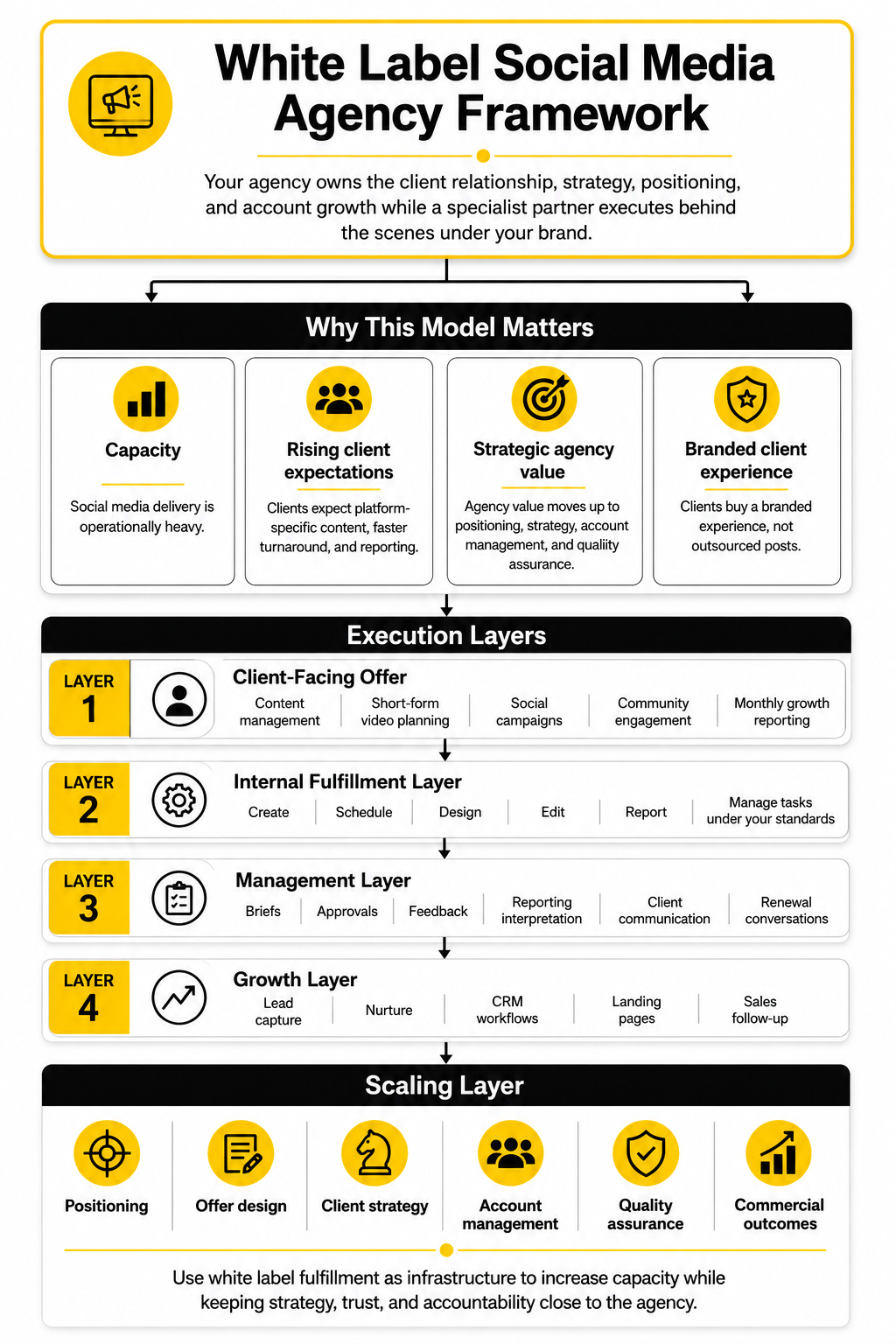
The framework has four layers. First, there is the client-facing offer: what the client believes they are buying, such as content management, short-form video planning, social campaigns, community engagement, or monthly growth reporting. Second, there is the internal fulfillment layer, where white label specialists create, schedule, design, edit, report, or manage tasks under your standards.
Third, there is the management layer. This is where your agency controls briefs, approvals, feedback, reporting interpretation, client communication, and renewal conversations. Fourth, there is the growth layer, where social media connects to lead capture, nurture, CRM workflows, landing pages, and sales follow-up.
This is why tooling matters, but tools should not lead the offer. A scheduling and reporting tool like Buffer can support publishing workflows, while a platform like ManyChat can help when the social strategy includes automated DM conversations. For agencies that want CRM, funnels, forms, pipeline tracking, and client communication in one place, GoHighLevel can fit naturally into the backend.
The mistake is thinking the software is the business model. It is not. The business model is the repeatable system that turns client goals into briefs, briefs into assets, assets into approvals, approvals into publishing, publishing into reporting, and reporting into retention.
What This Model Is Not
A white label social media agency is not a shortcut for selling services you do not understand. If you cannot judge whether the work is good, the client will eventually notice. You do not need to personally design every graphic or write every caption, but you do need enough strategic judgment to protect quality.
It is also not the same as pure outsourcing. Outsourcing can be task-based, invisible, and disconnected from the client’s bigger business goals. White label delivery should be structured, branded, documented, and integrated into your agency’s standards.
Finally, it is not a way to avoid client communication. In fact, this model usually requires better communication because there are more moving parts behind the scenes. The client should experience clarity, not complexity.
The Big Idea Before We Go Deeper
The agencies that win with this model treat white label fulfillment like infrastructure. They do not hide behind it, and they do not let it control the client relationship. They use it to increase capacity while keeping strategy, trust, and accountability close to the agency.
That is the lens for the rest of this guide. Part 2 will go deeper into the first major section: why the white label social media agency model matters, where the margin really comes from, and when this approach makes more sense than hiring in-house.
Why a White Label Social Media Agency Model Matters
A white label social media agency model matters because the service has become harder to deliver well at the exact same time clients expect more from it. Years ago, a small business might have been satisfied with a few static posts, basic captions, and a monthly report that showed follower growth. Now the same client may expect short-form video ideas, platform-native creative, community engagement, AI-assisted workflows, campaign tracking, and a clearer connection between social media and revenue.
That creates a serious delivery gap for agencies. Selling social media management is relatively easy when the client already knows they need visibility, consistency, and content. Delivering it profitably month after month is where many agencies get stuck, because each account adds strategy calls, creative briefs, revisions, approvals, publishing, reporting, and client education.
The white label model helps because it lets your agency stay focused on ownership of the relationship while experienced production support handles repeatable execution. That does not remove responsibility from your side. It gives you leverage, and leverage only works when you know exactly what should be delivered, how it should be reviewed, and how the client should experience the service.
Demand Is Rising, but So Are Expectations
The market is not short on demand. Businesses still need social media because customers use it to discover brands, compare options, ask questions, check credibility, and stay connected after the first purchase. The 2025 Sprout Social Index surveyed more than 4,000 consumers, 900 social practitioners, and 300 marketing leaders, which gives a useful picture of how deeply social media now sits inside brand communication and customer expectations 2025 Sprout Social Index.
The hard part is that social media has become more judgmental. Consumers do not only notice whether a brand posts. They notice whether the content feels relevant, whether the brand understands the platform, whether replies feel human, and whether the company is forcing trends it does not understand.
That is exactly where agencies can win, but only if delivery quality stays high. A white label social media agency can support more clients without lowering the standard, but the agency still needs a strong editorial eye. If the content feels generic, late, or disconnected from the client’s market, the white label structure will not save the account.
The Margin Problem Is Usually Hidden
Many agencies underestimate the true cost of social media delivery because the work is scattered across the month. A designer spends twenty minutes adjusting a graphic. A strategist spends thirty minutes rewriting captions. An account manager spends an hour chasing approvals. None of those tasks feel huge alone, but together they quietly destroy the margin.
This is why a client paying a monthly retainer can still become unprofitable. The issue is not always pricing. Sometimes the issue is that the agency sold a custom service with no repeatable delivery system behind it.
A white label social media agency model can protect margin by standardizing the production side. Instead of rebuilding the process from scratch for every client, you create defined packages, briefing templates, approval steps, content formats, reporting cycles, and escalation rules. That structure is what turns social media from a busy service into a scalable offer.
Hiring In-House Is Not Always the Better Move
Hiring in-house sounds attractive because it gives you more control. In reality, it also gives you payroll risk, management responsibility, training needs, software costs, and the problem of uneven workload. If you hire for five clients and then lose two accounts, your cost base does not automatically shrink.
White label support gives you more flexibility. You can increase production capacity when client demand rises and reduce delivery load when accounts churn or pause. That flexibility matters for agencies that are still finding product-market fit, testing new packages, or expanding into social media without wanting to build a full creative department immediately.
This does not mean in-house teams are bad. They can be excellent once the agency has predictable volume, stable retainers, and enough margin to support specialists. But for many growing agencies, the more carefully move is to keep strategy and client leadership close while using white label fulfillment to handle defined production work.
Clients Pay for Outcomes, Not Your Org Chart
Most clients do not care whether every task is completed by an employee sitting inside your agency. They care whether the work is good, whether deadlines are met, whether communication is clear, and whether the service helps the business move forward. That is an important mindset shift.
The mistake is treating white label delivery like something shameful. Professional service businesses use specialist partners all the time, from legal support to development teams to media buying contractors. What matters is whether the agency has quality control and accountability.
Your client bought the result from you. That means your agency must own the brief, the standard, the timeline, the feedback, and the final delivery. A white label social media agency can use outside fulfillment, but it cannot outsource leadership.
The Real Advantage Is Speed Without Chaos
Speed matters because social media moves quickly. Campaigns change, offers change, products launch, trends appear, customer questions pile up, and clients often need content faster than an internal team can comfortably handle. A good white label partner can give your agency more production bandwidth without forcing you to hire before you are ready.
But speed without process becomes chaos. If briefs are vague, approvals are messy, and reporting is inconsistent, more capacity just creates more problems. The agency ends up managing confusion instead of managing growth.
The real advantage comes from combining outside production capacity with a clear operating system. For example, publishing workflows can be managed through Buffer, client funnels and CRM follow-up can sit inside GoHighLevel, and DM-based lead capture can be supported through ManyChat. The tools are not the strategy, but they help the strategy run without everything living in scattered spreadsheets and inbox threads.
The Model Works Best When the Offer Is Narrow
A white label social media agency works best when the agency knows exactly what it sells. Broad offers sound impressive, but they are harder to fulfill and harder to quality-check. “We handle your entire social presence” is vague unless it is backed by clear deliverables, channel scope, response times, content formats, and reporting expectations.
A narrower offer is easier to sell and much easier to scale. For example, an agency might package LinkedIn content for B2B founders, Instagram and TikTok short-form planning for local service brands, or social content plus simple lead capture for coaches and consultants. The narrower the promise, the easier it becomes to brief the work and judge whether the output is strong.
This is also better for clients. They do not want a confusing menu of tasks that sounds impressive but feels hard to understand. They want to know what happens each month, what they need to provide, what your team handles, and how success will be measured.
The Agency Still Needs a Point of View
White label delivery should never turn your agency into a reseller of random content. If all you do is pass client notes to a vendor and pass vendor files back to the client, you are adding very little value. That is a dangerous position because the client can eventually look for a cheaper provider.
Your point of view is what protects your position. You should know what kind of content fits the client’s audience, which channels deserve focus, what tone makes sense, how often the client should publish, and which metrics actually matter. The fulfillment partner can help produce the work, but your agency should guide the direction.
This is where the best white label social media agency operators separate themselves from weak ones. They do not simply mark up production. They turn production into a managed client experience with strategy, quality control, and commercial judgment built in.
The Framework: What You Actually Sell Under Your Brand
The practical framework starts with a simple truth: your client is not buying posts. They are buying confidence that someone competent is turning their brand, offers, expertise, and market context into consistent social media execution. That distinction matters because a white label social media agency can only scale when the offer is built around outcomes and workflow, not random deliverables.
Your job is to package the client-facing promise in a way that feels clear, valuable, and manageable. The white label partner may help with writing, design, scheduling, reporting, or engagement, but your agency should control the standard. That is how you avoid becoming a pass-through vendor.
A strong framework also protects the relationship when social media gets messy. Platforms change, content performance moves up and down, clients delay approvals, and trends burn out quickly. The framework gives everyone a shared process instead of forcing your team to reinvent delivery every month.
Start With the Client Outcome
Before you define deliverables, define the client outcome. A local service business may want more booked consultations. A B2B founder may want authority and inbound conversations. An ecommerce brand may want product discovery, community trust, and campaign support.
This step prevents the classic agency mistake of selling the same content calendar to everyone. A white label social media agency can use repeatable systems, but the strategy still needs context. The repeatability should live in the process, not in lazy copy-and-paste content.
The outcome also affects which platforms deserve attention. LinkedIn content, Instagram Reels, TikTok videos, Facebook community posts, and YouTube Shorts do not serve the same purpose for every business. The agency has to decide where effort is most likely to matter before it hands anything to fulfillment.
Turn the Outcome Into a Clear Monthly Scope
Once the outcome is clear, convert it into a monthly scope. This is where you decide what is included, what is excluded, and what requires a separate fee. Without scope control, social media management becomes a bottomless service.
A clean scope might include a fixed number of posts, short-form video concepts, caption sets, basic graphics, scheduling, monthly reporting, and one revision round. A more advanced scope could include community management, campaign planning, social inbox triage, influencer coordination, or DM automation. The point is not to include everything; the point is to make the promise specific enough to deliver.
This also makes your white label partner easier to manage. Vague requests create vague output. Clear deliverables create better briefs, faster reviews, and fewer uncomfortable conversations with the client.
Build the Execution Process Before You Sell Heavily
The implementation process should be mapped before you add too many clients. This is where a lot of agencies get overconfident. They sell the service first, then scramble to build the machine while clients are already asking for calendars, revisions, and reports.
A white label social media agency should have the process documented from intake to renewal. That does not mean it has to be complex. It means every account should move through the same basic path, with clear owners and deadlines.
Here is the core process:
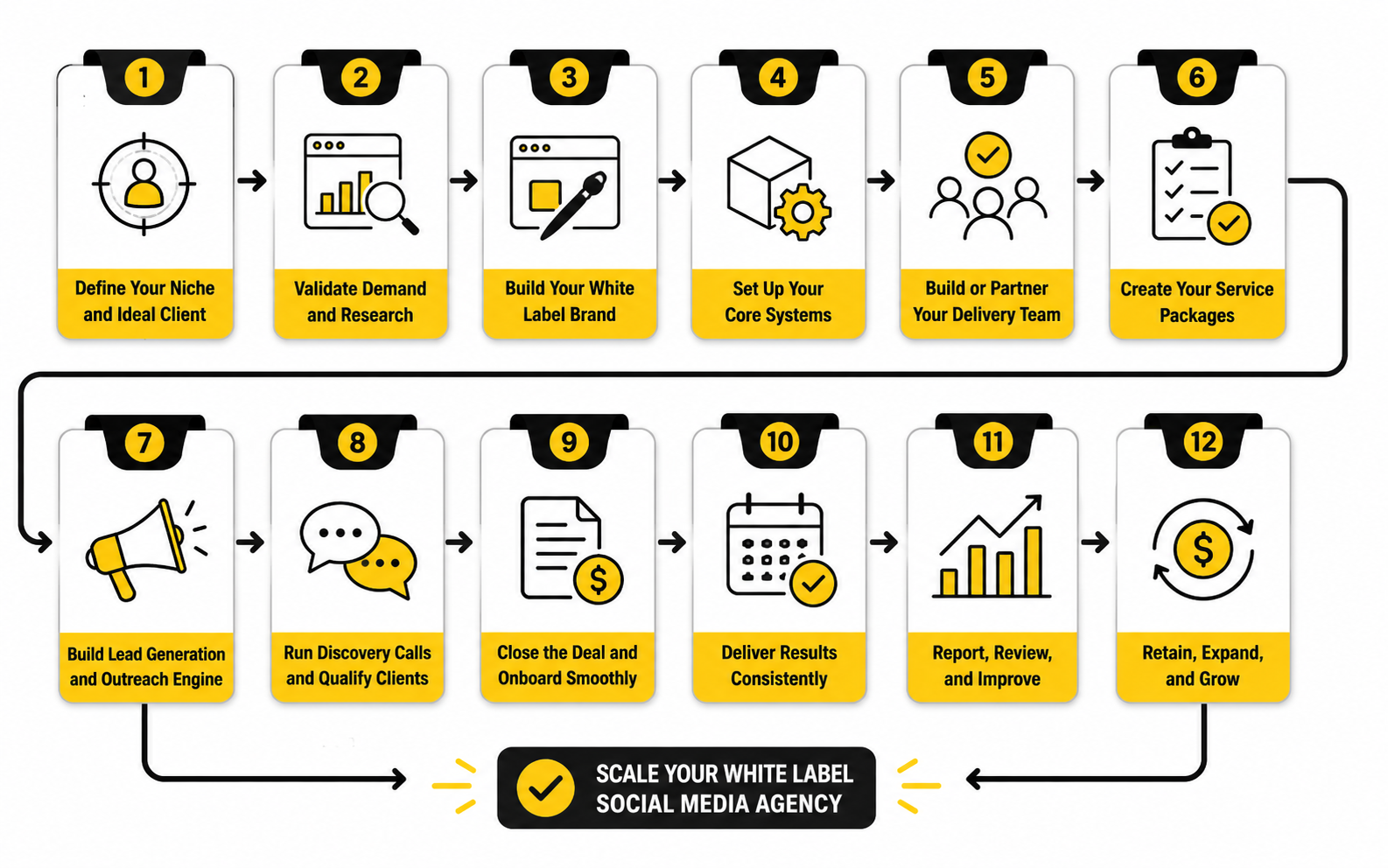
This is the point where the model becomes real. You are not selling “white label social media management” as a vague backend service. You are selling a controlled production system that turns messy client input into usable content and measurable delivery.
Create a Brief That Removes Guesswork
The brief is one of the most important assets in the whole model. If the brief is weak, the first draft will usually be weak too. Then your team spends time fixing work that should have been guided correctly from the beginning.
A practical brief should include the client’s audience, offer, tone, content pillars, banned claims, preferred formats, visual direction, examples of past content, competitor references, call-to-action rules, and approval expectations. It should also explain what the content is supposed to do. Content built for authority should not sound the same as content built for direct response.
This is especially important now because brands are under more pressure to feel authentic and relevant. The 2025 Sprout Social Index found that consumers rank authenticity and relatability among the most important traits they want from brand content, which makes generic output a real retention risk authenticity and relatability in brand content. A strong brief helps the white label team produce content that sounds like the client, not like every other brand in the same category.
Keep Strategy and Production Separate
Strategy and production are related, but they are not the same job. Strategy decides what should be said, to whom, on which platform, and for what business reason. Production turns that direction into assets, captions, schedules, and reports.
When agencies blur those roles, delivery gets sloppy. The production team starts making strategic guesses, and the account manager starts fixing creative details at the last minute. That creates rework and makes the client experience feel less confident.
A white label social media agency should keep the strategic layer close to the agency. Your team should approve the direction, protect the client’s positioning, and make sure the work connects to the bigger account plan. The white label partner can then execute within a clear lane.
Use Tools to Reduce Friction, Not Add Complexity
The tool stack should make the process easier for your team, your white label partner, and the client. If the tools create more logins, more confusion, and more places to check, they are not helping. Keep the stack lean until the process proves it needs more.
For publishing and content queues, Buffer can be useful because it keeps scheduling and review workflows more organized. For agencies that want social follow-up tied to CRM, pipeline, forms, and client communication, GoHighLevel can support a more complete backend. When social campaigns rely on comments or direct messages to start conversations, ManyChat can help turn engagement into structured follow-up.
The practical rule is simple. Do not buy software because it sounds like an agency system. Buy it because a specific part of your delivery process is slow, fragile, or too manual.
Define Quality Control Before the Client Reviews Anything
Quality control is where your agency earns its margin. The client should not be the first person to catch weak hooks, wrong claims, off-brand visuals, broken formatting, or lazy captions. If that happens often, the client starts managing the agency, and that is a terrible position.
Create a review checklist that your team uses before anything goes to the client. Check the platform fit, brand voice, visual consistency, factual accuracy, CTA clarity, spelling, formatting, compliance needs, and whether the content actually supports the agreed outcome. This does not need to take forever, but it does need to happen every time.
The best white label social media agency operators are strict here. They do not accept work just because it was delivered on time. They accept work when it is usable, aligned, and ready to represent the client’s brand.
Make Client Feedback Easy to Give
Client feedback can either improve delivery or destroy the process. If feedback arrives in scattered emails, voice notes, comments, and call transcripts, the production team will miss details. Then the client gets frustrated because they feel like they already explained the issue.
Give clients one clean place and one clear method for feedback. Ask them to comment on specific posts, explain the reason behind requested changes, and separate personal preference from brand-critical edits. This makes revisions faster and helps your team learn what the client actually cares about.
You should also set expectations around revision rounds. Unlimited revisions sound friendly during the sales call, but they create operational pain later. A professional process gives clients space to improve the work without turning every content batch into an endless committee meeting.
Reporting Should Explain Decisions, Not Just Metrics
Reporting is not just proof that work was done. It should explain what happened, what it means, and what the agency recommends next. A client does not need a wall of numbers if nobody translates the numbers into action.
For social media, that means looking beyond vanity metrics. Reach, engagement, watch time, saves, clicks, comments, profile visits, and conversions can all matter depending on the goal. The metric only becomes useful when it connects back to the strategy.
This is where the agency should lead, even if the white label partner helps prepare the report. Your team should interpret performance, explain trade-offs, and recommend the next adjustment. That is how reporting becomes a retention tool instead of a monthly PDF nobody reads.
Statistics and Data
Measurement is where a white label social media agency either becomes a serious growth partner or stays stuck as a content vendor. The client may approve the posts, like the designs, and enjoy the monthly calls, but the relationship gets stronger when the agency can explain what the data means. Not just what happened. What it means.
This is important because social media performance is noisy. One post can spike because of timing, a trend, a strong hook, a comment thread, or pure platform distribution. Another post can underperform even though the idea was strategically sound. If you react emotionally to every number, you will constantly change direction and confuse the client.
The job is to build a measurement system that separates signal from noise. A white label partner can help collect the numbers, but your agency should interpret them, connect them to the client’s goals, and decide what changes next.
Benchmarks Are Useful, but They Are Not the Strategy
Benchmarks help you understand whether an account is wildly underperforming, reasonably healthy, or unusually strong. They are not a magic target that every client should chase blindly. A small local business, a B2B consulting firm, a retail brand, and a nonprofit will not have the same audience behavior or conversion path.
The useful way to read benchmarks is directional. Rival IQ’s 2025 benchmark research covers 2,100 brands across 14 industries, which makes it helpful for understanding how social performance varies by category and platform 2025 Social Media Industry Benchmark Report. Sprout Social’s 2025 benchmark data also shows why platform and industry context matters, with engagement patterns differing across Facebook, Instagram, TikTok, LinkedIn, Pinterest, X, and YouTube social media benchmarks by industry.
The action is simple: use benchmarks to set expectations, not excuses. If a client is below their category’s normal range, look at content quality, posting consistency, audience fit, creative format, and distribution. If they are above benchmark but still not generating business value, the problem may not be engagement; it may be offer, traffic path, lead capture, or sales follow-up.
Track Metrics by Business Goal
Every client should not get the same report. If the client wants awareness, the report should focus on reach, impressions, profile visits, follower growth quality, video views, and share of voice. If the client wants leads, the report should focus on clicks, direct message starts, form fills, booked calls, cost per lead, and pipeline movement.
This is where many reports go wrong. They show all the metrics because all the metrics are available. That feels thorough, but it often creates confusion because the client does not know which number matters most.
A white label social media agency should define the primary goal before the first content batch goes live. Then every report should answer one clear question: are we moving closer to that goal? If not, the next question is what we will change.
Build a Simple Analytics System
A good analytics system does not need to be complicated. It needs to be consistent. The same core numbers should be reviewed every month, using the same definitions, so performance trends become easier to see.
The system should connect four layers:
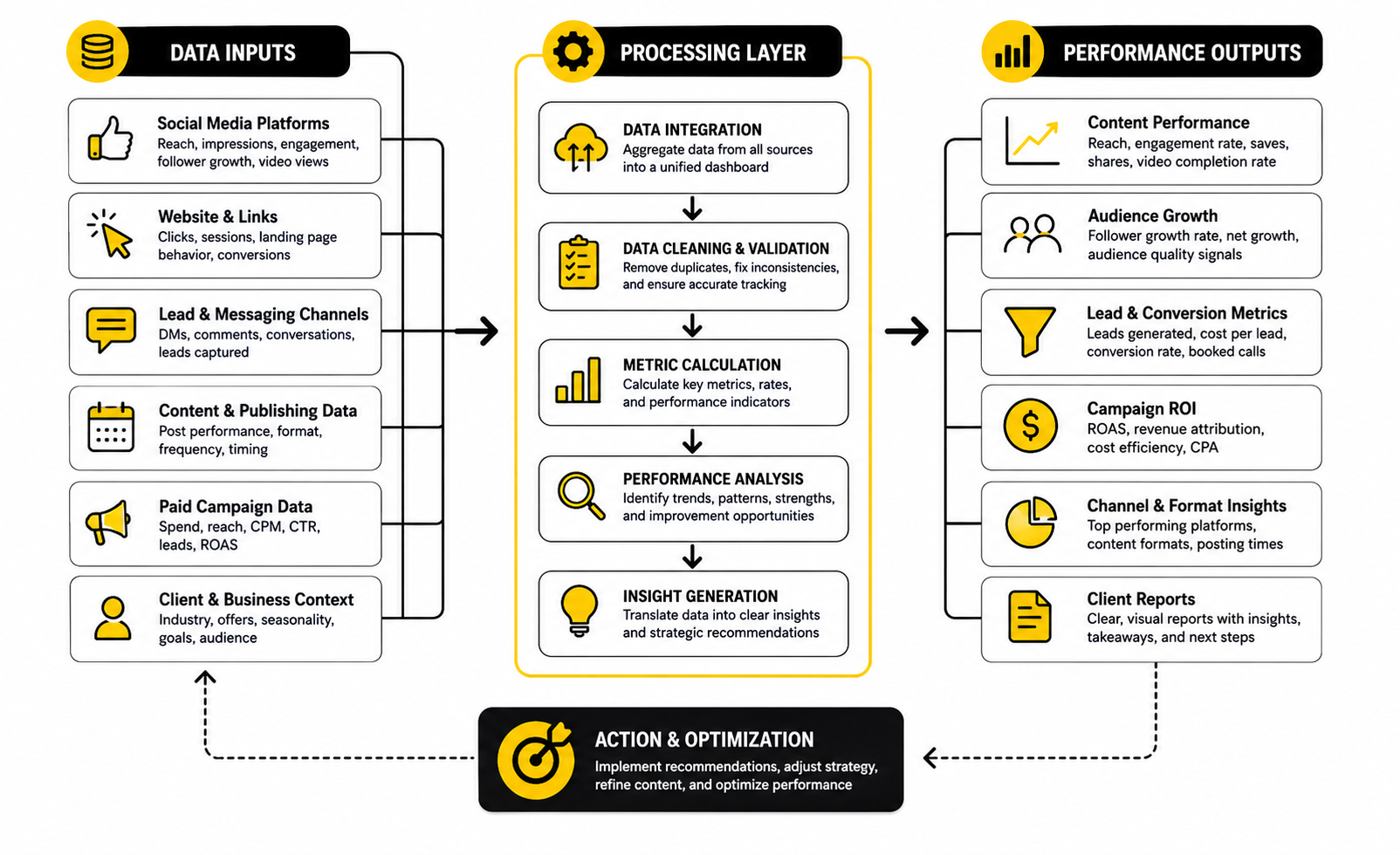
This structure helps the client understand the difference between work completed, attention earned, interaction created, and business impact. That distinction is critical. A post can get attention without creating leads, and a post can generate useful buyer conversations without becoming the most-liked asset of the month.
For agencies using CRM and pipeline workflows, GoHighLevel can help connect social campaigns to forms, calendars, automation, and client reporting. For content scheduling and publishing consistency, Buffer can keep the posting layer organized. For campaigns where comments or direct messages trigger follow-up, ManyChat can make the engagement-to-conversation step easier to manage.
Measure Content Quality Through Patterns
Content quality is not measured by one viral post. It is measured by patterns across multiple posts, formats, topics, and campaigns. A single spike can be useful, but it should not control the entire strategy.
Look for repeatable signs. Are educational posts getting saves? Are opinion posts creating comments? Are short videos reaching new audiences? Are client stories increasing profile visits? Are offer-led posts driving clicks or direct messages?
This is how you turn reporting into creative direction. If a topic creates saves and comments, expand it. If a format consistently gets reach but no action, adjust the call to action or the audience path. If polished graphics underperform but simple founder-led videos create conversations, the data is telling you where the audience feels more trust.
Separate Vanity Metrics From Decision Metrics
Vanity metrics are not useless. Likes, views, and follower growth can signal attention, and attention matters. The problem starts when those metrics are treated as proof of business progress without deeper context.
A decision metric helps you decide what to do next. Saves can suggest that the content is useful enough to revisit. Shares can suggest that the idea is resonating beyond the current audience. Comments can reveal objections, questions, and language your client should use in future content. Clicks and form fills show whether attention is turning into action.
A white label social media agency should explain this clearly to clients. If the client only cares about likes, you may end up optimizing for shallow approval instead of commercial value. If the client understands decision metrics, reporting becomes a strategy conversation rather than a scoreboard.
Read Platform Data Differently
Each platform has its own behavior, and that changes how you read performance. TikTok can create large reach without strong follower loyalty. LinkedIn can generate fewer interactions but more commercially relevant conversations. Instagram can support discovery, brand depth, and community, but formats matter heavily.
This is why one universal engagement rate target can be misleading. Rival IQ’s 2025 report notes that TikTok still leads in audience interaction compared with Instagram, Facebook, and X, even as TikTok engagement rates have continued to decline TikTok engagement benchmarks. That does not mean every client should move all effort to TikTok. It means the agency should judge platform performance based on the job that platform is supposed to do.
For example, a B2B client might accept lower reach on LinkedIn if the content creates sales conversations with qualified buyers. A local fitness studio might care more about Instagram saves, shares, profile visits, and booked trial sessions. An ecommerce brand might use TikTok for discovery and retarget interested viewers elsewhere.
Track Response Time and Conversation Quality
Social media is not only publishing. It is also customer interaction. If people comment, ask questions, send direct messages, or mention the brand, the response experience becomes part of the marketing performance.
This matters because customers increasingly expect brands to use social channels for service and communication. Sprout Social’s customer care research notes that 30% of consumers plan to use social media more in 2025, while 56% plan to maintain their current usage, and consumers rank personalized customer service as a top priority for brands on social social media customer service statistics.
For a white label social media agency, this creates a clear action point. Decide whether community management is included, excluded, or sold as an add-on. If it is included, measure response time, unresolved messages, sentiment themes, common questions, and opportunities passed to sales.
Make Reporting Useful for Retention
A monthly report should never feel like a homework assignment for the client. It should be short enough to read, clear enough to understand, and practical enough to guide the next month. The client should leave the report knowing what worked, what did not, what the agency learned, and what will change.
A strong report can follow this structure:
This is where the white label model needs a visible agency layer. Your fulfillment partner might prepare the raw numbers, but the client should hear interpretation from you. That is how the agency keeps strategic control and avoids being judged only on deliverables.
Use Data to Improve the Offer Itself
The best use of data is not just improving posts. It is improving the agency’s offer. If every client struggles with approvals, the problem is your approval workflow. If content performs but leads do not convert, the problem may be the landing page, form, calendar, or sales follow-up.
This is where a white label social media agency can create more value without simply adding more posts. You might improve the intake form, tighten the content pillars, add a DM automation path, create a better lead magnet, or connect campaign traffic to a stronger funnel. A tool like ClickFunnels can make sense when the missing piece is a dedicated conversion path after social traffic leaves the platform.
Data should drive operational decisions too. If revision time is too high, improve briefs. If reports take too long, simplify the dashboard. If clients ask the same questions every month, change how you explain results. That is how measurement turns into margin, not just charts.
How to Choose, Manage, and Scale White Label Partners
Once measurement is in place, the next question is capacity. If your agency can prove what is working, explain what needs to improve, and keep clients confident, you will eventually need more production support. That is where partner selection becomes a serious strategic decision, not just a quick vendor search.
A white label social media agency is only as strong as the delivery system behind it. The partner does not need to be perfect, but they do need to be reliable, coachable, organized, and capable of matching your standards. If they cannot do that, every new client adds risk instead of leverage.
This is the part many agency owners underestimate. They spend weeks refining the sales offer, then choose fulfillment based on a few portfolio samples and a cheap monthly price. That is backwards. The fulfillment partner is part of your client experience, even if the client never sees their name.
Choose for Fit, Not Just Skill
Skill matters, but fit matters more. A white label partner can be talented and still be wrong for your agency if their process, communication style, creative taste, or turnaround rhythm does not match your offer. You are not hiring an artist in isolation. You are building an operating system.
Start by checking whether the partner understands your client type. A team that creates trendy consumer content may not be right for a B2B founder-led LinkedIn offer. A partner that is strong with local service businesses may not understand ecommerce campaign cycles, product drops, or retention-focused creative.
You should also check how they think, not only what they produce. Ask how they handle unclear briefs, client feedback, platform changes, missed deadlines, and performance drops. Their answers will tell you whether they are a real partner or just a production queue.
Test the Partner Before You Give Them Clients
Do not hand over live client work without a test. That sounds obvious, but many agencies skip this because they are already overloaded. They need help fast, so they bring in a partner and hope the first batch works.
A better approach is to run a paid test using a realistic brief. Give the partner a sample client profile, brand voice, offer, platform goal, competitor context, and expected deliverables. Then review the work as if it were going to a real client.
Look for more than creative quality. Check whether they followed instructions, asked smart questions, organized files clearly, respected deadlines, and explained their decisions. A white label social media agency needs partners who reduce management load, not partners who create another layer of babysitting.
Protect the Client Relationship With Clear Boundaries
The agency must own the client relationship. That means the client should know who to contact, where feedback goes, how approvals work, and what happens when something changes. If the white label partner communicates directly with the client, the rules need to be explicit.
Some agencies keep all partner communication fully internal. Others allow white label specialists to join calls under the agency brand. Both can work, but the second option requires tighter training, stronger confidentiality rules, and clear expectations about language, positioning, and authority.
The danger is role confusion. If the client starts seeing the partner as the real expert and your agency as the messenger, your strategic position weakens. Your agency should remain the visible leader, even when specialists support execution.
Build Redundancy Before You Need It
One fulfillment partner is convenient. One fulfillment partner is also a risk. If that partner gets overloaded, changes pricing, loses key staff, misses deadlines, or shifts direction, your agency can suddenly have a delivery problem across multiple accounts.
Redundancy does not mean constantly switching partners. It means having backup options tested and ready. You might use one primary partner for standard content, another for short-form video editing, and a separate specialist for paid social creative or community management.
This protects the business as it grows. A white label social media agency should not depend on a single person or vendor for the entire delivery promise. The more clients you serve, the more important backup capacity becomes.
Decide What Should Stay In-House
Not everything should be white labeled forever. As your client base grows, some roles may become important enough to bring closer to the agency. Usually, those roles are strategy, account management, quality control, client reporting, and offer development.
Production can often stay flexible for longer. Design, caption drafting, video editing, scheduling, and report preparation can be handled through white label partners when the process is clear. But the closer a task gets to client trust, positioning, or commercial judgment, the more careful you need to be.
The smart path is not “in-house or white label.” It is a blended model. Keep the highest-leverage judgment inside the agency and use partners for repeatable production, specialist execution, and overflow capacity.
Watch for Margin Creep
Margin creep happens when small delivery costs increase slowly until the offer stops being profitable. One extra revision here, one urgent request there, a slightly higher partner fee, an unbilled reporting call, a rush design job, and suddenly the account looks busy but earns very little. This is one of the biggest scaling traps.
The fix is to monitor account profitability monthly. Track client revenue, partner cost, internal time, software cost, revision load, and account management time. If the client is profitable on paper but draining internal attention, that still matters.
AgencyAnalytics’ 2025 benchmark report found that AI has cut content creation time for 58% of agencies, which shows why agencies are looking for efficiency gains in delivery 2025 Marketing Agency Benchmarks Report. But faster production does not automatically create profit. You still need scope discipline, approval control, and pricing that reflects the full client experience.
Scale the Offer Before You Scale the Team
A common mistake is scaling people before scaling the offer. The agency adds more contractors, more tools, more calls, and more internal complexity before the core package is truly repeatable. That makes growth feel heavier than it should.
Scale the offer first. Tighten the intake, simplify the deliverables, standardize the approval workflow, clarify the reporting structure, and remove unnecessary custom work. Then add fulfillment capacity around a process that already works.
This is where templates are useful, but only if they improve quality. Brief templates, onboarding checklists, reporting formats, and campaign planning documents help a white label social media agency deliver consistently. They should guide thinking, not replace it.
Use AI Carefully Inside the Delivery System
AI can make social media delivery faster, but it can also make bad content faster. That is the uncomfortable truth. If your process already produces generic ideas, AI will often multiply that problem unless a human sets the direction and edits with taste.
Use AI for research support, draft variations, repurposing, transcription, content summaries, hook exploration, and workflow speed. Do not use it as a replacement for strategy, brand understanding, compliance judgment, or final approval. The client is paying for your agency’s judgment, not just output volume.
This also needs to be handled honestly inside your operating system. Define where AI is allowed, where human review is required, and how sensitive client information should be protected. A serious white label social media agency cannot treat AI usage as a vague background detail.
Create a Partner Scorecard
If you want to scale without guessing, score your partners. This does not need to be corporate or complicated. It just needs to make performance visible.
A practical partner scorecard can include:
Review the scorecard monthly or quarterly. If a partner is strong but slipping, address it early. If a partner consistently creates rework, the cheap price is not cheap anymore.
Know When to Raise Prices
If your white label social media agency gets better, your pricing should eventually reflect that. Better onboarding, stronger creative direction, tighter reporting, faster delivery, and clearer strategic thinking all increase value. If the service improves but pricing stays the same, the agency absorbs the benefit instead of sharing it with the business.
Raise prices when your costs increase, when your process becomes more valuable, when demand exceeds capacity, or when the offer starts creating stronger client outcomes. Do it with confidence, not apology. Clients who value the relationship will usually understand when the value is clear.
The key is to avoid random price hikes. Tie pricing to scope, service level, speed, complexity, and strategic involvement. A client who wants more channels, faster turnarounds, more revisions, deeper reporting, or community management should expect to pay more.
Avoid Becoming Invisible
The final advanced risk is invisibility. If the white label partner does most of the visible work and your agency only forwards updates, the client may start wondering what they are paying you for. That is dangerous, especially when budgets tighten.
Your agency must stay visible through strategy, communication, interpretation, and leadership. Bring ideas to the client before they ask. Explain tradeoffs. Challenge weak assumptions. Connect social media activity to the bigger business picture.
That is how you protect retention. The client should feel that your agency is leading the account, not merely managing a vendor. When that is true, the white label model becomes a serious scaling advantage instead of a fragile delivery shortcut.
Risks, FAQs, and the Final Decision Checklist
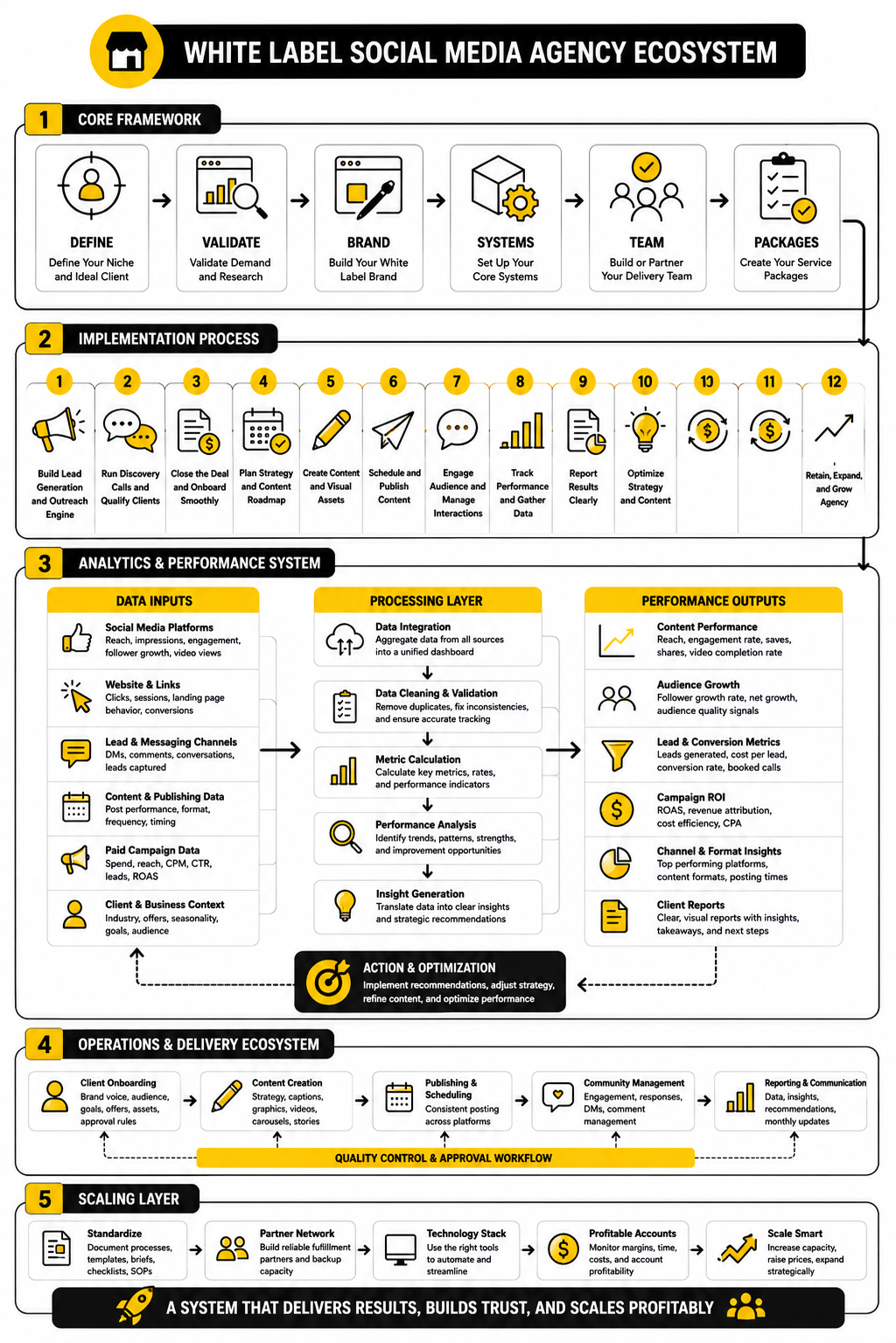
A white label social media agency becomes easier to scale when the backend is treated like an ecosystem. The agency owns the client relationship, the strategy, the quality standard, the reporting interpretation, and the commercial direction. The partner supports execution, but the agency still leads.
That ecosystem needs clear rules. Without rules, growth creates hidden problems: inconsistent output, weak client communication, unclear responsibilities, messy approvals, margin pressure, and reporting that does not lead to better decisions. With rules, the same model becomes a reliable way to grow without building every specialist role in-house.
The final step is to look at the full system before deciding whether to scale. If the offer is clear, the partner is reliable, the process is documented, the metrics are useful, and the agency still controls the client experience, the model is strong. If any of those pieces are missing, fix the system before adding more accounts.
Final Decision Checklist
A white label social media agency is a good fit when you already understand the service well enough to lead it. You do not need to personally create every asset, but you do need to know what good work looks like. That judgment is what protects the client and the margin.
Use this checklist before scaling the model:
If you can check most of those boxes, the model is ready to grow. If you cannot, do not panic. The answer is not to avoid white label delivery; the answer is to tighten the system before adding pressure.
What is a white label social media agency?
A white label social media agency sells social media services under its own brand while using an outside partner to help fulfill some or all of the work. The client works with the agency, not the backend provider. The agency usually owns strategy, client communication, approvals, reporting, and account growth.
This model is common because social media delivery includes many repeatable tasks. Content planning, caption drafting, graphic design, scheduling, reporting, and community support can all be systemized. The agency’s job is to make sure the work still feels strategic, branded, and client-specific.
Is white label social media management the same as outsourcing?
Not exactly. Outsourcing usually means handing off tasks to an outside person or team. White label social media management means the outside work is delivered under your agency’s brand and inside your client experience.
The difference is control. A proper white label model should include standards, briefs, review steps, communication rules, and reporting expectations. If you are simply forwarding client requests to a vendor and forwarding files back, that is outsourcing without much strategic value.
Can clients know that a white label partner is involved?
They can, depending on how your agency positions the relationship. Some agencies keep fulfillment fully behind the scenes. Others tell clients they use specialist production partners while making it clear that the agency remains accountable.
The important thing is not to misrepresent the service. If your contract, sales promise, or client communication says everything is handled by in-house employees, then using outside partners can create trust problems. Be clear in your agreements and own the client experience either way.
How much should a white label social media agency charge?
Pricing should be based on scope, complexity, turnaround speed, number of platforms, strategic involvement, and reporting depth. A basic content scheduling package should not be priced like a full strategy, creative, community, and lead-generation system. The more judgment and accountability your agency provides, the more the price should reflect that.
You also need to price around margin, not just competitor rates. Include partner fees, internal review time, account management, revisions, tools, reporting, and client calls. If the account looks profitable only because you ignore your own time, the pricing is not real.
What services can be white labeled?
Common white label social media services include content calendars, captions, graphics, short-form video editing, post scheduling, hashtag research, analytics reporting, community management, and campaign support. Some partners also support paid social creative, influencer coordination, or direct message workflows. The right scope depends on what your agency can confidently sell and manage.
The safest place to start is with production tasks that have clear inputs and outputs. Strategy, account management, and client interpretation are usually better kept close to the agency. That balance gives you leverage without weakening your authority.
What should stay inside the agency?
Strategy should usually stay inside the agency. So should client communication, positioning decisions, final quality control, reporting interpretation, and renewal conversations. These are the parts of the relationship that shape trust.
Production can be supported externally when the brief is strong and the review process is clear. That includes writing, design, editing, scheduling, and reporting preparation. The closer a task is to client confidence or business direction, the more carefully it should be managed.
How do you choose a reliable white label partner?
Start with fit. The partner should understand your client type, your platforms, your expected quality level, and your turnaround needs. Portfolio samples are helpful, but they are not enough.
Run a paid test before giving them live client work. Give them a realistic brief and judge the output, communication, file organization, deadline discipline, and ability to follow instructions. A reliable partner should reduce your workload, not create a second management problem.
What are the biggest risks of this model?
The biggest risks are weak quality control, unclear scope, inconsistent partner delivery, client communication gaps, and margin erosion. These problems usually appear slowly. At first, everything looks manageable, then the agency realizes every account needs too much manual correction.
The fix is process. Use better briefs, clearer packages, partner scorecards, internal reviews, approval rules, and profitability tracking. A white label social media agency does not fail because the model is bad; it fails when the operating system is weak.
Can a white label social media agency use AI?
Yes, but AI should support the workflow, not replace judgment. It can help with research, idea variations, repurposing, transcription, first drafts, and internal summaries. It should not be trusted blindly with brand voice, compliance-sensitive claims, final creative direction, or client-ready output.
Human review still matters. AI can make average content faster, but it can also make generic content easier to publish at scale. The agency needs a clear policy for where AI is allowed, what must be reviewed, and how client information is protected.
Which tools are useful for running the model?
The best tools are the ones that remove friction from your process. For publishing and scheduling, Buffer can help keep content organized. For CRM, forms, automation, pipeline tracking, and agency backend workflows, GoHighLevel can support a broader client operating system.
If your campaigns use comments or direct messages to trigger conversations, ManyChat can help manage that flow. If social campaigns need dedicated landing pages or funnels, ClickFunnels may fit the conversion side. The tool should serve the offer, not become the offer.
How do you measure success for white label social media services?
Success depends on the client’s goal. Awareness-focused clients need reach, impressions, profile visits, follower quality, and video views. Lead-focused clients need clicks, messages, form fills, booked calls, and pipeline movement.
The agency should also measure delivery health. Track on-time publishing, revision volume, approval delays, partner accuracy, client satisfaction, and account profitability. Good social media reporting looks at both performance and operations because both affect retention.
When should you stop using white label fulfillment and hire in-house?
Hire in-house when the workload is predictable, the role is central to your quality standard, and the margin can support the person without creating cash pressure. Strategy, account leadership, and quality control often become in-house priorities first. Production roles can stay flexible longer if the partner network is strong.
The mistake is hiring too early just because you want more control. Control is valuable, but fixed payroll adds risk when client volume is not stable. A blended model is often the more carefully path: keep leadership close and use partners for specialist or repeatable execution.
How can a small agency start without overcomplicating the model?
Start with one narrow offer, one client type, one primary platform mix, and one tested fulfillment partner. Build the intake, brief, review process, approval workflow, and report before trying to sell every possible social media service. Simplicity is not a weakness here.
Once the process works, expand carefully. Add more deliverables only when they strengthen the client outcome and can be delivered profitably. The best white label social media agency models grow from controlled systems, not from bloated service menus.
Build a stronger local presence with BAAM AI
Turn your website, Google profile, social channels, and AI visibility into one growth engine
Most businesses do not need more random marketing activity. They need a consistent presence system that helps the right people find them, trust them, and take action. BAAM AI brings strategy, local SEO, website updates, Google Maps visibility, social content, AI-search readiness, media production, and reporting into one practical monthly engine.
If you want your marketing to keep working after the campaign ends, start with a free BAAM AI presence audit. See how your business shows up today and where the fastest visibility wins are at BAAM AI.