
BAAM AI Blog
What The Klaviyo Terms Of Service Actually Cover
The Klaviyo terms of service are not just a boring legal page you accept when creating an account. They define the commercial relationship between you and Klaviyo, including how the platform can be used, what happens...
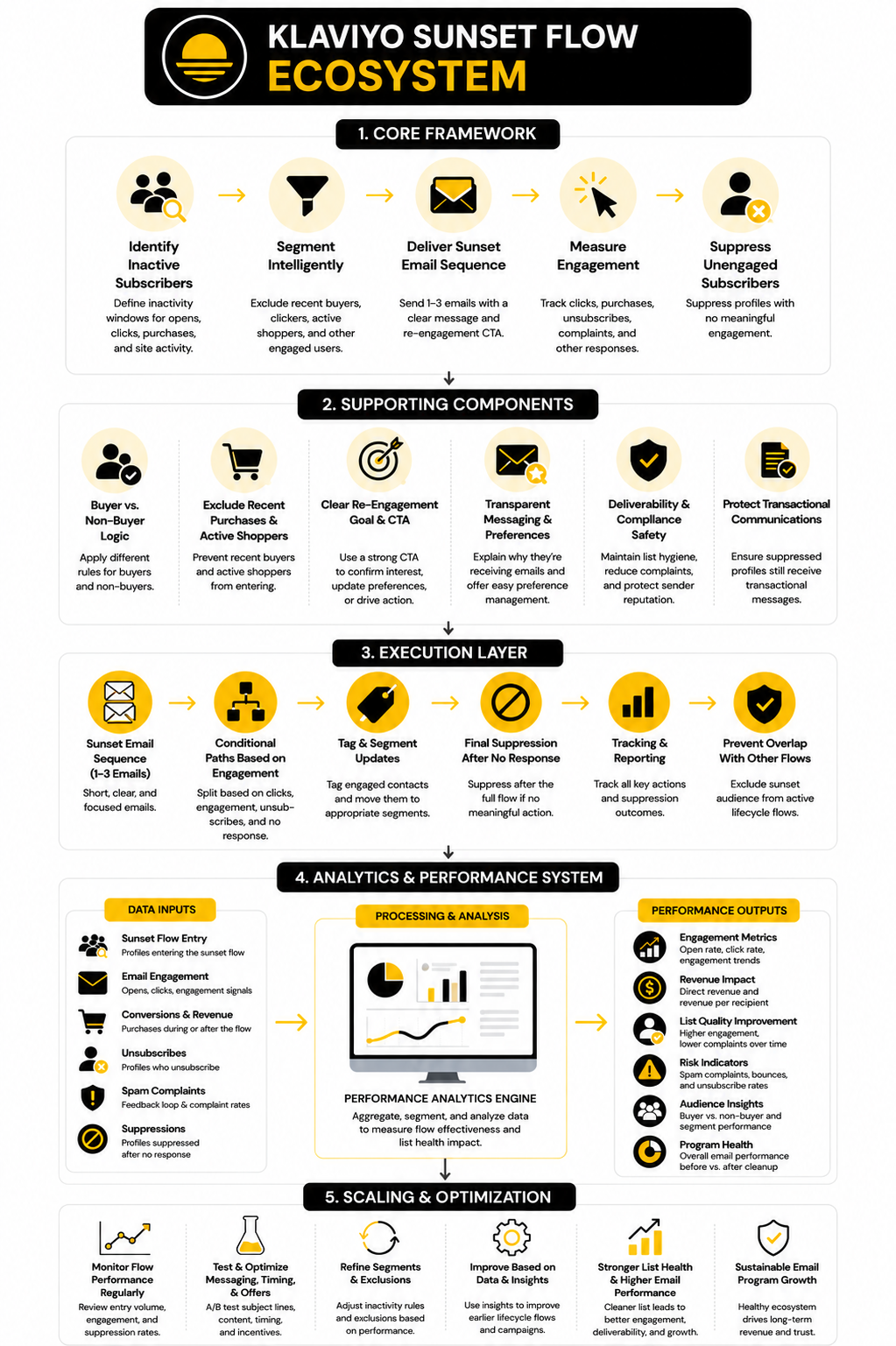
What The Klaviyo Terms Of Service Actually Cover
The Klaviyo terms of service are not just a boring legal page you accept when creating an account. They define the commercial relationship between you and Klaviyo, including how the platform can be used, what happens when rules are broken, and which responsibilities stay with your business. That matters because Klaviyo is not simply storing contacts; it is helping you send email, SMS, push messages, forms, automations, and customer data-driven campaigns at scale.
The important thing to understand is that Klaviyo’s legal framework is split across several pages. The main legal hub links out to policies covering acceptable use, privacy, data processing, subprocessors, SMS terms, and other service-specific rules through Klaviyo’s own legal terms and policies. So when people talk about the Klaviyo terms of service, they usually mean the full set of rules around the platform, not just one isolated document.
That is why you should not treat the terms like a one-time checkbox. If your business relies on Klaviyo for revenue, these terms affect deliverability, compliance risk, billing, account access, customer data, and even whether you can keep sending campaigns. In plain English, the terms decide what you can do, what Klaviyo can restrict, and what happens if your marketing creates risk for the platform.
Your Account Responsibilities
The first practical layer is account responsibility. If you use Klaviyo, you are responsible for what happens inside your account, including the contacts you upload, the campaigns you send, the automations you build, and the claims you make in your messages. Klaviyo provides the software, but your business is still the sender, advertiser, data controller in many situations, and brand behind the message.
This is especially important for ecommerce teams that have multiple people working inside the same account. A founder, agency, freelancer, retention marketer, developer, and customer support person can all touch different parts of the setup. If someone imports a weak list, sends prohibited SMS content, changes consent settings, or builds a misleading flow, the consequences usually land on the account owner.
You should also think carefully about access control. Do not give every contractor admin-level access just because it is convenient. Keep permissions tight, remove users when they leave, and document who is responsible for list imports, compliance settings, SMS setup, integrations, and campaign approvals.
Consent Is Not Optional
Consent is one of the biggest practical issues inside the Klaviyo terms of service because email and SMS marketing are permission-based channels. Klaviyo’s help documentation makes a clear distinction between email and SMS consent, and it explains that rules can vary by channel and region in its guide to understanding consent in profiles. That means you cannot assume that someone who gave you their email also gave you permission to text them.
This is where many brands get sloppy. They collect a phone number at checkout, sync it into Klaviyo, and assume it is safe to use for SMS campaigns. But SMS consent usually needs to be explicit, clearly disclosed, and tied to the type of messages the person agreed to receive.
For email, you still need clean acquisition practices. Bought lists, scraped contacts, unclear giveaways, and old databases can create deliverability problems even if they technically upload into the platform. Klaviyo may give you the tool to send, but the Klaviyo terms of service put the burden on you to make sure the people receiving your messages should actually be receiving them.
SMS Has Stricter Rules Than Email
SMS deserves its own section because it is more heavily restricted than email. Klaviyo’s SMS compliance guidance highlights core principles like getting explicit consent, making opt-out easy, avoiding prohibited content, and following message-sending rules in its SMS compliance basics. This is not just a Klaviyo preference; carriers, regulators, and messaging providers all have rules that can block or penalize risky senders.
The practical takeaway is simple: do not treat SMS like a shorter version of email. Text messages are more intrusive, more regulated, and more likely to trigger complaints if the recipient does not clearly remember opting in. A discount campaign that feels normal by email can feel aggressive by text if the customer did not expect it.
Klaviyo also lists categories that may be rejected or prohibited for SMS, including high-risk areas such as illegal substances, hate, firearms, tobacco, alcohol-related restrictions, and other sensitive content in its guidance on SMS and MMS prohibited content. If your brand sits anywhere near a regulated category, check the rules before building a campaign. Guessing is a bad strategy here.
Acceptable Use Rules Matter More Than Most Brands Think
The Acceptable Use Policy is one of the most important documents connected to the Klaviyo terms of service. Klaviyo updated its Acceptable Use Policy in April 2026, and it explains the types of activity and content that are not allowed when using its services. This is where you find the boundaries that protect Klaviyo, its infrastructure, inbox reputation, carrier relationships, and other customers on the platform.
This matters because email and SMS platforms are reputation-sensitive. One bad sender can damage shared infrastructure, trigger spam complaints, create carrier issues, or attract legal scrutiny. So Klaviyo has every incentive to restrict behavior that puts its network at risk.
For your business, the point is not just “avoid illegal things.” The more carefully way to read the policy is to ask whether your marketing could look deceptive, abusive, non-consensual, high-risk, or harmful from the outside. If the answer is yes, fix the campaign before you send it.
Data Processing And Customer Data
Klaviyo handles a lot of customer data. For a typical ecommerce store, that can include names, email addresses, phone numbers, purchase history, browsing behavior, event data, segmentation logic, and engagement activity. That is powerful for personalization, but it also means your Klaviyo account becomes part of your privacy and data protection responsibilities.
Klaviyo’s Data Processing Agreement explains how customer personal data is processed, how subprocessors are handled, and how customer instructions fit into the relationship. One practical detail worth noticing is that Klaviyo says it may store and process customer personal data anywhere Klaviyo or its subprocessors maintain facilities, subject to the DPA’s transfer provisions. That is the kind of detail privacy-conscious teams should review before signing off on a vendor.
You do not need to become a lawyer to use Klaviyo responsibly. But you do need to know what data you are sending into the platform, why you are sending it, how long you keep it, and how you respond when a customer asks to access, delete, or change their data. The tool can support your marketing, but it does not remove your privacy obligations.
Subprocessors Are Part Of The Deal
Most SaaS platforms rely on subprocessors, and Klaviyo is no different. A subprocessor is a third-party provider that helps deliver the service, such as infrastructure, hosting, analytics, support, or other operational functions. Klaviyo’s DPA states that subprocessors are bound by written data protection obligations, and Klaviyo remains liable for their compliance with those obligations under the agreement.
This matters because your customer data may not stay inside one single company’s systems. Even if Klaviyo is your main vendor, other approved providers may help process parts of the service. For many businesses, that is normal and acceptable, but it should still be reviewed as part of vendor due diligence.
If you sell into the EU, UK, Canada, California, or other privacy-sensitive markets, make this part of your compliance checklist. Review Klaviyo’s DPA, understand the subprocessor process, and keep your own privacy policy aligned with the tools you actually use. A privacy policy that says one thing while your tech stack does another is a liability waiting to happen.
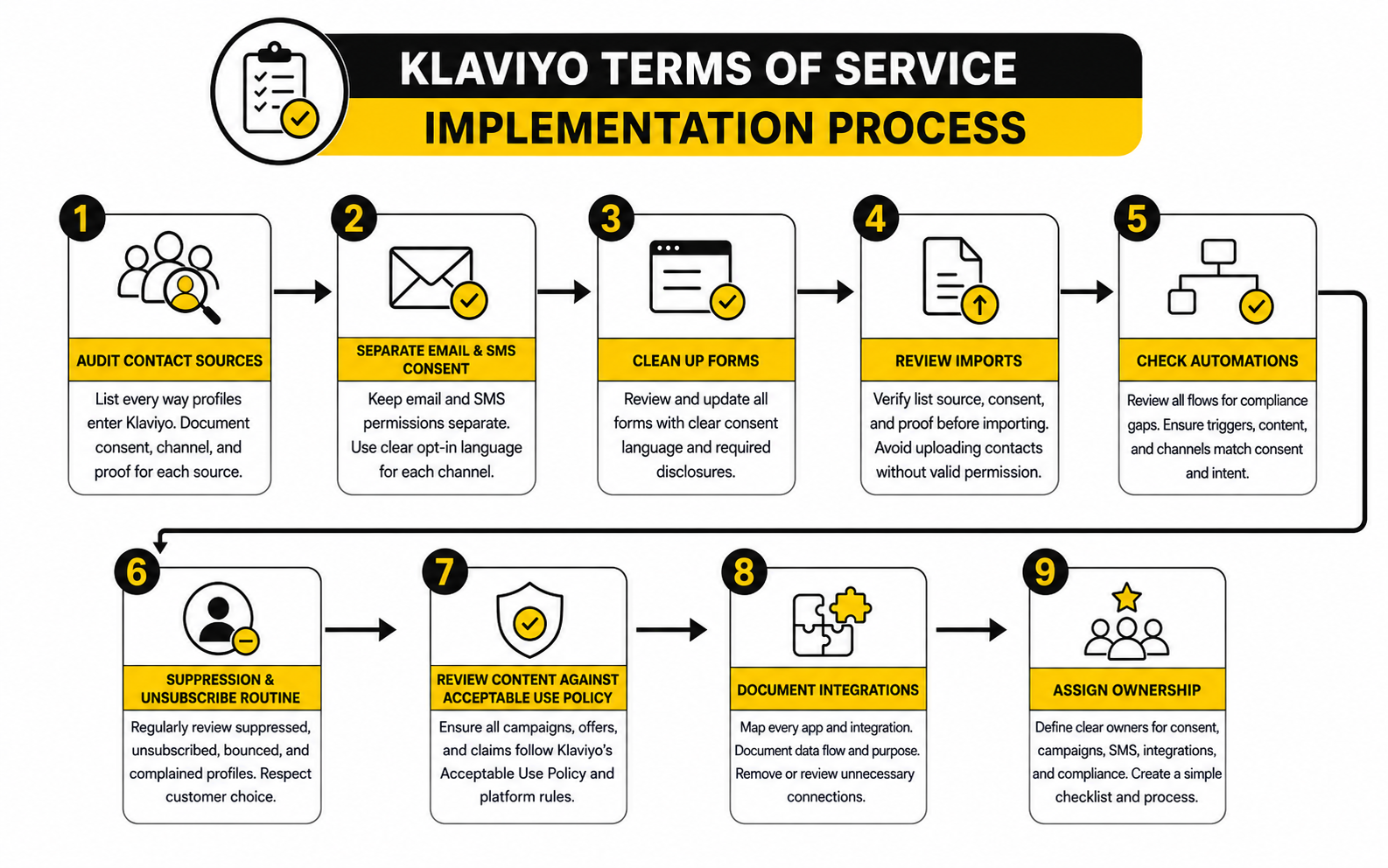
How To Implement The Klaviyo Terms Of Service In Your Account
Reading the Klaviyo terms of service is useful, but the real value comes from turning the rules into a working process. You do not want compliance living in someone’s memory, buried in a Slack thread, or handled only when something goes wrong. You want a repeatable setup that protects your account before you send campaigns, launch SMS, import contacts, or connect new tools.
The best way to think about this is simple: every subscriber should have a clear source, every message should have a clear permission basis, and every integration should have a clear reason to access customer data. That is the practical version of compliance. It is not glamorous, but it keeps your marketing machine clean.
Step 1: Audit Where Your Contacts Come From
Start by listing every place where a profile can enter Klaviyo. That usually includes checkout, popup forms, footer forms, quizzes, lead magnets, manual imports, loyalty apps, review platforms, helpdesk tools, referral tools, and custom API connections. If you cannot explain where a contact came from, you should not blindly market to that person.
This matters because Klaviyo separates consent status from the existence of a profile. A customer can exist in your Klaviyo account without being properly subscribed to every marketing channel, and Klaviyo’s own guide to understanding consent in profiles makes that distinction clear. So the first job is not “how many profiles do we have?” The better question is “which profiles have valid marketing consent, for which channel, and from what source?”
Build a simple internal map. For each acquisition source, write down what the customer sees, what box or button they click, whether consent is pre-checked, which channel they are joining, and where the proof is stored. That one exercise will expose most risky setups fast.
Step 2: Separate Email Consent From SMS Consent
Email and SMS should never be treated as one permission bucket. Someone can agree to receive email without agreeing to receive texts, and someone can give a phone number for shipping updates without agreeing to promotional SMS. If your setup blurs that line, fix it before scaling campaigns.
For SMS, the standard is usually stricter because the customer is giving you access to a much more personal channel. Klaviyo’s 2025 SMS guidance frames compliance around proper consent, appropriate content, and message-sending rules in its SMS compliance guide. That means your forms, checkout language, and preference pages need to make the SMS commitment obvious.
The practical move is to keep separate fields, separate opt-ins, and separate documentation for each channel. Do not use one vague “sign up for updates” message and assume it covers everything. Clear consent is boring until you need to prove it.
Step 3: Clean Up Forms Before You Drive More Traffic
Signup forms are often where compliance problems begin. A brand launches a popup quickly, adds a discount, connects it to a list, and never reviews the language again. Months later, the store is running paid traffic, influencer campaigns, and automated welcome flows through a form nobody has checked since launch.
Your forms should clearly say what the person is signing up for. If the form collects email, say they are joining email marketing. If it collects SMS, include the required SMS disclosure language, opt-out language, and any other region-specific details that apply to your market. Klaviyo also has a help article on how to create a mobile terms of service in Klaviyo, which is especially relevant if you are using SMS.
Do not hide the important parts in tiny language that nobody can reasonably notice. Yes, the wording needs to be legally safe. But it also needs to be understandable to a normal customer deciding whether to subscribe.
Step 4: Review Imports Before They Hit A List
Manual imports deserve extra attention because they are one of the easiest ways to create problems inside Klaviyo. A CSV can look innocent, but it might include old buyers, giveaway participants, scraped leads, partner contacts, retail customers, or people who never agreed to marketing. Once that file is imported and used in a campaign, the damage is already done.
Before importing, ask three questions. Where did these contacts come from? What exactly did they agree to receive? Can we prove it if challenged? If the answer is weak, do not upload them as active marketing subscribers.
This is also where you should be careful with agencies and freelancers. Nobody should be importing lists into your Klaviyo account without a written process. If you use an outside team, make list import approval part of their scope, not an informal task they handle on the fly.
Step 5: Check Every Automation For Compliance Gaps
Flows are powerful because they keep sending after you stop thinking about them. That is exactly why they need a compliance review. A campaign goes out once, but an abandoned cart flow, welcome series, winback flow, post-purchase sequence, or replenishment reminder can keep running for months.
Look at every live flow and ask whether the trigger, audience, message, and channel still make sense. A post-purchase email to a customer may be fine, but adding SMS to that same journey needs separate consent. A winback email might be reasonable for subscribed customers, but sending aggressive messages to stale or questionable contacts can hurt deliverability and trust.
Klaviyo’s email deliverability best practices are worth reviewing here because compliance and deliverability overlap in the real world. Bad consent creates bad engagement. Bad engagement creates inbox problems. Inbox problems create revenue problems.
Step 6: Create A Suppression And Unsubscribe Routine
Suppressions are not just a cleanup feature. They are part of how you respect customer choice and protect your sender reputation. If someone unsubscribes, bounces, complains, or should not receive marketing anymore, your account needs to reflect that clearly.
Build a routine for reviewing suppressed profiles, unsubscribes, complaints, and bounce patterns. You do not need to obsess over every single profile, but you should know whether suppression volume is rising, whether one form source is producing low-quality subscribers, or whether a specific campaign created unusual complaints. That is how you catch issues before they become account-level problems.
This also protects your team from making emotional decisions. When revenue is down, the temptation is to “just email more people.” A suppression routine gives you a hard line. Some people should not be messaged, even if a bigger send looks tempting on paper.
Step 7: Review Content Against The Acceptable Use Policy
Before sending campaigns, review the actual content through the lens of Klaviyo’s Acceptable Use Policy. Klaviyo’s Acceptable Use Policy covers prohibited activities and content, and it was updated on April 9, 2026. That makes it one of the first documents to check if your brand sells anything regulated, sensitive, controversial, or easy to misrepresent.
Do not only review product categories. Review the claims you make, the urgency you use, the discounts you advertise, and the way you describe outcomes. A compliant product can still be marketed in a risky way if the message is deceptive, misleading, or too aggressive.
This step is especially important for brands in wellness, finance-adjacent offers, supplements, alcohol-related products, adult categories, tobacco-adjacent products, weapons-adjacent categories, or anything with age restrictions. If your product needs careful positioning on paid ads, it probably needs careful positioning in Klaviyo too.
Step 8: Document Your Vendor And Integration Setup
Klaviyo often sits in the middle of a bigger stack. Your store platform, landing page builder, quiz tool, reviews app, loyalty program, customer support tool, CRM, analytics platform, and attribution tools may all push or pull customer data. That makes integration review part of implementing the Klaviyo terms of service.
For every connected app, write down what data it sends into Klaviyo, what data it receives from Klaviyo, and why that connection is needed. If nobody can explain the purpose of an integration, disconnect it or investigate it. Extra data access creates extra risk.
This also helps with privacy reviews. Klaviyo’s Data Processing Agreement explains how customer personal data and subprocessors are handled, but your business still needs to understand the full stack around Klaviyo. A clean integration map makes that much easier.
Step 9: Assign Ownership Inside The Team
The final step is assigning real ownership. Compliance fails when everyone assumes someone else handled it. One person should own consent sources, one person should own campaign approval, one person should own SMS compliance, and one person should own vendor or integration review.
In a small business, that might all be the founder. In a bigger ecommerce team, it might be split between lifecycle marketing, operations, legal, and development. The structure matters less than the clarity.
Make the process easy enough that people will actually follow it. A lightweight checklist before imports, before new flows, before SMS launches, and before new integrations will do more than a giant policy document nobody opens. The goal is not to slow the team down. The goal is to keep the account safe while the team moves fast.
Statistics And Data
Measurement is where the Klaviyo terms of service become practical. If your numbers show weak consent, poor engagement, rising complaints, or unusual unsubscribe behavior, that is not just a marketing problem. It can become a deliverability problem, a compliance problem, and eventually an account risk problem.
Do not look at analytics as a trophy cabinet. A high revenue number looks great until you realize it came from overmailing tired subscribers, pushing SMS too hard, or relying on a segment that should have been suppressed months ago. The goal is not to make every metric look pretty. The goal is to understand what the data is telling you before the platform, inbox providers, carriers, or customers force the issue.
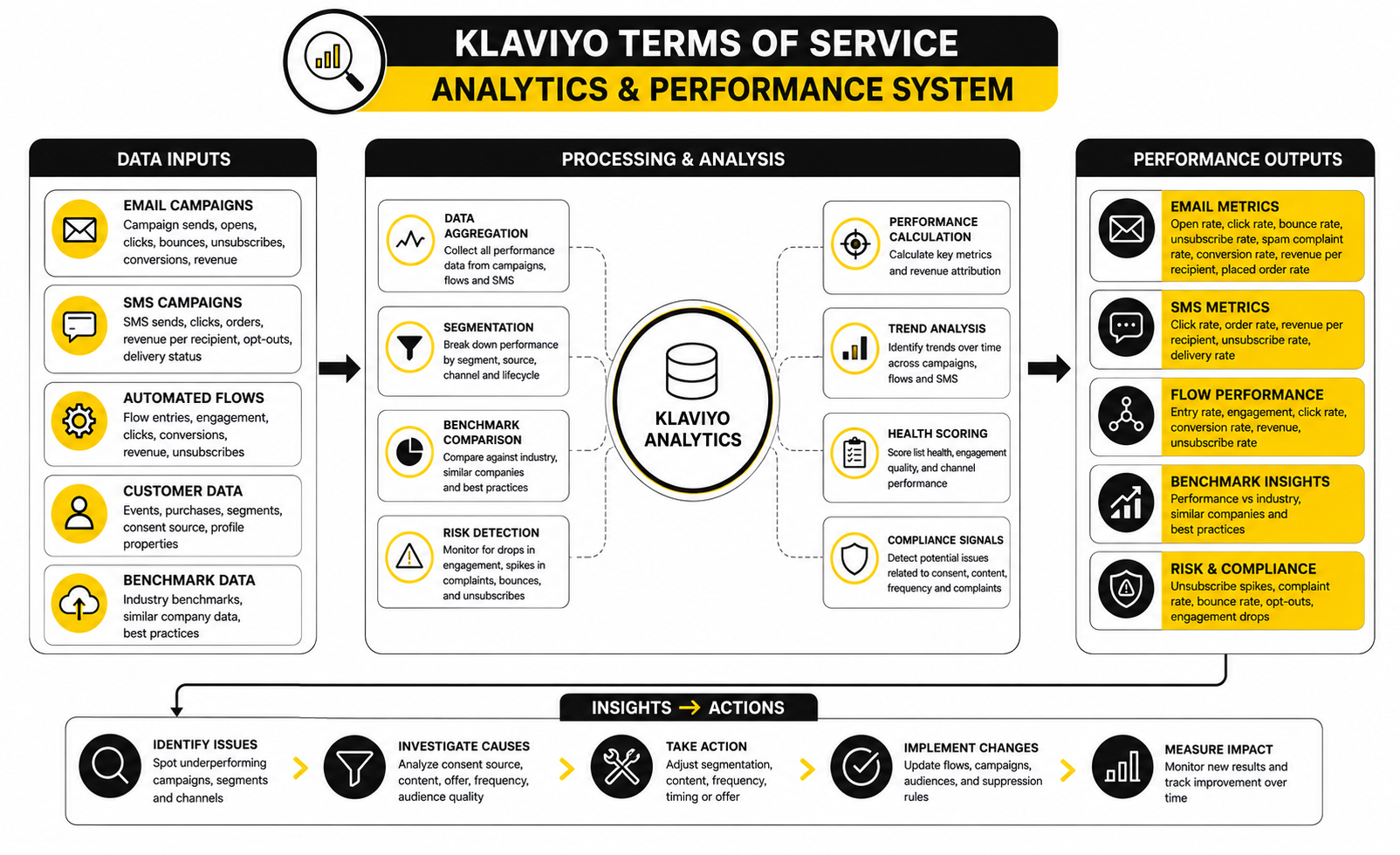
The Metrics That Actually Matter
Start with the core health metrics: open rate, click rate, bounce rate, unsubscribe rate, spam complaint rate, conversion rate, revenue per recipient, SMS unsubscribe rate, and placed order rate. Klaviyo’s own deliverability guidance tells users to monitor open rates, click rates, bounce rates, unsubscribe rates, and spam complaint rates because those signals help reveal whether your email program is healthy or drifting into risk. That lines up with the broader benchmark reporting Klaviyo provides for email marketing performance and SMS marketing performance.
The mistake is treating those numbers as isolated stats. A strong open rate with weak clicks may mean the subject line works but the offer or audience is wrong. A strong revenue per recipient with a rising unsubscribe rate may mean the campaign made money, but at the cost of future list quality.
The clean way to read the data is to separate engagement, conversion, and risk. Engagement tells you whether people care. Conversion tells you whether the message drives revenue. Risk tells you whether the way you are getting that revenue is sustainable.
Benchmarks Are Context, Not A Grade From God
Benchmarks help because they stop you from guessing. Klaviyo says its benchmark reports compare your account data against best practices, industry trends, and similar companies, with benchmark data updated monthly for eligible accounts in its guide to getting started with benchmark reports. That is useful because a beauty brand, apparel store, supplement brand, and home goods store should not blindly expect the same performance.
But benchmarks are not the strategy. They are a diagnostic tool. If your email click rate is below your industry average, the answer is not “send more emails.” The better question is whether your segmentation is too broad, your offer is weak, your creative is unclear, your list is stale, or your consent sources are bringing in the wrong people.
Use benchmarks to find the gap, then use your own account data to explain the gap. A benchmark can tell you that something is underperforming. It cannot tell you the full reason without context from your forms, flows, offers, segments, and customer lifecycle.
Flow Performance Tells You Whether Your Consent Is Useful
Automated flows are one of the best places to measure whether your subscriber acquisition is healthy. If your welcome flow performs well, people probably understand what they signed up for and still have buying intent. If your welcome flow gets poor clicks, high unsubscribes, or low conversion, your form may be attracting low-quality leads or making a promise your emails do not fulfill.
Klaviyo’s 2026 benchmark material notes that automated flows can outperform campaign emails across key metrics, with flow-based emails showing stronger click and order performance than campaigns in its email benchmark breakdown. That makes sense because flows usually hit people at a more relevant moment. A welcome email, abandoned cart reminder, or post-purchase message has more context than a broad promotional blast.
This is why flow reporting should not only be used to chase revenue. It should also be used to spot mismatches between consent, timing, and message content. If a flow is profitable but creates a high unsubscribe rate, do not celebrate too quickly. That number is telling you the message may be squeezing revenue out of people who do not want that relationship.
Campaign Data Shows Whether You Are Overusing The List
Campaigns reveal list fatigue faster than almost anything else. If open rates slowly fall, click rates weaken, unsubscribes rise, and revenue per recipient drops, your audience is probably getting less responsive. That can happen because you are sending too often, segmenting too loosely, repeating the same offer, or keeping unengaged contacts in active sends for too long.
This connects directly to the Klaviyo terms of service because list quality is not just a performance issue. If your campaigns generate complaints, poor engagement, or suspicious sending patterns, they can create platform risk. Klaviyo’s email deliverability best practices emphasize monitoring performance metrics and maintaining list hygiene, which is exactly what keeps growth from turning into damage.
The action is simple. Create engaged segments, reduce sends to people who have stopped interacting, and treat repeated non-engagement as a signal. A smaller clean send often beats a bigger reckless send because it protects inbox placement, brand trust, and future revenue.
SMS Metrics Need A Different Interpretation
SMS metrics should be judged more carefully than email metrics. A text message is more direct, more personal, and more likely to annoy people if the timing or consent is wrong. That means an SMS campaign can produce revenue and still be a bad campaign if unsubscribe rates or complaints are moving in the wrong direction.
Klaviyo’s SMS benchmark reporting focuses on click rate, order rate, revenue per recipient, and unsubscribe rate in its SMS marketing benchmarks. Those are the right categories because SMS performance is not just about clicks. You need to know whether people buy, whether the channel pays for itself, and whether subscribers are leaving after each send.
If SMS unsubscribe rate climbs after promotional sends, do not just test a different discount. Look at opt-in source, message frequency, send timing, campaign relevance, and whether the subscriber expected promotional texts in the first place. SMS is a privilege channel. Treat it that way.
Revenue Attribution Can Be Misleading If You Do Not Understand It
Klaviyo revenue attribution is useful, but it should not be treated as perfect truth. Attribution depends on windows, tracking rules, customer behavior, and how your store connects events back to messages. If you change attribution settings, compare periods carelessly, or ignore other marketing channels, you can make the numbers say more than they really prove.
The practical problem is that email and SMS often assist conversions rather than create them alone. A customer might see a paid ad, browse the site, receive an abandoned cart email, click an SMS, and then buy later. Klaviyo may attribute the order to a message, but that does not mean the message did 100% of the work.
So use attribution for decisions, not ego. Ask whether a flow or campaign improves buying behavior compared with your baseline. Look at revenue per recipient, click quality, placed order rate, unsubscribe rate, and customer lifecycle stage together. One metric alone is too easy to misread.
Compliance Signals Hidden Inside Performance Data
Some of the most important compliance signals do not look like legal signals at first. A sudden spike in unsubscribes can mean a bad offer, but it can also mean people did not expect to be on the list. A high bounce rate can mean an old import, a poor acquisition source, or a data hygiene problem. Spam complaints can mean your content, consent, or frequency is out of alignment with customer expectations.
This is where the Klaviyo terms of service should influence how you review analytics. You are not just asking, “Did this campaign make money?” You are asking, “Did this campaign make money in a way we can keep defending?” That second question is the one mature operators ask.
Build a simple red-flag review after every major send. Watch for unusual changes in unsubscribe rate, complaint rate, bounce rate, SMS opt-outs, and click-to-conversion quality. If one source, segment, or campaign keeps creating negative signals, stop pushing volume through it until you understand why.
What To Do When The Numbers Look Bad
Bad numbers are not the end of the world. Ignoring them is. When performance drops, the right move is to isolate the cause before making the list bigger, the discount deeper, or the send frequency higher.
Start by comparing the weak send against your normal baseline. Then check whether anything changed: audience, offer, creative, timing, subject line, consent source, flow trigger, attribution window, or integration behavior. Most performance problems become easier to solve once you stop looking at “email revenue” as one big number and start breaking it into smaller causes.
A practical response might look like this:
The point is not to panic. The point is to use the data before the data becomes a bigger problem.
Build A Monthly Klaviyo Terms Of Service Health Review
A monthly review keeps this manageable. You do not need a 40-page compliance report. You need a short, consistent review that connects performance data with account safety.
Look at benchmark movement, list growth quality, consent sources, suppression trends, unsubscribe patterns, SMS opt-outs, bounce rates, spam complaints, flow performance, campaign performance, and integration changes. Then write down what changed and what action the team will take. That documentation can be very useful when you need to explain why a list was imported, why a segment was suppressed, or why SMS frequency changed.
This is how you make the Klaviyo terms of service operational. You turn legal risk into visible metrics. You turn vague “best practices” into a repeatable review. And you give your team a clear way to grow without gambling the account every time revenue pressure goes up.
Advanced Risks Most Teams Miss
Once the basic process is in place, the next challenge is scale. A small store can often manage Klaviyo with a simple checklist and a careful founder reviewing every campaign. A larger team needs stronger rules because more people, more tools, more countries, and more revenue pressure create more ways to make mistakes.
This is where the Klaviyo terms of service become less about “can we send this?” and more about “can we keep operating this system safely as it gets bigger?” That is a different question. It forces you to think about permissions, data flow, regional compliance, vendor risk, deliverability infrastructure, and how fast your team should move when the downside is account disruption.
Growth Creates Compliance Debt
Compliance debt works like technical debt. You can ignore it for a while, but it compounds quietly until one day the account is messy, the list sources are unclear, and nobody can explain why certain subscribers are receiving certain messages. At that point, fixing the problem is slower, more expensive, and more stressful than doing it correctly from the start.
The most common source of compliance debt is speed. A team launches a popup without reviewing the consent language. Then they connect a quiz tool. Then they import retail contacts. Then they add SMS. Then they launch in another country. Each move might seem small, but together they create a system where consent, data, and messaging rules are no longer easy to trace.
The antidote is not bureaucracy. The antidote is keeping a living operating document that tracks acquisition sources, data fields, consent language, suppression logic, flow ownership, and integrations. If a new marketer joins the team and cannot understand the system in one sitting, the system is already too fragile.
International Sending Needs Extra Discipline
Klaviyo can support brands selling across borders, but international sending adds complexity fast. Consent expectations, privacy rights, SMS rules, unsubscribe requirements, data transfer rules, and language requirements can vary by region. You cannot assume a setup built for one market is safe everywhere else.
This matters most when a store expands from one core country into the EU, UK, Canada, Australia, or other privacy-sensitive markets. Klaviyo’s GDPR guidance points users toward mechanisms like Standard Contractual Clauses for European data transfers and stresses the importance of consent records in its GDPR FAQ. That does not mean every brand needs a huge legal department, but it does mean market expansion should trigger a compliance review.
The practical rule is simple: launch countries deliberately. Before sending to a new region, review form language, checkout consent, SMS availability, privacy policy language, unsubscribe handling, data retention, and customer rights workflows. International revenue is great. International mess is not.
AI And Personalization Raise The Stakes
Klaviyo’s value comes from customer data. The more events, segments, predictive signals, and profile properties you use, the more personalized your marketing can become. But advanced personalization also increases the risk of using data in ways customers did not expect.
This is not just a legal concern. It is a trust concern. A technically compliant message can still feel creepy if it reveals too much, uses sensitive inference, or makes the customer feel watched instead of served. That line matters because customer trust is part of long-term deliverability and retention.
Use personalization to make messages more useful, not more invasive. Product recommendations, replenishment timing, cart reminders, and post-purchase education usually make sense when handled well. But if a segment or message would make a normal customer ask, “How did they know that?” review it before sending.
Regulated And Sensitive Categories Need A Higher Bar
Some brands need more caution than others. If you sell products connected to health, wellness, supplements, alcohol, adult content, financial outcomes, age-restricted goods, or other sensitive areas, you should treat the Klaviyo terms of service as a daily operating constraint, not an occasional legal reference. Klaviyo’s Acceptable Use Policy describes prohibited activities and content, while its SMS guidance also highlights prohibited categories and carrier restrictions.
The mistake is assuming that because your store is allowed to sell a product, every marketing channel is automatically available. SMS is especially strict. Klaviyo’s help center explains that wireless carriers can reject messages involving prohibited categories such as illegal substances, sex, hate, alcohol, firearms, tobacco, and other high-risk topics in its guide to SMS and MMS prohibited content.
If your brand is even close to a sensitive category, build a separate review path. Review the product category, message claims, audience age, region, channel, and carrier restrictions before launch. This is not being paranoid. It is what mature operators do when the downside is losing a channel.
Agencies Should Not Be Treated As A Compliance Shortcut
Hiring an agency can improve execution, but it does not transfer responsibility away from the brand. If an agency imports a questionable list, writes risky claims, or sends SMS to people who did not clearly opt in, the account owner still carries the business risk. The Klaviyo terms of service apply to how the account is used, not just who clicked send.
This means your agency agreement should include practical operating rules. Who approves list imports? Who owns consent language? Who reviews SMS? Who can create new integrations? Who has admin access? Who documents changes to flows and forms?
Good agencies will not resist this. They will welcome clarity because it protects both sides. If a partner pushes back on basic compliance controls, that is not a growth partner. That is a liability with a login.
Technical Infrastructure Is Part Of Compliance
Deliverability is not separate from terms of service risk. If your authentication is weak, your domain reputation is poor, your sending patterns are erratic, or your list quality is messy, your marketing program becomes unstable. Klaviyo’s email deliverability best practices focus on infrastructure, reputation, list quality, engagement, and monitoring because those are the foundations of reaching the inbox.
At scale, you should treat sender infrastructure like a business asset. Authenticate domains correctly, warm sending carefully when needed, segment engaged subscribers, and avoid sudden volume spikes to cold audiences. Do not wait until revenue drops to care about inbox placement.
This is also where finance and marketing need to be aligned. Sending to more people may create a short-term revenue bump, but it can damage reputation if the audience is low quality. The best teams understand that protecting deliverability is protecting future revenue.
Data Minimization Makes Scaling Easier
A lot of teams collect too much data because they might use it someday. That sounds harmless until you remember that every extra field creates storage, access, privacy, and governance questions. If nobody uses a profile property for segmentation, personalization, support, analytics, or compliance, ask why it exists.
Data minimization is a strategic advantage. It makes audits easier. It makes privacy requests easier. It reduces confusion for marketers building segments. It also lowers the chance that sensitive or unnecessary information gets used in a campaign by mistake.
Review your profile properties and event data quarterly. Keep what drives useful marketing, customer experience, reporting, or compliance. Remove or stop syncing what does not. Clean data is easier to govern, easier to understand, and easier to trust.
Platform Dependence Is A Strategic Risk
Klaviyo can become a major revenue channel for ecommerce brands. That is the point. But when a single platform controls a large share of your retention revenue, you need to respect the operational risk that comes with that dependence.
This does not mean you should avoid Klaviyo. It means you should build the business so a policy issue, deliverability problem, integration failure, or account restriction does not create chaos. Export key reporting, maintain clean consent records, document your flows, keep your ecommerce data organized, and make sure the team understands how the lifecycle system works.
Think of Klaviyo as infrastructure, not just software. Infrastructure needs maintenance, backups, ownership, and rules. The brands that treat it casually are the ones most surprised when something breaks.
When To Bring In Legal Or Compliance Help
You do not need a lawyer to review every subject line. That would be overkill for most brands. But there are moments where expert review is worth it: launching SMS, entering new countries, selling regulated products, changing consent collection, handling privacy requests, importing old contacts, or connecting tools that move sensitive customer data.
Klaviyo’s legal terms and policies are the starting point, not the entire answer. They explain the platform relationship and user obligations, but they do not replace legal advice for your market, product, customer base, or risk profile. That distinction matters.
Use expert help when the risk is structural, not cosmetic. A better button color does not need legal review. A new SMS consent flow for multiple countries probably does. A revised abandoned cart email likely does not. A claims-heavy health campaign might.
The Strategic Tradeoff: More Reach Or Better Permission
At some point, every brand faces the same temptation: send to more people or send only to the people who clearly want to hear from you. The first option can look better in the short term because the audience is larger. The second option usually builds a healthier business.
The Klaviyo terms of service push you toward better permission, even when reach feels attractive. Clean consent, relevant messaging, clear unsubscribe paths, and careful channel use protect the account and the customer relationship. That is not just compliance. That is good marketing.
The brands that win long term do not squeeze every last dollar from every questionable contact. They build a list people actually want to be on. That is slower at first, but it compounds better.
Final Compliance Checklist Before You Scale
By this point, the pattern should be clear. The Klaviyo terms of service are not something you read once and forget. They are a working framework for how your team collects consent, stores data, sends campaigns, uses SMS, manages integrations, and protects the long-term value of your customer list.
Before you scale, make the system visible. Write down the rules. Assign owners. Review performance data. Keep consent sources clean. Make sure every tool connected to Klaviyo has a reason to be there.
The strongest Klaviyo accounts are not the ones that blast the biggest audience. They are the ones that can explain exactly who they are messaging, why they are allowed to message them, what data they are using, and how the customer can leave the relationship easily.
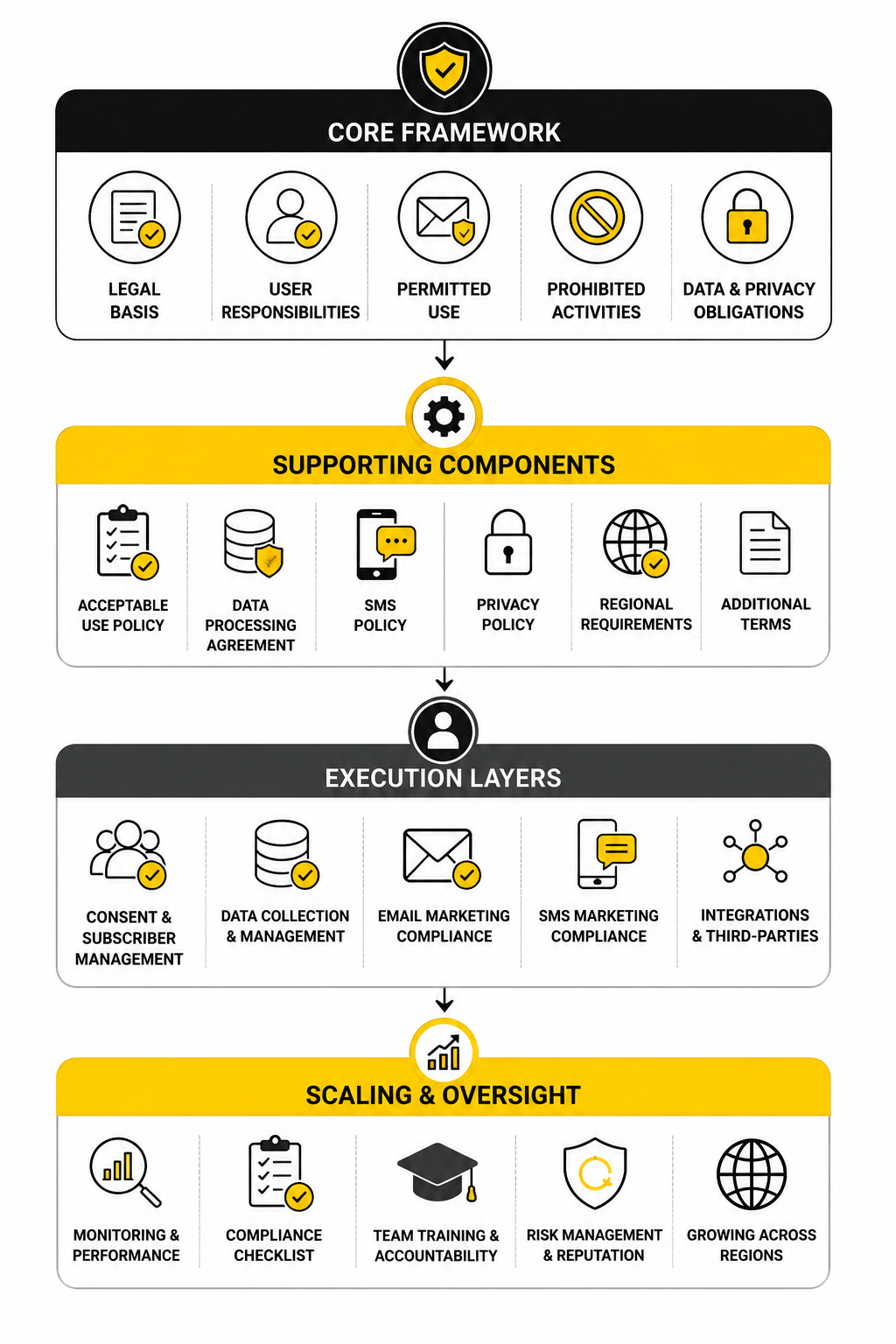
The Final System: Consent, Data, Messaging, And Measurement
A safe Klaviyo setup has four connected layers. Consent controls who can be contacted. Data controls what you know about them. Messaging controls what you send and how often you send it. Measurement tells you whether the whole system is healthy or starting to crack.
If one layer breaks, the others suffer. Bad consent creates weak engagement. Messy data creates poor personalization. Aggressive messaging creates unsubscribes and complaints. Weak measurement lets problems grow until they are expensive to fix.
Use this as the final operating model:
That is the mature version of using Klaviyo. Not fear-based. Not overcomplicated. Just controlled enough that growth does not turn into risk.
What are the Klaviyo terms of service?
The Klaviyo terms of service are the legal rules that govern how businesses can use Klaviyo’s platform. In practice, the broader rule set also includes Klaviyo’s Acceptable Use Policy, Data Processing Agreement, privacy documents, SMS guidance, and other service-specific policies listed in Klaviyo’s legal terms and policies. If you use Klaviyo for email, SMS, forms, automations, or customer data, these documents shape what is allowed and what your business is responsible for.
Why do the Klaviyo terms of service matter for marketers?
They matter because marketing activity creates risk when consent, data, claims, or sending practices are sloppy. A campaign is not just creative and copy; it is also a decision about who receives the message, what permission exists, and whether the content follows platform rules. If you ignore the Klaviyo terms of service, you may create deliverability problems, account restrictions, customer complaints, or privacy issues.
Can I upload any customer list into Klaviyo?
No, you should only upload contacts when you can explain where they came from and what they agreed to receive. A customer profile existing in your business does not automatically mean that person gave permission for every type of marketing. Before importing a list, verify the source, consent status, channel permission, and whether the contacts are still appropriate to message.
Does email consent also cover SMS consent?
No, email consent and SMS consent should be treated separately. Klaviyo’s SMS guidance emphasizes explicit consent, clear opt-in language, opt-out access, and appropriate message content in its SMS compliance basics. A person can agree to receive emails without agreeing to receive promotional text messages.
What happens if my SMS content falls into a prohibited category?
Your messages may be blocked, rejected, or create risk for your sending program. Klaviyo’s help center explains that wireless carriers restrict categories such as illegal substances, sex, hate, alcohol, firearms, tobacco, and other high-risk content in its guide to SMS and MMS prohibited content. If your brand is close to a regulated or sensitive category, review the rules before building SMS campaigns.
How often should I review my Klaviyo account for compliance?
A monthly review is a practical baseline for most active brands. You should also run a review before launching SMS, importing a large list, entering a new country, connecting a new integration, changing consent language, or launching campaigns in a sensitive product category. The goal is not to create paperwork for its own sake; the goal is to catch risk before it affects revenue or account access.
What Klaviyo metrics should I watch for risk?
Watch unsubscribe rate, spam complaint rate, bounce rate, SMS opt-out rate, click rate, conversion rate, revenue per recipient, and engagement trends by segment. Klaviyo’s benchmark reports help compare performance against similar companies and are updated monthly for eligible accounts, as explained in its guide to benchmark reports. The most useful insight usually comes from connecting these numbers to consent source, segment quality, send frequency, and campaign content.
Are benchmarks enough to know if my account is healthy?
Benchmarks are useful, but they are not the full story. They can show whether your performance is strong or weak compared with similar brands, but they cannot explain every cause. You still need to look at your acquisition sources, audience quality, campaign strategy, flow logic, offer strength, and deliverability patterns.
Do agencies carry the responsibility if they manage Klaviyo for me?
An agency can help execute, but the brand still owns the business risk of what happens inside the account. If an agency imports weak contacts, sends risky SMS, or builds flows that do not match consent, your business may still face the consequences. Give agencies clear rules for imports, approvals, SMS, integrations, admin access, and documentation.
Do I need legal help to use Klaviyo?
Not for every normal campaign. But legal or compliance support is smart when you launch SMS, expand internationally, handle regulated products, import old or unclear lists, change consent collection, or process sensitive customer data. Klaviyo’s legal policy hub is a starting point, but it does not replace advice tailored to your business, location, and product category.
How do the Klaviyo terms of service connect to GDPR?
The connection is strongest around personal data, consent, transfers, and customer rights. Klaviyo’s GDPR FAQ discusses topics such as Standard Contractual Clauses and consent records in its GDPR guidance. If you serve customers in the EU or UK, review your forms, privacy policy, data processing setup, and deletion or access workflows carefully.
What is the biggest mistake brands make with Klaviyo compliance?
The biggest mistake is treating compliance as separate from marketing performance. In reality, weak consent, messy data, poor segmentation, and aggressive sending usually show up in the metrics before they become a formal problem. If the data says customers are disengaging, unsubscribing, complaining, or ignoring your messages, listen early.
How should I use the Klaviyo terms of service as a team?
Turn them into a working checklist. Your team should know who owns consent sources, imports, SMS, campaign approval, suppression rules, integrations, and performance review. A simple operating process beats a long legal document nobody uses.
Build a stronger local presence with BAAM AI
Turn your website, Google profile, social channels, and AI visibility into one growth engine
Most businesses do not need more random marketing activity. They need a consistent presence system that helps the right people find them, trust them, and take action. BAAM AI brings strategy, local SEO, website updates, Google Maps visibility, social content, AI-search readiness, media production, and reporting into one practical monthly engine.
If you want your marketing to keep working after the campaign ends, start with a free BAAM AI presence audit. See how your business shows up today and where the fastest visibility wins are at BAAM AI.