
BAAM AI Blog
What Is Product Mix and Why It Matters in Marketing
Every business that offers more than one product or service has a product mix - the full portfolio of what it brings to market. At its core, the product mix (sometimes called the product assortment or product...
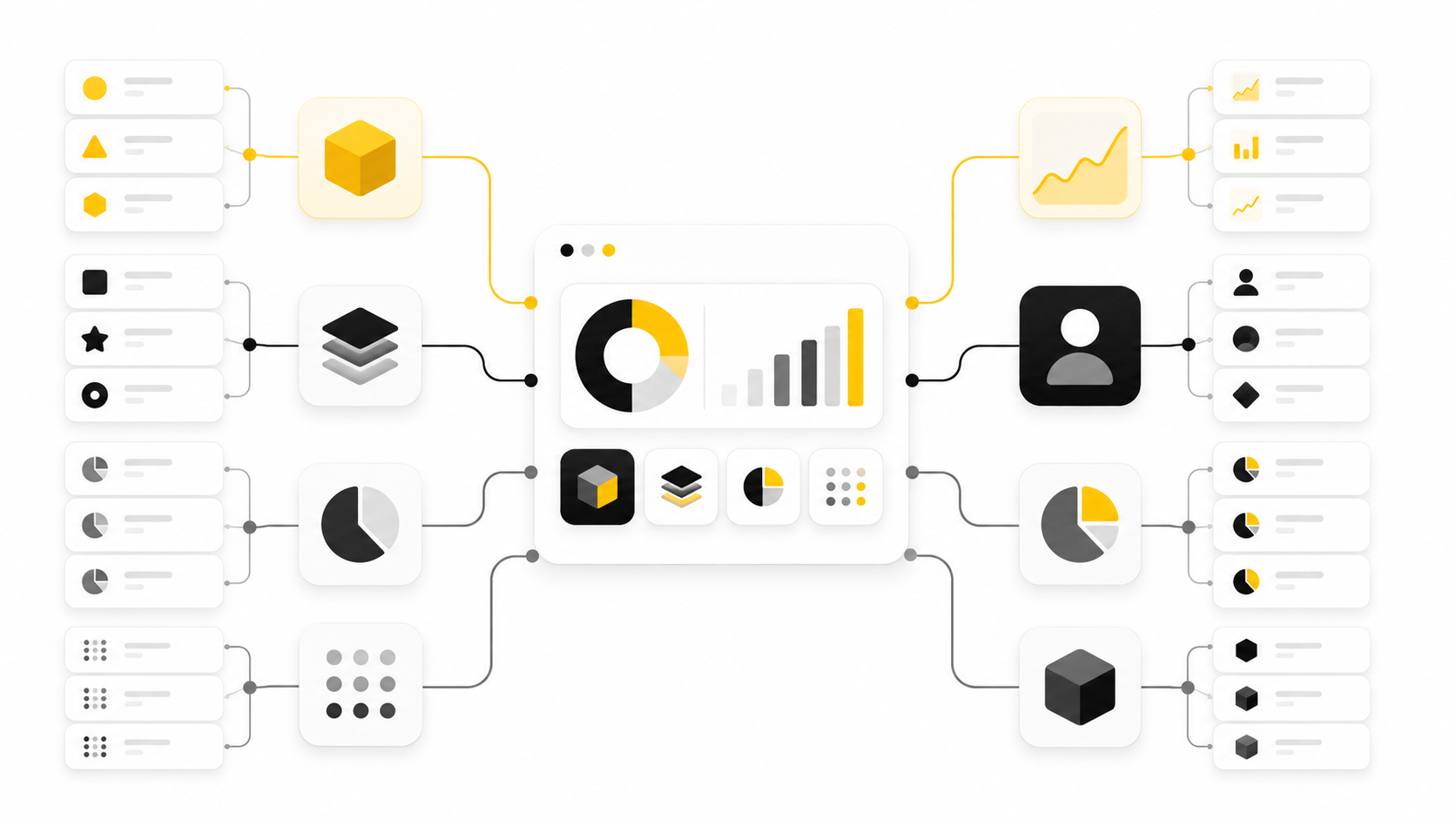
Every business that offers more than one product or service has a product mix - the full portfolio of what it brings to market. At its core, the product mix (sometimes called the product assortment or product portfolio) is the sum of all product lines and individual offerings a company sells to its customers. It defines who you are as a business and shapes every major decision in marketing and operations.
Early strategic leaders recognized that how you design and manage this mix determines your ability to attract customers, allocate resources efficiently, and compete effectively in crowded markets. In modern marketing, product mix analysis sits alongside pricing, promotion, and placement as a central piece of the corporate growth puzzle.
What Product Mix Means
A product mix is the complete set of products and services that a business offers to its target market. It includes everything from core products and product lines to variations, sizes, models, and complementary services.
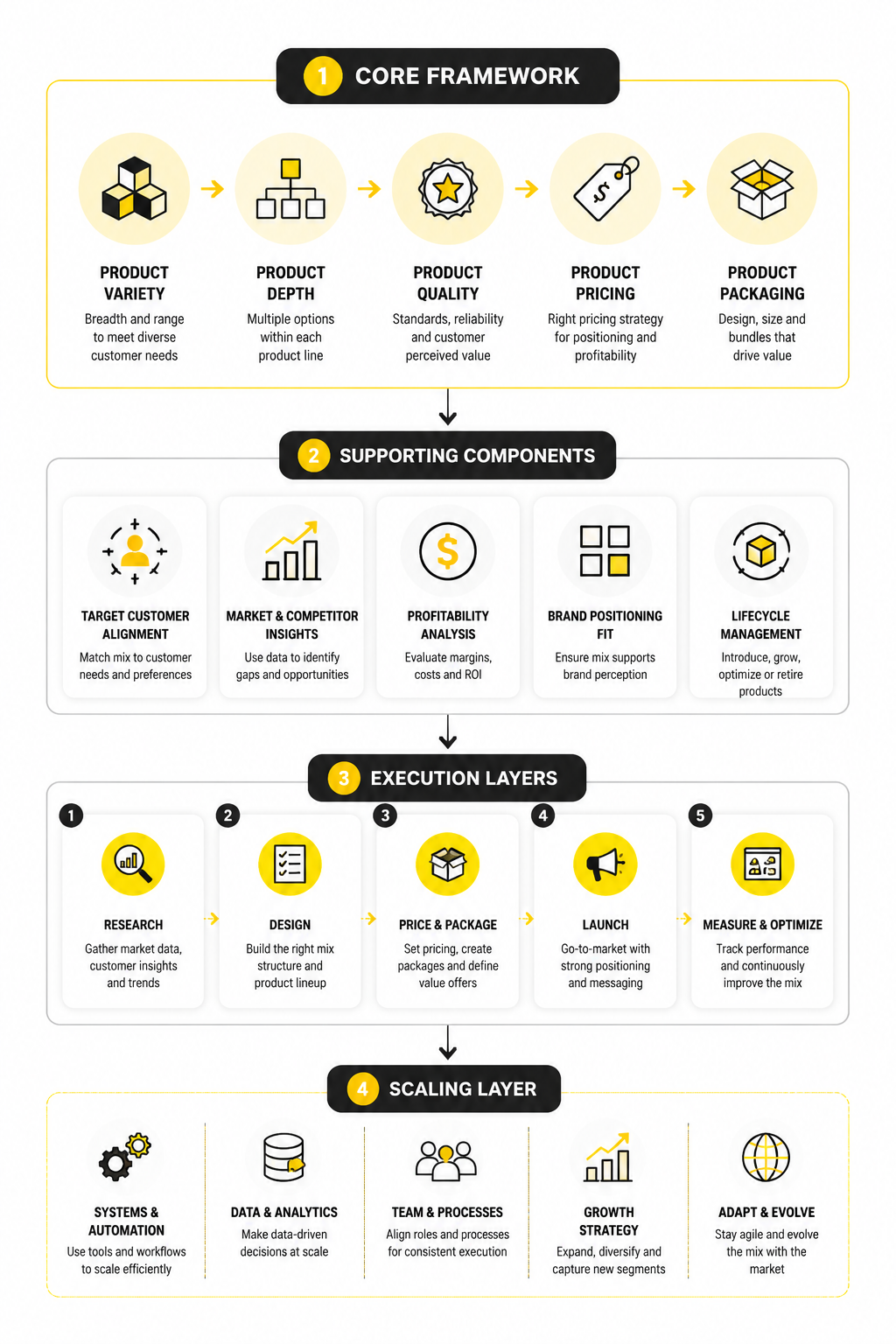
Marketers break the product mix down into four dimensions:
Understanding these structural elements gives leaders a practical way to analyze the portfolio and make more carefully decisions about where to invest or cut back.
Why Product Mix Matters in Business
Getting the product mix right isn’t just an academic exercise - it affects every part of your business model:
In short, product mix decisions influence profitability, customer satisfaction, inventory complexity, and how effectively marketing communicates value to the market.
Product Mix Framework and Core Components
The product mix framework gives a structured way to evaluate your offerings:
This framework helps companies assess portfolio complexity and strategic focus, guiding decisions about expansion, pruning, or repositioning.
How Product Mix Influences Strategy
Your product mix shapes long‑term strategy in several ways:
A proactive product mix strategy responds to consumer trends and market shifts rather than waiting for competitors to define what’s relevant.
Examples of Product Mix in Practice
Consider how major brands leverage product mix:
These examples show how companies balance width, depth, and consistency to serve global markets while maintaining brand coherence.
How to Optimize Your Product Mix
Start with analysis:
Effective product mix management means continually refining your offerings, not setting them once and forgetting them. This keeps your business agile and competitive.
In the next parts, we’ll dive deeper into each of these strategic dimensions and practical tactics you can apply.
How Product Mix Influences Strategy (continued)
Product mix directly shapes how businesses make strategic decisions about growth and resource allocation. When you adjust the mix, you’re signaling where the company should focus its efforts and how it plans to compete in the market. A broader mix can open the door to new customer segments and revenue streams, while a narrower mix allows deeper focus and potentially higher margins on core offerings. For example, companies often expand their width or depth to reach adjacent demand or consolidate their offerings when market saturation hits. This strategic flexibility is at the heart of product mix decisions and drives meaningful business outcomes.
Another strategic element of product mix is portfolio governance - the processes and rules that ensure mix decisions align with the long‑term goals of the business. Rather than reacting to short‑term trends, teams use frameworks and analytic tools to assess which products deliver sustainable value and support capacity, profitability, and brand positioning. Well‑established governance also prevents mismatches between sales ambitions and operational reality.
Better mix planning empowers cross‑functional collaboration. Instead of letting sales dictate catalog size alone, marketing, supply chain, and finance all contribute to mix optimization. This reduces hidden costs related to production complexity, inventory burdens, and resource contention.
Examples of Product Mix in Practice
When you look at real companies, their product mix decisions reveal clear strategic intent:
These practical cases illustrate how diverse mixes can still be managed with discipline and data insight to avoid inefficiency or brand dilution.
How to Optimize Your Product Mix
Optimizing a product mix isn’t a one‑time event - it’s a business process that should be embedded into planning and performance systems. The goal is simple: focus on the products that produce the most net value when considering demand, costs, capacity, and strategic fit.
Start with quantitative analysis. Use sales performance data, customer demand signals, and margin contribution to evaluate every SKU. This groundwork highlights where products are underperforming or draining resources. Tools like predictive analytics and demand forecasting improve the accuracy of mix decisions and help you anticipate changes rather than react to them.
Next, apply capacity and operational constraints to your decision framework. A product that looks profitable on paper may consume scarce manufacturing or logistical capacity, reducing overall profitability. Balancing this tension between revenue and operational cost ensures your optimal mix isn’t just theoretical but practical and executable.
Finally, tie your product mix decisions to clear performance metrics and cross‑department visibility. Teams should agree on goals for profitability, customer satisfaction, and inventory health, and track adjustments over time. Continuous review prevents the portfolio from drifting away from strategic priorities.
Each of these optimization steps aligns with a more deliberate and data‑informed approach to managing the product mix - one that supports long‑term growth without unnecessary complexity.
How to Put Product Mix Into Action
Getting from strategy to execution is where the value of product mix thinking becomes real. Implementation means turning your assessment of width, depth, length, and consistency into concrete decisions that affect development, inventory, pricing, and go‑to‑market plans. This is the point where product mix stops being a theoretical framework and starts guiding tactical work across teams. Executing a product mix strategy well means coordinating product development with marketing, sales, supply chain, and finance so every decision reinforces your broader goals.
Before you begin execution, successful teams translate strategic intent into measurable goals and frameworks. You need clarity on what you plan to achieve - whether it’s increasing market coverage, improving profitability, reducing complexity, or focusing on a specific customer segment - and then establish metrics that will tell you whether adjustments to the mix are working. With metrics in place, teams can prioritize which products or lines to expand, reduce, or modify based on demand and financial contribution.
Product mix implementation isn’t isolated to one department. Cross‑functional alignment ensures that once you decide to introduce new variants, discontinue underperforming items, or rebalance your assortment, operations, marketing, and sales are ready to support those moves. Execution also means defining timelines, assigning responsibility, and preparing contingency plans for inventory, pricing, or promotional shifts as your mix changes.
Step‑by‑Step Product Mix Execution Process
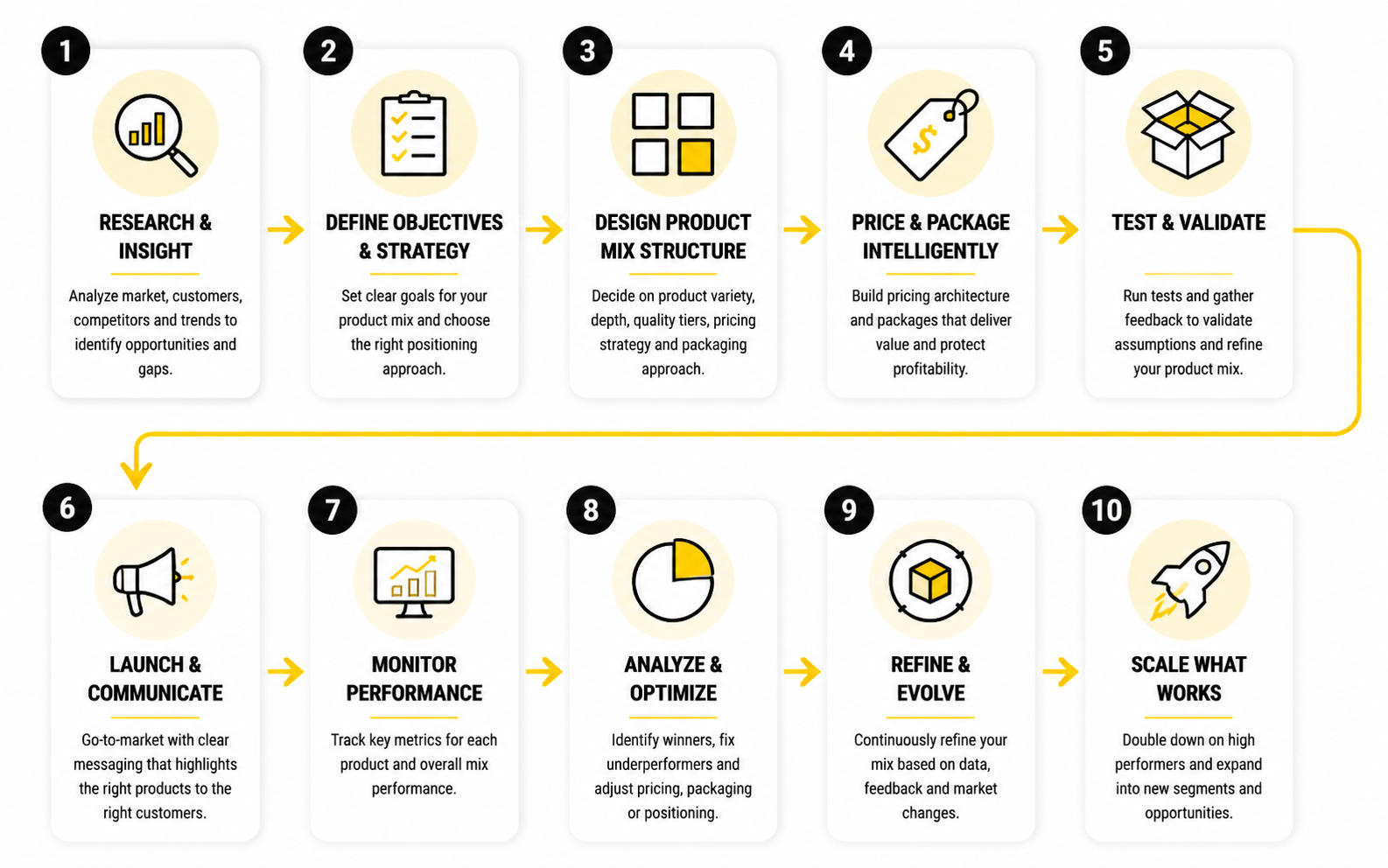
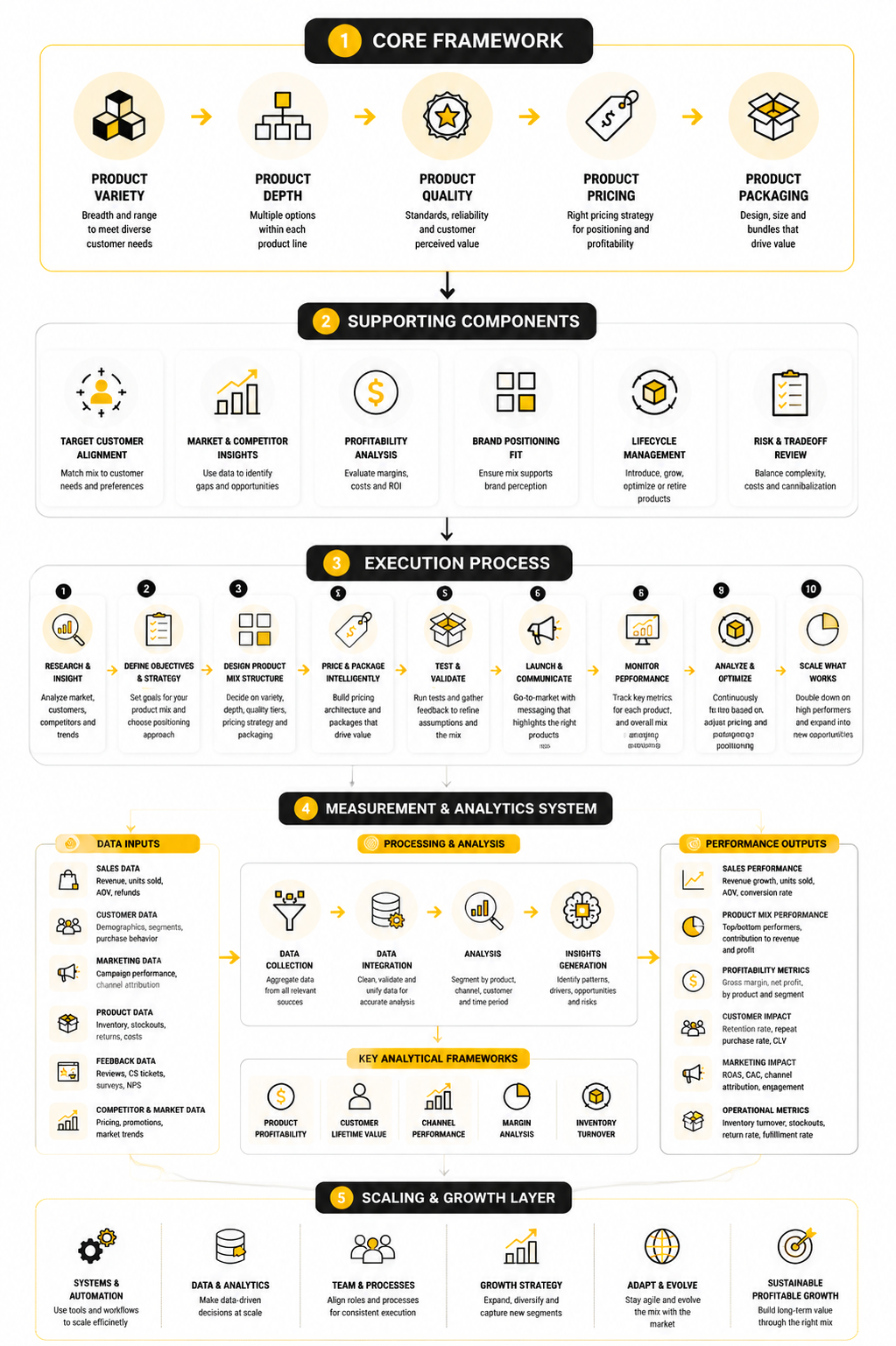
Translating your product mix strategy into action involves several practical steps that help teams manage complexity while maximizing value:
Start by reviewing recent sales data, market trends, and customer feedback to identify which products are meeting needs and which are lagging. This analysis should also look at operational constraints such as manufacturing capacity, lead times, and inventory costs, so decisions are grounded in both demand and execution reality.
Define objectives for your product mix based on data insights. Typical goals include increasing share in target segments, reducing low‑performing SKUs, or balancing revenue and margin performance. Using SMART goals (specific, measurable, achievable, relevant, time‑bound) ensures clarity and accountability during execution.
Not all product mix adjustments have equal impact. Prioritize actions that deliver the greatest financial or strategic value relative to implementation effort - for example, increasing depth on a high‑velocity product before launching entirely new lines, unless expansion aligns with strategic targets.
Execution touches product development, marketing, supply chain, and customer support. Bring these teams into planning early so production schedules, promotional campaigns, and inventory planning are aligned. Clear communication keeps everyone on the same timeline.
Once adjustments are planned, execute with careful tracking. This might mean refining product catalogs, changing pricing structures, or launching bundles or promotional offers. Use dashboards and KPIs tied to revenue, sell‑through, and inventory turnover to measure the impact of these changes.
Product mix execution doesn’t end with launch. Regularly review performance data to see how your mix changes affect customer behavior and financial outcomes. Frequent iteration helps you refine the mix and respond to shifts in demand, competition, or cost structures.
Each step helps organizations avoid ad‑hoc tweaks and instead manage their product mix in a way that supports both immediate needs and long‑term strategy. Strong execution creates a feedback loop where performance data continuously informs mix refinement.
Implementation is not static - it’s an ongoing process of testing, measurement, and adaptation. By following these steps, teams turn product mix choices into disciplined action plans that move the business toward its strategic goals.
Statistics and Data: Measuring the Impact of Your Product Mix
Understanding your product mix goes far beyond counting how many products you sell. The real value comes from measuring how each component of your mix performs and contributes to business goals. Analytics and data help you answer questions like: Which products drive the most revenue? Which ones drag profitability down? And where should you invest to improve overall portfolio health? Without solid measurement, product mix decisions become guesswork instead of strategy.
When businesses track performance consistently, they turn intuition into evidence‑based action. Metrics help you compare demand across lines, identify opportunities for pruning or growth, and spotlight the true drivers of profit and customer satisfaction. This data‑driven view also reveals structural issues - like an overly deep SKU set that increases carrying costs or inconsistent lines that confuse customers and dilute your brand. For example, metrics around product profitability and SKU contribution help retailers optimise assortments and eliminate low‑performing items while preserving revenue potential.
Metrics matter because they tell a story about value creation and cost impact. Sales figures alone don’t show if a product is profitable after accounting for marketing, inventory, and operational costs. Tracking a suite of KPIs gives a balanced view of portfolio health and helps teams prioritise the most strategic opportunities.
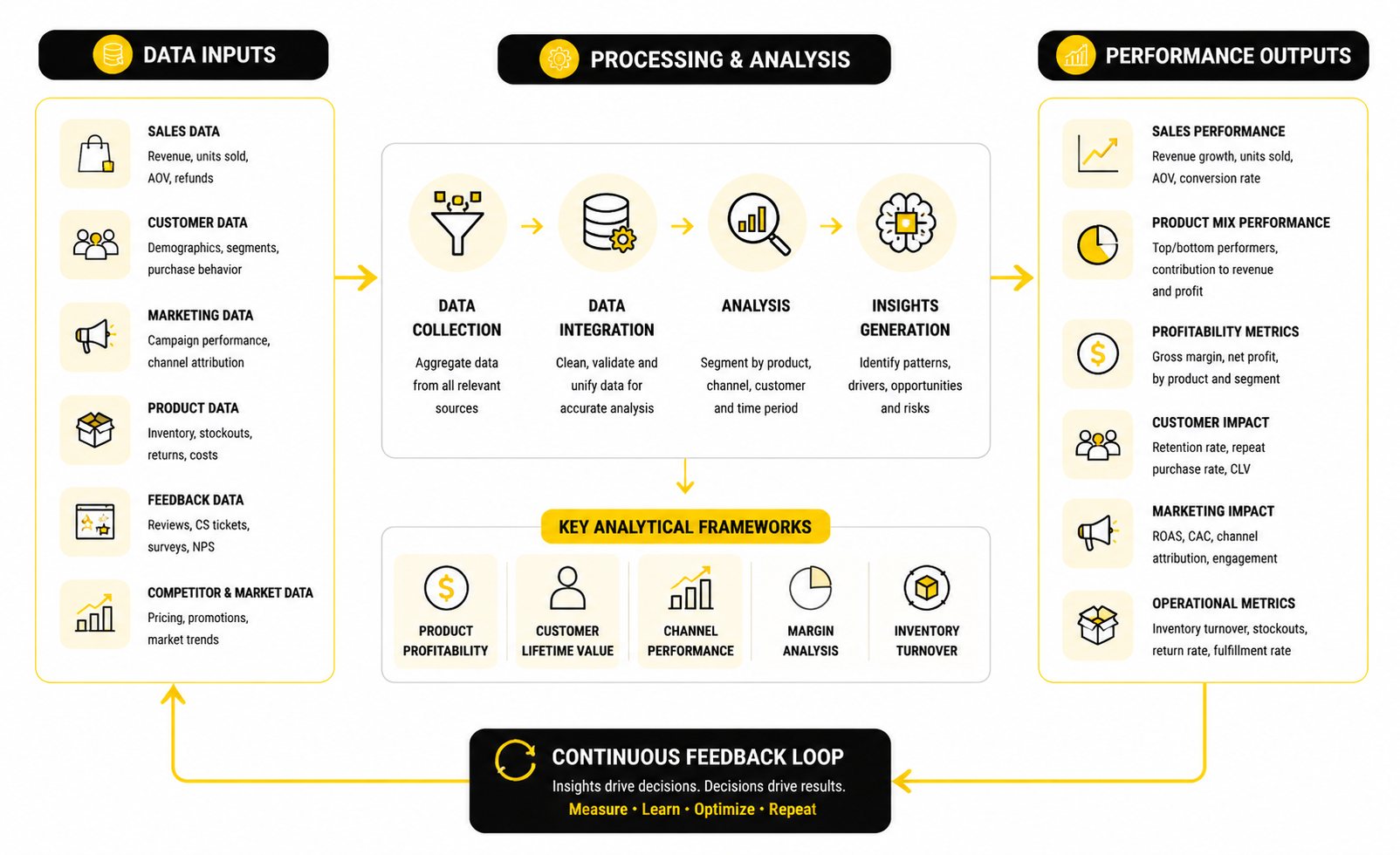
What to Measure and Why It Matters
Tracking product mix performance means collecting metrics that go beyond raw sales. These numbers should guide decisions that improve efficiency, profitability, and customer relevance.
Sales mix shows the proportion of total revenue that each product or line contributes. A small item generating a large share of revenue may deserve more investment, while high‑volume but low‑value SKUs might need pruning to streamline costs. Tracking changes in mix share over time reveals shifting customer preferences that should influence marketing and assortment planning.
Not all revenue is equal. Contribution margin subtracts variable costs from sales, showing how much a product contributes to covering fixed costs and profit. Higher margins indicate products worth supporting, while low margins flag candidates for redesign, repricing, or removal. Including this in mix analytics prevents overemphasis on volume at the expense of overall profitability.
Depth and length of the product mix often affect inventory complexity. Products with slow turnover tie up capital and increase logistics costs. By comparing turnover rates across SKUs, you can prioritise which items to scale back and which to promote. Higher turnover usually indicates better alignment with market demand.
Some products might show moderate sales but play a crucial role in customer acquisition or retention. Engagement metrics - like repeat purchase rates or usage frequency - reveal which offerings build loyalty. Aligning mix decisions with customer behaviour ensures your portfolio not only sells but sustains long‑term relationships.
These measures help you evaluate not just what is selling, but what adds measurable value to the business.
Interpreting Benchmarks and Trends
Numbers don’t have meaning in isolation - context makes them actionable. Benchmarks, such as industry averages or historical company performance, allow you to spot outliers and trends. For example, a SKU that once contributed 15 % of revenue but has dropped consistently in recent quarters signals declining relevance, suggesting a need to rethink its place in the mix.
Trend analysis - tracking metrics over weeks, months, or seasons - reveals whether mix adjustments are working or if customer demand has shifted unexpectedly. Forward‑looking teams blend analytics with forecasting methods to anticipate future demand, especially when launching new lines or pruning old ones.
Data interpretation also matters for cross‑functional alignment. When finance sees improving contribution margins, operations can justify reallocating capacity. When marketing sees rising engagement for specific variants, product teams can prioritise features or bundle strategies that support growth.
In essence, disciplined measurement turns your product mix from a static inventory list into a dynamic management tool that drives more carefully decisions and continuous improvement.
Advanced Considerations for Product Mix Strategy
As your product mix evolves, you’ll encounter strategic trade‑offs that go beyond basic portfolio balancing. At higher levels of maturity, product mix decisions become catalysts for competitive advantage, but they also introduce risks that require discipline and foresight. Leaders need to think not only about what to sell, but how their mix influences brand perception, operational efficiency, and long‑term growth.
One advanced topic is complexity cost. A product mix that grows without structure often increases internal friction - more SKUs mean more suppliers, varied production setups, and expanded inventory holding. This can erode margins faster than increased sales can compensate. Analysis from industry operations experts highlights that complexity can quietly inflate indirect costs, sometimes up to 20 % of operating expenses in heavily diversified portfolios. Integrating cost of complexity into mix decisions forces teams to weigh the true cost of every additional product variation.
Another level of sophistication comes from portfolio cannibalization. When new offerings diminish sales of existing ones without increasing overall revenue, your mix might be internally competing rather than expanding value. This is especially common when depth increases within similar lines without clear differentiation. Savvy teams monitor cross‑SKU elasticity and customer preference data to prevent one product from displacing another without adding net business value. In digital environments, algorithms often recommend related items; understanding how these influence mix performance can unearth hidden cannibalization effects that aren’t obvious from aggregate sales figures.
Resilience is another critical consideration. Markets fluctuate due to seasonality, economic cycles, and competitive moves. A product mix that prioritizes diversification across demand cycles - combining staples with trend‑driven items - can smooth volatility and support stable revenue flows. However, diversification must be balanced against consistency; too diverse a mix can dilute brand identity and confuse customers about your core value proposition.
Strategic decision‑makers also face scale‑dependent risks. At scale, small inefficiencies multiply. For example, having a high number of low‑volume SKUs might seem acceptable at early stages, but as volume grows, the logistical burden can disproportionately increase waste, fulfillment errors, and warehouse costs. Leading analytics platforms recommend tying SKU rationalization to dynamic demand forecasting, so products are evaluated continuously for performance against future projections, not just historical sales.
Finally, expert practitioners emphasize the importance of governance frameworks that extend beyond quarterly reviews. This includes establishing clear criteria for launching new products, phased sunset plans for declining items, and cross‑functional checkpoints where finance, marketing, and operations assess mix impact jointly. Embedding governance strengthens strategic alignment and prevents reactive decision‑making that can destabilize long‑term mix efficacy.
These next‑level aspects - complexity cost, cannibalization risk, resilience planning, scale considerations, and governance - aren’t just add‑ons. They become central parts of an optimized, sustainable product mix that supports competitive positioning and organizational efficiency.
What exactly is a product mix?
A product mix is the complete set of product lines and individual items that a company offers to its target customers. It covers everything from core products to variations and services the business markets and sells.
How does product mix differ from a product line?
A product line is a group of closely related products sold under one category, while the product mix is the entire portfolio of all product lines and items a company offers.
What are the four key components of a product mix?
The standard components are width (number of product lines), length (total items), depth (variations within each line), and consistency (how related lines are).
Why does product mix analytics matter for profitability?
Analytics help you measure things like sales mix, contribution margins, and inventory turnover so you can decide which products drive profit, improve resource allocation, and avoid carrying low‑value SKUs.
Can expanding a product mix ever backfire?
Yes. Too much depth or unrelated lines can increase operational complexity, dilute the brand, and eat into margins. Companies need to balance breadth with focus and strategic relevance.
How often should companies review their product mix?
Reviews should be regular and driven by performance data, marketplace trends, and customer feedback. Continuous iteration helps businesses adapt to demand shifts and competitive moves.
What is SKU pruning and why is it important?
SKU pruning is the process of eliminating under‑performing or redundant stock‑keeping units to simplify operations, reduce holding costs, and sharpen focus on high‑value products.
How does product mix interact with pricing strategy?
Pricing decisions influence how products within the mix compete for customer attention. Effective mix management aligns pricing tiers and positions products to maximise perceived value and profitability.
Does product mix impact brand identity?
Yes. A well‑managed mix supports a cohesive brand image and helps customers clearly understand what your company stands for. Inconsistent or overly diverse elements can create confusion.
What role does competitor analysis play in mix decisions?
Analysing competitor mixes helps you identify market gaps, differentiate offerings, and benchmark performance against similar portfolios, which guides strategic mix expansion or contraction.
How do you decide between expanding versus contracting your product mix?
Consider strategic goals, performance metrics, customer demand, and operational capacity. Expand where demand and strategic fit justify investment, and contract where offerings drain resources without comparable value.
What is the relationship between product mix and customer segments?
An intentional product mix lets you serve multiple segments with tailored offerings - from entry‑level options for new customers to premium tiers for high‑value buyers.
Build a stronger local presence with BAAM AI
Turn your website, Google profile, social channels, and AI visibility into one growth engine
Most businesses do not need more random marketing activity. They need a consistent presence system that helps the right people find them, trust them, and take action. BAAM AI brings strategy, local SEO, website updates, Google Maps visibility, social content, AI-search readiness, media production, and reporting into one practical monthly engine.
If you want your marketing to keep working after the campaign ends, start with a free BAAM AI presence audit. See how your business shows up today and where the fastest visibility wins are at BAAM AI.