
BAAM AI Blog
What Internet Marketing Is Concerned With
Internet marketing is concerned with connecting the right offer to the right people through digital channels, then turning that attention into measurable business results. That sounds simple, but the work behind it...
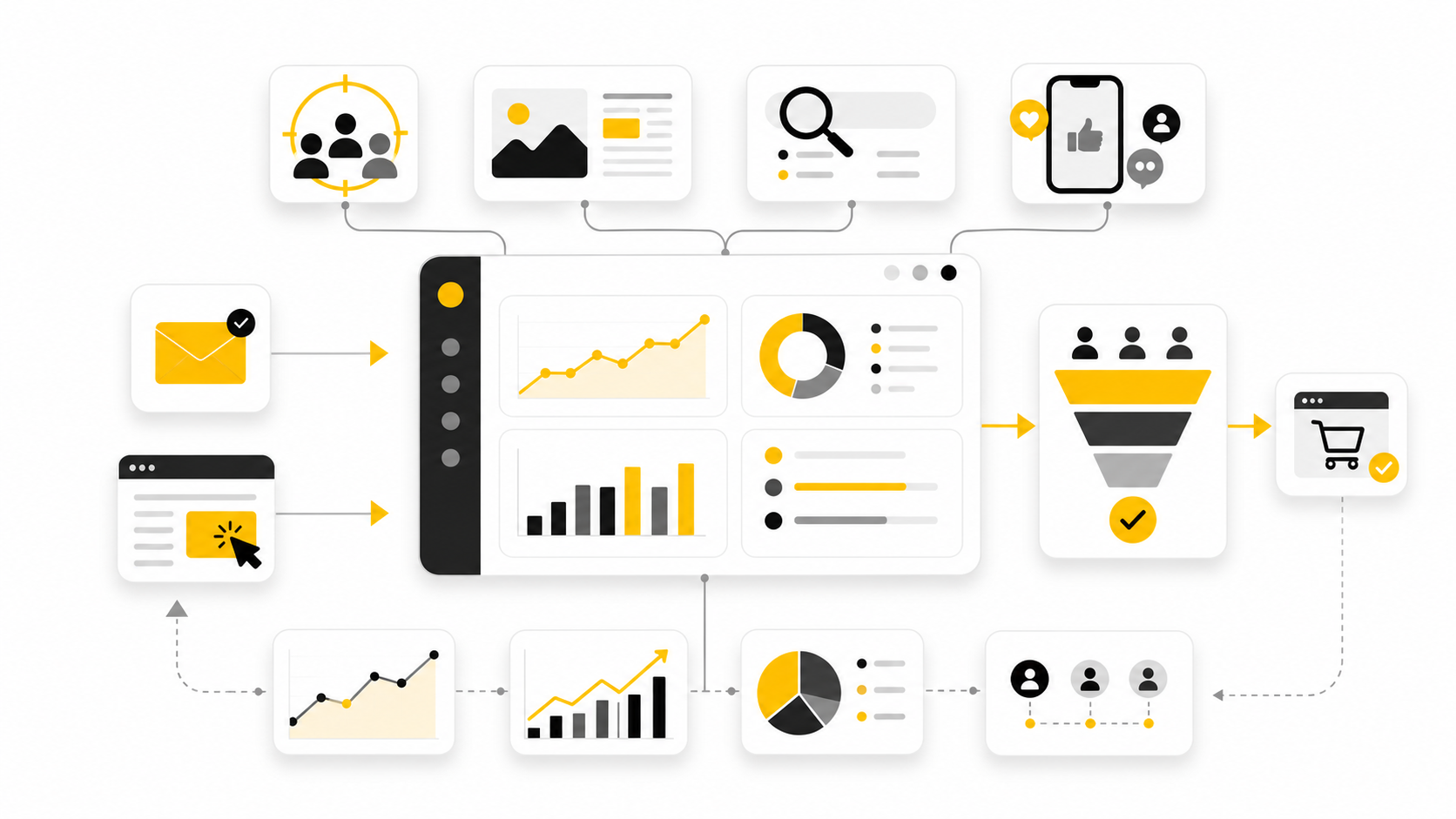
Internet marketing is concerned with connecting the right offer to the right people through digital channels, then turning that attention into measurable business results. That sounds simple, but the work behind it is not just “posting online” or “running ads.” It includes market research, positioning, content, traffic, conversion, automation, customer retention, and performance measurement.
The reason this matters is obvious when you look at how people now discover, compare, and buy. More than 5.5 billion people use the internet, and the average user spends hours each day across search, social platforms, video, messaging, email, apps, and websites, which means the customer journey is no longer controlled by a single channel or a single campaign. The brands that win are usually not the ones shouting the loudest; they are the ones building a system that helps people move from problem awareness to trust, action, and repeat purchase with less friction.
Internet marketing is also concerned with accountability. In older forms of marketing, a business could spend money on visibility and hope that sales followed. Online, that excuse gets weaker because traffic sources, landing pages, email sequences, checkout flows, CRM activity, and customer behavior can be tracked far more precisely. U.S. internet advertising revenue reached a record $259 billion in 2024, which shows how much budget has shifted toward channels where targeting, testing, and measurement are built into the work.
The bigger opportunity is not just “being online.” The bigger opportunity is building a practical growth engine. That means understanding who the customer is, why they should care, where they already spend attention, what message earns trust, what action comes next, and how the business follows up after the first click.
Why Internet Marketing Matters Now
Internet marketing matters because the buying process has become more self-directed. People search before they speak to sales, compare alternatives before they click a checkout button, and expect useful information before they trust a brand. A business that does not show up during those moments is not simply “missing content”; it is missing chances to shape demand.
It also matters because attention is fragmented. One customer might discover a product through a short-form video, research it through Google, check reviews, join an email list, abandon a cart, return through retargeting, and finally buy after receiving a practical follow-up message. That entire path is internet marketing, even though no single touchpoint tells the full story.
This is why internet marketing is concerned with systems, not isolated tactics. A blog post without a clear next step is weak. An ad without a strong landing page wastes money. An email list without segmentation turns into noise. The goal is to make each piece support the next piece so the customer journey feels natural instead of random.
Framework Overview
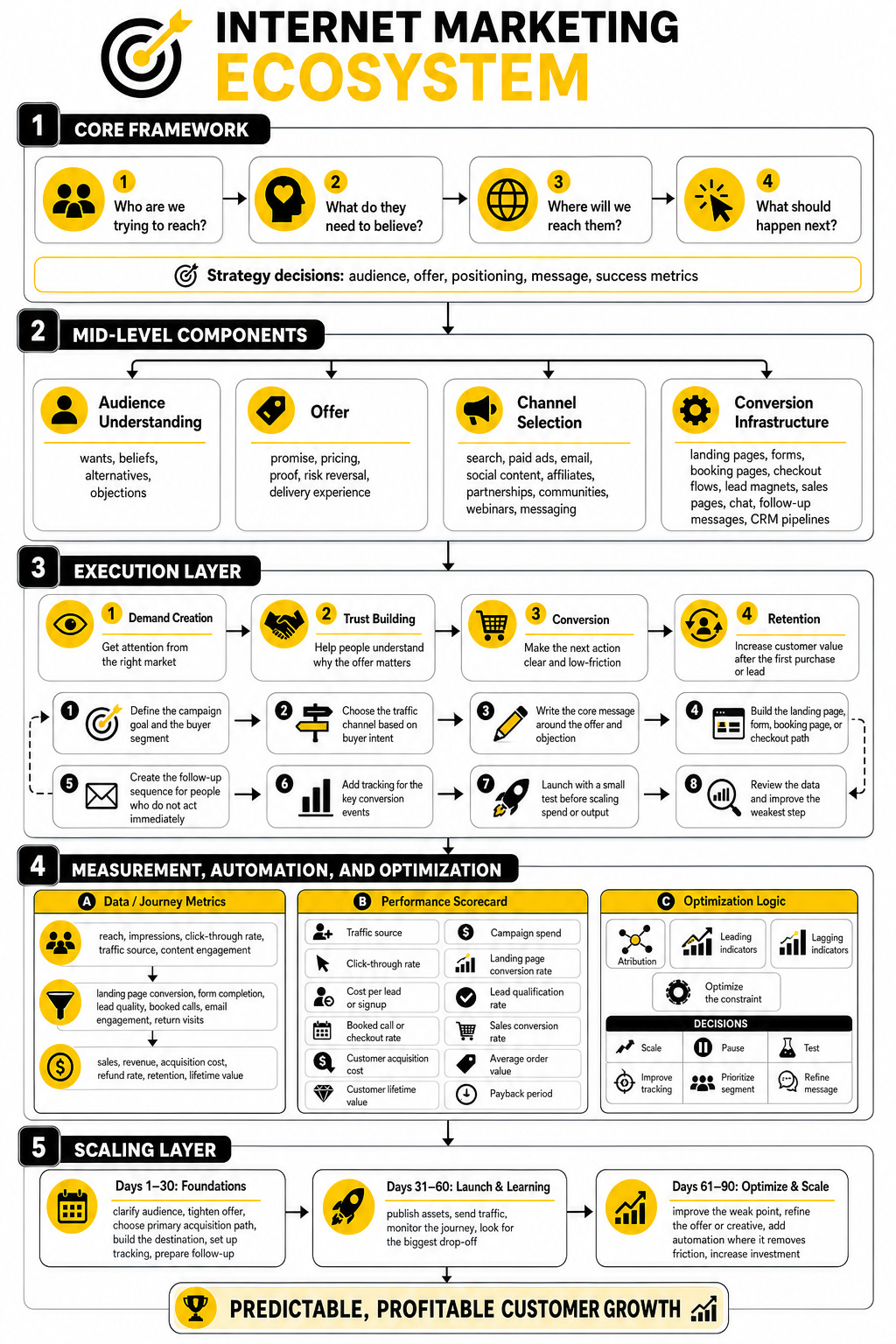
A useful internet marketing framework starts with four connected questions: who are we trying to reach, what do they need to believe, where will we reach them, and what should happen next? These questions keep the work practical. They stop the business from chasing every platform and force it to design marketing around buyer behavior.
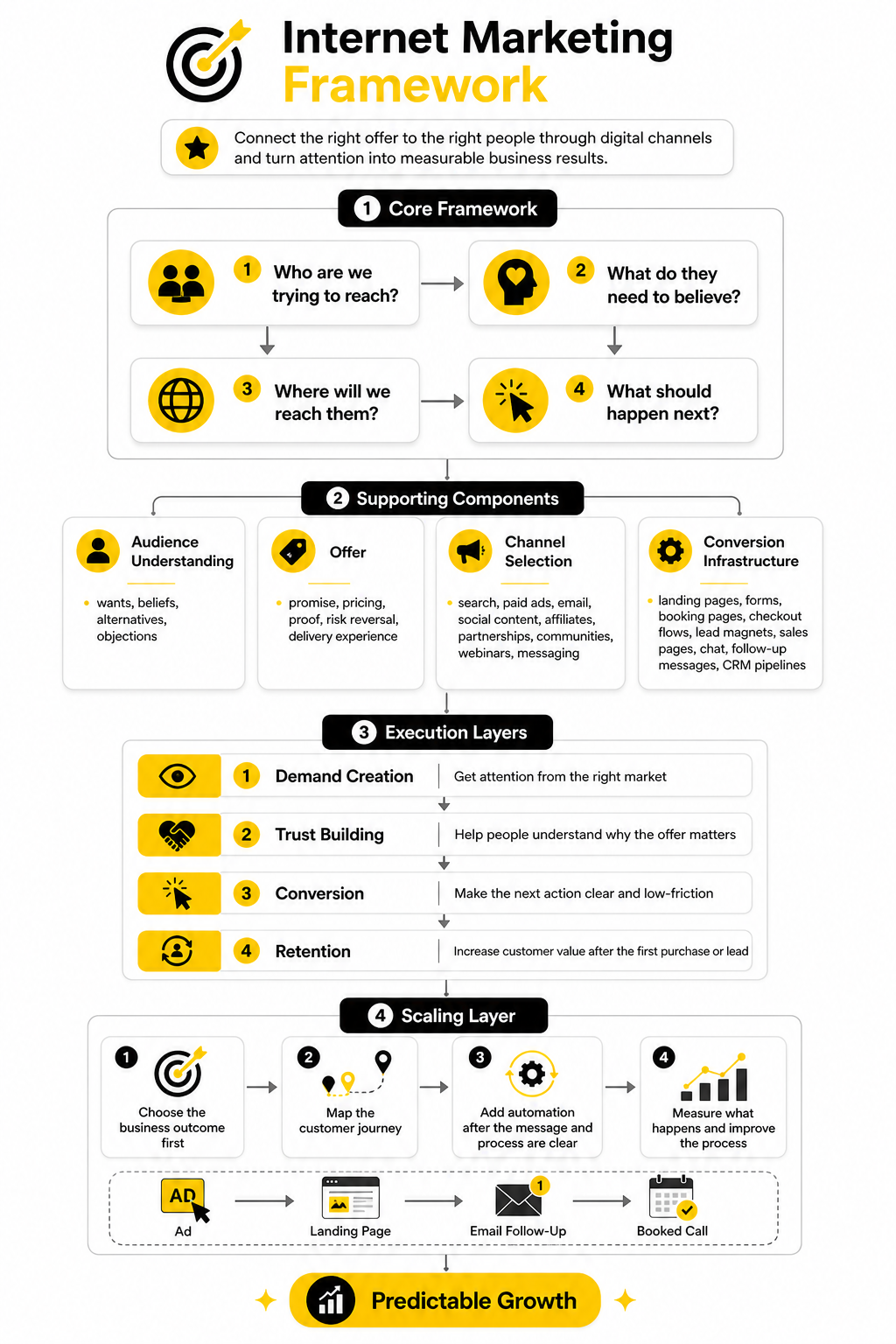
The framework also separates strategy from execution. Strategy decides the audience, offer, positioning, message, and success metrics. Execution turns those decisions into assets, campaigns, funnels, content, email flows, tracking, and optimization. When those two layers are mixed together, teams often mistake activity for progress.
The strongest internet marketing systems usually include four working layers: demand creation, trust building, conversion, and retention. Demand creation gets attention from the right market. Trust building helps people understand why the offer matters. Conversion makes the next action clear and low-friction. Retention increases customer value after the first purchase or lead.
Core Components of Internet Marketing
The first core component is audience understanding. You need to know what the customer wants, what they already believe, what alternatives they are considering, and what objections stop them from acting. Without that, campaigns become generic, and generic campaigns are easy to ignore.
The second component is the offer. A strong offer is not just a product or service; it is the promise, pricing, proof, risk reversal, and delivery experience wrapped into something the market can understand quickly. This is where many campaigns fail because the traffic strategy is blamed when the offer itself is unclear.
The third component is channel selection. Search, paid ads, email, social content, affiliates, partnerships, communities, webinars, and messaging platforms can all work, but they do not all work the same way. A local service business, a SaaS company, an ecommerce brand, and a creator-led education business need different channel priorities because their buyers behave differently.
The fourth component is conversion infrastructure. That includes landing pages, forms, booking pages, checkout flows, lead magnets, sales pages, chat, follow-up messages, and CRM pipelines. Tools like GoHighLevel, ClickFunnels, and systeme.io fit here because their real value is not the software itself; it is helping a business turn attention into a trackable next step.
Professional Implementation
Professional implementation starts by choosing the business outcome before choosing the tactic. A campaign built to generate booked calls should not be judged the same way as a campaign built to grow newsletter subscribers or sell low-ticket products. The metric has to match the job.
From there, the practical work is to map the journey. A simple journey might be ad to landing page to email follow-up to booked call. A more complex journey might include SEO content, retargeting, webinars, CRM segmentation, lead scoring, and customer reactivation. The point is not to make the system complicated; the point is to make it complete enough that good prospects do not disappear after one touch.
This is where automation becomes useful, but only after the message and process are clear. Email platforms like Brevo, social scheduling tools like Buffer, and messaging tools like ManyChat can support the system, but they cannot fix a vague offer or a weak customer journey. The tool should serve the strategy, not replace it.
Internet marketing is concerned with making that whole system work together. It is not one channel, one funnel, one ad, or one piece of content. It is the discipline of attracting the right attention, earning trust, guiding action, measuring what happens, and improving the process until growth becomes more predictable.
Audience, Offer, and Positioning
Before channels, funnels, or automation matter, internet marketing is concerned with understanding the market clearly enough to make the right people feel seen. That means you are not just asking who could buy. You are asking who has the problem now, who is motivated enough to act, who has budget or authority, and who is most likely to become a profitable customer.
This is where many campaigns quietly break. The business starts with “we need more traffic,” but traffic only amplifies what is already there. If the audience is vague, the offer is weak, or the positioning sounds like everyone else, more traffic simply creates more expensive confusion.
Strong internet marketing begins with sharper thinking. The goal is to define the customer so clearly that the message, channel, landing page, follow-up, and sales conversation all feel connected. When that happens, marketing stops feeling like guesswork and starts becoming a system.
Start With the Buyer’s Actual Situation
A useful audience profile is not a demographic paragraph. Age, location, job title, and income can help, but they rarely explain why someone buys today. A better starting point is the buyer’s situation: what they are trying to accomplish, what is frustrating them, what they have already tried, and what consequence they want to avoid.
This matters because people do not buy because a brand has a content calendar. They buy because something in their world creates urgency. A founder may need more booked calls because cash flow is tight. A marketing manager may need better attribution because leadership is questioning budget. An ecommerce operator may need a stronger landing page because ad costs are rising and the current page is wasting clicks.
The best research looks for those moments of pressure. Search queries, customer interviews, sales calls, support tickets, reviews, community discussions, and CRM notes all reveal language that a business can use responsibly. A company does not need to invent the market’s pain from scratch; it needs to listen closely enough to describe it better than competitors do.
Separate the User From the Buyer
In many markets, the person using the product is not always the person approving the purchase. This is especially important in B2B, education, healthcare, software, finance, and agency services. If the campaign speaks only to the user’s daily frustration but ignores the buyer’s business risk, it may generate interest without creating a sale.
For example, a team member may want a tool because it saves time, but the decision-maker may care about adoption, reporting, compliance, cost, implementation effort, and measurable return. Those are different concerns. The message has to respect both sides without becoming bloated.
This is why internet marketing is concerned with buying committees, objections, and internal justification. Even in consumer markets, a buyer may need to justify a purchase to a spouse, team, boss, or future self. Good positioning gives that person clear language for why the decision makes sense.
Build the Offer Around a Clear Promise
An offer is not just the thing being sold. It is the full reason someone should act now instead of doing nothing, choosing a competitor, or delaying the decision. That includes the promise, the deliverables, the price, the guarantee or risk reversal, the proof, the urgency, and the expected outcome.
A weak offer usually sounds like a list of features. A stronger offer connects those features to a desirable change. Instead of “email automation software,” the stronger promise might be faster follow-up, fewer lost leads, better segmentation, and more sales conversations from the traffic the business already has.
This is also where specificity matters. Vague promises like “grow your business online” are too easy to ignore because they require the reader to do the mental work. A clearer offer tells the reader what improves, who it is for, and why it is different. The more crowded the market, the more important that clarity becomes.
Make Positioning Do Real Work
Positioning is the mental shortcut you create in the customer’s mind. It answers a simple question: why this, for me, instead of everything else? If that answer is not obvious, the market will default to price, popularity, or indifference.
Good positioning usually comes from choosing a narrower angle. That could mean focusing on a specific audience, a specific outcome, a specific use case, a specific business model, or a specific enemy. The point is not to exclude everyone for the sake of sounding clever. The point is to become immediately relevant to the people most likely to care.
This is especially important because customers now compare options quickly. Research into modern customer expectations shows that buyers increasingly expect consistent, personalized interactions across touchpoints, with Salesforce’s customer research highlighting how strongly people judge brands by the quality and relevance of those interactions through the full relationship, not just the first sale: State of the Connected Customer. Positioning gives every touchpoint a job so the business does not sound different on every channel.
Match the Message to Awareness Level
Not every prospect is ready for the same message. Some people are problem-aware but do not know the solution category. Some are solution-aware but unsure which option to choose. Some are product-aware and need proof, pricing, or reassurance before acting.
This is one reason generic campaigns underperform. A cold audience may need education and context before seeing a direct pitch. A warm audience may need comparison content, demos, testimonials, or a clear offer. A returning visitor may need a stronger reason to stop researching and take the next step.
Internet marketing is concerned with moving people through those stages without rushing them. That does not mean every campaign needs a massive funnel. It means each message should match the buyer’s current level of understanding and give them a logical next step.
Use Research Without Hiding Behind It
Research should sharpen decisions, not slow everything down. You do not need endless personas, 80-page strategy decks, or abstract brand exercises before publishing anything. You need enough evidence to make a good decision, launch the message, and learn from real behavior.
Useful research can be simple. Look at the search terms people use. Read negative and positive reviews in the category. Study sales objections. Compare competitor landing pages. Check which content topics consistently attract qualified engagement instead of vanity attention.
The danger is treating research as a one-time task. Markets move, competitors adjust, platforms change, and customer expectations keep rising. DataReportal’s global digital research shows how large and active the online population has become, with billions of people using connected devices, social platforms, search, streaming, and messaging as part of daily life: Digital 2026 Global Overview Report. That scale creates opportunity, but it also means customer behavior is always shifting.
Turn Audience Insight Into Assets
Audience insight only becomes valuable when it changes what the business publishes and builds. It should shape the headline on the landing page, the opening line of an email, the structure of a webinar, the promise in an ad, and the objections answered before checkout or booking. If research sits in a document and never touches the campaign, it is not strategy; it is decoration.
This is where practical tools can help, but only when the thinking is clear first. A business that wants to test funnels quickly might use ClickFunnels to turn a focused offer into pages and follow-up flows. A service business or agency might use GoHighLevel when it needs CRM, forms, pipelines, automations, and client communication in one place.
The tool is never the strategy. The tool simply gives the strategy a place to operate. If the audience, offer, and positioning are strong, the software can help you move faster. If those foundations are weak, the software just helps you scale the wrong message.
Keep the Promise Consistent Across the Journey
A strong campaign creates continuity. The ad, post, search result, landing page, form, email, sales call, and onboarding experience should all feel like they came from the same strategic idea. When the promise changes from one step to the next, trust drops.
This happens often when teams work in silos. The paid ads team talks about one benefit, the website says another, the sales team sells a third angle, and the onboarding sequence introduces a completely different expectation. The customer may not describe that as a positioning problem, but they feel the mismatch.
Professional internet marketing reduces those gaps. It makes the promise clear, repeats it without sounding robotic, and supports it with proof at the right moments. That is how a business turns attention into trust before asking for action.
Positioning Before Promotion
Promotion without positioning is expensive. It can still create clicks, impressions, and short-term attention, but it rarely builds a durable advantage. The business keeps needing more spend, more volume, and more noise because the market does not have a clear reason to remember it.
Positioning gives promotion leverage. It helps the same ad budget work harder, the same content feel sharper, and the same sales conversation start with more trust. It also helps teams say no to channels, campaigns, and ideas that do not fit the market they are trying to win.
That is the real reason this section comes before traffic channels. Internet marketing is concerned with growth, but growth starts with relevance. Once the business knows who it is for, what it promises, and why the market should care, traffic becomes much easier to plan intelligently.
Traffic Channels and Demand Creation
Once the audience, offer, and positioning are clear, the next job is distribution. Internet marketing is concerned with getting the message in front of people who are already searching, browsing, comparing, learning, or showing signs of intent. This is where traffic channels become useful, but only when each channel has a defined role.
A traffic channel is not automatically a strategy. Search, social, email, paid ads, affiliates, partnerships, creators, communities, webinars, and direct outreach can all work, but they do different jobs. The mistake is treating them as interchangeable simply because they all can send visitors to a website.
The practical question is not “Which channel is best?” The better question is “Where is the buyer most likely to notice, trust, and act on this message?” That question keeps the strategy grounded in behavior instead of trends.
Separate Demand Capture From Demand Creation
Demand capture is when someone already wants a solution and is actively looking for it. Search traffic, comparison pages, review content, retargeting, marketplace listings, and branded campaigns often sit here. These channels are powerful because intent is already present.
Demand creation is different. It reaches people before they are actively searching or before they understand the problem clearly. Social content, creator partnerships, educational newsletters, webinars, podcasts, communities, and thought leadership often sit here because they help shape what the audience pays attention to in the first place.
A healthy internet marketing system usually needs both. If the business only captures existing demand, it depends on people already searching for the category. If it only creates demand, it may generate attention but struggle to convert that attention into pipeline or sales. The balance depends on market maturity, budget, sales cycle, offer complexity, and how urgently people feel the problem.
Choose Channels Based on Intent
Search works well when buyers use clear language to describe the problem, solution, or comparison they care about. That is why SEO and paid search can be strong for categories where people actively research before buying. The work is to map content and landing pages to intent, not just chase keywords with high volume.
Social works differently because people usually are not opening the app to buy. They are there to learn, be entertained, follow people they trust, or keep up with communities and trends. DataReportal’s digital research shows that social media remains a major part of daily internet behavior, with people using multiple platforms for discovery, communication, entertainment, and brand interaction: Digital 2025 Global Overview Report. That makes social useful, but the content has to earn attention before it can ask for action.
Email and owned audiences work best when the business has already earned permission. This is where follow-up, segmentation, education, launch sequences, customer retention, and reactivation become more profitable. The advantage is simple: you are not starting from zero every time you want to communicate.
Build One Primary Acquisition Path First
A common mistake is trying to launch everywhere at once. The business starts a blog, runs ads, opens five social accounts, builds a newsletter, creates a webinar, tests cold outreach, and then wonders why none of it feels consistent. That is not a growth engine; it is scattered activity.
A better implementation process starts with one primary acquisition path. For example, a service business might choose paid search to a landing page to a booked call. A creator-led business might choose short-form content to newsletter to offer. A SaaS company might choose SEO comparison content to free trial to onboarding sequence.
The point is not to ignore other channels forever. The point is to make one path measurable before stacking more complexity on top. When the first path works, the business can add supporting channels with more confidence.
Map the Execution Process
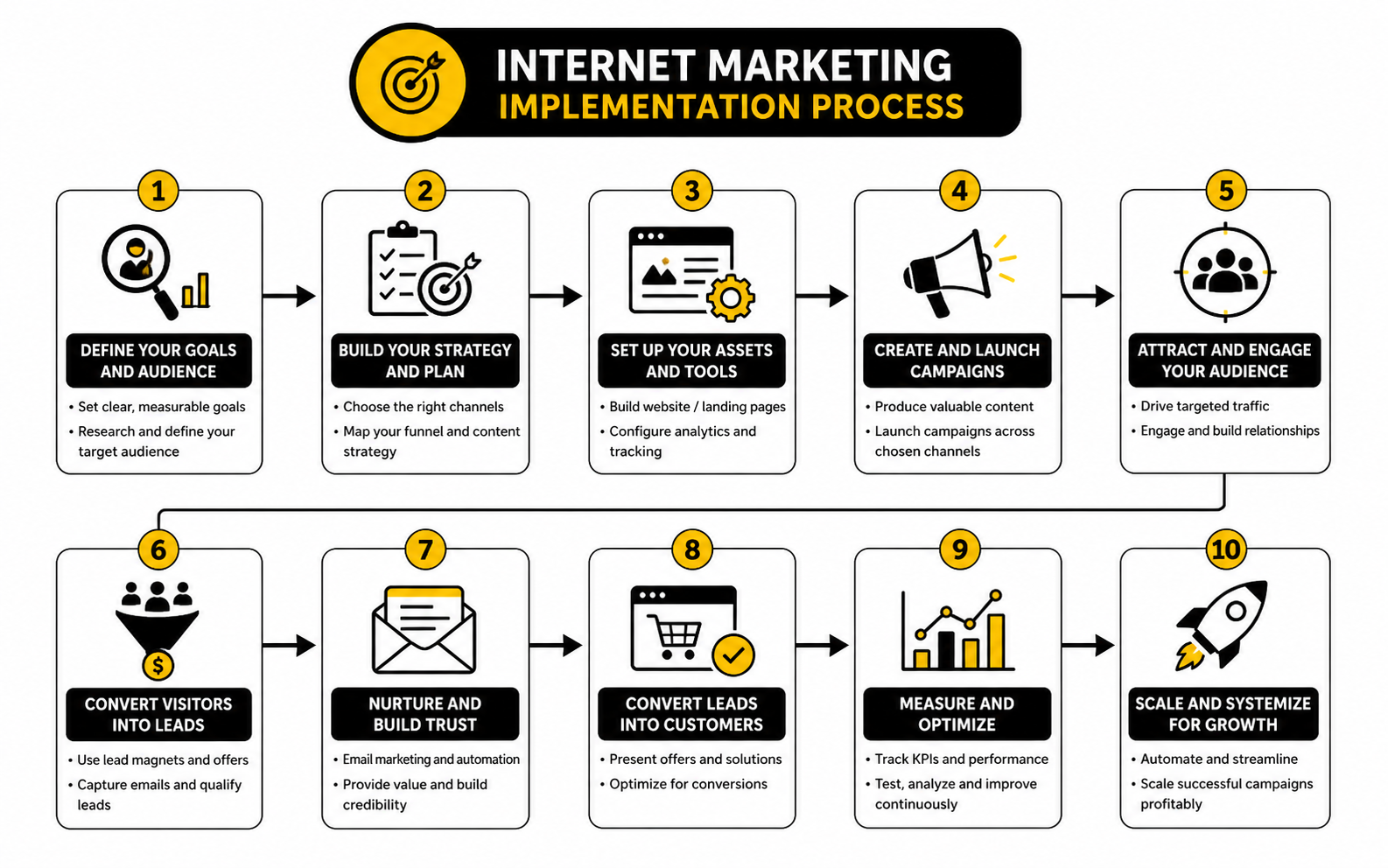
The execution process should be simple enough that the team can actually follow it. Every campaign needs a source of attention, a message, a destination, a conversion point, a follow-up system, and a measurement loop. If one of those pieces is missing, performance becomes harder to diagnose.
A practical process looks like this:
This is where internet marketing is concerned with process discipline. You do not need a complicated playbook, but you do need a repeatable way to turn strategy into assets. Without that, every campaign becomes a new emergency.
Connect Content to the Customer Journey
Content is not just for awareness. It can support every stage of the customer journey when it is planned correctly. A strong article can capture search intent, a comparison page can help a buyer justify a decision, a case study can reduce risk, and an onboarding email can improve retention.
The issue is that many businesses publish content without assigning it a job. One piece is supposed to educate. Another is supposed to create trust. Another is supposed to answer objections. Another is supposed to bring people back to an offer after they leave.
This is why content planning should start with customer questions. What does the buyer need to understand before they care? What do they compare before they choose? What objections appear repeatedly in sales calls? What proof would make the decision feel safer? Those questions create a much stronger content plan than copying competitor blog topics.
Use Paid Traffic Carefully
Paid traffic can speed up learning because it gives you data faster. You can test headlines, offers, audiences, landing pages, and conversion paths without waiting months for organic reach. That makes paid media useful even when the business does not plan to rely on ads forever.
But paid traffic also exposes weak systems quickly. If the offer is unclear, the landing page is slow, the follow-up is weak, or the audience is too broad, ad spend disappears fast. Gartner’s 2025 CMO Spend Survey found that digital channels account for most marketing spend, with paid online channels taking the largest share of digital budgets: Gartner CMO Spend Survey. That does not mean every business should spend aggressively; it means competition for efficient paid attention is serious.
The safest way to use paid traffic is to test the full path before scaling. Send traffic to one focused page. Track the next action. Watch the cost per lead, cost per booked call, cost per acquisition, and downstream quality. The first goal is not to spend more; it is to find evidence that the system can turn attention into value.
Make Organic Channels Compound
Organic channels are slower, but they can build durable leverage. Search content, YouTube videos, newsletters, social posts, communities, and podcasts can keep working after the first publish date. The compounding effect comes from consistent relevance, not from random posting.
That said, organic does not mean free. It costs time, expertise, editing, design, distribution, and patience. A weak organic strategy can waste months because the business confuses output with momentum. Publishing more is not the same as becoming more useful to the market.
A stronger organic strategy focuses on topics that connect to buyer intent and business value. Educational content should lead naturally into a problem the offer solves. Social content should make the audience want to keep hearing from the brand. Newsletter content should build enough trust that a future offer does not feel like an interruption.
Add Partnerships and Creators When Trust Is the Bottleneck
Some markets do not suffer from a lack of information. They suffer from a lack of trust. When buyers are skeptical, partnerships, affiliates, creator collaborations, expert interviews, and community relationships can help because the message travels through people or brands the audience already pays attention to.
This does not mean paying anyone with an audience. Audience fit matters more than follower count. A smaller creator or partner with the right trust can outperform a larger account that attracts broad but unqualified attention.
The IAB’s creator economy research shows how seriously advertisers now treat creator partnerships, with U.S. creator economy ad spend projected to keep growing as brands use creators for both awareness and conversion: Creator Economy Ad Spend Study. For implementation, the lesson is practical: use creators and partners when borrowed trust can shorten the path between discovery and action.
Build the Destination Before Scaling the Channel
Traffic should never be treated as the first asset. The destination has to be ready before the business pours attention into it. That destination might be a landing page, product page, sales page, webinar registration page, quiz, booking page, or lead capture form.
A focused landing page should make the next step obvious. The reader should understand who the offer is for, what outcome it supports, why it is credible, what happens next, and why acting now makes sense. Tools like Replo can be useful for ecommerce teams building higher-converting pages, while Fillout can help when the conversion point depends on forms, intake flows, or lead qualification.
The destination should also match the temperature of the traffic. Cold traffic usually needs more context and proof. Warm traffic may need a sharper offer and fewer distractions. Returning traffic may need urgency, reassurance, or a clearer reason to finish the action.
Create Follow-Up Before You Need It
Most people will not act the first time they see a message. That is normal. The problem is that many businesses spend heavily to get attention and then have no serious follow-up process after the first visit, click, or form submission.
Follow-up can include email, SMS, retargeting, CRM tasks, sales reminders, chatbot flows, booking reminders, and customer education. A business using Brevo might build segmented email sequences for leads and customers, while a business using ManyChat might use messaging flows for social-driven conversations. The right tool depends on where the customer starts and what action should happen next.
The key is to design follow-up before the campaign launches. If the business waits until leads are already leaking, it is reacting too late. A simple follow-up sequence can turn a one-time click into a real conversation, and that is where many internet marketing campaigns become profitable.
Review the Weakest Link First
When a campaign underperforms, the answer is not always more traffic. Sometimes the audience is wrong. Sometimes the promise is unclear. Sometimes the page does not match the ad. Sometimes the form asks too much too early. Sometimes the leads are good, but the sales follow-up is slow.
This is why the execution process needs diagnostics. Look at impressions, click-through rate, landing page engagement, conversion rate, lead quality, booked calls, show rate, sales rate, average order value, refund rate, and customer lifetime value. Each number tells you where the system is strong or weak.
Internet marketing is concerned with improving the whole path, not celebrating isolated metrics. A campaign with cheap clicks but poor customers is not a win. A campaign with lower volume but stronger intent may be far more valuable. The job is to find the path that creates profitable attention, not just visible activity.
Measurement, Automation, and Optimization
After traffic starts moving through the system, the real work becomes measurement. Internet marketing is concerned with knowing what happened, why it happened, and what should change next. Without that, every campaign becomes a debate based on opinions, screenshots, and whatever metric looks best in the moment.
Good measurement does not mean tracking everything. It means tracking the few numbers that explain whether attention is becoming business value. A campaign can have high impressions, strong engagement, and cheap clicks while still failing if the leads are unqualified or the sales process cannot convert them.
This is why analytics should be tied to the customer journey, not just the platform dashboard. The business needs to know where people came from, what they saw, what they did next, where they dropped off, and whether the final outcome justified the cost. That is the difference between reporting activity and managing performance.
Statistics and Data
The numbers around internet marketing are big, but big numbers are not automatically useful. U.S. internet advertising revenue reached $258.6 billion in 2024, and digital channels now account for 61.1% of total marketing spend in Gartner’s 2025 CMO Spend Survey. Those figures matter because they show where budgets have moved, but they do not tell you which channel your business should use tomorrow morning.
The useful takeaway is that competition for digital attention is intense. More money is flowing into online channels because they can be targeted, measured, optimized, and connected to revenue more directly than many traditional formats. That also means weak campaigns get punished faster because competitors are testing messages, offers, creative, and follow-up systems in the same space.
Benchmarks should be used the same way. A conversion rate, email open rate, cost per lead, or ad click-through rate can give you context, but it should not become the goal by itself. The goal is profitable movement through your specific funnel, with your specific audience, offer, economics, and sales cycle.
Measure the Journey, Not Just the Click
The first analytics mistake is stopping at the click. A click tells you that the message created enough curiosity for someone to move. It does not tell you whether the visitor understood the offer, trusted the page, wanted the next step, or became a valuable customer.
A more useful measurement view follows the journey in stages. At the top, you measure reach, impressions, click-through rate, traffic source, and content engagement. In the middle, you measure landing page conversion, form completion, lead quality, booked calls, email engagement, and return visits. At the bottom, you measure sales, revenue, acquisition cost, refund rate, retention, and lifetime value.
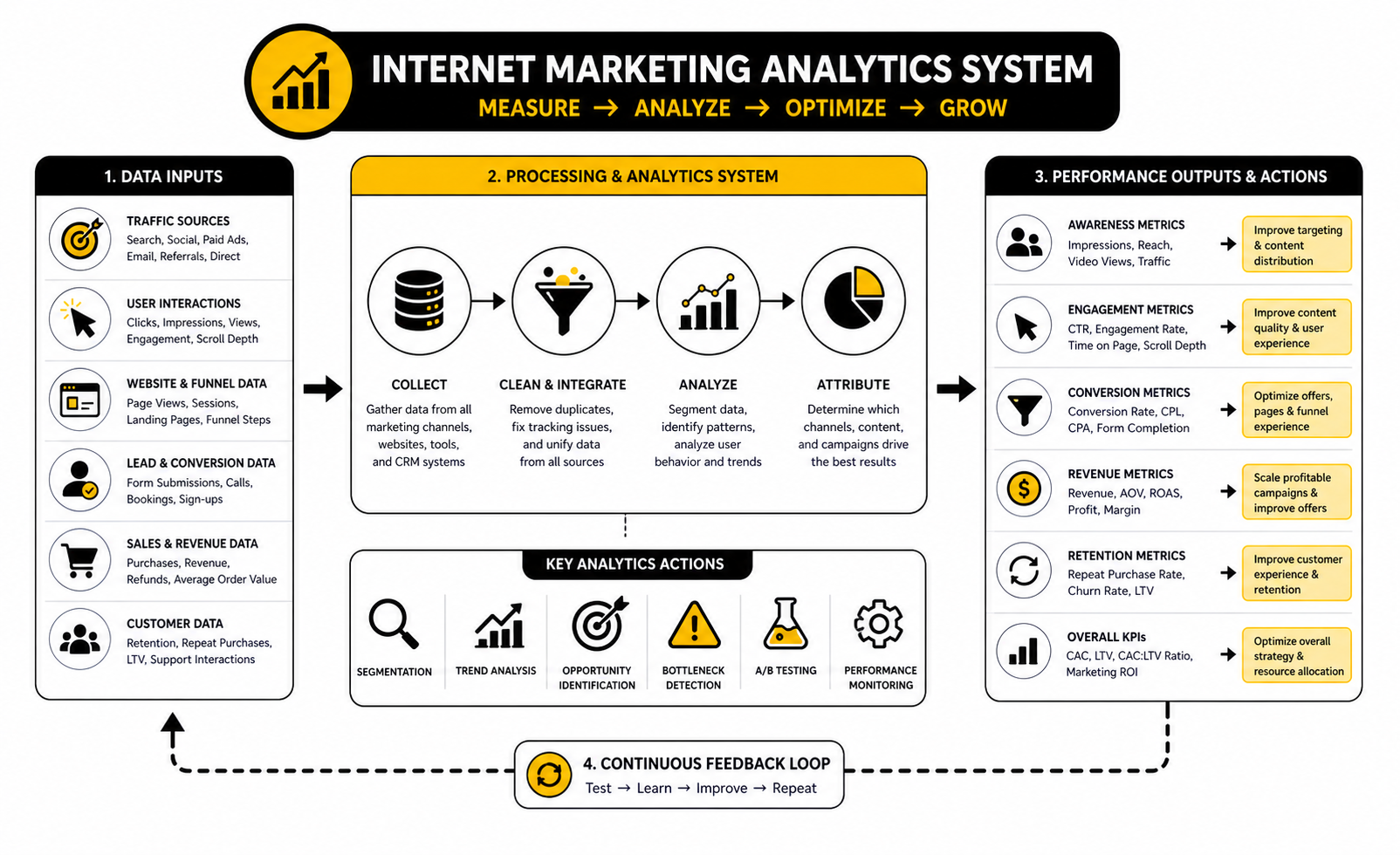
This structure makes diagnosis much easier. If impressions are high but clicks are weak, the message or targeting may be wrong. If clicks are strong but conversions are weak, the landing page, offer, proof, or audience expectation may be the issue. If leads convert but sales do not close, the problem may be qualification, follow-up speed, pricing, sales process, or product-market fit.
Read Metrics in Context
Metrics are signals, not verdicts. A low cost per lead may look good until you discover that the leads never buy. A high cost per acquisition may still be profitable if the customer lifetime value is strong. A low email open rate may not be a crisis if the campaign still drives qualified revenue from the right segment.
This is where internet marketing is concerned with interpretation. You are not collecting numbers to decorate a report. You are using them to decide what to keep, what to fix, what to cut, and what to scale.
Context also means comparing metrics at the right level. Platform-level data can show early signals, but CRM and revenue data show whether the campaign created business outcomes. A team that only looks inside ad dashboards may optimize for cheap conversions while quietly attracting the wrong customers.
Build a Simple Performance Scorecard
A scorecard keeps the team focused. It should not have 40 metrics. It should show the small set of numbers that explain whether the system is healthy.
A practical scorecard might include:
These numbers should be reviewed together, not separately. If cost per lead rises but lead quality improves, the campaign may still be moving in the right direction. If revenue rises but payback period becomes too long, the business may need better retention, pricing, upsells, or sales efficiency before scaling further.
Attribution Is Helpful, but It Is Not Perfect
Attribution tries to explain which touchpoints contributed to a conversion. That is useful, but it is never perfect. People use multiple devices, block tracking, clear cookies, talk to friends, watch content without clicking, search later, and buy after a sequence of interactions that no dashboard can fully see.
This does not make attribution useless. It means you should avoid pretending it is absolute truth. First-click attribution can highlight discovery channels. Last-click attribution can show what closed demand. Multi-touch attribution can reveal patterns across the journey. None of them should be used without judgment.
The practical move is to combine attribution with common sense and business evidence. Look at source data, CRM history, customer surveys, search trends, content engagement, branded search growth, sales notes, and revenue patterns. When several signals point in the same direction, you can make a better decision.
Automation Should Improve Timing and Relevance
Automation is valuable when it makes the customer journey more timely, relevant, and consistent. It should not be used to blast the same message to everyone. That is how brands turn useful systems into noise.
Good automation responds to behavior. Someone who downloaded a checklist may need education. Someone who viewed pricing may need proof or a comparison. Someone who abandoned a checkout may need reassurance. Someone who became a customer may need onboarding, usage help, or a relevant next offer.
Tools like GoHighLevel, Brevo, and Moosend can help manage those workflows, but the logic matters more than the platform. The automation should make the next step easier for the customer and more measurable for the business.
Optimize the Constraint
Optimization works best when you focus on the constraint. If the campaign is not getting enough qualified traffic, changing button colors is a distraction. If the landing page is converting poorly, adding more email automations will not fix the first bottleneck. If sales follow-up is slow, more leads may only create more waste.
The easiest way to find the constraint is to follow the funnel from top to bottom. Find the biggest drop-off that has the clearest business impact. Then improve that step before moving to the next one.
This keeps optimization practical. You might test a clearer headline, stronger proof, shorter form, better offer framing, faster follow-up, improved qualification, more relevant segmentation, or a stronger retargeting message. Each change should have a reason, a hypothesis, and a measurable result.
Know the Difference Between Leading and Lagging Indicators
Leading indicators show whether the system is likely to produce results. Examples include qualified traffic, content engagement from the right audience, email replies, demo requests, add-to-cart behavior, booking intent, and sales conversations. These signals help teams make decisions before final revenue data is complete.
Lagging indicators show what already happened. Revenue, profit, customer acquisition cost, retention, refunds, and lifetime value are lagging indicators. They are essential, but they often arrive after the campaign has already spent money or consumed time.
A strong internet marketing system uses both. Leading indicators help you adjust quickly. Lagging indicators keep you honest. If leading indicators look strong but lagging indicators stay weak, the business needs to recheck the offer, qualification, pricing, sales process, or customer experience.
Use Benchmarks as a Starting Point, Not a Ceiling
Benchmarks can stop you from flying blind, but they can also make teams lazy. If an email campaign performs above a general industry average, that does not mean it is excellent. It only means it beat a broad comparison group that may have different lists, offers, audiences, and goals.
The better benchmark is your own historical performance by channel, audience, offer, and stage of funnel. Compare search leads against search leads. Compare cold traffic landing pages against cold traffic landing pages. Compare customer reactivation emails against customer reactivation emails.
External data still has value when it shows market direction. For example, McKinsey’s personalization work emphasizes that better data, decisioning, design, distribution, and measurement are central to stronger personalized marketing systems: using the next frontier of personalized marketing. The action is not to copy a generic benchmark; the action is to improve how your own data turns into more relevant customer experiences.
Turn Reporting Into Decisions
A report is only useful if it changes what happens next. Too many teams build dashboards that everyone opens, skims, and forgets. That is not measurement. That is theater.
Every performance review should end with decisions. What gets scaled? What gets paused? What needs a new test? What needs better tracking? What customer segment deserves more attention? What message is clearly not working?
This is where measurement becomes a competitive advantage. Internet marketing is concerned with learning faster than the market punishes you. The businesses that improve from real data, not ego, usually build stronger campaigns over time.
Advanced Tradeoffs in Internet Marketing
At this stage, the work becomes less about knowing what internet marketing includes and more about making better tradeoffs. Every business has limited attention, budget, time, data, and creative energy. The job is not to do everything online; the job is to choose the moves that create the highest-quality growth without damaging trust, margins, or operational capacity.
This is where internet marketing is concerned with judgment. A tactic can be technically correct and still be wrong for the business right now. Paid ads may be powerful, but not if the offer is unproven. Automation may save time, but not if it makes the customer experience feel cold. Content may compound, but not if the team cannot publish with enough quality and consistency.
The deeper you go, the more the work becomes strategic. You are balancing speed against learning, scale against control, personalization against privacy, automation against human judgment, and short-term conversion against long-term brand trust. That is where better marketers separate themselves.
Speed Versus Quality
Moving fast matters because digital campaigns create feedback quickly. You can test a landing page, ad angle, email sequence, or offer variation and learn something useful in days instead of months. That speed is one of the biggest advantages of internet marketing compared with slower, harder-to-measure channels.
But speed can become sloppy. If a team launches weak creative, unclear offers, rushed pages, and disconnected follow-up just to “move fast,” the data becomes polluted. Poor execution can make a good idea look bad because the market never saw the idea in a strong enough form.
A practical rule is simple: move fast on tests, but do not move careless on fundamentals. The offer, message, page, tracking, and follow-up should be good enough to give the campaign a fair shot. You do not need perfection, but you do need enough quality that the result tells you something real.
Paid Growth Versus Organic Growth
Paid growth gives control. You can choose audiences, test messages, scale budgets, and get faster feedback. That makes it useful when the business needs predictable volume or wants to validate a funnel quickly.
Organic growth gives leverage. Search content, social authority, community trust, newsletters, and brand demand can reduce dependence on constant ad spend over time. The tradeoff is that organic usually requires patience, consistency, and a stronger editorial point of view.
The best businesses usually do not treat paid and organic as enemies. Paid channels can test which messages convert, and those insights can shape organic content. Organic channels can reveal what the audience cares about, and those insights can improve paid campaigns. When both sides feed each other, the marketing system becomes more carefully.
Personalization Versus Privacy
Personalization can improve relevance, but it has to be handled carefully. People like useful experiences, but they do not like feeling watched, manipulated, or trapped inside a creepy data machine. The line between helpful and invasive is not always technical; it is emotional.
This matters because trust is now part of the conversion path. A business that collects data without explaining value creates friction. A business that uses customer behavior to make the experience clearer, faster, and more relevant can increase trust instead of reducing it.
The practical approach is to collect the data you actually use, explain why it matters when needed, and avoid building campaigns that depend on fragile or questionable tracking. First-party data, consent-based email lists, customer preferences, purchase history, and direct customer feedback are usually more durable than chasing every possible signal across the web.
Automation Versus Human Touch
Automation helps when the process is repeatable. Lead routing, appointment reminders, onboarding emails, abandoned checkout messages, segmentation, CRM tasks, and reactivation campaigns can all become smoother with automation. This is especially useful when the business has enough volume that manual follow-up creates delays or missed opportunities.
But automation can also expose bad thinking. If the message is generic, the segmentation is lazy, or the timing is wrong, automation just sends the wrong thing faster. That is not efficiency. That is scaled irrelevance.
The right balance is to automate the predictable parts and keep human judgment where trust, nuance, and high-value decisions matter. For example, GoHighLevel can help centralize CRM workflows and follow-up, while Cal.com can support cleaner booking flows. But the sales conversation, offer strategy, and customer insight still need human thinking.
Scaling Without Breaking the System
Scaling is not just doing more of what worked once. More spend, more leads, more content, more emails, or more sales calls can create new bottlenecks. A campaign that works at small volume can break when the audience gets broader, lead quality drops, fulfillment slows down, or support gets overwhelmed.
This is why scaling should be staged. First, prove the path works with a narrow audience and clear offer. Then expand one variable at a time: budget, channel, audience, creative volume, follow-up, or offer variation. If everything changes at once, you will not know what caused the result.
The biggest scaling risk is operational. Marketing can create demand faster than the business can handle it. If onboarding, fulfillment, customer support, sales follow-up, or product delivery cannot keep up, growth turns into churn, refunds, bad reviews, and lower trust. That is why internet marketing is concerned with the whole business outcome, not just lead volume.
Brand Building Versus Direct Response
Direct response marketing asks for action now. It focuses on leads, purchases, bookings, trials, demos, and measurable conversion events. This is essential because a business needs revenue, not just visibility.
Brand building works differently. It creates memory, trust, familiarity, preference, and perceived authority before the buyer is ready to act. This is harder to measure in a neat dashboard, but it often makes future direct response campaigns work better.
The tradeoff is not whether brand or performance matters more. Both matter, but they work on different timelines. A smart internet marketing system uses direct response to capture active demand and brand building to make future demand easier to win.
AI Tools Versus Strategic Thinking
AI can speed up research, drafts, summaries, segmentation ideas, ad variations, support responses, and campaign planning. Used well, it removes friction and helps teams produce more options faster. That can be a real advantage when the strategy is already clear.
The danger is using AI to create more average content. If every competitor can generate generic posts, emails, ads, and landing page copy, volume alone becomes less valuable. The advantage shifts back to sharper positioning, original insight, better offers, stronger data, and cleaner execution.
AI should support the marketer, not replace the thinking. Tools like Chatbase can help turn knowledge into customer-facing chat experiences, and Wispr Flow can help speed up content and workflow input. But the real edge still comes from knowing what to say, who needs to hear it, and why they should believe it.
Channel Dependence Is a Real Risk
A business that depends too heavily on one channel is fragile. Search algorithms change. Ad costs rise. Social reach drops. Email deliverability shifts. Platform rules update. Competitors enter auctions and make yesterday’s economics harder.
The answer is not to panic and spread everywhere. The answer is to build resilience over time. That means owning more of the customer relationship, collecting first-party data, building email and CRM assets, developing brand search demand, and creating more than one reliable path to acquisition.
Owned systems matter here. A business using Brevo or Moosend can keep communicating with subscribers and customers without depending completely on a social feed or ad auction. That does not eliminate channel risk, but it reduces the damage when one source becomes less predictable.
Conversion Pressure Can Damage Trust
There is a point where optimization becomes too aggressive. Fake urgency, misleading claims, manipulative countdowns, exaggerated scarcity, unclear pricing, and overpromised outcomes may lift short-term conversions, but they weaken trust. That cost shows up later in refunds, complaints, churn, lower referrals, and weaker reputation.
Professional internet marketing does not need tricks to work. It needs clear offers, real proof, honest expectations, strong follow-up, and a buying path that respects the customer. Urgency is fine when it is true. Scarcity is fine when it is real. Persuasion is fine when it helps the buyer make a better decision.
The long-term goal is not to squeeze every possible click. The goal is to create customers who feel good about the decision after they buy. That is what makes retention, referrals, repeat purchases, and brand strength possible.
Complexity Should Be Earned
Many businesses add complexity too early. They build elaborate funnels, multi-step automations, retargeting layers, segmentation rules, dashboards, and nurture sequences before they have a strong offer or consistent traffic. Then the system becomes hard to manage and even harder to improve.
Complexity should be earned by volume and evidence. If one simple funnel works, then add segmentation. If one audience works, then test adjacent audiences. If one email sequence works, then personalize by behavior. The system should become more advanced because the data justifies it, not because complexity looks impressive.
This is especially important for smaller teams. A clean landing page, one strong offer, one traffic source, one follow-up sequence, and one scorecard can outperform a complicated setup that nobody maintains properly. Simple and consistent beats advanced and neglected.
Strategy Before Software
Software can make internet marketing easier, but it can also become a distraction. Teams often buy tools because they want the outcome the tool promises. Then they discover that the tool still requires positioning, copy, creative, offers, tracking, operations, and decision-making.
A funnel builder does not create demand by itself. A CRM does not fix a weak sales process by itself. An email platform does not make people care by itself. A chatbot does not replace a real customer experience by itself.
Use software when it supports a specific bottleneck. ClickFunnels can help when the bottleneck is building and testing direct-response funnels. systeme.io can help when a lean business wants pages, email, and offers in one place. Copper can help when relationship management and pipeline visibility become the priority. The right tool depends on the constraint, not the hype.
The Expert-Level Question
At the beginner level, people ask what internet marketing is concerned with. At the expert level, the question changes. You ask which part of the system creates the most leverage right now.
Sometimes the answer is clearer positioning. Sometimes it is better traffic quality. Sometimes it is a stronger landing page, faster follow-up, cleaner attribution, better sales enablement, stronger retention, or a more profitable offer. The best marketers do not treat every problem as a traffic problem.
That is the mindset that carries into the final implementation plan. Internet marketing is not a pile of tactics. It is a connected growth system, and the job is to strengthen the part of the system that creates the next meaningful improvement.
Implementation Plan, Tools, and FAQ
By now, the pattern should be clear. Internet marketing is concerned with building a complete growth system, not chasing isolated tactics. The system starts with audience insight, turns that insight into positioning and offers, distributes the message through the right channels, converts attention into action, and uses measurement to improve the next cycle.
The final step is making the system usable. A strategy that only looks good in a document is not enough. The business needs a practical operating rhythm, the right tools for its stage, clear responsibilities, and a way to keep improving without turning marketing into chaos.
The most useful implementation plan is simple enough to execute and strong enough to scale. It should tell the team what to build first, what to measure, what to automate, and what to ignore for now. That last part matters more than most people want to admit. Focus is a growth advantage.
Start With a 90-Day Operating Plan
A 90-day plan gives the business enough time to build, test, and learn without pretending that everything can be fixed in one week. The goal is not to create a perfect system immediately. The goal is to create a working version that produces useful data and reveals the next constraint.
The first 30 days should focus on foundations. Clarify the audience, tighten the offer, choose the primary acquisition path, build the destination, set up tracking, and prepare follow-up. This is where the business decides what the campaign is supposed to do before spending serious time or money.
The next 30 days should focus on launch and learning. Publish the assets, send traffic, monitor the journey, and look for the biggest drop-off. The final 30 days should focus on optimization and scale. Improve the weak point, refine the offer or creative, add automation where it removes friction, and decide whether the channel deserves more investment.
Choose Tools by Bottleneck
The best tool is the one that solves the constraint in front of you. If the constraint is funnel creation, use a funnel platform. If the constraint is CRM follow-up, use a CRM. If the constraint is email nurturing, use an email platform. If the constraint is booking friction, fix the booking process.
For direct-response funnels, ClickFunnels can help teams build pages, offers, and campaign paths without waiting on a heavy development process. For agencies, local businesses, and service teams that need CRM, pipelines, automations, and follow-up in one place, GoHighLevel can make the operating system easier to manage. For lean creators or small teams that want pages, email, and products in one simpler stack, systeme.io can be a practical starting point.
The point is not to collect software. The point is to remove friction from the customer journey and from the team’s workflow. If a tool does not improve speed, clarity, measurement, or conversion, it is probably just another monthly bill.
Build the System Before You Scale the Spend
Scaling too early is one of the fastest ways to waste money. A business should not dramatically increase ad spend, content volume, or outreach until the core path has enough evidence behind it. More traffic makes every weakness louder.
Before scaling, check the basics. The audience should be narrow enough to target. The offer should be easy to understand. The page should convert at a reasonable level for the channel. The follow-up should be active. The sales or checkout process should be ready. The tracking should show what is happening after the first click.
When those pieces are working, scaling becomes more rational. You can increase spend gradually, add new creative, expand to adjacent segments, build more content around proven demand, or add partnerships. That is very different from randomly doing more because the team wants faster results.
Keep the Customer Experience Honest
The internet makes it easy to overpromise. Fast pages, aggressive copy, retargeting, countdowns, email sequences, and AI-generated content can create pressure quickly. But pressure without trust is fragile.
A better system sells clearly and delivers honestly. It tells people what the offer does, who it is for, what happens next, and what they should realistically expect. That protects conversion quality and reduces the hidden costs that come after the sale.
This is especially important as more marketing becomes automated and AI-assisted. The IAB’s 2025 report shows U.S. digital ad revenue reaching $294.6 billion in 2025, which means competition for online attention keeps getting more serious. In a crowded market, trust is not soft. Trust is a performance asset.
What is internet marketing concerned with?
Internet marketing is concerned with using digital channels to attract the right audience, communicate a clear offer, convert attention into action, and improve results through measurement. It includes strategy, content, advertising, search, email, automation, analytics, conversion optimization, and retention. The main job is not just getting traffic; it is turning online attention into business value.
Is internet marketing the same as digital marketing?
The terms are often used together, but they are not always identical. Internet marketing usually refers to marketing activity that happens through internet-based channels such as websites, search engines, email, social media, online ads, and messaging platforms. Digital marketing can be broader because it may also include non-internet digital formats, depending on how the term is being used.
Why does internet marketing matter for small businesses?
Internet marketing matters for small businesses because buyers now research, compare, and contact companies online before making many decisions. A small business can use search, local pages, landing pages, reviews, email, and social content to appear during those decision moments. The advantage is not just visibility; it is the ability to measure what brings leads, calls, bookings, and revenue.
What are the main components of internet marketing?
The main components are audience research, offer development, positioning, traffic generation, conversion paths, follow-up, analytics, and optimization. Content, SEO, paid ads, email, funnels, social media, CRM, and automation are tools or channels inside that larger system. The strongest results usually come when those components support one clear customer journey.
What is the first step in internet marketing?
The first step is understanding the customer and the offer. Before choosing a channel, you need to know who the campaign is for, what problem they want solved, why they should trust you, and what action you want them to take. Without that clarity, traffic and tools usually amplify confusion.
Which internet marketing channel is best?
There is no universal best channel. Search is strong when buyers already know what they want and are actively looking. Social and creator content are useful when the market needs education, trust, or demand creation. Email and CRM are powerful when the business already has leads or customers to nurture. The best channel depends on buyer behavior, offer type, budget, sales cycle, and available resources.
How do you measure internet marketing success?
You measure success by connecting channel metrics to business outcomes. Clicks, impressions, open rates, and engagement can show early signals, but the important numbers are qualified leads, booked calls, sales, revenue, customer acquisition cost, retention, and lifetime value. A campaign is not successful just because it gets attention; it is successful when that attention becomes profitable action.
How long does internet marketing take to work?
The timeline depends on the channel and the strength of the offer. Paid traffic can produce feedback quickly, but it still needs a working page, message, and follow-up process. SEO, content, community, and brand-building usually take longer because they compound over time. A realistic approach is to use short-term tests for learning while building longer-term assets that reduce dependence on paid traffic.
What role does automation play in internet marketing?
Automation helps make follow-up more timely, consistent, and relevant. It can route leads, send email sequences, trigger reminders, segment contacts, recover abandoned checkouts, and support onboarding. Automation works best when the message and customer journey are already clear. If the strategy is weak, automation only sends weak messages faster.
What is the biggest mistake businesses make with internet marketing?
The biggest mistake is treating internet marketing as a list of tactics instead of a connected system. A business may run ads, publish content, send emails, and build pages without making those pieces work together. That creates activity but not momentum. The better approach is to build one clear path from attention to conversion, measure it, and improve the weakest step.
Do you need a big budget for internet marketing?
You do not need a huge budget to start, but you do need focus. A small budget can work if the audience is specific, the offer is clear, and the business chooses one primary acquisition path instead of spreading effort everywhere. Bigger budgets help with speed and scale, but they do not fix weak positioning, poor conversion, or bad follow-up.
How does AI change internet marketing?
AI changes internet marketing by making research, drafting, analysis, creative variation, chat experiences, and workflow automation faster. That can be useful, but it also makes generic content easier for everyone to produce. The advantage shifts toward better strategy, sharper positioning, stronger customer insight, and more useful execution. AI should support the marketer’s thinking, not replace it.
How should a beginner start with internet marketing?
A beginner should start with one audience, one offer, one channel, one conversion path, and one simple scorecard. Do not start by trying to master every platform. Build a focused landing page or offer page, drive a manageable amount of traffic, follow up properly, and learn from the results. Once that path works, add complexity only when it is justified.
What tools are useful for internet marketing?
Useful tools depend on the job. Funnel builders like ClickFunnels help with direct-response pages and offers. Platforms like GoHighLevel help with CRM, pipeline, and automation. Email platforms like Brevo help with nurturing and retention. The right tool is the one that improves the system you are actually building.
What is the final goal of internet marketing?
The final goal is predictable, profitable customer growth. That means reaching the right people, earning trust, helping them make a decision, delivering value after the sale, and improving the system over time. Internet marketing is concerned with the full path, not just the first click.
Build a stronger local presence with BAAM AI
Turn your website, Google profile, social channels, and AI visibility into one growth engine
Most businesses do not need more random marketing activity. They need a consistent presence system that helps the right people find them, trust them, and take action. BAAM AI brings strategy, local SEO, website updates, Google Maps visibility, social content, AI-search readiness, media production, and reporting into one practical monthly engine.
If you want your marketing to keep working after the campaign ends, start with a free BAAM AI presence audit. See how your business shows up today and where the fastest visibility wins are at BAAM AI.