
BAAM AI Blog
What egFWD Digital Marketing Actually Helps You Learn
The biggest reason people search for egfwd digital marketing is simple: they want to know whether it teaches real marketing skills or just gives them another certificate to post on LinkedIn.
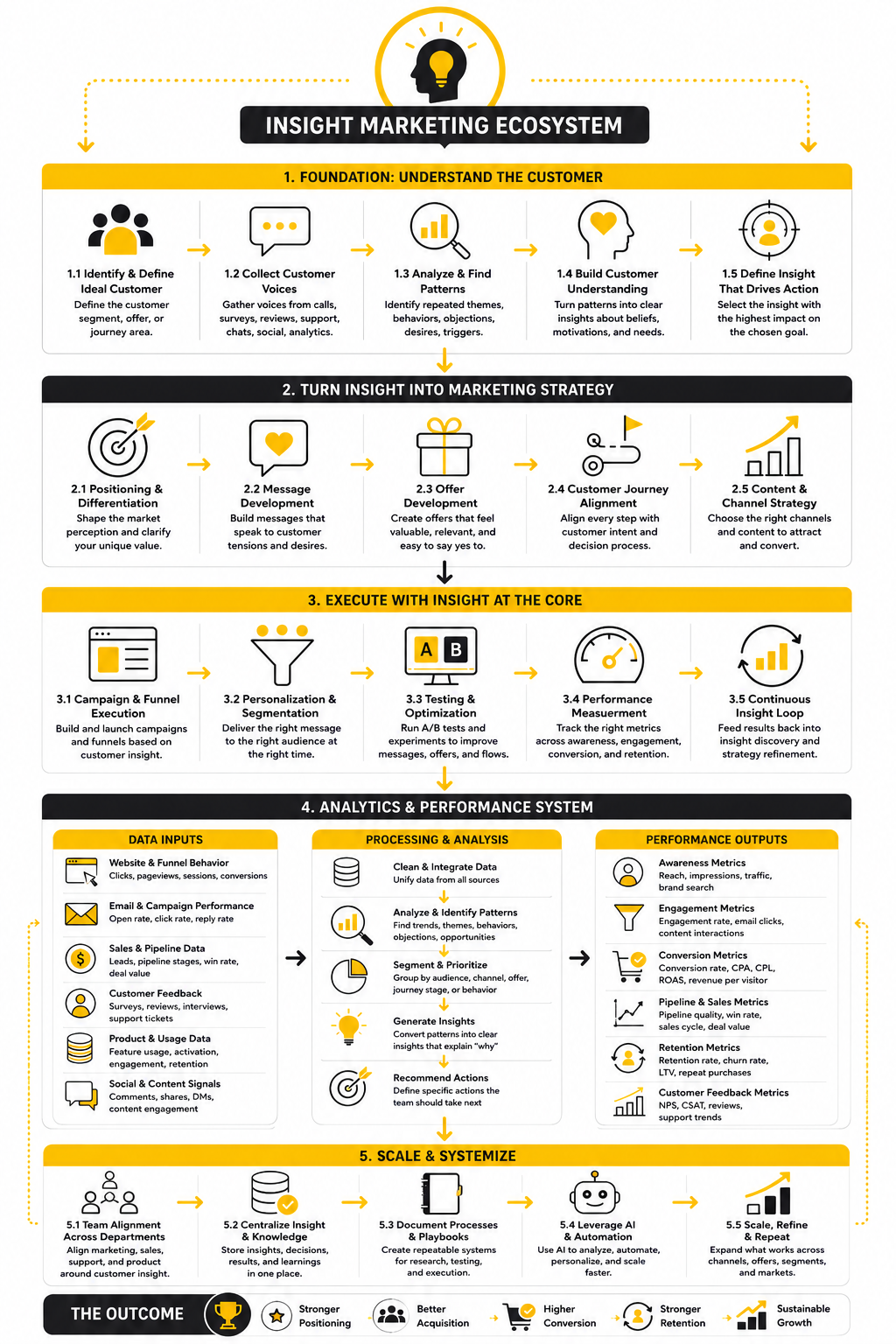
What egFWD Digital Marketing Actually Helps You Learn
The biggest reason people search for egfwd digital marketing is simple: they want to know whether it teaches real marketing skills or just gives them another certificate to post on LinkedIn.
The useful part is that egFWD is not positioned like a random “watch videos and pass a quiz” course. The digital marketing track is built around practical areas you will actually use if you want to freelance, work with a business, or start applying for entry-level marketing roles.
You are not just learning definitions like “SEO means search engine optimization” or “content marketing means creating content.” You are learning how those pieces connect inside a real customer journey, which is where most beginners usually get stuck.
Marketing Fundamentals
Before you touch ads, email, analytics, or automation, you need the basics. That means understanding the customer, the offer, the market, the message, and the channel. Without that foundation, every tactic becomes guesswork.
This is where egFWD digital marketing can be useful for beginners because it forces you to slow down and think like a marketer before acting like a media buyer. You start seeing that a weak campaign is not always a “bad ad problem.” Sometimes the audience is unclear, the offer is weak, the landing page is confusing, or the message does not match what people actually care about.
That matters because marketing is not about pressing buttons inside tools. Tools change all the time. The thinking behind them is what keeps you valuable.
Content Strategy And Copywriting
Content is usually where most beginners enter digital marketing because it feels accessible. You can write posts, create short-form scripts, plan campaigns, and test different messages without needing a huge budget. But good content is not just posting motivational captions and hoping the algorithm rewards you.
A proper content strategy answers basic but important questions. Who are you speaking to? What problem are they aware of right now? What do they need to believe before they trust the brand? What action should they take after reading, watching, or clicking?
This is also where you start noticing the difference between content that gets attention and content that supports a business goal. A viral post can be useless if it attracts the wrong people. A simple post with a clear promise can be valuable if it brings qualified leads, replies, signups, or sales conversations.
Social Media Marketing
Social media is not just “make posts for Facebook and Instagram.” It is audience research, positioning, consistency, creative testing, community response, and distribution. The platform is only the surface.
A good egFWD digital marketing learner should treat social media as a testing ground. You test hooks, angles, objections, formats, offers, and calls to action. Then you use the results to make better content, better ads, and better landing pages.
This is also where scheduling and workflow tools become useful. For example, if you are managing content for a small business or a client, a tool like Buffer can help you plan posts instead of publishing everything manually at the last minute. The tool will not fix a weak strategy, but it can make a strong strategy easier to execute consistently.
Paid Advertising
Paid ads are often the part that feels the most exciting because they look direct. You put money in, launch a campaign, and watch the numbers. But paid advertising can become expensive very quickly if you do not understand targeting, creative, budget control, landing pages, and measurement.
That is why the learning curve matters. You need to understand what makes an ad worth testing, what makes an audience worth targeting, and what makes a result worth scaling. Beginners often judge ads too emotionally, but serious marketers judge them by data, context, and business goals.
Paid advertising also teaches you humility. Sometimes the ad you love performs badly. Sometimes the simple version wins. The job is not to prove your taste is right; the job is to find what the market responds to.
SEO And Search Intent
SEO is one of the most valuable parts of digital marketing because it teaches you how people search when they already have intent. Social media often interrupts people while they scroll. Search captures people while they are actively looking for answers, comparisons, services, products, or solutions.
For an egFWD digital marketing student, SEO is not just about keywords. It is about understanding the reason behind the search. Someone searching “what is digital marketing” needs a different page than someone searching “best email marketing tool for small business.”
This skill becomes even more important as search changes with AI-generated answers and more complex search behavior. The marketers who win are the ones who can create clear, useful, trustworthy content that answers real questions better than generic content does.
Email Marketing And Lead Nurturing
Email marketing is still one of the most practical skills a beginner can learn because it connects content, offers, trust, and conversion. Social platforms can change their reach overnight. Ads can become more expensive. But an email list gives a business a direct channel to people who already showed interest.
The key is learning how to write emails people actually want to open. That means useful subject lines, clear value, simple structure, and a reason to keep reading. You do not need to sound clever; you need to sound relevant.
For small business email campaigns, tools like Brevo or Moosend can fit naturally once you understand the strategy. The tool comes after the thinking, not before it.
Analytics And Campaign Optimization
Analytics is where marketing becomes less emotional and more honest. You can have a beautiful campaign, a strong-looking page, and a confident opinion, but the numbers will show whether people actually responded. That is uncomfortable, but it is also where improvement happens.
A good digital marketer does not only ask, “Did this campaign work?” They ask better questions. Where did people drop off? Which channel brought the best leads? Which message created the strongest response? Which part of the funnel needs fixing first?
This is one of the most important mind shifts in egFWD digital marketing. You stop seeing marketing as a collection of tasks and start seeing it as a system that can be measured, improved, and repeated.
The Skills That Matter After You Finish egFWD Digital Marketing
Finishing the course is not the final goal. The real goal is becoming useful in the market. That means you need to turn what you learn into proof, experience, and confidence.
A certificate can help open a conversation, but it will rarely close the opportunity by itself. Clients and employers want to know what you can do. They want to see whether you can think clearly, communicate well, and improve results without needing someone to hold your hand through every step.
That is why your next step after egFWD digital marketing should be building a small but serious portfolio. Not a huge portfolio. Not a fake portfolio. A real, focused one that shows how you think.
Build A Simple Portfolio
Your portfolio does not need to be fancy. It needs to be clear. A few strong samples are better than ten messy projects that do not explain what you did.
You can include content calendars, campaign ideas, landing page copy, email sequences, SEO article briefs, ad concepts, or analytics breakdowns. The point is to show that you understand the work, not just the theory. When someone looks at your portfolio, they should quickly understand your role, your thinking, and the outcome you were trying to create.
If you want to build landing pages for campaigns, a tool like Replo can be useful for ecommerce-style pages, while ClickFunnels or systeme.io can make sense for simple funnels. Again, the software is not the strategy, but it helps you turn your strategy into something people can actually click through.
Practice With Real Constraints
A lot of beginners practice marketing in a vacuum. They write content for imaginary brands, create campaigns with unlimited budgets, and build strategies without deadlines. That feels safe, but it does not prepare you for real work.
Real marketing has constraints. The budget is limited. The client is unsure. The audience is skeptical. The offer is imperfect. The deadline is close. The data is messy.
That is why practical projects matter so much. Even a small project for a local business, student club, personal brand, or side project can teach you more than endless passive learning. You learn how to make decisions when the situation is not perfect, which is exactly what marketers do every day.
Learn Basic Automation
Automation is no longer optional if you want to be efficient. You do not need to become a developer, but you should understand how leads move from one step to another. A person fills out a form, receives a follow-up email, gets tagged in a CRM, enters a workflow, and eventually books a call or receives an offer.
This is where tools like GoHighLevel can be useful for agencies, local businesses, and service providers. It brings CRM, landing pages, automations, follow-ups, and pipeline management into one place, which is helpful when you are trying to understand the full customer journey. For chat-based funnels, ManyChat can also fit well when the business depends on Instagram, Messenger, or WhatsApp conversations.
The important thing is not to become obsessed with automating everything. Automate what improves speed, consistency, or follow-up quality. Do not automate weak messaging and expect better results.
Get Comfortable With Client Communication
Digital marketing is not only technical. A lot of your success will come from how clearly you communicate with clients, managers, or team members. You need to explain what you are doing, why it matters, what the numbers mean, and what should happen next.
This is where many beginners lose opportunities. They may know how to create a campaign, but they cannot explain it in a way that makes the client feel confident. They use jargon, avoid hard conversations, or send reports that are full of numbers but empty of insight.
A strong marketer makes things easier to understand. They do not hide behind complexity. They translate marketing activity into business language: leads, sales, retention, cost, time, trust, and growth.
How To Turn egFWD Digital Marketing Into A Real Execution System
Learning digital marketing is useful, but execution is where the skill becomes real. This is the point where you stop collecting information and start building a repeatable process. If you are using egfwd digital marketing as your starting point, the best move is to turn every lesson into a small action that produces something visible.
That visible thing could be a content plan, a landing page draft, a simple email sequence, a campaign report, or a client-ready marketing audit. The format matters less than the habit. You are training yourself to think, build, measure, and improve.
This is also where beginners separate themselves. Most people finish a course and wait for confidence to appear. The more carefully approach is to create confidence by doing the work in small, structured cycles.
Start With One Clear Marketing Goal
Do not begin with tools. Do not begin with a logo, a color palette, or a complicated content calendar. Begin with one clear marketing goal.
A goal gives every action a reason. If the goal is lead generation, your content, landing page, offer, and follow-up should all support that. If the goal is awareness, your campaign should focus more on reach, positioning, and audience education before asking for a direct sale.
This is where many beginners make their first mistake. They try to do SEO, ads, email, social media, and automation all at once. That creates motion, but not progress. A simple goal gives you focus, and focus makes your work easier to measure.
Choose One Business Or Project
The fastest way to practice is to choose one business or project and stick with it long enough to see patterns. It can be your own side project, a small local business, a creator brand, a student initiative, or a fictional practice brand if you have no other option. Real businesses are better, but the main point is consistency.
When you jump between random examples every week, you never build context. You do not learn the audience deeply, you do not understand the offer, and you do not see how one campaign affects the next. Digital marketing improves when your decisions build on each other.
Keep the project simple. Pick one offer, one audience, and one primary conversion action. That action might be booking a call, joining an email list, filling out a form, buying a product, or sending a message.
Define The Audience Before The Campaign
Audience work is not a fluffy branding exercise. It decides what you say, where you say it, and why anyone should care. If you skip it, your campaign will sound generic no matter how polished it looks.
Start by writing down who the campaign is for, what problem they already know they have, and what they have probably tried before. Then write what they are afraid of, what they want, and what would make them trust the offer. This gives you raw material for content, ads, landing pages, and follow-up messages.
The goal is not to create a perfect customer avatar with made-up details. The goal is to understand the buying situation. A person does not buy because they are “25 to 34 and interested in business.” They buy because they have a problem, pressure, desire, deadline, or opportunity.
Build The Campaign In A Simple Sequence
Once the goal and audience are clear, the process becomes much easier. You are not randomly creating assets anymore. You are building a path that takes someone from attention to action.
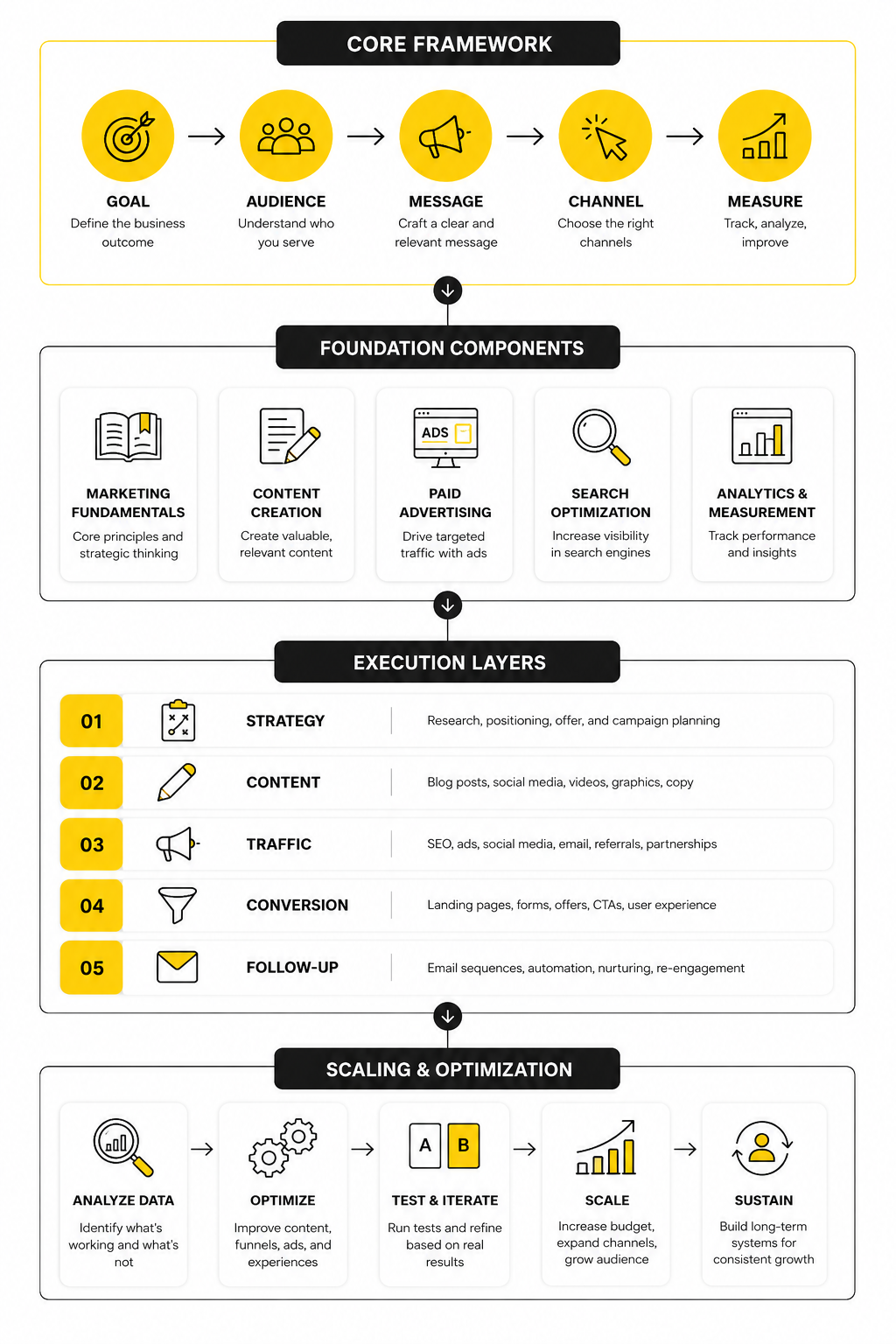
A basic campaign does not need to be complicated. It needs to be complete. The person should understand the problem, see the value of the offer, trust the next step, and know exactly what to do.
Use this simple execution sequence:
This sequence is simple on purpose. You can use it for a small content campaign, an email campaign, a lead magnet, a service offer, or a paid ad test. The scale changes, but the logic stays the same.
Write The Core Message First
The core message is the campaign’s spine. It should explain who the offer is for, what problem it solves, why it matters now, and what action the person should take. If you cannot explain that clearly, the campaign is not ready.
A weak message usually tries to say too much. It lists features, throws in vague benefits, and hopes something sticks. A strong message makes the value obvious quickly.
For example, “We help small gyms get more members” is better than “We provide innovative digital growth solutions.” It is specific, easy to understand, and connected to a business outcome. That is the kind of clarity you should train while working through egFWD digital marketing projects.
Create One Main Content Angle
A content angle is the way you enter the conversation already happening in your audience’s head. It could focus on a pain point, a mistake, a comparison, a result, a myth, a checklist, or a step-by-step process. The angle decides whether people stop and pay attention.
Do not create ten angles immediately. Start with one strong angle and build different formats around it. You can turn the same angle into a LinkedIn post, Instagram carousel, short video script, email, ad concept, and landing page section.
This is how real marketers work efficiently. They do not reinvent the entire strategy every day. They find a useful idea, test how people respond to it, and then expand it across channels.
Build A Landing Page That Matches The Promise
The landing page should continue the same promise from the content or ad. If the post talks about saving time, the page should not suddenly focus on pricing flexibility. If the ad promises a free checklist, the page should make that checklist easy to understand and easy to get.
A basic landing page needs a clear headline, a short explanation, a reason to trust the offer, and one obvious call to action. That is enough for a first version. You can improve it later after you see how people behave.
If you want a simple way to turn campaign ideas into pages, ClickFunnels, systeme.io, or Replo can help you build without getting stuck in technical setup. Use them to move faster, but do not let the tool distract you from the message.
Set Up Follow-Up Before You Drive Traffic
Traffic without follow-up is wasteful. Someone may click, read, hesitate, and leave. If there is no email sequence, message flow, retargeting plan, or CRM process, you lose people who might have converted with a little more trust.
This matters because most people do not take action the first time they see an offer. They need reminders, proof, context, and a reason to come back. Follow-up is how you keep the conversation alive after the first click.
For a beginner, the follow-up system can be simple. A form, a confirmation email, two or three helpful emails, and a clear next step is enough to practice the process. You can always make it more advanced later.
Use Email To Build Trust
Email is one of the cleanest ways to practice lead nurturing because it forces clarity. You have to write a subject line, deliver value, and move the reader toward the next step. There is no algorithm to blame if the message is weak.
A simple starter sequence can include a welcome email, one educational email, one proof-based email, and one direct call-to-action email. Each email should have one job. Do not overload the reader with five different links and three different offers.
Email still earns serious attention because it remains a measurable owned channel, and Litmus reports that 35% of companies see email ROI of 36:1 or more. That does not mean every beginner will get that result. It does mean the channel is worth learning properly instead of treating it like an afterthought.
Use Forms And Booking Links To Reduce Friction
If your campaign asks people to take action, make the action easy. A confusing form or messy booking process can ruin an otherwise good campaign. People should not need to think hard about how to contact you, claim the offer, or book the next step.
For lead capture, Fillout can help you create simple forms that look professional. For scheduling calls, Cal.com can make the booking step smoother. These tools are useful because they remove friction at the exact point where interest can turn into action.
Do not overcomplicate this. Ask only for the information you actually need. Every extra field creates another reason for someone to quit.
Keep Your CRM Basic At First
A CRM is not just a place to store names. It helps you understand where each lead is in the process. New lead, contacted, interested, booked, won, lost - even a simple pipeline gives structure to your follow-up.
For service businesses and agencies, GoHighLevel can be useful because it combines CRM, funnels, automations, calendars, and follow-up workflows. That makes it easier to see the whole journey instead of jumping between disconnected tools. But the principle matters more than the platform: every lead should have a next step.
Start with a basic pipeline and improve it as your process becomes clearer. The worst CRM is not the simple one. The worst CRM is the one nobody updates.
Measure The Few Numbers That Actually Matter
Beginners often open analytics and immediately get overwhelmed. There are too many numbers, too many charts, and too many ways to misread what is happening. The solution is to track fewer metrics at first.
For a simple campaign, focus on the numbers that connect directly to the goal. If you are generating leads, track visitors, conversion rate, cost per lead if ads are involved, booked calls, and actual customers. If you are building an email list, track signup rate, open rate, click rate, and replies.
The point is not to become a data scientist overnight. The point is to learn how marketing decisions affect outcomes. When you see that one message gets more clicks but fewer qualified leads, you start thinking like a marketer instead of a content creator chasing surface-level engagement.
Review Results Weekly
A weekly review keeps your campaign from drifting. Look at what you published, what people clicked, where they dropped off, and what feedback came in. Then decide what to change next.
Do not change everything at once. If you rewrite the headline, change the offer, redesign the page, switch the audience, and edit the emails in the same week, you will not know what caused the result. Improve one or two things at a time.
This is one of the most practical habits you can build after egFWD digital marketing. Small improvements compound. Random changes do not.
Separate Traffic Problems From Conversion Problems
Not every campaign problem is the same. If nobody sees the campaign, you have a traffic or distribution problem. If people visit but do not act, you probably have a conversion problem.
This distinction saves a lot of wasted effort. A landing page cannot convert traffic it never receives. More traffic will not fix an offer nobody wants.
Before making changes, ask where the breakdown happens. Is the content failing to attract attention? Is the click happening but the page failing to persuade? Are people signing up but ignoring the follow-up? The answer tells you where to focus.
Document What You Learn
Your notes are part of your portfolio. When you document what you tried, what happened, and what you changed, you create proof of thinking. That is valuable whether you apply for a job, pitch freelance clients, or build your own business.
Keep the format simple. Write the campaign goal, the audience, the assets created, the results, and the lessons learned. Add screenshots or links when possible.
This habit turns practice into evidence. Instead of saying “I studied digital marketing,” you can say “I built this campaign, measured these numbers, found this issue, and improved this part.” That is a much stronger position.
Statistics And Data
Data is where egfwd digital marketing becomes more than theory. It shows you whether your campaign is attracting the right people, whether your message is clear, and whether your offer is strong enough to create action. But numbers only help when you know what they are actually telling you.
The mistake is treating benchmarks like grades. A 3% click rate is not automatically good or bad. A $70 lead is not automatically expensive. A 2% landing page conversion rate is not automatically a disaster. The number only means something when you compare it with the goal, the channel, the offer, the audience, and the economics behind the business.
That is why measurement needs a system. You are not collecting stats to look smart in a report. You are collecting signals that tell you what to fix next.
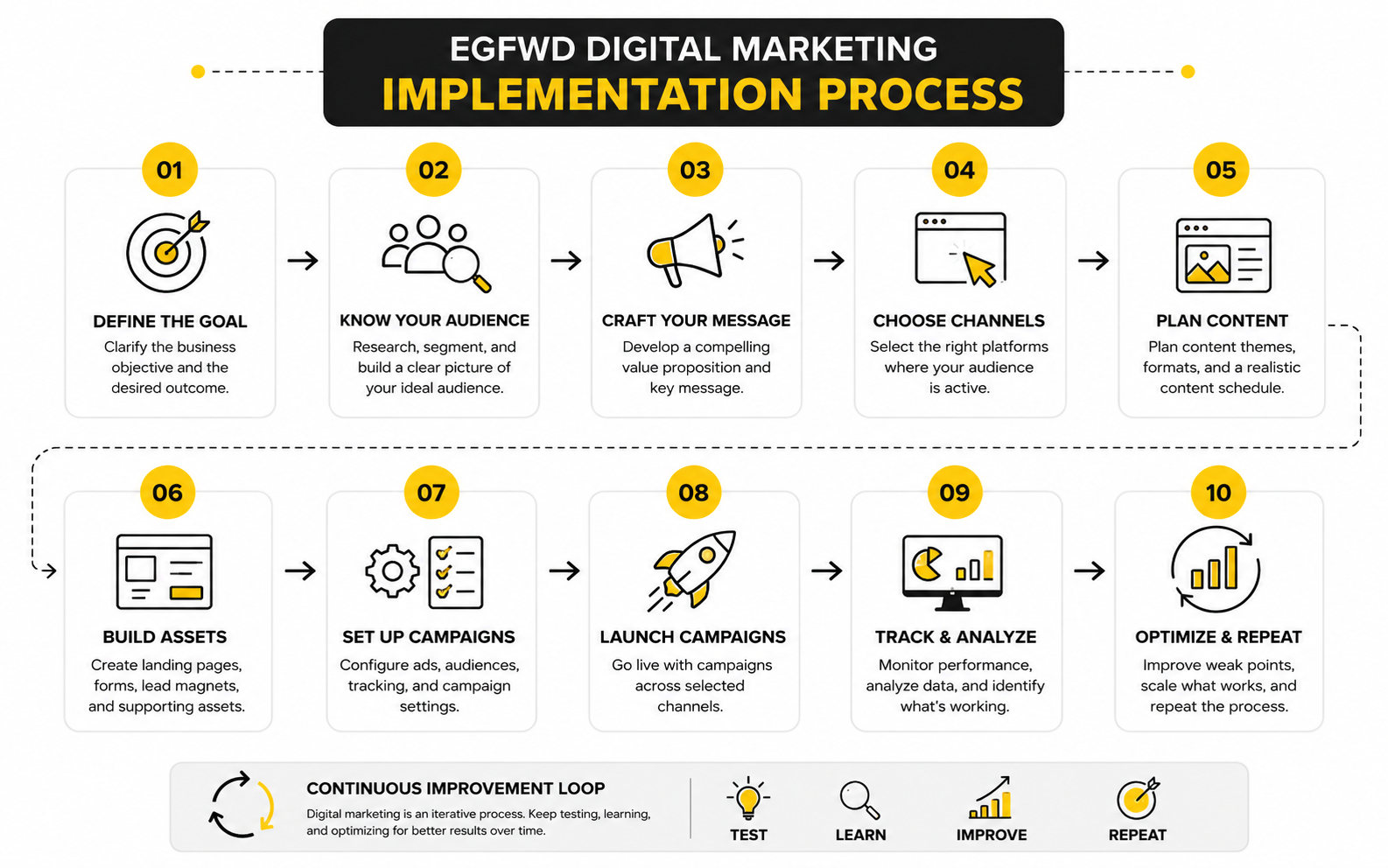
The Four Numbers Every Beginner Should Track First
When you are early in digital marketing, do not start with a dashboard full of twenty metrics. Start with the four that explain the campaign journey most clearly: reach, click-through rate, conversion rate, and cost per result. These numbers show whether people saw the message, cared enough to click, took the next step, and did so at a cost that makes sense.
Reach tells you whether distribution is working. If nobody sees the campaign, the message cannot be judged fairly. A weak reach number usually points to a channel, posting frequency, audience size, budget, or distribution problem.
Click-through rate tells you whether the message created enough interest to earn action. If reach is decent but clicks are low, the hook, creative, offer, or audience fit probably needs work. This is where you improve the angle before blaming the landing page.
Conversion rate tells you whether the destination delivered on the promise. If people click but do not submit the form, book the call, buy the product, or join the list, you likely have a page, offer, trust, or friction problem. This is one of the most important diagnostic skills you can build after egFWD digital marketing.
Cost per result tells you whether the campaign makes business sense. A cheap lead is not always a good lead, and an expensive lead is not always bad. The real question is whether that lead can turn into enough revenue to justify the cost.
Benchmarks Are Starting Points, Not Rules
Benchmarks are useful because they give you context. They stop you from guessing blindly and help you understand whether your numbers are in a normal range. But they are not commandments.
For example, Google Ads search campaigns vary heavily by industry, intent, and competition, but recent benchmark data shows an average search ad click-through rate of 6.66%, average cost per click of $5.26, average conversion rate of 7.52%, and average cost per lead of $70.11 across analyzed campaigns in 2025 from WordStream’s PPC benchmark dataset. Those numbers are useful, but they should not become your entire strategy.
If your cost per lead is higher than the average, it does not automatically mean the campaign is failing. A high-ticket service can afford a higher lead cost if the close rate and customer value are strong. A low-ticket product usually cannot. Context decides.
Email Metrics Need Careful Interpretation
Email marketing is one of the easiest channels to measure, but it is also easy to misread. Open rates can be inflated by privacy changes, automated inbox behavior, and tracking limitations. That means clicks, replies, conversions, and revenue usually tell a better story than opens alone.
The 2025 GDMA email benchmark shows an average confirmed open rate of 32.40%, click-to-open rate of 7.62%, and click-through rate of 2.91% in its dataset from Spotler’s GDMA benchmark summary. Those numbers help you compare performance, but they should lead to better questions instead of lazy conclusions. Are people opening but not clicking? Are they clicking but not buying? Are they replying with objections?
For a beginner, this is powerful because email gives fast feedback. If the subject line gets attention but the email gets no clicks, the body may not build enough desire. If people click but do not convert, the landing page or offer may be the issue. Each number points to a specific part of the system.
Social Media Data Should Not Be Judged By Likes Alone
Social media can trick you because public engagement feels rewarding. Likes, comments, and shares are visible, so they feel important. But visibility does not always equal business value.
A post can get attention from people who will never buy, apply, subscribe, or book a call. Another post can get fewer likes but bring better leads because it speaks to a sharper pain point. This is why egFWD digital marketing students should learn to separate vanity metrics from business signals early.
Social benchmarks also vary by platform and industry. Hootsuite’s 2025 benchmark data shows average engagement rates such as 2.7% on LinkedIn, 3.5% on Instagram, and 2.6% on Instagram Reels across the reported sample in its average engagement rate benchmark report. Those numbers are helpful for comparison, but the better question is whether your content is attracting the audience that can actually move the business forward.
Landing Page Data Shows Where Trust Breaks
A landing page is where the campaign promise gets tested. People clicked because something sounded relevant. Now the page has to prove that the next step is worth taking.
If traffic is strong but conversion is weak, look at the page before spending more money. The headline may not match the ad. The offer may be unclear. The form may ask for too much. The proof may be weak. The call to action may be buried.
This is where tools can help, but only if you know what to look for. A funnel builder like ClickFunnels or systeme.io can make testing pages easier, while Replo can be useful for ecommerce-style landing pages. But the page still needs a clear message, strong offer, and low-friction next step.
Cost Per Lead Means Nothing Without Lead Quality
Cost per lead is one of the most abused metrics in digital marketing. A campaign can generate cheap leads and still lose money. Another campaign can generate expensive leads and become profitable because those leads are serious buyers.
This is why you should never judge lead generation by cost alone. You need to connect lead cost with qualification, booking rate, close rate, average order value, and lifetime value. Without that connection, you are only measuring the top of the funnel.
A practical way to think about it is simple. If a lead costs $20 but never responds, it is expensive. If a lead costs $100 and regularly turns into a $2,000 customer, it may be cheap. The number only matters when it is connected to revenue.
A Simple Measurement Framework For egFWD Students
The best analytics setup is the one you can actually use. You do not need a massive reporting system at the beginning. You need a clear weekly habit that tells you what happened and what to do next.
Use this basic framework:
This framework keeps your attention on decisions, not decoration. A dashboard is only useful if it changes what you do. If the report does not lead to a next action, it is just noise.
When A Metric Is Good But The Campaign Is Still Bad
Sometimes the numbers look good on the surface, but the campaign still does not work. This happens when you optimize for the wrong signal. High clicks with low conversions usually means curiosity is not turning into commitment. High open rates with low replies can mean the topic is interesting but the offer is weak.
This is especially common with social media. A controversial hook can create engagement, but if it attracts the wrong people, the business outcome suffers. A broad giveaway can create leads, but if the prize attracts freebie seekers instead of buyers, the list quality drops.
This is why the “best” metric is the one closest to the business goal. If the goal is booked calls, do not celebrate impressions too much. If the goal is purchases, do not stop at add-to-cart numbers. Keep moving down the funnel until you find the number that actually matters.
When A Metric Is Bad But The Campaign Has Potential
A weak early result does not always mean the campaign is dead. Sometimes one part of the system is broken while the rest is promising. This is why diagnosis matters.
If people are clicking at a healthy rate but not converting, the message may be strong and the page may need work. If people are converting but not becoming qualified leads, the offer may be too broad. If people are opening emails but not clicking, the email may need a clearer reason to act.
Good marketers do not panic after one bad number. They ask where the breakdown happened. Then they make one focused improvement and test again.
The Best Reports Are Written For Decisions
A beginner report should not be a wall of screenshots. It should explain what happened, why it matters, and what should happen next. That is the difference between reporting data and using data.
A simple report can include:
This format is useful because it shows thinking. Clients and managers do not just want numbers. They want interpretation. They want to know what the data means and what decision it supports.
What Data Should Teach You About Marketing
Data should make you less emotional and more useful. It should help you stop defending ideas just because you like them. It should also stop you from abandoning ideas too quickly when one fix could improve the result.
That is the real value of measurement in egFWD digital marketing. You learn to see marketing as a system instead of a collection of random tasks. Every campaign becomes a feedback loop.
The goal is not to chase perfect numbers. The goal is to build better judgment. Once you can look at a campaign, read the signals, and know what to improve next, you are no longer just studying digital marketing. You are practicing it.
Advanced Strategy After The Basics Are Working
Once you understand campaigns, tracking, and weekly optimization, the next question is not “What else can I learn?” The better question is “What should I improve first so the whole system performs better?” That is where egfwd digital marketing starts becoming a real business skill instead of a beginner checklist.
Advanced marketing is not about adding more tools, more channels, or more complicated dashboards. It is about making sharper decisions under pressure. You have limited time, limited budget, imperfect data, and a market that keeps changing.
This is the part most beginners underestimate. Scaling is not just doing more of what worked once. Scaling means protecting quality while increasing output, budget, speed, or complexity.
Strategy Comes Before Channel Expansion
A lot of new marketers want to expand too quickly. One week they are working on Instagram, the next week they add TikTok, then email, then SEO, then ads, then a funnel, then automation. It feels productive, but it often creates a messy system where nothing gets enough attention to work properly.
The more carefully move is to strengthen one channel before adding another. If your landing page is weak, more traffic will only expose the weakness faster. If your offer is unclear, a larger ad budget will not magically fix the message.
Channel expansion should happen when you have evidence. You should know what audience responds, what message creates action, what offer converts, and what follow-up keeps people moving. Without that, you are not scaling; you are multiplying confusion.
Know The Difference Between Growth And Noise
Growth means the business is moving closer to a meaningful goal. Noise means activity is increasing without improving the outcome. This distinction matters because digital marketing can produce a lot of visible movement that does not create real value.
More impressions can be noise if they do not attract the right audience. More leads can be noise if they are unqualified. More content can be noise if it does not improve trust, demand, or conversion.
A serious marketer learns to ask one uncomfortable question: “What changed because of this work?” If the answer is only “we posted more” or “we got more views,” the strategy may still be shallow. The goal is not to look busy; the goal is to create movement that matters.
Budget Pressure Changes The Game
Marketing budgets are not unlimited, and that makes prioritization more important. Gartner’s 2025 CMO Spend Survey reported that marketing budgets remained flat at 7.7% of company revenue, which means many teams are being asked to produce more growth without a major budget increase through Gartner’s CMO spend research. That pressure affects agencies, freelancers, in-house teams, and small businesses.
For someone coming from egFWD digital marketing, this is an important reality check. It is not enough to know how to run a campaign. You need to understand why one campaign deserves budget and another does not.
When budget is tight, your job is to reduce waste. That can mean improving conversion before increasing spend, using email before relying only on ads, fixing follow-up before buying more leads, or narrowing the audience before launching broad campaigns. Strategy is often about saying no.
The Tradeoffs That Make Or Break Campaigns
Every marketing decision has a tradeoff. If you optimize for speed, you may lose depth. If you optimize for perfection, you may move too slowly. If you optimize for low cost, you may sacrifice quality.
This is where advanced thinking becomes practical. You stop looking for one “best” answer and start choosing the best move for the current situation. A startup, local business, ecommerce brand, creator, and agency client will not always need the same strategy.
Good marketers do not copy tactics blindly. They understand the tradeoff behind the tactic and decide whether it fits the goal.
Speed Versus Quality
Speed matters because markets move quickly. You often need to test angles, publish content, launch pages, and get feedback before the opportunity cools down. Waiting for perfect conditions can become a hidden form of procrastination.
But speed without quality can damage trust. Sloppy copy, unclear offers, broken forms, weak follow-up, and generic AI content can make a brand look careless. Moving fast only works when the basics are still solid.
The practical answer is to create quality standards before scaling output. Use templates, checklists, review steps, and clear approval rules. That lets you move faster without turning the campaign into a mess.
Automation Versus Human Judgment
Automation can save time, but it can also amplify bad decisions. If your segmentation is poor, automation sends the wrong message faster. If your copy is weak, automation distributes weak copy at scale.
That is why tools like GoHighLevel, ManyChat, and Brevo should support a strategy, not replace one. They are useful when the journey is already clear. They are dangerous when they create the illusion that complexity equals maturity.
A good rule is simple: automate repetitive actions, not strategic thinking. Let automation handle reminders, tagging, routing, confirmations, and follow-up timing. Keep humans responsible for positioning, offers, sensitive replies, and major campaign decisions.
AI Assistance Versus Generic Output
AI can help marketers move faster, especially with research organization, draft creation, content repurposing, and idea development. But AI also makes it easier to publish content that sounds polished and says nothing. That is a real risk.
The strongest marketers use AI as a production assistant, not a substitute for judgment. They bring the audience insight, offer clarity, examples, proof, and strategic direction. AI helps shape the work, but it should not decide what the market cares about.
This matters because more brands are using AI, which means generic content is becoming easier to ignore. HubSpot’s 2025 AI marketing research is built around how teams use AI to scale more carefully, not just publish more through its AI trends for marketers report. The lesson is obvious: efficiency only matters when the output is still useful.
Personalization Versus Privacy
Personalization can improve relevance, but it depends on trust. People want useful experiences, not creepy ones. The more data you collect, the more responsibility you carry.
Privacy-friendly marketing is becoming a strategic advantage, not just a compliance checkbox. Deloitte’s 2025 marketing trends highlight first-party data, trust, and direct customer insight as core themes for modern marketing through its Marketing Trends 2025 report. That matters because rented audiences and third-party signals are less dependable than relationships you build directly.
For a beginner, the takeaway is practical. Collect only what you need, explain why you need it, and use it to create a better experience. If the data does not improve the customer journey, you probably should not ask for it.
Scaling Without Breaking The System
Scaling is exciting because it feels like the reward for early wins. But scaling too early can expose every weak point at once. A campaign that works with 50 leads may collapse when it gets 500 if the follow-up, sales process, reporting, or fulfillment cannot keep up.
This is why scaling should be treated like a controlled process. You increase one pressure point at a time and watch what happens. More traffic, more content, more leads, more automation, or more channels each creates different problems.
The goal is not just to grow. The goal is to grow without lowering the quality of the experience.
Scale The Message Before The Budget
Before increasing ad spend, make sure the message is strong. A weak message becomes more expensive when you scale it. A strong message gives every channel a better chance of working.
Look for signs that the message is ready. People understand it quickly. They click for the right reason. They ask relevant questions. They convert without needing excessive explanation. Sales conversations feel easier because the campaign already educated the lead.
If those signs are missing, fix the message first. More money will not solve confusion. It will just buy more exposure for the confusion.
Scale Follow-Up Before Lead Volume
A business that cannot follow up properly should be careful about generating more leads. Slow replies, missed messages, unclear handoffs, and forgotten opportunities destroy campaign performance. This is one of the quietest leaks in digital marketing.
Before increasing lead volume, check the follow-up process. Who receives the lead? How fast do they respond? What message do they send? What happens if the person does not reply? What happens after a booked call?
This is where a CRM and automation setup can create real leverage. GoHighLevel can be especially useful when a business needs pipelines, reminders, SMS or email follow-up, booking flows, and campaign tracking in one place. The point is not to build a complicated machine; the point is to make sure no serious lead disappears.
Scale Content With Systems, Not Random Effort
Content becomes harder when you scale because consistency is not just a creative problem. It becomes a workflow problem. You need ideas, briefs, writing, design, approval, scheduling, reporting, and repurposing.
A simple system beats random inspiration. Build content pillars, keep a swipe file of audience questions, create reusable formats, and schedule posts with a tool like Buffer. This keeps the work moving without depending on daily motivation.
The best content systems also create feedback loops. High-performing posts become email ideas. Common questions become landing page sections. Sales objections become ad angles. Nothing should live in isolation.
The Risks Beginners Should Take Seriously
Digital marketing has low barriers to entry, which is good. It means you can start learning quickly. But that also means many beginners build bad habits early because nobody forces them to slow down and think.
The risk is not just making mistakes. Mistakes are part of the process. The bigger risk is repeating weak patterns until they feel normal.
If you want egFWD digital marketing to become a real advantage, you need to avoid the traps that keep beginners stuck.
Tool Chasing
Tool chasing happens when you believe the next platform will fix the current problem. You switch from one funnel builder to another, one email tool to another, one scheduler to another, and still do not improve the offer, message, or follow-up. It feels like progress because setup work is easy to justify.
Tools matter, but only after the strategy is clear. A better form builder will not fix an offer nobody wants. A better CRM will not fix leads that are poorly qualified. A better page builder will not fix a headline that says nothing.
Choose tools based on the bottleneck. If scheduling is chaotic, use a scheduler. If lead capture is messy, improve forms. If follow-up is slow, fix the CRM. Do not buy tools to avoid strategic decisions.
Over-Optimizing Too Early
Optimization is useful when you have enough data. Before that, it can become a distraction. Beginners often tweak button colors, rewrite tiny sections, and compare micro-metrics when the bigger issue is that the campaign has not reached enough people yet.
Early campaigns need directionally useful feedback, not perfect statistical certainty. You want to know whether the audience cares, whether the offer makes sense, and whether the next step is clear. Once you have stronger signal, then optimization becomes more precise.
The sequence matters. First validate the message. Then improve the page. Then improve the follow-up. Then scale traffic. If you reverse that order, you make the work harder than it needs to be.
Ignoring Sales Reality
Marketing does not end at the lead. If the sales process is weak, marketing performance will look worse than it really is. A campaign can generate qualified interest and still fail because the response is slow, the call is unstructured, or the offer is explained poorly.
This is especially important for service businesses. Leads often need conversation, trust, and clarity before they buy. Marketing can create the opportunity, but the sales process has to convert it.
That means marketers should understand what happens after the form submission or booked call. Listen to objections. Review lead quality. Ask what questions prospects repeat. The best campaign improvements often come from sales conversations, not dashboards.
Mistaking Activity For Positioning
Posting more does not automatically make a brand stronger. Running more ads does not automatically make an offer more desirable. Sending more emails does not automatically create trust.
Positioning is about the place you occupy in the customer’s mind. It answers why this offer, why this brand, why now, and why not someone else. Without that clarity, activity becomes forgettable.
This is where advanced marketers slow down. They sharpen the promise, narrow the audience, clarify the category, and make the brand easier to understand. Then the tactics have something stronger to carry.
How To Think Like A Professional Marketer
A professional marketer does not just ask, “What should we post?” They ask what the business needs, what the customer believes, what the market is rewarding, and what constraint is slowing growth. That shift changes everything.
The work becomes less reactive. You stop chasing random trends and start building systems. You still test new ideas, but you test them inside a strategy instead of replacing the strategy every week.
This is the mindset that makes egFWD digital marketing valuable beyond the course itself. The certificate can show you started. Your thinking shows whether you can actually help.
Diagnose Before You Prescribe
Never recommend a tactic before understanding the problem. If a business says it needs more Instagram posts, it may actually need a clearer offer. If it says it needs ads, it may actually need a better landing page. If it says leads are bad, it may actually have slow follow-up.
Diagnosis saves time and protects trust. It also makes your recommendations stronger because they are tied to evidence. You are not guessing from a list of popular tactics.
Use simple questions. Where are people dropping off? What has already been tried? What is the current conversion rate? What happens after someone becomes a lead? These questions make you sound like a professional because they are the questions professionals actually ask.
Build Assets, Not Just Campaigns
Campaigns end. Assets keep working. A strong landing page, email sequence, SEO article, case study, lead magnet, onboarding flow, or sales script can keep creating value long after the first campaign push.
This is an important scaling principle. If every marketing effort disappears after one week, the business has to restart constantly. If each effort creates an asset, the system becomes stronger over time.
Think of every project as something that should improve the business library. A campaign can produce new audience insights. A content test can produce reusable hooks. A webinar can become clips, emails, and follow-up material. The smartest marketers reuse intelligently.
Protect Trust At Every Step
Trust is easy to damage and hard to rebuild. Overpromising, fake urgency, misleading hooks, spammy automation, and sloppy personalization may create short-term clicks, but they weaken the brand. That cost is not always visible in the dashboard immediately.
Strong marketing makes the next step feel safe. The message is clear, the offer is honest, the proof is relevant, and the follow-up respects the person’s attention. That does not mean being boring. It means being persuasive without being careless.
This is especially important as AI and automation make it easier to produce more communication. More output means more chances to either build trust or burn it. Choose carefully.
Bringing The Full System Together
By this point, the lesson should be clear: egfwd digital marketing is only valuable if you turn it into a working system. A course can give you structure, vocabulary, projects, and direction. Your results come from how well you connect those pieces into real execution.
The full system is simple on the surface. Learn the fundamentals, choose one goal, build the campaign, measure the signals, improve the weak point, and repeat. That loop is not glamorous, but it is how practical marketing skill gets built.
The market also rewards this kind of thinking. Egypt FWD describes its digital marketing specialization as covering marketing fundamentals, content creation, ads, search optimization, and Google Analytics measurement through its official digital marketing specialization page. That is a strong foundation, but the real advantage comes when you can apply those skills to actual business problems.
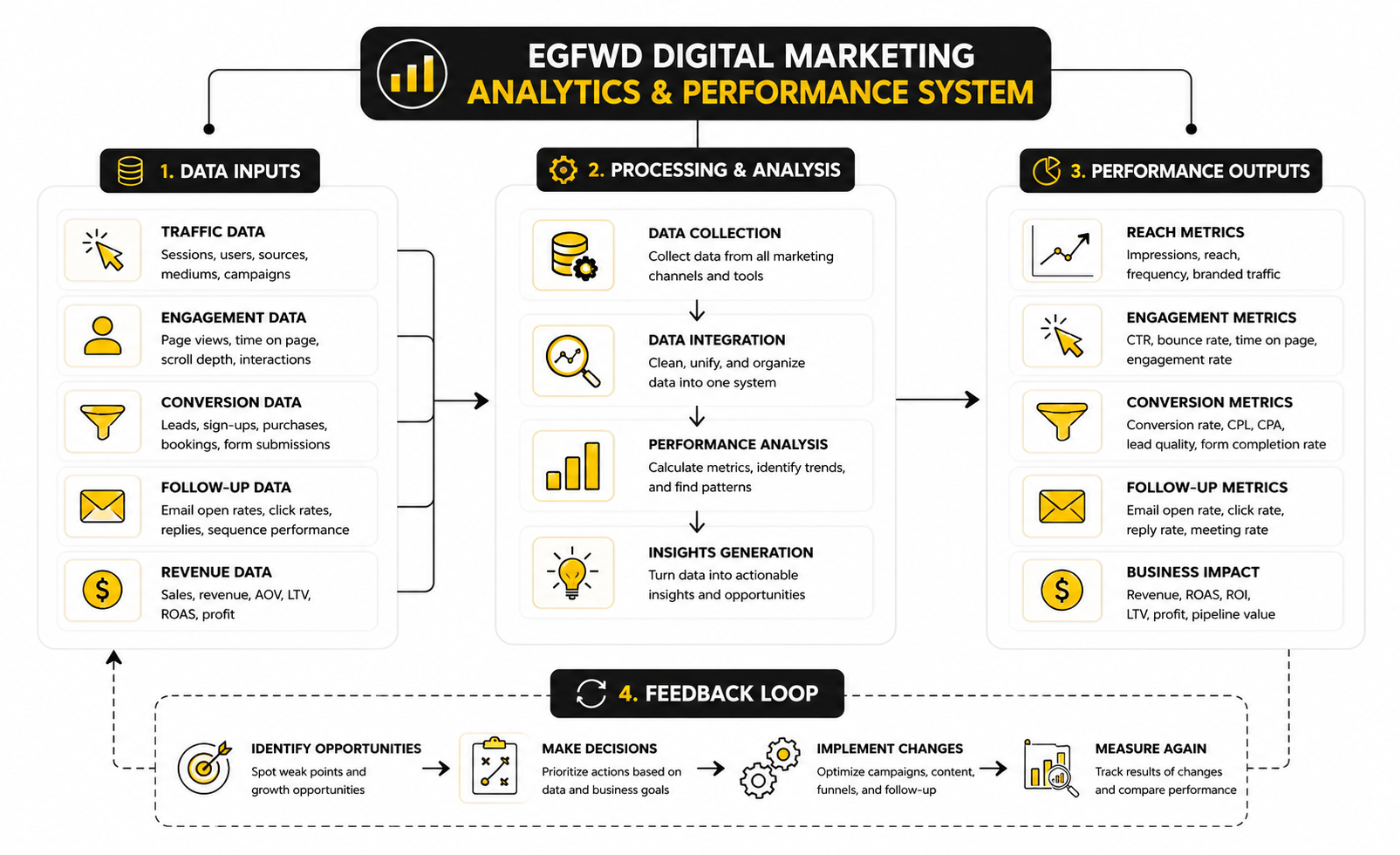
Your Final Skill Stack
A strong beginner does not need to master everything at once. You need enough range to understand the full customer journey and enough depth to contribute in one or two areas. That is how you become useful without pretending to be an expert in every channel.
Your practical skill stack should include:
This is the stack that turns egFWD digital marketing into something useful. You are not just saying you completed a course. You are showing that you understand how marketing work connects to outcomes.
What To Do In The Next 30 Days
The next 30 days should not be about consuming more random content. It should be about building evidence. Pick one business, one offer, one audience, and one measurable action.
Then create one campaign from start to finish. Write the message, create the content, build the landing page or form, set up the follow-up, and track the results. Keep it simple enough to finish.
Use tools only where they remove friction. If you need a landing page, use ClickFunnels, systeme.io, or Replo. If you need forms, use Fillout. If you need scheduling, use Cal.com. The tool choice matters less than finishing the loop.
How To Position Yourself After egFWD
Do not position yourself as “I know digital marketing.” That is too broad and too easy to ignore. Position yourself around a specific outcome you can help create.
You could say you help small businesses create simple lead-generation campaigns. You could focus on content strategy for service brands. You could specialize in email follow-up, landing page audits, social media planning, or campaign reporting. Specific positioning makes you easier to understand.
This matters because companies are looking for practical skills, not vague interest. The American Marketing Association’s 2025 marketer skills report is based on survey data, job postings, and expert input to map the changing marketing skill landscape through its 2025 skills research. The direction is obvious: marketers need to combine creativity, analytics, AI awareness, channel judgment, and business communication.
Is egFWD digital marketing good for beginners?
Yes, egFWD digital marketing can be a strong starting point for beginners because it introduces the core areas of digital marketing in a structured way. The value is highest when you treat the course as a launchpad, not a finish line. You still need to build campaigns, practice writing, analyze results, and create portfolio proof after completing the learning material.
Does egFWD digital marketing help with freelancing?
It can help, but the course alone will not make clients trust you automatically. Freelancing depends on proof, communication, positioning, and your ability to solve a specific business problem. Use the course projects as a base, then build stronger samples around lead generation, content planning, email sequences, landing pages, or campaign audits.
What should I build after finishing egFWD digital marketing?
Build one complete campaign. Choose a simple offer, define the audience, write the core message, create content, build a landing page or form, set up follow-up, and track the results. This gives you a practical portfolio piece instead of just a certificate.
Is a certificate enough to get a digital marketing job?
A certificate can help you get noticed, but it is rarely enough by itself. Employers and clients want evidence that you can think clearly and execute. A small portfolio with campaign examples, reports, copy samples, and documented decisions will usually be stronger than a certificate alone.
Which digital marketing skill should I learn first?
Start with marketing fundamentals and copywriting. If you cannot understand the audience or write a clear message, every channel becomes harder. After that, learn one traffic channel, one conversion system, and basic analytics.
Should I focus on SEO, paid ads, social media, or email?
Choose based on the type of work you want and the businesses you want to serve. SEO is strong for long-term search demand, paid ads are useful for fast testing, social media helps with visibility and trust, and email is excellent for follow-up. The best marketers understand how these channels connect instead of treating them as isolated skills.
How long does it take to become job-ready after egFWD digital marketing?
It depends on how much you practice. Someone who completes lessons passively may still feel stuck months later. Someone who builds three to five focused portfolio projects can become much more credible quickly because they have proof of execution, not just notes.
What tools should beginners use after egFWD digital marketing?
Use tools that match your current bottleneck. Buffer can help with content scheduling, Brevo can help with email campaigns, GoHighLevel can help with CRM and automation, and ClickFunnels can help with funnels. Do not collect tools for the sake of it. Use them to complete the marketing process faster.
How do I know if my campaign is working?
A campaign is working when it moves people toward the intended business goal at a cost and quality level that makes sense. Look at reach, clicks, conversions, lead quality, follow-up response, and revenue potential. Do not judge success from one vanity metric like likes or impressions.
What is the biggest mistake beginners make in digital marketing?
The biggest mistake is trying to do everything at once. Beginners often jump between channels, tools, tactics, and trends without building one complete system. It is better to finish one campaign, learn from it, and improve than to start ten disconnected activities.
Can I use AI while learning digital marketing?
Yes, but use AI carefully. AI can help with research organization, content drafts, repurposing, outlines, and brainstorming. It should not replace audience insight, strategy, judgment, or fact-checking.
Is digital marketing still worth learning in 2026?
Yes, digital marketing is still worth learning because businesses still need attention, trust, leads, sales, and retention. The tools are changing, especially with AI and privacy shifts, but the core work remains valuable. Marketers who can combine strategy, execution, analytics, and communication will stay relevant.
How can I stand out from other beginners?
Stand out by showing proof. Build campaign breakdowns, write clear reports, document what you tested, and explain what you learned. Most beginners only say they are passionate; serious beginners show their work.
Build a stronger local presence with BAAM AI
Turn your website, Google profile, social channels, and AI visibility into one growth engine
Most businesses do not need more random marketing activity. They need a consistent presence system that helps the right people find them, trust them, and take action. BAAM AI brings strategy, local SEO, website updates, Google Maps visibility, social content, AI-search readiness, media production, and reporting into one practical monthly engine.
If you want your marketing to keep working after the campaign ends, start with a free BAAM AI presence audit. See how your business shows up today and where the fastest visibility wins are at BAAM AI.