
BAAM AI Blog
What Digital Campaign Management Really Includes
Digital campaign management is not just scheduling posts, launching ads, and checking dashboards when something feels off. It is the operating system behind a campaign: strategy, audience selection, creative...
What Digital Campaign Management Really Includes
Digital campaign management is not just scheduling posts, launching ads, and checking dashboards when something feels off. It is the operating system behind a campaign: strategy, audience selection, creative production, channel setup, tracking, testing, reporting, optimization, and follow-up. When those pieces are managed together, the campaign has a real chance to improve instead of simply running until the budget is gone.
The reason this matters is simple: digital channels have become too expensive and too fragmented for casual execution. U.S. internet advertising revenue reached $258.6 billion in 2024, which means more brands are competing for attention across search, social, video, retail media, email, messaging, and creator-led channels. In that environment, the winner is rarely the business with the cleverest slogan. It is usually the business with the clearest process.
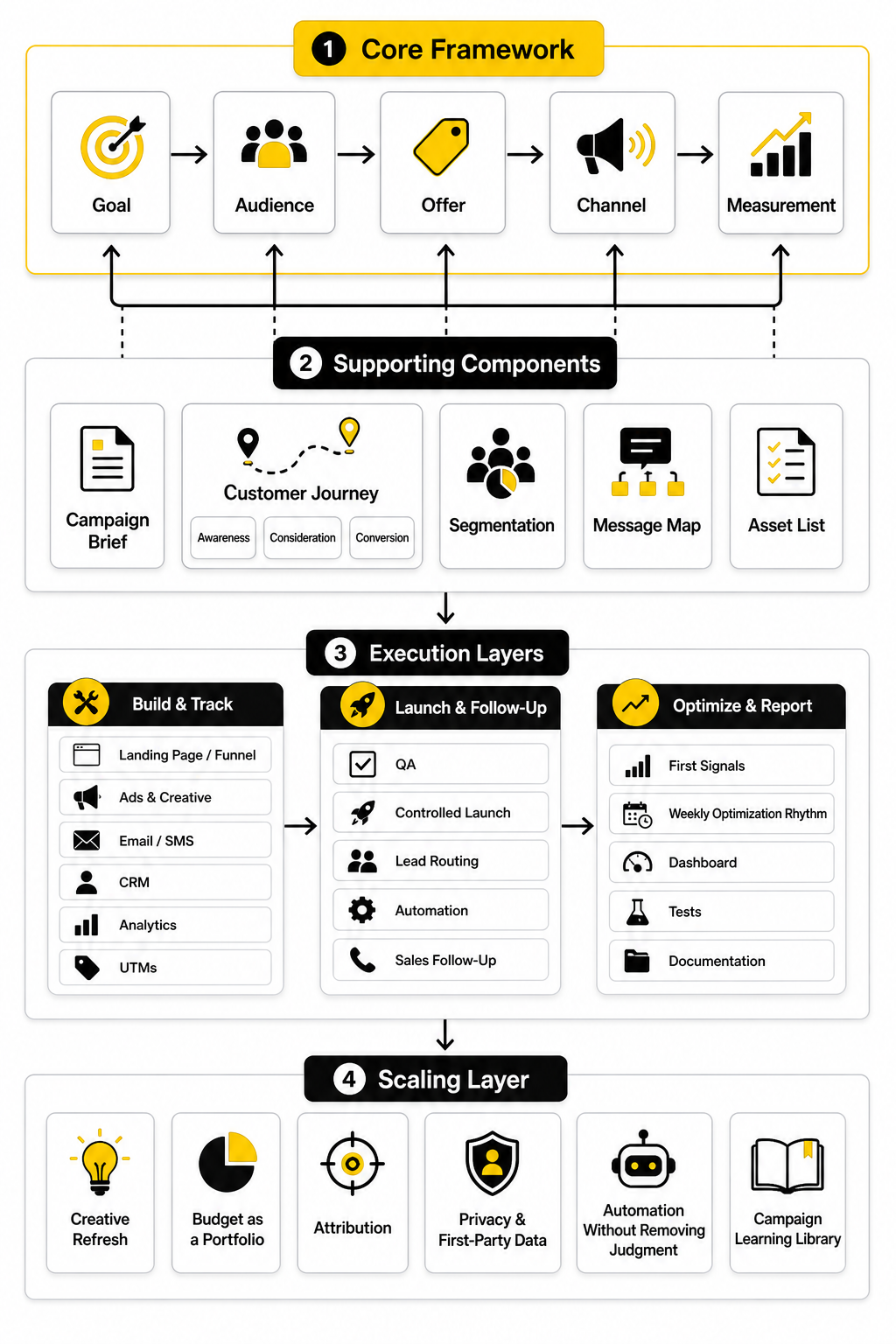
A strong campaign management process connects the big question to the daily work. What are we trying to achieve? Who exactly are we trying to reach? What offer or message gives them a reason to act now? Which channel should carry that message first? What will we measure before we decide whether the campaign is working?
Those questions sound basic, but they prevent expensive confusion. Without them, a team can spend weeks producing assets before realizing nobody agreed on the audience, the offer, or the conversion goal. That is how campaigns become busy but not effective.
The Core Parts of a Managed Digital Campaign
A well-managed digital campaign usually has several moving parts, and each one needs an owner. The first is the campaign goal, because every later decision depends on it. A lead generation campaign, a product launch campaign, a webinar campaign, and a retention campaign can all use similar channels, but they should not use the same message, landing page, follow-up sequence, or reporting structure.
The second part is audience definition. This should go deeper than broad demographic labels like “small business owners” or “busy parents.” Good audience work identifies the pain, the trigger, the objection, the urgency, and the buying context. When a team understands those details, the campaign sounds less generic and the creative becomes easier to produce.
The third part is the offer. A campaign without a clear offer often becomes a collection of brand messages. That might create some awareness, but it usually does not create enough action. The offer does not always need to be a discount. It can be a free consultation, a demo, a diagnostic, a checklist, a limited launch window, a trial, a waitlist, or a useful content asset that moves the buyer one step closer.
The fourth part is channel execution. This is where digital campaign management becomes practical. Search may capture existing demand, paid social may create demand, email may convert warm prospects, SMS may drive timely action, and retargeting may recover people who almost converted. The job is not to be everywhere. The job is to choose the right channels for the campaign stage and manage them as one system.
The fifth part is measurement. A campaign should have a simple measurement structure before it goes live, not after the team starts asking why sales are unclear. At minimum, the team needs to know the main conversion event, the secondary signals, the cost metrics, the quality indicators, and the reporting rhythm. Otherwise, every channel looks successful in its own dashboard while the business still struggles to understand what actually worked.
Strategy Comes Before Channel Selection
One of the easiest ways to waste money is to choose the channel before choosing the strategy. A team decides it needs TikTok, LinkedIn, Google Ads, email automation, or a new landing page because that is what competitors appear to be doing. Then the campaign becomes channel-led instead of customer-led.
The better order is goal first, audience second, offer third, channel fourth. If people are already searching for a high-intent solution, search ads and SEO-driven content may deserve priority. If the market does not yet understand the problem, short-form video, creator partnerships, paid social, and educational email sequences may make more sense. If the audience is already in the database, the smartest first move may be segmentation and lifecycle messaging rather than buying more traffic.
This is also where campaign management tools can help, but only after the strategy is clear. A platform like GoHighLevel can be useful when the campaign depends on funnels, CRM follow-up, appointment booking, automation, and pipeline visibility. But the tool will not fix a weak offer or a vague audience. Software amplifies the process you already have, for better or worse.
The same is true for email and messaging tools. If a campaign needs structured email sequences, transactional updates, or list segmentation, a platform like Brevo can support the execution. If the campaign relies on social scheduling and consistent distribution, Buffer can help keep publishing organized. The practical point is not that every brand needs the same stack. The point is that each tool should serve a campaign decision, not replace one.
Why Most Campaigns Become Hard to Manage
Campaigns usually become messy for predictable reasons. The first reason is too many goals. A campaign that tries to generate leads, grow followers, sell a product, build brand awareness, test five audiences, and validate a new offer at the same time will create confusing data. When everything is the goal, nothing is truly optimized.
The second reason is weak tracking. Teams often launch with tracking that is “good enough” until the first reporting meeting exposes the gaps. Maybe form submissions are tracked but qualified leads are not. Maybe ad platforms show conversions, but the CRM does not show which conversions became real opportunities. Maybe email clicks look strong, but the sales team says the leads are not ready.
The third reason is disconnected handoff. Marketing runs the campaign, sales receives the leads, customer support hears the objections, and leadership sees only the final numbers. If those groups are not sharing feedback during the campaign, optimization becomes shallow. The marketing team may keep improving click-through rate while the sales team quietly knows the message is attracting the wrong buyers.
The fourth reason is creative fatigue. Ads, emails, landing pages, and social posts do not perform forever. Even strong creative can lose momentum when the same audience sees it too many times. Good digital campaign management includes creative refreshes before performance collapses, not after panic starts.
The fifth reason is reporting overload. A dashboard with fifty metrics can look impressive and still fail to answer the one question that matters: should we keep spending money this way? Practical reporting separates diagnostic metrics from decision metrics. Diagnostic metrics explain what happened. Decision metrics tell the team what to do next.
The Campaign Brief Is the Control Center
A campaign brief is not bureaucracy. It is the simplest way to keep a campaign from drifting. When the brief is clear, every person involved can make faster decisions because the goal, audience, offer, message, channel plan, timeline, and measurement rules are already defined.
A useful campaign brief should answer these questions:
The brief does not need to be long. In fact, shorter is usually better. A one-page brief that people actually use is more valuable than a ten-page document nobody opens after the kickoff call.
This is especially important when AI enters the workflow. HubSpot’s 2025 marketing AI research found that 74% of marketers say AI is critically or very important to their marketing in the next year, which means more teams are using AI to speed up content, analysis, segmentation, and testing. That speed is useful only when the campaign direction is clear. Without a strong brief, AI simply helps teams create more scattered work faster.
Build the Campaign Around the Customer Journey
Digital campaign management works best when it follows the customer journey instead of forcing every person into the same message. A cold prospect, a returning website visitor, a webinar attendee, and an abandoned checkout user should not all receive the same campaign experience. They are in different stages of awareness, so they need different messages.
At the awareness stage, the campaign should make the problem visible and relevant. The content may be educational, emotional, or curiosity-driven, but it should not assume the person is ready to buy immediately. At the consideration stage, the campaign should help the person compare options, understand tradeoffs, and trust the brand. At the conversion stage, the campaign should remove friction and make the next step obvious.
This is where segmentation becomes powerful. Salesforce’s State of Marketing research is based on insights from nearly 4,500 marketers worldwide, and its focus on AI, data, and personalization reflects what modern teams are trying to solve: customers expect relevance, but teams often struggle to deliver it consistently. Better segmentation does not mean making the campaign complicated for the sake of it. It means matching the message to what the customer already knows and what they need next.
For example, a landing page visitor who watched a demo may need proof, pricing clarity, or a direct booking option. A new subscriber may need education and trust. A repeat customer may need expansion, renewal, or referral messaging. When each stage has a clear next step, the campaign feels more natural and the reporting becomes easier to interpret.
Turn the Strategy Into a Campaign Workflow
Once the strategy is clear, digital campaign management becomes much more concrete. The campaign needs to move from “we know what we want to achieve” into “we know exactly what has to happen before launch, during launch, and after launch.” This is where many teams either become calm and organized or start losing control.
The workflow should not be complicated for the sake of looking professional. It should be simple enough that everyone can follow it and detailed enough that important work does not fall through the cracks. A good process protects the campaign from rushed creative, broken tracking, unclear approvals, and last-minute channel changes.
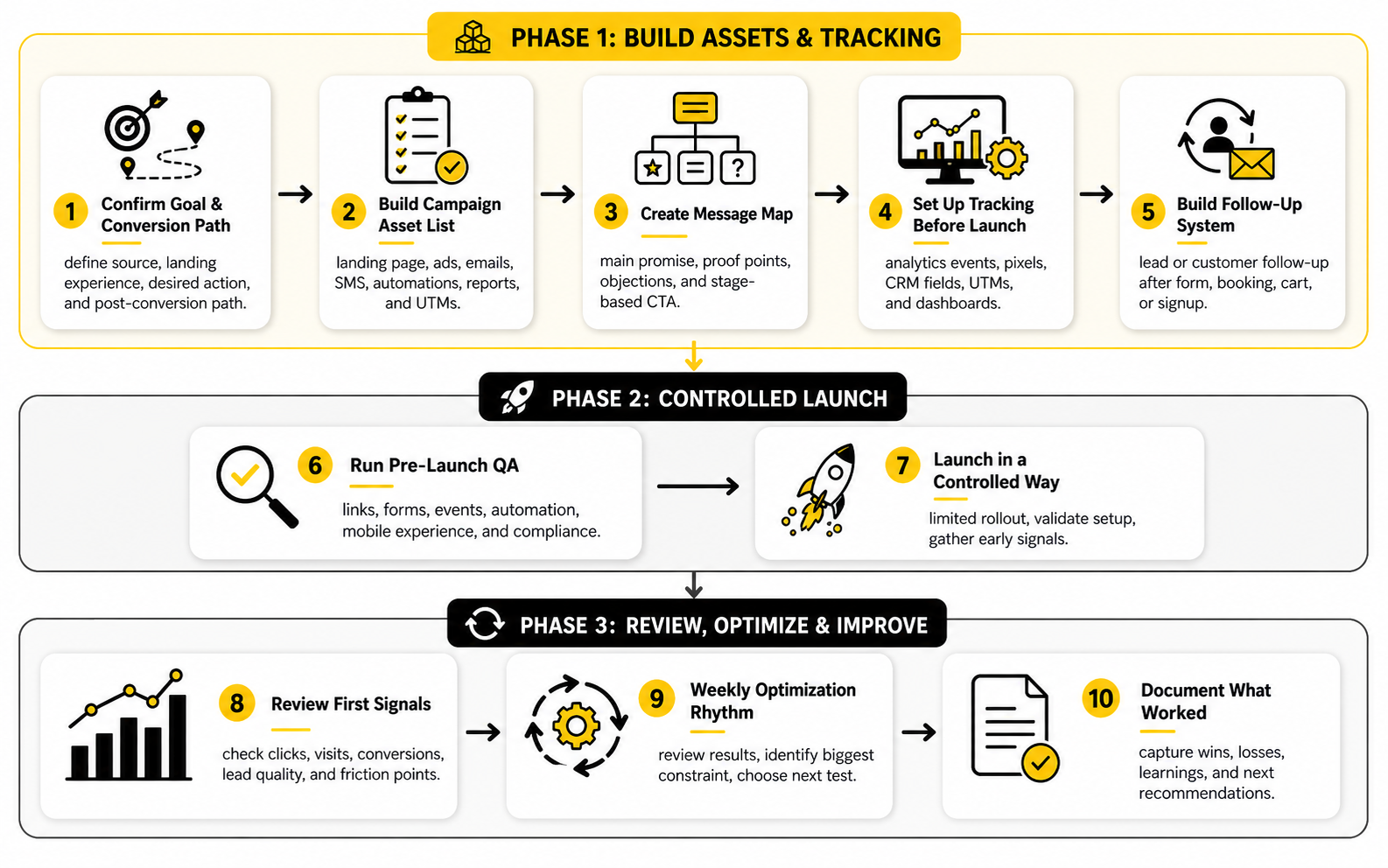
The best way to think about implementation is in three layers. First, build the assets and tracking. Second, launch the campaign in a controlled way. Third, review the data and improve the campaign before making bigger budget decisions.
Step 1: Confirm the Campaign Goal and Conversion Path
Before anyone starts building, confirm the exact conversion path. This means knowing where the person comes from, what page or experience they land on, what action they are supposed to take, and what happens immediately after that action. If the path is unclear, the campaign will leak attention even if the ads or emails are strong.
For a lead generation campaign, the path may go from ad to landing page to form to calendar booking to CRM pipeline. For an ecommerce campaign, it may go from creator content to product page to cart to checkout to post-purchase email. For a webinar campaign, it may go from social post to registration page to reminder sequence to live attendance to sales follow-up.
This is also the point where the team should define the main conversion and the secondary conversion signals. A main conversion might be a purchase, booked call, qualified lead, or trial signup. Secondary signals might include landing page views, email clicks, video completions, form starts, cart additions, or demo page visits. Those smaller signals help you diagnose the campaign without pretending every click is equally valuable.
Step 2: Build the Campaign Asset List
A campaign asset list turns vague execution into visible work. It should include every ad, landing page, email, SMS message, social post, video, form, automation, report, and sales enablement asset needed for the campaign. This list is not glamorous, but it is one of the most useful tools in the whole process.
The asset list should also show the owner, status, deadline, and approval requirement for each item. That prevents the classic problem where everyone assumes someone else is writing the follow-up emails, checking the landing page, or preparing the sales script. In digital campaign management, assumptions are expensive.
A practical campaign asset list may include:
If the campaign depends on a funnel, tools like ClickFunnels, Systeme.io, or GoHighLevel can make the build easier. The real advantage is not just page creation. It is the ability to connect the page, form, automation, and follow-up into one campaign flow instead of stitching everything together manually.
Step 3: Create the Message Map
A message map keeps the campaign from sounding random across different channels. The same campaign may appear in ads, emails, landing pages, social posts, SMS, and sales conversations. If each channel uses a different angle, the customer experience feels disconnected.
The message map should define the main promise, supporting points, proof points, objections, and calls to action. It should also define how the message changes by stage. A cold audience usually needs context and relevance. A warm audience needs confidence and urgency. A hot audience needs clarity, proof, and a low-friction next step.
This is where teams should be careful with AI-generated copy. AI can help draft variations, summarize research, and speed up production, but it should not invent claims or create generic language that could fit any brand. With nearly 1,900 marketers and business leaders included in the 2025 State of Marketing AI Report, it is obvious that AI is now part of the marketing workflow. The edge goes to teams that use it with clear direction, not teams that let it replace strategy.
Step 4: Set Up Tracking Before Launch
Tracking should be built before the campaign goes live, not patched together after the first results come in. This includes analytics events, ad platform pixels, CRM fields, UTMs, form tracking, call tracking when relevant, and dashboard views. If tracking is not ready at launch, the first few days of campaign data may be too messy to trust.
The UTM structure deserves special attention because it keeps campaign traffic readable across analytics tools. A simple structure might include source, medium, campaign, content, and term. The exact naming convention matters less than consistency. If one person uses “paid-social,” another uses “paidsocial,” and another uses “meta_ads,” reporting becomes harder than it needs to be.
This also matters because measurement pressure is increasing. Nielsen’s 2024 Annual Marketing Report found that only 38% of global marketers evaluate holistic ROI by measuring traditional and digital marketing together, even though fragmented media makes that broader view more important. You do not need a perfect attribution model to run a strong campaign, but you do need enough tracking discipline to make smart decisions.
Step 5: Build the Follow-Up System
The follow-up system is where many campaigns quietly win or lose. Getting a lead, click, registration, or cart addition is only part of the job. What happens next often determines whether the campaign creates revenue or just fills a dashboard with activity.
For lead generation, follow-up should be fast, relevant, and connected to the original promise. If someone requests a consultation, downloads a guide, or books a demo, the next message should match that action. A delayed or generic response breaks momentum.
For ecommerce, follow-up may include abandoned cart emails, product education, review requests, replenishment reminders, and post-purchase offers. For service businesses, it may include appointment reminders, qualification forms, nurture emails, and sales pipeline updates. If the campaign uses messaging, ManyChat can be useful when the customer journey includes Instagram, Messenger, WhatsApp, or automated chat flows.
The key is to avoid treating follow-up as an afterthought. A campaign with average traffic and excellent follow-up can beat a campaign with great traffic and weak follow-up. That is not theory. It is basic execution.
Step 6: Run Pre-Launch Quality Assurance
Pre-launch QA is not optional. It is the final check that protects the budget, the brand, and the team’s credibility. A campaign can look finished and still have broken links, missing forms, incorrect tracking, weak mobile formatting, expired coupon codes, or emails going to the wrong segment.
The QA process should include both technical checks and customer-experience checks. Technical checks confirm that pages load, forms submit, events fire, automations trigger, and CRM records update correctly. Customer-experience checks confirm that the message makes sense, the offer is clear, the page works on mobile, and the next step feels obvious.
A simple QA checklist should cover:
This is the point where boring work becomes profitable. Nobody celebrates a clean QA checklist, but everyone feels the pain when it is skipped.
Step 7: Launch in a Controlled Way
A controlled launch gives the team room to catch issues before scaling. This does not mean being timid. It means the first phase of the campaign should be designed to validate the setup, gather early signals, and confirm that the customer journey works as expected.
For paid campaigns, that may mean starting with a limited budget, a focused audience, and a small set of creative variations. For email campaigns, it may mean sending to a segment first before rolling out to the full list. For funnels, it may mean testing the full path internally and then with a smaller live audience before expanding traffic.
This matters because early results are often noisy. One day of data does not prove a campaign is broken or successful. The launch window should be long enough to gather meaningful signals but structured enough to catch obvious problems quickly.
Step 8: Review the First Signals Without Overreacting
The first review should focus on whether the campaign is functioning, not whether it has already reached its full potential. Are people seeing the message? Are they clicking? Are they reaching the landing page? Are they taking the next step? Are leads or purchases flowing into the right systems?
At this stage, the team should look for obvious friction. Low click-through may suggest the angle or creative is weak. Strong clicks with weak landing page action may suggest a mismatch between the ad and the page. Good form submissions with poor lead quality may suggest the offer is attracting the wrong people.
Do not optimize everything at once. Change too many variables and you will not know what caused the improvement or decline. The whole point of digital campaign management is controlled improvement, not random movement.
Step 9: Create a Weekly Optimization Rhythm
A campaign needs a rhythm after launch. Without a rhythm, optimization becomes reactive and emotional. Someone sees a bad day in the dashboard, panics, changes the campaign, and then the team spends the next week trying to understand what happened.
A weekly optimization rhythm keeps decisions grounded. The team reviews performance, identifies the biggest constraint, chooses the next test, assigns owners, and documents the change. That documentation is important because campaigns often fail to learn from themselves.
The weekly review should answer:
This is where reporting should become practical rather than decorative. Dashboards are useful only when they lead to better decisions. A clean weekly rhythm turns campaign data into action.
Step 10: Document What Worked
The final implementation step is documentation. Every campaign should leave behind a useful record of what was tested, what worked, what failed, and what should happen next time. Without that, the team starts from scratch again and again.
Good documentation does not need to be long. It should capture the campaign goal, offer, audience, channels, assets, budget, key results, winning messages, losing assumptions, and next recommendations. That makes future digital campaign management faster and more carefully.
The most valuable part is often the learning section. Maybe one audience was cheaper but lower quality. Maybe one landing page angle converted better but produced weaker sales calls. Maybe the strongest creative was not the most polished one, but the one that explained the problem most clearly. Those insights are campaign assets too.
Statistics and Data
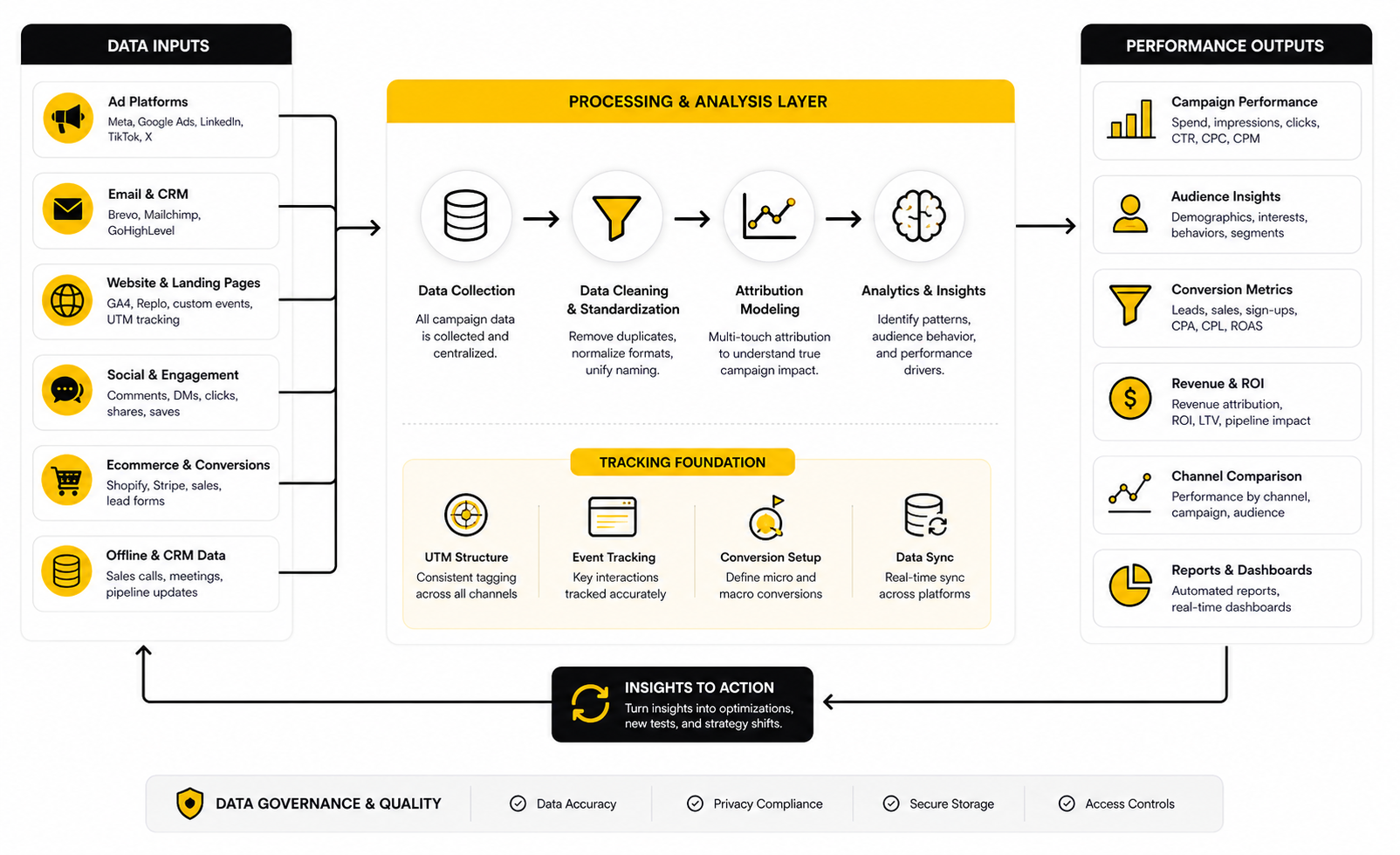
Measurement is where digital campaign management stops being opinion-driven. Without data, every campaign review becomes a debate about taste, channel preference, or whoever speaks with the most confidence. With the right data, the team can see where attention is being won, where momentum is being lost, and which next action has the best chance of improving results.
But this is important: data is not automatically useful just because it is available. Most campaign dashboards show far more numbers than a team can act on. The job is to separate performance signals from background noise, then connect those signals to decisions.
A good measurement system should answer five practical questions. Did the campaign reach the right people? Did the message get their attention? Did the page or funnel convert that attention into action? Did those actions turn into qualified opportunities or revenue? Did the result justify the spend, time, and operational effort?
Start With the Numbers That Control Decisions
The most useful campaign metrics are the ones that change what you do next. Impressions, clicks, open rates, conversion rates, cost per lead, customer acquisition cost, return on ad spend, pipeline value, and revenue can all matter. The mistake is treating them all as equally important at the same moment.
At the top of the funnel, reach and engagement metrics help you understand whether the campaign is getting enough attention from the intended audience. In the middle of the funnel, landing page conversion rate, form completion rate, email click rate, demo page views, and webinar attendance tell you whether interest is turning into intent. At the bottom of the funnel, cost per qualified lead, sales conversion rate, average order value, retention, and revenue show whether the campaign is actually good for the business.
This is why a campaign should have one primary metric and a small set of supporting metrics. If the primary goal is booked sales calls, the campaign cannot be judged only by click-through rate. If the primary goal is ecommerce revenue, the team should not celebrate cheap traffic that never buys. A metric is useful only when it is tied to the campaign’s real purpose.
Benchmarks Are Context, Not Targets
Benchmarks can help you understand whether your campaign is wildly outside the normal range, but they should not become the strategy. A benchmark tells you what is common. It does not tell you what is profitable for your offer, audience, price point, funnel, or sales process.
For example, Google Ads performance varies heavily by industry, and WordStream’s 2025 benchmark data shows that average cost per click and cost per lead can differ dramatically from one market to another in its 2025 Google Ads benchmarks report. That matters because a $12 cost per click might be painful for a low-ticket product and completely acceptable for a high-value B2B service. The number means nothing until it is compared with margin, close rate, and customer lifetime value.
Email is the same. HubSpot’s benchmark summary shows that open rates, click-through rates, bounce rates, and unsubscribe rates vary by industry in its email marketing benchmark guide. A high open rate can still be weak if nobody clicks or buys. A lower open rate can still be profitable if the audience is narrow, qualified, and ready to act.
The practical way to use benchmarks is simple. Use them to spot obvious problems, then use your own campaign data to make decisions. External benchmarks help you ask better questions. Your economics decide what “good” actually means.
Read Metrics as a Chain, Not a Pile
Campaign performance is easier to understand when you read the numbers as a chain. Each step either keeps momentum or loses it. If you only look at the final conversion, you may miss the real bottleneck.
A simple campaign chain might look like this:
Each stage has a job. If impressions are low, the campaign may have a targeting, budget, or delivery issue. If impressions are strong but clicks are weak, the message or creative may not be compelling enough. If clicks are strong but conversions are weak, the landing page, offer, proof, speed, or form friction may be the problem.
This chain view also prevents lazy conclusions. “The ads are not working” is not specific enough. Maybe the ads are doing their job and the page is failing. Maybe the page is converting, but the sales process is too slow. Maybe the campaign is generating leads, but the offer is attracting people who were never likely to buy.
The Metrics That Matter Most by Campaign Type
Different campaigns need different scorecards. A lead generation campaign should not be measured the same way as a content promotion campaign. An ecommerce campaign should not be judged the same way as a long-cycle B2B nurture campaign.
For lead generation, the core metrics usually include cost per lead, cost per qualified lead, booking rate, show rate, sales acceptance rate, close rate, and pipeline value. Cost per lead alone is dangerous because cheap leads can become expensive if they never convert. The more important question is whether the campaign produces qualified conversations at a price the business can afford.
For ecommerce, the core metrics usually include conversion rate, average order value, cost per acquisition, return on ad spend, gross margin, cart abandonment, repeat purchase rate, and customer lifetime value. Revenue can look exciting while profit quietly disappears. That is why ecommerce measurement should connect campaign performance to margin, not just sales volume.
For content and awareness campaigns, the core metrics usually include qualified reach, engagement quality, video completion, scroll depth, assisted conversions, branded search lift, retargeting audience growth, and later-stage influence. These campaigns are often judged unfairly because they do not always create immediate purchases. They still need measurement, but the measurement should match the job of the campaign.
For retention campaigns, the core metrics usually include repeat purchase rate, churn, expansion revenue, renewal rate, win-back rate, product usage, and customer engagement. This is where digital campaign management becomes more than acquisition. A campaign that keeps existing customers active can be more profitable than one that constantly chases new ones.
Attribution Should Guide You, Not Fool You
Attribution is useful, but it is not perfect. The customer journey is too messy for one model to explain everything cleanly. A person may see a social ad, search the brand later, read a review, join an email list, click a retargeting ad, and finally convert after a sales call.
That is why last-click attribution can be misleading. It often gives too much credit to the final touchpoint and not enough credit to the earlier work that created demand. On the other hand, giving every channel credit for every conversion can make the campaign look better than it really is.
A practical approach is to use attribution as a directional tool. Look at platform data, analytics data, CRM data, and revenue data together. Nielsen’s 2024 Annual Marketing Report makes the same broader point: only 38% of global marketers measure traditional and digital marketing together to evaluate holistic ROI, which leaves many teams with an incomplete picture of what is actually driving performance.
Watch for Leading Indicators Before Revenue Arrives
Not every campaign produces revenue immediately. Some campaigns have long buying cycles, especially in B2B, high-ticket services, education, finance, software, and complex ecommerce products. If the team waits only for final revenue, it may miss early signals that show whether the campaign is moving in the right direction.
Leading indicators help you judge momentum before the final result is visible. These can include qualified traffic growth, higher demo page engagement, stronger email replies, improved form completion, better meeting show rates, lower cart abandonment, increased branded search, or more high-intent retargeting audiences. None of those signals replaces revenue, but they help explain whether the campaign is building toward it.
The danger is treating weak indicators as proof of success. A high click-through rate is not a business outcome. A large email list is not a revenue model. A viral post is not a campaign strategy. Leading indicators are useful only when they connect logically to a later business result.
Diagnose Problems Before Changing Tactics
When a campaign underperforms, the first instinct is often to change the channel, rewrite everything, or cut the budget. Sometimes that is the right move. More often, the more carefully move is to diagnose the constraint first.
If traffic quality is poor, the issue may be targeting, keyword intent, placement quality, or audience selection. If traffic quality is good but conversion is weak, the issue may be the offer, landing page, proof, page speed, form length, or pricing clarity. If conversions are happening but revenue is weak, the issue may be lead qualification, sales follow-up, product fit, or customer expectations.
This is where a clear reporting rhythm pays off. Instead of making random changes, the team can identify the biggest bottleneck and run one focused improvement at a time. That creates learning. Random changes create confusion.
Build a Dashboard People Can Actually Use
A good dashboard should not try to impress anyone. It should help the team make decisions faster. That means it should be clean, readable, and organized around the campaign journey.
The first section should show the primary outcome. This might be revenue, qualified leads, booked calls, purchases, trials, or pipeline created. The second section should show the funnel steps that explain that outcome. The third section should show channel-level performance. The fourth section should show tests, changes, and notes so the team can connect performance movement to actual decisions.
If the campaign uses a CRM-heavy process, GoHighLevel can help connect forms, automations, pipeline stages, and follow-up activity in one place. If the campaign relies heavily on email performance, Brevo can support segmentation, automation, and campaign reporting. The tool matters less than the discipline behind it, but the right setup makes the discipline easier to maintain.
The dashboard should also include notes. This sounds small, but it is huge. If spend increased, creative changed, a landing page was updated, an email subject line was tested, or a sales follow-up process changed, write it down. Otherwise, the team may see performance move and forget what caused it.
Compare Cost Against Value, Not Ego Metrics
The most dangerous campaign data is the data that looks good but does not matter. Cheap clicks can be worthless. High impressions can hide poor targeting. Strong open rates can lead nowhere. A low cost per lead can still be expensive if the leads are not qualified.
Better digital campaign management compares cost against value. If a campaign generates leads, measure cost per qualified lead and cost per sales opportunity. If it generates purchases, measure acquisition cost against gross margin and lifetime value. If it generates pipeline, measure how much of that pipeline becomes closed revenue.
This is also why budget decisions should not be based only on platform dashboards. Ad platforms can show conversions, but the business still needs to know whether those conversions became real customers. Campaign performance belongs in the same conversation as CRM data, sales data, and financial data.
Know When to Scale, Pause, or Rebuild
Data should eventually lead to a decision. A campaign can usually move in one of three directions: scale, pause, or rebuild. Each decision needs a different level of confidence.
Scale when the campaign is producing the right outcome at an acceptable cost, and the operational system can handle more volume. That means the landing page works, follow-up is reliable, lead quality is acceptable, and revenue economics make sense. Scaling too early can make a small problem expensive very quickly.
Pause when the data is too weak, tracking is broken, quality is poor, or the campaign is spending without enough useful learning. Pausing is not failure. It is often the responsible move when the team needs to fix the offer, funnel, targeting, or measurement setup before spending more.
Rebuild when the campaign has a deeper strategic problem. If the audience does not care, the offer is unclear, the economics do not work, or the message attracts the wrong people, optimization will not save it. At that point, the data has done its job. It has shown that the campaign does not need another tiny tweak. It needs a better foundation.
Advanced Campaign Decisions That Separate Good Teams From Average Teams
Once the campaign is planned, launched, tracked, and reviewed, the harder work begins. Basic digital campaign management is about getting the pieces in place. Advanced campaign management is about making better tradeoffs when the data is imperfect, the budget is limited, and the team has more ideas than capacity.
This is where experience matters. A beginner often asks, “Which channel is best?” A stronger operator asks, “Which constraint is limiting growth right now?” That question changes everything because it forces the team to stop chasing random tactics and focus on the next highest-leverage decision.
The answer may be creative volume, conversion rate, lead quality, sales follow-up, retention, positioning, offer structure, or budget allocation. It may have nothing to do with the channel everyone is arguing about. The best teams stay calm enough to diagnose before they scale.
Balance Speed With Control
Speed matters in campaigns because markets move, competitors copy, and audience attention does not wait. A slow team can miss the moment while still feeling productive because meetings, approvals, and revisions keep happening. But speed without control creates a different problem: broken funnels, weak creative, messy tracking, and rushed decisions.
The practical answer is not to choose speed or control. It is to define which parts of the campaign need speed and which parts need strict quality checks. Creative testing can move quickly. Tracking, compliance, offer terms, checkout flows, lead routing, and customer data handling should not be treated casually.
This tradeoff becomes more important as AI speeds up production. McKinsey’s 2025 global AI research found that 88% of respondents say their organizations use AI in at least one business function, but only about one-third have started scaling AI programs at the enterprise level. That gap matters for marketing teams because using AI to produce more assets is easy. Building the governance, review process, and measurement discipline to use those assets well is the harder part.
Know the Difference Between Testing and Thrashing
Testing is controlled learning. Thrashing is nervous activity disguised as optimization. The difference is whether the team changes one meaningful variable at a time and documents the reason for the change.
A strong test has a clear hypothesis. For example, the team might test whether a problem-focused headline beats a benefit-focused headline, whether a shorter form improves qualified lead volume, or whether a demo CTA outperforms a guide download for a warm audience. The point is not just to get a winner. The point is to learn something that improves future digital campaign management decisions.
Thrashing looks different. The team changes the landing page, audience, ad copy, budget, email sequence, and offer at the same time. Performance moves, but nobody knows why. Then the next campaign starts with opinions instead of learning.
A simple test plan should define:
This keeps testing grounded. It also prevents the team from calling every random edit an experiment.
Protect the Campaign From Creative Fatigue
Creative fatigue is one of the most common scaling problems. A campaign starts strong, the team increases spend, and performance slowly gets worse. The audience has seen the same angles too many times, but the team keeps blaming targeting or bidding because those are easier to adjust.
Creative fatigue does not always mean the whole campaign is broken. It may mean the audience still wants the offer, but the current message has stopped earning attention. That is why creative refreshes should be planned before the campaign declines, not after the dashboard turns red.
Advanced campaign teams build creative systems, not one-off assets. They create multiple angles, hooks, formats, proof points, objections, and calls to action. They also watch which themes produce quality conversions, not just cheap clicks.
For social-heavy campaigns, tools like Buffer can help keep publishing organized across channels, but scheduling is only one part of the job. The deeper work is maintaining a steady flow of relevant messages without turning the brand into a content machine that says the same thing in twenty slightly different ways. Volume helps only when the ideas are sharp.
Scale Only When the System Can Handle More Demand
Scaling is not just increasing the budget. Scaling means the campaign can handle more attention, more leads, more orders, more conversations, and more operational pressure without breaking. If the system is weak, scale makes the weakness more expensive.
Before increasing spend, check the full delivery path. Can the landing page handle traffic? Can the CRM route leads correctly? Can the sales team respond quickly? Can customer support answer campaign-related questions? Can fulfillment, onboarding, or service delivery keep up if the campaign works?
This matters because marketing success can create operational failure. A campaign may generate demand, but if response times are slow or the customer experience is poor, the business loses trust. The campaign gets blamed, but the real issue is capacity.
A smart scaling checklist should include:
Scale in steps. Increase pressure, watch the system, fix the bottleneck, then increase again. That is slower than smashing the budget button, but it protects profit.
Treat Budget as a Portfolio
Campaign budget should not be managed like one big pile of money. It should be managed like a portfolio with different jobs. Some spend should capture proven demand. Some spend should test new angles. Some spend should build retargeting pools or nurture future buyers. Some spend may support retention or reactivation.
This portfolio view helps avoid two bad extremes. The first extreme is putting everything into the safest current winner until that winner fatigues. The second is spreading budget across too many experiments until nothing gets enough data to matter. Both are common, and both create avoidable waste.
Gartner’s 2025 CMO Spend Survey found that marketing budgets remained flat at 7.7% of overall company revenue, which means many teams are being asked to do more without meaningful budget relief. That makes budget discipline more important. When money is tight, the team cannot afford to confuse activity with progress.
A practical campaign budget can be split into three buckets. The first bucket funds proven campaigns that already produce acceptable economics. The second funds optimization work that improves existing campaigns. The third funds experiments that may create the next growth channel or message. The exact percentages depend on the business, but the principle stays the same: protect what works, improve what is close, and test what could build the next stage.
Manage Channel Conflict Before It Distorts Decisions
Channels often compete for credit. Paid search may claim the conversion because the customer clicked a branded keyword. Paid social may argue it created the demand first. Email may show the final click. Sales may say the deal closed because of the call.
This is not just a reporting problem. It can become a political problem inside the business. If every channel owner is defending their own dashboard, the campaign becomes harder to manage objectively.
The solution is to define channel roles before judging channel performance. Search might be responsible for capturing existing demand. Paid social might be responsible for creating interest and feeding retargeting. Email might be responsible for moving warm prospects toward action. Sales might be responsible for converting qualified conversations into revenue.
When roles are clear, the team can interpret data more fairly. A top-of-funnel campaign should not be punished for failing to behave like bottom-of-funnel search. A retargeting campaign should not get all the credit for demand another channel created. The point is not perfect attribution. The point is better decision-making.
Build for Privacy and Trust
Privacy is now part of campaign performance. Tracking limitations, consent requirements, cookie changes, platform restrictions, and customer expectations all affect what marketers can measure and how they can personalize. Ignoring this is not just risky. It also creates fragile campaigns that depend too much on data access the business does not fully control.
A stronger approach is to build campaigns around first-party data. That includes email subscribers, customers, leads, form submissions, purchase behavior, CRM activity, product usage, and direct customer interactions. This data is not just more durable. It is usually more meaningful because it comes from people who have actually interacted with the business.
Trust also affects conversion. People are more careful with their information than they used to be, especially when forms ask for phone numbers, company details, budget ranges, or personal preferences. If the campaign asks for data, the value exchange should be clear. Tell people what they get, why it matters, and what happens next.
For form-heavy campaigns, Fillout can be useful when the experience needs conditional logic, cleaner data collection, or a more flexible intake flow. But again, the tool is not the strategy. The strategy is to collect only the data that helps the customer journey and the business decision.
Use Automation Without Removing Judgment
Automation is powerful when it removes repetitive work and keeps the campaign moving. It can route leads, send reminders, trigger follow-up, update CRM fields, segment audiences, score behavior, and notify sales teams. Used well, automation makes digital campaign management more consistent.
Used badly, automation makes the campaign feel cold and careless. The classic mistake is building a complicated sequence that reacts to every small behavior but never feels human. Another mistake is automating follow-up before the team understands what a good follow-up should say.
Automation should support judgment, not replace it. A lead who books a call needs a different experience from someone who downloaded an awareness-stage checklist. A customer who just purchased needs a different sequence from someone who abandoned checkout. A high-value prospect may need a human touch faster than a generic nurture flow can provide.
Platforms like GoHighLevel can help connect automation, CRM, funnels, booking, and messaging in one place. That can be a serious advantage for agencies, service businesses, and local businesses that need speed and visibility. The advanced move is to keep the automation simple enough to manage and personal enough to feel relevant.
Avoid the Tool Stack Trap
More tools do not automatically create better campaigns. In fact, too many tools can make digital campaign management harder because data gets scattered, ownership becomes unclear, and small fixes require too many systems. The stack should make execution cleaner, not heavier.
Before adding another platform, ask what problem it solves. Does it remove manual work? Does it improve conversion? Does it make reporting clearer? Does it help the team move faster without losing control? If the answer is vague, the tool probably adds complexity.
A lean campaign stack usually covers a few core jobs: landing pages or funnels, email or messaging, CRM, analytics, creative production, scheduling, and reporting. The exact tools depend on the business model. A creator-led ecommerce brand, a B2B SaaS company, a local service business, and an agency do not need identical systems.
The tool stack should also match the team’s actual capacity. A powerful platform that nobody maintains becomes expensive shelfware. A simpler tool that the team uses properly often produces better results.
Know When the Offer Is the Real Problem
Sometimes the campaign is not the issue. The offer is. No amount of targeting, tracking, creative testing, or automation can save an offer that people do not want, do not understand, or do not trust.
This is uncomfortable because teams often prefer to optimize the visible parts of the campaign. They want to change the headline, test a new audience, adjust the landing page, or switch channels. Those changes are easier than admitting the promise is weak, the pricing is confusing, the proof is thin, or the timing is wrong.
Offer problems usually show up in patterns. People click but do not convert. Leads convert but do not show up. Sales calls happen but objections repeat. Customers buy once but do not return. Each pattern tells you the campaign may be exposing a deeper business issue.
When that happens, pause the surface-level optimization and revisit the offer. Clarify the outcome. Strengthen the proof. Reduce the perceived risk. Improve the value exchange. Make the next step easier. A better offer can make every channel perform better.
Create a Campaign Learning Library
The most advanced teams do not let campaign learning disappear. They collect it. Every campaign adds information about audiences, offers, objections, creative angles, channels, landing pages, follow-up, and sales quality. That information should become an internal asset.
A campaign learning library can be simple. It may be a shared document, database, or project board that records what was tested and what happened. The key is to make it easy to search before the next campaign starts.
The library should include:
This is how campaign management compounds. The first campaign may be messy. The second should be more carefully. By the fifth or tenth, the team should not be guessing from zero anymore.
Make the Campaign Easier to Operate Next Time
A campaign is not only successful because it performs well once. It is more valuable when the team can repeat, adapt, or improve it without rebuilding everything from scratch. That means the process itself should be treated as an asset.
After each campaign, look for operational friction. Which approvals slowed things down? Which assets were requested too late? Which tracking issues appeared again? Which reports were useful, and which were ignored? Which handoffs caused confusion?
Then fix the process before the next launch. Build templates. Standardize UTM naming. Create reusable QA checklists. Save proven email structures. Keep a clean swipe file of ad angles. Define reporting views before they are needed.
This is not glamorous work, but it is how a team gets faster without getting sloppy. Great digital campaign management is not just about one strong launch. It is about building a system that makes the next launch easier, cleaner, and more profitable.
Bring the Whole Campaign System Together
At this point, digital campaign management should feel less like a checklist and more like a connected operating system. Strategy gives the campaign direction. Implementation turns that direction into assets, tracking, and launch activity. Measurement shows where performance is strong, weak, or misleading. Advanced management helps the team scale without losing control.
The full system works because each part supports the next. A better brief leads to stronger creative. Stronger creative brings better attention. Better tracking explains what happens after the click. Better reporting creates more carefully tests. more carefully tests create campaign learning the team can reuse.
This is the part many teams miss. They treat every campaign as a fresh project instead of building a repeatable machine. The goal is not to make every campaign identical. The goal is to make the process reliable enough that each new campaign starts with more clarity than the last one.
What a Mature Campaign System Looks Like
A mature campaign system has clear roles, clean handoffs, and a realistic decision rhythm. People know who owns the offer, who owns the creative, who owns the landing page, who owns tracking, who owns follow-up, and who decides when the campaign changes. That alone removes a lot of chaos.
It also has a clear source of truth. Campaign notes, test results, creative assets, links, UTMs, performance reports, and post-campaign learnings should not be scattered across private messages, forgotten spreadsheets, and old project boards. If the team cannot find what happened last time, it cannot learn from it.
The strongest systems also connect marketing activity to business outcomes. They do not stop at impressions, clicks, opens, or leads. They look at qualified opportunities, purchases, revenue, margin, retention, and customer quality. That is how digital campaign management becomes a growth function instead of just a production function.
Common Mistakes to Avoid at the End of a Campaign
The end of a campaign is where teams often lose valuable learning. They move straight into the next launch without documenting what worked, what failed, and what should change next time. That creates a cycle where every campaign feels urgent but the process never gets more carefully.
Another mistake is judging the campaign too narrowly. A campaign may miss the original target but reveal a stronger audience, better message, or important funnel issue. That learning still matters. The question is not only “Did it win?” The better question is “What did this campaign teach us that improves the next decision?”
A final mistake is keeping a campaign alive because the team already invested time into it. Sunk cost is not a strategy. If the data shows the offer is weak, the audience is wrong, or the economics do not work, the responsible move is to adjust or stop. Good campaign managers protect future budget from past decisions.
How to Keep Improving Your Campaign Management Process
Improvement should happen after every campaign, not once a year during planning. The team should review both performance and process. A campaign can produce decent results while still being painful to execute. That pain is a signal too.
Ask where the campaign slowed down. Was the brief unclear? Were approvals late? Was creative rushed? Did tracking break? Did sales get enough context? Did customer support know what was being promoted? These questions expose operational bottlenecks that performance dashboards usually miss.
Then turn the answers into reusable assets. Build better briefs, QA lists, reporting templates, naming conventions, swipe files, follow-up sequences, and review agendas. This is how digital campaign management gets easier over time. Not because campaigns become simple, but because the team stops solving the same problems from scratch.
What is digital campaign management?
Digital campaign management is the process of planning, launching, tracking, optimizing, and reviewing marketing campaigns across digital channels. It includes strategy, audience targeting, creative production, channel setup, analytics, testing, automation, and follow-up. The goal is to turn marketing activity into measurable business outcomes instead of disconnected tasks.
Why is digital campaign management important?
It matters because digital marketing has too many moving parts to manage casually. A campaign may include ads, email, landing pages, forms, CRM updates, tracking pixels, social posts, automations, sales handoffs, and reporting dashboards. Without a management process, small mistakes multiply quickly and performance becomes harder to understand.
What are the main stages of a digital campaign?
The main stages are strategy, planning, asset creation, tracking setup, launch, optimization, reporting, and post-campaign review. Each stage has a different job. Strategy defines the direction, implementation turns it into action, measurement explains performance, and review turns the campaign into reusable learning.
What metrics should I track in a digital campaign?
Track the metrics that match the campaign goal. For lead generation, focus on qualified leads, booked calls, show rates, close rates, and pipeline value. For ecommerce, focus on conversion rate, cost per acquisition, average order value, return on ad spend, margin, and repeat purchases. For awareness, look at qualified reach, engagement quality, video completion, retargeting pool growth, and assisted conversions.
How do I know if a campaign is working?
A campaign is working when it produces the intended outcome at a cost and quality level the business can accept. That outcome might be revenue, qualified leads, booked appointments, trial signups, purchases, or retention. Do not judge the campaign only by surface metrics like clicks or impressions unless the goal is purely reach.
How often should a campaign be optimized?
Most campaigns should be reviewed on a consistent weekly rhythm, with lighter checks during launch. Daily monitoring is useful for spotting technical issues, broken tracking, or extreme performance swings. But major optimization decisions usually need enough data to avoid overreacting to random movement.
What is the biggest mistake in digital campaign management?
The biggest mistake is launching before the goal, audience, offer, conversion path, and tracking are clear. When those pieces are vague, the team ends up optimizing symptoms instead of solving the real problem. The campaign may stay busy, but it will not become more predictable.
How much should I spend on a digital campaign?
The right budget depends on the goal, audience size, channel costs, offer value, margin, and sales cycle. A small campaign can be useful if it generates enough data to validate a message or funnel. A larger campaign only makes sense when the conversion system and economics are strong enough to handle more volume.
What tools do I need for digital campaign management?
Most teams need tools for landing pages or funnels, email or messaging, CRM, analytics, creative production, scheduling, and reporting. The exact stack depends on the business model. A lean stack used consistently is usually better than a large stack nobody manages properly.
How does automation fit into campaign management?
Automation helps with repetitive actions like lead routing, email follow-up, reminders, segmentation, CRM updates, and sales notifications. It makes the campaign more consistent and reduces manual work. But automation should support the customer journey, not replace human judgment where context matters.
What is the difference between campaign reporting and campaign analysis?
Reporting shows what happened. Analysis explains why it may have happened and what to do next. A report might show that landing page conversions dropped. Analysis looks at traffic quality, message match, page speed, offer clarity, form friction, and recent campaign changes to decide the next move.
How do I prevent a campaign from becoming messy?
Use a clear brief, asset list, owner map, UTM structure, QA checklist, reporting rhythm, and post-campaign review. These simple systems prevent most avoidable confusion. The more channels and people involved, the more important this structure becomes.
When should I scale a campaign?
Scale when the campaign is producing the right outcome at an acceptable cost, and the business can handle the extra demand. Check lead quality, sales capacity, fulfillment, support, tracking accuracy, and creative freshness before increasing spend. Scaling a weak system only makes the weakness more expensive.
When should I stop a campaign?
Stop or pause a campaign when tracking is unreliable, costs are clearly unsustainable, lead quality is poor, or the campaign has revealed a deeper offer or audience problem. Pausing is not failure. It gives the team room to fix the foundation before spending more money.
Can AI help with digital campaign management?
AI can help with research, creative drafts, content repurposing, reporting summaries, segmentation ideas, and test planning. It is especially useful for speeding up repetitive work. But AI still needs a clear brief, accurate inputs, human review, and strong measurement to be useful.
Build a stronger local presence with BAAM AI
Turn your website, Google profile, social channels, and AI visibility into one growth engine
Most businesses do not need more random marketing activity. They need a consistent presence system that helps the right people find them, trust them, and take action. BAAM AI brings strategy, local SEO, website updates, Google Maps visibility, social content, AI-search readiness, media production, and reporting into one practical monthly engine.
If you want your marketing to keep working after the campaign ends, start with a free BAAM AI presence audit. See how your business shows up today and where the fastest visibility wins are at BAAM AI.