
BAAM AI Blog
What Content Marketing Agency Services Usually Include
Most content marketing agency services are built around one simple job: turning your expertise into assets that attract, educate, convert, and retain the right people. That sounds simple, but the work underneath it...
What Content Marketing Agency Services Usually Include
Most content marketing agency services are built around one simple job: turning your expertise into assets that attract, educate, convert, and retain the right people. That sounds simple, but the work underneath it is layered. A good agency is not just “writing blog posts”; it is connecting strategy, research, production, distribution, measurement, and iteration into one repeatable system.
This matters because content is no longer just a traffic play. Buyers use it to compare options, build internal consensus, reduce risk, and decide whether a company sounds credible enough to contact. Gartner’s research on the B2B buying journey notes that 75% of B2B buyers prefer a rep-free sales experience, which means your content often has to do part of the sales job before anyone books a call.
That is why the best agencies think beyond publishing volume. They ask what the buyer needs to believe before moving forward. Then they create content that helps the buyer reach that conclusion without feeling pushed.
Content Strategy And Planning
Strategy is the part many businesses want to skip, and it is usually the part that decides whether everything else works. A content strategy defines who the content is for, what problems it should address, which channels matter, and how success will be measured. Without it, content becomes a pile of disconnected assets that may look busy but does not compound.
A strong agency will usually start by reviewing your positioning, audience segments, current content, search visibility, competitors, offers, and sales process. This helps them understand where content can create the most leverage. For example, a company with strong demand but weak conversion may need sales enablement content, while a company with low awareness may need SEO-led educational content first.
The strategy should also define the role of each content type. Blog posts may capture search demand. Case studies may prove credibility. Comparison pages may help buyers choose. Email sequences may nurture people who are not ready yet. Social content may keep your point of view visible between buying moments.
Content Marketing Institute’s 2025 B2B research found that top performers are more likely to have a documented strategy, clear goals, and scalable creation models than marketers who feel stuck or only moderately effective. The takeaway is practical: strategy is not a nice PDF for the leadership team. It is the operating system for consistent content execution.
Audience And Keyword Research
Keyword research is still important, but weak keyword research creates weak content. A real content marketing agency does not just collect high-volume phrases and hand them to writers. It studies buyer intent, pain points, decision stages, competitors, SERP formats, and the language customers actually use.
For the keyword content marketing agency services, the intent is usually commercial investigation. The reader is not just curious about content marketing in general. They are likely trying to understand what agencies offer, what to outsource, what results to expect, and how to choose a partner without wasting money.
That means the content should not read like a generic glossary. It should answer the hidden questions behind the search:
This is where experienced agencies separate themselves from cheap content vendors. They do not treat every keyword like a writing assignment. They treat each keyword as a clue about the buyer’s current situation.
Editorial Calendar And Production Workflow
An editorial calendar is not just a schedule of publishing dates. It is a production control system. It keeps strategy from turning into random activity and gives everyone clarity on what is being created, why it matters, who owns it, and when it ships.
A solid agency calendar will usually include topics, target keywords, funnel stage, content format, writer assignment, subject matter expert input, draft deadline, editing deadline, publishing date, promotion plan, and performance review date. That may sound heavy, but it prevents the common chaos where ideas are approved verbally, drafts drift for weeks, and nobody knows what happened to the campaign.
The workflow matters even more when multiple people are involved. Subject matter experts need a simple way to contribute without becoming full-time writers. Editors need enough context to protect the brand voice. Designers need briefs early, not the day before launch. SEO specialists need to review structure before publishing, not after the post is already live.
For lean teams, this is often where an agency adds immediate value. The business already has expertise, but no repeatable machine for turning that expertise into useful content. The agency builds the machine.
Content Creation
Content creation is the most visible part of the work, so it gets the most attention. But good content creation is not just writing clean sentences. It involves research, structure, positioning, examples, clarity, formatting, editing, and a real understanding of what the reader needs to do next.
Most content marketing agency services include some mix of:
The right mix depends on the business model. A B2B SaaS company may need comparison pages, integration pages, product-led SEO, and sales enablement. A local service business may need location pages, educational articles, review-driven trust content, and follow-up email sequences. An ecommerce brand may need collection page content, buying guides, product education, landing pages, and retention campaigns.
The quality bar is rising because generic content is easier than ever to produce. HubSpot’s AI content research shows marketers are using AI for content workflows, but it also makes the obvious point unavoidable: if everyone can create more content faster, the content that wins has to be more useful, more specific, and more trusted. That is why agency content should include expert input, original angles, better structure, and real buyer understanding instead of polished filler.
SEO Content And Organic Growth
SEO is one of the most common reasons companies hire a content agency. Organic search can create compounding traffic, reduce dependence on paid ads, and capture people who are already looking for a solution. But SEO only works when content is built around intent, authority, and quality, not just keywords.
Modern SEO content usually includes topic mapping, keyword clustering, search intent analysis, content briefs, internal linking, metadata, technical checks, content refreshes, and performance reporting. The agency should also understand how search results are changing. AI summaries, zero-click searches, forum results, video results, and comparison-focused SERPs all affect what type of content has a realistic chance to win.
This is why “write 10 blog posts per month” is not a strategy by itself. Ten unfocused posts can burn budget quickly. Three well-planned pages that support a valuable topic cluster may produce more business impact over time.
A good agency will also know when SEO is not the only answer. Some offers have low search volume but high deal value. In those cases, thought leadership, founder-led content, outbound support, webinars, partner content, and sales enablement may matter more than chasing volume.
Thought Leadership And Point Of View
Thought leadership is often misunderstood. It does not mean posting vague opinions on LinkedIn or publishing executive ghostwritten articles that say nothing new. Real thought leadership helps the audience see a problem differently, make a better decision, or understand a market shift before it becomes obvious.
The 2024 Edelman and LinkedIn B2B Thought Leadership Impact Report found that strong thought leadership can influence buying behavior, while low-quality thought leadership can actively hurt perception. That is a critical distinction. Publishing for visibility is not enough; the content has to earn attention by saying something useful, credible, and differentiated.
An agency can help extract ideas from founders, executives, consultants, sales teams, product leaders, and customer-facing staff. The raw insight usually already exists inside the company. The problem is that it is trapped in sales calls, Slack threads, support tickets, internal docs, and founder rants.
Good agencies know how to turn that raw material into sharp content. They interview experts, identify patterns, challenge weak claims, shape the argument, and adapt the idea into articles, social posts, newsletters, videos, and sales assets. That is how thought leadership becomes a system instead of a random burst of inspiration.
Content Distribution
Publishing is not distribution. This is one of the biggest mistakes companies make with content. They spend hours creating a strong asset, publish it once, maybe share it on LinkedIn, and then wonder why it did not perform.
Distribution means getting the content in front of the right people repeatedly, in the right format, through the right channels. That can include SEO, email, social media, communities, partnerships, paid amplification, sales outreach, retargeting, newsletters, webinars, and repurposed short-form content. The agency’s job is to make sure strong ideas do not die quietly on the blog.
For social scheduling and multi-channel distribution, a tool like Buffer can help small teams keep posts moving without turning content promotion into a daily scramble. For businesses using automated follow-up, CRM, landing pages, and pipeline workflows, GoHighLevel can fit naturally into the distribution and nurture layer. The tool is not the strategy, but the right tool can make the strategy easier to execute consistently.
Distribution should be planned before content is created. A long-form guide might become a newsletter, five LinkedIn posts, a sales follow-up asset, a webinar outline, a short video script, and a retargeting landing page. That is not “repurposing” as an afterthought. That is using one strong idea across multiple buyer touchpoints.
Email Marketing And Nurture Content
Email is where content often turns attention into revenue. Not everyone who reads a blog post is ready to buy. Not everyone who downloads a guide wants a sales call. Email gives you a way to keep educating, segmenting, and moving people closer to action without relying on them to remember you later.
A content agency may help create welcome sequences, lead magnet delivery emails, nurture campaigns, newsletters, product education emails, re-engagement campaigns, and sales-assisted follow-up sequences. The goal is not to blast people until they unsubscribe. The goal is to continue the conversation in a useful way.
For simpler email campaigns, platforms like Brevo or Moosend can support newsletters and automated sequences. For more complex funnel and CRM workflows, GoHighLevel’s automation features may be a better fit if the business also needs pipeline tracking, booking, SMS, and sales follow-up in one place.
The important thing is message quality. Automation can help deliver the right content at the right time, but it cannot fix weak positioning. If the emails are generic, too frequent, or disconnected from the buyer journey, the sequence becomes noise.
Conversion Assets And Lead Generation
Content should not only attract readers. At some point, it should help the right people take the next step. That is where conversion assets come in.
These assets can include landing pages, lead magnets, quizzes, calculators, templates, checklists, webinars, comparison pages, demo pages, pricing education, and consultation booking flows. A content agency may create the messaging, structure, copy, and supporting content for these assets, while designers and developers handle the build.
For landing pages and ecommerce-style campaign pages, Replo can be useful when teams need to launch polished pages faster. For funnel-heavy businesses, ClickFunnels or Systeme.io may fit if the content strategy includes opt-ins, offers, upsells, and automated follow-up.
But the agency should never treat lead generation as just “add a popup.” The offer has to match the reader’s intent. A beginner reading an educational article may want a checklist. A comparison-stage buyer may want a demo, audit, or pricing guide. A skeptical enterprise buyer may want proof, security documentation, or a detailed case study.
Social Media Content
Social content works best when it is tied to a clear point of view, not when it is treated as a box to tick. A content agency can help turn long-form assets, customer insights, founder opinions, and research into posts that keep the brand visible and credible. This is especially useful when buyers are not actively searching but are still forming preferences.
The mistake is trying to make every social post sell directly. Some posts should educate. Some should challenge assumptions. Some should show proof. Some should start conversations. Some should drive people to deeper assets.
For visual planning and scheduling, Flick Social can help teams manage social workflows more efficiently, while Buffer is useful for straightforward scheduling across channels. Again, the tool only helps if the content has a reason to exist.
Social media should also feed the broader content engine. Comments can reveal objections. High-performing posts can become articles. Sales questions can become short videos. Founder posts can become newsletter sections. When the system works, every channel makes the other channels more carefully.
Analytics, Reporting, And Content Optimization
Content reporting should not stop at pageviews. Traffic matters, but it is only one signal. A serious agency should track the metrics that connect content to business outcomes.
Depending on the strategy, this may include organic rankings, impressions, click-through rate, engaged sessions, assisted conversions, demo requests, email signups, lead quality, pipeline influence, sales feedback, content decay, internal link performance, and conversion rate by page. The exact metrics depend on the business model and the content’s role in the funnel.
Optimization is where content starts to compound. Old articles can be refreshed. Pages with traffic but low conversions can get stronger CTAs. High-performing topics can become clusters. Weak content can be merged, rewritten, or removed. Sales assets can be improved based on objections heard in calls.
This is one of the clearest differences between a content vendor and a content partner. A vendor ships deliverables. A partner studies what happened after publishing and improves the system.
How A Content Marketing Agency Implements Your Strategy
After planning what needs to be done, the real work begins with execution. This is where the abstract strategy becomes a practical sequence of tasks that produce measurable business outcomes. A professional content marketing agency services process is structured, repeatable, and optimized to reduce friction and deliver consistent results. Below is a practical look at how agencies bring your content system to life.
Setting Up The Implementation Framework
Before the first draft gets written or the first asset is published, the agency will set up an implementation framework. This includes defining roles, tools, timelines, and checkpoints. Without this step, even a great strategy can fall apart in execution because priorities shift, deadlines are missed, and quality becomes inconsistent.
Key pieces of the implementation framework include:
This foundation ensures the team moves in lockstep and that every piece of content has a clear purpose tied to a buyer need and a performance goal.
Topic Selection And Prioritization
The agency will start by prioritizing the topics and formats that matter most to your buyers. Instead of creating content for its own sake, they evaluate where opportunities lie based on strategic business goals, search demand, competitive gaps, and sales feedback.
A common prioritization flow looks like this:
This step prevents wasted effort on low-value topics and ensures resources are spent on areas that can genuinely drive traffic, engagement, and conversions.
Detailed Content Briefing
Before a single sentence is drafted, writers receive detailed content briefs. These briefs go beyond keywords. They include target audience profiles, intent signals, competitor references, structural guidelines, SEO requirements, internal linking plans, and required calls‑to‑action. A high‑quality content brief often doubles the output value by aligning expectations up front and reducing revision cycles.
Agencies build these briefs using research tools, market insights, and the strategy defined earlier. This level of preparation allows writers to focus on crafting compelling narratives instead of guessing what the client wants.
Execution Workflow With Visual Guidance
To make the implementation process tangible, teams often use visual workflows that lay out every step from ideation to publishing.
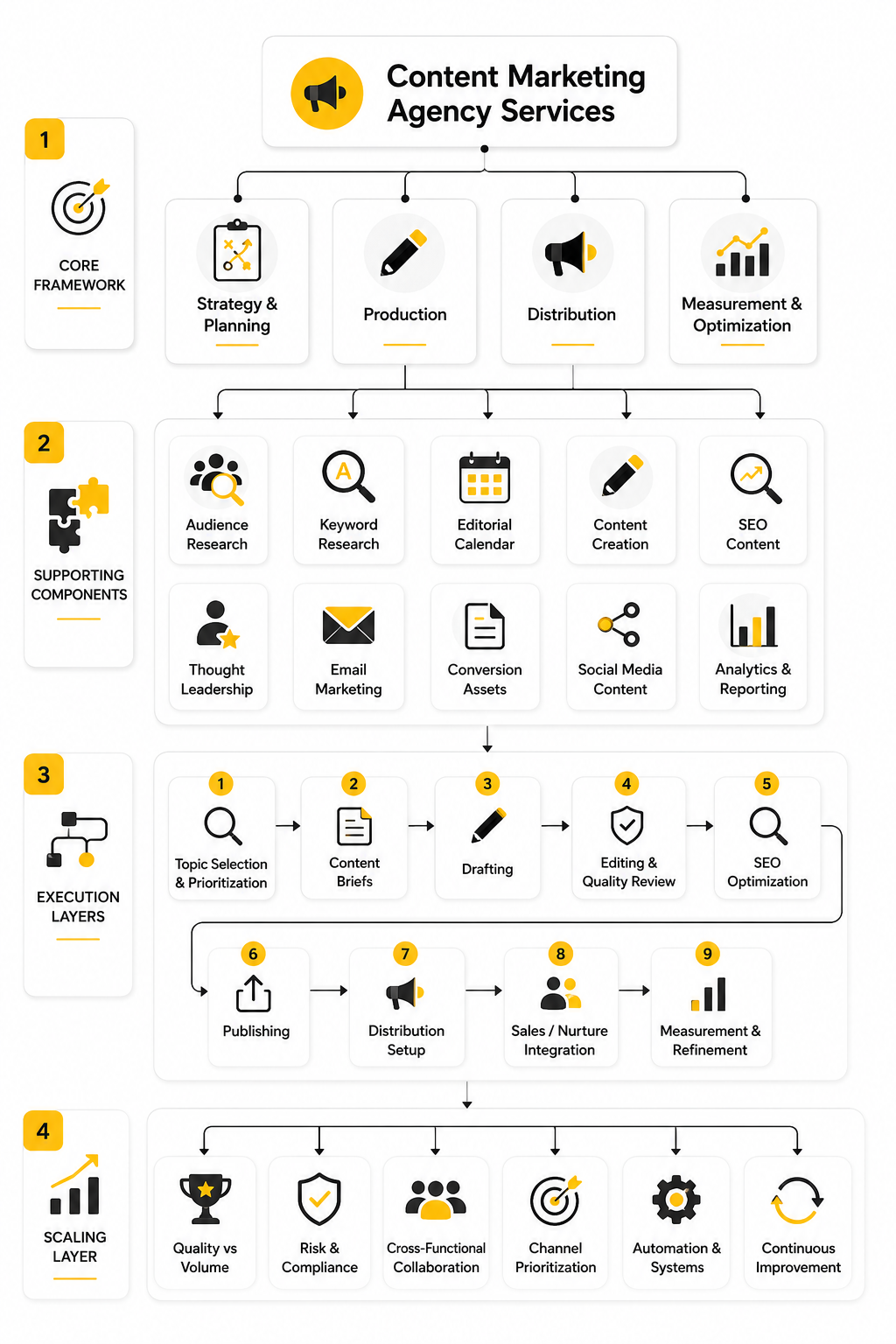
This visual process typically includes:
This end‑to‑end flow keeps work predictable and ensures nothing is missed.
Cross‑Functional Collaboration
Content marketing isn’t done in a silo. The agency will coordinate with your internal teams - especially sales, product, and customer success - to enrich the output with real insights and align it with business realities.
For example:
This collaboration makes content more than polished words - it makes it useful in real conversations.
Publishing And Promotion
Once content is ready, the agency transitions to publishing and promotion. Publishing isn’t just dropping it on your blog and walking away. It involves:
An implementation‑oriented agency coordinates these steps according to the channel plan defined in strategy so each published asset has the best chance to reach its audience.
Integrating With Sales And Nurture Systems
A content marketing agency services implementation doesn’t stop at publication. Modern content systems tie in closely with nurture and sales automation. This can involve setting up sequences, tagging logic, and funnels that route leads based on engagement signals.
For straightforward email campaigns, platforms like Brevo help teams automate welcome sequences and follow‑ups without complex setup. When you need advanced pipeline automation alongside content workflows, GoHighLevel gives a unified platform that manages click‑through triggers, lead scoring, SMS sequences, and booking flows all in one place.
Monitoring And Iterating With Data
After publishing and distribution, performance tracking becomes the core of refinement. Agencies feed data from analytics platforms into weekly or monthly reviews to understand what’s working and what’s not. Common metrics include:
Based on these signals, the agency optimizes content through refreshes, structural tweaks, stronger CTAs, updated visuals, or republishing. The best teams treat content as a living asset, not a one‑time deliverable.
Scaling The Process Over Time
The final part of implementation is scaling. Once the initial engine is running, the agency helps you scale by systematizing repeatable patterns, automating manual steps, and refining your publishing cadence. This often includes:
A strong implementation process transforms content from a cost center into a growth driver that consistently feeds your sales funnel and brand presence.
With a clear plan, structured workflow, and ongoing optimization, content marketing agency services become a predictable engine for business growth - not a gamble.
Would you like the next part focused on how to choose the right agency and what red flags to watch for?
Measurement, Analytics, And What The Data Actually Means
When you talk about content marketing agency services, measurement and analytics are what separate guesswork from growth. Data isn’t just numbers on a dashboard - it’s the evidence that tells you whether your content is attracting the right people, engaging them, and helping them make decisions that eventually lead to revenue. Without a measurement framework, content becomes intuition instead of leverage.
The challenge most companies face isn’t a lack of data - it’s interpreting that data in a way that drives more carefully decisions. Many teams track simple metrics like pageviews because those are easy to measure, but the metrics that actually connect to business success look deeper into conversions and pipeline influence. In fact, roughly 60% of successful marketers actively measure content ROI, while less successful teams often stop at traffic metrics that don’t tell the full story.
Key Performance Signals That Matter
To understand performance, agencies focus on a mix of engagement, conversion, and revenue‑aligned metrics. Each tells a different part of the story:
This set of signals should be interpreted together. A piece with high traffic but low conversions may still be useful early in the funnel, while a lower‑traffic asset with strong conversion rates might be a hidden gem worth promoting more aggressively.
Benchmarks You Can Use For Interpretation
Benchmarks help you understand whether a metric is strong, average, or weak relative to industry norms and business goals. Without them, even good performance can look mediocre, or weak performance might be misinterpreted as acceptable.
Benchmarks matter because they give context. A 2% conversion rate might be average for a standard blog post, but exceptional for an introductory educational article. When you compare against industry norms rather than your own historical data alone, you can identify opportunities to optimize, invest, or shift strategy.
Integrating Dashboards And Attribution
To make sense of all this, agencies build measurement systems that link content performance with business outcomes instead of isolated vanity metrics. Modern reporting often includes:
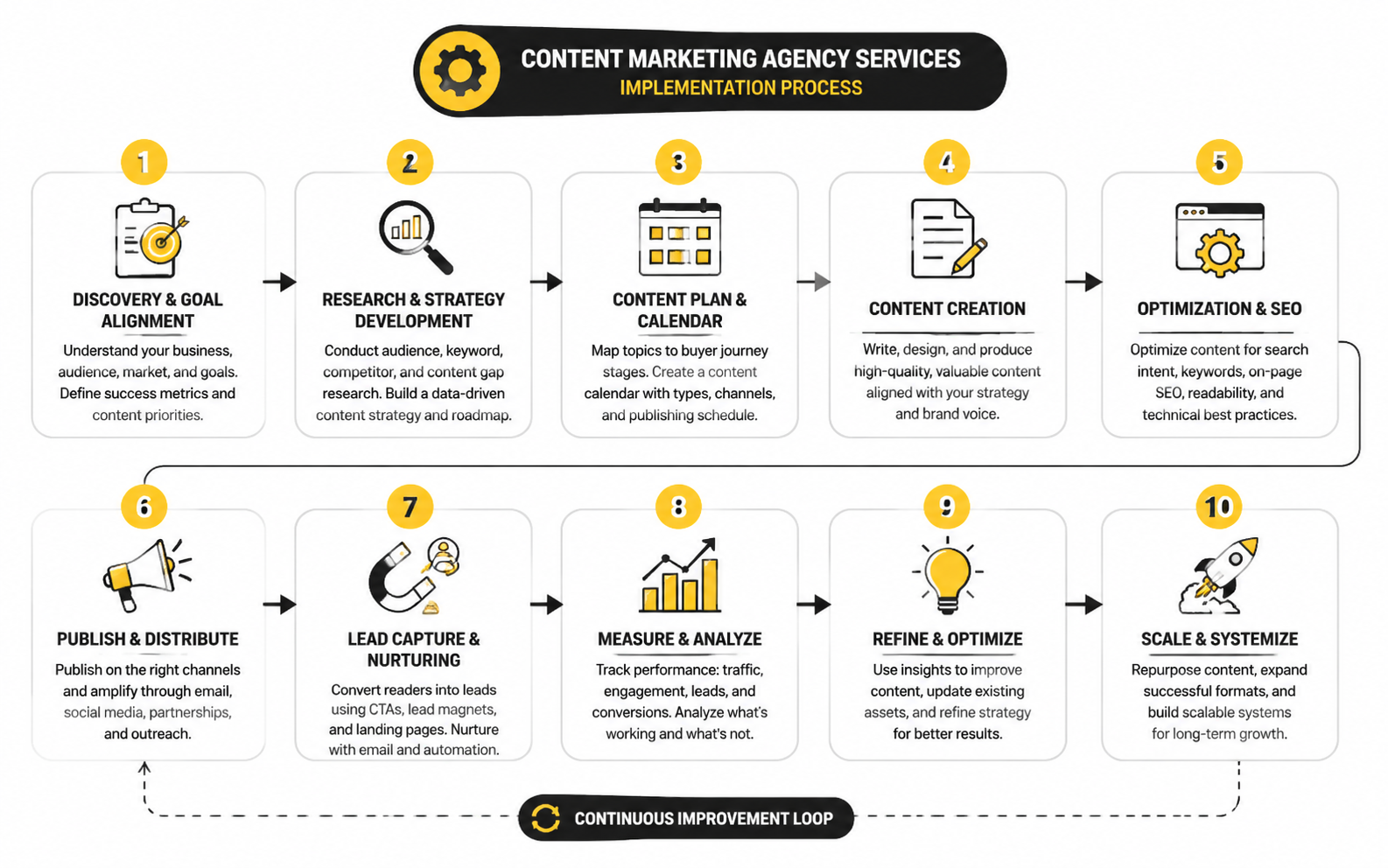
Visualization of this system helps teams move beyond looking at pageviews toward metrics that truly reflect buyer intent and pipeline influence. Rather than focusing on traffic alone, you begin tracking signals that tie directly to revenue.
How To Turn Data Into Action
Data without action isn’t measurement - it’s noise. The right analytics workflow informs decisions such as:
Measurement also allows agencies to:
When interpreted intelligently, data transforms your content program from guesswork to a predictable engine that informs budget, strategy, and growth priorities.
If you’d like, the next part can explore how to evaluate content marketing agency services and pick the right partner based on performance signals and business priorities.
Advanced Considerations When Working With A Content Marketing Agency
When engaging a content marketing agency services partner, the work doesn’t end at execution and measurement. Strategic tradeoffs, scaling issues, and long-term considerations are critical to ensure content investments compound instead of plateauing.
Balancing Quality And Volume
One common challenge is finding the right balance between output and quality. Producing a high volume of content can increase reach quickly, but it risks diluting brand voice or delivering thin content that underperforms. Conversely, prioritizing only premium content may slow growth or leave gaps in the funnel.
Agencies help navigate this tradeoff by:
The goal is to ensure that every piece of content either drives measurable engagement or reinforces credibility, rather than being “published for the sake of publishing.”
Managing Risk And Compliance
Content creation carries operational and reputational risks. Errors in facts, misrepresentations, or regulatory oversights can damage trust. Agencies with experience in regulated industries or B2B sectors implement review workflows, source verification, and legal approvals before publishing.
Best practices include:
This structured approach reduces the likelihood of errors while keeping production efficient.
Scaling Content Across Teams And Channels
Scaling content marketing is more than increasing output—it’s about creating systems that multiple contributors can follow without bottlenecks. Agencies help companies:
The scalable process ensures that as your content library grows, new assets integrate smoothly into existing campaigns and analytics frameworks.
Prioritizing Channels And Resource Allocation
Even with a solid content machine, resource allocation remains a strategic decision. Not every channel or format will deliver equal ROI. Agencies analyze historical performance, audience behaviors, and competitive gaps to decide where to focus effort and budget.
Decisions may include:
This disciplined approach helps organizations avoid overextension and ensures content investments align with business outcomes.
Continuous Improvement And Experimentation
The best content marketing agency services are iterative. Agencies embed feedback loops to optimize messaging, formats, and targeting over time. This includes:
Continuous iteration prevents stagnation, allowing the content program to evolve alongside market trends and audience expectations.
Strategic foresight, disciplined processes, and data-informed decisions turn content marketing from a tactical activity into a sustainable growth engine. By addressing these advanced considerations, businesses can maximize the return on their content marketing investments and position themselves for long-term impact.
Q1: What exactly do content marketing agency services cover?
Content marketing agencies offer strategy, content creation, distribution, SEO, email marketing, social media support, analytics, and optimization. Their goal is to turn expertise into measurable engagement and conversions, rather than just producing articles.
Q2: How do agencies measure success?
Agencies track metrics such as organic traffic, engagement (time on page, scroll depth), lead generation, conversion rates, and pipeline influence. The best agencies integrate these into dashboards that tie content performance directly to business outcomes.
Q3: What types of content do agencies typically produce?
Common formats include blog posts, white papers, case studies, ebooks, email sequences, video scripts, social media posts, landing pages, and lead magnets. The choice depends on buyer journey stages and business goals.
Q4: Can I outsource all content to an agency?
Yes, but strategic partnerships work best. Agencies often collaborate with in-house teams to leverage internal expertise, ensure brand voice consistency, and accelerate production without overextending internal resources.
Q5: How does SEO fit into agency services?
SEO is a core part of most agencies’ offerings. They conduct keyword research, optimize on-page elements, plan topic clusters, manage internal linking, and monitor rankings. The focus is always on intent-driven content rather than just keywords.
Q6: What role does analytics play in ongoing content strategy?
Analytics inform what content works, where to improve, and how to scale. Agencies analyze engagement, conversions, and revenue influence to optimize campaigns, refresh high-value content, and guide future topic selection.
Q7: How do agencies ensure content aligns with my brand voice?
Agencies use style guides, detailed briefs, and collaborative reviews. They often interview executives or subject matter experts to extract authentic perspectives and ensure consistency across channels.
Q8: How quickly can I expect results?
Content marketing is a medium-to-long-term strategy. Early signs such as engagement and lead generation may appear in a few weeks, but measurable organic growth and pipeline impact typically take 3–6 months or more.
Q9: Are there risks in working with a content agency?
Risks include producing generic content, misalignment with audience needs, or failing to deliver ROI. Mitigation comes from clear strategy, defined KPIs, strong collaboration, and data-driven optimization.
Q10: How do I know if the agency is the right fit?
Look for proven expertise in your industry, a documented process, measurable results, transparency in reporting, and a collaborative approach. Agencies should function as growth partners, not just vendors.
Q11: Can agencies help with multi-channel distribution?
Absolutely. They plan how content reaches audiences via SEO, email, social media, partnerships, and paid promotion, ensuring ideas are amplified across multiple touchpoints for maximum impact.
Q12: How do agencies scale content over time?
Agencies establish repeatable workflows, templates, and automation to maintain quality while increasing output. They integrate new formats, channels, and contributors without disrupting the existing ecosystem.
Build a stronger local presence with BAAM AI
Turn your website, Google profile, social channels, and AI visibility into one growth engine
Most businesses do not need more random marketing activity. They need a consistent presence system that helps the right people find them, trust them, and take action. BAAM AI brings strategy, local SEO, website updates, Google Maps visibility, social content, AI-search readiness, media production, and reporting into one practical monthly engine.
If you want your marketing to keep working after the campaign ends, start with a free BAAM AI presence audit. See how your business shows up today and where the fastest visibility wins are at BAAM AI.