
BAAM AI Blog
What A Social Influencer Actually Does
A social influencer is not just someone who posts attractive photos, reviews products, or gets free packages from brands. At the simplest level, a social influencer earns attention, keeps that attention through...
Affiliate disclosure: this article may include compensated links. Recommendations should still be evaluated against your use case, budget, and current provider terms.
Should you choose this tool?
this tool is worth considering when the use case, budget, and implementation effort match what you actually need to do next.
teams that want a practical tool decision without reading another generic feature list
Check this toolWhat A Social Influencer Actually Does
A social influencer is not just someone who posts attractive photos, reviews products, or gets free packages from brands. At the simplest level, a social influencer earns attention, keeps that attention through repeated value, and then guides a specific audience toward opinions, behaviors, products, or communities. That influence can be commercial, educational, cultural, political, or personal, depending on the niche and the relationship the creator has built with followers.
This is why follower count alone is a weak way to judge influence. A creator with 12,000 highly engaged followers in skincare, B2B software, personal finance, or fitness can often drive more action than a creator with 500,000 passive followers who barely trust their recommendations. Real influence shows up when people save the post, ask questions, join the email list, click the link, buy the product, share the idea, or change how they think.
The market is moving in that direction too. Creator advertising is no longer a small experimental budget line; U.S. creator economy ad spend was projected to hit $37 billion in 2025, while broader creator economy estimates have pointed toward a possible $480 billion market by 2027. That does not mean every creator is building a serious business. It means brands, platforms, and audiences now treat social influence as part of the modern marketing system.
Influence Is Built On Repeated Trust
The word “influencer” gets thrown around so much that people forget the main ingredient: trust. A social influencer becomes valuable when followers believe the person understands their world, filters information honestly, and recommends things with some level of care. Without that trust, the creator is just a media slot with a face attached.
This is also where many beginner creators get the game wrong. They chase reach before they build credibility. They accept random sponsorships before the audience understands what they stand for. They post whatever performs this week instead of building a clear reason for people to come back.
Trust is not built through one viral post. It is built through consistency, useful opinions, visible taste, honest boundaries, and a pattern of helping the same type of person solve the same type of problem. A fitness creator who explains training clearly every week earns trust differently than a fashion creator who curates outfits, but the principle is the same: the audience needs to know what kind of value to expect.
The Best Influencers Act Like Media Brands
A serious social influencer is closer to a small media company than a walking billboard. They have a niche, a content calendar, distribution channels, audience feedback, brand positioning, offers, analytics, and partnerships. Even solo creators are often making decisions that look a lot like editorial strategy, product marketing, and community management.
That shift matters because it changes how you should think about growth. Posting more is not enough. A creator needs a repeatable content system, a point of view, and a way to turn attention into something owned, such as an email list, community, product, or client pipeline. Otherwise, every platform change can reset the business overnight.
This is why tools matter once the basics are working. Scheduling platforms like Buffer can help a creator stay consistent without living inside every app all day. DM automation tools like ManyChat can help turn comments, story replies, and campaign interest into actual conversations. The tool is not the strategy, but the right stack protects the strategy from chaos.
The Main Types Of Social Influencers
Not every social influencer plays the same role. Some creators drive awareness, some drive education, some drive purchases, and some mainly shape culture. If you treat all influencers as interchangeable, you end up choosing partners based on vanity metrics instead of business fit.
Most influencers can be grouped by audience size, but the more useful question is what kind of relationship they have with the audience. A huge entertainment creator may be great for awareness, while a smaller niche expert may be better for trust and conversion. A local creator may outperform both if the campaign depends on geography, community, and real-world relevance.
The better you understand these categories, the easier it becomes to decide whether you want to become a social influencer, hire one, or build a brand that works with them.
Nano Influencers
Nano influencers usually have small audiences, often under 10,000 followers, but their strength is intimacy. Their followers may include local communities, niche hobbyists, professional circles, or people who feel like they personally know the creator. That makes nano creators especially useful when authenticity matters more than scale.
The downside is that nano influencers may not have polished systems yet. Some are new to brand work, slow with reporting, or unclear on pricing. But that can also be an advantage for brands that want genuine content and are willing to guide the collaboration clearly.
For creators, the nano stage is where the foundation gets built. This is where you learn your voice, your audience, your repeatable topics, and your boundaries. A nano social influencer who builds deep trust early can often monetize sooner than someone chasing empty follower growth.
Micro Influencers
Micro influencers usually have a larger but still focused audience. They are often strong in niches like beauty, travel, food, SaaS, home decor, parenting, productivity, personal finance, or fitness. Their audience is big enough to produce meaningful reach, but still specific enough that recommendations can feel personal.
This category is attractive because micro influencers often balance credibility and cost. They are usually easier to work with than celebrities, more relatable to the target customer, and more likely to produce content that feels native to the platform. For many brands, this is the sweet spot.
For the creator, the micro stage is where content needs to become more intentional. The audience expects consistency. Brands expect professionalism. The creator needs better systems for inbound requests, contracts, disclosures, analytics, and follow-up.
Macro Influencers And Celebrity Creators
Macro influencers and celebrity creators bring scale. They can put a product, campaign, or message in front of a massive audience quickly. That is useful for launches, awareness campaigns, cultural moments, and brands that already have strong conversion systems in place.
But scale creates distance. The bigger the audience, the harder it can be to maintain the feeling of personal connection. That does not mean macro influencers cannot sell; many absolutely can. It means brands need to understand whether they are buying attention, credibility, content assets, or direct response.
This is where measurement becomes non-negotiable. A large social influencer campaign should not rely on likes and vibes alone. Brands need trackable links, offer codes, landing pages, post-campaign reporting, and a clear view of whether the campaign actually moved the business.
Why Social Influencer Marketing Works
Social influencer marketing works because people do not make decisions in a vacuum. They look for signals from people they trust, admire, relate to, or want to become. A creator compresses that decision-making process by adding context, demonstration, emotion, and social proof.
Traditional ads can still work, but they often interrupt. Influencer content can feel more like discovery. A product appears inside a tutorial, routine, review, story, comparison, or personal recommendation, which gives the audience a reason to care before they ever see a sales page.
That is the real power of the social influencer model. It does not just say, “Buy this.” It says, “Here is how this fits into a life, problem, identity, goal, or aspiration you already care about.”
Audiences Trust People More Than Polished Campaigns
People are increasingly skeptical of corporate messaging, especially when it feels too scripted. A creator can translate a brand’s message into language the audience actually uses. That translation is where a lot of the value lives.
This does not mean influencer content should be messy or careless. It means the creator’s voice should stay intact. When every sentence sounds like it came from a legal department, the post loses the very thing the brand paid for.
The strongest campaigns give creators a clear brief without suffocating the content. The brand defines the goal, claims, offer, and restrictions. The creator shapes the story in a way their audience will actually believe.
Social Proof Reduces Buyer Friction
When someone sees a social influencer use a product repeatedly, answer questions about it, and show it in a realistic context, the product becomes easier to understand. The audience can imagine how it works, who it is for, and whether it fits their situation. That reduces friction before the buyer reaches the checkout page.
This is especially important for products that need explanation. Software, supplements, courses, skincare, financial tools, and high-ticket services often require more than a simple product photo. They need education, proof, and reassurance.
That is why landing pages and creator content should work together. A creator can generate the demand, but the page has to convert it. Builders like Replo can be useful when a brand needs dedicated campaign pages that match the angle, audience, and offer behind a creator partnership.
Creators Make Niches Easier To Reach
Most brands do not need everyone. They need the right people. A strong social influencer has already gathered a specific audience around a topic, lifestyle, belief, problem, or aspiration.
That targeting is difficult to replicate with broad ads alone. A vegan meal prep creator, a Notion productivity creator, a local Austin food creator, and a B2B sales creator each attract a different type of buyer. The creator’s audience is already filtered by interest and behavior before the brand enters the conversation.
This is why niche relevance usually beats broad popularity. If the audience is wrong, the campaign is wrong. A smaller creator with the right audience can be more valuable than a larger creator whose followers have no reason to care.
How To Build A Social Influencer Strategy That Actually Works
A social influencer strategy should never start with “Who has the most followers?” That is the lazy version, and it usually creates lazy results. The better starting point is simple: what business outcome are you trying to create, and what type of creator has earned the right kind of attention from the right audience?
This matters because influencer marketing can serve different jobs. One campaign might be built for awareness, where reach and content quality matter most. Another might be built for lead generation, where the creator’s trust, call to action, and landing page flow matter more than raw impressions. Another might be built for direct sales, where offer clarity, audience fit, timing, and attribution become the whole game.
The creator economy is now big enough that brands cannot treat it like a casual side experiment. U.S. creator ad spend was projected to reach $37 billion in 2025, and that growth has made the space more competitive, more measurable, and more operational. If you want the upside, you need a process that is clear enough to repeat.
Start With The Campaign Goal
Before choosing a social influencer, define the campaign goal in plain language. Do you want people to discover the brand, join a waitlist, book a call, download a guide, buy a product, visit a store, or create user-generated content you can reuse in ads? Each goal changes the kind of creator you should choose.
For awareness, you may care more about storytelling ability, audience overlap, average views, and shareability. For conversion, you should care more about audience intent, past sponsor performance, landing page relevance, and how naturally the creator can explain the offer. For content production, you may care less about audience size and more about whether the creator can make videos, photos, or demos that your brand can repurpose.
This is where many campaigns break before they begin. The brand says it wants sales, but chooses creators based on aesthetics. Or it says it wants awareness, but judges the campaign only by coupon code redemptions. Pick the goal first, then build everything else around it.
Define The Audience Before You Define The Creator
The next step is audience clarity. A social influencer is only useful if their audience overlaps with the people you actually want to reach. That sounds obvious, but it is one of the most common mistakes in influencer selection.
Define the audience in terms of pain, desire, context, and buying stage. “Women 25 to 34” is not enough. “Busy professional women who want simple strength training routines they can follow at home before work” is much more useful because it gives you a real filter for creator fit.
Once the audience is clear, review creators through that lens. Look at comment quality, recurring questions, content themes, audience language, and whether the creator’s followers seem to match the buying situation. The best campaigns feel natural because the product already belongs in the conversation.
Choose Creators With A Fit Score, Not A Gut Feeling
A social influencer should be evaluated with a simple scorecard. You do not need a complicated model, but you do need more than vibes. A creator can look perfect on the surface and still be wrong for the campaign if the audience is disengaged, the content style does not match the offer, or the creator has no believable connection to the category.
A practical creator scorecard can include:
Do not overcomplicate this. The point is to force better thinking before money changes hands. A simple weighted score can prevent the team from picking creators just because someone likes their feed.
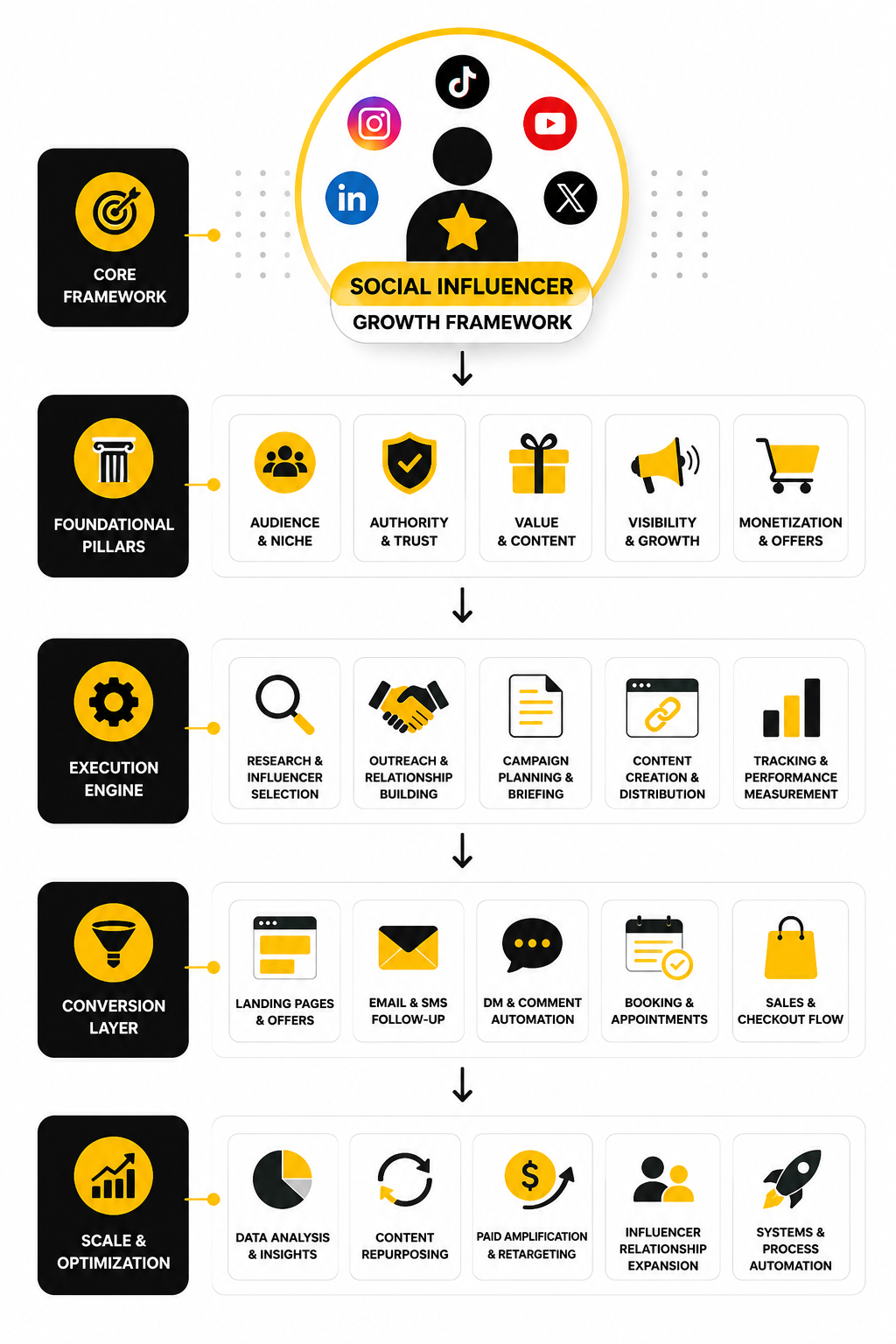
Build The Campaign Workflow Step By Step
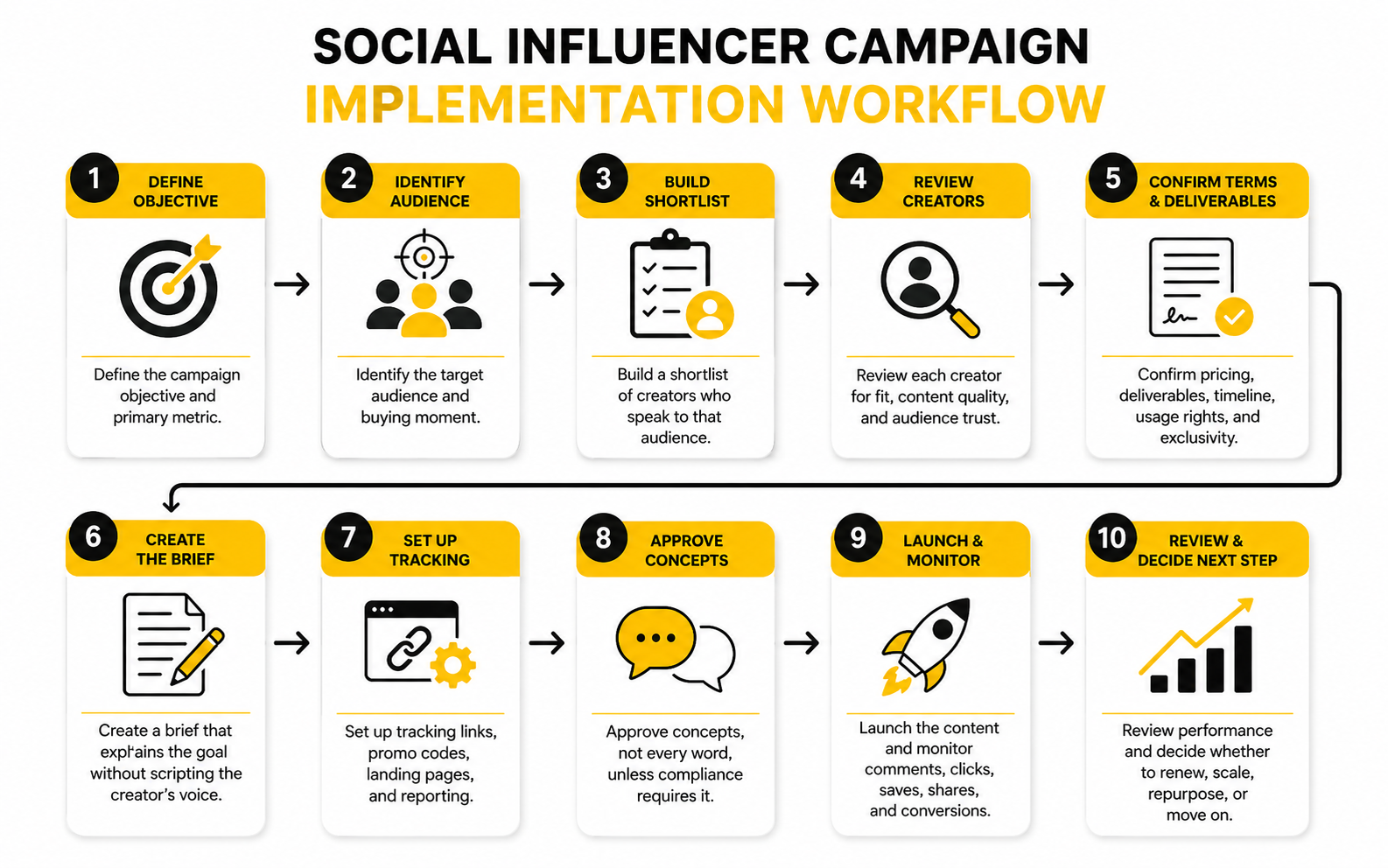
Once the goal, audience, and creator criteria are clear, the execution becomes much easier. This is where influencer marketing turns from an idea into an actual operating system. The workflow should be documented so every campaign improves the next one.
A clean process looks like this:
The best part about this structure is that it keeps everyone honest. If the campaign fails, you can usually see where the breakdown happened. Maybe the audience was wrong, the brief was too stiff, the offer was weak, the creator had low trust, or the landing page did not match the promise.
Write A Brief That Creators Can Actually Use
A good brief gives the creator enough direction to succeed without stripping away the reason their audience follows them. It should explain the campaign goal, target audience, key product truth, required claims, content format, deadline, disclosure requirements, and call to action. It should not read like a corporate script that could be handed to any creator on the internet.
The brief should also make the non-negotiables clear. If the product has legal restrictions, required disclaimers, prohibited claims, or usage rules, spell them out early. The FTC’s endorsement guidance makes it clear that creators need to disclose material connections like payment, free products, or affiliate relationships in a way people can easily notice and understand through its endorsement guidance for influencers and advertisers.
Then give the creator room to translate. A social influencer knows the rhythm, humor, objections, and language of their own audience better than a brand manager does. The strongest briefs protect the brand while still letting the creator sound like a real person.
Set Up The Conversion Path Before The Post Goes Live
Do not wait until launch day to think about where the traffic goes. If a creator sends attention to a confusing homepage, a slow page, or an offer that does not match the content, the campaign will leak money. The content creates demand, but the conversion path captures it.
A strong conversion path usually includes a dedicated landing page, a clear offer, a simple call to action, tracking links, and a follow-up system. For simple campaigns, that may be a product page with a creator code. For service businesses, it may be a booking page, form, email sequence, or CRM pipeline.
This is where the right tools can make execution cleaner. A brand running creator-led funnels can use ClickFunnels or Systeme.io to build campaign flows without overengineering the setup. Agencies and local businesses that need CRM, booking, automation, and follow-up in one place may prefer GoHighLevel, especially when influencer traffic needs to turn into leads instead of one-off clicks.
Make Tracking Simple But Serious
Tracking does not need to be perfect to be useful, but it does need to exist. At minimum, every social influencer campaign should have trackable links, platform-specific UTMs, creator-specific promo codes, and a clear reporting window. Without those basics, you are guessing.
Measure different things based on the campaign goal. Awareness campaigns can look at reach, watch time, shares, saves, profile visits, and branded search lift. Conversion campaigns should look at clicks, opt-ins, purchases, booked calls, cost per acquisition, and revenue. Content campaigns should look at asset quality, usage rights, ad performance, and whether the creator content outperforms studio content.
The trap is treating every number as equally important. It is not. A campaign built for lead generation can have fewer likes and still win if the leads are qualified. A campaign built for awareness can produce weak immediate sales and still be useful if it creates strong reach, search demand, and retargeting audiences.
Plan For Follow-Up, Not Just Exposure
Most people do not buy the first time they see something. That is why social influencer campaigns should connect to a follow-up system. If someone clicks, comments, replies, joins a list, downloads a resource, or books a call, the brand should know what happens next.
For Instagram and Facebook campaigns, ManyChat can help route comment-based actions and direct message flows into a more structured journey. For email follow-up, tools like Brevo or Moosend can help turn creator-driven attention into owned audience growth. The point is not to add complexity for fun. The point is to avoid wasting demand that someone else worked hard to create.
Follow-up also helps separate serious buyers from casual viewers. A person who clicks from a creator post may need reviews, comparisons, a limited-time offer, a webinar, or a simple reminder. When the backend is ready, influencer marketing becomes more than a post; it becomes a real acquisition channel.
Statistics And Data
Data is where a social influencer campaign becomes real. Not perfect, not magically predictable, but real enough to improve. If you only look at likes, you are measuring applause. If you only look at sales, you may miss the role the creator played in awareness, trust, retargeting, and future demand.
The better approach is to measure the whole path. A creator post can create attention, turn attention into intent, and then help that intent become a lead, sale, booking, follow, or repeat touchpoint. Each stage has different numbers, and each number should tell you what to do next.
This matters more now because influencer marketing is no longer a casual brand experiment. U.S. creator ad spend was projected to reach $37 billion in 2025, growing much faster than the broader media market. When that much budget moves into creator partnerships, brands need clearer measurement, cleaner reporting, and better decisions after the campaign ends.
The Metrics That Actually Matter
The first mistake is treating every metric like it has the same value. It does not. Reach, views, comments, clicks, leads, purchases, and revenue are all useful, but they answer different questions.
Reach tells you how many people had the chance to see the content. Watch time tells you whether they stayed long enough to care. Saves and shares tell you whether the content was useful, memorable, or identity-driven enough to keep moving. Clicks tell you whether the call to action created intent. Conversions tell you whether the offer, landing page, price, trust, and timing worked together.
A social influencer campaign should usually track these categories:
The key is not to collect everything for the sake of looking sophisticated. The key is to decide which numbers match the campaign goal. A creator hired for awareness should not be judged only by last-click purchases, and a creator hired for sales should not be celebrated just because the post got a lot of likes.
Benchmarks Are Useful, But Context Wins
Benchmarks can help you spot obvious problems, but they should not become the strategy. A 2% engagement rate might be weak in one niche and strong in another. A video with fewer views can still outperform a viral post if it attracts buyers instead of casual scrollers.
This is why platform, niche, audience size, and content format all matter. Nano and micro creators often generate stronger engagement because the audience relationship is tighter. Larger creators may create more total reach, but the relationship can be less personal. Neither is automatically better; they serve different jobs.
Industry benchmark reports regularly show that influencer marketing is still expanding, with the global influencer marketing industry projected around $32.55 billion in 2025. That number is useful because it confirms budget is flowing into the channel. But it does not tell you whether your specific campaign is working. Your own baseline will always matter more than the average.
Read Engagement Quality, Not Just Engagement Rate
Engagement rate is one of the most quoted influencer metrics, but it is also one of the easiest to misunderstand. A high engagement rate can mean strong trust, strong entertainment value, controversy, giveaways, low-quality comment farming, or a very small audience. You need to look at what people are actually doing.
Comment quality is often more revealing than the percentage itself. Are people asking buying questions? Are they tagging friends who match the target customer? Are they sharing personal objections? Are they saying they already use the product or want to try it? Those signals tell you the creator has moved the audience beyond passive viewing.
A strong social influencer does not just generate reactions. They create a conversation that makes the product, idea, or offer easier to understand. That is why a brand should review the comment section manually before making renewal decisions.
Build A Simple Influencer Analytics System
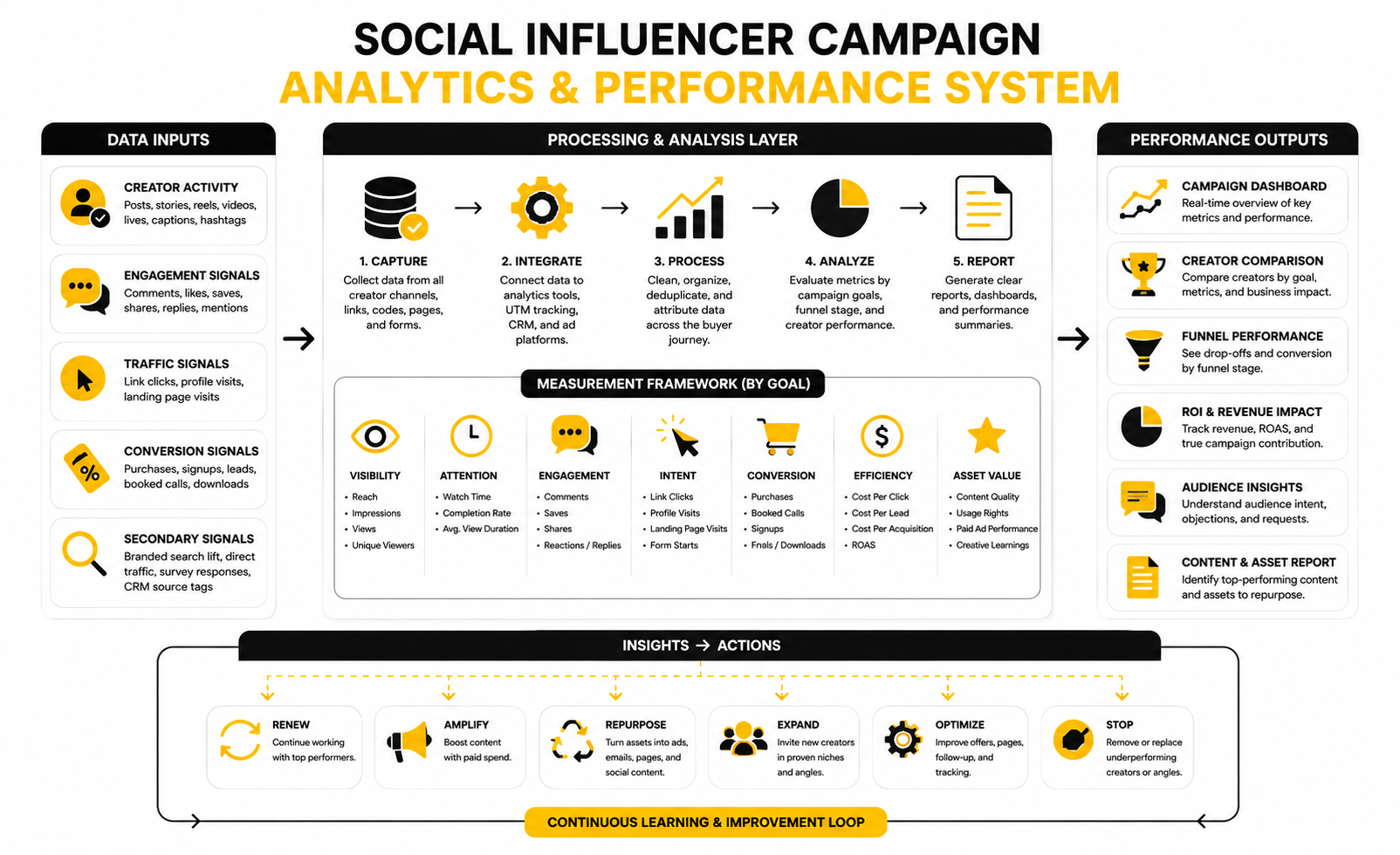
The cleanest analytics setup connects creator activity to business outcomes without pretending attribution will be perfect. You want enough tracking to make decisions, not so much complexity that nobody uses it. A practical system can be built with creator-specific links, UTM parameters, promo codes, landing pages, CRM tags, and post-campaign reporting.
A basic measurement flow should look like this:
This is where the backend matters. If leads come from creator content but disappear into a messy inbox, you will undercount performance and waste follow-up opportunities. A CRM and automation platform like GoHighLevel can help service businesses track creator-driven leads, automate follow-up, and connect campaign activity to booked calls or sales conversations.
Understand The Difference Between Attribution And Influence
Attribution tells you what can be tracked. Influence tells you what actually shaped the buyer’s decision. They overlap, but they are not the same thing.
A buyer might see a creator’s TikTok, search the brand on Google, read reviews, join the email list, and purchase two weeks later from a retargeting ad. Last-click attribution may credit the ad, but the social influencer created the original demand. If you ignore that, you may cut the creator and keep the channel that only captured demand someone else created.
That does not mean you should accept vague claims forever. It means you should combine multiple signals: tracked clicks, promo code usage, branded search lift, direct traffic changes, comment intent, survey responses, CRM source tags, and customer feedback. The more expensive the product, the more important this blended view becomes.
Measure Content Value Separately From Media Value
A social influencer campaign can produce two kinds of value. The first is media value: the creator reaches their own audience. The second is content value: the brand gets creative assets that can be reused on landing pages, ads, email, product pages, and organic channels.
Do not mix these together without thinking. A creator may not drive the cheapest sales from their own post, but their video might become the best-performing ad creative in the account. Another creator may drive immediate sales but produce content that cannot be reused well. Both can be valuable, but they should be judged differently.
This is why usage rights should be discussed before the campaign starts. If the brand wants to run the content as paid ads, place it on landing pages, or use it in email campaigns, the contract should say that clearly. A tool like Replo can be useful when brands want creator-specific landing pages that feature social proof, testimonials, product demos, and campaign-specific messaging in one place.
Watch For The Hidden Performance Signals
Some of the best campaign signals do not show up in a neat dashboard. If a creator’s audience starts asking detailed product questions, comparing plans, requesting tutorials, or tagging decision-makers, the campaign is doing more than generating impressions. It is creating intent.
The same is true when followers repeat the creator’s language back to the brand. That means the message landed. If people say, “I saw this from her,” or “This is exactly what I needed for my workflow,” the campaign has created a bridge between the creator’s trust and the brand’s offer.
You should also watch negative signals. If comments show confusion, the offer may be unclear. If clicks are high but conversions are low, the landing page may be weak or mismatched. If engagement is high but clicks are almost nonexistent, the content may be entertaining without creating buying intent.
Do Not Ignore Compliance Data
Performance is not the only thing that needs measurement. Compliance matters too. Sponsored posts should be disclosed clearly, and the FTC’s influencer guidance explains that material connections between creators and brands need to be easy for people to notice and understand through its endorsement guidance.
This is not just legal housekeeping. Clear disclosure protects trust. If an audience feels tricked, the creator loses credibility and the brand absorbs the backlash.
Track whether every required disclosure appeared in the right place, whether the creator used approved claims, and whether the post stayed within the agreed category rules. For regulated industries, this should be part of the campaign report, not an afterthought.
Turn The Data Into Decisions
The point of analytics is action. After a campaign ends, you should know what to do next. Renew the creator if the audience fit, content quality, and business signals are strong. Repurpose the content if the asset is stronger than the post performance. Amplify the post with paid spend if organic traction proves the message works. Stop the partnership if the audience, trust, or economics are clearly wrong.
A practical post-campaign review should answer:
This is how influencer marketing gets better over time. You do not need every campaign to be a massive win. You need every campaign to teach you something useful, so the next social influencer partnership is sharper, cleaner, and more profitable.
Advanced Strategy: What Changes When You Scale
Once the basics are working, the game changes. A single social influencer campaign can survive with a spreadsheet, a few manual checks, and one person managing the details. A scaled influencer program cannot.
Scaling means more creators, more content, more contracts, more usage rights, more tracking links, more approvals, more payment terms, more compliance checks, and more performance data. The upside is leverage. The risk is that the whole system becomes messy enough that good creators get ignored, weak creators get renewed, and nobody knows which part of the program is actually making money.
This is where brands need to stop thinking in campaigns only. The goal is to build an influencer operating system. Not a bloated one, but a repeatable process that finds the right creators, protects the brand, captures the demand, and learns from every partnership.
Short-Term Campaigns Versus Long-Term Partnerships
Short-term campaigns are useful when you are testing a new audience, launching a product, trying a new content angle, or validating whether a creator’s audience responds. They give you speed and flexibility. They also protect you from locking into a partnership before you understand the creator’s real performance.
Long-term partnerships are better when trust compounds. If a social influencer mentions your product once, the audience may notice it. If they use it naturally over several months, answer questions, show results, and bring it into different content formats, the recommendation becomes more believable.
The tradeoff is commitment. Long-term deals often require higher fees, exclusivity discussions, clearer usage rights, and a stronger relationship between brand and creator. That is not a problem if the creator is a strong fit. It is a very expensive problem if the first test was shallow and the renewal was based on vanity metrics.
Exclusivity Can Protect You Or Trap You
Exclusivity sounds attractive because it keeps a creator from promoting direct competitors. In categories like skincare, supplements, software, finance, fitness, and high-ticket services, that can matter. If a creator recommends five similar tools in the same month, the audience starts to question whether any recommendation is real.
But exclusivity has a cost. The broader and longer the exclusivity window, the more the creator may charge because you are limiting their future income. A vague exclusivity clause can also create conflict if the creator does not understand which brands, categories, or products are restricted.
A cleaner approach is to define exclusivity tightly. Name the category, competitors, time period, platforms, and content formats. Do not ask for more control than you actually need. You want to protect trust, not suffocate the creator’s business.
Usage Rights Are Where Brands Often Lose Leverage
Usage rights are not a boring legal detail. They can be the difference between a one-time post and a content asset that keeps producing value for months. If a creator makes a strong product demo, testimonial, or comparison video, the brand may want to use it in ads, landing pages, email campaigns, product pages, or sales materials.
That needs to be agreed before the content goes live. The agreement should cover where the content can be used, how long it can be used, whether the brand can edit it, whether paid amplification is allowed, and whether the creator’s likeness can appear in ads. Without that clarity, the brand may discover too late that the best-performing asset cannot legally be scaled.
This is especially important if the campaign is built around paid social. A social influencer post may produce decent organic results, but the real upside might come from whitelisting, creator licensing, or turning that content into ads. If usage rights are missing, the brand is forced to renegotiate from a weaker position.
Brand Safety Is Not Optional
Brand safety becomes more important as the program grows. The more creators you work with, the more risk you inherit. That risk can come from old posts, audience behavior, undisclosed sponsorships, fake engagement, controversial claims, competitor conflicts, or content that simply does not match your brand.
The influencer industry keeps growing, with creator ad spend projected to hit $37 billion in the U.S. in 2025, but more money also attracts more shortcuts. Fraud, low-quality engagement, and sloppy disclosure can hide inside attractive-looking profiles. A creator who looks perfect at a glance may still be a bad partner once you review their audience and history.
Do the boring work before the exciting launch. Review recent posts, older content, comment quality, audience patterns, sponsorship history, disclosure habits, and any category-sensitive claims. You do not need paranoia. You need a standard.
Fraud Detection Should Happen Before Negotiation
Fake followers are not always obvious. Some accounts have normal-looking follower counts, polished content, and attractive engagement at first glance. The warning signs usually appear when you look deeper.
Watch for sudden follower spikes with no clear reason, generic comments, repeated emoji-only engagement, mismatched audience geography, engagement that looks too consistent, and posts where reach does not match follower count. A social influencer with real trust usually has comments that sound like humans, not a wall of recycled praise.
Fraud checks should happen before serious negotiation because they change the price. A creator with inflated numbers should not be paid like a creator with a real audience. More importantly, a fake audience does not just waste budget; it corrupts your data and makes future decisions worse.
AI Influencers And Synthetic Content Need Extra Scrutiny
AI can help with influencer workflows, editing, research, scripting support, and content repurposing. That is different from replacing human credibility with synthetic personalities. Audiences are becoming more sensitive to that distinction.
Recent backlash against AI-generated fashion and beauty influencers shows the risk clearly: followers may reject synthetic creators when they feel authenticity, representation, or lived experience is being replaced. In beauty, wellness, finance, parenting, fitness, and other trust-heavy categories, this can damage the exact emotional connection that makes influencer marketing work.
That does not mean AI has no place. It means the brand needs to be honest about what is AI-assisted, what is human-led, and what claims require lived experience. A social influencer campaign built on trust should not create confusion about who is real, what they actually used, or why the recommendation exists.
Build A Creator Portfolio, Not A Creator Dependency
One creator can be powerful, but dependence is dangerous. Algorithms change, audiences shift, creators burn out, scandals happen, rates rise, and content formats evolve. If one influencer controls too much of your acquisition, the brand is exposed.
A stronger strategy is to build a portfolio. Mix creator sizes, platforms, content formats, and campaign roles. Some creators can drive reach. Some can drive trust. Some can create strong assets. Some can explain complex products. Some can speak to niche buyer segments that your brand could never reach credibly on its own.
This also gives you better data. When you test multiple creators with a consistent offer and clean tracking, patterns appear. You start to learn which angles, audience segments, platforms, and formats produce real business outcomes.
Protect The Creator Relationship
Influencer marketing is not just media buying. You are working with people who have their own audience, reputation, workload, creative process, and business priorities. Treating creators like disposable ad placements is a fast way to get weaker work.
Good creators want clear briefs, fair timelines, fast communication, respectful feedback, and on-time payment. They also want brands that understand the difference between guidance and micromanagement. If every sentence needs approval from five people, the content will probably lose the creator’s voice.
The best partnerships feel professional on both sides. The brand brings clarity, product truth, tracking, and support. The creator brings audience understanding, content skill, and trust. When both sides respect the exchange, the work gets better.
Turn Creator Content Into A Full-Funnel Asset
A strong social influencer partnership should not end when the post goes live. Good creator content can support the full funnel if you plan for it. It can drive awareness on social, answer objections on landing pages, add proof inside email sequences, improve retargeting ads, and help sales teams explain the product faster.
This is why content should be organized after every campaign. Save the best hooks, demos, objections, comments, testimonials, screenshots, and creative angles. Tag them by audience, pain point, offer, platform, and funnel stage. That turns a campaign library into a learning system.
Tools can help when the backend starts getting bigger. Dub.co can support cleaner link tracking, Fillout can help capture campaign-specific lead information, and Copper can help teams manage relationship-heavy follow-up when influencer traffic turns into sales conversations. The point is not to add software everywhere. The point is to stop letting valuable attention fall through cracks.
Know When Not To Use A Social Influencer
Influencer marketing is powerful, but it is not the right move for every situation. If your offer is unclear, your landing page is weak, your product has poor retention, or your customer support cannot handle demand, a creator campaign may only expose the problem faster. Attention magnifies whatever is already there.
It is also a bad fit when the brand wants total control over the message. If the creator cannot speak in their own voice, the campaign loses the trust advantage. At that point, you may be better off running traditional ads or hiring actors for scripted content.
The real question is whether the brand is ready to turn borrowed trust into a clean customer journey. If the answer is yes, a social influencer can become one of the strongest growth levers in the business. If the answer is no, fix the offer and backend first.
The Final System: Turning Influence Into A Repeatable Growth Channel
At this point, the big idea should be clear: a social influencer is not a shortcut around strategy. A creator can accelerate trust, attention, and demand, but the business still needs a strong offer, a clean customer journey, smart measurement, and a real follow-up system. Without that, influencer marketing becomes expensive noise.
The strongest brands treat influencer partnerships like an ecosystem. The creator creates demand. The landing page captures intent. The email or CRM system follows up. The content library improves future ads. The reporting loop shows what to scale, what to fix, and what to stop doing.
That is the difference between “we paid someone to post” and “we built a creator-led acquisition system.” One is a transaction. The other compounds.
The Creator-Led Growth Flywheel
A strong social influencer program improves every time it runs. The first campaign teaches you which audience cares. The second campaign improves the offer and creative angle. The third campaign gives you better content, better tracking, and better creator selection.
The flywheel looks like this:
This is where the whole system comes together. A social influencer can open the door, but your backend decides how much value you keep. If the backend is strong, one good creator relationship can create content, customers, search demand, retargeting audiences, and long-term brand memory.
The Practical Stack Behind The System
You do not need a giant tech stack to run influencer campaigns well. You need the right pieces in the right places. The basic stack should help you plan content, capture demand, track performance, and follow up with people who show interest.
For content scheduling and consistency, Buffer can help keep publishing organized across channels. For comment-to-DM flows and social response capture, ManyChat is useful when creator campaigns generate conversations that need fast replies. For landing pages and creator-specific funnels, ClickFunnels, Systeme.io, or Replo can help turn traffic into action.
For service businesses, agencies, coaches, local companies, and high-ticket offers, the follow-up layer matters even more. GoHighLevel can connect forms, bookings, CRM stages, automations, and campaign follow-up in one place. When social influencer traffic becomes leads instead of instant purchases, speed and structure are not optional.
What Is A Social Influencer?
A social influencer is a person who has built enough trust, attention, and authority with an online audience to shape opinions, behaviors, or buying decisions. They usually do this through consistent content on platforms like TikTok, Instagram, YouTube, LinkedIn, X, Facebook, Pinterest, or niche communities. The real value is not just the follower count; it is the audience relationship and the creator’s ability to move people toward action.
How Many Followers Do You Need To Be A Social Influencer?
There is no fixed follower number that magically makes someone a social influencer. A creator with 2,000 loyal followers in a specific niche can have more real influence than someone with 200,000 disengaged followers. The better question is whether the audience listens, responds, trusts the creator’s recommendations, and takes action.
Are Micro Influencers Better Than Big Influencers?
Micro influencers are often better for niche trust, specific communities, and conversion-focused campaigns. Big influencers are often better for reach, awareness, and broad cultural visibility. Neither is automatically better. The right choice depends on the campaign goal, audience, offer, budget, and measurement plan.
How Do Brands Choose The Right Social Influencer?
Brands should choose a creator based on audience fit, content quality, engagement quality, category credibility, brand safety, past sponsorship style, and expected business value. Follower count should be only one part of the decision. A creator who already speaks to the exact buyer you want is usually more valuable than a bigger creator with a random audience.
How Do Social Influencers Make Money?
Social influencers can make money through sponsored posts, affiliate links, brand partnerships, product collaborations, subscriptions, courses, consulting, digital products, events, licensing, and ad revenue. Many creators combine several income streams instead of relying on one platform. That is smart because algorithm changes, platform rules, and brand budgets can shift quickly.
What Should A Brand Include In An Influencer Brief?
A good brief should include the campaign goal, target audience, key message, product details, required claims, restricted claims, content format, deadline, disclosure requirements, call to action, tracking link, and approval process. It should give direction without forcing the creator to sound scripted. The creator’s voice is the reason the partnership has value.
How Do You Measure A Social Influencer Campaign?
Measure the campaign based on the goal. Awareness campaigns should track reach, views, watch time, saves, shares, and branded search signals. Conversion campaigns should track clicks, leads, purchases, booked calls, cost per acquisition, and revenue. Content campaigns should also track asset quality, usage rights, and paid ad performance.
What Is A Good Engagement Rate For Influencers?
A “good” engagement rate depends on the platform, niche, audience size, content format, and campaign type. Smaller creators often have higher engagement rates because the audience relationship is more personal. But engagement rate alone is not enough. Comment quality, audience fit, buying intent, and actual conversion behavior matter more than a single percentage.
Do Influencers Have To Disclose Sponsored Posts?
Yes, sponsored relationships and other material connections should be disclosed clearly. The FTC’s guidance says endorsements must be truthful and not misleading, and material connections between advertisers and endorsers should be made clear through its endorsement guidance. This protects the audience, the creator, and the brand.
What Is The Difference Between An Influencer And A Content Creator?
A content creator makes content. A social influencer makes content that also shapes audience decisions. There is overlap, but they are not always the same. Some creators produce excellent assets without a strong audience, while some influencers have deep audience trust but may need support creating polished brand content.
Should Brands Pay Influencers Upfront Or Use Affiliate Deals?
Both models can work, but they solve different problems. Upfront fees compensate the creator for content production, audience access, and guaranteed deliverables. Affiliate deals reward performance, but they can be unfair if the creator is creating demand that is later captured through other channels. Many strong partnerships use a hybrid model with a base fee plus performance upside.
Can A Social Influencer Campaign Work For B2B?
Yes, but B2B influencer marketing usually looks different from consumer influencer marketing. The audience is smaller, the buying cycle is longer, and trust often comes from expertise instead of entertainment. LinkedIn creators, newsletter writers, YouTube educators, podcast hosts, consultants, and niche community leaders can all influence B2B buying decisions.
What Is The Biggest Mistake Brands Make With Influencers?
The biggest mistake is treating creators like ad placements instead of trust partners. Brands over-script the message, choose creators based on follower count, send traffic to weak pages, skip tracking, and then blame the creator when results are unclear. A social influencer campaign works best when the creator, offer, content, landing page, and follow-up system all fit together.
How Long Should An Influencer Partnership Last?
Start with a test, then expand if the signals are strong. A one-off post can validate audience fit, but longer partnerships often perform better because trust builds through repeated exposure. The right length depends on the offer, budget, product category, creator relationship, and whether the campaign is designed for awareness, sales, or content production.
Is Influencer Marketing Still Worth It?
Yes, when it is done with strategy and measurement. U.S. creator ad spend was projected to reach $37 billion in 2025, which shows that brands are still moving serious budget into creator-led media. But the winners are not the brands throwing money at random posts. The winners are the ones building systems around trust, content, conversion, and follow-up.
Build a stronger local presence with BAAM AI
Turn your website, Google profile, social channels, and AI visibility into one growth engine
Most businesses do not need more random marketing activity. They need a consistent presence system that helps the right people find them, trust them, and take action. BAAM AI brings strategy, local SEO, website updates, Google Maps visibility, social content, AI-search readiness, media production, and reporting into one practical monthly engine.
If you want your marketing to keep working after the campaign ends, start with a free BAAM AI presence audit. See how your business shows up today and where the fastest visibility wins are at BAAM AI.