
BAAM AI Blog
What A Junior Copywriter Actually Does Day To Day
A junior copywriter is not paid to “just write words.” That is the beginner misunderstanding. The real job is to turn a brief, a product, a customer problem, and a business goal into copy that helps someone take the...
What A Junior Copywriter Actually Does Day To Day
A junior copywriter is not paid to “just write words.” That is the beginner misunderstanding. The real job is to turn a brief, a product, a customer problem, and a business goal into copy that helps someone take the next step.
In a normal week, that can mean writing email subject lines, landing page sections, product descriptions, social captions, ad variations, blog intros, sales page blocks, video scripts, or short promotional messages. The work is usually reviewed by a senior copywriter, creative director, marketing manager, founder, or client, so feedback is part of the job from day one.
That feedback loop matters. A junior copy writer who can calmly revise copy, explain their thinking, and improve the next draft quickly becomes more useful than someone who writes one pretty draft and gets defensive when it changes. Copywriting is not about protecting your sentence. It is about improving the result.
The U.S. Bureau of Labor Statistics projects employment for writers and authors to grow about 4% from 2024 to 2034, with roughly 13,400 openings per year on average, which is a useful reminder that writing work still exists but competition is real in the broader writing market: writer and author job outlook. That is why junior copywriters need to show more than “I like writing.” They need to show that they understand persuasion, research, editing, and marketing context.
The Core Responsibilities You Should Expect
Most junior copywriter roles sit somewhere between writing, research, editing, and production support. You may not own the whole campaign yet, but you will often help create the pieces that keep campaigns moving. That can feel unglamorous at first, but it is also where you learn how real marketing teams work.
A junior copywriter might be asked to research competitors, summarize customer reviews, draft headline options, rewrite copy in a brand voice, proofread pages before launch, or adapt one campaign idea across multiple channels. The point is not only to produce copy. The point is to make the senior team faster and the campaign stronger.
You will also be expected to understand basic marketing formats. Email copy is not the same as an ad. A product page is not the same as a blog post. A social caption is not the same as a sales page opening.
Strong juniors learn the differences quickly. They ask what the copy is supposed to do, where the reader is in the buying journey, what the main objection is, and what action the business wants next. Those questions make your writing sharper because they stop you from treating every assignment like a school essay.
Research Before Writing
Research is where good junior copywriters separate themselves from people who only sound clever. Before writing, you need to understand the audience, the product, the offer, the competitors, and the reason someone would care. Skipping this step usually creates vague copy that sounds polished but says nothing.
Useful research can come from customer reviews, sales calls, Reddit threads, support tickets, competitor pages, product demos, surveys, and internal notes. The best copy often borrows the customer’s language, not the writer’s favorite phrase. When you notice the exact words people use to describe a problem, your copy becomes more believable.
This is also where AI can help, but only if you use it carefully. A tool can summarize reviews, cluster objections, or help you compare positioning angles, but it cannot replace judgment. If you let the tool invent insights, you are not doing research. You are outsourcing the part of the job that makes the copy work.
Drafting Copy That Fits The Channel
A junior copywriter needs range. You do not need to be world-class at every format immediately, but you do need to understand that each channel has its own job. A homepage headline needs clarity fast. A nurture email needs momentum. A paid ad needs a sharp hook and a reason to click.
This is where many beginners overwrite. They try to make every line sound impressive, when the better move is usually to make the message easier to understand. Clear copy tends to beat clever copy, especially when the reader is busy, skeptical, or comparing options.
A practical way to improve is to write multiple versions before choosing one. Draft ten headlines, five openings, three calls to action, and two different angles. The first idea is often obvious. The better idea usually appears after you push past the obvious one.
Editing And Proofreading
Editing is not just fixing typos. It is where you remove friction. You cut weak words, tighten structure, simplify confusing claims, and make sure every line supports the purpose of the piece.
A junior copy writer should get comfortable reading copy out loud. If a sentence sounds awkward when spoken, it will usually feel awkward when read. That simple habit catches more problems than most beginners expect.
Proofreading still matters too. Typos in a campaign, email, landing page, or ad can make the brand look careless. Nobody expects a junior to be perfect, but people do expect you to care enough to check your work before handing it over.
Skills That Make A Junior Copywriter Valuable
The most valuable junior copywriters combine writing ability with marketing awareness. They do not only ask, “Does this sound good?” They ask, “Will this help the reader understand, trust, click, sign up, reply, book, or buy?”
That shift changes everything. It makes your copy more focused. It also makes you easier to manage because your feedback conversations become about business goals, not personal taste.
The market is moving in this direction too. LinkedIn’s 2025 marketing skills analysis highlighted rising demand around areas like AI literacy, campaign execution, and communication, which all connect directly to modern copywriting work: marketing skills on the rise. A junior copywriter who can write, use tools responsibly, and understand campaign context has a much stronger profile than someone who only says they are “creative.”
Clear Writing
Clear writing is the foundation. If people do not understand what you mean, the copy has failed. This is true even when the product is complex, the market is technical, or the brand voice is playful.
Clear writing does not mean boring writing. It means the reader can follow the idea without working too hard. You can still use rhythm, personality, and strong phrasing, but the message has to land first.
A simple test is to ask whether a stranger could read the copy and explain the offer back in one sentence. If they cannot, the copy probably needs more clarity before it needs more creativity.
Customer Awareness
Copywriting becomes easier when you understand what the customer already believes. A cold prospect needs more context. A warm lead may need proof. A returning customer may only need a timely reason to act.
This is why junior copywriters should learn basic customer awareness stages. Someone who has never heard of the problem needs different copy than someone comparing two tools. Someone who is ready to buy needs reassurance, not a long lecture.
Customer awareness also helps you avoid lazy exaggeration. You do not need to shout when you understand the reader’s actual pressure. Specificity does the heavy lifting.
Voice And Tone Control
A junior copywriter often has to write in someone else’s voice. That might be a founder, a brand, a product team, or a client. Your job is not to make everything sound like you.
Voice control means you can adjust sentence length, word choice, energy, formality, humor, and directness without losing the message. A fintech landing page, a skincare email, and a B2B SaaS ad should not all sound identical. The copy should feel like it belongs to the brand.
One useful exercise is to build a small voice guide before writing. Note what the brand says, what it avoids, how it handles claims, and what kind of emotional temperature it uses. That small step can save a lot of revisions.
Basic Conversion Thinking
You do not need to be a conversion rate optimization expert to get a junior role, but you should understand the basics. Copy exists inside a journey. The reader sees a message, makes a judgment, and either continues or leaves.
That means every piece of copy should answer a few simple questions. What is being offered? Who is it for? Why should they care now? What should they do next? What might stop them?
This is where tools and platforms can matter, but only after the thinking is clear. For example, a junior copywriter working on landing pages may eventually touch builders like Replo, funnel platforms like ClickFunnels, or CRM and campaign systems like GoHighLevel. But the tool does not rescue weak messaging. The offer, angle, proof, and call to action still have to make sense.
Tools A Junior Copywriter Should Understand
You do not need to master every marketing tool before applying for junior roles. That would be a waste of time. But you should understand the categories of tools that copy commonly lives inside.
Email platforms matter because many junior copywriters write newsletters, nurture sequences, launch emails, and promotional campaigns. Social scheduling tools matter because copy often gets adapted into posts and captions. Form builders, landing page tools, and CRM platforms matter because copy is usually part of a larger lead generation system.
For email and customer communication, platforms like Brevo, Moosend, and ManyChat can help you understand how copy turns into actual campaigns. For social distribution, Buffer is useful to know because it shows how content planning, captions, and publishing schedules connect.
Do not collect tools as a substitute for skill. Learn enough to understand where your copy goes, how it is used, and what constraints each format creates. That alone will make you easier to hire and easier to train.
A Practical Copywriting Process For Junior Copywriters
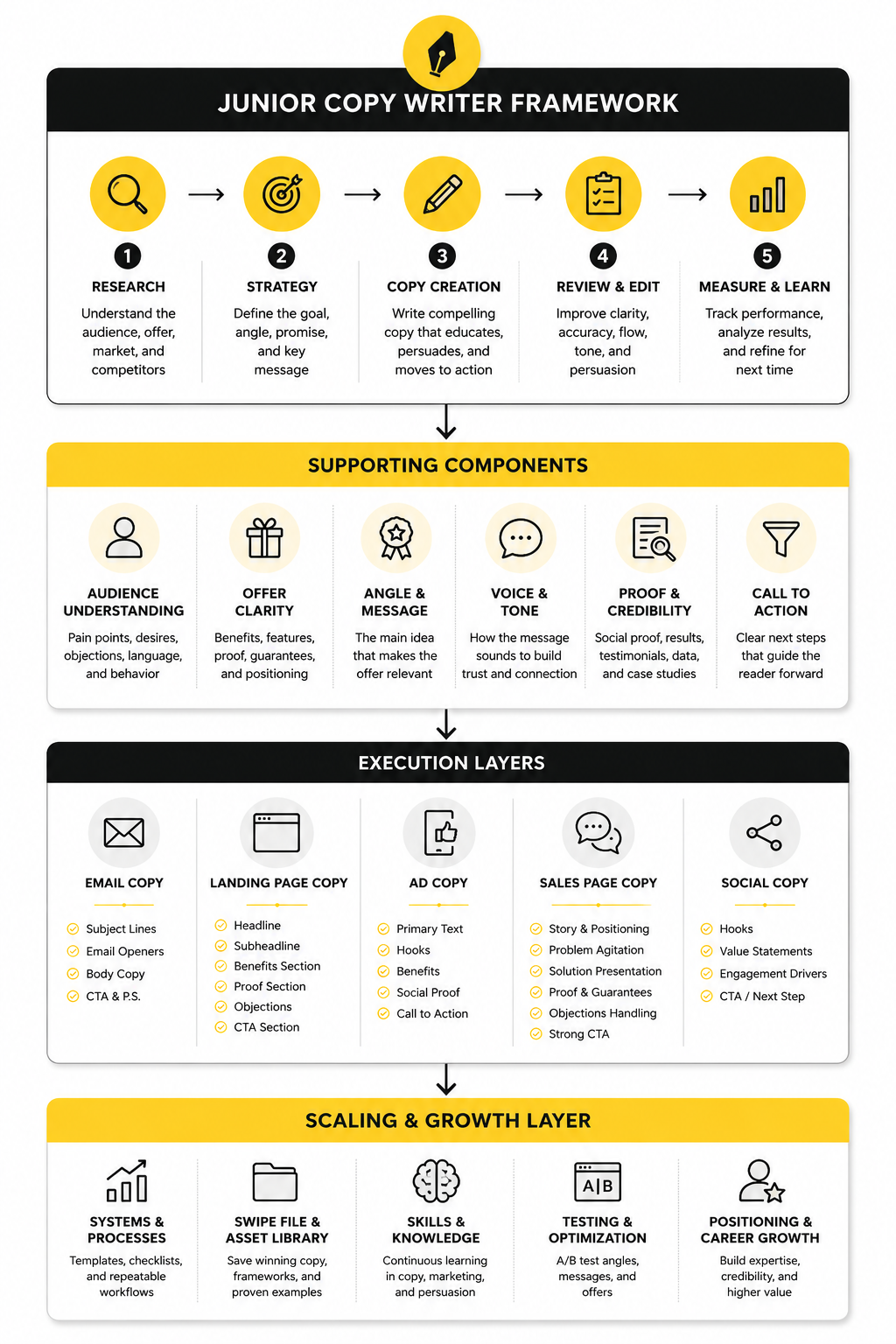
A junior copywriter gets better faster when they stop treating copy as a blank-page activity. The work becomes much easier when you follow a repeatable process: clarify the goal, understand the reader, choose the angle, draft the copy, edit it, then review performance after it goes live. That process gives you structure without making your writing stiff.
This matters because most bad beginner copy does not fail because the writer has no talent. It fails because the writer starts too late in the process. They open a document before they understand the offer, the audience, the channel, or the reason the copy needs to exist.
Think of the process as a safety rail. It keeps you from guessing. It also helps a manager or client see that you are not just “trying ideas,” but working through the problem in a professional way.
Step 1: Clarify The Assignment Before You Write
Before you write a single line, you need to know what the copy is supposed to achieve. A junior copy writer should never be afraid to ask practical questions, because vague assignments create vague copy. The goal is not to look difficult; the goal is to prevent unnecessary revisions later.
Start with the basics. What is the asset? Who will read it? Where will they see it? What action should they take after reading it? What information must be included, and what should be avoided?
This is also the moment to confirm the success metric. An email might be judged by replies, clicks, booked calls, sales, or retention. A landing page might be judged by signups, demo requests, checkout starts, or qualified leads. The copy changes depending on what the business actually wants.
Step 2: Build A Simple Copy Brief
A copy brief does not need to be complicated. In fact, the best junior copywriter briefs are usually short, clear, and useful. The brief should help you make decisions while writing instead of becoming another document nobody reads.
A practical brief can include:
This small document saves time because it gives everyone something to react to before the draft exists. If the angle is wrong, it is much easier to fix it in the brief than after you have written 900 words. That is why a junior copy writer who can brief well often earns trust quickly.
Step 3: Research The Customer’s Language
Research is not about collecting random facts. It is about finding the words, fears, desires, objections, and expectations that already exist in the customer’s mind. Your job is to use that information to make the copy feel specific and relevant.
Start by looking for repeated phrases. Reviews, comments, sales notes, support tickets, and survey responses often reveal what people actually care about. If five customers complain that a tool is “hard to set up,” that phrase may be more useful than a fancy line about “workflow optimization.”
This is where you should be careful with AI. You can use it to summarize themes, organize notes, or compare competitor claims, but you should still inspect the source material yourself. A junior copywriter who only reads the AI summary can easily miss the emotional detail that makes the copy work.
Step 4: Choose One Main Angle
A common beginner mistake is trying to say everything at once. The result is copy that feels busy, unfocused, and forgettable. Strong copy usually has one dominant angle supported by proof, not five weak angles fighting for attention.
The angle should connect the reader’s problem to the offer in a way that feels immediate. For example, the angle might be speed, simplicity, lower risk, better control, higher quality, less manual work, or a clearer path to a result. The right angle depends on what the reader already knows and what they are most likely to care about now.
Once you choose the angle, let it guide the rest of the piece. The headline, opening, benefits, proof, and call to action should all support the same idea. That is how copy starts to feel tight instead of stitched together.
Step 5: Draft Fast, Then Improve Slowly
The first draft is where you get the raw material down. Do not try to make every sentence perfect while you are still figuring out the structure. A junior copy writer should learn to separate drafting from editing because those are different mental modes.
When drafting, focus on momentum. Write the messy version. Get the hook, argument, proof, transition, and call to action on the page. You can fix weak lines later, but you cannot improve a draft that does not exist.
When editing, slow down. Remove repeated ideas, tighten long sentences, replace vague claims, and make the next step obvious. This is where the copy becomes professional.
Step 6: Use A Review Checklist
A checklist is boring in the best possible way. It catches mistakes your brain skips when you are too close to the draft. For a junior copywriter, a review checklist is one of the easiest ways to improve consistency.
Use questions like these before sending work for review:
This step also makes feedback easier. When you can say, “I checked the CTA, proof, tone, and required points before sending,” you sound more reliable. That matters in junior roles because reliability is part of the value you bring.
How To Write A Strong First Draft
A strong first draft does not need to be final-ready. It needs to have a clear direction. The biggest goal is to get the argument on the page so the team can improve it.
Start with the reader’s situation, not your desire to sound clever. What are they trying to do? What is annoying, expensive, risky, slow, or confusing for them? What would make them pay attention now?
Then connect that situation to the offer. Do not jump straight into features unless the reader already understands why those features matter. Features need context before they become persuasive.
Start With The Reader’s Problem
Good copy usually begins close to the reader’s reality. That does not mean every piece needs a dramatic pain-point opening. It means the first few lines should make the reader feel like the message is relevant to them.
For example, if the copy is for a landing page builder, the problem may not be “you need landing pages.” The real problem might be slow campaign launches, expensive developer bottlenecks, or pages that are hard to update after testing. That deeper problem gives the copy more force.
A junior copywriter should practice translating surface-level features into practical problems. “Drag-and-drop editor” is a feature. “Launch campaign pages without waiting on a developer” is closer to the buyer’s life.
Turn Features Into Useful Benefits
A feature tells the reader what the product has. A benefit tells the reader why that feature matters. You need both, but beginners often stop at the feature and expect the reader to connect the dots.
A simple way to improve this is to ask, “So what?” after every feature. If a tool has templates, so what? It may help the user launch faster. If a CRM has automated follow-ups, so what? It may help the business avoid leads slipping through the cracks.
This is where platforms like GoHighLevel, Systeme.io, and ClickFunnels are useful to study. Their pages show how offers, funnels, automation, and calls to action are packaged for business owners who want practical outcomes, not just a list of software functions.
Add Proof Without Overloading The Copy
Proof makes copy more believable, but too much proof can slow the reader down. A junior copywriter needs to learn how to place proof where doubt naturally appears. That could be after a claim, before a call to action, or near a pricing decision.
Proof can include testimonials, customer numbers, product screenshots, demos, comparisons, guarantees, recognizable customers, certifications, or specific product details. The right proof depends on what the reader is likely to question. If the claim is about ease of use, show simplicity. If the claim is about performance, show results that can be verified.
Do not invent proof. Do not stretch claims. Do not turn a weak detail into a big promise just because the copy feels stronger. Trust is hard to earn and very easy to damage.
How To Handle Feedback Without Losing Momentum
Feedback is part of the job, not a personal attack. The faster you accept that, the faster you improve. A junior copy writer who handles feedback well becomes easier to work with, and that can matter as much as raw writing talent.
When feedback arrives, read it once without reacting. Then separate it into categories: strategic changes, clarity edits, tone adjustments, factual corrections, and personal preferences. Not every comment has the same weight.
If something is unclear, ask a focused question. Do not ask, “What do you mean?” Ask, “Do you want this to sound more direct, or should I reposition the benefit around speed instead of cost?” Better questions lead to better revisions.
Learn The Difference Between Taste And Strategy
Some feedback is about taste. Someone may prefer a shorter sentence, a softer phrase, or a different rhythm. That feedback can still matter because brand voice matters, but it is not always a strategic problem.
Strategic feedback is different. It means the angle is wrong, the audience is misunderstood, the offer is unclear, the proof is weak, or the call to action does not match the campaign goal. Those issues need deeper revision.
A good junior copywriter learns to spot the difference. You do not need to fight every taste note, and you should not ignore strategic notes. The goal is to make the copy more effective, not to win every comment thread.
Keep A Swipe File Of Feedback
A swipe file is not only for great ads and headlines. You should also keep a private record of useful feedback you receive. Over time, that becomes your personal training library.
Save notes about patterns. Maybe you overwrite intros. Maybe your CTAs are too soft. Maybe you use too many abstract words. Maybe you need to bring the offer higher in the draft.
This habit turns feedback into skill. Instead of making the same correction ten times, you start preventing the mistake before it reaches the reviewer. That is how a junior copywriter starts operating like a stronger professional.
Statistics And Data
Data is where copywriting becomes less mysterious. A junior copywriter does not need to become a full analytics specialist, but they do need to understand what performance numbers are trying to say. Otherwise, every result becomes emotional: “This copy worked,” “This copy failed,” or “People didn’t like it.”
That is too vague. Good measurement helps you see where the copy is strong, where the funnel is leaking, and what should be tested next. The point is not to worship numbers. The point is to make better decisions with less guessing.
The biggest mistake is looking at one metric in isolation. A high open rate with no clicks may mean the subject line created curiosity but the email body did not deliver. A low landing page conversion rate may mean the copy is weak, but it could also mean the traffic is poorly matched, the offer is unclear, the page is slow, or the form asks for too much too soon.
The Metrics A Junior Copywriter Should Watch
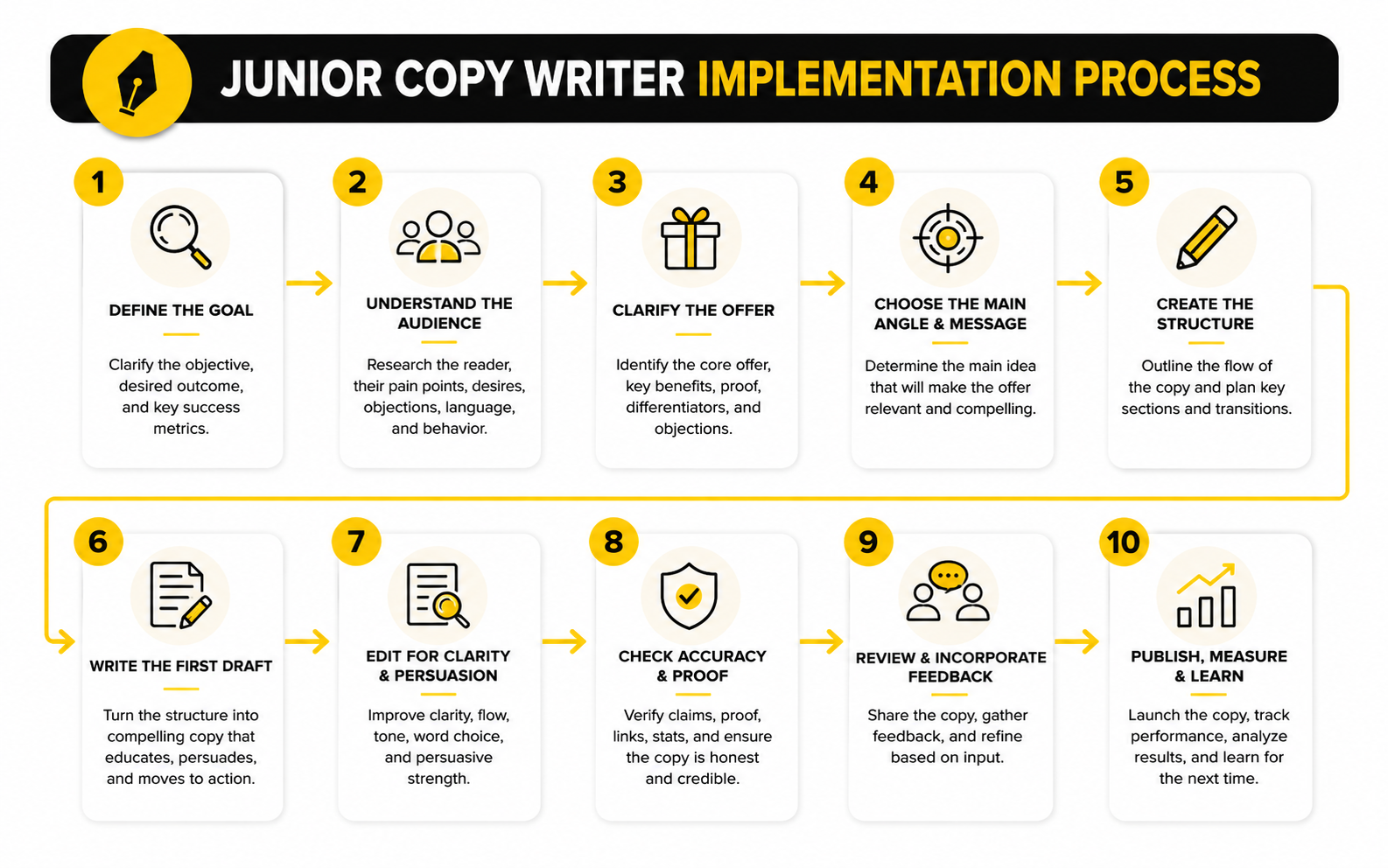
A junior copy writer should start with the metrics closest to the asset they are writing. For email, that usually means open rate, click-through rate, click-to-open rate, unsubscribe rate, reply rate, and conversion rate. For landing pages, it usually means conversion rate, bounce rate, scroll depth, form starts, form completions, and button clicks.
Each metric answers a different question. Open rate gives a rough signal about subject line relevance and sender trust, but privacy changes mean it should not be treated as perfect truth. Click rate tells you whether the message created enough interest for the reader to act. Conversion rate tells you whether the reader completed the business goal.
That is why the best copy reviews connect metrics to behavior. Do not just say, “The click rate was low.” Ask what that means. Did the reader understand the offer? Was the call to action visible enough? Did the body copy create desire, or did it only describe features?
Benchmarks Are Starting Points, Not Final Judgments
Benchmarks are useful, but they are not commandments. They tell you what is common in a category, not what your audience, offer, list quality, traffic source, or brand should achieve. A junior copywriter who understands that will make more carefully recommendations than one who simply compares every campaign to an industry average.
Email benchmarks can vary widely by industry and list type. For example, published email benchmark summaries show nonprofit, SaaS, and retail campaigns producing very different open and click patterns, which means a single “good email rate” is too simplistic: email marketing benchmarks by industry. That matters because copy written for a warm nonprofit donor list should not be judged the same way as cold B2B software outreach.
Landing page benchmarks also shift heavily by industry and conversion goal. Search Engine Land’s summary of Unbounce benchmark data notes that median landing page conversion rates can range from low single digits in categories like SaaS to much higher rates in categories such as legal: conversion rate benchmarks in 2025. The lesson is simple: compare your copy against the right context, or the numbers will mislead you.
What Email Data Actually Means
Email copy has several moving parts, so you need to diagnose the right part of the email. If open rate is weak, look at the sender name, subject line, preview text, list quality, and deliverability. If opens are strong but clicks are weak, the issue is usually inside the email body, offer, proof, or call to action.
Click-to-open rate can be especially useful because it looks at what people did after opening. A decent open rate with a poor click-to-open rate often means the subject line got attention, but the email did not convert that attention into action. That is a copy problem worth studying.
Unsubscribes deserve attention too. A few unsubscribes are normal, especially when a list is being cleaned or a campaign is more sales-focused. But a sudden spike can signal a mismatch between expectation and message, too much frequency, weak segmentation, or copy that feels pushy instead of useful.
What Landing Page Data Actually Means
Landing page data should be read like a map of reader friction. If many people arrive but leave quickly, the message above the fold may not match the traffic source. If people scroll but do not click, the page may be interesting but not persuasive enough. If they click but do not complete the form, the form or offer may be creating resistance.
A junior copy writer should pay close attention to message match. If an ad promises a fast checklist but the landing page opens with a broad company pitch, the reader feels the disconnect instantly. That disconnect kills trust before the copy even gets a fair chance.
This is why page builders and funnel tools are useful when they make testing and measurement easier. A tool like Replo can help teams move faster on landing page iterations, while platforms like ClickFunnels and GoHighLevel are commonly used to connect pages, forms, automations, and follow-up steps. But again, the tool is not the strategy. The copy still has to match the promise that brought the visitor there.
The Difference Between Leading And Lagging Signals
Not every metric tells you the same kind of truth. Some metrics are leading signals, which means they show early behavior before the final result happens. Others are lagging signals, which means they show the final business outcome after the campaign has run.
For example, email opens, clicks, scroll depth, and form starts are leading signals. Sales, booked calls, demo completions, qualified leads, and revenue are lagging signals. Both matter, but they should not be confused.
A junior copywriter should use leading signals to improve the asset and lagging signals to understand whether the campaign actually helped the business. If clicks improved but sales did not, the copy may have increased interest without improving buyer quality. If sales improved while clicks stayed flat, the copy may have attracted fewer but better-fit readers.
How To Interpret Copy Performance Without Overreacting
One campaign rarely tells the whole story. A subject line that wins once is not automatically a universal rule. A landing page variation that loses once is not automatically bad copy. Data needs enough volume, enough context, and enough patience to become useful.
Small sample sizes are dangerous because they make random changes look meaningful. If 34 people saw a page and two converted, you do not have a deep strategic insight yet. You have an early signal that needs more data before you make big conclusions.
The right approach is calm and practical. Look for patterns over time. Compare similar campaigns. Segment by traffic source, audience, device, and offer when possible. Then decide what the next reasonable test should be.
Look For The Bottleneck
Every campaign has a bottleneck. The job is to find it before rewriting everything. If people are not opening the email, do not start by rewriting the whole nurture sequence. Start with the subject line, preview text, sender trust, list segment, and timing.
If people click the email but do not convert on the page, the email may be doing its job. The bottleneck may be the landing page, offer, form, price, or proof. This is exactly why a junior copywriter needs to understand the whole journey, not just the asset they were assigned.
A simple diagnostic flow helps:
This keeps the conversation focused. Instead of saying, “The copy did not work,” you can say, “The email created clicks, but the page did not convert those visitors, so the next test should focus on the landing page promise, proof, and form friction.”
Separate Copy Problems From Offer Problems
Sometimes the copy is not the main problem. This is uncomfortable, but it is true. Great copy cannot fully fix a weak offer, poor targeting, bad timing, unclear pricing, or a product that the market does not want.
A junior copy writer should learn to spot this without being dramatic. If the copy clearly explains the offer, handles objections, includes proof, and drives targeted traffic to a clear next step, but the campaign still underperforms, the team may need to revisit the offer itself. That is a business discussion, not just a writing discussion.
This distinction makes you more valuable. You are not just saying, “Let me try a punchier headline.” You are thinking like a marketer. You are asking whether the promise, audience, incentive, and friction level actually line up.
Use Data To Decide The Next Test
Data should lead to action. If it does not, it becomes dashboard decoration. A junior copywriter should always translate performance into the next useful test.
If the subject line gets low opens, test a clearer promise against a curiosity-driven version. If the page gets scrolls but few clicks, test stronger CTA placement or a more direct benefit above the fold. If the form gets starts but few completions, test fewer fields or clearer reassurance near the form.
Do not test ten things at once unless the original version is so broken that you are making a full rebuild. Testing one meaningful variable at a time makes the result easier to understand. That is how copywriting improves systematically instead of randomly.
Benchmarks For Your Own Growth As A Junior Copywriter
The most important benchmarks are not only campaign metrics. You should also measure your own development. A junior copywriter who tracks their work will improve faster because they can see patterns that memory usually misses.
Track the types of assets you write, the feedback you receive, the revisions requested, and the performance signals when available. Over time, you will notice where you are strong and where you need deliberate practice. Maybe your email hooks are strong, but your landing page structure needs work. Maybe your first drafts are clear, but your CTAs are too soft.
The broader job market also rewards this kind of practical adaptability. The U.S. Bureau of Labor Statistics projects about 13,400 writer and author openings per year from 2024 to 2034, while LinkedIn’s 2025 marketing skills reporting highlights campaign execution, AI literacy, and communication as valuable marketer skills: writer and author outlook and marketing skills on the rise. That should tell you something important. Being “good with words” is not enough by itself.
A strong junior copywriter can write, revise, interpret results, and connect the work to business outcomes. That is the benchmark that matters most. Not cleverness. Not word count. Not how many drafts you can produce in a day. The real measure is whether your copy helps the reader move and helps the business learn.
Advanced Considerations Before You Take On Bigger Copy Projects
At some point, a junior copywriter has to move beyond “write the assigned asset” and start thinking about the system around the asset. That is where the job gets more interesting. It is also where weak judgment becomes more expensive.
A subject line, landing page section, or ad hook can look good in isolation and still fail inside the campaign. Maybe it attracts the wrong person. Maybe it overpromises. Maybe it creates clicks that do not turn into qualified leads. Better copywriting means understanding those tradeoffs before they become performance problems.
This is why a junior copy writer should learn to think in terms of risk, context, and scale. The words matter, but so do the expectations those words create. If your copy brings in attention that the product cannot satisfy, the campaign may win the click and lose the customer.
Strategy Comes Before Style
Style is useful, but strategy decides whether the copy has a chance. A punchy line cannot fix a weak angle. A clever metaphor cannot repair an unclear offer. A beautiful sentence is still a liability if it distracts from the action the reader needs to take.
The strategic question is simple: what belief needs to change before the reader can act? Maybe they need to believe the problem is urgent. Maybe they need to believe the solution is easier than expected. Maybe they need to trust that the product is credible. Each belief requires different copy.
This is where a junior copywriter can become unusually valuable. Instead of asking only, “How should I say this?” start asking, “What does the reader need to understand, feel, or believe before this message works?” That is the difference between writing copy and solving the copy problem.
The Risk Of Overpromising
Overpromising is one of the fastest ways to damage trust. It can happen in a headline, a guarantee, a testimonial, an email subject line, or even a call to action. The copy may feel more exciting in the short term, but the business pays for it later through refunds, complaints, unsubscribes, poor-fit leads, or brand damage.
This matters even more when using testimonials, reviews, influencers, or customer stories. The FTC’s endorsement guidance makes it clear that advertising claims, reviews, and endorsements need to reflect genuine experiences and avoid misleading consumers: FTC endorsement guidance. You do not need to be a lawyer to understand the practical lesson. Do not make the copy stronger than the proof allows.
A junior copy writer should build the habit of asking, “Can we prove this?” before turning a claim into a headline. If the answer is no, soften it, make it more specific, or remove it. Strong copy is persuasive, but it should not be reckless.
AI Makes Speed Easier, But Judgment More Important
AI has changed the workflow for junior copywriters. It can help brainstorm angles, summarize research, turn notes into draft structures, and generate variations faster than a blank page. Used well, it can make you more productive.
But AI also makes average copy easier to produce at scale. That creates a new problem. If everyone can generate passable headlines, the real advantage shifts to research, taste, judgment, positioning, editing, and strategic restraint.
Marketing and sales remain among the business functions where AI use is highly visible, and McKinsey’s 2025 AI research notes that revenue increases from AI are commonly reported in marketing and sales use cases: state of AI research. That does not mean junior copywriters should blindly automate everything. It means you need to learn where AI helps and where human review is non-negotiable.
Use AI for speed, options, and structure. Do not use it as a substitute for source checking, customer understanding, compliance review, or final judgment. The more copy a team produces, the more important quality control becomes.
Scaling Copy Without Losing Quality
Scaling copy sounds exciting until the brand voice starts falling apart. More emails, more ads, more landing pages, more social posts, more variations, more campaigns. Without a system, everything becomes inconsistent.
The goal is not to make every piece of copy identical. The goal is to make the brand recognizable while adapting to different channels and audiences. That takes guidelines, examples, review standards, and a clear process for what gets approved before it goes live.
A junior copywriter can help here by documenting what works. Save approved headlines, strong CTAs, useful objection-handling blocks, tone examples, and common phrases the brand uses. Over time, that becomes a practical copy system instead of a messy folder of old drafts.
Create Reusable Copy Assets
Reusable copy assets save time without forcing the team into lazy repetition. These assets can include approved value propositions, product descriptions, feature-to-benefit translations, objection responses, proof points, calls to action, and short brand voice examples. They give you a starting point when deadlines are tight.
The trick is to reuse thinking, not blindly reuse sentences. A CTA that works on a product page may need a softer version in an educational email. A benefit that works for founders may need a different framing for marketing managers. Reusable assets should speed up judgment, not replace it.
This is also where CRM and automation tools can help organize campaigns. Platforms like GoHighLevel, Brevo, and Moosend can support follow-up systems, segmentation, and email execution. But the quality still depends on the message, the offer, and the discipline behind the campaign.
Protect The Brand Voice
Brand voice is not decoration. It is a trust signal. When every message sounds like it came from a different company, the audience feels the inconsistency even if they cannot explain it.
A junior copy writer should learn the difference between voice and tone. Voice is the brand’s consistent personality. Tone changes based on the situation. A renewal reminder, a launch email, and a customer apology should not have the same emotional temperature, but they should still feel like the same brand.
The safest way to protect voice is to collect real approved examples. Do not rely only on adjectives like “bold,” “friendly,” or “premium.” Those words are too vague. Show what the voice sounds like in a headline, paragraph, CTA, error message, and promotional email.
Build A Review System Before The Work Gets Too Big
When copy volume increases, review can become a bottleneck. Senior people do not have time to rewrite everything. Junior copywriters do not improve if feedback is rushed, inconsistent, or vague. The solution is a review system.
A simple review system can separate different types of feedback. Strategy feedback checks whether the angle is right. Accuracy feedback checks whether the claims are true. Voice feedback checks whether the copy fits the brand. Performance feedback checks whether the copy is likely to drive the desired action.
This makes review cleaner. Instead of receiving a messy pile of comments, you understand what kind of problem you are solving. That also helps you revise faster and avoid making the same mistake across several assets.
Common Mistakes That Slow Down Junior Copywriters
Most junior copywriter mistakes are fixable. The danger is not making them once. The danger is repeating them because nobody has named them clearly.
One common mistake is writing before understanding. Another is trying to sound impressive instead of being useful. Another is treating feedback like criticism instead of data. These are normal early-career patterns, but they need to be corrected quickly.
The best juniors are not perfect. They are coachable. They notice patterns, adjust fast, and build better habits with every assignment.
Writing For The Reviewer Instead Of The Reader
It is natural to want your manager or client to like the copy. But the reviewer is not always the real audience. The copy still has to work for the person who will see it in the inbox, feed, ad placement, or landing page.
Writing for the reviewer often leads to safe, polished, approval-friendly copy. It may pass internal review but fail to move the actual reader. That is not the win you want.
A better approach is to explain your choices through the reader’s perspective. “I made the opening more direct because this audience already knows the problem.” “I moved the proof higher because the claim creates skepticism.” That kind of thinking shows maturity.
Confusing More Copy With Better Copy
Longer copy is not automatically better. Shorter copy is not automatically better either. The right length depends on the reader’s awareness, the complexity of the offer, the level of trust, and the size of the decision.
Beginners often add more words because they are not confident in the core message. They stack benefits, explanations, and adjectives until the copy feels heavy. The reader should not have to dig through the paragraph to find the point.
A useful rule is to make the copy as long as needed and as short as possible. If a sentence does not clarify, persuade, prove, transition, or move the reader forward, it probably needs to go.
Ignoring The Offer
Copy can improve an offer’s presentation, but it cannot magically make an unattractive offer irresistible. If the incentive is weak, the pricing is confusing, the promise is vague, or the audience is wrong, the copy will struggle. That is not failure. That is signal.
A junior copywriter should learn to identify offer issues respectfully. You do not need to say, “This offer is bad.” You can say, “The reader may need a clearer reason to act now,” or “The current promise may be too broad to feel urgent.” That keeps the conversation productive.
When the offer improves, the copy often becomes simpler. You do not need as much verbal force when the value is obvious. Great offers make writing easier.
How To Grow From Junior Copywriter To Stronger Strategic Contributor
The fastest path out of beginner status is not writing more random copy. It is building sharper judgment. That means learning how markets think, how offers work, how buyers hesitate, and how campaigns are measured.
You can still practice craft every day. Headlines, hooks, bullets, CTAs, transitions, and editing all matter. But the bigger leap happens when you understand why one message is right for a specific audience at a specific moment.
Content teams are also under pressure to produce more with clearer business impact. The 2025 B2B content marketing benchmark research highlights how top-performing teams are more likely to have clear goals, scalable models, and stronger content operations: B2B content marketing benchmarks. That is the direction the profession is moving. Copywriters who understand systems will have more leverage than copywriters who only deliver isolated drafts.
Study Offers, Not Just Ads
Ads are useful to study, but offers are even more important. The offer is the deal being presented to the market. It includes the product, price, promise, proof, urgency, guarantee, bonuses, risk reversal, and next step.
Two ads can use similar wording and produce very different results because the offers behind them are different. That is why copying surface-level phrasing is not enough. You need to understand what makes the offer compelling.
When you study a campaign, ask what the reader gets, why they should believe it, why now, and what makes it feel lower risk. Those answers will teach you more than saving a pretty headline.
Learn The Business Model Behind The Copy
A junior copywriter who understands the business model writes better copy. A SaaS company cares about trials, demos, activation, retention, and expansion. An ecommerce brand cares about average order value, repeat purchases, margins, and inventory. A service business cares about qualified leads, booking rates, close rates, and capacity.
These details change the copy. A campaign designed to generate cheap leads may use a different promise than a campaign designed to attract serious buyers. A high-ticket service page needs more trust-building than a low-cost impulse purchase.
You do not need to become a finance expert. You just need to understand how the company makes money and what kind of customer it actually wants. That context makes your writing more precise.
Build A Portfolio Around Thinking
A beginner portfolio often shows finished pieces only. That is fine, but it is not enough if you want to stand out. Show the thinking behind the work too.
For each project, explain the audience, goal, problem, angle, constraints, and why you made the key copy decisions. If you have performance data, include it honestly. If you do not, explain what you would test and why.
This makes your portfolio more credible because it shows how you approach the work. A hiring manager can teach a junior copy writer the company’s style. It is much harder to teach curiosity, structure, and judgment if those habits are missing.
Bringing The Whole Copywriting System Together
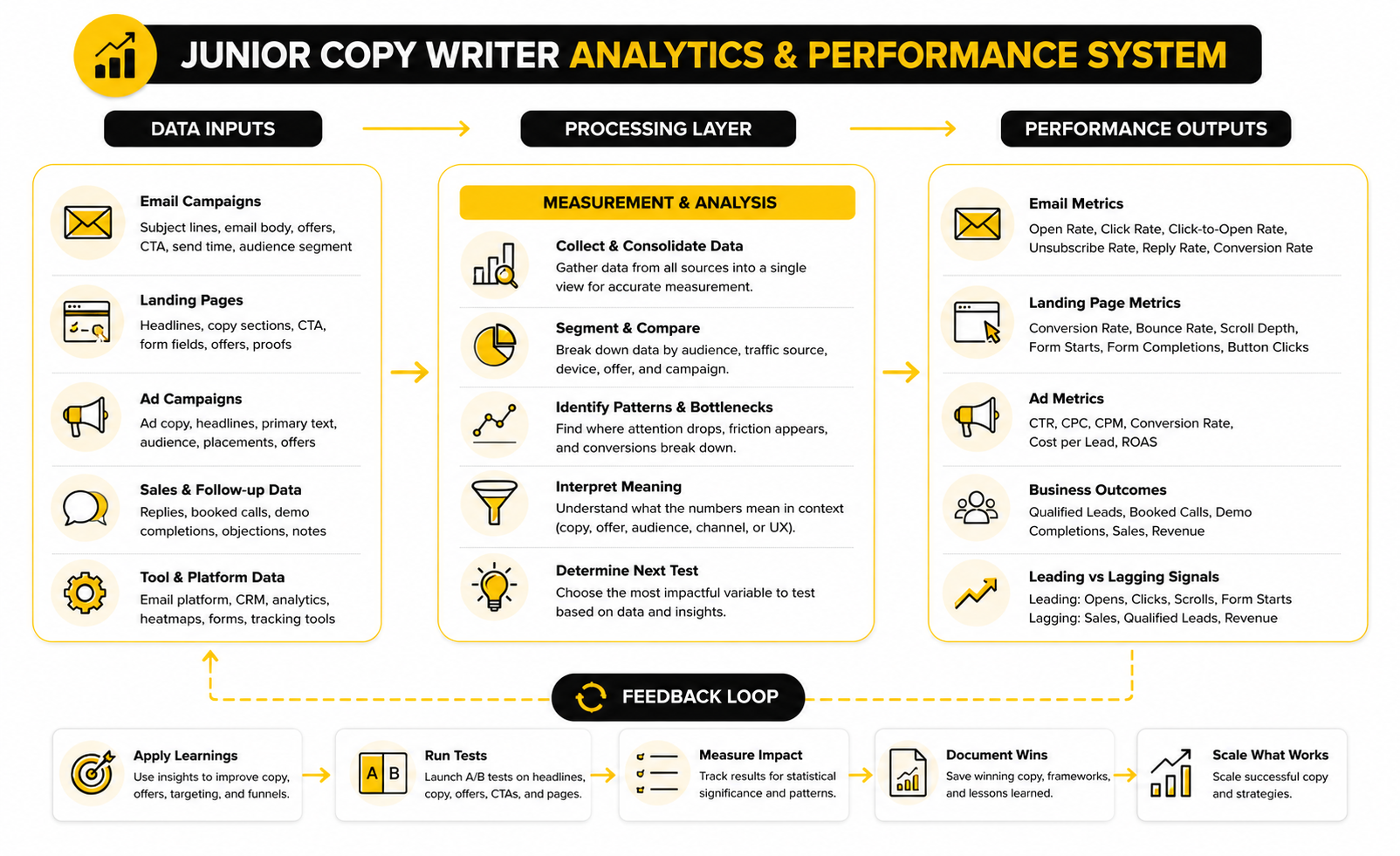
A junior copywriter becomes more useful when they can see the full system, not just the draft in front of them. The process starts with research, moves into strategy, turns into copy, gets reviewed, goes live, and then comes back as performance data. That loop is where real improvement happens.
The best way to think about it is simple. Every assignment should teach you something about the audience, the offer, the channel, the brand, or the market. If you write the copy, ship it, and never learn from the result, you are leaving growth on the table.
This is also why junior copywriters should not hide inside the writing part of the job. Ask what happened after the email was sent. Ask how the landing page performed. Ask what objections came up on sales calls after the campaign. That feedback turns you from a writer into a stronger marketing thinker.
Your Copywriting System Should Be Simple Enough To Use
The system does not need to be complex. In fact, if it is too complex, you will stop using it when deadlines get tight. A practical copywriting system should help you move faster and make better decisions.
Use a simple workflow:
That last step matters. If an email gets strong replies, save the structure. If a landing page section explains the offer clearly, save it as a reference. If a reviewer gives feedback that improves the message, save the lesson so you do not need to relearn it later.
The Bigger Career Lesson
The market does not need more people who can produce generic words. It needs marketers who can think clearly, communicate precisely, and help businesses move customers from confusion to action. That is where a junior copy writer can build a serious career.
The career path is not always linear. Some copywriters move into conversion copywriting, content strategy, lifecycle marketing, brand messaging, creative strategy, product marketing, or freelance consulting. The stronger your foundation, the more options you create.
The writing profession is still competitive, but not dead. The U.S. Bureau of Labor Statistics projects about 13,400 writer and author openings per year from 2024 to 2034, and the strongest candidates will be the ones who can connect writing skill to business outcomes: writer and author outlook. That is the lane to aim for.
What does a junior copywriter do?
A junior copywriter writes marketing and sales copy under the guidance of a more experienced marketer, copywriter, editor, or creative lead. The work can include emails, ads, landing pages, social captions, product descriptions, blog intros, website copy, and campaign variations. The role is usually a mix of writing, research, editing, feedback, and learning how campaigns work.
Is junior copy writer the same as junior copywriter?
Yes, people often use both phrases to mean the same role, although “junior copywriter” is the more common job title. The phrase junior copy writer may appear in searches, job posts, or informal descriptions. In practice, both refer to an entry-level copywriting role focused on marketing copy.
Do I need a degree to become a junior copywriter?
A degree can help, especially in marketing, communications, journalism, English, psychology, or business, but it is not always required. Many teams care more about your portfolio, writing samples, thinking process, and ability to revise. If you can show that you understand audience, offer, clarity, persuasion, and feedback, you can compete without a traditional path.
What should be in a junior copywriter portfolio?
A junior copywriter portfolio should include a few strong samples that show different formats. Include emails, landing page copy, ads, product copy, social posts, or short campaign concepts if they match the type of job you want. The best portfolios also explain the goal, audience, angle, constraints, and reasoning behind the copy, not just the final words.
Can I use AI as a junior copywriter?
Yes, but use it carefully. AI can help with brainstorming, research organization, outline creation, rough variations, and editing prompts. It should not replace source checking, customer understanding, brand judgment, or final review.
AI is becoming more common in marketing workflows, and McKinsey’s 2025 AI research shows marketing and sales among the functions where organizations report revenue impact from AI use: state of AI research. That makes AI literacy useful, but it does not remove the need for human judgment.
What skills matter most for a junior copywriter?
The most important skills are clear writing, research, editing, customer awareness, voice control, basic conversion thinking, and the ability to handle feedback. You should also understand how copy changes across email, ads, landing pages, social, and website pages. Over time, strategy becomes just as important as writing style.
How do junior copywriters get better faster?
The fastest way to improve is to write with a process, get feedback, revise without ego, and study real performance data when possible. Keep a swipe file of strong examples, but also keep a feedback file of mistakes you do not want to repeat. Improvement comes from deliberate practice, not just writing more words.
What metrics should a junior copywriter understand?
A junior copywriter should understand open rate, click-through rate, click-to-open rate, conversion rate, bounce rate, scroll depth, form starts, replies, unsubscribes, and qualified leads. You do not need to own the full analytics system at the start. You do need to know what each metric suggests and what action it might drive.
How long does it take to become good at copywriting?
It depends on how much you write, how good your feedback is, and whether you study the business context behind the copy. Someone who writes every week, reviews performance, and gets specific feedback can improve much faster than someone who only reads theory. The real jump happens when you stop thinking only about sentences and start thinking about audience, offer, proof, and action.
What is the biggest mistake junior copywriters make?
The biggest mistake is writing before understanding the assignment. If you do not know the reader, goal, offer, channel, proof, and desired action, the draft will usually be weak. Good copy starts before the writing begins.
Should a junior copywriter specialize early?
You can specialize early, but do not rush it blindly. It is useful to try several formats first so you understand what you enjoy and where you perform well. After that, specializing in areas like email, landing pages, SaaS, ecommerce, B2B, direct response, or lifecycle marketing can make your positioning stronger.
How do I know if my copy is good?
Good copy is clear, relevant, believable, and connected to a specific action. It should match the reader’s awareness level, explain the offer without confusion, and reduce the friction that stops someone from moving forward. Performance data helps, but even before data arrives, the copy should pass a basic clarity test: a real person should understand who it is for, what is being offered, why it matters, and what to do next.
What tools should a junior copywriter learn?
Start with the categories, not random tools. Learn how email platforms, landing page builders, CRM systems, social scheduling tools, form tools, and analytics dashboards work at a basic level. Tools like Brevo, Buffer, Replo, ClickFunnels, and GoHighLevel can help you understand where copy goes after it leaves the document.
Can junior copywriters freelance?
Yes, but freelancing requires more than writing ability. You need to find clients, understand briefs, set expectations, manage revisions, price projects, protect your time, and deliver work that supports a business goal. If you freelance as a junior copy writer, start with smaller projects where the scope is clear and the risk is manageable.
What should I learn after the basics?
After the basics, learn positioning, offer strategy, conversion research, customer interviews, analytics, testing, lifecycle marketing, and brand messaging. These skills help you move from executing tasks to shaping the strategy behind the copy. That is how you become harder to replace.
Build a stronger local presence with BAAM AI
Turn your website, Google profile, social channels, and AI visibility into one growth engine
Most businesses do not need more random marketing activity. They need a consistent presence system that helps the right people find them, trust them, and take action. BAAM AI brings strategy, local SEO, website updates, Google Maps visibility, social content, AI-search readiness, media production, and reporting into one practical monthly engine.
If you want your marketing to keep working after the campaign ends, start with a free BAAM AI presence audit. See how your business shows up today and where the fastest visibility wins are at BAAM AI.