
BAAM AI Blog
Viral Video Marketing: A Practical Framework For Turning Attention Into Growth
Viral video marketing is not “posting until something randomly blows up.” That is how teams burn budget, confuse their audience, and mistake luck for strategy. A better way to think about it is simple: viral video...
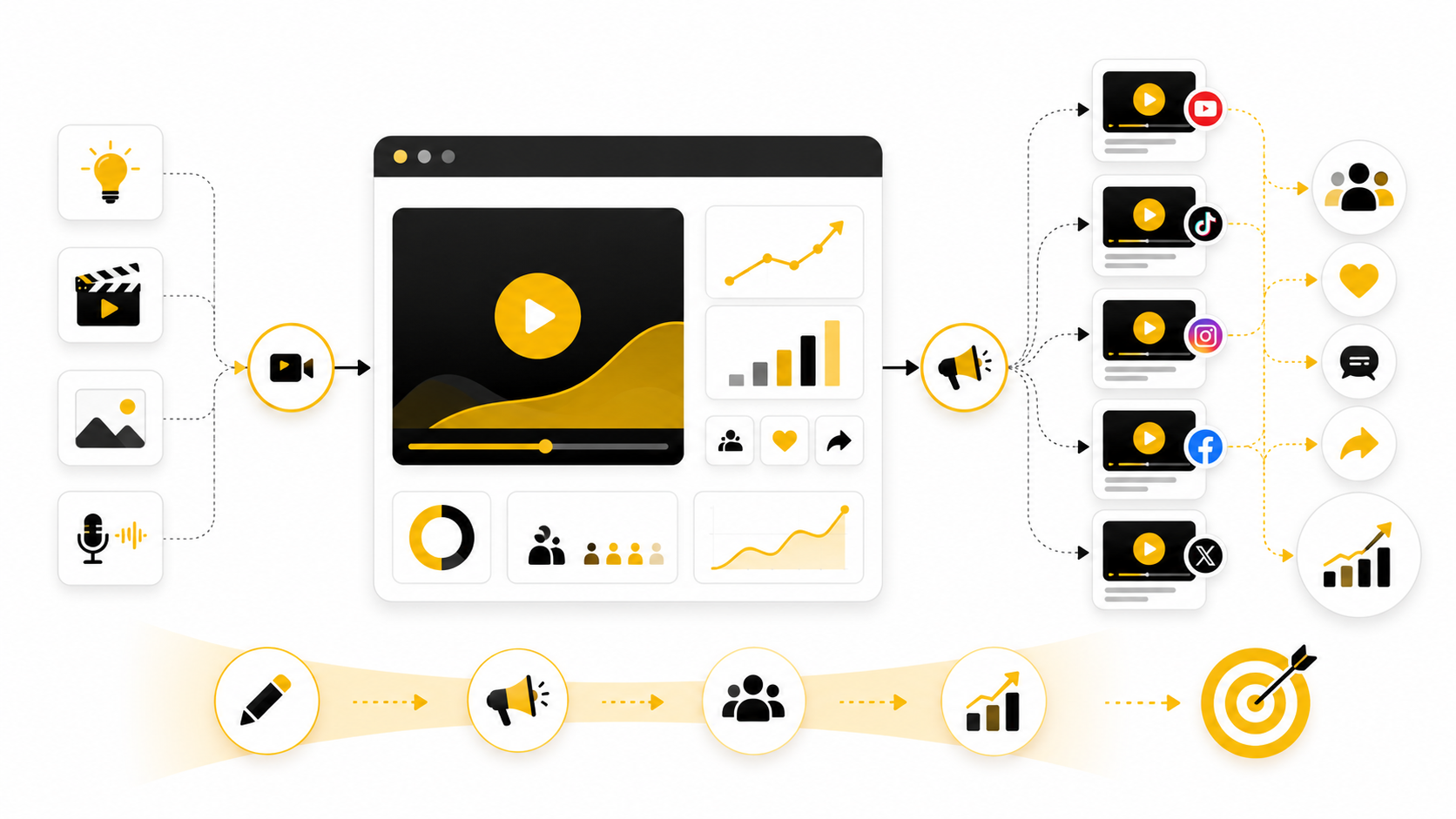
Viral video marketing is not “posting until something randomly blows up.” That is how teams burn budget, confuse their audience, and mistake luck for strategy. A better way to think about it is simple: viral video marketing is the deliberate process of creating, packaging, distributing, and converting video content that people are likely to watch, share, remix, discuss, or act on.
That matters because video is now one of the most competitive attention markets in business. Short-form video has become a major growth channel across TikTok, Instagram Reels, YouTube Shorts, LinkedIn, and even paid landing-page funnels. YouTube Shorts alone has reportedly reached around 200 billion daily views, while broader video marketing research continues to show that brands use video because it helps explain products, build trust, and drive measurable demand.
The problem is that most companies approach virality backward. They study the final post, copy the surface-level format, and miss the underlying reason people cared. Real viral video marketing starts before the camera turns on: with audience tension, a sharp angle, a repeatable content system, and a conversion path that does not waste the attention once it arrives.
Why Viral Video Marketing Matters Now
Viral video marketing matters because attention has become both more abundant and more fragile. There are more platforms, more creators, more brands, and more formats than ever, but people still decide within seconds whether a video deserves their time. That means the winning brands are not always the ones with the biggest budgets; they are often the ones with the clearest angle, fastest feedback loop, and strongest understanding of what their audience already cares about.
The business case is also stronger than it used to be. Video is no longer just a brand-awareness asset that sits at the top of the funnel. Modern teams use video for discovery, product education, retargeting, founder-led trust building, sales enablement, customer onboarding, and community growth, which is why reports like Wyzowl’s video marketing research continue to track video as a core marketing channel rather than a creative side project.
The shift is especially important for smaller teams. A founder, creator, consultant, ecommerce brand, SaaS company, agency, or local business can now reach a large audience without buying traditional media first. But that only helps if the content is connected to a real offer, a real audience, and a real follow-up system, because views without conversion are just rented attention.
The Viral Video Marketing Framework
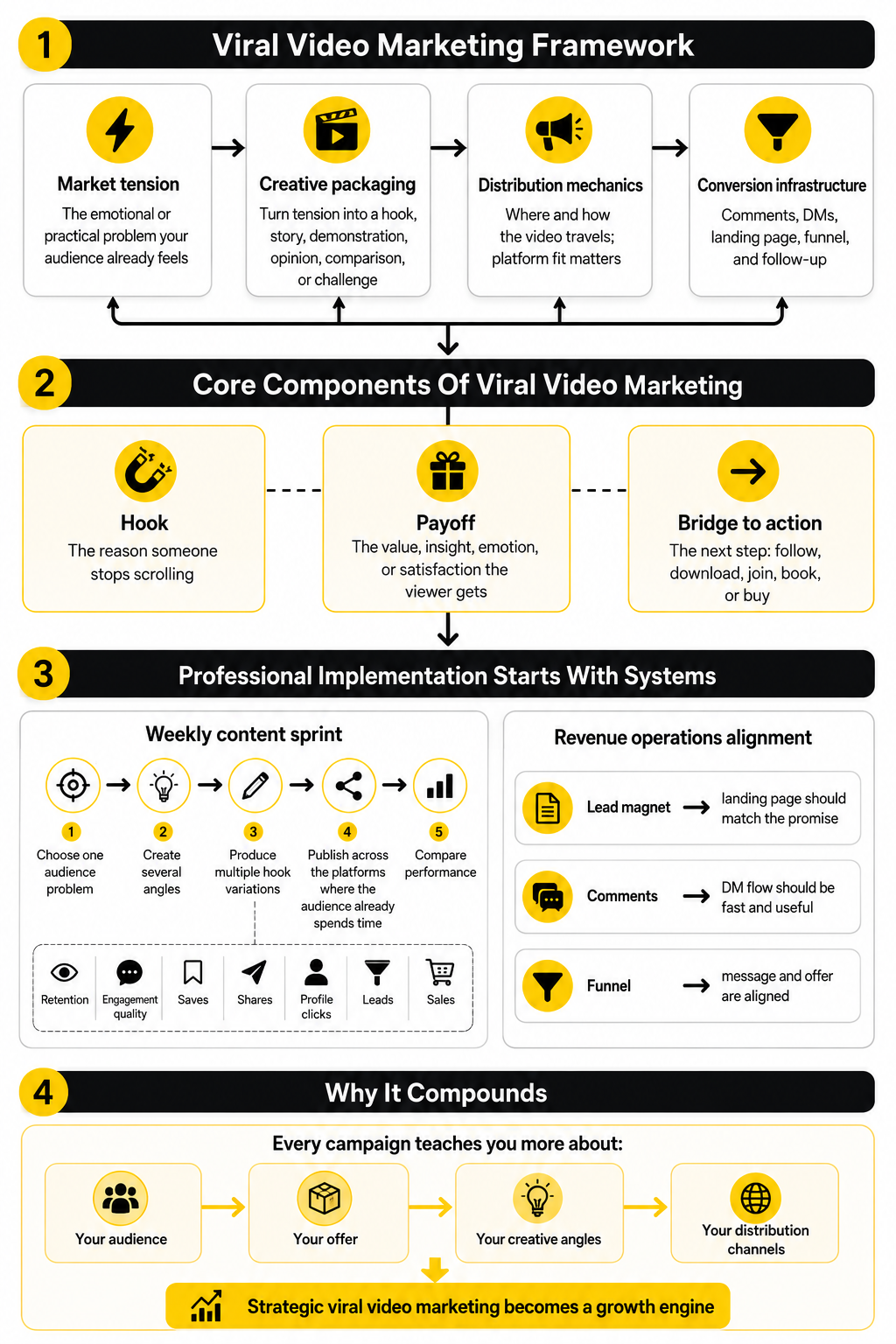
A useful viral video marketing framework has four layers: market tension, creative packaging, distribution mechanics, and conversion infrastructure. Market tension is the emotional or practical problem your audience already feels. Creative packaging turns that tension into a hook, story, demonstration, opinion, comparison, or challenge that feels worth watching.
Distribution mechanics decide where and how the video travels. A TikTok-first concept may need a different opening rhythm than a YouTube Shorts concept, and a LinkedIn video often needs a different promise than an Instagram Reel. Platform fit matters because algorithms reward different signals, but people still reward the same fundamentals: relevance, novelty, clarity, emotion, and momentum.
Conversion infrastructure is the part many marketers skip. If a video gets attention, the next step should be obvious, whether that is a comment automation, a landing page, a newsletter, a booking page, a product page, or a simple follow-up sequence. Tools like ManyChat can be useful when a campaign relies on comment-to-DM workflows, while platforms like GoHighLevel can help teams connect leads, automations, funnels, and follow-up in one place.
Core Components Of Viral Video Marketing
The first core component is the hook. A hook is not just the first sentence of a video; it is the reason someone stops scrolling. Strong hooks create a gap between what the viewer knows and what they want to know, and they do it quickly without sounding fake, desperate, or overly polished.
The second component is the payoff. A viral video can be entertaining, useful, emotional, controversial, surprising, or deeply relatable, but it still needs to give the viewer a reason to feel satisfied. Weak videos often have decent openings but no real payoff, so people leave early or watch once without sharing.
The third component is the bridge to action. This is where viral video marketing becomes marketing instead of just content creation. The video should make the next step feel natural, whether that step is following for more, downloading a resource, trying a tool, joining a waitlist, booking a call, or watching a deeper explanation.
Professional Implementation Starts With Systems
Professional implementation means treating viral video marketing as a repeatable operating system, not a series of random creative swings. The team needs a way to collect audience insights, turn those insights into angles, write hooks, produce variations, publish consistently, review performance, and feed the learning back into the next batch. Without that loop, every video becomes a separate guessing game.
The simplest version starts with a weekly content sprint. Choose one audience problem, create several angles around it, produce multiple hook variations, publish across the platforms where the audience already spends time, and compare performance based on retention, engagement quality, saves, shares, profile clicks, leads, and sales. This keeps the process practical instead of turning every video into a high-pressure masterpiece.
The better version connects content production to revenue operations. If a video promotes a lead magnet, the landing page should match the promise. If a video drives comments, the DM flow should be fast and useful. If a video sends traffic to a funnel, a builder like ClickFunnels or systeme.io can support the conversion path, but the tool only works if the message and offer are aligned.
What this guide Will Build Toward
The rest of this guide will break viral video marketing into a practical system you can actually use. We will move from strategy to execution, then from execution to measurement and scaling. The goal is not to promise guaranteed virality, because nobody credible can promise that.
The goal is to increase your odds in a disciplined way. That means understanding why people share, how platforms surface content, how hooks create momentum, how creative formats reduce production friction, and how conversion systems turn attention into business outcomes. When those pieces work together, viral video stops feeling like a lottery ticket and starts becoming a growth engine.
This is the difference that matters. Random viral content can spike and disappear. Strategic viral video marketing compounds because every campaign teaches you more about your audience, your offer, your creative angles, and your distribution channels.
Audience Tension And Message Strategy
Every strong viral video starts with tension. Not drama for the sake of drama, but a real gap between what your audience wants and what is currently blocking them. In viral video marketing, that tension is usually practical, emotional, social, or identity-based.
A practical tension sounds like “I need more leads, but my content gets ignored.” An emotional tension sounds like “I know my offer is good, but nobody seems to care.” A social tension sounds like “everyone in my industry is saying the same thing, and I need a sharper way to stand out.” An identity tension sounds like “I want to be seen as the kind of person or brand that gets this.”
That is where most average content fails. It explains a topic, but it does not touch the pressure behind the topic. A video about “how to make better marketing videos” is fine, but a video built around “your videos are not boring because of your camera; they are boring because there is no conflict” has much stronger pull.
Start With The Audience’s Existing Conversation
Your audience is already having a conversation before they see your video. They have opinions, frustrations, doubts, goals, shortcuts, bad advice they have tried, and competitors they secretly compare themselves to. Your job is not to interrupt that conversation with a generic content idea; your job is to enter it with precision.
This is why social listening matters. Read comments under competitor posts, product reviews, Reddit threads, YouTube comments, TikTok replies, LinkedIn discussions, sales call notes, support tickets, and community questions. Look for repeated language, because repeated language usually points to a real tension.
For viral video marketing, the best raw material often comes from sentences your audience would actually say. “I keep posting but nothing happens.” “I do not know what to say on camera.” “I get views but no leads.” “Everyone says be authentic, but what does that even mean?” Those are not just complaints; they are content angles waiting to be shaped.
Turn Tension Into A Clear Point Of View
Once you find the tension, you need a point of view. A point of view is not a hot take slapped onto a video for attention. It is a clear stance that helps the viewer understand the problem differently.
For example, “post consistently” is advice. “Consistency only works after your message is sharp enough to deserve repetition” is a point of view. The second version gives the viewer a reason to stop, think, and keep watching because it challenges a common assumption without becoming cheap controversy.
The best points of view usually do one of three things. They reframe the problem, simplify a confusing process, or expose a hidden cost. In viral video marketing, this is powerful because people share content that gives them language for something they already felt but had not clearly expressed yet.
Match The Message To The Buyer Stage
Not every viral video should sell directly. Some videos should attract the right audience, some should build trust, some should educate, and some should push people toward action. The mistake is treating every piece of content like it has the same job.
Top-of-funnel videos should be easy to enter. They can challenge myths, name common problems, show relatable moments, or explain a concept in a fresh way. These videos create reach because they speak to a broad tension without requiring the viewer to already know your product.
Middle-of-funnel videos should deepen belief. They can compare approaches, show mistakes, explain frameworks, break down examples, or answer objections. Bottom-of-funnel videos should make the next step obvious, whether that means booking a call, joining a list, downloading a resource, starting a trial, or entering a funnel built with something like ClickFunnels, systeme.io, or GoHighLevel.
Creative Hooks, Formats, And Story Angles
A hook is the first decision point. If the viewer does not stop, nothing else matters. The algorithm never gets to see retention, shares, saves, comments, or conversions because the video died before the audience gave it a chance.
Good hooks are specific. They do not say “here are some marketing tips.” They say “your video is losing people in the first three seconds because you are starting with context instead of conflict.” That difference matters because specific hooks create immediate relevance.
The best hooks also create forward motion. They make the viewer feel that the next few seconds will reveal something useful, surprising, uncomfortable, or worth repeating. That is why a strong hook should not just grab attention; it should set up the payoff.
Use Format To Reduce Creative Friction
You do not need to reinvent the format every time. In fact, professional viral video marketing usually works better when the team has a small library of repeatable formats. This makes production faster and lets you test ideas without rebuilding the whole creative process from scratch.
Useful formats include myth versus truth, mistake breakdowns, before-and-after explanations, quick audits, ranking videos, reaction videos, teardown videos, mini case breakdowns, contrarian lessons, checklist videos, and “what I would do instead” videos. The format gives the idea a container, which makes it easier for the viewer to understand what they are watching.
The format should match the tension. If the audience feels confused, use a simplification format. If they feel misled, use a myth-busting format. If they feel stuck, use a diagnosis or teardown format. If they feel motivated but unsure what to do next, use a step-by-step format.
Build Around One Sharp Idea
One video should usually carry one sharp idea. Trying to explain five concepts in one short-form video makes the message weaker, not stronger. The viewer needs to know what the video is really about without working hard.
A sharp idea can be simple. “Your hook is not the first line; it is the first promise.” “Views are not demand unless they move the right people closer to action.” “A viral video without follow-up is a missed sales conversation.” Each of these ideas could become a full video because each has a clear angle.
This is especially important when repurposing content. A webinar, podcast, sales call, or long YouTube video may contain ten useful points, but each short video should extract one clean idea. Tools and workflows can help with clipping and scheduling, but the strategic work is deciding which idea deserves its own moment.
Make The Payoff Worth The Attention
A weak payoff damages trust. The viewer stops for the hook, waits for the promised insight, and then gets vague advice they have heard a hundred times. That may earn a view, but it rarely earns a follow, share, lead, or sale.
A strong payoff gives the viewer something concrete. It can be a distinction, a checklist, a phrase, a diagnostic question, a simple framework, a teardown, or a next step. The more practical the payoff feels, the more likely the viewer is to save it, share it, or look for more from you.
This does not mean every video needs to be educational. Entertainment, emotion, and identity can all work. But even entertaining content needs a payoff, whether that payoff is laughter, recognition, relief, surprise, or the feeling that the viewer is now part of an inside conversation.
Distribution, Testing, And Platform Fit
Distribution is not just where you post. It is how the video is packaged for the environment where it appears. The same idea may need a different opening, caption, length, visual rhythm, and call to action depending on the platform.
TikTok rewards fast cultural fluency and native-feeling creativity. Instagram Reels often benefits from visual clarity, creator familiarity, and shareable identity-driven ideas. YouTube Shorts can support broader discovery when the premise is clear quickly, while LinkedIn tends to reward business relevance, founder perspective, and practical insight.
That does not mean you need completely separate strategies for every platform. It means you should start with one core idea and adapt the packaging. Viral video marketing becomes much more efficient when you separate the message from the format and then tune the format for each channel.
Test Hooks Before You Test Everything Else
When a video underperforms, most people blame the topic. Sometimes the topic is fine and the hook failed. That is why hook testing should happen before you rewrite the whole strategy.
Create several openings for the same idea. One can lead with a problem, another with a contrarian claim, another with a direct question, and another with a specific outcome. This gives you a cleaner read on what actually makes people stop.
The testing process should be simple. Keep the core idea stable, change the hook, publish variations, and compare early retention, completion, saves, shares, profile visits, comments, and downstream actions. You are not looking for vanity metrics alone; you are looking for patterns that tell you which angle makes the audience lean in.
Respect Platform Behavior Without Chasing Every Trend
Trends can help, but chasing every trend is a weak strategy. By the time a brand approves the idea, the trend may already be stale. Worse, the brand can look like it is trying too hard if the trend has no natural connection to the audience or offer.
A better approach is to understand the behavior behind the trend. Is it working because it is funny, participatory, nostalgic, controversial, useful, visually satisfying, or easy to remix? Once you understand the behavior, you can create something native without copying the surface.
This is where scheduling and workflow tools can support the process, especially for teams managing several channels. A platform like Buffer can help organize publishing, but the real leverage comes from having a clear testing system before the content ever reaches the calendar.
Use Comments As A Strategy Input
Comments are not just engagement. They are research. A good comment section tells you what people misunderstood, what they want next, what language they use, what objections they have, and which parts of the message created emotion.
This is why creators and brands should review comments with intent. Do not only reply to boost engagement. Pull questions into future videos, turn objections into hooks, and use repeated phrases as signals for what the market cares about.
For campaigns built around comment-to-DM flows, the comment section can also become a conversion trigger. If someone comments a keyword to receive a checklist, template, or training, a tool like ManyChat can help deliver the next step quickly. That works best when the video earns the comment naturally instead of begging for engagement.
Production Workflow And Content Operations
Once the strategy is clear, the next question is simple: how do you make this consistently without turning your team into a content factory that hates its own calendar? Viral video marketing needs creativity, but it also needs operations. Without a workflow, every video feels urgent, every edit takes too long, and every publishing day becomes a scramble.
A strong workflow removes friction from the parts that should be repeatable. Research, scripting, filming, editing, posting, tracking, and repurposing should not be reinvented every week. The creative idea still matters, but the process around the idea should be boring in the best possible way.
The goal is not to produce more content just to look busy. The goal is to create enough quality attempts that you can learn what your audience actually responds to. One perfect video per month gives you very little data; a structured batch of strong variations gives you patterns.
Build A Weekly Content Sprint
A weekly sprint keeps viral video marketing practical. Instead of waiting for inspiration, you choose one audience tension, turn it into several angles, and produce a controlled batch of videos around that theme. This gives the team focus while still leaving room for creative testing.
Start each sprint with a single question: what problem, belief, mistake, or desire are we going to own this week? That question prevents scattered content. If you sell marketing automation, one sprint might focus on “why leads do not convert after a viral post.” If you sell ecommerce products, one sprint might focus on “why people hesitate before buying.” If you sell services, one sprint might focus on “why prospects delay the buying decision.”
From there, create several angles from the same core idea. One angle can be educational, one can be contrarian, one can be a quick teardown, one can answer an objection, and one can show a simple process. This is how you increase output without diluting the message.
Use A Simple Seven-Step Execution Process
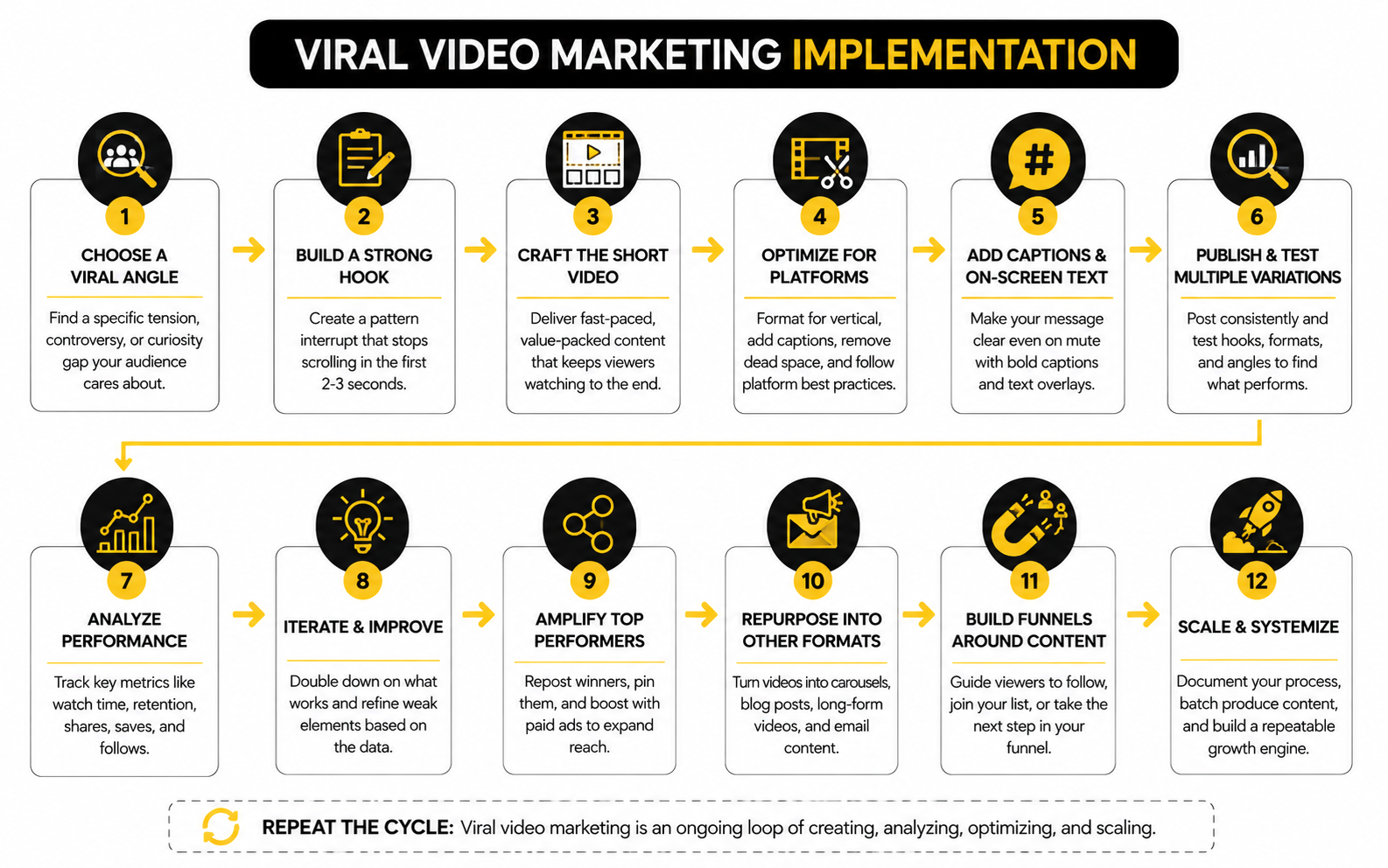
A practical execution process gives everyone the same map. It also stops the team from arguing about taste when they should be looking at the job each video is supposed to do. The process does not need to be complicated, but it does need to be consistent.
This sequence matters because it protects the strategy from being swallowed by production. If you jump straight to filming, you usually end up with generic content. If you start with tension and buyer stage, the video has a reason to exist before anyone presses record.
Create A Hook Bank Before You Need It
A hook bank is one of the most useful assets in a viral video marketing workflow. It gives the team a starting point when ideas are slow, and it makes testing faster because you are not writing from a blank page every time. The best hook bank is not a list of generic templates; it is a living library of angles that have already matched your audience’s language.
Organize hooks by function. Some hooks challenge a belief, some name a mistake, some promise a shortcut, some reveal a hidden cost, and some introduce a surprising comparison. This makes it easier to choose the right opening for the right video instead of forcing every idea into the same format.
A strong hook bank should include your own winners, competitor-inspired patterns, audience questions, sales objections, review language, and comment phrases. Do not copy another creator’s exact line. Study the structure, then make the idea specific to your audience, offer, and voice.
Batch Production Without Making The Content Feel Generic
Batching works when it reduces setup time. It fails when every video starts to feel identical. The trick is to batch the process, not the personality.
Record several videos in one session, but vary the rhythm, structure, and framing. A batch can include a direct-to-camera opinion, a screen-recorded teardown, a quick checklist, a reply to a comment, and a short story-based explanation. That gives you efficiency without making your feed feel like a template dump.
For solo creators and lean teams, batching can be as simple as scripting on Monday, recording on Tuesday, editing on Wednesday, scheduling on Thursday, and reviewing on Friday. For larger teams, each stage can have an owner, but the principle stays the same: separate creative decisions from production tasks so the work keeps moving.
Turning Views Into Leads, Sales, And Retention
Attention is only the first win. If a video reaches the right people but gives them nowhere useful to go, the campaign leaks value. This is where many brands get excited about viral video marketing and then quietly lose the business result.
The next step should match the intent created by the video. A broad awareness video should not always push a hard sales call. A high-intent objection video should not waste people with a vague “follow for more.” The call to action should feel like the logical next move from the promise of the content.
This is why conversion paths need to be planned before publishing. If the video offers a checklist, the checklist should exist. If the video tells people to comment a keyword, the automation should be ready. If the video sends viewers to a landing page, that page should repeat the same promise instead of dropping them into a generic homepage.
Choose The Right Call To Action For The Video
A call to action is not just a sentence at the end. It is the bridge between attention and action. A weak call to action feels bolted on; a strong one feels like the next obvious step.
For top-of-funnel videos, the call to action can be light. Ask people to follow, save, comment with a question, or watch a related video. The goal is to create a second touchpoint, not force a buying decision before trust exists.
For middle- and bottom-of-funnel videos, the call to action can be more direct. Invite people to download a resource, join a workshop, request a demo, book a call, start a trial, or visit a focused landing page. If the offer is clear and the video handled the right tension, a direct next step does not feel pushy.
Use Landing Pages That Match The Video Promise
A viral video can create curiosity very quickly, but a mismatched landing page can destroy that curiosity even faster. If the video promises a specific outcome, the landing page needs to continue that same conversation. Do not send viewers to a cluttered page that makes them figure out what to do next.
For ecommerce brands, this may mean a product page or advertorial-style page that supports the exact angle from the video. A landing page builder like Replo can fit when the team needs flexible product pages connected to paid or organic video campaigns. For service businesses and creators, a simple funnel built in ClickFunnels or systeme.io can be enough if the offer is clear.
The key is message match. The headline should echo the video’s promise, the page should remove the next objection, and the action should be obvious. A viral post gives you momentum; the page either keeps that momentum or kills it.
Capture Demand While Interest Is Fresh
People forget fast. If someone watches a video, comments, clicks, or visits a page, the follow-up should happen while the idea is still warm. Waiting days to respond to a high-intent signal is leaving money on the table.
For social campaigns, comment automation can help deliver resources quickly. A viewer comments a keyword, receives the promised asset, and enters a more useful conversation. ManyChat can support this kind of flow when the campaign is designed around comments, DMs, and follow-up.
For broader lead management, the system should connect forms, messages, appointments, email, SMS, and pipeline tracking. GoHighLevel can be useful for teams that want their viral video marketing efforts connected to CRM activity instead of scattered across disconnected tools. The point is not to overbuild the tech stack; the point is to make sure attention becomes a trackable relationship.
Keep Customers Engaged After The First Conversion
Viral content should not only acquire new people. It can also help retain and activate the people who already bought. This is an underrated part of the process.
Post-purchase videos can show customers how to use the product, avoid common mistakes, get faster wins, or feel more confident about their decision. For services, short videos can explain the next step, clarify expectations, and reduce buyer anxiety. For software, videos can highlight features, workflows, and success habits that improve activation.
Retention content rarely looks as flashy as acquisition content, but it matters. A customer who understands the product is more likely to use it, trust it, and talk about it. That means your video system should support the full customer journey, not just the chase for new views.
Measurement, Analytics, And What The Data Actually Means
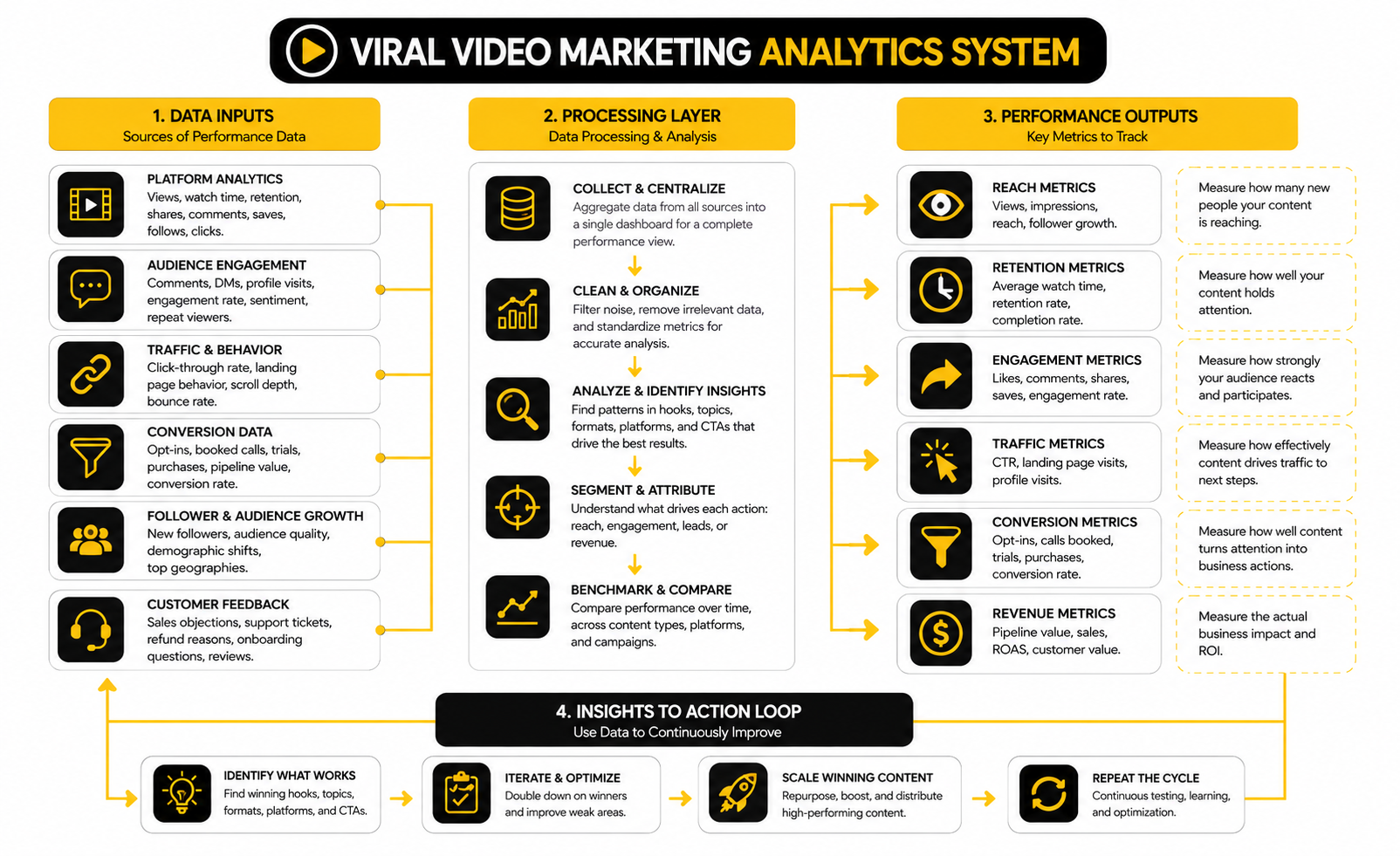
The point of measurement is not to prove that a video “did well.” The point is to understand why it performed the way it did and what you should change next. Viral video marketing becomes much easier to improve when every metric is tied to a specific part of the viewer journey.
Views tell you that the video reached people, but they do not tell you whether the right people cared. Watch time tells you whether the video held attention, but it does not tell you whether that attention moved anyone closer to buying. Saves, shares, comments, clicks, leads, booked calls, and sales each reveal a different layer of performance.
This is why you need a measurement system, not a pile of disconnected screenshots. A video can have low views but strong leads. Another can have huge reach and zero commercial value. The job is to separate attention, engagement, intent, and revenue so you know what you are actually optimizing.
Statistics And Data
The broad data confirms that video is not a side channel anymore. Wyzowl’s long-running video marketing research found that video remains widely used by marketers and tied to ROI, lead generation, product understanding, and sales outcomes. That matters because it supports the bigger point: video should be measured as a business asset, not just a creative asset.
Short-form video also has massive distribution potential, but scale can be misleading. YouTube Shorts reaching around 200 billion daily views shows how large the attention pool has become. It does not mean every brand should blindly chase Shorts, and it definitely does not mean all views are equally valuable.
Benchmark reports are useful only when you use them correctly. Metricool’s 2025 social media benchmark research analyzed more than 1 million accounts and 21 million posts, which makes it helpful for understanding broad platform patterns. But your best benchmark is still your own trend line, because a B2B agency, an ecommerce skincare brand, and a local fitness studio will not have the same definition of a successful video.
The Four Layers Of Video Performance
A practical analytics system should separate performance into four layers: attention, retention, engagement, and conversion. Attention answers the question, “Did people stop?” Retention answers, “Did they stay?” Engagement answers, “Did they care enough to react?” Conversion answers, “Did the video move the business?”
This prevents bad decisions. If attention is weak, the hook or packaging probably needs work. If retention is weak, the opening may have overpromised, the pacing may be slow, or the payoff may arrive too late. If engagement is weak, the topic may not be emotionally or practically important enough. If conversion is weak, the offer, call to action, landing page, or follow-up may be the problem.
Do not treat every metric as equal. A share often says the viewer found the video socially useful. A save often says the video had practical value. A comment can signal emotion, confusion, disagreement, or buying intent. A click shows movement, but the quality of that click depends on what happens after the viewer lands.
How To Read Retention Without Overreacting
Retention is one of the most useful metrics in viral video marketing because it shows where attention breaks. If people drop in the first second, the opening visual or first line is probably not strong enough. If they drop after the hook, the video may have created curiosity but failed to build momentum.
Look for patterns, not isolated dips. One video can underperform for many reasons: timing, topic fatigue, weak packaging, platform mismatch, or simple randomness. But if five videos in a row lose people at the same point, the data is telling you something useful.
Retention should drive editing decisions. Cut slow context from the opening. Move the payoff closer to the start. Add visual progression when the explanation becomes abstract. Tighten the script so every line earns its place. This is not about making content frantic; it is about respecting the viewer’s attention.
How To Interpret Engagement Signals
Engagement is not one metric. Likes, comments, shares, saves, follows, profile visits, and direct messages all mean different things. If you lump them together, you miss the lesson.
Likes are the lightest signal because they require very little effort. Shares are stronger because the viewer is willing to attach their identity to the content or send it to someone else. Saves are especially valuable for educational, tactical, or checklist-style videos because they suggest the viewer wants to return later.
Comments need context. A video with debate-heavy comments may travel further, but that does not automatically mean it is attracting buyers. A video with fewer comments but more specific questions may be commercially stronger because the audience is asking about implementation, pricing, tools, or next steps.
Track Conversion From The Start
Conversion tracking should not be added after a video takes off. It should be part of the campaign setup. If the goal is leads, bookings, trials, sales, or email subscribers, you need a path that can be measured before traffic arrives.
Use unique links, campaign-specific landing pages, forms, coupon codes, comment keywords, or tagged automations where appropriate. A clean setup helps you see which videos create real movement instead of guessing from surface-level engagement. If a campaign uses comment-to-DM delivery, ManyChat can help connect social engagement to a measurable follow-up flow.
For teams running several campaigns, a CRM or funnel system can make attribution easier. GoHighLevel can work for teams that want forms, automations, pipeline tracking, email, SMS, and booking activity connected in one place. A funnel builder like ClickFunnels or systeme.io can also help when the campaign needs a focused page built around one video promise.
Separate Viral Metrics From Business Metrics
Viral metrics show reach and momentum. Business metrics show whether that momentum created value. You need both, but you should not confuse them.
A video with high reach and low conversion may still be useful if it introduces the brand to the right market. It may also be useless if it attracts the wrong audience. A video with modest reach and strong conversions may be more valuable than a viral post because it speaks directly to a buying problem.
The simplest way to avoid confusion is to assign one primary goal to each video before publishing. If the goal is reach, judge it by attention, retention, shares, and follower growth. If the goal is demand, judge it by clicks, opt-ins, replies, booked calls, trials, or purchases. If the goal is trust, judge it by saves, thoughtful comments, return viewers, and assisted conversions.
Use Benchmarks Carefully
Benchmarks can help you spot whether you are far below the market, but they should not become your strategy. A benchmark tells you what is common across a sample. It does not know your offer, margin, sales cycle, audience sophistication, or brand stage.
Industry reports can still be useful. Rival IQ’s social media benchmark report focuses on cross-industry social engagement patterns, while Socialinsider’s video performance research tracks platform-level video behavior and engagement patterns. These reports help you understand the playing field, but they should not replace your own testing.
Your internal benchmark should be built from your last 30 to 90 days of content. Compare videos by format, topic, hook type, length, platform, call to action, and conversion path. Once you know your own baseline, improvement becomes much more practical because you are competing against your previous performance instead of chasing someone else’s average.
Build A Simple Reporting Rhythm
A good reporting rhythm keeps the team focused. You do not need a massive dashboard to improve viral video marketing. You need a clear weekly review that turns numbers into decisions.
Review each video through the same questions. Did the hook stop people? Did the video hold them? Did the topic create useful engagement? Did the call to action move people to the next step? Did the conversion path support the promise?
Then decide what to do next. Keep the topic and change the hook. Keep the hook and test a different format. Turn a strong comment into a new video. Rebuild the landing page if clicks are strong but conversions are weak. Scale the creative only when the signal is clear enough to justify more effort.
Measure Incrementality When The Stakes Are Higher
As campaigns get bigger, basic attribution becomes less reliable. A buyer may see five videos, click one retargeting ad, search the brand later, read reviews, and then convert from an email. If you only credit the final click, you misunderstand the role video played.
This is where incrementality matters. Google’s measurement guidance frames incrementality around understanding what happened because of marketing that would not have happened otherwise, using tools such as lift studies, conversion lift, and broader media measurement methods like MMM and attribution together. The practical takeaway is simple: when budget increases, measurement needs to move beyond last-click reporting.
Smaller teams do not need a complex model on day one. Start with clean tracking, campaign-specific links, consistent naming, and basic conversion reporting. As spend grows, add controlled tests, holdout groups, lift measurement, and deeper channel analysis so viral video marketing gets judged by real business impact, not just platform-reported credit.
Scaling Viral Video Marketing Without Losing The Signal
Scaling viral video marketing is not the same as posting more. More volume can help, but only if the quality of insight survives the increase in output. If the team scales production before it understands what is working, it usually just creates more noise.
The first scaling decision is whether you are scaling ideas, formats, creators, platforms, or paid distribution. Each one creates a different kind of complexity. Scaling formats is usually safer than scaling platforms because the audience logic stays more stable, while platform expansion can create false confidence if the same creative is being forced into environments where it does not fit.
The second decision is what you are willing to protect. If your edge is founder perspective, do not outsource the voice until the voice is documented clearly. If your edge is speed, do not create an approval process that kills timing. If your edge is trust, do not chase short-term shock value that makes the audience question your judgment.
Scale The Creative System Before The Team
Hiring more editors, creators, or agencies will not fix a weak creative system. It may actually make the problem worse because more people will produce more variations of the same unclear message. Before you scale headcount, make the thinking easier to transfer.
A useful creative system includes your strongest audience tensions, proven hook patterns, banned claims, offer angles, platform notes, editing rules, brand voice examples, and examples of videos that performed well for the right reasons. This gives new contributors a clear operating environment. They are not guessing what “good” means.
This matters because viral video marketing rewards both creativity and consistency. You want enough structure to protect the brand, but not so much structure that every video feels lifeless. The system should make good ideas easier to produce, not turn every creator into a script-reading machine.
Know When To Add Paid Distribution
Organic performance can reveal what people care about, but paid distribution can help you reach more of the right people faster. The mistake is boosting a video just because it got views. A viral organic post is not automatically a good ad.
Before adding spend, check the deeper signals. Did the video attract the right comments? Did it drive profile visits, clicks, opt-ins, trial starts, booked calls, or purchases? Did it communicate a problem your offer actually solves? If the answer is yes, paid distribution may help extend a message that already has proof.
The best paid candidates are not always the flashiest videos. Sometimes a clear objection-handling video or product explanation will outperform a viral entertainment-style post when the goal is revenue. Treat paid amplification as a way to scale validated intent, not as a shortcut around strategy.
Protect The Brand While Moving Fast
Speed matters, but trust matters more. A brand can recover from an average video. It is much harder to recover from content that misleads people, exploits a sensitive topic, or creates attention for the wrong reason.
This is especially important as AI-generated video, synthetic voices, deepfakes, and automated clipping become more common. Platforms and regulators have been pushing harder on disclosure, and AI content labeling has become a practical compliance issue for marketers working with realistic synthetic media. Guides tracking platform rules for AI disclosure across YouTube, Instagram, Facebook, and TikTok make the direction clear: transparency is no longer optional when content could confuse viewers about what is real.
Brand safety also matters when using creators, affiliates, clip pages, or paid repurposing campaigns. The rise of social clipping has created new distribution opportunities, but it has also raised disclosure and control issues, especially when clips are paid, edited aggressively, or posted by third parties. If a campaign depends on external creators or clippers, the contract should define usage rights, disclosure requirements, approval rules, prohibited claims, and takedown procedures before anything goes live.
Common Mistakes That Kill Viral Potential
Most viral video marketing mistakes happen before publishing. The team chooses a vague topic, writes a soft hook, records too much context, adds a weak call to action, and then blames the platform when the video underperforms. The platform may be part of the problem, but it is rarely the whole problem.
The bigger issue is usually a mismatch between attention and intent. A video might be interesting but unrelated to the offer. It might be educational but too slow for the format. It might be funny but attract people who will never buy. That is why “more views” is not a complete strategy.
You do not need to avoid every mistake forever. You need to recognize them quickly enough to stop repeating them. That is where disciplined review beats emotional reaction.
Mistake 1: Chasing Trends Without A Strategic Filter
Trends can give you reach, but they can also make your brand forget what it stands for. If every trend becomes a content brief, the audience learns that your brand is reactive rather than useful. That may create temporary visibility, but it rarely creates durable trust.
Use trends only when they connect naturally to your audience tension, point of view, or offer. If the connection takes too much explaining, skip it. A forced trend usually feels forced because the viewer can sense the brand is borrowing culture without adding anything.
A better filter is simple. Ask whether the trend helps you say something you already believe in a more timely or native way. If yes, use it. If no, let it pass.
Mistake 2: Confusing Controversy With Positioning
A strong point of view can make content travel. But controversy without substance is a cheap tactic. It may generate comments, but those comments do not always move the audience closer to trust.
Positioning should clarify what you believe, who you help, and what you do differently. Controversy should never be the entire strategy. If the video only works because people are angry, you need to ask whether that attention is worth owning.
There is a practical test here. After the emotional reaction fades, does the video still teach, reveal, demonstrate, or frame something useful? If not, the content may be loud, but it is not strategic.
Mistake 3: Overproducing The Wrong Things
High production value can help, but it cannot save a weak idea. Many teams spend too much time polishing videos that should have been rewritten. Clean lighting and smooth edits are useful, but they are not a substitute for tension, clarity, and payoff.
This is especially dangerous for brands with larger creative budgets. The approval process grows, the video becomes prettier, and the message becomes safer until nothing interesting is left. The final asset may look professional, but it no longer feels alive.
The right move is to match production effort to confidence. Early tests should be fast enough to learn from. Once an angle proves itself, then it makes sense to invest in stronger editing, variations, paid versions, landing pages, and creator partnerships.
Mistake 4: Building A Funnel After The Video Works
A viral post creates a short window of attention. If the conversion path is not ready, the opportunity leaks immediately. This is one of the most expensive mistakes because the team only notices it after the video has already taken off.
The fix is to build the minimum viable follow-up before publishing. If the video asks people to comment, the DM flow should be live. If the video sends people to a page, the page should match the promise. If the video invites people to book a call, the calendar and confirmation flow should be clean.
For simple campaigns, a focused page and email sequence may be enough. For teams managing several offers, channels, and lead stages, a connected system like GoHighLevel can make the follow-up easier to manage. The point is not the tool itself; the point is that attention needs somewhere useful to go.
Mistake 5: Ignoring The Sales Team And Customer Support
Your best content ideas may not be in the marketing calendar. They may be hiding in sales calls, support tickets, refund requests, onboarding questions, and customer objections. These are gold because they reveal the exact places where buyers hesitate.
Sales teams hear the language of uncertainty. Support teams hear the language of confusion. Customer success teams hear the language of adoption. All of that can become stronger video content because it comes from real buyer behavior, not brainstorm assumptions.
Create a simple feedback loop. Ask sales for the top objections every week. Ask support what customers misunderstand. Ask customer success what separates successful users from struggling users. Then turn those patterns into videos that educate before the buyer ever reaches a human conversation.
Advanced Strategic Tradeoffs
The more mature your viral video marketing becomes, the more you will face tradeoffs. You cannot optimize for everything at once. A video built for broad reach may not convert as strongly as a video built for high-intent buyers, and that is fine if you know the job of the asset.
The danger is mixing goals. Teams often want a video to be entertaining, educational, brand-safe, sales-driven, founder-led, trend-native, highly polished, easy to produce, and guaranteed to go viral. That brief is not strategy. That brief is wishful thinking.
Better teams make sharper choices. They decide what matters most for each campaign and accept the cost. If the goal is reach, the message may need to be simpler. If the goal is conversion, the audience may be narrower. If the goal is authority, the video may need more depth and less trend-chasing.
Reach Versus Relevance
Reach feels exciting because the numbers are visible. Relevance feels quieter because it shows up later in pipeline, sales quality, and customer fit. You need both, but not every video should chase both equally.
A broad video can introduce new people to your world. A relevant video can move qualified people closer to action. The mistake is judging a narrow, high-intent video by the same view expectations as a mass-market awareness post.
For B2B, high-ticket services, niche software, and specialized products, relevance often matters more than raw volume. One video that reaches 5,000 of the right people can be more valuable than one that reaches 500,000 people who only came for entertainment. That is not anti-viral; it is strategic.
Consistency Versus Creative Risk
Consistency builds familiarity. Creative risk creates breakthroughs. Too much consistency becomes predictable, while too much risk makes the brand feel unstable.
The solution is to separate core formats from experimental slots. Keep a few reliable content formats that you publish every week, then reserve part of the calendar for higher-risk ideas. This gives the algorithm and audience a stable signal while still creating room for surprise.
A practical split could be 70 percent proven formats, 20 percent variations, and 10 percent experiments. The exact ratio can change, but the principle stays useful. Do not let the entire content calendar become either a rigid template machine or a chaotic pile of experiments.
Founder-Led Versus Brand-Led Content
Founder-led content can build trust quickly because people connect with people faster than logos. It works especially well when the founder has a strong point of view, direct customer insight, or a credible story behind the offer. But it can also create dependency if the entire video strategy requires one person to show up every day.
Brand-led content scales more easily, but it can feel less personal if it lacks voice. This is why many teams use both. The founder handles opinion, trust, and market perspective, while the brand account handles education, product clarity, customer proof, and repeatable formats.
The best choice depends on the business. A consultant, agency, creator, or early-stage SaaS company may benefit heavily from founder-led video. A larger ecommerce brand or marketplace may need a more distributed creator system. Either way, document the voice before you scale it.
Organic Learning Versus Paid Speed
Organic content gives you learning. Paid distribution gives you speed. When used together, they can create a powerful loop.
Organic posts can test hooks, topics, audience reactions, and creative formats at lower cost. Paid campaigns can then push proven messages to more precise audiences. This reduces waste because you are not paying to learn every lesson from scratch.
But do not wait forever for organic proof if the market is competitive. Some offers need paid traffic earlier because the target audience is specific, the buying intent is valuable, or the platform is too crowded for consistent organic reach. The right balance depends on your margin, sales cycle, audience size, and creative capacity.
Building A Durable Viral Video Marketing Advantage
The durable advantage is not one viral video. It is the ability to keep finding angles your audience cares about and turn them into content that moves people. That ability compounds.
Over time, your team should know which tensions create attention, which hooks hold retention, which formats drive saves, which topics create leads, and which calls to action turn viewers into customers. This is where viral video marketing becomes less mysterious. You are still working with uncertainty, but you are no longer guessing blindly.
The teams that win are not always the loudest. They are the ones that learn faster, protect trust, and connect creative work to business outcomes. Virality may be unpredictable, but the system around it can be very deliberate.
Bringing The Full Viral Video Marketing System Together
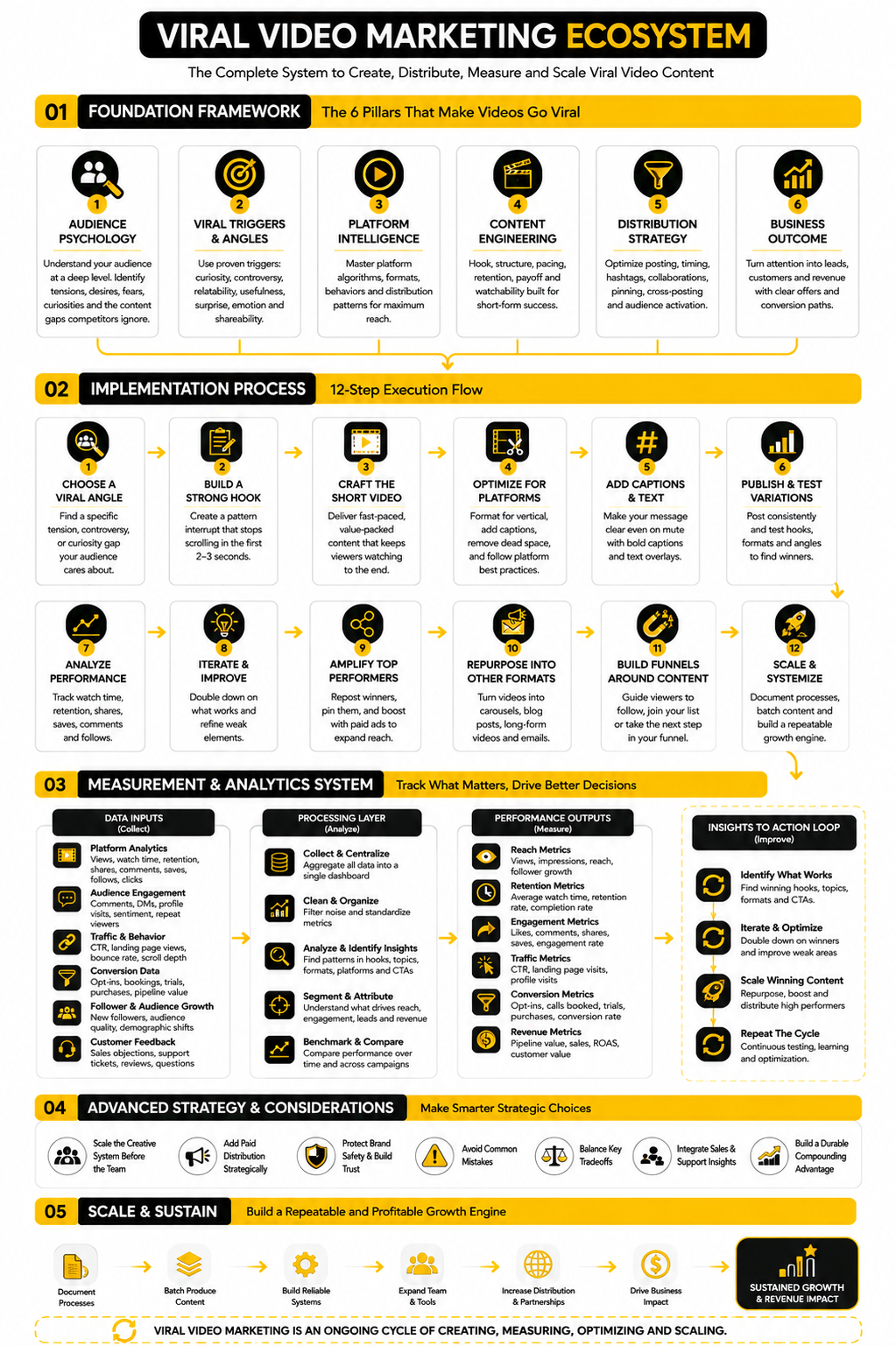
At this point, the pattern should be clear. Viral video marketing is not one tactic. It is an ecosystem made of audience insight, sharp positioning, creative testing, platform-native distribution, conversion paths, measurement, and continuous improvement.
The strongest teams do not treat these pieces separately. They connect them. Audience research shapes hooks, hooks shape retention, retention reveals creative quality, engagement reveals market resonance, conversion data reveals commercial intent, and customer feedback shapes the next round of content.
That is how the system compounds. One video teaches you something. Ten videos reveal patterns. One hundred videos, reviewed properly, can reshape how you understand your market.
What Is Viral Video Marketing?
Viral video marketing is the process of creating and distributing video content that has a strong chance of spreading through shares, recommendations, algorithmic discovery, and audience participation. It is not just about getting a large number of views. It is about creating videos that attract the right audience and move them toward a meaningful business action.
The best viral video marketing combines creative insight with a clear growth system. The video needs a strong hook, a relevant message, and a payoff worth watching. It also needs a next step, because attention without follow-up rarely turns into revenue.
Is Viral Video Marketing Only For Big Brands?
No, and that is one of the reasons it matters so much. Small businesses, creators, agencies, ecommerce brands, consultants, and SaaS startups can all use viral video marketing if they understand their audience well enough. A large budget helps with production and distribution, but it does not replace a strong angle.
Smaller teams often have an advantage because they can move faster. They can test hooks, respond to comments, film rough ideas, and adapt without layers of approval. The key is to stay focused on clarity, relevance, and consistency instead of trying to imitate big-brand campaigns.
Can You Guarantee A Video Will Go Viral?
No credible marketer can guarantee that a specific video will go viral. Platforms, timing, audience behavior, creative quality, and competition all affect performance. Anyone promising guaranteed virality is usually selling hype, not strategy.
What you can do is improve the odds. Strong audience research, better hooks, clearer storytelling, platform-specific packaging, and disciplined testing all make viral performance more likely. The goal is not to control every outcome; it is to build a system that keeps producing better attempts.
What Makes A Video More Shareable?
A video becomes more shareable when it gives the viewer a reason to pass it on. That reason can be practical, emotional, funny, surprising, validating, controversial, or identity-driven. People share content when it helps them express something, solve something, or connect with someone.
For business content, practical value matters a lot. A clear framework, mistake breakdown, checklist, or strong point of view can make someone think, “I need to send this to my team.” That is a very different kind of share than casual entertainment, but it can be extremely valuable.
How Long Should A Viral Marketing Video Be?
The right length depends on the platform, topic, format, and viewer intent. A simple idea may need only 15 to 30 seconds. A deeper explanation, teardown, or story may need 60 to 120 seconds or longer if the pacing stays strong.
Length is not the real issue. Momentum is. A short video can feel slow if the hook is weak, while a longer video can hold attention if every line earns its place. Measure retention and completion patterns instead of blindly following a fixed length rule.
Which Platform Is Best For Viral Video Marketing?
There is no universal best platform. TikTok, Instagram Reels, YouTube Shorts, LinkedIn, Facebook, and even X can all work depending on the audience and offer. The better question is where your buyers already spend attention and what kind of content they expect there.
A B2B consultant may find stronger business intent on LinkedIn, while a consumer brand may get better discovery on TikTok or Instagram. YouTube Shorts can be useful for broad reach and search-adjacent discovery. Start with the platform where audience fit is strongest, then expand after you understand what works.
How Often Should You Post Viral Video Content?
You should post often enough to learn, but not so often that quality collapses. For many teams, three to seven short-form videos per week is a practical starting point. The right cadence depends on your production capacity, platform focus, and ability to review performance.
Consistency matters because it gives you more data. But consistency does not mean publishing weak videos just to fill a calendar. A smaller number of sharp, well-reviewed videos will usually beat a larger volume of generic posts.
What Metrics Matter Most?
The most useful metrics depend on the job of the video. If the goal is reach, watch views, retention, shares, and follower growth. If the goal is demand, watch clicks, opt-ins, replies, booked calls, trials, and sales.
Do not judge every video by the same metric. A broad awareness video and a bottom-of-funnel objection video are doing different jobs. Viral video marketing works best when each video has one primary goal before it is published.
Why Do Some Videos Get Views But No Sales?
Views do not automatically mean buying intent. A video may be entertaining, controversial, or broadly relatable without attracting people who need your offer. That is why reach and revenue can move in very different directions.
The fix is not always to sell harder. Sometimes you need a stronger bridge between the video and the offer. Sometimes you need better middle-of-funnel content. Sometimes the call to action, landing page, or follow-up system needs work. Look at the whole path before blaming the video alone.
Should You Use Trends In Viral Video Marketing?
Trends can help, but they should not control the strategy. Use a trend only when it fits your audience, message, and brand voice. If the connection feels forced, the video will probably feel forced too.
A better approach is to study why the trend is working. Is it funny, surprising, participatory, nostalgic, or easy to remix? Once you understand the behavior behind the trend, you can create something native without copying the surface.
How Do You Turn Viral Videos Into Leads?
You turn viral videos into leads by giving viewers a relevant next step. That might be a free checklist, workshop, consultation, product demo, email list, quiz, or comment-to-DM flow. The next step should match the promise of the video.
This is where tools can help, but strategy comes first. A comment automation in ManyChat can work well when people ask for a resource in the comments. A funnel in ClickFunnels or systeme.io can work well when the video drives people to a focused offer page.
Do You Need Expensive Equipment?
No. Expensive equipment can improve production quality, but it does not create a strong message. A clear idea filmed on a phone can outperform a polished video with no tension, weak pacing, and a generic point.
Start with clean audio, decent lighting, and a simple visual setup. Then focus on hooks, pacing, clarity, and payoff. Upgrade production once you know which formats and messages are worth scaling.
How Do You Repurpose Long-Form Content Into Viral Videos?
Start by finding the sharpest moments, not the longest ones. Look for strong opinions, clear frameworks, emotional moments, objections, surprising lines, and useful explanations. Each short video should carry one idea.
Do not simply cut random clips and hope they work. Add context where needed, rewrite the hook, tighten the pacing, and package the clip for the platform. Repurposing works best when it feels intentional, not recycled.
How Long Does It Take To See Results?
Some videos can take off quickly, but a real viral video marketing system takes time to build. You need enough attempts to identify patterns in topics, hooks, formats, platforms, and conversion paths. Early results often come from learning what does not work.
A practical goal is to review performance in weekly and monthly cycles. Weekly reviews help improve hooks, pacing, and publishing decisions. Monthly reviews help reveal broader patterns around audience demand, offer fit, and revenue impact.
What Is The Biggest Mistake Beginners Make?
The biggest mistake is chasing views before understanding the audience. Beginners often copy viral formats without knowing why those formats worked. They focus on surface-level style instead of the tension, timing, and message underneath.
Start with the audience. What do they want? What frustrates them? What do they misunderstand? What have they tried already? Once those answers are clear, the creative work becomes much easier.
Build a stronger local presence with BAAM AI
Turn your website, Google profile, social channels, and AI visibility into one growth engine
Most businesses do not need more random marketing activity. They need a consistent presence system that helps the right people find them, trust them, and take action. BAAM AI brings strategy, local SEO, website updates, Google Maps visibility, social content, AI-search readiness, media production, and reporting into one practical monthly engine.
If you want your marketing to keep working after the campaign ends, start with a free BAAM AI presence audit. See how your business shows up today and where the fastest visibility wins are at BAAM AI.