
BAAM AI Blog
Using Social Media To Promote Your Business: A Practical Growth Framework
Using social media to promote your business is not about posting more. It is about creating a repeatable system that helps the right people discover you, trust you, remember you, and take the next step when they are...
Affiliate disclosure: this article may include compensated links. Recommendations should still be evaluated against your use case, budget, and current provider terms.
Should you choose this tool?
this tool is worth considering when the use case, budget, and implementation effort match what you actually need to do next.
teams that want a practical tool decision without reading another generic feature list
Check this toolUsing social media to promote your business is not about posting more. It is about creating a repeatable system that helps the right people discover you, trust you, remember you, and take the next step when they are ready.
That matters because social media is no longer a side channel. Global social media user identities reached 5.79 billion in April 2026, which means more than two in three people on Earth now use social platforms each month, based on DataReportal’s global social media statistics. In the United States, YouTube, Facebook, Instagram, TikTok, WhatsApp, Reddit, and Snapchat all continue to shape how different audiences discover information, compare options, and interact with brands, as shown in Pew Research Center’s 2025 social media use research.
The opportunity is obvious, but so is the trap. Most businesses treat social media like a content treadmill: post something, hope someone sees it, repeat tomorrow. A better approach connects your positioning, content, conversations, offers, follow-up, and measurement into one simple operating system.
Why Social Media Promotion Matters Now
Social media works because it sits close to attention, culture, and buying intent. People use platforms to be entertained, but they also use them to research brands, ask for recommendations, compare products, and decide who feels credible. That makes social media useful for far more than awareness.
For a business, the real power is not just reach. It is the ability to show up repeatedly with useful proof, clear positioning, and easy next steps. When someone sees your posts, watches your short videos, reads your comments, joins your email list, clicks your offer, or sends a direct message, social media has moved from “marketing activity” into business development.
The mistake is assuming that every post needs to sell immediately. Some content should attract new people, some should educate, some should build trust, some should handle objections, and some should drive action. When those roles are clear, using social media to promote your business becomes much easier to manage.
The Framework Overview
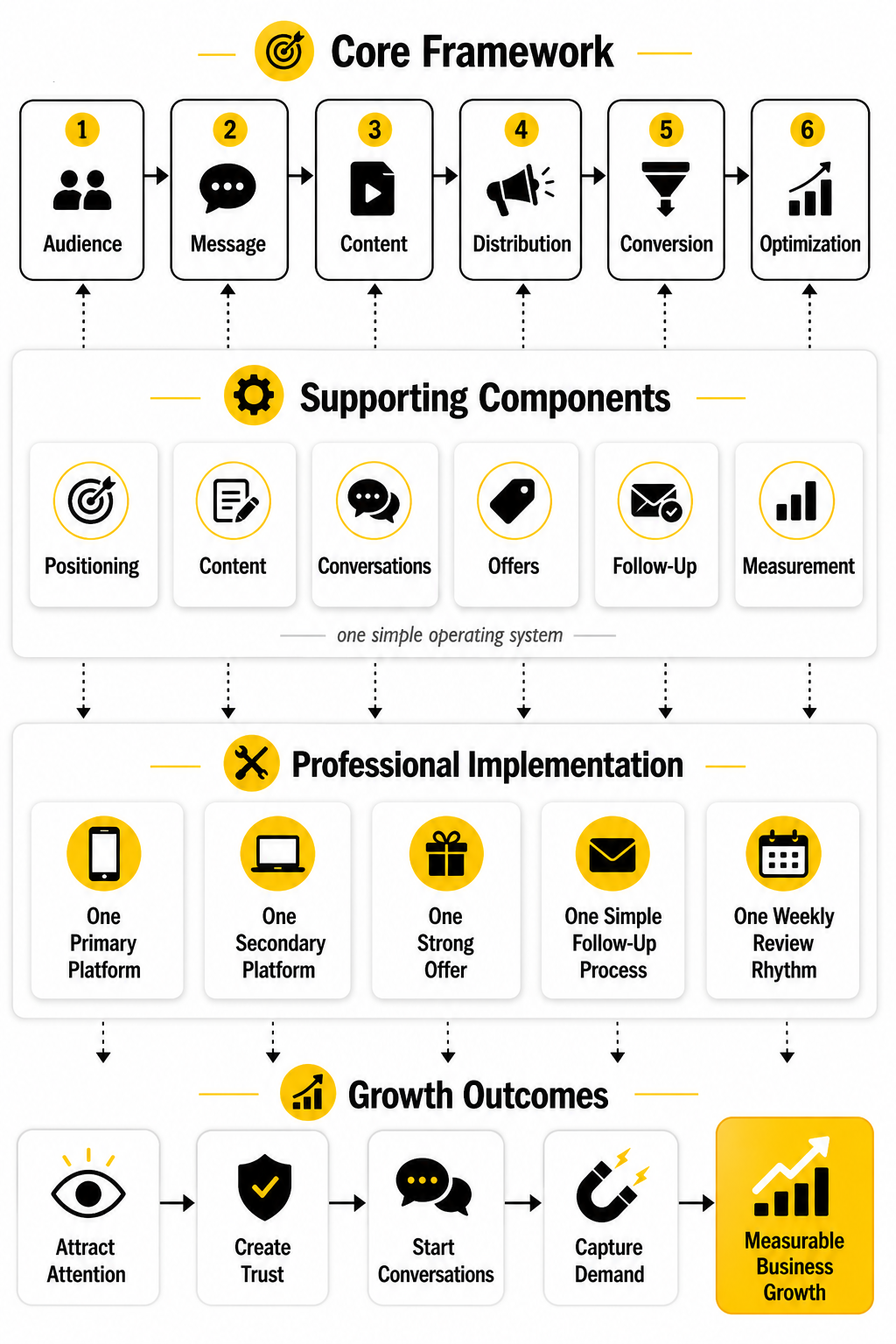
The framework for this guide is simple: audience, message, content, distribution, conversion, and optimization. Each part supports the next one. If your audience is unclear, your message becomes generic; if your message is generic, your content feels forgettable; if your content has no conversion path, attention leaks away.
This is why tools should support the system, not replace it. A scheduler like Buffer can help you publish consistently, a messaging tool like ManyChat can help you turn comments or DMs into follow-up, and a CRM or funnel platform like GoHighLevel can help you connect leads, appointments, campaigns, and sales activity. But none of those tools fix weak positioning or random content.
The best social strategy usually feels boring behind the scenes. You know who you are trying to reach, what problem you help them solve, what proof they need, what action you want them to take, and how you will follow up. That discipline is what separates a business asset from a collection of posts.
Core Components Of A Business Social Media System
A strong social media system starts with a clear audience. You need to know who you want to attract, what they already believe, what they are trying to avoid, and what would make them trust you. Without that clarity, even polished content can miss the mark.
The next component is your message. Your message explains what you do, who it is for, why it matters, and why your approach is different. It should show up in your profile, your pinned content, your short-form videos, your educational posts, your lead magnets, and your sales conversations.
Then comes the content engine. This includes the topics you repeat, the formats you use, the proof you share, and the rhythm you can realistically maintain. Consistency does not mean posting everywhere every day; it means showing up often enough with enough relevance that your audience can understand and remember you.
Professional Implementation Starts With Restraint
Professional implementation does not mean building a massive content department on day one. It means choosing the few actions that matter most and doing them well. For many businesses, that means one primary platform, one secondary platform, one strong offer, one simple follow-up process, and one weekly review rhythm.
The strongest operators do not chase every platform update. They watch audience behavior, test content carefully, and keep the business goal visible. Reports like Sprout Social’s 2025 impact of social media marketing research show why social teams are under pressure to prove business value, not just publish content.
That is the standard this guide will use from here. We are not going to treat social media as a popularity contest. We are going to treat it as a practical promotion system that can attract attention, create trust, start conversations, capture demand, and support measurable business growth.
The Strategy Before The Content
Before you create another post, tighten the strategy. This is the part most businesses skip because posting feels productive and strategy feels slow. But if your strategy is vague, social media becomes a lottery ticket instead of a growth channel.
A good strategy answers five questions before the content calendar gets built. Who are we trying to reach? What problem do they already care about? What do they need to believe before they buy? What action should they take next? How will we follow up after they engage?
This matters because using social media to promote your business is not the same as using social media to stay visible. Visibility is useful, but visibility without a business path becomes noise. The goal is to turn attention into trust, trust into action, and action into a relationship you can continue.
Start With The Audience You Can Actually Win
You do not need to reach everyone. In fact, trying to reach everyone usually makes your content weaker because it removes the sharp edges from your message. The better move is to define the audience segment where your offer, proof, and voice have the strongest chance of landing.
Start with the customer you can help fastest and most profitably. That might be local homeowners, SaaS founders, ecommerce buyers, gym members, agency clients, restaurant owners, creators, consultants, or enterprise teams. The point is not to choose a label; the point is to choose a buying situation.
A buying situation includes the problem, urgency, budget, alternatives, and emotional pressure around the decision. Someone who is “interested in fitness” is vague. Someone who has tried three diets, feels stuck, and wants a coach before summer is much easier to speak to with precision.
Build A Practical Audience Snapshot
Your audience snapshot should be simple enough to use while writing content. If it takes twelve pages to understand, nobody on your team will use it. Keep it practical, specific, and tied to buying behavior.
A useful snapshot includes:
This snapshot helps you avoid random content ideas. It also helps you decide what not to post. That restraint is powerful because strong social media strategy is as much about exclusion as it is about creativity.
Clarify Your Positioning Before You Publish
Positioning is the reason people understand why your business matters. It tells the audience what you do, who you help, and why your approach deserves attention. Without clear positioning, even good content can feel disconnected.
Your positioning does not need to be clever. It needs to be clear. A local accountant who helps tradespeople reduce tax stress has stronger positioning than a “financial solutions provider” trying to sound bigger than they are.
The best test is simple: can a stranger understand your business in five seconds from your profile, pinned content, and recent posts? If not, the content is carrying too much weight. Fix the message before you increase the posting volume.
Use A Simple Positioning Formula
A practical positioning statement can look like this:
For example, a business might say it helps ecommerce brands turn product page traffic into more email subscribers without adding complex custom development. That message is not trying to impress everyone. It is trying to be instantly useful to the right person.
This also makes your content easier to plan. Educational posts can explain the problem. Proof posts can show the outcome. Comparison posts can address the frustration. Offer posts can make the next step clear.
Match The Platform To The Business Goal
A platform is not a strategy. TikTok, Instagram, LinkedIn, YouTube, Facebook, Reddit, Pinterest, and X all reward different behaviors, formats, and audience expectations. Choosing a platform because it is popular is weaker than choosing it because your buyers use it in a way that supports your goal.
For some businesses, LinkedIn is useful because the buyer is thinking professionally and evaluating expertise. For others, Instagram or TikTok works because the product benefits from visual demonstration, creator-style storytelling, or social proof. For local service businesses, Facebook groups, Instagram, Google Business Profile activity, and short-form video may all work together.
Do not overcomplicate the first phase. Pick one primary platform where your audience and content strengths overlap. Then pick one secondary platform only if it supports the same assets without doubling the workload.
Choose Based On Behavior, Not Hype
Platform choice should come from buyer behavior. Are people searching for solutions? Are they comparing providers? Are they looking for inspiration? Are they asking peers for recommendations? Are they watching demonstrations before buying?
A B2B consultant might win with LinkedIn posts, comments, webinars, and direct conversations. A skincare brand might need short-form video, creator content, product education, and community proof. A local clinic might combine educational reels, patient-safe general advice, reviews, appointment links, and reminder campaigns.
The wrong platform is not always useless. It is often just inefficient. If the audience is there but not in a buying or research mindset, you may need a different content role for that platform instead of expecting it to close sales directly.
Define The Customer Journey On Social Media
People rarely move from first post to purchase in one clean step. They notice you, check your profile, consume more content, compare you with alternatives, look for proof, and decide whether the next step feels safe. Your social strategy should support that journey instead of pretending it does not exist.
Think of the journey in four stages: discovery, trust, action, and follow-up. Discovery content helps new people understand the problem or opportunity. Trust content gives them proof, education, perspective, and reasons to believe you. Action content points them toward a lead magnet, consultation, product page, checkout, event, or message. Follow-up keeps the relationship alive after the first click or conversation.
This is where many businesses lose money. They create discovery content but no clear next step. Or they create sales posts for people who have not yet built enough trust. The journey has to be connected.
Create Content For Each Stage
Discovery content should be easy to understand and easy to share. It can include short tips, strong opinions, mistake breakdowns, trend explanations, before-and-after thinking, or simple answers to common questions. The goal is not to say everything; the goal is to earn the next moment of attention.
Trust content goes deeper. It can explain your process, show your thinking, answer objections, compare options, explain trade-offs, and highlight credible proof. This is where your audience starts to feel that you are not just posting for attention.
Action content needs to be direct. Tell people what to do next and why that step helps them. If your next step is a funnel, a landing page builder like ClickFunnels or an all-in-one platform like Systeme.io can make sense, especially when the offer needs a simple path from interest to signup or sale.
Make The Offer Clear Before You Scale Content
Content creates demand, but the offer captures it. If your offer is unclear, people may like your posts and still never become leads or customers. That is not an algorithm problem; it is an offer problem.
A strong social media offer is easy to understand, relevant to the audience’s current pain, and low-friction enough for the stage of trust. For cold audiences, that might be a checklist, quiz, template, mini-training, sample, calculator, audit, newsletter, or direct message prompt. For warmer audiences, it might be a consultation, trial, demo, workshop, paid product, or application.
The offer should match the buyer’s readiness. Asking a cold viewer to book a high-ticket sales call may work occasionally, but it often leaves money on the table. A smaller first step can capture more people and create a cleaner follow-up path.
Remove Friction From The Next Step
Your next step should be obvious from your profile and your best content. People should not have to hunt for the link, guess what happens next, or decode vague calls to action. Confusion kills conversions quietly.
For service businesses, the next step might be a booking page, a form, or a DM keyword. A scheduling tool like Cal.com can help when appointments are part of the sales process. A form tool like Fillout can help when you need to qualify leads before a call.
For ecommerce or digital products, the next step might be a product page, bundle, quiz, email signup, or limited campaign. The key is to make the transition from social attention to owned follow-up as smooth as possible. Social media gives you the first touch, but your business system has to capture the relationship.
Turn Strategy Into Operating Rules
A strategy is only useful when it changes daily behavior. That means you need operating rules that guide what you post, how you respond, what you measure, and what you stop doing. Without rules, every week becomes a new debate.
Your operating rules can be simple. Post around three to five core topics. Use one primary call to action for a defined period. Review performance weekly. Save audience questions. Turn winning ideas into repeatable formats. Stop creating content that gets engagement from people who will never buy.
This is where using social media to promote your business becomes more predictable. You are no longer asking, “What should we post today?” You are asking, “Which part of the system needs support right now?” That shift makes content easier, cleaner, and much more useful.
Content, Offers, And Conversion Paths
Once the strategy is clear, the next job is turning it into content people can actually use. This is where social media promotion becomes tangible. You are no longer thinking in vague terms like “post consistently”; you are building a path from first impression to meaningful action.
The best content does not exist in isolation. It connects to a business goal, an audience problem, and a next step. That is why using social media to promote your business works better when every post has a role instead of every post trying to do everything.
Your content system should answer three practical questions. What does the audience need to understand? What do they need to believe? What should they do next if the message lands?
Build Content Around Problems, Not Just Topics
Topics are useful, but problems are stronger. A topic might be “email marketing,” “home renovation,” “tax planning,” or “fitness.” A problem is more specific: low open rates, renovation delays, surprise tax bills, or losing motivation after two weeks.
Problem-led content feels more relevant because it starts where the audience already is. It does not ask people to care about your category first. It enters the conversation they are already having in their head.
This matters because social platforms move fast. If the first line, first frame, or first idea does not feel connected to a real problem, people scroll. Relevance is the hook before creativity even gets a chance.
Turn One Problem Into Multiple Content Angles
A single customer problem can become several pieces of content without repeating yourself. You can explain why the problem happens, show the hidden cost, compare common solutions, break down mistakes, answer objections, and point people toward a practical next step. This gives you variety without forcing you to invent a new topic every day.
For example, if your audience struggles to turn social traffic into leads, you could create content around weak profile links, unclear offers, slow follow-up, missing lead magnets, poor landing pages, and inconsistent retargeting. Those are different angles connected to one business problem. That is much stronger than posting random tips with no strategic thread.
This approach also helps you sound more expert without becoming complicated. Experts do not just know more topics. They understand the same problem from more useful angles.
Create A Content Mix That Matches Buyer Readiness
Not everyone who sees your content is ready to buy. Some people are just discovering the problem. Some know the problem but do not trust you yet. Some are comparing options. Some are almost ready and only need a clear next step.
Your content mix should serve those different levels of readiness. If you only post educational content, you may attract attention without creating demand. If you only post sales content, you may push too hard before trust exists.
A practical content mix includes education, perspective, proof, personality, and action. Education helps people understand. Perspective shows how you think. Proof builds confidence. Personality makes the brand feel human. Action tells people exactly what to do next.
Use Five Core Content Roles
Every strong social media system needs content that plays different jobs. You do not need a complex taxonomy. You need a simple mix you can actually produce.
The balance depends on your business model. A local service business may need more trust and offer content. A creator-led business may need more perspective and community content. An ecommerce brand may need more product demonstration, user-generated content, comparison content, and conversion paths.
Make The Execution Process Repeatable
This is where the system becomes practical. A repeatable process stops content from depending on mood, inspiration, or last-minute panic. It also makes delegation much easier because the work has a rhythm.
Start by collecting audience inputs. Save real questions from comments, DMs, sales calls, customer support, reviews, search queries, and objections. These inputs are gold because they show you the language people actually use.
Then turn those inputs into content ideas, scripts, visuals, captions, and calls to action. A tool like Flick Social can help with planning social content and hashtags, while Buffer can help you schedule posts once the content is ready. Tools help most when the strategy is already clear.
Use A Simple Weekly Workflow
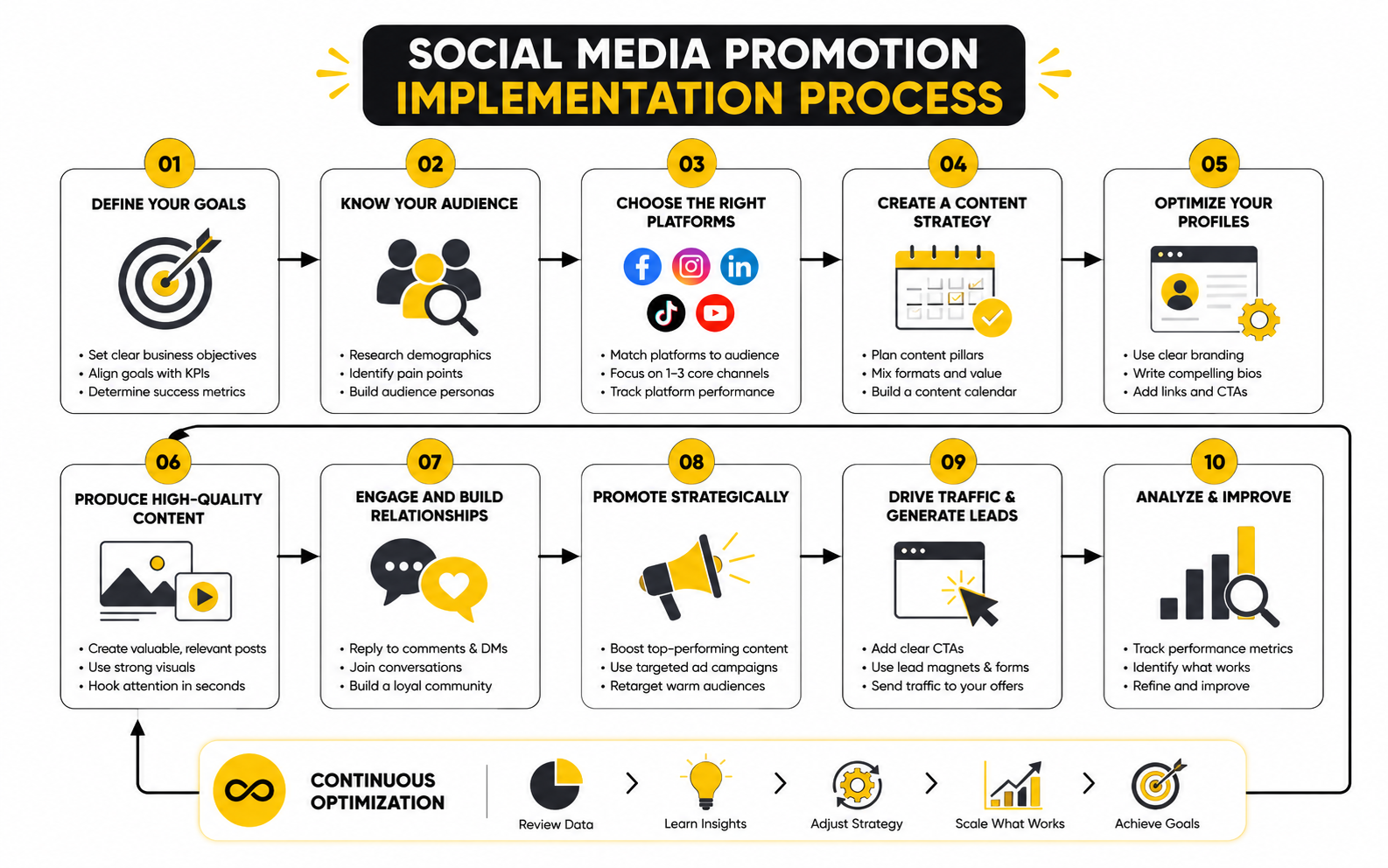
A weekly workflow gives your social media execution structure without making it feel heavy. The point is to reduce daily decision-making. You want the team focused on quality and consistency, not reinventing the process every morning.
A simple workflow can look like this:
This process is intentionally simple. Complicated systems look impressive but often collapse under real business pressure. A simple workflow that gets done every week beats a sophisticated one nobody follows.
Connect Every Content Type To A Next Step
A post can create attention, but a next step turns attention into business value. The next step does not always need to be aggressive. It just needs to match the intent of the content and the readiness of the audience.
A soft next step might be “save this,” “comment with a keyword,” “send this to your team,” or “follow for the next breakdown.” A stronger next step might be “download the checklist,” “book a call,” “start a free trial,” “join the workshop,” or “shop the product.”
This is where many businesses underperform. They create useful content and then go silent at the exact moment the reader is most interested. Do not make people guess what to do next.
Match Calls To Action To The Content
Educational content often works best with a low-friction next step. Invite people to save the post, ask a question, download a related resource, or comment with a keyword. This keeps the relationship moving without forcing a sales conversation too early.
Proof content can carry a stronger next step because it reduces uncertainty. If someone has just seen your process, results, testimonials, product demo, or comparison, they may be ready to visit a landing page, book an appointment, or request more information. This is where a well-built funnel through ClickFunnels, Systeme.io, or GoHighLevel can help connect the social click to a real business outcome.
Direct offer content should be clear and unapologetic. Say who the offer is for, what problem it solves, what happens next, and why now is a good time to act. Confidence converts better than vague enthusiasm.
Build Landing Pages That Continue The Conversation
Your landing page should feel like the natural next step from the post, not a totally different conversation. If the post talks about a specific problem, the page should continue that problem. If the post promises a checklist, audit, demo, or product benefit, the page should make that promise obvious immediately.
The page does not need to be long by default. It needs to be clear. Strong pages usually include a sharp headline, a specific outcome, proof, a simple explanation of the offer, risk reducers, and one primary call to action.
For ecommerce campaigns, a landing page builder like Replo can be useful when product storytelling, campaign pages, and conversion testing matter. For service businesses, the page may be simpler: problem, promise, proof, process, booking action. The format depends on the sale.
Keep Message Match Tight
Message match means the social post, ad, landing page, and follow-up all feel connected. This is basic, but it is huge. If someone clicks because they want a pricing checklist and lands on a generic homepage, momentum drops.
Strong message match uses the same core promise across the journey. The wording does not need to be identical, but the intent should be obvious. People should feel, “Yes, this is what I clicked for.”
This also helps measurement. If each campaign has a clear promise and matching page, you can see which ideas create leads, not just likes. That makes future content decisions much more carefully.
Capture The Lead Before Attention Disappears
Social media attention is rented. You can earn it, but you do not fully control it. That is why lead capture matters.
Lead capture gives you a way to continue the conversation through email, SMS, a CRM, a community, a webinar, a booking flow, or a sales process. This does not mean every business needs a complex funnel. It means every business needs a way to avoid losing interested people after the first interaction.
Email still matters because it gives you more control than platform algorithms. A platform like Brevo or Moosend can support newsletters, welcome sequences, and campaign follow-up when email is part of your conversion path.
Use Lead Magnets With Real Buying Relevance
A lead magnet should not attract random freebie seekers. It should attract people who are likely to care about the paid solution. That means the resource should sit close to the problem your business solves.
Good lead magnets include checklists, calculators, templates, audits, comparison guides, short trainings, diagnostic quizzes, and buyer guides. The best ones help the audience make progress while also revealing why your paid offer is the logical next step. That is the sweet spot.
Avoid generic downloads that only inflate the list. A smaller list of people with real buying intent is more valuable than a large list that never moves. Quality beats volume here, and it is not close.
Write Follow-Up That Feels Human
The follow-up should not feel like a machine shouting at someone because they clicked a link. It should continue the conversation with context. Remind them why they signed up, deliver what was promised, help them get a quick win, and then show the next step.
For simple journeys, a welcome email and one or two follow-up messages may be enough. For higher-consideration offers, you may need a longer sequence with education, proof, objection handling, and a clear invitation to book or buy. The complexity should match the decision.
This is also where direct messaging can help. If someone comments with a keyword or asks for a resource, ManyChat can help automate the first response while still giving people a clear path to a human conversation when needed. Automation should remove friction, not remove the relationship.
Turn One Strong Idea Into Multiple Assets
One strong idea should not die after one post. Repurposing is not lazy when it is done properly. It is how you get more value from your best thinking.
A short video can become a carousel, a text post, an email, a short blog section, a sales page angle, and a FAQ answer. A customer objection can become a reel, a comparison post, a landing page section, and a follow-up email. A webinar can become clips, quotes, checklists, and nurture content.
This is especially useful for small teams. You do not need more random ideas. You need a better system for extracting more from the ideas that already work.
Repurpose Based On Intent
Do not repurpose mechanically. A LinkedIn post copied to Instagram may not work because the audience behavior and format expectations are different. The idea can travel, but the execution should fit the platform.
Start with the core message. Then adapt the hook, format, length, visual style, and call to action for each channel. That keeps the content native without losing strategic consistency.
This is one of the most practical ways to scale using social media to promote your business. You keep the message focused, reduce production pressure, and give your best ideas more chances to reach the right people.
Statistics And Data
The numbers only matter when they help you make better decisions. Social media analytics can show whether your message is reaching the right people, whether the content is strong enough to hold attention, and whether attention is turning into business outcomes. The danger is treating every metric as equally important.
Using social media to promote your business requires a measurement system, not a vanity dashboard. A post with many likes can still fail if it attracts the wrong audience or sends nobody to the next step. A smaller post can be far more valuable if it drives qualified replies, saves, website clicks, bookings, email signups, or purchases.
The broader market explains why measurement has become non-negotiable. There were 5.79 billion social media user identities worldwide at the start of April 2026, based on DataReportal’s global social media statistics. That scale creates opportunity, but it also creates noise, so your job is not to admire big platform numbers; your job is to identify the signals that connect to your business model.
What Social Media Metrics Actually Mean
Every metric answers a different question. Reach tells you how many people had a chance to see the content. Impressions tell you how many times the content was displayed. Engagement shows whether people interacted. Clicks show whether the content created enough intent for someone to move forward.
The mistake is judging every post by the same number. A brand awareness post should not be judged only by sales. A direct offer post should not be celebrated only because people liked it. The metric must match the purpose of the content.
If a post is designed for discovery, watch reach, hook retention, shares, and profile visits. If a post is designed for trust, watch saves, comments, replies, watch time, and repeat engagement. If a post is designed for conversion, watch clicks, leads, booking rates, checkout starts, sales, and follow-up response rates.
Separate Attention Metrics From Business Metrics
Attention metrics tell you whether people noticed and interacted with your content. Business metrics tell you whether that attention helped the company grow. Both matter, but they are not the same thing.
Attention metrics include reach, impressions, views, likes, comments, shares, saves, follows, and profile visits. These numbers help you understand content resonance, platform fit, and audience interest. They are useful early signals, especially when you are testing hooks, topics, formats, and posting rhythm.
Business metrics include leads, booked calls, trials, demos, purchases, repeat purchases, customer acquisition cost, pipeline value, and revenue. These numbers matter more when the goal is sales impact. If your social content is creating attention but no business movement, the problem may be the offer, the call to action, the landing page, the follow-up, or the audience match.
Build A Measurement System Before You Need It
A simple measurement system helps you avoid emotional decisions. Without it, one low-performing post can make you question the whole strategy, and one viral post can make you chase the wrong audience. You need a way to read patterns, not react to isolated spikes.
The system should connect platform analytics, website behavior, lead capture, sales follow-up, and revenue outcomes. For a small business, that may be a spreadsheet, platform dashboards, UTM links, and a CRM. For a more advanced team, it may include dedicated reporting, attribution tools, campaign dashboards, and customer journey analysis.
A CRM like GoHighLevel can help when you need social leads, forms, calendars, conversations, automations, and pipeline tracking in one place. A simpler setup can still work, but the key is the same: track the path from content to action as clearly as possible.
Track The Journey In Layers
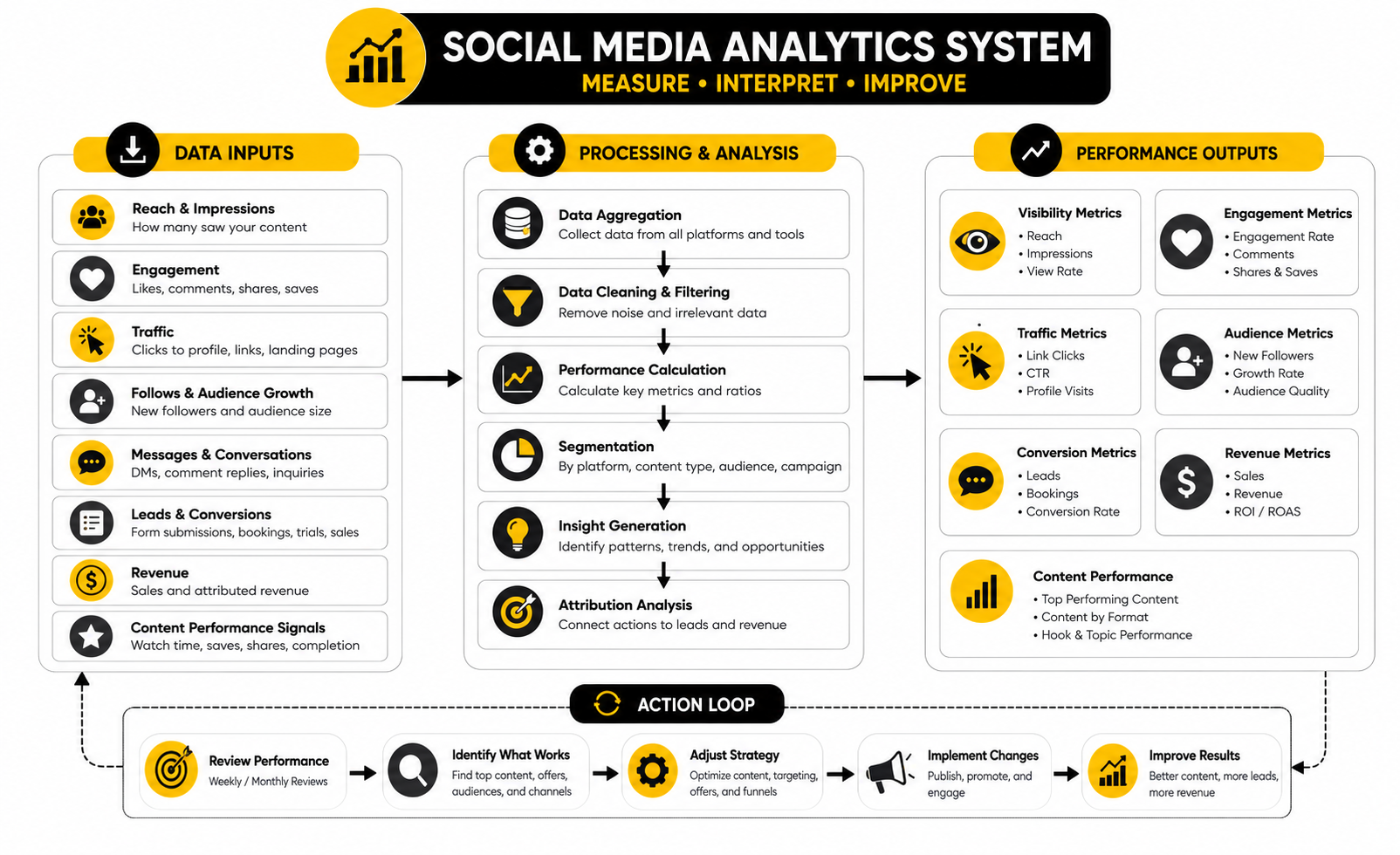
Think of measurement in layers instead of one giant report. Each layer answers a different business question. This makes the data easier to understand and easier to act on.
The first layer is content performance. Which topics, hooks, formats, and angles are earning attention from the right people? This tells you what to create more of and what to stop forcing.
The second layer is conversion movement. Which posts, profiles, links, forms, DMs, or landing pages are turning attention into leads or buyers? This tells you whether your social media system has a working bridge between interest and action.
The third layer is commercial impact. Which campaigns, channels, offers, and follow-up sequences are creating pipeline, revenue, retention, or customer growth? This tells you whether social media is supporting the business, not just the content calendar.
Use Benchmarks Carefully
Benchmarks can be helpful, but they can also mislead you. A benchmark tells you what is common in a market, not what is possible for your offer, audience, or business model. You should use benchmarks as context, not as a commandment.
Industry reports show why context matters. The 2025 Emplifi social media benchmarks report found that Instagram Reels had a 2.2% reach engagement rate in 2024, while TikTok’s average reach engagement rate was 1.7% in the same comparison. That does not mean every business should blindly choose Reels over TikTok; it means format, audience, and platform behavior need to be tested against your own goals.
Sprout Social’s 2025 benchmark research also shows how platform activity can shift by network and industry, with Facebook and Instagram engagements growing while TikTok continued emerging in the mix. The practical takeaway is simple. Your own baseline matters more than a global average once you have enough data.
Create Your Own Baseline
Your baseline is the normal performance range for your account. It should be based on your platform, audience size, posting frequency, content format, niche, and offer. This gives you a fairer comparison than looking at generic public benchmarks.
Start by reviewing the last 30 to 90 days of content. Look for average reach, engagement rate, saves, shares, profile visits, link clicks, leads, and sales actions. Then separate posts by content role so you are not comparing a trust-building post with a direct promotion.
Once you know your baseline, performance becomes clearer. A post does not need to be viral to be useful. If it outperforms your normal range on the metric it was designed to influence, it is a signal worth studying.
Measure Content By Its Job
Content measurement becomes easier when every post has a job before it goes live. If the job is discovery, measure whether it reached new people. If the job is trust, measure whether people saved, commented, watched, or returned. If the job is conversion, measure whether people clicked, replied, booked, joined, or bought.
This prevents weak conclusions. A deeply educational post may not generate explosive reach, but it may create high-quality saves and replies. A strong offer post may get fewer likes but generate serious buyers. Those outcomes should not be judged with the same yardstick.
For example, a tutorial video might be successful because people save it and ask follow-up questions. A comparison post might be successful because it drives qualified website visits. A direct offer post might be successful because it generates booked calls, even if public engagement looks average.
Watch Ratios, Not Just Totals
Raw numbers can flatter or scare you. Ratios give better context. A post with 1,000 views and 80 saves may be more useful than a post with 20,000 views and 20 saves, depending on the goal.
Useful ratios include engagement rate, save rate, share rate, click-through rate, lead conversion rate, booking rate, show-up rate, close rate, and revenue per lead. These ratios help you see quality, not just volume. They also show where the journey is breaking.
If reach is high but clicks are low, the content may be entertaining but not tied to intent. If clicks are high but leads are low, the landing page or offer may be weak. If leads are high but sales are low, the follow-up, qualification, pricing, or sales process may need attention.
Read Platform Data With Common Sense
Platform dashboards are useful, but they do not tell the whole story. Social platforms optimize for their own engagement ecosystems, not your profit. That means you need to interpret the data with your business model in mind.
A post that keeps people on the platform may be rewarded with more reach, but that does not automatically mean it moves people toward your offer. A post that sends people to a landing page may get less visible engagement but create more measurable business value. Both can be useful when you know their role.
This is why social teams should look beyond likes and views. The 2025 Sprout Social impact report surveyed more than 1,200 marketing leaders about proving social impact, and its focus on reporting infrastructure reflects the real issue: leaders need evidence that social supports business priorities, not just engagement charts.
Do Not Confuse Algorithm Feedback With Customer Feedback
Algorithm feedback tells you what the platform distributed. Customer feedback tells you what the market valued. They can overlap, but they are not identical.
A controversial post may get comments because people argue. That does not mean it attracted buyers. A niche post may reach fewer people but bring in strong leads because it speaks directly to a valuable pain point.
Customer feedback includes DMs, sales call language, support questions, reviews, objections, referrals, and the words people use when they buy. This feedback should shape your content just as much as dashboard numbers. Sometimes the most profitable content is not the loudest content.
Measure The Funnel After The Click
Social media analytics should not stop at the platform. The real question is what happens after someone clicks, replies, comments, books, downloads, or buys. That is where many businesses discover the real bottleneck.
If a social post drives traffic but the landing page does not convert, the content may not be the issue. If the landing page converts but leads do not respond, the follow-up may be too slow or too generic. If calls are booked but sales are weak, qualification or offer clarity may need work.
A funnel builder like ClickFunnels can help when you need dedicated conversion paths for campaigns. For product pages and ecommerce landing pages, Replo can help teams create campaign-specific pages that keep the message match tighter after the click.
Use UTM Links For Cleaner Tracking
UTM links help you identify where traffic came from and which campaign created it. They are not glamorous, but they are extremely useful. Without them, your analytics can become a messy pile of “social” traffic with little detail.
A simple UTM structure can track source, medium, campaign, and content. For example, you might separate Instagram profile clicks from Instagram story clicks, organic LinkedIn posts from paid campaigns, or one lead magnet from another. This gives you better visibility into what is actually working.
The goal is not perfect attribution. Perfect attribution is rare, especially when people see content multiple times before acting. The goal is better decision-making, and UTM discipline gives you a much cleaner starting point.
Turn Data Into Weekly Decisions
A measurement system is only useful if it changes what you do next. Do not collect numbers just to make reports look serious. Use the data to decide what to repeat, improve, test, pause, or remove.
A weekly review should be short and practical. Look at the posts that drove the strongest signals for each content role. Identify which topics created qualified attention, which calls to action moved people forward, and which conversion paths created real opportunities.
Then make decisions. Create more content around proven problems. Rewrite weak calls to action. Improve landing pages with high traffic and low conversion. Strengthen follow-up where leads are dropping. Cut content that only attracts the wrong crowd.
Ask Better Questions In The Review
The quality of your review depends on the quality of your questions. “How many likes did we get?” is not enough. It is too shallow to guide a business.
Ask questions like:
These questions turn analytics into action. That is the point. Data should make the next move clearer, not make the team stare at dashboards longer.
The Data Should Sharpen The Strategy
Good analytics do not replace judgment. They sharpen it. The numbers help you see what the audience responds to, what the business benefits from, and where the system is leaking.
When using social media to promote your business, do not chase every spike. Look for repeatable signals. A single viral post can be luck, but repeated saves around the same problem are insight. Repeated clicks from one platform are insight. Repeated objections in DMs are insight.
That is how social media becomes a growth system. You publish with intent, measure the right signals, improve the weak links, and keep moving closer to content that earns attention and supports revenue.
Conversations, Automation, Paid Promotion, And Scaling
At this stage, the system has content, conversion paths, and measurement. The next question is how to scale without losing the human edge that made the strategy work in the first place. This is where many businesses make expensive mistakes.
Scaling social media is not just “post more” or “spend more.” It is deciding what deserves more reach, what should stay organic, what should be automated, what must remain personal, and what risk you are willing to accept. That is the expert layer of using social media to promote your business.
The better your foundation, the safer scaling becomes. If the audience, offer, content roles, landing pages, follow-up, and analytics are already working, scaling can amplify a real system. If those pieces are weak, scaling only makes the leaks more expensive.
Treat Comments And DMs Like A Revenue Channel
Comments and direct messages are not just engagement signals. They are conversations with people who have already shown interest. That makes them one of the most overlooked parts of social media promotion.
A comment can reveal an objection, a buying question, a content idea, or a lead. A DM can become a support moment, a sales conversation, a booking, or a referral. The business that responds well often wins trust before the business with the bigger following even notices the opportunity.
This does not mean every comment needs a long reply. It means your team should know which interactions deserve attention. Questions, objections, pricing curiosity, feature comparisons, local availability, purchase intent, and complaints should never be treated like random noise.
Create Response Rules Before Volume Hits
Response rules help your team move quickly without sounding robotic. They define which messages get a public reply, which ones move to DM, which ones need a human, and which ones should be escalated. Without these rules, social inboxes become chaotic as soon as the account grows.
A useful response system includes:
This is one of the simplest ways to turn engagement into business value. The post creates the opening, but the conversation often creates the conversion.
Use Automation Without Making The Brand Feel Automated
Automation is powerful when it removes friction. It is dangerous when it removes judgment. The best use of automation is to deliver resources, route leads, confirm appointments, tag interests, and trigger timely follow-up without pretending every interaction is deeply personal.
For example, if someone comments a keyword to receive a checklist, automation can send the resource instantly. That is useful. But if someone asks a nuanced buying question and receives a generic sequence, trust drops fast.
A tool like ManyChat can help with comment-to-DM flows, lead capture, and simple conversational automation. The key is to design the flow around the user’s intent, not around your desire to push everyone into the same funnel.
Know What Should Stay Human
Some parts of social media should not be fully automated. Complaints, complex objections, partnership inquiries, high-value leads, sensitive customer issues, and public criticism need human judgment. These moments affect trust more than a perfectly timed auto-reply ever will.
The same applies to content. Sprout Social’s 2026 content strategy research highlights that consumers want brands to prioritize human-generated content, while AI is better used for insights and process support through its social media content strategy report. That is the right mental model.
Use AI and automation to speed up research, summarize patterns, draft first versions, organize ideas, and route routine actions. Keep the voice, judgment, empathy, and final decision-making human. That balance matters more as AI-generated content becomes easier to produce and easier to ignore.
Decide When Paid Promotion Makes Sense
Paid promotion should not be used to rescue weak content. It should be used to amplify content, offers, and audiences that already show promise. If a post earns strong saves, shares, comments, profile visits, clicks, or leads organically, paid reach can help you test whether the signal holds at a larger scale.
The paid-versus-organic tradeoff is simple. Organic content teaches you what people respond to. Paid promotion helps you reach more of the right people faster. Both are useful, but they should not be confused.
Recent market movement shows why this matters. Brand spending is increasingly shifting toward paid amplification of creator content, with eMarketer projections reported by Business Insider showing paid amplification expected to match influencer fees at $14.2 billion in 2027 and surpass them by 2028 through the changing influencer marketing spend mix. That shift reflects a practical reality: strong content often needs distribution support.
Promote What Has Already Proven Something
Before putting money behind content, ask what it has already proven. Did it attract the right audience? Did people watch long enough? Did it generate qualified comments? Did it send traffic to the right page? Did it create leads or sales?
Paid promotion is safer when the organic signal is specific. A post with broad entertainment appeal may scale reach but attract low-quality attention. A post with slightly lower reach but strong buyer signals may be a better candidate for amplification.
Start with small tests. Promote the strongest content to a defined audience, watch the downstream numbers, and compare results against your organic baseline. If the paid traffic behaves worse than organic traffic, do not blame the ad budget first; inspect the audience, creative, offer, landing page, and follow-up.
Work With Creators Carefully
Creator partnerships can be extremely useful because they borrow trust, format fluency, and audience access. But they can also become expensive if you choose creators based only on follower count. The right creator is not always the biggest creator.
Look for audience fit, content quality, credibility, consistency, and comment quality. A smaller creator with a highly relevant audience may outperform a larger creator whose followers are passive or mismatched. The goal is not exposure for its own sake; the goal is trusted attention from people who could realistically care.
Creator content should also have a clear business role. Are you trying to drive awareness, gather content assets, test messaging, promote a launch, build proof, or retarget warm audiences? Different goals require different briefs, contracts, usage rights, and success metrics.
Protect Trust And Compliance
Paid creator relationships must be disclosed clearly. The FTC’s business guidance explains that endorsements, influencer relationships, and reviews need transparency through its endorsement and influencer guidance. This is not a detail to leave vague in a campaign brief.
Disclosure is not only a legal issue. It is a trust issue. If an audience feels tricked, the short-term reach is not worth the long-term brand damage.
This is especially important with affiliate marketing, gifting, paid clipping, whitelisting, and creator ads. Academic research has repeatedly found disclosure problems in social media monetization, including a study of more than 500,000 YouTube videos and 2.1 million Pinterest pins that found only about 10% of affiliate marketing content contained any disclosure through research on affiliate disclosures on YouTube and Pinterest. A later cross-platform study of Dutch influencers also found that influencer marketing remains generally underdisclosed through research on legal disclosures across Instagram, YouTube, and TikTok.
Build A Social Customer Care Layer
As your social presence grows, customers will use it for help. That includes pre-sale questions, delivery issues, complaints, refunds, technical problems, product confusion, and public feedback. Ignoring this layer weakens the entire system.
Social customer care is not the same as posting content. It needs response standards, ownership, escalation, and visibility across the team. If marketing answers one thing, support says another, and sales promises a third, the brand starts to look messy.
Sprout Social’s customer service research notes that 30% of consumers planned to use social more in 2025, while 56% planned to maintain current usage, and consumers ranked personalized customer service as a top social priority through its 2025 social customer service statistics. The practical takeaway is clear: as social becomes a front door, support quality becomes part of marketing.
Connect Social Support To The CRM
Social support should not live in a silo. When a customer asks for help, that context should connect to the broader relationship where possible. This helps the team avoid repeated questions, missed follow-ups, and disconnected experiences.
A CRM like Copper can be useful for relationship-driven teams that need visibility across leads, accounts, and follow-ups. For agencies and local businesses that want social conversations, forms, calendars, automations, and pipeline tracking together, GoHighLevel can be a stronger operational fit.
The tool matters less than the habit. Capture meaningful context. Assign ownership. Follow up when promised. Small operational details create a surprisingly large trust advantage.
Manage Brand Risk Before It Becomes Public
Social media increases speed. That is great when the message works and risky when something goes wrong. A weak reply, unclear claim, angry customer, insensitive post, or misleading offer can spread quickly.
Risk management does not mean becoming bland. It means knowing your boundaries before pressure hits. Strong brands can still have personality, opinions, and sharp positioning. They simply understand the difference between being memorable and being reckless.
Your risk system should include review rules for sensitive claims, approval rules for regulated industries, disclosure rules for partnerships, and escalation rules for public criticism. If your industry touches health, finance, legal advice, children, employment, housing, or regulated products, be even more careful.
Do Not Overpromise In Content
Overpromising is one of the fastest ways to damage trust. Social media rewards bold claims, but your business has to live with the consequences after the click. If the offer cannot reliably deliver the promise, the content is not clever; it is a liability.
Use specific language, but stay honest. Explain who the offer is for, what it can help with, what affects results, and what the next step involves. Clarity can still sell.
This applies to testimonials, before-and-after content, income claims, health claims, and customer results. Proof is powerful, but only when it is presented responsibly. Trust compounds slowly and disappears quickly.
Scale The Team Without Diluting The Voice
At some point, the founder, owner, or lead marketer cannot do everything alone. That is normal. The challenge is scaling production without turning the brand into generic committee content.
The solution is documentation plus editorial judgment. Document the audience, positioning, content pillars, voice, offer language, proof standards, compliance rules, and approval process. Then give creators enough context to make good decisions instead of forcing them to guess.
A social media system can involve strategists, writers, video editors, designers, community managers, media buyers, salespeople, and support staff. But someone still needs to own the message. Without that owner, the brand voice slowly gets softer, safer, and less useful.
Create A Content Quality Standard
A quality standard helps the team decide whether a post is ready. It is not about making everything perfect. It is about making sure every piece has a reason to exist.
Before publishing, ask:
These questions reduce weak content before it reaches the audience. They also make feedback easier because the team has shared standards instead of personal opinions.
Avoid Scaling The Wrong Signal
The most dangerous scaling mistake is amplifying the wrong signal. A funny post can bring followers who will never buy. A broad trend can create reach that weakens positioning. A cheap lead campaign can fill the pipeline with people sales should never have spoken to.
This is why earlier measurement work matters. Scale the signals tied to qualified attention and business movement. Do not scale noise just because the dashboard looks exciting.
Using social media to promote your business at an advanced level means saying no more often. No to irrelevant trends. No to cheap reach. No to automation that damages trust. No to creator deals that do not fit. No to paid campaigns that hide a weak offer.
Build Owned Assets As You Grow
Social platforms are powerful, but you do not own the platforms. Algorithms change, accounts get restricted, formats rise and fall, and distribution can shift without warning. A smart social strategy uses platforms to build assets the business controls.
Owned assets include email lists, SMS lists where appropriate, customer databases, communities, webinars, content libraries, search assets, customer research, testimonials, and sales processes. These assets make the business less dependent on any single platform. That is not optional if you care about resilience.
This does not mean abandoning social media. It means using social media as the front end of a bigger relationship system. A newsletter tool like Brevo, a funnel platform like Systeme.io, or a broader operating system like GoHighLevel can help when the goal is to turn social attention into a database, pipeline, and repeatable follow-up process.
Repurpose Social Insights Into Business Assets
The best social insights should not stay trapped inside posts. Turn repeated questions into sales page sections. Turn objections into email sequences. Turn high-performing hooks into webinar topics. Turn comments into product research. Turn customer language into better positioning.
This is where social media becomes more than promotion. It becomes a live research loop. Your audience tells you what they care about, what confuses them, what they distrust, what they want, and what they are willing to act on.
That intelligence should influence offers, product development, sales scripts, onboarding, support, and retention. When this loop is working, social media is not just a channel. It is one of the fastest feedback systems in the business.
Optimization, Mistakes, And The Final System
The final stage is not about adding more complexity. It is about making the whole system easier to run, easier to improve, and harder to break. When the audience, content, conversion path, measurement, conversations, automation, and scaling rules work together, social media becomes a business asset instead of a daily guessing game.
This is where using social media to promote your business becomes more mature. You stop chasing every trend and start managing an ecosystem. Each platform, post, offer, landing page, email, message, and sales conversation has a role.
The goal is not perfection. The goal is compounding. Small improvements across your content, profile, calls to action, follow-up, and reporting can create a much stronger system over time.
Common Mistakes That Slow Growth
The first major mistake is creating content without a commercial path. A business can publish useful posts for months and still produce weak results if the profile, offer, landing page, and follow-up are unclear. Attention is valuable, but only when the system gives interested people somewhere useful to go.
The second mistake is measuring the wrong thing. Likes and views are not useless, but they are incomplete. If you are trying to generate consultations, leads, trials, or purchases, your review process has to include those outcomes.
The third mistake is scaling before the basics work. Paid promotion, influencer partnerships, automation, and AI workflows can all help, but they amplify whatever is already there. If the offer is vague, the audience is wrong, or the follow-up is slow, scaling simply makes the problem louder.
Fix The Leaks Before You Add Volume
Most underperforming social media systems have leaks, not a total lack of opportunity. People see the post but do not understand the profile. They visit the profile but cannot find the offer. They click the link but land on a generic page. They submit a form but receive weak follow-up.
Fix those leaks in order. Improve the profile promise. Tighten the call to action. Match the landing page to the post. Make the form easier. Speed up the response. Then look at traffic volume.
This is not glamorous work, but it is where real gains often hide. A stronger conversion path can make the same content more profitable without requiring more reach.
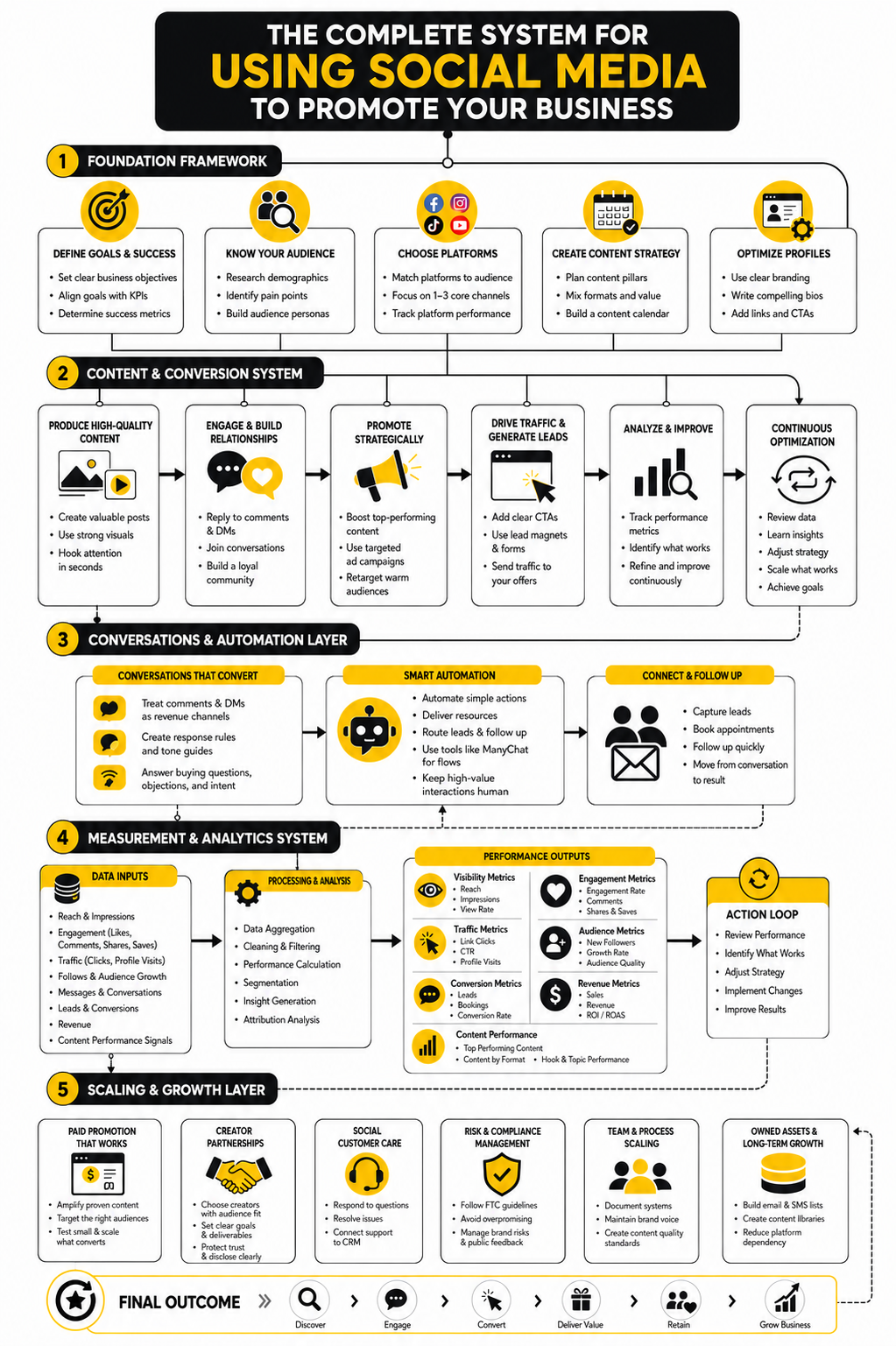
Build The Final Social Media Ecosystem
A complete social media ecosystem has four loops. The first loop is the content loop, where audience inputs become posts, videos, emails, and sales assets. The second loop is the conversion loop, where attention turns into clicks, replies, leads, bookings, or purchases.
The third loop is the relationship loop, where follow-up, support, community, and customer education keep people engaged after the first action. The fourth loop is the learning loop, where analytics, customer conversations, and sales feedback improve the next round of strategy.
This is the full picture. Social media is not just the top of the funnel, and it is not only a brand channel. Used properly, it influences discovery, education, trust, sales, retention, research, and reputation.
Keep The System Simple Enough To Maintain
A system only works if the team can keep using it. If your content process requires too many approvals, too many platforms, too many tools, or too many disconnected reports, it will eventually slow down. The best system is usually the simplest one that captures the important signals.
For a small team, that may mean one primary platform, one scheduling tool, one landing page, one email sequence, one CRM, and one weekly review. For a larger team, the system can expand, but the logic should stay clean. Every tool should either save time, improve quality, increase visibility, capture demand, or support follow-up.
If a tool does none of those things, remove it. Complexity is not a badge of honor. Revenue, clarity, and consistency are the things that matter.
How do I start using social media to promote my business?
Start with your audience, offer, and next step before you start posting heavily. Decide who you want to attract, what problem you help them solve, and what action you want them to take after they engage. Once that is clear, build a simple content plan around education, proof, trust, and direct offers.
Which social media platform is best for business promotion?
The best platform is the one where your buyers already spend attention in a useful mindset. LinkedIn may work better for B2B expertise, Instagram and TikTok may work better for visual products or creator-style education, and Facebook may still matter for local businesses and community-driven markets. Do not choose based on hype; choose based on buyer behavior.
How often should a business post on social media?
Post often enough to stay visible without destroying quality. For many businesses, three to five strong posts per week on one main platform is better than daily weak content across five platforms. Consistency matters, but relevance matters more.
What type of content works best for promoting a business?
The best content mix includes discovery content, educational content, trust content, offer content, and conversion content. One post should not carry the whole business. You need content that attracts new people, builds confidence, answers objections, and gives clear next steps.
How do I turn followers into leads?
Give followers a specific next step that matches their level of trust. That could be a checklist, quiz, consultation, webinar, product page, booking link, free trial, or direct message prompt. Then follow up quickly and continue the same conversation that started on social media.
Should I use paid ads to promote social media content?
Use paid promotion when a post, offer, or campaign has already shown a meaningful signal. That signal could be saves, shares, qualified comments, profile visits, clicks, leads, bookings, or sales. Do not use ads to compensate for weak positioning or a confusing offer.
How do I know if social media is actually working?
Match each metric to the job of the content. Discovery posts should be judged by reach, shares, profile visits, and audience quality. Trust content should be judged by saves, comments, watch time, replies, and repeat engagement. Conversion content should be judged by clicks, leads, bookings, purchases, and revenue movement.
What should I put in my social media bio?
Your bio should quickly explain who you help, what outcome you support, and what the next step is. Keep it clear, not clever. A visitor should understand your business within a few seconds.
How can small businesses compete with bigger brands on social media?
Small businesses can win with sharper positioning, faster replies, more personal content, and stronger local or niche relevance. Big brands often move slowly and sound generic. A smaller business can build trust by being specific, helpful, responsive, and human.
Should I automate social media replies and DMs?
Automation is useful for simple actions like sending resources, confirming interest, routing leads, and triggering follow-up. It should not replace human judgment for serious sales questions, complaints, sensitive issues, or high-value opportunities. Use automation to remove friction, not to remove the relationship.
Is AI useful for social media marketing?
AI can help with research, idea generation, summaries, drafts, repurposing, and workflow speed. It should not erase your voice or replace real audience understanding. Sprout Social’s 2026 content strategy research highlights that consumers want brands to prioritize human-generated content while using AI for insights and process efficiency through its social media content strategy report.
How do I avoid sounding too salesy on social media?
Be useful before you ask for action, but do not hide the fact that you sell something. Explain problems clearly, show your process, share proof responsibly, answer objections, and make direct offers when the timing is right. Confidence feels professional; pressure feels desperate.
What are the biggest risks of using social media for business?
The biggest risks are overpromising, attracting the wrong audience, ignoring compliance, mishandling public feedback, depending too heavily on one platform, and automating too much. FTC guidance makes clear that endorsements, reviews, and influencer relationships need transparency through its business guidance on endorsements and influencers. Trust is part of the strategy, not a side issue.
How long does it take social media promotion to work?
It depends on the offer, audience, platform, content quality, follow-up, and existing trust. Some campaigns can create leads quickly, especially with a clear offer and warm audience. Building a reliable organic system usually takes repeated testing because you need enough content and conversion data to see patterns.
What should I do when a post performs well?
Study why it worked before you simply repeat it. Look at the hook, topic, format, audience reaction, comments, saves, shares, clicks, and conversion behavior. Then turn the winning idea into related posts, emails, landing page sections, sales talking points, and follow-up content.
Build a stronger local presence with BAAM AI
Turn your website, Google profile, social channels, and AI visibility into one growth engine
Most businesses do not need more random marketing activity. They need a consistent presence system that helps the right people find them, trust them, and take action. BAAM AI brings strategy, local SEO, website updates, Google Maps visibility, social content, AI-search readiness, media production, and reporting into one practical monthly engine.
If you want your marketing to keep working after the campaign ends, start with a free BAAM AI presence audit. See how your business shows up today and where the fastest visibility wins are at BAAM AI.