
BAAM AI Blog
Upwork Email Marketing: How to Hire, Brief, and Manage Freelancers Who Can Actually Grow Revenue
Hiring for Upwork email marketing can look simple from the outside. You post a job, wait for proposals, pick someone with Klaviyo, Mailchimp, HubSpot, or lifecycle marketing experience, and hope the campaigns start...

Affiliate disclosure: this article may include compensated links. Recommendations should still be evaluated against your use case, budget, and current provider terms.
Should you choose HubSpot?
HubSpot is worth considering when the use case, budget, and implementation effort match what you actually need to do next.
teams that want a practical tool decision without reading another generic feature list
Check HubSpotHiring for Upwork email marketing can look simple from the outside. You post a job, wait for proposals, pick someone with Klaviyo, Mailchimp, HubSpot, or lifecycle marketing experience, and hope the campaigns start making money. In reality, the best results usually come from a much tighter process: knowing what you need, separating strategy from task execution, and giving the freelancer enough context to improve revenue without guessing.
Email still deserves that level of care because it remains one of the few owned channels where a business can build repeat sales without paying for every click again. Litmus reports that many companies see email ROI between 10:1 and 36:1, while its State of Email research also shows that email teams are under pressure to ship faster and prove performance more clearly. That is exactly why hiring a freelancer casually is risky. A weak email marketer can burn trust with your list, damage deliverability, and leave you with pretty templates that do not move revenue.
Upwork can be a strong place to find email marketing help because the marketplace has active specialists across strategy, copywriting, automation, design, deliverability, CRM cleanup, and campaign production. Upwork’s own email marketing job category regularly shows thousands of open projects, and its hiring guidance lists typical email marketer rates around $15 to $40 per hour, depending on scope and experience. The opportunity is real, but the filter matters. You are not just hiring someone to “send emails.” You are hiring someone to protect a revenue channel.
Why Upwork Email Marketing Matters
Upwork email marketing matters because email is not one isolated task. A strong freelancer may need to understand positioning, segmentation, copywriting, design, automation logic, offer strategy, analytics, deliverability, and customer behavior. When those pieces work together, email becomes a reliable growth channel. When they are disconnected, it becomes a calendar full of campaigns nobody wants to read.
This is especially important for ecommerce brands, SaaS companies, coaches, agencies, and service businesses that already have leads or customers but are not following up properly. DataReportal’s Digital 2025 coverage makes the broader context clear: email remains a central online behavior, with Gmail alone reaching roughly 2 billion monthly mobile app users. Your audience is still in the inbox. The question is whether your emails deserve attention when they arrive there.
The mistake many businesses make is hiring too narrowly. They look for someone who can “set up flows” or “write newsletters,” but they do not define the business outcome behind the work. A welcome flow, abandoned cart sequence, win-back campaign, launch sequence, newsletter, or lead nurture system should connect to a real commercial goal. That goal might be first purchase, repeat purchase, sales call booking, product education, reactivation, referral, or retention.
The Real Problem Is Not Finding Freelancers
Finding email marketers on Upwork is not the hard part. Upwork’s live email marketing category shows a constant stream of projects, from campaign setup and CRM work to ecommerce automation and lead generation support. The harder part is deciding who is strategic enough for your situation and who is only comfortable completing isolated tasks.
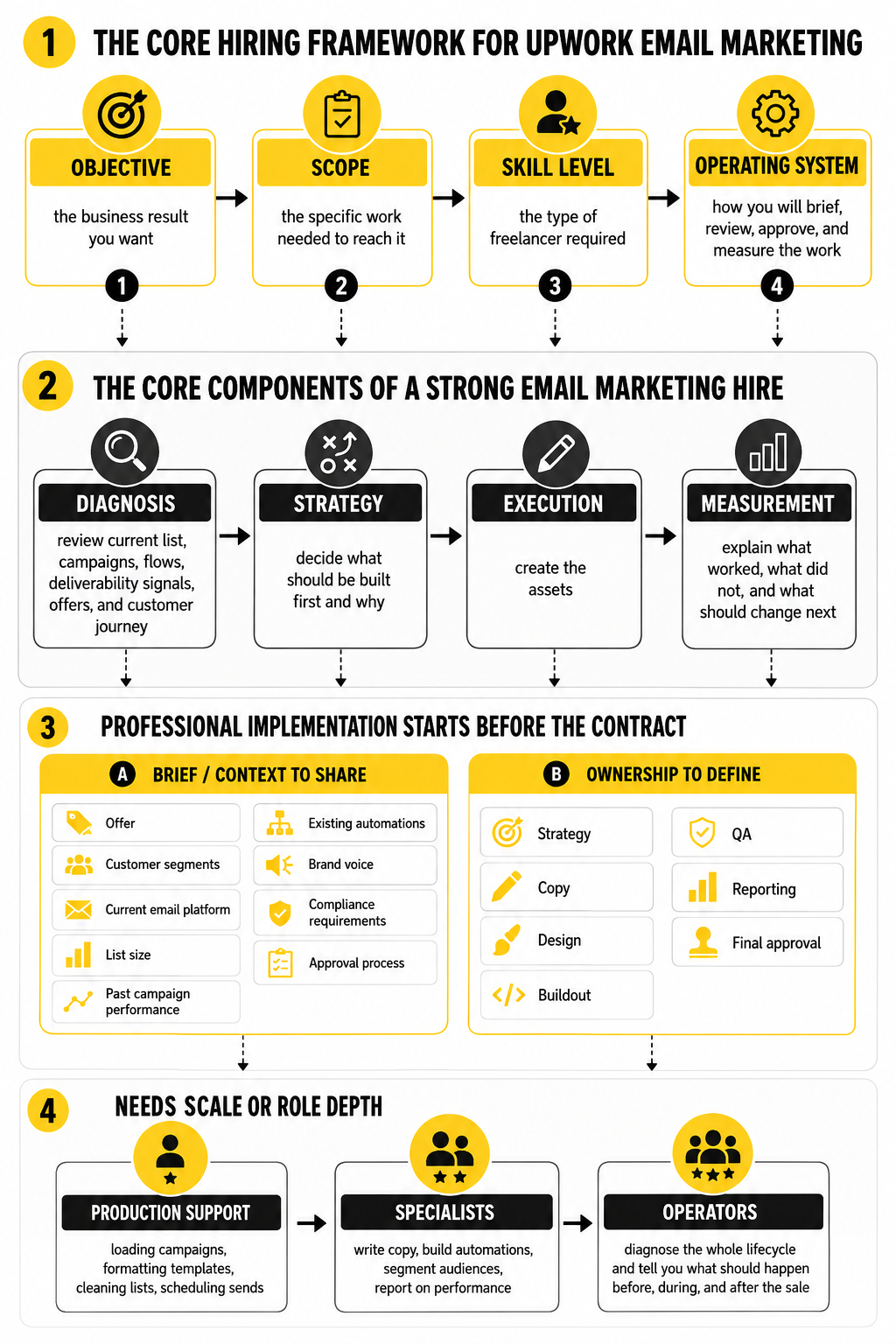
That distinction matters because email marketing work exists on a spectrum. At one end, you have production support: loading campaigns, formatting templates, cleaning lists, and scheduling sends. In the middle, you have specialists who can write copy, build automations, segment audiences, and report on performance. At the higher end, you have operators who can diagnose the whole lifecycle and tell you what should happen before, during, and after the sale.
Most bad hires happen when the client needs the second or third type of person but writes a job post for the first. The freelancer then does exactly what was requested, but the business still does not grow. That is frustrating, but it is also preventable. Better hiring starts with a better framework.
A Practical Framework for Hiring
The best way to approach Upwork email marketing is to separate the hiring process into four decisions: objective, scope, skill level, and operating system. The objective is the business result you want. The scope is the specific work needed to reach it. The skill level is the type of freelancer required. The operating system is how you will brief, review, approve, and measure the work.
This framework keeps you from writing vague job posts like “Need an email marketing expert.” That kind of post attracts everyone, which means you have to sort through too many weak proposals. A sharper post might say you need a Klaviyo specialist to audit an ecommerce account, rebuild core lifecycle flows, improve segmentation, and create a 30-day campaign calendar tied to repeat purchase and revenue per recipient. That gives serious freelancers something concrete to respond to.
The same logic applies if you are building a service business funnel. You may need a CRM and automation setup that turns new leads into booked calls, not just a newsletter writer. In that case, a platform like GoHighLevel may fit naturally if your workflow depends on pipelines, appointment booking, SMS, email automation, and agency-style client management. The tool is not the strategy, though. The freelancer still needs to understand the customer journey.
Core Components of a Strong Email Marketing Hire
A strong email marketing hire usually brings four components to the table: diagnosis, strategy, execution, and measurement. Diagnosis means they can look at your current list, campaigns, flows, deliverability signals, offers, and customer journey before making recommendations. Strategy means they can decide what should be built first and why. Execution means they can actually create the assets. Measurement means they can explain what worked, what did not, and what should change next.
You want all four components present, even if the freelancer is stronger in one area than another. A copywriter who never looks at segmentation may write polished emails to the wrong people. A technical automation specialist who ignores messaging may build clean workflows that fail to persuade. A designer who focuses only on visuals may create beautiful emails that underperform because the offer, timing, or audience is wrong.
The strongest Upwork freelancers tend to show evidence of thinking, not just screenshots. They can explain the problem behind a campaign, the reason behind a flow structure, and the tradeoffs behind their recommendations. They do not promise magic numbers without context. They ask about margins, customer behavior, list quality, attribution, product mix, sales cycle, and previous campaign data.
Professional Implementation Starts Before the Contract
Professional implementation starts before you click “hire.” It begins with the brief, because freelancers can only make strong decisions when they understand the business. You should be ready to share your offer, customer segments, current email platform, list size, past campaign performance, existing automations, brand voice, compliance requirements, and approval process. Without that context, even a talented freelancer is forced to guess.
A good brief also defines ownership. Someone needs to own strategy, copy, design, buildout, QA, reporting, and final approval. In a small business, one freelancer may handle most of that. In a more mature business, the Upwork email marketer may work alongside a designer, developer, paid media buyer, retention manager, or founder. Either way, unclear ownership slows everything down.
This is where many projects fail quietly. The freelancer is hired, but no one gives them access, no one approves drafts quickly, and no one decides how performance will be judged. Then the project drifts. The fix is simple but non-negotiable: define the workflow before the first campaign is built.
The Framework for Hiring the Right Email Marketer
A good Upwork email marketing hire starts with one simple question: what business problem should email solve right now? Not every company needs the same kind of freelancer. A store with strong traffic but weak repeat purchases needs a different operator than a consultant with a messy lead nurture sequence or an agency trying to manage email for several clients.
The framework from Part 1 gives you a practical way to avoid hiring blindly. Start with the objective, then define the scope, match the skill level, and build the operating system around the work. This sounds obvious, but most weak Upwork posts skip at least two of those steps. That is why they attract freelancers who can complete tasks but cannot create meaningful progress.
Email is too valuable to manage casually. Recent Litmus reporting shows that 35% of companies see email ROI of 36:1 or more, and Klaviyo’s 2026 benchmarks show ecommerce email performance varying heavily by industry, with revenue per recipient benchmarks ranging from low cents to multiple dollars. That range matters. It proves the channel can work, but it also proves execution quality changes everything.
Start With the Business Objective
Before you hire anyone, define the commercial outcome in plain language. “Improve email marketing” is not an objective. “Increase repeat purchases from existing customers,” “recover more abandoned checkouts,” “turn webinar leads into booked calls,” or “reactivate cold subscribers before a product launch” is much better.
This matters because the objective determines the type of Upwork email marketing freelancer you need. A lifecycle strategist can map customer journeys and prioritize automations. A copywriter can sharpen campaign messaging. A technical email specialist can clean up integrations, tagging, triggers, and deliverability problems. A campaign manager can keep the calendar moving every week.
Do not make the freelancer guess which role you need. If the business problem is unclear, strong freelancers either avoid the job or charge more because they know discovery will take time. Weak freelancers will say yes immediately. That is not a good sign; it usually means they are responding to the task, not diagnosing the business.
Define the Scope Before You Define the Budget
Budget makes more sense after scope. Upwork lists email marketers commonly around $15 to $40 per hour, with a median rate around $25, but that does not mean every email project belongs in that range. A simple newsletter setup and a full lifecycle revenue audit are not the same job.
A tight scope protects both sides. It tells the freelancer what success looks like, and it helps you compare proposals fairly. Without scope, one freelancer may quote for five campaigns, another may quote for strategy and automation, and another may quote for a quick template refresh. Those proposals are not comparable, even if they all use the phrase “email marketing.”
For most businesses, scope should include the platform, list size, assets needed, number of emails or flows, integrations, reporting expectations, and approval process. If you are using a broader sales and automation platform like GoHighLevel, include whether the freelancer will handle email only or also pipelines, forms, calendars, SMS, and follow-up automations. That one detail can completely change the workload.
Match the Freelancer to the Growth Stage
A new business with a small list should not hire the same way as a mature ecommerce brand with years of purchase data. Early-stage businesses usually need foundational work: list capture, a welcome sequence, basic segmentation, and a simple campaign rhythm. Mature businesses need deeper optimization: lifecycle analysis, deliverability monitoring, purchase behavior segmentation, testing plans, and revenue reporting.
This is where many founders overhire or underhire. Overhiring happens when they pay for an expensive strategist before there is enough data or traffic to justify the work. Underhiring happens when they hire a cheap task executor to fix a strategic revenue problem. Both mistakes waste money, just in different ways.
The practical move is to match the freelancer to the stage of the channel. If you have no email foundation, hire someone who can build clean basics quickly. If the foundation exists but performance is flat, hire someone who can audit and improve the system. If email already drives meaningful revenue, hire someone with enough strategic depth to protect the channel while increasing output.
Separate Strategy, Copy, Design, and Technical Buildout
Email marketing looks like one service, but it is usually several services wrapped together. Strategy decides what should be sent, to whom, and why. Copy turns that decision into persuasive messaging. Design makes the email readable, branded, and easy to act on. Technical buildout makes sure the right person receives the right message at the right time.
Some Upwork freelancers can handle all four well, but many cannot. That is not a problem if you know it upfront. A brilliant copywriter may not be the right person to debug a broken Klaviyo integration. A technical automation specialist may not be the right person to write a high-converting product launch sequence. A designer may make emails look polished but still need strategic direction.
Your job is to decide whether you need a generalist or a specialist. A generalist is useful when the account is simple and speed matters. A specialist is better when the stakes are higher, the list is larger, or the problem is specific. The more revenue email already touches, the more careful you should be about hiring someone who only understands one layer of the work.
Build a Simple Measurement System
A freelancer cannot prove value if nobody agrees on measurement. Opens are useful directional signals, but they are not enough. Clicks, conversions, revenue per recipient, unsubscribe rate, spam complaints, deliverability health, booked calls, repeat purchase rate, and list growth may all matter depending on the business model.
For ecommerce, campaign and flow revenue are usually important, but they need context. Klaviyo’s public benchmark data shows that email performance varies by vertical, and top-performing brands are not simply sending more; they are usually doing a better job with segmentation, offers, and lifecycle timing. That means your Upwork email marketing hire should be judged on the quality of the system, not just one campaign that had a good day.
For service businesses, measurement can be less obvious but still very clear. Track lead-to-call rate, call show-up rate, reply rate, pipeline movement, and sales opportunities influenced by email. If your funnel includes landing pages and sales pages, tools like ClickFunnels or Systeme.io may help connect the email journey to the conversion path. Again, the tool is only useful when the strategy is clear.
Decide What “Good” Looks Like Before Work Begins
You should not wait until the end of the project to decide whether the freelancer did a good job. Define quality before the first draft, first flow, or first campaign is delivered. Good can mean sharper segmentation, cleaner automation logic, better subject line testing, stronger calls to action, improved deliverability hygiene, faster campaign production, or more reliable reporting.
This is important because email work often has delayed results. A welcome flow may need time to collect enough data. A win-back sequence may only affect a smaller segment of the list. A deliverability cleanup may temporarily reduce send volume before improving inbox placement. If you judge too quickly or too vaguely, you may punish the right work and reward the wrong work.
A professional freelancer will respect clear standards. They may even help you refine them during the discovery phase. What you want to avoid is a project where success is based on feelings: “I liked the emails” or “I thought revenue would be higher.” Feelings are not useless, but they are not a management system.
Turn the Framework Into a Hiring Brief
Once the objective, scope, skill level, and measurement system are clear, turn them into a concise hiring brief. This brief does not need to be long. It needs to be specific enough that serious freelancers can understand the business and decide whether they are a fit.
A strong brief should include:
This is where Upwork email marketing starts to become much easier. Instead of attracting generic proposals, you give experienced freelancers enough signal to respond intelligently. Their proposal quality becomes part of the test. If they ignore the business objective and only talk about templates, you know what kind of freelancer they are.
The Best Hire Is Usually the Best Fit, Not the Cheapest Option
Price matters, but fit matters more. A lower-cost freelancer can be a great choice for production work, simple setup, or clearly documented tasks. A higher-cost freelancer can be worth it when they prevent strategic mistakes, improve lifecycle revenue, or clean up a system that has been underperforming for months.
The dangerous middle is hiring cheap while expecting strategic ownership. That is where businesses get disappointed. They want diagnosis, planning, copy, design, technical setup, QA, and reporting, but they budget as if they are only buying data entry. Strong email marketers notice that mismatch immediately.
The better approach is honest alignment. If you need execution, hire for execution and provide the strategy. If you need strategy, pay for someone who can think. If you need both, make that clear in the brief and expect the budget to reflect it. Email can produce serious returns, but only when the person managing it has the right mandate.
Core Skills to Look For Before You Hire
Once the hiring framework is clear, the next step is knowing what skill actually looks like. This is where Upwork email marketing gets tricky, because almost every freelancer can claim they know campaigns, automations, segmentation, and reporting. The difference is in how they talk about tradeoffs, priorities, and constraints.
A strong email marketer does not jump straight into “I will build five flows.” They ask what the business sells, how customers buy, where leads come from, how the list was built, what has already been sent, and what revenue or conversion data exists. That curiosity is not a nice bonus. It is the difference between someone who follows instructions and someone who can improve the system.
The goal is not to find a unicorn who is perfect at everything. The goal is to understand the core skills well enough to hire the right person for the right job. If you can identify these skills during proposal review and interviews, your odds of making a good Upwork hire go way up.
Strategic Diagnosis
Strategic diagnosis is the ability to look at the account before prescribing work. A freelancer with this skill will want to review your current email platform, list health, opt-in sources, segments, automations, campaign history, attribution setup, and customer journey. They will not assume the problem is “more emails” until they understand what is already happening.
This matters because email problems often hide behind surface-level symptoms. Low revenue may come from weak offers, poor segmentation, broken tracking, bad landing pages, thin traffic, weak deliverability, or an email calendar that ignores buying intent. A task-only freelancer may keep sending campaigns into that mess. A strategic freelancer slows down long enough to find the bottleneck.
You can test this skill by asking what they would audit first. A strong answer usually includes list quality, existing flows, recent campaign performance, core customer segments, deliverability basics, and the conversion path after the click. If they only talk about subject lines and templates, they may be useful for production, but they are probably not the person to own strategy.
Customer Journey Thinking
Email marketing works best when it follows the customer journey instead of forcing every subscriber into the same message stream. New leads need context and trust. First-time buyers need reassurance, product education, and a reason to come back. Loyal customers need relevance, exclusivity, and well-timed offers. Cold subscribers need a different approach entirely.
This is why lifecycle thinking is such a valuable skill. The freelancer should be able to explain what happens before purchase, after purchase, before renewal, after inactivity, and around key moments in the sales cycle. For ecommerce, that could include welcome, browse abandonment, cart abandonment, post-purchase, replenishment, cross-sell, win-back, and VIP flows. For service businesses, it could include lead nurture, appointment reminders, no-show follow-up, proposal follow-up, referral requests, and reactivation.
Good customer journey thinking also prevents over-emailing. Not everyone should receive every campaign. The more mature your email program becomes, the more important it is to control who receives what and when. That is how you protect attention while still increasing revenue.
Segmentation and Personalization
Segmentation is one of the clearest signs that a freelancer understands real email marketing. They should know how to group people by behavior, purchase history, lifecycle stage, engagement, lead source, product interest, and intent. They should also understand that personalization is not just dropping a first name into the subject line.
Modern email platforms make segmentation easier, but the thinking still matters. Klaviyo’s 2026 benchmarks show that ecommerce email performance can vary widely across industries, with revenue per recipient benchmarks ranging from $0.32 to $2.54 in the benchmark view. That kind of spread is a reminder that sending volume alone is not the advantage. Relevance is.
When reviewing an Upwork email marketing freelancer, look for evidence that they can build segments for a reason. “Engaged subscribers,” “recent buyers,” “high-intent browsers,” “repeat customers,” and “lapsed customers” should not be random labels. Each segment should connect to a different message, offer, cadence, or automation path.
Copywriting That Matches Intent
Email copy is not just writing nicely. It is matching the message to the reader’s stage of awareness and the action you want them to take. A welcome email should not sound like a hard-sell clearance blast. A cart abandonment email should not read like a generic newsletter. A win-back email should not pretend the subscriber is still highly engaged.
A strong email copywriter understands subject lines, preview text, hooks, offer framing, objection handling, calls to action, and message hierarchy. They also know when to keep an email short and when a longer explanation is necessary. In practical terms, they write for movement, not decoration.
When hiring on Upwork, ask to see samples that include context. A portfolio screenshot is useful, but it is not enough. You want to know the audience, the goal, the offer, and the reason behind the structure. If the freelancer can explain those decisions clearly, they are much more likely to write emails that support the business instead of just filling a calendar.
Technical Platform Skill
The technical side matters because a good strategy can fail if the setup is messy. Triggers, filters, exclusions, tags, custom fields, suppression rules, product feeds, forms, landing pages, and integrations all affect what subscribers actually experience. One wrong condition can send the wrong message to the wrong person at the wrong time.
Platform fit depends on your business model. Ecommerce brands may need someone strong in Klaviyo, Shopify, WooCommerce, or similar ecommerce systems. Service businesses and agencies may need CRM-first automation, pipelines, booking flows, and multi-step follow-up inside a platform like GoHighLevel. Simpler creators or lean businesses may prefer an all-in-one funnel and email setup through Systeme.io or a sales funnel builder like ClickFunnels.
Do not hire based only on tool logos. Ask what they have actually built inside the platform. A strong freelancer can describe automation logic, segmentation rules, testing steps, and reporting setup. A weaker one usually stays vague and says they are “familiar with” the tool.
Deliverability Awareness
Deliverability is not glamorous, but it is critical. If emails do not reach the inbox, the copy, design, and offer barely matter. A capable email marketer should understand sender authentication, list hygiene, engagement quality, unsubscribe handling, spam complaint risk, and the danger of blasting unengaged subscribers.
This became even more important after major inbox providers tightened sender requirements. Google’s sender guidelines require messages to pass authentication through SPF or DKIM, with DMARC alignment for many sending scenarios, while Yahoo’s sender guidance highlights authentication, low complaint rates, and easy unsubscribe handling as core requirements. The practical takeaway is simple: your freelancer should not treat deliverability as an afterthought.
Ask direct questions here. What would they check before increasing campaign volume? How would they handle a cold list? What complaint rate would worry them? What would they do if open rates suddenly dropped across major domains? You do not need them to be a full deliverability consultant for every project, but they should know enough not to damage your sender reputation.
The Implementation Process
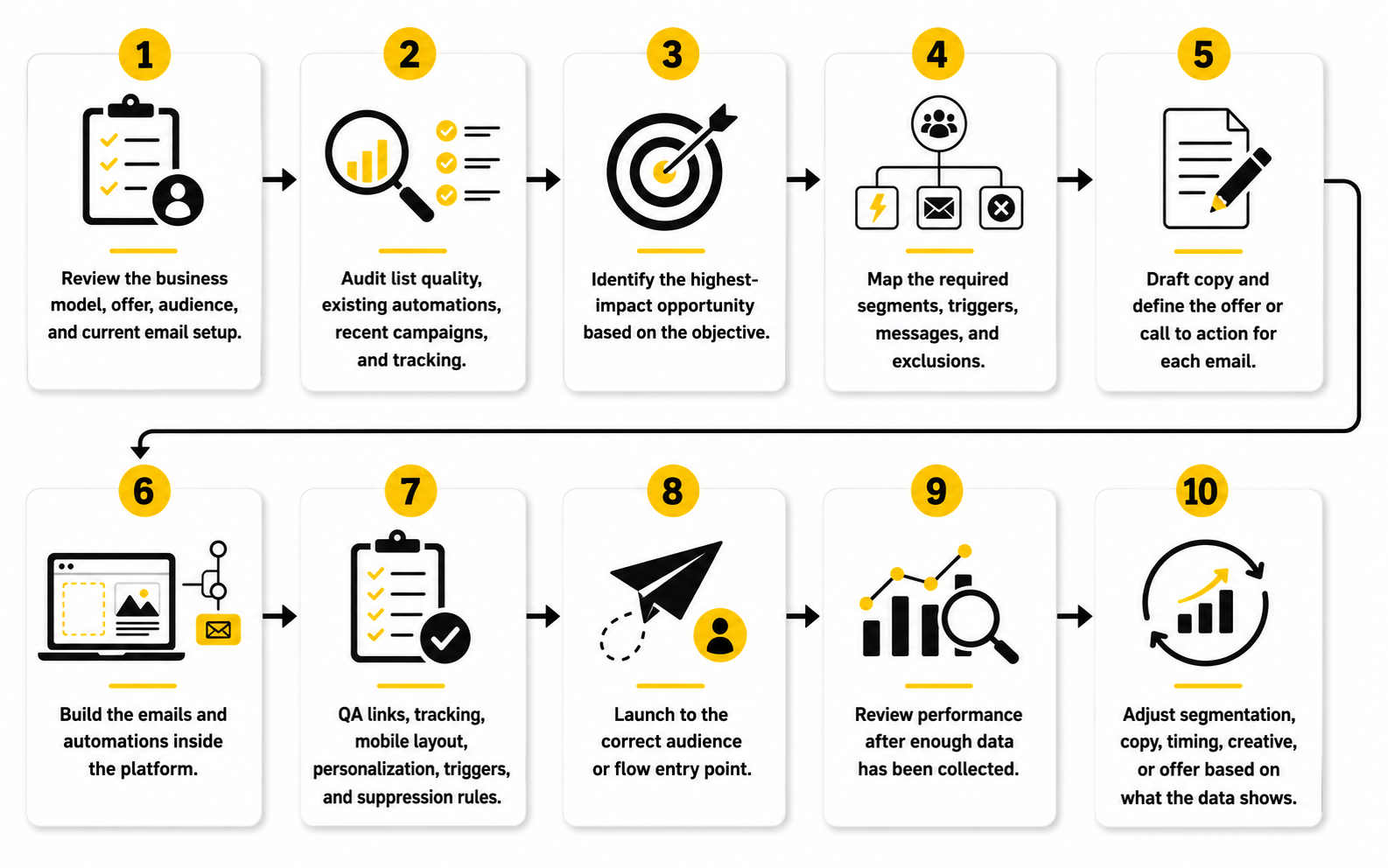
Implementation should feel controlled, not chaotic. The best Upwork email marketing projects move through a clear sequence: audit, plan, build, review, test, launch, measure, and improve. That process creates speed because everyone knows what happens next.
A practical implementation flow looks like this:
This process is especially useful because it stops the freelancer from jumping straight into production. It also gives you checkpoints before anything goes live. That matters when emails affect real customers, real leads, and real revenue.
Quality Assurance Before Launch
QA is where many email projects either become professional or become risky. Every email should be checked for broken links, wrong products, missing UTM parameters, mobile layout issues, personalization errors, outdated pricing, spelling mistakes, and incorrect segments. For automations, the QA process should also test triggers, delays, exits, exclusions, and conflicts with other flows.
This step is not busywork. A small mistake in email can scale quickly because one click sends the message to hundreds, thousands, or tens of thousands of people. If the freelancer treats QA casually, that is a warning sign. Good email marketers are slightly obsessive before launch because they know how expensive sloppy work can be.
A simple QA checklist should be part of the project workflow. It does not need to be complicated, but it should be written down. The person approving the email should know what has already been checked and what still needs a final human review.
Reporting and Optimization
Reporting should explain what happened and what to do next. A weak report dumps opens, clicks, and revenue into a screenshot. A strong report connects performance to decisions: which segment responded, which message angle worked, where drop-off happened, and what should be tested or changed next.
For ecommerce, useful reporting may include revenue per recipient, placed order rate, click rate, unsubscribes, spam complaints, flow revenue, campaign revenue, and performance by segment. For service businesses, useful reporting may include replies, booked calls, show-up rates, pipeline movement, and lead quality. The metric should match the job the email was hired to do.
This is where long-term Upwork email marketing relationships become valuable. Once the freelancer understands the business and the data, they can improve the system faster each month. The first project builds the foundation. The next cycles turn that foundation into a more predictable revenue channel.
Collaboration Skill
Email marketing touches too many parts of the business for the freelancer to work in isolation. They may need input from the founder, designer, developer, customer support team, sales team, paid media buyer, or ecommerce manager. That means collaboration is a real hiring skill, not a soft extra.
Look for freelancers who communicate clearly, ask focused questions, and document decisions. They should be able to explain why they need access, what they are changing, when they need feedback, and what is ready for approval. If they disappear for days and return with finished work that misses the brief, the process will get painful quickly.
The best collaborators reduce your mental load. They do not need hand-holding for every tiny decision, but they also do not make major changes without context. That balance is exactly what you want when hiring email marketing help through Upwork.
How to Write an Upwork Job Post That Attracts Strong Specialists
By this point, the hiring target should be much clearer. You know the business problem, the scope, the skill level, and the implementation process. Now comes the part that decides who actually applies: the Upwork job post.
Most Upwork email marketing job posts are too vague. They ask for an “email marketing expert” without explaining the business model, platform, list condition, deliverables, or success metric. That forces serious freelancers to guess, and serious freelancers do not like guessing. The best ones want enough context to decide whether they can help.
A strong job post does not need to be long. It needs to be specific, honest, and outcome-driven. The more clearly you describe the problem, the easier it becomes for skilled freelancers to respond with useful ideas instead of generic portfolio links.
What to Include in the Job Post
Start with the business model and the current situation. Say whether you run an ecommerce store, SaaS product, agency, course business, coaching offer, marketplace, local service company, or B2B sales funnel. Then explain what email currently does inside the business. Are you starting from zero, fixing a weak system, replacing a freelancer, launching a product, or trying to scale an existing email program?
Next, name the platform and connected tools. A freelancer working in Klaviyo needs different context than someone building automations inside GoHighLevel, Systeme.io, ClickFunnels, Mailchimp, HubSpot, ActiveCampaign, or another CRM. The tool affects setup, tracking, segmentation, and what kind of freelancer is best suited for the job.
Then define the deliverables in plain language. Do you need an audit, a strategy document, three flows, eight campaign emails, a newsletter calendar, template design, list cleanup, deliverability checks, CRM tagging, reporting, or ongoing management? Strong freelancers can price and plan accurately when the deliverables are clear. Weak job posts create weak proposals.
Statistics and Data
Data should make your Upwork email marketing hire easier to manage, not more confusing. The point is not to collect random benchmarks and pressure the freelancer with them. The point is to understand what each metric actually tells you, what it does not tell you, and what action it should drive.
Email remains attractive because the upside is real. Litmus reports that 35% of companies see email ROI of 36:1 or more, while its ROI analysis shows many companies sitting in the 10:1 to 36:1 range. That is enough to justify serious investment, but it is not a guarantee. ROI depends on list quality, offer strength, deliverability, attribution, segmentation, lifecycle timing, and the quality of the freelancer managing the channel.
Benchmarks are useful only when you compare the right thing. Klaviyo’s 2026 ecommerce benchmarks, based on more than 183,000 customers, show average campaign open rates around 31.0%, click rates around 1.69%, revenue per recipient around $0.32, and order rates around 0.05% across the visible benchmark summary. Those numbers are not a universal target for every business. They are a reference point for ecommerce senders using a specific platform and dataset.
MailerLite’s 2026 benchmark report shows a different kind of dataset, with a 2025 average open rate of 43.46% and average click rate of 2.09%. That does not automatically mean MailerLite users are “better” or Klaviyo users are “worse.” It means list composition, industries, customer types, measurement methods, and sender behavior can change the averages. This is why a good freelancer should use benchmarks as context, not as a lazy scoreboard.
The Metrics That Actually Matter
Open rate is useful, but it is not the business result. It can help diagnose subject lines, sender trust, list engagement, timing, and deliverability, but privacy changes and inbox behavior make it imperfect. A higher open rate is nice, but it does not pay you unless the email moves people toward a meaningful action.
Click rate is usually more actionable because it shows whether the message created enough interest for someone to leave the inbox. If opens are strong but clicks are weak, the issue may be the offer, copy, creative, call to action, or audience match. If clicks are strong but conversions are weak, the problem may be after the click: landing page, product page, checkout, calendar booking flow, pricing, or sales process.
Revenue per recipient is powerful for ecommerce because it connects email performance to list value. It helps answer a practical question: when you send to a specific segment, how much revenue does each recipient generate on average? But it still needs context. A small VIP segment may produce high revenue per recipient, while a broad newsletter send may produce lower revenue but still create meaningful total revenue.
Build a Measurement System Before You Judge Performance
Measurement should be built before the freelancer starts optimizing. Otherwise, every conversation becomes subjective. The freelancer says performance improved, the client says revenue feels low, and nobody can tell whether the issue is email, tracking, attribution, traffic quality, or the offer.
A simple measurement system should connect four layers: deliverability, engagement, conversion, and business impact. Deliverability tells you whether emails are likely reaching inboxes. Engagement tells you whether people are opening, clicking, replying, or unsubscribing. Conversion tells you whether subscribers are buying, booking, registering, or taking the intended action. Business impact tells you whether email is improving revenue, retention, pipeline, or customer lifetime value.
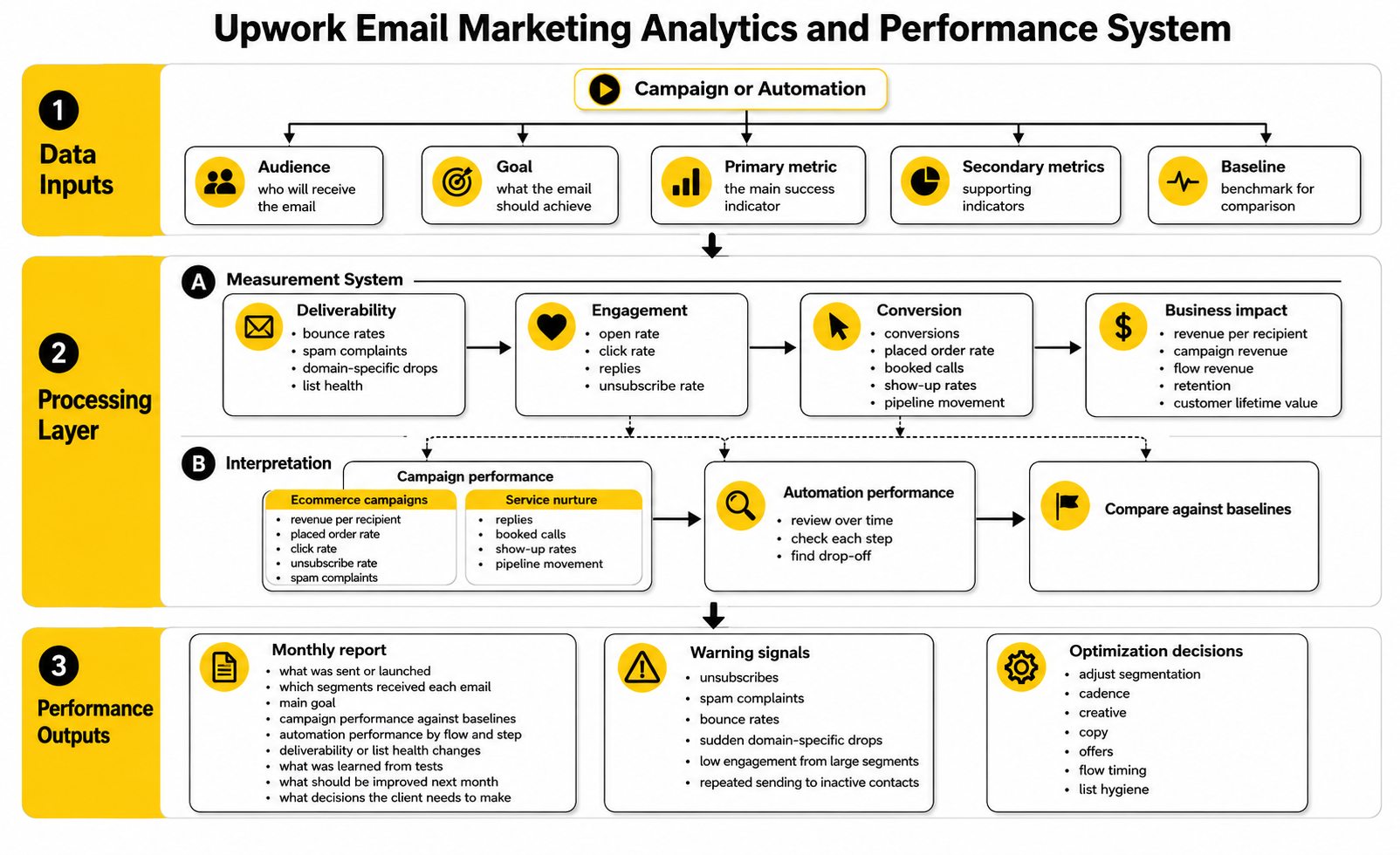
This is where the analytics process becomes very practical. For every campaign or automation, define the audience, goal, expected action, primary metric, secondary warning signals, and next decision. That one habit turns reporting from passive observation into management.
A useful measurement setup might include:
How to Interpret Campaign Performance
Campaign performance should be judged against intent. A flash sale email, educational newsletter, product launch email, referral request, and reactivation campaign should not all be judged by the same standard. They exist for different reasons, so the data needs to be interpreted differently.
For a promotional ecommerce campaign, revenue per recipient, placed order rate, click rate, unsubscribe rate, and spam complaints matter. If revenue is high but unsubscribes spike, the campaign may have made money while weakening the list. If clicks are high but orders are low, the email probably did its job and the landing page, offer, product page, or checkout needs attention.
For a service business nurture email, replies, booked calls, show-up rates, and pipeline movement may matter more than direct checkout revenue. A freelancer managing this kind of email program should understand the CRM journey, not just the broadcast tool. When email connects to booking and follow-up, tools like Cal.com or GoHighLevel can make the measurement path clearer because the email is tied to appointment behavior and pipeline stages.
How to Interpret Automation Performance
Automations need a different lens because they run continuously. A welcome flow, abandoned cart flow, lead nurture sequence, post-purchase series, or win-back flow should be evaluated over time, not after one small batch of recipients. The freelancer should look at each step and ask where people are dropping off.
For ecommerce, automated flows often show stronger intent than regular campaigns because they are triggered by behavior. Klaviyo’s benchmark resources show abandoned cart, welcome, browse abandonment, and win-back flows producing different revenue per recipient patterns, including higher values for abandoned cart flows in some order-value ranges. The lesson is straightforward: timing and intent matter.
For lead generation, automations should be measured by movement. Did new leads consume the next piece of content, book a call, reply, attend, request a quote, or move deeper into the sales process? If a freelancer only reports opens and clicks on a lead nurture sequence, they are probably not measuring close enough to the money.
Warning Signals You Should Not Ignore
Some metrics are not growth signals. They are warning signals. Unsubscribes, spam complaints, bounce rates, sudden domain-specific drops, low engagement from large segments, and repeated sending to inactive contacts can all point to future deliverability problems.
Google’s sender rules make this more serious for bulk senders. Gmail guidance requires authentication practices such as SPF or DKIM, DMARC for many bulk sending scenarios, easy unsubscribe, and keeping spam rates low; Google’s FAQ also notes that bulk senders may remain ineligible for mitigation when user-reported spam rates are greater than 0.3%. That number should make every business more careful about list quality and send relevance. If subscribers complain, the inbox will eventually push back.
This is why your Upwork email marketing freelancer should not celebrate revenue while ignoring complaints. A campaign can make money today and damage tomorrow’s deliverability. The right person protects both the short-term result and the long-term health of the channel.
Benchmarks Should Lead to Better Questions
Benchmarks are not there to make you feel good or bad. They are there to trigger better questions. If your open rate is far below a relevant benchmark, ask whether the issue is list quality, sender reputation, subject lines, audience fatigue, or poor segmentation. If your click rate is weak, ask whether the message, offer, creative, or call to action is unclear. If revenue per recipient is low, ask whether the audience has buying intent or whether the landing page is failing.
This is also how you evaluate freelancer reporting. A strong freelancer does not just say, “Open rate was 38% and click rate was 2.1%.” They explain what those numbers mean, what probably influenced them, and what should happen next. That is the difference between reporting and analysis.
The best Upwork email marketing relationships become better over time because the freelancer builds a performance memory. They learn which segments respond, which offers work, which angles create clicks, which automations produce revenue, and which campaigns create fatigue. That learning compounds, but only if the data is tracked consistently and interpreted honestly.
What the Freelancer Should Report Each Month
Monthly reporting should be short enough to read and clear enough to act on. You do not need a 40-slide presentation full of vanity charts. You need a direct explanation of performance, risks, decisions, and next steps.
A good monthly report should cover:
This reporting rhythm keeps the freelancer accountable without turning the relationship into micromanagement. It also helps you separate real performance issues from normal variance. One weak campaign is not always a crisis. A three-month pattern is something to investigate.
Data Should Change the Work
The point of measurement is action. If the data does not change the work, the reporting is mostly decoration. Your freelancer should use performance signals to adjust segmentation, cadence, creative, copy, offers, flow timing, and list hygiene.
For example, weak click rates may lead to sharper hooks, fewer competing calls to action, stronger offer framing, or cleaner email design. High unsubscribe rates may lead to tighter targeting, lower frequency for certain segments, or a better preference center. Strong performance from a specific customer segment may lead to more campaigns built around that segment’s buying behavior.
This is where Upwork email marketing becomes a real growth system instead of a task list. The freelancer sends, measures, learns, and improves. You get more than emails. You get a channel that becomes more carefully with every campaign.
How to Interview, Test, and Manage Email Marketing Freelancers
A strong job post gets better applicants, but it does not replace judgment. The next step is evaluating how an Upwork email marketing freelancer thinks before you give them access to your list, automations, and customer data. This is where you separate polished profiles from people who can actually operate.
Do not interview only for confidence. Confidence is easy to fake in marketing because the language sounds impressive: lifecycle strategy, segmentation, optimization, deliverability, revenue growth, customer journey, retention. The real test is whether the freelancer can explain what they would do, why they would do it, what they would avoid, and how they would measure the result.
The best interviews feel practical. You are not trying to trap the freelancer. You are trying to see whether their thinking matches the work your business needs. If they can diagnose clearly, communicate simply, and push back when needed, you probably have a better candidate than someone who agrees with everything immediately.
Ask Questions That Reveal Thinking
Generic questions get generic answers. “Do you know Klaviyo?” or “Can you write emails?” will not tell you enough. A better question gives the freelancer a realistic situation and asks them how they would approach it.
Ask what they would check first if campaign revenue dropped for three weeks. Ask how they would handle a large unengaged segment before a product launch. Ask what they would do if abandoned cart revenue looked strong but spam complaints started rising. Ask how they would prioritize work if the account had no welcome flow, no post-purchase flow, and inconsistent weekly campaigns.
Strong freelancers will slow down and ask for context. They will mention list quality, recent sends, traffic sources, offer changes, tracking, segmentation, deliverability, and the post-click experience. Weak freelancers will jump to one-size-fits-all answers like “send more emails,” “improve subject lines,” or “run A/B tests” without explaining what problem those actions solve.
Use a Paid Test Without Turning It Into Free Strategy
A paid test can be useful, especially when the project is important. The test should be small enough to complete quickly but realistic enough to reveal skill. For example, you could ask for a short audit of one flow, a rewrite of one campaign email, a segmentation plan for one launch, or a QA review of an existing automation.
Keep the test ethical. Do not ask five freelancers to each build a full strategy and then use their ideas without hiring anyone. That is not smart hiring; it is a bad reputation move. Good freelancers notice when clients are fishing for unpaid consulting.
A good paid test should have a clear brief, a defined output, and a fixed fee. You are looking for judgment, structure, communication, and attention to detail. The final answer matters, but the way they get there matters just as much.
Protect Access and Ownership
Email platforms hold sensitive business data. They contain customer names, purchase history, lead sources, revenue data, tags, segments, automations, and sometimes SMS or CRM activity. That means access should be handled professionally from day one.
Use role-based access whenever possible. Give the freelancer the permissions they need, not unlimited control by default. Keep admin ownership inside your business account, remove access when the contract ends, and document what the freelancer changes. This is basic, but it is not optional.
Ownership should also be clear in the contract and brief. You should know who owns the copy, templates, strategy documents, flow maps, reports, and creative files after payment. Upwork contracts help with the platform side, but your project brief should still make expectations obvious. Do not wait until the relationship ends to discuss who controls the work.
Manage Compliance Like a Business Risk
Email marketing is not just creative work. It touches privacy, consent, unsubscribes, claims, data handling, and regional rules. A freelancer does not need to be your lawyer, but they should understand that compliance is part of the job.
For U.S. commercial email, the FTC’s CAN-SPAM guidance requires commercial messages to avoid deceptive headers, avoid deceptive subject lines, identify the message as an ad when applicable, include a valid physical postal address, provide a clear opt-out method, and honor opt-out requests promptly. For EU and UK audiences, consent and data protection expectations are stricter under GDPR-style rules, especially when personal data and marketing permissions are involved.
This matters when you hire through Upwork because freelancers may work across countries, platforms, and business models. Do not assume they automatically understand your legal context. Give them your compliance requirements, confirm how unsubscribes are handled, and never ask them to upload questionable lists. A cheap campaign to a bad list can become expensive very quickly.
Understand the Strategy Versus Execution Tradeoff
Not every freelancer should own strategy. Some are excellent executors. They can build clean emails, follow a brief, load campaigns, format templates, and QA links. That is valuable work, especially when you already know what needs to happen.
The problem starts when you expect an execution freelancer to make senior strategic decisions. They may not challenge your offer, question your segmentation, diagnose your lifecycle gaps, or push back on risky send volume. They may simply do what you asked, even if the plan is weak. That is not always their fault. You hired the wrong level for the job.
If your business needs strategic direction, hire for it directly. Look for a freelancer who can audit, prioritize, explain tradeoffs, and make decisions based on customer behavior and commercial goals. If your business needs production support, hire for speed, accuracy, reliability, and platform skill. Mixing these expectations without saying so is where projects get messy.
Watch for Red Flags Before You Commit
Red flags are usually visible early. A freelancer who guarantees unrealistic revenue results before reviewing your data is guessing. A freelancer who wants to blast the full list without asking about engagement or consent is risky. A freelancer who cannot explain previous work beyond “I made campaigns” may not understand the strategy behind it.
Be careful with candidates who overfocus on templates and ignore the customer journey. Design matters, but email performance is not just a beauty contest. Also be careful with candidates who only talk about open rates. Opens are useful, but they are not enough to judge revenue, retention, or pipeline impact.
Communication red flags matter too. If the freelancer misses details in the job post, avoids direct questions, sends a copy-paste proposal, or cannot explain their process, do not assume it will improve after hiring. Upwork email marketing projects depend on precision. Sloppy communication before the contract usually becomes sloppy execution after the contract.
Plan for Scaling Before You Need It
The freelancer who helps you launch the first few flows may not be the same person who can manage a mature email program. That is normal. As the channel grows, the work becomes more complex, and the operating model may need to change.
At a small scale, one freelancer can often handle strategy, copy, design, buildout, and reporting. At a larger scale, you may need separate roles: lifecycle strategist, copywriter, designer, CRM or ESP specialist, deliverability consultant, and analytics support. Trying to force one person to do everything can create bottlenecks, especially if campaign volume increases.
Scaling also affects tools. A simple setup may work when you are sending a few campaigns a month. A more advanced setup may need better forms, landing pages, booking flows, CRM hygiene, and automation visibility. For service businesses or agencies, GoHighLevel can make sense when email is part of a broader follow-up and pipeline system. For lean funnel-based businesses, ClickFunnels or Systeme.io may be enough when the priority is getting an offer, landing page, and email sequence live without building a huge stack.
Avoid Tool-Led Hiring
Tool experience matters, but tool-led hiring can trap you. Someone may know where the buttons are in a platform but still lack the judgment to build a profitable email system. That is why you should hire for thinking first and tool skill second, unless the job is purely technical.
For example, a Klaviyo specialist who understands ecommerce behavior can usually explain why a post-purchase flow should change based on product type, reorder cycle, average order value, or customer segment. A CRM automation specialist should be able to explain how lead source, sales stage, call booking, and no-show behavior change the follow-up. A funnel specialist should understand how the email sequence supports the page, the offer, and the conversion event.
This does not mean tools are irrelevant. It means tools should support the strategy. If the freelancer’s entire pitch is the software they use, keep digging. You are hiring a marketer, not just a platform operator.
Build a Feedback Loop That Improves the Work
Good management does not mean micromanaging every subject line. It means creating a feedback loop where the freelancer gets enough context to improve. Share sales feedback, customer objections, product changes, promotion results, support questions, and audience insights. Those details help the freelancer write and segment better.
Feedback should be specific. “Make it punchier” is less useful than “The audience already understands the problem, so lead with the offer and proof instead of education.” “This feels off-brand” is less useful than “Our tone is direct and calm; avoid hype words like insane, secret, and guaranteed.” The clearer your feedback, the faster the freelancer adapts.
The freelancer should also bring feedback to you. They should tell you when the list is fatigued, when the offer is weak, when the approval process is slowing output, or when a segment should be excluded. That is the kind of partnership you want. Not an order taker. Not a guru. A practical operator who helps the channel get sharper.
Know When to End or Expand the Contract
Not every contract should become ongoing. Some Upwork email marketing projects are naturally project-based: audit the account, build core flows, clean up templates, set up reporting, or prepare a launch sequence. Once the work is done, the relationship can end cleanly or shift into light maintenance.
Ongoing contracts make sense when email needs consistent strategic attention. That usually means regular campaigns, monthly reporting, optimization cycles, seasonal promotions, list growth, deliverability monitoring, and lifecycle improvements. If email is already a meaningful revenue or pipeline channel, ongoing support can be easier than rebuilding context with a new freelancer every few months.
The decision is simple. Expand the contract when the freelancer is improving the system, communicating clearly, and making better decisions over time. End it when they need constant chasing, repeat the same mistakes, ignore data, or cannot grow beyond basic tasks. Email rewards consistency, but only when the person managing it keeps getting better.
Tools, Workflows, Mistakes to Avoid, and FAQ
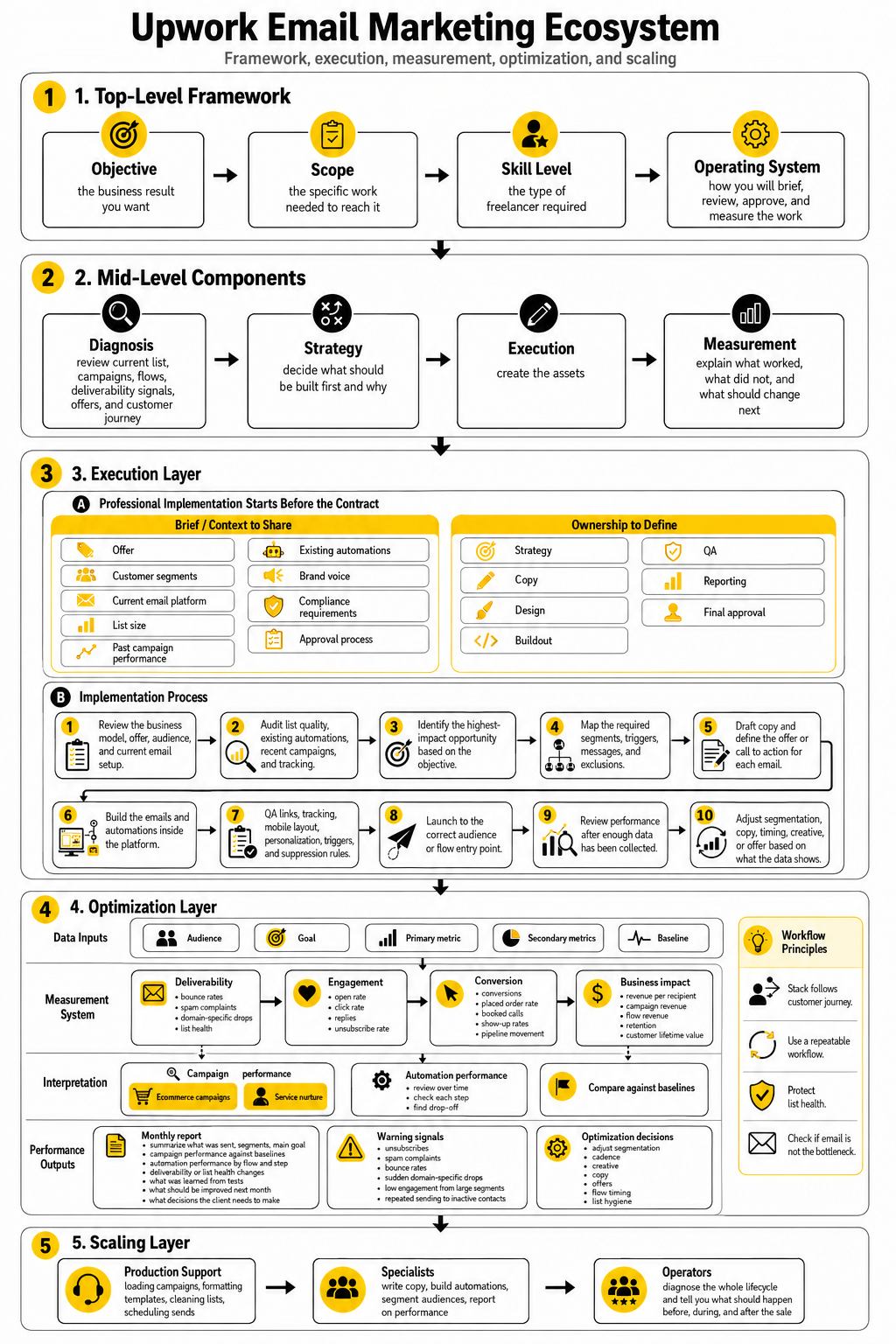
The final layer is the ecosystem around the freelancer. Upwork email marketing does not work in isolation. It depends on the tools you choose, the data you collect, the workflow you enforce, and the decisions you make after each send.
This is where many businesses accidentally create complexity. They hire a freelancer, add more software, chase more metrics, and assume the channel is becoming more advanced. But advanced does not mean complicated. Advanced means the right message reaches the right person, at the right time, with clear tracking and a reason to exist.
A clean email ecosystem should make execution easier. The freelancer should know where leads enter, how contacts are tagged, what automations run, what campaigns are planned, where conversions happen, and how performance is reviewed. If those pieces are scattered, even a skilled freelancer will spend too much time untangling the system instead of improving it.
Build the Stack Around the Customer Journey
The stack should follow the customer journey, not the other way around. If your business depends on booked calls, the email system should connect naturally to forms, calendar booking, reminders, pipeline stages, and follow-up. If your business depends on ecommerce purchases, the system should connect product behavior, customer history, segments, offers, and post-purchase timing.
For service businesses, agencies, consultants, and local lead generation, GoHighLevel can be useful when email is part of a broader sales workflow that includes pipelines, SMS, appointment booking, forms, and CRM follow-up. For creators, lean offer owners, and simple funnel businesses, Systeme.io or ClickFunnels may fit when the main priority is building pages and connecting them to sequences. For ecommerce, the best choice usually depends on your store platform, product data, catalog complexity, and lifecycle needs.
The key is not to let tools become the strategy. A better platform will not fix vague offers, weak list capture, poor segmentation, or bad follow-up logic. Hire the freelancer to improve the system, then choose tools that make that system easier to operate.
Keep the Workflow Simple Enough to Repeat
A repeatable workflow beats heroic effort. Every campaign should move through the same basic path: idea, brief, draft, review, build, QA, approval, launch, report, and learning. Every automation should move through mapping, copy, buildout, testing, launch, monitoring, and optimization.
The reason this matters is consistency. When the workflow is unclear, campaigns become last-minute, approvals drag, QA gets skipped, and reporting becomes an afterthought. That is when mistakes happen. A professional process protects the freelancer, the business, and the audience.
Your workflow should also define decision rights. The freelancer can recommend and execute, but someone inside the business should approve claims, offers, pricing, promotions, product details, and legal requirements. Email is too visible to run casually. One bad send can reach the entire list.
Avoid the Most Expensive Hiring Mistakes
The first mistake is hiring for activity instead of outcomes. More campaigns do not automatically mean more revenue. More automations do not automatically mean a better customer experience. The question is always what the work is supposed to change.
The second mistake is giving a freelancer a messy account and expecting them to create results without discovery time. If the list is cold, tracking is broken, offers are unclear, or the CRM is full of duplicate tags, the first job may be cleanup. That can feel slower than launching campaigns, but it is often the work that makes everything else possible.
The third mistake is ignoring list health. Google’s sender guidance makes deliverability discipline more important, especially for bulk senders, and its FAQ notes that senders can remain ineligible for mitigation when user-reported spam rates are above 0.3%. If a freelancer wants to blast a questionable list without checking engagement, consent, authentication, and complaints, do not treat that as aggression. Treat it as risk.
Know When Email Is Not the Bottleneck
Sometimes email is not the main problem. The campaign may get clicks, but the landing page fails. The nurture sequence may create replies, but the sales process is slow. The abandoned cart flow may work, but the checkout has friction. The newsletter may perform fine, but the offer is not compelling enough.
This is why smart Upwork email marketing work looks beyond the inbox. A freelancer does not need to own every part of the funnel, but they should be able to tell when email is exposing a different problem. If clicks are healthy and conversions are weak, the next move may be landing page testing, offer cleanup, better checkout experience, or sales follow-up improvements.
This is also where adjacent tools can help. A better form tool, landing page, calendar, CRM, or sales page can make email more measurable and more useful. But again, use tools to support a clear journey. Do not patch strategy problems with more software.
What is Upwork email marketing?
Upwork email marketing means hiring freelancers through Upwork to help with email strategy, campaigns, automations, copywriting, design, reporting, deliverability, or CRM setup. The freelancer may work on a one-time project or manage email as an ongoing channel. The quality of the result depends heavily on how clearly the business defines the objective, scope, access, and success metrics.
Is Upwork good for hiring email marketing freelancers?
Upwork can be good for hiring email marketing freelancers because it gives you access to a wide range of specialists across platforms, industries, and budgets. Upwork’s own email marketer cost guide lists common rates around $15 to $40 per hour, though experienced strategists and niche specialists may cost more. The platform is useful, but the job post and evaluation process matter more than the marketplace itself.
How much should I pay for Upwork email marketing?
The right budget depends on whether you need execution, strategy, technical setup, or full channel ownership. Simple campaign production can fit a lower budget, while lifecycle strategy, deliverability cleanup, automation rebuilds, and revenue reporting require a more experienced freelancer. A better way to budget is to define the scope first, then compare proposals based on deliverables, expertise, and expected business value.
What should I include in an Upwork email marketing job post?
Include your business model, email platform, list size, current problem, desired outcome, deliverables, timeline, approval process, and metrics. Mention whether the freelancer will handle strategy, copy, design, technical buildout, reporting, or only one part of the workflow. The clearer the post, the easier it is for strong freelancers to respond with relevant proposals.
Should I hire a generalist or a specialist?
Hire a generalist when the account is simple, the scope is clear, and you need one person to move quickly across several tasks. Hire a specialist when the problem is specific, high-value, or risky, such as deliverability, ecommerce lifecycle strategy, advanced segmentation, CRM automation, or launch copy. The more revenue email already touches, the more important specialist judgment becomes.
What email marketing skills matter most?
The most important skills are strategic diagnosis, customer journey thinking, segmentation, copywriting, technical platform skill, deliverability awareness, reporting, and collaboration. Not every freelancer will be excellent at all of them. Your job is to match the skill set to the work instead of expecting one person to do everything at the highest level.
How do I test an email marketing freelancer before hiring?
Use a small paid test that reflects the real work. You can ask for a short audit, one campaign rewrite, a flow map, a segmentation recommendation, or a QA review of an existing automation. The goal is to evaluate thinking, communication, structure, and attention to detail without asking for unpaid strategy.
What metrics should an email marketing freelancer report?
The freelancer should report metrics that match the goal of the email. For ecommerce, that may include revenue per recipient, placed order rate, click rate, unsubscribe rate, spam complaints, flow revenue, and campaign revenue. For service businesses, it may include replies, booked calls, show-up rates, pipeline movement, and lead quality.
Are open rates still useful?
Open rates are still useful as a directional signal, but they should not be treated as the main measure of success. Privacy changes and inbox behavior can make opens less reliable than clicks, conversions, replies, and revenue. MailerLite’s 2026 benchmark report shows average email open rates of 43.46% and click rates of 2.09%, but those numbers should be interpreted in context, not copied as universal targets.
What is a good email marketing benchmark?
A good benchmark depends on your industry, platform, list quality, offer, and audience. Klaviyo’s 2026 benchmark data, based on more than 183,000 customers, shows average campaign open rates around 31.0%, click rates around 1.69%, revenue per recipient around $0.32, and order rates around 0.05% in its visible summary. Those numbers are useful for comparison, but your own historical baseline is usually the most important benchmark.
What tools should an Upwork email marketer know?
The right tools depend on the business. Ecommerce marketers may need Klaviyo, Shopify, WooCommerce, or similar ecommerce systems. Service businesses may need CRM and pipeline tools like GoHighLevel. Funnel-based businesses may use ClickFunnels or Systeme.io, while content-led businesses may need newsletter, landing page, and automation tools.
How do I avoid hiring the wrong freelancer?
Avoid hiring based only on low price, tool logos, or confident promises. Ask how the freelancer would diagnose your account, what they would prioritize, what risks they would check, and how they would measure success. A good freelancer can explain tradeoffs clearly. A weak freelancer usually jumps straight to generic tactics.
Should the freelancer manage deliverability?
For most projects, the freelancer should at least understand deliverability basics. They should know about authentication, engagement, list hygiene, unsubscribes, spam complaints, and the risks of sending to cold or unverified contacts. For serious deliverability problems, you may need a specialist rather than a general email marketer.
Can one freelancer handle strategy, copy, design, automation, and reporting?
Sometimes, yes. One strong generalist can often manage a small or mid-sized email program. As the channel grows, the work may need to be split across strategy, copy, design, technical implementation, deliverability, and analytics. The mistake is assuming one freelancer can handle every layer forever without quality dropping.
When should I move from a project contract to ongoing support?
Move to ongoing support when email requires regular campaigns, optimization, reporting, list growth, deliverability monitoring, and lifecycle improvements. A project contract is enough for a defined audit, flow buildout, template cleanup, or launch sequence. Ongoing support makes sense when email is a recurring revenue or pipeline channel that needs continuous improvement.
What is the biggest mistake businesses make with Upwork email marketing?
The biggest mistake is hiring without defining the business objective. If you do not know whether email should increase repeat purchases, recover carts, book calls, nurture leads, reactivate customers, or support a launch, the freelancer is forced to guess. Clear objectives create better job posts, better proposals, better management, and better results.
Build a stronger local presence with BAAM AI
Turn your website, Google profile, social channels, and AI visibility into one growth engine
Most businesses do not need more random marketing activity. They need a consistent presence system that helps the right people find them, trust them, and take action. BAAM AI brings strategy, local SEO, website updates, Google Maps visibility, social content, AI-search readiness, media production, and reporting into one practical monthly engine.
If you want your marketing to keep working after the campaign ends, start with a free BAAM AI presence audit. See how your business shows up today and where the fastest visibility wins are at BAAM AI.