
BAAM AI Blog
Undifferentiated Marketing: What It Is and How It Works
Undifferentiated marketing—often called mass marketing—is a strategy where a company treats the entire market as one homogeneous group instead of breaking it into separate customer segments. It assumes that most...
What Undifferentiated Marketing Is
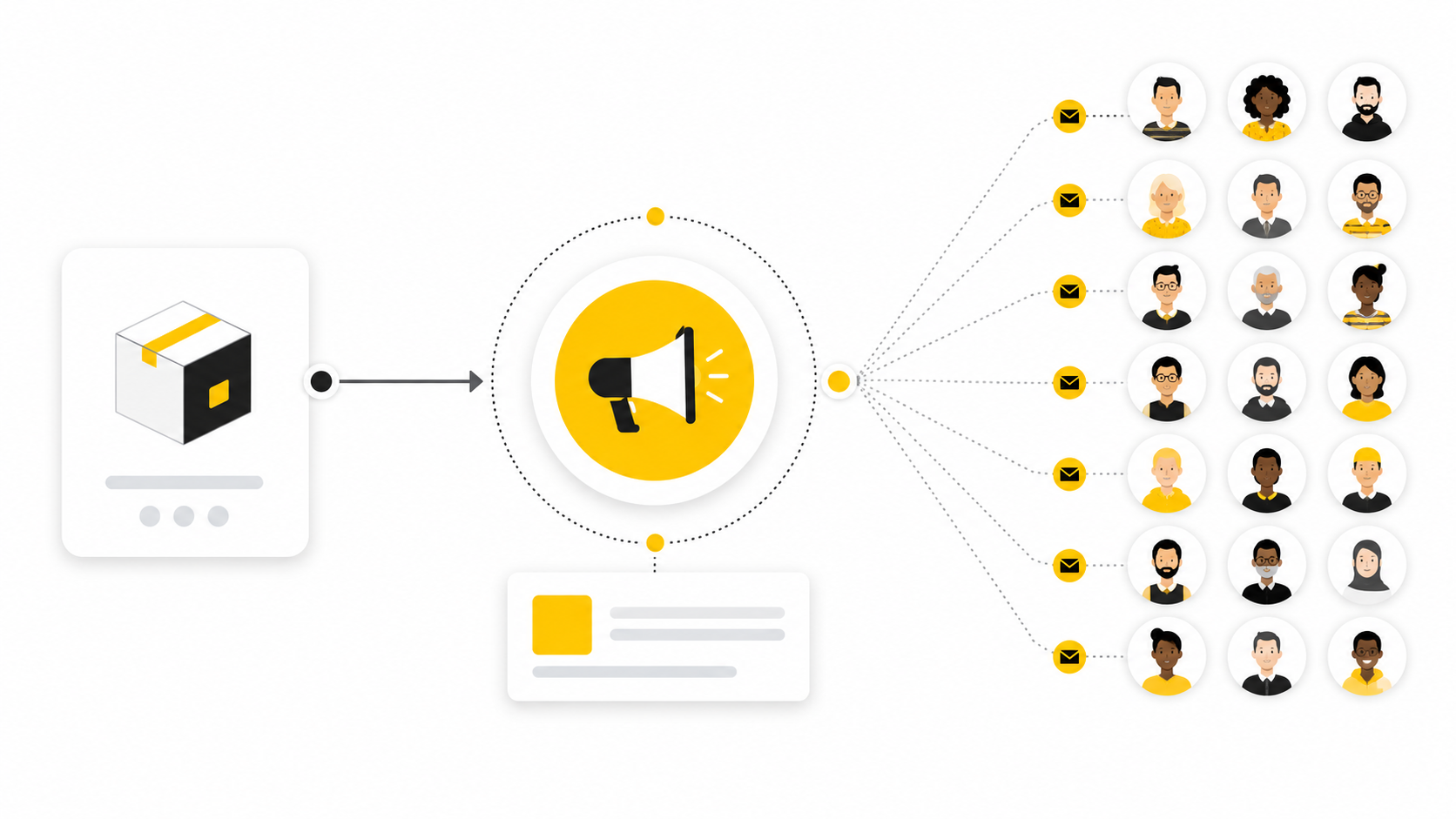
Undifferentiated marketing—often called mass marketing—is a strategy where a company treats the entire market as one homogeneous group instead of breaking it into separate customer segments. It assumes that most potential customers have similar needs and preferences and can be reached effectively with a single marketing message and mix. This contrasts with segmented or personalized strategies where the message changes per audience group.
In practical terms, this means using one product, one price strategy, one set of channels, and one broad promotional message to reach the broadest audience possible. Brands that adopt this approach focus on common customer traits rather than individual differences to simplify their marketing execution.
Why Undifferentiated Marketing Matters
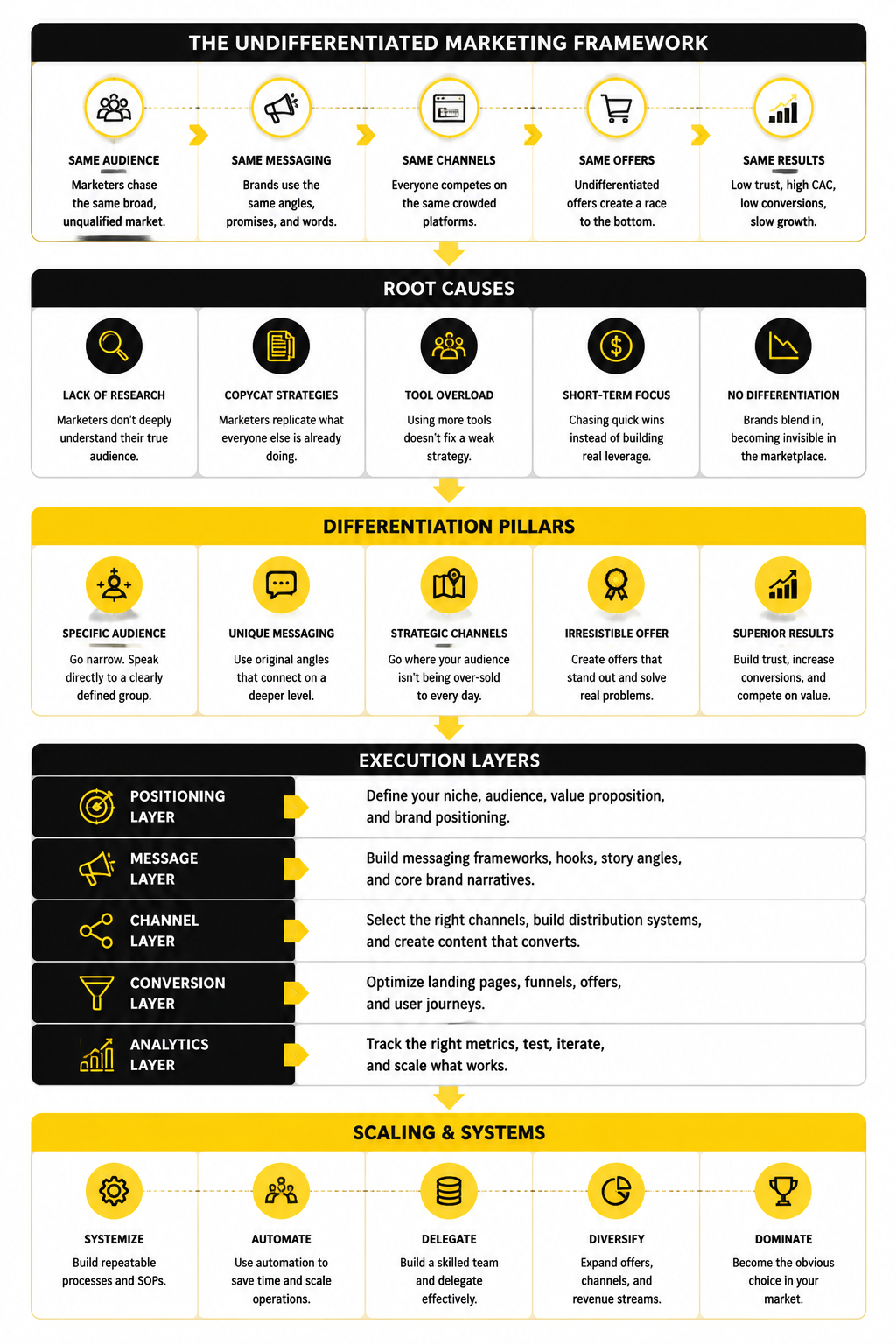
Undifferentiated marketing remains relevant because there are still products and contexts where a single, broad message is more efficient than customized campaigns. For products with universal demand—like basic household items such as soap, salt, or sugar—audiences don’t need tailored messaging for the product to appeal broadly. This makes undifferentiated marketing cost-effective and operationally simpler.
There’s also strategic value in brand awareness and scale. By speaking to everyone instead of a niche, companies can maximize exposure quickly, often at lower overall cost than multiple segmented campaigns. This can make sense particularly for brands early in the product lifecycle, commodities, or markets with limited competition.
Framework Overview of Undifferentiated Marketing
Undifferentiated marketing’s framework centers on a single unified approach across all components of the marketing mix:
This structure drives consistency and simplicity—companies focus effort on maximizing reach rather than tailoring to nuances. It’s especially relevant for high-volume, low-differentiation products or services.
Core Components of Undifferentiated Marketing
To execute an effective undifferentiated strategy, professionals focus on several key areas:
Together, these components allow brands to reach many potential buyers with a single strategy, reducing complexity and overhead.
How Professionals Implement Undifferentiated Marketing
Marketing professionals consider undifferentiated marketing when conditions favor simplicity and broad appeal. To implement it effectively:
In many modern contexts, pure undifferentiated marketing is rare outside of essential goods. Professionals often blend mass approaches with targeted tactics when simple undifferentiated campaigns underperform.
Undifferentiated vs. Differentiated & Niche Strategies
Marketing strategies exist along a spectrum:
Choosing the right strategy depends on product type, market diversity, and competitive context. For staple goods with widespread demand, undifferentiated marketing can still be appropriate. For products requiring nuance or personalization, segmented strategies often outperform.
Professional Implementation of Undifferentiated Marketing
When marketing professionals choose an undifferentiated strategy, they’re making a deliberate choice about efficiency, scale, and simplicity. This choice isn’t random or outdated - it’s based on judgment about the nature of the product, the audience, and competitive context. Experts start by evaluating whether the market genuinely behaves as a homogeneous group where a single broad approach makes sense, rather than being composed of distinct sub‑groups that need tailored messaging. This analysis often begins with basic customer and market research to see if shared needs outweigh meaningful differences.
After confirming that a broad message is appropriate, professionals select high–reach channels that maximize visibility without grinding resources into multiple segmented campaigns. Historically this meant television, radio, and print; today it also includes large digital ad networks and platforms where a broad demographic can be reached with one campaign. This kind of mass distribution supports the very goal of undifferentiated marketing: saturate the market with a single, memorable message rather than tailor multiple versions.
Messaging is crafted carefully to emphasize universal appeal. Instead of nuanced positioning for niche audiences, successful campaigns highlight benefits that almost anyone can relate to - for example, everyday convenience, reliability, or cost‑saving. In practice, this means avoiding too many technical details or deep personalization and instead focusing on broad human motivators like happiness, ease, or simplicity.
Execution also depends on operational coordination. Because this strategy hinges on uniformity, it’s critical that product, pricing, distribution, and promotion all work in concert. Marketing leaders often work closely with ops and supply chain teams to ensure that mass distribution channels are stocked and messaging is consistent across all touchpoints - from billboards to social feeds.
Finally, ongoing measurement ensures that the undifferentiated approach stays effective. Since this strategy doesn’t customize messages per audience segment, marketers focus on macro KPIs like total reach, brand recall, and broad conversion metrics rather than segment‑specific performance metrics. If broad performance starts lagging, professionals may pivot toward hybrid strategies that mix mass reach with emerging segments.
When Undifferentiated Marketing Is Most Effective
Undifferentiated marketing works best under specific market conditions that align with its fundamental assumptions. The first big condition is audience homogeneity: the potential customers must share similar needs or problems such that one message genuinely resonates with most of them. For example, products like basic household goods or essential services - where usage is common across diverse demographic groups - often fit this profile.
Another key condition is resource and capability balance. Smaller teams or brands with limited budgets might find undifferentiated marketing more effective precisely because it allows them to concentrate efforts on one unified campaign instead of spreading thin across multiple segmented strategies. In these contexts, a broad approach reduces complexity and cost without requiring deep segmentation infrastructure.
It’s also important that the competitive landscape supports a one‑size‑fits‑all message. In markets where differentiation isn’t substantial - either because products are similar commodity items or because customers don’t perceive meaningful differences - a mass marketing strategy can reinforce presence and familiarity without promising unique benefits that may not exist.
At the same time, undifferentiated strategies are less suited to products with diverse customer needs - such as technology platforms or fashion items - where segments have distinct preferences or behaviors. In those cases, a universal message could fall flat or even miss the mark with important audiences. Marketers must be honest about whether their product genuinely has broad, shared appeal before committing to a mass‑market approach.
Common Pitfalls in Undifferentiated Marketing
While undifferentiated marketing can deliver scale and simplicity, it also carries risks that professionals must navigate. One of the biggest pitfalls is generic messaging that fails to resonate deeply. Without customization, campaigns can feel bland or irrelevant to subsets of the audience - especially in markets where personalization is the norm and customers expect tailored experiences.
Another challenge is competitive pressure. Competitors using segmented or niche strategies can create stronger bonds with specific customer groups, potentially drawing loyalty away from a broad‑brush approach. This is especially true in industries where customer preferences are diverse or shifting rapidly.
Finally, marketers must guard against over‑reliance on the strategy. The marketplace evolves, and an approach that once worked across the board might lose relevance as new segments emerge or behaviors change. Effective implementation includes monitoring for signs that a single message no longer drives desired outcomes and being prepared to blend mass and targeted tactics when needed.
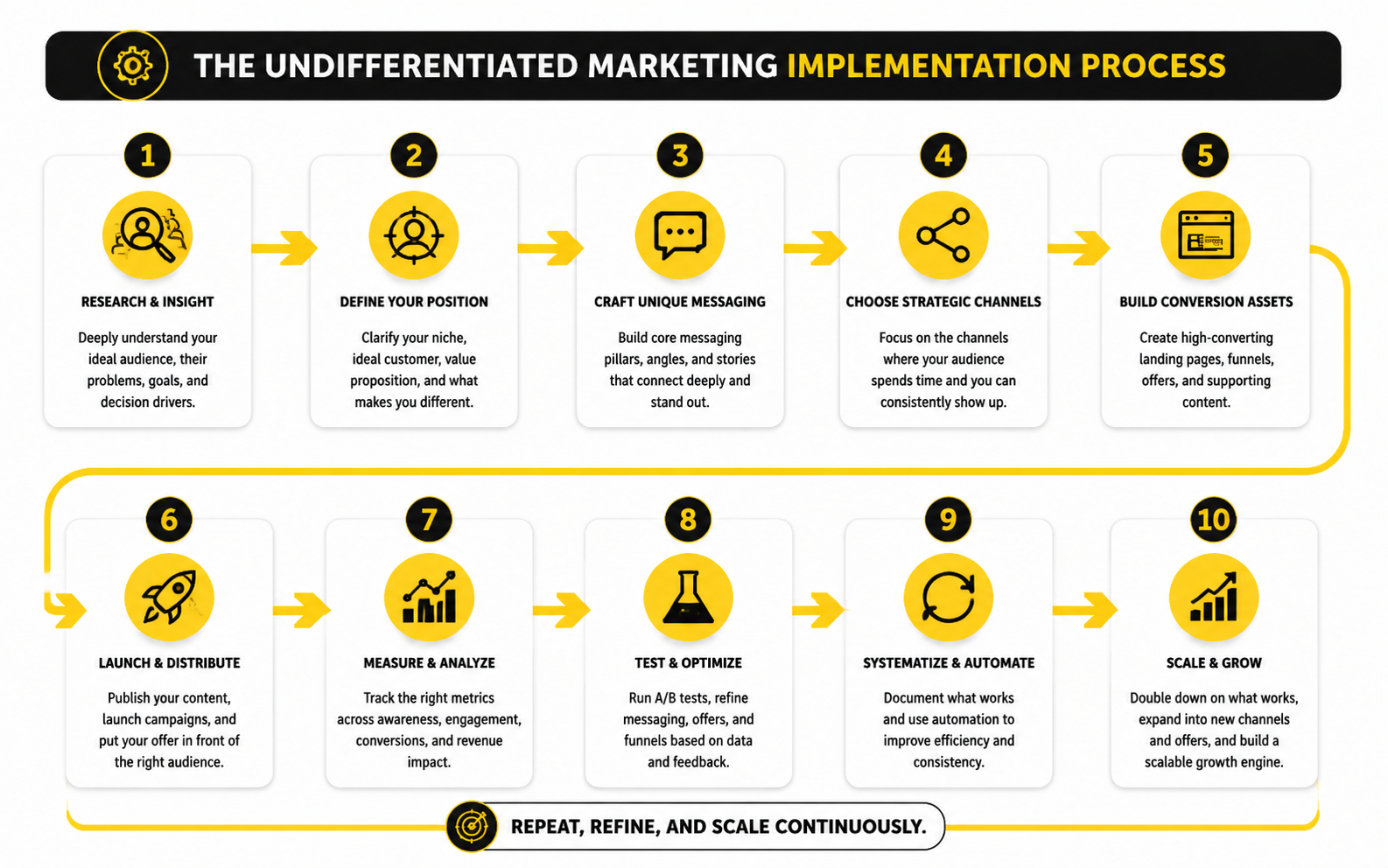
A Step‑by‑Step Guide to Implementing Undifferentiated Marketing
Implementing undifferentiated marketing isn’t guesswork - it’s a structured process that moves from understanding your market to delivering a unified campaign with measurable results. The goal is to build and execute a single broad strategy that resonates with as many potential customers as possible rather than tailoring messaging by segment.
Step 1: Validate the Market’s Homogeneity
Before anything else, you must determine whether your audience truly shares similar needs.
This foundational work prevents wasted effort and helps ensure the rest of your implementation isn’t built on a flawed premise.
Step 2: Define a Unified Value Proposition
With confirmation that a broad audience exists, the next step is to crystallize the core value you’re offering. This is the message your entire marketing effort will communicate.
A strong unified proposition ensures that subsequent campaigns resonate without customization.
Step 3: Select High‑Reach Distribution Channels
Undifferentiated marketing thrives on visibility and scale. Choosing the right channels makes your single message go far.
The criterion for all choices is audience breadth, not precision targeting.
Step 4: Build and Launch Your Campaign
Once channels are set, you can begin campaign creation.
Consistency reinforces recall, which is crucial in mass marketing.
Step 5: Track Macro Performance Metrics
Unlike segmented campaigns that evaluate many micro KPI’s, undifferentiated strategies rely on broad performance indicators.
These metrics help you assess whether your unified campaign is moving the needle at scale.
Step 6: Adjust Based on Market Signals
Even a well‑executed undifferentiated strategy needs refinement as markets evolve.
Implementing undifferentiated marketing with discipline and responsiveness ensures that it continues to deliver value rather than becoming irrelevant or stale.
With this step‑by‑step process, you can take undifferentiated marketing from theory into a tangible execution plan that drives awareness and growth - all without losing focus on simplicity and broad appeal.
Data, Benchmarks, and What the Numbers Mean in Undifferentiated Marketing
When you run an undifferentiated marketing strategy, you can’t just measure clicks and call it a day. Because this approach is about broad reach and brand presence, the metrics you focus on - and how you interpret them - must reflect brand health and market impact, not only short‑term conversions.
Measuring What Matters
The analytics for undifferentiated marketing operate at multiple levels, from exposure to long‑term brand equity. A reliable measurement framework should include metrics that show whether people are reaching and remembering your brand, engaging with it, and whether that broad awareness is influencing performance over time.
For example, reach and impressions - the number of unique users who saw your message and how often they saw it - are fundamental early indicators of whether mass marketing is even getting in front of the right audience. But reach on its own is incomplete without engagement and brand perception measures that show whether the exposure has meaning.
Exposure, Engagement, Conversion, and Value
A systematic way to interpret analytics is to view them through four measurement layers:
This layered view helps you interpret what the numbers actually mean instead of treating every lift as equally valuable.
IMAGE 4
How to Use These Benchmarks Strategically
Tracking benchmarks is essential because raw numbers - like “10,000 impressions” - don’t tell you whether a campaign is working relative to expectations or industry norms. Comparative data helps you understand whether your reach or engagement is normal, strong, or weak.
Here are practical ways to interpret performance signals:
Why These Numbers Matter
The actionable insight from these metrics isn’t just that your strategy “got eyes on the brand”. Instead:
In essence, the right interpretation of analytics in undifferentiated marketing tells you whether your macro strategy is building real presence and economic value - not just volume - and directs you on when to refine or reallocate your efforts to sustain momentum.
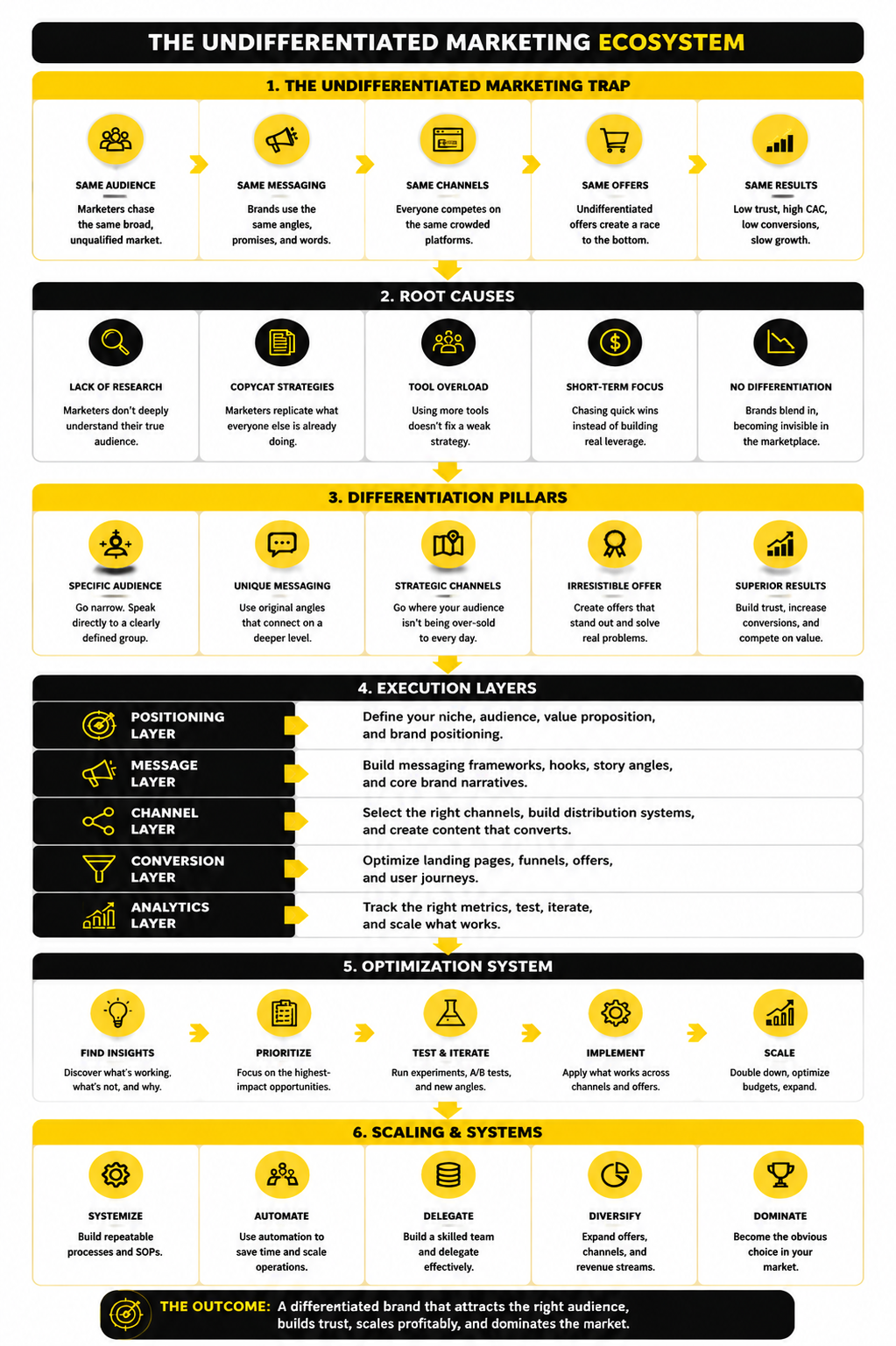
Advanced Considerations for Undifferentiated Marketing
Once a brand is familiar with the basics of undifferentiated marketing, the next step is to navigate strategic tradeoffs and scaling complexities. While the approach is straightforward, its success depends on understanding where simplicity works and where it might backfire.
Strategic Tradeoffs
Undifferentiated marketing prioritizes scale over customization, but this comes with tradeoffs:
Scaling Challenges
As campaigns grow, logistical and operational issues become more pronounced:
Scaling undifferentiated marketing requires a balance between reach and freshness, maintaining mass appeal while avoiding stagnation.
Expert-Level Guidance
Marketing leaders who successfully execute undifferentiated campaigns often follow these principles:
Ultimately, undifferentiated marketing is not just about broad messaging - it’s about strategic discipline, operational execution, and continuous monitoring. Brands that master these advanced considerations can leverage simplicity at scale without losing sight of market dynamics.
1. What is undifferentiated marketing?
Undifferentiated marketing is a strategy where a company targets the entire market with a single marketing mix, assuming that most consumers have similar needs and preferences.
2. When should a brand use undifferentiated marketing?
It is most effective for products with universal appeal, like staple goods or services where customization isn’t necessary, and the goal is maximum reach with efficiency.
3. How does undifferentiated marketing differ from differentiated marketing?
Unlike differentiated marketing, which creates tailored messages for specific segments, undifferentiated marketing uses one broad message for all potential customers.
4. What are the key benefits of this strategy?
The main advantages include cost efficiency, simplified operations, faster campaign execution, and broad brand visibility.
5. What are the primary risks?
Risks include audience disengagement, message fatigue, and losing niche segments to competitors with more targeted approaches.
6. How do professionals measure success in undifferentiated marketing?
Success is measured using macro metrics like total reach, brand awareness, engagement rates, share of voice, and long-term revenue impact.
7. Can undifferentiated marketing work in digital channels?
Yes. Digital platforms with large audiences, such as social media networks and display ad networks, allow broad messaging without segmentation.
8. How do you prevent message fatigue?
Rotate creatives periodically, maintain consistency in core messaging, and monitor frequency to avoid oversaturation while keeping the message fresh.
9. Should undifferentiated marketing evolve over time?
Absolutely. Market conditions, consumer preferences, and competitive landscapes change, so campaigns should adjust while maintaining a broad reach strategy.
10. What kind of products benefit most from undifferentiated marketing?
Essential household goods, basic consumer staples, and products with minimal differentiation benefit most because their universal appeal allows a single message to resonate widely.
11. Is undifferentiated marketing still relevant today?
Yes, especially for high-volume, low-complexity products, or in situations where brand awareness at scale is more important than precise targeting.
12. How do experts combine undifferentiated and targeted approaches?
Some brands use hybrid strategies, combining broad messaging for awareness with targeted campaigns for specific segments to maximize reach and relevance.
Build a stronger local presence with BAAM AI
Turn your website, Google profile, social channels, and AI visibility into one growth engine
Most businesses do not need more random marketing activity. They need a consistent presence system that helps the right people find them, trust them, and take action. BAAM AI brings strategy, local SEO, website updates, Google Maps visibility, social content, AI-search readiness, media production, and reporting into one practical monthly engine.
If you want your marketing to keep working after the campaign ends, start with a free BAAM AI presence audit. See how your business shows up today and where the fastest visibility wins are at BAAM AI.