
BAAM AI Blog
Twitter SMM: A Practical Framework For Building Reach, Trust, And Revenue On X
Twitter SMM is not about posting random thoughts and hoping the algorithm does something nice for you.

Twitter SMM is not about posting random thoughts and hoping the algorithm does something nice for you.
It is the discipline of using X, still widely called Twitter, as a social media marketing channel for visibility, authority, audience growth, lead generation, customer support, and sales conversations. That sounds simple until you actually try to run it. The platform moves fast, public conversations can turn quickly, and weak content gets ignored almost instantly.
The opportunity is still real, though. X remains one of the few major social platforms where public conversation, breaking news, founder commentary, creator distribution, customer complaints, industry debates, and direct response offers all sit in the same feed. That makes it useful for brands that can think clearly, publish consistently, and respond like humans instead of hiding behind polished campaign language.
The mistake most brands make is treating Twitter SMM as a posting calendar. They schedule promotional updates, add a few hashtags, repost blog links, and then wonder why nothing happens. A stronger approach starts with positioning, audience intelligence, content systems, conversation design, and measurable conversion paths.
This guide breaks Twitter SMM into a practical six-part system. The goal is not to chase every trend or copy loud accounts. The goal is to build a repeatable channel that earns attention, starts useful conversations, and turns the right followers into subscribers, leads, customers, partners, or community members.
Why Twitter SMM Still Matters
Twitter SMM matters because X is not just another feed where people passively scroll through lifestyle content. It is a live conversation layer for business, media, technology, politics, finance, entertainment, sports, and creator culture. For the right niche, one sharp post can reach prospects, journalists, competitors, investors, partners, employees, and customers in the same day.
The platform is also unusually useful for market intelligence. People complain publicly, compare tools, ask for recommendations, debate trends, share screenshots, react to product launches, and expose objections in real time. That gives marketers a rare view into what the market actually thinks before it gets cleaned up into survey language.
There is risk, of course. X has gone through major changes since the Twitter rebrand, and advertisers have had to watch brand safety, trust, moderation, and audience shifts more carefully. That is exactly why professional Twitter SMM cannot be reduced to “post more.” It needs a clear strategy, a consistent voice, and rules for when to engage, when to ignore, and when to escalate.
Recent platform data also shows why smart marketers still pay attention. DataReportal’s X overview lists hundreds of millions of potential advertising reach users worldwide, while Pew Research notes that X remains especially associated with news and public affairs compared with several other social platforms. Those two realities make the channel valuable for brands that need relevance, not just reach: DataReportal’s X statistics and Pew Research on X users and news.
What Twitter SMM Actually Includes
Twitter SMM includes everything a brand does on X to attract attention, build trust, and move people toward a business outcome. That can include organic posting, reply strategy, social listening, creator partnerships, paid ads, customer support, direct messages, community building, thought leadership, and launch campaigns. The strongest programs connect all of those pieces instead of treating them as separate tasks.
Organic content is usually the visible part. This includes posts, threads, short videos, polls, quote posts, replies, memes, commentary, product updates, customer stories, and educational breakdowns. But the real strategy sits underneath the content: who you are trying to reach, what you want them to believe, what conversations you want to join, and what action should happen after attention is earned.
A practical Twitter SMM program also needs a conversion layer. That might be an email list, webinar, demo page, sales funnel, community, lead magnet, booking page, or automated DM flow. For example, brands that use X to start conversations may pair the platform with ManyChat for message automation or GoHighLevel for lead capture, CRM, follow-up, and pipeline tracking.
The Basic Twitter SMM Framework
A simple Twitter SMM framework has four layers: audience, positioning, content, and conversion. Audience defines who you are trying to reach and what they already care about. Positioning defines why they should listen to you instead of another account saying similar things.
Content turns that positioning into daily proof. It shows your thinking, your taste, your expertise, your offers, and your ability to understand the market. Conversion then gives interested people a clear next step, so attention does not disappear into vanity metrics.
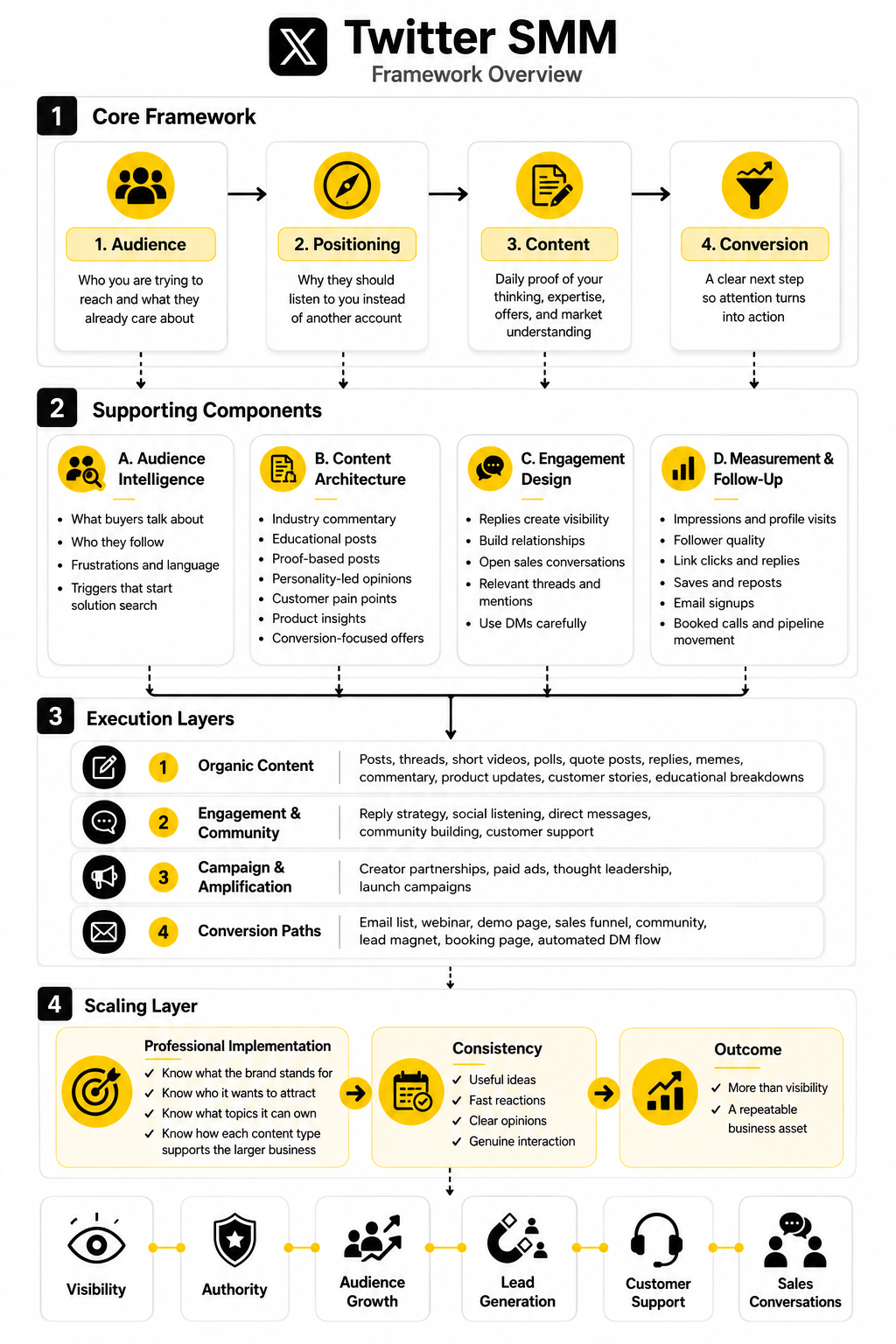
This matters because a lot of Twitter marketing fails from imbalance. Some accounts have strong opinions but no offer. Others have offers but no trust. Some post useful content but never invite people into a next step. A real framework keeps the channel commercially useful without making every post feel like an ad.
The Four Core Components
The first core component is audience intelligence. You need to know what your buyers talk about, who they follow, what frustrates them, what language they use, and what triggers them to look for a solution. X is useful here because search, lists, replies, quote posts, and competitor comments can reveal demand before it becomes obvious in keyword tools.
The second component is content architecture. Instead of posting whatever feels interesting that day, you create repeatable content pillars. For Twitter SMM, those pillars often include industry commentary, educational posts, proof-based posts, personality-led opinions, customer pain points, product insights, and conversion-focused offers.
The third component is engagement design. Replies are not filler. On X, smart replies can create visibility, build relationships, open sales conversations, and make a brand feel present. A practical engagement routine includes replying to ideal customers, joining relevant threads, responding to mentions, monitoring brand terms, and using direct messages carefully when there is real context.
The fourth component is measurement and follow-up. You do not need to obsess over every metric, but you do need to know what is working. Impressions, profile visits, follower quality, link clicks, replies, saves, reposts, email signups, booked calls, trial starts, and pipeline movement all tell different parts of the story.
Why Professional Implementation Changes The Outcome
Professional Twitter SMM is different from casual posting because it creates a system. The brand knows what it stands for, who it wants to attract, what topics it can own, and how each content type supports the larger business. That makes the channel easier to manage and much easier to improve.
This is also where tools can help, but only after the strategy is clear. A scheduling tool like Buffer can keep publishing consistent, while a funnel builder like ClickFunnels can turn campaign traffic into leads or buyers. Tools do not fix weak positioning, but they do make a strong strategy easier to execute.
The real advantage comes from consistency. X rewards accounts that show up with useful ideas, fast reactions, clear opinions, and genuine interaction. When a brand combines that with a conversion path, Twitter SMM becomes more than visibility. It becomes a repeatable business asset.
The Twitter SMM Framework
A strong Twitter SMM strategy starts with a simple truth: people do not follow brands because the brand wants reach. They follow because the account gives them something useful, interesting, sharp, timely, or emotionally relevant. That is why the framework has to begin with the audience’s world, not your posting schedule.
The framework has five working layers: audience, positioning, content, engagement, and conversion. Each layer supports the next one. When one layer is weak, the whole strategy starts to wobble, even if the posts look polished on the surface.
This is where most brands make Twitter harder than it needs to be. They try to win with volume before they understand the room. They publish more posts, test more hooks, and chase more trends, but they still sound like everyone else because the strategic foundation is missing.
Start With Audience Reality
Audience research on X is not just demographic research. It is behavioral research. You are trying to understand what your ideal customers complain about, what they celebrate, who they trust, what language they use, and what they already believe before they ever see your account.
This matters because X is a conversation-first platform. People are not only consuming content; they are reacting, arguing, recommending, correcting, joking, and comparing options in public. For marketers, that creates a live research environment that is much more useful than guessing from a static buyer persona.
The practical move is to build a focused listening list before you build a content calendar. Add customers, competitors, category creators, journalists, operators, analysts, partners, and accounts your buyers already engage with. Then look for repeated questions, emotional triggers, objections, buying signals, and phrases that keep coming back.
Good audience research should answer these questions:
The important part is restraint. Do not turn every observation into a post immediately. First, look for patterns. One loud thread is not a strategy, but ten repeated complaints across different conversations can reveal a real content angle.
Define A Clear Position
Positioning is the reason someone remembers you after the scroll. It tells people what you stand for, who you help, and why your perspective is worth paying attention to. Without it, even useful posts can feel disconnected.
For Twitter SMM, positioning needs to be sharper than a generic brand statement. “We help businesses grow online” is too broad. “We help B2B SaaS founders turn founder-led content into qualified pipeline” is much clearer because it names the audience, the channel, and the business outcome.
Your position should shape your tone, topics, examples, offers, and opinions. A premium agency should not sound like a meme page unless that contrast is intentional and credible. A technical SaaS brand should not copy creator-style hot takes if its buyers expect depth, evidence, and practical implementation.
A useful positioning statement can follow this structure:
For example, a consultant using Twitter SMM might define the position as helping early-stage founders build authority and inbound demand through practical category commentary without spending every day chasing viral posts. That position gives the content a direction. It also makes it easier to decide what not to post, which is just as important.
Build Content Pillars That Earn Attention
Content pillars are not random topic buckets. They are repeatable lanes of conversation that let your audience understand why they should keep coming back. The best pillars balance usefulness, credibility, personality, and commercial intent.
A good Twitter SMM content system usually includes several types of posts. Educational content teaches the audience how to think or act. Opinion content shows your point of view. Proof content demonstrates that your ideas work. Conversational content invites replies. Conversion content gives people a next step.
The mix matters because one type of content cannot do the whole job. If every post teaches, the account can feel dry. If every post sells, people tune out. If every post is a hot take, the account may get attention but fail to build trust.
A practical pillar structure could look like this:
This is also where quality control matters. X rewards speed, but brands still need judgment. A fast post that damages trust is not a win, especially when the account represents a company, founder, or professional service.
Use Engagement As Distribution
Engagement is not something you do after posting. It is part of distribution. On X, replies, quote posts, and thoughtful interactions can put your account in front of people who would never discover you through your own feed.
The mistake is treating engagement as generic networking. “Great point” replies do almost nothing. Strong replies add context, challenge an idea respectfully, answer a question, share a useful detail, or create a reason for someone to click through to the profile.
This is especially important for newer or smaller accounts. If your own posts do not have much reach yet, intelligent replies under relevant accounts can give you borrowed attention. That does not mean hijacking conversations or pitching strangers. It means showing up where your audience already spends time and contributing something worth reading.
A simple engagement routine can work well:
This is where the channel becomes more than publishing. The account starts learning from the market every day. That feedback loop is one of the biggest advantages of Twitter SMM when it is done properly.
Create A Conversion Path Before You Need It
Attention is useful, but attention without a next step leaks value. If someone likes your thinking, visits your profile, and wants more, the path should be obvious. That path could be a newsletter, free resource, demo, consultation, product trial, community, webinar, or sales page.
The conversion path should match the audience’s level of intent. A cold follower may not be ready to book a call, but they might join an email list. A high-intent buyer who has replied to several posts may be ready for a demo or direct conversation. Your Twitter SMM strategy should support both.
This is why the profile matters more than many people think. The bio, pinned post, link, banner, and recent posts should work together. When someone lands on the profile, they should quickly understand what you do, who it is for, why it matters, and what to do next.
For simple lead capture, a focused landing page is usually better than sending people to a busy homepage. Tools like ClickFunnels, Systeme.io, or GoHighLevel can help turn profile clicks and campaign traffic into subscribers, booked calls, or buyers. The tool is not the strategy, but a clean conversion path makes the strategy measurable.
Match The Framework To The Platform’s Current Reality
X has changed a lot, and a serious Twitter SMM strategy needs to account for that. The platform still has major reach, but marketers also have to be more careful about audience fit, brand safety, content quality, and the difference between visible engagement and business impact. DataReportal’s X statistics still show large global advertising reach, while Pew’s research continues to show X playing a meaningful role in news and public conversation in the United States: DataReportal’s X data and Pew Research on X and news.
That means the channel is valuable, but not automatically valuable for everyone. A consumer brand with a visual lifestyle product may need a different platform mix than a B2B founder selling expertise. A media brand, SaaS company, consultant, crypto product, AI tool, or creator-led business may find X much more naturally aligned with how its market already talks.
The framework helps you make that decision with less emotion. If your audience is active, your position is clear, your content has a point of view, your engagement creates conversations, and your conversion path is ready, X can become a serious marketing channel. If those pieces are missing, more posting will only make the weakness more visible.
Core Components Of A Strong Twitter SMM Strategy
Once the framework is clear, the next step is turning it into a working system. Twitter SMM is not one activity. It is a set of connected habits that help a brand listen better, publish better, engage faster, and convert attention without becoming annoying.
The strongest strategies usually have six core components: profile positioning, audience listening, content production, engagement routines, conversion assets, and reporting. None of these components needs to be complicated. The important thing is that each one has a clear job and gets reviewed regularly.
This is where discipline beats random creativity. A clever post can create a spike, but a system creates repeatable outcomes. If you want X to become a business asset, you need a process that does not depend on being inspired every morning.
Profile Positioning
Your profile is the landing page people see after a post, reply, repost, or search result catches their attention. If the profile is vague, people leave. If it is clear, they understand who you help, what you talk about, and why following you makes sense.
A good profile does not try to say everything. It should make one strong promise to one clear audience. The bio, pinned post, banner, and profile link should all point in the same direction instead of feeling like separate pieces written at different times.
The pinned post matters because it gives people a starting point. It can introduce your best framework, explain your offer, share a useful resource, or show the clearest reason to follow you. For Twitter SMM, the pinned post should not be an afterthought because it often decides whether profile traffic turns into followers, subscribers, or leads.
A strong profile should make these points obvious:
Audience Listening
Audience listening is the research layer that keeps your content from becoming self-centered. It helps you understand what people already care about before you ask them to care about your posts. This is especially important on X because conversations move fast and the same topic can look very different across niches.
The goal is not to copy what people are saying. The goal is to understand the emotional and practical context behind their behavior. When you know what your audience is frustrated by, confused about, skeptical of, or excited to try, your content gets sharper.
Set up listening around four groups: buyers, competitors, creators, and category conversations. Buyers show you real demand. Competitors show you positioning gaps. Creators show you what earns attention. Category conversations show you the bigger shifts shaping the market.
A useful listening routine should capture:
This research should feed directly into your content calendar. If the same objection appears again and again, it deserves a post. If customers keep using the same phrase to describe a pain point, that phrase should influence your copy.
Content Production
Content production is where the strategy becomes visible. This does not mean every post has to be perfectly polished. It means your posts should come from a clear point of view instead of a last-minute scramble.
A practical Twitter SMM content engine has repeatable formats. You might use short opinion posts, tactical breakdowns, question posts, threads, customer insight posts, product notes, trend reactions, and offer posts. The format can change, but the underlying pillars should stay consistent.
The easiest way to make content production manageable is to separate ideas from writing. Collect ideas daily from customer calls, comments, competitor posts, support conversations, sales objections, and industry news. Then turn the best ideas into posts during dedicated writing sessions instead of trying to create from zero every day.
A simple weekly production rhythm can look like this:
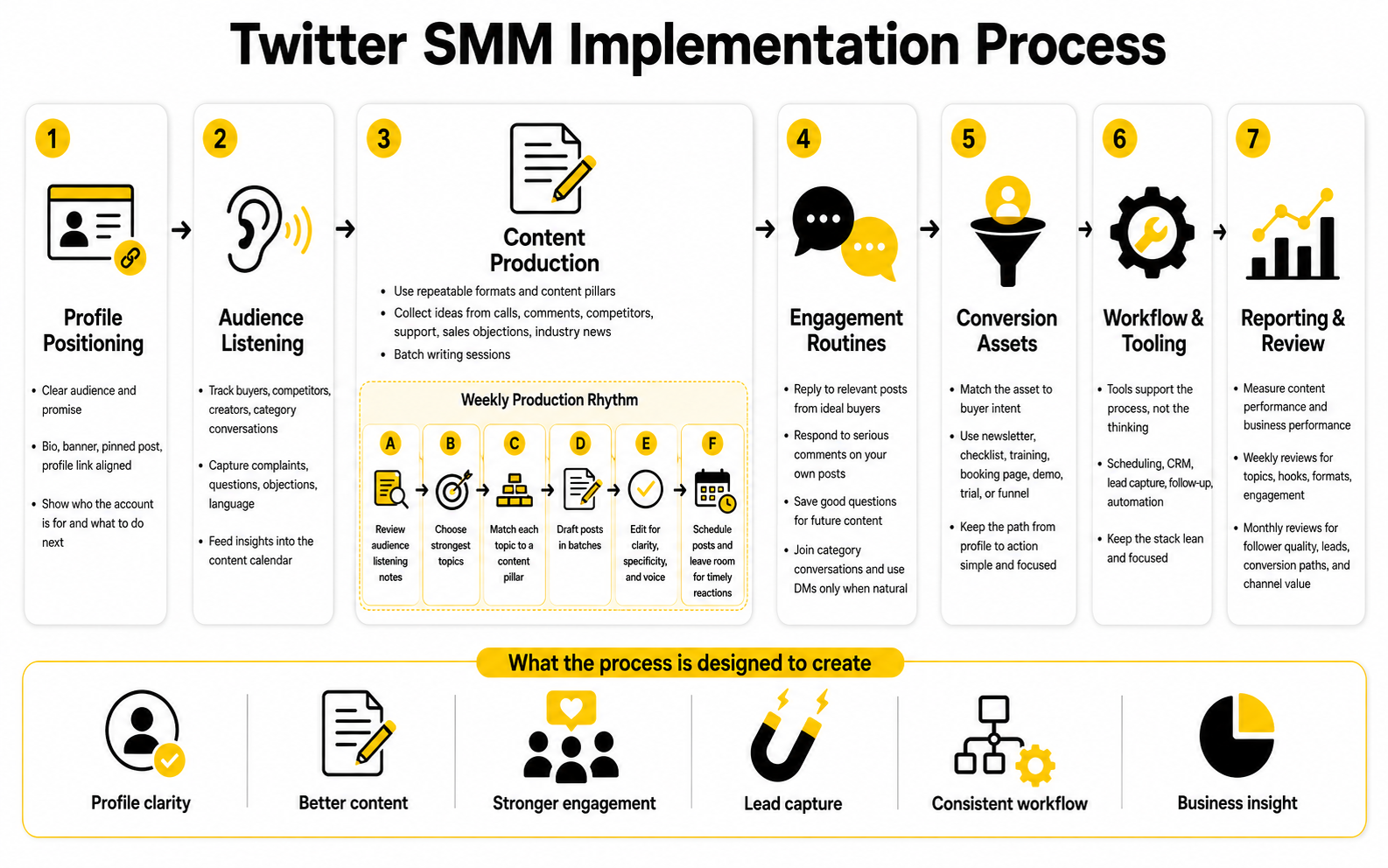
This process keeps the account consistent without making it robotic. You still have space for timely posts, but your baseline content does not depend on luck. That is the difference between using X casually and running Twitter SMM like a real channel.
Engagement Routines
Engagement is where many brands either underperform or overdo it. Some accounts post and disappear, which makes them feel distant. Others reply everywhere with shallow comments, which makes them feel desperate.
The better approach is intentional engagement. Reply where your audience already pays attention. Add something useful. Ask better questions. Push a conversation forward without turning every interaction into a pitch.
This is especially important for service businesses, SaaS brands, consultants, and creator-led companies. A thoughtful reply can start a relationship long before someone fills out a form. The public interaction creates trust, and the private conversation becomes much easier when there is already context.
A strong daily engagement routine can include:
Direct messages should be handled carefully. A DM that follows a real conversation can feel helpful. A cold pitch with no context usually feels lazy and damages trust.
Conversion Assets
If Twitter SMM creates attention but there is no conversion asset, the value leaks. People may like your posts and still never become leads, subscribers, customers, or partners. That is why the conversion path needs to be built before the account starts gaining meaningful traction.
The conversion asset should match the buyer’s intent. A free checklist, newsletter, or short training can work for people who are interested but not ready to buy. A booking page, demo request, trial, or funnel can work for people who already understand the problem and want help.
For many brands, the cleanest setup is simple. Use X to create trust and demand, then send qualified traffic to one focused page. Tools like GoHighLevel, ClickFunnels, or Systeme.io can support that path when you need landing pages, forms, follow-up, and basic automation.
A conversion asset should be specific enough to feel relevant. “Join our newsletter” is weak unless the newsletter has a clear promise. “Get weekly teardown notes on how B2B founders turn content into pipeline” is stronger because the value is concrete.
Workflow And Tooling
Tools should support the process, not replace the thinking. A scheduling tool helps you publish consistently. A CRM helps you track conversations. An automation tool helps with follow-up. None of them fixes weak positioning or boring content.
For content scheduling and workflow, Buffer can help small teams keep posts organized without building a heavy system. For lead capture and follow-up, GoHighLevel can be useful when Twitter SMM connects to sales pipelines, appointment booking, email, SMS, and CRM workflows. For conversation automation around campaigns, ManyChat can help when there is a clear opt-in path and the messages are genuinely useful.
The stack should stay lean at first. Most teams need a place to collect ideas, a way to schedule posts, a landing page, a CRM, and a reporting routine. Adding more software before the operating rhythm is clear usually creates noise, not growth.
Reporting And Review
Reporting should answer one question: is the strategy creating better business outcomes over time? Vanity metrics can be useful signals, but they are not the finish line. A post with fewer impressions can still be more valuable if it attracts the right buyer, starts a serious conversation, or leads to a booked call.
The reporting routine should separate content performance from business performance. Content performance tells you what earns attention. Business performance tells you whether that attention is commercially useful. You need both, because reach without relevance is fragile.
A practical review can happen weekly and monthly. Weekly reviews help you adjust topics, hooks, formats, and engagement routines. Monthly reviews help you evaluate follower quality, lead sources, conversion paths, and whether X deserves more time, budget, or creative energy.
Track metrics such as:
The point is not to drown in dashboards. The point is to know what to repeat, what to improve, and what to stop doing. That is how Twitter SMM becomes more predictable instead of staying stuck in guesswork.
Statistics And Data
Measurement is where Twitter SMM becomes honest. It is easy to feel busy when posts are going out, replies are happening, and impressions are moving up and down. The problem is that activity is not the same as progress, and progress is not always visible in the metric everyone is watching.
The data should answer a practical question: is X helping the business create more trust, more demand, more useful conversations, and more revenue opportunities? If the answer is yes, you should know which content, audiences, and actions are driving that result. If the answer is no, the numbers should show you where the system is breaking.
Benchmarks can help, but they should never become the strategy. A general engagement benchmark does not know your niche, offer, account size, audience quality, or sales cycle. Use benchmarks to understand the environment, then use your own historical data to decide what to improve.
What The Platform Numbers Actually Tell You
X still has meaningful reach, but the opportunity is uneven. The platform remains relevant for public conversation, news, commentary, creators, founders, technology, finance, media, and fast-moving industries, while some consumer brands may find stronger performance on more visual or entertainment-driven platforms. That is why Twitter SMM measurement should start with audience fit, not vanity reach.
Global usage estimates from DataReportal’s X statistics show that X still offers large potential advertising reach, but reach alone does not tell you whether your buyers are active or responsive there. Pew’s research on X users and news also reinforces the platform’s role in public affairs and real-time information, which explains why commentary-led accounts can still perform well. For marketers, the takeaway is simple: X is strongest when your market already talks, debates, researches, or reacts in public.
That means a B2B software founder, newsletter operator, agency owner, investor, journalist, developer tool, AI product, or consultant may read the platform very differently from a local retail brand. One account may see X as a primary demand channel. Another may use it mainly for credibility, customer support, and listening. The data only becomes useful when it is tied to the job X is supposed to do for your business.
The Metrics That Matter Most
Twitter SMM metrics should be grouped by stage. Awareness metrics show whether people are seeing you. Engagement metrics show whether the content creates a reaction. Trust metrics show whether people are choosing to learn more. Conversion metrics show whether attention is turning into business value.
Impressions are useful, but they are only the top of the stack. A high-impression post that attracts the wrong audience can be less valuable than a smaller post that gets replies from decision-makers. This is why serious reporting should include quality signals, not just surface-level numbers.
The most useful metrics usually fall into these categories:
The key is not to track everything forever. The key is to choose the numbers that match the goal of the account. If the goal is authority, profile visits and relevant replies matter. If the goal is lead generation, clicks, opt-ins, booked calls, and sales conversations matter more.
How To Build An Analytics System
An analytics system does not need to be complicated. It needs to connect posts, audience response, traffic, and follow-up in a way you can actually review. If the reporting process takes too long, the team will avoid it, and the strategy will slowly return to guesswork.
Start by tagging content by pillar and purpose. A market commentary post should not be judged the same way as a direct offer post. One is meant to create reach and point of view, while the other is meant to drive action. If you compare them as if they have the same job, you will make bad decisions.
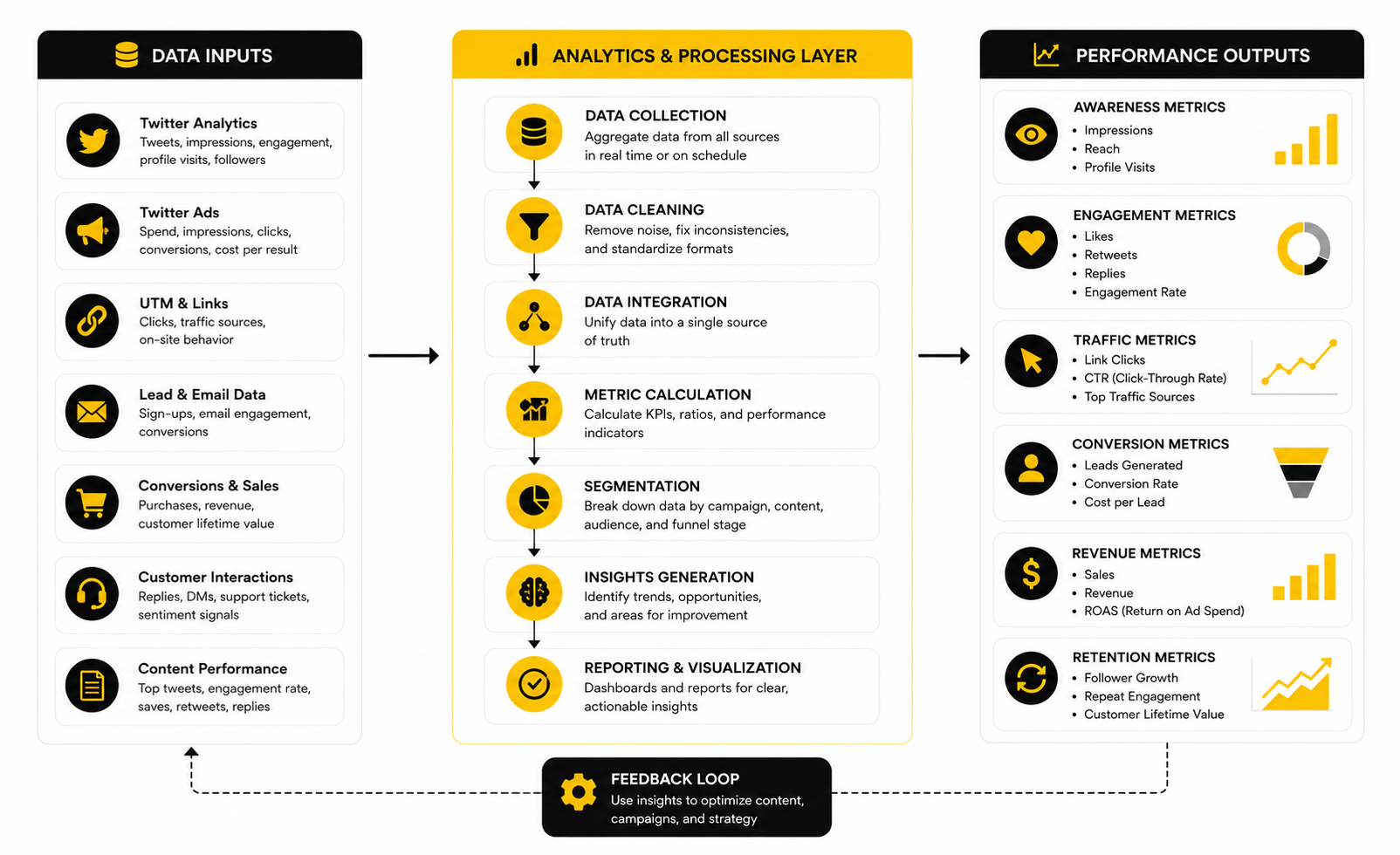
A simple analytics workflow can look like this:
This is also where clean tracking matters. Use UTM parameters on important links so you can see what X is sending to your site, funnel, or calendar. If you use a CRM like GoHighLevel, connect form fills, appointments, and pipeline stages so Twitter SMM is measured beyond likes and clicks.
How To Read Engagement Correctly
Engagement is useful, but it is easy to misread. Likes are the lightest signal because they take almost no effort. Replies and reposts usually show stronger interest because they require more public action. Bookmarks can be a strong signal for educational content because people save what they may want to revisit.
The context matters more than the raw number. Ten replies from buyers can be more valuable than 300 likes from people who will never buy. A lower-engagement post can still be strategically useful if it explains your offer clearly and gives high-intent prospects a reason to take the next step.
This is why you should review who engaged, not only how many people engaged. Look at the accounts behind replies, reposts, and follows. If your content is reaching peers but not prospects, the account may be building industry visibility without building demand. That can still be useful, but you should not confuse it with pipeline.
How To Interpret Follower Growth
Follower growth is a lagging signal. It usually improves after your positioning, content, and engagement are already working. Chasing followers directly often leads to shallow content because the easiest way to attract attention is not always the best way to attract buyers.
A healthy follower graph should be read alongside profile visits and content themes. If profile visits are high but follow rate is weak, the profile may be unclear. If follower growth spikes after controversial posts but leads do not improve, the attention may not be commercially useful. If growth is slower but the new followers match your target audience, that can be a better outcome.
Quality matters because X is a relationship and reputation channel. A small audience of founders, operators, buyers, journalists, or category insiders can outperform a large audience of passive scrollers. Twitter SMM should not be managed like a popularity contest unless popularity is the actual business model.
How To Measure Content Pillars
Content pillars should be measured separately because each pillar has a different job. Market commentary may create reach. Educational posts may create saves and follows. Proof posts may create trust. Offer posts may create clicks, replies, and booked calls.
This prevents one of the biggest mistakes in social reporting: killing commercially valuable content because it does not go viral. Direct offer posts often get less engagement than broad opinion posts, but they may create more revenue. If you only reward reach, your content calendar slowly becomes less useful to the business.
A practical review should ask:
The goal is not to make every pillar perform the same way. The goal is to understand the role each pillar plays. Once you know that, you can adjust the mix instead of making emotional decisions based on one post.
How To Measure Conversion
Conversion measurement is where the channel proves its value. If X creates attention but no one clicks, subscribes, books, replies, or buys, the strategy needs work. That does not always mean the content is bad; it may mean the offer, profile link, landing page, or follow-up path is weak.
The cleanest approach is to measure micro-conversions and macro-conversions separately. Micro-conversions include profile visits, link clicks, newsletter signups, resource downloads, and direct message conversations. Macro-conversions include booked calls, trials, demos, purchases, opportunities, and revenue.
For campaigns, send people to a focused page rather than a cluttered homepage. A funnel builder like ClickFunnels or Systeme.io can make this easier when you want a clear opt-in, thank-you page, and follow-up sequence. If the offer is service-based, a CRM and booking flow matter more because the real conversion may happen after a conversation.
What Benchmarks Are Good For
Benchmarks are useful for context, not judgment. Reports like Rival IQ’s Social Media Industry Benchmark Report can help you understand how brand engagement varies by platform and industry. But your own account history is usually more actionable than a broad average.
The reason is simple. Benchmarks combine accounts with different audiences, budgets, creative quality, posting frequency, brand awareness, and goals. A startup founder posting sharp category commentary should not blindly compare performance against a legacy consumer brand with a different audience and content mix.
Use benchmarks to notice macro trends. Use your own data to make decisions. If your relevant replies, profile visits, and qualified leads are improving month over month, the strategy may be working even if your engagement rate is below a generic benchmark.
The Weekly Review
A weekly review should be fast and practical. Look at what you posted, what performed, who engaged, and what should happen next. This is not a meeting for admiring charts; it is a decision-making rhythm.
Review the best posts first, but do not stop there. Look at posts that underperformed and ask whether the topic was weak, the hook was unclear, the format was wrong, the timing was poor, or the audience simply did not care. Sometimes the idea is good but the packaging failed.
A useful weekly review includes:
This keeps Twitter SMM grounded in learning. You are not just publishing and hoping. You are building a feedback loop.
The Monthly Review
The monthly review should connect X performance to business outcomes. This is where you look beyond individual posts and ask whether the channel is becoming more valuable. If it is not, the monthly review should show whether the problem is reach, relevance, trust, offer, or follow-up.
Compare the month against the previous month and the previous quarter where possible. Look for direction, not perfection. A single viral post can distort the picture, so pay more attention to trends across multiple posts and campaigns.
The monthly review should answer these questions:
This is how the data becomes useful. Not by reporting everything, but by deciding what the next move should be. The numbers should push the strategy forward.
Advanced Tradeoffs In Twitter SMM
By this stage, the basics are clear: define the audience, sharpen the position, publish with purpose, engage intentionally, and measure what matters. The advanced work is different. It is about making strategic tradeoffs when the easy answers stop working.
Twitter SMM gets harder as the account grows because every decision starts carrying more weight. A small account can test freely, change direction quickly, and take more creative risks. A larger brand has to think about reputation, legal review, customer expectations, internal alignment, and how one public post can affect sales, hiring, partnerships, and support.
That does not mean big accounts should become boring. It means they need better judgment. The goal is to stay fast enough to be relevant without becoming reckless, and structured enough to scale without sounding like a committee wrote every post.
Reach Versus Relevance
The first major tradeoff is reach versus relevance. Broad posts usually travel farther because more people can understand them. Specific posts often travel less, but they attract better-fit followers, replies, clicks, and sales conversations.
This matters because X can reward content that is entertaining even when it is commercially useless. A funny observation may get thousands of impressions and still do nothing for your pipeline. A narrow post about a painful buyer problem may get fewer likes but create two serious conversations with people who actually need the product.
A mature Twitter SMM strategy needs both, but not in equal amounts for every brand. If you are building a media asset, broad reach may be the business model. If you are selling a high-ticket service, B2B software, or consulting offer, relevance should usually win. The job is not to become famous to everyone; it is to become obvious to the right people.
Personal Voice Versus Brand Voice
X rewards human accounts because people want to follow people. That creates a tension for companies. A personal founder voice often performs better than a polished corporate account, but it also creates dependency on one person’s time, taste, and reputation.
The best solution is not always choosing one over the other. Many brands need a portfolio approach: founder accounts for point of view and trust, company accounts for product updates and support, and team accounts for expertise in specific areas. This spreads distribution while keeping the brand from sounding flat.
The risk is inconsistency. If every person posts with a totally different promise, the market gets confused. Give people room to sound human, but align them around the same category narrative, customer pain points, product truth, and commercial priorities.
A practical voice system should define:
This is not about controlling every word. It is about giving smart people boundaries so they can move quickly without creating avoidable problems.
Speed Versus Accuracy
Speed is a real advantage on X. The platform rewards early reactions, sharp commentary, and timely participation in active conversations. But speed becomes dangerous when brands react before they understand the context.
The tradeoff is simple. If you wait too long, the moment passes. If you move too fast, you can publish something inaccurate, insensitive, or strategically pointless. The stronger the brand, the more costly that mistake can become.
The answer is a decision filter. Not every trend deserves a response. Before jumping in, ask whether the topic is relevant to your audience, connected to your expertise, safe for your brand, and likely to create the kind of attention you actually want.
A useful trend filter looks like this:
If the answer is unclear, skip it. Missing a trend rarely hurts a serious brand. Joining the wrong one can.
Organic Versus Paid Distribution
Organic Twitter SMM is valuable because it builds trust publicly. Paid distribution is useful because it can amplify what already works, reach specific audiences, and support launches or retargeting. The mistake is using paid ads to rescue weak organic content.
Paid distribution should usually come after organic learning. If a post, thread, resource, or offer already gets strong signals from the right people, it may deserve amplification. If the message gets ignored organically, spending money usually just scales the silence.
Brand safety also matters more in paid campaigns. Advertisers have watched X carefully since the platform’s ownership and moderation changes, and industry coverage has repeatedly highlighted concerns around trust, adjacency, and advertiser confidence. X has continued promoting brand safety and suitability tools, while outside analysis from sources like eMarketer’s brand safety coverage and Pew Research’s X user research shows why marketers should evaluate the platform with clear risk standards instead of blind optimism.
The practical approach is balanced. Use organic content to learn what your market responds to. Use paid distribution to amplify validated messages, drive traffic to focused offers, and retarget people who already showed intent. Do not let ad spend become a substitute for positioning.
Automation Versus Authenticity
Automation can make Twitter SMM easier, but it can also make a brand sound dead. Scheduling posts is fine. Tracking conversations is smart. Automating useful follow-up after a clear opt-in can be effective. Pretending that generic automated messages are personal is where things go wrong.
This matters because X is sensitive to tone. People can tell when a reply is lazy, when a DM is mass-produced, and when a brand is trying to force a funnel into a conversation that did not ask for one. The more personal the platform feels, the more damaging careless automation becomes.
Use automation for structure, not fake intimacy. A tool like Buffer can support scheduling. A CRM like GoHighLevel can organize leads and follow-up. A platform like ManyChat can help when people knowingly opt into a message flow. But the strategy should still feel human at the points where trust is built.
A good rule is simple: automate the admin, personalize the relationship. Scheduling, tagging, tracking, reminders, and reporting can be systemized. Opinions, replies, sales judgment, and sensitive conversations need human attention.
Scaling Without Losing The Signal
Scaling Twitter SMM does not just mean posting more. It means increasing output while protecting the signal that made the account work in the first place. More content can help, but only if it improves reach, trust, or conversion without diluting the voice.
Many teams scale too early. They add more posts, more contributors, more campaigns, and more tools before the core message is proven. The result is a busier account with less clarity.
A better scaling path starts with what already works. Identify the topics that attract the right audience, the formats that create meaningful replies, the offers that generate action, and the voices that feel most credible. Then build systems around those patterns.
Scaling can include:
The point is not to industrialize the account until it loses all taste. The point is to make the best thinking easier to publish consistently.
Risk Management
Risk management is not the fun part of Twitter SMM, but it matters. X is public, searchable, fast, and reactive. A poor response, careless claim, or misunderstood joke can travel much farther than the original campaign.
The biggest risks are usually not dramatic. They are small mistakes repeated at scale: unsupported claims, inconsistent tone, ignoring customer complaints, overpromising product results, using trendjacking badly, or letting junior team members respond without enough context. These issues can slowly weaken trust even when there is no single public crisis.
Create simple guardrails before you need them. Decide who can post, who can reply, who approves sensitive topics, what claims require evidence, and how complaints should be handled. If the brand operates in finance, health, legal, education, or other regulated categories, the rules need to be even tighter.
Risk management should cover:
This does not mean the account should become lifeless. It means the team should know where the edges are. Clear rules create more confidence, not less.
Common Strategic Mistakes
The most common mistake is chasing virality before trust. Viral reach feels good, but it can pull an account away from the audience that matters. If the content starts serving the algorithm more than the buyer, the business value usually drops.
Another mistake is turning every post into a lesson. Education is useful, but an account with no opinions can feel generic. People need to know what you believe, what you reject, and why your perspective is different.
A third mistake is hiding the offer. Some brands publish helpful content for months but never tell people what they sell. That creates an audience, but not always a business. You do not need to pitch constantly, but the path from content to commercial action should be clear.
Other mistakes include:
The fix is not complicated, but it requires discipline. Know who you serve. Say something useful and specific. Engage like a real person. Measure what moves the business. Improve the system every week.
When Twitter SMM Is Not The Right Channel
X is powerful, but it is not magic. Some audiences are not active there. Some products need more visual storytelling. Some buying journeys happen through search, marketplaces, referrals, communities, or long-form education before social content plays any meaningful role.
If your ideal customers rarely use X for professional discovery, Twitter SMM may still be useful for credibility, support, partnerships, or founder visibility, but it should not dominate your marketing plan. A channel is only strategic when it fits the buyer’s behavior. Otherwise, you are forcing the market to meet you where it does not naturally spend time.
The honest move is to test with clear limits. Give the channel a defined role, a consistent publishing and engagement rhythm, and a measurement window. If the account starts producing relevant conversations, qualified traffic, or stronger reputation signals, keep improving it. If it only creates noise, put more energy into channels where your audience already shows intent.
Tools, Workflows, And Final Recommendations
The final layer of Twitter SMM is the ecosystem around the account. By now, the strategy should not depend on memory, motivation, or random bursts of posting. It should run through a simple operating system that connects research, content, engagement, analytics, conversion, and follow-up.
This does not mean you need a bloated tech stack. Most teams need fewer tools than they think and better habits than they currently have. The goal is to make the right actions easier to repeat: collect useful ideas, turn them into sharp posts, engage with the right people, capture demand, and review what actually moved the business.
A clean Twitter SMM ecosystem usually includes:
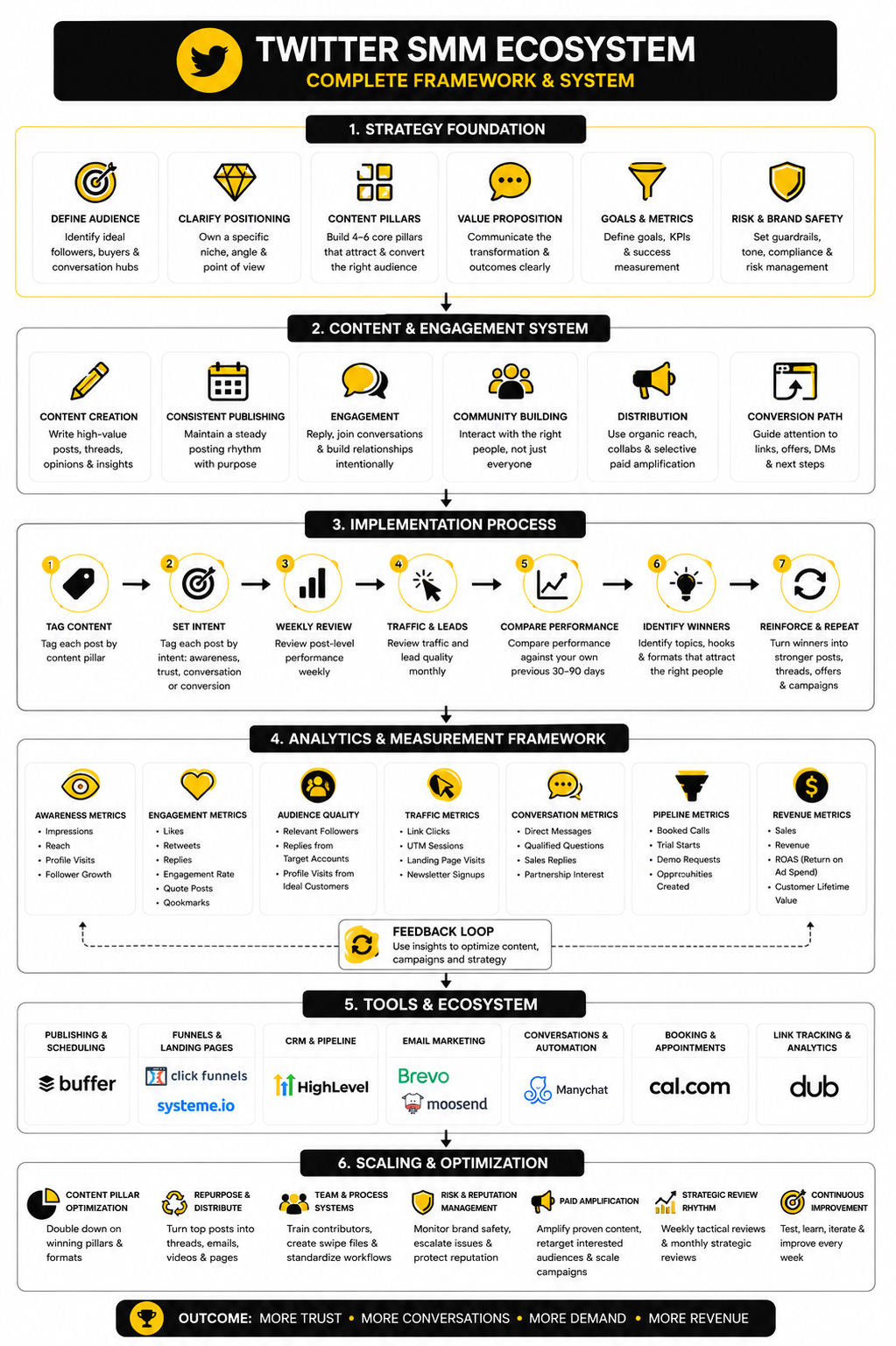
The best workflow is simple enough that people actually use it. If your system requires 12 tabs, five approvals, and a weekly archaeology mission to understand what happened, it will collapse. Strong execution comes from clear ownership, tight feedback loops, and a rhythm the team can maintain even during busy weeks.
Recommended Twitter SMM Stack
Start with the smallest stack that supports the strategy. A solo creator or consultant may only need a notes app, scheduling tool, landing page, email list, and booking link. A growing brand may need a CRM, approval workflow, UTM tracking, paid campaign reporting, and a clearer escalation process for customer issues.
For publishing, Buffer is a practical option when you want to plan posts, keep a steady cadence, and avoid managing every post manually. For funnels and lead capture, ClickFunnels and Systeme.io can support focused opt-in pages, campaign pages, and basic sales flows. For CRM, appointment booking, follow-up, and pipeline visibility, GoHighLevel can be useful when X is part of a broader acquisition system.
For email follow-up, tools like Brevo or Moosend can help turn attention into a longer-term owned audience. For campaign conversations, ManyChat can support structured follow-up when people clearly opt in and the message flow is useful. Keep the stack focused on the job. More software only helps when the process is already clear.
Final Recommendations
Treat Twitter SMM as a business channel, not a posting habit. That means every major activity should connect to a reason: learning from the market, creating authority, starting conversations, supporting launches, capturing leads, or influencing sales. If a tactic does not support one of those jobs, question it.
The fastest improvement usually comes from clarity. Make the profile easier to understand. Make the content more specific. Make the offer easier to find. Make the reporting less emotional. Make the engagement more useful and less performative.
For most brands, the right next move is not to post ten times more. It is to tighten the system. Choose the audience, define the position, publish from strong pillars, engage with intent, track the right signals, and build a conversion path that does not waste attention.
What is Twitter SMM?
Twitter SMM is social media marketing on X, the platform still widely called Twitter. It includes organic content, engagement, social listening, paid campaigns, direct messages, customer support, creator partnerships, and conversion systems. The goal is to use the platform to build visibility, trust, conversations, leads, and revenue opportunities.
Is Twitter SMM still worth it?
Twitter SMM is still worth it when your audience actively uses X for conversation, research, news, professional commentary, or product discovery. It is especially useful for founders, agencies, consultants, B2B brands, media companies, SaaS products, finance communities, AI tools, and creator-led businesses. It is less useful when your buyers are not active there or when your product depends heavily on visual discovery better suited to other platforms.
How often should a brand post on X?
There is no universal posting frequency that works for every account. A small team can start with one to three strong posts per day plus intentional replies, while larger teams may publish more if quality stays high. The better question is whether each post supports a clear pillar, reaches the right audience, and creates a useful signal.
What should I post for Twitter SMM?
Post content that helps the audience think better, solve a problem, understand a trend, evaluate a decision, or see proof that your approach works. A strong mix includes market commentary, educational posts, proof-based content, conversation starters, product insights, customer pain points, and clear offer posts. The mix should reflect your business model, not someone else’s content style.
How do I grow faster on X?
Growth usually comes from sharper positioning, better hooks, stronger ideas, consistent publishing, and useful engagement under relevant accounts. Do not chase broad attention too early. First, become clearly valuable to a specific audience, then expand the topics and formats that already attract the right people.
Are hashtags important for Twitter SMM?
Hashtags are not the core growth lever for most serious Twitter SMM strategies. They can help in certain events, campaigns, communities, or live conversations, but they rarely fix weak content. Strong ideas, relevant replies, clear positioning, and consistent audience fit matter much more.
Should I use threads or short posts?
Use both when they serve different jobs. Short posts are useful for sharp opinions, quick insights, questions, and timely commentary. Threads work better when the idea needs structure, depth, steps, or a full breakdown that would be too compressed in one post.
How do I measure Twitter SMM success?
Measure success by the role X plays in the business. If the goal is awareness, watch impressions, profile visits, follower quality, and relevant engagement. If the goal is demand generation, track link clicks, email signups, direct messages, booked calls, trial starts, sales opportunities, and revenue influenced by the channel.
What is a good engagement rate on X?
A good engagement rate depends on industry, account size, content type, audience quality, and goal. Benchmark reports such as Rival IQ’s social media benchmark report can provide context, but your own historical performance is usually more useful. A lower engagement rate can still be valuable if the post attracts qualified buyers, serious replies, or sales conversations.
Should brands use paid ads on X?
Brands should use paid ads on X when the audience fit is clear, the message has already shown organic promise, and the brand has a focused conversion path. Paid ads are best used to amplify validated content, support launches, retarget interested people, or drive traffic to specific offers. They should not be used to force weak messaging into the market.
What are the biggest Twitter SMM mistakes?
The biggest mistakes are posting without a clear audience, chasing virality over relevance, ignoring replies, hiding the offer, measuring only impressions, and automating conversations that should feel human. Another common mistake is copying accounts from unrelated niches. Your strategy should fit your audience, business model, and risk tolerance.
Can AI help with Twitter SMM?
AI can help with idea organization, content repurposing, draft variations, research summaries, and reporting workflows. It should not replace judgment, original perspective, or real engagement. The best use of AI is to speed up the mechanical parts while a human still owns the thinking, tone, claims, and relationships.
How long does Twitter SMM take to work?
Twitter SMM usually takes time because trust compounds. Some posts may perform quickly, but a reliable channel often needs weeks or months of consistent positioning, posting, engagement, and review. The early goal is not immediate dominance; it is to build enough signal to understand what your audience responds to and what creates business value.
What should my Twitter profile link go to?
Your profile link should go to the next step that makes the most sense for your audience. That might be a newsletter, lead magnet, demo page, booking page, product trial, sales funnel, or community. Avoid sending serious prospects to a cluttered homepage when a focused landing page would make the decision easier.
Do I need a founder account or a company account?
Many businesses benefit from both. Founder accounts often build trust and distribution faster because they feel more human, while company accounts are useful for product updates, support, announcements, and brand presence. The best setup depends on the team’s capacity, the founder’s willingness to publish, and the role X plays in the marketing strategy.
Build a stronger local presence with BAAM AI
Turn your website, Google profile, social channels, and AI visibility into one growth engine
Most businesses do not need more random marketing activity. They need a consistent presence system that helps the right people find them, trust them, and take action. BAAM AI brings strategy, local SEO, website updates, Google Maps visibility, social content, AI-search readiness, media production, and reporting into one practical monthly engine.
If you want your marketing to keep working after the campaign ends, start with a free BAAM AI presence audit. See how your business shows up today and where the fastest visibility wins are at BAAM AI.