
BAAM AI Blog
Total Addressable Market: The Practical Guide To Sizing A Real Opportunity
Total addressable market is the full revenue opportunity available if a product or company could sell to every customer in its defined market. That does not mean the business will win all of it. It means TAM gives...
Total addressable market is the full revenue opportunity available if a product or company could sell to every customer in its defined market. That does not mean the business will win all of it. It means TAM gives you the ceiling, so you can judge whether the opportunity is worth the time, capital, team, and risk required to chase it.
This matters because weak market sizing creates weak strategy. A huge number can make a pitch look exciting, but if the assumptions underneath it are loose, the number becomes decoration. A smaller but better-defined total addressable market is often more useful than a massive “everyone could use this” estimate that no operator can actually act on.
The best TAM work does not stop at a headline number. It connects the size of the market to who buys, what they spend, how often they buy, what problem they are solving, and how reachable those customers really are. That is why investors, founders, marketers, and operators use TAM alongside SAM and SOM instead of treating it as a standalone vanity metric.
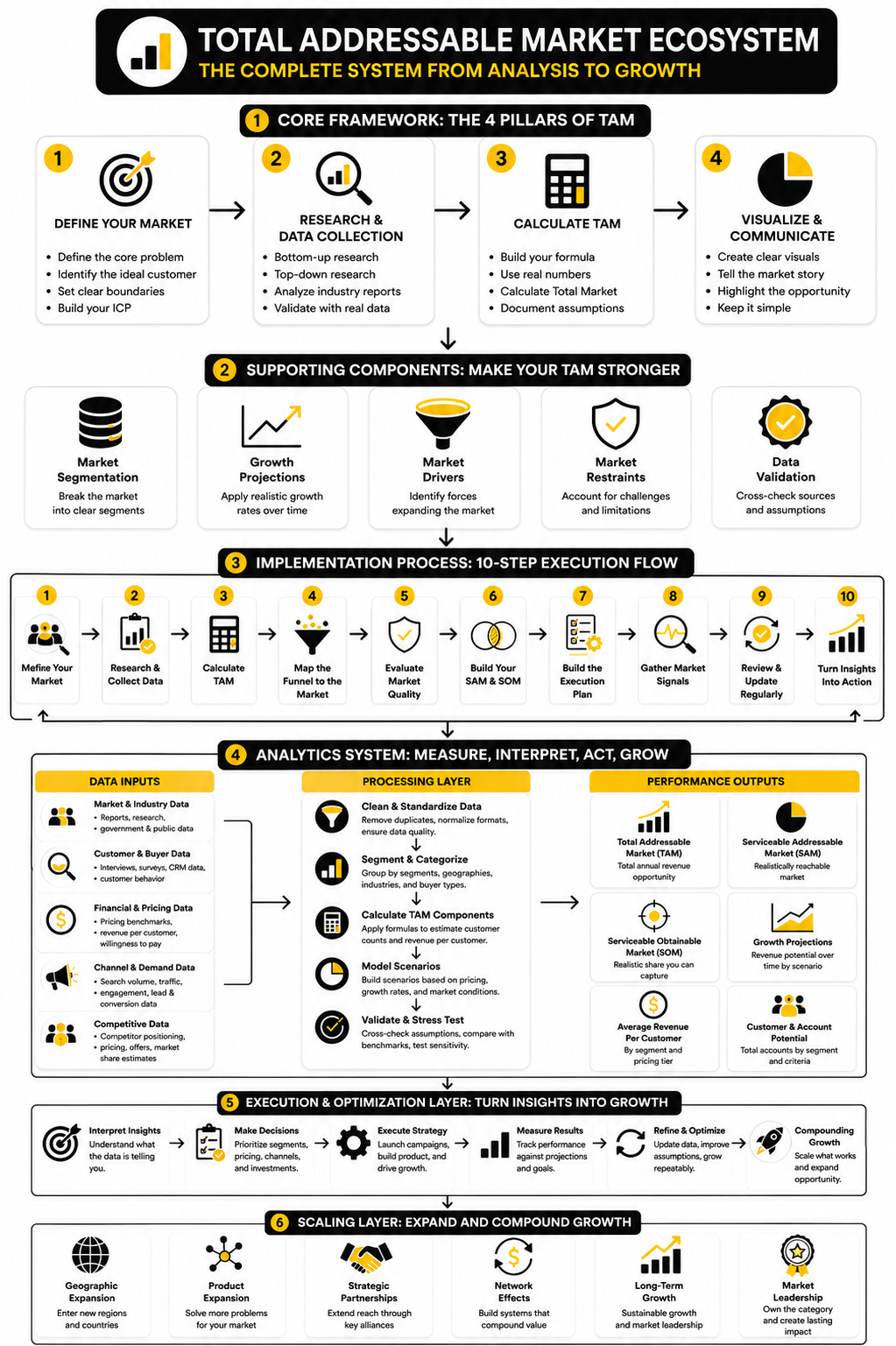
this guide will break the topic into six connected parts:
Why Total Addressable Market Matters
Total addressable market matters because it forces a business to define the size of the prize before building the plan. A company can have a strong product, a capable team, and a clever marketing engine, but if the reachable market is too narrow, growth will eventually hit a wall. That wall is painful because it usually appears after money has already been spent on hiring, product development, paid acquisition, and sales infrastructure.
For founders, TAM helps answer whether the opportunity can support the ambition. Venture-backed companies often need very large outcomes, while bootstrapped businesses can thrive in more focused markets with healthier margins and lower complexity. The point is not that every business needs a billion-dollar market; the point is that the market must match the business model, funding plan, and growth expectations.
For marketers and sales teams, TAM keeps targeting honest. If the market is defined too broadly, campaigns become vague, messaging becomes generic, and conversion rates suffer. If the market is defined too narrowly, the business may miss adjacent segments that could become profitable expansion paths.
Framework Overview
The most useful way to understand total addressable market is through the TAM, SAM, and SOM framework. TAM is the full market opportunity, SAM is the portion of that market your business can realistically serve, and SOM is the portion you can realistically capture within a defined time period. This structure keeps the discussion grounded because it separates theoretical demand from practical reach and near-term execution.
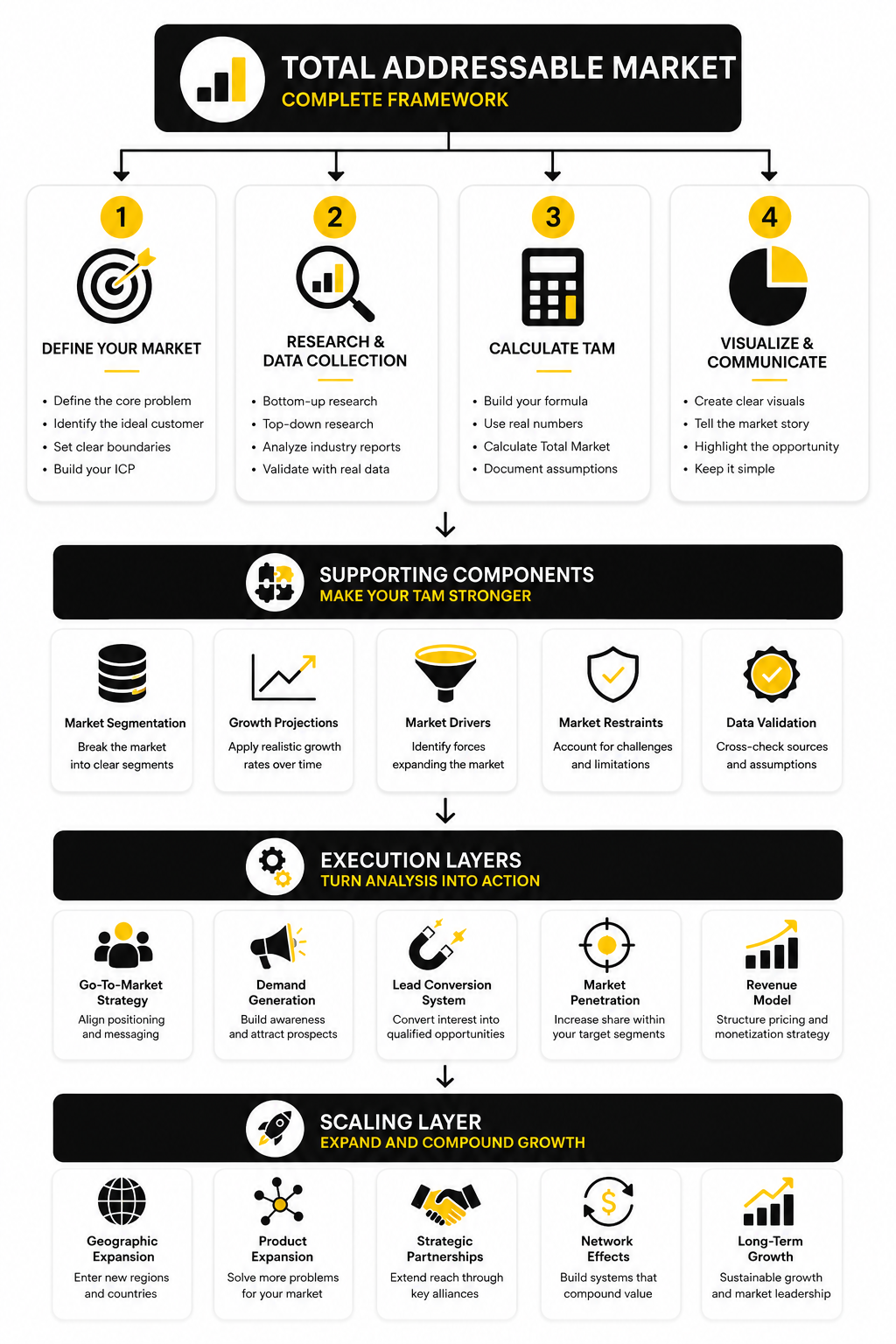
TAM is the outer boundary. It asks, “What is the total annual revenue opportunity if every relevant buyer bought this type of solution?” That question sounds simple, but the answer depends heavily on market definition, pricing model, customer segments, geography, and buying frequency.
SAM narrows the market to what your product, sales model, geography, compliance position, language support, and operational capacity can actually serve. SOM narrows it again to what you can win against competitors with your current resources and go-to-market motion. This is where TAM becomes useful, because it turns a large abstract number into a sequence of strategic choices.
Core Components Of A Defensible TAM
A defensible total addressable market starts with a clearly defined customer. “Small businesses” is usually too broad. “Independent dental clinics in the United States with 3 to 20 employees and active patient financing needs” is much closer to something a team can research, price, target, and sell to.
The second component is spend behavior. TAM should be based on how customers actually spend money, not just how many people might benefit from the idea. A market with millions of potential users can still be weak if those users do not have budget, urgency, authority, or willingness to switch from an existing solution.
The third component is a calculation method that can be checked. A top-down estimate starts from a broad market report and narrows it down, while a bottom-up estimate starts with customer count, pricing, purchase frequency, and adoption assumptions. In professional settings, the strongest TAM analysis usually compares both approaches, because each method catches different blind spots.
Professional Implementation
Professional implementation means treating total addressable market as a working model, not a slide. The model should be revisited when pricing changes, new segments open, competitors reposition, regulations shift, or the company learns something important from real customers. A TAM built once and never updated becomes stale quickly, especially in markets shaped by AI, automation, software consolidation, and changing buyer behavior.
The practical workflow is straightforward. Define the market boundary, segment the buyers, estimate the number of accounts or users, assign realistic annual revenue per customer, validate the result against external benchmarks, and pressure-test the assumptions with customer interviews or sales data. The math matters, but the assumptions matter more.
This is also where tools can help, as long as they do not replace judgment. A team using CRM data, landing page tests, outbound campaigns, and funnel analytics can turn TAM from theory into a live operating system. For example, a service business or agency that uses a CRM and automation platform such as GoHighLevel can connect market segments to pipeline reality instead of leaving the TAM number trapped in a spreadsheet.
Why Total Addressable Market Matters
A serious total addressable market analysis gives you something more useful than a big number. It gives you a way to decide whether the business deserves more investment, sharper positioning, or a different direction entirely. That is the real value: not impressing people, but making better decisions before the expensive mistakes happen.
When a market is poorly defined, everything downstream becomes blurry. Product teams build for too many people at once, marketers write messaging that sounds safe but forgettable, and sales teams waste time chasing accounts that were never likely to buy. A clear TAM does not solve every growth problem, but it gives the business a sharper map.
The key is to treat TAM as a strategic filter. If the market is large but hard to reach, the opportunity may require more capital, a longer sales cycle, or a stronger distribution advantage. If the market is smaller but easy to access, the business may still be excellent, especially when margins are strong and customer retention is high.
It Helps You Match Ambition With Reality
Every business has a growth ceiling, even if the team does not want to admit it yet. Total addressable market helps reveal that ceiling before the company builds a plan that depends on impossible scale. This matters because the wrong ambition can be just as dangerous as too little ambition.
A venture-backed software company usually needs a very different market profile than a local service business, niche agency, or solo-owned digital product. The venture-backed company may need a market large enough to support a major exit, while the smaller business may only need a focused segment with clear demand and profitable acquisition channels. Neither model is automatically better; they simply require different market math.
This is where founders often get trapped. They see a giant category and assume their company can grow into it. But unless the product, pricing, channel, team, and timing all support that path, the headline market size does not mean much.
It Makes Positioning More Specific
Good positioning starts with knowing who the product is really for. Total addressable market analysis forces that conversation because it makes broad language uncomfortable. If you cannot describe the buyer clearly, you probably cannot size the market clearly either.
This is especially important in crowded categories. A CRM, funnel builder, chatbot, scheduling tool, or email platform can technically serve many kinds of businesses, but the strongest go-to-market strategy usually starts with a narrower beachhead. A company that says “we help everyone grow” sounds generic, while a company that defines a specific customer, pain, and budget becomes easier to understand and easier to buy from.
That sharper positioning also improves content, ads, sales scripts, landing pages, and onboarding. A team building funnels in a platform like ClickFunnels or an all-in-one system like Systeme.io still needs a clear market definition first. Tools can help convert demand, but they cannot create a focused strategy out of vague targeting.
It Improves Capital Allocation
Money follows assumptions. If the assumptions are wrong, the budget gets misused. That is why total addressable market analysis is not just a finance exercise; it affects hiring, product roadmap, paid acquisition, partnerships, and sales coverage.
A business with a narrow but profitable market may need depth, not breadth. That could mean better customer success, stronger retention, premium positioning, or a referral-driven growth loop. A business with a large and fragmented market may need automation, segmentation, brand building, and a more scalable acquisition engine.
The mistake is treating every opportunity like it needs the same growth motion. Some markets reward enterprise sales. Others reward self-serve funnels, partner channels, marketplace distribution, or community-led growth. TAM helps you see which motion has enough room to justify the investment.
It Gives Investors A Cleaner Decision
Investors do not only want to know whether a market is big. They want to know whether the founder understands the market deeply enough to win a meaningful piece of it. A massive total addressable market with weak assumptions can hurt credibility because it signals that the team may be optimizing for optics instead of truth.
A cleaner market-sizing argument usually includes a clear customer segment, a realistic annual spend estimate, a reasonable adoption assumption, and a path from today’s traction to future market expansion. That kind of thinking makes the opportunity easier to evaluate. It also shows that the founder understands the difference between theoretical demand and executable demand.
This is why a smaller, well-defended TAM can be more persuasive than a giant number with no operating logic. Investors can disagree with an assumption and still respect the model if the thinking is transparent. What they usually do not respect is a market slide that looks impressive but collapses under basic questions.
It Prevents The “Everyone Is Our Customer” Trap
“Everyone is our customer” sounds exciting until you try to write an ad, build a landing page, or prioritize a product roadmap. Then it becomes a problem. The broader the audience, the harder it is to speak with precision.
A strong total addressable market analysis pushes the team to choose. It asks which customers have the pain now, which ones have budget now, which ones are reachable now, and which ones are most likely to become profitable accounts. That level of focus is not limiting; it is how momentum starts.
The best companies often expand from a specific wedge into a larger market. They do not begin by trying to serve every possible customer at once. They win a segment, learn from it, strengthen the offer, and then expand with evidence instead of hope.
It Connects Strategy To Execution
TAM becomes powerful when it changes what the team does next. If the analysis shows a large market but weak reach, distribution becomes the priority. If it shows a strong niche with high willingness to pay, pricing and retention may matter more than audience growth.
This is where market sizing becomes practical. The business can decide which segments deserve sales outreach, which keywords deserve content investment, which partnerships matter, and which features support expansion. Without that connection, TAM stays trapped in a deck.
A useful total addressable market model should create better questions. Which segment has the fastest path to revenue? Which segment has the best expansion potential? Which segment looks attractive on paper but becomes expensive once acquisition costs are included? Those questions make the business sharper.
The TAM, SAM, And SOM Framework
The cleanest way to make total addressable market useful is to stop treating it as one number. TAM, SAM, and SOM work together because each layer answers a different business question. TAM shows the full opportunity, SAM shows the portion your business can serve, and SOM shows the portion you can realistically win.
This framework matters because strategy gets messy when those layers are blended together. A founder might say the market is worth billions, but the sales team may only be able to reach one country, one industry, or one buyer type right now. That gap is not a small detail; it is the difference between a market that looks good in a pitch and a market that can actually produce revenue.
TAM, SAM, and SOM also help different teams work from the same reality. Leadership can set ambition, product can prioritize the right segments, marketing can choose sharper channels, and sales can focus on accounts with a real chance of closing. The framework becomes useful when it turns a broad opportunity into execution choices.
TAM: The Full Revenue Ceiling
TAM is the total annual revenue opportunity if every relevant customer bought the product or service. It is not a forecast, and it is not a promise. It is the upper boundary of the market under a specific definition.
That last phrase matters: under a specific definition. A business selling appointment software to all service businesses has a different TAM than a business selling appointment software only to independent med spas in English-speaking markets. Both can be valid, but they are not the same market.
A good TAM definition includes the customer type, geography, use case, price range, and buying frequency. Without those limits, the number can expand almost endlessly and stop being useful. The goal is not to make the biggest possible TAM; the goal is to define the real opportunity clearly enough that a smart person can challenge it.
SAM: The Market You Can Actually Serve
SAM is the part of the total addressable market your company can realistically serve with its current or near-term product, business model, and operating constraints. This is where the analysis becomes more honest. It filters out customers who may technically exist but are not practical targets.
For example, a software company might have a global TAM, but only support English onboarding, U.S. payment methods, and a support team in one time zone. In that case, the serviceable market is smaller than the global opportunity. That does not mean the company is weak; it means the model is more precise.
SAM also helps prevent premature expansion. A team may see demand in multiple verticals, but each new vertical adds positioning work, sales enablement, onboarding complexity, and support needs. If the company cannot serve those segments well, counting them inside SAM creates false confidence.
SOM: The Market You Can Realistically Win
SOM is the portion of the serviceable market the business can realistically capture within a defined period. This is the most execution-focused layer. It should reflect competition, sales capacity, marketing budget, conversion rates, churn, product maturity, and brand strength.
SOM is where vague ambition gets tested. If a company wants to win 5 percent of a serviceable market, the next question is obvious: what channel, team, budget, product advantage, or distribution edge makes that possible? If the answer is not clear, the estimate needs work.
This layer is also useful for planning. SOM can guide revenue targets, hiring plans, quota design, content strategy, and paid acquisition budgets. It turns market sizing into a practical operating tool instead of a static spreadsheet exercise.
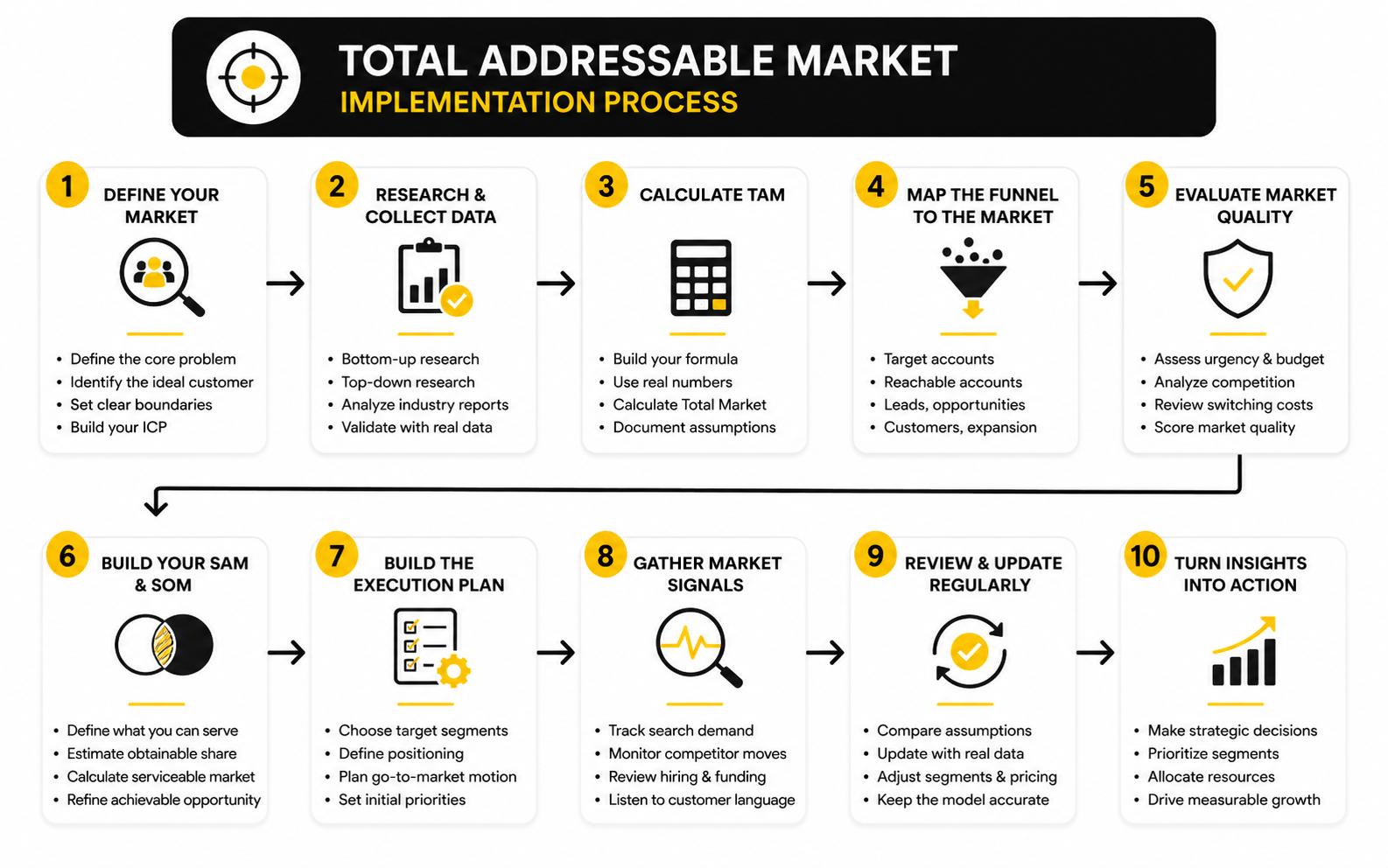
Professional Implementation: How To Calculate And Use TAM
A professional total addressable market process starts with the customer, not the spreadsheet. The spreadsheet only becomes useful after the market boundary is clear. If the buyer is fuzzy, every number that follows will look more precise than it really is.
The implementation process should move from definition to validation. First, define the market. Then choose a calculation method. Then test the assumptions against external research, internal data, customer interviews, sales conversations, and channel performance.
The final output should not be a single untouchable number. It should be a range, a set of assumptions, and a clear explanation of what would make the opportunity expand or shrink. That is how real teams use TAM without turning it into fiction.
Step 1: Define The Market Boundary
Start by writing one plain-English sentence that defines the market. It should say who the customer is, what problem they are solving, where they operate, and what type of solution they are buying. If that sentence is vague, the TAM will be vague too.
A strong market boundary removes customers who are technically possible but strategically irrelevant. That could mean excluding regions you cannot serve, industries with different compliance needs, buyers with no budget, or use cases your product does not handle well. This is not being conservative for the sake of it; it is being useful.
The boundary should also match the company’s current stage. An early-stage business may focus on one wedge market, while a mature business may model multiple segments separately. The mistake is pretending every future expansion segment belongs in the same immediate market.
Step 2: Segment The Customer Base
After the boundary is clear, split the market into segments that behave differently. Good segmentation usually reflects budget, urgency, sales cycle, buying process, product fit, and retention potential. Bad segmentation only groups customers by surface-level traits that do not change how they buy.
For a B2B company, useful segments might include company size, industry, geography, technology stack, or role of the buyer. For a consumer company, useful segments might include income, behavior, frequency of need, channel preference, or willingness to pay. The point is to create groups that lead to different strategic choices.
This step is where a lot of TAM work improves fast. A single blended market number hides the fact that some segments are attractive, some are expensive, and some are distractions. Segmenting the market makes those differences visible.
Step 3: Choose The Calculation Method
There are three common ways to calculate total addressable market: top-down, bottom-up, and value-based. A top-down approach starts with a broad industry number and narrows it down. A bottom-up approach starts with the number of potential customers and multiplies by realistic annual revenue per customer.
The bottom-up method is usually the most useful for operators because it ties directly to real customers and pricing. The basic formula is simple: number of potential customers multiplied by annual revenue per customer. The quality of the estimate depends on how well those two inputs are researched.
A value-based approach can help when the product changes the economics of the market. Instead of only asking what customers currently spend, it asks what the outcome is worth and how much value the company can reasonably capture. This method needs discipline because it can become inflated quickly if the value story is not backed by real willingness to pay.
Step 4: Validate The Assumptions
Once the first model is built, the real work begins. Every important assumption should be checked against another source, another method, or real customer evidence. If the model depends on a customer count, verify the count. If it depends on pricing, verify willingness to pay. If it depends on adoption, verify the buying trigger.
This is where sales calls, CRM data, landing page tests, and outbound experiments become valuable. A market may look attractive on paper, but if no one responds, books a call, starts a trial, or moves through the pipeline, the assumptions need to change. TAM should get sharper as the company learns.
A practical team can use tools like Fillout for structured customer research, Copper for CRM-driven segment tracking, or Brevo for campaign testing. The tool is not the strategy, but the right data makes the strategy harder to fake.
Step 5: Turn The Model Into Decisions
The purpose of a total addressable market model is not to admire it. The purpose is to decide what to do next. That might mean choosing one segment, adjusting pricing, changing the sales motion, narrowing the offer, or expanding into an adjacent market.
A useful TAM model should influence resource allocation. If one segment has a larger market but a slower sales cycle, and another segment has a smaller market but faster payback, the business needs to choose based on its cash position and growth goals. The biggest market is not always the best first market.
This is also where the model should connect to measurable execution. The team should be able to say which campaigns, channels, partnerships, products, or sales plays are tied to each segment. If the market sizing does not lead to action, it is just analysis theater.
Statistics And Data
Data only helps when it changes the decision. A total addressable market model should not become a collection of impressive-looking numbers pulled from market reports, investor decks, and industry blogs. The goal is to understand what the numbers mean, whether they support the strategy, and what action they should trigger.
The strongest market-sizing work combines external benchmarks with internal performance signals. External data helps you understand the size and direction of the market, while internal data shows whether your company can actually reach, convert, retain, and expand within that market. When those two views disagree, the internal data usually deserves more attention because it reflects what is happening in your actual business.
This is where many teams get sloppy. They use a large total addressable market to justify growth goals, but they do not connect that market to conversion rates, acquisition costs, sales capacity, churn, or expansion revenue. A market can be huge and still be unattractive if the economics of reaching it are weak.
The Numbers That Actually Matter
The first number to measure is the size of the customer universe. This means the number of accounts, buyers, locations, users, or households that genuinely fit your market definition. If this number is wrong, the rest of the TAM model becomes unstable.
The second number is realistic annual revenue per customer. This should reflect actual pricing, expected plan mix, contract size, purchase frequency, and expansion potential. A software company should not use enterprise-level pricing across a market mostly made of small businesses, and a service provider should not assume every buyer will purchase the highest-margin package.
The third number is reachable demand. This is where TAM starts connecting to execution. A company may identify 100,000 potential customers, but if only a small portion can be reached through existing channels at a profitable cost, the near-term opportunity is much smaller than the headline number suggests.
Use Benchmarks As Guardrails, Not Gospel
Benchmarks are useful because they give you a reality check. They can show whether your assumptions are aggressive, conservative, or completely detached from how similar companies perform. But benchmarks should never be copied blindly because every business has a different market, sales motion, pricing model, and level of maturity.
For SaaS companies, retention and acquisition efficiency are especially important because they reveal whether the market can support profitable growth. The 2024 SaaS Benchmarks Report noted that public SaaS companies showed net dollar retention around 110%, which is useful context for understanding how expansion and churn shape revenue potential. That number does not tell you what your company will achieve, but it does show why retention has to be part of market sizing.
CAC payback is another useful signal. The 2024 B2B SaaS Performance Metrics Benchmarks Report tracks metrics such as CAC payback period, net revenue retention, and sales and marketing efficiency because those numbers determine whether growth is financially healthy. A large TAM means less if every customer takes too long to pay back the cost of acquisition.
Measure The Funnel Against The Market
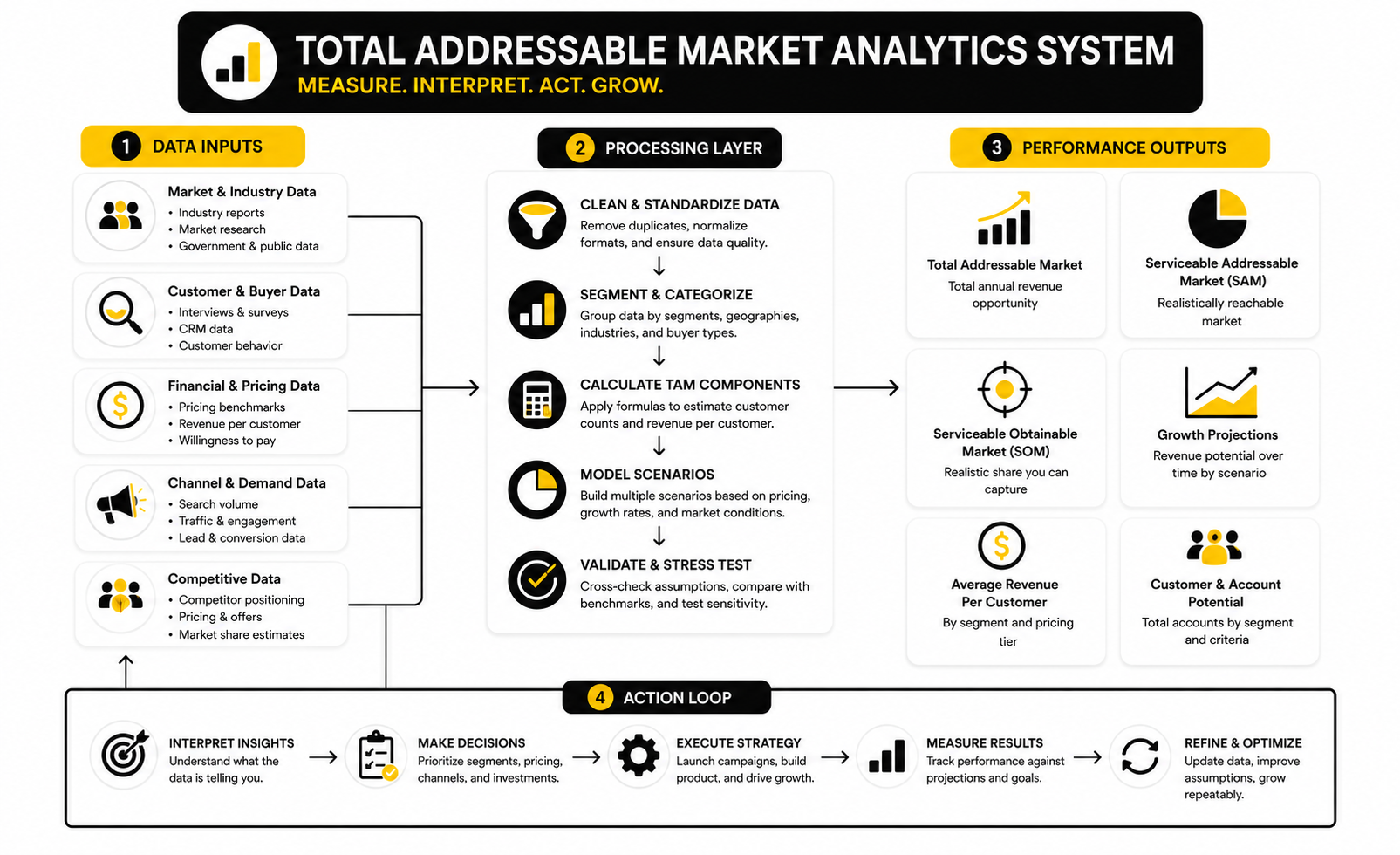
A total addressable market model becomes more useful when it is tied to the funnel. The market tells you how many potential buyers exist, but the funnel tells you how many of those buyers you can actually move from awareness to revenue. This is the bridge between strategy and performance.
Start with the major stages: target accounts, reachable accounts, engaged leads, qualified opportunities, closed customers, retained customers, and expanded customers. Each stage should have a conversion rate, a volume number, and a clear owner. Without that, TAM remains too abstract to guide action.
This funnel view also exposes bottlenecks. If the market is large but outbound response is low, the issue may be targeting, messaging, offer strength, or channel fit. If conversion is strong but lead volume is weak, the market may be valid but underdeveloped. If acquisition works but churn is high, the market may be real but the product or onboarding experience may not be strong enough yet.
Separate Market Size From Market Quality
A big market is not automatically a good market. Market quality depends on urgency, budget, competition, switching costs, retention, margin, and access. Two markets can have the same total addressable market on paper and completely different business outcomes in practice.
A high-quality market usually has a painful problem, clear ownership of the budget, frequent buying moments, and measurable value after purchase. A low-quality market may have interest but little urgency, weak willingness to pay, or a buying process that makes revenue slow and expensive. The difference matters because revenue potential is not just about how many customers exist.
This is why the best TAM analysis includes qualitative signals too. Sales calls, customer interviews, review mining, support tickets, cancellation reasons, and win-loss analysis can reveal what the raw numbers miss. A market full of frustrated buyers with budget is very different from a market full of curious browsers.
Track Adoption Signals Over Time
Market size is not fixed. It changes as technology improves, buyer behavior shifts, regulations change, budgets move, and new categories become normal. That is why a total addressable market model should be reviewed regularly instead of being treated as a one-time planning asset.
Adoption signals help you understand whether the market is expanding, maturing, or becoming harder to enter. These signals can include search demand, category funding, hiring patterns, software review activity, competitor messaging, regulatory movement, and customer language. None of these signals is perfect alone, but together they show direction.
This matters most in emerging markets. Early demand can look small because buyers are still learning the category, while late-stage demand can look large but become expensive because competition has already intensified. The action changes depending on the signal: early markets need education and trust-building, while mature markets need differentiation and sharper economics.
Turn Analytics Into Operating Decisions
Analytics should create decisions, not dashboards. If a segment has strong conversion and weak retention, improve product fit before scaling acquisition. If a segment has weak conversion but high contract value, improve sales enablement, proof, and qualification before abandoning it.
A practical analytics system connects market assumptions to actual performance. That means tracking which segments produce pipeline, which channels create qualified buyers, which offers convert, which customers stay, and which accounts expand. When this data is visible, the team can update the TAM model based on reality instead of opinion.
This is where execution tools can support the process. A team using Buffer for channel testing, ManyChat for conversational lead capture, or Chatbase for buyer support and qualification can gather useful demand signals faster. The important part is not the tool itself; it is whether the data helps the business make sharper market decisions.
Know When The Data Is Warning You
Bad data does not always say “stop.” Sometimes it says “narrow the market,” “change the offer,” “fix onboarding,” or “switch channels.” The job is to read the signal correctly instead of forcing the original total addressable market story to survive.
If customer acquisition cost rises while conversion quality drops, the market may be less reachable than expected. If win rates are strong in one segment and weak everywhere else, the initial market definition may be too broad. If retention is poor across the board, the company may have demand but not durable value yet.
The best teams do not defend the old model. They update it. A total addressable market estimate should become more accurate as the business learns, and every performance signal should either strengthen the thesis or force a better one.
Advanced Strategic Considerations
Once the basic total addressable market model is in place, the harder questions begin. The early model tells you where the opportunity might be, but the advanced work tells you whether that opportunity is worth pursuing before other options. This is where strategy becomes less about market size and more about tradeoffs.
A large market can hide brutal economics. A smaller market can hide faster trust, better margins, and stronger retention. The job is not to chase the biggest number; the job is to find the market where your product, positioning, channel, and operating model have the best chance of compounding.
This is also where experienced operators separate possibility from priority. A company may be able to serve five segments eventually, but it probably cannot win all five at the same time. Focus is not a lack of ambition. Focus is how ambition becomes executable.
Expansion Markets Need Proof, Not Hope
Expansion is tempting because it makes the total addressable market look larger. A founder can add new geographies, verticals, use cases, company sizes, or pricing tiers and suddenly the model feels more exciting. But expansion only strengthens the strategy when there is evidence behind it.
The first proof point is demand overlap. If customers in the new segment describe the problem differently, use different tools, require different compliance standards, or need a different buying process, the expansion may be more like a new business than a natural extension. That is not bad, but it needs to be treated honestly.
The second proof point is operational fit. A segment may want the product, but if serving it requires new support capacity, new integrations, new onboarding flows, or a completely different sales motion, the market is not as easy to capture as it looks. The total addressable market should expand only when the company can explain how that expansion will be served profitably.
Market Timing Can Change The Value Of The Same TAM
The same total addressable market can be attractive at one moment and unattractive at another. Early markets often have low awareness, low search demand, and long education cycles, but they may also have less competition and more room to shape the category. Mature markets usually have clearer demand, but they also attract more competitors, higher ad costs, and more skeptical buyers.
This creates a timing tradeoff. Enter too early and you may spend years educating buyers who are not ready. Enter too late and you may find that distribution, trust, and pricing power already belong to someone else.
The practical move is to watch behavior, not hype. Are buyers actively searching for solutions? Are budgets being assigned? Are competitors hiring salespeople, launching category pages, or moving into paid acquisition? Those signals tell you whether the market is still forming or already turning into a fight for share.
Distribution Can Be More Important Than Market Size
A total addressable market estimate usually starts with demand, but growth often depends on distribution. A company with a smaller market and a strong channel can outperform a company with a larger market and no reliable way to reach buyers. This is why “how will we reach them?” matters as much as “how many are there?”
Distribution advantages can come from content, partnerships, outbound data, communities, marketplaces, affiliates, product-led sharing, paid media, or existing customer networks. The best channel depends on the segment and the buying process. A high-ticket B2B product may need sales-led trust, while a simple creator tool may grow better through templates, referrals, and social proof.
The danger is assuming a market is reachable just because it is measurable. A list of potential buyers is not the same as a growth engine. If the channel is weak, the serviceable market should be reduced until the company proves it can create demand at a reasonable cost.
Pricing Changes The Shape Of The Market
Pricing does not just affect revenue. It changes who the market is, how the product is sold, how much support is needed, and which competitors matter. A low-price offer and a premium offer can exist in the same broad category but operate in very different markets.
A company with low pricing may have a larger pool of potential buyers, but it needs efficient acquisition, low support burden, and strong volume. A company with premium pricing can survive on fewer customers, but it needs stronger proof, better onboarding, and a clearer business outcome. Neither approach is automatically superior.
This is why total addressable market should be modeled at multiple pricing levels. The question is not only “how many buyers exist?” The better question is “how many buyers exist at this price, with this promise, through this channel, and with this level of service?”
Competitive Density Changes The Real Opportunity
A large TAM becomes less attractive when the market is crowded with strong incumbents, high switching costs, and expensive acquisition channels. Competition does not eliminate opportunity, but it changes the strategy required to win. In some cases, the best move is not to attack the broad category but to own a specific wedge inside it.
A wedge can be a niche audience, a painful workflow, a neglected buyer, a faster onboarding experience, or a more opinionated product. The wedge matters because it gives the company a believable reason to win before it tries to expand. Without that reason, the company becomes another option in a sea of similar options.
Competitive density should also affect the SOM estimate. If the market has entrenched leaders, strong brand loyalty, and long contracts, the obtainable share should be conservative. If the market is fragmented, underserved, or full of dissatisfied buyers, the obtainable share may be more realistic even with a smaller team.
Category Creation Requires A Different Model
Some companies are not entering an existing market. They are trying to create or reshape a category. In that case, total addressable market becomes harder to calculate because current spending may not fully represent future demand.
A category-creation model needs to estimate both existing substitute spend and future behavior change. Buyers may not have a budget line for the new product yet, but they may already spend money on manual work, agencies, disconnected tools, or internal labor. That existing pain can become the anchor for a more realistic market estimate.
The risk is overestimating how fast behavior changes. Buyers may understand the value and still delay adoption because of trust, workflow disruption, procurement, training, or internal politics. Category creation can produce huge outcomes, but the path is usually slower and more expensive than a simple TAM slide suggests.
Operational Constraints Should Reduce The Market
A market is not truly serviceable if the business cannot deliver the promised outcome at scale. This is especially important for agencies, service businesses, B2B software, and operationally heavy offers. The customer may exist, the budget may exist, and the demand may exist, but capacity can still become the bottleneck.
Operational constraints include support volume, implementation time, onboarding complexity, compliance needs, data quality, integration work, and customer success capacity. If every new customer requires too much manual work, the company may need to narrow its serviceable market or redesign the product before scaling. Otherwise growth creates fragility instead of leverage.
This is where systems matter. A business using GoHighLevel to centralize CRM, automations, and client communication can often serve more accounts with less operational drag. But the principle stays the same: the total addressable market only matters if the company can serve that market without breaking the machine.
AI And Automation Can Expand Or Compress TAM
AI can expand a total addressable market by making a product cheaper, faster, easier to use, or available to customers who previously could not afford it. Automation can also reduce service costs, shorten onboarding, and make smaller accounts profitable. That can turn a previously unattractive segment into a viable growth path.
But AI can also compress the market. If a feature becomes easy to replicate, pricing power can fall. If buyers expect automation as a baseline, products that once looked differentiated may become standard. The market may still be large, but the value capture can shift quickly.
This means AI-driven TAM expansion should be modeled carefully. The question is not only whether AI increases adoption. The question is whether it improves margins, strengthens retention, creates defensibility, or simply invites more competitors into the same space.
The Best Market Is Often The One You Can Learn From Fastest
Early on, the best market is not always the largest or most prestigious. It is often the market where you can get the fastest useful feedback. Fast feedback helps the team improve positioning, pricing, onboarding, product scope, and sales messaging before bigger bets are made.
A market with reachable buyers, visible pain, and short sales cycles can teach you more than a larger market with slow procurement and unclear ownership. Those lessons can later support expansion into more complex segments. That sequence is usually healthier than jumping straight into the hardest market because the TAM looks impressive.
This is why expert-level market sizing includes learning velocity. How quickly can the business test the segment? How quickly can it close customers? How quickly can it understand churn, usage, objections, and willingness to pay? The market that teaches you fastest can become the market that makes you strongest.
Strategic TAM Review Questions
A strong total addressable market model should survive pressure. It should not collapse when someone challenges the customer count, pricing assumption, channel plan, or competitive reality. If it does collapse, that is not failure; it is a useful warning.
Use these questions to sharpen the model before it drives major decisions:
These questions keep the conversation practical. They move the team away from defending a giant market number and toward building a better business case. That is the whole point of total addressable market analysis: better judgment, better focus, and better execution.
Common Mistakes And Final Review Checklist
The final step is to pressure-test the total addressable market model before it turns into strategy, hiring, budget, or investor messaging. This is where the business should slow down and ask whether the model reflects reality or simply supports the story the team already wanted to tell. That distinction matters because TAM is useful only when it improves judgment.
A strong model should be clear enough for someone outside the company to understand and tough enough to survive basic pushback. If the customer definition, pricing assumption, market boundary, or acquisition path cannot be explained simply, the model needs more work. Complexity is not the enemy, but unclear thinking is.
The goal is not perfection. Markets move, customers change, and assumptions improve as the company learns. The goal is to build a total addressable market model that is honest, useful, and connected to execution.
Mistake 1: Counting Everyone Who Could Benefit
The most common mistake is counting everyone who could theoretically use the product. Interest is not the same as demand, and demand is not the same as willingness to pay. A defensible TAM should count buyers who have the problem, the budget, the authority, and a realistic path to purchase.
This mistake usually comes from optimism, not laziness. Founders and marketers naturally want to believe the product can help a broad audience. But a broad audience creates weak numbers if most of those people will never buy.
The better approach is to narrow first and expand later. Start with the buyers who are most likely to purchase, retain, and produce useful feedback. Once that segment is proven, the business can model adjacent markets with more confidence.
Mistake 2: Using Revenue Assumptions That Do Not Match The Buyer
A total addressable market model can look impressive when annual revenue per customer is inflated. The problem is that the model then stops reflecting the actual market. If the buyer is small, price-sensitive, or difficult to retain, the revenue assumption must show that.
This happens often when companies mix enterprise pricing with small-business customer counts. The model uses the large population of small accounts but applies the revenue potential of a much larger customer. That combination creates a number that looks exciting but cannot be defended.
The fix is simple: model segments separately. Use realistic pricing for each buyer group, then show how the market changes if the company moves upmarket, downmarket, or into a new vertical. That makes the total addressable market more credible and more useful.
Mistake 3: Ignoring Distribution Reality
A market is not truly reachable just because it exists. If the company has no reliable way to reach buyers, educate them, earn trust, and convert them profitably, the near-term opportunity is smaller than the TAM suggests. Distribution is where many market-sizing stories break.
This is why channel evidence matters. Search volume, outbound response, partner access, community presence, paid acquisition costs, and referral behavior all help show whether the market can be reached. Without those signals, the business is guessing.
The better question is not only “how many buyers are out there?” It is “how many can we reach through a repeatable motion?” That question pulls the TAM model closer to revenue.
Mistake 4: Treating TAM As Static
Total addressable market changes over time. New competitors enter, buyers adopt new workflows, budgets shift, regulations change, and technology lowers or raises the cost of serving customers. A model that was useful six months ago may already need revision.
This does not mean the team should rebuild the model every week. It means the company should update the assumptions when meaningful evidence changes. New win-loss data, churn patterns, channel performance, pricing tests, or customer interviews can all reshape the market view.
A living TAM model becomes more valuable with time. It should get sharper as the company learns, not stay frozen because it appeared in a deck.
Final Review Checklist
Before using a total addressable market model for a major decision, review it from the outside in. Pretend you are an investor, advisor, board member, or skeptical operator seeing the model for the first time. The goal is to find weak assumptions before they create expensive consequences.
A useful checklist should cover definition, math, evidence, and execution. If any one of those layers is weak, the model may still be directionally useful, but it should not drive high-stakes decisions without more validation. This is not bureaucracy; it is strategic hygiene.
Use this checklist before turning the TAM model into hiring plans, sales targets, ad budgets, product roadmaps, or fundraising claims:
The best total addressable market questions usually come from people who are trying to make the model practical. They do not just want a definition; they want to know how to use the number without misleading themselves. These answers are designed to help you apply the concept with more confidence.
What Is Total Addressable Market?
Total addressable market is the total annual revenue opportunity available for a product or service within a defined market. It represents the upper revenue ceiling if every relevant customer bought the solution. It is not a sales forecast, and it should not be treated like guaranteed revenue.
What Is The Difference Between TAM, SAM, And SOM?
TAM is the full market opportunity, SAM is the part of that market your company can realistically serve, and SOM is the portion you can realistically win. The three layers help separate ambition from execution. This matters because a large market does not automatically mean a large near-term opportunity.
Why Is Total Addressable Market Important?
Total addressable market is important because it helps companies decide whether an opportunity is worth pursuing. It also helps teams prioritize segments, channels, pricing, and product investments. Without it, strategy can become reactive, vague, and disconnected from the real size of the opportunity.
How Do You Calculate Total Addressable Market?
The most practical method is usually bottom-up market sizing. You estimate the number of potential customers and multiply that by realistic annual revenue per customer. The quality of the answer depends on how well you define the buyer and validate the revenue assumption.
Is A Bigger TAM Always Better?
A bigger TAM is not always better. A large market can be expensive, crowded, slow to penetrate, or difficult to serve. A smaller market with urgent demand, strong margins, and easier distribution can often be a better first target.
What Makes A TAM Estimate Credible?
A credible TAM estimate has a clear market definition, realistic customer counts, believable pricing, and transparent assumptions. It should also be supported by external research and real customer evidence where possible. The strongest models can be challenged without falling apart.
Should Startups Use Top-Down Or Bottom-Up TAM?
Startups should usually lead with bottom-up TAM because it connects directly to customers, pricing, and go-to-market execution. Top-down analysis can still help as a benchmark or sanity check. The best approach is to compare both methods and explain why the final estimate makes sense.
How Often Should A TAM Model Be Updated?
A total addressable market model should be updated when the business learns something meaningful. That could include new pricing data, customer interviews, churn patterns, sales performance, competitive changes, or expansion evidence. It does not need constant editing, but it should not sit untouched for years.
Can TAM Be Too Narrow?
Yes, TAM can be too narrow if the model excludes realistic expansion opportunities or focuses only on the first customer segment. But being narrow early is often useful because it creates focus. The key is to separate the beachhead market from the larger expansion market instead of blending them together.
What Is A Good TAM For Investors?
There is no universal “good” TAM because it depends on the investor, business model, category, and return expectations. Venture investors usually look for markets large enough to support major scale, while other investors may prefer smaller markets with strong profitability and lower risk. The important thing is that the market size matches the growth story.
How Does Pricing Affect Total Addressable Market?
Pricing directly affects TAM because the model usually multiplies customer count by annual revenue per customer. A higher price may increase revenue per customer but reduce the number of buyers who can realistically pay. A lower price may expand the buyer pool but require more volume and stronger acquisition efficiency.
What Is The Biggest TAM Mistake?
The biggest mistake is confusing theoretical possibility with actual demand. Just because someone could use a product does not mean they will buy it, pay enough for it, or stay long enough to create a good business. A strong total addressable market model filters for buyer reality, not imagination.
Build a stronger local presence with BAAM AI
Turn your website, Google profile, social channels, and AI visibility into one growth engine
Most businesses do not need more random marketing activity. They need a consistent presence system that helps the right people find them, trust them, and take action. BAAM AI brings strategy, local SEO, website updates, Google Maps visibility, social content, AI-search readiness, media production, and reporting into one practical monthly engine.
If you want your marketing to keep working after the campaign ends, start with a free BAAM AI presence audit. See how your business shows up today and where the fastest visibility wins are at BAAM AI.