
BAAM AI Blog
Top Social Media Companies: The Practical Guide to the Platforms That Shape Attention, Commerce, and Culture
The top social media companies are no longer just places where people post updates, watch videos, or follow friends. They are distribution networks, ad platforms, entertainment engines, commerce layers, messaging...
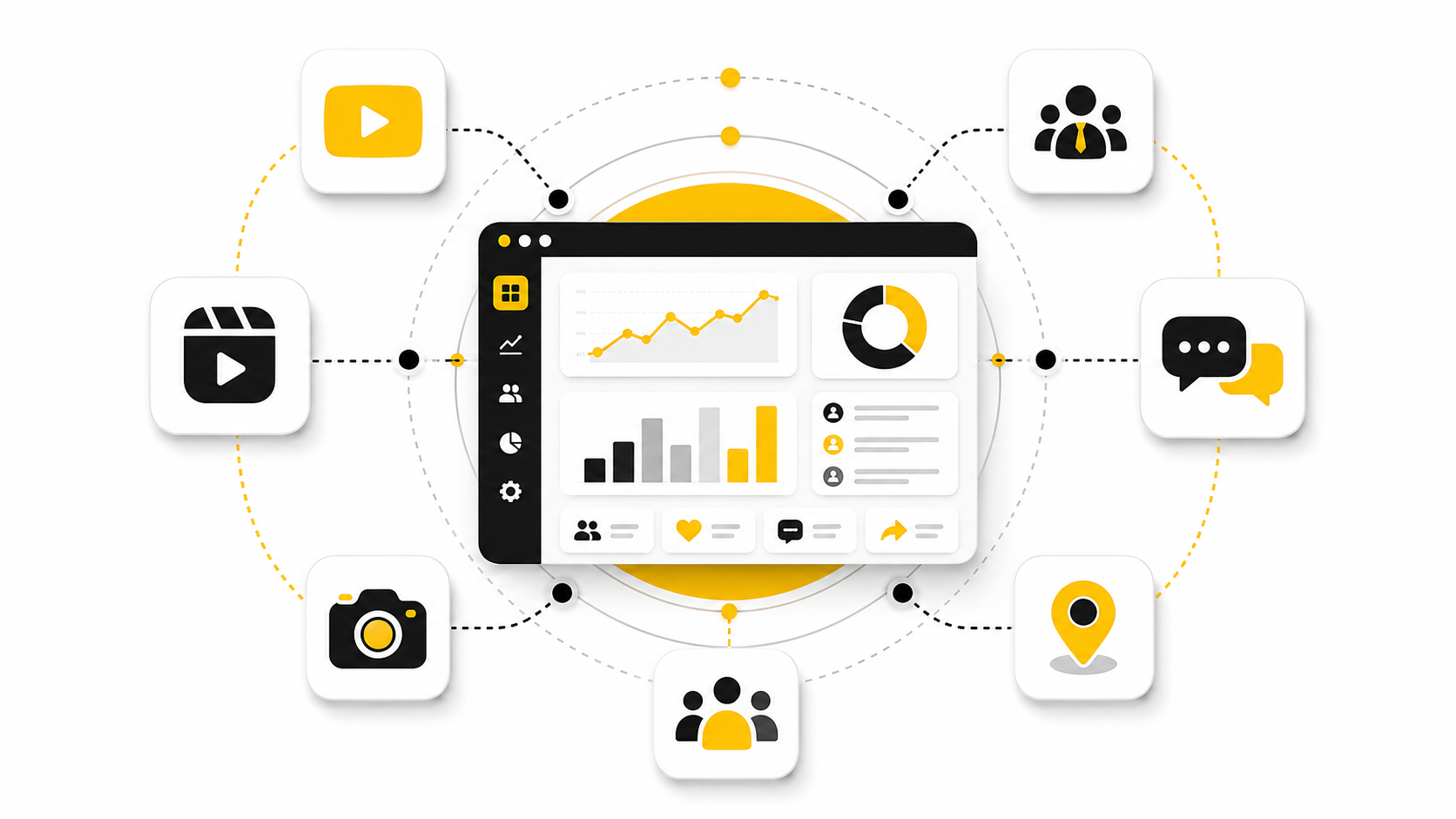
The top social media companies are no longer just places where people post updates, watch videos, or follow friends. They are distribution networks, ad platforms, entertainment engines, commerce layers, messaging systems, search alternatives, and AI-powered recommendation machines all at once. That is why understanding the biggest players matters whether you are building a personal brand, growing an agency, running an ecommerce store, or choosing where to invest your marketing budget.
The scale is hard to ignore. Global social media use now reaches billions of people, with DataReportal estimating more than 5.6 billion active social media user identities worldwide, while Meta reported 3.56 billion daily active people across its family of apps in March 2026. YouTube says its platform reaches billions of monthly logged-in users, and YouTube Shorts now averages more than 200 billion daily views. These are not small communities anymore. They are the infrastructure of modern attention.
But “biggest” does not always mean “best.” Facebook, Instagram, YouTube, TikTok, LinkedIn, Snapchat, Pinterest, Reddit, X, WhatsApp, Discord, and newer social layers all win in different ways. Some dominate reach. Some dominate culture. Some drive purchase intent. Some are better for B2B trust, creator monetization, private communities, customer conversations, or short-form discovery. The smart move is not to chase every platform. It is to understand what each company is built to do, then match the platform to the job.
Why Top Social Media Companies Matter
The top social media companies matter because they control the channels where attention is created, sorted, and monetized. A single algorithm update can change how creators earn, how brands reach customers, and how publishers distribute content. That makes social media strategy less about posting randomly and more about understanding the incentives behind each platform.
For businesses, these companies are also customer acquisition systems. Meta’s family of apps, YouTube, TikTok, LinkedIn, Pinterest, Reddit, and Snapchat all give advertisers different ways to target demand, build memory, and move people toward action. The best platform is rarely the one with the flashiest headline number. It is the one where your audience already spends time with the right intent.
For creators and operators, the stakes are even more direct. Social platforms can create distribution faster than websites, newsletters, or paid search alone, but they can also make you dependent on rented attention. That is why serious teams usually pair social reach with owned assets like email lists, CRM systems, landing pages, communities, and automation workflows. A tool like ManyChat fits naturally here because social engagement only becomes more valuable when it can turn conversations into follow-up.
The Framework for Comparing Social Media Companies
A useful framework starts with a simple question: what does this platform reward? YouTube rewards watch time, search behavior, and creator consistency. TikTok rewards fast entertainment, trend fluency, and retention. LinkedIn rewards professional credibility, expertise, and network trust. Instagram rewards visual identity, creator relationships, and high-frequency engagement.
The second question is who owns the relationship. On public-feed platforms, discovery can be massive but unstable. On messaging and community platforms, reach may be smaller but the relationship is usually deeper. That difference matters because a million passive views and 10,000 high-intent subscribers are not the same asset.
The third question is how the company makes money. Advertising platforms optimize for ad inventory, conversion data, and time spent. Subscription or community-led platforms may care more about retention, identity, and direct interaction. Commerce-oriented platforms care about product discovery and buyer intent. Once you understand the business model, the platform’s product decisions become much easier to read.
The Core Components of a Strong Social Platform
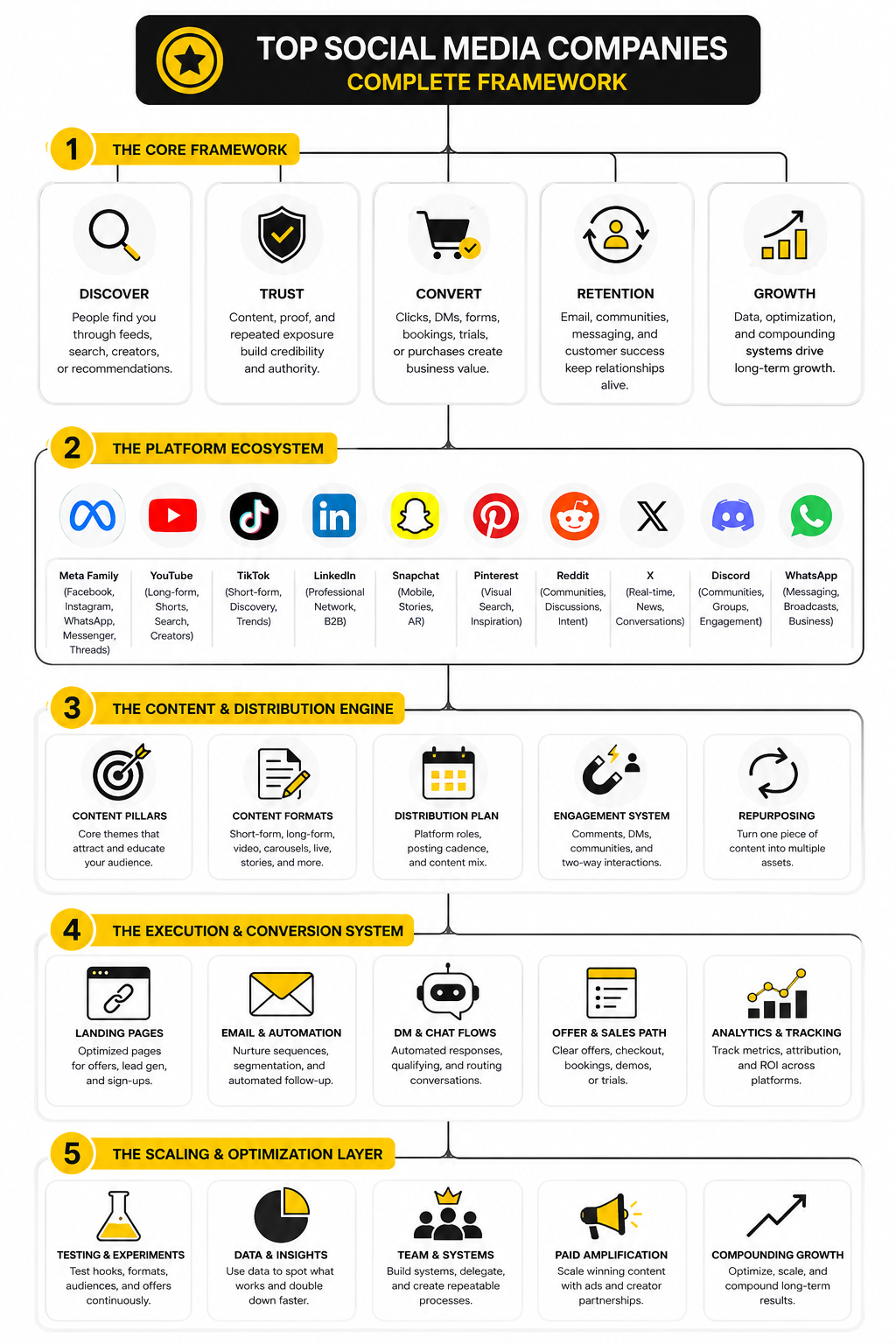
Every major social media company has a few core components working together. The first is identity: profiles, pages, handles, creators, brands, groups, or channels. The second is distribution: feeds, recommendations, search, notifications, shares, and messaging. The third is monetization: ads, subscriptions, shopping, creator payouts, lead generation, or premium features.
The strongest platforms connect those pieces smoothly. A creator can publish, reach an audience, build trust, and monetize without needing too many disconnected tools. A brand can test content, run paid campaigns, capture leads, and measure outcomes. That is where platforms become more than media apps. They become operating systems for attention.
This is also where professional implementation begins. Teams need a way to plan content, manage channels, respond to conversations, route leads, and measure what actually converts. Tools like Buffer can help organize publishing across channels, while platforms like GoHighLevel are more relevant when the goal is to connect social leads with CRM, follow-up, pipelines, and client-facing marketing systems. The platform gets you attention. The system behind it turns that attention into a business outcome.
The Biggest Social Media Companies by Role and Business Model
The top social media companies are easier to understand when you stop treating them as one category. Meta is not playing the same game as Reddit. YouTube is not built like Snapchat. LinkedIn is not trying to win the same kind of attention as TikTok. The labels all say “social media,” but the business models, user behavior, and marketing value are very different.
For a professional strategy, that distinction matters more than the raw user count. A platform with massive reach can still be weak for your offer if the audience is in the wrong mindset. A smaller platform can outperform a larger one when it owns a specific intent, community, or buying moment. This is where the practical comparison begins.
Meta: The Social Advertising Empire
Meta sits at the center of the social media industry because it owns multiple major networks at once: Facebook, Instagram, WhatsApp, Messenger, and Threads. Its advantage is not just audience size. It is the combination of identity, social graph data, messaging, creator content, paid ads, and business tools inside one ecosystem. Meta reported 3.56 billion daily active people across its family of apps in March 2026, which gives it a reach base most competitors simply cannot match.
Facebook still matters because of groups, local communities, events, marketplace behavior, and older consumer segments with serious purchasing power. Instagram is stronger for creators, lifestyle brands, visual discovery, short-form video, and social proof. WhatsApp is different again because it is closer to private communication than public broadcasting, which makes it powerful for customer support, relationship building, and direct follow-up.
Meta’s business model is still heavily advertising-led, and that shapes the platform experience. The company keeps improving targeting, creative automation, AI recommendations, and business messaging because more relevant content creates more ad inventory and stronger conversion paths. For brands, the lesson is simple: Meta is not one channel. It is a full attention-to-conversation system, especially when paired with automation tools like ManyChat for Instagram and Messenger follow-up.
YouTube: The Video Search and Creator Platform
YouTube is one of the most important social media companies because it blends social discovery with search behavior. People go there to be entertained, but they also go there to learn, compare, research, and solve problems. That makes YouTube different from a pure feed platform. A strong video can keep bringing traffic months or years after it is published.
The platform’s scale is enormous. YouTube says it has billions of monthly logged-in users, and YouTube Shorts now averages more than 200 billion daily views. That matters because YouTube is competing in two directions at once: long-form video for depth and short-form video for discovery. Most social platforms are strong in one of those formats, not both.
For businesses, YouTube is often the best platform for authority-building content. Tutorials, comparisons, product education, founder-led content, webinars, interviews, and case-study style videos all fit naturally there. The downside is that YouTube usually requires more production discipline than a fast-moving short-form platform. The upside is that the content can become a searchable asset instead of disappearing inside a feed after 48 hours.
TikTok: The Culture and Discovery Machine
TikTok changed the social media industry by making interest-based discovery feel normal. Instead of relying mainly on who you follow, TikTok built a feed where content can travel quickly because the recommendation system tests videos against audience behavior. That shift forced Instagram, YouTube, Snapchat, Pinterest, and even LinkedIn to take short-form video more seriously.
TikTok is especially strong when the product, message, or creator fits entertainment-first discovery. Beauty, fashion, food, fitness, music, consumer apps, creator education, and personality-led brands can move fast there. The platform is less forgiving when content feels like traditional advertising. People do not open TikTok hoping to watch a pitch deck.
The strategic question is not whether TikTok is “worth it.” The better question is whether your team can produce native content consistently enough to learn from the platform. TikTok rewards testing, hooks, speed, and cultural timing. If your approval process takes three weeks, you are already fighting the platform instead of using it.
LinkedIn: The Professional Trust Network
LinkedIn has a unique position among the top social media companies because it owns professional identity. People use it with a career, hiring, industry, or business mindset. That changes everything. A post that would feel too serious on Instagram can perform well on LinkedIn because the audience expects expertise, opinion, and professional context.
LinkedIn says it has more than 1 billion members, and Microsoft’s recent updates continue to show LinkedIn as a growing business inside the Microsoft ecosystem. The important detail is not just member count. It is the type of data LinkedIn owns: roles, companies, industries, skills, hiring signals, career moves, and business networks. For B2B marketers, that identity layer is extremely valuable.
LinkedIn works best when the content is specific, useful, and credibility-driven. Founder insights, operator lessons, market analysis, hiring perspectives, customer education, and thoughtful commentary all fit the platform. It is not the place to copy-paste generic motivational content and hope for the best. The audience is busy, skeptical, and valuable, which means the bar for substance is higher.
Snapchat: The Camera-First Communication Platform
Snapchat is often underestimated because it does not behave like a traditional public-feed network. Its strength is private communication, camera usage, augmented reality, and younger audience behavior. That makes it less visible in public conversation but still very relevant for brands targeting Gen Z and mobile-first consumers.
Snap reported 900 million monthly active users and 460 million daily active users in Q1 2026, which keeps it firmly inside the conversation about major social platforms. The company has also invested heavily in AR, creator tools, Spotlight, and advertiser products. That mix gives Snapchat a different role from Instagram or TikTok. It is not just about broadcasting content; it is about communication, lenses, identity, and interactive experiences.
For marketers, Snapchat usually makes the most sense when the audience is young, visual, and mobile-native. It can be useful for entertainment, fashion, beauty, music, events, consumer products, and location-based campaigns. But it should not be treated as a universal default. If your buyers are senior B2B decision-makers, LinkedIn will usually make more sense.
Pinterest: The Visual Search and Planning Platform
Pinterest deserves a separate category because it is closer to visual search than traditional social media. Users often arrive with intent: planning a room, choosing an outfit, researching recipes, collecting wedding ideas, comparing aesthetics, or saving products for later. That makes Pinterest valuable for brands that benefit from aspiration and planning behavior.
Pinterest reported 570 million monthly active users in Q1 2026, and its value is not just the size of the audience. It is the mindset. People use Pinterest before decisions are fully made, which means brands can influence taste, preference, and purchase direction earlier in the journey.
This is why Pinterest can be powerful for ecommerce, home decor, fashion, beauty, food, travel, printables, design, and lifestyle content. The platform rewards high-quality visuals, clear ideas, useful organization, and content that can stay relevant over time. It is less about reacting to trends every hour and more about becoming part of someone’s planning process.
How Professionals Choose the Right Platforms
Choosing between the top social media companies is not a popularity contest. It is a fit decision. The right platform depends on your audience, content format, offer type, buying cycle, creative capacity, and follow-up system. When those pieces line up, social media becomes predictable enough to manage. When they do not, it becomes a content treadmill.
The mistake most teams make is starting with the platform instead of the business goal. They ask, “Should we be on TikTok?” when the better question is, “Where does our buyer discover, evaluate, trust, and act?” A local service business, a SaaS founder, an ecommerce brand, a coach, and a media company can all use social media well, but they should not use the same channel mix.
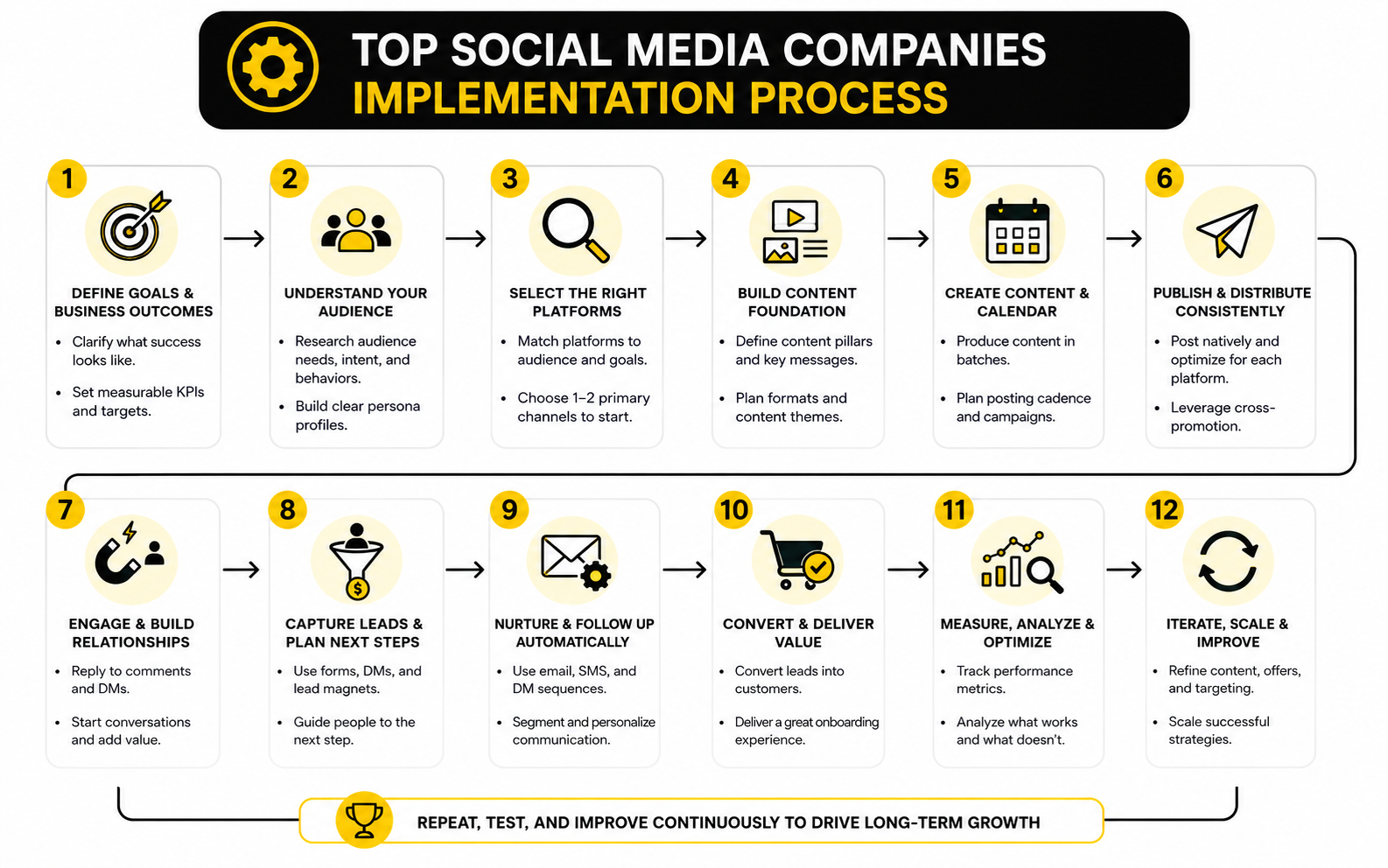
A practical platform decision should connect four things: who you want to reach, what they are doing on the platform, what content you can realistically produce, and what happens after they engage. That last part is where many strategies break. Views are useful, but they are not the finish line.
Start With Audience Intent
Audience intent is the reason one platform can outperform another even with fewer users. Pinterest users may be planning a purchase, YouTube users may be researching a problem, LinkedIn users may be evaluating expertise, and TikTok users may be discovering something they did not know they wanted. Those are different moments, and each moment needs a different content style.
This is why the same brand message should not be copied everywhere. A direct-response offer might work well in Meta ads, but feel too aggressive as an organic LinkedIn post. A product demo might work on YouTube because people are already searching for context, but fail on TikTok unless it is packaged with a strong hook and fast payoff. The platform shapes the expectation before your content even appears.
For a clean decision, map the platform to the buyer’s stage. Use TikTok, Instagram Reels, YouTube Shorts, and Snapchat when discovery matters. Use YouTube, Reddit, Pinterest, and LinkedIn when research, comparison, or trust matters. Use WhatsApp, Messenger, email, CRM, and community channels when relationship depth and follow-up matter.
Match Content Format to Team Capacity
A platform strategy that your team cannot execute is not a strategy. It is a wish list. Short-form video, long-form video, carousels, livestreams, threads, newsletters, community moderation, and paid creative all require different workflows. Some companies can publish daily native video. Others are better at deep written analysis, interviews, or product education.
This is where content operations become more important than motivation. If the team has strong subject-matter expertise but weak video production, LinkedIn and YouTube explainers may be a better starting point than TikTok. If the team has visual products and strong creative assets, Instagram, Pinterest, and short-form video can make more sense. If the team already has customer questions, sales calls, and support conversations, those can become content inputs across multiple platforms.
The practical move is to build around repeatable formats. One strong weekly YouTube video can become Shorts, LinkedIn posts, email angles, Instagram clips, and sales enablement material. One customer objection can become a carousel, a Reel, a Reddit-style answer, and a landing page section. Good social teams do not just make content. They create a reusable content machine.
Build a Follow-Up System Before Scaling Reach
Reach without follow-up leaks value. Someone watches, clicks, replies, saves, or comments, but nothing happens next. That is fine for pure media brands, but it is weak for most businesses. If social media is supposed to create revenue, the next step needs to be obvious.
A simple follow-up system can include a landing page, lead magnet, calendar booking page, email sequence, CRM pipeline, or automated chat flow. For agencies and service businesses, GoHighLevel can connect social leads with pipelines, automations, appointment booking, and client follow-up. For creators or ecommerce brands using Instagram conversations, ManyChat can help turn comments and messages into structured conversations.
This matters because top social media companies are very good at generating signals, but they do not automatically build your business system for you. The platform may deliver attention. Your process has to capture it, qualify it, and turn it into something measurable. That is the professional difference.
A Practical Platform Selection Process
A clean selection process removes guesswork. You do not need to be everywhere. You need to choose the platforms where your audience, offer, content strengths, and conversion path overlap. That is where momentum comes from.
Turn Platform Strategy Into a Weekly Operating Rhythm
Once the platform choices are clear, the work needs a rhythm. Without a weekly operating system, social media gets pushed into random gaps between meetings. That is when quality drops, publishing becomes inconsistent, and every post feels like starting from zero.
A strong weekly rhythm can be simple. Review performance on Monday, plan topics on Tuesday, produce assets midweek, schedule content before the weekend, and reserve time for engagement every day. A scheduling tool like Buffer can help keep publishing organized, but the tool is not the strategy. The strategy is the repeated decision-making process behind the content.
The best teams also separate creation from response. Publishing is only one half of social media. Comments, DMs, mentions, creator replies, sales questions, and community conversations often contain the real commercial value. If nobody owns that layer, the account may look active while the business impact stays weak.
Keep Paid and Organic Working Together
Organic content and paid social should not live in separate worlds. Organic tells you what people care about, what hooks earn attention, what objections show up, and what language feels natural. Paid social lets you scale proven angles, test offers faster, and reach buyers beyond your existing audience.
This is especially important on platforms like Meta, YouTube, TikTok, LinkedIn, Pinterest, Reddit, and Snapchat, where ad products sit directly beside organic behavior. The creative that wins organically can often inform paid tests, but it still needs adaptation. A post that earns comments may not automatically convert as an ad. A strong ad may not feel natural as an organic post.
The practical workflow is simple: let organic content surface patterns, then use paid campaigns to test the strongest patterns against clear business goals. Keep the feedback loop tight. If paid comments reveal confusion, turn that into organic education. If organic posts create demand, build a conversion path behind them. This is how social media becomes a learning system instead of a guessing game.
Statistics and Data
The numbers behind the top social media companies are useful only when they help you make better decisions. Big user counts tell you where attention is concentrated, but they do not tell you whether a platform is right for your offer. A smaller platform with higher intent can outperform a larger platform with weaker fit, especially when the content, audience, and follow-up system are aligned.
The first number to watch is reach. DataReportal’s April 2026 update estimates 5.79 billion social media user identities worldwide, which shows how deeply social platforms now sit inside daily internet behavior. But that number should not make you think every brand needs to publish everywhere. It means your audience is almost certainly on social media, but the real work is finding the specific platform where your message has the best chance to create action.
The second number to watch is platform-level momentum. Meta reported 3.56 billion daily active people across its family of apps in March 2026, Reddit reported 126.8 million daily active uniques in Q1 2026, Snap reported 956 million monthly active users and 483 million daily active users in Q1 2026, and Pinterest reported 631 million monthly active users in Q1 2026. These figures are not just bragging rights. They show which companies still have enough user momentum to keep investing in creator tools, ad products, AI recommendations, and commerce features.
Reach Metrics Show Market Access, Not Strategy
Reach tells you how much potential access a platform can provide. It is the top of the measurement stack, not the whole stack. A platform with hundreds of millions or billions of users can still be wrong for a narrow B2B offer, while a smaller professional or community platform can deliver higher-quality conversations.
This is why platform size should be interpreted as opportunity, not proof. Meta’s scale makes it difficult to ignore for consumer brands, local services, creators, and advertisers who need broad targeting. LinkedIn’s value comes less from being the largest network and more from its professional identity layer, with the company describing itself as a network of more than 1 billion members. Reddit’s audience is smaller than Meta’s, but its topic-based communities can reveal intent, objections, language, and buying questions that broad-feed platforms often hide.
The action from reach data is simple: use it to shortlist platforms, not to finalize your strategy. If the audience is large and relevant, test the channel. If the audience is large but behavior does not match your offer, do not force it. The goal is not to chase the biggest number. The goal is to find the best market access for your specific business.
Engagement Metrics Reveal Content Fit
Engagement tells you whether the platform’s users care enough to react, save, comment, share, click, watch, or continue the conversation. But engagement is easy to misread. A funny short video may get huge reactions without attracting buyers, while a niche LinkedIn post may get fewer likes but generate serious leads. The metric only matters when it connects to the job of the content.
For short-form platforms, retention and rewatch behavior are often more useful than likes. If people stop watching after two seconds, the hook is weak. If they watch to the end but do not comment or click, the content may be entertaining but not commercially clear. For YouTube, average view duration, returning viewers, search traffic, and subscriber conversion can tell you whether the content is building a durable asset rather than a one-time spike.
The action from engagement data is to improve the content format, not panic after one post. If saves are high, the content may be useful enough to turn into a guide, carousel, email, or lead magnet. If comments are high, the audience may be giving you sales objections or new angles. If shares are high but clicks are low, the idea may be culturally strong but the offer path may need work.
Conversion Metrics Separate Attention From Business Impact
Conversion metrics show whether social activity is turning into a measurable business result. This can include email signups, booked calls, demo requests, purchases, trial starts, quote requests, app installs, community joins, or qualified conversations. Without conversion tracking, a social strategy can look busy while quietly producing very little.
This is where many teams discover a hard truth. The platform is not always the problem. Sometimes the content is creating interest, but the next step is weak, the landing page is unclear, the offer is too broad, or the follow-up is too slow. If a post drives clicks but no leads, the issue may sit after the click. If a DM campaign creates conversations but no sales opportunities, the issue may sit inside qualification and response handling.
The action from conversion data is to fix the path, not just publish more. Build clear landing pages, use trackable links, separate campaigns by source, and make sure the follow-up system is ready before scaling traffic. For social campaigns that need dedicated pages, ClickFunnels or Systeme.io can help when the goal is to connect social attention with opt-ins, offers, and sales pages.
A Simple Analytics System for Social Media
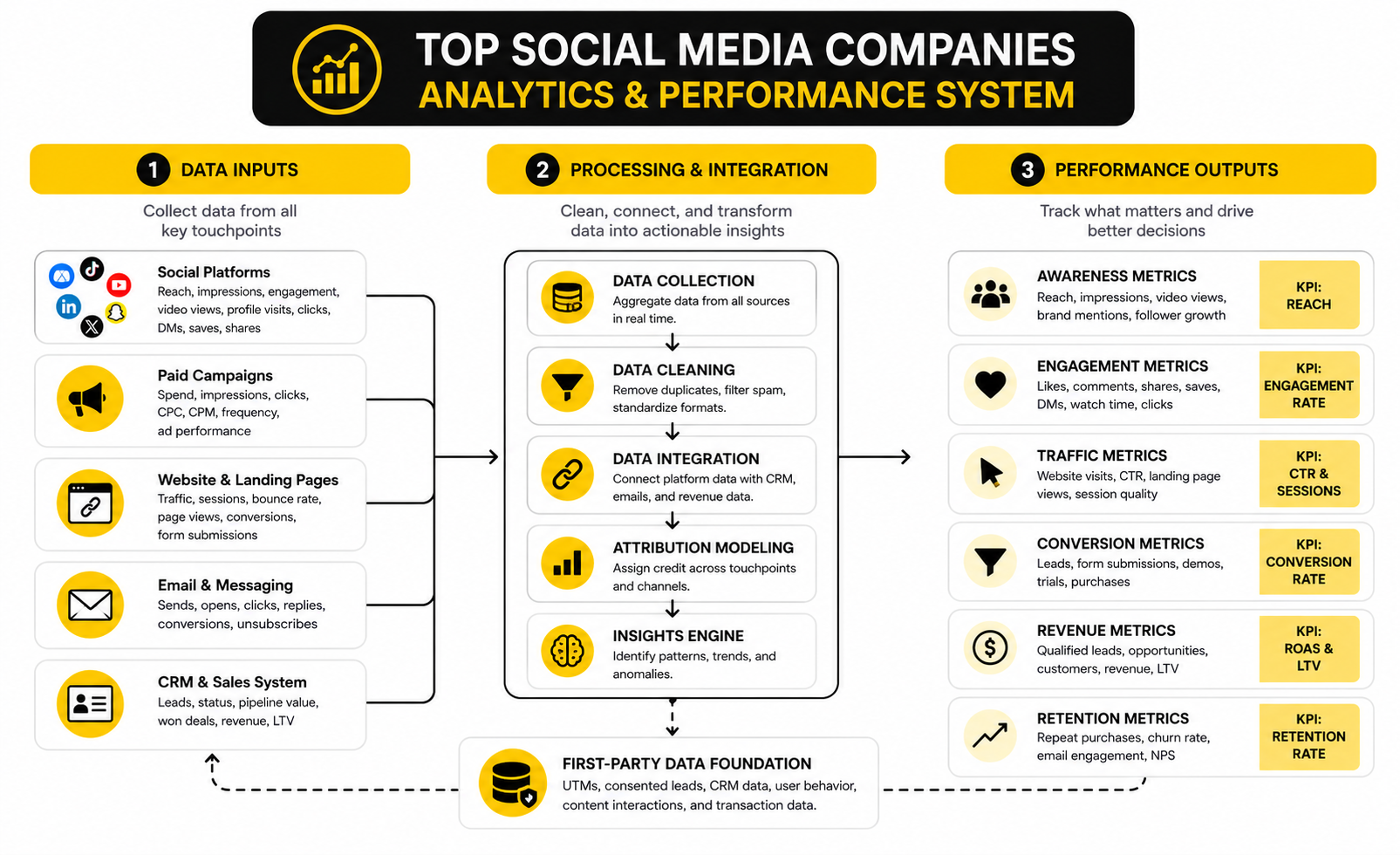
A useful analytics system does not need to be complicated. It needs to connect platform behavior to business outcomes. That means you should measure each platform based on the role you assigned to it, not based on one universal scorecard.
Benchmarks Should Guide Questions, Not Dictate Decisions
Benchmarks can be helpful, but only when they are used carefully. Average engagement rates, CPMs, click-through rates, and conversion rates vary by platform, industry, creative quality, audience, offer, season, and market conditions. A generic benchmark can point you in the right direction, but it should never replace your own data.
The better use of benchmarks is diagnostic. If your click-through rate is far below typical performance for your own account history, the creative or call to action may be weak. If your cost per lead is rising while lead quality is falling, the targeting, offer, or funnel may need a reset. If reach is strong but engagement is flat, the format may be getting distribution without enough relevance.
The action is to create internal benchmarks as quickly as possible. After 30 to 60 days, compare your current content against your own previous content. Your account history will usually be more useful than industry averages because it reflects your audience, your positioning, your creative style, and your offer. External benchmarks can start the conversation. Internal benchmarks should drive the decision.
What the Data Means for Each Platform Type
Different platform types need different measurement priorities. Feed-first platforms like Instagram, TikTok, Facebook, and X often require close attention to hooks, retention, saves, shares, comments, and profile actions. Search-and-intent platforms like YouTube, Pinterest, Reddit, and sometimes LinkedIn need more focus on discoverability, topic depth, click behavior, and long-tail performance.
Private and messaging-heavy platforms need a different lens again. WhatsApp, Messenger, Discord, and community spaces may not produce flashy public metrics, but they can generate stronger relationship signals. Response rate, conversation quality, booked calls, repeat participation, and customer support outcomes may matter more than public likes. This is why treating every social platform with the same dashboard is a mistake.
The action is to match the metric to the platform’s natural behavior. Do not judge Pinterest only like TikTok. Do not judge LinkedIn only like Instagram. Do not judge WhatsApp like YouTube. The top social media companies are built around different user habits, so your measurement system has to respect those differences.
When a Platform Is Working
A platform is working when the signal matches the assigned role. If YouTube is supposed to build authority, you should see stronger watch time, search traffic, returning viewers, and assisted conversions over time. If LinkedIn is supposed to create B2B trust, you should see relevant profile visits, qualified comments, inbound messages, newsletter growth, or sales conversations. If Meta ads are supposed to drive leads, you should see stable acquisition costs and a follow-up system that converts.
A platform is not working when the activity looks healthy but the business signal is missing. High views with no audience fit are not enough. Lots of followers with no trust are not enough. Cheap leads that never buy are not enough. This is the part many teams avoid because it forces clear thinking.
The action is to define success before the campaign starts. Pick the platform’s job, choose the metric that proves that job is being done, and set a review window. Then improve based on evidence. That is how you avoid emotional platform decisions and build a social media system that can actually compound.
Advanced Strategy for Scaling Across the Top Social Media Companies
Scaling across the top social media companies is where strategy gets more serious. Early on, you can test platforms with simple content, basic tracking, and manual follow-up. Once the channel starts working, the problems change. You are no longer asking, “Can this platform create attention?” You are asking, “Can we turn this into a reliable system without losing quality, trust, or control?”
That shift matters because social media rewards speed, but business rewards consistency. A team can grow quickly by chasing trends, posting aggressively, and testing every format available. But if the brand becomes scattered, the follow-up breaks, or the content starts attracting the wrong audience, growth can turn into noise. Bigger numbers are not always better numbers.
The advanced move is to separate platform growth from business growth. Platform growth means followers, reach, watch time, and engagement. Business growth means revenue, pipeline, retention, partnerships, customer insight, and brand equity. The best social strategies connect both, but they do not confuse them.
The Platform Dependency Problem
Every serious social media strategy needs to respect platform dependency. When a company relies too heavily on one platform, it becomes exposed to algorithm changes, ad cost shifts, account restrictions, policy updates, and changes in user behavior. This is not theoretical. The top social media companies constantly adjust recommendations, ad products, moderation systems, creator tools, and feed design because their own business incentives are changing too.
Meta’s Q1 2026 results showed ad impressions across its family of apps increased 19% year over year, which signals how aggressively major platforms can expand and optimize ad inventory. That may create opportunity for advertisers, but it also means the environment keeps moving. A creative strategy that worked six months ago can become less effective when competition rises, placements shift, or the feed changes.
The practical response is not to avoid social media. That would be a mistake. The response is to use social platforms for distribution while building assets you control: email lists, CRM data, communities, customer relationships, owned content hubs, and repeatable sales processes. Social media should feed the system, not be the whole system.
Algorithm Risk and Creative Fatigue
Algorithm risk is one of the biggest scaling issues because it is partly outside your control. A platform can reduce reach for certain formats, prioritize different behaviors, or shift from follower-based distribution to recommendation-based discovery. When that happens, accounts that depend on one style of content can see performance drop quickly.
Creative fatigue is the version of this problem that comes from your own audience. The hook that worked repeatedly eventually becomes familiar. The format that once felt fresh starts feeling predictable. The offer angle that drove clicks starts attracting lower-quality leads because the best-fit audience has already seen it. This is why scaling social media is not just about posting more. It is about refreshing angles while keeping the brand recognizable.
A healthy creative system needs variation inside consistency. Keep the core positioning stable, but rotate the proof, hooks, objections, formats, and entry points. If you use Buffer for scheduling, treat the calendar as a testing board, not just a posting queue. The goal is to learn which angles keep producing qualified attention, then build more around those signals.
AI Content, Trust, and the Quality Gap
AI has changed the production side of social media. More teams can create posts, scripts, captions, images, short videos, and campaign variations faster than before. That can be useful, but it also creates a quality gap. When everyone can produce more content, average content becomes easier to ignore.
YouTube’s 2026 creator update framed AI as a tool for creators while also emphasizing the need to fight spam, impersonation, and low-quality content, and the wider creator economy is already dealing with questions around synthetic media, likeness rights, and disclosure. Research on generative AI content on YouTube has also highlighted tensions around unverifiable income claims, content misappropriation, synthetic engagement, and changing authorship norms in AI-assisted creator work. Those issues matter because trust becomes more valuable when production gets cheaper.
The action is simple: use AI to improve the process, not to replace judgment. AI can help with research organization, repurposing, outlines, variations, caption drafts, and customer-question mining. But the insight, proof, taste, experience, and accountability still need to come from a real operator. If your content starts sounding like everyone else, the platform may still distribute it occasionally, but the audience will not build trust.
Brand Safety and Reputation Risk
As reach grows, reputation risk grows with it. A small account can make mistakes quietly. A large account gets screenshotted, quoted, criticized, remixed, and judged across contexts it cannot fully control. This is especially true for brands operating in regulated industries, sensitive categories, politics, finance, health, education, or anything involving minors, personal data, or strong claims.
The danger is not only saying something false. It is also oversimplifying a claim, using misleading proof, replying emotionally, overpromising outcomes, or letting creators represent the brand without enough guidance. Social media moves fast, but trust breaks faster. Once a company has to explain why a post was careless, the marketing win usually disappears.
A mature social media operation needs clear boundaries. Define what the brand will not claim, what requires legal or expert review, who can respond publicly, how complaints are escalated, and how creator partnerships are approved. This does not mean every post should sound corporate and dead. It means the team should know where the guardrails are before growth puts pressure on the system.
Community Depth Beats Shallow Reach
One advanced tradeoff is reach versus depth. Public-feed platforms are excellent for discovery, but they are not always the best place to build durable relationships. Communities, email lists, messaging channels, webinars, events, and customer groups can create fewer visible metrics while producing stronger business outcomes.
Reddit’s growth, including 126.8 million daily active uniques in Q1 2026, shows that topic-based communities still matter in a feed-dominated internet. People do not only want polished brand content. They want answers, debate, lived experience, niche expertise, and honest comparison. That is why Reddit, Discord, LinkedIn groups, Facebook groups, Slack communities, and private customer spaces can reveal what polished analytics dashboards miss.
The strategic lesson is to use public platforms to create entry points, then build deeper spaces for the people who care most. A creator can use short-form video for discovery, YouTube for depth, email for retention, and community for trust. A service business can use LinkedIn for authority, webinars for education, and a CRM for follow-up. The surface area changes, but the principle stays the same: depth is where the relationship compounds.
The Paid Social Scaling Trap
Paid social can scale faster than organic, but it can also hide weak fundamentals. A campaign can generate leads before the team understands lead quality. A low cost per lead can look exciting until sales discovers that most contacts are not qualified. A high-performing creative can create short-term volume while slowly damaging brand perception if it feels too aggressive or misleading.
This is why paid social should be tied to downstream data as early as possible. Track not only clicks and leads, but also qualified leads, appointments held, close rate, refund rate, customer value, and sales-cycle quality. If the ad platform is optimizing for cheap actions that do not turn into customers, the campaign is not really working. It is just buying activity.
Tools matter here, but only when the process is clear. GoHighLevel can be useful for agencies and service businesses that need pipelines, automations, appointment booking, and client follow-up in one place. For ecommerce or creator funnels, ClickFunnels and Systeme.io can help structure the conversion path after the click. The tool should support the strategy, not cover up unclear positioning.
International Growth and Platform Differences
The top social media companies do not behave the same way in every market. Platform adoption, content norms, payment behavior, language, regulation, creator culture, and messaging habits vary by region. A strategy that works in the United States may need serious adaptation in Europe, Latin America, India, Southeast Asia, or the Middle East.
This matters especially for brands that want to scale globally. WhatsApp may be central in one market, while Instagram DMs matter more in another. YouTube search may drive evergreen education in one region, while TikTok discovery creates faster awareness somewhere else. LinkedIn can be powerful for B2B in many markets, but the tone, posting style, and buyer expectations still vary.
The right approach is to localize more than language. Localize examples, formats, posting times, creator partnerships, compliance review, payment expectations, and support workflows. If you treat global social media as simple translation, you will miss the real behavior differences that drive performance.
Data Privacy, Regulation, and Platform Constraints
Privacy and regulation are now core parts of social media strategy. Tracking is harder than it used to be, user consent matters more, and platforms face growing pressure around data use, AI systems, minors, advertising transparency, and content moderation. For marketers, this means measurement will keep requiring cleaner first-party data and more careful attribution.
This is another reason owned systems matter. If you can collect consented leads, tag sources properly, manage customer data responsibly, and connect campaigns to CRM outcomes, you are less dependent on platform-reported metrics. That does not make platform analytics useless. It simply means they should be part of a broader measurement system.
A practical setup includes UTM discipline, CRM source fields, clear consent language, lead-quality review, and regular audits of what data is collected and why. This may sound less exciting than viral content, but it protects the business as it grows. Scaling without data discipline eventually creates confusion, waste, or risk.
How to Build a Resilient Social Media Portfolio
A resilient social media portfolio does not mean being active everywhere. It means each platform has a clear role, and the business would not collapse if one channel slowed down. That is the balance serious teams should aim for.
The point is not complexity. The point is control. When each channel has a job, the whole system becomes easier to manage. You can scale what works, protect against platform changes, and stop confusing attention with progress.
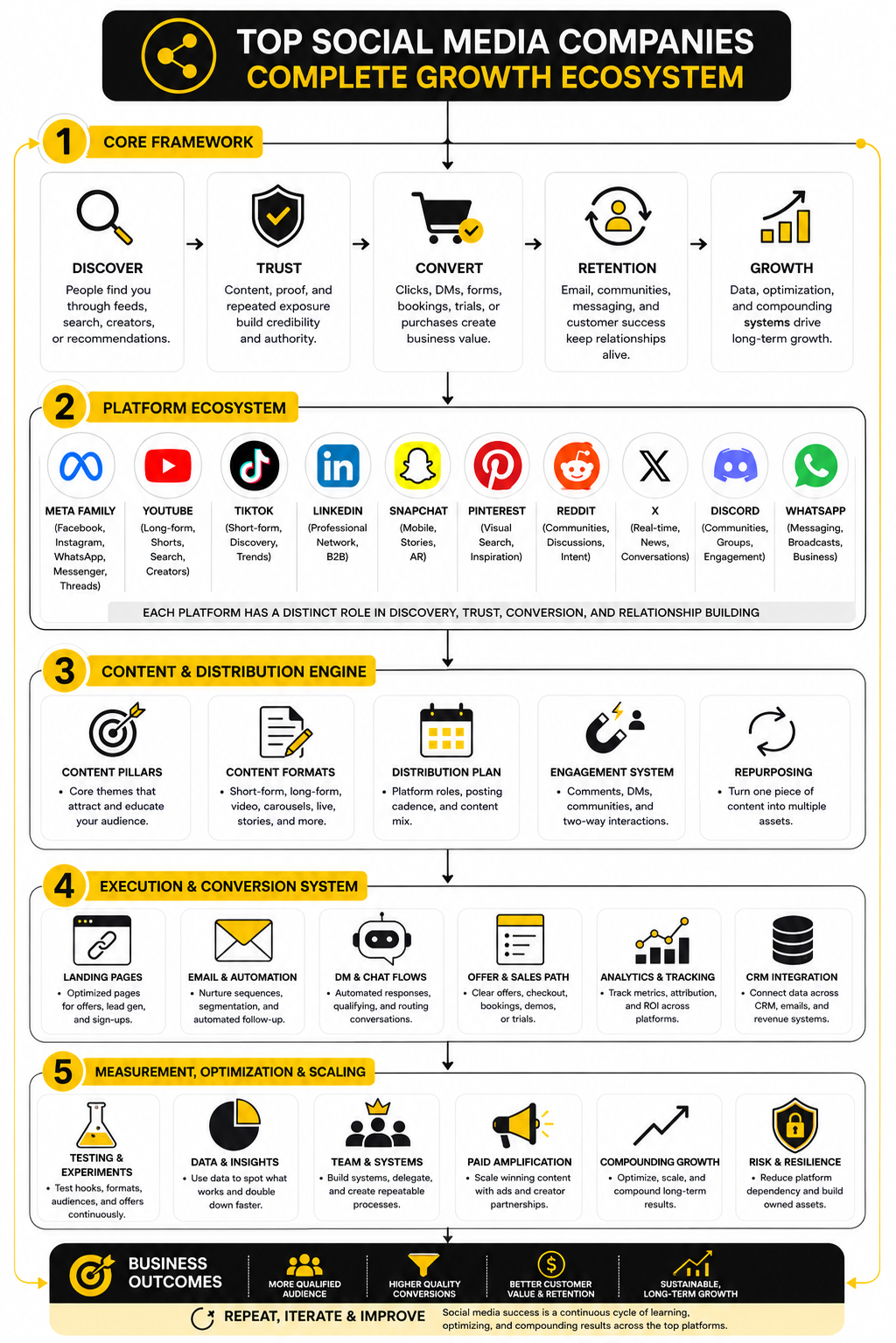
Bringing the Social Media Ecosystem Together
At this point, the pattern should be clear: the top social media companies are not interchangeable traffic sources. They are different ecosystems with different incentives, different audience behaviors, and different strengths. The brands that win do not just post more. They understand the role each platform should play inside a bigger growth system.
A strong ecosystem usually has four layers. The first layer is discovery, where people find you through feeds, search, recommendations, creators, or paid ads. The second layer is trust, where deeper content, proof, expertise, and repeated exposure help people believe you are worth paying attention to. The third layer is conversion, where clicks, DMs, forms, bookings, trials, or purchases create measurable business value. The fourth layer is retention, where email, communities, customer success, messaging, and ongoing content keep the relationship alive.
That is the real game. Social media should not sit off to the side as a random content task. It should connect with your offer, your sales process, your data, your customer experience, and your long-term brand. Once you see it that way, choosing between platforms becomes much easier because each channel either has a clear job or it does not belong in the system yet.
What are the top social media companies right now?
The top social media companies include Meta, YouTube, TikTok, LinkedIn, Snapchat, Pinterest, Reddit, X, Discord, and major messaging platforms like WhatsApp. Meta remains one of the largest because it owns Facebook, Instagram, WhatsApp, Messenger, and Threads, while YouTube dominates video search and creator-led media. The best company for your strategy depends less on size and more on audience intent, content fit, and conversion path.
Which social media company is the biggest?
Meta is one of the largest social media companies by daily usage across its family of apps, reporting 3.56 billion daily active people in March 2026. YouTube is also massive, with billions of monthly logged-in users and Shorts averaging more than 200 billion daily views. The answer depends on whether you measure by daily users, monthly users, watch time, revenue, ad reach, or cultural influence.
Is YouTube considered a social media company?
Yes, YouTube should be treated as a social media company because it has creators, subscriptions, comments, recommendations, community features, livestreams, Shorts, and social discovery. It is also a search engine, video platform, entertainment network, and education hub. That hybrid role is exactly why it is so valuable for brands that want content to keep working after the first post.
Is TikTok still important for businesses?
TikTok remains important when your offer can be discovered through fast, native, entertainment-led content. It is especially useful for consumer brands, creators, local products, music, beauty, fashion, fitness, apps, education, and personality-led businesses. It is less useful when the team cannot produce quickly, test hooks often, or adapt to platform culture without sounding forced.
Which social media platform is best for B2B marketing?
LinkedIn is usually the strongest default platform for B2B because people use it with a professional mindset. It works well for founders, consultants, SaaS companies, recruiters, agencies, executives, and niche experts who can publish useful ideas consistently. YouTube, Reddit, webinars, newsletters, and search-driven content can also support B2B well when the buying journey requires education and trust.
Which platforms are best for ecommerce brands?
Instagram, TikTok, YouTube, Pinterest, Facebook, and paid Meta campaigns are often strong for ecommerce, but each platform plays a different role. TikTok and Instagram can create discovery, YouTube can educate and compare, Pinterest can influence planning and visual search, and Meta ads can scale retargeting and acquisition. The real advantage comes from connecting the platform to product pages, email capture, automated follow-up, and a clear offer path.
How many social media platforms should a business use?
Most businesses should start with one primary platform and one support platform. That keeps execution focused while still giving the brand more than one distribution path. Once the team has repeatable content formats, clear measurement, and a working conversion system, it can expand into more channels without turning social media into chaos.
What metrics matter most when comparing social media platforms?
The most useful metrics are reach, engagement quality, conversion, retention, and audience fit. Reach shows market access, engagement shows content resonance, conversion shows business value, and retention shows whether the relationship is compounding. A platform that creates fewer leads but better customers can be more valuable than one that produces large numbers with weak intent.
Should brands prioritize organic social or paid social?
Brands should use organic social to learn what the audience cares about and paid social to scale proven angles. Organic content reveals hooks, objections, language, and positioning signals. Paid campaigns can test offers faster and reach beyond the existing audience, but they should be judged by downstream quality, not just clicks or cheap leads.
What is the biggest mistake companies make with social media?
The biggest mistake is treating social media as isolated posting instead of a complete system. A post should connect to a business goal, a platform role, a content format, a next step, and a measurement process. Without that connection, teams often chase views, followers, or trends without building anything durable.
How do smaller companies compete with major brands on social media?
Smaller companies can compete by being sharper, faster, more specific, and more human. Big brands often move slowly, use generic messaging, and struggle to sound close to the customer. A smaller team can win by focusing on niche expertise, direct founder-led content, real customer questions, fast testing, and high-quality follow-up.
How should agencies manage social media for clients?
Agencies should define the platform role before promising results. One client may need LinkedIn authority, another may need Meta lead generation, another may need YouTube education, and another may need Instagram DM automation. The best agency setup includes clear content formats, approval workflows, reporting dashboards, CRM tracking, and a follow-up process that proves the work is tied to business outcomes.
Are follower counts still important?
Follower counts matter, but they are not the strongest measure of success. A large audience can help with credibility and distribution, but a smaller audience with higher trust and stronger buying intent can outperform it. Followers should be treated as one signal inside a broader system that includes reach, engagement, qualified conversations, conversions, and retention.
What role does AI play in social media strategy?
AI can help with research, repurposing, outlines, content variations, caption drafts, customer-question mining, and faster creative testing. It should not replace human judgment, expertise, taste, or proof. As AI content becomes easier to produce, real experience and trustworthy positioning become more important, not less.
What is the best long-term strategy for social media?
The best long-term strategy is to build a portfolio, not a dependency. Use one or two platforms for discovery, one channel for authority, one system for capturing demand, and one process for measuring business outcomes. That gives you the upside of the top social media companies without putting your whole business at the mercy of one algorithm.
Build a stronger local presence with BAAM AI
Turn your website, Google profile, social channels, and AI visibility into one growth engine
Most businesses do not need more random marketing activity. They need a consistent presence system that helps the right people find them, trust them, and take action. BAAM AI brings strategy, local SEO, website updates, Google Maps visibility, social content, AI-search readiness, media production, and reporting into one practical monthly engine.
If you want your marketing to keep working after the campaign ends, start with a free BAAM AI presence audit. See how your business shows up today and where the fastest visibility wins are at BAAM AI.