
BAAM AI Blog
Top Digital Marketing Companies In The World
The top digital marketing companies in the world are no longer just ad agencies. The best ones combine strategy, media buying, creative, analytics, automation, ecommerce, CRM, AI, and conversion systems into one...
The top digital marketing companies in the world are no longer just ad agencies. The best ones combine strategy, media buying, creative, analytics, automation, ecommerce, CRM, AI, and conversion systems into one growth engine.
That matters because marketing budgets are under pressure, but digital keeps taking a bigger share. Gartner reported that digital channels now make up 61.1% of total marketing spend, while eMarketer projected global ad spending would pass $1 trillion with digital taking more than 75%. In plain English: if a company cannot win online, it is slowly losing market share.
This guide breaks down the companies that shape modern digital marketing, how they differ, and how to choose the right partner. Some are global holding companies. Some are consulting-led giants. Some are performance specialists. Others are platform-driven agencies that help brands build funnels, automation, and owned customer journeys with tools like GoHighLevel, ClickFunnels, ManyChat, and Buffer.
Why The Top Digital Marketing Companies Matter
Digital marketing is now too complex for random tactics. Search, paid media, social, email, influencer marketing, analytics, AI content workflows, landing pages, CRM, and customer retention all affect each other. A strong agency does not just “run campaigns”; it connects the full customer journey.
The best digital marketing companies also bring scale. Global groups such as WPP, Publicis, Omnicom, Dentsu, Accenture Song, Deloitte Digital, and Havas work with enterprise brands that need strategy, creative, media, technology, and measurement across many markets. Industry analysis of the world’s largest agency groups shows how consulting firms and agency holding companies now compete directly for the same transformation budgets.
That shift is important for smaller brands too. Even if you never hire a global agency, their model shows where marketing is going: stronger data, faster creative testing, better automation, and tighter revenue attribution. The winners are not the companies that post the most content; the winners are the companies that build systems.
The Framework For Comparing Digital Marketing Companies
A useful comparison starts with one question: what business outcome should the agency own? Some companies are built for brand awareness. Some are built for performance marketing. Some are built for ecommerce growth. Some are best when the work involves deep technology, customer data, and enterprise transformation.
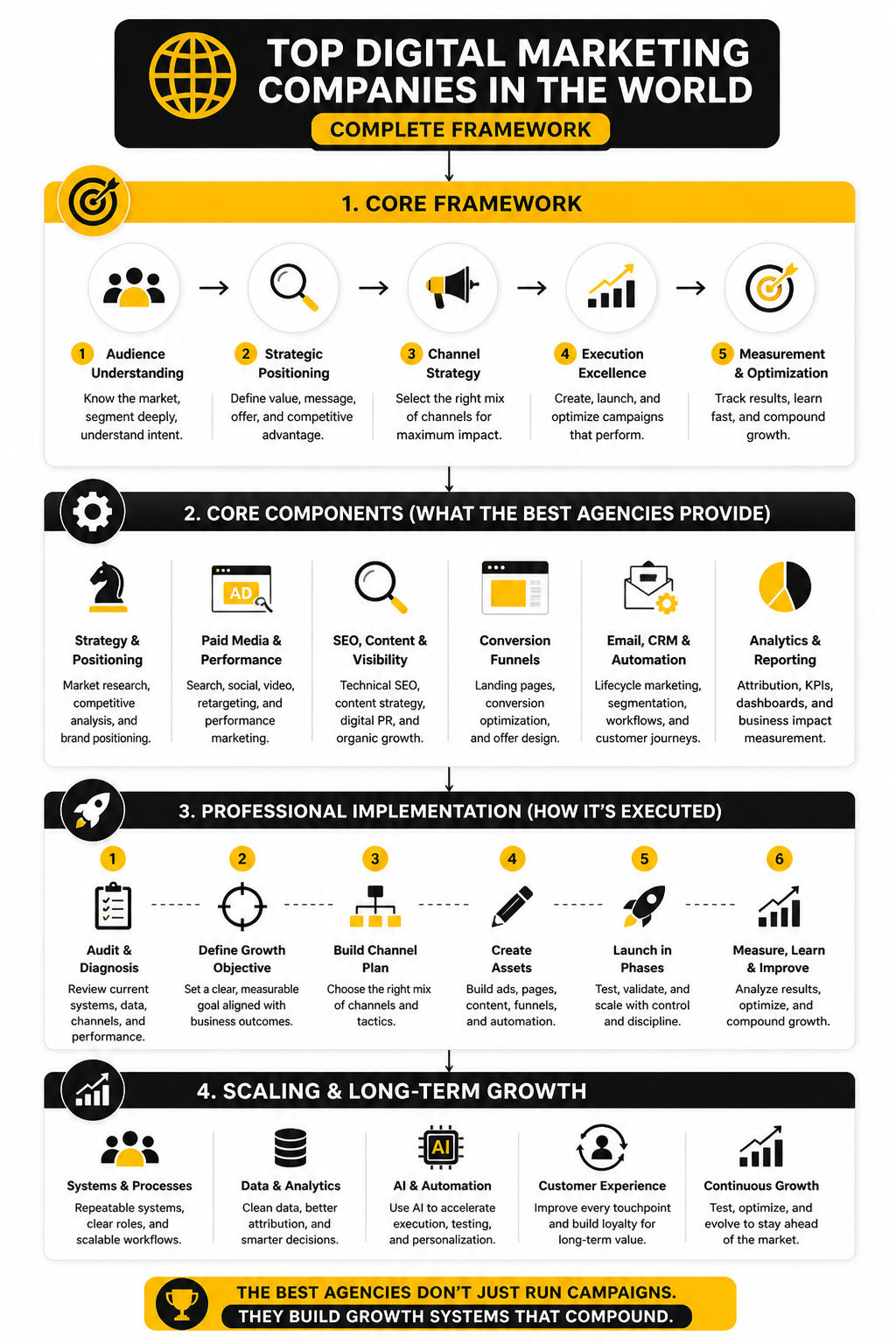
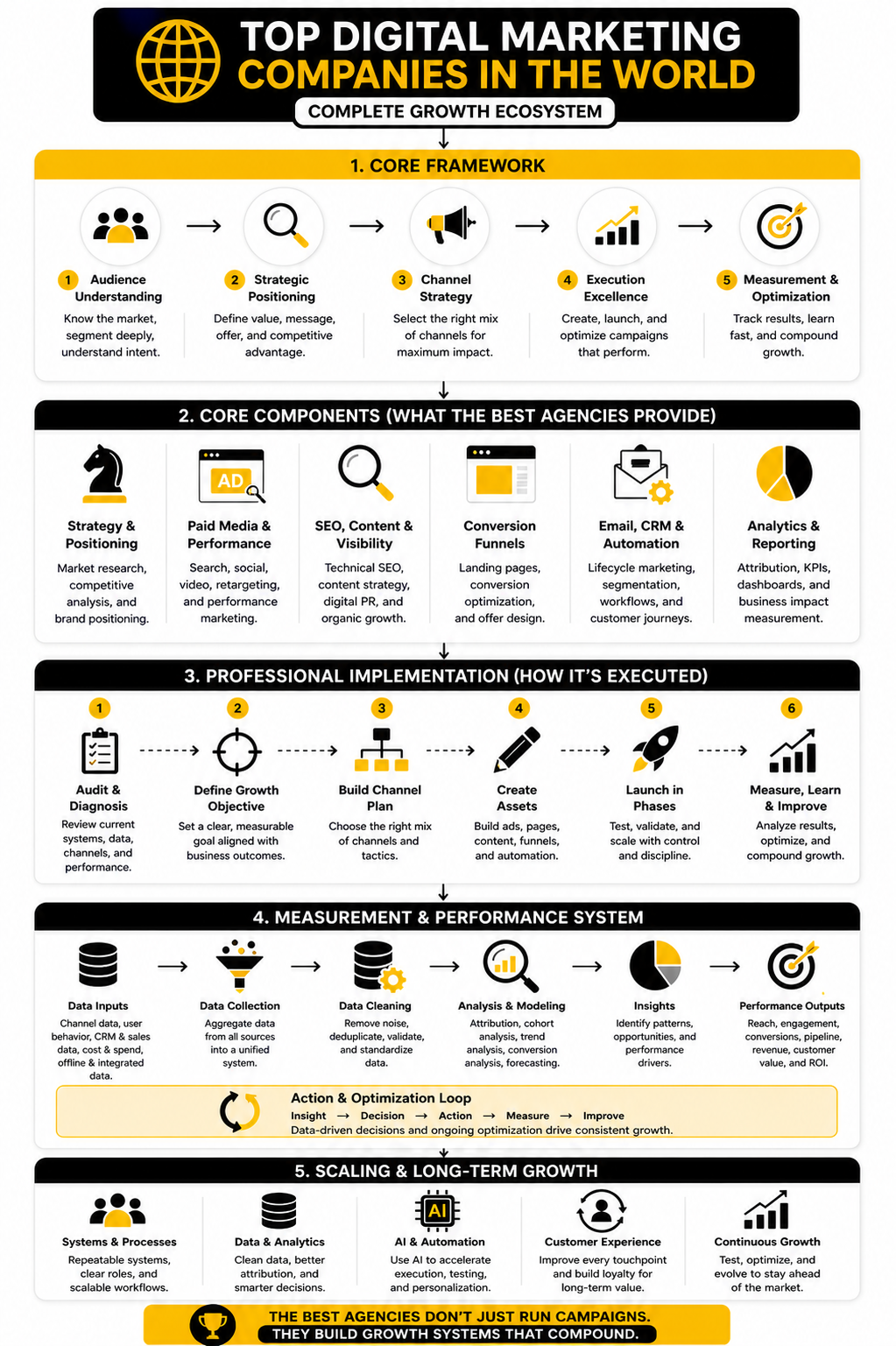
The cleanest framework is to evaluate each company across four areas: strategy, execution, technology, and measurement. Strategy answers where growth should come from. Execution turns that strategy into campaigns, content, funnels, and media. Technology connects the tools, data, CRM, automation, and reporting. Measurement proves what worked and what should change next.
This is where many brands make the wrong decision. They choose a famous agency when they need a specialist, or they choose a cheap specialist when they actually need senior strategic direction. The right partner is not always the biggest name; it is the company with the strongest fit for your market, budget, team, and growth target.
Core Services The Best Agencies Provide
The best agencies do not sell “digital marketing” as one vague package. They break growth into specific services, then connect those services so the customer journey does not feel stitched together. That is the difference between buying activity and buying outcomes.
Digital Strategy And Market Positioning
Strong digital strategy starts before ads, content, or automation. A serious agency studies the market, customer behavior, competitors, margins, sales cycles, and brand positioning before recommending channels. This matters because a B2B software company, a luxury ecommerce brand, and a local service business should not use the same playbook.
The best digital marketing companies in the world are especially useful when the problem is not obvious. Sometimes the issue is weak creative. Sometimes it is poor landing pages. Sometimes it is bad offer positioning, slow sales follow-up, messy tracking, or a channel mix that worked three years ago but does not work now.
This is where strategy earns its money. A good agency helps leadership decide what not to do. That sounds simple, but it protects budget from being spread across too many channels with no meaningful advantage.
Paid Media And Performance Marketing
Paid media is still one of the fastest ways to create demand, test offers, and scale what already works. The problem is that paid traffic has become more expensive, more automated, and more dependent on creative quality. Running ads without strong messaging, landing pages, and measurement is now a very fast way to burn cash.
Digital advertising keeps growing because buyers spend more time across search, social, video, retail media, creator content, and connected TV. Worldwide ad spending was forecast to pass $1 trillion in 2025, with digital taking more than 75%, which shows why performance marketing is no longer a side channel. It is one of the main battlegrounds.
The strongest agencies build paid media around testing systems. They test audiences, hooks, offers, creatives, landing pages, and follow-up sequences. For companies that need better lead capture and sales pipelines, platforms like GoHighLevel can support the operational side of that system instead of leaving leads scattered across disconnected tools.
SEO, Content, And Search Visibility
SEO is not dead. Lazy SEO is dead. The agencies that still win with organic search understand technical SEO, topical authority, content quality, digital PR, user intent, and how AI search is changing discovery.
This is especially important for companies with long sales cycles. Paid ads can create immediate traffic, but strong content can compound over time and lower dependence on media spend. A useful article, comparison page, product guide, or industry report can keep attracting qualified visitors long after the campaign budget is gone.
The best agencies treat SEO as a revenue channel, not a publishing calendar. They connect keyword research to buyer intent, build content around real commercial questions, and measure what happens after the click. That last part matters because rankings mean very little if the traffic does not convert.
Conversion Funnels And Landing Pages
Traffic is only useful when the page does its job. That is why conversion funnels, landing pages, and offer architecture have become core agency services. A brand can have brilliant ads and still fail because the landing page is confusing, slow, generic, or disconnected from the promise in the ad.
Good funnel work is practical. It clarifies the offer, removes friction, improves the call to action, and gives visitors enough confidence to take the next step. For ecommerce teams building faster product and campaign pages, Replo can be a useful fit when the goal is to launch high-converting Shopify pages without waiting on a full development cycle.
For coaches, course creators, and direct-response brands, ClickFunnels and Systeme.io can support funnel building, lead capture, and sales flows. The tool is not the strategy, but the right tool makes the strategy easier to execute.
Email, CRM, And Marketing Automation
Most companies are too focused on the first click. The real money is often in the follow-up. Email, CRM, segmentation, retargeting, SMS, chat automation, and lifecycle campaigns help turn attention into pipeline, pipeline into sales, and customers into repeat buyers.
This is where many agencies separate themselves from basic campaign managers. They do not just ask, “How do we get more leads?” They ask, “What happens after someone opts in, books a call, abandons a cart, watches a webinar, or requests pricing?” That is a better question.
For email and customer communication, tools like Brevo and Moosend can fit smaller teams that want practical automation without enterprise complexity. For chat-based lead generation and social messaging flows, ManyChat is especially relevant when Instagram, Facebook Messenger, or WhatsApp are part of the customer journey.
Professional Implementation
The strongest agencies do not start implementation by “launching campaigns.” They start by turning the strategy into a practical operating system. That system defines who owns each channel, what gets built first, how success is measured, and how fast the team learns from the market.
Marketing teams are under real pressure to get more output from the same budget. Gartner’s 2025 CMO Spend Survey found that marketing budgets stayed flat at 7.7% of overall company revenue, which is exactly why process matters. When money is tight, messy execution becomes expensive very quickly.
The Implementation Process
A serious digital marketing company usually moves through a clear sequence. The exact details change by industry, but the flow is consistent because growth work needs diagnosis before scale. Skip the early steps and you end up optimizing campaigns that should never have launched in the first place.
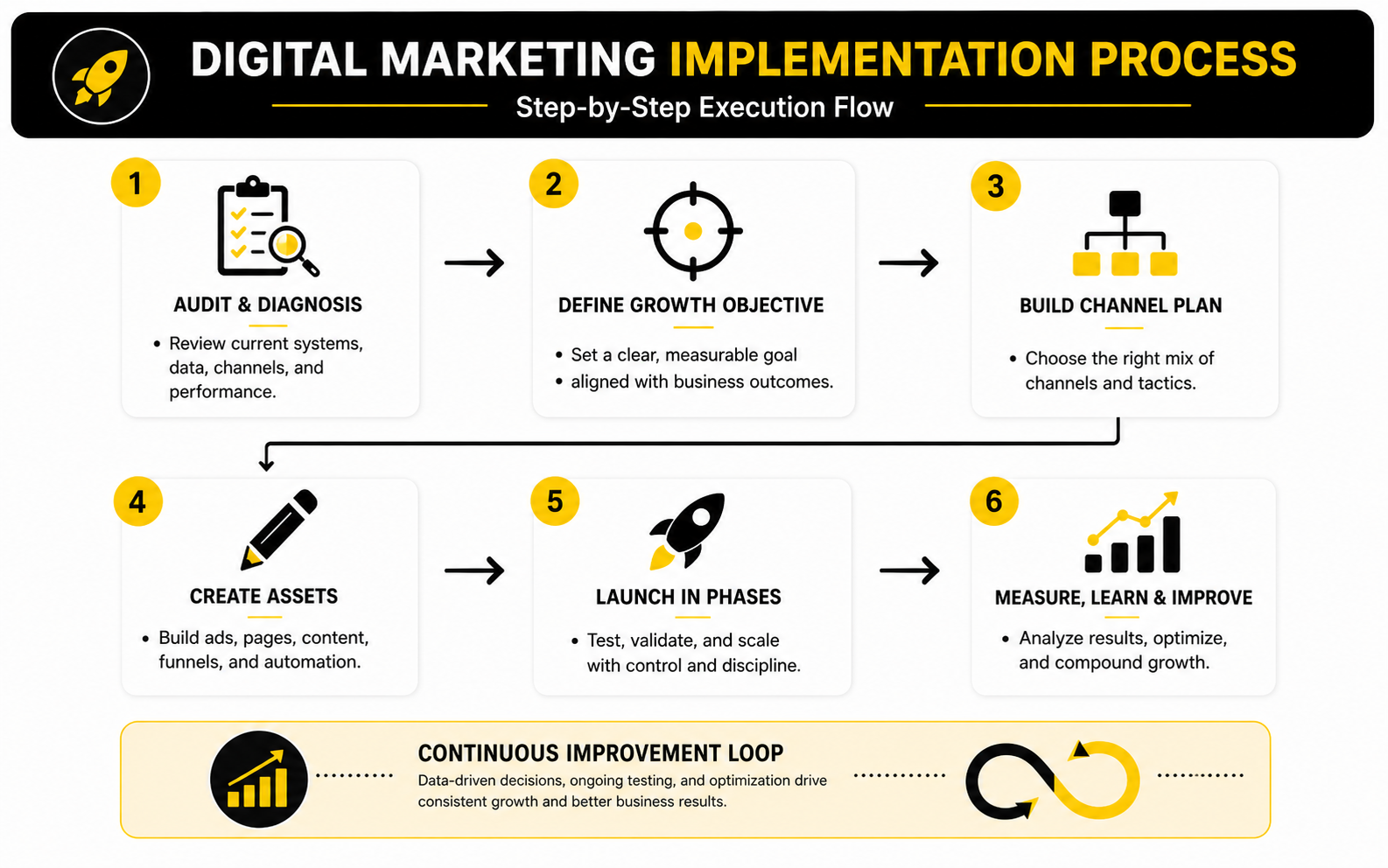
The agency reviews the website, analytics, ad accounts, CRM, content, SEO visibility, email flows, landing pages, sales process, and customer data. This is not busywork. It shows where revenue is leaking before new money goes into acquisition.
The goal must be more specific than “get more leads” or “increase awareness.” A stronger objective might be lowering customer acquisition cost, improving booked-call quality, increasing ecommerce conversion rate, growing organic pipeline, or expanding retention revenue. Clear objectives stop teams from celebrating vanity metrics.
Once the objective is clear, the agency chooses the right mix of search, paid social, SEO, email, creator partnerships, conversion funnels, automation, and sales enablement. This is where experience matters because every channel has a different payback period. Paid media can move fast, SEO compounds slowly, and lifecycle marketing often improves profit without needing more traffic.
Implementation becomes tangible when the team builds ads, landing pages, email sequences, forms, lead magnets, product pages, dashboards, and follow-up workflows. For teams that rely heavily on funnels, tools like ClickFunnels can help launch offers faster. For agencies managing pipelines, automation, booking, and client reporting in one place, GoHighLevel can be useful because the execution layer is connected to the sales process.
Good agencies do not throw every idea into the market at once. They launch with enough budget and traffic to learn, but with enough control to avoid waste. This usually means testing a small number of clear hypotheses before expanding into more audiences, channels, and creative angles.
The first version is rarely the winner. The best agencies review creative performance, funnel drop-offs, lead quality, sales feedback, and revenue contribution on a regular rhythm. Then they make decisions based on evidence, not personal taste.
Measurement And Reporting
Reporting should make decisions easier. If a report only shows impressions, clicks, likes, and traffic, it is not enough. Those numbers can be useful, but they do not tell the full story of whether marketing is creating profitable growth.
Modern reporting needs to connect campaign performance with business outcomes. That means tracking conversion rates, cost per qualified lead, customer acquisition cost, pipeline value, revenue, retention, and lifetime value where possible. Salesforce’s marketing research highlights AI, data, and personalization as major priorities for nearly 4,500 marketers worldwide, which shows how important clean data has become.
This is also where automation helps. A company using disconnected forms, inboxes, spreadsheets, and ad dashboards will struggle to see what is really happening. A cleaner setup with CRM, attribution, and follow-up workflows gives both the agency and the client a shared view of performance.
Creative Testing And Optimization
Creative is now one of the biggest performance levers in digital marketing. Targeting is more automated than it used to be, privacy rules have reduced some tracking visibility, and platforms increasingly reward ads that people actually engage with. That puts more pressure on hooks, angles, messaging, proof, visuals, and offers.
The best digital marketing companies build creative testing into the process from day one. They do not produce one polished campaign and hope it works. They create controlled variations, test them against real audiences, and keep the ideas that produce measurable progress.
This does not mean creative should become robotic. Strong creative still needs taste, empathy, and a clear understanding of the customer. The practical difference is that the best teams combine human judgment with data instead of choosing between them.
AI, Automation, And Human Control
AI is now part of serious digital marketing implementation, but it should not replace strategy. McKinsey’s 2025 AI research points to a wider use of AI and agentic systems, while also noting that many organizations still struggle to move from pilots to scaled impact. That is the key lesson: AI tools are powerful, but only when they sit inside a clear operating model.
In agency work, AI can speed up research, content drafts, audience analysis, creative variations, reporting, customer support, and workflow automation. Tools like Chatbase can support AI chat experiences, while Fillout can help with more carefully forms and intake flows. Used properly, these tools reduce friction without making the customer experience feel cheap.
The danger is letting automation run ahead of judgment. Bad data, weak prompts, generic content, and unclear accountability can create more noise instead of more growth. The best agencies keep humans in control of positioning, brand standards, customer insight, and final decisions.
Statistics And Data
Data should make the agency decision clearer, not heavier. When comparing the top digital marketing companies in the world, the useful numbers are the ones that reveal budget pressure, channel momentum, measurement quality, and whether the agency can connect activity to revenue. Random stats look impressive, but they do not help you choose a partner.
Marketing leaders are being asked to do more with less flexibility. Gartner found that 2025 marketing budgets stayed flat at 7.7% of overall company revenue, while digital channels now account for 61.1% of total marketing spend. That combination tells you something important: digital is not getting simpler, but the margin for waste is getting smaller.
The broader advertising market tells the same story. Global ad spend was projected to pass $1 trillion in 2025, with digital taking more than 75%, and U.S. internet advertising reached $294.6 billion in 2025. The action point is obvious. If an agency cannot explain how it measures digital performance beyond clicks and impressions, it is not built for the market brands are actually operating in.
The Metrics That Actually Matter
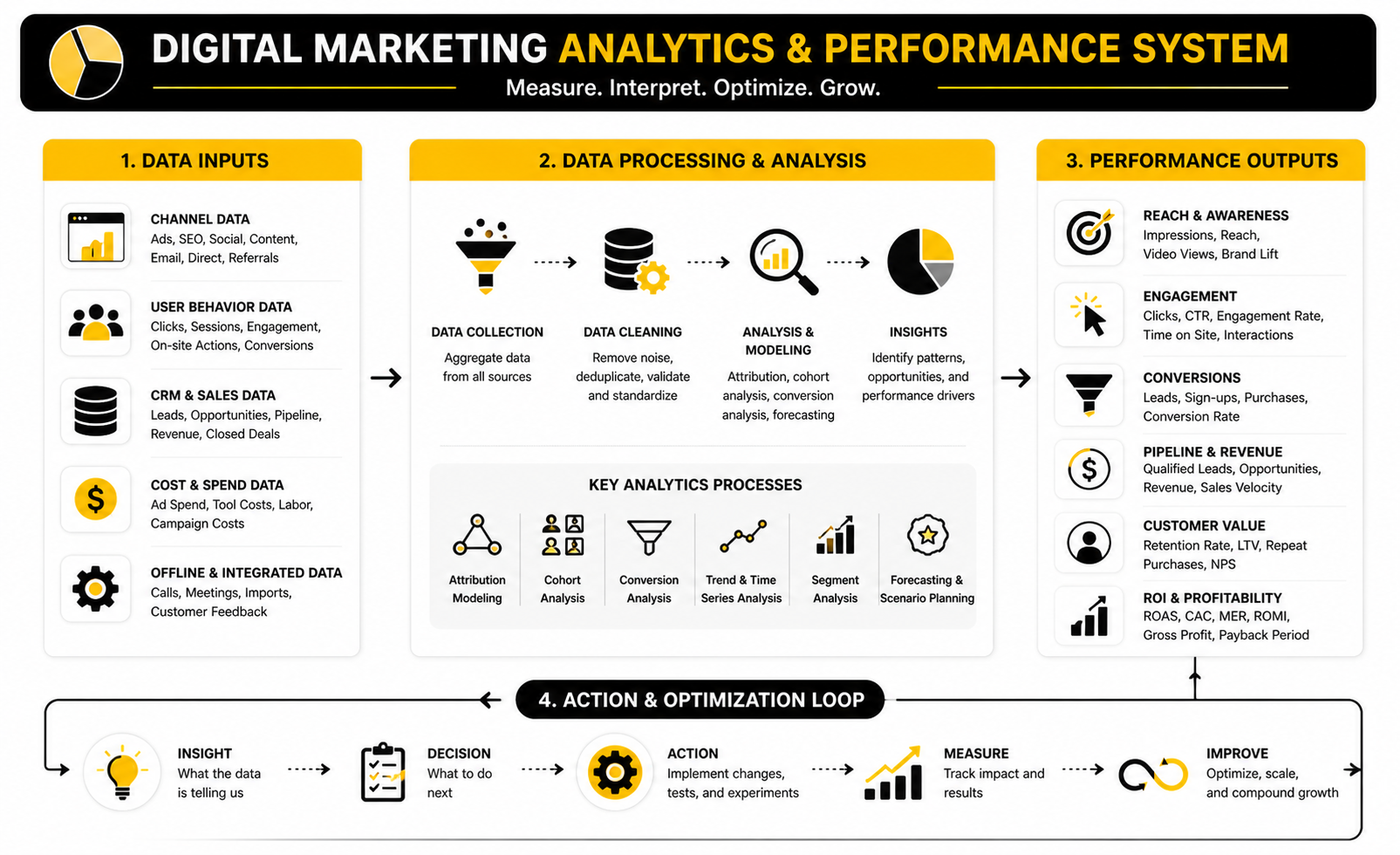
The first measurement layer is traffic quality. Sessions, clicks, reach, impressions, and video views can show whether campaigns are getting attention, but they do not prove commercial value. A good agency uses these numbers as early signals, not as the final scoreboard.
The second layer is conversion performance. This includes landing page conversion rate, cost per lead, cost per qualified lead, booked-call rate, checkout conversion rate, form completion rate, and email opt-in rate. If these numbers are weak, the issue may not be the channel; it may be the offer, page, audience, creative, or follow-up.
The third layer is business impact. This is where pipeline, customer acquisition cost, revenue, retention, lifetime value, payback period, and margin come in. The best agencies keep pushing the conversation toward this layer because it forces everyone to focus on outcomes that leadership actually cares about.
How To Interpret Benchmarks
Benchmarks are useful, but only when they are treated as context. A low cost per lead can be terrible if the leads never buy. A high cost per click can be completely fine if the campaign attracts high-intent buyers with strong lifetime value.
This is why the best digital marketing companies do not blindly compare every client to generic industry averages. They look at business model, deal size, sales cycle, conversion path, geography, seasonality, and competitive intensity. A SaaS company selling annual contracts needs a different performance standard than a local service business or a fast-moving ecommerce store.
The practical move is to build your own benchmark system. Track baseline performance before major changes, then measure lift after the agency improves creative, pages, offers, automation, and channel mix. That gives you a fairer view than comparing your business to a broad market average that may not reflect your reality.
Analytics Systems And Attribution
Attribution is messy, but ignoring it is worse. Customers rarely see one ad, click once, and buy immediately. They search, compare, read reviews, visit social profiles, join email lists, watch videos, and come back later when the timing is right.
A strong analytics setup gives each channel a sensible role. Paid search often captures existing demand. Paid social can create demand. SEO builds durable discovery. Email and CRM improve conversion after the first touch. Social content builds familiarity that may not show up cleanly in last-click reports.
This is why tools and process matter. A CRM-backed setup with clean forms, source tracking, pipeline stages, and sales feedback will beat a beautiful dashboard built on broken data. For agencies that need lead tracking, automation, booking, and pipeline visibility in one place, GoHighLevel can support the measurement layer without forcing every team into a heavy enterprise stack.
Performance Signals That Should Trigger Action
Good reporting should create decisions. If paid traffic is rising but conversions are flat, the landing page or offer needs work. If leads are cheap but sales teams complain about quality, targeting and qualification need to be tightened.
If organic traffic is growing but pipeline is not, the content may be attracting informational visitors instead of buyers. If email revenue is weak, the list may need better segmentation, stronger offers, cleaner deliverability, or more relevant lifecycle flows. If social engagement is high but no one moves to the next step, the content may be entertaining without creating intent.
The point is not to worship data. The point is to make better moves faster. The agencies worth hiring use data to protect your budget, sharpen your message, and turn marketing into a system that compounds instead of a collection of disconnected campaigns.
How To Choose The Right Digital Marketing Company
Choosing an agency is not about finding the most famous logo. It is about matching your business problem to the agency’s actual strength. A global brand may need a holding-company network with media scale, creative depth, and regional coordination, while a lean growth team may need a performance partner that can move faster and stay closer to revenue.
The top digital marketing companies in the world usually fall into a few practical categories. Consulting-led firms are strong when marketing is tied to digital transformation, customer data, systems, and enterprise change. Agency networks are strong when a brand needs media buying, creative production, global campaign management, and specialist teams across multiple markets. Boutique specialists are often better when the goal is speed, channel expertise, and sharper execution in one specific area.
The mistake is hiring one type of partner and expecting it to behave like another. A huge agency may not be the best choice for a founder who needs hands-on funnel testing next week. A tiny specialist may not be the best choice for a multinational company that needs governance, compliance, reporting, and execution across 20 markets.
Strategic Tradeoffs To Understand
Every agency choice comes with tradeoffs. Large agencies bring scale, senior relationships, media access, and multi-channel resources, but they can also move slower and cost more. Smaller agencies can be more agile, more personal, and more focused, but they may struggle if the account suddenly needs enterprise-level coverage.
Specialist agencies can outperform generalists when the problem is narrow. If your issue is conversion rate, paid social creative, technical SEO, lifecycle email, or ecommerce landing pages, a specialist may beat a full-service agency. But if your business has broken positioning, weak tracking, a messy sales process, and unclear reporting, a single-channel specialist will only solve one piece of the puzzle.
This is why your internal maturity matters. If your team already has strong strategy and operations, you can hire specialists around clear gaps. If your team lacks strategic direction, you need a partner that can diagnose the system before scaling execution.
Red Flags When Evaluating Agencies
Be careful with agencies that promise guaranteed results without understanding your market, margins, sales cycle, or current baseline. Serious marketers can forecast scenarios, but they do not pretend every business has the same growth path. The more confident the promise sounds before the audit, the more skeptical you should be.
Another red flag is channel obsession. If an agency recommends paid ads, SEO, TikTok, email, or AI automation before understanding the business model, they are selling their service instead of solving your problem. A strong partner asks sharper questions first.
You should also watch how they talk about reporting. If they focus only on impressions, clicks, traffic, or followers, that is not enough. With budgets flat at 7.7% of overall company revenue, you need a partner that can connect marketing activity to qualified pipeline, sales, retention, or profit.
Scaling Without Losing Control
Scaling digital marketing is not just spending more. It means increasing output while keeping message quality, data quality, and customer experience under control. That is harder than it sounds, especially when more teams, tools, channels, regions, and stakeholders get involved.
The best agencies build systems that can scale without becoming chaotic. They create campaign naming rules, approval workflows, testing calendars, creative libraries, dashboards, CRM stages, landing page templates, and feedback loops between marketing and sales. Boring? Maybe. Essential? Absolutely.
Tools can support this, but they cannot replace discipline. A team using Buffer can manage social publishing more cleanly, ManyChat can help automate conversational follow-up, and GoHighLevel can centralize agency-style CRM and automation workflows. The real advantage comes when those tools are connected to a clear operating process.
AI Should Improve The System, Not Flood It
AI has changed how agencies research, write, analyze, test, and produce creative. Salesforce’s latest marketing research is based on insights from nearly 4,500 marketers worldwide and shows why AI, data, and personalization are now central themes in modern marketing teams. But AI does not magically fix weak strategy.
The bad version of AI marketing is obvious. More generic content, more unqualified outreach, more shallow ads, more reports nobody reads, and more noise in the customer journey. That is not leverage. That is clutter with better software.
The good version is different. AI helps the agency move faster while humans still own positioning, insight, brand judgment, customer empathy, and final decisions. When evaluating agencies, ask how they use AI to improve speed, quality, testing, and measurement without weakening the brand.
The Practical Selection Checklist
A strong agency evaluation process should be simple enough to use and strict enough to protect your budget. Do not choose based on a pitch deck alone. Choose based on evidence, fit, process, and the quality of questions they ask.
Use this checklist before signing:
The final decision should feel practical, not emotional. The right agency will not always tell you what you want to hear. They will tell you what needs to change, what they can own, what they cannot own, and what must happen for the work to produce real growth.
What are the top digital marketing companies in the world?
The top digital marketing companies in the world usually include global agency networks, consulting-led digital firms, and specialist performance agencies. Names often discussed in this category include WPP, Publicis Groupe, Omnicom, Dentsu, Accenture Song, Deloitte Digital, Havas, and other major firms with global reach. The right choice depends less on the logo and more on your business model, budget, market, and growth problem.
What makes a digital marketing company one of the best?
A top digital marketing company combines strategy, creative, media, analytics, technology, and execution. It should understand how to create demand, capture demand, convert demand, and measure the business impact. The best firms do not just deliver campaigns; they build repeatable growth systems.
Are large digital marketing agencies better than smaller agencies?
Large agencies are better when you need scale, governance, global execution, media buying power, and broad specialist coverage. Smaller agencies can be better when you need speed, senior attention, sharper channel expertise, and faster experimentation. Neither is automatically better, so the more carefully move is to match agency size to the complexity of the job.
How much do top digital marketing companies cost?
Costs vary widely based on scope, market, channels, seniority, and whether the agency is handling strategy, media, creative, analytics, or implementation. Enterprise agencies can require large retainers and serious media budgets, while smaller specialist firms may work on leaner monthly retainers or project fees. The real question is not only what the agency costs, but whether the work can improve pipeline, revenue, margin, or customer lifetime value.
What services should a digital marketing company provide?
A strong digital marketing company may provide strategy, paid media, SEO, content, landing pages, conversion optimization, email marketing, CRM, automation, analytics, social media, and creative testing. Not every agency needs to provide everything. What matters is whether their services connect cleanly to the customer journey and the business outcome you want.
How do I know if an agency is actually good?
Look at the quality of their diagnosis. A good agency asks about margins, sales cycles, customer segments, attribution, internal capacity, offer strength, and current performance before recommending tactics. If they jump straight into selling one channel, they may be more interested in closing the deal than solving the problem.
What red flags should I watch for?
Be careful with guaranteed results, vague case studies, unclear reporting, junior-only account teams, and agencies that cannot explain how their work connects to revenue. Also watch for agencies that hide behind vanity metrics. Traffic, impressions, and clicks matter only when they support a larger commercial goal.
Should I hire a full-service agency or a specialist?
Hire a full-service agency when your growth problem spans multiple areas, such as strategy, media, creative, analytics, and customer experience. Hire a specialist when you already know the bottleneck and need deep expertise in one area, such as paid social, SEO, lifecycle email, or conversion rate optimization. The wrong move is hiring a specialist for a strategic problem or hiring a large full-service firm for a narrow execution gap.
How important is analytics when choosing an agency?
Analytics is critical because it protects your budget. A strong agency should help you understand what is working, what is wasting money, and what needs to change next. The best reporting connects marketing performance to qualified leads, pipeline, sales, retention, and profit instead of stopping at surface-level channel metrics.
How is AI changing digital marketing agencies?
AI is speeding up research, content production, creative testing, reporting, personalization, and workflow automation. But AI does not replace positioning, customer insight, brand judgment, or strategic thinking. The best agencies use AI to improve the system, while weak agencies use it to produce more generic output.
Which digital marketing company is best for small businesses?
Small businesses usually need practical execution, clear communication, and fast feedback loops more than global agency infrastructure. A smaller specialist agency or a strong growth consultant may be a better fit than a large network. For many small teams, the ideal partner understands funnels, CRM, automation, paid acquisition, and follow-up systems without overcomplicating the process.
Which digital marketing company is best for enterprise brands?
Enterprise brands usually need agencies with global coordination, strong governance, advanced analytics, creative scale, and experience managing complex stakeholder environments. Large agency networks and consulting-led firms are often better suited for that kind of work. The best enterprise partner should be able to handle complexity without losing accountability.
How long does it take to see results from a digital marketing agency?
Paid campaigns and landing page improvements can often show early signals faster than SEO, brand building, or lifecycle marketing. SEO, content, and customer data improvements usually take longer because they compound over time. A serious agency should explain the expected learning period, early indicators, and the timeline for meaningful business impact.
Build a stronger local presence with BAAM AI
Turn your website, Google profile, social channels, and AI visibility into one growth engine
Most businesses do not need more random marketing activity. They need a consistent presence system that helps the right people find them, trust them, and take action. BAAM AI brings strategy, local SEO, website updates, Google Maps visibility, social content, AI-search readiness, media production, and reporting into one practical monthly engine.
If you want your marketing to keep working after the campaign ends, start with a free BAAM AI presence audit. See how your business shows up today and where the fastest visibility wins are at BAAM AI.