
BAAM AI Blog
Top 10 SEO Companies: How To Choose The Right Agency Without Getting Burned
Hiring one of the top 10 SEO companies sounds simple until you start comparing agencies. Every website says they are strategic. Every pitch deck promises growth. Every case study looks polished enough to make you...
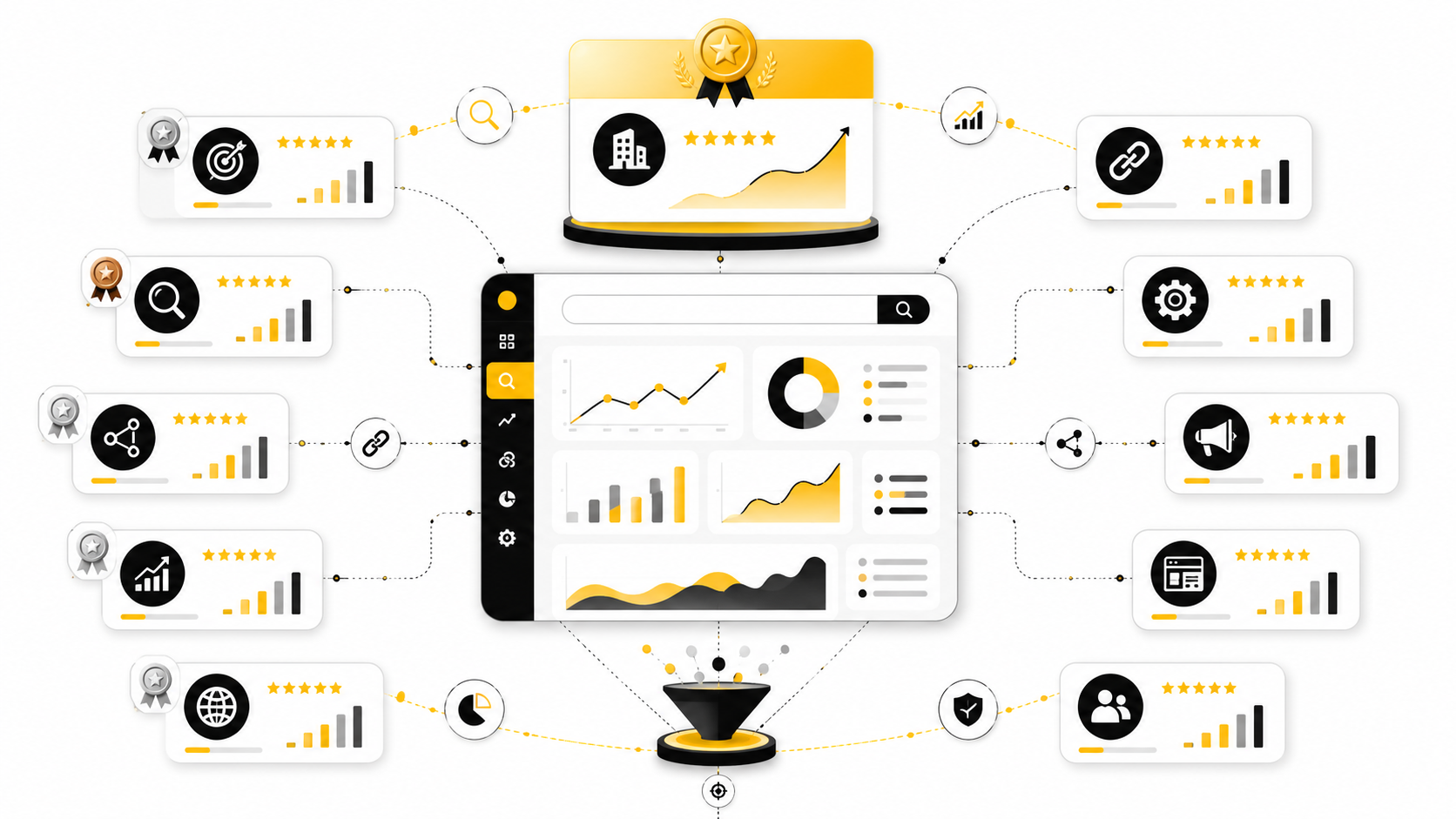
Hiring one of the top 10 SEO companies sounds simple until you start comparing agencies. Every website says they are strategic. Every pitch deck promises growth. Every case study looks polished enough to make you wonder whether the agency is truly excellent or just excellent at selling agency work.
That matters because SEO has changed fast. Organic search is still a major channel, with BrightEdge reporting that organic search remains the largest trackable source of website traffic in its channel share research. At the same time, AI Overviews, zero-click results, Reddit threads, YouTube results, local packs, comparison pages, and brand mentions now shape what buyers see before they ever click your site.
The right SEO partner does not just chase rankings anymore. They understand technical search, content quality, authority, digital PR, conversion paths, analytics, local visibility, and how AI-generated search experiences are changing discovery. The wrong partner gives you a keyword spreadsheet, publishes forgettable content, builds weak links, and asks for patience while your competitors quietly take the market.
This guide breaks down how to evaluate the top 10 SEO companies with a practical buyer’s lens. It is not about picking the loudest agency or the one with the prettiest homepage. It is about understanding which company fits your business model, your growth stage, your internal team, your risk tolerance, and the kind of search visibility you actually need.
Why Choosing the Right SEO Company Matters
SEO is no longer a simple traffic game. A company can increase organic sessions and still fail if the traffic does not convert, if rankings come from irrelevant content, or if AI search results summarize competitors more clearly. Strong SEO now has to connect visibility with pipeline, revenue, trust, and brand demand.
Search behavior is also fragmenting. SparkToro’s 2024 zero-click study found that 58.5% of U.S. Google searches ended without a click, and Pew Research found that users were less likely to click traditional links when an AI summary appeared in Google results in its 2025 browsing behavior analysis. That does not mean SEO is dead. It means the best SEO companies have to earn visibility across more surfaces, create clearer answers, build stronger topical authority, and help brands become the source that search engines and buyers both trust.
This is why “top 10 SEO companies” should never be treated as a generic shopping list. A local law firm, a SaaS company, an ecommerce brand, a healthcare network, and a national franchise do not need the same SEO strategy. The best choice depends on fit, not hype.
The Evaluation Framework Behind This List
A useful SEO-company framework starts with outcomes, not vanity metrics. Rankings still matter, but they are only one signal. Better questions include whether the agency can improve qualified organic traffic, support conversion rates, fix technical blockers, build durable authority, and explain exactly how its work supports revenue.
The strongest agencies usually show evidence in several areas at once. They have verified client feedback on platforms like Clutch’s SEO company directory, credible service depth, clear reporting, realistic timelines, and a point of view on how search is changing. They also avoid the lazy promise that “more content” automatically means more growth.
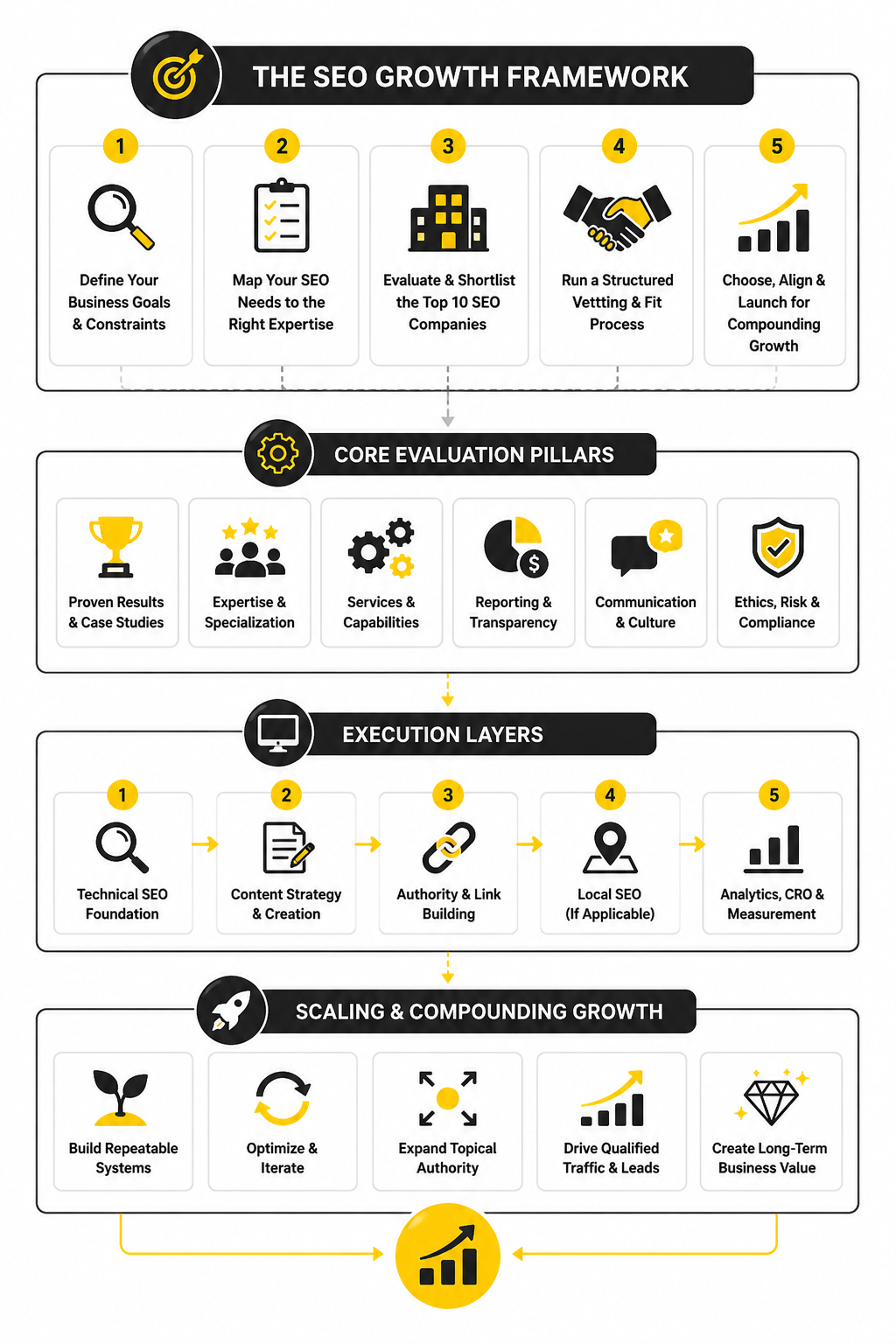
The framework used throughout this guide looks at five practical factors: specialization, proof, process, transparency, and fit. Specialization shows whether the agency understands your market. Proof shows whether results are more than sales copy. Process reveals how the work gets done. Transparency protects you from vague retainers. Fit determines whether the agency can actually work with your team.
The Top 10 SEO Companies To Know
A smart list of the top 10 SEO companies should not pretend there is one perfect agency for every business. SEO is too dependent on industry, site size, competition, budget, technical debt, content maturity, and sales cycle. The better way to read this list is to look for patterns: which agencies are strongest for enterprise SEO, which are better for local businesses, which understand ecommerce, and which can support a more complete growth system.
This section uses public reputation signals, service positioning, visible client work, third-party directories, and the kind of SEO problems each company appears built to solve. Review platforms such as Clutch’s SEO agency rankings and award programs like the Search Engine Land Awards are useful signals, but they are not enough by themselves. You still need to ask sharper questions before signing a contract.
The order below is practical, not absolute. A company ranked lower on one list may be the better choice for your business if it has stronger experience in your vertical. That is the part most buyers miss, and it is where expensive SEO mistakes usually begin.
1. WebFX
WebFX is one of the most visible full-service digital marketing agencies in the U.S., and it often appears on major SEO-company lists because of its scale, service depth, and long operating history. Its SEO work sits inside a broader performance-marketing model that can include paid media, content, web design, analytics, CRO, and marketing technology. That makes WebFX especially relevant for businesses that want one agency to coordinate multiple acquisition channels instead of managing a stack of separate vendors.
The main reason WebFX belongs in a top 10 SEO companies list is operational capacity. Larger SEO programs often fail because the agency cannot produce content, fix technical issues, coordinate reporting, and keep strategy moving at the same time. WebFX’s public service pages and third-party profiles show a broad team structure, which can be useful for mid-market and enterprise companies that need execution across several workstreams.
The tradeoff is that bigger is not always better. A large agency can bring process, but you still need to know who will actually manage your account and how much senior strategy time you are getting. Before choosing WebFX, ask for a clear 90-day plan, sample reporting, and examples from businesses with a similar revenue model.
2. Ignite Visibility
Ignite Visibility is a strong fit for companies that want SEO connected with broader digital strategy. The agency has built a reputation across SEO, paid media, social, creative, email, Amazon marketing, and digital PR, which matters when organic growth depends on more than on-page optimization. For brands trying to improve search visibility while also coordinating demand generation, Ignite Visibility is worth serious consideration.
Its positioning is especially relevant now because search visibility is becoming more brand-driven. A company with weak authority, thin content, and little market presence will struggle no matter how many keywords it targets. Agencies that can combine SEO with PR, content distribution, and paid amplification are often better prepared for competitive markets.
That said, buyers should be careful not to buy “everything” just because an agency offers everything. The right question is not whether Ignite Visibility has the services. The right question is whether your business has the budget, internal support, and strategic need to use those services well.
3. Victorious
Victorious is often discussed as a dedicated SEO agency rather than a generalist marketing shop. That can be a major advantage for companies that want deep SEO specialization without buying a full-service retainer. Its public positioning emphasizes search strategy, technical SEO, content, link acquisition, and transparent campaign management.
Specialized SEO agencies can be useful when your existing marketing team already handles brand, design, paid media, and lifecycle marketing. In that setup, you do not need a broad agency trying to touch every channel. You need a focused team that can diagnose organic-search opportunities and work cleanly with the people already inside your business.
Victorious is a good example of why “top 10 SEO companies” should include different agency models. A specialist can outperform a full-service agency when the problem is clearly SEO-specific. But if your website, analytics, conversion funnel, and content operation are all underdeveloped, you may need a partner with wider implementation support.
4. NP Digital
NP Digital is closely associated with Neil Patel’s content and software ecosystem, but the agency itself has grown into a global performance-marketing firm. It is relevant for businesses that want SEO tied to content strategy, paid media, data, and international growth. The agency’s visibility in the market also gives it a strong brand advantage, which can be useful when evaluating credibility and methodology.
NP Digital is especially interesting for companies that care about content-led growth. Search visibility increasingly depends on topical depth, helpful content, entity strength, and how well a brand answers buyer questions across the full journey. A partner with strong content DNA can help when the issue is not just technical SEO but the lack of useful, differentiated content.
The caution is simple: brand recognition should not replace due diligence. A famous founder or recognizable agency name does not automatically mean your account gets the best strategy. Ask who owns the work, how strategy is reviewed, and whether the agency can show results for businesses with similar search economics.
5. OuterBox
OuterBox has a strong reputation in ecommerce SEO, which makes it different from many general SEO agencies. Ecommerce SEO requires a different operating model because category pages, product pages, faceted navigation, crawl budget, duplicate content, merchandising, and conversion paths all affect performance. A content-only SEO plan will not fix those problems.
For online stores, the right SEO company needs to understand revenue mechanics. Ranking a blog post is useful, but ranking commercial category pages, improving product discoverability, and reducing technical friction can matter more. OuterBox’s ecommerce focus makes it a practical option for brands that sell through Shopify, WooCommerce, BigCommerce, Magento, or custom commerce platforms.
This is also where SEO connects directly with landing-page and funnel performance. If an ecommerce team is improving organic traffic but still struggling to convert visitors, tools like Replo can help teams build and test higher-converting Shopify landing pages without waiting on a full development cycle. The agency still owns the search strategy, but the business needs a page system that can turn qualified traffic into revenue.
6. SEO Brand
SEO Brand is a practical option for companies that need SEO tied closely to business development, lead generation, ecommerce, and analytics. The agency’s positioning is not just about ranking pages; it leans into measurable growth, which is exactly where SEO should be heading. A good SEO program should make the sales team’s life easier, not just make the marketing dashboard look busier.
This matters because many businesses do not have a traffic problem at first. They have a relevance problem, a conversion problem, or a tracking problem. An agency like SEO Brand can be a better fit when the goal is to connect organic visibility with qualified leads, ecommerce revenue, or measurable buyer actions.
When evaluating SEO Brand, look closely at how it defines success before the contract starts. Ask what it considers a meaningful conversion, how it handles attribution, and which parts of the funnel it can influence directly. If the agency can tie SEO activity to business outcomes without hiding behind vague ranking reports, that is a good sign.
7. Straight North
Straight North is known for SEO, paid advertising, web design, and lead generation, which makes it relevant for companies that care about pipeline quality. This is especially useful for B2B, industrial, professional services, and local-market businesses where a raw increase in organic traffic does not automatically mean better sales opportunities. In those cases, the SEO strategy has to attract buyers who are actually ready to talk.
The key advantage of a lead-generation-focused agency is practical prioritization. Instead of chasing every keyword with volume, the agency should identify the searches that connect to real buyer intent. That usually means balancing service pages, location pages, comparison content, educational content, and conversion-focused landing pages.
Straight North can make sense if your internal team needs help turning organic visitors into leads. But you should still ask how the agency validates lead quality after form submissions or phone calls. If no one checks whether leads are qualified, SEO reporting can look successful while the sales team quietly rejects the work.
8. HigherVisibility
HigherVisibility is a strong contender for companies that want SEO, local SEO, franchise SEO, paid search, web design, and digital strategy under one roof. Local and franchise SEO deserve special attention because they are operationally different from national SEO. A business with dozens or hundreds of locations has to manage local landing pages, Google Business Profiles, reviews, citations, content consistency, and market-level reporting.
For location-based businesses, the best SEO company is not always the one with the most impressive national case study. It is often the one that understands how people search in specific cities, neighborhoods, and service areas. Local SEO also depends on trust signals that are not limited to the website, including reviews, business listings, local relevance, and proximity-driven search results.
HigherVisibility is worth considering if your business has multiple markets or locations and needs a cleaner local search system. Ask how the agency handles duplicate location pages, review strategy, GBP optimization, and location-level attribution. Those answers will tell you more than a generic promise about “more visibility.”
9. Siege Media
Siege Media is different from many companies on this list because it is especially known for content marketing and SEO-driven content assets. That makes it a strong fit for businesses that need linkable content, editorial strategy, and organic growth through high-quality publishing. It is not the obvious choice for every technical SEO problem, but it is very relevant when authority and content quality are the bottlenecks.
Content-led SEO is harder than it looks. Publishing more articles is easy. Creating content that earns links, satisfies search intent, supports product positioning, and holds up against expert competitors is much harder. Siege Media’s focus is useful for brands that already have a functional site but need stronger content assets to compete.
This is also where buyers should be honest about internal review speed. Strong content programs need subject-matter input, approvals, and a willingness to publish useful work instead of watered-down brand copy. If your company cannot support that process, even a strong content agency will be slowed down.
10. iPullRank
iPullRank is one of the more technical and strategy-heavy agencies in the SEO space. It is a strong fit for complex websites, enterprise SEO challenges, technical audits, content strategy, and search programs that require deeper analysis than a standard checklist. For large sites with crawl, rendering, internal linking, migration, indexation, or content-quality problems, this kind of technical depth matters.
Enterprise SEO has a different failure pattern than small-business SEO. The problem is rarely just “we need more blog posts.” More often, the site has thousands or millions of URLs, competing templates, legacy CMS issues, messy data, and internal teams that struggle to ship fixes. An agency with strong technical and strategic capability can help prioritize what actually moves the needle.
iPullRank is a serious option if your SEO problem is complex and your internal team needs senior thinking. The main question is whether your organization can implement the recommendations. Technical SEO insights are only valuable when product, engineering, content, and leadership are aligned enough to act on them.
Core Services The Best SEO Companies Should Offer
The best SEO companies do not all look identical, but they should cover the same core areas in some form. A top agency needs to understand how search engines crawl, render, index, interpret, rank, and display your content. Google’s own SEO documentation frames SEO around helping search engines understand content while helping users find and evaluate it through search, which is still the simplest way to separate useful SEO from noise: Google’s SEO starter guide.
Technical SEO is the first layer because search performance breaks when the site cannot be crawled, indexed, rendered, or understood properly. This includes site architecture, internal linking, page speed, structured data, canonical tags, redirects, duplicate content, sitemap health, robots directives, JavaScript rendering, and migration planning. It is not glamorous, but it is often where serious growth is unlocked.
Content strategy is the second layer. The agency should map topics to the buyer journey, identify missing commercial pages, improve weak content, consolidate overlapping pages, and create new assets only when there is a clear reason. Good content does not exist because a keyword tool found a phrase; it exists because a real buyer has a real question and the business can answer it better than competitors.
Authority building is the third layer. This can include digital PR, linkable assets, partnerships, expert contributions, brand mentions, and legitimate outreach. The agency should be able to explain its approach clearly because vague link building is one of the fastest ways to create risk without creating durable value.
Measurement is the fourth layer. A serious agency should know how to report on rankings, impressions, clicks, assisted conversions, leads, revenue, crawl improvements, content performance, and market-level visibility. If your business uses a CRM or pipeline tool, a platform like GoHighLevel can help connect lead capture, follow-up, and attribution so SEO performance does not disappear after the form submission.
How Professional SEO Implementation Actually Works
Professional SEO implementation starts with diagnosis, not deliverables. Weak agencies sell a fixed menu before they understand the site. Strong agencies inspect the business model, analytics, competitors, technical health, content inventory, backlink profile, SERP landscape, and internal resources before they decide what should happen first.
The first 30 to 45 days are usually about discovery and prioritization. The agency should audit the site, review search data, evaluate competitors, identify technical blockers, inspect conversion paths, and build a practical roadmap. This phase should create clarity, not a giant PDF that nobody reads.
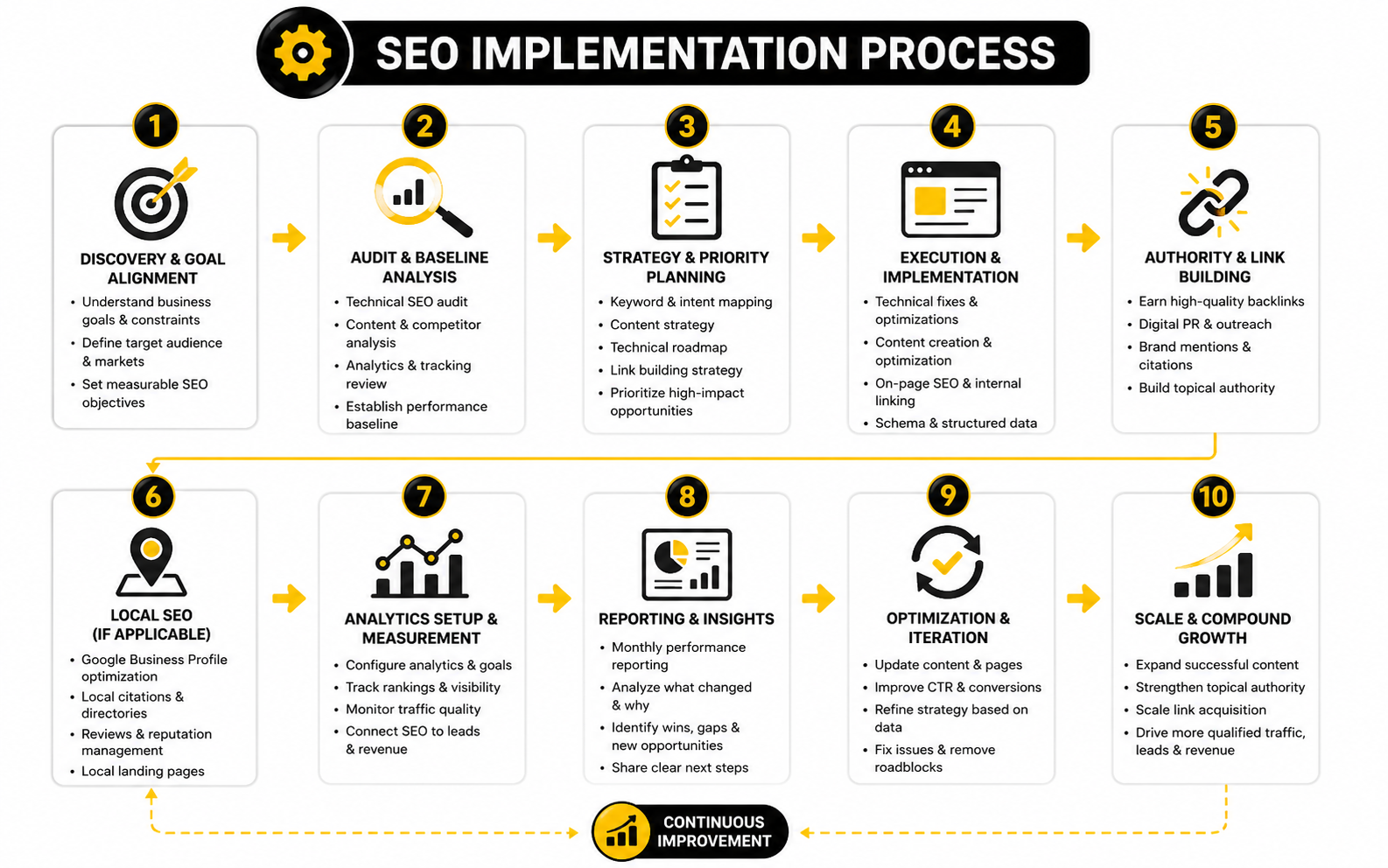
Once the roadmap is clear, implementation should move in focused cycles. A good agency will not try to fix everything at once because that creates confusion and slows execution. Instead, it will prioritize the work that has the best mix of impact, confidence, and speed.
A healthy SEO implementation process usually looks like this:
This is where execution quality becomes obvious. Anyone can say “technical SEO” or “content optimization” in a proposal. The real test is whether the agency can turn those words into shipped fixes, better pages, cleaner reporting, and visible movement in search results.
For service businesses, implementation also has to include follow-up. Organic leads lose value when response time is slow, nurture is inconsistent, or calls are not tracked properly. If SEO is feeding a sales process, tools such as GoHighLevel’s AI features can support faster response workflows and lead handling, but the strategy still needs human judgment behind it.
A professional SEO company should also know when not to act. Not every ranking drop requires a rewrite. Not every low-volume keyword deserves a page. Not every competitor tactic is worth copying. Good implementation is disciplined, because random SEO activity creates motion without momentum.
Statistics and Data
Data should make the agency selection process clearer, not noisier. The problem is that SEO reporting often gets filled with numbers that look important but do not change the decision. Impressions, keyword counts, traffic charts, and average positions all have value, but only when they are connected to the question that matters: is organic search creating qualified business growth?
This is especially important when comparing the top 10 SEO companies because each agency may report performance differently. One agency may emphasize rankings. Another may lead with organic sessions. Another may show pipeline, revenue, or assisted conversions. None of those metrics are automatically wrong, but each one tells only part of the story.
The best way to interpret SEO data is to separate visibility, engagement, conversion, and revenue. Visibility tells you whether the market can find you. Engagement tells you whether the right people are clicking and staying. Conversion tells you whether the site turns demand into action. Revenue tells you whether the entire system is worth scaling.
The Numbers That Actually Matter
Organic traffic is still valuable, but the meaning of traffic has changed. BrightEdge’s 2025 research found that AI search was growing quickly but still represented less than 1% of referral traffic, while organic search remained the primary driver and delivered the majority of conversions in its AI search traffic analysis. That is the key nuance: AI search is changing discovery, but traditional organic search still deserves serious investment.
Click behavior is also changing, which means rankings alone can mislead you. Pew Research found that users who saw a Google AI summary clicked a traditional search result in 8% of visits, compared with 15% of visits when no AI summary appeared in its 2025 AI summary click analysis. That does not mean you should ignore rankings for AI Overview queries, but it does mean you need to measure whether visibility is turning into visits, leads, and brand recall.
Zero-click behavior makes the same point from another angle. Semrush reported that U.S. zero-click search traffic reached roughly 27.2% in March 2025, up from 24.4% in March 2024, in its zero-click search update. For businesses, the action is not to panic. The action is to build pages and brand assets that can win clicks when clicks are available, while also earning visibility in places where the search result itself influences the buyer.
How To Read SEO Benchmarks Without Fooling Yourself
Benchmarks are useful, but only when you use them as context instead of commandments. A 20% organic traffic increase might be excellent for an enterprise site in a mature market and disappointing for a newer site with obvious technical issues. A lower click-through rate might be a failure on a branded query and completely normal on an informational query dominated by SERP features.
That is why a serious SEO company should benchmark your site against your own baseline first. Before comparing you to competitors, the agency should know which pages already drive revenue, which queries are losing visibility, which technical issues suppress performance, and which conversion paths are broken. External benchmarks help, but your own data decides the priorities.
The most useful benchmark is trend quality. If impressions rise but clicks fall, your pages may be showing up for weaker queries or losing attention to AI summaries and SERP features. If clicks rise but leads do not, the problem may be intent mismatch or conversion friction. If leads rise but revenue does not, the issue may be lead quality, sales follow-up, or attribution.
The Analytics System A Good SEO Agency Should Build
A proper SEO analytics system should connect the search result to the business result. That means Google Search Console, analytics, rank tracking, CRM data, call tracking, form submissions, ecommerce revenue, and content performance need to tell one coherent story. If the agency only shows keyword movement, you are missing the bigger picture.
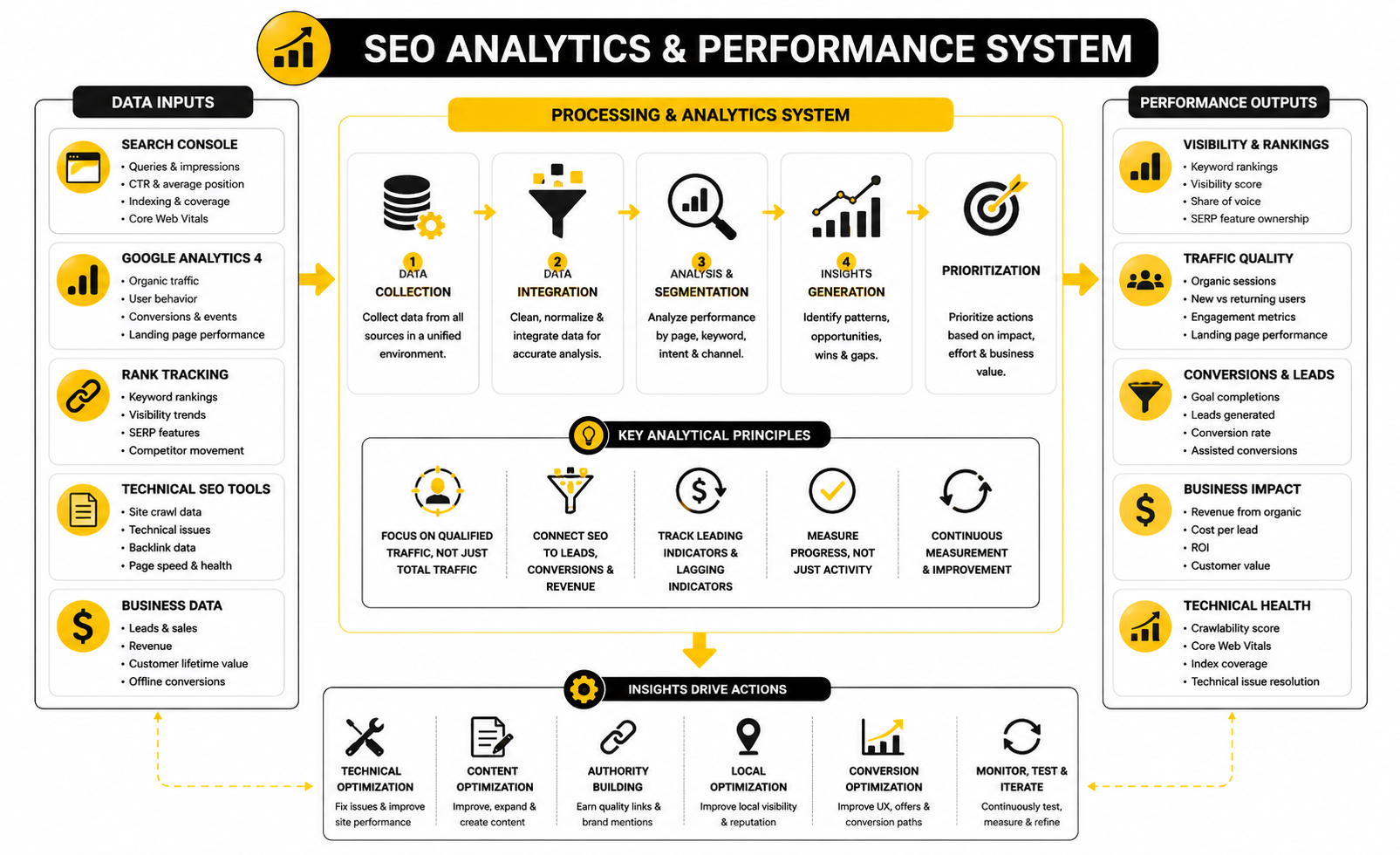
The reporting setup should answer five practical questions every month:
This is where many businesses discover that their SEO problem is actually a measurement problem. They hire an agency, publish content, watch traffic move, and still cannot say which pages create customers. Before you scale SEO spend, fix that visibility gap.
What Performance Signals Should Drive Action
Not every metric deserves the same response. A ranking drop on one low-value informational keyword may not matter. A decline across high-intent service pages can be urgent. A traffic increase from irrelevant blog posts may look good in a report and still do nothing for the business.
Strong agencies prioritize signals by business impact. If a commercial page loses impressions and revenue at the same time, that needs attention quickly. If a group of articles gets impressions but low clicks, the agency may need better titles, stronger meta descriptions, richer content, or a different angle that earns attention in crowded search results. If a high-traffic page has weak conversions, the next move may be CRO instead of more content.
This is also why funnel tools can matter around SEO. If organic traffic drives leads but the follow-up process is slow, the campaign leaks value after the click. A system like GoHighLevel can help service businesses organize lead capture, pipeline tracking, reminders, and follow-up workflows so SEO performance is easier to connect to booked calls and closed deals.
The Red Flags Hidden Inside SEO Reports
Bad SEO reporting usually looks busy. It includes too many screenshots, too many vanity metrics, and too little interpretation. If the report does not tell you what changed, why it changed, what the agency learned, and what will happen next, it is not a management tool.
Watch for reports that celebrate keyword gains without showing business relevance. A company can rank for dozens of low-intent phrases and still miss the searches that buyers use when they are ready to compare vendors. The same applies to traffic reports that ignore conversions, location quality, device behavior, or landing-page intent.
The biggest red flag is silence around failed tests. SEO includes uncertainty, and even strong agencies will make bets that do not work. The difference is that a good agency explains what happened and adjusts the plan. A weak agency hides behind long timelines and sends the same report every month.
How To Compare Agencies Using Data
When comparing the top 10 SEO companies, ask each agency to explain how it would measure success for your specific business. Do not accept a generic answer. The right metrics for a national ecommerce brand are not the same as the right metrics for a local legal practice, a SaaS company, or a franchise system.
A practical agency scorecard should include strategy quality, reporting clarity, implementation ability, communication, and commercial impact. You should know what the agency will track in the first 90 days, what it expects to improve in the first six months, and which outcomes may take longer. SEO is not instant, but the process should never feel mysterious.
The best agencies use data to make better decisions, not to protect their ego. They will tell you when a page needs to be rebuilt, when a topic is not worth chasing, when technical debt is blocking growth, and when SEO is not the only channel that needs attention. That honesty is valuable because the goal is not to buy SEO activity. The goal is to build a search system that compounds.
Advanced Considerations Before You Sign
Choosing from the top 10 SEO companies is not just a marketing decision. It is an operating decision. The agency you hire will influence your website structure, content calendar, analytics setup, development priorities, brand positioning, and sometimes even how your sales team follows up with leads.
That is why the best choice is rarely the agency with the slickest pitch. It is the agency that understands what your business can actually execute. SEO strategy without implementation capacity turns into a folder full of recommendations, and recommendations do not rank, convert, or compound by themselves.
The deeper question is simple: what kind of SEO partner does your company need right now? Some companies need a technical operator. Some need a content engine. Some need local-search discipline. Some need enterprise coordination. Some need a full growth partner that can connect search visibility with conversion, CRM, lifecycle marketing, and sales follow-up.
The Tradeoff Between Specialists and Full-Service Agencies
A specialist agency can be the better choice when the problem is narrow and painful. If your site has crawl issues, migration risk, weak internal linking, poor category architecture, or thin ecommerce templates, you may need deep SEO expertise more than a general marketing team. Specialists are often stronger when the job requires diagnosis, prioritization, and technical precision.
A full-service agency can be the better choice when SEO depends on multiple moving parts. If the website needs redesign work, the funnel is weak, paid search data should inform organic strategy, and the sales team needs better lead handling, a broader partner may create more momentum. The value is not that they offer more services; the value is that the services are coordinated around one growth plan.
The risk is buying the wrong model. Hiring a specialist when you need execution across design, development, and sales operations can create bottlenecks. Hiring a full-service agency when you only need advanced SEO can create unnecessary cost and diluted focus. The agency model should match the constraint.
Budget Should Match Complexity, Not Ego
SEO pricing varies widely because SEO problems vary widely. Ahrefs found that local SEO averaged around $1,557 per month, while agencies charged an average of around $1,819 per month in its SEO pricing survey. That gives useful context, but it does not mean a serious national, ecommerce, or enterprise SEO program should be judged against a small-business local retainer.
A low retainer can be perfectly reasonable for a small site with basic needs. It can also be a warning sign if the business expects technical audits, strategy, content production, link acquisition, reporting, developer collaboration, and conversion guidance. Something has to give, and it usually shows up as shallow work, slow execution, or junior account management.
The better way to think about budget is through complexity. A five-page local service site, a 5,000-product ecommerce store, and a global SaaS company with multiple subfolders do not need the same budget because they do not have the same SEO surface area. Pay for the level of thinking and execution your problem actually requires.
The Hidden Cost of Slow Implementation
SEO does not fail only because the agency is weak. It also fails when the client cannot ship. If every technical fix waits for a developer sprint, every content draft sits in legal review, and every analytics issue gets pushed to next month, the campaign loses momentum no matter how smart the strategy is.
This is where internal ownership matters. Someone on your team needs the authority to approve changes, unblock developers, provide subject-matter input, and hold the agency accountable. Without that person, the agency becomes a consultant shouting into the void.
A strong agency will surface implementation risks early. It should tell you when recommendations require engineering support, when content needs expert review, and when conversion tracking is not clean enough to prove results. That honesty may feel uncomfortable in the sales process, but it saves months of confusion later.
SEO Risk Is Real, Especially With Shortcuts
The fastest way to ruin an SEO investment is to chase shortcuts that violate how search quality works. Google’s spam policies explicitly call out manipulative practices such as scaled content abuse, link spam, cloaking, sneaky redirects, and other tactics designed to manipulate rankings rather than help users. Any agency that cannot clearly explain how it earns links, creates content, or uses automation should be treated carefully.
This matters even more now because AI makes low-quality scale cheap. A bad agency can generate hundreds of pages, rewrite competitor content, and call it a content strategy. That may create temporary movement, but it does not build a brand, does not create trust, and can leave the business exposed when search systems become better at detecting unhelpful content.
The safest SEO companies are not timid. They still move fast, test aggressively, and look for leverage. The difference is that they build around durable assets: better pages, cleaner architecture, useful content, real expertise, stronger authority, and a search experience that helps the buyer make a decision.
AI Search Changes The Strategy, Not The Goal
AI search is not a reason to abandon SEO. It is a reason to make SEO sharper. HubSpot’s 2026 marketing data shows that more than 92% of marketers are already using or planning to use SEO optimization for traditional and AI-powered search engines in its marketing statistics report. That tells you where the market is moving: search optimization is expanding beyond blue links, not disappearing.
The practical shift is that your content needs to be easier to understand, cite, summarize, and trust. Pages that rely on fluff, vague claims, or keyword repetition are weaker in both traditional search and AI-assisted search. Strong pages answer clear questions, show expertise, structure information well, and make the brand’s position obvious.
When interviewing agencies, ask how they think about AI Overviews, LLM visibility, entity strength, structured information, and brand mentions. Be careful with anyone selling “AI SEO” as if it is a completely separate magic channel. The fundamentals still matter, but the execution bar is higher.
Scaling SEO Requires Systems, Not Just More Content
A company can usually brute-force the first stage of SEO with a few strong pages and basic technical fixes. Scaling is different. Once you have dozens, hundreds, or thousands of important URLs, the work becomes a system of templates, internal links, editorial standards, crawl management, reporting, refresh cycles, and conversion testing.
This is where many SEO programs get messy. Teams publish content faster than they can maintain it. Product pages go live without search-friendly copy. Old articles compete with new ones. Internal links become random. Reporting gets fragmented across tools, dashboards, and spreadsheets nobody trusts.
A top SEO company should help you build a repeatable operating system. That means clear rules for when to create, update, consolidate, redirect, or remove pages. It also means content briefs, technical QA, search-intent checks, internal-linking standards, and monthly prioritization that keeps the program focused.
Conversion Strategy Should Not Be An Afterthought
Organic traffic has limited value if the page does not help visitors take the next step. For service businesses, that next step may be a booked call, quote request, form submission, phone call, or consultation. For ecommerce, it may be a product view, add to cart, checkout, email capture, or repeat purchase.
The agency does not need to own every conversion task, but it should understand how SEO traffic behaves after the click. A page that ranks but does not convert may need better messaging, stronger proof, clearer calls to action, faster load time, better layout, or a more relevant offer. More traffic is not always the fix.
This is where SEO connects with the rest of the growth stack. If a business is building funnels around organic traffic, ClickFunnels can be useful for creating focused offer flows, while Systeme.io can support simpler funnel, email, and automation needs. The tool is not the strategy, but the right tool can reduce friction when the SEO traffic is already coming in.
The Questions That Separate Serious Agencies From Weak Ones
A polished proposal is easy to create. A serious operating plan is harder. Before choosing among the top 10 SEO companies, ask questions that force the agency to reveal how it thinks, how it prioritizes, and how it handles uncertainty.
Use questions like these:
That last question is more useful than it looks. A strong agency knows where it fits and where it does not. A weak agency says yes to everything because the sale matters more than the outcome.
When You Should Not Hire An SEO Company Yet
Sometimes the right move is to wait. If your offer is unclear, your website cannot convert, your analytics are broken, or your team cannot approve changes, hiring an SEO agency may create more frustration than growth. SEO amplifies a business system; it does not magically fix a weak one.
That does not mean you need a perfect business before starting. You just need enough clarity to make SEO work accountable. The agency should know what you sell, who you serve, which actions matter, and what a qualified lead or customer is worth.
If those basics are missing, fix them first. Tighten the offer, clean up tracking, improve the core pages, and define the buyer journey. Then an SEO company has something real to scale.
Final Decision Framework
By this point, the choice should feel less like picking from a random list and more like building the right search-growth system. The top 10 SEO companies can all look attractive on the surface, but the best fit is the one that matches your business model, your internal capacity, and the search problems blocking growth right now. That is the difference between buying SEO activity and building a durable organic acquisition channel.
Before you sign, bring everything back to fit. If you need technical cleanup, hire for technical depth. If you need authority, hire for digital PR and content quality. If you need local visibility, hire for location-level execution. If you need revenue accountability, hire a partner that can connect SEO with analytics, conversion paths, and sales follow-up.
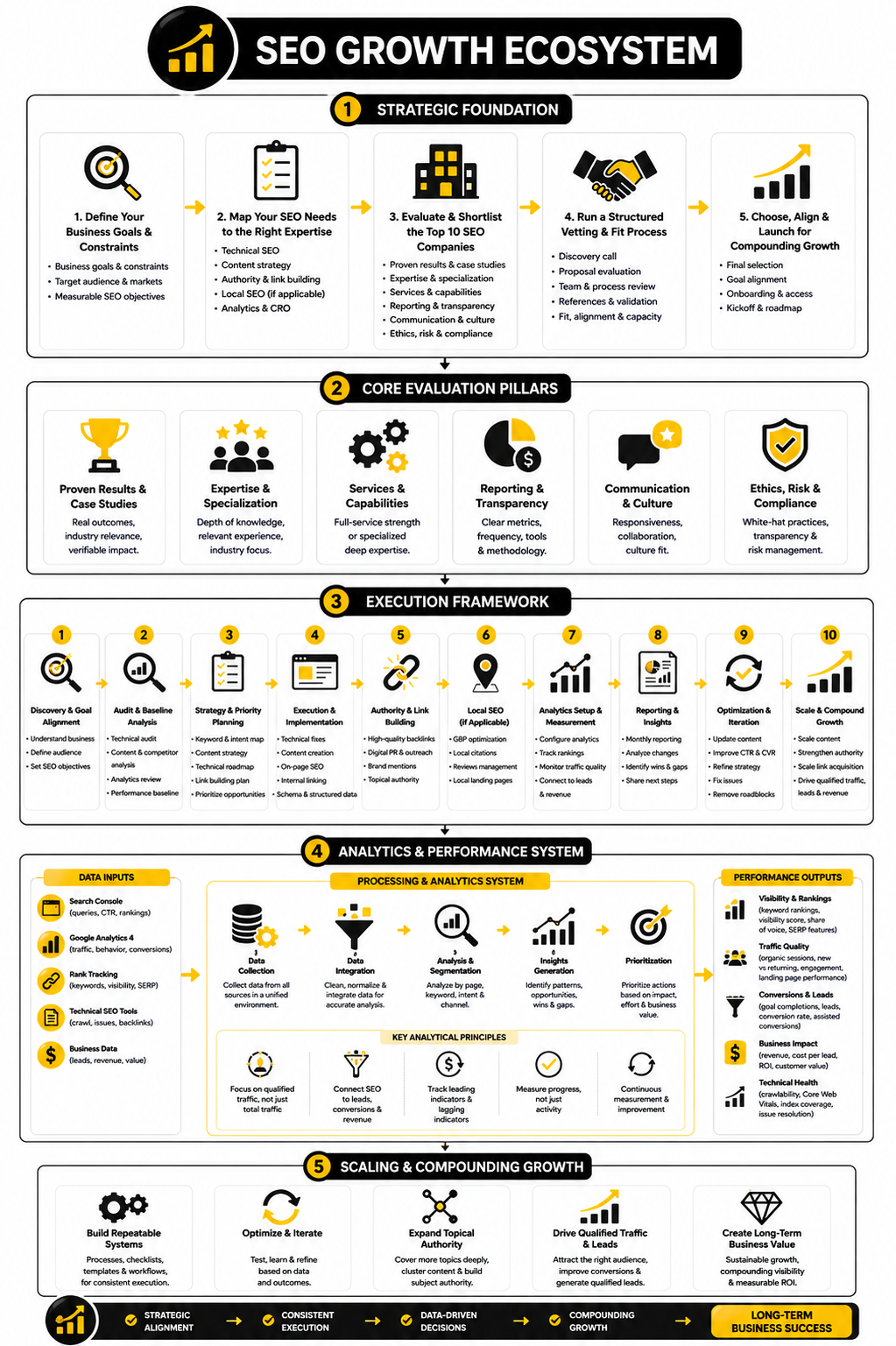
A strong SEO partner should make the whole ecosystem easier to understand. Your website, content, authority, analytics, CRM, landing pages, and sales process should not feel like separate pieces fighting each other. They should work together so the right buyers can find you, trust you, and take the next step without friction.
What are the top 10 SEO companies?
The top 10 SEO companies covered in this guide are WebFX, Ignite Visibility, Victorious, NP Digital, OuterBox, SEO Brand, Straight North, HigherVisibility, Siege Media, and iPullRank. They are not identical agencies, and that is the point. Some are better for enterprise SEO, some for ecommerce, some for content-led growth, some for local visibility, and some for technical strategy.
A buyer should not choose an agency only because it appears on a list. The better move is to match the agency’s strengths to the business problem you need solved. If your website has technical debt, a content-only agency may not be enough. If your brand lacks authority, a purely technical partner may not move the market.
How do I choose the best SEO company for my business?
Start by defining the constraint. Are you losing rankings because of technical issues, weak content, poor authority, local competition, bad analytics, or a conversion problem after the click? Once you know the constraint, you can evaluate agencies based on the kind of work they are actually built to do.
Then ask for a specific process, not a generic promise. A good agency should explain how it audits your site, prioritizes opportunities, reports progress, and works with your team. If the plan sounds like the same package they sell to everyone, keep looking.
Are SEO companies worth the money?
SEO companies are worth the money when they help you build an asset that compounds. A strong organic search program can keep producing qualified visibility long after an individual campaign is launched. That is very different from renting attention through paid ads only.
But SEO is not automatically worth it. If the agency is vague, your website cannot convert, or your team cannot implement recommendations, the return can be weak. The value comes from strategy, execution, measurement, and follow-through working together.
How much should I pay for SEO services?
SEO pricing depends on site complexity, competition, service depth, and the agency’s experience. Local SEO may sit in a lower monthly range, while ecommerce, national, and enterprise SEO programs often require much more because there are more pages, technical dependencies, content needs, and reporting requirements. Treat pricing as a signal of scope, not just cost.
The mistake is shopping for the cheapest agency while expecting senior strategy, content, technical audits, link acquisition, analytics, and conversion guidance. That math usually breaks. A better approach is to ask what work will be done, who will do it, how often it will ship, and how success will be measured.
How long does SEO take to work?
Most serious SEO programs need months, not days. Early technical fixes, content updates, and indexing improvements can show movement sooner, but meaningful growth usually depends on competition, site history, authority, and implementation speed. A new site in a competitive market should expect a longer path than an established site with fixable issues.
A good agency should still show progress before the final outcome arrives. You should see completed audits, shipped fixes, improved content, cleaner tracking, and clearer reporting. If the only answer is “wait six months” with no visible work, that is not a strategy.
What should an SEO agency report every month?
A useful monthly SEO report should explain what changed, why it changed, what was shipped, what was learned, and what happens next. It should include visibility, rankings, organic traffic, landing-page performance, conversions, technical progress, and business impact where tracking allows. The report should help you make decisions, not just admire charts.
The best reports also separate leading indicators from lagging indicators. Technical fixes, content refreshes, and indexation improvements may happen before revenue changes. That context matters because SEO has stages, and each stage needs different interpretation.
What are the biggest red flags when hiring an SEO company?
The biggest red flags are guaranteed rankings, vague link building, unclear deliverables, no discussion of analytics, and a proposal that looks copied and pasted. Be careful with agencies that promise fast results without first reviewing your site, competitors, and business model. Serious SEO starts with diagnosis.
Another red flag is reporting that avoids business outcomes. If an agency only talks about impressions and keyword counts, you may never know whether SEO is helping revenue. Good SEO companies are comfortable discussing qualified traffic, conversions, and commercial impact.
Should I hire a specialist SEO agency or a full-service agency?
Hire a specialist when your main problem is clearly SEO-specific. That could mean technical audits, site migrations, ecommerce architecture, internal linking, content consolidation, or authority building. Specialists can be extremely valuable when you already have the rest of your marketing operation covered.
Hire a full-service agency when SEO depends on multiple connected functions. If you need website updates, landing pages, paid search coordination, analytics cleanup, CRM workflows, and conversion support, a broader partner may be better. The decision should follow the bottleneck, not the agency’s sales pitch.
How does AI search affect SEO agency selection?
AI search raises the bar for clarity, authority, structure, and brand trust. Agencies now need to think beyond traditional rankings and understand how AI Overviews, generative search, entity signals, source citations, and zero-click behavior influence discovery. Google’s guidance on AI-generated content still comes back to whether automation is used to help users or manipulate rankings through unhelpful scale in its AI content guidance.
That means you should ask agencies how they approach content quality, structured information, brand mentions, expert input, and SERP feature changes. Be skeptical of anyone selling AI SEO as a magic shortcut. The fundamentals still matter, but lazy execution gets exposed faster.
What should I prepare before talking to SEO companies?
Prepare your goals, target customers, top products or services, priority markets, current analytics access, sales process, and any known website issues. You should also know what a qualified lead or customer is worth. That information helps an agency build a strategy around business impact instead of generic traffic growth.
You do not need to have everything perfect. But you should have enough clarity for the agency to understand what success means. If your goals are vague, the SEO plan will probably be vague too.
Can SEO companies guarantee first-page rankings?
No serious SEO company should guarantee first-page rankings for competitive terms. Search results are influenced by competition, algorithms, search intent, site quality, authority, location, personalization, and SERP features. An agency can control the quality of strategy and execution, but it cannot control Google.
A better promise is a clear process, transparent work, and measurable progress. The agency should explain what it will improve and how it will respond if results do not move as expected. Guarantees sound comforting, but accountability is much more useful.
What is the difference between SEO and local SEO?
SEO focuses on improving organic visibility across search results, while local SEO focuses on visibility in specific geographic markets. Local SEO often includes Google Business Profile optimization, reviews, citations, local landing pages, proximity signals, and location-level reporting. A national content strategy will not automatically solve a local visibility problem.
If your business depends on calls, appointments, foot traffic, or service-area leads, local SEO should be part of the conversation from the start. The agency should understand how people search in your specific markets. It should also know how to measure results by location, not just across the whole website.
How do I know if my current SEO agency is doing a good job?
Look at shipped work first. Has the agency fixed technical issues, improved important pages, clarified tracking, created useful content, earned legitimate authority, and explained what changed? Activity without shipped improvements is usually a warning sign.
Then look at trend quality. Are the right pages gaining visibility? Are qualified visitors increasing? Are conversions improving? Are reports becoming clearer over time? Good SEO does not always move in a straight line, but the strategy should become more focused, not more confusing.
Build a stronger local presence with BAAM AI
Turn your website, Google profile, social channels, and AI visibility into one growth engine
Most businesses do not need more random marketing activity. They need a consistent presence system that helps the right people find them, trust them, and take action. BAAM AI brings strategy, local SEO, website updates, Google Maps visibility, social content, AI-search readiness, media production, and reporting into one practical monthly engine.
If you want your marketing to keep working after the campaign ends, start with a free BAAM AI presence audit. See how your business shows up today and where the fastest visibility wins are at BAAM AI.