
BAAM AI Blog
Top 10 Digital Marketing Websites
The best digital marketing websites are not just places to read random tips. They are where marketers check what is changing, pressure-test their strategy, learn from real data, and turn scattered tactics into...
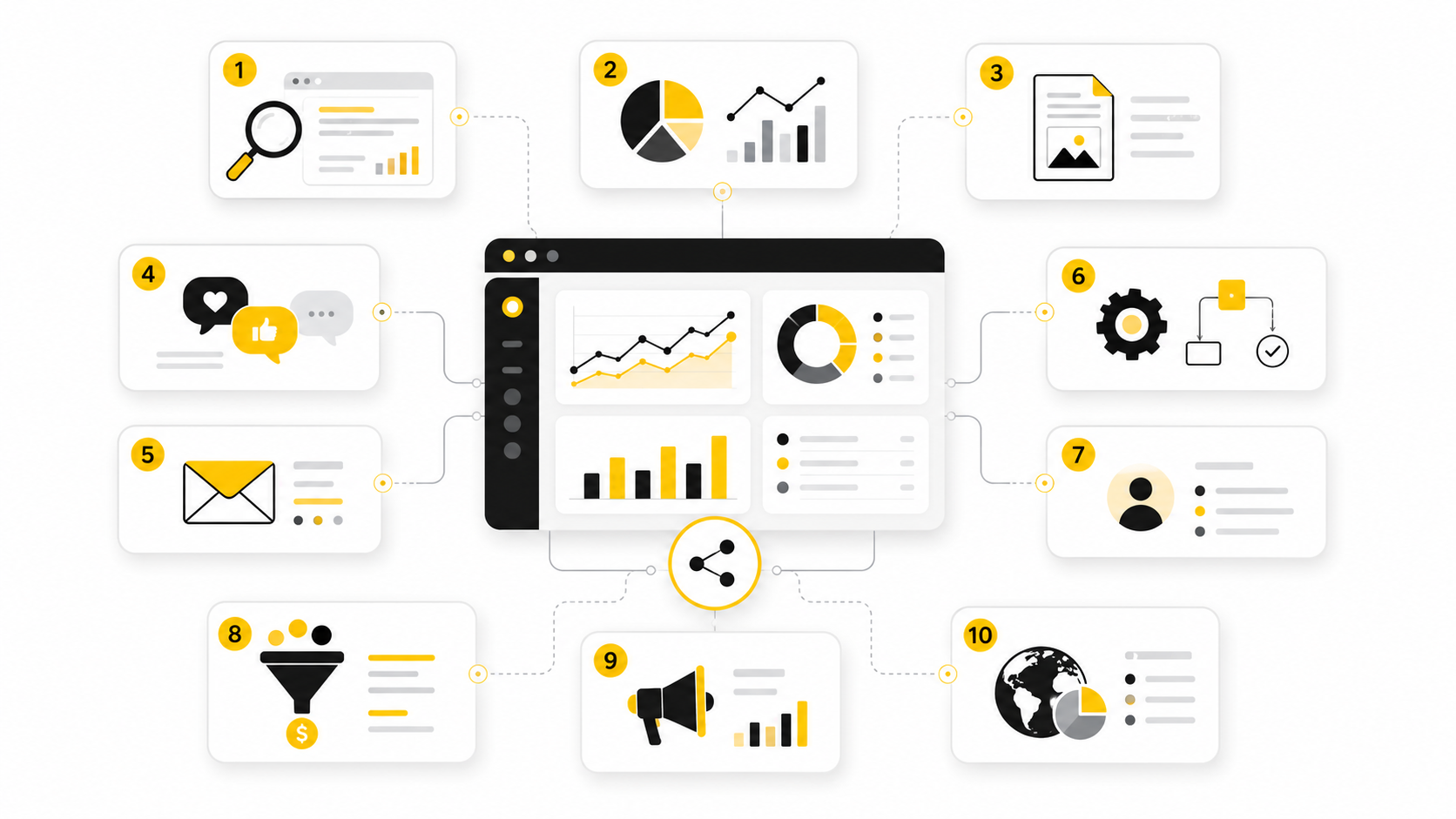
The best digital marketing websites are not just places to read random tips. They are where marketers check what is changing, pressure-test their strategy, learn from real data, and turn scattered tactics into campaigns that actually move revenue. That matters because digital marketing has become too broad for one person to “just keep up” casually.
Search is changing, AI is reshaping workflows, social platforms keep shifting attention, and content teams are under pressure to prove business impact. The latest global digital reports show that more than 6 billion people now use the internet, while social media has reached 5.79 billion user identities worldwide. In other words, the opportunity is massive, but the noise is even bigger.
That is why this guide is not just a basic list of the top 10 digital marketing websites. It is a practical way to understand which sites are worth following, what each one is best for, and how to build a more carefully learning stack around SEO, content, paid media, social media, analytics, automation, funnels, and AI. Some websites are best for strategy. Some are better for execution. A few are strongest when you already know what problem you are trying to solve.
this guide is split into six parts so the full guide stays useful instead of turning into a giant wall of links. Part 1 sets the foundation, explains why these websites matter, and shows the evaluation framework used to judge them. The later parts will move from broad strategy into specific website recommendations, implementation, and final decision-making.
Why the Right Digital Marketing Websites Matter
Most marketers do not have an information shortage. They have a filtering problem. There are thousands of newsletters, blogs, YouTube channels, software hubs, and “growth experts” publishing advice every day, but only a small percentage of that advice is current, tested, and relevant to the kind of business you are actually building.
The right websites save time because they help you separate durable principles from temporary hacks. Google’s own SEO guidance still frames search around helping search engines understand content and helping users decide whether a page is worth visiting, which is a useful reminder that good marketing still starts with clarity, usefulness, and trust. You can see that foundation directly in Google’s SEO Starter Guide, and it is still one of the few resources every marketer should understand before chasing advanced tactics.
This matters even more now because marketing channels are converging. SEO affects brand discovery, content affects sales enablement, social proof affects conversion, and AI affects how teams research, produce, analyze, and personalize campaigns. Salesforce’s latest marketing research focuses heavily on AI, data, and personalization across nearly 4,500 marketers worldwide, which reflects the direction the whole industry is moving.
The Problem With Most “Best Marketing Websites” Lists
A lot of lists rank websites by popularity, not usefulness. That creates a problem because the most famous website is not always the best website for your current situation. A beginner, a solo creator, a local agency, an ecommerce brand, and a B2B SaaS team all need different kinds of marketing guidance.
Another issue is that many lists mix categories without explaining the difference. A news site, a software blog, an SEO education hub, a social media publishing platform, and a funnel builder can all be valuable, but they do not solve the same problem. Treating them equally makes the list look complete while making the reader do all the strategic work.
The better approach is to judge each website by role. For example, a resource like Buffer makes more sense when you are thinking about social publishing and content workflows, while ManyChat is more relevant when your focus is automated conversations, lead capture, and messaging-based customer journeys. Both can belong in a modern marketing stack, but only if they are used for the right job.
Framework Overview
The top 10 digital marketing websites here are evaluated through a practical framework, not just personal preference. A useful marketing website should help you make better decisions, execute faster, avoid outdated advice, and connect tactics to measurable business outcomes. That means credibility matters, but so does usability.
The framework uses four main filters: authority, freshness, practical depth, and implementation value. Authority asks whether the website has real expertise, original research, official documentation, or proven industry trust. Freshness asks whether the content keeps up with current search, social, AI, privacy, advertising, and consumer behavior changes.
Practical depth is where many websites fail. A good article should not only tell you that something matters; it should show how to think about it, where it fits, and what to do next. Implementation value is the final test because marketing knowledge only becomes useful when it improves campaigns, content, funnels, automations, reporting, or customer experience.
Core Components of a Strong Digital Marketing Resource
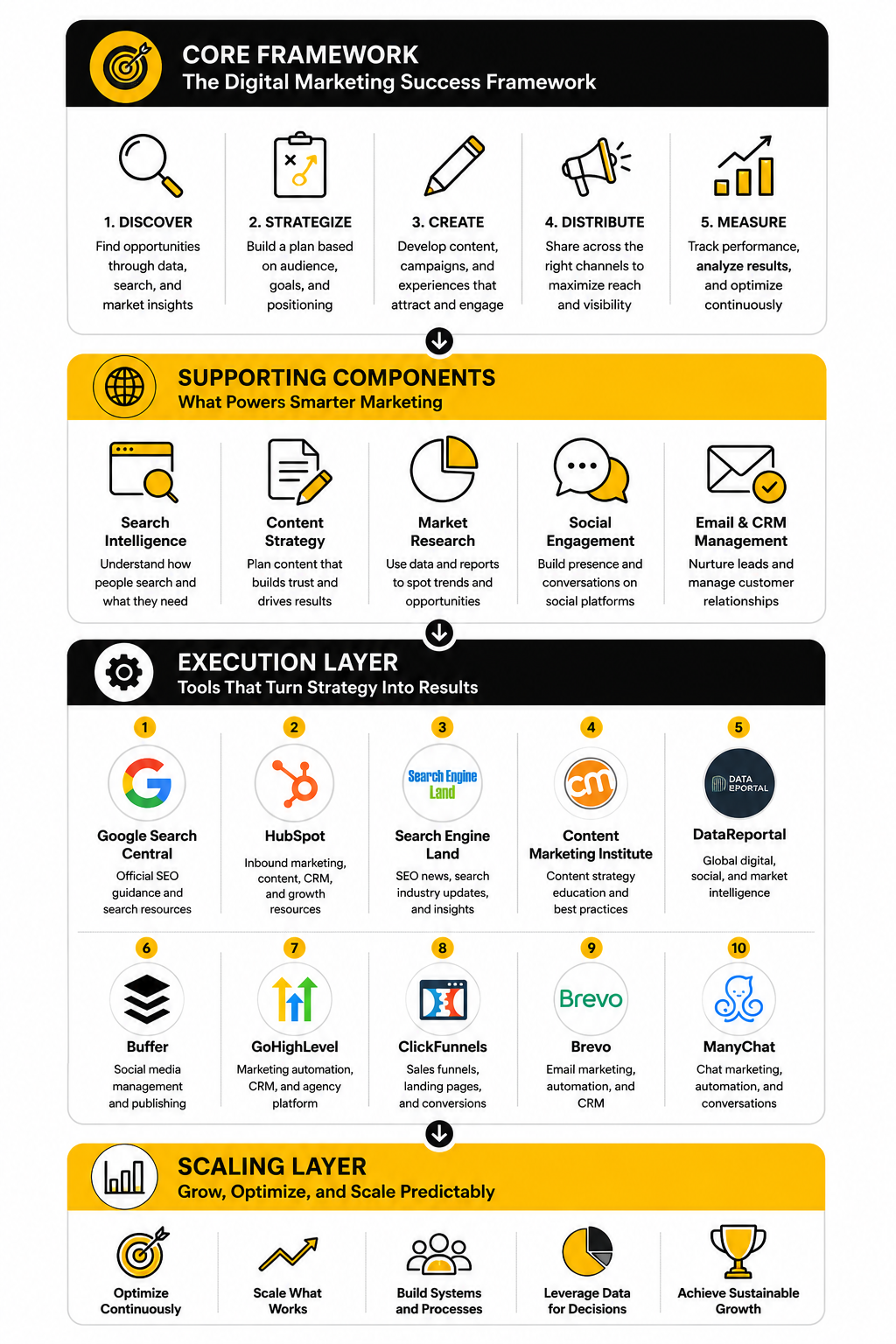
A strong digital marketing website usually does at least one of five things extremely well. It teaches fundamentals, reports industry changes, provides data, shows tactical execution, or helps you implement systems. The best resources often combine two or three of these strengths, but very few are excellent at all five.
The first component is strategic clarity. This is where resources from places like Google Search Central, Content Marketing Institute, and major research publishers become useful because they help marketers understand the bigger rules of the game. Content Marketing Institute’s current research, for example, is built around insights from more than 1,000 B2B marketers, which is far more useful than one person’s isolated opinion.
The second component is channel-specific expertise. SEO websites should be judged differently from email marketing websites, funnel platforms, social media tools, or CRM automation hubs. A platform like GoHighLevel is relevant when you care about CRM, automations, pipelines, and agency systems, while a funnel tool like ClickFunnels fits better when the job is landing pages, offers, and conversion paths.
The third component is execution support. Ideas are cheap if they never become campaigns. The websites that deserve attention are the ones that help you turn strategy into pages, emails, workflows, scripts, reports, creative briefs, social calendars, lead magnets, and conversion tests.
Professional Implementation
Professionals should not use digital marketing websites like a daily buffet. That is how you end up consuming everything and implementing nothing. A better system is to assign each website a job inside your marketing workflow.
For example, use official and research-heavy sources for strategy, search-focused websites for SEO decisions, platform blogs for channel updates, and software resources when you are building actual campaigns. If your work involves landing pages, a tool like Replo can support ecommerce page execution, while Brevo is more relevant when email marketing, customer communication, and campaign management are the priority.
This is the main idea that will guide the rest of the article: do not follow marketing websites just because they are popular. Follow them because they help you make better decisions in a specific part of your growth system. The next part will break down the evaluation framework in more detail so the final top 10 list feels useful, not random.
The Evaluation Framework for Choosing Marketing Resources
A list of the top 10 digital marketing websites should not be built around fame alone. Some popular websites are useful for beginners, but too broad for experienced teams. Some technical resources are incredibly accurate, but too narrow for someone trying to build a complete marketing system.
The better question is simple: does this website help you make better marketing decisions faster? If the answer is yes, it belongs in the conversation. If the answer is no, it might still be interesting, but it should not become part of your regular workflow.
This framework looks at each website through practical filters: credibility, freshness, depth, usability, channel relevance, and implementation value. That may sound strict, but it has to be. Marketing advice that is outdated, vague, or disconnected from execution can waste months.
Credibility Comes First
Credibility is the first filter because digital marketing is full of confident opinions. A website can sound smart and still be wrong, incomplete, or built around tactics that stopped working years ago. The strongest marketing websites either publish original research, explain platform-level changes directly, or show repeatable methods that align with how modern channels actually work.
Official sources matter here. For SEO, Google’s own Search Central documentation is still a primary reference because it explains how Google wants site owners to think about crawlability, indexing, helpful content, and search appearance. For broader market context, research hubs such as DataReportal, IAB, Gartner, Salesforce, Adobe, and HubSpot help show where budgets, behavior, and technology adoption are moving.
Credibility does not mean a website has to be corporate or boring. It means the claims are grounded. If a site says a tactic works, it should explain why, when, and under what conditions instead of pretending every business can copy the same playbook and get the same result.
Freshness Matters More Than Ever
Digital marketing changes quickly because the platforms keep changing. Search results now include AI-generated summaries, social algorithms shift distribution, privacy rules affect targeting, and marketing teams are adopting AI tools faster than many companies can govern them. A website that was excellent five years ago can become risky if it does not update its advice.
Freshness is especially important for SEO, paid media, analytics, social media, AI marketing, and email deliverability. HubSpot’s 2026 marketing research shows that over 92% of marketers plan to use or already use SEO optimization for traditional and AI-powered search engines, which is a clear sign that search education now has to cover more than classic keyword rankings. That does not make older SEO principles useless, but it does mean marketers need sources that explain the current search environment.
The same applies to marketing technology. Gartner’s 2025 research notes that martech utilization has dropped to 49%, which is a useful warning for teams adding tools faster than they can use them. A good digital marketing website should help you avoid that trap, not push you into another subscription without a clear reason.
Practical Depth Beats Surface-Level Tips
A weak marketing article gives you a list of tactics. A strong marketing resource helps you understand the decision behind the tactic. That difference matters because serious marketing work is rarely about copying one isolated trick.
Practical depth means a website explains the context, the trade-offs, and the next step. For example, an article about landing pages should not only say “write a better headline.” It should explain the audience, offer, traffic source, page structure, proof, objections, and conversion goal.
This is where software-backed resources can be genuinely useful when used carefully. A funnel-focused platform like ClickFunnels naturally thinks in terms of offers, steps, and conversions. A CRM and automation platform like GoHighLevel naturally fits conversations around pipelines, client management, follow-up, and agency systems. Those perspectives are valuable when you understand the lens behind the content.
Channel Relevance Keeps the List Honest
Not every digital marketing website should be judged by the same standard. An SEO resource should be judged by technical accuracy, search strategy, content quality, and update speed. A social media resource should be judged by platform awareness, publishing workflow, audience behavior, and creative usefulness.
This is why the final list cannot be one generic ranking of “best websites.” A resource like Buffer is strongest when the goal is social publishing, planning, and social media education. A tool like ManyChat fits better when the goal is messaging automation, lead capture, and customer conversations.
This keeps the comparison fair. You would not judge an email platform by the same criteria as an SEO news site. You would not judge an analytics report by the same criteria as a landing page builder. Each website has to earn its place based on what it is actually supposed to help you do.
Implementation Value Is the Final Test
The most underrated filter is implementation value. A website may be credible, current, and interesting, but if it does not help you take action, it should not dominate your attention. Marketing teams do not win by reading more; they win by applying the right ideas consistently.
Implementation value can show up in different ways. It might be a checklist, a framework, a template, a workflow, a benchmark, a teardown, a tutorial, or a clear strategic explanation that helps you make a better decision. The format matters less than the result.
This is especially important now because AI has made content volume cheaper. More articles, more posts, and more summaries do not automatically create better marketing. Adobe’s 2026 marketing research focuses on the search for impact in an era of speed, which reflects the real issue: speed only helps when it is tied to clearer execution and better outcomes through AI-driven marketing operations.
A Simple Scoring Model
To keep the final top 10 digital marketing websites useful, each resource can be scored across six practical areas. This is not about creating a fake scientific ranking. It is about making the evaluation transparent enough that you can adapt it to your own business.
A simple model looks like this:
This scoring model also prevents the biggest mistake people make when researching the top 10 digital marketing websites: treating every site as if it should solve every problem. The goal is not to find one perfect website. The goal is to build a reliable set of resources that covers the major parts of digital marketing without overwhelming your workflow.
How This Framework Shapes the Final List
The final list will include a mix of education hubs, research sources, platform resources, and practical tools. That mix is intentional because digital marketing is not one discipline anymore. It is a connected system of attention, trust, conversion, retention, automation, and measurement.
A strong SEO website might help you understand search demand and organic visibility. A strong content marketing website might help you plan better assets. A strong automation or funnel platform might help you turn that attention into leads, booked calls, purchases, or long-term customer relationships.
That is the standard used for the next section. The top 10 digital marketing websites are not there because they are trendy. They are there because each one plays a useful role in a serious marketing system.
The Top 10 Digital Marketing Websites
The top 10 digital marketing websites should work together like a practical operating system. One website helps you understand search. Another helps with content strategy. Another helps with social publishing, automation, email, funnels, analytics, or customer journeys.
That is the point of this list. You do not need ten websites that all say the same thing. You need ten resources that cover the major parts of modern digital marketing without turning your workflow into chaos.
1. Google Search Central
Google Search Central belongs at the top because search is still one of the most important discovery channels in digital marketing. Even as AI search changes the way results appear, marketers still need to understand crawling, indexing, structured data, page quality, and how Google interprets websites. The Google Search documentation remains one of the most reliable places to learn those fundamentals directly from the source.
This does not mean Google Search Central is the only SEO resource you need. It is not built to give you aggressive growth tactics, competitor teardowns, or content strategy templates. Its value is that it gives you the baseline rules, and that baseline keeps you from building campaigns on myths.
Use it when you are checking technical SEO decisions, search appearance issues, indexing problems, structured data, or content quality guidance. If a random SEO tip conflicts with Google’s own documentation, slow down before you implement it. That one habit can save you from a lot of bad advice.
2. HubSpot
HubSpot is one of the strongest all-around digital marketing websites because it covers content, CRM, email, sales alignment, automation, and customer experience in a way that is accessible for beginners but still useful for teams. It is especially strong when you want marketing concepts explained clearly without getting buried in technical jargon. Its marketing statistics and research pages are also useful for quickly understanding broader trends across SEO, AI, social media, email, and lead generation.
HubSpot’s strength is not that every article is the deepest resource on the internet. Its strength is coverage and clarity. When you need a practical starting point for a marketing concept, it is often one of the fastest places to get oriented.
Use HubSpot when you are building foundational knowledge, creating content calendars, improving lead generation, connecting marketing to sales, or explaining strategy to a team. It is also useful when you need current market context, such as its reporting that over 92% of marketers plan to use or already use SEO optimization for traditional and AI-powered search engines.
3. Search Engine Land
Search Engine Land is one of the most useful websites for staying current with SEO, paid search, Google updates, and search industry news. It is different from Google Search Central because it covers what marketers are seeing in the field, not just what the platform officially documents. That makes it helpful when search results are changing and you need context fast.
Its best use is not beginner education. It is better for marketers who already understand the basics and want to keep up with platform changes, search features, PPC updates, algorithm movement, and expert commentary. That matters because search has become more volatile as AI Overviews, AI Mode, and other answer-first experiences change how people discover brands.
Use Search Engine Land as a monitoring source. Do not treat every news item as a reason to rebuild your strategy overnight. Treat it as an early-warning system that helps you decide what deserves deeper investigation.
4. Content Marketing Institute
Content Marketing Institute is one of the best websites for content strategy because it focuses on the discipline behind content, not just writing tips. It is useful when you care about editorial planning, audience building, content operations, distribution, measurement, and the connection between content and business outcomes. Its annual B2B research is especially valuable because it gives marketers a broader view of what content teams are struggling with and investing in.
This resource is strongest for B2B companies, agencies, consultants, and teams that need content to support trust, education, sales cycles, and authority. It is less useful if all you want is quick copywriting hacks. That is fine, because serious content marketing should not be reduced to headline formulas anyway.
Use it when your content program feels busy but unfocused. It can help you think about why you are creating content, who it is for, and how it should support the customer journey. Its 2026 research draws from more than 1,000 marketers discussing content challenges, impact, tools, and budgets, which makes it more grounded than generic content advice.
5. DataReportal
DataReportal is one of the most useful websites for understanding the size and direction of the digital world. It is not a tactical “how to write better ads” website. It is a research resource that helps marketers understand internet adoption, social media usage, mobile behavior, ecommerce activity, and global digital trends.
That matters because strategy improves when you understand the environment your audience lives in. Digital marketing decisions should not be based only on what your competitors are doing. They should also reflect how people actually use the internet, where attention is moving, and how behavior changes across regions and age groups.
Use DataReportal when you need market context for strategy, presentations, client work, or planning. Its reporting that global internet users have passed 6 billion people is not just a big number. It is a reminder that digital marketing is now the default environment for discovery, comparison, and purchase behavior in many markets.
6. Buffer
Buffer is a strong resource for social media marketing because it sits close to the actual publishing workflow. Its blog and tools are useful for creators, small businesses, and marketing teams that need practical help with planning, scheduling, testing, and improving social content. It is especially helpful when social media needs to become more consistent without becoming more chaotic.
The value of Buffer is that it connects education to execution. Social strategy can get vague quickly, but publishing forces decisions: what to post, where to post, when to post, how to repurpose, and how to review performance. That makes Buffer useful beyond just reading articles.
Use Buffer when the bottleneck is consistency. If your team has ideas but no repeatable publishing system, this is where a social media resource becomes operational. The goal is not to post more for the sake of posting more; the goal is to build a manageable cadence that improves over time.
7. GoHighLevel
GoHighLevel is most relevant for agencies, local businesses, consultants, and service-based teams that need CRM, automation, pipeline management, funnels, booking, and follow-up in one place. It is not just a website to read. It is a platform that reflects a specific way of thinking about digital marketing: capture the lead, track the conversation, automate the follow-up, and move the opportunity through a pipeline.
That makes GoHighLevel useful when marketing needs to connect directly to sales activity. A campaign that generates leads but does not have follow-up is incomplete. A website that gets traffic but does not connect to pipeline visibility is also incomplete.
Use GoHighLevel when your marketing problem is not only traffic or content, but the system after the click. This is where many businesses lose money. They spend to acquire attention, then fail to respond quickly, nurture properly, or measure the real sales outcome.
8. ClickFunnels
ClickFunnels belongs on this list because funnels are still one of the clearest ways to think about conversion. A funnel forces you to define the offer, the audience, the next step, the proof, and the follow-up path. That is useful whether you are selling a product, booking calls, promoting a webinar, or building a lead magnet.
The best reason to use ClickFunnels is not because every business needs a complicated funnel. Most do not. The reason it is useful is because it trains you to think in conversion paths instead of disconnected pages.
Use ClickFunnels when you are building offer-driven campaigns. If the goal is a purchase, application, opt-in, registration, or booked call, the funnel view can be more useful than thinking only in terms of a traditional website. Just keep the strategy clean, because a messy funnel is still messy even if the software is good.
9. Brevo
Brevo is useful for email marketing, customer communication, and campaign management. Email still matters because it gives businesses a direct channel that is not fully controlled by search engines or social algorithms. When your audience gives you permission to contact them, your follow-up system becomes one of the most valuable parts of your marketing.
The value of Brevo is strongest when you want email, automation, segmentation, and customer communication in a practical system. It is especially relevant for businesses that need to move beyond one-off newsletters and start building intentional journeys. That could mean welcome sequences, promotional campaigns, reactivation flows, or customer updates.
Use Brevo when your marketing needs better retention and follow-up. Acquisition gets attention, but follow-up often creates the profit. A good email system helps turn interest into trust, and trust into action.
10. ManyChat
ManyChat is one of the most relevant websites and platforms for messaging automation. It is useful because customer conversations increasingly happen inside chat environments, social platforms, and direct messages. For creators, ecommerce brands, local businesses, and course sellers, that kind of conversational marketing can turn engagement into leads faster than sending every person to a generic page.
The strength of ManyChat is that it helps automate high-intent interactions. Someone comments, clicks, replies, or asks for information, and the business can respond with a structured conversation instead of letting the opportunity disappear. That is practical, especially when attention windows are short.
Use ManyChat when your audience is already engaging through social or messaging channels. It should not replace your website, email list, or CRM. It should support the handoff from attention to action.
The Execution Process for Using These Websites
The mistake is trying to read all ten websites every week. That creates content consumption, not marketing progress. A better process is to assign each website a job, then use it only when that job is relevant.
Start with the business goal, then choose the resource. If the goal is organic visibility, start with Google Search Central and search-focused industry coverage. If the goal is content strategy, use Content Marketing Institute and HubSpot. If the goal is lead conversion, bring in ClickFunnels, GoHighLevel, Brevo, or ManyChat depending on the journey.
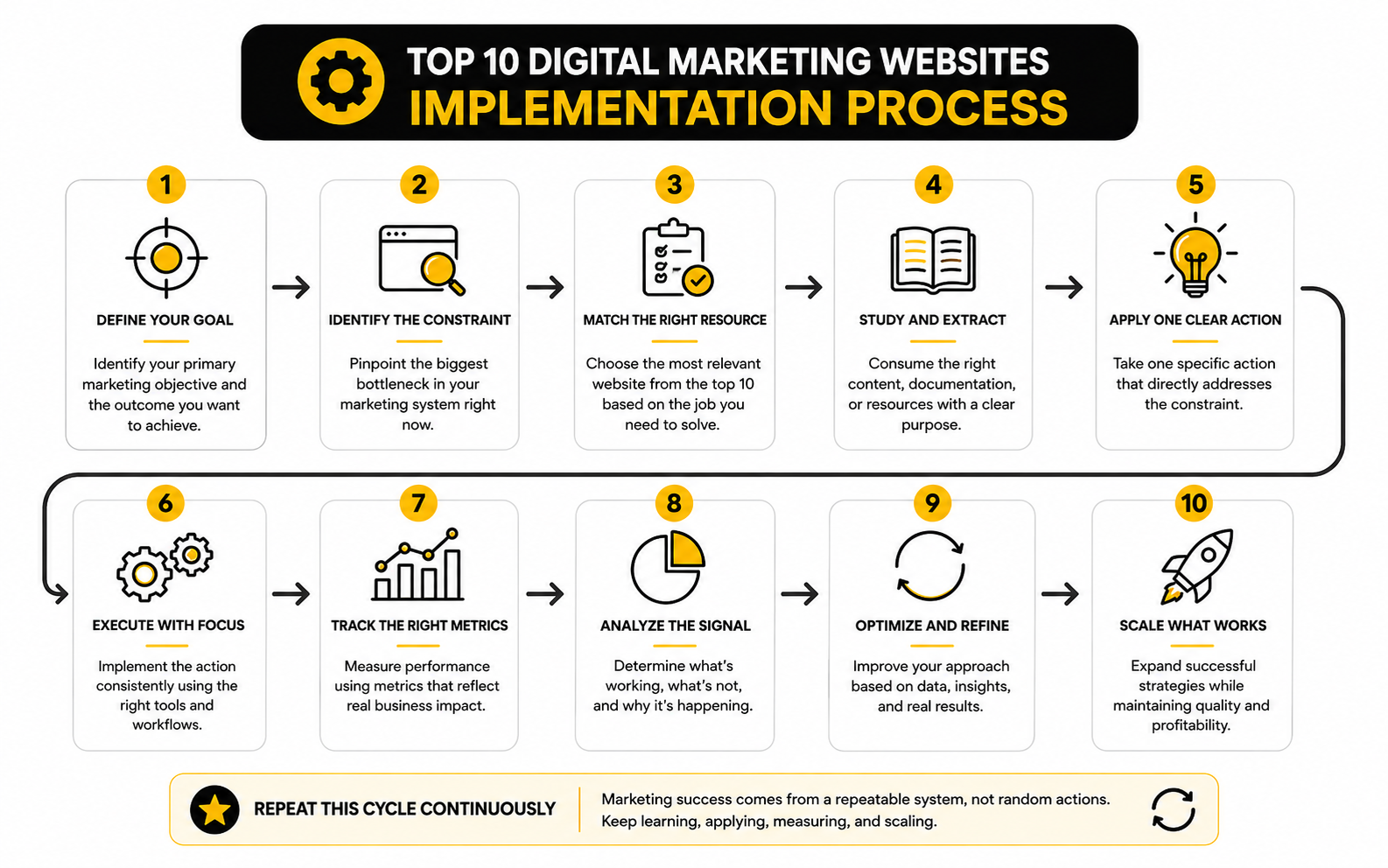
A simple execution process looks like this:
This is where the top 10 digital marketing websites become useful as a system. Each one supports a different decision point. Together, they help you move from research to execution without drowning in advice.
How to Avoid Tool Overload
Tool overload happens when marketers confuse capability with strategy. A platform can do a hundred things, but your business may only need three of them right now. Gartner’s warning that martech utilization has fallen to 49% is a serious reminder that buying tools is easier than using them well.
The fix is to build from the customer journey backward. Ask what happens when someone first discovers you, what they need to believe before they take action, what step they should take next, and how you will follow up. That journey should decide which websites, tools, and workflows deserve attention.
This also keeps your marketing stack lean. You might need Buffer for publishing, Brevo for email, GoHighLevel for CRM and follow-up, ClickFunnels for offer pages, and ManyChat for messaging automation. Or you might only need two of those right now. The professional move is choosing based on the bottleneck, not based on what looks exciting this week.
How to Use These Websites by Marketing Goal
The top 10 digital marketing websites become more valuable when you connect them to specific goals. That is the difference between reading for entertainment and reading for growth. A marketer who knows the goal can pull the right insight from the right source and ignore the rest.
This matters because performance data does not improve marketing by itself. Analytics only helps when it changes a decision. If a number does not affect what you publish, test, automate, stop, or scale, it is just decoration.
Statistics and Data
The biggest mistake with marketing statistics is treating them like trivia. A stat should help you understand demand, behavior, risk, or opportunity. If it does not lead to a better decision, it should not be taking up space in your strategy.
For example, global internet adoption passing 6 billion users is not just a “big internet” fact. It tells you that digital channels are now the default environment for awareness, comparison, research, and buying behavior in many markets. The practical takeaway is that even local businesses need a digital presence that answers questions clearly, earns trust quickly, and gives people a next step.
The same is true for social media scale. DataReportal’s 2026 reporting shows 5.66 billion social media user identities worldwide, which means social is no longer just a brand awareness channel. It is where discovery, proof, conversation, and customer research often happen before someone ever visits your website.
What the Numbers Actually Mean
Good marketers do not ask, “Is this number impressive?” They ask, “What should this number make us do differently?” That question turns data into strategy.
If social usage is massive, the action is not to post randomly on every platform. The action is to identify where your audience already pays attention, then build a repeatable publishing system that creates trust before the sale. That is where a resource like Buffer can support the workflow because consistency becomes measurable instead of emotional.
If search behavior is changing because of AI, the action is not to panic and abandon SEO. HubSpot’s 2026 marketing data shows that over 92% of marketers plan to use or already use SEO optimization for traditional and AI-powered search engines, while nearly 30% report search traffic declines as users turn to AI tools. The practical takeaway is clear: keep improving classic SEO fundamentals, but also build stronger brand signals, clearer expertise, better content structure, and answer-ready pages that can perform in both traditional and AI-assisted discovery.
Performance Signals That Matter
A professional analytics system starts by separating vanity metrics from operating metrics. Vanity metrics can be useful for context, but they rarely tell the whole story. Operating metrics show whether the marketing system is actually moving people closer to a business outcome.
For SEO, rankings and impressions matter, but they should be interpreted alongside qualified clicks, engaged sessions, assisted conversions, branded search growth, and leads or sales from organic traffic. For content marketing, pageviews are not enough; you also need to understand return visits, email signups, pipeline influence, sales enablement usage, and whether the content answers real buying questions. For paid media, cost per click is only useful when connected to landing page conversion rate, lead quality, sales rate, payback period, and lifetime value.
For social media, reach is only the start. Saves, shares, profile clicks, replies, comments from real prospects, direct messages, and downstream email or CRM activity are often more useful. If you are using messaging automation through ManyChat, the important signal is not just how many people enter a flow; it is how many complete the path, give useful information, book, buy, or move into a follow-up system.
Building a Simple Analytics System
An analytics system does not need to be complicated to be useful. It needs to connect the customer journey from attention to action. That means tracking what people see, what they click, what they trust, what they submit, what they buy, and what happens after the first conversion.
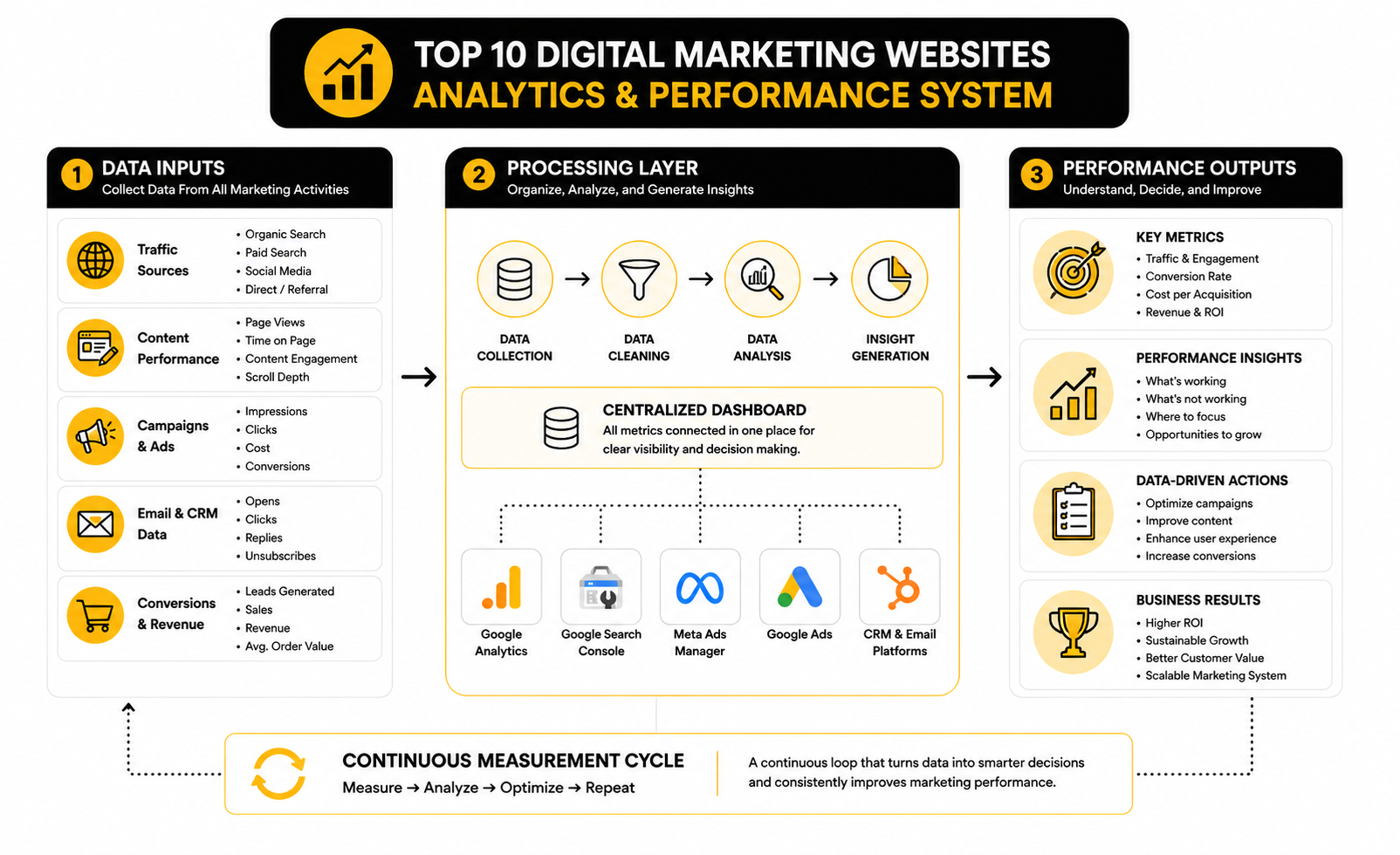
A practical analytics system can be built around five layers:
This is where tools and websites start working together. Google Search Central helps you understand search visibility issues. Content Marketing Institute helps you think about content quality and purpose. GoHighLevel can help connect leads, automations, pipelines, and follow-up. Brevo can support email communication and lifecycle campaigns.
Benchmarks Are Directional, Not Absolute
Benchmarks are useful, but they can also mislead you. A benchmark tells you what is common across a broad group, not what is possible or appropriate for your offer, audience, price point, sales cycle, or brand maturity. Use benchmarks to spot major gaps, not to outsource judgment.
Digital advertising is a good example. The IAB reported that U.S. internet advertising revenue reached nearly $300 billion in 2025, with 13.9% year-over-year growth. That tells you digital advertising is still growing and becoming more performance-driven, but it does not mean your business should increase ad spend blindly.
The action depends on your funnel economics. If paid traffic is expensive but your landing pages are weak, focus on conversion before scaling spend. If your offer converts well but follow-up is slow, fix CRM and automation before increasing budget. If your retention is poor, acquisition growth may simply create a bigger leak.
Martech Utilization Is a Measurement Problem Too
Marketing technology should make execution clearer, not heavier. Gartner’s 2025 research found that martech utilization has dropped to 49%, which should make every team pause before adding another tool. A stack that is only half-used is not a stack; it is overhead.
This is why the top 10 digital marketing websites should not push you into tool collecting. Use websites and platforms based on the measurable job they perform. A funnel tool should improve offer conversion, a CRM should improve follow-up and pipeline visibility, an email platform should improve lifecycle communication, and a social tool should improve publishing consistency and learning speed.
A useful rule is simple: every marketing tool should have an owner, a use case, a primary metric, and a review cadence. If nobody owns it, it will drift. If there is no metric, it will become a habit instead of a performance asset.
Turning Analytics Into Action
Measurement only matters when it creates a decision. If organic traffic is rising but leads are flat, the next action might be content-to-offer alignment. If social engagement is strong but email growth is weak, the next action might be a better lead magnet or a clearer profile call to action.
If funnel traffic is healthy but conversion is low, the next action might be rewriting the offer, simplifying the page, adding proof, or testing a stronger next step through ClickFunnels. If email subscribers are growing but sales are not, the next action might be segmentation, better onboarding, or a more relevant nurture sequence. If leads are coming in but sales are not closing, the next action might be speed-to-lead, qualification, pipeline tracking, or automated reminders.
This is the practical way to use data. Do not report everything. Report what helps you decide what to fix, scale, pause, or test next. That is how the top 10 digital marketing websites become part of a working growth system instead of another reading list.
Professional Implementation for Teams, Agencies, and Creators
At this stage, the question is no longer which websites are worth reading. The real question is how to turn the top 10 digital marketing websites into a working system without creating noise, overlap, or tool fatigue. That is where professional implementation matters.
Beginners usually look for more information. Experienced marketers look for better constraints. They know that a clear strategy with a few reliable sources beats a bloated research folder full of unused links.
Professional implementation starts by assigning each resource a role. One source is for platform truth. One is for trend awareness. One is for content strategy. One is for execution. One is for measurement. When every website has a job, your research becomes faster and your decisions become cleaner.
Strategic Tradeoffs Most Marketers Ignore
Every marketing resource has a bias. Official platform documentation is accurate, but it is usually conservative. Software blogs are practical, but they often frame problems around the tool they sell. Industry reports are useful for context, but they can become too broad if you do not translate them into specific actions.
That does not make those resources bad. It just means you need to understand the lens. Google Search Central is useful for search fundamentals, but it will not build your content moat for you. A funnel platform can help you structure an offer, but it will not fix weak positioning. A social media tool can improve consistency, but it will not make boring content worth sharing.
This is why the best marketers compare sources before making major decisions. If a trend appears in platform documentation, industry research, and real campaign data, it deserves attention. If it only appears in one viral post, treat it like a hypothesis, not a strategy.
The Risk of Chasing Every New Channel
Digital marketing rewards speed, but it punishes distraction. There is always a new platform, new ad format, new AI tool, new content tactic, or new “growth hack” promising faster results. The problem is that every new channel adds operational weight.
The more carefully move is to separate channel opportunity from channel readiness. A channel may be growing, but your team may not have the creative capacity, audience insight, tracking setup, or follow-up system to use it well. That gap is where a lot of marketing budgets disappear.
This is especially true with AI. Salesforce’s latest State of Marketing research points to widespread AI adoption across marketing teams, with AI being used for content creation, personalization, predictive analytics, and customer engagement through its 10th State of Marketing report. The takeaway is not “use AI everywhere.” The takeaway is to use AI where it improves speed, quality, decision-making, or customer experience without weakening trust.
Scaling Without Losing Quality
Scaling marketing is not just doing more. It is doing more of what works while protecting the parts that make it work. More content, more ads, more automations, and more landing pages can help, but only if the strategy stays sharp.
Content is a good example. Content Marketing Institute’s 2026 B2B research includes input from more than 1,000 marketers, and the bigger pattern is clear: teams are still trying to connect content, AI, budgets, effectiveness, and business impact. That is the real scaling challenge. Publishing volume is easy to increase; useful differentiation is harder.
The same applies to funnels and automation. ClickFunnels can help you build conversion paths, and GoHighLevel can help you manage follow-up and pipelines. But scaling those systems requires clean offers, accurate tracking, useful segmentation, and regular review. Otherwise, you are just automating confusion.
Building a Source Stack Instead of a Tool Stack
A source stack is the set of websites you use to make better decisions. A tool stack is the set of platforms you use to execute those decisions. Most marketers obsess over the tool stack and underthink the source stack.
That is backward. If your sources are weak, your tools will simply help you execute weak ideas faster. If your sources are strong, even a simple tool stack can produce better campaigns because the thinking behind the work is sharper.
A practical source stack might look like this:
This does not mean every business needs every tool. It means every business needs a clear relationship between learning and execution. When the source stack and tool stack support the same strategy, marketing gets much easier to manage.
Advanced Criteria for Choosing What to Trust
At an expert level, the question is not “Is this website good?” The question is “Good for what, in which context, and with what limitations?” That extra layer of thinking protects you from shallow advice.
Use these criteria when evaluating digital marketing resources:
This is where many “best websites” lists fail. They rank resources without explaining the context. The better approach is to build a filtered set of sources that match your business model, budget, team size, audience, and sales motion.
Agency-Level Implementation
Agencies need a stricter system because they are not just making decisions for one brand. They are making decisions across multiple clients, industries, budgets, and levels of maturity. That makes source quality and process discipline even more important.
For agencies, the top 10 digital marketing websites should feed into client strategy, campaign planning, reporting, and internal training. Research sources can support market context and client education. Platform documentation can support technical recommendations. Execution platforms can support repeatable delivery systems across accounts.
An agency might use GoHighLevel for client CRM workflows, automations, booking, and pipeline tracking, while using ManyChat for social DM campaigns when the client already has an active audience. The key is not selling every client the same setup. The key is matching the system to the client’s actual bottleneck.
Creator and Solo Founder Implementation
Creators and solo founders need a different approach. They usually do not need a complex enterprise marketing stack. They need focus, speed, and a simple system that turns attention into owned audience, trust, and revenue.
For this group, the best setup is usually lightweight. Use one or two trusted research sources for direction, one publishing system for consistency, one email or CRM tool for follow-up, and one conversion path for the core offer. Anything beyond that should earn its place.
A creator might use Buffer to stay consistent on social, Brevo for email communication, and ClickFunnels or Systeme.io for a simple offer path. That is already enough to build a serious marketing engine if the positioning and content are strong.
Enterprise and Team-Level Risks
Larger teams usually have the opposite problem. They have too many tools, too many stakeholders, too many dashboards, and too many disconnected initiatives. The risk is not lack of capability. The risk is fragmentation.
Gartner’s 2025 marketing technology research shows martech utilization at 49%, which is a warning sign for any team adding platforms without changing workflows. A tool that is technically available but not embedded into daily execution does not create leverage. It creates cost, complexity, and false confidence.
Enterprise teams should evaluate the top 10 digital marketing websites through governance, integration, and accountability. Who owns the insight? Who turns it into action? Who updates the process? Who measures whether it worked? Without those answers, even the best resources become passive reading.
The Human Judgment Layer
The more AI and automation enter marketing, the more human judgment matters. That may sound counterintuitive, but it is true. Automation can increase output, but it cannot automatically decide what your brand should stand for, what your audience truly cares about, or which tradeoffs are worth making.
AI can help summarize research, draft content, analyze customer language, generate creative variations, and speed up production. But humans still need to decide what is accurate, differentiated, ethical, useful, and commercially smart. That is where strong source selection becomes even more important.
Use the top 10 digital marketing websites as inputs, not instructions. Let them inform your strategy, challenge your assumptions, and improve your execution. But do not outsource your judgment to any website, tool, report, or trend.
The Scaling Rule That Keeps Everything Clean
The best scaling rule is simple: do not scale what you have not clarified. Do not scale unclear messaging. Do not scale a weak offer. Do not scale traffic to a page that cannot convert. Do not scale automation before the human process works manually.
This rule protects your budget and your reputation. If a campaign is confusing at small volume, it will become expensive at large volume. If follow-up is broken with 20 leads, it will collapse with 200.
That is why the top 10 digital marketing websites should be used to improve the system before you push harder. First, clarify the strategy. Then test the channel. Then measure the signal. Then scale what proves itself. That sequence is slower than chasing hype, but it is much more reliable.
Final Recommendations
The smartest way to use the top 10 digital marketing websites is to treat them as an ecosystem, not a ranked checklist. Each website should support a specific marketing function, and each function should connect to a real business outcome. When you do that, the list becomes more than research; it becomes a decision system.
Use Google Search Central when you need a reliable baseline for search visibility. Use HubSpot, Content Marketing Institute, DataReportal, Search Engine Land, and industry research when you need strategy, context, and trend awareness. Use platforms like Buffer, GoHighLevel, ClickFunnels, Brevo, and ManyChat when you are ready to turn that thinking into publishing, follow-up, conversion, and customer communication.
The main lesson is simple: pick sources by job. Do not read everything. Do not buy everything. Build a system that helps you find the constraint, choose the right resource, take one useful action, and measure whether that action moved the business forward.
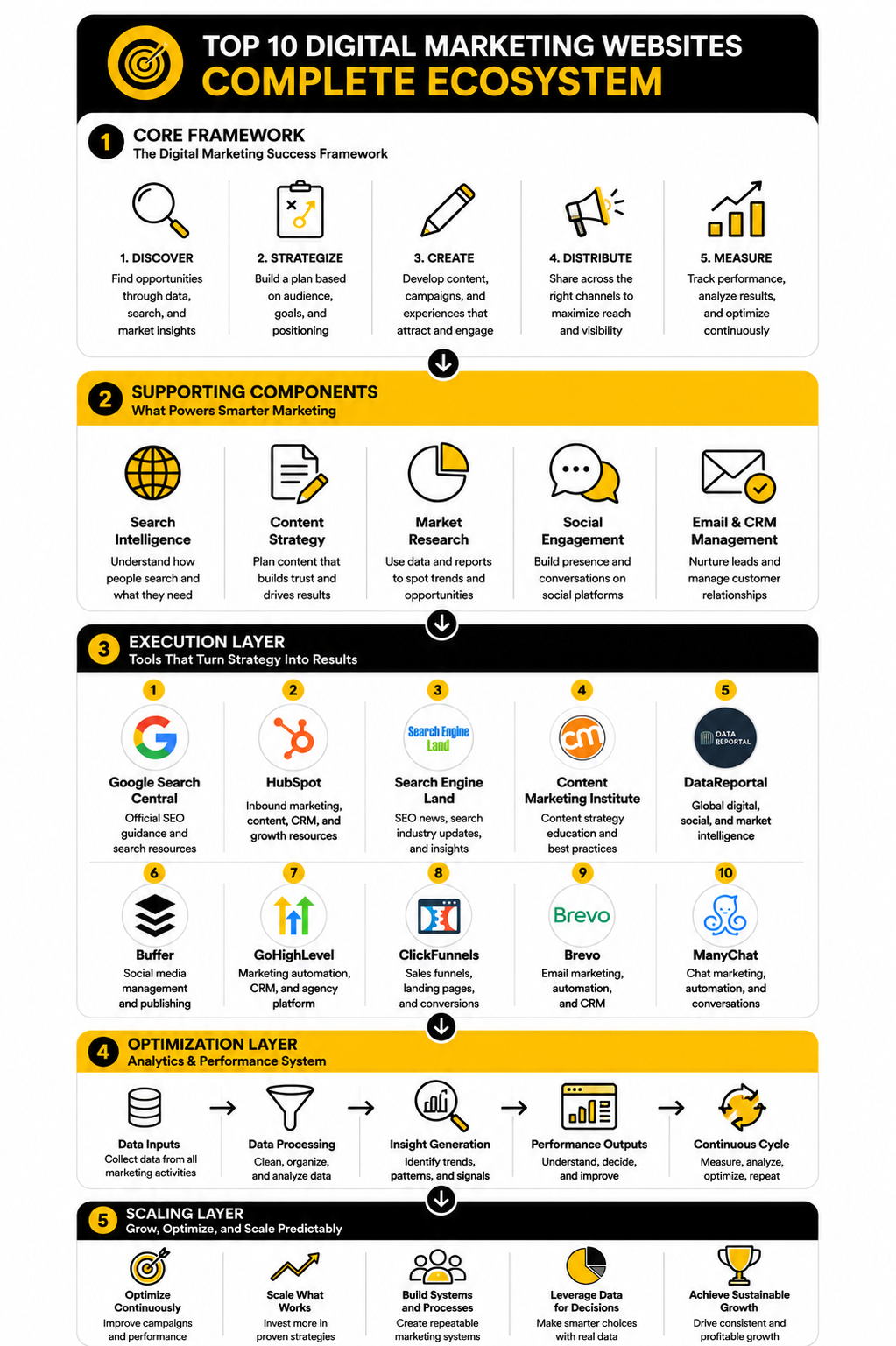
The Final Digital Marketing Website Ecosystem
A complete digital marketing ecosystem has four layers. The first layer is market intelligence, where you learn what is changing in customer behavior, search, advertising, AI, social media, and content. This layer keeps you from making decisions based on outdated assumptions.
The second layer is strategy and planning, where you decide which audience, offer, channel, message, and content path deserve attention. This is where a lot of businesses rush, and it shows. Weak planning creates weak execution no matter how good the tools are.
The third layer is execution, where websites and platforms help you publish, automate, convert, nurture, and manage customer journeys. This is where tools like Systeme.io, Replo, Fillout, and Chatbase may fit depending on the use case. The fourth layer is measurement, where you decide what to improve, what to stop, and what to scale.
What are the top 10 digital marketing websites?
The top 10 digital marketing websites covered in this guide are Google Search Central, HubSpot, Search Engine Land, Content Marketing Institute, DataReportal, Buffer, GoHighLevel, ClickFunnels, Brevo, and ManyChat. Together, they cover search, content, social media, marketing data, automation, funnels, email, CRM, and messaging. The best choice depends on the marketing problem you are trying to solve.
Why does this list include software platforms and not only blogs?
Digital marketing is not only about reading advice. It is also about building systems that publish, convert, follow up, and measure results. That is why platforms like GoHighLevel, ClickFunnels, Buffer, Brevo, and ManyChat belong in the conversation.
Which digital marketing website is best for SEO?
Google Search Central is the best starting point for SEO because it gives direct guidance on crawling, indexing, structured data, search appearance, and site quality. Search Engine Land is better for SEO news, search industry updates, and commentary on what is changing. For practical content strategy around SEO, HubSpot and Content Marketing Institute can also help.
Which website is best for content marketing?
Content Marketing Institute is one of the strongest websites for content marketing strategy, especially for B2B teams and agencies. It focuses on planning, operations, audience value, and business impact instead of treating content as random blog production. HubSpot is also useful when you want more accessible explanations, templates, and broad marketing education.
Which website is best for social media marketing?
Buffer is one of the most useful websites and platforms for social media marketing because it connects education with actual publishing workflow. It helps teams think about consistency, scheduling, content planning, and performance review. For messaging-based social campaigns, ManyChat is stronger because it focuses on direct conversations and automation.
Which websites should agencies use?
Agencies should use a mix of strategic sources and execution platforms. Google Search Central, Search Engine Land, Content Marketing Institute, DataReportal, and HubSpot can support research, strategy, and client education. GoHighLevel, ManyChat, ClickFunnels, and Brevo can support delivery when they match the client’s bottleneck.
How often should I check digital marketing websites?
You do not need to check every website every day. For most marketers, weekly review is enough for industry updates, while official documentation should be checked when you are making a specific technical or strategic decision. The goal is not constant consumption; the goal is better execution.
Are AI marketing websites now more important than traditional marketing websites?
AI marketing resources are becoming more important, but they do not replace traditional marketing fundamentals. Search, content, offers, positioning, trust, conversion, customer journeys, and measurement still matter. AI changes speed and workflow, but it does not remove the need for clear strategy.
How should beginners use this list?
Beginners should start with HubSpot for broad education, Google Search Central for SEO basics, Buffer for social media workflow, and Content Marketing Institute for content strategy. Once the basics are clear, they can add tools like Brevo, ClickFunnels, or Systeme.io when they need email, funnels, or simple campaign infrastructure.
How should advanced marketers use this list?
Advanced marketers should use the list to sharpen decisions, not collect more information. They should compare official documentation, industry research, and campaign data before making major changes. The best use is building a source stack that supports strategy, execution, and measurement without adding unnecessary complexity.
What is the biggest mistake people make with digital marketing websites?
The biggest mistake is treating websites like answers instead of inputs. No website knows your offer, audience, margins, sales process, brand, or capacity better than you do. Use the top 10 digital marketing websites to improve judgment, but do not outsource judgment to them.
Do I need paid tools to benefit from these websites?
No, you can learn a lot from free resources before paying for any platform. Paid tools become useful when they solve a specific execution problem, such as publishing consistency, email automation, CRM follow-up, landing page creation, or messaging workflows. Do not buy software until you know what job it needs to do.
What should I do after reading this guide?
Pick one constraint in your marketing system and match it to the right resource. If the constraint is visibility, study search and content. If the constraint is conversion, review offers, funnels, and landing pages. If the constraint is follow-up, improve email, CRM, automation, or messaging.
Build a stronger local presence with BAAM AI
Turn your website, Google profile, social channels, and AI visibility into one growth engine
Most businesses do not need more random marketing activity. They need a consistent presence system that helps the right people find them, trust them, and take action. BAAM AI brings strategy, local SEO, website updates, Google Maps visibility, social content, AI-search readiness, media production, and reporting into one practical monthly engine.
If you want your marketing to keep working after the campaign ends, start with a free BAAM AI presence audit. See how your business shows up today and where the fastest visibility wins are at BAAM AI.