
BAAM AI Blog
The Copywriting Framework That Turns Attention Into Action
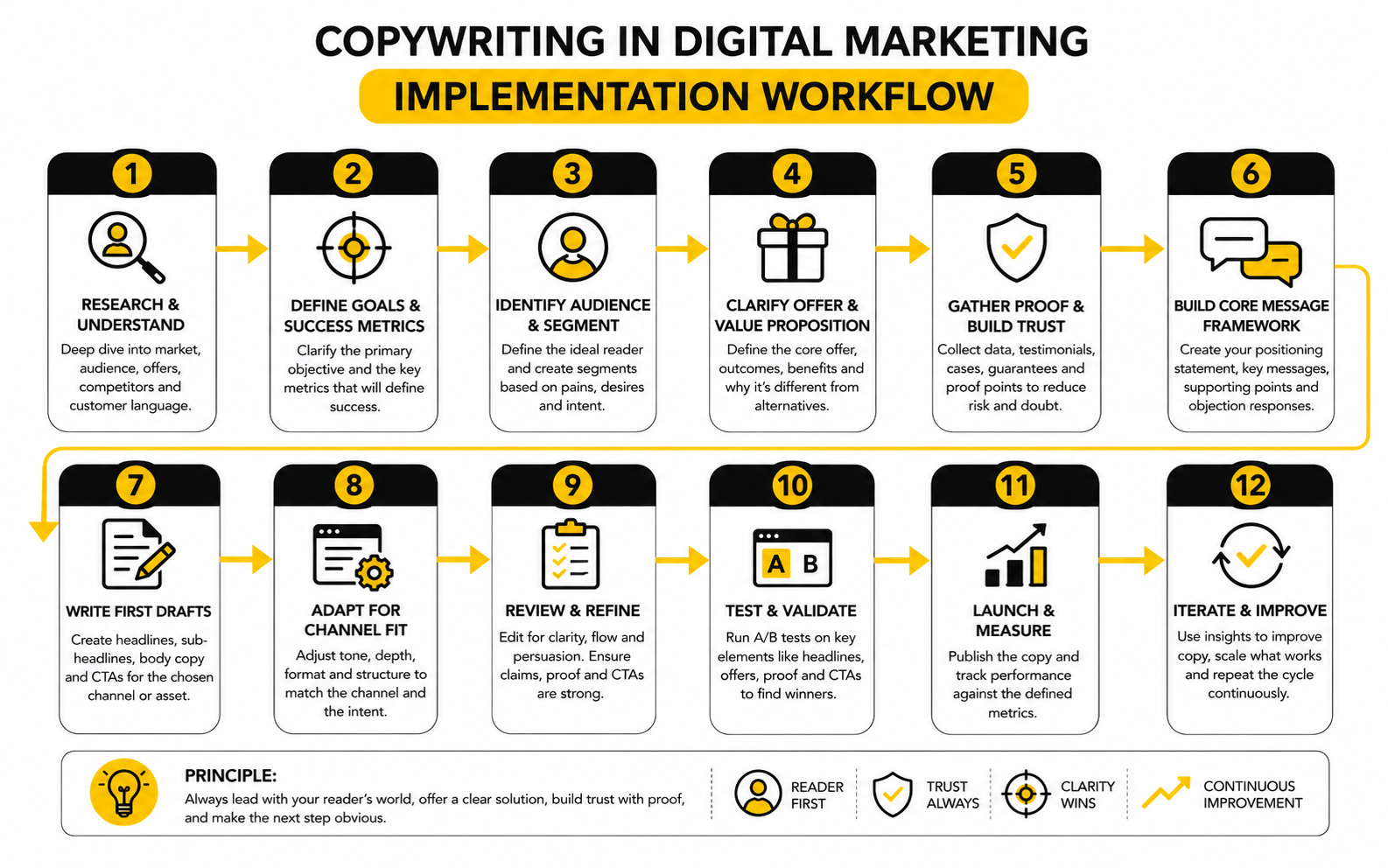
The practical framework for copywriting in digital marketing is simple: understand the reader, define the offer, structure the message, prove the claim, reduce friction, and ask for the next action. That sequence...
The practical framework for copywriting in digital marketing is simple: understand the reader, define the offer, structure the message, prove the claim, reduce friction, and ask for the next action. That sequence matters because persuasive copy is not built by starting with clever words. It is built by making the buying decision easier to understand.
This is where many campaigns go wrong. Teams jump straight into headlines, landing page layouts, email sequences, or ad variations before they have clarified the actual message. Then the copy becomes a pile of disconnected claims instead of a guided path from problem to decision.
The better approach is to treat copy as a decision architecture. Every section, sentence, proof point, and call to action should help the reader move from uncertainty to confidence. That does not mean manipulating people; it means removing avoidable confusion so the right person can make a clear choice.
Step 1: Start With Audience Insight
Strong copy starts with what the customer already thinks, feels, doubts, and wants. You are not writing into silence. You are entering a conversation that already exists in the reader’s head, and the copy has to meet them there before it can lead them anywhere else.
Audience insight should come from real signals, not internal assumptions. Useful inputs include customer interviews, support tickets, sales call notes, reviews, search queries, survey responses, community discussions, and analytics from previous campaigns. The goal is to find the exact language people use when they describe the problem, not the polished language the business uses in its pitch deck.
This matters because buyers respond faster when the message sounds like their reality. Content Marketing Institute’s 2025 B2B research found that top-performing marketers were far more likely to attribute success to understanding their audience, with 82 percent of top performers naming audience understanding as a success factor. That is not a soft branding point. It is the foundation that makes every later copy decision sharper.
Step 2: Define The Offer Before Writing The Page
An offer is not just the product, service, or lead magnet. It is the full value exchange the reader is being asked to accept. That includes the outcome, the effort required, the cost, the risk, the timing, the proof, and the next step.
Before writing copy, define what the reader gets and why it is worth acting on now. If that answer is weak, the copy will usually become louder instead of clearer. You will see more urgency, more adjectives, more claims, and more friction because the offer itself has not been made strong enough.
A good offer can be explained in one plain sentence without losing its value. That sentence should make the audience, outcome, mechanism, and action obvious. Once the offer is clear, the copywriter can build supporting sections around it instead of trying to invent persuasion from scratch.
Step 3: Build The Message Hierarchy
Message hierarchy decides what the reader sees first, second, third, and last. This is critical because people do not process digital pages like formal essays. They scan, compare, pause, skip, and return to the parts that feel relevant.
Nielsen Norman Group’s usability research has repeatedly shown that people often scan web pages rather than read them word for word, which makes clear headings, concise text, and visible information structure essential. That does not mean the copy should be thin. It means the most important ideas need to be easy to spot before the reader commits to deeper reading.
A useful hierarchy usually starts with the primary outcome, then explains the problem, the mechanism, the benefits, the proof, the objections, and the action. The exact order can change depending on awareness level, but the principle stays the same. The page should answer the reader’s next question before they have to work too hard to find it.
Step 4: Match The Copy To Awareness Level
Not every reader needs the same message. Someone who knows they need a specific solution does not need the same education as someone who has only started noticing the problem. This is why copywriting in digital marketing has to match awareness level instead of treating every visitor like they are ready to buy.
A cold audience usually needs problem recognition and a reason to care. A warm audience needs differentiation, proof, and a clear path forward. A hot audience needs confidence, risk reduction, and a direct call to action.
This one adjustment can change the entire tone of a campaign. Cold copy that pushes too hard feels premature. Hot copy that explains too much creates drag. The right message meets the reader where they are and moves them one step further, not ten steps at once.
Step 5: Turn Benefits Into Specific Outcomes
Benefits are not the same as features. A feature explains what something is or does. A benefit explains why that feature matters to the person reading.
The problem is that many benefits are still too vague. Words like faster, easier, more carefully, better, and streamlined can help, but only when they are tied to a specific outcome. The reader needs to understand what actually changes in their work, life, decision, team, revenue, time, or risk.
For example, “save time” is weaker than explaining what the saved time allows the reader to stop doing or start doing. “Improve conversions” is weaker than explaining which conversion moment is being improved and why. Specific outcomes make the copy feel more believable because the reader can picture the change.
Step 6: Add Proof Where Doubt Appears
Proof should not be dumped into the page as decoration. It should appear where the reader is likely to doubt the claim. That is how proof becomes useful instead of ornamental.
Useful proof can include customer testimonials, third-party reviews, product data, screenshots, customer logos, certifications, benchmark results, before-and-after comparisons, founder credibility, process transparency, and specific guarantees. The best proof depends on the risk level of the decision. A low-cost newsletter signup may only need a clear promise, while a high-ticket purchase needs stronger evidence.
The key is to match the proof to the objection. If the reader doubts whether the product works, show evidence of results. If they doubt whether it is right for them, show use cases or qualification criteria. If they doubt whether they can implement it, show the process, support, onboarding, or time required.
Step 7: Remove Friction Before The Call To Action
Friction is anything that makes the reader pause for the wrong reason. Some friction is natural because decisions require thought. Bad friction comes from unclear pricing, vague next steps, weak trust signals, confusing forms, missing details, or copy that creates more questions than it answers.
Baymard’s checkout research continues to show how much purchase intent can be lost close to the finish line, with an average ecommerce cart abandonment rate around 70 percent. Copy cannot fix every reason people abandon a purchase, but it can fix many communication problems that make hesitation worse. Clear shipping details, payment reassurance, return information, concise form labels, and visible support options all reduce unnecessary doubt.
This is especially important on landing pages and funnels. If you are building a focused conversion path with a tool like Replo, ClickFunnels, or GoHighLevel, the copy should make every step feel intentional. The page should not just look good; it should make the next action feel obvious.
Step 8: Write Calls To Action That Match The Commitment
A call to action should match the size of the decision. Asking someone to “Buy Now” makes sense when they are ready to buy, but it can feel too aggressive when they are still evaluating. The wording should reflect what the reader believes they are doing at that moment.
For lower-commitment actions, the copy can emphasize learning, checking, comparing, or getting a useful resource. For higher-commitment actions, the copy should make the value, risk reversal, and next step extremely clear. A call to action is not just a button label; it is the final piece of reassurance before the reader acts.
The surrounding copy matters as much as the button itself. A good CTA section often restates the outcome, removes a final objection, and explains what happens after the click. That small bit of clarity can prevent hesitation at the exact moment when the campaign needs momentum.
Step 9: Draft, Edit, And Pressure-Test The Copy
The first draft is where you get the message out. The edit is where the copy becomes useful. The pressure test is where you find out whether the message actually survives contact with the reader’s questions.
A practical editing process should check for clarity, specificity, flow, proof, friction, and action. Every sentence should either clarify the value, build trust, answer an objection, or move the reader forward. If a sentence only sounds nice but does not help the decision, it probably needs to go.
This is also where AI can help, as long as it does not replace judgment. The 2025 B2B content marketing research showed that 81 percent of B2B marketers use AI for content tasks, but only a smaller share have it deeply integrated into daily workflows. That is the right lesson for copywriting: use AI to speed up research, variation, summarization, and editing, but keep the strategic decisions human.
Step 10: Test The Message In The Real Channel
Copy is not finished when the team approves it. It is finished when it works in the channel where the customer actually experiences it. That means the copy should be reviewed in context, not just inside a document.
An email subject line has to be judged inside the inbox. A landing page headline has to be judged above the fold on mobile. A social ad has to be judged next to competing content, comments, visuals, and platform behavior. The channel changes how the words are perceived.
Testing does not always need to be complicated. You can compare headline angles, CTA language, proof placement, email subject lines, opening hooks, or form
Build a stronger local presence with BAAM AI
Turn your website, Google profile, social channels, and AI visibility into one growth engine
Most businesses do not need more random marketing activity. They need a consistent presence system that helps the right people find them, trust them, and take action. BAAM AI brings strategy, local SEO, website updates, Google Maps visibility, social content, AI-search readiness, media production, and reporting into one practical monthly engine.
If you want your marketing to keep working after the campaign ends, start with a free BAAM AI presence audit. See how your business shows up today and where the fastest visibility wins are at BAAM AI.