
BAAM AI Blog
The Best SMM Strategy For Sustainable Growth
The best SMM strategy is not “post more.” That advice sounds productive, but it usually creates busywork, inconsistent content, and weak measurement. A strong social media marketing strategy connects positioning...

The best SMM strategy is not “post more.” That advice sounds productive, but it usually creates busywork, inconsistent content, and weak measurement. A strong social media marketing strategy connects positioning, content, distribution, community, automation, and conversion into one system.
That matters because social is no longer just a visibility channel. Digital channels now account for 61.1% of total marketing spend, and creator advertising alone is projected to reach $37 billion in U.S. ad spend in 2025. At the same time, audiences are more selective, platforms change faster, and generic content gets ignored.
So this guide treats SMM like a business growth system, not a posting calendar. You will see how the best social media marketing teams build repeatable momentum without losing the human edge that makes people trust a brand. The goal is simple: create content people care about, distribute it intelligently, and turn attention into measurable business outcomes.
this guide is split into six parts so each layer of the strategy can build naturally on the previous one. The first part sets the foundation and gives you the full roadmap. The later parts will go deeper into execution, measurement, optimization, and scaling.
Why The Best SMM Strategy Starts With A System
Most brands do not fail at social media because they lack ideas. They fail because their ideas are not connected to a clear operating system. One post tries to educate, another tries to sell, another copies a trend, and after a few weeks nobody knows what is actually working.
The best SMM approach starts by deciding what social media is supposed to do for the business. For some brands, it is demand generation. For others, it is community building, customer education, talent attraction, creator partnerships, or customer support. Without that decision, every metric feels important and no metric gives real direction.
This is why the best social teams combine creativity with structure. The Hootsuite Social Trends 2025 report is based on a survey of 3,864 marketers and highlights a clear shift toward experimentation, social listening, AI support, and performance thinking. That does not mean brands should become robotic; it means the creative work needs a tighter feedback loop.
The Framework Overview
A practical SMM framework has four jobs: clarify the market, create useful content, distribute it across the right channels, and convert attention into action. If one of those jobs is missing, the strategy becomes fragile. Good content without distribution stays invisible, while strong reach without conversion becomes vanity marketing.
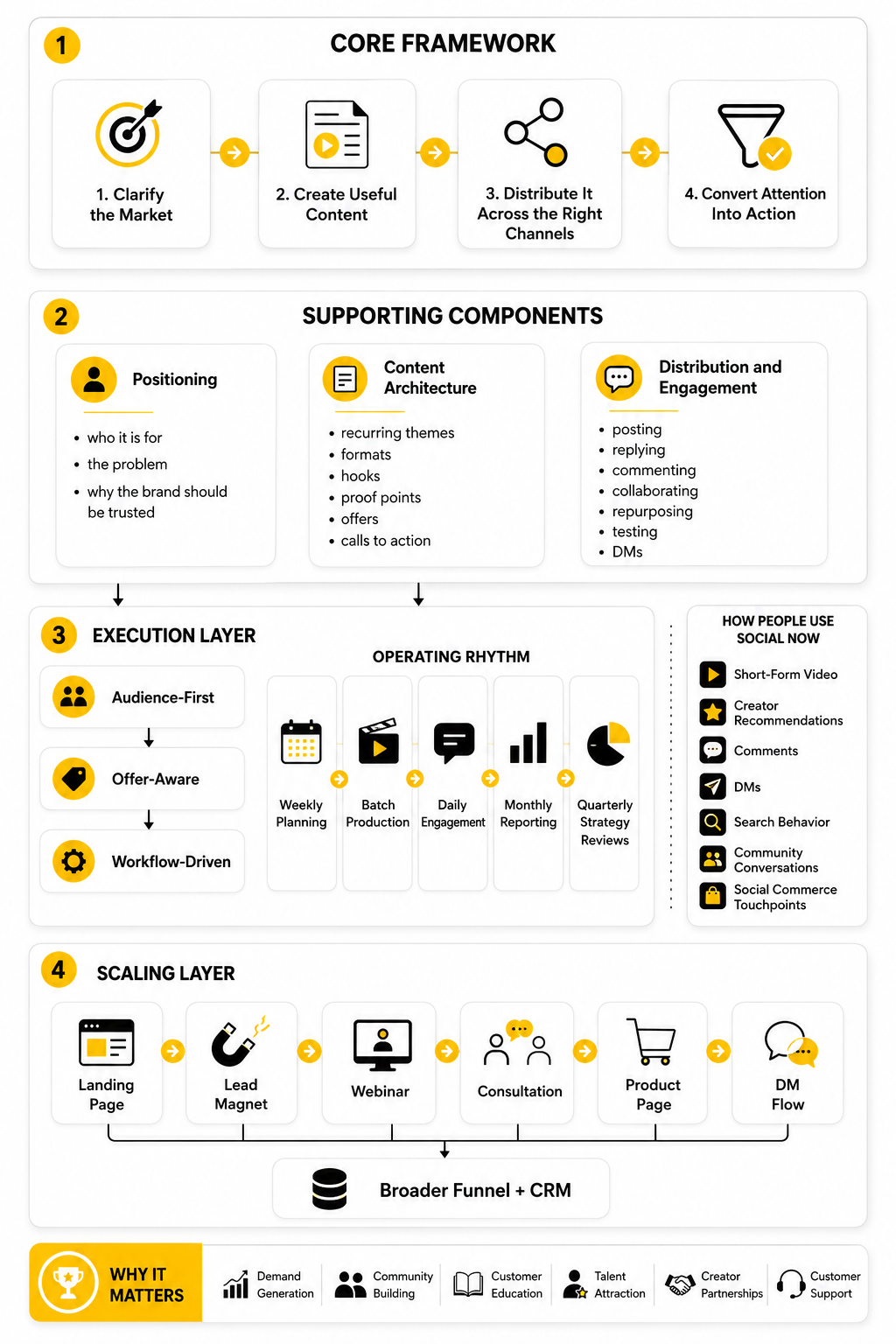
The framework also needs to respect how people actually use social platforms now. People discover brands through short-form video, creator recommendations, comments, DMs, search behavior, community conversations, and increasingly through social commerce touchpoints. Social media has become a messy mix of entertainment, research, trust-building, customer service, and buying intent.
That is why the best SMM strategy is not platform-first. It is audience-first, offer-aware, and workflow-driven. Platforms matter, but the system behind them matters more.
Core Components Of The Best SMM Strategy
The first component is positioning. Before you create content, you need to know who the content is for, what problem it addresses, and why the brand should be trusted. Weak positioning makes every post harder to write because the brand has no clear point of view.
The second component is content architecture. This includes recurring themes, formats, hooks, proof points, offers, and calls to action. A brand that only posts random tips will usually struggle to build memory, but a brand with recognizable content pillars becomes easier to follow and easier to buy from.
The third component is distribution and engagement. Posting is only one part of social media marketing; replying, commenting, collaborating, repurposing, testing, and using DMs matter too. Tools can help here, especially when the workflow becomes repetitive, such as using Buffer for scheduling or ManyChat for DM automation when there is clear audience intent.
Professional Implementation
Professional SMM implementation starts with fewer guesses and better decisions. You do not need to be active everywhere just because every platform exists. You need to understand where your audience pays attention, what they expect there, and what kind of content can realistically be produced at a consistent quality level.
The implementation also needs a simple operating rhythm. That usually means weekly planning, batch production, daily engagement, monthly reporting, and quarterly strategy reviews. The point is not to turn social into bureaucracy; the point is to stop relying on random inspiration.
Finally, professional implementation connects social media with the rest of the marketing funnel. A strong post can lead to a landing page, a lead magnet, a webinar, a consultation, a product page, or a DM flow. If the business needs a broader funnel and CRM layer, a platform like GoHighLevel can fit naturally when the strategy requires follow-up, pipeline management, and campaign automation beyond the social platform itself.
Audience, Positioning, And Platform Selection
The best SMM strategy starts getting serious when you stop asking, “What should we post?” and start asking, “Who are we trying to earn attention from, and why would they care?” That shift sounds small, but it changes everything. It forces you to build from the buyer, the market, and the decision process instead of chasing whatever format is trending this week.
Social media is huge, but that does not mean every audience behaves the same way. More than two in three people globally now use social media, but their reasons for using each platform vary dramatically. Some people want entertainment, some want education, some want product discovery, some want professional insight, and some want to feel part of a community.
That is why Part 2 is about audience, positioning, and platform selection. If you get this part wrong, even excellent content becomes harder to scale. If you get it right, every post has a clearer job.
Define The Audience Before Choosing The Platform
A weak SMM plan starts with a platform list. A strong one starts with a real audience profile. You need to know who the buyer is, what they already believe, what they are tired of seeing, what problem they want solved, and what kind of proof they trust.
This goes deeper than basic demographics. Age, job title, income, and location can help, but they do not explain attention. What matters more is the person’s current situation, desired outcome, level of awareness, objections, and buying triggers.
For example, a founder looking for lead generation help does not consume social content the same way as a social media manager trying to improve reporting. The founder may respond to revenue-focused breakdowns, simple systems, and proof of pipeline. The manager may care more about workflow, approvals, content formats, engagement benchmarks, and tools that save time.
A practical audience profile should answer these questions:
The best SMM campaigns do not talk to “everyone interested in marketing.” They speak to a specific person with a specific pain and a specific next step. That is what makes the content feel sharp instead of generic.
Build Positioning People Can Remember
Positioning is the reason someone should follow, trust, and eventually buy from you instead of another option. It is not a slogan. It is the clear mental space your brand owns in the audience’s mind.
Bad positioning sounds like this: “We help businesses grow with social media.” That could describe thousands of agencies, creators, SaaS tools, consultants, and freelancers. It is technically clear, but it has no edge.
Good positioning is more specific. It defines the audience, the problem, the method, and the outcome in a way that feels believable. For example, a brand could position itself around helping local service businesses turn social engagement into booked appointments, or helping ecommerce brands use creator-style content to improve paid social performance.
The best SMM positioning usually has four parts:
This matters because social media moves fast. People scroll through dozens of posts, creators, offers, and opinions in minutes. If your positioning is vague, you make the audience do extra work to understand why they should care.
Positioning also protects the content strategy from random trends. You can still use trends when they fit, but you do not become dependent on them. The brand has a center of gravity.
Match Platforms To Behavior, Not Hype
Platform selection should be based on audience behavior, content fit, and business goals. It should not be based on panic. Every year there is a new wave of advice telling brands to abandon one platform and go all-in on another, but that is rarely how real strategy works.
The more carefully move is to map each platform to a specific role. YouTube may support education and search-driven discovery. LinkedIn may support B2B authority and professional relationships. Instagram may support visual trust, creator-style storytelling, and product discovery. TikTok may support fast awareness and cultural relevance. Facebook may still matter for groups, local audiences, retargeting, and older demographics.
The latest U.S. platform data shows why assumptions are dangerous. YouTube and Facebook remain the most widely used platforms among American adults, while Instagram, TikTok, WhatsApp, and Reddit have grown over the past few years, based on Pew Research Center’s 2025 social media research. That does not mean every brand should prioritize YouTube and Facebook first. It means platform choice should be grounded in where the target audience actually spends meaningful attention.
A simple way to choose platforms is to separate them by job:
One platform can play multiple roles, but you should still define the primary job. Otherwise, you end up judging every platform by the same metric, which creates bad decisions.
Choose A Primary Channel And A Support Channel
Trying to dominate five platforms at once usually leads to average work everywhere. The better approach is to choose one primary channel and one or two support channels. This gives the team enough focus to improve quality, learn the platform, and build a repeatable publishing rhythm.
The primary channel is where the brand will invest the most creative energy. This is where the core content strategy lives. It should be selected based on audience fit, content strength, and commercial relevance.
The support channel is where content can be repurposed, adapted, or used to create additional touchpoints. For example, a B2B consultant might use LinkedIn as the primary channel, then repurpose strong posts into email, short videos, and webinar topics. An ecommerce brand might use TikTok or Instagram Reels as the primary discovery channel, then use email, retargeting, and landing pages to convert interest.
This is where discipline matters. The goal is not to be everywhere. The goal is to become recognizable somewhere, then expand with intention.
Understand The Buyer’s Awareness Stage
Not everyone who sees your social content is ready to buy. Some people are just discovering the problem. Some are comparing options. Some are close to making a decision but need proof. A strong SMM strategy creates content for different awareness stages without making the feed feel scattered.
At the top of the funnel, content should earn attention by naming the problem clearly. This could include observations, mistakes, myths, trends, short educational posts, or strong points of view. The job is to make the audience feel understood.
In the middle of the funnel, content should build trust. This is where frameworks, comparisons, process breakdowns, behind-the-scenes content, and objection handling become useful. The audience is not just asking whether they like the content; they are asking whether the brand understands the problem deeply enough to solve it.
At the bottom of the funnel, content should make the next step obvious. This does not mean every post should hard-sell. It means the audience should regularly see proof, offers, product education, customer outcomes, demos, and clear calls to action.
The best SMM plan balances all three stages. If you only post awareness content, people may like you but never buy. If you only post sales content, people may ignore you before trust is built.
Turn Audience Research Into Content Angles
Audience research becomes useful when it turns into specific content angles. A content angle is the lens you use to make a topic feel relevant. Two brands can talk about the same topic, but the stronger angle wins attention.
For example, “social media tips” is not an angle. It is a category. “Why your educational posts get likes but no leads” is an angle because it speaks to a real frustration and creates curiosity.
Good angles usually come from real audience language. Look at comments, reviews, sales calls, support tickets, Reddit threads, YouTube comments, LinkedIn discussions, competitor posts, and search behavior. You are looking for repeated objections, emotional phrases, confusing questions, and moments where people describe the gap between what they tried and what they wanted.
Strong angles often fit one of these patterns:
This is one of the most overlooked parts of the best SMM strategy. The topic gets you into the right category, but the angle earns the click, the watch, the save, the share, or the reply.
Set A Clear Voice Before Scaling Content
A brand’s social voice should feel consistent without sounding scripted. This is especially important when multiple people create content for the same account. Without a clear voice, the brand starts sounding different every week.
Voice includes word choice, pace, humor, confidence, emotional intensity, and how directly the brand speaks to the reader. Some brands should sound sharp and opinionated. Some should sound calm and expert. Some should feel playful, visual, and creator-led. The right choice depends on the audience and the positioning.
The key is to make the voice usable. A vague instruction like “sound authentic” does not help a content team. A better voice guide explains what the brand sounds like, what it avoids, how it handles disagreement, how it talks about competitors, and how it moves from education to a call to action.
For a practical SMM workflow, define voice with simple rules:
This keeps the content human while still giving it structure. That combination is what makes a brand easier to recognize over time.
Create A Platform Decision Matrix
A platform decision matrix prevents emotional decisions. It helps you evaluate each channel based on fit instead of hype. This is especially useful when stakeholders keep asking, “Should we be on this platform too?”
The matrix does not need to be complicated. Score each platform from 1 to 5 across audience fit, content fit, conversion potential, production difficulty, competition level, and team capacity. A platform with high audience fit but impossible production demands may not be the right first move.
Here is a simple decision model:
This model keeps the strategy grounded. It also makes it easier to say no, which is one of the most valuable skills in social media marketing. Every platform you add creates more planning, production, editing, publishing, engagement, and reporting work.
The best SMM strategy is not the one with the most channels. It is the one where each channel has a reason to exist.
Content Strategy, Creative Direction, And Publishing Rhythm
Once the audience and platform choices are clear, the next job is turning the strategy into a working content engine. This is where the best SMM plan stops being theory. You need a process that helps the team decide what to say, how to say it, when to publish it, and how to learn from the response.
The mistake is treating content as a list of isolated posts. That creates a feed with no memory, no momentum, and no clear relationship to the business. A stronger approach treats every post as part of a larger conversation with the market.
This part of the strategy should answer three practical questions. What ideas are worth repeating? What formats can the team produce consistently? What publishing rhythm is realistic enough to maintain without lowering quality?
Build Content Pillars Around Business Relevance
Content pillars are not random topic buckets. They are the recurring themes that connect audience problems to the brand’s expertise, offer, and point of view. If the pillars are too broad, the content becomes generic. If they are too narrow, the team runs out of useful angles too quickly.
A practical SMM strategy usually needs three to five core pillars. Each pillar should serve a different purpose in the buyer’s journey. One pillar might create awareness, another might build trust, another might handle objections, and another might show proof.
For example, a brand selling a marketing automation service could use pillars like lead generation mistakes, funnel strategy, follow-up systems, customer conversion, and workflow automation. Those topics naturally connect to the offer without making every post feel like a pitch. That is the sweet spot.
The best SMM teams also define what each pillar is not. This prevents content drift. If a topic attracts attention but does not support the positioning, audience, or commercial goal, it may not belong in the strategy.
Turn Pillars Into Repeatable Content Formats
Pillars tell you what to talk about. Formats tell you how the idea will show up in the feed. This is where content becomes easier to produce because the team is no longer inventing the structure from scratch every time.
Strong formats are repeatable, recognizable, and flexible. They give the audience a familiar experience while still allowing new ideas to feel fresh. This is why frameworks, breakdowns, checklists, teardown-style posts, myth-busting posts, short tutorials, opinion posts, and before-and-after explanations work so well.
Short-form video deserves special attention because it continues to dominate many social strategies. A 2025 analysis of more than 5 million short-form videos and 582,000 accounts shows how competitive the format has become across Reels, TikTok, and Shorts. That does not mean every brand should produce endless video, but it does mean the strategy should seriously consider whether video can explain the offer faster than text or static creative.
The right format depends on the message. A complex idea may need a carousel, article, webinar, or long-form video. A sharp observation may work better as a short text post. A product feature may need a demo, comparison, or quick walkthrough.
Create A Simple Execution Workflow
The execution workflow is where the strategy becomes tangible. Without a workflow, content production depends on mood, last-minute pressure, and scattered feedback. With a workflow, the team knows what happens first, what gets reviewed, what gets published, and what gets measured.
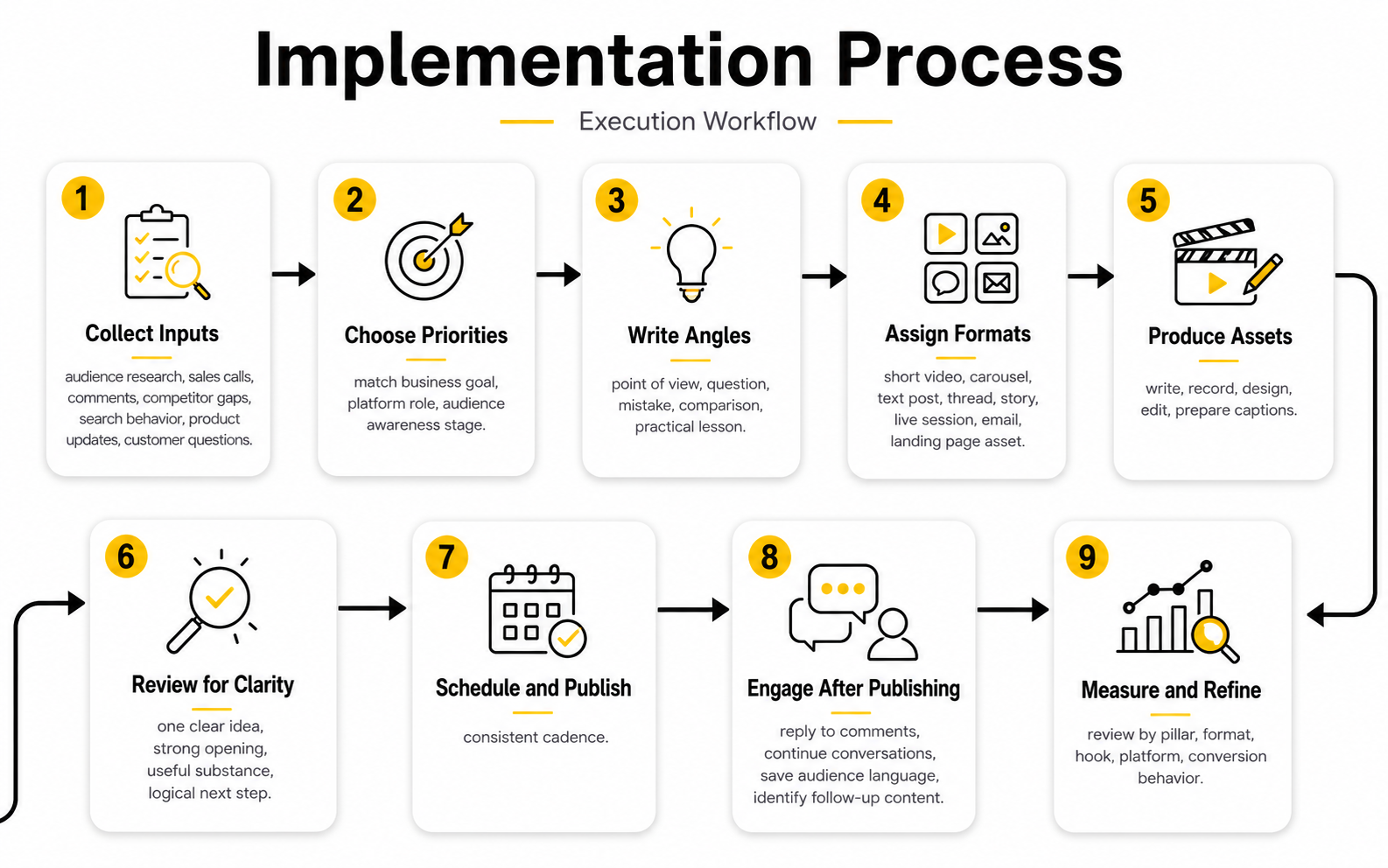
A simple weekly process is often enough. You do not need a giant content machine to do this well. You need a repeatable sequence that protects quality and keeps the team moving.
A practical workflow can look like this:
This process is not complicated, but it is powerful. It gives creative people structure without suffocating the creative work. That is exactly what the best SMM strategy needs.
Write Hooks That Earn The Next Second
A hook is not clickbait when it accurately frames something useful. It is simply the opening that gives someone a reason to stop scrolling. If the opening is weak, the rest of the content may never get a chance.
Good hooks are specific, relevant, and connected to the audience’s current tension. They do not need to shout. They need to make the reader or viewer think, “This is about me.”
For example, “Social media tips for businesses” is too broad. “Your educational posts get likes because they are helpful, but they do not create leads because they avoid buying intent” is much sharper. It names a real problem and creates a reason to continue.
Strong hooks often use one of these angles:
The key is to keep the promise honest. If the hook creates curiosity, the body must pay it off. Trust disappears quickly when the opening overpromises and the content underdelivers.
Build A Content Calendar Without Killing Creativity
A content calendar should create momentum, not turn the brand into a publishing robot. The calendar gives the team visibility into what is coming, but it should still leave room for timely ideas, market shifts, platform changes, and audience feedback.
A useful calendar includes the platform, pillar, format, hook, asset owner, status, publish date, call to action, and performance notes. That is enough structure to keep the work organized without turning every post into a spreadsheet problem. Tools like Buffer can help when scheduling, approval, and cross-channel consistency become harder to manage manually.
The weekly rhythm should match the team’s capacity. Posting daily sounds impressive, but weak daily content can damage trust faster than strong content published less often. Consistency only works when the quality is high enough to deserve attention.
A good starting rhythm could be:
This gives the strategy enough activity to learn while staying realistic. The best SMM plan is the one the team can sustain.
Repurpose Content With Intent
Repurposing is not copying and pasting the same post everywhere. It is adapting one strong idea for different platform behaviors. This is an important difference.
A webinar can become short clips, LinkedIn posts, email lessons, carousel slides, quote graphics, and a sales enablement asset. A strong customer question can become a post, a video, a FAQ entry, a landing page section, and a sales script. One good idea can travel far when it is adapted properly.
The trap is repurposing without context. A caption that works on LinkedIn may feel too stiff on Instagram. A TikTok-style video may need a different opening for YouTube Shorts. A carousel may need to become a simpler text post if the platform rewards conversation more than visual explanation.
Repurposing should preserve the core insight while changing the execution. That is how a brand gets more mileage from its best thinking without making every channel feel duplicated.
Make Creative Direction Practical
Creative direction gives the brand a recognizable look, feel, and rhythm. It includes visual style, editing pace, tone, framing, thumbnail approach, caption structure, and the kind of proof used in the content. This is not just a design concern. It affects trust.
Good creative direction makes the content easier to recognize in a crowded feed. It also reduces production friction because the team is not debating the basics every time. The brand knows how it wants to show up.
The practical way to define creative direction is to create simple rules:
For video, creative direction should also define the opening pattern, pacing, subtitles, framing, and call-to-action style. For text-based platforms, it should define line length, formatting, tone, and how the brand handles opinions. These details sound small, but they create consistency.
Connect Every Content Piece To A Next Step
Content should not always sell, but it should always know what it is doing. Some posts are designed to attract new people. Some are designed to deepen trust. Some are designed to start conversations. Some are designed to convert.
This is where many brands lose money. They create valuable content but never connect it to a clear next step. The audience may like the brand, but they do not know what to do next.
A next step can be soft or direct. A soft next step might ask for a reply, comment, save, share, or question. A direct next step might send people to a lead magnet, product page, booking link, webinar, or DM automation.
For social selling and lead capture, the destination matters. A simple landing page can work when the offer is straightforward, while a more advanced funnel may be better for webinars, consultations, trials, or multi-step education. Tools like ClickFunnels, Systeme.io, or GoHighLevel can fit when the SMM strategy needs a stronger path from content to conversion.
The important point is simple. Do not let attention leak. If the content earns trust, give the audience a logical way to continue.
Measurement, Optimization, And Paid Amplification
Measurement is where the best SMM strategy becomes honest. It shows whether the content is only getting attention or actually moving the business forward. Without measurement, social media turns into opinion: the loudest person in the room decides what “worked.”
The goal is not to track everything. The goal is to track the few numbers that explain whether the strategy is improving. A strong measurement system connects platform activity to audience behavior, pipeline movement, customer trust, and revenue impact.
This is also where many teams get uncomfortable. Social media influences people before they click, before they fill out a form, and sometimes long before they buy. That does not make measurement impossible, but it does mean you need a more carefully system than “this post got likes.”
Statistics And Data That Actually Matter
The best data tells you what to do next. Random statistics can make a report look impressive, but they rarely improve the strategy. Good SMM measurement separates signal from noise.
There is a real measurement gap in social media right now. The 2025 Sprout Social Index is based on research from more than 4,000 consumers and 1,200 marketers, and its ROI analysis highlights that 65% of leaders want direct connections between social campaigns and business goals, while only 30% of marketers believe they can measure social media ROI well. That gap matters because teams are being asked to prove business value while still relying on platform metrics that do not always show the full customer journey.
Benchmark data is useful too, but only when it is interpreted correctly. The 2025 Sprout Social Content Benchmarks Report analyzed more than 3 billion messages from over 1 million public social profiles, which makes it useful for understanding broader patterns in posting, inbound engagement, and outbound engagement. But a benchmark should never become the goal by itself. Your own baseline matters more than someone else’s average.
Creator and influencer performance also needs serious measurement because budgets are moving fast. U.S. creator economy ad spend is projected to hit $37 billion in 2025, growing 26% year over year and about four times faster than the overall media industry. That number does not mean every brand should rush into creator campaigns. It means creator activity should be measured with the same discipline as paid search, paid social, email, and funnel campaigns.
Build A Measurement System Before You Need The Report
The worst time to design a measurement system is after a campaign has already ended. By then, tracking links may be missing, landing pages may be unclear, CRM fields may be incomplete, and the team is forced to guess. That is not measurement; that is reconstruction.
A proper SMM measurement system starts before publishing. Each campaign should have a goal, a primary metric, supporting metrics, a tracking method, and a decision rule. The decision rule is important because it tells the team what action to take when the data comes in.
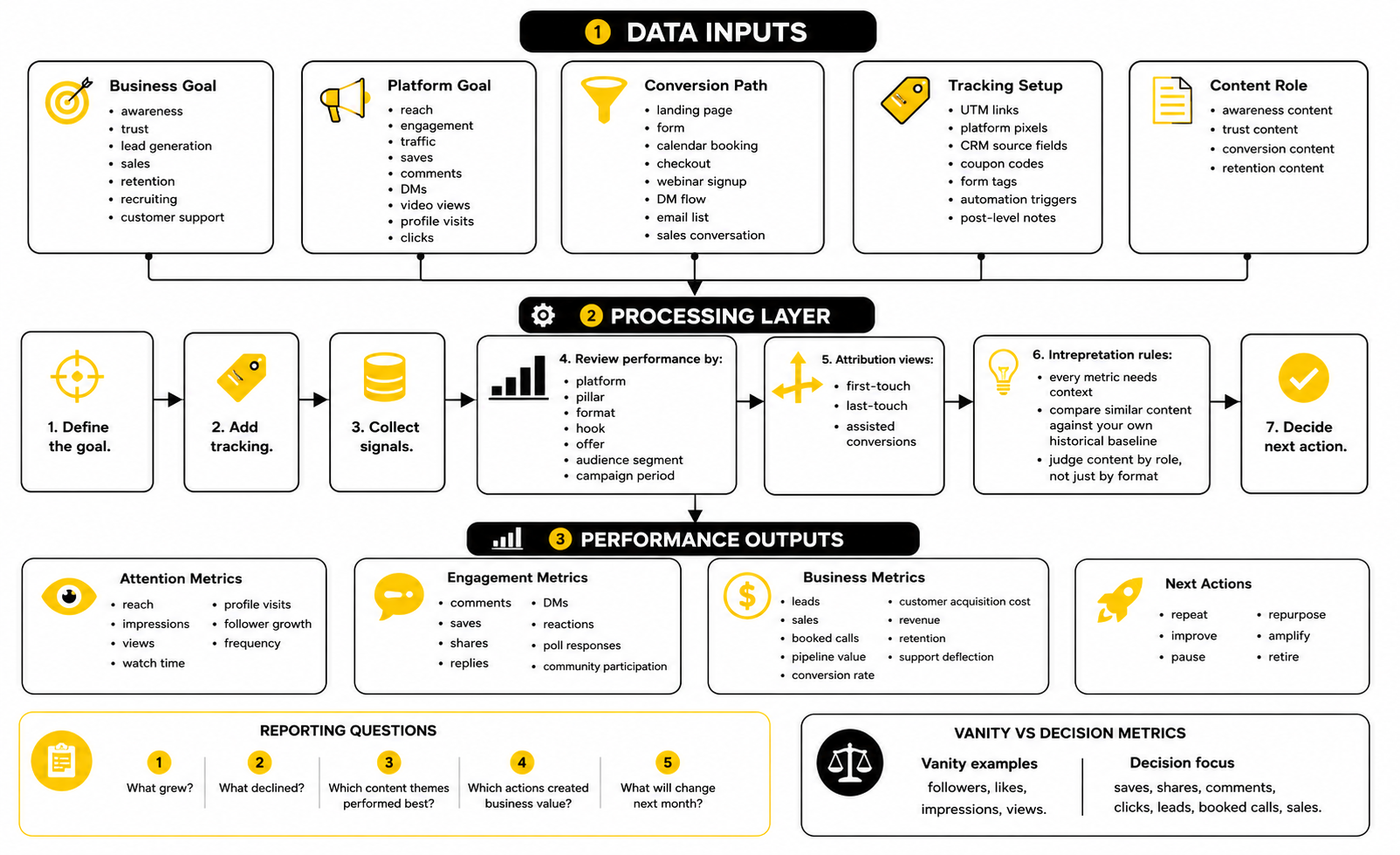
A simple measurement system can work like this:
This system keeps the team from arguing about isolated numbers. It also stops the common mistake of calling a post “bad” because it had low reach when its real job was to generate qualified replies. Every metric needs context.
Separate Vanity Metrics From Decision Metrics
Vanity metrics are not useless, but they become dangerous when they are treated like business outcomes. Followers, likes, impressions, and views can show attention. They do not automatically show trust, demand, or revenue.
Decision metrics are different. They help you choose the next move. Saves may show that an educational post is valuable enough to revisit. Shares may show that the message is emotionally or professionally relevant. Comments may show that the topic creates conversation. Clicks, leads, booked calls, trials, purchases, and repeat engagement show deeper movement.
The best SMM measurement stack usually includes three layers:
Each layer matters, but each answers a different question. Attention tells you whether people noticed. Engagement tells you whether they cared. Business metrics tell you whether the activity created measurable value.
Read Engagement Rate The Right Way
Engagement rate is one of the most misunderstood social metrics. A high engagement rate can mean the content is excellent, but it can also mean the audience is small, loyal, or unusually reactive to one topic. A low engagement rate can mean the post failed, but it can also happen when reach expands to a colder audience.
That is why engagement rate should be read alongside reach, audience quality, comments, shares, saves, and downstream actions. A post with moderate engagement but strong lead quality may be more valuable than a viral post that attracts the wrong audience. This is especially true for B2B, high-ticket services, local businesses, and niche markets.
The best way to use engagement rate is to compare similar content against your own historical baseline. Compare educational posts to educational posts. Compare Reels to Reels. Compare founder-led opinion posts to other founder-led opinion posts. Do not compare a meme, a product demo, and a webinar promotion as if they were trying to do the same job.
Measure Content By Role, Not Just Format
A content format does not explain performance by itself. A short video can educate, entertain, sell, handle objections, or build trust. A carousel can be a checklist, a teardown, a product explanation, or a thought leadership piece. The role matters more than the container.
This is why performance reports should include content role. If a post was meant to create reach, judge it by reach, shareability, and new audience exposure. If it was meant to convert, judge it by clicks, replies, form submissions, bookings, or attributed revenue. If it was meant to build trust, judge it by saves, thoughtful comments, returning viewers, and impact on later conversion behavior.
A useful reporting structure might group content like this:
This helps the team avoid lazy conclusions. A conversion post does not need to go viral to be successful. An awareness post does not need to generate sales immediately to be useful.
Connect Social Data To The Funnel
Social media rarely works in a straight line. Someone might see a post on LinkedIn, watch a short video a week later, click an email two weeks after that, then finally book a call from a retargeting ad. If your measurement only credits the last click, social may look weaker than it really is.
That does not mean you should ignore attribution. It means you should use multiple views of attribution. First-touch attribution helps you see where people first discovered the brand. Last-touch attribution helps you see what pushed them to act. Assisted conversion data helps you understand which social touchpoints supported the decision.
For a practical setup, connect social campaigns to your CRM wherever possible. Tag lead sources, track UTMs, create campaign-specific forms, and use automation to record where a contact came from. If social is feeding DMs, consultations, or multi-step follow-up, a system like GoHighLevel can help connect social activity with pipeline stages, follow-up workflows, and sales outcomes.
This is where the best SMM strategy becomes easier to defend. You are no longer saying, “This post performed well.” You are saying, “This content pillar generated qualified conversations, those conversations created pipeline, and this campaign influenced revenue.”
Use Benchmarks Without Becoming A Slave To Them
Benchmarks are useful when they give you perspective. They help you see whether your performance is unusually strong, unusually weak, or simply normal for the platform and industry. But benchmarks can also mislead you if you treat them as universal targets.
A small expert-led account may generate fewer impressions than a large lifestyle brand but drive better leads. A local service business may not need massive reach if the content consistently creates booked appointments. A SaaS company may care less about likes and more about demo requests, trial activation, and customer education.
Use benchmarks as a starting point, then build your own internal standards. Track performance by platform, content pillar, format, campaign, and offer. After a few months, your own data becomes more valuable than general industry averages.
The key question is not, “Are we above the benchmark?” The better question is, “Are we improving the metrics that matter for our business?” That is a much more useful way to manage social media.
Know When To Amplify With Paid Social
Paid amplification works best when organic data has already shown what resonates. Do not use paid social to rescue weak messaging. Use it to scale proven content, test offers faster, retarget warm audiences, and move people through the funnel.
A strong paid SMM approach usually starts with organic signals. If a post earns strong saves, shares, comments, watch time, or qualified replies, it may deserve paid support. If a piece of content creates leads organically, paid distribution can help you test whether the message works beyond your existing audience.
Paid amplification can support several goals:
The important part is to keep paid traffic connected to the same measurement system. Track creative, audience, offer, landing page, and follow-up performance together. Paid social becomes expensive quickly when the team only watches platform metrics and ignores what happens after the click.
Turn Reports Into Decisions
A social media report should not be a screenshot collection. It should explain what happened, why it likely happened, and what the team will do next. That is the difference between reporting and optimization.
A useful monthly SMM report should answer five questions. What grew? What declined? Which content themes performed best? Which actions created business value? What will change next month?
The report should also include interpretation. If reach increased but leads dropped, the audience may have become broader but less qualified. If engagement rose but clicks stayed flat, the content may be useful but the call to action may be weak. If clicks increased but conversions did not, the issue may be the landing page, offer, load speed, form friction, or follow-up.
This is how the best SMM teams improve. They do not worship the numbers, and they do not ignore them. They use data to make better creative, sharper offers, cleaner funnels, and stronger decisions.
Advanced Strategy, Tradeoffs, And Scaling Issues
Once the content engine and measurement system are working, the next challenge is scale. This is where the best SMM strategy becomes more demanding because growth creates complexity. More channels, more content, more creators, more approvals, more data, and more stakeholders can improve performance, but they can also dilute the brand if the system is not controlled.
Scaling social media is not just about doing more. It is about increasing output without lowering quality, increasing reach without attracting the wrong audience, and increasing automation without making the brand feel cold. That balance matters more than most teams admit.
The advanced work is about knowing what to protect, what to automate, what to delegate, and what to keep human. If the strategy grows but the judgment does not, the brand starts sounding busy instead of useful.
The Biggest Tradeoff Is Speed Versus Quality
Fast content wins when the topic is timely, the message is clear, and the team can publish without breaking trust. Quality wins when the content needs deeper thinking, stronger proof, better creative, or a more careful commercial angle. The problem is that many teams treat speed and quality like enemies when they should be managed as different modes.
Some content should move quickly. Comments, quick reactions, trend participation, community replies, and lightweight observations can often be published with a simple review process. These pieces help the brand stay active and responsive.
Other content should move slowly. Product comparisons, launch campaigns, founder narratives, customer proof, research-backed claims, and high-intent conversion assets need more care. These pieces carry more brand risk and usually influence buying decisions more directly.
A practical system separates content into lanes:
This lets the team move faster without treating every asset like a legal document. It also prevents careless publishing when the content could affect reputation, conversion, or trust.
Scaling Content Requires Stronger Editorial Judgment
The more people involved in social media, the more important editorial judgment becomes. A solo creator can rely on instinct. A growing brand needs shared standards.
Editorial judgment is not just grammar or tone. It is the ability to decide whether an idea is worth publishing, whether a claim is supported, whether the angle is sharp enough, whether the post fits the brand, and whether the audience will actually care. This is where many social programs break.
The best SMM teams create simple editorial filters before they scale production. They do not ask, “Is this content finished?” They ask better questions.
These questions protect the brand from volume for volume’s sake. They also make feedback more useful because reviewers can judge content against clear standards instead of personal taste.
Automation Should Remove Friction, Not Personality
Automation can make social media more efficient, but it can also make a brand sound dead. The difference comes down to where automation is used. Use it to remove repetitive work, organize data, route conversations, and trigger follow-up. Do not use it to fake intimacy.
Scheduling, reporting, approval workflows, UTM creation, CRM tagging, content repurposing, lead routing, and basic DM qualification can all benefit from automation. These tasks are important, but they do not need to drain creative energy every day.
The danger starts when automation replaces judgment. Auto-generated comments, generic replies, fake engagement, and robotic outreach can damage trust quickly. People know when they are being handled by a system that does not understand them.
A tool like ManyChat can be useful when a clear trigger exists, such as delivering a resource, qualifying a lead, or moving a conversation to the right next step. The key is to keep the flow simple, transparent, and useful. Automation should help the user get what they asked for faster, not trap them in a fake conversation.
AI Can Help, But It Cannot Own The Voice
AI is now part of the social media workflow, whether teams admit it or not. It can help with research summaries, idea expansion, caption variations, content repurposing, transcript cleanup, reporting summaries, and creative testing. Used well, it speeds up production without removing the brand’s brain.
But AI should not be allowed to flatten the voice. Generic AI content often sounds polished but empty. It makes broad statements, repeats familiar advice, and avoids the specific tension that makes strong social content work.
This matters because marketers are under pressure to prove both efficiency and originality. The 2025 Sprout Social Index shows that social teams are being pushed to connect content more directly to business outcomes while also adapting to AI and changing consumer expectations. AI can help with the workload, but it does not replace positioning, judgment, taste, or real audience understanding.
A good AI-assisted workflow keeps humans in control:
That is the right role for AI. It should make the team faster and sharper, not more generic.
Creator Partnerships Need Strategic Fit
Creator partnerships can be powerful, but only when the creator, audience, message, and offer fit together. A creator with a large following is not automatically valuable. A smaller creator with a trusted niche audience may produce better business results.
The creator economy is growing quickly, but the money is not evenly distributed. U.S. creator economy ad spend is projected to reach $37 billion in 2025, while recent creator payment analysis reported by Business Insider found that the top 10% of creators captured 62% of brand ad revenue on CreatorIQ’s platform in 2025. That combination tells you something important: budgets are rising, but competition and pricing are uneven.
For brands, the lesson is not “pay the biggest creator.” The lesson is to evaluate fit carefully. Look at audience overlap, content quality, comment depth, trust signals, past partnerships, category relevance, and whether the creator can explain the product in a way that feels natural.
Creator campaigns should also be measured beyond surface engagement. Track content usage rights, paid amplification potential, landing page performance, assisted conversions, audience growth, and qualitative feedback. A creator post that produces fewer likes but better qualified leads may be the better deal.
Social Commerce Raises The Standard For Trust
Social commerce has made the buying journey shorter, but that does not mean trust is automatic. People may discover, research, compare, and buy without ever leaving a social environment. That creates opportunity, but it also raises the cost of weak messaging.
When social content moves closer to the transaction, every detail matters more. Product claims, reviews, creator recommendations, shipping expectations, return policies, pricing, and support experience all shape the buyer’s decision. A clever post can start demand, but a confusing checkout or weak proof can kill it.
Trust is especially important because consumers are more skeptical about institutions, brands, and information quality. The 2025 Edelman Trust Barometer special report on brands highlights how brand trust is being influenced by AI-driven discovery, product research, reviews, and expectations for relevance. That means social media content cannot rely on attention alone. It needs credibility.
For ecommerce brands, this is where the landing experience matters. A platform like Replo can make sense when social traffic needs campaign-specific landing pages that match the creative angle. The goal is simple: the promise in the post should continue clearly on the page.
Reputation Risk Increases As Reach Grows
Small accounts can sometimes make mistakes quietly. Larger brands usually cannot. As reach grows, the same post can be interpreted by more audiences, clipped out of context, challenged publicly, or used as proof that the brand does not understand its market.
This does not mean brands should become boring. It means they need better risk judgment. Bold content can work, but it should be intentional rather than careless.
Common social media risks include unsupported claims, insensitive timing, misleading performance promises, weak disclosure in partnerships, inconsistent brand voice, poor customer response, and over-automation. Some risks damage engagement. Others create legal, financial, or reputation problems.
The best SMM strategy includes a simple escalation process. The team should know which topics require extra review, who approves high-stakes claims, how customer complaints are handled, and what happens if a post receives serious backlash. This is not pessimism. It is professionalism.
Community Management Becomes A Growth Lever
Community management is often treated like a support task, but it can become one of the strongest growth levers in social media. Comments, replies, DMs, and community discussions reveal what the audience thinks in their own words. That is strategy gold.
A strong community process does three things. It responds to people quickly, captures insight from real conversations, and turns repeated questions into better content. This creates a loop between audience behavior and content planning.
Response expectations are also rising. Sprout Social’s 2025 reporting notes that consumers increasingly expect brands to be present and responsive, with nearly three-quarters expecting a response to social messages within 24 hours or sooner, as referenced in Sprout Social’s 2025 annual filing. That expectation changes how brands should staff social. Engagement cannot be an afterthought if the audience treats social as a customer-facing channel.
Community management should feed the strategy every week. The best comments become post ideas. The best objections become sales enablement. The best questions become FAQs, product education, email content, or short videos. This is how social stops being a broadcast channel and becomes a live research system.
Build A Stack That Fits The Stage
Tool overload is a real problem. A brand does not need ten platforms to run social media well. It needs the right stack for its stage, team size, and growth model.
Early-stage teams usually need simple planning, scheduling, analytics, and lead capture. Growing teams need approval workflows, reporting, automation, CRM connection, and better asset management. Advanced teams need attribution, paid amplification, creator management, social listening, customer care routing, and revenue reporting.
The mistake is buying tools before the process is clear. A tool will not fix weak positioning, vague ownership, or inconsistent publishing. It will only make the mess more expensive.
A practical stack might include:
For teams that need scheduling without overcomplication, Buffer can cover the publishing layer. For teams that need social activity connected to funnels, automations, and CRM follow-up, GoHighLevel can support a broader system. The point is not to collect tools. The point is to remove bottlenecks that block execution.
Know What Not To Scale
This is the part many teams ignore. Not everything that works once should be scaled. Some posts work because they are timely, personal, unusually emotional, or tied to a specific market moment. Scaling them mechanically can make the brand look repetitive.
Do not scale content that attracts the wrong audience. Do not scale hooks that create curiosity but no trust. Do not scale formats that burn out the team. Do not scale offers that convert poorly after the click. Do not scale creator partnerships that produce views but no qualified demand.
The best SMM strategy gets more selective as it grows. It does not chase every spike. It studies why the spike happened and whether repeating it would support the business.
This is where mature social media marketing becomes less exciting but more profitable. You say no more often. You cut weak channels faster. You protect the voice. You amplify what actually connects attention to trust and trust to action.
Tools, Workflow, Scaling Plan, And FAQ
The final layer of the best SMM strategy is the operating system that keeps everything moving. By this point, the strategy already has audience clarity, positioning, content pillars, execution rhythm, measurement, automation rules, and scaling guardrails. Now the goal is to turn all of that into a system a team can actually run every week.
This is where simplicity wins. A social media system should make better work easier, not bury the team under dashboards, approvals, and tools nobody uses. The best stack is the one that protects creative quality, improves speed, and keeps social activity connected to business outcomes.
A good final system has four parts: planning, production, publishing, and performance review. If those four pieces are clear, the team can grow without losing the strategy. If they are unclear, every new channel, campaign, or hire adds more friction.
Choose Tools Based On Workflow, Not Hype
Tools should support the strategy, not define it. A scheduling tool will not fix weak content. A CRM will not fix unclear offers. A funnel builder will not fix poor audience targeting.
Start by identifying the bottleneck. If the problem is consistency, use a better calendar and scheduling workflow. If the problem is lead follow-up, connect social activity to a CRM and automation system. If the problem is conversion, improve the landing page, offer, and follow-up sequence before adding more traffic.
For many teams, the practical stack can stay lean. Use one place to plan ideas, one tool to schedule and publish, one system to track leads, and one reporting rhythm to review performance. When the strategy grows, add tools only where the manual process is clearly breaking.
A focused stack might include Buffer for publishing, ManyChat for clear DM delivery flows, GoHighLevel for CRM and follow-up, and ClickFunnels or Systeme.io when the campaign needs a dedicated funnel. The tool choice should always follow the workflow.
Build A Weekly Operating Rhythm
The best SMM workflow does not depend on last-minute posting. It has a rhythm the team can repeat even when things get busy. That rhythm should include planning, production, publishing, engagement, and review.
A simple weekly system can work like this:
This rhythm keeps the team from constantly starting over. It also makes social media easier to manage because everyone knows what happens next. The work still has room for timely posts and creative reactions, but the core machine is not dependent on chaos.
Assign Clear Roles Before Scaling
Scaling gets messy when nobody owns the moving parts. One person thinks strategy belongs to the content lead, another thinks it belongs to the founder, another thinks performance belongs to paid media, and suddenly nobody is responsible for the full system. That is how good ideas die inside messy execution.
Define ownership clearly. Someone needs to own strategy, someone needs to own content production, someone needs to own publishing, someone needs to own engagement, and someone needs to own reporting. In a small team, one person may hold several roles, but the responsibilities still need to be clear.
A practical role breakdown looks like this:
Clear roles protect speed. They also protect quality because the right person reviews the right part of the work. Not every post needs five opinions, but every important campaign needs clear ownership.
Use A 90-Day Scaling Plan
Ninety days is a useful planning window for social media because it is long enough to see patterns but short enough to stay focused. A one-week test is usually too noisy. A one-year plan often becomes outdated before it finishes.
The first 30 days should focus on setup and baseline data. Finalize positioning, choose platforms, define pillars, create the workflow, publish consistently, and measure early signals. The goal is not perfection; the goal is clean execution and useful data.
Days 31 to 60 should focus on optimization. Identify which pillars, hooks, formats, and calls to action are creating the best signals. Improve weak content, repurpose strong ideas, test landing pages, and tighten the follow-up path.
Days 61 to 90 should focus on scale. Increase output only where quality is stable, amplify proven content, test paid support, add creator partnerships if they fit, and improve reporting. This is where the best SMM strategy starts becoming a growth asset instead of a content task.
Bring The System Together
At the highest level, social media marketing should operate like an ecosystem. Content creates attention. Engagement builds trust. Funnels capture intent. Automation improves follow-up. Analytics guide better decisions. Community feedback keeps the strategy close to the market.
That is the full system. It is not just posting, not just branding, not just paid ads, and not just reporting. It is the connection between all of those pieces.
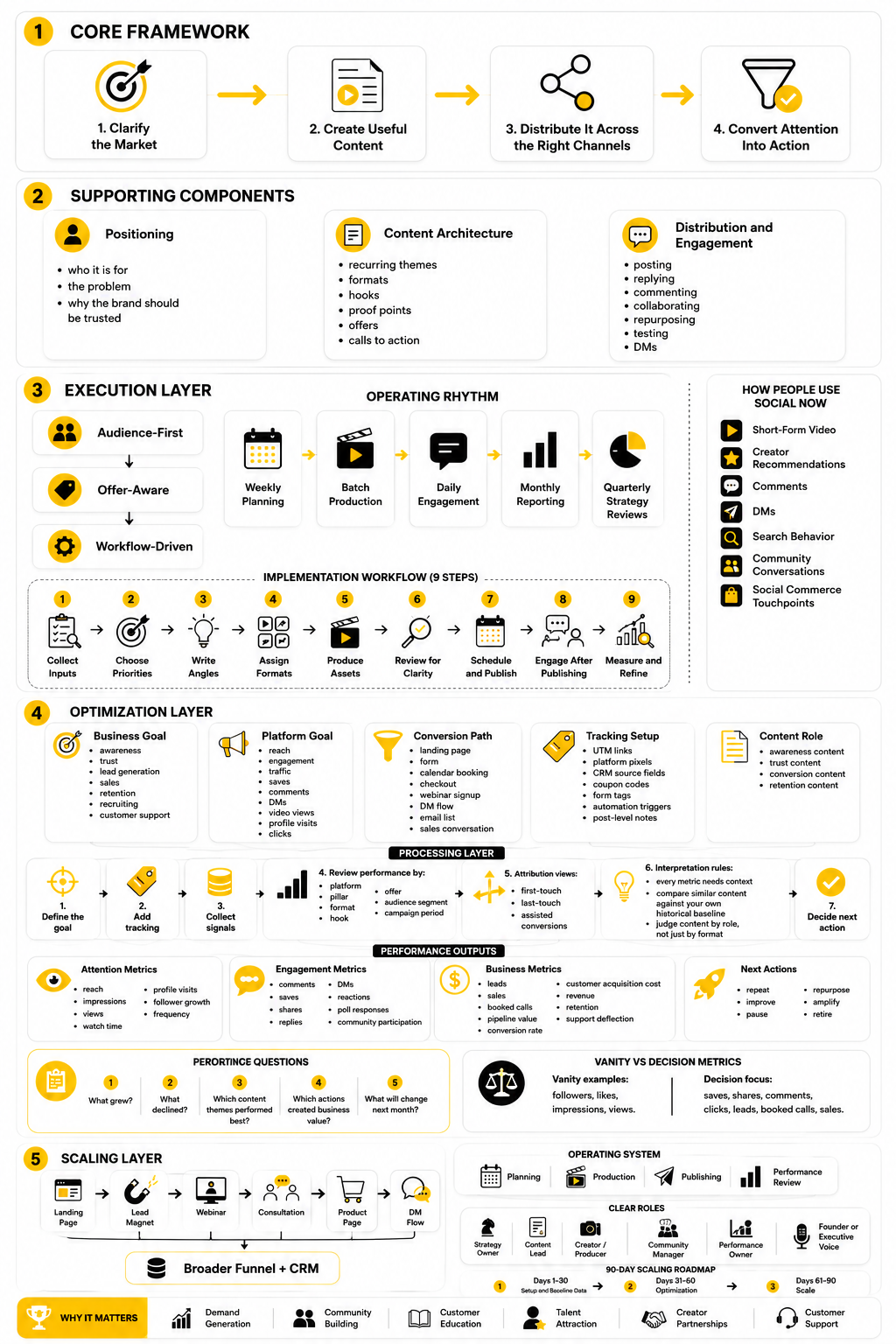
The brands that win are usually not the ones doing the most random activity. They are the ones building a system that learns. Every post teaches something, every comment reveals something, every campaign tests something, and every report improves the next decision.
What Is The Best SMM Strategy For A Small Business?
The best SMM strategy for a small business is focused, practical, and tied to revenue. Start with one primary platform where your audience already pays attention, then build a repeatable content rhythm around education, trust, and clear offers. Small businesses usually win faster by being specific and consistent instead of trying to copy large brands with bigger teams and budgets.
How Long Does SMM Take To Work?
Social media marketing can create early signals within weeks, but meaningful business results usually need a longer feedback loop. You need time to test content pillars, understand audience response, improve offers, and build trust. A 90-day window is a practical minimum for judging whether the strategy is moving in the right direction.
How Often Should A Brand Post On Social Media?
A brand should post as often as it can maintain useful quality. For many teams, two to four strong posts per week on the primary channel is better than weak daily posting. The right cadence depends on platform behavior, team capacity, production quality, and whether the content is generating useful engagement or business movement.
Which Platform Is Best For SMM?
There is no universal best platform for SMM. The best platform is the one where your audience spends meaningful attention and where your content can naturally support discovery, trust, and conversion. B2B brands may lean toward LinkedIn or YouTube, ecommerce brands may lean toward Instagram, TikTok, or YouTube Shorts, and local businesses may still get strong results from Facebook, Instagram, and community-driven channels.
Is Organic Social Media Still Worth It?
Organic social media is still worth it when it has a clear role in the business. It can build authority, educate buyers, support customer trust, create retargeting audiences, and generate conversations that paid ads alone may not create. The mistake is expecting organic social to behave like direct-response advertising every time.
Should SMM Focus On Followers Or Leads?
Followers matter when they represent the right audience, but leads usually matter more for business growth. A large audience with weak buying intent can create impressive vanity metrics and still produce poor results. The best SMM strategy uses follower growth as one signal, but it gives more weight to qualified conversations, email signups, booked calls, trials, purchases, and pipeline movement.
What Metrics Should I Track First?
Start with a small group of metrics that match your goal. For awareness, track reach, views, watch time, profile visits, and follower quality. For conversion, track clicks, form submissions, DMs, booked calls, sales, revenue, and lead quality.
How Do I Know If My Content Pillars Are Working?
Your content pillars are working when they consistently create useful signals. That can mean saves, shares, thoughtful comments, qualified replies, profile visits, clicks, leads, or sales depending on the role of the pillar. If a pillar gets attention but does not attract the right people or support the business, it may need to be reframed or removed.
Should I Use AI For Social Media Content?
AI can help with research, outlines, repurposing, caption variations, reporting summaries, and workflow speed. It should not replace brand voice, strategic judgment, customer insight, or factual review. The safest approach is to use AI as an assistant, then have a human edit for specificity, proof, clarity, and tone.
When Should I Start Paid Social?
Start paid social when organic data shows that a message, offer, or content angle already resonates. Paid ads can scale proven content, retarget warm audiences, and test offers faster, but they should not be used to hide weak positioning. If the funnel does not convert organically at all, paid traffic may simply make the problem more expensive.
How Important Is Community Management?
Community management is extremely important because social media is not only a publishing channel. Comments, DMs, replies, and community conversations reveal objections, questions, language, and buying signals. Strong community management improves trust while also feeding better content ideas back into the strategy.
What Is The Biggest SMM Mistake Brands Make?
The biggest mistake is treating social media as disconnected content instead of a connected growth system. Brands post without a clear audience, measure without context, automate without judgment, and scale before the message is strong. The fix is to connect positioning, content, engagement, funnels, automation, and analytics into one operating rhythm.
Can SMM Work Without A Big Budget?
Yes, SMM can work without a big budget if the strategy is focused and the execution is consistent. A smaller team can still win by choosing the right platform, creating useful content, engaging directly, and making the next step easy for the audience. Budget helps with speed and reach, but clarity and trust are still the foundation.
What Makes The Best SMM Different From Average Social Media Marketing?
The best SMM is connected to business outcomes instead of only platform activity. It has clear positioning, strong audience insight, repeatable content formats, useful measurement, smart automation, and a real follow-up path. Average social media marketing posts content and hopes; strong SMM builds a system and improves it every week.
Build a stronger local presence with BAAM AI
Turn your website, Google profile, social channels, and AI visibility into one growth engine
Most businesses do not need more random marketing activity. They need a consistent presence system that helps the right people find them, trust them, and take action. BAAM AI brings strategy, local SEO, website updates, Google Maps visibility, social content, AI-search readiness, media production, and reporting into one practical monthly engine.
If you want your marketing to keep working after the campaign ends, start with a free BAAM AI presence audit. See how your business shows up today and where the fastest visibility wins are at BAAM AI.