
BAAM AI Blog
Technical Copywriter: The Practical Guide To Turning Complex Products Into Clear, Persuasive Content
A technical copywriter sits in the messy middle between product, engineering, marketing, sales, and the customer. Their job is not just to “make technical things sound simple.” It is to translate complex products...

A technical copywriter sits in the messy middle between product, engineering, marketing, sales, and the customer. Their job is not just to “make technical things sound simple.” It is to translate complex products into content that helps buyers understand the value, trust the claims, and take the next step without feeling lost.
That matters more now because technical buyers are more self-directed than ever. Developers, IT teams, operators, founders, and technical decision-makers do not want vague hype. They want proof, clarity, workflow context, limitations, comparisons, implementation details, and language that respects their intelligence.
The demand is visible across the way people learn and buy. In the 2024 Stack Overflow Developer Survey, more than 65,000 developers participated, and Stack Overflow later highlighted that many developers rely heavily on technical documentation when learning. Google’s own developer documentation style guide also reflects the same reality: clear, consistent technical communication is not decoration; it is infrastructure.
A good technical copywriter turns that infrastructure into momentum. They can write landing pages, product pages, onboarding emails, integration guides, sales enablement content, comparison pages, release notes, case studies, and technical explainers. The best ones do it without flattening the product, exaggerating the value, or forcing a clever angle where precision would work better.
this guide is split into six parts so each piece builds naturally on the last. Part 1 defines the role, sets the context, and gives you the complete structure before moving into the deeper framework. The remaining parts will continue using the same section names listed below.
What A Technical Copywriter Actually Does
A technical copywriter writes persuasive content for products, services, and systems that need explanation before they can be sold. That usually includes software, SaaS platforms, APIs, AI tools, cybersecurity products, data platforms, developer tools, industrial technology, fintech products, healthtech systems, and other complex offers. The work blends technical understanding with conversion strategy, so the writing has to be accurate enough for experts and clear enough for buyers who are still learning.
This role is different from a general copywriter because the product itself often carries real complexity. A generic writer may focus on emotional hooks, urgency, benefits, and brand voice. A technical copywriter still uses those tools, but they also has to understand workflows, use cases, objections, integrations, constraints, compliance concerns, and the difference between a feature that sounds impressive and a feature that actually changes the customer’s work.
It is also different from a technical writer. A technical writer usually creates documentation, instructions, API references, help center articles, and procedural content. A technical copywriter may use documentation as source material, but the output is more commercial: it helps readers understand why the product matters, why it is credible, and why it is worth evaluating now.
Why The Role Is Harder Than It Looks
Technical copywriting fails when it leans too far in either direction. If the writing becomes too technical, it reads like internal documentation and loses commercial energy. If it becomes too sales-heavy, technical readers stop trusting it because the claims feel inflated, vague, or detached from reality.
That tension is exactly why the role is valuable. Technical buyers often have low tolerance for fluff because they know what implementation really involves. They notice when a page promises “smooth integration” but never explains what systems it connects with, what setup takes, what limitations exist, or what the user can actually do after deployment.
The technical copywriter’s job is to make the product easier to buy without making it less true. That means asking sharper questions, challenging lazy claims, reading product material carefully, and turning scattered inputs into a coherent argument. In practice, this often means the writer becomes a bridge between teams that understand different parts of the truth but rarely express it in the same language.
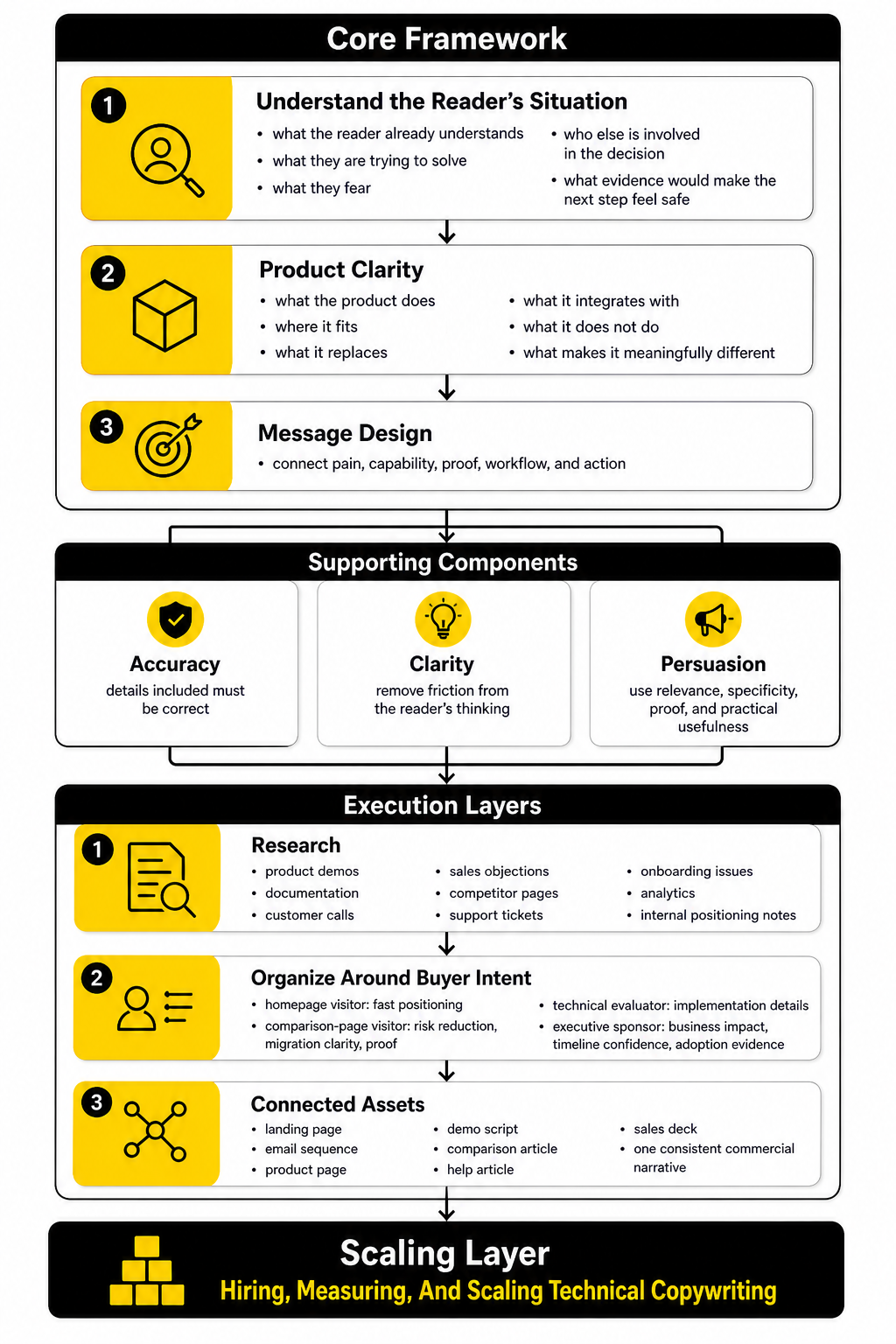
Framework Overview
The framework for technical copywriting starts with understanding the reader’s situation before touching the page. You need to know what the reader already understands, what they are trying to solve, what they fear, who else is involved in the decision, and what evidence would make the next step feel safe. Without that context, even polished copy can miss the real buying conversation.
The second layer is product clarity. A technical copywriter has to know what the product does, where it fits, what it replaces, what it integrates with, what it does not do, and what makes it meaningfully different. This is where strong writers spend more time than weak writers, because the best copy usually comes from better inputs rather than clever phrasing.
The third layer is message design. Once the reader and product are clear, the writer can shape the page, email, guide, or campaign around a clean argument. That argument should connect pain, capability, proof, workflow, and action in a way that feels natural instead of forced.
Core Components Of Technical Copywriting
The first core component is accuracy. Technical copy does not need to include every detail, but the details it does include must be correct. One wrong claim about an integration, security feature, API behavior, data model, or implementation step can damage trust quickly.
The second component is clarity. Clear technical copy removes unnecessary friction from the reader’s thinking. It defines unfamiliar terms, avoids vague claims, uses concrete language, and explains the product in the order the reader needs to understand it.
The third component is persuasion. Technical readers still need a reason to care, a reason to believe, and a reason to act. The difference is that persuasion must come from relevance, specificity, proof, and practical usefulness rather than empty intensity.
Professional Implementation
Professional technical copywriting usually begins with research, not writing. The writer reviews product demos, documentation, customer calls, sales objections, competitor pages, support tickets, onboarding issues, analytics, and internal positioning notes. This prevents the copy from becoming a surface-level rewrite of what the company already says about itself.
The next step is organizing the message around buyer intent. A homepage visitor may need fast positioning, while a comparison-page visitor may need risk reduction, migration clarity, and proof. A technical evaluator may need implementation details, while an executive sponsor may need business impact, timeline confidence, and adoption evidence.
The final step is turning the message into assets that work together. A landing page, email sequence, product page, demo script, comparison article, help article, and sales deck should not feel like separate opinions from separate teams. A strong technical copywriter helps create one consistent commercial narrative that can travel across channels without becoming repetitive.
Why Technical Copywriting Matters
Technical copywriting matters because complex products rarely sell on attention alone. A buyer may click because the promise sounds useful, but they keep reading only when the copy answers real questions. They need to understand what the product does, why it is credible, how it fits their workflow, and what risk they reduce by choosing it.
This is especially true in B2B, SaaS, AI, cybersecurity, automation, developer tools, and technical services. The buyer is not just buying a tool; they are often buying a change in process, a new internal dependency, or a system other people will need to trust. That makes the technical copywriter responsible for more than words on a page, because the copy has to reduce confusion before confusion becomes friction.
The market keeps moving in that direction. Gartner reported that 61% of B2B buyers prefer a rep-free buying experience, which means the content has to do more of the explaining before a sales conversation happens. Forrester also found that 86% of B2B purchases stall during the buying process, so clarity is not a nice extra; it is one of the ways companies keep deals moving.
Buyers Do More Research Before They Talk To Sales
A technical buyer rarely arrives with a blank mind. They have already searched competitors, read documentation, scanned reviews, checked pricing signals, watched demos, asked peers, and tried to understand whether the product fits their environment. By the time they contact sales, they may already have a short list and a strong opinion.
That changes the job of the website, landing page, comparison page, and technical content library. These assets cannot simply generate curiosity and hand everything over to a rep. They need to help the buyer make progress independently, because the buyer is already doing the work.
A technical copywriter supports this by writing content that respects how people evaluate technical products. The copy should answer practical questions early, define what the product is best for, show where it fits, and remove vague language that forces the reader to guess. When a buyer does not have to fight the page to understand the product, they are more likely to keep moving.
Technical Buyers Notice Weak Claims Fast
Technical audiences are not allergic to marketing. They are allergic to marketing that insults their intelligence. When a product page says “effortless,” “revolutionary,” “smooth,” or “all-in-one” without explaining what that means, technical readers start looking for the catch.
This is where a technical copywriter becomes valuable. They know how to replace generic claims with specific, usable language. Instead of saying a platform “streamlines operations,” stronger copy might explain which workflow is shortened, what manual step is removed, what data moves automatically, and what the user can do after setup.
The point is not to make every page dense. The point is to make every promise easier to believe. Technical copy does not need to sound complicated to be credible, but it does need to show that the company understands the buyer’s reality.
Clear Copy Reduces Sales Friction
Sales friction often starts before anyone joins a call. A buyer reads a page, does not understand the positioning, cannot see the difference from competitors, or worries that implementation will be painful. Then they either delay the decision, ask the same basic questions on every call, or disappear completely.
Clear copy prevents some of that waste. It gives buyers a stronger mental model before they speak with the team. It also helps internal champions explain the product to finance, leadership, security, operations, or engineering without rewriting the argument from scratch.
That internal champion point matters a lot. In many technical purchases, the person who likes the product is not the only person who approves it. Good technical copy gives that person the language, proof, and structure they need to defend the decision internally.
Documentation And Copy Are Now Connected
Technical copywriting and documentation used to feel like separate worlds. Marketing created persuasive pages, while product or engineering created support content. That separation still exists in many companies, but buyers do not experience the journey that way.
A prospect may move from a homepage to a pricing page, then to docs, then to a help article, then to a comparison page, then back to a demo request. If those pages use different promises, different terminology, or different levels of detail, the experience feels fragmented. That fragmentation creates doubt.
Developer audiences make this connection especially obvious. The 2024 Stack Overflow Developer Survey had more than 65,000 respondents, and Stack Overflow’s own analysis noted that 84% of developers who are not using Stack Overflow use technical documentation to learn. For a technical copywriter, that is the signal: docs are not just support material; they are part of the buying experience.
Better Copy Helps Teams Stay Aligned
A technical copywriter often uncovers positioning problems that are bigger than the page itself. Product may describe the tool one way, sales may pitch it another way, leadership may use a broader category label, and customers may explain the value in completely different language. When that happens, the writing process exposes the gap.
This is useful, even when it is uncomfortable. If the team cannot explain the product consistently, the market probably cannot understand it quickly. Copy becomes the forcing function that turns scattered opinions into a sharper message.
The best technical copywriters do not just ask, “How can this sound better?” They ask, “What are we really saying, who needs to believe it, and what proof makes it credible?” That kind of thinking improves landing pages, sales decks, onboarding emails, demo scripts, knowledge base content, and even product naming.
AI Makes Technical Copywriting More Important, Not Less
AI can help teams draft faster, summarize research, generate content variants, and repurpose technical material. That is useful. But speed does not automatically create accuracy, positioning, judgment, or trust.
The Content Marketing Institute’s 2025 B2B research found that 81% of B2B marketers use generative AI tools, but only a much smaller share have AI deeply integrated into daily workflows. That gap matters because technical copy cannot rely on output volume alone. Someone still has to verify claims, choose the right level of detail, protect the brand from overpromising, and shape the argument around the buyer’s real decision process.
This is where a skilled technical copywriter earns their seat. They can use AI as leverage without letting AI flatten the message into generic content. The tool can help with speed, but the writer still owns the thinking.
Strong Technical Copy Creates Commercial Trust
Trust is not built by sounding impressive. It is built when the reader feels that the company understands the problem, tells the truth about the product, and makes the next step feel reasonable. That is the real business value of technical copywriting.
A technical copywriter creates trust by making the product easier to evaluate. They clarify use cases, explain tradeoffs, support claims with evidence, and avoid hiding important details behind vague language. That does not make the copy less persuasive; it makes the persuasion stronger because it feels grounded.
For complex products, this is the difference between interest and action. People may admire a clever headline, but they move forward when they understand the value and believe the company can deliver. That is why technical copywriting matters.
The Technical Copywriting Framework
A technical copywriter needs a process because complex products punish random writing. You cannot guess your way into clear positioning when the product has integrations, edge cases, security concerns, technical stakeholders, and business buyers all pulling the message in different directions. The framework keeps the work grounded, so the copy becomes easier to trust, easier to review, and easier to use across channels.
The goal is not to make every asset follow the same rigid template. A comparison page, product page, onboarding email, and technical guide all need different shapes. But underneath those formats, the thinking should stay consistent: understand the buyer, understand the product, build the argument, prove the claims, and make the next step obvious.
This is where technical copywriting becomes more strategic than most people expect. The writer is not only choosing words. They are deciding what information deserves attention, what should be simplified, what needs proof, what can be left out, and what the reader must believe before they will move forward.
Start With The Buyer’s Real Situation
The first step is to understand the buyer’s operating reality. That means going beyond job titles and basic personas. A technical copywriter needs to know what the buyer is trying to fix, what systems they already use, what internal pressure they feel, and what would make a solution feel too risky.
This research should include sales call notes, support tickets, customer interviews, demo questions, review sites, community discussions, and search behavior. The point is to hear the language people use before the company cleans it up into internal messaging. When the writer captures real buyer language, the copy starts sounding less like a pitch and more like a useful answer.
Good buyer research also reveals what different stakeholders care about. An engineering lead may care about maintainability and API behavior. A revenue leader may care about pipeline impact, speed, and reporting. A technical copywriter has to write for the buying group, not just the loudest person in the funnel.
Map The Buying Questions
Once the buyer is clear, the next step is mapping the questions they ask as they move from awareness to evaluation. Early questions are usually broad: what is this, who is it for, and why should I care? Later questions become sharper: will this work with our stack, how hard is migration, what does pricing depend on, and what proof shows this will actually work?
This matters because many technical pages answer the wrong questions at the wrong time. They explain advanced features before the reader understands the use case. Or they push a demo before the reader has enough confidence to speak with sales.
A technical copywriter should arrange information in the order trust is built. First, orient the reader. Then show relevance. Then explain capability. Then support the claim. Then guide the next step. That sequence sounds simple, but it fixes a lot of messy copy.
Audit The Product Before Writing The Promise
The product audit is where the technical copywriter gets close to the actual offer. This includes reviewing the product interface, documentation, integrations, onboarding flow, security pages, pricing logic, implementation timelines, and any limitations that could affect the buyer’s decision. The writer does not need to become the engineer, but they do need enough understanding to avoid shallow or risky claims.
This step protects the company from vague promises. If the product integrates with a CRM, the copy should clarify what that integration actually does. If the product uses AI, the copy should explain where AI helps, what the user controls, and where human review still matters.
The best product audit also finds stronger angles. Sometimes the most persuasive detail is not the headline feature the company keeps promoting. It may be a setup shortcut, workflow improvement, reporting view, compliance support, or operational detail that customers quietly love because it removes daily friction.
Build The Message Hierarchy
A message hierarchy decides what the reader should understand first, second, third, and last. Without it, technical copy becomes a pile of accurate facts with no commercial direction. The information may be true, but the reader still has to assemble the argument alone.
The hierarchy usually starts with positioning. The reader needs to know what the product is and what problem it solves. Then the copy can move into differentiated capabilities, workflow context, proof, objections, and conversion points.
This is where a technical copywriter earns trust with both marketing and product teams. They can keep the message commercially sharp without cutting out the technical substance. They can also prevent the page from becoming a feature dump, which is one of the fastest ways to lose a busy evaluator.
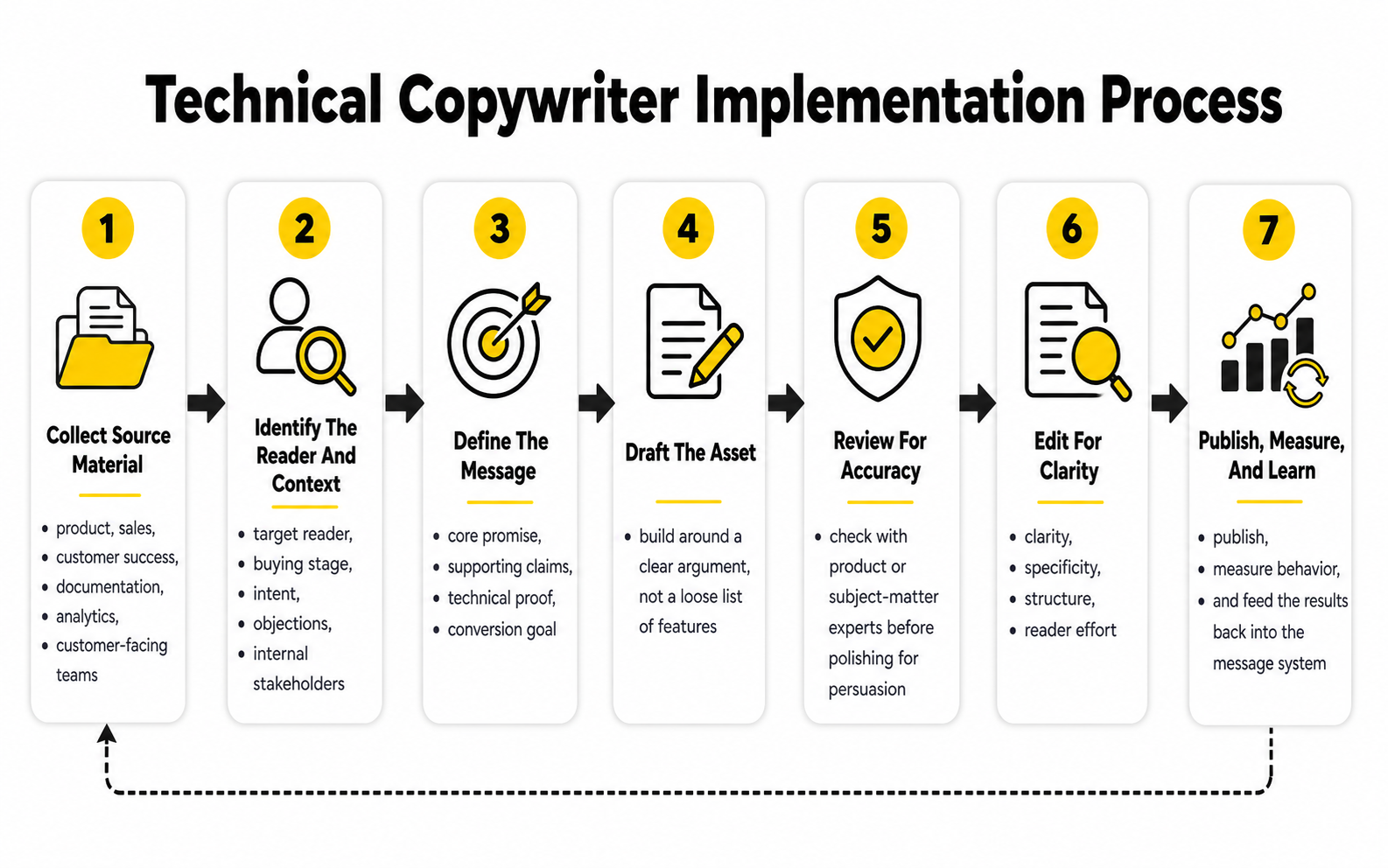
Turn Research Into A Repeatable Execution Process
The execution process should be simple enough for a team to repeat. If it only works when one writer holds everything in their head, the system is too fragile. A strong process creates consistent inputs, clear review stages, and reusable messaging that can support more than one asset.
A practical workflow usually looks like this:
This process matters because technical copy usually involves more reviewers than simple consumer copy. Product may check accuracy, legal may check risk, marketing may check positioning, and sales may check whether the page helps conversations. A repeatable workflow keeps those reviews productive instead of chaotic.
Separate Claims From Proof
Technical buyers do not trust claims just because they are written confidently. They need evidence that the product can do what the page says. That evidence can come from documentation, screenshots, product data, security details, customer results, technical architecture, benchmarks, integrations, or transparent explanations of how the system works.
A technical copywriter should separate every important claim from the proof behind it. If the claim is “faster implementation,” the proof might be onboarding steps, setup time ranges, migration support, templates, or customer implementation data. If the claim is “better visibility,” the proof might be reporting views, alert logic, data sources, or role-based dashboards.
This discipline makes the writing stronger because it forces the team to remove weak language. If there is no proof, the claim either needs to be softened, clarified, or removed. That is not being cautious for no reason; it is how you protect credibility.
Use Documentation As A Strategic Input
Documentation is one of the most useful source materials for technical copy, but it should not be copied blindly. Docs often explain how something works after the user has chosen the product. Copy has to explain why the product is worth evaluating before the user has committed.
Still, docs are a goldmine because they show real product behavior. Google’s developer documentation style guide emphasizes clear and consistent writing for technical practitioners, and that same standard helps marketing content avoid confusion. When copy and documentation share terminology, the buying journey feels more coherent.
This is especially important for developer-facing products. The 2024 Stack Overflow Developer Survey highlighted API and SDK documents as the documentation source of choice for developers learning technical material. A technical copywriter who ignores docs is ignoring one of the places technical buyers already go for trust.
Match Depth To Intent
Not every reader needs the same amount of detail. A homepage should create orientation quickly. A product page should explain the use case and core capabilities. A comparison page should handle differentiation and risk. A technical guide can go deeper because the reader has already shown stronger intent.
The mistake is treating every asset like it should contain everything. That creates bloated pages and tired readers. The better approach is to give each asset one job and connect it to the next logical asset.
A technical copywriter should design depth deliberately. If the reader is early, use plain language and strong signposting. If the reader is evaluating seriously, bring in sharper details, constraints, proof, and implementation context.
Write For Reviewers Before You Write For Approval
Technical copy often gets stuck because reviewers react from different priorities. Product wants precision. Sales wants stronger hooks. Leadership wants a bigger vision. Legal wants less risk. The writer has to make the work reviewable, not just readable.
That means labeling assumptions, showing where claims came from, and making it easy for subject-matter experts to correct details without rewriting the whole asset. It also means keeping a clear distinction between messaging decisions and technical facts. When those two get mixed together, feedback becomes slow and political.
A technical copywriter can reduce this friction by creating a source-backed draft. The copy should be persuasive, but the logic behind it should be visible. That gives the team something concrete to improve instead of another abstract debate about tone.
Create A Message System, Not One-Off Copy
The strongest output of technical copywriting is not a single landing page. It is a message system the company can reuse across pages, campaigns, sales conversations, onboarding, and product education. That system keeps the company from reinventing the same explanation every time a new asset is needed.
A message system usually includes positioning, audience segments, pain points, value propositions, proof points, objection handling, terminology, claims guidance, and preferred language. It can also include examples of what not to say, which is incredibly useful when teams are trying to avoid overpromising. This gives the company a shared standard for communicating complex value.
For teams building funnels, email sequences, and technical landing pages, this kind of system also makes tools more effective. A platform like ClickFunnels can help publish and test conversion paths, but the tool will not fix unclear messaging by itself. The technical copywriter still has to build the argument that makes the funnel worth following.
Statistics And Data
Measurement is where technical copywriting stops being a taste debate. Without data, teams argue about whether a headline “feels stronger,” whether a page is “too technical,” or whether the CTA should be more aggressive. With the right data, the conversation shifts to something more useful: what the reader understood, where they hesitated, and what action the copy helped create.
A technical copywriter should not treat analytics as a scoreboard for vanity wins. Pageviews, impressions, and clicks can be useful, but they rarely explain the full quality of the message. The better question is whether the copy helped the right reader move from confusion to confidence.
This matters even more when the buying journey is self-directed. Gartner’s 2025 sales survey found that 61% of B2B buyers prefer an overall rep-free buying experience, which means buyers are using content to answer questions they used to bring to sales. If the copy does not explain the product clearly enough, the buyer may never give the company a chance to clarify.
What You Should Actually Measure
The first measurement mistake is tracking everything with the same level of importance. A technical product page, documentation-driven landing page, comparison page, onboarding email, and demo request page should not be judged by one generic metric. Each asset has a job, so each asset needs performance signals that match that job.
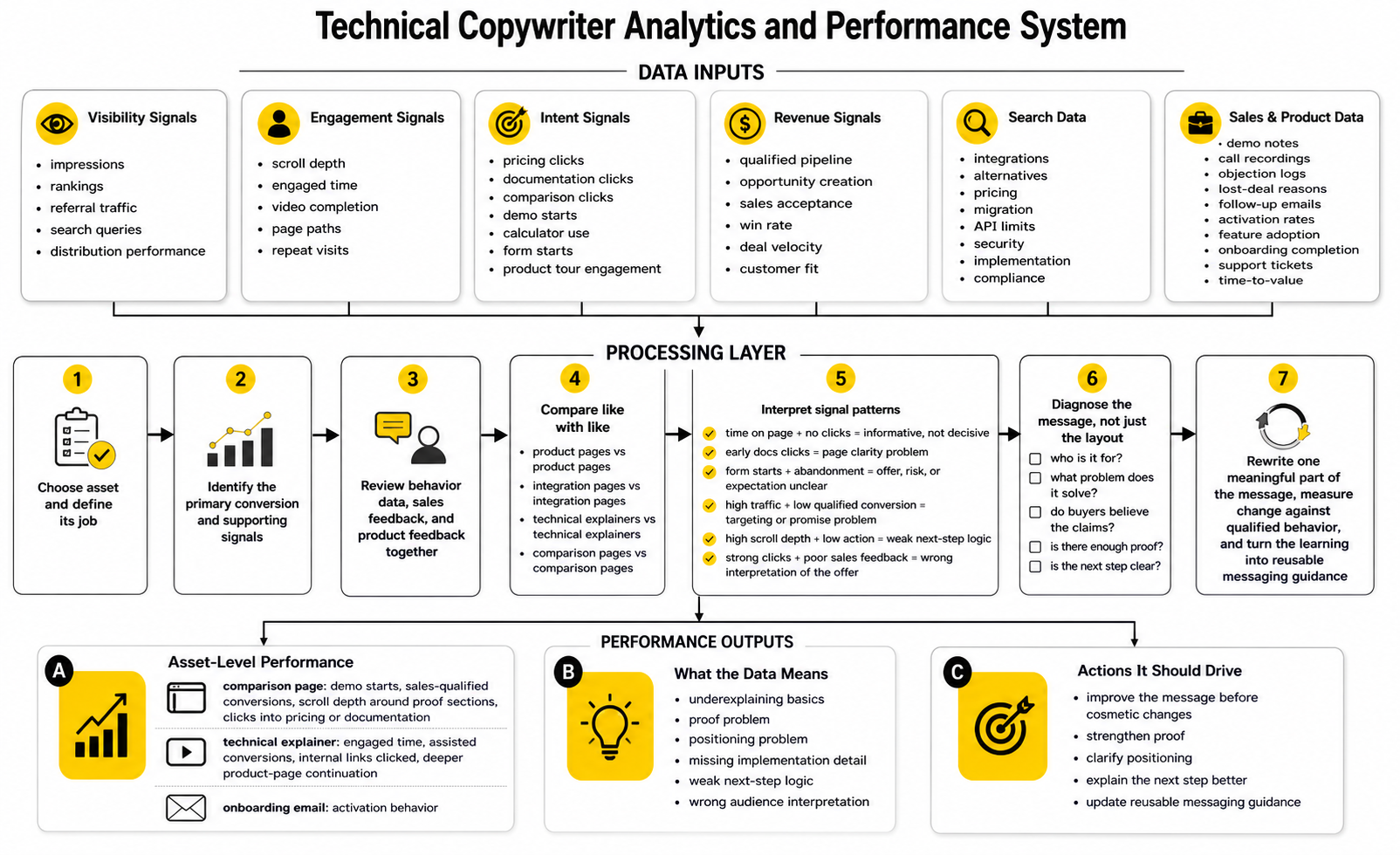
A high-intent comparison page might be judged by demo starts, sales-qualified conversions, scroll depth around proof sections, and clicks into pricing or documentation. A technical explainer might be judged by engaged time, assisted conversions, internal links clicked, and whether readers continue to deeper product pages. An onboarding email might be judged by activation behavior, not just open rate.
The technical copywriter needs to connect the metric to the reader’s decision. If the reader is early, the copy should create understanding. If the reader is comparing, the copy should reduce doubt. If the reader is close to action, the copy should make the next step feel obvious and low-risk.
Performance Signals That Reveal Copy Problems
Bad copy does not always show up as a terrible conversion rate. Sometimes it shows up as shallow engagement, repeated sales questions, weak demo quality, high bounce from pricing, or heavy traffic to support content because the marketing page did not explain the basics. These signals are easy to miss if the team only watches top-line conversions.
A technical copywriter should look for patterns in the data. If readers spend time on the page but do not click, the copy may be informative but not decisive. If they click into documentation too early, the page may not be explaining the product clearly enough. If they start forms but abandon them, the offer, risk, or expectation may be unclear.
The best signal is often not one number. It is the relationship between numbers. High traffic with low qualified conversion suggests a targeting or promise problem. High scroll depth with low action suggests weak next-step logic. Strong clicks but poor sales feedback suggests the page may be attracting the wrong interpretation of the offer.
The Analytics System For Technical Copy
A useful analytics system should connect content behavior to commercial intent. That does not mean every article or page needs to prove direct revenue on its own. It means the team should understand how each asset helps the buyer progress and where the message breaks down.
The system should combine four layers:
That structure helps teams avoid lazy conclusions. A page with modest traffic may be extremely valuable if it supports high-intent buyers. A page with huge traffic may be weak if it attracts readers who never become qualified prospects.
Benchmarks Need Context
Benchmarks are useful only when they help you ask better questions. They are not universal targets. A conversion rate for a simple consumer landing page does not tell you much about a technical SaaS page selling to a buying committee with security, finance, legal, and operations involved.
That is why technical copy performance should be compared against pages with similar intent. Compare product pages against product pages, integration pages against integration pages, technical explainers against technical explainers, and comparison pages against comparison pages. Otherwise, the benchmark creates noise instead of insight.
Industry data can still help set expectations. The Content Marketing Institute’s 2025 B2B research found that 61% of B2B marketers expected increased investment in video and 52% expected increased investment in thought leadership content, which shows how much competition exists for buyer attention. But that does not mean every technical copywriter should chase video or thought leadership by default. The right move depends on where the buyer needs more clarity.
Data Should Improve The Message, Not Just The Layout
Many teams use analytics to test surface changes. They change button color, shorten a paragraph, move a form, or rewrite a headline without checking whether the underlying message is wrong. That can produce small gains, but it rarely fixes a broken explanation.
Technical copy should be measured against message quality. Do readers understand who the product is for? Do they understand what problem it solves? Do they believe the claims? Do they see enough proof? Do they know what happens after they click?
When the data shows hesitation, the technical copywriter should look at the argument before touching the cosmetics. A weak CTA may not be a CTA problem. It may be a proof problem, a positioning problem, or a missing implementation detail that makes the buyer hesitate.
Search Data Shows What Buyers Already Care About
Search data is one of the cleanest ways to see what technical buyers are trying to understand. Queries around integrations, alternatives, pricing, migration, API limits, security, implementation, and compliance reveal the questions buyers do not want to wait for sales to answer. Those questions should shape the copy.
This is especially important for technical products because search intent can be very specific. Someone searching for an integration guide is not in the same mindset as someone searching for a category definition. Someone searching for a competitor alternative is not looking for a fluffy brand story; they want a clear comparison and a reason to switch.
A technical copywriter should use search data to decide what deserves its own page, what belongs inside a product page, and what should be handled in documentation. Tools like Firecrawl can also help teams collect and structure public web content for research workflows, but the writer still needs to interpret what the data means. Raw search data does not create positioning by itself.
Sales Data Shows Where Copy Is Underexplaining
Sales conversations reveal the gaps that analytics cannot fully explain. If prospects repeatedly ask the same questions after reading the website, the copy is probably underexplaining something important. If deals stall after technical review, the content may not be handling implementation, proof, or risk early enough.
This is where the technical copywriter should work closely with sales. Demo notes, call recordings, objection logs, lost-deal reasons, and follow-up emails can show where the buyer’s understanding breaks. Those patterns should feed directly into product pages, comparison pages, FAQs, sales enablement content, and nurture sequences.
The goal is not to replace sales with copy. The goal is to make sales conversations more advanced. When the copy handles basic clarity, sales can spend more time on fit, use case depth, stakeholder alignment, and closing the real gap.
Product Data Shows Whether The Promise Survives First Use
Marketing performance is not enough if the product experience contradicts the promise. A page may convert well, but if users do not activate, retain, or adopt the feature being promoted, the copy may be overselling the wrong value. That is dangerous because it creates short-term pipeline and long-term trust problems.
A technical copywriter should care about product usage data when it is available. Activation rates, feature adoption, onboarding completion, support tickets, and time-to-value can all reveal whether the message is attracting the right expectations. If users arrive expecting one workflow but use the product for another, the copy needs adjustment.
This is also where lifecycle content matters. A clear product page gets the buyer interested, but onboarding emails, setup guides, tooltips, and help content turn that interest into actual use. Platforms like GoHighLevel can help teams connect funnels, automations, and CRM activity, but the measurement still has to answer one practical question: did the message help the customer make progress?
AI Metrics Need Extra Scrutiny
AI has changed how teams produce and measure content, but it has also made weak measurement more dangerous. More content does not automatically mean better content. Faster drafting does not automatically mean clearer positioning. More variants do not automatically mean stronger buyer understanding.
The Content Marketing Institute’s 2025 B2B research found that 40% of B2B marketers expected higher investment in AI for content optimization and performance, while 39% expected higher investment in AI for content creation. That is a strong signal that AI is moving deeper into content operations. But for technical copywriting, the risk is obvious: AI can produce confident language that still needs human verification.
A technical copywriter should use AI metrics carefully. Track whether AI-assisted content improves speed, but also track correction time, expert review issues, factual accuracy, conversion quality, and sales feedback. If AI helps produce more pages but creates more review burden or weaker buyer trust, the system is not actually improving.
How To Interpret Conversion Data Without Fooling Yourself
Conversion data can be misleading when the sample is too small, the traffic source changes, or the offer changes at the same time as the copy. A spike after a rewrite does not automatically mean the copy caused the improvement. A drop does not automatically mean the copy failed.
Technical copy often needs longer evaluation windows because buying cycles are slower. A buyer may read a comparison page today, forward it internally next week, return to documentation later, and request a demo after a stakeholder meeting. If attribution only rewards the final click, the copy that created confidence earlier may look less valuable than it really was.
The practical move is to combine quantitative and qualitative evidence. Look at conversions, assisted conversions, engaged sessions, page paths, sales notes, demo quality, and customer questions together. That gives the technical copywriter a more honest picture of what the content is actually doing.
The Measurement Loop
Measurement should create a loop, not a report that dies in a spreadsheet. The team should review performance, identify friction, form a copy hypothesis, make a focused change, and measure the result. Then the learning should be added back into the message system so future assets improve faster.
A simple loop works well:
This is how technical copywriting gets better over time. Not by guessing louder. Not by chasing random benchmarks. By reading the numbers, understanding what they actually mean, and using them to make the buyer’s path clearer.
Professional Implementation Across Channels
Professional implementation is where a technical copywriter proves whether the message system can survive real distribution. A strong framework is useful, but it only matters if the copy works across the places buyers actually evaluate the product. That includes websites, landing pages, product pages, documentation paths, comparison content, email sequences, demo flows, sales assets, onboarding, and customer education.
The challenge is that each channel has a different job. A homepage has to orient quickly. A technical product page has to explain fit and capability. A sales deck has to support a live conversation. An onboarding email has to help someone take a specific action without creating extra cognitive load.
This is why technical copywriting cannot be treated as isolated asset production. The same core message needs to adapt without becoming inconsistent. If the website says one thing, the demo says another, and the docs imply something else, the buyer feels the gap even if they cannot name it.
Build Around The Buyer’s Stage
A technical copywriter should match the depth of the copy to the buyer’s stage. Early-stage buyers need orientation, category clarity, and language that helps them understand the problem. Mid-stage buyers need comparison, use cases, workflow fit, and proof. Late-stage buyers need implementation confidence, risk reduction, stakeholder support, and a clear path to action.
That stage-based approach prevents two common mistakes. The first is overloading early pages with technical depth before the buyer understands why the product matters. The second is keeping late-stage content too vague, which forces serious evaluators to chase information through sales calls, support docs, and internal follow-ups.
The buying group also changes by stage. Forrester’s 2025 buyer research found that 73% of purchases involve three or more departments, with an average of 13 people inside the buyer’s organization and nine from outside involved in the decision. That means the copy has to help one reader carry the argument to other people, not just persuade the person who first lands on the page.
Handle Multiple Stakeholders Without Writing A Mess
Technical products often have several audiences at once. A founder may care about speed and cost. A technical lead may care about architecture, security, and maintenance. A marketing or revenue leader may care about adoption, reporting, and measurable business impact. A procurement or legal reviewer may care about risk, terms, data handling, and vendor stability.
Trying to speak to all of them in the same paragraph usually creates weak copy. The better move is to structure the page so each stakeholder gets what they need at the right moment. That can mean using clearer sections, stronger subheads, comparison blocks, implementation notes, proof points, and links to deeper resources.
A technical copywriter should not blur stakeholder concerns into generic benefit language. They should separate the decision layers. The main narrative should stay simple, while the supporting sections give each reviewer enough confidence to keep the buying process moving.
Turn Product Pages Into Evaluation Tools
A technical product page should not read like a brochure. It should help the reader evaluate whether the product solves their problem. That means the page needs to clarify the use case, show the workflow, explain the capabilities, support the claims, and make the next step logical.
The best product pages often answer practical questions before the reader has to ask them. What does this replace? What does it connect with? What does setup involve? What changes for the team after implementation? What proof shows that this is more than a nice feature?
This is where specificity does the selling. A technical copywriter should make the product feel real by explaining the actual movement from problem to outcome. Not with fake certainty, not with inflated numbers, and not with generic transformation language. Just clear, useful, credible explanation.
Use Comparison Content Carefully
Comparison content can be powerful because high-intent buyers actively look for alternatives, competitors, and tradeoffs. But it can also damage trust if it becomes one-sided, lazy, or obviously unfair. Technical audiences can spot a rigged comparison fast.
A strong comparison page should explain who each option is best for, where the product is stronger, where it may not be the right fit, and what decision criteria matter. That kind of honesty does not weaken the page. It makes the argument more believable because the reader sees that the company understands real tradeoffs.
A technical copywriter should avoid turning comparisons into attack pages. The goal is to help the buyer make a better decision. If the product is truly a fit, clear criteria will do more work than aggressive positioning.
Connect Copy With Funnel Architecture
Copy and funnel structure should support each other. A great message can underperform if the page path is confusing, the next step is too heavy, or the follow-up sequence ignores what the buyer just read. A strong funnel can also fail if the copy gives people no real reason to continue.
This is where implementation tools can help, but they should never become the strategy. Platforms such as ClickFunnels, systeme.io, and GoHighLevel can help teams build pages, automate follow-up, and connect lead activity. But the technical copywriter still has to define the promise, proof, objection handling, and conversion logic.
The practical test is simple. After reading the page, does the next action feel like the natural next step? If the answer is no, the funnel has a message problem, not just a UX problem.
Make Email Sequences Useful, Not Noisy
Email is often where technical copy becomes too generic. A prospect downloads a guide, books a demo, starts a trial, or attends a webinar, then receives a sequence that feels disconnected from their intent. That is a fast way to lose trust.
A better email sequence continues the buying conversation. It should answer the next likely question, reduce the next likely objection, and point to the next useful resource. For a technical product, that may mean linking to an implementation overview, integration page, security explanation, customer proof, product tour, or comparison guide.
The copy should also respect reader effort. A technical buyer does not need five emails repeating the same value proposition in different words. They need a concise path from interest to confidence.
Use Chat And Automation Without Flattening The Experience
Chatbots, forms, routing tools, and automated responses can remove friction when they are implemented well. They can also create a worse experience when they push people into generic scripts or ask questions the website should have already answered. Technical buyers do not want to fight an automation layer just to get basic clarity.
A technical copywriter can help by shaping the conversation logic. What should the bot ask first? What answer should it give when someone asks about integrations, pricing, setup, or security? When should the conversation route to a human? What language should be avoided because it overpromises?
Tools such as ManyChat and Chatbase can support automated conversations, but the quality still depends on the message design. Automation magnifies the copy. It does not magically improve it.
Align Documentation, Sales, And Marketing Language
At scale, inconsistency becomes expensive. Marketing might call a capability “AI workflow automation,” sales might call it “smart routing,” and documentation might call it “conditional task orchestration.” Each phrase may make sense in isolation, but together they make the product harder to understand.
A technical copywriter should help create a shared language system. That includes approved product terms, feature names, value propositions, proof points, objection responses, and explanations of what not to say. This is not about policing every sentence. It is about making the buyer’s journey feel coherent.
This alignment is especially important when documentation influences buying decisions. The 2025 Stack Overflow Developer Survey received more than 49,000 responses from developers across 177 countries, which reinforces how large and diverse technical audiences are. If a company serves technical users, documentation and marketing cannot live in separate realities.
Know When To Go Deep And When To Stay Simple
One of the hardest technical copywriting decisions is how much detail to include. Too little detail creates doubt. Too much detail creates drag. The right answer depends on intent, audience maturity, product complexity, and the action you want the reader to take.
For a broad landing page, the copy should usually keep the main path simple and link to deeper resources. For an integration page, technical guide, or comparison asset, the reader expects more specificity. For an enterprise security page, detail is not clutter; it is part of the trust-building process.
A technical copywriter should treat depth like a design choice. The goal is not to make the copy short. The goal is to make the reader’s decision easier.
Manage The Risk Of Overpromising
Overpromising is one of the biggest risks in technical copywriting. It can happen through exaggerated outcomes, vague AI claims, unclear implementation language, or benefit statements that ignore customer effort. The copy may convert in the short term, but it creates problems when the product experience cannot match the promise.
This risk grows when teams move fast. AI can generate polished claims quickly, growth teams may want stronger hooks, and sales teams may push for more aggressive language. The technical copywriter has to protect the boundary between persuasive and misleading.
That does not mean writing timid copy. It means writing precise copy. A strong claim with clear conditions, context, and proof will outperform a vague superlative when the buyer is serious.
Scale With Templates, But Do Not Let Templates Think For You
Templates help technical copy scale. They create consistency, reduce blank-page time, and make it easier for teams to produce product pages, integration pages, comparison pages, release notes, case studies, and email sequences. Used well, templates protect quality.
Used badly, templates create sameness. Every page starts sounding like every other page. Every feature gets the same benefit structure. Every CTA feels pasted on. That is when scaled content becomes content debt.
A technical copywriter should build templates around decision logic, not just layout. A good template asks the right questions: who is this for, what problem does it solve, what proof supports it, what objection must be handled, and what should the reader do next? The template should guide thinking, not replace it.
Build A Review System That Does Not Kill The Copy
Technical copy needs review, but review can easily destroy momentum. Too many reviewers, unclear ownership, and vague feedback can turn a strong draft into a safe but lifeless compromise. The result is often accurate, approved, and forgettable.
The fix is to separate review responsibilities. Subject-matter experts should check accuracy. Marketing should check positioning and conversion logic. Legal or compliance should check risk. Sales should check whether the copy supports real buyer conversations.
A technical copywriter should make those lanes explicit before the draft goes around. That one move prevents a lot of chaos. It also helps reviewers give better feedback because they know what kind of judgment they are being asked to provide.
Prepare For AI-Assisted Content Operations
AI will keep changing how technical content gets produced, reviewed, and optimized. Content Marketing Institute’s 2025 B2B research found that 40% of B2B marketers expected increased investment in AI for content optimization and performance, while 39% expected increased investment in AI for content creation. That shift makes the technical copywriter more important, not less.
The writer’s role moves toward judgment, systems, verification, positioning, and editorial control. AI can help summarize documentation, draft variants, analyze competitor pages, and repurpose content. But it cannot independently decide which claim is safe, which detail matters to a buying committee, or which message will survive expert review.
The smart move is to build AI into the workflow without letting it become the authority. Use it for speed. Use it for structure. Use it for first-pass analysis. But keep the technical copywriter responsible for truth, clarity, persuasion, and commercial judgment.
Hiring, Measuring, And Scaling Technical Copywriting
At this point, the role is clear: a technical copywriter is not just there to “write better words.” They help turn product complexity into a message system that buyers, sales teams, product teams, and customer-facing teams can actually use. The final step is knowing how to hire for that skill, measure it properly, and scale it without watering it down.
This is where many companies get stuck. They either hire a generalist who writes clean copy but cannot handle technical depth, or they hire a technical writer and expect them to create conversion-focused assets without commercial strategy. Both can work in specific situations, but they are not the same role.
A strong technical copywriter brings together product understanding, buyer empathy, research discipline, messaging structure, and practical conversion judgment. That mix is rare, which is why hiring and scaling the function needs more thought than posting a generic “copywriter wanted” brief.
How To Hire A Technical Copywriter
Hiring should start with the type of complexity the writer needs to handle. A SaaS company selling to marketing teams needs a different profile than a cybersecurity company selling to CISOs, a developer tool selling to engineers, or a healthcare platform selling into regulated enterprise accounts. The core writing skill matters, but the surrounding domain judgment matters too.
A good hiring brief should define the assets, the audience, the product depth, the review environment, and the expected business outcome. If the work involves product pages, comparison pages, technical explainers, lifecycle emails, and sales enablement, say that clearly. If the writer needs to interview engineers, read docs, and challenge product claims, say that too.
Do not hire only from polished portfolio screenshots. Ask how the writer got to the message. The thinking behind the work tells you more than the finished headline.
What To Look For In The Portfolio
A useful portfolio shows that the writer can handle complexity without hiding behind buzzwords. Look for examples where the writer explains a technical product clearly, connects features to buyer problems, handles objections, and uses proof without turning the page into a dry manual. The best samples usually feel simple on the surface because the hard thinking has already been done.
You should also look for range. A technical copywriter who can only write long-form explainers may struggle with landing pages. A writer who only writes punchy ads may struggle with deep evaluation content. The stronger profile can adapt the same message across formats without making everything sound identical.
Ask for context around the work. What source material did they use? Who reviewed it? What changed after feedback? What did the asset need to achieve? A writer who can explain those decisions is usually much safer than one who only talks about style.
The Interview Questions That Reveal Real Skill
The best interview questions test judgment, not just confidence. Give the writer a short technical product description and ask how they would turn it into a product page. Ask what they would need to know before writing. Ask which claims feel risky. Ask what proof they would want.
You can also ask them to critique an existing page. Strong candidates will not just say the copy is too long or too vague. They will point out missing buyer context, unclear positioning, weak proof, buried differentiators, unsupported claims, and confusing next steps.
Practical questions work well:
The answers should feel grounded. A technical copywriter does not need to know everything immediately, but they should know how to find out, verify it, and turn it into clear messaging.
When To Hire Freelance, In-House, Or Agency Support
Freelance support is often best when the company needs a focused asset, positioning sprint, website rewrite, funnel sequence, or specialist input without adding headcount. It works especially well when the company has access to product experts and can give the writer strong inputs. The risk is that freelancers can become disconnected from internal learning if nobody captures the message system after the project.
In-house hiring makes sense when the product is complex, the roadmap moves quickly, and the company needs constant alignment between product, marketing, sales, and customer education. An internal technical copywriter can build institutional knowledge over time. That becomes valuable when every launch, page, campaign, and sales asset needs technical precision.
Agency support can help when the company needs strategy, production capacity, and execution across many channels at once. The risk is quality control. If the agency does not have deep technical interviewing and review processes, the output can become polished but shallow.
How To Brief A Technical Copywriter Properly
A weak brief creates weak copy. If the writer only gets a product name, a vague target audience, and a request to “make it convert,” the project is already in trouble. Technical copy needs better inputs.
A strong brief should include:
That does not mean every project needs a giant document. It means the technical copywriter should not be forced to guess the strategy from scattered notes. Good inputs make the work faster, sharper, and safer.
Scaling Technical Copy Without Losing Quality
Scaling technical copywriting is not about producing more words. It is about creating a system where more assets can be produced without losing accuracy, consistency, or commercial focus. That requires shared language, reusable proof, clear review rules, and a living message library.
The system should include positioning statements, approved terminology, product explanations, customer pains, objection responses, proof points, claims guidance, and examples of preferred phrasing. This gives teams a common source of truth. It also reduces the chance that every writer, marketer, salesperson, and product manager invents their own version of the message.
Content operations also matter. The Content Marketing Institute’s 2025 B2B research found that 81% of B2B marketers use generative AI tools, while only 19% have AI integrated into daily workflows. That gap is important because scaling is not just about tools. It is about process, governance, and judgment.
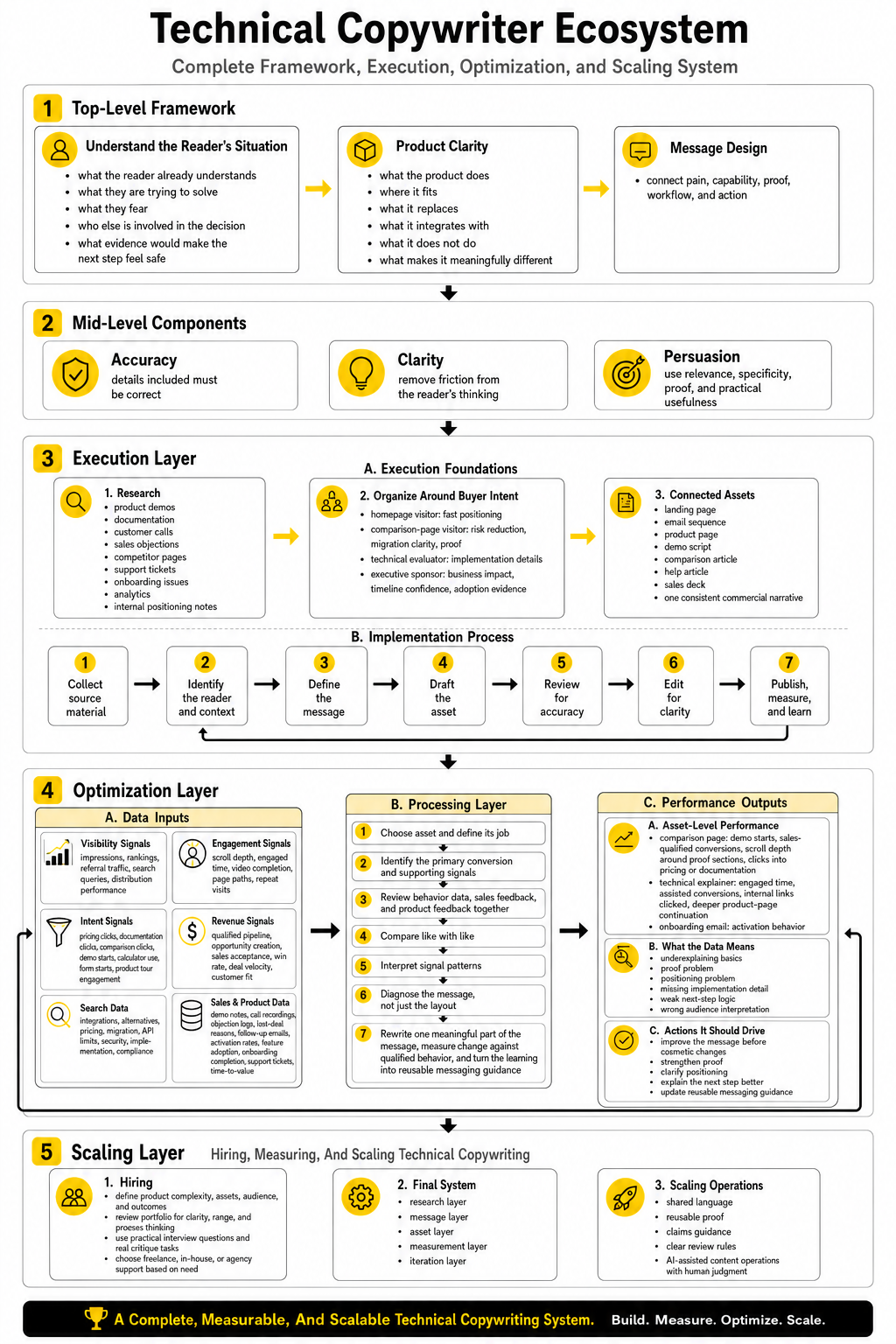
The Final Technical Copywriting System
A complete technical copywriting system connects research, messaging, execution, measurement, and iteration. It gives the company a way to explain technical value consistently without freezing the message forever. The system should be stable enough to create alignment and flexible enough to improve as the market, product, and buyer questions change.
The final system has five practical layers:
This is the difference between hiring someone to write isolated pages and building a communication advantage. The technical copywriter becomes part of how the company learns from buyers and turns that learning into clearer, stronger, more useful content. That is where the role becomes strategic.
Common Mistakes To Avoid
The first mistake is confusing technical depth with technical clarity. A page can be full of accurate information and still fail because the reader cannot see what matters. Technical copy should organize complexity, not simply display it.
The second mistake is letting internal language leak into external copy. Teams often use shorthand that makes sense inside the company but means very little to the buyer. A technical copywriter should translate internal language into buyer-facing language without losing precision.
The third mistake is treating AI output as final copy. AI can help with outlines, summaries, variants, and first drafts, but technical content needs verification. The risk is not just awkward writing; the risk is confident inaccuracy.
The fourth mistake is failing to connect copy with the product experience. If the copy promises fast setup but onboarding feels unclear, the message breaks. The buyer may convert, but the customer loses trust later.
The fifth mistake is measuring only the final conversion. Technical copy often supports long evaluation cycles, internal sharing, and assisted decisions. If the team only tracks direct conversions, it may undervalue the assets that actually build confidence.
What does a technical copywriter do?
A technical copywriter writes persuasive content for complex products, services, or systems. They help buyers understand what the product does, why it matters, how it works at a practical level, and why it is worth evaluating. The role blends product understanding, buyer research, messaging strategy, and conversion-focused writing.
How is a technical copywriter different from a technical writer?
A technical writer usually focuses on documentation, instructions, help articles, API references, and user guidance. A technical copywriter focuses on commercial content such as product pages, landing pages, comparison pages, emails, sales enablement, and technical explainers. Both need clarity and accuracy, but the technical copywriter also has to persuade and move the buyer toward a business action.
When should a company hire a technical copywriter?
A company should hire a technical copywriter when the product is hard to explain, the sales team keeps answering the same basic questions, conversion rates are weak despite decent traffic, or buyers struggle to understand the difference between the company and its competitors. It is also useful before a major launch, website rewrite, positioning update, or expansion into a more technical market. The earlier the writer gets involved, the easier it is to build a message system instead of patching scattered assets later.
What industries need technical copywriting most?
Technical copywriting is especially useful in SaaS, AI, cybersecurity, fintech, healthtech, developer tools, data platforms, automation, cloud infrastructure, industrial technology, and B2B services with complex delivery models. These industries often require the buyer to understand workflows, integrations, risk, implementation, and proof before taking action. A general marketing message usually is not enough.
What skills should a technical copywriter have?
A technical copywriter should be able to research deeply, interview subject-matter experts, understand product documentation, simplify complex ideas, write persuasive copy, and organize information around buyer intent. They should also know how to handle claims carefully, work with reviewers, and use data to improve performance. The best ones are curious, practical, and comfortable asking direct questions.
Does a technical copywriter need to know how to code?
Not always. For developer tools, APIs, infrastructure, and engineering-heavy products, some coding literacy can be very useful. For other technical markets, the writer may not need to code, but they still need to understand the product well enough to ask intelligent questions and avoid inaccurate claims.
What should a technical copywriter ask before starting a project?
They should ask who the reader is, what problem the product solves, what the reader already believes, what objections block action, what proof supports the claims, and what the copy needs to achieve. They should also ask for product documentation, demo access, customer insights, competitor pages, sales feedback, and subject-matter expert input. Without those inputs, the copy is likely to become generic.
How do you measure technical copywriting performance?
Measurement depends on the asset. A landing page might be measured by qualified conversions, form starts, demo requests, and sales feedback. A technical explainer might be measured by engaged time, internal clicks, assisted conversions, and the quality of follow-up behavior.
Can AI replace a technical copywriter?
AI can help a technical copywriter work faster, but it cannot fully replace the judgment required for technical accuracy, buyer understanding, positioning, proof selection, and risk control. This matters because B2B teams are already using AI heavily, while many still lack mature daily workflows for it. A strong technical copywriter can use AI as leverage while still owning the thinking.
What makes technical copy persuasive?
Technical copy becomes persuasive when it makes the buyer feel understood and reduces the risk of taking the next step. It should explain the product clearly, connect features to real use cases, support claims with proof, and answer the questions that matter at that stage of the journey. Persuasion comes from relevance and credibility, not hype.
How long should technical copy be?
Technical copy should be as long as the decision requires and as short as the reader’s patience allows. Early-stage pages usually need faster orientation and clearer signposting. High-intent pages, comparison content, security pages, and implementation guides often need more detail because the reader is closer to a real decision.
What is the biggest technical copywriting mistake?
The biggest mistake is writing before the product, buyer, and proof are clear. That leads to vague claims, generic benefits, and copy that sounds polished but does not help the buyer decide. A technical copywriter should slow down at the research stage so the final copy can move faster.
How can technical copy support sales teams?
Technical copy helps sales teams by answering basic questions before calls, giving champions language they can share internally, and creating assets that support stakeholder alignment. It can also reduce repeated objections when product pages, comparison pages, and follow-up emails explain the right things clearly. Better copy does not replace sales; it makes sales conversations more useful.
What should be included in a technical copywriting system?
A technical copywriting system should include buyer research, positioning, approved terminology, value propositions, proof points, objection handling, claims guidance, channel-specific templates, and a measurement process. It should also include review rules so subject-matter experts, marketing, legal, and sales know what kind of feedback they are responsible for. That system keeps the message consistent as the company grows.
Build a stronger local presence with BAAM AI
Turn your website, Google profile, social channels, and AI visibility into one growth engine
Most businesses do not need more random marketing activity. They need a consistent presence system that helps the right people find them, trust them, and take action. BAAM AI brings strategy, local SEO, website updates, Google Maps visibility, social content, AI-search readiness, media production, and reporting into one practical monthly engine.
If you want your marketing to keep working after the campaign ends, start with a free BAAM AI presence audit. See how your business shows up today and where the fastest visibility wins are at BAAM AI.