
BAAM AI Blog
Target Customer: How To Define, Understand, And Reach The People Most Likely To Buy
A target customer is not “anyone who might be interested.” It is the specific type of person or business most likely to need your offer, understand its value, trust your positioning, and take action at the right...
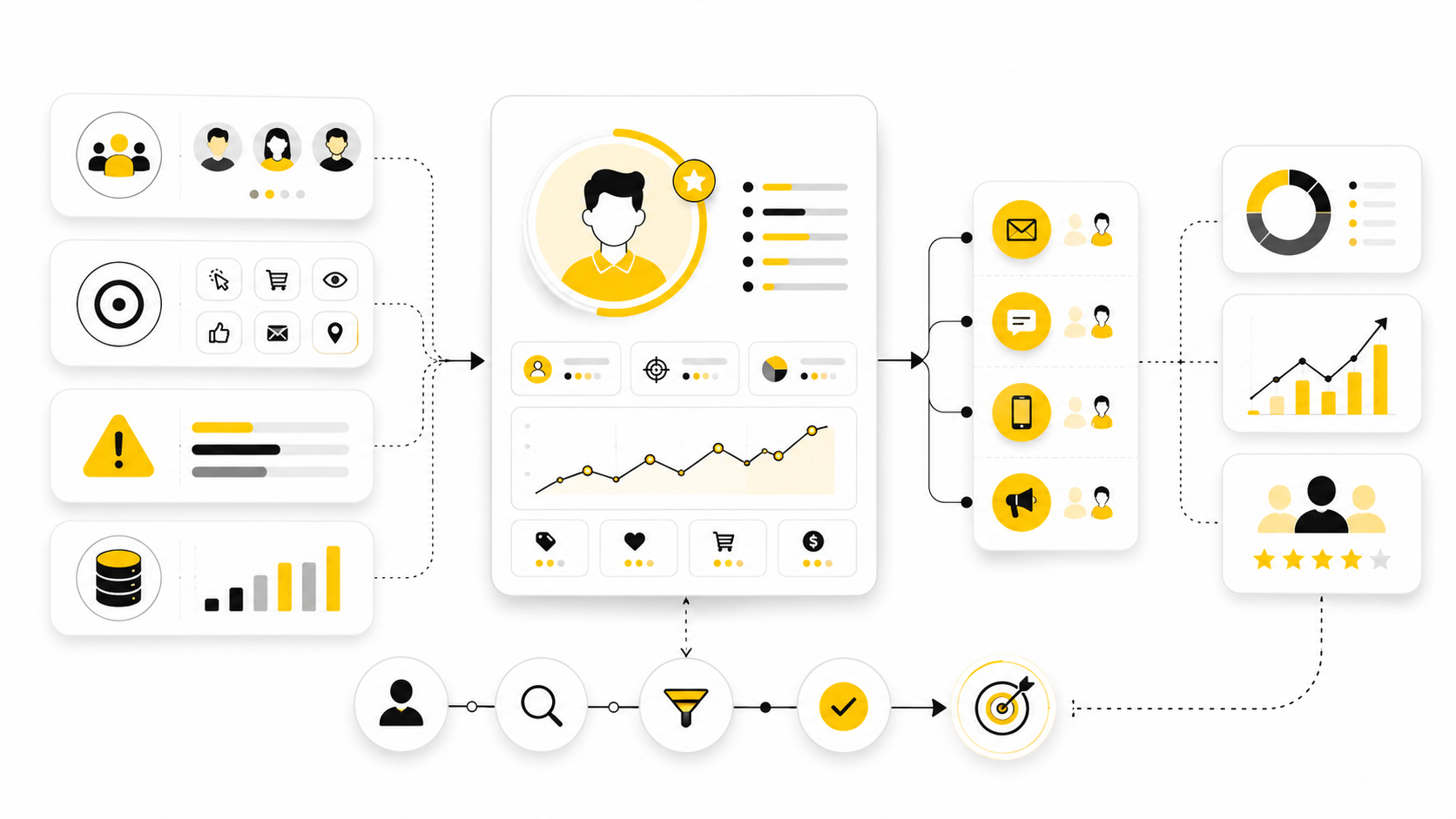
A target customer is not “anyone who might be interested.” It is the specific type of person or business most likely to need your offer, understand its value, trust your positioning, and take action at the right moment. When you define that customer clearly, marketing stops feeling like guessing and starts becoming a practical system.
This matters because most weak campaigns do not fail from lack of effort. They fail because the message is too broad, the offer is aimed at too many people, and the team is trying to sell with vague assumptions instead of clear customer insight. A strong target customer definition gives your content, ads, sales process, product decisions, and retention strategy one shared direction.
The goal of this guide is to make the concept useful, not theoretical. We will break down what a target customer really is, why it matters, how to build a practical framework, what data to use, and how to turn the insight into real marketing execution. By the end, you should be able to describe your best customer in a way that your team can actually use.
Target Customer Foundations And Article Roadmap
A target customer is the practical answer to one strategic question: who is this business built to serve best? That answer should be specific enough to guide decisions, but not so narrow that it becomes a fictional character nobody can find in the market. The best version sits between broad demographics and overly detailed personas.
For example, “small business owners” is usually too wide to be useful. “Service-based local business owners doing $300,000 to $2 million in annual revenue who rely on booked appointments and need more predictable lead flow” is much stronger. It tells you what they sell, how they grow, what pressure they feel, and where your offer might fit.
this guide will treat the target customer as a strategic asset, not a marketing worksheet. That means we will look at buying triggers, pain points, decision criteria, objections, channels, budgets, and the conditions that make someone a high-fit customer. A good profile should help you decide what to say, what to build, where to show up, and who not to chase.
Why It Matters
Defining your target customer matters because attention is expensive and trust is fragile. When your message speaks to everybody, it usually lands with nobody because it lacks the detail that makes a buyer feel understood. Clear targeting makes your marketing sharper because it forces you to match the customer’s real situation instead of promoting generic benefits.
It also protects your business from bad-fit growth. Not every sale is a good sale, especially when customers require heavy support, misunderstand the offer, churn quickly, or never had the right problem in the first place. A strong target customer definition helps you attract people who are more likely to succeed with what you sell.
This becomes even more important as channels get noisier. Ads, email, social content, webinars, landing pages, sales calls, and follow-up automation all perform better when they are built around a clear customer. The message can be simpler, the offer can be more relevant, and the buying path can feel more natural.
Framework Overview
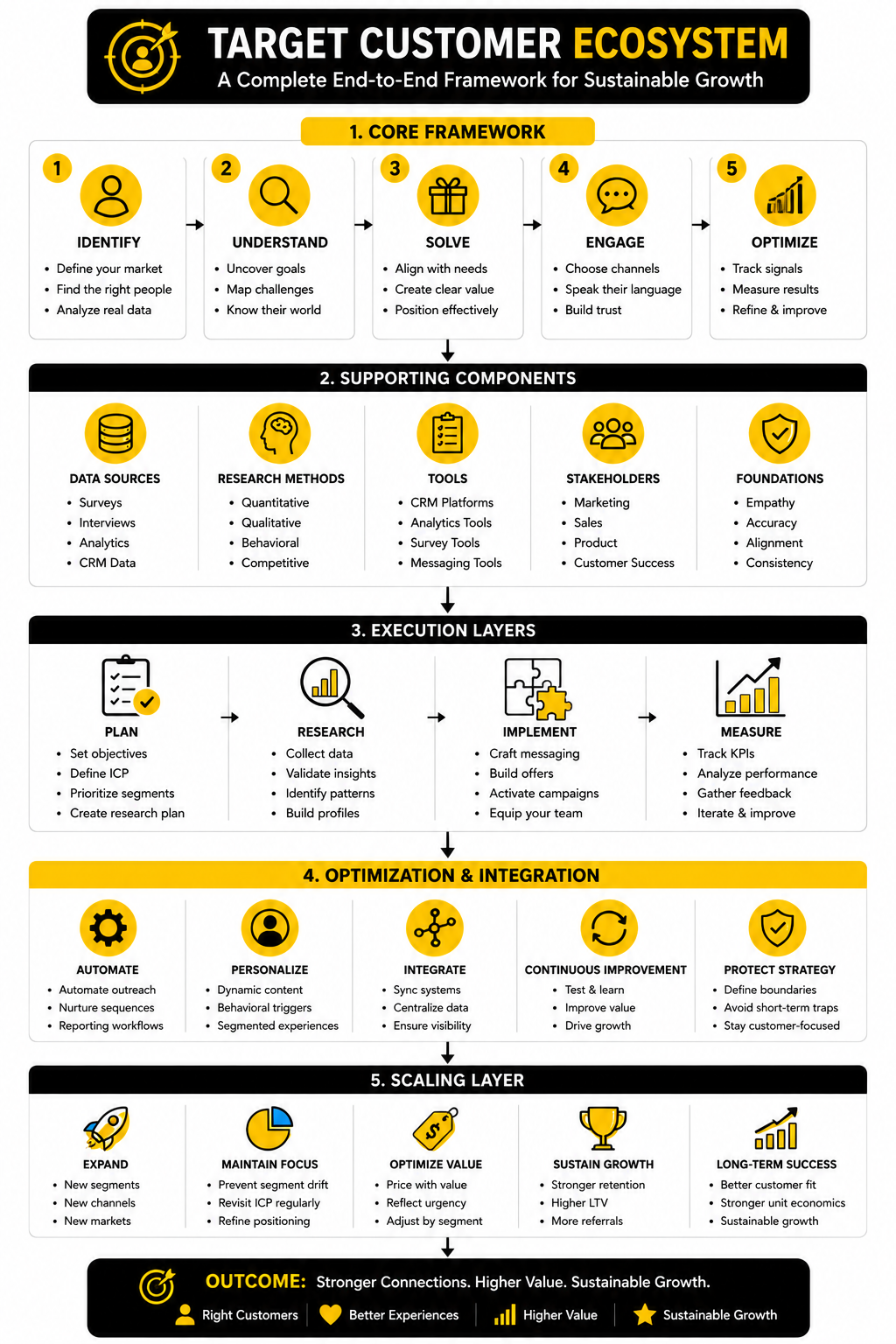
A useful target customer framework starts with the market, then narrows into segments, then identifies the best-fit customer inside those segments. The point is not to invent a perfect buyer in your head. The point is to use evidence, patterns, and real customer behavior to define who is most likely to buy and stay.
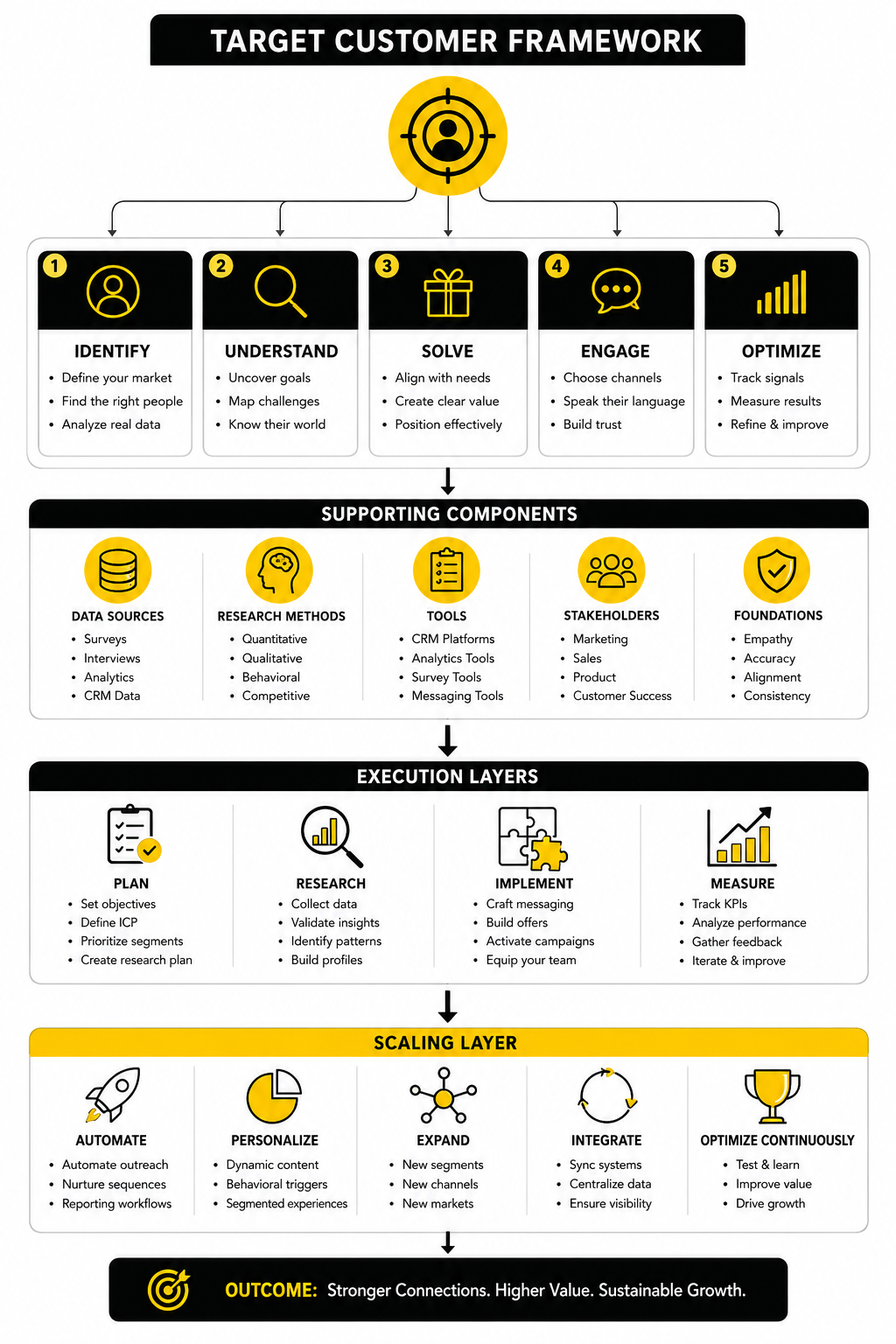
The framework here will move through four layers: market context, customer segment, buying situation, and execution strategy. Market context explains where demand exists. Customer segment explains who shares the same needs, buying behavior, and success potential.
Buying situation is where the profile becomes practical. It looks at the trigger that makes the customer search, the pain that creates urgency, the objections that slow them down, and the outcome they actually want. Execution strategy then turns that insight into positioning, offers, content, funnels, sales conversations, onboarding, and retention.
Core Components
A strong target customer profile is built from more than age, location, job title, or company size. Those details can help, but they rarely explain why someone buys. The deeper value comes from understanding the problem, the moment of need, the desired outcome, and the decision process.
The core components include customer identity, current situation, pain points, buying triggers, desired outcomes, objections, decision criteria, preferred channels, and value potential. Each component answers a different question about the customer. Together, they create a profile your team can use across strategy and execution.
This is where many businesses go wrong. They create a persona with surface-level details, then never connect it to landing pages, email sequences, offers, sales scripts, or product priorities. A target customer profile only matters if it changes what the business does.
Professional Implementation
Professional implementation means turning the target customer definition into daily decisions. Marketing should use it to shape positioning, content topics, ad angles, landing page copy, lead magnets, and nurture sequences. Sales should use it to qualify leads, frame discovery questions, handle objections, and recognize when a prospect is not a fit.
Product teams can use the same insight to prioritize features, improve onboarding, and remove friction from the customer journey. Customer success teams can use it to spot risk signals, personalize support, and understand what different customers need to get value faster. When every team works from the same customer definition, the business becomes more aligned.
The key is to keep the profile alive. Your target customer can change as the market shifts, your offer improves, competitors reposition, or your best customers reveal new buying patterns. That is why the final part of this guide will cover measurement, optimization, and the questions businesses should revisit regularly.
Why Your Target Customer Shapes Growth
A clear target customer gives growth a direction. Without it, every campaign becomes a loose experiment, every offer sounds a little generic, and every sales conversation depends too much on improvisation. You can still get some customers that way, but it is hard to build a repeatable system.
The problem is not that broad marketing never works. The problem is that broad marketing usually hides what is really happening. You may get clicks, leads, calls, and even sales, but you will not know which customers are profitable, which ones stay, which ones refer, and which ones quietly drain the business.
That is why the target customer sits close to the center of strategy. It shapes how you position the offer, how you choose channels, how you write copy, how you qualify leads, and how you decide what not to pursue. Growth gets easier when the business knows exactly who it is trying to win.
Clear Targeting Makes Your Message Sharper
A strong message does not start with clever writing. It starts with knowing the person on the other side well enough to speak to their real situation. When you understand your target customer, your copy can name the problem clearly, explain the cost of inaction, and show why your offer fits the moment they are in.
This matters because customers are exposed to endless generic claims. “Save time,” “grow faster,” and “get better results” are not wrong, but they are too vague on their own. A target customer profile gives those claims context, which is what makes them feel relevant.
For example, a message aimed at a solo consultant should not sound the same as a message aimed at a multi-location service business. Both may want more leads, but their constraints, buying process, budget, and urgency are different. When the message reflects those differences, the customer does less mental work to understand why the offer matters.
Better Customers Usually Come From Better Fit
Not every customer is equally valuable. Some customers buy quickly, use the product properly, get results, and stay for a long time. Others need constant convincing, ignore the process, resist the price, and leave before they ever experience the full value.
A well-defined target customer helps you spot the difference earlier. It gives you a practical way to separate good-fit demand from distracting demand. That is important because growth is not just about adding more customers; it is about adding the right customers in a way the business can support.
This is especially true for service businesses, agencies, SaaS companies, coaches, consultants, and B2B offers. The wrong customer can consume hours of delivery, support, and sales attention while producing weak margins. The right customer makes the business more stable because the offer, expectations, and outcome are aligned from the start.
Target Customer Clarity Improves Channel Decisions
Every marketing channel has a hidden cost. Social content costs time. Paid ads cost budget. SEO costs patience. Email costs trust. Sales outreach costs attention and reputation. When you know your target customer, you can choose channels based on how they actually discover, evaluate, and buy.
This prevents a common mistake: copying another business’s channel strategy without knowing whether your customers behave the same way. A creator-led brand, a local service company, and an enterprise SaaS product may all use content, but the customer journey behind that content will look completely different. The channel is only useful when it matches the buyer’s behavior.
Modern buyers also do more research before they speak to a company. In B2B, a 2025 Gartner-reported survey found that 61% of buyers preferred a rep-free buying experience, and the same report noted that irrelevant outreach actively pushes buyers away. That makes target customer clarity even more important because your digital touchpoints often do the selling before a human conversation ever happens.
Personalization Depends On Customer Understanding
Personalization is not just adding a first name to an email. Real personalization means the offer, message, timing, and next step reflect what the customer is trying to do. You cannot do that well without a clear target customer and a clean understanding of the segments inside your market.
This is where many businesses overcomplicate things. They buy tools, build automations, and create funnels before they understand the customer journey. Then they wonder why the experience feels robotic even though the system is technically advanced.
The better sequence is simple: understand the customer first, then automate around that understanding. If you are building lead capture, nurture, and follow-up journeys, platforms like GoHighLevel, ClickFunnels, or systeme.io are most useful when the message behind the automation is already clear.
Sales Conversations Become Easier
A clear target customer does not only help marketing. It also makes sales conversations more focused because the team knows what to listen for. Instead of pitching every feature, sales can diagnose fit, understand urgency, and connect the offer to the customer’s actual decision criteria.
This changes the tone of the conversation. The goal becomes helping the right person make a confident decision, not forcing a generic pitch onto anyone who showed interest. That makes the process feel more consultative and less desperate.
It also improves qualification. A good sales process should identify who is ready, who needs education, who is not a fit, and who may become a fit later. Without a target customer definition, those decisions become subjective and inconsistent.
Product And Offer Decisions Get Cleaner
Your target customer should influence what you build and what you leave out. Businesses often add features, services, bonuses, or packages because a few loud prospects asked for them. That can create a bloated offer that becomes harder to explain, harder to deliver, and harder to scale.
When you know who the offer is for, decisions become cleaner. You can ask whether a feature helps the target customer reach the desired outcome faster, with less friction, or with more confidence. If it does not, it may be a distraction.
This applies to simple offers too. A landing page, lead magnet, audit, consultation, trial, webinar, or onboarding flow should all be designed around the same customer reality. The more aligned those pieces are, the more natural the buying journey feels.
Weak Targeting Creates Expensive Noise
Weak targeting often looks busy from the outside. The business is posting content, running ads, building funnels, testing emails, and taking sales calls. But underneath all that activity, the message is scattered because the company is not fully sure who it is trying to win.
That kind of noise is expensive. It creates low-quality leads, unclear reporting, inconsistent sales calls, and content that does not compound. Worse, it can make the team believe the channel is broken when the real issue is poor customer definition.
This is why target customer work should happen before scaling spend. More traffic will not fix a vague offer. More automation will not fix weak positioning. More content will not fix a message that is aimed at the wrong person.
The Best Target Customer Is Specific, But Not Fragile
There is a balance here. A target customer should be specific enough to guide execution, but flexible enough to reflect the real market. If the profile becomes too rigid, you may ignore profitable customers who do not match the document perfectly.
The best approach is to define your primary target customer, then support it with adjacent segments. The primary profile guides the main message and offer. Adjacent segments give you room to adapt without losing focus.
This keeps the strategy practical. You are not trying to reduce real people into a tiny box. You are trying to understand who is most likely to value your offer, buy it for the right reasons, and succeed after the purchase.
Targeting Creates Strategic Trade-Offs
Defining a target customer means choosing. That is the uncomfortable part. When you decide who the business is really for, you also decide which messages, channels, offers, and prospects deserve less attention.
Those trade-offs are not a weakness. They are what make strategy useful. A business that refuses to choose usually ends up with watered-down positioning and a sales process full of exceptions.
The goal is not to exclude people for the sake of being narrow. The goal is to focus your strongest energy on the customers most likely to create mutual value. That is where growth becomes more predictable, because the business is no longer chasing every possible buyer.
The Link Between Target Customer And Trust
Trust grows when customers feel understood. They want to see that you know their problem, respect their context, and can help them reach a specific outcome. A clear target customer profile gives you the raw material to create that feeling across every touchpoint.
This is not just a branding issue. Trust affects clicks, replies, booked calls, referrals, retention, and pricing power. When the market believes your offer is built for people like them, the buying decision becomes less risky.
That is the real reason target customer work matters. It is not a worksheet exercise. It is the foundation for sharper marketing, cleaner sales, stronger delivery, and better long-term customer relationships.
The Target Customer Framework
Once you understand why the target customer matters, the next step is turning that idea into a usable process. This is where most businesses either get serious or drift back into guesswork. A framework matters because it gives you a repeatable way to move from market noise to a customer profile your team can actually use.
The process should not begin with a cute persona name or a stock-photo customer description. Start with the market, then narrow into segments, then identify the buying situation, then translate the insight into execution. That sequence keeps the work grounded in reality instead of imagination.
A practical target customer framework has four layers:
Each layer answers a different question. Market context asks where demand exists. Customer segments ask which groups share similar needs and behavior. Buying situation asks what pushes the customer to act. Execution system asks how the business will reach, convert, serve, and retain that customer.
Start With Market Context
Market context is the wide-angle view. Before you define a target customer, you need to understand the environment they are buying inside. That includes the category, competitors, alternatives, pricing expectations, buying habits, and the forces creating urgency.
This step prevents you from building a profile in isolation. A customer does not wake up thinking about your brand first. They compare options, delay decisions, ask peers, search online, use existing tools, and evaluate whether the problem is painful enough to solve now.
Good market context also shows where your offer has the best chance to matter. Sometimes the strongest opportunity is not the largest market. It is the market segment where the pain is sharper, the current solution is weaker, and the customer has a clear reason to change.
Separate Segments Before Choosing A Target
A segment is a group of customers who share meaningful similarities. Those similarities can include industry, business model, revenue stage, job role, problem type, buying trigger, budget, urgency, or usage behavior. The key word is meaningful, because not every difference deserves its own segment.
For example, age and location may matter in some consumer categories, but they may be almost useless for a B2B software offer. A better segmentation might be based on team size, workflow complexity, compliance needs, or the cost of doing nothing. The goal is to group customers by what actually changes how they buy.
Once you see the segments clearly, choosing a target customer becomes a strategic decision instead of a guess. You can compare each segment by pain intensity, willingness to pay, ease of reach, competitive pressure, retention potential, and delivery fit. That makes the decision more honest.
Find The Buying Situation
The buying situation is where the target customer profile becomes useful. It explains what is happening in the customer’s world when they start caring enough to act. This is often more important than who they are on paper.
A customer may match your demographic or firmographic criteria and still have no urgency. Another customer may look less obvious at first, but they are actively dealing with a painful trigger that makes your offer highly relevant. The trigger is what turns a passive audience into an active buyer.
Look for the moment that creates motion. It could be a failed launch, rising ad costs, too many missed leads, a new competitor, a hiring bottleneck, a compliance change, a messy CRM, a weak onboarding process, or a founder finally realizing manual follow-up is costing money. A strong target customer definition captures that moment clearly.
Map The Decision Process
A target customer is not only a person with a problem. They are also a decision-maker inside a process. That process may be fast and emotional, or slow and committee-driven, depending on the offer.
For simple consumer purchases, the decision may happen in minutes. For higher-ticket services or B2B offers, the customer may need internal approval, budget justification, risk reduction, proof, and multiple conversations. If you ignore the decision process, your marketing may create interest but fail to create action.
This is why your framework should define who influences the purchase, who approves it, who uses the product, and who feels the pain most directly. In small businesses, those roles may be the same person. In larger companies, they are often split across several people with different priorities.
Turn Insight Into A Step-By-Step Process
This is the point where the framework becomes execution. You are not just describing the target customer anymore. You are building a system around them.
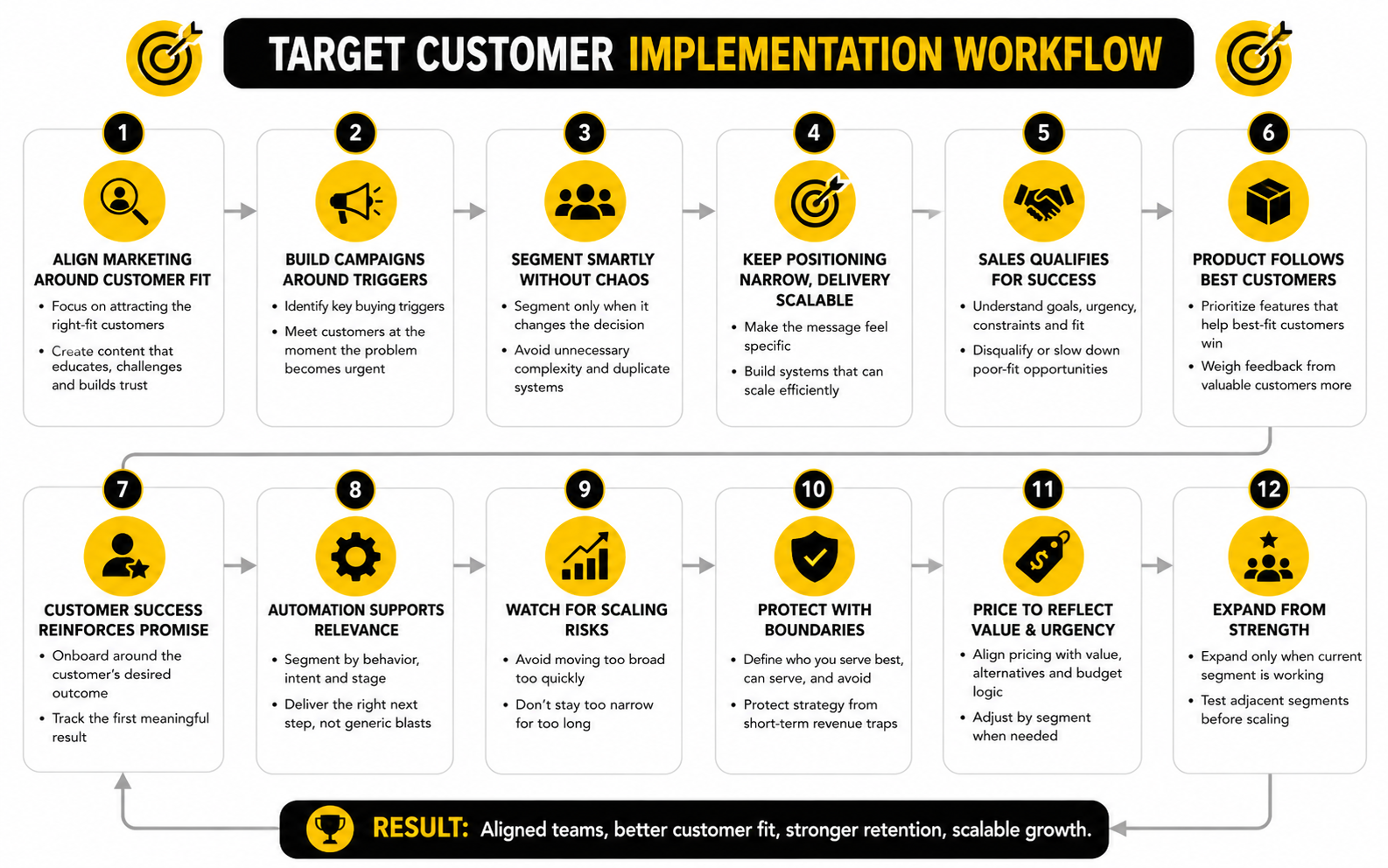
Use this process to make the work practical:
Each step should produce something your team can use. Customer data should become patterns. Patterns should become segments. Segments should become a chosen target customer. The target customer should then shape the offer, message, funnel, content, sales process, and retention plan.
Step 1: Collect Real Customer Data
Start with what customers have already shown you. Look at sales calls, support tickets, reviews, CRM notes, website analytics, email replies, onboarding feedback, churn reasons, and purchase history. You are looking for patterns that explain why people buy, why they hesitate, and why they stay.
Do not rely only on surveys. Surveys can help, but customers often describe themselves differently from how they behave. Behavior gives you the stronger signal because it shows what people actually did when money, time, or risk was involved.
You can also collect insight through forms, quizzes, chat conversations, and call notes. Tools like Fillout, ManyChat, and Chatbase can support that process when the questions are designed around useful customer insight instead of vanity data.
Step 2: Group Customers By Meaningful Patterns
Once you have the raw data, look for repeated patterns. Which customers bought fastest? Which ones had the clearest pain? Which ones needed the least convincing? Which ones stayed longer or expanded over time?
The goal is to avoid treating all customers as equal. A low-ticket customer who creates constant support demand may look good in acquisition reporting but weak in profit. A smaller segment with stronger retention and clearer urgency may be much more valuable.
This is where segmentation becomes practical. You are not creating segments because a textbook says so. You are grouping people because different types of customers need different messages, proof, offers, and buying paths.
Step 3: Choose The Strongest-Fit Segment
After grouping customers, choose the segment with the best combination of demand, fit, reachability, and value. This does not always mean choosing the biggest group. Often, the best target customer is the group with the strongest pain and the clearest reason to trust your offer.
A useful way to judge segments is to score them across five criteria:
This step forces strategic honesty. A segment may be attractive because it is large, but if the customers are hard to reach, slow to decide, or unlikely to succeed, it may not be the right primary target. The best segment is the one where your business can create clear value and capture value consistently.
Step 4: Define The Buying Trigger And Desired Outcome
The buying trigger explains why the customer acts now. The desired outcome explains what they want life or business to look like after the problem is solved. You need both.
Without the trigger, your message has no urgency. Without the desired outcome, your offer has no emotional pull. A customer does not just buy software, coaching, automation, design, or consulting; they buy a better version of their current situation.
Write this in plain language. “They need a CRM” is weaker than “they are losing leads because follow-up is inconsistent and nobody can see where each prospect stands.” The second version gives you a much stronger foundation for messaging, offers, and sales conversations.
Step 5: Document Objections And Decision Criteria
Every target customer has friction. They may worry about price, time, complexity, trust, switching costs, internal approval, technical setup, or whether the offer will work for their specific situation. If you do not document those objections, your marketing will avoid the exact issues customers need help resolving.
Decision criteria are the positive side of that same process. They explain what the customer needs to see before they feel confident. That might include proof, speed, integrations, support, simplicity, guarantees, case studies, or a clear onboarding path.
This is not about manipulating people. It is about removing uncertainty. When your content and sales process answer the real questions in the buyer’s mind, the decision feels safer.
Step 6: Match The Message To The Customer’s Situation
Once the target customer is clear, messaging becomes much easier. You can speak to the customer’s current pain, the trigger that made it urgent, the outcome they want, and the proof they need. That is far stronger than listing features and hoping people connect the dots.
A good message should make the customer feel recognized quickly. It should show that you understand the problem, the stakes, and the path forward. It should also make clear who the offer is not for, because that protects the business from poor-fit leads.
This is where funnel tools and landing page builders can be useful, but only after the strategy is clear. A page built in Replo, ClickFunnels, or systeme.io will only convert well when the message is built around a real customer situation.
Step 7: Build The Journey Across Channels
Your target customer should shape the full journey, not just the first ad or landing page. Think through what they need before they become aware, while they compare options, when they hesitate, after they buy, and when they decide whether to stay. Each stage needs a different type of support.
Content can educate the customer before they are ready to buy. Email can build trust and handle objections over time. Sales calls can clarify fit and urgency. Onboarding can help customers reach the first meaningful result faster.
The tools matter less than the sequence. A platform like GoHighLevel can help connect CRM, funnels, booking, follow-up, and automation, but the system still needs a clear target customer behind it. Automation without customer clarity just makes weak messaging move faster.
Step 8: Measure Quality, Not Just Volume
The final step is measurement. Do not judge the target customer strategy only by traffic, impressions, or lead count. Those numbers can look good while the business is attracting the wrong people.
Measure the quality of the customers coming through the system. Look at qualified lead rate, booked call quality, close rate, onboarding completion, activation, retention, expansion, referrals, support load, and profit margin. These numbers tell you whether the target customer definition is helping the business grow in a healthy way.
This is where the framework loops back on itself. If the wrong customers keep entering the funnel, revisit the message and channels. If the right customers enter but do not convert, revisit the offer, proof, and sales process. If they buy but do not stay, revisit onboarding, expectations, and product fit.
Statistics And Data
Data should make your target customer clearer, not more confusing. The point is not to collect every possible number or build a dashboard that nobody uses. The point is to separate real buying signals from noise so you can improve the way you attract, convert, and retain the right customers.
A good measurement system answers three simple questions. Are we reaching the right people? Are those people moving through the journey in a healthy way? Are they becoming customers who create long-term value for the business?
This is where a lot of teams get distracted. They celebrate reach, clicks, impressions, and form fills before they know whether those numbers are connected to customer quality. Volume can feel exciting, but if the wrong people are entering the funnel, more volume just gives you more problems to sort through later.
The Numbers That Actually Matter
The most useful target customer metrics connect marketing activity to customer quality. You want numbers that show whether your chosen audience is responding, whether the message is creating qualified demand, and whether those customers are worth acquiring. Anything else is secondary.
Start with these core signals:
These metrics tell a story together. A segment with cheap leads but weak close rates may not be as attractive as it looks. A segment with higher acquisition cost but stronger retention, lower support demand, and better expansion potential may be the better target customer.
Do Not Treat Every Lead As Equal
Lead volume is one of the easiest numbers to inflate. You can lower friction, broaden targeting, soften the offer, or create a giveaway that attracts people who were never likely to buy. The dashboard may look better, but the business may be worse off.
That is why qualified lead rate matters more than total lead count. A qualified lead should match the target customer profile, show a relevant problem, have a realistic path to purchase, and fit the offer’s delivery model. If a lead does not meet those standards, it should not be treated as equal to a high-fit opportunity.
This is especially important when you use automated funnels, booking flows, or inbound forms. Tools like Fillout can help you capture better qualification data, but the questions need to reflect what makes someone a strong fit. Ask about the customer’s situation, urgency, budget range, current solution, and desired outcome instead of only collecting basic contact details.
Conversion Rate Means More When You Segment It
A single conversion rate can hide the truth. Your landing page may convert at an acceptable average, while the best-fit segment converts strongly and poor-fit visitors barely move. If you only look at the average, you may make the wrong decision.
Segment conversion rate shows which audiences respond to which offers, messages, and channels. You can compare conversion by traffic source, campaign angle, industry, company size, customer problem, form answer, lead magnet, or sales page variation. This helps you understand whether your target customer is actually behaving differently from everyone else.
The action is simple. If the target customer converts well, increase focus and improve the journey. If they click but do not convert, revisit the message, proof, offer, and friction points. If they do not click at all, your channel or positioning may be misaligned.
Customer Acquisition Cost Needs Context
Customer acquisition cost only matters when you compare it to customer value. A $50 acquisition cost can be terrible for a low-margin one-time product. A $2,000 acquisition cost can be healthy for a high-retention B2B customer with strong lifetime value.
The mistake is treating CAC as a standalone score. The better question is whether the target customer pays back the acquisition cost fast enough and creates enough value after the first purchase. This is why CAC, lifetime value, margin, and payback period should be reviewed together.
When CAC rises, do not immediately blame the ad platform or channel. Rising acquisition cost can mean the audience is too broad, the offer is too weak, the message is stale, the funnel is leaking, or the business is attracting customers with low buying intent. The number is a signal, not the diagnosis.
Customer Lifetime Value Shows Strategic Fit
Customer lifetime value helps you understand whether a target customer is worth pursuing over time. It captures the bigger picture beyond the first sale. A customer who renews, upgrades, buys again, refers others, and needs less support may be far more valuable than a customer who looks profitable only at the first transaction.
This matters because target customer strategy is not just about who buys. It is about who succeeds after buying. Academic work on lifetime value modeling has shown why future value is not always simple to estimate, especially when customers behave unevenly or churn after one purchase, which is exactly why businesses need careful interpretation instead of rough guessing customer lifetime value prediction research.
For practical use, you do not need a perfect model on day one. Start by comparing average order value, repeat purchase rate, retention, gross margin, support demand, and referral behavior by customer segment. The goal is to identify which target customer groups create durable value, not just quick revenue.
Retention Tells You Whether The Promise Was Right
Retention is one of the cleanest tests of target customer fit. If the right customers buy for the right reason and receive the value they expected, they are more likely to stay. If they churn quickly, the issue may be targeting, positioning, onboarding, product fit, or expectation setting.
This is why churn should never be treated as only a customer success problem. Marketing may have attracted the wrong people. Sales may have overpromised. The offer may not match the customer’s real constraints. Onboarding may fail to get them to the first meaningful result.
For subscription, SaaS, service, and membership businesses, retention data should feed directly back into the target customer profile. The best customers are not always the easiest to close. Sometimes the best target customer is the one who takes slightly longer to buy but stays longer, gets better outcomes, and creates fewer delivery problems.
Benchmarks Are Useful, But They Are Not The Strategy
Benchmarks can help you spot whether a number is unusually weak or strong. They can also prevent panic when a metric is normal for your category. But benchmarks should not replace your own customer data.
A benchmark tells you what is common. Your customer data tells you what is true for your offer, audience, channel, price point, and business model. Those are not the same thing.
Use benchmarks as a starting point, then build your own internal standard. For example, a lead-to-call rate may be acceptable in one funnel and terrible in another depending on intent, price, and customer sophistication. The better question is whether the number is improving for your chosen target customer and whether that improvement creates better business outcomes.
Build A Simple Analytics System
Your analytics system should connect the full customer journey. You need to see where the target customer came from, what message they responded to, what they did next, whether they became qualified, whether they bought, and whether they stayed. Without that connection, every team ends up arguing from partial data.
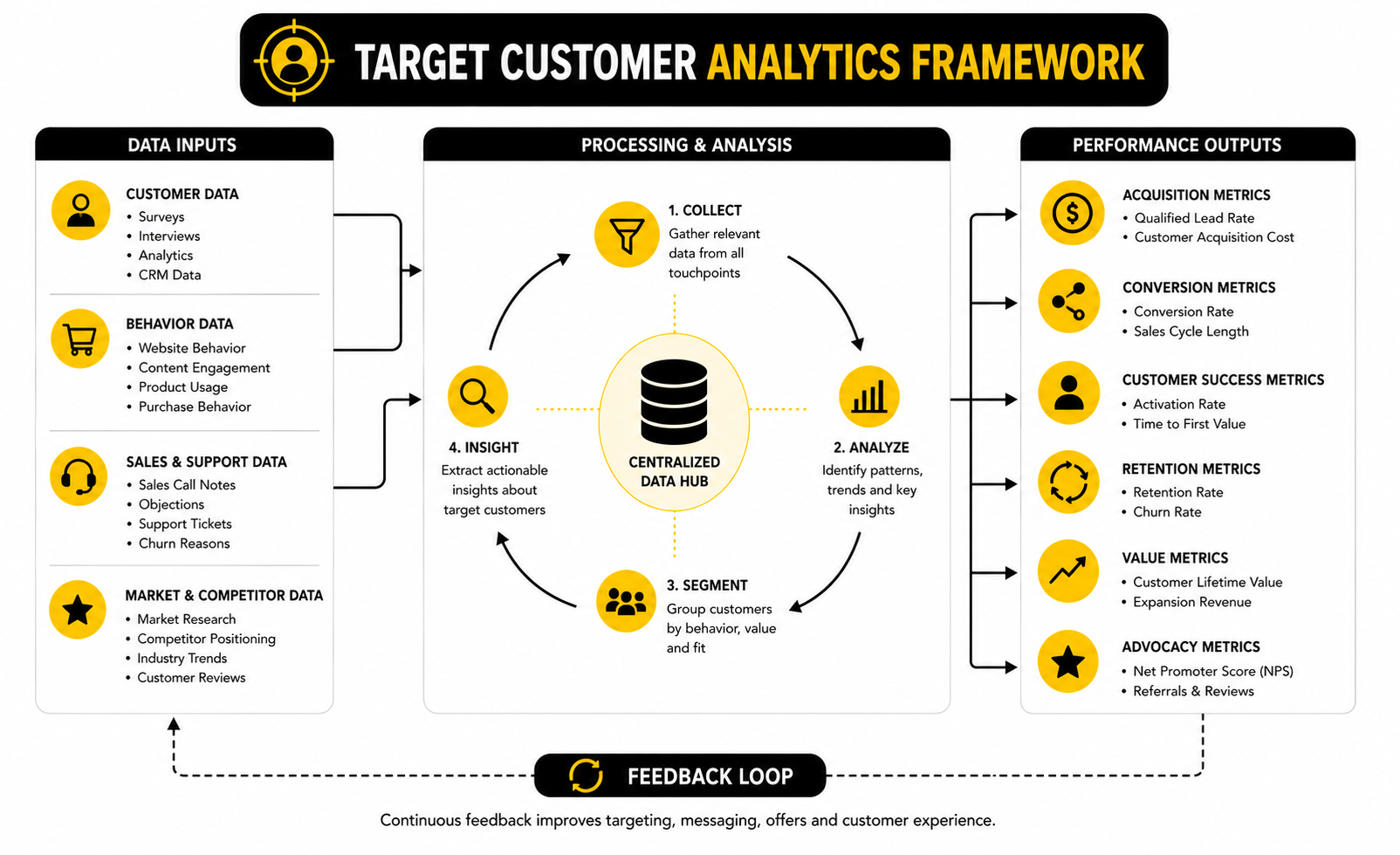
A simple system can track the journey in five stages:
Reach shows whether you are getting in front of the right audience. Engagement shows whether the message is relevant enough to create attention. Qualification shows whether the people responding actually fit the target customer profile. Conversion shows whether the offer and sales process are working. Retention shows whether the promise, product, and customer fit hold up after purchase.
Read The Data In Sequences, Not Snapshots
A single metric rarely tells the full story. Low conversion rate could mean weak traffic quality, unclear messaging, poor offer fit, slow page speed, missing proof, confusing pricing, or a mismatch between promise and buyer intent. You need to read the numbers in sequence.
For example, high engagement with low qualification means the hook is attracting attention from the wrong people. High qualification with low sales conversion means the offer, proof, pricing, or sales process may need work. Strong conversion with weak retention means the business may be selling people who are not set up to succeed.
This sequence-based view is powerful because it keeps you from fixing the wrong thing. Do not rewrite the entire funnel because one number is weak. Find where the customer journey breaks, then fix that specific point.
Separate Leading And Lagging Indicators
Leading indicators show early signs that the target customer strategy is working. These include click quality, form answers, reply quality, booked calls, sales conversation fit, product activation, and early engagement. They help you make faster decisions before the final revenue numbers fully appear.
Lagging indicators show the business result after enough time has passed. These include revenue, profit, retention, customer lifetime value, churn, referrals, and expansion. They matter deeply, but they usually take longer to confirm.
You need both. Leading indicators help you adjust quickly. Lagging indicators keep you honest. A campaign can look promising early and still fail if the customers do not stay, expand, or produce enough value.
Use Qualitative Data To Explain The Numbers
Quantitative data tells you what happened. Qualitative data helps explain why it happened. You need both to understand your target customer properly.
Sales call notes, chat transcripts, survey responses, cancellation reasons, support tickets, reviews, and email replies often reveal the reasons behind the numbers. If conversion drops, customers may be confused about the offer. If churn rises, they may not understand how to get value. If qualified leads slow down, the message may no longer match the market’s current pain.
This is also where AI and automation can help, as long as the data is clean. A tool like Chatbase can help organize customer questions into patterns, while a CRM-focused setup in GoHighLevel can help connect conversations, pipeline stages, and follow-up. The tool is not the strategy, but it can make the signals easier to see.
What The Data Should Change
Data is only useful if it changes decisions. If your target customer analysis never affects the message, offer, budget, funnel, sales process, or onboarding, then the business is just reporting for the sake of reporting. That is a waste.
Use the data to decide:
This is the practical standard. Every important metric should connect to an action. If nobody knows what decision a number supports, it probably does not belong in the main dashboard.
The Best Signal Is Customer Quality Over Time
The strongest target customer signal is not one click, one form fill, one booked call, or one purchase. It is the quality of customers over time. That means looking at the full journey from first touch to long-term value.
A healthy target customer segment should show consistent signs of fit. They should understand the message, move through the buying journey with less friction, buy for the right reasons, use the offer properly, stay longer, and create more value than they cost to acquire and serve.
That is the real measurement goal. You are not trying to prove that a campaign got attention. You are trying to prove that your business is attracting the people it is built to serve best.
Professional Implementation Across Marketing, Sales, And Product
A target customer profile only becomes valuable when it changes how the business operates. It should not sit in a slide deck, hidden in a strategy folder, while the team keeps writing the same generic copy and chasing the same mixed-quality leads. The profile has to show up in marketing decisions, sales conversations, product priorities, customer success, and leadership trade-offs.
This is where execution gets more advanced. At a basic level, a target customer helps you write better messaging. At a professional level, it becomes a filter for resource allocation. It tells the business where to spend time, where to slow down, where to automate, where to personalize, and where to say no.
That last part matters more than most people want to admit. If every customer is treated as equally important, the business eventually bends itself around the loudest customers instead of the best-fit customers. Strong targeting gives you the confidence to protect the strategy.
Align Marketing Around Customer Fit
Marketing should not only be measured by how many people it attracts. It should be measured by how many right-fit people it attracts. That changes the entire tone of the work.
Instead of creating content for broad attention, the team can build around the pains, triggers, objections, and outcomes of the target customer. The strongest content does not simply ask, “What will get clicks?” It asks, “What would help this buyer understand the problem, trust the solution, and move one step closer to a decision?”
This does not mean every piece of content needs to sell directly. Some content should educate, some should challenge false assumptions, some should compare options, and some should reduce risk. But all of it should serve the same strategic audience, otherwise the brand becomes visible without becoming trusted.
Build Campaigns Around Buying Triggers
A buying trigger is one of the most useful inputs in campaign strategy. It gives the message urgency without relying on hype. When you know what causes your target customer to start looking for a solution, your campaign can meet them at the moment the problem becomes expensive enough to solve.
This is different from generic pain-point marketing. A pain point can exist for months without action. A trigger creates movement because something changed in the customer’s world. They missed revenue, lost time, hit capacity, changed roles, launched a new offer, entered a new market, or realized the current system cannot support the next stage of growth.
Campaigns built around triggers usually feel more relevant because they match the buyer’s timing. A CRM offer aimed at “business owners who want to grow” is forgettable. A CRM offer aimed at “service businesses losing booked calls because lead follow-up is inconsistent” is much sharper because it connects the customer, the moment, and the cost of delay.
Use Segmentation Without Creating Chaos
Segmentation is powerful, but too much segmentation can make the business messy. Every new segment can create new landing pages, emails, ad angles, qualification rules, sales scripts, onboarding paths, and reporting views. If the team cannot maintain that complexity, the strategy becomes fragile.
The goal is not to create a separate universe for every customer type. The goal is to identify the segments that genuinely require different messaging, proof, offers, or sales motions. If two segments behave the same way, buy for the same reason, and respond to the same promise, they may not need separate execution.
A practical rule is to segment only when the difference changes a decision. If it changes the offer, segment it. If it changes the buying process, segment it. If it changes onboarding, retention, pricing, or proof, segment it. If it only sounds interesting in a meeting, leave it out.
Keep Positioning Narrow And Delivery Scalable
There is a tension between focused positioning and scalable delivery. Narrow positioning helps the target customer feel understood. Scalable delivery helps the business grow without rebuilding everything for every buyer.
The mistake is thinking you must choose one. You can position around a specific customer situation while building a delivery system that supports several similar use cases. This is how many strong businesses expand without losing clarity.
The key is to separate the front-end message from the back-end operating model. The message should feel specific to the target customer. The delivery system should be structured enough to repeat, improve, and scale without becoming custom chaos.
Sales Should Qualify For Success, Not Just Revenue
Sales teams can easily fall into the trap of closing whoever is willing to buy. That might help the month, but it can hurt the business later if those customers churn, complain, need heavy support, or never reach the promised outcome. Professional implementation means sales qualifies for success, not just revenue.
This starts with better discovery. The salesperson should understand the customer’s current situation, urgency, constraints, expectations, decision process, and definition of success. If those factors do not match the offer, the honest move is to slow the sale down or disqualify it.
That level of discipline is not weakness. It protects margins, customer experience, team morale, and brand reputation. A business that knows its target customer can sell with more confidence because it is not trying to convince the wrong people.
Product Decisions Should Follow The Best Customers
Product and offer decisions become dangerous when they are driven by whoever complains the loudest. The loudest customer is not always the most valuable customer. Sometimes they are simply the least aligned customer.
A clear target customer gives product teams a better filter. When a feature request, service addition, or packaging change appears, the team can ask whether it helps the best-fit customer reach the promised outcome faster, more easily, or more reliably. If it does, the idea deserves attention. If it mainly serves edge cases, it may need to wait.
This does not mean ignoring feedback. It means weighting feedback properly. Ten requests from poor-fit customers should not automatically outweigh three signals from high-value customers who match the business’s strategic direction.
Customer Success Should Reinforce The Original Promise
Customer success is where the target customer strategy gets tested after the sale. If the buyer was promised speed, clarity, simplicity, more leads, better follow-up, or easier execution, the post-purchase experience needs to move them toward that result quickly. Otherwise, the gap between marketing and reality creates churn.
The onboarding process should be built around the customer’s desired outcome, not just product education. Customers do not want to “learn the platform” for its own sake. They want to solve the problem that made them buy.
That is why customer success teams should track the first meaningful result. For one business, that might be the first booked call. For another, it might be the first launched funnel, the first imported contact list, the first completed workflow, or the first successful customer handoff. The exact milestone depends on the target customer and the promise made before purchase.
Automation Should Support Relevance
Automation can make a business faster, but it can also make bad targeting more obvious. If the wrong message goes to the wrong person at scale, the system does not feel efficient. It feels careless.
The right way to automate is to start with customer understanding, then build rules around it. Segment contacts based on meaningful behavior, qualification answers, stage, intent, and previous actions. Then use automation to deliver the right next step instead of blasting the same message to everyone.
For example, a lead who booked a call but did not show up needs a different follow-up than a lead who downloaded a guide and never returned. A qualified target customer with urgent pain should not receive the same sequence as a casual researcher. Platforms like GoHighLevel, Brevo, and Moosend are most useful when they reflect those differences clearly.
Scaling Creates New Target Customer Risks
A target customer profile that worked at one stage may not hold forever. As the business grows, the market changes, the offer matures, competitors react, and new customer segments appear. Scaling can reveal that your original profile was useful, but incomplete.
One risk is moving too broad too quickly. The business sees traction, expands messaging to more audiences, and suddenly the offer becomes harder to explain. The short-term revenue may look good, but the brand loses the sharpness that created demand in the first place.
Another risk is staying too narrow for too long. Sometimes the business has earned the right to expand, but the team keeps clinging to the first target customer because it feels safe. The smart move is to expand deliberately, using data from retention, profit, acquisition cost, and delivery fit instead of guessing.
Watch For Segment Drift
Segment drift happens when the business slowly starts serving a different customer than the one it originally intended to serve. It usually does not happen in one big decision. It happens through small compromises.
A few custom requests get accepted. A few off-profile customers get closed. A few campaigns are launched for easier lead volume. A few product changes are made for accounts that do not represent the future of the company. Eventually, the business wakes up with a customer base that no longer matches the strategy.
This is why regular profile review matters. Leadership should compare the stated target customer against the customers actually entering the funnel, buying, staying, expanding, and referring. If those groups are no longer aligned, the business needs to choose whether to update the strategy or correct the drift.
Price Should Reflect Customer Value And Urgency
Pricing is part of target customer strategy. A customer with urgent pain, clear value potential, and strong ability to pay can support a different pricing model than a customer with low urgency and limited budget. If pricing ignores the target customer, the offer can become misaligned fast.
Underpricing can attract customers who need heavy support but lack commitment. Overpricing can block customers who would succeed but cannot justify the risk yet. The right price depends on the value created, the cost of alternatives, the buyer’s budget logic, and the confidence your proof creates.
This is why pricing should be reviewed by segment, not just overall revenue. If one target customer segment converts at a lower rate but retains longer and expands more, it may deserve a different package, onboarding path, or sales process. Price is not just a number; it is a signal about who the offer is built for.
Do Not Let Tools Replace Strategy
Tools can help you research, capture, segment, follow up, sell, and measure. They cannot decide who your business should serve. That decision requires judgment.
It is easy to build a complex stack before the target customer is clear. You can have a funnel builder, CRM, chatbot, scheduler, email platform, analytics tool, and AI assistant, yet still send weak messages to the wrong people. That is not a software problem.
The stack should come after the strategy. Use ClickFunnels or Replo to build focused landing pages. Use Cal.com when scheduling needs to reduce friction. Use Copper or another CRM only when the pipeline stages reflect how your target customer actually buys.
Create A Target Customer Decision Scorecard
A decision scorecard keeps the target customer from becoming subjective. It gives the team a shared way to evaluate segments, campaigns, leads, partnerships, and product requests. This is especially useful once the business grows beyond one founder or one small team.
The scorecard does not need to be complicated. It should help people make better decisions quickly. The best version uses a few clear criteria and forces the team to explain the trade-off.
Use criteria like:
A high score does not mean the business should chase the segment blindly. It means the segment deserves serious attention. A low score does not mean the customer is bad; it means they may not be the right target customer for this stage of the business.
Protect The Strategy With Clear Boundaries
The strongest target customer strategies have boundaries. They define who the business serves best, who it can serve with adjustments, and who it should avoid. Without those boundaries, every opportunity can look tempting.
This is especially important when cash pressure is high. A business may accept poor-fit customers because it wants short-term revenue. Sometimes that is understandable, but it should be treated as a conscious exception, not a new strategy.
Boundaries protect the business from accidental positioning. They help marketing stay focused, sales stay disciplined, product stay coherent, and customer success stay effective. When the target customer is clear, the business does not need to reinvent itself for every prospect.
Expansion Should Happen From Strength
The best time to expand beyond your original target customer is when the current segment is working. That means acquisition is repeatable, conversion is healthy, retention is strong, delivery is stable, and the team understands why customers buy. Expansion from strength is strategic. Expansion from panic is usually messy.
When you expand, do it one adjacent segment at a time. Choose a segment that shares similar pain, buying behavior, delivery needs, or desired outcomes. Then test the message, offer, and journey before making it a major part of the business.
This keeps growth controlled. You are not abandoning focus. You are extending it carefully. That is how a target customer strategy evolves without becoming vague.
Measurement, Optimization, And FAQ
At this point, the target customer should no longer feel like a static profile. It should feel like a working system. You have the strategy, the process, the measurement layer, and the implementation logic that connects marketing, sales, product, and customer success.
The final step is keeping that system alive. Markets shift, channels get crowded, buyers become more skeptical, competitors copy what works, and customer expectations move. A target customer definition that never gets reviewed eventually becomes a historical document instead of a growth tool.
The best businesses treat customer clarity as an operating habit. They keep learning from the people who buy, the people who do not buy, the people who stay, and the people who leave. That feedback loop is what turns targeting from a one-time exercise into a real advantage.
Keep The Target Customer Profile Updated
Review your target customer profile on a consistent schedule. For a fast-moving business, quarterly is usually practical. For a more stable business, twice a year may be enough, but the profile should still be checked when performance changes suddenly.
Look for changes in lead quality, close rate, sales cycle length, churn, support demand, customer profitability, and buyer objections. If the same pattern appears repeatedly, it probably belongs in the profile. If an old assumption no longer matches the data, update it without getting sentimental.
The goal is not constant reinvention. The goal is controlled refinement. Keep the core strategy stable, but stay honest about what the market is showing you.
Build A Feedback Loop Across Teams
Marketing sees which messages attract attention. Sales hears the objections in real conversations. Product sees which customers actually use the offer properly. Customer success sees where expectations break after purchase.
When those teams do not share what they learn, the target customer profile becomes incomplete. Each team holds a different piece of the truth, and the business starts making decisions from partial information. That is how misalignment grows.
A simple monthly review can fix a lot. Bring together the strongest customer signals, the weakest-fit leads, the best objections, the highest-value customer patterns, and the most common churn reasons. Then decide what should change in messaging, qualification, onboarding, product, or follow-up.
Optimize The System Before Scaling Spend
Scaling should come after customer fit is clear. If the funnel is attracting the wrong people, more traffic will not solve the problem. It will only make the problem louder and more expensive.
Before increasing spend, check whether the right customers are moving through the journey in a healthy way. Are they clicking for the right reason? Are they becoming qualified leads? Are sales conversations productive? Are customers reaching the first meaningful result? Are they staying long enough to justify the acquisition cost?
Once those signals are strong, scaling becomes safer. You are not just buying more attention. You are expanding a system that already proves it can attract and serve the right target customer.
What is a target customer?
A target customer is the specific type of person or business most likely to need your offer, value the outcome, trust your positioning, and buy for the right reasons. It is more focused than a broad audience and more practical than a fictional persona. A strong target customer definition should guide marketing, sales, product, support, and growth decisions.
Why is defining a target customer important?
Defining a target customer helps a business focus its message, budget, offer, and delivery around the people most likely to become valuable customers. Without that clarity, marketing becomes broad, sales becomes inconsistent, and product decisions can drift toward whoever is loudest. Clear targeting makes growth easier to repeat because the business understands who it is built to serve best.
What is the difference between a target customer and a target audience?
A target audience is usually the broader group you want to reach with marketing. A target customer is more specific because it focuses on the people most likely to buy, succeed, and create long-term value. You may have a large audience, but your best target customer is the segment inside that audience with the strongest fit.
How do I identify my target customer?
Start by reviewing real customer data, not assumptions. Look at who buys fastest, who gets the best results, who stays longest, who refers others, and who creates the least friction for the business. Then compare those customers by pain intensity, ability to pay, buying trigger, channel reachability, and long-term value.
What data should I use to define a target customer?
Use a mix of quantitative and qualitative data. Quantitative data includes conversion rates, qualified lead rates, retention, churn, customer lifetime value, acquisition cost, and support load. Qualitative data includes sales call notes, reviews, survey responses, support tickets, cancellation reasons, and customer interviews.
How specific should a target customer profile be?
A target customer profile should be specific enough to guide real decisions, but not so narrow that it becomes unrealistic. It should explain the customer’s situation, problem, trigger, desired outcome, objections, decision process, and fit with your offer. Surface details like age or job title only matter when they change how the customer buys.
Can a business have more than one target customer?
Yes, but one primary target customer should usually guide the main strategy. Additional segments can be useful when they share strong fit but need different messaging, offers, or buying paths. The danger is trying to serve too many segments before the business has enough clarity, budget, and operational capacity.
How often should I update my target customer profile?
Review the profile at least twice a year, and more often if the market moves quickly or performance changes sharply. You should also revisit it after launching a new offer, entering a new market, changing pricing, or seeing a meaningful shift in lead quality or churn. The profile should evolve with evidence, not random opinions.
What are the biggest mistakes businesses make with target customers?
The biggest mistake is defining the target customer too broadly. Other common mistakes include relying on demographics only, ignoring retention data, chasing low-quality leads, building personas nobody uses, and letting poor-fit customers shape the offer. A target customer profile should be practical enough to influence daily decisions.
How does a target customer affect messaging?
A clear target customer makes messaging more specific and believable. It helps you describe the customer’s real problem, explain why it matters now, show the desired outcome, and answer the objections that block action. When the message matches the customer’s situation, the offer feels more relevant.
How does a target customer affect sales?
Sales becomes sharper when the team knows what a good-fit customer looks like. Reps can qualify better, ask stronger discovery questions, handle objections more naturally, and avoid pushing poor-fit prospects into the pipeline. The goal is not just to close deals; it is to close customers who are likely to succeed.
How does a target customer affect product decisions?
Product decisions should support the customers the business most wants to serve. A clear target customer helps teams decide which features, services, packages, and onboarding improvements deserve priority. It also prevents the business from overbuilding for edge cases that do not represent its best customers.
What metrics show whether my target customer strategy is working?
The best metrics connect acquisition to customer quality. Track qualified lead rate, close rate, customer acquisition cost, payback period, activation rate, retention, churn, lifetime value, support load, expansion, and referrals. The strategy is working when the business attracts customers who buy for the right reasons, get value, stay longer, and cost less to serve relative to the value they create.
What should I do if my target customer is not converting?
First, identify where the journey breaks. If they do not click, the channel or message may be wrong. If they click but do not convert, the offer, proof, or page may be weak. If they become leads but do not buy, the sales process, pricing, timing, or qualification may need work.
Should I target the most profitable customers only?
Profit matters, but it should not be the only factor. The best target customer usually combines profitability with reachable demand, clear pain, strong fit, realistic delivery, retention potential, and strategic alignment. A profitable customer who is difficult to reach or impossible to satisfy may not be the best long-term target.
Build a stronger local presence with BAAM AI
Turn your website, Google profile, social channels, and AI visibility into one growth engine
Most businesses do not need more random marketing activity. They need a consistent presence system that helps the right people find them, trust them, and take action. BAAM AI brings strategy, local SEO, website updates, Google Maps visibility, social content, AI-search readiness, media production, and reporting into one practical monthly engine.
If you want your marketing to keep working after the campaign ends, start with a free BAAM AI presence audit. See how your business shows up today and where the fastest visibility wins are at BAAM AI.