
BAAM AI Blog
Successful Email Campaigns: A Practical Framework for Turning Sends Into Revenue
Successful email campaigns are not built by writing one clever subject line, pressing send, and hoping the list reacts. They come from a clear system: the right audience, the right offer, the right timing, strong...
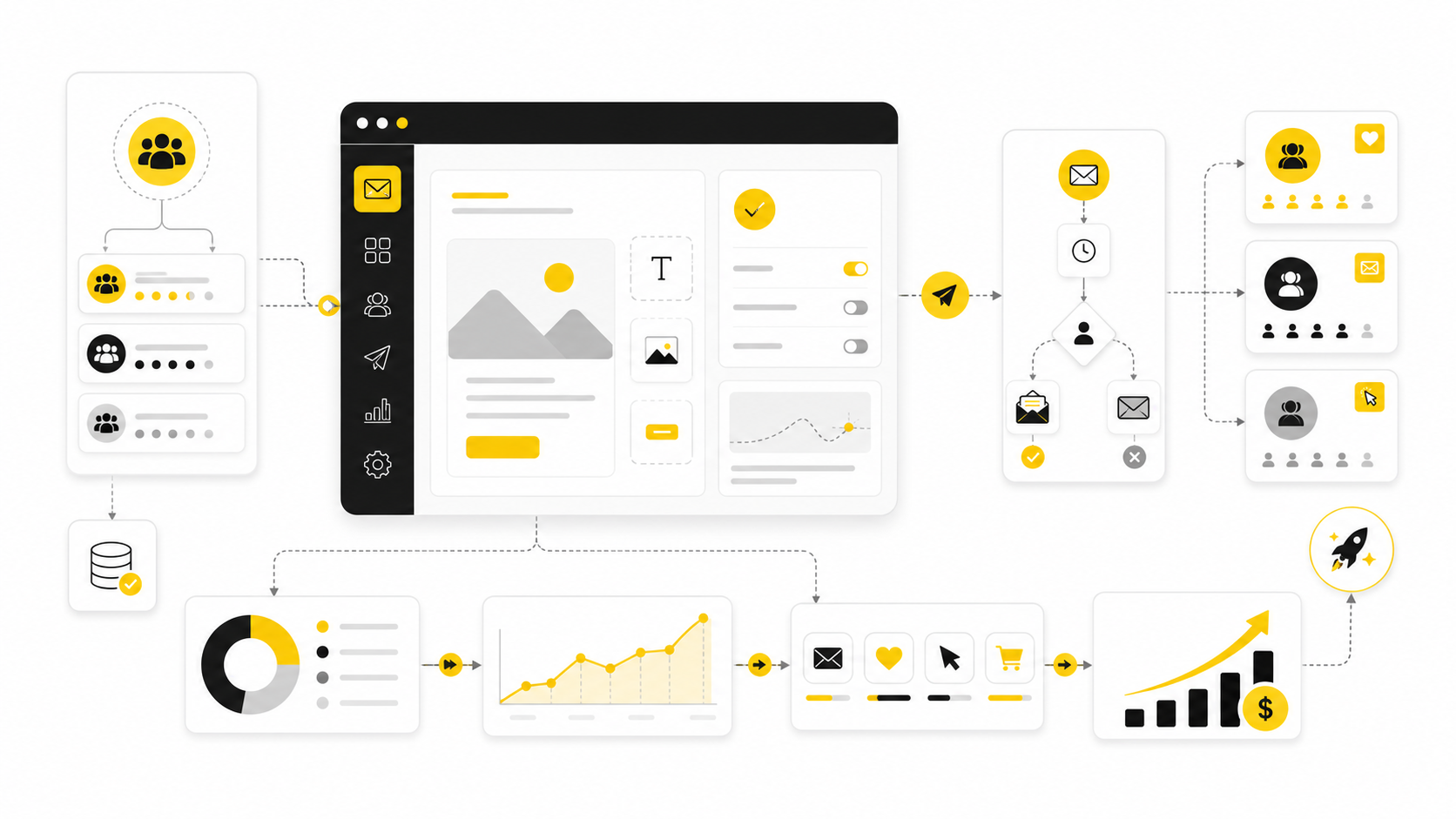
Successful email campaigns are not built by writing one clever subject line, pressing send, and hoping the list reacts. They come from a clear system: the right audience, the right offer, the right timing, strong deliverability, and measurement that connects email activity to business outcomes. That matters because email is still one of the few marketing channels where you can own the relationship instead of renting attention from an algorithm.
The problem is that most email advice is either too tactical or too vague. One side obsesses over open rates, emojis, and send times. The other side says “send value” without explaining how a campaign actually becomes profitable. A better approach is to treat email as a performance channel with creative, data, trust, and operations working together.
Recent benchmark data makes that clear. The UK DMA’s 2025 Email Benchmarking Report showed delivery rates reaching 98%, open rates rising to 35.9%, and unique click rates reaching 2.3%, which is useful context but not the whole picture because opens alone do not prove revenue impact (DMA Email Benchmarking Report 2025). Mailchimp’s benchmark data shows average open rates vary heavily by industry, with some categories around the high 20s and others above 40%, which is why copying another brand’s “winning campaign” usually disappoints (Mailchimp email marketing benchmarks).
this guide is split into six parts so each piece of the system gets enough space. The goal is not to create a generic checklist, but to build a practical operating model for successful email campaigns that can be used by founders, marketers, ecommerce teams, agencies, and B2B operators. Each section builds on the previous one, moving from strategy to execution to optimization.
Why Successful Email Campaigns Still Matter
Email matters because it sits closer to the customer relationship than most marketing channels. Paid ads can create demand, social can build visibility, and search can capture intent, but email is where a business can repeatedly educate, persuade, recover, onboard, renew, and retain. That is why successful email campaigns should be judged by their contribution to pipeline, revenue, retention, repeat purchase, and customer trust, not only by opens and clicks.
The channel is also becoming more demanding. Google’s sender guidelines require proper authentication, easy unsubscribe, and low spam complaints for senders who want reliable inbox placement (Google email sender guidelines). Yahoo’s sender requirements also emphasize authentication, low complaint rates, and easy unsubscribe, which means sloppy list practices are no longer just “bad marketing” - they are a deliverability risk (Yahoo sender best practices).
This is where many teams lose money without seeing it clearly. Sinch Mailgun’s 2026 Email Impact Report is based on more than 400 billion emails sent in 2025 and a survey of more than 1,200 email senders, and its release notes reported that nearly 18% of emails fail to reach the inbox (Sinch Mailgun Email Impact Report). That means a campaign can have strong copy, a solid offer, and a well-built landing page, yet still underperform because the message never gets seen.
The Campaign Performance Framework
A successful email campaign has four jobs: reach the inbox, earn attention, create a relevant reason to act, and make the next step easy. If one of those jobs fails, the campaign leaks performance. That is why email strategy should start with a framework before it gets into templates, subject lines, or automation tools.
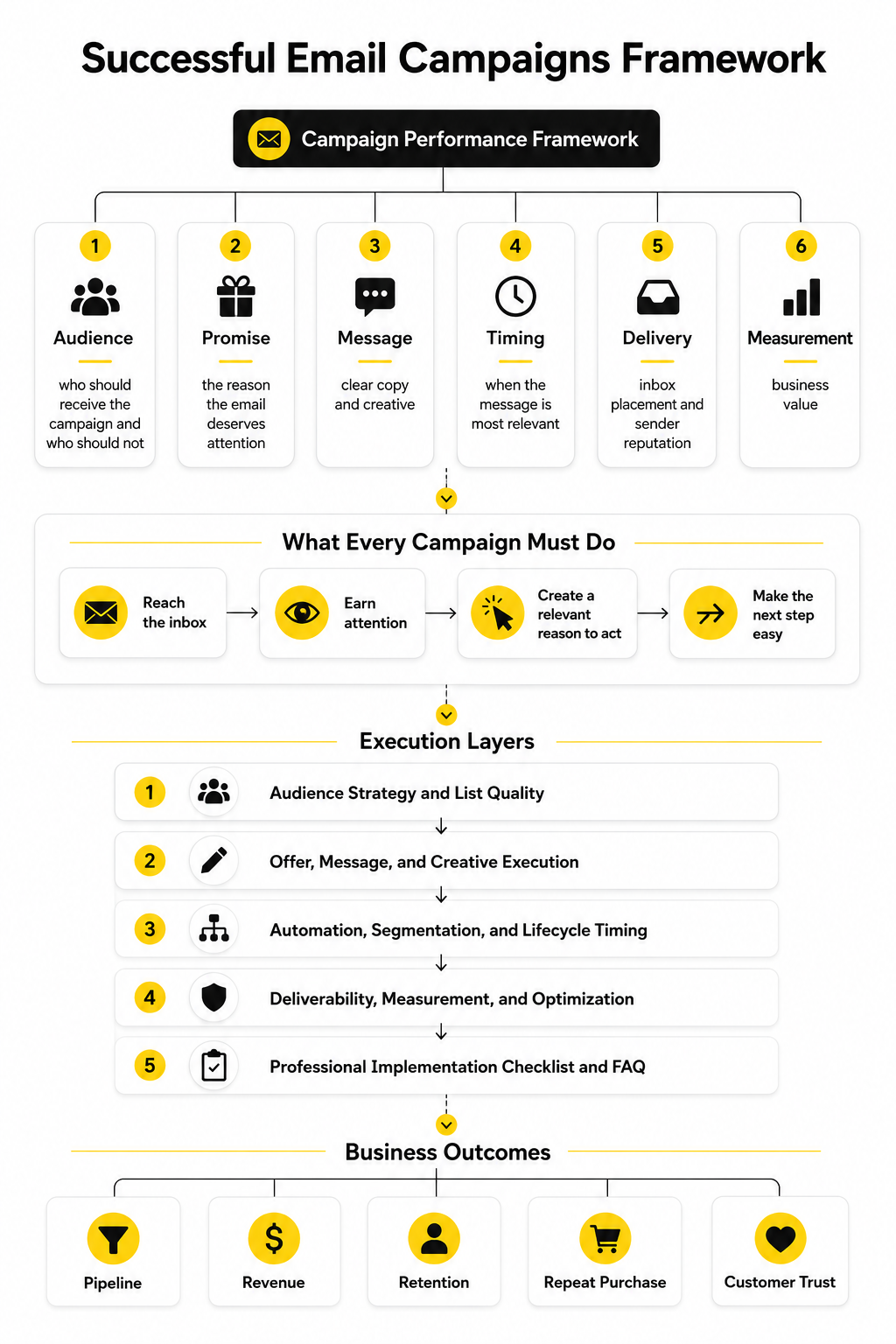
The framework this guide will use is simple: Audience, Promise, Message, Timing, Delivery, and Measurement. Audience defines who should receive the campaign and who should not. Promise defines the reason the email deserves attention. Message turns that promise into clear copy and creative. Timing decides when the message is most relevant. Delivery protects inbox placement and sender reputation. Measurement proves whether the campaign produced business value.
This framework also explains why software alone does not create successful email campaigns. A platform can help you send, segment, automate, and report, but it cannot fix weak positioning or irrelevant offers by itself. Tools like Brevo, Moosend, and GoHighLevel are useful when they support a clear campaign system, not when they replace the thinking behind it.
What Makes This Framework Practical
The practical value of the framework is that it forces every campaign decision to connect to a business reason. Instead of asking, “What should we send this week?” the better question is, “Which segment has a meaningful reason to hear from us right now, and what action would move the relationship forward?” That shift makes email feel less like random broadcasting and more like structured revenue communication.
It also reduces the temptation to chase isolated benchmarks. A 40% open rate can be weak if nobody buys, books, replies, or clicks the meaningful call to action. A lower open rate can still be valuable if the campaign reaches a smaller, more qualified segment and drives profitable action. Klaviyo’s ecommerce benchmark work consistently separates campaign performance from automation and flow performance because triggered messages often behave differently from broad promotional sends (Klaviyo ecommerce benchmarks).
The rest of the article will use this framework to build from foundation to execution. First comes audience strategy and list quality, because no amount of copywriting can rescue a campaign sent to the wrong people. Then the article moves into offers, messaging, automation, deliverability, measurement, and the professional implementation checklist that ties everything together.
Audience Strategy and List Quality
The next step is audience strategy, because successful email campaigns start long before the email is written. The list decides who is likely to care, who is ready to act, and who should be left out completely. This is where professional email marketing separates itself from “send it to everyone and see what happens.”
A strong campaign audience is not just a big database. It is a group of people with a clear relationship to the business, a clear reason to receive the message, and enough recent context to make the campaign relevant. If the audience is wrong, every other part of the campaign becomes harder: the subject line has to work harder, the offer has to compensate for weak intent, and deliverability risk goes up because disengaged people ignore, delete, or complain.
List quality also protects long-term performance. Google tells senders to keep spam rates below 0.1% and avoid ever reaching 0.3% or higher, which makes audience discipline a real operational requirement rather than a nice-to-have (Google email sender guidelines FAQ). Yahoo’s sender guidance also tells senders to authenticate mail, keep complaint rates low, and stay below a 0.3% spam complaint rate (Yahoo sender best practices). In plain English: a bad list does not just hurt one campaign. It can damage the next one too.
Start With Permission, Not Volume
Permission is the foundation of email performance. Someone who knowingly signed up for product updates, a lead magnet, a quote request, a webinar, or a customer account is very different from someone who was scraped, imported, or loosely “acquired” through a third-party list. The first person has context. The second person often has confusion, irritation, or no memory of the brand at all.
That context affects engagement. Research on email address privacy and marketing practices found that internal promotional and CRM emails were common after signups, which reinforces a simple point: once someone gives a brand an email address, the brand has a responsibility to use that access carefully (email address privacy and marketing practices research). Permission is not a one-time loophole. It is an ongoing expectation that the emails will match why the person signed up in the first place.
For successful email campaigns, this means the source of every contact should be easy to understand. A lead from a pricing page should not be treated the same as a giveaway entrant. A recent buyer should not be treated the same as a cold lead from two years ago. A newsletter subscriber should not automatically receive aggressive sales campaigns unless the original promise made that kind of communication clear.
Segment by Intent Before Demographics
Demographics can help, but intent usually matters more. A campaign sent to “women aged 25 to 44” is less precise than a campaign sent to people who viewed a product three times, requested a demo, abandoned checkout, clicked a comparison email, or bought within the last 60 days. The best segmentation starts with what people have done, not only who they appear to be.
Behavior-based segmentation is especially useful because it connects the message to a visible signal. If someone abandoned a cart, the campaign can focus on confidence, objections, urgency, or support. If someone downloaded a guide but never booked a call, the campaign can focus on education and next-step clarity. If someone has been inactive for six months, the campaign should not pretend they are as warm as a recent buyer.
Klaviyo’s ecommerce benchmark data is useful here because it separates broad campaign performance from automated flow performance, and its 2024 benchmark report analyzed more than 325 billion emails across ecommerce categories (Klaviyo email marketing benchmarks). That distinction matters because triggered and segmented messages usually have a different job than general campaigns. A broadcast creates awareness or demand across a wider group. A segmented campaign responds to a specific moment.
Build Segments Around Campaign Jobs
Every segment should have a job. If a segment does not change the message, offer, timing, or call to action, it may not need to exist. Segmentation only becomes valuable when it helps the campaign become more relevant.
A practical email program usually needs a few core segment types. These segments should be simple enough to manage, but specific enough to improve decisions.
This keeps the campaign strategy grounded. Instead of writing one email and hoping it fits everyone, you decide what each audience needs from the business right now. That is how successful email campaigns become more useful, less noisy, and easier to measure.
Clean the List Before It Cleans You
List hygiene sounds boring until deliverability drops. Then it becomes urgent. Old, unengaged, invalid, or risky contacts can quietly weaken sender reputation because mailbox providers watch engagement signals, complaints, bounce behavior, and authentication quality.
Cleaning a list does not mean deleting every quiet subscriber immediately. It means separating people by engagement and treating them appropriately. A subscriber who has not opened or clicked in 30 days may simply need better relevance. A subscriber who has ignored everything for a year probably should not keep receiving every promotion. A contact that bounces should be removed or suppressed quickly.
This is also where teams need to stop confusing list size with asset value. A smaller list of people who recognize the brand, want the topic, and engage with the emails is usually more valuable than a bloated list full of silent contacts. Successful email campaigns are not built on vanity database numbers. They are built on reachable people with real reasons to care.
Match Acquisition Source to Email Intent
How someone joins the list should shape what happens next. A person who signs up for a discount is usually closer to a transaction than someone who joins through a general educational newsletter. A person who requests a demo has a different expectation from someone who downloaded a broad industry checklist.
This is why the first few emails after signup matter so much. They set expectations, clarify the promise, and guide the subscriber toward the next logical action. If the signup source and the follow-up sequence feel disconnected, the subscriber may ignore the campaign even if the product is relevant.
For teams building this system from scratch, the easiest path is to map each acquisition source to one primary follow-up goal. A webinar registration might lead to attendance reminders, a replay, and a consultation offer. A checkout opt-in might lead to purchase support, product education, and a replenishment or cross-sell path. A lead magnet might lead to a short educational sequence that earns enough trust before making a stronger offer.
Use the Right Tool for the Audience System
The tool should support the audience strategy, not define it. For small teams, the priority is usually clean forms, simple segmentation, reliable automation, and reporting that makes campaign decisions easier. For agencies or service businesses, the priority may include pipelines, appointment booking, CRM tracking, and multi-channel follow-up.
A platform like Brevo can fit teams that want email marketing, automation, and contact management in one practical stack. A platform like GoHighLevel can make sense when email campaigns need to connect with CRM workflows, sales pipelines, booking, and client follow-up. For ecommerce or product-led funnels, the right setup may combine email automation with landing pages, checkout flows, and behavioral triggers.
The important thing is not the logo on the software. The important thing is whether the tool lets you capture the right data, create useful segments, suppress the wrong contacts, and measure the actions that actually matter. If it cannot do those things cleanly, it will eventually slow the campaign down.
Define the Audience Before Writing the Email
Before writing any campaign, define the audience in one plain sentence. Not a vague sentence like “our subscribers.” A real sentence like “recent trial users who activated the core feature but have not upgraded,” or “customers who bought once in the last 90 days but have not returned.”
That sentence immediately improves the campaign. It tells you what the person likely knows, what they may be unsure about, what promise is relevant, and what action makes sense. It also prevents the email from becoming a generic announcement that tries to speak to everyone and ends up persuading no one.
This is the practical test: if you cannot describe the audience clearly, you are not ready to write the campaign. Fix the segment first. Strong targeting makes the copy sharper, the offer easier to position, and the result easier to interpret.
Offer, Message, and Creative Execution
Once the audience is clear, the campaign needs a reason to exist. This is where many teams overcomplicate email. They write around the offer, decorate the message, and hope the reader figures out why it matters.
The better path is more direct. A campaign should make a relevant promise to a specific audience and then remove friction from the next action. That does not mean every email needs a discount, a hard pitch, or a giant launch announcement. It means the reader should understand why the email is in their inbox, why it matters now, and what they should do next.
Successful email campaigns are built from this sequence: audience first, offer second, message third, creative fourth, and send logic last. If the offer is weak, the copy has to push too hard. If the message is unclear, the design cannot save it. If the campaign has no next step, attention disappears without creating business value.
Start With the Campaign Objective
Every campaign needs one primary objective. Not three. Not a vague hope that people “engage with the brand.” One clear business outcome should guide the message, the call to action, the segment, and the measurement.
The objective might be to drive product purchases, book consultations, recover abandoned carts, fill webinar seats, get trial users to activate, collect replies, renew customers, or move leads toward a sales conversation. Each objective needs a different kind of email. A renewal campaign should not sound like a first-touch newsletter, and a cart recovery email should not read like a brand manifesto.
This is where email becomes easier. When the objective is clear, the campaign can be judged honestly. A campaign designed to generate booked calls should be measured by booked calls and qualified replies, not just opens. A campaign designed to drive repeat purchase should be measured by revenue, purchase rate, average order value, and customer behavior after the click.
Turn the Offer Into a Clear Promise
The offer is not just the product, discount, webinar, guide, or consultation. The offer is the reason the reader should care. It connects the thing being promoted to the outcome the audience wants.
A weak offer says, “Here is our new feature.” A stronger offer says, “Here is how to finish the task faster without switching tools.” A weak offer says, “Book a call.” A stronger offer says, “Find the fastest path to fix the bottleneck that is costing you leads.” The difference is not hype. The difference is clarity.
For successful email campaigns, the promise should pass three tests. It should be specific enough to feel real, relevant enough to match the segment, and simple enough to understand in a few seconds. If the reader has to decode the offer, the campaign is already losing momentum.
Write the Message Before Designing the Email
Design matters, but message comes first. A clean email with a weak message still fails. A plain email with a sharp message can still drive action because the reader understands the point immediately.
The message should answer four questions in order. Why am I receiving this? Why should I care? What changes if I act? What should I do next? When those questions are answered clearly, the email feels useful instead of intrusive.
This does not mean every email has to be short. Some campaigns need education, proof, comparison, or objection handling. But every sentence should earn its place. If a paragraph does not increase clarity, trust, urgency, or motivation, cut it.
Build the Campaign Execution Flow
The execution process should be simple enough to repeat and strict enough to prevent messy sends. That matters because successful email campaigns are not one-off creative accidents. They are the result of a process that helps teams move from idea to measurable result without skipping the boring parts that protect performance.
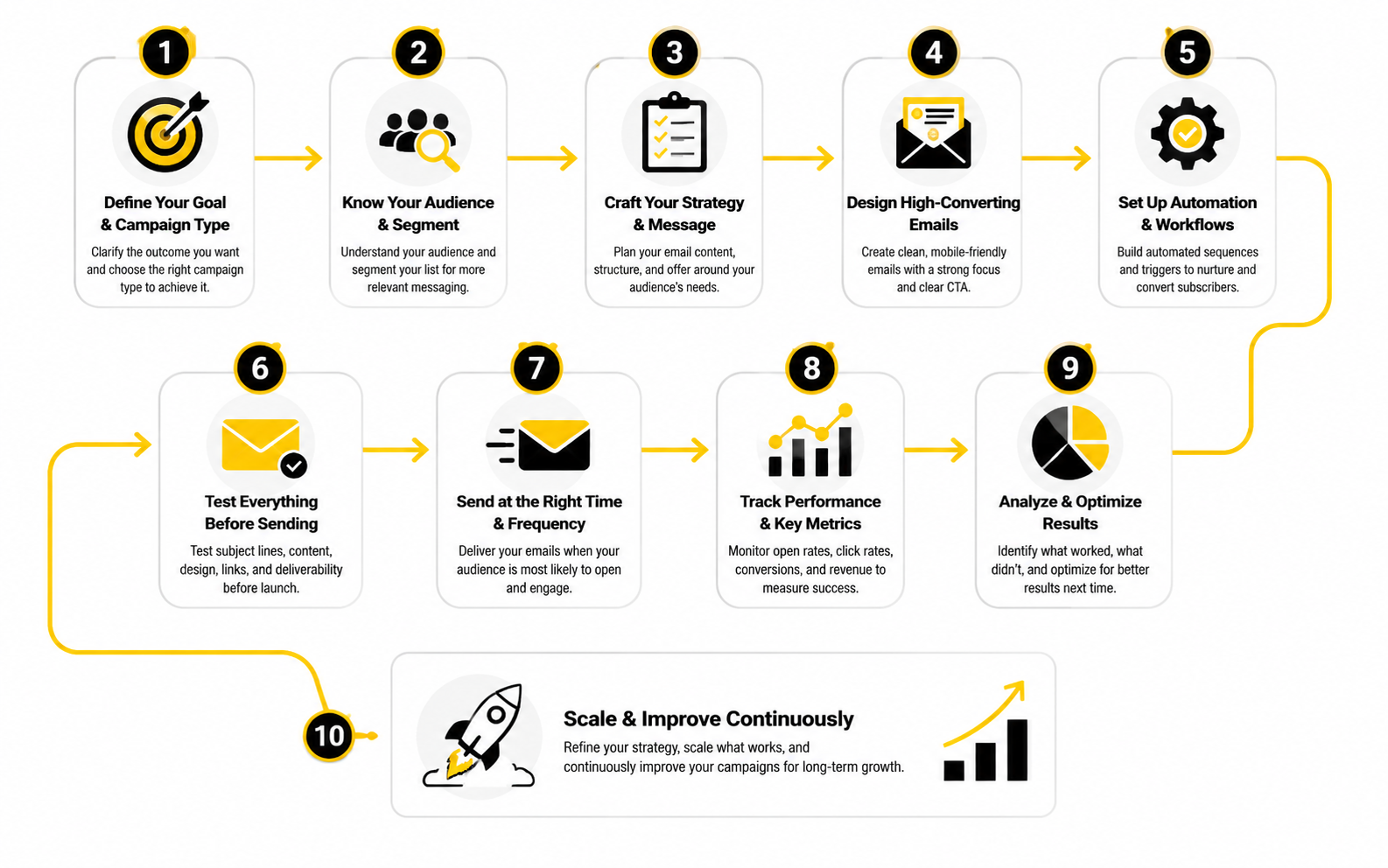
A practical campaign workflow looks like this:
This process is not glamorous, but it works because it removes guesswork. It forces the team to make decisions in the right order. It also makes post-campaign analysis cleaner because everyone knows what the campaign was supposed to do before it launched.
Use Subject Lines to Frame the Value
The subject line should frame the value of the email, not trick people into opening it. Curiosity can work, but only when the email pays it off quickly. If the subject line creates attention and the body disappoints, the campaign trains people not to trust future sends.
A good subject line usually does one of three things. It names a useful outcome, surfaces a relevant problem, or points to a timely opportunity. The best version depends on the audience’s relationship with the brand and how much context they already have.
Preview text should support the subject line instead of repeating it. This small detail often gets ignored, but it helps the inbox message feel complete. Think of the subject line as the hook and the preview text as the reason to believe the email is worth opening.
Structure the Body Around One Main Action
The body of the email should move the reader toward one main action. That does not mean every campaign can only include one link, but it does mean every link should support the same campaign goal. Mixed intent creates hesitation.
A simple structure works well for most campaigns. Start with the reader’s situation, introduce the relevant promise, explain why it matters now, add proof or clarity, and make the next step obvious. This keeps the email focused without making it feel robotic.
The call to action should describe the action, not just the button. “Get the checklist,” “Book your audit,” “See the new plans,” or “Finish your setup” usually gives more context than “Click here.” The CTA should feel like the natural next step, not a sudden demand.
Match the Email to the Destination
An email campaign does not end at the click. The destination has to continue the same promise. If the email promises a faster way to compare options, the landing page should make comparison easy. If the email promotes a consultation, the booking page should reduce friction and confirm what the person will get.
This is where funnel alignment becomes important. A campaign that sends warm leads to a confusing homepage wastes intent. A campaign that sends buyers to a product page with unclear pricing, weak proof, or too many distractions loses momentum.
For teams that need campaign pages quickly, tools like Replo, ClickFunnels, and Systeme.io can be useful when the email needs a focused landing experience instead of a generic website visit. The point is not to add more software for the sake of it. The point is to make the post-click path match the email’s promise.
Add Proof Without Slowing the Reader Down
Proof makes campaigns stronger, but it has to be used carefully. Too much proof can turn a direct email into a cluttered sales page. Too little proof can make the offer feel unsupported.
The right proof depends on the campaign. A product campaign may need reviews, ratings, use cases, comparisons, or return policy clarity. A B2B campaign may need customer outcomes, security reassurance, implementation details, or a clear explanation of what happens after booking. A newsletter-style campaign may need useful insight, credible data, or a strong point of view.
The strongest proof is specific and relevant to the segment. A broad claim like “trusted by thousands” is less useful than a concise reason the audience should trust the next step. If the proof does not help the reader feel safer, more carefully, or more confident, it probably does not belong in the email.
Keep Creative Clean and Purposeful
Creative execution should make the message easier to understand. It should not compete with the message. The best email design supports scanning, highlights the main action, and makes the hierarchy obvious on mobile.
This matters because most readers do not carefully study every campaign. They scan, decide, and move on. So the email needs a clear headline, readable body copy, visible CTA, and enough spacing to make the message feel easy to consume.
Accessibility also belongs in the creative process. Text should be readable, buttons should be clear, images should not carry all the meaning, and the campaign should still make sense if images are blocked. This is not just a technical detail. It is part of respecting the reader and protecting performance across real inbox conditions.
Create a Pre-Send Quality Check
The final step before sending is not “looks good to me.” It is a real quality check. Even strong campaigns can break because of wrong links, missing tracking, outdated segments, broken personalization, poor mobile rendering, or a forgotten suppression rule.
A useful pre-send check covers the essentials:
This step is boring in the best possible way. It prevents avoidable mistakes. And in email, avoidable mistakes are expensive because once a campaign is sent, it cannot be pulled back from the inbox.
Statistics and Data
Measurement is where successful email campaigns become repeatable. Without data, every send turns into a debate about taste: one person likes the subject line, another likes the design, and someone else wants to send more often because “email works.” With data, the conversation becomes sharper: who received it, who engaged, who acted, what revenue or pipeline moved, and what should change next time.
The key is to avoid turning analytics into a pile of disconnected numbers. Open rate, click rate, conversion rate, unsubscribe rate, spam complaints, revenue, and deliverability all tell a different part of the story. None of them should be used alone. A campaign can get strong opens and weak sales, low clicks and high revenue, or decent conversions while quietly damaging sender reputation.
The job of measurement is not to impress the team with a dashboard. The job is to guide action. If the data does not help you decide what to keep, cut, test, suppress, rewrite, segment, or scale, it is noise.
Benchmarks Are Context, Not Targets
Benchmarks are useful because they show what “normal” can look like across the market. The DMA’s 2025 Email Benchmarking Report showed 98% delivery rates, 35.9% open rates, and 2.3% unique click rates, which gives teams a practical reference point for campaign health (DMA Email Benchmarking Report 2025). Those numbers matter because they show that basic visibility and engagement are still achievable, even as inboxes get more competitive.
But benchmarks should not become the goal. A campaign selling a high-ticket B2B service to a narrow list may have a lower click rate and still be extremely profitable. A broad ecommerce promotion may need a higher click rate because the value per click is lower and the offer depends on volume.
The better way to use benchmarks is to ask what they reveal about your own baseline. If your delivery rate is materially below the market, investigate authentication, bounce quality, list source, and complaint behavior. If your clicks are weak while opens are healthy, the issue may be offer relevance, body copy, CTA clarity, or audience intent. If opens are weak but delivery is stable, the issue may be subject line framing, sender recognition, timing, or list fatigue.
Measure the Full Campaign Path
Successful email campaigns should be measured across the whole path, not just inside the email platform. The inbox is only the first step. The real question is what happened after the send.
A useful analytics system tracks the path in layers:
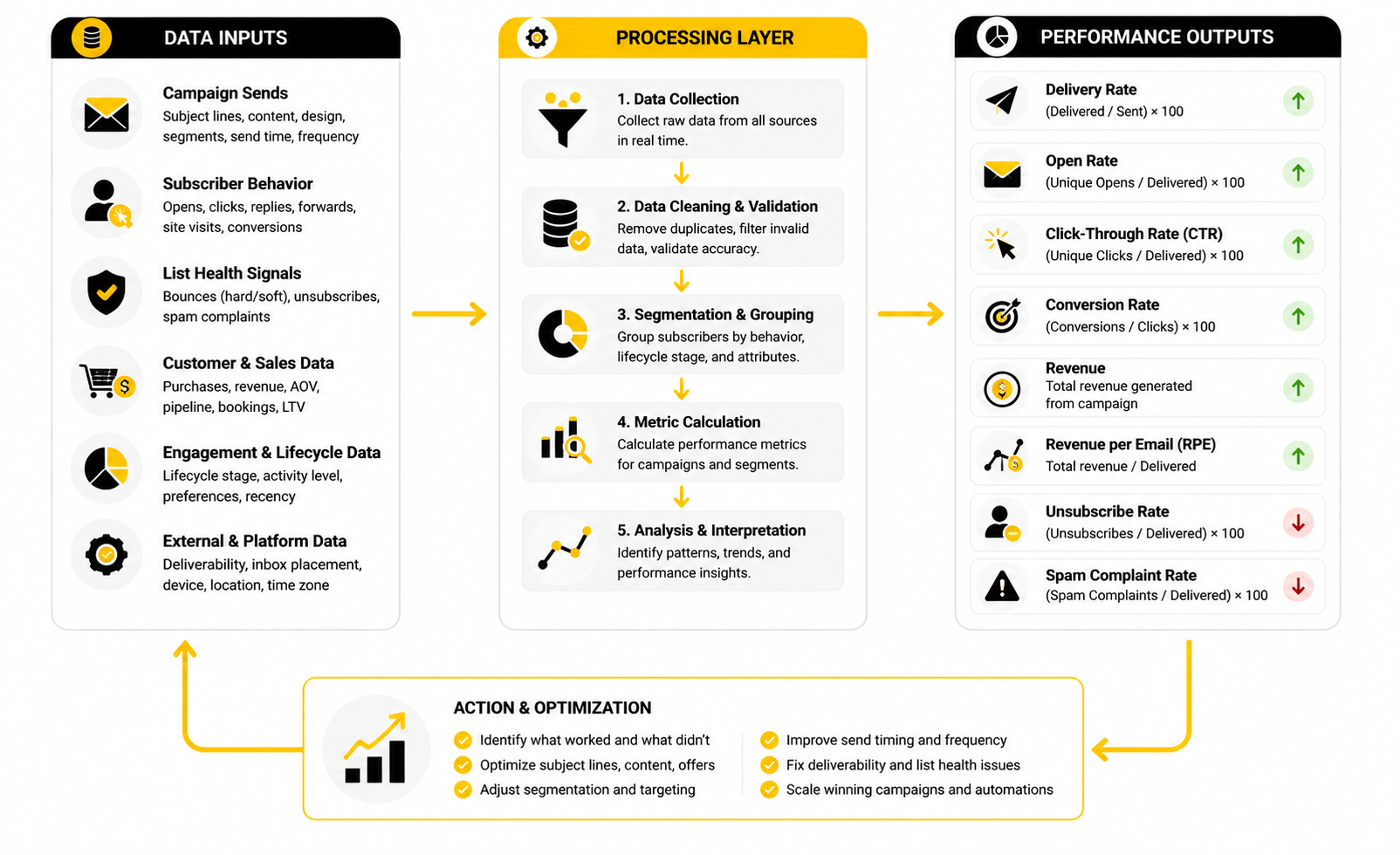
This layered view prevents bad conclusions. If clicks are strong but conversions are weak, the email may be doing its job while the landing page is not. If opens are weak but clicks per opener are strong, the message may be persuasive for the people who saw it, but the subject line or sender recognition needs work. If revenue is strong but complaints also rise, the campaign may be profitable in the short term while damaging long-term deliverability.
Understand What Opens Can and Cannot Tell You
Open rate is still useful, but it is not as clean as it used to be. Apple’s Mail Privacy Protection changed open tracking by preloading email content in ways that can inflate or distort open data. That does not make open rate worthless, but it does mean it should be treated as a directional signal instead of a precise measure of human attention.
Open data is best used for patterns. If one segment consistently opens more than another, that can reveal stronger brand recognition or better fit. If open rates drop suddenly across the whole list, that can point to deliverability issues, sender changes, fatigue, or subject line problems. If opens look healthy but downstream action is weak, the campaign probably needs better alignment between curiosity and value.
The mistake is treating opens as the main win. A campaign does not succeed because someone loaded an email. It succeeds when the right person moves closer to the business outcome the campaign was built to create.
Clicks Show Interest, but Not Intent Alone
Clicks are stronger than opens because they require action. When someone clicks, they are telling you the message created enough interest to leave the inbox. That makes click behavior one of the most useful early signals for campaign quality.
Still, a click is not the same as buying, booking, replying, or renewing. A curiosity click can be shallow. A pricing click can be serious. A click from a loyal customer can mean something different from a click from a cold lead. This is why the destination, link type, and segment matter.
For successful email campaigns, click analysis should go beyond total click rate. Look at which links attracted attention, which audience segments clicked, which clicks created conversions, and whether repeat clicks come from the same people or a broader group. A campaign with fewer but higher-quality clicks can beat a campaign that generates more traffic but no action.
Conversion Rate Reveals Message-Market Fit
Conversion rate is where the campaign starts proving whether the promise matched the audience. If a campaign has solid delivery, reasonable opens, and meaningful clicks but weak conversions, the issue is usually not “email as a channel.” The issue is the fit between the offer, the audience, and the next step.
This is why conversion rate should be tied to the campaign objective. A webinar campaign should measure registrations and attendance quality. A sales campaign should measure purchases, qualified calls, or pipeline movement. A lifecycle campaign should measure activation, repeat purchase, renewal, or retention behavior.
The most useful conversion analysis asks what friction stopped the next step. Was the offer unclear? Was the page too slow or too general? Was the price revealed too late? Did the CTA ask for too much commitment? Did the email attract the wrong type of click? These questions turn conversion data into practical improvement.
Revenue Matters, but Attribution Needs Discipline
Revenue is the metric most teams care about, and rightly so. Email should contribute to business growth. But revenue attribution can be messy if every platform tries to claim the same sale.
A customer may see an ad, read two emails, visit a product page, receive an abandoned cart reminder, and then buy after searching the brand. If the email platform credits the sale, the ad platform credits the sale, and analytics credits direct traffic, the business can easily overcount performance. This is why campaign reporting should be consistent, not just optimistic.
Litmus reported in 2025 that 35% of companies see email ROI of 36:1 or more, while 21% of marketing leaders still do not measure ROI (Litmus email marketing ROI report). That gap is the real lesson. Email can produce strong returns, but only teams with disciplined tracking can see which campaigns are actually creating the return.
Deliverability Metrics Protect Future Campaigns
Deliverability metrics are not separate from performance. They are part of performance. If emails do not reach the inbox, the campaign cannot earn attention, clicks, or revenue.
The most important deliverability signals include bounce rate, spam complaint rate, unsubscribe rate, authentication status, engagement trends, and inbox placement testing. Google tells senders to keep spam rates below 0.1% and avoid reaching 0.3% or higher, which gives teams a clear danger line for complaint behavior (Google email sender guidelines FAQ). Yahoo also tells senders to keep complaint rates low, authenticate email, and support easy unsubscribe practices (Yahoo sender best practices).
This means a campaign that drives revenue but creates unusually high complaints deserves a serious review. The segment may have been too broad. The promise may have been too aggressive. The frequency may have been too high. Short-term performance is not worth training inbox providers and subscribers to distrust the brand.
Compare Campaigns by Type
Not all emails should be compared against each other. A broad newsletter, a product launch, an abandoned cart sequence, a reactivation campaign, and a renewal reminder have different jobs. Measuring them against one blended average hides useful insight.
Campaigns should be grouped by type before analysis. Promotional sends should be compared to other promotional sends. Lifecycle automations should be compared to similar triggered flows. Re-engagement emails should be judged by recovered attention, suppression decisions, and downstream value, not by the same standards as a hot launch campaign.
Klaviyo’s benchmark work separates ecommerce campaign performance from automated flows, and its 2024 report used data from more than 325 billion emails to show how performance varies across industries and automation types (Klaviyo email marketing benchmarks). That distinction matters because triggered emails often reach people at a more relevant moment. A campaign sent because someone did something is different from a campaign sent because the marketing calendar says it is Tuesday.
Watch Trends More Than One-Off Results
One campaign result can be misleading. A holiday send may overperform because demand is naturally high. A campaign sent during a busy news cycle may underperform through no fault of the message. A small segment may produce volatile numbers because a few conversions can swing the percentage.
Trends are more useful. If click rates decline across several sends, the audience may be tiring of the format or offer mix. If unsubscribes rise after frequency increases, the sending rhythm may be too aggressive. If revenue grows while engagement shrinks, the brand may be extracting value from a smaller group while losing broader list health.
The best email teams look for patterns before making big conclusions. They document what changed, what stayed the same, and what the campaign was supposed to prove. This turns measurement into learning instead of reporting.
Build a Simple Campaign Scorecard
A campaign scorecard keeps analysis focused. It should be short enough that the team actually uses it, but complete enough to prevent shallow conclusions. The goal is to review every meaningful send through the same lens.
A practical scorecard includes:
This scorecard makes successful email campaigns easier to repeat because it captures both outcome and context. It prevents the team from celebrating vanity metrics when business results are weak. It also prevents overreacting to one low number when the campaign still did its strategic job.
Let the Data Decide the Next Action
The final purpose of analytics is decision-making. Every campaign should lead to a next action. Sometimes that action is to scale the audience, sometimes it is to refine the segment, sometimes it is to rewrite the offer, and sometimes it is to suppress contacts who are no longer engaged.
If delivery is weak, fix infrastructure and list quality before testing creative. If opens are weak, improve sender trust, subject line clarity, and timing. If clicks are weak, improve the promise, body copy, CTA, and offer relevance. If conversions are weak, inspect the landing page, pricing clarity, checkout flow, booking path, or sales handoff. If complaints are high, stop pushing and tighten the audience immediately.
That is the mindset that separates casual sending from professional email marketing. Data is not there to make the report look good. Data is there to tell you what the market did with your message, so the next campaign can be sharper, safer, and more profitable.
Automation, Segmentation, and Lifecycle Timing
At this stage, the campaign system moves from individual sends into lifecycle strategy. This is where email becomes more than a newsletter or promotion channel. It becomes a structured way to guide people from first interest to purchase, onboarding, repeat engagement, retention, and reactivation.
The advanced move is not sending more email. The advanced move is sending more relevant email based on timing, behavior, and relationship stage. Successful email campaigns scale when they stop treating every subscriber like they are in the same moment.
Lifecycle timing also forces a better question. Instead of asking, “What campaign should we send this week?” ask, “Where is this person in the relationship, and what would genuinely help them move forward?” That question protects relevance as the list grows.
Build Around Lifecycle Moments
A lifecycle email system should be built around moments that matter. These moments are usually tied to behavior: signup, first visit, product view, trial activation, abandoned checkout, purchase, onboarding, renewal window, inactivity, or customer milestone. Each moment gives the campaign a reason to exist.
A welcome sequence has a different job from a reactivation campaign. A welcome sequence should confirm the promise, establish trust, and guide the subscriber toward the next useful step. A reactivation campaign should identify whether the relationship still has life or whether the contact should be suppressed.
Bloomreach’s 2025 automation guidance names common triggers such as welcome sequences, abandoned cart reminders, post-purchase follow-ups, re-engagement campaigns, and birthday or anniversary emails (Bloomreach email marketing automation guide). The lesson is not that every business needs every trigger. The lesson is that automation works best when it responds to a meaningful customer moment.
Use Automation Without Losing Human Judgment
Automation is powerful because it creates consistency. It makes sure important follow-ups happen even when the team is busy. It also helps smaller teams run more sophisticated customer journeys without manually sending every message.
But automation can become dangerous when it keeps running after the context changes. A customer who already bought should not keep receiving the same sales push. A lead who booked a call should not get a campaign telling them to book again. A subscriber who is inactive for a long time should not receive every promotion forever just because they are still technically on the list.
This is why every automation needs entry rules, exit rules, suppression logic, and a review schedule. Entry rules decide who qualifies. Exit rules decide when the person should leave. Suppression logic protects people from irrelevant or conflicting messages. Review schedules keep old automations from becoming invisible revenue leaks.
Balance Campaigns and Automations
Campaigns and automations do different jobs. Campaigns are useful for launches, announcements, seasonal offers, editorial updates, market timing, and strategic pushes. Automations are useful for predictable moments that happen repeatedly across the customer journey.
The mistake is leaning too hard in one direction. A business that only sends campaigns may miss the quiet but valuable lifecycle moments that happen every day. A business that only relies on automation may become too passive and miss timely opportunities to create demand.
The best email programs use both. Campaigns create momentum. Automations capture and guide intent. Together, they turn email from a calendar task into a relationship system.
Personalization Should Be Useful, Not Creepy
Personalization is not just adding someone’s first name to a subject line. Real personalization changes the relevance of the email based on behavior, preferences, lifecycle stage, purchase history, or stated interests. Done well, it makes the message feel timely and useful.
Done badly, personalization feels invasive or wrong. Nothing breaks trust faster than a brand using data in a way that feels surprising, inaccurate, or manipulative. If the data is stale, incomplete, or sensitive, it should not be used casually in campaign copy.
Privacy research keeps reinforcing the same point: consent has to be specific, informed, freely given, and unambiguous, and poor implementation creates both compliance and trust risk (automated GDPR consent violation research). That matters for email because personalization depends on data. If the data foundation is weak or the permission model is unclear, personalization can create more risk than revenue.
Scale Requires Better Data Discipline
Scaling email is not just about having a bigger list or more automations. Scaling means the system can handle more contacts, more segments, more triggers, more offers, and more reporting without becoming chaotic. That requires disciplined data.
Clean fields matter. Source tracking matters. Consent status matters. Purchase history, lead stage, lifecycle status, and engagement signals need to be reliable. If the data is messy, the campaigns will eventually become messy too.
This becomes especially important when teams connect email with CRM, landing pages, checkout, booking, SMS, ads, or support. A platform like GoHighLevel can help service businesses connect email campaigns with CRM, booking, pipeline stages, and follow-up workflows. For teams that need forms or lead capture feeding clean data into campaigns, Fillout can be useful when the form logic needs to support segmentation from the start.
Watch the Frequency Tradeoff
Email frequency is one of the hardest scaling decisions. Sending more can increase revenue in the short term. Sending too much can reduce engagement, increase unsubscribes, and weaken the brand relationship.
The right frequency depends on the audience, product type, buying cycle, and email quality. A daily media newsletter can work if the subscriber expects daily value. A daily sales promotion from a brand the customer barely knows can feel exhausting. Context matters.
The safest approach is to monitor engagement and complaint behavior by segment. Highly engaged buyers may tolerate more frequent updates than inactive subscribers. New leads may need a short burst of education, then a slower rhythm. High-value customers may deserve more personal communication rather than more generic campaigns.
Create Suppression Rules Before You Need Them
Suppression rules are one of the most underrated parts of successful email campaigns. They stop the wrong people from receiving the wrong message. That sounds simple, but it prevents some of the most damaging campaign mistakes.
A good suppression setup might exclude recent buyers from acquisition promos, active sales opportunities from generic nurture sequences, unsubscribed contacts from all marketing, hard bounces from future sends, and inactive contacts from high-frequency campaigns. It may also prevent someone from receiving overlapping offers that create confusion or train them to wait for discounts.
Suppression is not negative targeting. It is respect. It protects the customer experience and keeps campaign data cleaner because the audience that receives the message is more aligned with the objective.
Avoid Over-Automating the Relationship
Automation should support the relationship, not replace it. Some moments still need a human touch. A high-intent reply, enterprise lead, major customer complaint, or valuable account expansion opportunity should not be buried inside a generic workflow.
This is especially important in B2B, agencies, coaching, consulting, and high-ticket services. An automated sequence can warm the lead, answer common objections, and create momentum. But once the person shows serious intent, the handoff to sales or the founder may matter more than another automated email.
A practical rule helps: automate predictable steps, personalize meaningful moments. That keeps the system efficient without making the business feel robotic.
Use AI Carefully Inside the Workflow
AI can help with research, drafting, summarizing customer feedback, generating subject line variations, organizing campaign ideas, and analyzing patterns. That makes it useful for speeding up production and improving consistency. But AI should not be allowed to invent claims, fake proof, or push unverified personalization into live campaigns.
The strongest AI use cases are operational. Use it to create first drafts, identify message angles, group customer objections, rewrite for clarity, and prepare test variations. Then keep a human editor responsible for truth, tone, offer accuracy, compliance, and final approval.
AI is also only as good as the data and instructions around it. If the customer data is incomplete or the campaign brief is vague, the output will reflect that weakness. Successful email campaigns still need strategy before tools, even when the tools are faster than ever.
Build a Testing System, Not Random Experiments
Testing should answer real questions. A random subject line test can be useful, but only if the team knows what it is trying to learn. Otherwise, testing becomes entertainment disguised as optimization.
Good tests isolate one meaningful variable. That might be the promise, the offer, the segment, the CTA, the send timing, the landing page, or the sequence order. The test should be large enough to produce a useful signal and documented well enough that the next campaign can benefit.
The best teams build a learning library. They track which angles work for which segments, which offers create profitable action, which timing patterns help, and which creative structures consistently underperform. Over time, this turns email from guessing into accumulated advantage.
Prepare for Compliance Before Growth
Compliance cannot be treated as a last-minute checkbox. As email programs scale, legal and operational risk increases because more data, more jurisdictions, more vendors, and more automations are involved. That means consent, unsubscribe handling, data retention, and privacy notices need to be clear before the list becomes large.
The Dutch data protection authority’s digital direct marketing guidance states that organizations generally need consent before sending digital direct marketing, with limited exceptions such as certain existing customer relationships (Dutch DPA digital direct marketing guidance). This is a useful reminder for international campaigns. Email rules are not identical everywhere, so the system should track permission and region instead of assuming one rule fits every contact.
Compliance also affects brand trust. People notice when unsubscribe links are hard to find, preferences are ignored, or follow-up feels disconnected from what they agreed to receive. Growth built on weak permission is fragile growth.
Know When to Add Complexity
More segmentation, more automations, more tools, and more personalization are not automatically better. Complexity has a cost. It requires maintenance, QA, documentation, reporting, and someone who understands how all the pieces fit together.
Add complexity when it solves a real performance problem. If a segment behaves differently, create a segment. If a lifecycle moment repeats often and creates value, automate it. If a manual process keeps causing delays or mistakes, systemize it. If a tool improves data quality or conversion flow, consider it.
Do not add complexity just because it looks advanced. The most profitable email system is often the simplest system that can reliably deliver the right message to the right person at the right moment. That is the standard. Everything else is decoration.
Deliverability, Measurement, and Optimization
The final system behind successful email campaigns is not one campaign, one dashboard, or one clever automation. It is the ecosystem that connects audience quality, message relevance, deliverability, lifecycle timing, conversion tracking, and continuous improvement. When those pieces work together, email stops being a guessing game and becomes a reliable growth engine.
This is also where the discipline shows. A weak email program keeps chasing new tactics because it never fixes the foundation. A strong program improves the inputs, watches the signals, and makes more carefully decisions with every send. That is the difference between “we sent an email” and “we built a campaign system.”
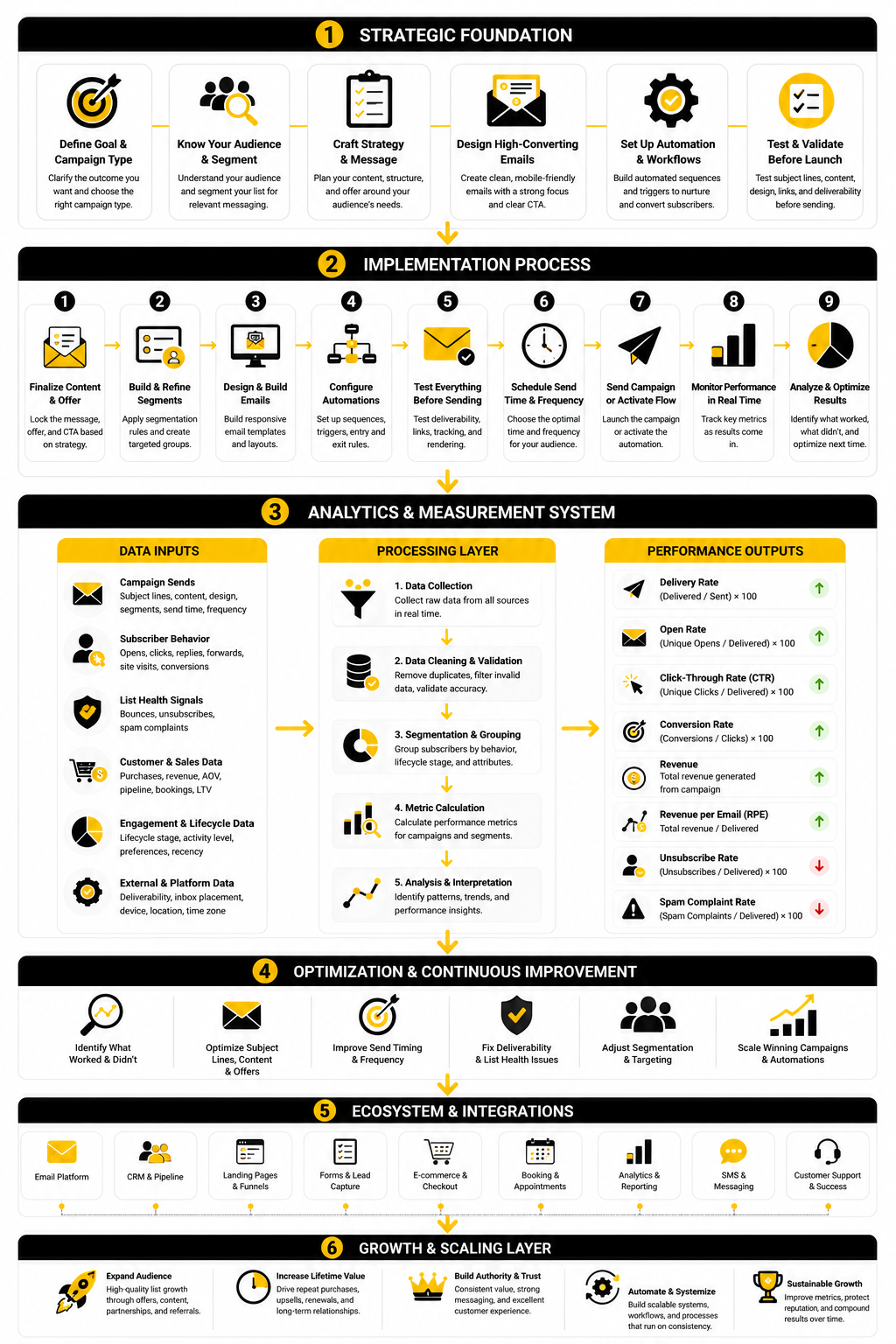
The ecosystem is simple to understand, but it takes consistency to run well. Better data creates better segments. Better segments create more relevant messages. More relevant messages improve engagement and reduce risk signals. Stronger engagement supports deliverability. Stronger deliverability gives the campaign more real chances to convert. Then measurement feeds the learning back into the next campaign.
Optimize the System, Not Just the Email
Optimization should not stop at subject lines or button text. Those details matter, but they are rarely the whole problem. If the audience is wrong, the offer is weak, or the landing page does not match the email, small copy tweaks will not fix the campaign.
The best optimization starts by finding the true constraint. If delivery is poor, fix authentication, complaint rates, bounce handling, and list quality. If clicks are poor, improve the promise, message clarity, and CTA. If conversions are poor, inspect the destination page, checkout, booking path, pricing clarity, or sales follow-up.
This is why successful email campaigns need a full-funnel view. The email is only one part of the experience. The campaign succeeds when the whole path works.
Protect Trust as the Program Grows
Trust is the asset behind every good email program. People open because they recognize the sender, expect something useful, and believe the message will be worth their time. Once that trust weakens, every future campaign gets harder.
The warning signs are easy to miss at first. Opens soften. Clicks concentrate in a smaller group. Unsubscribes rise after aggressive promos. Spam complaints creep upward. Revenue may still look fine for a while, but the list is quietly becoming less responsive.
Google tells senders to keep spam rates below 0.1% and avoid reaching 0.3% or higher, while Yahoo’s sender guidance also warns senders to keep complaint rates below 0.3% (Google email sender guidelines FAQ, Yahoo sender best practices). Those thresholds matter because complaints are not just feedback. They are reputation signals that can affect whether future campaigns reach the inbox.
Build a Professional Operating Rhythm
A serious email program needs a rhythm. Not bureaucracy. Rhythm. The team should know how campaigns are planned, approved, tested, launched, measured, and improved.
A practical operating rhythm usually includes weekly campaign planning, monthly performance review, quarterly lifecycle audits, and regular deliverability checks. The goal is to prevent random sending and build a repeatable process. When the rhythm is clear, campaigns move faster because the decisions are not reinvented every time.
This rhythm also makes accountability easier. Someone owns the audience. Someone owns the message. Someone owns QA. Someone owns analytics. When ownership is vague, mistakes slip through and performance becomes harder to improve.
What makes an email campaign successful?
A successful email campaign reaches the right audience, communicates a relevant promise, drives the intended action, and protects long-term list health. It is not judged by one metric alone. Opens, clicks, conversions, revenue, replies, unsubscribes, complaints, and deliverability all need to be interpreted together.
The most important factor is alignment. The audience, offer, message, timing, and destination must all point toward the same outcome. When that alignment is missing, the campaign may look polished but still underperform.
What is the best metric for successful email campaigns?
The best metric depends on the campaign objective. A sales campaign should be measured by revenue, purchase rate, average order value, and profit quality. A lead generation campaign should be measured by qualified replies, booked calls, show rate, pipeline value, and close rate.
That said, no single metric tells the full story. Click rate can show interest, but conversion rate shows whether the next step worked. Revenue can show business impact, but complaints and unsubscribes show whether the campaign created risk. Use a scorecard instead of obsessing over one number.
Are open rates still useful?
Open rates are still useful, but they should be treated as directional rather than perfectly precise. Privacy changes, image loading behavior, and mailbox features can make opens less reliable than clicks or conversions. They still help identify broad trends in attention and sender recognition.
Use open rates to spot patterns, not to declare final winners. If opens drop suddenly across the list, investigate subject lines, sender reputation, timing, and deliverability. If opens are strong but conversions are weak, the issue is probably further down the campaign path.
How often should a business send email campaigns?
There is no universal perfect frequency. The right cadence depends on audience expectations, product category, buying cycle, campaign quality, and list engagement. A daily newsletter can work when subscribers signed up for daily value, while daily promotions can quickly exhaust a colder list.
The better approach is to segment by engagement and monitor tolerance. Highly engaged customers may accept more frequent communication. Inactive contacts usually need fewer sends, a re-engagement path, or suppression. Frequency should be earned by relevance.
What is the biggest mistake in email marketing?
The biggest mistake is sending to the wrong audience with a message that has no clear reason to exist. Most campaign problems start before the copy is written. If the segment is vague and the offer is weak, the subject line, design, and automation tool cannot rescue the campaign.
Another common mistake is treating list size as the main asset. A smaller list of engaged, permission-based contacts is more valuable than a large list full of people who do not remember the brand. Quality beats volume when inbox reputation and revenue are on the line.
How do you improve click rates?
Improve click rates by making the promise clearer, the audience more specific, and the call to action more natural. Clicks happen when the reader understands what is being offered and believes the next step is worth taking. Weak clicks usually point to weak relevance, unclear copy, or a CTA that asks for too much too soon.
The email should make one main action obvious. Do not clutter the campaign with competing links that pull the reader in different directions. If the campaign has multiple links, they should still support one primary goal.
How do you improve email conversions?
Email conversions improve when the message and destination match. If the email promises a fast comparison, the landing page should make comparison easy. If the email asks someone to book a call, the booking page should explain what happens next and remove unnecessary friction.
Look beyond the email platform. Page speed, form length, checkout clarity, pricing visibility, proof, mobile experience, and sales follow-up can all affect conversion. A campaign may drive the right click and still lose the person after the click.
What role does automation play in successful email campaigns?
Automation helps capture important lifecycle moments that happen repeatedly. Welcome sequences, onboarding emails, abandoned cart reminders, renewal reminders, and re-engagement flows can all improve consistency. They work because they respond to behavior instead of relying only on calendar-based campaigns.
But automation still needs strategy. Every workflow should have entry rules, exit rules, suppression logic, and periodic review. Otherwise, the business can accidentally keep sending irrelevant emails long after the customer’s situation has changed.
Should every email campaign include a discount?
No. Discounts can work, but they should not become the default solution. If every campaign trains subscribers to wait for a lower price, the business may improve short-term clicks while weakening margin and brand value.
Many successful email campaigns use education, proof, urgency, exclusivity, product clarity, comparison, customer success, or timing instead of discounts. The right offer depends on the audience’s level of intent and the business model. A discount is a tool, not a strategy.
What tools help with professional email implementation?
The best tool depends on the business model and workflow. Teams that need email marketing and automation may look at platforms such as Brevo or Moosend. Service businesses and agencies that need CRM, pipelines, booking, and follow-up in one system may prefer GoHighLevel.
For landing pages and funnel execution, tools like ClickFunnels, Systeme.io, and Replo can help when the post-click experience needs to match the email offer. The right choice is the tool that supports clean data, useful segmentation, reliable automation, and measurable outcomes.
How do you know when to suppress inactive subscribers?
Suppress inactive subscribers when they no longer show meaningful engagement and continued sending creates more risk than value. The exact window depends on the business, buying cycle, and sending frequency. A long-cycle B2B list may require a different inactivity threshold than a high-frequency ecommerce list.
Do not suppress blindly without a re-engagement attempt. First, try a focused campaign that gives the subscriber a clear reason to stay, update preferences, or take a useful next step. If there is still no engagement, suppression protects deliverability and improves the quality of future reporting.
What should a campaign brief include?
A strong campaign brief should include the objective, audience, offer, key message, CTA, destination, send date, suppression rules, tracking plan, and success metrics. It should also clarify what the campaign is not supposed to do. That prevents scope creep and keeps the email focused.
The brief does not need to be long. It needs to be clear. If the team cannot explain the campaign in a few practical sentences, the audience probably will not understand it either.
How can small teams run successful email campaigns without a big department?
Small teams should keep the system simple. Start with clean list growth, a focused welcome sequence, one or two core lifecycle automations, and a repeatable campaign scorecard. Do not build a complex automation maze before the basics are working.
The advantage of a small team is speed. You can review replies, spot objections, adjust messaging, and test offers quickly. The key is to document what works so the email program improves instead of restarting from zero every week.
What is the fastest way to improve email performance?
The fastest improvement usually comes from tightening the audience and clarifying the offer. Better targeting makes the message more relevant immediately. A clearer offer gives the reader a stronger reason to act.
After that, inspect the post-click path. Many campaigns lose money after the click because the landing page, booking process, checkout, or sales handoff creates friction. Fixing that path can improve results without sending a single extra email.
Build a stronger local presence with BAAM AI
Turn your website, Google profile, social channels, and AI visibility into one growth engine
Most businesses do not need more random marketing activity. They need a consistent presence system that helps the right people find them, trust them, and take action. BAAM AI brings strategy, local SEO, website updates, Google Maps visibility, social content, AI-search readiness, media production, and reporting into one practical monthly engine.
If you want your marketing to keep working after the campaign ends, start with a free BAAM AI presence audit. See how your business shows up today and where the fastest visibility wins are at BAAM AI.