
BAAM AI Blog
Strategy Before Writing
A certified copywriter earns trust before the first draft is written. The work starts with diagnosis, because weak copy is often a symptom of a deeper problem: unclear positioning, a vague offer, a confused audience...
Strategy Before Writing
A certified copywriter earns trust before the first draft is written. The work starts with diagnosis, because weak copy is often a symptom of a deeper problem: unclear positioning, a vague offer, a confused audience, or a page trying to do too many jobs at once. If you skip that step, you may still produce polished sentences, but polished sentences will not rescue a broken strategy.
This is where many beginners get the job backward. They open a document and start writing headlines before they understand the customer’s pressure, the company’s promise, and the action the copy needs to support. Professional copywriting is not about sounding clever first; it is about making the right decision easier for the right reader.
The practical rule is simple. Before writing, define the business goal, the reader’s current state, the desired next step, and the evidence needed to make that step feel safe. That gives the copy a job, and copy without a job is just content.
Start With The Business Goal
Every copy asset should be tied to one clear business goal. A landing page might need to generate demos, an email sequence might need to reactivate cold leads, and a sales page might need to explain the value of a paid offer. The certified copywriter’s job is to identify that goal early so the writing does not drift into general persuasion.
This matters because different goals require different messaging. Copy designed to create awareness should not read like copy designed to close a purchase today. A reader who just discovered the problem needs education, while a reader comparing vendors needs proof, contrast, and risk reduction.
A strong brief usually answers these questions before any draft begins:
Those questions keep the copy grounded. They also make review easier because feedback can be judged against the goal instead of personal taste. That one shift can save hours of vague comments like “make it punchier” or “this needs more energy.”
Understand The Reader’s Real Situation
Good copy does not start with what the business wants to say. It starts with what the reader is already thinking, feeling, comparing, fearing, and trying to avoid. The better a certified copywriter understands that reality, the less they need to rely on hype.
Readers also do not move through pages as patiently as writers imagine. Nielsen Norman Group’s long-running usability research found that web users generally prefer content that is concise, scannable, and objective, with the combined version performing far better than promotional writing in measured usability. That does not mean copy should be flat; it means the reader should never have to fight the page to understand the point.
The best reader research usually comes from direct language, not internal brainstorming. Sales calls, support tickets, customer reviews, survey responses, community posts, and competitor comparisons often reveal the words people already use when they describe the problem. A copywriter who captures that language can make the copy feel more relevant without forcing the keyword into every sentence.
Clarify The Offer Before Polishing The Words
A weak offer creates weak copy. If the promise is vague, the audience is too broad, or the next step feels risky, even a strong writer will struggle to make the message persuasive. That is why offer clarity comes before wordsmithing.
A certified copywriter should be able to separate the product from the offer. The product is what the business sells. The offer is the packaged reason someone should act now, including the promise, mechanism, proof, urgency, guarantee, pricing logic, bonuses, onboarding, or next step.
This is especially important when writing for funnels, lead magnets, webinars, consultations, trials, or service packages. A page builder or funnel platform can help publish the asset quickly, but it cannot decide whether the offer makes sense. Tools like ClickFunnels can support the implementation, but the conversion logic still comes from the strategy behind the copy.
Build The Message Hierarchy
Message hierarchy is the order in which ideas should appear. It decides what the reader sees first, what gets explained next, what proof appears before the call to action, and what details can wait until later. Without hierarchy, copy becomes a pile of claims instead of a guided path.
A useful hierarchy usually starts with relevance. The reader should quickly understand who the offer is for, what problem it solves, and why it is different from the alternatives they already know. From there, the copy can move into proof, mechanism, outcomes, objections, process, and action.
This is where professional restraint matters. Not every benefit deserves the same weight. Not every feature belongs above the fold. A certified copywriter has to decide what matters most to the reader at that stage of awareness, then remove anything that distracts from the next decision.
Match The Copy To The Buyer’s Stage
A cold reader needs a different conversation than someone who already trusts the brand. Cold traffic usually needs context, problem clarity, and credibility before the ask. Warm traffic can handle a more direct offer because some trust already exists.
This is why copying a competitor’s page rarely works. Their audience may have a different level of awareness, a different source of traffic, a different brand reputation, and a different sales process behind the page. What looks like a simple headline decision may actually depend on dozens of invisible business factors.
The more carefully approach is to match copy depth to the buyer’s stage:
This keeps the article, page, email, or ad from asking for too much too soon. It also helps the writer avoid overexplaining to people who are already ready, which can be just as damaging as underexplaining to people who are skeptical.
Know What Certification Can And Cannot Prove
Certification can prove that a copywriter took training seriously. It can show exposure to frameworks, assignments, editing standards, and professional vocabulary. For someone entering the field, that structure can be useful because it gives them a system instead of leaving them to guess from random tips online.
But certification does not automatically prove market judgment. It does not prove the writer can handle a difficult client conversation, simplify a messy offer, diagnose weak positioning, or improve a page after performance data comes in. Those abilities develop through practice, feedback, and real business context.
So the best way to view certification is as a credibility layer, not the whole identity. A certified copywriter should still build a portfolio, document their process, collect testimonials when possible, and show how they think through business problems. That combination is stronger than a badge by itself.
Research, Positioning, And Offers
Once the strategy is clear, the next job is to gather the raw material that makes the copy believable. This is where a certified copywriter moves from theory into practical execution. The goal is not to “find inspiration”; the goal is to collect enough evidence, language, and context to write with precision.
Research protects the copy from lazy assumptions. Without it, the writer usually defaults to broad claims like “save time,” “grow faster,” or “get better results,” which are too vague to carry a serious offer. With it, the message becomes sharper because it reflects what buyers actually care about, not what the business hopes they care about.
This part of the process also keeps the copy ethical. Strong persuasion does not require exaggeration. It requires relevance, clarity, proof, and timing.
Build A Research Base Before Making Claims
A certified copywriter should never invent urgency, fake proof, or dress opinions as facts. The research base should include the customer’s language, the company’s real strengths, competitor positioning, objections from the sales process, and any credible proof the business can support. If the business cannot prove a claim, the copy should not lean on it.
A practical research base usually includes:
This does not need to become a six-week academic project. But it does need to be disciplined enough to stop the writer from guessing. Even a simple survey built with a tool like Fillout can help a copywriter collect clearer customer language before rewriting a landing page, email sequence, or sales asset.
Turn Customer Language Into Message Angles
Customer language is not automatically good copy. It is raw material. The copywriter still needs to sort it, interpret it, and turn it into message angles that support the offer.
A message angle is the main persuasive route the copy takes. One angle might focus on speed, another on risk reduction, another on simplicity, and another on expert guidance. The strongest angle depends on what the reader already believes, what they have tried before, and what would make the offer feel meaningfully different.
This is where inexperienced writers often go too broad. They try to include every possible benefit in one asset, which makes the copy feel crowded and unfocused. A certified copywriter should be able to choose the strongest angle for the asset instead of trying to make one page carry the entire business.
Use A Step-By-Step Execution Process
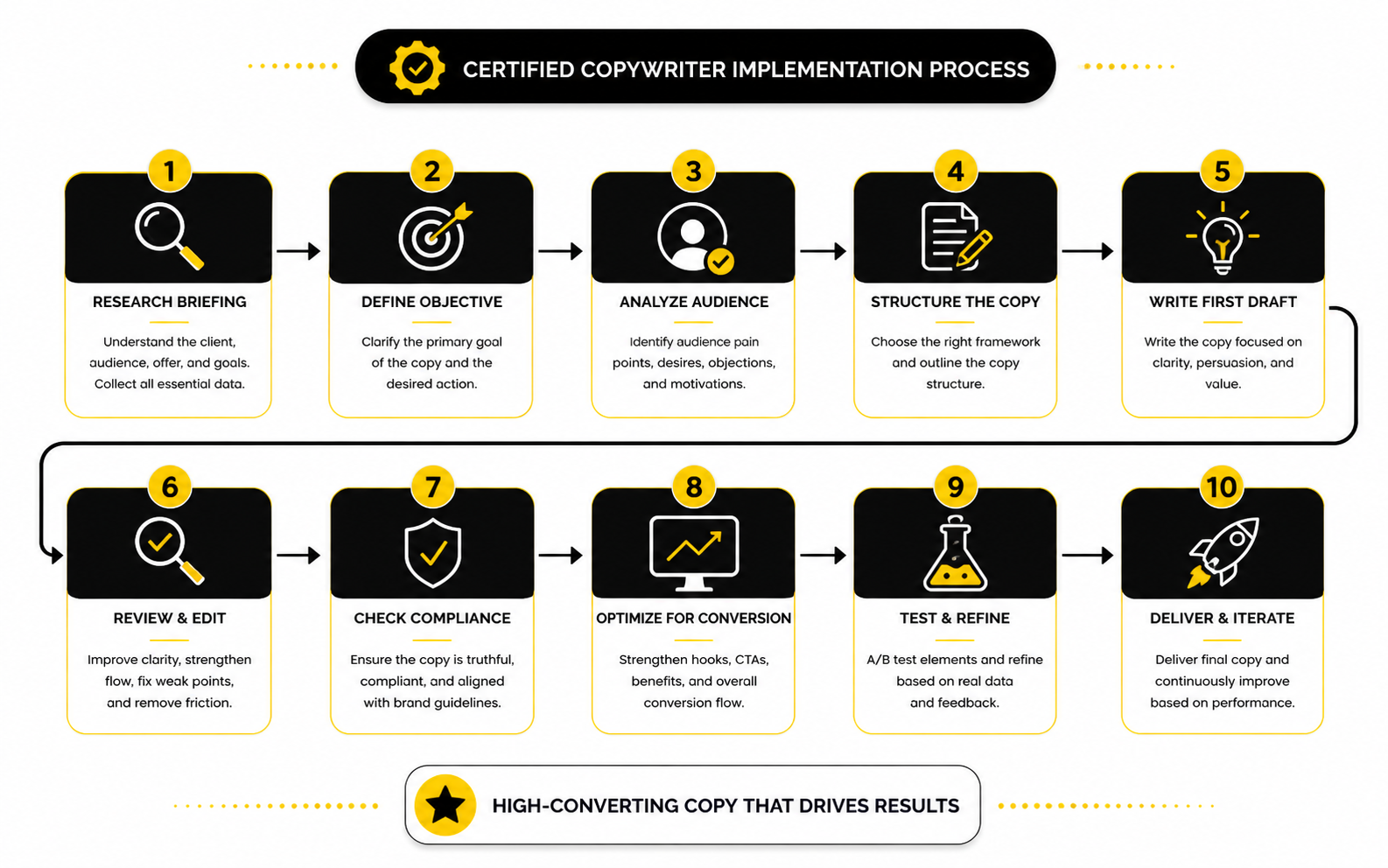
The execution process should make the work repeatable. Creativity still matters, but professional copywriting cannot depend on waiting for a good mood. A clear process helps the writer move from research to finished copy without losing the strategy along the way.
A practical copywriting process can look like this:
This process also makes collaboration easier. Designers, founders, marketers, and developers can see why the copy is structured the way it is. That reduces random edits and keeps the work tied to the business goal.
Position The Offer Against Real Alternatives
Positioning is not just about saying why something is good. It is about showing why this option makes sense compared with the alternatives in the reader’s mind. Those alternatives might be competitors, doing nothing, hiring internally, using AI, buying a cheaper tool, or delaying the decision.
A certified copywriter needs to identify those alternatives before writing the main argument. If the reader is comparing five similar services, the copy needs differentiation. If the reader is unsure whether the problem is urgent, the copy needs education. If the reader has been burned before, the copy needs trust, process, and risk reduction.
This is why strong positioning usually answers three practical questions:
When those answers are clear, the copy becomes much easier to write. When they are vague, the copywriter ends up compensating with louder language, which usually makes the message weaker.
Shape The Offer So The Next Step Feels Safe
An offer is not persuasive just because it sounds valuable. It becomes persuasive when the reader can understand it quickly, believe the promise, and feel safe taking the next step. That safety can come from proof, transparency, guarantees, onboarding clarity, demos, examples, pricing logic, or a low-friction call to action.
The offer should also match the level of commitment being requested. Asking someone to book a call may require less detail than asking them to pay upfront. Asking someone to start a free trial may require less proof than asking them to switch platforms, migrate data, or involve a team.
This is where the copywriter has to think like the buyer. What could make this feel risky? What would make it feel easier? What detail would remove hesitation without adding noise?
Keep The Copy Useful, Not Just Persuasive
Useful copy respects the reader’s time. It explains what matters, removes confusion, and makes the next step obvious. That matters because web users often scan instead of reading word for word, with Nielsen Norman Group’s research finding that 79 percent of test users scanned new pages while only 16 percent read word by word.
That does not mean every page should be short. It means every section should earn its place. Long copy can work when the decision is complex, the price is high, the reader is skeptical, or the offer needs explanation. Short copy can work when the reader already understands the value and only needs a clear path forward.
A certified copywriter should know the difference. The goal is not to write more or less by default. The goal is to give the reader enough clarity to act without burying them under unnecessary words.
Statistics And Performance Data
Data matters because copy is not finished when the draft is approved. A certified copywriter should understand whether the message is helping the reader move forward, where friction appears, and which parts of the asset deserve another pass. Measurement turns copywriting from a one-time creative task into a practical improvement system.
The mistake is treating benchmarks like universal grades. A 4 percent conversion rate might be weak for a warm consultation page and strong for cold SaaS traffic. A high email open rate might look impressive, but if the clicks and replies are poor, the subject line created curiosity without enough buying intent.
That is why the copywriter has to read numbers in context. The real question is not “is this metric good?” The real question is “what does this number tell us about the reader’s belief, attention, trust, and readiness to act?”
Measure The Right Action For The Asset
Every asset needs one primary success signal. A blog post may be judged by qualified traffic, assisted conversions, email signups, or sales conversations started. A landing page may be judged by form completions, booked calls, trial starts, or purchases. An email sequence may be judged by clicks, replies, bookings, or revenue, not just opens.
This distinction matters because different metrics reward different behavior. If a certified copywriter optimizes only for clicks, they may create curiosity that attracts unqualified visitors. If they optimize only for conversions, they may ignore whether the copy is educating the right prospects earlier in the funnel.
The best setup is simple. Choose one primary metric, two or three supporting metrics, and one quality signal. For example, a lead generation page might track conversion rate as the primary metric, scroll depth and form starts as supporting metrics, and sales-qualified lead rate as the quality signal.
Understand What Benchmarks Can Actually Tell You
Benchmarks are useful for orientation, not final judgment. They help you see whether performance is unusually low, unusually strong, or roughly in the expected range for the channel and offer type. But they do not know your traffic quality, your audience trust, your pricing, your sales process, or how much proof the reader needs.
Landing page benchmarks show why context matters. Unbounce’s conversion benchmark data, built from more than 57 million conversions across over 41,000 landing pages, shows major differences by industry and conversion event. That means a copywriter should not compare a high-commitment B2B demo page to a simple newsletter signup and pretend the numbers mean the same thing.
Email benchmarks require the same caution. Brevo’s 2025 benchmark discussion shows that email performance varies widely by industry, with public administration and nonprofits performing differently from other categories. That matters because a low click rate may point to weak copy, but it may also point to list quality, offer mismatch, timing, deliverability, or the wrong expectation set by the subject line.
Build A Simple Copy Analytics System
The analytics system does not need to be complicated. It needs to connect the copy asset to the reader’s next action and make friction visible. A certified copywriter should be able to look at the numbers and form a reasonable hypothesis, not just report that performance went up or down.
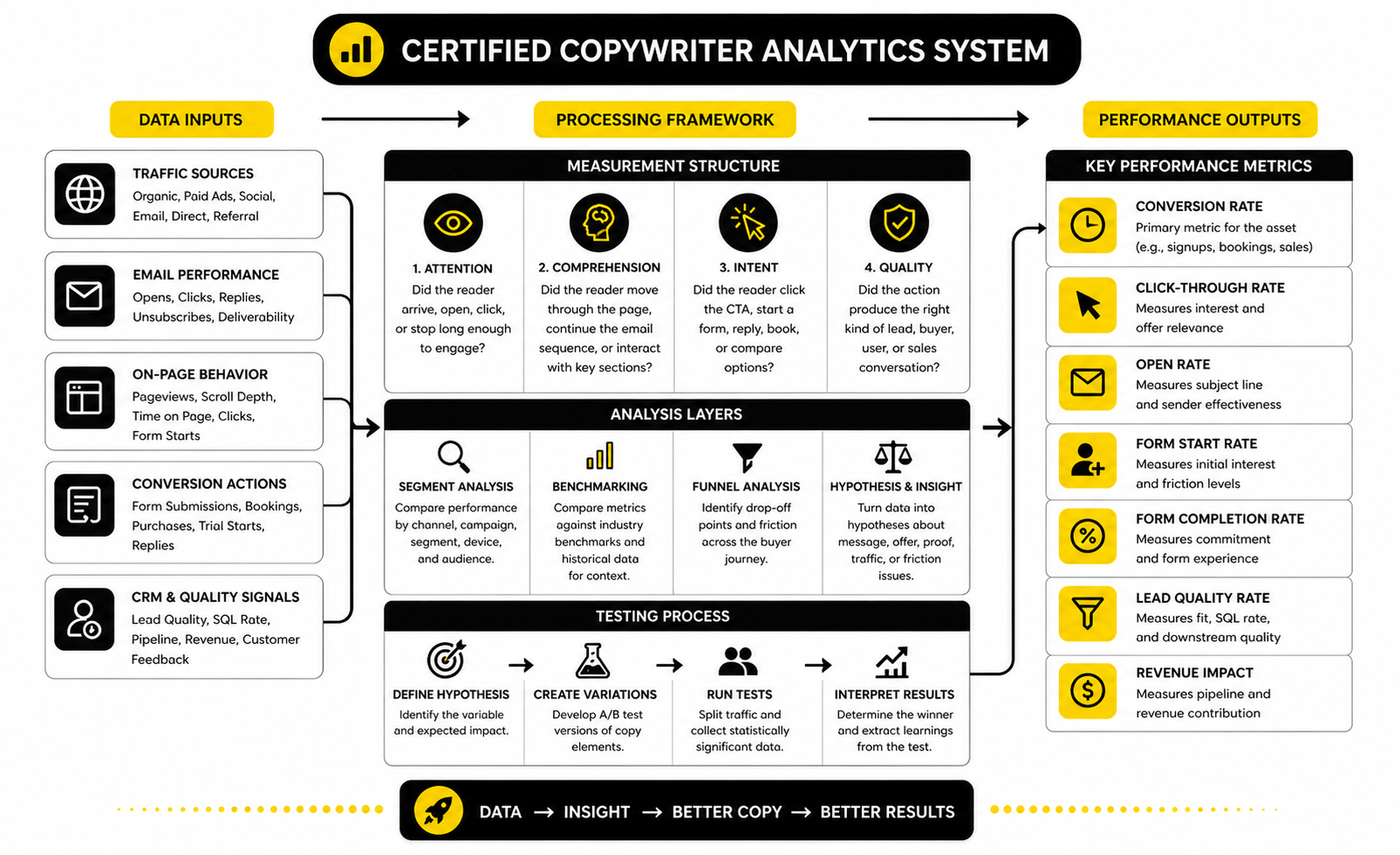
A practical copy analytics system usually tracks four layers:
This structure keeps the copywriter from overreacting to one number. If attention is strong but intent is weak, the hook may be working while the offer or proof is not. If intent is strong but quality is poor, the promise may be attracting the wrong audience or setting the wrong expectation.
Read Performance Signals Like A Copywriter
Performance data becomes useful when it points to a message problem. A high bounce rate may mean the traffic is wrong, but it may also mean the headline fails to confirm relevance quickly enough. Low scroll depth may mean the page opens with too much setup before the reader sees the value.
Email data works the same way. A strong open rate with weak clicks often suggests that the subject line created interest, but the body copy did not build enough desire or clarity. A low open rate with strong click-through among openers may suggest that the offer is relevant, but the subject line or sender trust is limiting reach.
Here is how to interpret common signals without guessing wildly:
The point is not to diagnose perfectly from one dashboard. The point is to ask better questions. Good copy measurement creates sharper next drafts.
Connect Data To Buyer Psychology
Numbers become more useful when they are tied to buyer psychology. A reader who does not click may not be lazy; they may be unconvinced, distracted, skeptical, confused, or not ready. The copywriter’s job is to identify which of those explanations is most likely.
This is where qualitative research still matters. Analytics can show where people drop off, but customer interviews, sales notes, session recordings, and on-page feedback can help explain why. A certified copywriter who combines both sources will usually make better decisions than someone who only stares at dashboards.
For example, if a landing page gets traffic but few booked calls, the issue may not be the button text. The real issue may be that the page does not explain who the offer is for, what happens on the call, or why the reader should trust the provider. The data points to the problem area, but the copywriter still has to interpret the human hesitation behind it.
Use Tests To Learn, Not To Gamble
Testing is not about changing button colors and hoping for magic. It is about testing a clear hypothesis. If the hypothesis is vague, the result will be vague too.
A strong test might compare two headline angles, two offer frames, or two versions of the call to action. One version may lead with speed, while another leads with risk reduction. One version may ask for a demo, while another offers a lower-friction diagnostic or checklist.
For a certified copywriter, the value of testing is not just the winner. The value is the learning. If a risk-reduction angle beats a speed angle, that may tell the business something important about buyer anxiety, not just that one headline was better.
Avoid Vanity Metrics
Vanity metrics make the work feel successful without proving business impact. Pageviews, impressions, likes, and opens can be useful early indicators, but they should not be treated as final outcomes. A copywriter who hides behind soft numbers will struggle to earn serious trust.
This matters even more now because content volume is easier to produce. Content Marketing Institute’s 2025 B2B research found that only 29 percent of B2B marketers rated their content strategy as extremely or very effective, which shows the gap between publishing more and communicating better. A certified copywriter should help close that gap by tying copy decisions to outcomes the business actually cares about.
The practical standard is clear. If a metric does not help improve the message, qualify the audience, reduce friction, increase trust, or support revenue, it should not drive the copy strategy. Measure what matters, ignore what flatters, and use the data to make the next version stronger.
Writing Conversion Assets That Hold Up In The Real World
At this stage, the certified copywriter has already done the strategic work. The audience is clearer, the offer has shape, the core message has direction, and the measurement system is ready to show what happens after publishing. Now the challenge is different: turning the strategy into assets that survive real attention, real skepticism, and real business constraints.
This is where advanced copywriting becomes less glamorous and more valuable. The writer has to balance persuasion with accuracy, speed with quality, conversion with brand trust, and automation with human judgment. Anyone can write a punchy line in isolation; the harder skill is building copy that works across a campaign without creating confusion or breaking trust.
That is also why a certified copywriter should not treat every asset as a separate creative project. A landing page, email sequence, ad, form, chatbot, sales deck, and follow-up message may all be part of the same buyer journey. If those pieces sound disconnected, the reader feels the friction even if they cannot name it.
Balance Persuasion With Proof
The more ambitious the promise, the more proof the copy needs. That proof can come from testimonials, product demos, transparent process explanations, third-party validation, customer outcomes, screenshots, before-and-after context, or clear comparisons. But it has to be real, specific, and relevant to the decision being made.
This is especially important when using testimonials or endorsements. The FTC’s endorsement guidance makes clear that advertisers should not use testimonials in a way that misleads people about what they can generally expect, and material connections should be disclosed when they affect credibility. That matters for copywriters because a persuasive asset can create legal and reputational risk if it turns weak evidence into a big promise.
A certified copywriter should be comfortable saying, “We need stronger proof before we make that claim.” That is not being difficult. That is protecting the business from copy that converts attention in the short term but creates disappointment, refunds, complaints, or distrust later.
Know When To Use Direct Response And When To Pull Back
Direct response copy has a job: get the reader to act. It can be powerful when the offer is clear, the audience is warm enough, and the decision can reasonably happen now. But when direct response techniques are used without judgment, the copy can feel pushy, manipulative, or out of sync with the brand.
The tradeoff is simple. Stronger urgency can increase action, but fake urgency can damage trust. Sharper pain points can create relevance, but overdramatized pain can make the brand feel predatory. A bold guarantee can reduce risk, but a vague or unrealistic guarantee can create operational problems later.
The best copywriters know how to turn the volume up or down. A high-ticket B2B service may need calm authority, detailed proof, and a consultative next step. A low-ticket impulse offer may need speed, clarity, and a simple purchase path. The certified copywriter’s job is not to force one style everywhere; it is to match the persuasion level to the buyer, offer, and brand.
Design The Message Across The Full Funnel
Real-world copy rarely lives on one page. A prospect may see a social post, click an ad, read a landing page, receive emails, interact with a form, book a call, and then get follow-up messages from sales. Every step either strengthens the decision or introduces doubt.
That means message consistency matters. The ad should set the right expectation for the landing page. The landing page should make the next step feel obvious. The confirmation page should reassure the reader that they made the right move. The follow-up emails should continue the same promise instead of changing the conversation entirely.
For example, a copywriter building an automated lead follow-up system may pair persuasive emails with CRM and workflow tools like GoHighLevel, but the automation should not feel mechanical. The copy still needs timing, context, and restraint. A fast follow-up is useful; a noisy sequence that ignores the reader’s behavior is not.
Protect The Brand From Generic AI Output
AI has changed the writing workflow, but it has not removed the need for skilled judgment. The problem is not that AI can write drafts. The problem is that unedited AI copy often sounds plausible while being strategically thin, repetitive, unsupported, or too generic to create trust.
Marketing teams are already dealing with that tension. The 2025 State of Marketing AI Report surveyed almost 1,900 marketing and business leaders, which shows how mainstream AI has become in marketing work. But the more content gets produced, the more valuable sharp positioning, original customer insight, and strong editing become.
A certified copywriter should treat AI as a production assistant, not a strategy replacement. It can help organize research, generate alternate angles, outline sections, or speed up rough drafts. It should not be trusted to invent proof, decide positioning, understand nuanced customer anxiety, or publish copy without human review.
Scale Without Losing Message Quality
Scaling copy sounds attractive until the message starts to blur. More pages, more emails, more ads, more social posts, and more funnels can create more opportunities, but they can also create inconsistency. The larger the system gets, the more important the underlying message architecture becomes.
A strong copy system usually includes:
This is not corporate paperwork for the sake of paperwork. It is how a business keeps copy consistent when multiple people are writing, editing, designing, and publishing. For a certified copywriter, this kind of system can become a major competitive advantage because it shows that they can support growth, not just deliver isolated drafts.
Avoid The Expert Trap
The expert trap is when the copywriter understands the product so well that they forget what the reader does not know yet. This happens constantly in technical, SaaS, finance, health, legal, and B2B markets. The business wants to explain everything, while the reader is still trying to understand whether the problem matters and whether the offer is relevant.
The fix is not to dumb the message down. The fix is to sequence the information properly. Lead with the reader’s situation, then explain the mechanism, then support the claim with proof, then provide deeper detail for people who need it.
A certified copywriter should be able to translate expert knowledge into buyer clarity. That means cutting jargon, defining terms when needed, and resisting the temptation to showcase everything the company knows. The reader does not need every detail at once; they need the next useful detail at the right moment.
Handle Risk Before It Becomes A Conversion Problem
Risk is often invisible in a first draft. The page may look clean, the offer may sound strong, and the call to action may be clear, but the reader still hesitates. That hesitation usually comes from unanswered questions.
Common risks include price risk, time risk, implementation risk, trust risk, identity risk, and social risk. A buyer might wonder whether the product is too expensive, whether setup will be painful, whether their team will use it, whether the company is credible, whether they will look foolish for recommending it, or whether the promise is too good to be true.
Good copy addresses those concerns before they become objections. It can do that through transparent pricing logic, onboarding explanations, comparison sections, FAQs, guarantees, demos, testimonials, or clear next-step expectations. The key is to reduce anxiety without turning the asset into a defensive wall of text.
Build For Trust, Not Just Response
Trust is now a serious performance variable. The 2025 Edelman Trust Barometer reported that many people believe leaders across business, government, and media deliberately mislead them, and public skepticism creates a harder environment for any persuasive message. That means copywriters cannot assume readers will give brands the benefit of the doubt.
This is why exaggerated copy is dangerous. It may increase short-term curiosity, but it trains the reader to doubt the brand. Clean, specific, proof-backed writing often feels less flashy, but it holds up better when the buyer is skeptical.
A certified copywriter should aim for conversion that the business can stand behind. That means the copy should attract the right people, set the right expectations, and make the offer easier to understand. That is the kind of writing that performs today without creating problems tomorrow.
Professional Implementation, Portfolio Proof, And Next Steps
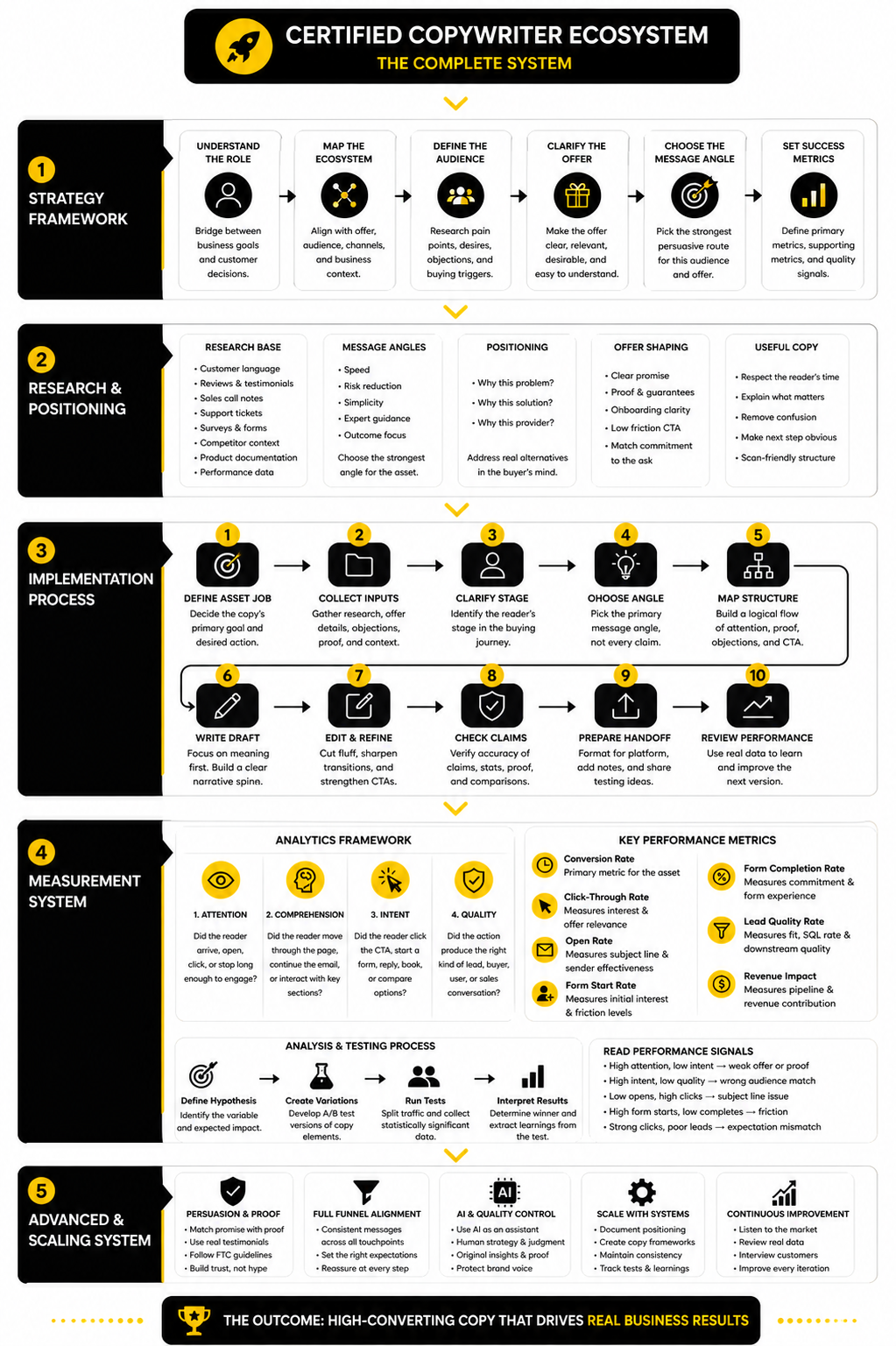
A certified copywriter becomes more valuable when they can connect strategy, execution, measurement, and proof into one working system. That system is what turns scattered writing samples into professional credibility. It also helps clients and employers see the difference between someone who can write clean sentences and someone who can support real marketing outcomes.
The final step is not simply “get certified and apply for jobs.” It is to build evidence around the way you think, the way you work, and the kind of assets you can improve. A certificate can open the door, but your process, portfolio, and judgment are what keep the conversation going.
Build A Portfolio That Shows Thinking, Not Just Samples
A strong portfolio should not only show finished copy. It should show the problem, the audience, the goal, the constraints, and the reasoning behind the final asset. That gives a potential client or hiring manager something much more useful than a pretty screenshot.
For a certified copywriter, the portfolio can include landing pages, email sequences, ads, lead magnets, product descriptions, website rewrites, sales pages, onboarding messages, and content briefs. But each piece should have context. What was the asset supposed to do? What changed from the original version? What research shaped the message?
This does not mean you need confidential client data. If you cannot share results, explain the strategic decisions instead. Show before-and-after structure, message hierarchy, claim support, call-to-action logic, and how the copy would be measured after launch.
Turn Certification Into A Credibility Asset
Certification is most useful when it supports a bigger credibility story. Instead of saying “I am certified” and stopping there, explain what the training helped you do better. Did it improve your research process, your editing discipline, your conversion thinking, or your ability to structure campaigns?
Clients do not usually care about the certificate in isolation. They care about whether you can reduce risk, save time, improve clarity, and help them communicate in a way their market understands. So the certification should point back to practical outcomes.
A simple positioning line can help. For example, a certified copywriter might say they help service businesses clarify their offer and turn messy ideas into conversion-focused pages and emails. That is more useful than leading with the credential alone.
Create A Repeatable Client Delivery System
Professional implementation requires more than writing. It requires onboarding, briefing, review, handoff, revision, and follow-up. A copywriter who manages those steps well feels easier to work with, which often matters as much as the draft itself.
A simple delivery system can include:
This kind of system makes the work feel controlled instead of chaotic. It also protects the copywriter from endless revisions because expectations are clearer from the beginning.
Keep Improving After The First Win
The best copywriters do not treat one successful asset as proof that they are done learning. Markets shift, platforms change, buyer expectations evolve, and competitors adapt. The copywriter who keeps listening to the market will keep writing sharper copy.
That improvement can come from studying sales calls, reviewing campaign data, interviewing customers, reading support conversations, and tracking which messages actually create action. It can also come from better collaboration with designers, media buyers, sales teams, founders, and product teams.
A certified copywriter should stay close to the feedback loop. The work gets better when the writer sees what happens after the copy goes live.
What Is A Certified Copywriter?
A certified copywriter is a writer who has completed some form of structured copywriting training or certification. The certification may cover persuasive writing, research, editing, customer psychology, sales pages, emails, ads, or content strategy. The important point is that certification should support real skill, not replace it.
Do You Need A Certification To Become A Copywriter?
No, you do not need a certification to become a copywriter. Many strong copywriters build careers through practice, portfolio work, client results, and direct experience. Certification can help create structure and credibility, especially for beginners, but it is not the only path into the field.
Is A Certified Copywriter More Trustworthy Than A Non-Certified Copywriter?
Not automatically. A certified copywriter may have useful training, but trust should come from the full picture: portfolio, process, testimonials, communication, strategy, and proof of judgment. A non-certified copywriter with strong experience can be more capable than a certified writer who has never handled real business constraints.
What Skills Should A Certified Copywriter Have?
A certified copywriter should understand research, positioning, offer clarity, headline writing, persuasion, editing, calls to action, customer objections, and basic performance measurement. They should also know how to write for different formats, including landing pages, emails, ads, websites, product pages, and lead generation assets. The strongest copywriters also understand collaboration because copy rarely works alone.
How Long Does It Take To Become A Good Copywriter?
It depends on how much you practice and how much feedback you get. You can learn basic frameworks quickly, but strong judgment takes longer because it comes from writing, reviewing, testing, and seeing how real readers respond. The copywriter who writes consistently and studies real customer behavior will usually improve faster than someone who only consumes training.
What Should A Beginner Certified Copywriter Put In Their Portfolio?
A beginner can include practice projects, speculative rewrites, personal projects, volunteer work, or early client work, as long as the context is honest. The portfolio should explain the target audience, business goal, message angle, and reasoning behind the copy. A few thoughtful pieces are better than many disconnected samples.
How Should A Certified Copywriter Price Their Work?
Pricing depends on skill level, niche, scope, turnaround, research depth, and business value. A simple email may be priced differently from a full funnel, sales page, or website rewrite. The more carefully move is to price around the value and complexity of the project, not just the number of words.
Can AI Replace A Certified Copywriter?
AI can speed up drafting, outlining, brainstorming, and editing, but it does not replace strategic judgment. A certified copywriter still needs to understand the customer, choose the right message, verify claims, protect the brand, and shape the offer. AI is useful when guided by a skilled human; it is risky when treated as a complete strategy.
What Makes Copywriting Different From Content Writing?
Copywriting usually focuses on a specific action, such as signing up, booking a call, clicking, buying, replying, or starting a trial. Content writing often focuses more on education, trust-building, search visibility, or audience development. The two overlap, but copywriting is usually closer to conversion and decision-making.
How Do You Know If Copy Is Working?
Copy is working when it helps the right reader take the right next step. That might mean more qualified leads, more booked calls, stronger email engagement, better demo requests, higher sales page conversions, or fewer confused prospects. The metric depends on the asset, so the goal must be clear before performance can be judged.
What Should Businesses Ask Before Hiring A Certified Copywriter?
Businesses should ask about process, research, relevant examples, revision expectations, proof handling, and how the copywriter thinks about measurement. They should also ask how the writer handles unclear offers, weak proof, and competing priorities from different stakeholders. Those answers reveal more than a certificate alone.
What Is The Biggest Mistake New Copywriters Make?
The biggest mistake is writing before understanding the strategy. New copywriters often try to sound persuasive before they understand the audience, offer, objections, and desired action. That leads to copy that may sound energetic but does not give the reader a strong reason to act.
Build a stronger local presence with BAAM AI
Turn your website, Google profile, social channels, and AI visibility into one growth engine
Most businesses do not need more random marketing activity. They need a consistent presence system that helps the right people find them, trust them, and take action. BAAM AI brings strategy, local SEO, website updates, Google Maps visibility, social content, AI-search readiness, media production, and reporting into one practical monthly engine.
If you want your marketing to keep working after the campaign ends, start with a free BAAM AI presence audit. See how your business shows up today and where the fastest visibility wins are at BAAM AI.