
BAAM AI Blog
Statistics and Data That Actually Matter
Email metrics are useful only when they help you make a better decision. A high open rate can still produce weak sales. A low click rate can hide a strong offer if the email was sent to the wrong segment. A good...
Email metrics are useful only when they help you make a better decision. A high open rate can still produce weak sales. A low click rate can hide a strong offer if the email was sent to the wrong segment. A good benchmark gives you context, but your own audience behavior is what tells you what to fix next.
This is why the best email copywriting course should teach measurement as part of the writing process. You are not learning email copy just to make sentences sound better. You are learning how to create messages that move people through a customer journey and produce measurable business outcomes.
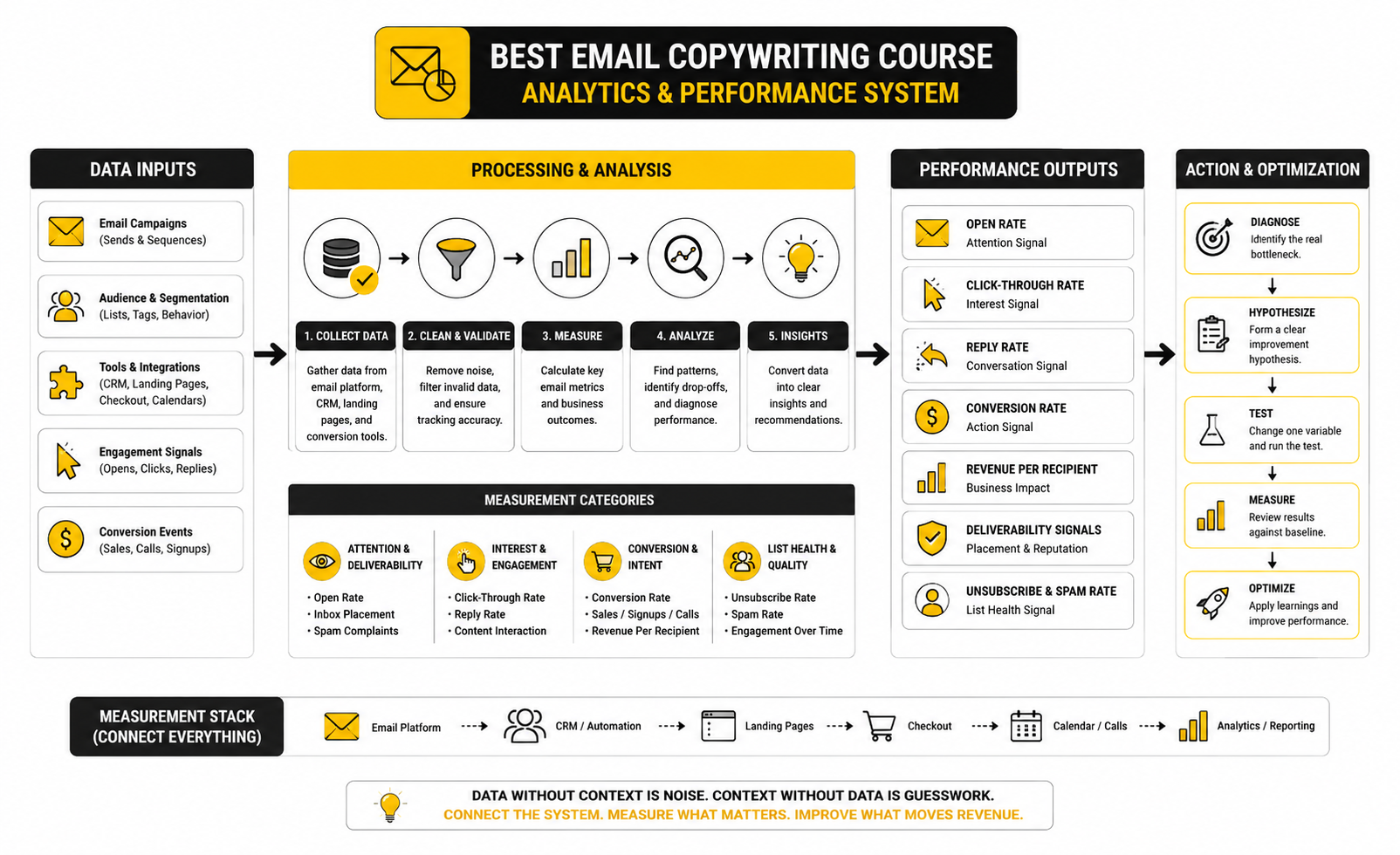
The mistake is treating every number as equally important. They are not. Some metrics diagnose attention. Some diagnose interest. Some diagnose conversion intent. Some diagnose list quality, deliverability, or offer-market fit.
The Metrics Behind Better Email Copy
Open rate can still tell you something, but it is no longer the clean signal many marketers pretend it is. Apple’s Mail Privacy Protection made opens less reliable because many opens can be automatically triggered rather than coming from a real human reading the message. That does not mean open rate is useless, but it does mean you should treat it as a directional signal instead of a final truth. Apple Mail Privacy Protection overview
Click-through rate is usually more useful for copywriters because it shows that someone did more than glance at the email. They found the message relevant enough to take action. Brevo’s 2025 benchmark data shows that click-through rates vary by region and industry, which is a good reminder that “good” performance depends on the audience, the offer, and the email’s job. Brevo 2025 email marketing benchmarks
Conversion rate matters most when the email is designed to create a business action. That action might be a purchase, booked call, trial start, webinar signup, demo request, upgrade, or reply. If a course does not teach you how email copy connects to conversion events, it is teaching writing in isolation, not revenue-focused email marketing.
What Benchmarks Should and Should Not Do
Benchmarks are helpful for spotting whether your results are wildly out of range. If your emails are getting almost no clicks, no replies, and no conversions, benchmarks can help you see that something is broken. But benchmarks should not become the standard you worship.
A benchmark is an average across different brands, lists, industries, offers, send frequencies, and list quality levels. Your email program may be healthier than the benchmark even if one metric is lower, especially if revenue per recipient, reply quality, or sales-qualified leads are strong. The reverse is also true: you can beat an average open rate and still have a weak email program if the list is disengaged or the offer is unclear.
The more carefully move is to build your own baseline. Measure your welcome sequence, promo emails, newsletters, reactivation emails, and sales follow-ups separately. Once you know your normal numbers, you can see whether a new email improved the system or just looked good in a vacuum.
How to Read Open Rates Without Fooling Yourself
Open rate mostly tells you about attention and deliverability, but it does not prove persuasion. A high open rate can come from a strong subject line, a trusted sender name, curiosity, good timing, or even inflated tracking. That is why you should never judge the best email copywriting course by whether it promises magical subject line formulas.
A good subject line should attract the right reader into the right message. If it overpromises, tricks people, or creates curiosity the body does not satisfy, the email may get opened but damage trust. That is a bad trade.
When open rates are weak, investigate the basics before rewriting everything. Look at sender reputation, list quality, subject line clarity, preview text, audience fit, send timing, and whether your emails are landing in the inbox at all. Validity’s 2025 deliverability benchmark emphasizes inbox placement as a more accurate deliverability measure than basic delivery because “delivered” does not always mean the email reached the inbox. Validity 2025 email deliverability benchmark
How to Read Clicks, Replies, and Revenue
Clicks are a stronger signal because they show action. If people open but do not click, the problem may be in the body copy, offer clarity, CTA, audience segment, or link destination. It may also mean the email did its job without needing a click, especially for newsletters where the main value is delivered inside the email.
Replies are often underrated. For service businesses, consultants, agencies, and B2B offers, a reply can be more valuable than a click because it starts a direct sales conversation. A course that only talks about buttons and ignores reply-driven email is missing a major practical use case.
Revenue is the cleanest metric when tracking is set up properly, but even revenue needs context. One email can produce a sale because five previous emails warmed up the reader. Another email can look weak because it educated people earlier in the funnel instead of pushing for immediate conversion. Good analytics should help you understand the sequence, not just the single send.
The Measurement Stack for Serious Email Work
The cleanest email measurement system connects campaign performance to business outcomes. That means your email platform, CRM, checkout, calendar, landing page, and analytics need to work together. If those systems are disconnected, you may know who clicked but not whether the click became revenue.
For agencies, coaches, local businesses, and service companies, GoHighLevel can make this easier because email, CRM, automation, calendars, pipelines, and follow-up can live in one operating system. For creators, startups, and small businesses that want straightforward email campaigns with automation and reporting, Brevo can be a practical setup. The tool choice should support the strategy, not become a distraction from it.
This is also why copywriting training should include implementation thinking. A copywriter who understands how emails are triggered, tagged, segmented, tested, and measured will write more useful emails. They will also make better recommendations when something underperforms.
What the Data Should Make You Do Next
Metrics are only valuable if they change behavior. If open rates are low but deliverability is healthy, test subject lines and preview text. If opens are fine but clicks are weak, tighten the angle, CTA, offer framing, and first half of the email.
If clicks are strong but conversions are poor, the email may not be the main problem. The landing page, checkout flow, sales page, pricing, page speed, proof, or offer may be causing the drop-off. This is where email copywriters become more valuable when they understand the full funnel.
A strong course should teach you to diagnose before rewriting. Do not randomly change subject lines, CTAs, layout, and offer positioning all at once. Change one meaningful thing, measure the result, and document what you learned.
The Best Courses Teach Judgment, Not Just Reporting
Anyone can screenshot a dashboard. The useful skill is knowing what the dashboard means. That is why the best email copywriting course should teach you how to connect numbers to decisions.
If a campaign underperforms, you should be able to ask better questions. Was the list warmed up? Was the offer relevant? Was the promise specific? Did the CTA match the reader’s awareness level? Did the email create enough reason to act now? Did the landing page continue the same argument?
That is the level you want to reach. Not “I wrote an email and hoped it worked.” More like: “I know what this email was supposed to do, I know which signals show whether it did that job, and I know what to test next.”
Build a stronger local presence with BAAM AI
Turn your website, Google profile, social channels, and AI visibility into one growth engine
Most businesses do not need more random marketing activity. They need a consistent presence system that helps the right people find them, trust them, and take action. BAAM AI brings strategy, local SEO, website updates, Google Maps visibility, social content, AI-search readiness, media production, and reporting into one practical monthly engine.
If you want your marketing to keep working after the campaign ends, start with a free BAAM AI presence audit. See how your business shows up today and where the fastest visibility wins are at BAAM AI.