
BAAM AI Blog
Statistics and Data That Actually Matter
Measurement is where a copywriting network becomes honest. Before this point, everyone can have an opinion about the headline, the offer, the tone, or the page structure. Once the asset is live, the numbers start...
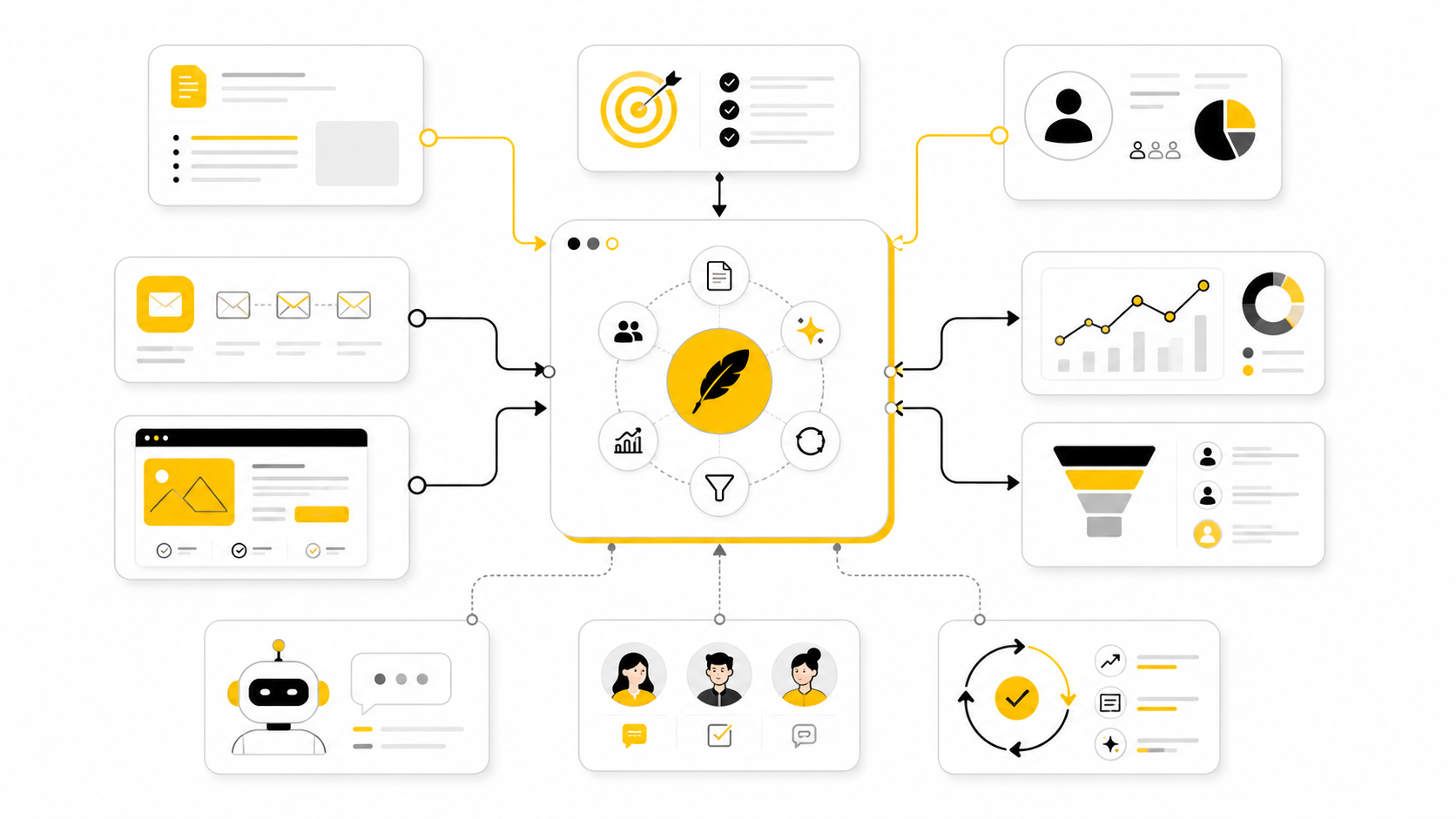
Measurement is where a copywriting network becomes honest. Before this point, everyone can have an opinion about the headline, the offer, the tone, or the page structure. Once the asset is live, the numbers start showing where the message is working, where it is leaking attention, and where the team is guessing.
The goal is not to collect every metric available. That creates dashboards nobody uses. The goal is to connect each number to a decision the team can make: improve the promise, sharpen the offer, change the audience segment, adjust the follow-up, add proof, reduce friction, or stop spending on an angle that is not converting.
A serious copywriting network treats data as feedback, not as decoration. Metrics should help the team understand what happened and what to test next. If a number does not change a decision, it is probably not a priority metric.
Benchmarks Are Starting Points, Not Targets
Benchmarks are useful because they stop you from judging performance in a vacuum. A 4% landing page conversion rate can be good, weak, or completely normal depending on the market, offer, traffic source, awareness level, and conversion action. This is why broad averages are helpful for orientation but dangerous when they become the only standard.
Unbounce’s conversion benchmark data is useful because it is based on a large landing page dataset, with performance drawn from 57 million conversions across more than 41,000 landing pages. That scale makes the data worth studying, but it still does not mean your page should blindly chase one universal number. A demo request for enterprise software is not the same action as a coupon claim, newsletter signup, ecommerce purchase, or webinar registration.
The practical move is to use benchmarks as a diagnostic reference. If your numbers are far below the range for similar pages, something may be wrong with the offer, traffic quality, message match, or page friction. If your numbers are above average but lead quality is poor, the copy may be attracting attention without attracting the right buyer.
Measure the Whole Message Journey
The biggest measurement mistake is judging copy from one isolated metric. A landing page conversion rate matters, but it does not tell the whole story. A page can convert well and still send weak leads, while another page can convert fewer visitors but create better sales conversations.
A copywriting network should measure the full path from first touch to meaningful business outcome. That includes the ad or entry point, the landing page, the form, the email follow-up, the sales conversation, and the revenue result. Gartner’s research showing that 61% of B2B buyers prefer a rep-free buying experience makes this even more important because more of the buyer’s decision is happening before direct human contact.
This is where network thinking beats asset thinking. You are not asking, “Did this page win?” You are asking, “Did this message move the right person to the right next step?” That question is much more useful.
Build a Simple Analytics System
The analytics system should be simple enough that the team actually uses it. Start with the conversion action, then work backward to the signals that explain it. If the goal is booked calls, measure qualified visitors, form starts, form completions, booked calls, show-up rate, opportunity rate, and closed revenue.
The copywriting network should also separate leading indicators from lagging indicators. Leading indicators show early movement, such as click-through rate, scroll depth, reply rate, form starts, or chatbot engagement. Lagging indicators show business impact, such as pipeline, revenue, retention, or customer acquisition cost.
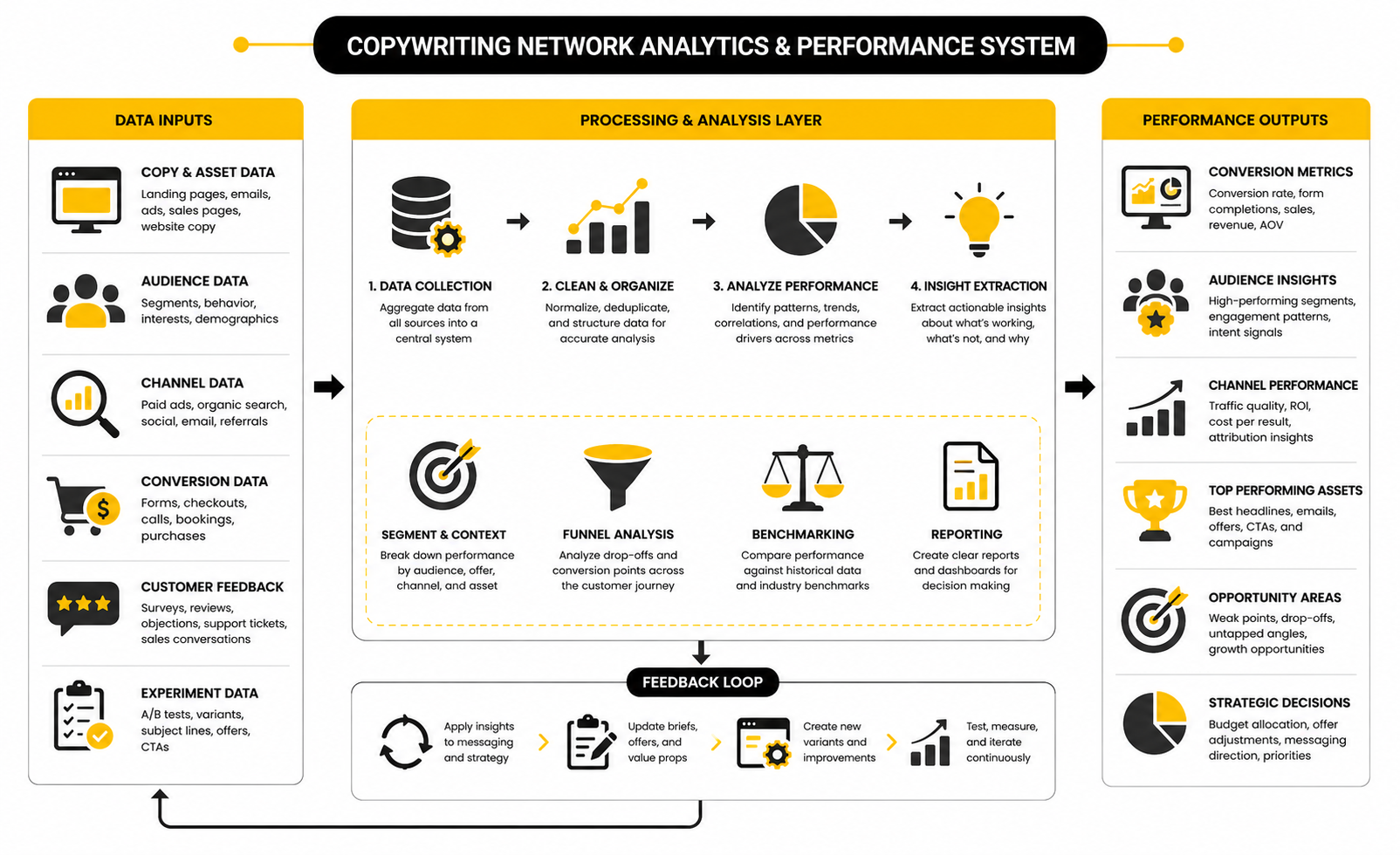
This system gives the team a clean way to interpret performance. If traffic clicks the ad but does not stay on the page, the problem may be message match. If people read the page but do not start the form, the offer or call to action may be weak. If people submit the form but sales rejects the leads, the copy may be too broad or the qualification step may be too soft.
Read Email Metrics Carefully
Email metrics are easy to misread. Open rates can still be directionally useful, but privacy changes and inbox behavior make them less reliable than they used to be. Clicks, replies, conversions, booked calls, purchases, and downstream quality usually tell you more about whether the copy created real action.
Mailchimp’s benchmark guidance frames email benchmarks as a way to compare open rates, click-through rates, and conversion rates against industry averages so teams can spot areas of strength and weakness through its email marketing benchmark resources. That is useful, but only when the team remembers what each metric can and cannot prove. A subject line can lift opens, but the body copy, offer, timing, and audience quality decide whether the campaign creates value.
For a copywriting network, the best email measurement usually connects the sequence together. One email may have a lower click rate but set up the next email to perform better. Another email may get clicks but attract the wrong people. The network has to read the pattern, not just the single send.
Track Message Match Across Channels
Message match is one of the most important performance signals because it tells you whether the promise that earns attention is the same promise the visitor sees after clicking. If the ad says one thing and the page opens with something broader, colder, or less specific, people feel the mismatch quickly. They may not analyze it, but they leave.
This applies across ads, organic search, social posts, referral links, webinars, email campaigns, and chatbot flows. The entry message creates an expectation. The destination copy has to continue that expectation while adding enough clarity and proof to move the person forward.
A copywriting network should review message match before and after launch. Before launch, check whether the headline, first screen, call to action, and proof points align with the traffic source. After launch, compare click-through rate, bounce behavior, scroll depth, and conversion rate to see where the expectation breaks.
Use Qualitative Data to Explain the Numbers
Quantitative data tells you what happened. Qualitative data often tells you why it happened. A low conversion rate may look like a weak headline, but customer feedback might reveal that the pricing model is unclear, the proof feels thin, or the offer sounds too similar to every competitor.
Useful qualitative inputs include sales call notes, customer interviews, chat transcripts, survey responses, support tickets, user testing notes, review mining, and form abandonment feedback. These inputs should feed back into the copywriting network so the next brief starts with better context. Otherwise, the team keeps reacting to symptoms instead of fixing the message problem.
This is also where AI can help without replacing judgment. Tools can summarize recurring objections, cluster survey responses, and identify repeated phrases faster than a human working manually. But the strategic decision still belongs to the team because not every repeated phrase is important, and not every objection deserves space in the copy.
Connect Copy Metrics to Revenue Metrics
The strongest copywriting network does not stop at engagement metrics. Engagement can be useful, but revenue metrics reveal whether the message attracted the right demand. This is the difference between writing copy that gets attention and writing copy that helps the business grow.
Benchmarkit’s 2025 B2B SaaS benchmark data shows that many marketing teams still focus heavily on pipeline and opportunity metrics, with 62% measuring pipeline generated and 51% measuring opportunities generated as top performance metrics. That is the right direction because it pushes copy measurement closer to business outcomes. The weakness appears when teams track pipeline without also checking quality, sales cycle, acquisition cost, and closed revenue.
For practical use, connect each major copy asset to one business question. Did this landing page create qualified pipeline? Did this email sequence revive dormant leads? Did this sales page increase purchase intent without increasing refunds? Did this onboarding copy reduce confusion and support demand? That is how measurement becomes useful.
Know What Each Metric Should Trigger
Data only matters when it drives action. A high bounce rate should trigger a message match review, not a random redesign. Low form starts should trigger an offer and call-to-action review, not five new headline variations with the same weak promise.
Here is a practical way to think about common signals:
These signals are not automatic diagnoses. They are starting points for more carefully investigation. The network still needs judgment, but it is judgment guided by evidence instead of personal preference.
Avoid Vanity Metrics Disguised as Progress
Vanity metrics are dangerous because they make the team feel productive while hiding weak business impact. Page views, impressions, likes, opens, and generic engagement can be useful in context. On their own, they do not prove the copy is working.
This is especially important for content-heavy teams. The Content Marketing Institute’s B2B research found that only 22% of B2B marketers described their content marketing as extremely or very successful, which is a reminder that publishing more does not automatically create better outcomes. The teams that win usually understand the audience better, measure more clearly, and connect content to a real commercial path.
A copywriting network should keep vanity metrics in their proper place. They can show reach, early interest, or distribution strength. But the deeper question is whether the message is moving the right people toward the right action.
Turn Data Into the Next Brief
The final step is the one most teams skip. They review performance, make a few comments, and then move on. That wastes the best part of the data.
Every campaign should create reusable learning for the next message brief. Winning angles should be saved. Failed promises should be documented. Objections should be added to the research bank. Proof points that improved conversion should become easier to find and reuse.
This is how a copywriting network compounds. The first campaign gives you data. The second campaign starts with better assumptions. The third campaign becomes faster because the team is no longer starting from scratch. That is the real value of measurement: not prettier reports, but better copy with every cycle.
Build a stronger local presence with BAAM AI
Turn your website, Google profile, social channels, and AI visibility into one growth engine
Most businesses do not need more random marketing activity. They need a consistent presence system that helps the right people find them, trust them, and take action. BAAM AI brings strategy, local SEO, website updates, Google Maps visibility, social content, AI-search readiness, media production, and reporting into one practical monthly engine.
If you want your marketing to keep working after the campaign ends, start with a free BAAM AI presence audit. See how your business shows up today and where the fastest visibility wins are at BAAM AI.