
BAAM AI Blog
Statistics and Data That Actually Matter
Email data is useful only when it changes what you do next. Random benchmarks can make a dashboard look intelligent, but they do not automatically tell you whether your email system is healthy. The best email tools...
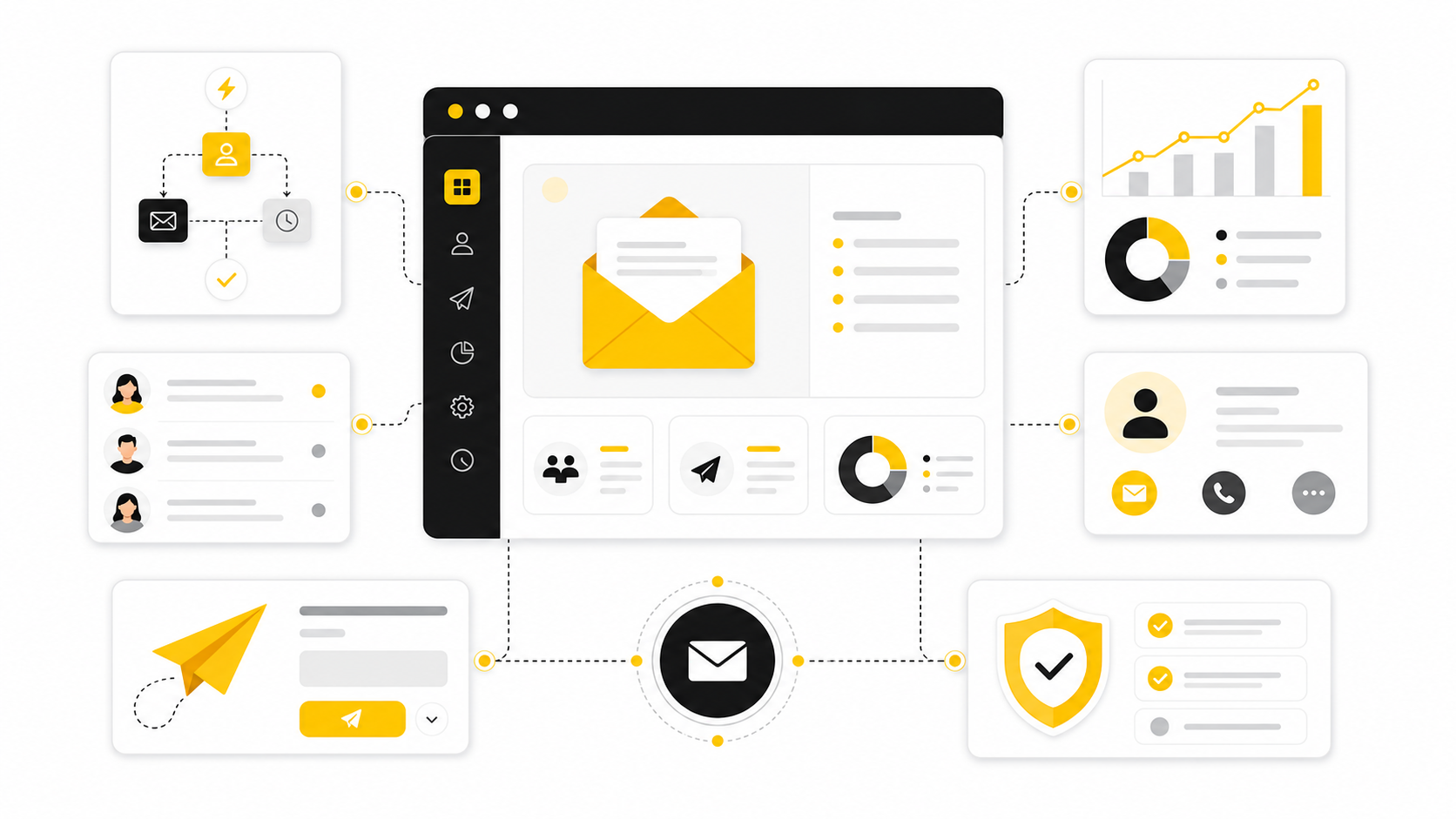
Email data is useful only when it changes what you do next. Random benchmarks can make a dashboard look intelligent, but they do not automatically tell you whether your email system is healthy. The best email tools help you connect the numbers to decisions: send more, send less, improve the offer, clean the list, fix deliverability, sharpen segmentation, or rebuild the journey.
This is where many teams get stuck. They stare at open rates, celebrate a spike, panic over a dip, and still have no idea whether email is driving revenue. A better approach is to measure the full chain from delivery to engagement to conversion to retention.
Email is still big enough to deserve serious measurement. Global email volume continues to rise, with estimates showing roughly 376.4 billion emails sent and received per day in 2025. The channel is not shrinking; the challenge is that inboxes are crowded, privacy changes distort some metrics, and subscribers are faster than ever at ignoring irrelevant messages.
Start With the Measurement Chain
The cleanest way to understand email performance is to measure it in layers. Each layer answers a different question. If you mix them together, you end up blaming the wrong thing.
The first layer is delivery, which tells you whether the email was accepted by receiving servers. The second layer is inbox placement, which tells you whether the message likely reached the inbox instead of spam or promotions. The third layer is engagement, which tells you whether people opened, clicked, replied, or ignored the message.
The fourth layer is conversion, where the business outcome happens. That might be a purchase, booked call, demo request, form completion, reply, renewal, upgrade, or product activation. The fifth layer is retention, where email proves whether it can keep customers engaged after the first conversion.
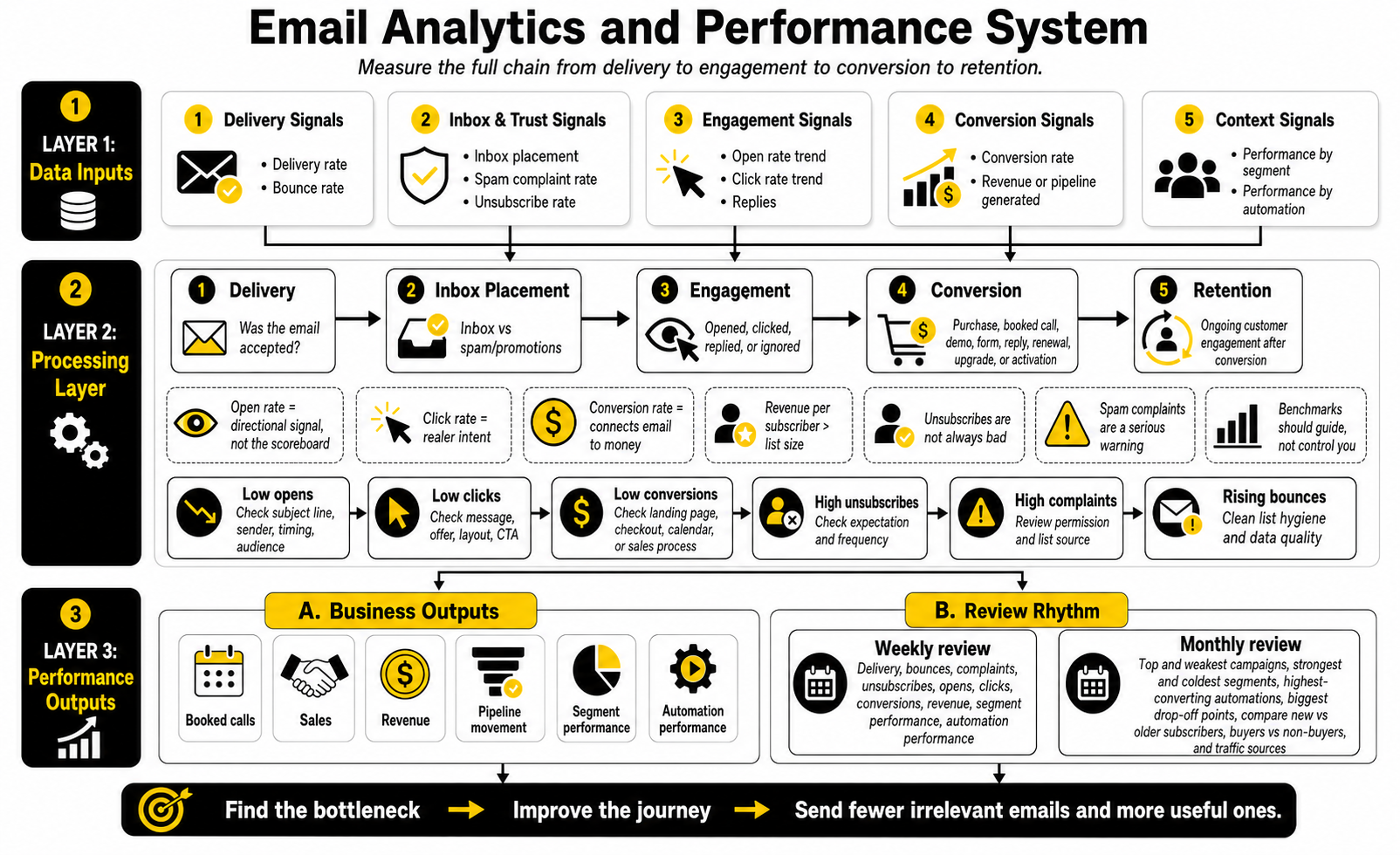
This chain matters because each metric has a job. If delivery is weak, copy is not the first problem. If clicks are weak but opens are strong, the issue may be message relevance, offer clarity, or call-to-action strength. If clicks are strong but conversions are weak, the problem is probably landing page, pricing, checkout, sales process, or offer fit.
Open Rate Is a Signal, Not the Scoreboard
Open rate used to be treated like the headline metric. That is no longer smart. Privacy features, image loading behavior, inbox filtering, and bot activity can all affect open tracking, so opens should be read as a directional signal rather than a clean measure of human attention.
That does not mean open rate is useless. It can still help you compare subject lines, sender names, timing, audience fatigue, and broad engagement trends inside the same list. The mistake is treating it as proof that the campaign worked.
A better question is: did the open rate move together with clicks, replies, and conversions? If opens rise but clicks and sales stay flat, the subject line may have created curiosity without intent. If opens are lower but revenue is higher, the campaign may have reached a smaller but more qualified segment.
Mailchimp’s benchmark data shows broad variation by industry, with its all-user benchmark listing an average open rate of 35.63% and average click rate of 2.62%. Those numbers are useful for context, but they should not become your target by default. Your real benchmark is your own audience, your own offer, and your own historical trend.
Click Rate Shows Realer Intent
Click rate is usually more useful than open rate because it measures an action. Someone saw enough value, curiosity, urgency, or trust to leave the inbox and move to the next step. That makes clicks one of the clearest signals for whether your message matched the reader’s intent.
Still, clicks need interpretation. A high click rate can be misleading if the clicks do not lead to useful behavior. People may click because the email is interesting, but if they do not buy, book, reply, or continue the journey, the email may be creating attention without progress.
The best email tools let you see clicks by segment, device, link, campaign type, and automation stage. That is where the useful insight appears. A weak overall click rate might hide a strong click rate from high-intent subscribers and a dead response from cold contacts.
Conversion Rate Connects Email to Money
Conversion rate is where email stops being a content activity and becomes a business system. A conversion is not always a sale. It can be a booked consultation, demo request, quote form, onboarding step, upgrade, renewal, or reply from a qualified lead.
The key is defining the conversion before you send the email. If the goal is a booked call, measure booked calls. If the goal is checkout recovery, measure recovered revenue. If the goal is activation, measure the product action that proves the user moved forward.
This is where CRM and funnel-connected tools become valuable. A platform like GoHighLevel can make sense when email performance needs to connect with pipeline stages, appointments, sales conversations, and follow-up tasks. A funnel-focused setup like ClickFunnels can make sense when the main conversion path moves through opt-in pages, sales pages, checkouts, upsells, and offer sequences.
Revenue Per Subscriber Is Better Than List Size
List size is easy to brag about and easy to misunderstand. A large list with weak engagement can be less valuable than a smaller list with strong intent. The number that matters more is revenue per subscriber, lead, or customer segment.
Revenue per subscriber forces you to look at quality. Are your acquisition sources attracting the right people? Are your segments meaningful? Are new subscribers converting faster than old ones? Are repeat buyers responding differently from first-time buyers?
This metric also helps you avoid cheap-list thinking. Buying leads, running low-quality giveaways, or adding poorly matched subscribers can grow the list while lowering performance. The best email tools help you see that quickly instead of letting vanity metrics hide the damage.
Unsubscribes Are Not Always Bad
Unsubscribes are often treated like failure, but that is too simplistic. A small, steady unsubscribe rate is normal because people change interests, budgets, jobs, and priorities. In some cases, unsubscribes can even protect deliverability by removing people who no longer want your emails.
The problem is not unsubscribes by themselves. The problem is a sudden spike, especially after a specific campaign, frequency change, list import, or automation update. That usually means the promise, targeting, timing, or content did not match what people expected.
Mailchimp’s benchmarks list an all-user unsubscribe rate of 0.22%, which gives a useful reference point. But again, context matters. A highly promotional launch sequence may produce more unsubscribes than a normal newsletter, and that may be acceptable if revenue and complaint rates stay healthy.
Spam Complaints Are a Serious Warning
Spam complaints deserve more attention than unsubscribes. An unsubscribe says, “I do not want this anymore.” A spam complaint says, “I did not expect this, do not trust this, or want the mailbox provider to punish this sender.”
That distinction matters. Spam complaints can damage sender reputation and reduce inbox placement. If complaints rise, you should review consent source, list age, message frequency, subject line honesty, sender identity, and whether the content matches the original opt-in promise.
Do not try to solve spam complaints with prettier design. Solve them with cleaner permission, better relevance, and clearer expectations. Make unsubscribing easy, send to people who actually asked to hear from you, and stop forcing messages onto segments that have gone cold.
Deliverability Metrics Protect the Whole System
Deliverability is the foundation under every other metric. If emails are not reaching the inbox, open rate, click rate, and conversion rate become distorted. You may think your offer is weak when the real issue is that subscribers are not seeing it.
Sinch Mailgun’s deliverability research shows that 48% of senders cite staying out of spam as a top challenge. That is not a small technical detail. It is a direct performance risk for any business relying on email as a revenue channel.
Track bounces, blocked messages, spam placement, authentication status, complaint trends, engagement decline, and sudden domain-level performance drops. If you are sending at meaningful volume, your email platform’s basic analytics may not be enough. That is when dedicated deliverability monitoring becomes worth considering.
Benchmarks Should Guide, Not Control You
Benchmarks are useful when they help you ask better questions. They are dangerous when they become generic targets. A B2B sales nurture sequence, ecommerce flash sale, nonprofit update, creator newsletter, and password reset email should not be judged by the same standard.
Use benchmarks to spot extreme problems. If your click rate is far below your industry range for months, something is probably wrong. If unsubscribes or complaints are unusually high, your targeting or promise may be off. If conversion is weak despite healthy clicks, the issue may be outside the email itself.
But do not blindly copy the average. Average performance is not the dream outcome. The goal is to build a system where your own numbers improve because your list quality, segmentation, offer, timing, and follow-up are getting sharper.
What to Review Every Week
Weekly review keeps email performance from drifting. You do not need a massive reporting ritual. You need a simple rhythm that catches problems early and turns data into action.
Review these numbers first:
The point is not to stare at every metric equally. The point is to find the bottleneck. If delivery is healthy but clicks are weak, improve relevance and calls to action. If clicks are strong but conversions are weak, inspect the landing page, offer, checkout, form, or sales handoff.
What to Review Every Month
Monthly review should focus on strategy, not just campaign reporting. This is where you look for patterns that are hard to see week by week. You want to understand which audiences, offers, automations, and acquisition sources are producing the best long-term value.
Review your top-performing campaigns, weakest campaigns, strongest segments, coldest segments, highest-converting automations, and biggest drop-off points. Compare new subscribers against older subscribers. Compare buyers against non-buyers. Compare traffic sources if your tool setup allows it.
This is also where tools around the email platform can matter. If social content feeds your list, Buffer can help you review whether consistent publishing is creating subscriber growth. If forms are the main capture point, Fillout can help improve the quality of the data entering the system.
The Metrics That Should Trigger Action
A good analytics setup should tell you what to do next. If a metric moves and nothing changes, you are not measuring; you are collecting dashboard decoration. The best email tools make action easier by connecting performance data to segments, automations, and customer records.
Low opens should trigger subject line, sender, timing, and audience checks. Low clicks should trigger message, offer, layout, and CTA checks. Low conversions should trigger landing page, checkout, calendar, or sales process checks. High unsubscribes should trigger expectation and frequency checks.
High complaints should trigger an immediate permission and list-source review. Rising bounces should trigger list hygiene and data-quality cleanup. Falling revenue per subscriber should trigger a deeper review of acquisition quality, segmentation, and offer fit.
ROI Is the Metric Leadership Cares About
Email ROI matters because it translates email from “marketing activity” into business value. Litmus reported that in its 2025 email ROI research, 30% of marketing leaders receive $36 to $50 for every $1 spent on email, while 5% receive more than $50. That is why email keeps getting budget even when newer channels get more attention.
The uncomfortable part is that ROI is not always measured well. If your email tool cannot connect campaigns and automations to revenue, bookings, upgrades, renewals, or pipeline movement, you may be undercounting or overestimating impact. Both are dangerous.
A practical ROI model should include platform cost, creative time, list growth cost, deliverability tools, implementation cost, and the revenue or pipeline email influenced. Keep it simple enough to use consistently. The goal is not perfect attribution; the goal is better decisions.
Data Should Make Email More Human
The purpose of measurement is not to turn email into a mechanical numbers game. It is to understand people better. When someone clicks, ignores, buys, replies, unsubscribes, or comes back months later, they are giving you behavioral feedback.
Good data helps you respect that feedback. It helps you send fewer irrelevant emails and more useful ones. It helps you stop shouting at the entire list and start speaking to people based on what they actually need.
That is the real reason analytics belongs in this guide to the best email tools. The right platform does not just show reports. It helps you turn those reports into better timing, cleaner segmentation, stronger offers, and a customer journey that feels more relevant from the first email to the final conversion.
Build a stronger local presence with BAAM AI
Turn your website, Google profile, social channels, and AI visibility into one growth engine
Most businesses do not need more random marketing activity. They need a consistent presence system that helps the right people find them, trust them, and take action. BAAM AI brings strategy, local SEO, website updates, Google Maps visibility, social content, AI-search readiness, media production, and reporting into one practical monthly engine.
If you want your marketing to keep working after the campaign ends, start with a free BAAM AI presence audit. See how your business shows up today and where the fastest visibility wins are at BAAM AI.