
BAAM AI Blog
Statistics And Data: How To Measure HubSpot Free Email Properly
Measurement is where HubSpot free email becomes useful beyond the act of sending. The goal is not to stare at dashboards and feel productive. The goal is to understand whether your emails are reaching the right...
Affiliate disclosure: this article may include compensated links. Recommendations should still be evaluated against your use case, budget, and current provider terms.
Should you choose HubSpot?
HubSpot is worth considering when the use case, budget, and implementation effort match what you actually need to do next.
teams that want a practical tool decision without reading another generic feature list
Check HubSpotMeasurement is where HubSpot free email becomes useful beyond the act of sending. The goal is not to stare at dashboards and feel productive. The goal is to understand whether your emails are reaching the right people, creating the right behavior, and improving the customer journey.
This is also where a lot of marketers get distracted. They chase open rates because open rates are easy to see. They celebrate list growth because bigger numbers feel good. They compare themselves to benchmarks without checking whether their audience, offer, list quality, and send type are even similar.
Use the numbers, but do not worship them. Email analytics should tell you what to fix, what to repeat, and what to stop doing.
The Metrics That Actually Matter
The first metric to watch is deliverability. If your emails do not reach the inbox, nothing else matters. A 2025 deliverability benchmark from Validity found that Europe had an inbox placement rate of 89.1 percent, while Microsoft mailboxes were harder to reach with an inbox placement rate of 75.6 percent. That matters because performance problems are not always copy problems. Sometimes your emails are simply not landing where people can see them.
The second metric is click rate. Clicks show stronger intent than opens because the reader took a visible action. Mailchimp’s benchmark data lists an all-user average click rate of 2.62 percent, while ecommerce sits lower at 1.74 percent and nonprofits higher at 3.27 percent. Do not panic if your click rate is not huge. Instead, ask whether the click was meaningful and whether the landing page continued the journey properly.
The third metric is conversion. This is the metric that connects email to business reality. A conversion could be a booked call, demo request, purchase, form submission, reply, webinar registration, or trial signup. HubSpot free email can show useful engagement data, but you should still define the business action that matters before you send.
Why Open Rates Need Context
Open rates are still useful, but they are weaker than many people think. Apple’s Mail Privacy Protection can preload email tracking pixels, which means some Apple Mail opens can be inflated or unreliable. Mailchimp’s Apple privacy guidance explains that contacts using this protection may show emails as opened even when the person did not actually open them, making open metrics less accurate for those contacts.
That does not mean open rates are useless. They can still help you compare subject lines, sender names, list quality, and general audience warmth over time. But they should not be your main success metric. A campaign with a modest open rate and strong clicks can be far more valuable than a campaign with a high open rate and no meaningful action.
For HubSpot free email, treat open rate as an early signal. If opens are unusually low, check your sender name, subject line, list source, send timing, and deliverability basics. If opens are high but clicks are weak, the problem is probably the promise, body copy, offer, or call to action.
The Simple Analytics System To Use Every Week
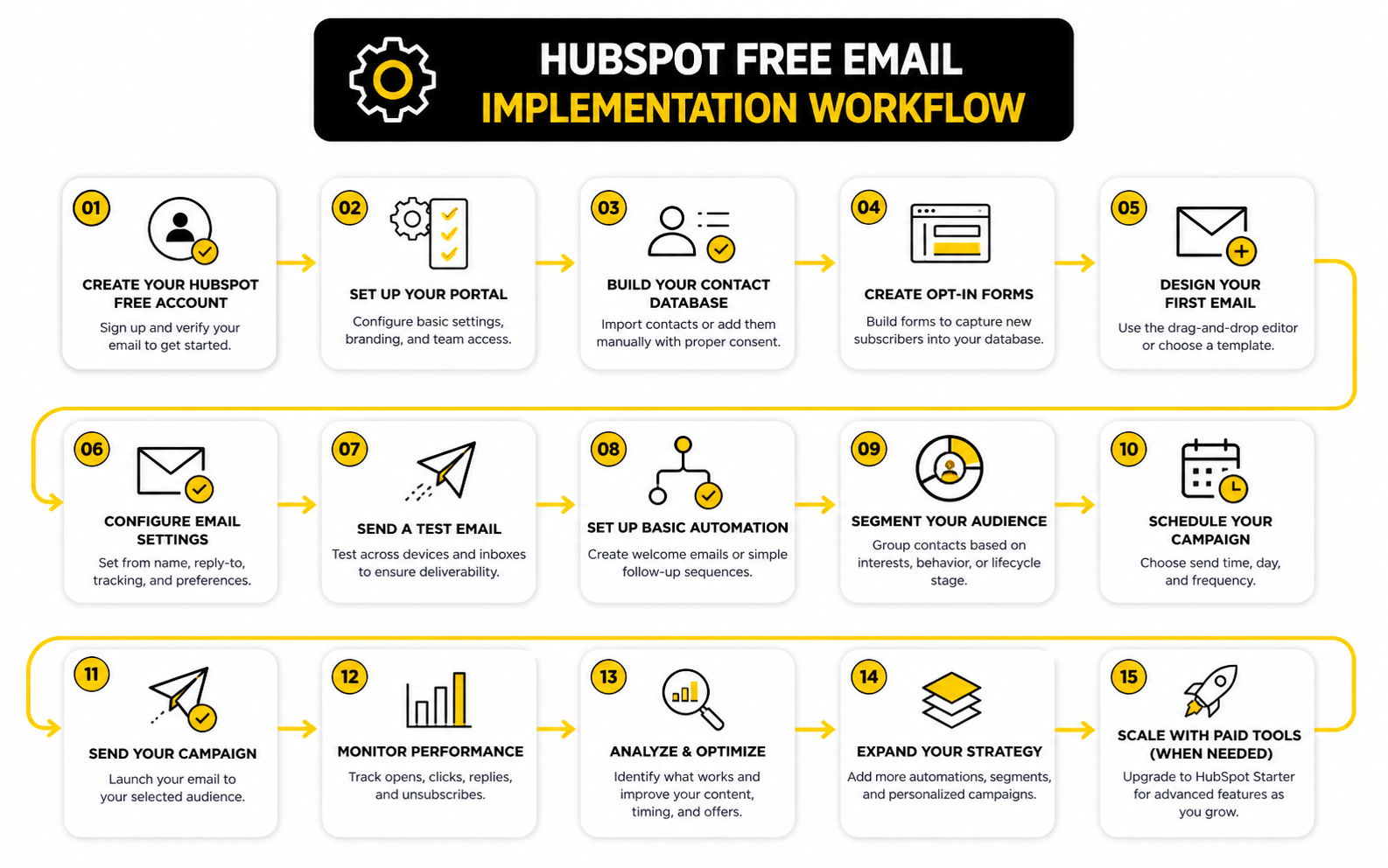
A practical analytics system should answer five questions. Did the email get delivered? Did the right people open it? Did anyone click? Did the click lead to a meaningful action? Did the campaign improve what happens next in the CRM?
That is enough for most small teams. You do not need a complex reporting dashboard at the beginning. You need a repeatable rhythm that turns performance data into decisions.
Review these signals after every campaign:
The key is not to track everything forever. The key is to track the few signals that help you make a better next send.
Benchmarks Are Guardrails, Not Grades
Benchmarks are useful because they give you a sanity check. Mailchimp’s all-user benchmark shows an average open rate of 35.63 percent and an average unsubscribe rate of 0.22 percent. MailerLite’s 2025 benchmark reports an average open rate of 43.46 percent, an average click rate of 2.09 percent, and an unsubscribe rate of 0.22 percent. Those numbers help you spot extremes, but they do not tell the whole story.
A small expert list can beat benchmarks because the audience is highly relevant. A large cold list can underperform because the relationship is weak. A sales-heavy email can drive more unsubscribes than an educational one, even if it produces revenue. Context matters.
Use benchmarks to ask better questions. If your click rate is far below the typical range, your call to action may be weak or your offer may not match the list. If your unsubscribe rate spikes, your promise and your content may be misaligned. If your open rate looks strong but revenue is flat, you may be attracting curiosity without buyer intent.
What Good Performance Looks Like In Practice
Good performance is not one magic number. It is alignment between audience, message, and business outcome. A good HubSpot free email campaign should reach a clean list, create visible engagement, and move at least some contacts into a more useful next step.
For an educational email, success might mean strong clicks to a guide, replies from qualified prospects, or more people visiting a key service page. For a lead follow-up email, success might mean booked calls or direct replies. For a customer update, success might mean fewer support questions, better product adoption, or more repeat purchases.
This is why you should label campaigns by purpose. A newsletter, sales follow-up, event invitation, and product announcement should not be judged by the same standard. Each email has a job. Measure whether it did that job.
When Bad Numbers Are Actually Useful
Bad numbers are not failure if they teach you what to fix. A weak click rate may show that your offer is not compelling enough. A high unsubscribe rate may show that your list expected something different. A poor conversion rate may show that the landing page is doing less work than the email.
The worst response is emotional guessing. Do not immediately rewrite everything, change your brand voice, or abandon email because one campaign underperformed. Look for the bottleneck. If delivery is fine but opens are weak, fix the front door. If opens are fine but clicks are weak, fix the message. If clicks are fine but conversions are weak, fix the destination.
That is the real advantage of measuring properly. You stop treating email as a mystery. You start treating it like a system.
The Reporting Habit That Makes The Free Plan More Valuable
After each campaign, write a short internal note. Keep it simple: what you sent, who received it, what happened, and what you will change next time. This gives you a performance history that is more useful than isolated numbers.
Over time, this habit reveals patterns. You will see which topics create clicks, which segments respond, which calls to action work, and which campaigns create real pipeline or revenue. That insight is what helps you decide whether HubSpot free email is still enough or whether you need stronger automation and reporting.
The free plan is most valuable when it helps you learn fast without creating chaos. Measurement is how you make that happen. You send, observe, improve, and repeat with a little more precision each time.
Build a stronger local presence with BAAM AI
Turn your website, Google profile, social channels, and AI visibility into one growth engine
Most businesses do not need more random marketing activity. They need a consistent presence system that helps the right people find them, trust them, and take action. BAAM AI brings strategy, local SEO, website updates, Google Maps visibility, social content, AI-search readiness, media production, and reporting into one practical monthly engine.
If you want your marketing to keep working after the campaign ends, start with a free BAAM AI presence audit. See how your business shows up today and where the fastest visibility wins are at BAAM AI.