
BAAM AI Blog
Statistics And Data
Email marketing numbers are useful only when they help you make a better pricing, strategy, or execution decision. Random benchmarks do not tell you whether a package is good. They only become valuable when you...
Email marketing numbers are useful only when they help you make a better pricing, strategy, or execution decision. Random benchmarks do not tell you whether a package is good. They only become valuable when you connect them to the package scope, the business model, the list quality, and the outcome the client expects.
This is especially important when comparing email marketing packages pricing because different packages should be judged by different metrics. A campaign production package should be measured by output quality, consistency, click activity, and campaign revenue. An automation setup package should be measured by triggered revenue, conversion movement, recovery rates, and how well it supports the customer journey over time.
The mistake is treating every metric as equally important. They are not. Some metrics are diagnostic, some are commercial, and some are only useful when viewed alongside other signals.
Email ROI Is A Directional Signal, Not A Guarantee
Email is often promoted as a high-ROI channel, and there is good reason for that. Recent email marketing research frequently places average returns around $36 for every $1 spent, while broader industry reporting continues to describe email as one of the strongest owned marketing channels: email marketing ROI statistics. That number is useful because it reminds buyers not to treat email as a minor admin task.
But ROI averages can also create bad expectations. A business with a tiny list, weak offer, poor lead quality, and no customer journey will not magically get benchmark-level returns just because it buys an email package. The return depends on the list, the offer, the buying cycle, the tracking setup, and the quality of implementation.
That is why ROI should influence pricing, but it should not be used as lazy sales hype. A serious package should explain what part of ROI it can realistically improve. That might be better conversion from leads, more repeat purchases, higher booked-call rates, recovered abandoned carts, or stronger customer retention.
Open Rates Are Helpful, But They Are No Longer Enough
Open rates still matter, but they need to be interpreted carefully. Privacy changes, image preloading, bots, and inbox behavior can distort what an “open” really means. Litmus has noted that email measurement is shifting away from engagement proxies and toward revenue accountability, partly because bot-driven and privacy-driven activity can make opens less reliable: State of Email reporting.
That does not mean open rates are useless. They can still help compare subject lines, list segments, send timing, and broad audience interest. The problem starts when a provider uses open rate as the main proof that the package is working.
For pricing, this matters because cheap packages often sell surface-level reporting. They show opens and maybe clicks, but they do not connect performance to business outcomes. Better packages explain what the numbers mean and what will change next because of them.
Clicks Show Intent More Clearly Than Opens
Clicks usually tell a cleaner story than opens because the subscriber took a more deliberate action. A click means the message created enough interest for the reader to move beyond the inbox. That makes click rate, click-to-open rate, and link-level performance useful signals for judging campaign quality.
Current benchmark data varies by industry, but many 2025 benchmark summaries place average click-through rates in the low single digits, with ActiveCampaign describing typical click-through performance as often ranging from 0.77% to 4.36% and an average around 2.62% across industries: email click-through benchmarks. The exact number matters less than the pattern. If a list consistently opens but does not click, the problem is usually message-market fit, offer strength, email structure, or call-to-action clarity.
This should drive action inside the package. A provider should review which links get clicked, which segments respond, which offers create movement, and where the reader drops off. If the package includes reporting but no recommendations, it is not really optimization.
Revenue Metrics Make Pricing Easier To Defend
Revenue metrics are the cleanest way to defend higher email marketing packages pricing when the business model supports it. For ecommerce, this may include revenue per recipient, revenue per campaign, flow revenue, recovered cart revenue, repeat purchase revenue, and customer lifetime value movement. For service businesses, it may include booked calls, qualified replies, proposal requests, pipeline value, or closed deals influenced by email.
The key is matching the metric to the sales motion. A low-ticket ecommerce store can often measure purchases directly from campaigns and automations. A consulting business may need to track replies, call bookings, proposal movement, and CRM stages because the sale happens later.
This is why tracking setup belongs in professional implementation. If the package is priced around revenue impact, the measurement system has to support that promise. Otherwise, both sides end up arguing from incomplete data.
The Analytics System Should Follow The Customer Journey
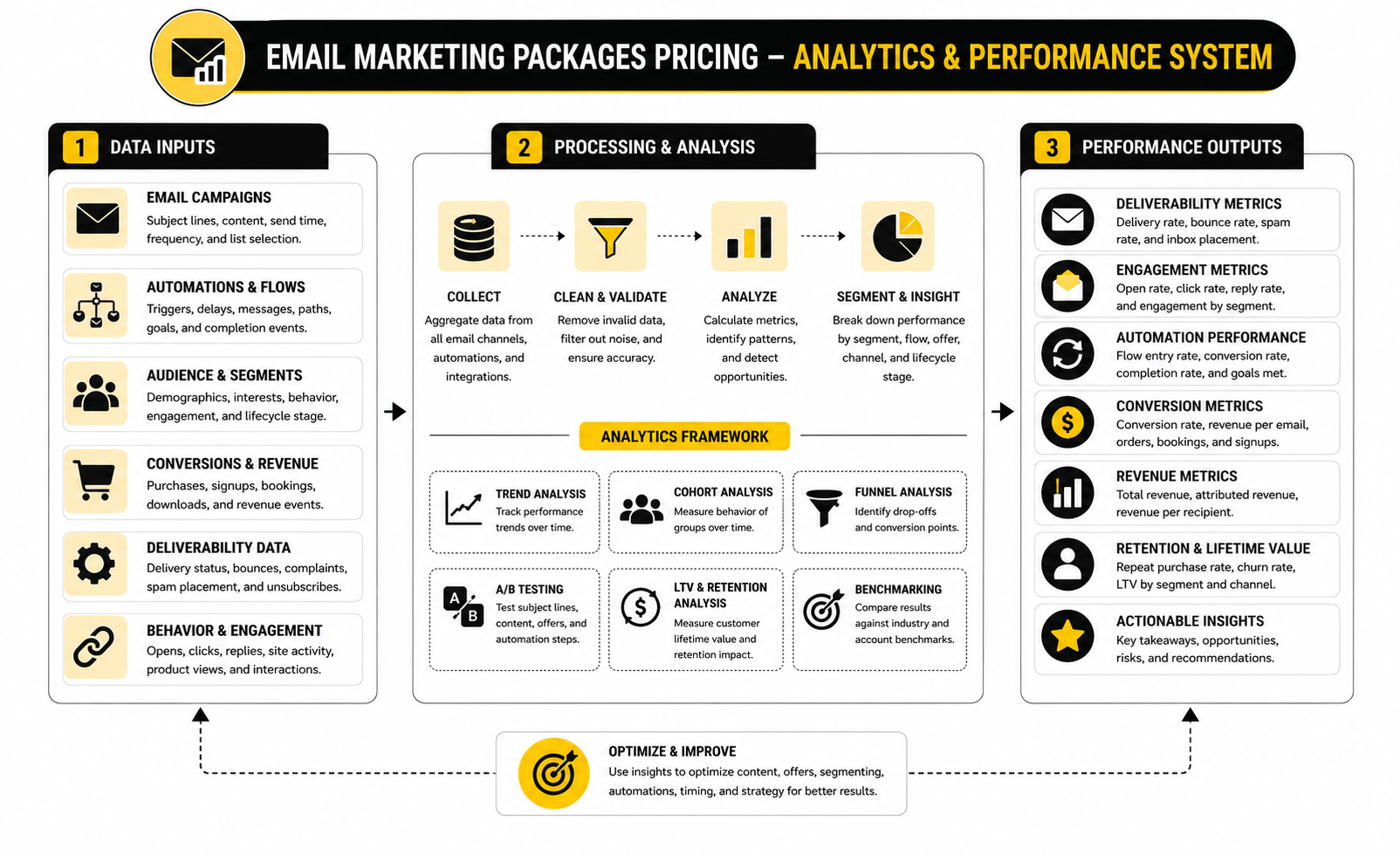
A good analytics system does not start with a dashboard. It starts with the customer journey. The business should know what happens when someone subscribes, clicks, buys, books, goes inactive, returns, or becomes a repeat customer.
The simplest version is a journey-based scorecard. It tracks acquisition quality, campaign engagement, automation performance, conversion behavior, list health, and retention signals. This gives the provider a practical way to see whether the package is improving the whole email system or just producing more sends.
A useful scorecard might include:
This is the difference between reporting and management. Reporting tells the client what happened. Management uses the data to decide what to fix, test, cut, or scale.
Deliverability Is A Pricing Factor, Not A Technical Footnote
Deliverability affects every other number. If emails do not reach the inbox, the best copy and offer will not matter. That is why deliverability work should be treated as part of package scope, especially for businesses with large lists, frequent sends, older databases, or aggressive promotional calendars.
Recent deliverability research shows why this deserves attention. Validity’s 2025 benchmark report describes global inbox placement pressure and notes Europe as one of the stronger regions, with inbox placement around 89.1%, while Microsoft inbox placement was reported as especially challenging at 75.6%: 2025 deliverability benchmark report. Mailgun’s deliverability research also found that 48% of senders named staying out of spam as a top challenge, followed by list hygiene and bounce reduction: State of Email Deliverability.
This data should change how packages are built. A low-cost campaign package may include only basic list hygiene and standard QA. A serious growth or full-service package should include deliverability monitoring, authentication checks, bounce review, engagement cleanup, suppression logic, and send pattern recommendations.
List Health Explains More Than Most People Think
List health often explains why two businesses get completely different results from the same package. A smaller list of engaged buyers can outperform a large list full of cold, imported, inactive, or poorly sourced contacts. More subscribers do not automatically mean more revenue.
The main list health signals are engagement, complaint rate, bounce rate, unsubscribe rate, source quality, and purchase or conversion history. If a business is adding low-intent subscribers through weak giveaways, email performance may look worse even when the provider is doing solid work. If a business has strong organic acquisition and clear buyer intent, even a lean package can perform well.
This should shape pricing conversations. Providers should not promise aggressive results without checking list quality first. Buyers should not compare package prices without asking whether cleanup, segmentation, and health monitoring are included.
Benchmarks Should Guide Questions, Not Replace Judgment
Benchmarks are useful because they give you a reference point. They can show whether a campaign is unusually weak, whether an automation is underperforming, or whether deliverability might be suppressing results. But benchmarks should never replace judgment.
A B2B service business with a long sales cycle should not panic because its purchase conversion rate does not look like an ecommerce store. An ecommerce brand with frequent promotions should not celebrate high opens if revenue per send is declining. A creator with a loyal niche audience may outperform broad industry averages because the relationship is stronger.
The best use of benchmarks is to ask better questions. Why did this segment click more? Why did this campaign drive replies but not sales? Why is a flow producing revenue but also increasing unsubscribes? Those questions create better decisions, and better decisions are what make higher-quality email packages worth paying for.
What The Data Should Change In The Package
Data should create action, not decoration. If reporting does not change the campaign calendar, automation priorities, segmentation, offer strategy, or testing plan, it is probably just a monthly PDF nobody needs. A professional package should turn performance signals into next steps.
For example, low clicks may lead to clearer calls to action, better offer framing, shorter emails, stronger segmentation, or new creative angles. Weak automation performance may lead to revised timing, different incentives, stronger onboarding, or better post-click landing pages. Poor deliverability may lead to list cleanup, authentication fixes, slower sending, or a tighter re-engagement strategy.
This is the practical way to evaluate email marketing packages pricing. The cheapest package usually reports the numbers. The better package explains the numbers. The strongest package uses the numbers to improve the system.
Build a stronger local presence with BAAM AI
Turn your website, Google profile, social channels, and AI visibility into one growth engine
Most businesses do not need more random marketing activity. They need a consistent presence system that helps the right people find them, trust them, and take action. BAAM AI brings strategy, local SEO, website updates, Google Maps visibility, social content, AI-search readiness, media production, and reporting into one practical monthly engine.
If you want your marketing to keep working after the campaign ends, start with a free BAAM AI presence audit. See how your business shows up today and where the fastest visibility wins are at BAAM AI.