
BAAM AI Blog
Statistics And Data
Statistics only matter when they help you make a better decision. A benchmark can show whether performance is healthy, but it cannot tell you why people are buying, why they are ignoring you, or which segment...
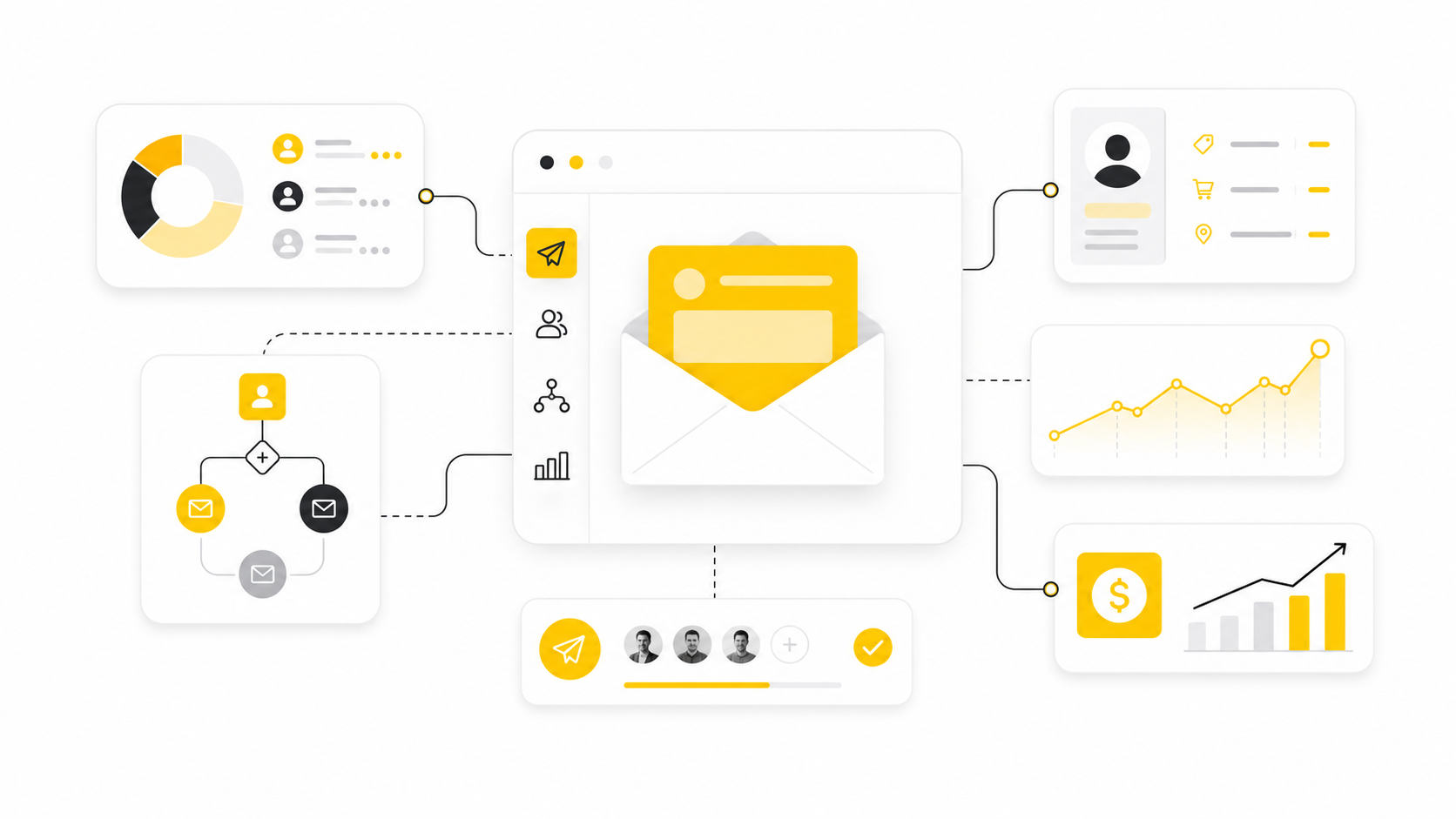
Statistics only matter when they help you make a better decision. A benchmark can show whether performance is healthy, but it cannot tell you why people are buying, why they are ignoring you, or which segment deserves more attention. That is why advanced email marketing should use data as a diagnostic system, not as a scoreboard for vanity metrics.
The wrong way to use benchmarks is to ask, “Is my open rate good?” The better question is, “What does this number tell us about audience quality, message relevance, deliverability, timing, offer strength, and revenue impact?” Once you think that way, email analytics become much more useful because every metric points to a possible action.
Benchmarks are still helpful, especially when you need context. Litmus found that many marketing leaders get strong email returns, with 35% reporting $10 to $36 back for every $1 spent and another 30% reporting $36 to $50. That does not mean every email program automatically prints money; it means the channel can be extremely profitable when the audience, offer, automation, and measurement system are built properly.
The Metrics That Actually Matter
Open rate is still useful, but it should not be treated as the main truth. Privacy features, image loading behavior, bot activity, and mailbox scanning can distort opens, so a rising open rate does not always mean more real human attention. Use opens as an early signal for subject line relevance and list health, but do not build your entire strategy around them.
Click rate is stronger because it measures action. If people click, the message created enough interest to move them from the inbox to the next step. ActiveCampaign’s 2025 benchmark guidance places typical click-through rates across industries around 0.77% to 4.36%, which is a useful reminder that even small percentage changes can matter when your list and offer are large enough.
Conversion rate is where the business conversation starts getting serious. A campaign with a modest click rate can still be valuable if the clicks are qualified and the offer converts well. A campaign with high clicks but weak sales may point to a landing page issue, offer mismatch, pricing objection, weak proof, or poor post-click experience.
Read Metrics As A Chain, Not In Isolation
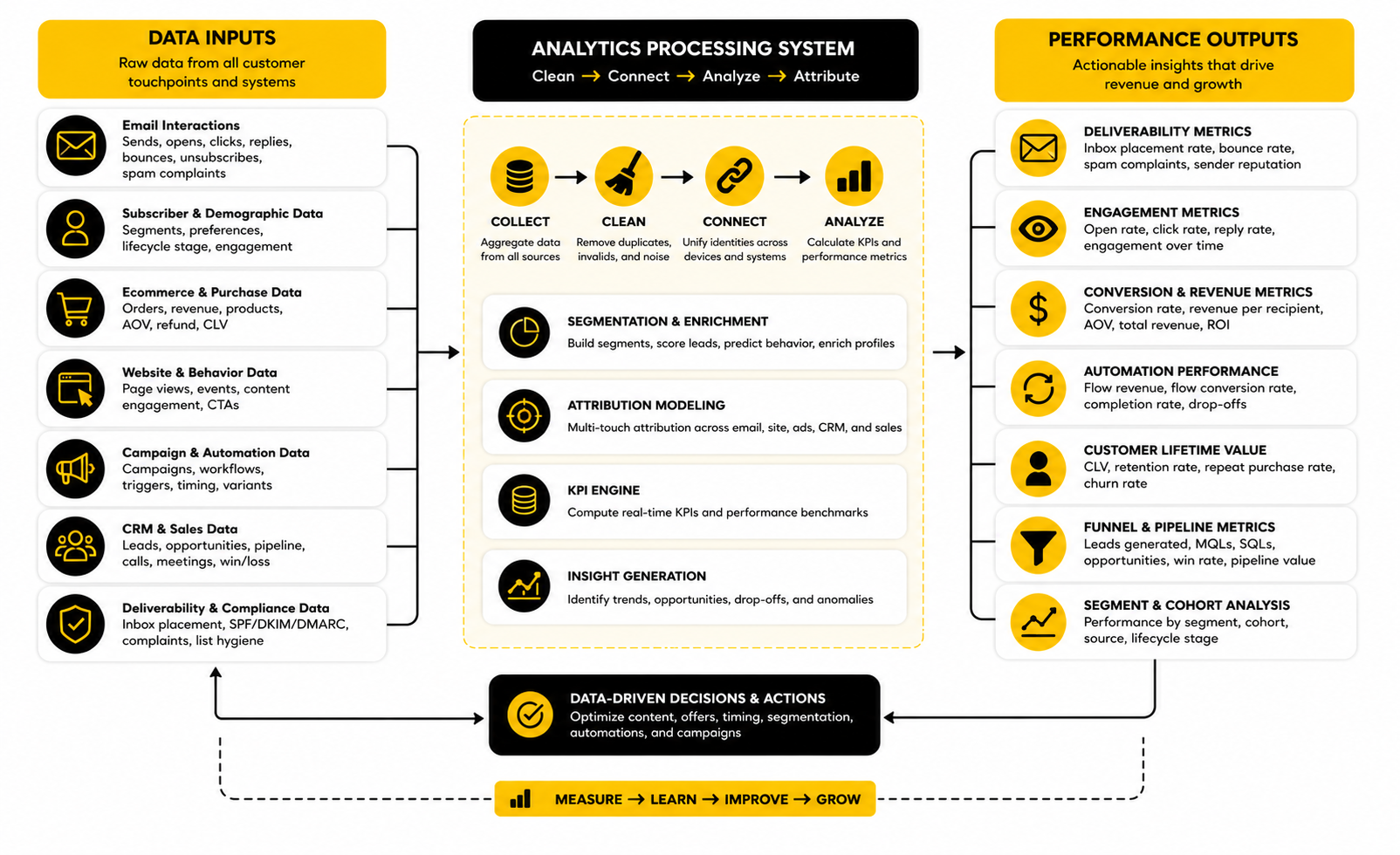
Email performance should be read as a chain: delivered, opened, clicked, converted, retained, and attributed. If delivery is weak, everything after it suffers. If opens are strong but clicks are weak, the subject line may be better than the body content or offer. If clicks are strong but conversions are weak, the problem may sit after the email rather than inside it.
This chain-based view prevents bad conclusions. For example, a low conversion rate does not automatically mean the email copy failed. It might mean the landing page is slow, the checkout is confusing, the sales page is misaligned, the audience is too cold, or the offer asks for too much commitment too soon.
Advanced email marketing gets better when each metric has a job. Delivery tells you whether the message reached the mailbox. Engagement tells you whether people cared enough to act. Conversion tells you whether the action created business value. Retention tells you whether the value continued after the first response.
Benchmarks Need Context
Benchmarks are averages, not commandments. A B2B advisory firm, a fashion ecommerce brand, a local service business, and a SaaS company should not expect identical email performance. Their buying cycles, list sources, offer types, audience trust levels, and conversion paths are completely different.
MailerLite’s 2026 benchmark data shows how much performance can vary by category, with ecommerce listed at a 32.67% benchmark open rate and 1.07% click rate, while consulting shows a higher open benchmark of 45.96% and click benchmark of 2.41%. That gap does not automatically mean consulting marketers are more carefully. It often reflects different relationship depth, purchase behavior, email expectations, and list composition.
Use benchmarks to identify outliers, not to copy someone else’s numbers blindly. If your click rate is far below your industry range, investigate relevance, segmentation, design, offer clarity, and deliverability. If your click rate is above average but revenue is weak, look at conversion paths, pricing, landing pages, and sales follow-up instead of celebrating too early.
Deliverability Is A Revenue Metric
Deliverability is often treated like a technical side issue, but it directly affects revenue. If your emails land in spam, promotions folders, or nowhere at all, the rest of your system loses leverage. This is why the best email teams watch inbox placement, bounce rates, complaint rates, unsubscribe patterns, and engagement trends before they obsess over creative tweaks.
Validity’s 2025 deliverability research reported that Europe had the strongest regional inbox placement at 89.1%, which still means a meaningful share of messages may not reach the primary intended destination. That should make every marketer pause. Even a strong deliverability profile can leave money on the table if list quality, authentication, content, or sending behavior weakens.
The action is practical. Monitor spam complaints by campaign and segment, remove hard bounces quickly, suppress chronically inactive contacts, authenticate properly, and avoid sudden sending spikes that look suspicious. Deliverability work feels quiet, but it protects the entire revenue engine.
Automation Performance Should Be Measured Separately
Automated emails should not be lumped together with regular campaigns. They are triggered by behavior, so they usually reach people at moments of higher intent. That makes their performance profile different from scheduled newsletters, launches, or promotional blasts.
Omnisend’s 2025 ecommerce report found that automated emails drove 37% of email sales from only 2% of email volume. That number matters because it shows why advanced email marketing cannot rely only on broadcast campaigns. The highest-leverage emails are often the ones tied to a real customer action.
Measure automation by flow and by step. A welcome flow, abandoned cart flow, post-purchase flow, reactivation flow, and renewal flow all have different jobs. If one message in a sequence performs poorly, do not judge the whole automation too quickly; inspect where people drop off, what changed before that step, and whether the next action still feels natural.
Revenue Per Recipient Is Often More Useful Than Revenue Per Send
Revenue per send can be misleading because it rewards large sends even when relevance is weak. Revenue per recipient is more precise because it helps you compare the value of different segments, campaigns, and automations. It shows whether a message is actually productive for the people receiving it.
For ecommerce, revenue per recipient can expose hidden winners. A small VIP segment might generate more value per person than a broad promotion to the entire list. A replenishment flow might outperform a discount campaign because it reaches buyers at the right moment instead of trying to manufacture urgency.
For service businesses, use pipeline value, booked calls, qualified opportunities, and closed revenue instead of only direct purchases. If the email’s job is to move someone into a consultation or sales conversation, then measuring only instant sales will undercount its real impact. This is where a CRM setup inside a platform like GoHighLevel can help connect email activity to pipeline movement.
Attribution Must Be Useful, Not Perfect
Attribution is never perfect. People read emails on one device, click later on another, search the brand, visit the site directly, talk to sales, and then buy days or weeks later. Trying to make attribution flawless can become a distraction from making better decisions.
The goal is useful attribution. Use consistent UTM parameters, clear campaign naming, platform revenue tracking, CRM stages, and post-purchase or post-call source context where possible. If your tracking consistently shows which flows, segments, and offers influence revenue, it is already valuable even if it cannot explain every touchpoint perfectly.
Be especially careful with last-click reporting. Email may create demand before another channel gets credit for the final conversion. A practical dashboard should show both direct email revenue and assisted signals such as clicks before purchase, email-influenced pipeline, repeat purchase lift, and engagement before renewal.
The Dashboard Should Match The Business Model
A good dashboard is not a wall of numbers. It is a decision tool. The metrics for a DTC brand, agency, SaaS company, coach, marketplace, and local service business should look different because the email program is doing different work.
An ecommerce dashboard should usually include revenue per recipient, flow revenue, campaign revenue, conversion rate, repeat purchase rate, average order value, unsubscribe rate, complaint rate, deliverability indicators, and segment performance. A sales-led dashboard should focus more on lead quality, booking rate, show rate, sales-qualified opportunities, pipeline value, closed revenue, speed to lead, and follow-up performance.
Tools matter only when they help the team act faster. Brevo, Moosend, and GoHighLevel can support reporting and automation in different ways, but the dashboard still needs human judgment. If nobody changes strategy after reviewing the data, the dashboard is decoration.
Performance Signals And What To Do Next
Every metric should trigger a response. If delivery drops, inspect authentication, complaints, bounces, list sources, spam traps, content patterns, and sending volume. If opens drop across the whole list, review sender reputation, subject lines, audience fatigue, and whether your emails still match subscriber expectations.
If clicks drop while opens stay stable, the issue is probably inside the message. Look at the offer, first screen, call to action, design hierarchy, copy clarity, mobile layout, and whether the email gives people a strong enough reason to leave the inbox. If conversions drop while clicks stay stable, move downstream and review the landing page, checkout, calendar flow, form, pricing, proof, and follow-up path.
If unsubscribes or complaints rise, slow down and listen to the signal. You may be sending too often, targeting too broadly, overusing urgency, pushing offers that do not match the segment, or emailing people who should have been suppressed. Advanced email marketing is not just about scaling what works; it is also about noticing when the audience is telling you to stop doing something.
Build a stronger local presence with BAAM AI
Turn your website, Google profile, social channels, and AI visibility into one growth engine
Most businesses do not need more random marketing activity. They need a consistent presence system that helps the right people find them, trust them, and take action. BAAM AI brings strategy, local SEO, website updates, Google Maps visibility, social content, AI-search readiness, media production, and reporting into one practical monthly engine.
If you want your marketing to keep working after the campaign ends, start with a free BAAM AI presence audit. See how your business shows up today and where the fastest visibility wins are at BAAM AI.