
BAAM AI Blog
Statistics and Data
Smart Sending is not something you judge by one metric. If you only look at revenue, you may turn it off too aggressively. If you only look at skipped profiles, you may panic and loosen rules that were actually...
Smart Sending is not something you judge by one metric. If you only look at revenue, you may turn it off too aggressively. If you only look at skipped profiles, you may panic and loosen rules that were actually protecting your list.
The better approach is to treat smart sending Klaviyo data as a signal system. You are measuring whether your account is sending the right message at the right moment without creating fatigue, suppressing high-intent flows, or damaging deliverability. That means you need to read skips, engagement, revenue, and negative signals together.
Start With Skipped Profiles
Skipped profiles are the first metric to check because they show where Smart Sending is actively changing delivery. Klaviyo lists Smart Sending as one of the reasons profiles can be skipped in campaign reporting, alongside issues like suppressed contacts, invalid emails, and unsubscribes in its skipped profiles troubleshooting guide. That distinction matters because a Smart Sending skip is not the same as a deliverability failure.
A high number of Smart Sending skips usually means one of three things. Your campaign calendar is too crowded, your flows are colliding with campaigns, or your Smart Sending window is too strict for the way your account is built. None of those automatically means the setting is wrong, but it does mean the account deserves a closer look.
The key is to check which messages are being skipped. If a general newsletter skips people who just received a cart recovery email, that is probably fine. If your first cart recovery email is constantly skipped because broad campaigns keep firing first, you may be protecting the wrong message.
Watch Revenue Per Recipient, Not Just Total Revenue
Total revenue can mislead you when Smart Sending is involved. If you turn Smart Sending off, you may send to more people and see more total revenue from a campaign. That does not automatically mean the decision was better.
Revenue per recipient gives you a cleaner view because it shows how efficiently the message performed across the people who actually received it. Klaviyo’s benchmark resources include revenue per recipient, order rate, click rate, and open rate because each metric answers a different performance question in its email benchmarks report. Smart Sending should be judged through that same wider lens.
If total revenue rises but revenue per recipient falls, you may simply be buying extra revenue with extra fatigue. That can be acceptable for a rare final-hours sale, but it is not a healthy weekly operating model. Strong email programs are not built by squeezing every possible send out of the list.
Compare Campaigns Against Flows
Campaigns and flows should not be evaluated in isolation. A campaign can look successful while quietly suppressing an automated flow that would have converted better. That is one of the most common hidden costs of poor Smart Sending setup.
Look at campaign send days and flow skip patterns together. If browse abandonment, abandoned cart, checkout recovery, or welcome emails spike in skips right after major campaigns, you have a priority question. The answer may be to keep Smart Sending on for the campaign, turn it off for a specific high-intent flow message, or adjust the campaign schedule so the collision happens less often.
Do not make this emotional. The campaign is not “bad” just because it caused skips, and the flow is not “better” just because it is automated. The question is simple: which message has the strongest intent and the highest value in that moment?
Read Open Rates Carefully
Open rates can help, but they are not the full truth. Apple’s Mail Privacy Protection changed how many marketers interpret opens because some opens can be inflated or less directly tied to human behavior. So open rate is useful as a directional signal, not as the final verdict.
Klaviyo’s deliverability guidance still includes open rate as a key metric to monitor, and it suggests watching open rate alongside click rate, bounce rate, unsubscribe rate, and spam complaint rate in its deliverability monitoring guide. That is the right way to use it. If opens drop while clicks, conversions, and revenue per recipient also weaken, you probably have a real engagement problem.
For Smart Sending, open rate is most useful when comparing similar messages over time. If your campaign open rate improves after reducing overlap, that may suggest subscribers are paying more attention because you are not crowding their inbox. But do not call it a win until clicks and revenue quality support the same story.
Click Rate Shows Whether The Message Earned Attention
Click rate is usually more useful than open rate when judging message quality. A click requires more intent than an open. If Smart Sending reduces unnecessary sends and your click rate improves, that is a good sign that the remaining audience is more engaged.
Klaviyo’s 2025 benchmark material is built around practical comparison points like open rate, click rate, revenue per recipient, and order rate, using data from billions of emails and text messages in its 2025 Benchmark Report. The point is not to worship benchmarks. The point is to understand whether your account is moving in the right direction compared with similar businesses.
If click rate falls after you disable Smart Sending, pay attention. More sends may be creating more impressions, but the audience may be less interested on average. That is usually a sign to tighten targeting, improve segmentation, or stop bypassing Smart Sending for messages that are not truly urgent.
Track Unsubscribes And Spam Complaints Closely
This is where the data gets serious. Unsubscribes and spam complaints tell you when subscribers are pushing back. If you turn off Smart Sending and these signals rise, the list is telling you that your frequency is becoming a problem.
Klaviyo’s deliverability guidance highlights spam complaint rate, unsubscribe rate, bounce rate, open rate, and click rate as core signals to review when monitoring email health in its deliverability guide. Those signals matter because inbox providers look at engagement and negative feedback when deciding how future emails should be treated. A short-term revenue bump is not worth creating a long-term deliverability problem.
Do not wait for a crisis. If unsubscribes or complaints rise after increasing sends, tighten the rules quickly. The best Smart Sending strategy is the one that protects revenue without teaching subscribers to ignore, delete, or report your emails.
Measure SMS Separately From Email
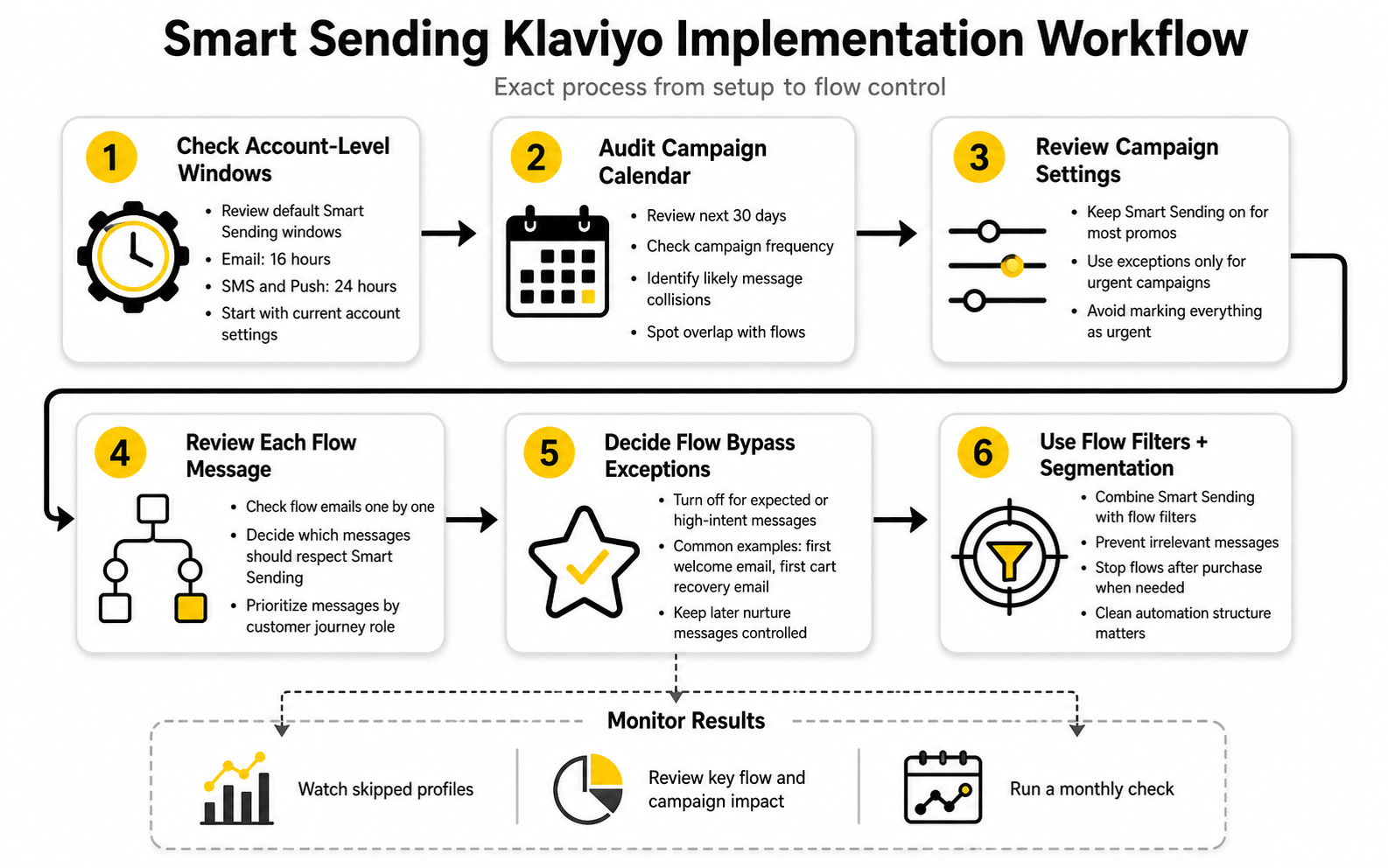
SMS needs its own measurement. Klaviyo’s Smart Sending documentation explains that SMS uses its own Smart Sending window and that multiple profiles sharing the same phone number can be skipped if that number received an SMS inside the window. That makes SMS behavior different from email behavior.
The reason this matters is simple: SMS feels more intrusive. A subscriber may tolerate several emails in a week but become annoyed quickly if texts arrive too often. So SMS opt-outs, click rate, conversion rate, and revenue per recipient should be reviewed separately from email.
Do not use email logic for SMS. If an email campaign can respect a 16-hour window, that does not mean an SMS reminder should be squeezed into the same day just because it technically can. Treat SMS like a higher-trust channel and protect it harder.
Use Benchmarks As Context, Not Commands
Benchmarks are useful, but they are not your strategy. A beauty brand, supplement brand, apparel store, and B2B ecommerce company can all see different behavior because buying cycles, urgency, discounting, and audience expectations are different. That is why industry-specific benchmarks are more helpful than generic averages.
Use benchmark data to spot obvious problems. If your click rate is far below similar brands, your issue may be targeting, creative, offer strength, or list quality rather than Smart Sending itself. If your revenue per recipient is strong but unsubscribes are rising, you may be extracting value too aggressively.
The best benchmark is still your own recent performance. Compare each message against its previous versions, not just against an industry chart. Smart Sending decisions should improve the account’s trend over time, not just make one dashboard number look better this week.
The Smart Sending Scorecard
A simple scorecard keeps the analysis grounded. You do not need a complex model to understand whether Smart Sending is helping. You need the right questions in the right order.
Use this scorecard when reviewing campaigns and flows:
That final question is underrated. Sometimes the problem is not the Smart Sending window. Sometimes the problem is that the brand sends too many campaigns too close together and expects automation to clean up the mess.
What Good Data Looks Like
Good Smart Sending data does not mean zero skips. Zero skips may simply mean your account has low send volume, weak automation coverage, or Smart Sending turned off too often. Some skips are normal when campaigns and flows are both active.
Good data looks like controlled suppression of lower-priority messages, stable or improving engagement, healthy revenue per recipient, and no concerning rise in unsubscribe or complaint behavior. It also means your most important customer moments are still being delivered. That balance is the whole point.
Bad data looks different. You see important flow emails skipped repeatedly, campaign performance propped up by extra volume, SMS opt-outs rising, and engagement weakening over time. When that happens, the fix is not to blindly disable smart sending Klaviyo settings everywhere. The fix is to decide which messages deserve priority, then let the data prove whether that decision was right.
Build a stronger local presence with BAAM AI
Turn your website, Google profile, social channels, and AI visibility into one growth engine
Most businesses do not need more random marketing activity. They need a consistent presence system that helps the right people find them, trust them, and take action. BAAM AI brings strategy, local SEO, website updates, Google Maps visibility, social content, AI-search readiness, media production, and reporting into one practical monthly engine.
If you want your marketing to keep working after the campaign ends, start with a free BAAM AI presence audit. See how your business shows up today and where the fastest visibility wins are at BAAM AI.