
BAAM AI Blog
Statistics And Data
Measurement is where an email nurture campaign becomes a business system instead of a creative guess. The goal is not to stare at dashboards for the sake of it. The goal is to understand where the reader is...
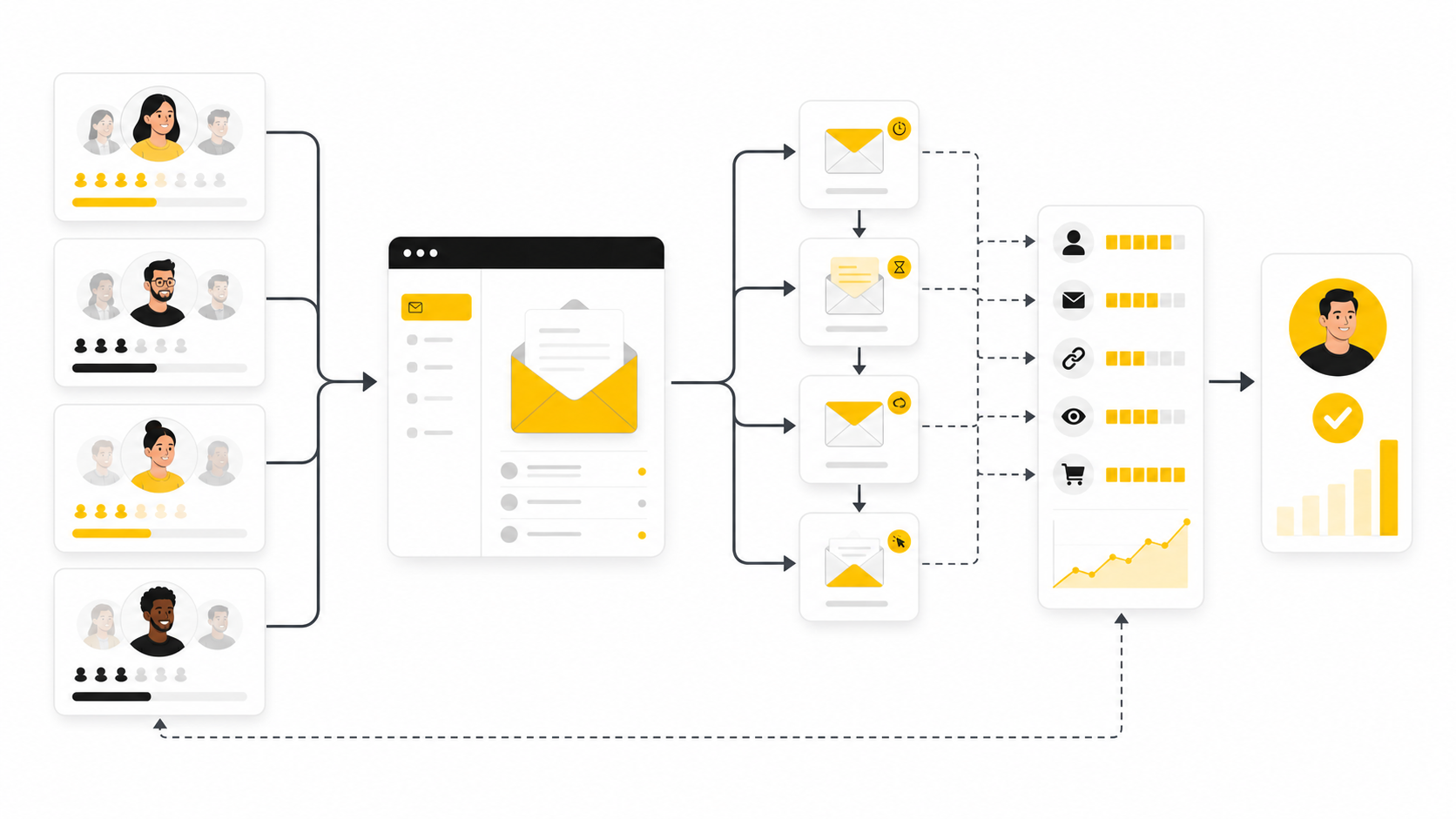
Measurement is where an email nurture campaign becomes a business system instead of a creative guess. The goal is not to stare at dashboards for the sake of it. The goal is to understand where the reader is progressing, where they are hesitating, and what needs to change so the sequence creates more qualified action.
The biggest mistake is treating one metric as the truth. Open rate, click rate, reply rate, booking rate, conversion rate, unsubscribe rate, and revenue all tell different parts of the story. A campaign can have strong opens and weak sales, weak opens and strong reply quality, or average clicks but excellent booked-call conversion.
That is why the data needs interpretation. Numbers only matter when they help you make a better decision. If a metric does not change what you do next, it is probably not the metric you should obsess over.
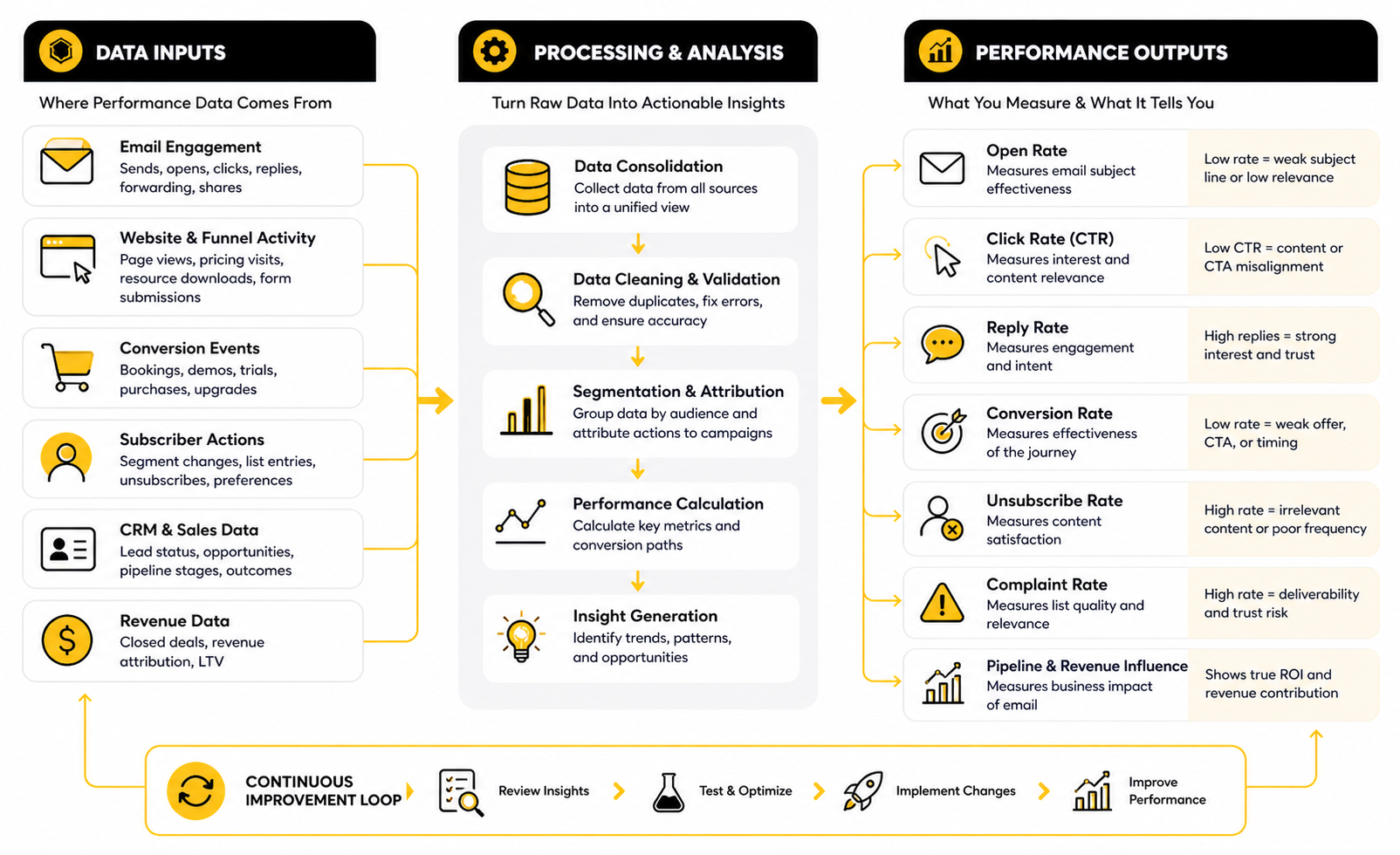
Track The Full Journey, Not Just Opens
Open rate is useful, but it is not the same as intent. Privacy changes, inbox behavior, Apple Mail Privacy Protection, bot activity, and image loading can all affect how opens are recorded. Treat open rate as a directional signal, not as proof that the nurture campaign is working.
Click rate is usually more meaningful because it shows the reader took a visible step. Still, a click only tells you that the offer, resource, or CTA was interesting enough to investigate. It does not prove the person was qualified, convinced, or ready to buy.
The real view comes from tracking the path from email to business outcome. For a service business, that may mean email click to booked call to qualified opportunity to closed deal. For SaaS, it may mean email click to trial activation to paid conversion. For ecommerce, it may mean email click to cart recovery, first purchase, repeat order, or subscription.
Use Benchmarks As Context, Not Targets
Benchmarks are useful because they show whether your email nurture campaign is wildly outside the normal range. They are dangerous when teams treat them as universal goals. A niche B2B campaign with 400 high-intent leads should not be judged the same way as a retail list with 400,000 subscribers.
Recent benchmark reports show how much performance varies by industry, audience, list quality, and send type. The MailerLite 2025 benchmark report covers millions of campaigns across industries and regions, which makes it useful for broad context. The MoEngage 2025 Email Benchmarks Report also analyzed billions of emails and found that many brands still rely on basic personalization rather than deeper behavioral relevance.
The practical takeaway is simple: compare against benchmarks, but optimize against your own funnel. Your best benchmark is last month’s performance for the same audience, same offer, same trigger, and same conversion goal. That gives you a cleaner read than comparing your nurture campaign against a generic industry average.
Read Open Rate As A Positioning Signal
Open rate mostly tells you whether the subject line, sender name, timing, and relationship were strong enough to earn attention. If open rate is weak across the whole sequence, the problem may be the promise, the entry point, or list quality. If only one email has weak opens, the subject line or timing may be the issue.
Do not immediately rewrite the entire campaign because one subject line underperforms. Look for patterns first. If educational emails get opened but offer emails do not, the reader may not understand why the offer matters yet.
A healthy email nurture campaign trains people to expect value. If opens drop hard after the first message, the first email may have failed to set expectations or the lead magnet may have attracted low-intent subscribers. If opens stay stable but clicks do not happen, attention is not the problem. Relevance, trust, or CTA strength probably is.
Read Click Rate As A Relevance Signal
Click rate shows whether the message created enough interest to move the reader forward. A low click rate does not always mean the email was bad. It may mean the CTA was too aggressive, the offer was unclear, the link was buried, or the reader needed another step before taking action.
Look at clicks by email role. An educational email may naturally get fewer clicks if its job is to build understanding. A proof email should create curiosity around evidence. A conversion email should drive meaningful action toward the main goal.
This is why every email needs one job. If an email includes five links, a weak click rate becomes hard to interpret. You will not know whether the message failed, the CTA failed, or the reader was simply pulled in too many directions.
Measure Replies And Sales Conversations Separately
Replies are underrated in nurture analytics. They show that a real person had enough interest, confusion, trust, or urgency to respond. For high-ticket offers and service businesses, one good reply can be more valuable than dozens of passive clicks.
The quality of replies matters more than the quantity. A reply saying “not interested” is still useful because it tells you the sequence reached someone who made a decision. A reply asking about pricing, implementation, timeline, or fit is stronger because it reveals buying friction.
Track what people ask before they book or buy. If the same question appears repeatedly, that question should probably be addressed earlier in the email nurture campaign. Your inbox is not just communication. It is research.
Watch Conversion Rate By Sequence Stage
Conversion rate should be measured at multiple points. You want to know how many people enter the sequence, how many reach each email, how many click, how many take the intended action, and how many become revenue. Without that breakdown, you may blame the wrong part of the campaign.
For example, if many people click but few book, the email may be doing its job while the booking page creates friction. If few people click the offer email, the problem may be the message, timing, or CTA. If people book but do not become qualified opportunities, the nurture campaign may be attracting or advancing the wrong leads.
This is where tools and tracking discipline matter. A CRM-connected setup like GoHighLevel can help when you need to connect nurture emails with forms, calendars, pipeline stages, and follow-up actions. For lighter systems, Brevo or Moosend can still work well if the goal and tagging structure are clear.
Treat Unsubscribes As Feedback, Not Failure
Unsubscribes are not automatically bad. Some people should leave your list because they are not a fit, not interested, or no longer in market. A healthy nurture system should qualify people in and out.
The problem starts when unsubscribes spike around a specific email. That usually means the message felt irrelevant, too aggressive, too frequent, or disconnected from the original reason the person joined. If the spike happens after the first email, the entry promise and follow-up experience may not match.
Spam complaints are more serious. They can hurt deliverability and signal that the reader did not recognize, trust, or want the message. If complaints rise, check consent, list source, sender identity, frequency, and whether the first email clearly reminds people why they are receiving the sequence.
Connect Deliverability To Revenue
Deliverability is not a technical side issue. If your emails do not land in the inbox, the best nurture strategy does not matter. Sender reputation, authentication, list hygiene, engagement quality, and complaint rates all affect whether your campaign gets seen.
The Validity 2025 Email Deliverability Benchmark Report frames deliverability as a foundation for email performance, not a backend detail. That is exactly how you should treat it. A nurture campaign with declining inbox placement may look like it has a copy problem when it actually has a deliverability problem.
Watch for sudden drops in opens, clicks, and replies across multiple campaigns. That can suggest deliverability trouble, especially if nothing changed in the offer or audience. Clean inactive contacts, authenticate sending domains, avoid spammy patterns, and make sure your sequence earns engagement early.
Build A Simple Nurture Dashboard
A good dashboard should help you make decisions fast. It does not need twenty charts. It needs the few numbers that show whether the email nurture campaign is moving people forward.
Track these metrics together:
This dashboard should be reviewed by sequence, not only by account-wide averages. Account-wide email metrics hide too much. A welcome sequence, demo follow-up, webinar nurture, and abandoned checkout flow can all perform differently, and each one needs its own diagnosis.
Turn Data Into Specific Optimization Decisions
The point of analytics is action. If open rate is low, test the subject line, sender name, timing, or promise. If click rate is low, improve the CTA, sharpen the message, or make the next step more relevant.
If people click but do not convert, inspect the landing page, booking page, form, offer clarity, and mobile experience. A tool like Fillout can help when you need a cleaner qualification or intake step. Cal.com can help when the main conversion is booking a meeting and the current scheduling process creates friction.
If conversions happen but lead quality is poor, tighten the trigger and segmentation. The campaign may be persuasive, but persuasive to the wrong people. That is not a copy problem. That is a targeting and qualification problem.
Review Cohorts Instead Of Blended Averages
Blended averages can hide what is really happening. A nurture campaign might look stable overall while one traffic source performs terribly and another performs extremely well. If you only review the average, you miss the opportunity to scale what works and fix what does not.
Cohort analysis means comparing groups based on when they entered, where they came from, what they downloaded, what segment they belong to, or which offer they saw. This is especially useful when traffic sources vary in intent. A referral lead and a cold paid lead should not be expected to behave the same way.
Reviewing cohorts also helps you avoid false conclusions. If overall conversion rate drops after a traffic increase, the campaign may not have gotten worse. You may simply be sending lower-intent people into the same sequence. That distinction matters because the solution is different.
Know When A Metric Is Too Early To Trust
Not every number deserves immediate action. Small sample sizes can mislead you, especially in B2B or high-ticket campaigns with lower lead volume. A single booked call, unsubscribe, or deal can swing the numbers dramatically.
Let the campaign gather enough data before making major changes. You can still fix obvious problems quickly, like broken links, unclear CTAs, formatting issues, or bad automation rules. But deeper conclusions about messaging, timing, and conversion should come from patterns, not panic.
A practical rule is to separate technical fixes from strategic changes. Technical fixes happen immediately. Strategic changes need enough data to prove the issue is real. That discipline keeps you from constantly rebuilding an email nurture campaign before it has a fair chance to work.
Professional Implementation: Automation, Segmentation, And Tools
A mature email nurture campaign needs more than good copy and a few performance reports. It needs operational discipline. That means clean data, clear ownership, sensible automation rules, and a system that can scale without making the subscriber experience worse.
This is the part where many teams overcomplicate the setup. They add lead scores, tags, branches, AI prompts, sales alerts, CRM fields, and retargeting audiences before the core journey is stable. Advanced systems are useful only when they make the campaign more relevant, more measurable, or easier to manage.
The real question is not “how much automation can we add?” The better question is “what should happen next based on what this person has actually done?” That mindset keeps the nurture system practical instead of turning it into a confusing maze.
Use Lead Scoring Carefully
Lead scoring can help prioritize follow-up, but it can also create false confidence. A person who clicks three educational links may look active without being sales-ready. Another person may open very little but reply once with a serious buying question.
Use scoring as a signal, not a verdict. Give more weight to behaviors that indicate intent, such as viewing pricing, requesting a demo, starting a trial, returning to a key page, replying to an email, or completing a qualification form. Give less weight to soft engagement, such as opening emails or clicking broad educational content.
The best scoring models are simple enough for sales and marketing to understand. If nobody can explain why a lead reached a certain score, the score becomes decoration. A practical model should help the team decide who needs immediate follow-up, who needs more nurture, and who should be deprioritized.
Create Exit Rules Before You Create Branches
Exit rules protect the reader experience. They stop people from receiving messages that no longer fit their situation. Without exit rules, automation can keep pitching a call after someone already booked, keep selling after someone purchased, or keep sending beginner education after someone became a serious opportunity.
Every nurture workflow should define what removes a person from the sequence. That might include purchase, booking, reply, unsubscribe, sales disqualification, demo request, trial activation, or entry into a more relevant campaign. This is basic, but it matters a lot.
Branches are useful only after exits are clean. If the foundation is messy, more branching just creates more places for the system to break. Keep the first version simple, prove that it works, then add conditional paths where behavior clearly justifies a different message.
Decide Where Human Follow-Up Belongs
Not every lead should stay inside automation forever. Some behaviors deserve a human response. A reply, pricing question, high-intent form submission, demo request, or repeated visit to a key conversion page can all justify manual follow-up.
The handoff should be specific. Sales should know why the person is being flagged, what they engaged with, what sequence they came from, and what next step makes sense. “Hot lead” is not enough context. “Downloaded the buyer checklist, clicked the implementation email, visited pricing twice, and asked about setup time” is useful.
This is where CRM hygiene becomes important. A connected setup such as GoHighLevel can help when the email nurture campaign needs to create tasks, update pipeline stages, send reminders, and trigger follow-up based on behavior. The goal is not to automate the relationship away. The goal is to use automation until a real conversation would be more valuable.
Avoid Overpersonalization That Feels Creepy
Personalization works when it feels useful. It fails when it feels invasive, forced, or obviously generated from tracking data. Just because you can mention every action someone took does not mean you should.
A good email nurture campaign uses behavior to adjust relevance quietly. If someone attends a webinar on implementation, the follow-up can focus on implementation concerns. It does not need to say, “We noticed you stayed for 37 minutes and clicked the pricing link at 2:14 p.m.”
The MoEngage 2025 Email Benchmarks Report points to stronger performance from more advanced personalization, but the strategic lesson is not to add personalization everywhere. The lesson is to personalize around intent. Use data to make the email more helpful, not to prove how much data you have.
Protect Deliverability As You Scale
Scaling an email nurture campaign can quietly damage deliverability if you push volume faster than engagement supports. More leads, more segments, more automations, and more promotional sends can all increase pressure on your sender reputation. If that reputation weakens, even your best emails may stop reaching the inbox.
Deliverability should be part of the scaling plan from the beginning. Authenticate sending domains, warm new domains carefully, clean inactive contacts, monitor complaints, and avoid sudden volume spikes. The 2025 Email Deliverability Benchmark Report emphasizes inbox placement as a more meaningful deliverability measure than basic delivery, which is important because “delivered” can still mean “delivered to spam.”
This is especially important for teams using multiple funnels, lead magnets, and campaigns at once. One low-quality acquisition source can hurt the whole email program if it brings in people who ignore, unsubscribe, or complain. Scale the channels that bring engaged leads, not just the channels that bring cheap contacts.
Keep Compliance Built Into The Workflow
Compliance is not the exciting part of email marketing, but it is non-negotiable. Consent, unsubscribe access, sender identity, data handling, and privacy expectations all affect whether your nurture campaign is safe to run. This becomes more important as you expand across regions or collect more behavioral data.
The practical approach is to build compliance into the system instead of treating it as a final checklist. Use clear opt-in language, make unsubscribe links easy to find, honor preferences quickly, and avoid adding people to unrelated sequences without a valid reason. If a subscriber joined for one resource, the follow-up should reasonably connect to that resource.
This also protects trust. People are more tolerant of marketing emails when the relationship is clear. They are less tolerant when the message feels unexpected, unrelated, or difficult to escape.
Use AI For Speed, Not Strategic Judgment
AI can help with drafts, variations, subject line ideas, segmentation logic, summarizing replies, and turning customer questions into content ideas. That can save time. But AI should not decide the strategy without human judgment.
The danger is generic scale. AI can make it easier to produce more emails, but more emails are not automatically better. A sequence that sounds polished but says nothing specific will still underperform.
Use AI to accelerate the parts that are repetitive, then apply human editing where it matters most: positioning, offer clarity, objections, proof, and tone. If you are using an automation platform with AI features, such as GoHighLevel AI, keep the same rule. Let AI support the workflow, but do not let it replace the thinking behind the workflow.
Plan For Multiple Nurture Tracks
As the business grows, one nurture sequence usually becomes several tracks. You may need one for new subscribers, one for webinar attendees, one for abandoned bookings, one for trial users, one for dormant leads, and one for post-purchase expansion. That is normal.
The risk is creating overlapping campaigns that compete with each other. A person should not receive a beginner welcome email, a sales follow-up, a reactivation email, and a promotional campaign in the same short window. That creates noise and makes the brand feel disorganized.
Create a simple priority system. High-intent sales workflows should usually override general education. Customer onboarding should override prospect nurture. Re-engagement should not interrupt someone who is already active in a current buying journey.
Build A Content Library For Reuse
A strong email nurture campaign gets easier to improve when the team has a reusable content library. This library can include objection responses, proof points, product explanations, customer questions, comparison angles, demo clips, sales call insights, and best-performing CTAs. It keeps the campaign consistent without forcing you to start from zero every time.
The library should be organized by stage and purpose. Early-stage content should clarify the problem. Middle-stage content should explain the approach and build trust. Late-stage content should reduce risk and make action easier.
This is also where content operations and nurture strategy connect. A social post, webinar section, sales call objection, or support answer can often become a useful nurture email. Tools like Buffer can help organize distribution on social, while the email sequence captures and deepens the relationship after someone joins your list.
Match Tool Choice To Business Complexity
The best tool depends on the job. A creator with a simple lead magnet does not need the same system as a local agency managing leads, SMS, appointments, pipelines, and client campaigns. A SaaS team with product events does not need the same setup as an ecommerce brand recovering carts and building repeat purchase flows.
For simple email automation, tools like Brevo or Moosend can be enough. For funnel-heavy businesses, ClickFunnels or Systeme.io can make sense when pages, offers, and emails need to live close together.
For businesses that rely on appointments, pipelines, multi-channel follow-up, and client management, GoHighLevel is often a more complete fit. If your lead capture depends on quizzes, intake forms, or qualification flows, Fillout can support the front end of the nurture system. The right stack is the one that keeps the journey clear, measurable, and manageable.
Know The Risks Of Scaling Too Fast
Scaling too fast creates predictable problems. The list grows, but quality drops. The automation map expands, but nobody owns maintenance. More campaigns launch, but reporting becomes harder to trust.
The fix is boring but effective: document the system. Keep a clear record of each sequence, trigger, audience, goal, email count, CTA, owner, and review date. Without documentation, the nurture program becomes tribal knowledge, and every update becomes risky.
You also need a review rhythm. Every major email nurture campaign should have a scheduled audit, especially after new traffic sources, offers, products, or sales processes are introduced. A campaign that worked six months ago can slowly drift out of alignment if the business changes around it.
Build For Trust First
The advanced move is not adding more automation. The advanced move is preserving trust while the system gets bigger. That is what separates a useful nurture engine from a noisy email machine.
Trust comes from relevance, consistency, clarity, and restraint. Send when there is a reason. Personalize when it helps. Ask for action when the reader is ready for the next step. Remove people from sequences when the message no longer fits.
That sounds simple, but it is the discipline most teams skip. A strong email nurture campaign does not just push leads toward a conversion. It helps the right people move forward with confidence and lets the wrong people opt out without friction.
Build a stronger local presence with BAAM AI
Turn your website, Google profile, social channels, and AI visibility into one growth engine
Most businesses do not need more random marketing activity. They need a consistent presence system that helps the right people find them, trust them, and take action. BAAM AI brings strategy, local SEO, website updates, Google Maps visibility, social content, AI-search readiness, media production, and reporting into one practical monthly engine.
If you want your marketing to keep working after the campaign ends, start with a free BAAM AI presence audit. See how your business shows up today and where the fastest visibility wins are at BAAM AI.