
BAAM AI Blog
Statistics And Data
The smartest way to read the data from email marketing conferences 2023 is not to chase one magic benchmark. Benchmarks are useful, but they are not strategy. A 35% open rate can be excellent for one list and weak...
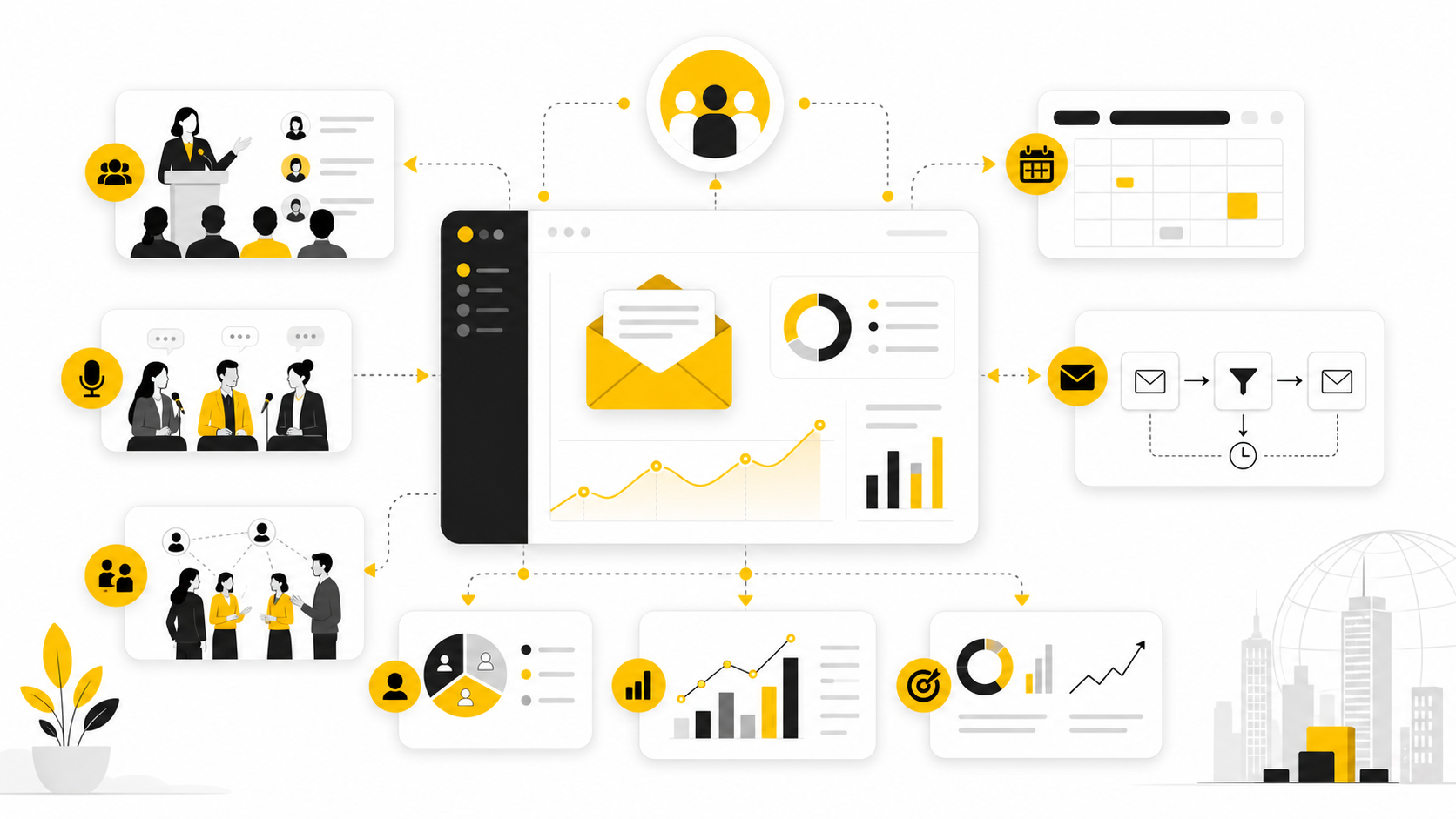
The smartest way to read the data from email marketing conferences 2023 is not to chase one magic benchmark. Benchmarks are useful, but they are not strategy. A 35% open rate can be excellent for one list and weak for another if the audience, intent, send frequency, offer, and list quality are completely different.
The more useful question is this: what does the number tell you to do next? Open rates can point toward subject line strength, sender recognition, timing, and audience interest, but they are also affected by privacy changes and image loading behavior. Click rates usually say more about message relevance, offer clarity, layout, and call-to-action strength. Revenue, conversion rate, reply rate, booked calls, repeat purchase rate, and pipeline movement are closer to the business outcome.
That is why the conference lessons from 2023 should be judged through a measurement system, not a single dashboard tile. Email became too important and too complex for teams to rely on surface-level reporting. The teams that got the most value from events were the ones that could connect what they learned to clearer attribution, cleaner segmentation, better lifecycle reporting, and stronger decision-making.
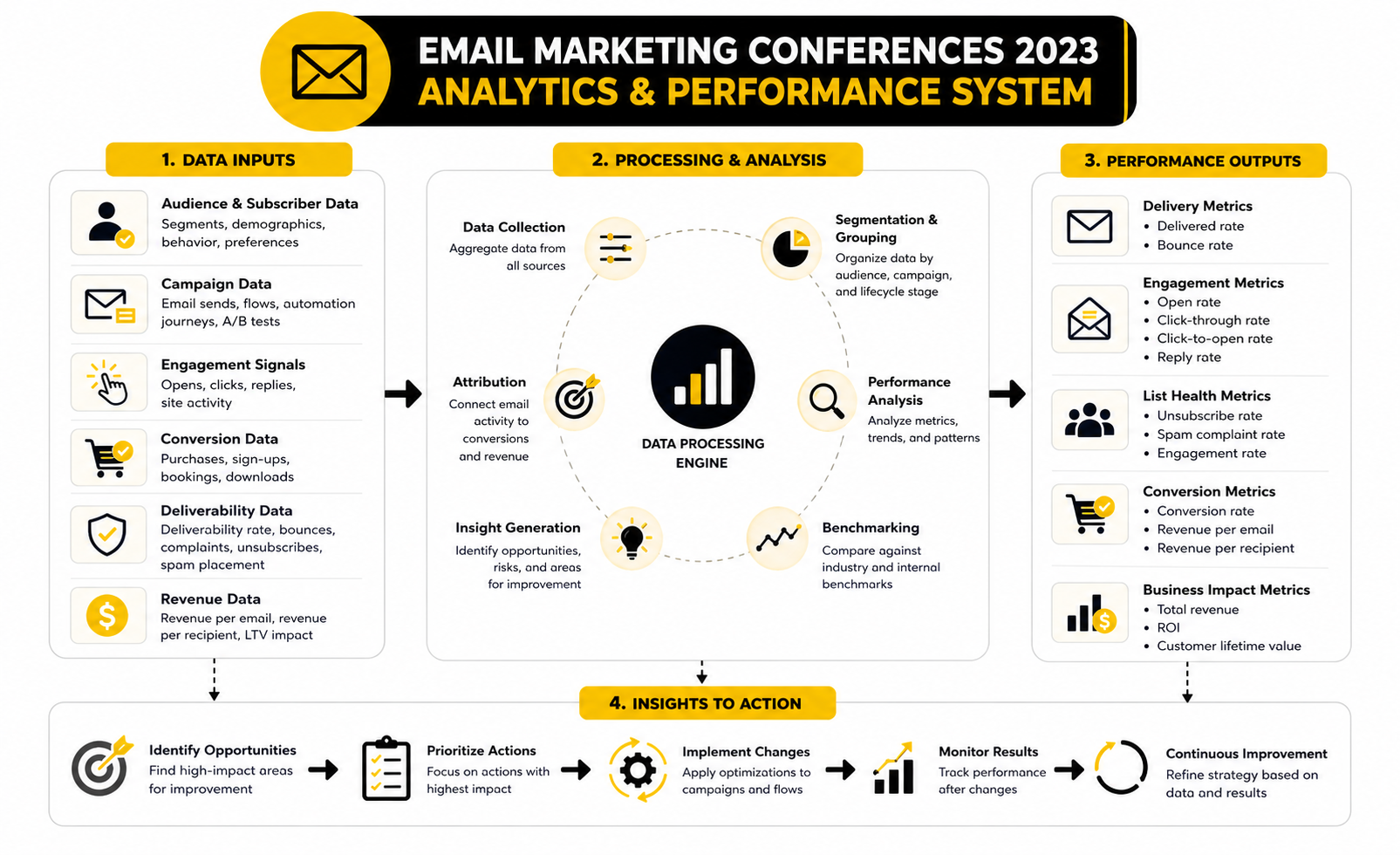
A practical email analytics system should separate signals into four layers:
This structure keeps the team honest. A campaign with strong opens and weak clicks may have curiosity but not enough relevance. A campaign with low opens and high revenue may be reaching a smaller but more motivated segment. A campaign with short-term sales and rising unsubscribes may be profitable today while damaging the list tomorrow.
What Benchmarks Actually Tell You
Benchmarks are useful when they give context, not when they become the goal. The GetResponse email marketing benchmarks show how open rates, click-through rates, click-to-open rates, unsubscribes, and spam complaints vary by industry, region, list size, message type, and campaign behavior. That variation matters because a team selling B2B software should not blindly compare itself to a nonprofit newsletter or ecommerce flash sale campaign.
Industry benchmark roundups from sources like Smart Insights make the same point in a different way. The averages are helpful for orientation, but they do not explain your audience’s intent, your list acquisition quality, or your offer strength. If you use benchmarks as a diagnostic tool, they help. If you use them as a scoreboard, they can push you into bad decisions.
For example, a low open rate does not automatically mean the subject line is bad. It could mean the list is cold, the sender name is not trusted, the segment is too broad, or the audience did not expect the message. A low click rate does not automatically mean the copy failed either. It could mean the offer was wrong, the email had too many calls to action, the landing page was misaligned, or the audience was still too early in the journey.
The ROI Signal Matters More Than Vanity Metrics
Email has a strong reputation for ROI, but the real lesson is not “email makes money.” The real lesson is that email makes money when teams can connect the channel to the customer journey. Litmus’ email ROI research shows that many companies still see meaningful returns from email, with a substantial share reporting returns of 36:1 or higher. That is a strong case for investing in the channel, but only if the team can explain what is driving the return.
The problem is that many teams still measure activity better than impact. They know how many campaigns they sent, how many people opened, and how many people clicked. They do not always know which flows influenced revenue, which segments became more valuable, which campaigns helped retention, or which messages created assisted conversions that did not happen immediately.
That is where conference insights become practical. If a session taught better lifecycle planning, the measurement question should be: did the new journey increase activation, repeat purchase, booked calls, renewal, or customer expansion? If a session taught deliverability, the measurement question should be: did inbox placement, bounce rate, spam complaints, and engagement quality improve after the fixes?
Deliverability Is A Business Metric
Deliverability should not be treated like a technical side issue. It directly affects whether subscribers see the message, whether campaigns can generate revenue, and whether the brand keeps trust with mailbox providers. The Sinch Mailgun State of Email Deliverability research highlights how sender requirements, authentication, inbox placement, and list practices became more urgent after Gmail and Yahoo pushed stricter bulk sender requirements.
The lesson for teams reviewing email marketing conferences 2023 is simple: deliverability work is not optional infrastructure. It is part of performance marketing. If your emails do not reach the inbox, your copywriting, design, offer strategy, and automation logic are fighting a losing battle.
The best deliverability measurement starts with the basics. Track bounce rate, spam complaint rate, unsubscribe rate, inactive subscriber growth, authentication status, blocklist issues, and inbox placement where possible. Then connect those metrics to campaign performance so the team can see how list quality and sender reputation affect revenue, not just technical health.
Segmentation Data Should Change The Work
Segmentation is one of the clearest areas where conference learning should lead to action. The Litmus 2024 State of Email Trends reported that more than 90% of surveyed email marketers said segmentation improves performance. That does not mean every team needs a complex personalization engine immediately. It means most teams should stop sending broad campaigns when a more relevant segment would do a better job.
The first useful segmentation split is usually behavioral. Subscribers who just joined, recently purchased, abandoned a checkout, booked a call, downloaded a resource, clicked a product category, or went inactive should not all receive the same message. Their intent is different, so the email should be different too.
The second useful split is lifecycle stage. A new lead needs trust and context. A first-time buyer needs confidence and guidance. A repeat customer needs deeper value and a reason to come back. An inactive subscriber needs a clear reason to re-engage or a respectful path out of the list.
The third useful split is value. Not every subscriber contributes equally to the business. High-intent leads, repeat buyers, loyal customers, and high-fit accounts deserve different treatment from casual subscribers who never engage. This is not about ignoring part of the list; it is about matching effort to opportunity.
The Metrics That Should Drive Action
A healthy email program does not need hundreds of metrics. It needs the right metrics connected to decisions. If the team cannot say what action a number should drive, the number is probably noise.
For campaign performance, track delivered emails, open rate, click-through rate, click-to-open rate, unsubscribe rate, spam complaint rate, conversion rate, revenue, and revenue per recipient. These numbers show whether the campaign reached people, attracted attention, earned action, and created business value without damaging the list.
For lifecycle automation, track entry volume, completion rate, conversion by step, time to conversion, drop-off points, revenue per subscriber, and suppression behavior. These numbers show whether the journey is doing its job or whether subscribers are getting stuck, ignored, or rushed.
For list quality, track source-level engagement, opt-in quality, bounce rate, inactive percentage, spam complaints, and unsubscribe patterns. These numbers show whether list growth is healthy or whether acquisition tactics are bringing in people who were never likely to engage.
For business impact, track revenue, pipeline, booked calls, repeat purchase rate, retention, churn reduction, customer lifetime value, and assisted conversions. These are the numbers that help email keep its seat at the strategy table.
How To Interpret Performance After A Conference
After attending or studying email marketing conferences 2023, the goal is not to prove that every new idea worked immediately. The goal is to create a better decision loop. You test, measure, learn, and decide whether to scale, adjust, or stop.
A good test starts with one clear hypothesis. For example, “A behavior-based reactivation segment will produce better click and conversion rates than sending the same offer to the full inactive list.” That is much stronger than “We will improve engagement,” because it defines what is changing and what success should look like.
The test also needs a fair comparison. If you change the audience, offer, subject line, design, and send time all at once, you may get a result but you will not know what caused it. Professional teams keep tests clean enough to produce a decision.
Finally, the result needs interpretation beyond “winner” and “loser.” A campaign can lose on clicks but win on revenue. A shorter email can win on mobile engagement but produce fewer qualified leads. A reactivation campaign can drive unsubscribes and still be useful if it cleans the list and improves future deliverability.
Building A Reporting Rhythm
Measurement only works when the team reviews it consistently. A dashboard nobody discusses does not improve the email program. A weekly review with clear decisions is more valuable than a beautiful report that gets ignored.
Weekly reviews should focus on recent campaigns, production issues, deliverability warnings, and obvious performance changes. This is where the team catches problems quickly and makes small adjustments before they compound. It is also where campaign teams can learn what actually happened instead of moving straight to the next send.
Monthly reviews should focus on lifecycle flows, list health, audience segments, revenue contribution, and testing learnings. This rhythm gives the team enough data to see patterns instead of overreacting to one campaign. It also creates space to decide what should be rebuilt, paused, expanded, or documented.
Quarterly reviews should connect email to the bigger business picture. Which journeys are contributing to acquisition, activation, retention, or expansion? Which segments are becoming more valuable? Which parts of the email program are creating work without enough return? This is the level where email stops being “the newsletter team” and becomes a serious growth system.
Build a stronger local presence with BAAM AI
Turn your website, Google profile, social channels, and AI visibility into one growth engine
Most businesses do not need more random marketing activity. They need a consistent presence system that helps the right people find them, trust them, and take action. BAAM AI brings strategy, local SEO, website updates, Google Maps visibility, social content, AI-search readiness, media production, and reporting into one practical monthly engine.
If you want your marketing to keep working after the campaign ends, start with a free BAAM AI presence audit. See how your business shows up today and where the fastest visibility wins are at BAAM AI.