
BAAM AI Blog
Statistics And Data
Measurement is where buzz marketing becomes easier to defend. Without data, the campaign is just a collection of posts, comments, screenshots, and opinions. With the right data, you can see whether the market is...

Measurement is where buzz marketing becomes easier to defend. Without data, the campaign is just a collection of posts, comments, screenshots, and opinions. With the right data, you can see whether the market is actually responding, which signals matter, and where the attention is turning into pipeline, sales, community growth, or brand lift.
The mistake is measuring buzz like a normal ad campaign. Paid ads usually start with spend, impressions, clicks, and conversions. Buzz marketing includes those numbers, but it also needs signals that show whether people are repeating the message, adding their own language, and bringing other people into the conversation.
That means the goal is not to dump every metric into a dashboard. The goal is to understand what the numbers are telling you about momentum. Good measurement should answer three questions: is the message spreading, is the right audience engaging, and is the attention creating business value?
The Four Layers Of Buzz Measurement
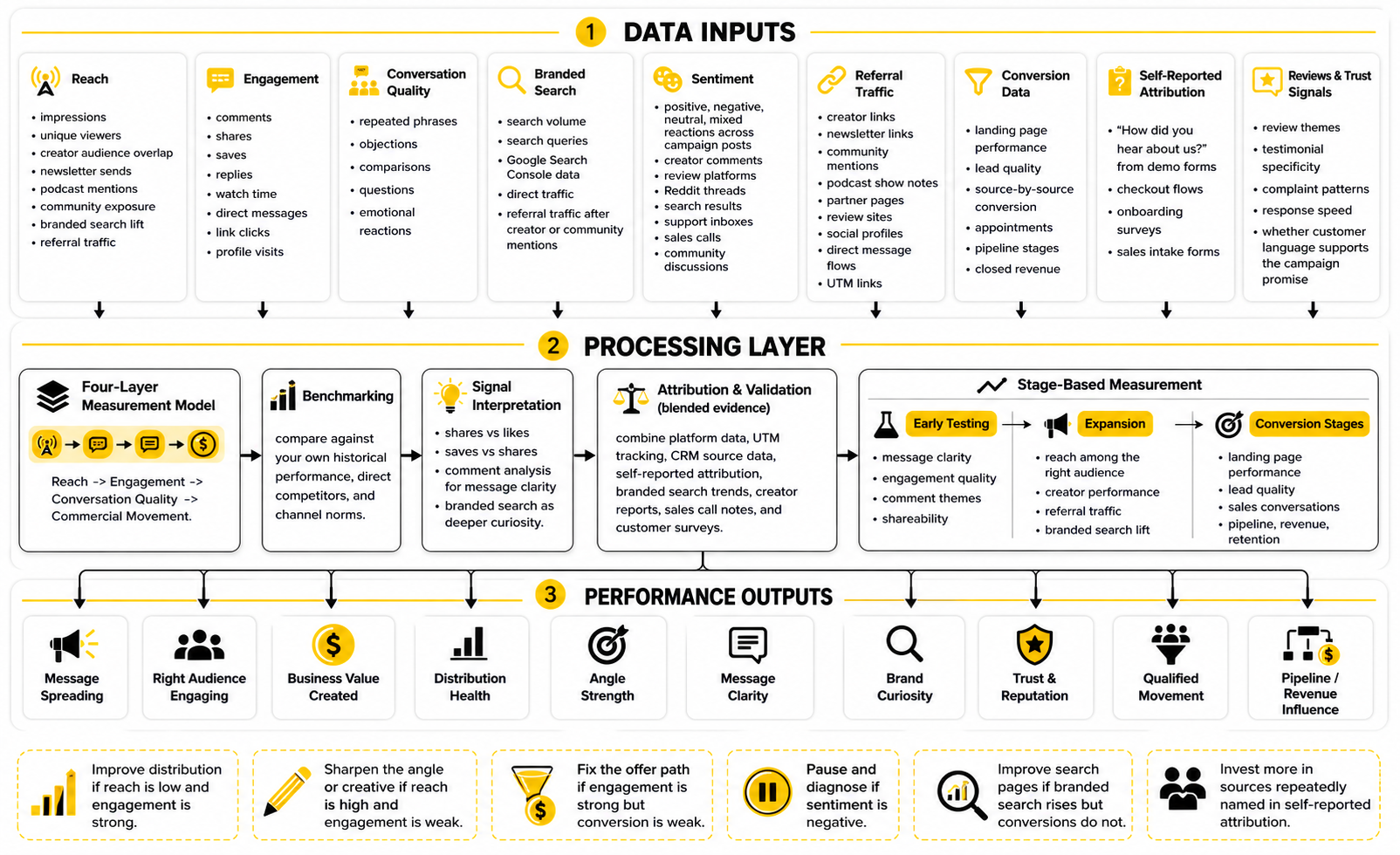
A practical analytics system should separate buzz marketing metrics into four layers. Each layer tells you something different, and mixing them together too early creates confusion. A post can get attention without trust, a creator can drive traffic without conversion, and a campaign can create conversation without revenue.
The first layer is reach, which shows how many people had a chance to see the message. The second layer is engagement, which shows whether people reacted enough to click, comment, save, share, reply, or watch. The third layer is conversation quality, which shows whether the market is repeating the intended idea in useful language. The fourth layer is commercial movement, which shows whether the campaign influenced leads, trials, demos, sales, retention, referrals, or partner opportunities.
This matters because each layer needs a different action. Low reach usually means distribution is weak. Low engagement usually means the angle is not strong enough. Weak conversation quality usually means the message is unclear. Weak commercial movement usually means the offer, funnel, or follow-up is disconnected from the buzz.
Reach Shows Exposure, Not Impact
Reach is useful, but it is not proof that buzz is working. A campaign can reach a large audience and still create almost no market movement. This is especially true when the content spreads outside the target audience or gets passive views without meaningful response.
Use reach to understand distribution health. Track impressions, unique viewers, creator audience overlap, newsletter sends, podcast mentions, community exposure, branded search lift, and referral traffic. If the campaign is not reaching enough relevant people, the issue may be seeding, channel choice, timing, or creator fit.
The action is simple: do not celebrate reach until you know who the reach is reaching. A smaller audience with high relevance is often more valuable than a broad audience that has no reason to care. Buzz marketing is not a stadium game; it is a relevance game first.
Engagement Shows Whether People Care Enough To React
Engagement gives you the first real signal of interest. Comments, shares, saves, replies, watch time, direct messages, link clicks, and profile visits show that people did more than glance at the campaign. But engagement still needs context.
Industry benchmarks can help, but they should not become the whole strategy. Sprout Social’s 2025 benchmark research analyzed 3 billion messages across 1 million active public profiles, which is useful for comparing social performance by category. Rival IQ’s 2025 benchmark report also shows why channel and industry context matter, because engagement expectations vary widely across Instagram, TikTok, Facebook, and X.
The action is to compare against three benchmarks at the same time. Compare the campaign against your own historical performance, against direct competitors, and against the specific channel norm. If your campaign beats your own baseline but underperforms the category, the message may be improving but still not sharp enough to lead the market.
Shares And Saves Are Stronger Than Likes
Likes are easy. Shares and saves are stronger because they show the content has transfer value or future value. When someone shares a post, they are putting a small piece of their identity behind it. When someone saves it, they are saying the idea may be useful later.
For buzz marketing, shares usually matter more than likes because the campaign depends on social transmission. A post with fewer likes but more shares can be more valuable than a post that gets broad passive approval. The share tells you the message is not just acceptable; it is repeatable.
Saves matter in a different way. They often signal practical value, especially for frameworks, checklists, comparisons, templates, and tactical breakdowns. If saves are high but shares are low, the content may be useful but not socially expressive. If shares are high but saves are low, the content may be emotionally strong but less practical.
Comments Reveal Message Clarity
Comments are not just engagement. They are raw market language. They show what people think the campaign means, what they agree with, what they challenge, what they repeat, and what they misunderstand.
This is why comment analysis should be part of the measurement process. Look for repeated phrases, objections, comparisons, questions, and emotional reactions. If the audience is summarizing the campaign in the same language you intended, the message is clear. If every comment focuses on a side issue, the angle may be attracting attention for the wrong reason.
Do not only count comments. Read them. A campaign with fewer comments but stronger buying intent can beat a noisy campaign full of jokes, arguments, or irrelevant reactions.
Branded Search Shows Deeper Curiosity
Branded search is one of the cleanest signals that buzz is moving beyond the original channel. When people hear about a brand, product, founder, campaign name, or offer and then search for it, they are showing deeper curiosity. That behavior is especially valuable because it often happens after exposure that is hard to attribute directly.
Track branded search trends before, during, and after the campaign. Look at search volume, search queries, Google Search Console data, direct traffic, referral traffic, and landing page visits that follow creator posts or community mentions. The goal is to see whether conversation is creating demand people actively pursue.
This is where buzz marketing often gets undercounted. Someone may see a LinkedIn post, hear a podcast mention, ask a friend, search the brand two days later, and finally convert through direct traffic. A last-click report may call that “direct,” but the buzz created the demand.
Sentiment Shows Whether Attention Is Helping Or Hurting
Sentiment is the difference between useful attention and dangerous attention. A campaign can create a lot of noise while quietly damaging trust. That is why positive, negative, neutral, and mixed reactions need to be reviewed, not ignored.
The 2025 Edelman brand trust research highlights how closely brand behavior and trust now sit together, including the growing role of AI-assisted shopping and review research, with 91% of generative AI users saying they use those platforms for shopping in some way. That matters because people are not only judging your campaign directly; they are also checking reviews, summaries, comparisons, and public conversations around it.
The action is to watch sentiment across multiple surfaces. Track the campaign post, creator comments, review platforms, Reddit threads, search results, support inboxes, sales calls, and community discussions. If negative sentiment appears, identify whether it is a real product issue, a message mismatch, a compliance problem, or simply the wrong audience reacting.
Referral Traffic Shows Where Buzz Travels
Referral traffic helps you see which conversations are sending people to your owned assets. This can include creator links, newsletter links, community mentions, podcast show notes, partner pages, review sites, social profiles, and direct message flows. It is not perfect, but it gives you a map of where buzz is moving.
Use UTM parameters wherever possible. Give creators and partners clean links. Separate campaign links by channel, asset, creator, and wave. If you are using a funnel builder like ClickFunnels, keep the campaign destination focused so traffic quality is easier to interpret.
The action is to double down on sources that produce qualified movement, not just clicks. A partner that sends fewer visitors but more demos may be stronger than a viral post that sends low-intent traffic. Buzz is only valuable when it moves the right people.
Conversion Data Shows Whether The Funnel Matches The Conversation
Conversion data tells you whether the promise that created attention is still clear when people reach the next step. If engagement is strong but conversion is weak, the problem may not be the campaign. The problem may be the page, offer, form, pricing, proof, or follow-up.
Track conversion by source. Compare creator traffic, community traffic, email traffic, paid amplification, organic social, direct traffic, and branded search. Each source may behave differently because each audience arrives with a different level of trust and context.
For service businesses, agencies, SaaS offers, and high-ticket campaigns, it helps to track more than form fills. A CRM and follow-up system like GoHighLevel can help connect campaign leads to appointments, pipeline stages, conversations, and closed revenue. That matters because buzz often creates assisted demand, not always instant purchases.
Attribution Should Be Directional, Not Delusional
Attribution is useful, but it will never capture every part of buzz marketing perfectly. People talk in private messages, forward links, mention brands in calls, search later, clear cookies, switch devices, and convert through channels that hide the original influence. If you expect perfect attribution, you will underinvest in the very activity that creates demand.
The MMA’s 2024 State of Attribution report notes a stronger emphasis on measurable outcomes and continuing frustration with measurement and attribution capabilities in marketing organizations. Ascend2’s 2024 attribution research also found that 98% of marketing professionals agree attribution is vital to marketing strategy, which shows how important measurement has become even when the data is imperfect.
The practical move is to use blended evidence. Combine platform data, UTM tracking, CRM source data, self-reported attribution, branded search trends, creator reports, sales call notes, and customer surveys. You are looking for a pattern strong enough to guide decisions, not a fantasy dashboard that explains every human conversation.
Self-Reported Attribution Catches What Dashboards Miss
Self-reported attribution is simple: ask people how they heard about you. It will not be perfect, but it often reveals sources that analytics tools miss. For buzz marketing, this is especially valuable because many conversations happen privately.
Add a “How did you hear about us?” field to demo forms, checkout flows, onboarding surveys, and sales intake forms. Keep it open-ended when possible. If you force people into a dropdown too early, you may hide the very language you need to learn from.
Then compare self-reported answers with your tracked data. If many people mention a creator, podcast, customer, community, or friend that analytics barely shows, you have found an influence source worth investigating. That is not a reporting flaw; that is market intelligence.
Review And Trust Signals Need Their Own Dashboard
Buzz does not only happen on social platforms. Reviews, testimonials, ratings, comments, and public feedback shape how people interpret the campaign after they first hear about it. If someone discovers your brand through a buzz campaign and then finds weak proof, the momentum can disappear.
Trustpilot reported that people wrote 61 million new reviews on its platform in 2024, which shows how much review content now surrounds buying decisions. At the same time, fake reviews are under heavier scrutiny, with Google committing to tougher action after a UK Competition and Markets Authority investigation into fake review practices.
The action is to monitor proof quality, not just proof volume. Track review themes, testimonial specificity, complaint patterns, response speed, and whether customer language supports the campaign promise. Strong buzz attracts attention; strong proof helps that attention survive scrutiny.
The Best Metrics Depend On Campaign Stage
A buzz campaign should not use the same success metric at every stage. Early testing should focus on message clarity, engagement quality, comment themes, and shareability. Expansion should focus on reach among the right audience, creator performance, referral traffic, and branded search lift.
Conversion stages should focus on landing page performance, lead quality, sales conversations, pipeline, revenue, and retention. If the campaign includes a community or referral loop, measure repeat participation, invites, user-generated content, and returning engagement. Each stage has a different job.
This prevents the team from killing good campaigns too early. Early buzz may show up as comments, saves, DMs, and branded searches before it shows up as revenue. That does not mean revenue is optional. It means the measurement window needs to match how the audience actually buys.
What The Numbers Should Make You Do
Data is only useful if it changes action. If reach is low but engagement is strong, improve distribution and seeding. If reach is high but engagement is weak, sharpen the angle or change the creative. If engagement is strong but conversion is weak, fix the offer path.
If sentiment is negative, pause and diagnose before scaling. If branded search rises but conversions do not, improve the pages people find when they search. If self-reported attribution keeps naming a specific source, invest more there and build a stronger partnership around it.
The best buzz marketing teams treat measurement as a feedback loop, not a report card. They use data to decide what to amplify, what to rewrite, what to retire, and what to turn into a repeatable play. That is how a campaign stops being a lucky spike and starts becoming a growth system.
Build a stronger local presence with BAAM AI
Turn your website, Google profile, social channels, and AI visibility into one growth engine
Most businesses do not need more random marketing activity. They need a consistent presence system that helps the right people find them, trust them, and take action. BAAM AI brings strategy, local SEO, website updates, Google Maps visibility, social content, AI-search readiness, media production, and reporting into one practical monthly engine.
If you want your marketing to keep working after the campaign ends, start with a free BAAM AI presence audit. See how your business shows up today and where the fastest visibility wins are at BAAM AI.