
BAAM AI Blog
Statistics And Data
Measurement is where a real estate SMMA becomes professional or gets exposed. Anyone can talk about leads, reach, views, and growth. The real question is whether the data shows a clear path from attention to...
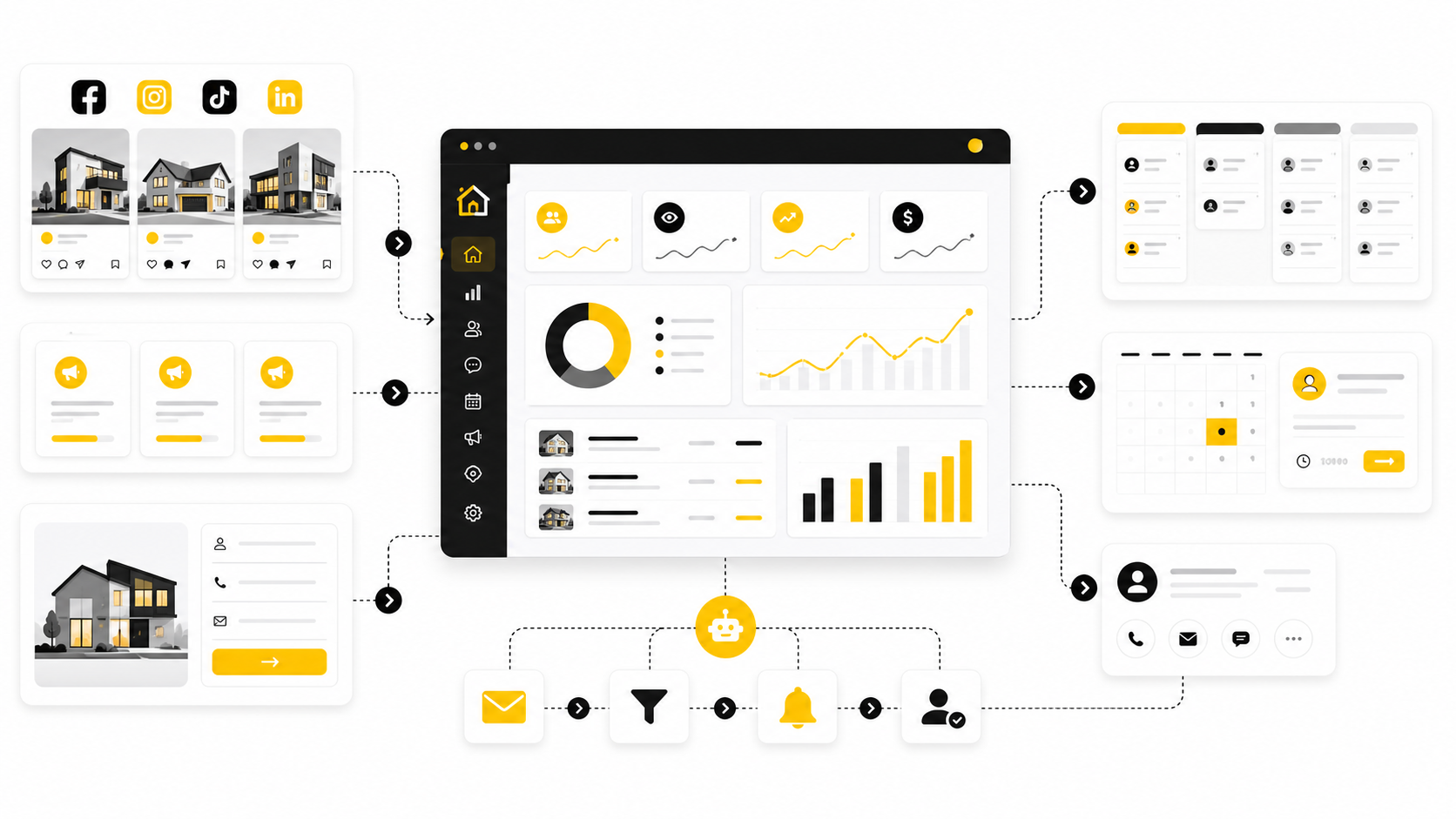
Measurement is where a real estate SMMA becomes professional or gets exposed. Anyone can talk about leads, reach, views, and growth. The real question is whether the data shows a clear path from attention to conversation, from conversation to appointment, and from appointment to revenue.
This is also where many agencies make the wrong move. They dump screenshots from ad platforms, celebrate cheap leads, and avoid the harder question: did the campaign create business momentum for the client? A real estate business does not need decorative reporting. It needs numbers that explain what happened, why it happened, and what should change next.
The point of data is decision-making. If a metric does not help the agency improve creative, adjust the offer, strengthen follow-up, or help the client sell better, it should not dominate the report. Keep the analytics tight, practical, and tied to the acquisition system built in the previous section.
The Numbers That Actually Matter
The first number to watch is qualified lead volume. Total leads can be misleading because a campaign can produce many low-intent inquiries that never answer the phone, never qualify, and never move into a real conversation. Qualified lead volume tells the agency whether the campaign is attracting people with a meaningful reason to engage.
The second number is appointment rate. This is where a lot of real estate marketing starts to separate from simple lead generation. If leads are coming in but not booking calls, the problem may be the offer, the form, the response speed, the follow-up message, or the client’s sales process.
The third number is cost per qualified opportunity, not just cost per lead. A seller appointment at a higher cost can be more valuable than a pile of cheap buyer leads with no urgency. This is especially true in real estate because one transaction can carry a large commission, while one bad lead source can burn time every week.
Why Cost Per Lead Can Be Dangerous
Cost per lead is useful, but it is not the whole truth. A low cost per lead can make a campaign look successful while hiding weak intent. If the leads do not respond, do not qualify, or do not match the client’s business goal, the campaign is not healthy.
A real estate SMMA should treat cost per lead as an early diagnostic number. It can show whether the offer and creative are generating affordable interest. It cannot prove that the campaign is producing revenue.
The better question is what happens after the lead enters the system. If one campaign produces leads at twice the cost but books three times as many serious consultations, that campaign may be the better asset. Data should help the agency make that call instead of chasing the cheapest number.
Benchmarks Need Context
Benchmarks are useful only when they are interpreted carefully. A campaign for luxury sellers in a high-value market should not be judged the same way as a campaign for first-time buyers in a lower-price market. The audience, transaction value, sales cycle, geography, offer, and follow-up process all change what “good” looks like.
This matters because real estate marketing is not one category. Listing campaigns, seller valuation campaigns, buyer consultation campaigns, relocation campaigns, investor campaigns, rental campaigns, and agent recruiting campaigns all behave differently. If the agency uses one benchmark for all of them, the reporting becomes lazy.
The more carefully approach is to build internal benchmarks by campaign type. Track what seller leads usually cost, what percentage become appointments, how many appointments become signed listings, and how long the sales cycle takes. Over time, your own data becomes more useful than generic industry averages.
Use Public Data To Understand The Market, Not To Fake Certainty
Public research can help explain why real estate businesses need stronger digital systems. Social media remained the top lead-generating technology for Realtors at 39%, ahead of CRM at 23% and local MLS tools at 17% in the 2025 Realtors Technology Survey. That is not a promise that every social campaign will work. It is evidence that social media has become a serious lead channel inside the industry.
Zillow’s 2025 agent report also gives useful context because 36% of sellers find agents through online channels, while 33% of buyers say online research plays a key role in choosing an agent: Zillow 2025 Consumer Housing Trends Report. Again, that does not mean every Instagram reel turns into a listing appointment. It means the client’s online presence now influences whether they are trusted before the conversation starts.
Use these numbers to frame the opportunity, not to overpromise. The real estate SMMA still has to prove performance inside the client’s market. External data explains why the channel matters; campaign data proves whether the system is working.
The Analytics System
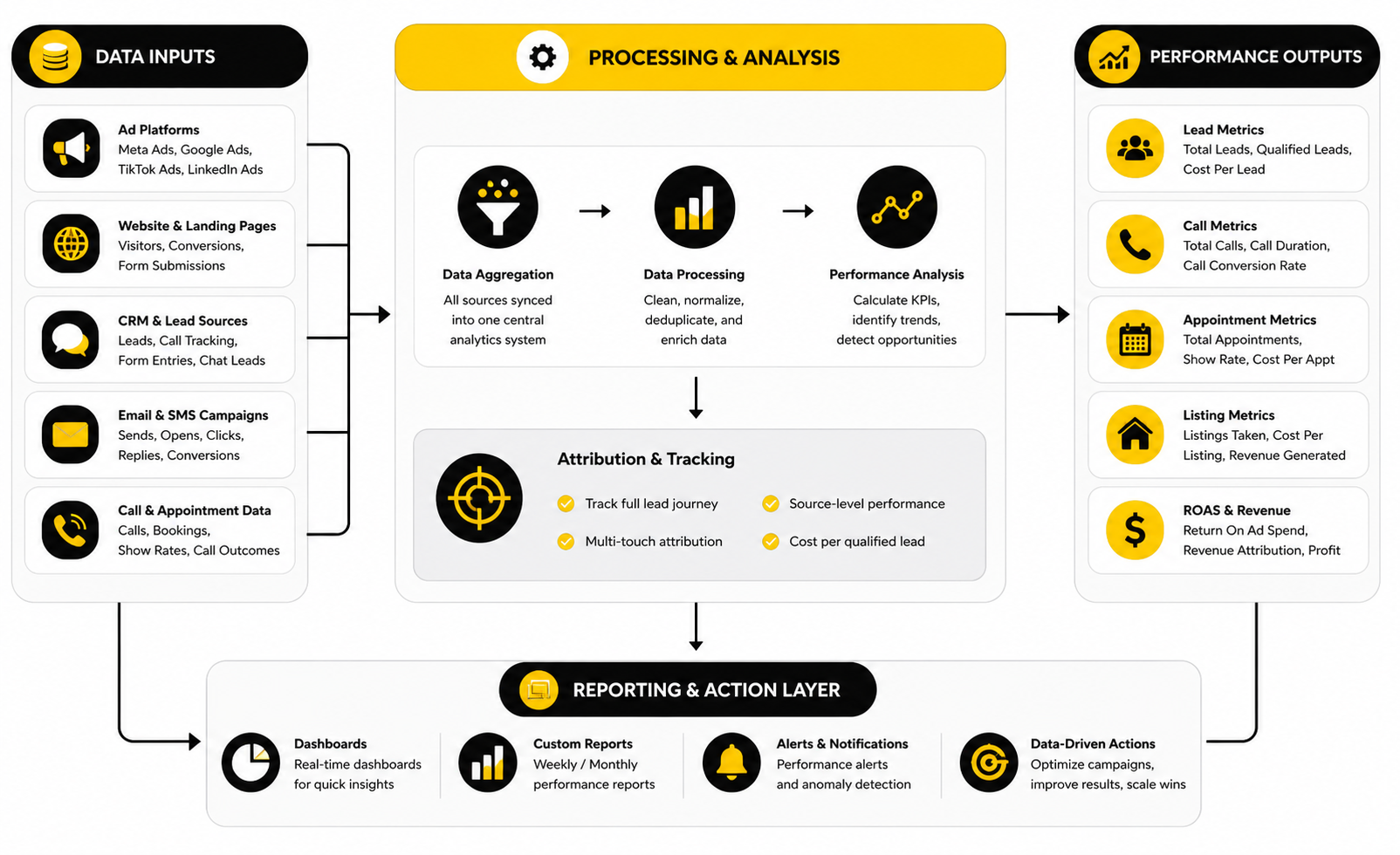
A clean analytics system should show the full path from source to outcome. The client should be able to see where the lead came from, what offer they responded to, whether they booked, whether they were reached, what stage they are in, and what happened next. If that path is broken, the agency is guessing.
The simplest structure is source, campaign, lead, appointment, pipeline stage, and outcome. This can be tracked with a CRM, ad platform data, call notes, appointment records, and weekly client feedback. It does not need to be complicated, but it does need to be consistent.
This is where centralized systems are useful. A platform like GoHighLevel can help a real estate SMMA connect funnels, forms, pipelines, automations, calendars, calls, SMS, email, and reporting in one place. The tool is not the strategy, but it makes the strategy easier to measure.
What To Track In The Dashboard
A useful dashboard should track traffic and visibility first. This includes impressions, reach, video views, click-through rate, landing page visits, and profile engagement. These numbers help explain whether the market is seeing the message and whether the creative is getting enough attention.
The next layer is conversion activity. This includes form submissions, calls, messages, booked appointments, calendar show-ups, cost per lead, and cost per booked appointment. These metrics show whether attention is turning into action.
The final layer is sales movement. This includes qualified opportunities, active pipeline value, signed agreements, listing appointments, buyer consultations, closed deals, and lost reasons. This is the layer that makes reporting valuable to the client because it connects marketing to business reality.
Performance Signals And What They Mean
Good reporting should diagnose problems quickly. If impressions are high but clicks are low, the creative or hook may not be strong enough. If clicks are high but form submissions are low, the landing page or offer may be causing friction.
If leads are coming in but appointments are not being booked, the follow-up system needs attention. The issue may be slow response, weak messaging, poor call attempts, unclear qualification, or a mismatch between the ad promise and the actual conversation. This is why the agency should not optimize only inside the ad account.
If appointments are booked but few become real opportunities, the campaign may be attracting the wrong intent level. It could also mean the client needs better scripting, better qualification, or a clearer sales process. A real estate SMMA should be direct about this because hiding operational issues only delays the fix.
Reading Creative Performance
Creative performance is not just about likes. A video can get strong engagement and still produce weak leads if it attracts the wrong audience. A simple direct-response ad can look less exciting publicly and still generate better sales conversations.
Look at watch time, saves, shares, comments, click-through rate, and lead quality together. If people watch but do not act, the content may be educational but missing a clear next step. If people click but do not convert, the page or form may not match the promise.
The best creative data tells you what the market cares about. If downsizing content performs better than generic seller tips, build more around that angle. If neighborhood pricing updates outperform broad market commentary, make the campaign more local and specific.
Reading Follow-Up Performance
Follow-up performance is usually the hidden lever. A campaign can generate strong interest, but if the agent responds slowly or inconsistently, the data will look worse than it should. That is why response time, contact rate, appointment rate, and no-show rate belong in the report.
The classic lead response problem is still relevant because online prospects decay quickly. Harvard Business Review’s research on web-generated leads found that many companies were slow to respond or never responded, which is exactly the kind of gap that destroys campaign ROI: The Short Life Of Online Sales Leads. Real estate clients should not treat speed as optional.
The action is simple. Set up instant notifications, use SMS and email confirmation, create call tasks, and review missed follow-up every week. If the agency controls the system and the client controls the conversation, both sides need visibility.
Reporting Cadence
Weekly reporting should focus on what changed and what action will be taken next. The client does not need a giant report every seven days. They need to know whether the campaign is improving, what the agency noticed, and what will be adjusted.
Monthly reporting should go deeper. This is where the agency reviews trend lines, lead quality, cost per opportunity, appointment volume, pipeline movement, creative winners, offer performance, and follow-up issues. Monthly reviews are also where retention is strengthened because the client can see strategic thinking, not just task completion.
Quarterly reporting should connect marketing to business direction. If the client wants more listings, better recruiting, higher-value buyers, or a new geographic focus, the campaigns should evolve with that goal. A real estate SMMA should not keep running the same play forever just because it was easy to launch.
Turning Data Into Action
Data should always lead to a decision. If the lead quality is poor, refine the offer or audience angle. If the appointment rate is weak, fix the follow-up process. If the creative is fatiguing, produce new hooks and formats.
Do not optimize everything at once. Change one or two meaningful variables, then measure the result. Random changes create confusing data, and confusing data makes client conversations harder.
The best agencies build a simple rhythm: review, diagnose, adjust, document, repeat. That rhythm turns performance management into a real operating system. It also gives the client confidence because they can see that the agency is not guessing; it is learning from the numbers and improving the machine.
Build a stronger local presence with BAAM AI
Turn your website, Google profile, social channels, and AI visibility into one growth engine
Most businesses do not need more random marketing activity. They need a consistent presence system that helps the right people find them, trust them, and take action. BAAM AI brings strategy, local SEO, website updates, Google Maps visibility, social content, AI-search readiness, media production, and reporting into one practical monthly engine.
If you want your marketing to keep working after the campaign ends, start with a free BAAM AI presence audit. See how your business shows up today and where the fastest visibility wins are at BAAM AI.