
BAAM AI Blog
Start With The Job Your Newsletter Should Do
A strong newsletter strategy starts before the first subject line. The real question is not “What should we send this week?” The real question is “What job should this newsletter do for the business and for the reader?”
Affiliate disclosure: this article may include compensated links. Recommendations should still be evaluated against your use case, budget, and current provider terms.
Should you choose this tool?
this tool is worth considering when the use case, budget, and implementation effort match what you actually need to do next.
teams that want a practical tool decision without reading another generic feature list
Check this toolStart With The Job Your Newsletter Should Do
A strong newsletter strategy starts before the first subject line. The real question is not “What should we send this week?” The real question is “What job should this newsletter do for the business and for the reader?”
That sounds basic, but it fixes a lot of messy newsletter programs. If the goal is retention, the newsletter should help customers get more value from what they already bought. If the goal is demand generation, the newsletter should build trust before someone is ready to book a call. If the goal is community, the newsletter should make readers feel like they are part of something they would miss if it disappeared.
This is where many newsletter strategy examples become useful. Morning Brew did not grow because it had a pretty email template. It had a clear reader promise: make business news easier and faster to understand, then make sharing the newsletter feel natural through a referral loop that became part of the product experience itself, as explained in Tyler Denk’s breakdown of Morning Brew’s referral program.
The Hustle is another useful example, but for a different reason. HubSpot did not acquire it just because newsletters were trendy. HubSpot said the acquisition added a newsletter, podcast, and premium research content to help scaling companies grow through a broader media ecosystem, which shows how a newsletter can become a strategic audience asset rather than just another campaign channel in HubSpot’s acquisition announcement.
For a smaller business, the lesson is simple. Your newsletter does not need to become a media company. But it does need a job clear enough that every issue can be judged against it.
Pick A Newsletter Model Before You Pick A Template
Most people jump into design too early. They choose a layout, add a logo, write a welcome sentence, and then wonder why the newsletter feels flat after three weeks. The better move is to choose the newsletter model first.
A newsletter model is the repeatable promise behind the email. It tells the reader what kind of value they can expect and tells your team what kind of content to create. Without that model, every issue becomes a blank page, and blank pages kill consistency.
Here are practical models that work across different businesses:
The model should match the reader’s reason for subscribing. Someone joining a SaaS newsletter after downloading a technical checklist probably wants implementation guidance, not broad industry commentary. Someone joining a creator newsletter may want taste, personality, and useful recommendations more than a polished corporate update.
This is also where tools matter, but only after the strategy is clear. If you need simple email campaigns with automation and segmentation, platforms like Brevo or Moosend can fit newsletter-led campaigns. If the newsletter is part of a larger CRM, funnel, appointment, or agency workflow, GoHighLevel may make more sense. The tool should support the model, not define it.
Use Segmentation Without Making The Newsletter Feel Robotic
Segmentation is one of the biggest differences between a casual newsletter and a serious newsletter strategy. A casual newsletter sends the same thing to everyone because it is easier. A serious newsletter still feels human, but it uses context to avoid wasting the reader’s time.
The point is not to create 47 tiny segments that nobody can manage. The point is to separate readers when their needs are clearly different. A new subscriber should not always get the same message as a long-time customer. A lead interested in ecommerce does not need the same examples as a local service business owner.
Personalization matters because readers now expect relevance. McKinsey’s personalization research found that 71% of consumers expect personalized interactions, while 76% get frustrated when they do not get them. That does not mean every email needs to mention someone’s first name five times. It means the content should feel like it was meant for the situation the reader is actually in.
Good newsletter segmentation can be simple:
The safest place to start is signup source. If someone joined from a webinar, reference the webinar topic in the welcome sequence. If someone joined from a lead magnet, continue the same problem-solving thread. Campaign Monitor’s segmentation guide makes this practical by recommending that brands identify signup routes, tag subscribers by source, and tailor welcome emails around how people joined the list in its segmentation workflow.
The danger is over-personalization. If an email feels like surveillance, trust drops. Use segmentation to be useful, not creepy.
Build A Repeatable Issue Format
A newsletter becomes easier to run when every issue has a familiar structure. Readers also benefit from that structure because they know where to look, what to expect, and how long the email will take to read. Familiarity is not boring when the content is genuinely useful.
Think of the format as a container. You can change the topic each week, but the reader experience stays consistent. This is one reason briefing-style newsletters work so well: the reader knows they are getting a fast scan, not an unpredictable essay.
A simple B2B newsletter format might look like this:
A creator newsletter might use a different structure:
An ecommerce newsletter might be even tighter:
The format should remove friction for both the writer and the reader. If every issue requires a new creative concept, the newsletter will eventually slow down. If every issue follows a useful rhythm, the newsletter becomes a habit.
This is also where benchmarks should be handled carefully. Open rates are less reliable than they used to be because privacy changes can inflate opens, so clicks, replies, conversions, and revenue usually tell you more about real engagement. Still, benchmarks can help you spot obvious problems, and current industry resources from Mailchimp and the DMA Email Benchmarking Report 2025 show why comparing your own numbers by industry and campaign type is more useful than chasing one universal “good” open rate.
Match The CTA To The Reader’s Temperature
Every newsletter needs a next step, but not every next step should be a hard sell. A reader who joined yesterday may need education. A customer who has clicked three product tutorials may be ready for a demo, upgrade, or consultation. A long-time subscriber who rarely clicks may need a lighter prompt, like a question or preference update.
This is where the newsletter becomes a revenue system instead of a content habit. You can use softer CTAs in educational issues and stronger CTAs when intent is obvious. The CTA should feel like the natural next step from the email, not a random button pasted at the bottom.
For example, a newsletter about improving lead follow-up could naturally link to a CRM, automation, or workflow tool. A newsletter about landing page testing could naturally point readers toward Replo if the audience is ecommerce-focused. A newsletter about chatbot-driven lead capture could naturally mention ManyChat when the reader actually has a messaging use case.
The worst CTA is the one that asks too much too early. “Book a call” can work, but only when the email has created enough intent. In many newsletters, a better CTA is “read the guide,” “see the template,” “compare the options,” “reply with your situation,” or “watch the walkthrough.”
A good newsletter strategy does not treat every subscriber like they are at the same stage. It moves people forward one useful step at a time. That is the difference between a newsletter people tolerate and a newsletter people actually act on.
Turn The Strategy Into A Working Newsletter System
Once the model, audience, format, and CTA logic are clear, the next step is execution. This is where many newsletter strategy examples look simple from the outside but are actually supported by a tight process behind the scenes. The newsletter may feel casual to the reader, but the production system should not be casual at all.
A working newsletter system needs four things: inputs, decisions, production, and feedback. Inputs are the ideas, customer questions, product updates, research, and sales insights that feed the newsletter. Decisions are the rules that determine what gets included, what gets skipped, and what deserves a stronger CTA.
Production is the writing, editing, designing, testing, and scheduling. Feedback is what happens after the send: clicks, replies, conversions, unsubscribes, spam complaints, and sales conversations. If those four pieces are not connected, the newsletter becomes a recurring task instead of a compounding asset.
Build The Newsletter Workflow Before You Scale Frequency
Do not start by asking whether you should send weekly, twice weekly, or daily. Start by asking whether you can reliably produce one strong issue without scrambling. Frequency only works when the workflow can support it.
A simple weekly workflow can look like this:
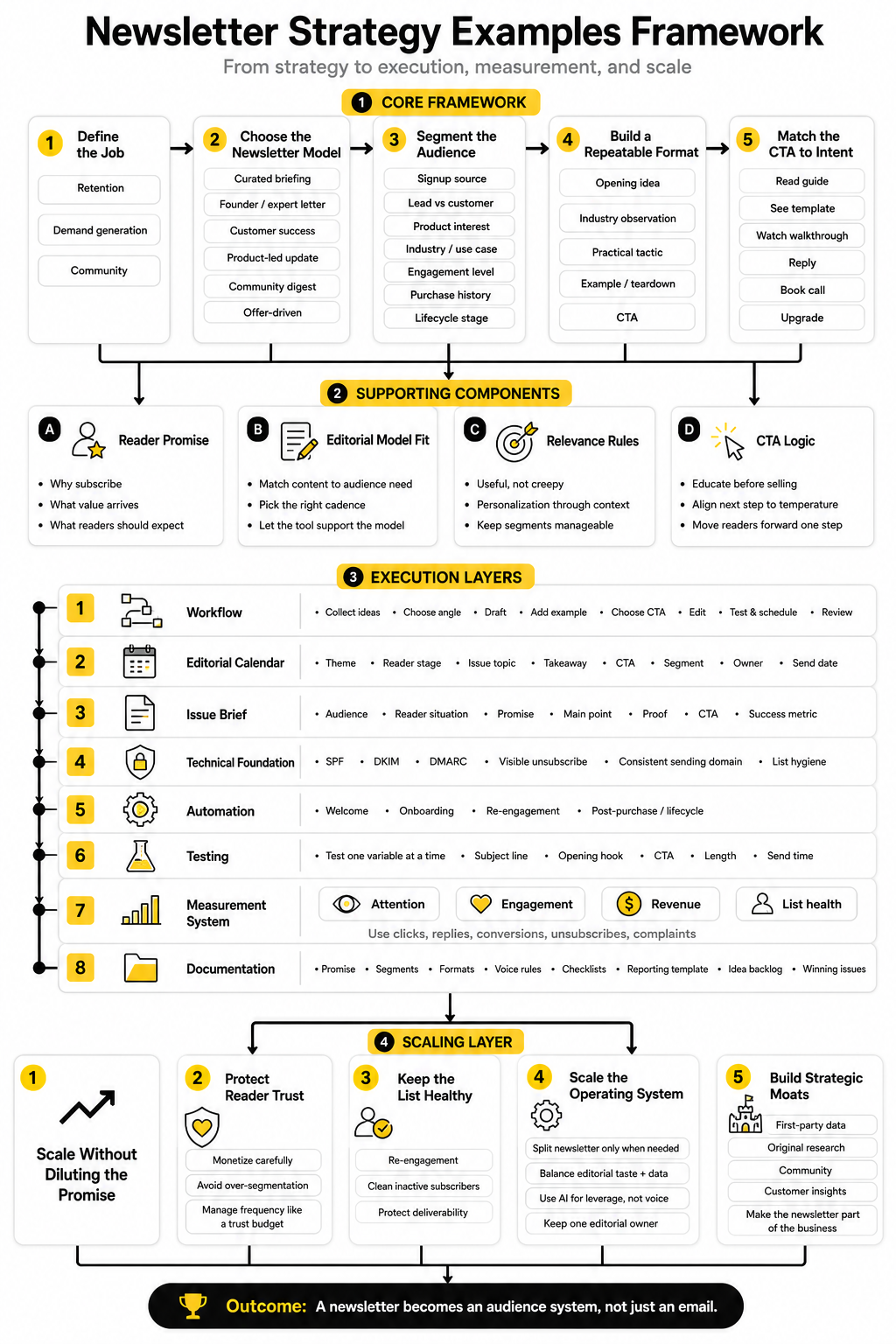
This kind of process is not glamorous, but it is what keeps the newsletter consistent. It also makes delegation possible because the work is no longer trapped in one person’s head. When the workflow is clear, a founder, marketer, writer, or assistant can all understand what “good” looks like.
For small teams, the most important part is the idea collection step. If you wait until writing day to find an idea, you will eventually publish filler. Keep a running backlog of customer objections, reader questions, useful links, campaign notes, and examples so every issue starts with material that already matters.
Create An Editorial Calendar That Connects Content To Business Moments
An editorial calendar should not be a random list of topics. It should connect the newsletter to launches, seasonal buying moments, product priorities, customer education needs, and audience pain points. That is how you keep the newsletter useful while still making it commercially relevant.
For example, an agency might plan a month around lead generation because it is promoting a workshop or CRM offer. An ecommerce brand might plan around replenishment cycles, product education, gift periods, and back-in-stock moments. A SaaS company might plan around onboarding, feature adoption, customer use cases, and churn prevention.
The calendar does not need to be complicated. A practical monthly view can include:
This is where newsletter planning becomes more disciplined. You are not just “sending content.” You are deciding what the reader needs to understand before the next business action makes sense.
Prepare Each Issue With A Clear Brief
A newsletter brief saves time because it prevents vague writing. Before drafting, write a short brief that explains who the issue is for, what problem it solves, what belief it should create, and what action the reader should take next. This keeps the email focused and makes editing much easier.
A good brief can be very short:
This matters because most weak newsletters try to do too much. They teach, sell, announce, summarize, and entertain all at once, then none of it lands. A brief forces one issue to have one job.
If the newsletter is tied to a funnel, the brief should also name the next step clearly. For a lead magnet sequence, that might be a comparison page, consultation, or demo. For a simple offer-led campaign, a funnel builder like ClickFunnels or Systeme.io can be useful when the newsletter needs to move readers into a landing page, checkout, or automated follow-up path.
Set Up The Technical Foundation Before Sending More Email
The best content will not help much if the email struggles to reach the inbox. Newsletter execution needs a technical foundation: authentication, clean list growth, easy unsubscribes, and basic deliverability monitoring. This is not optional anymore.
Gmail’s sender guidelines require bulk senders who send 5,000 or more messages per day to Gmail accounts to authenticate outgoing email, avoid unwanted mail, and make unsubscribing easy through Google’s email sender requirements. Yahoo has also pushed senders toward stronger standards for authentication, low spam complaints, and easy unsubscribes through its sender requirements and recommendations. Even if your list is smaller, these rules are a useful baseline because inbox providers are clearly rewarding responsible sending behavior.
At minimum, check these before increasing volume:
This is also why list quality beats list size. A smaller list of people who actively want the newsletter is more valuable than a large list full of dead, bought, or confused contacts. Newsletter strategy examples from strong brands usually look content-driven on the surface, but the quiet foundation is permission, relevance, and sending discipline.
Use Automation For Timing, Not For Laziness
Automation should make the newsletter experience more relevant, not more robotic. A welcome sequence, re-engagement flow, customer onboarding series, or post-purchase education sequence can make the newsletter feel more helpful because the timing matches the reader’s situation. The mistake is using automation to send more messages without improving the experience.
For ecommerce, automated emails often carry a lot of revenue because they are triggered by behavior. Omnisend’s 2025 ecommerce report found that abandoned cart, welcome, and browse abandonment emails were the top three automation types sent and accounted for 87% of all automated orders. That does not mean every business should copy ecommerce flows exactly, but it proves the larger point: timing matters.
For service businesses and agencies, the same idea applies differently. A new lead might get a welcome sequence, a proof email, a problem education email, and then a consultation CTA. A customer might get onboarding tips, usage reminders, case examples, and upgrade prompts when they are actually relevant.
A platform like GoHighLevel fits this kind of workflow when the newsletter connects to CRM stages, appointments, pipelines, and follow-up automation. A tool like ManyChat can fit when newsletter growth or lead capture happens through messaging channels before email. The key is to automate the parts that benefit from timing while keeping the actual message useful and human.
Test One Variable At A Time
Testing is where newsletter execution improves, but only if you keep it simple. If you change the subject line, intro, offer, CTA, format, and send time all at once, you will not know what caused the result. Good testing isolates one variable and gives the result enough sends to mean something.
Start with variables that affect reader behavior directly:
Do not obsess over open rates alone. Apple Mail Privacy Protection and similar privacy changes make opens less reliable as a measure of true engagement, which is why clicks, replies, conversions, unsubscribe rate, and spam complaints deserve more attention. The DMA’s 2025 Email Benchmarking Report shows unique click rates rising to 2.3% in 2024, which is more useful as a directional engagement signal than treating opens as the whole story.
Testing should answer practical questions. Which topic creates more replies? Which CTA creates more demo requests? Which segment clicks the product education link? Which issue causes unsubscribes because it promised the wrong thing? That is how the newsletter gets sharper over time.
Document The System So It Can Survive Busy Weeks
A newsletter strategy is only real if it can survive a busy week. If the process falls apart the moment the founder travels, the marketer gets overloaded, or a launch takes priority, the system is too fragile. Documentation fixes that.
Create a simple newsletter operating document with:
This document should be practical, not bloated. The goal is to make the newsletter easier to produce and easier to improve. When someone new joins the team, they should be able to read it and understand how the newsletter works, what it should sound like, and what mistakes to avoid.
This is the process layer most people skip. They look for more newsletter strategy examples, more templates, and more swipe files, but the missing piece is usually not inspiration. It is a repeatable system that turns ideas into useful emails every single week.
Statistics and Data
Data should make your newsletter calmer, not noisier. The point is not to stare at a dashboard after every send and panic because one number moved. The point is to understand what each signal means, what it does not mean, and what decision it should drive.
This is especially important when studying newsletter strategy examples because public case studies often highlight the exciting numbers. Subscriber growth, open rates, and revenue screenshots are easy to share. The harder and more useful work is knowing which metric connects to which part of the system.
A newsletter can look healthy at the top and still be weak underneath. A high open rate may mean the subject line worked, or it may be inflated by privacy changes. A low click rate may mean the content missed, or it may mean the issue was designed to educate rather than drive a click. Numbers matter, but only when they are interpreted in context.
Separate Attention, Engagement, And Revenue
The cleanest way to measure a newsletter is to split performance into three layers: attention, engagement, and revenue. Each layer answers a different question. When you mix them together, the data becomes confusing fast.
Attention metrics show whether the email reached people and earned enough curiosity to be noticed. Engagement metrics show whether readers did something meaningful after opening. Revenue metrics show whether the newsletter contributed to pipeline, purchases, retention, or another business outcome.
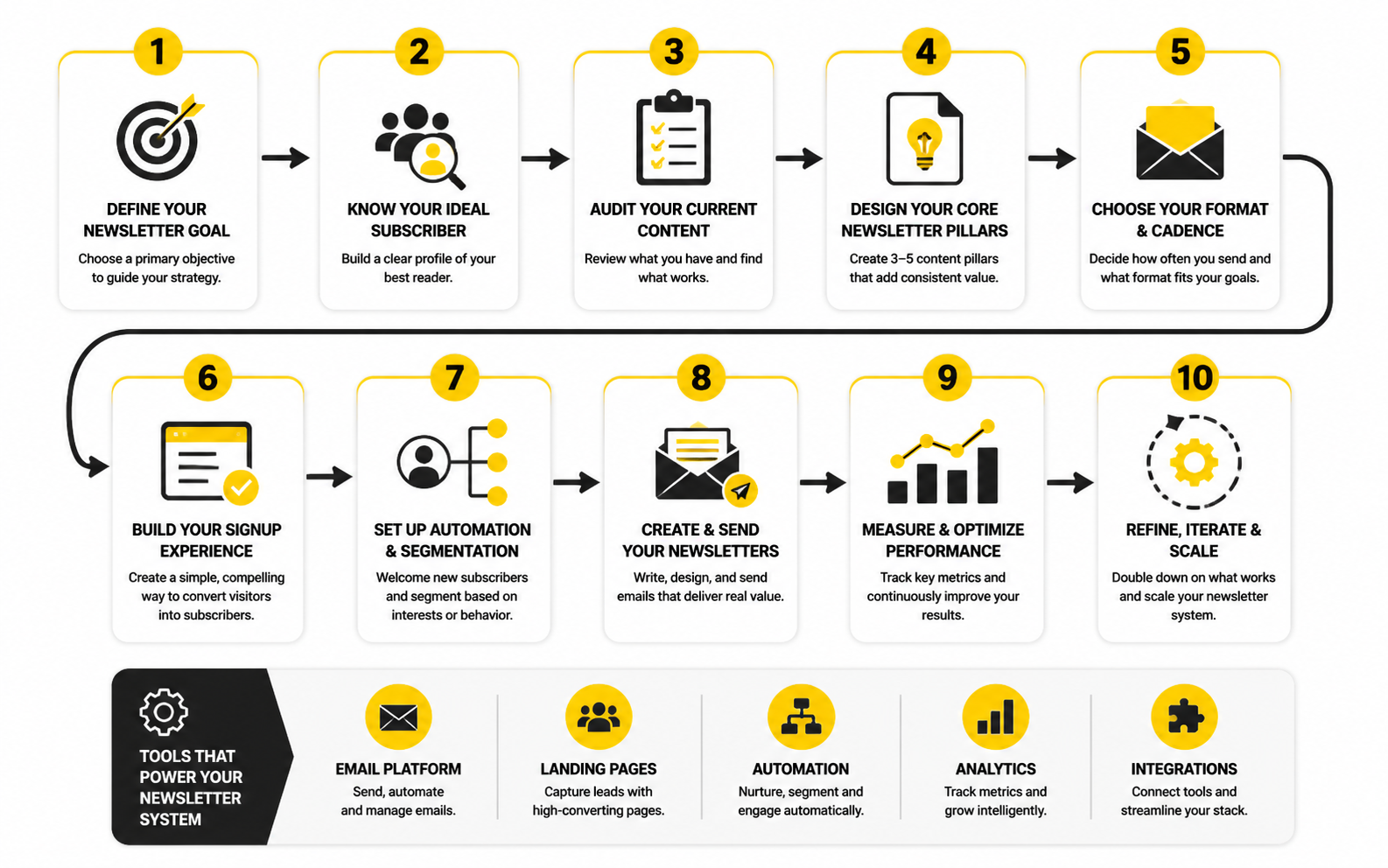
A practical measurement system can look like this:
This structure keeps you from overreacting. If attention is weak, you look at deliverability, sender name, subject line, and list quality. If engagement is weak, you look at the offer, content relevance, CTA clarity, and segmentation. If revenue is weak, you look at the landing page, sales handoff, offer fit, and attribution.
Treat Open Rate As A Clue, Not A KPI
Open rate used to be one of the cleanest newsletter metrics. That changed when privacy features made open tracking less reliable. Apple Mail Privacy Protection can preload email images, which means tracking pixels may fire even when a person did not intentionally open the message, as explained in Wired’s breakdown of Apple Mail privacy changes.
That does not mean open rate is useless. It still gives directional feedback, especially when you compare similar sends to the same audience over time. But it should not be the main number used to judge newsletter success.
Use open rate for questions like these:
Do not use open rate as proof that people loved the issue. They may not have read it. They may not have clicked anything. They may not have taken the next step that matters to the business.
Make Clicks And Replies Your Stronger Engagement Signals
Clicks are usually a stronger signal than opens because they show intentional action. A reader clicked because the link, offer, resource, or next step had enough relevance to earn effort. That makes click data useful for improving both content and commercial strategy.
The DMA’s 2025 Email Benchmarking Report found that unique click rates reached 2.3% in 2024, which is useful as a directional benchmark rather than a universal target. A newsletter with a lower click rate may still be working if it drives replies, brand trust, or sales conversations. A newsletter with a higher click rate may still fail if the clicks go to weak offers or pages that do not convert.
Replies are even more valuable for some newsletters. A reply shows that the reader felt enough trust, frustration, interest, or urgency to start a conversation. For service businesses, agencies, consultants, and B2B companies, replies can be more commercially meaningful than raw click volume.
Track clicks by link type, not just total clicks. A click to a case study means something different from a click to a pricing page. A click to a tutorial means something different from a click to book a call. The action after the click tells you what the reader is actually ready for.
Use Benchmarks Without Letting Them Control The Strategy
Benchmarks are useful when they help you spot problems. They are dangerous when they become the strategy. Your newsletter does not need to beat every industry average; it needs to improve against its own goals.
Mailchimp’s benchmark resource is useful because it breaks email performance down by industry and explains that its data comes from campaigns with at least 1,000 subscribers where tracking was active in its email marketing benchmarks. MailerLite’s 2025 benchmark report is also useful because it covers open rate, click rate, click-to-open rate, and unsubscribe rate across millions of campaigns and many industries in its benchmark analysis. These sources can help you understand whether your numbers are wildly off, but they should not replace your own baseline.
A better way to use benchmarks is to ask:
This is where newsletter strategy examples become more useful. You stop copying someone else’s cadence or format and start studying the relationship between promise, audience, CTA, and performance. That is where the real insight is.
Watch List Health Before It Becomes A Deliverability Problem
List health is boring until it becomes expensive. If engagement drops, spam complaints rise, or old contacts keep bouncing, your newsletter can start losing inbox placement before the content even gets a fair chance. That is why list health should be reviewed every month, not only when something breaks.
Google’s sender requirements for bulk senders emphasize authentication, low spam rates, and easy unsubscribe options in its email sender guidelines. Yahoo’s sender recommendations point in the same direction with authentication, complaint control, and one-click unsubscribe expectations in its sender best practices. The direction is obvious: inbox providers want senders to prove they are wanted.
Track these list health signals:
A rising unsubscribe rate is not always bad. If you made a sharper promise or changed the newsletter direction, some people leaving can improve list quality. A rising spam complaint rate is different. That usually means expectations were unclear, the list source was weak, or the newsletter is no longer matching what people signed up for.
Connect Newsletter Metrics To The Funnel
Newsletter reporting becomes much more useful when it connects to the funnel. The email platform can show clicks, but the business needs to know what happened after those clicks. Did people book? Buy? Upgrade? Reply? Watch? Request a proposal? Return to the site later?
This is where UTM discipline matters. Every important newsletter link should be tagged clearly so analytics tools can separate newsletter traffic from organic search, paid traffic, social, and direct visits. The exact naming system matters less than consistency.
A simple UTM structure might include:
If your newsletter drives readers into funnels, landing pages, forms, or booking flows, make sure those tools can report what happened after the click. A landing page builder, form tool, CRM, or funnel platform should help you see the connection between the email and the next action. For newsletter campaigns tied to appointments, pipelines, and lead follow-up, GoHighLevel can make that connection easier because the email activity sits closer to the CRM and sales workflow.
For simpler email programs, a platform like Brevo can be enough when the goal is to run campaigns, segment readers, and measure basic performance. The point is not to overbuild the stack. The point is to track the journey from send to action.
Build A Simple Newsletter Scorecard
A scorecard keeps reporting practical. Instead of reviewing every possible metric, choose a small set that matches the newsletter’s job. Then review the same numbers every week or month so trends become obvious.
For an audience-building newsletter, the scorecard might include subscriber growth, referral source, open rate direction, click rate, replies, and unsubscribes. For a revenue-focused newsletter, it should include clicks to offer pages, conversion rate, booked calls, purchases, and revenue per send. For a customer newsletter, it might include product education clicks, feature adoption, churn signals, support-ticket reduction, and customer replies.
A useful scorecard can include:
The final line is the most important. Reporting without a decision is just decoration. Every scorecard should end with an action: keep the format, change the CTA, segment the next send, clean the list, test a new subject angle, rewrite the landing page, or follow up with engaged readers.
Read The Data Like A Strategist
The best newsletter operators do not ask, “Was this send good or bad?” They ask, “What did this send teach us about the audience?” That shift matters because one newsletter issue is rarely enough to prove anything by itself.
A low click rate may teach you that the topic was too broad. A high unsubscribe rate may teach you that the subject line attracted the wrong expectation. A strong reply rate may teach you that the audience wants more opinion, more specificity, or more help with that problem.
Here is the practical way to read performance:
This is why data should not make your newsletter colder. Good data should make it more human because it shows what readers actually care about. The numbers are not the strategy by themselves; they are feedback that helps the strategy get sharper.
Scale The Newsletter Without Diluting The Promise
Once the newsletter is working, the next challenge is scale. This is where strategy gets more subtle because growth can make the newsletter better or worse. More subscribers, more sends, more segments, and more revenue opportunities all create leverage, but they also create more ways to lose trust.
The newsletter promise should stay stable even as the operation grows. Readers should still know why the email exists, who it is for, and what kind of value they will get. If the newsletter starts as practical advice and slowly turns into a rotating set of promotions, the audience will feel the shift before the dashboard fully shows it.
This is why the best newsletter strategy examples are not just about acquisition. They are about protecting the reader relationship while the business grows around it. Growth is only useful when the list becomes more valuable, not just larger.
Decide What Kind Of Scale You Actually Want
Not every newsletter should scale the same way. A creator newsletter may scale through personality, paid subscriptions, sponsors, and community. A SaaS newsletter may scale through lifecycle education, product adoption, and customer expansion. An agency newsletter may scale through qualified conversations, booked calls, and trust with a narrow audience.
Before chasing more subscribers, decide what scale means for the business:
These goals require different decisions. A newsletter built for sponsorship revenue needs reach, clear audience positioning, and advertiser-friendly reporting. A newsletter built for high-ticket consulting may need fewer subscribers but stronger trust, more replies, and better qualification.
HubSpot’s 2025 newsletter research found that 25% of surveyed newsletter operators saw substantial profit growth over the past year, but it also found that more than half expect newsletter revenue to become harder by 2030. That is the tradeoff. Newsletters are still valuable, but lazy newsletters will have a harder time standing out.
Protect Reader Trust When Monetizing
Monetization is not the problem. Misalignment is the problem. Readers understand that a newsletter may sell products, recommend tools, run sponsors, or promote services, but they expect the recommendations to fit the promise they signed up for.
The danger starts when monetization decisions override editorial judgment. Too many sponsors, weak affiliate matches, irrelevant product pushes, and constant urgency can turn a useful newsletter into a sales feed. Once that happens, even good content starts to feel suspicious.
A practical monetization filter helps:
This is where affiliate links should be used with restraint. For example, a newsletter issue about landing page testing can naturally point to Replo if the audience is building ecommerce pages. An issue about booked-call funnels can naturally mention GoHighLevel or ClickFunnels when the reader needs a funnel and follow-up system. The link should feel earned by the content.
Avoid The Segmentation Trap
Segmentation can improve relevance, but it can also create operational drag. Many teams build too many segments too early, then struggle to write enough useful content for each one. The result is either inconsistent sending or shallow personalization that does not actually help the reader.
The better move is to segment by meaningful intent, not by every possible attribute. A reader’s industry may matter. Their lifecycle stage may matter. Their last clicked topic may matter. But if a segment does not change what you would send, it is probably not worth maintaining yet.
Use this rule: a segment only matters when it changes the message, the offer, or the timing. If it does not change at least one of those, keep the system simpler.
Advanced segmentation should usually come after you have enough data to support it. Start with broad categories like new subscriber, active lead, customer, inactive reader, and high-intent clicker. Then refine based on actual behavior rather than assumptions.
Manage Frequency Like A Trust Budget
Sending more often can increase revenue, but it can also increase fatigue. There is no universal best frequency because the right cadence depends on the promise, the audience, and the value per issue. A daily curated briefing can work if it is genuinely useful every day. A product-heavy daily newsletter will burn out most lists fast.
Think of frequency as a trust budget. Every send spends a little attention. If the email gives more value than it takes, the relationship strengthens. If it takes more attention than it gives back, the relationship weakens.
Watch for fatigue signals:
The answer is not always to send less. Sometimes the answer is to separate content types. Keep the main newsletter valuable and use dedicated campaign emails for launches, webinars, or limited offers. That way readers are not forced to experience every promotion as if it were the core newsletter.
Build A Re-Engagement Plan Before The List Goes Cold
Inactive subscribers are not just a reporting issue. They can hurt deliverability, distort performance data, and make the list look healthier than it really is. If someone has not opened, clicked, replied, or visited from your emails for months, you need a plan.
A re-engagement sequence should be direct and respectful. Do not guilt people. Do not pretend you are personally devastated that they have not clicked. Give them a reason to stay, let them choose preferences when possible, and make it easy to leave.
A simple re-engagement flow can include:
This is not just about cleaning the list. It is about preserving the sender reputation you worked to build. Google’s sender guidance tells bulk senders to keep user-reported spam rates below 0.1% and avoid reaching 0.3% or higher, which makes permission and engagement more than a best practice. They are part of staying welcome in the inbox.
Know When To Split One Newsletter Into Multiple Products
At some point, one newsletter may become too broad. This usually happens when the audience expands into different use cases, buyer stages, or content expectations. What started as one simple email becomes a compromise that is not specific enough for anyone.
Splitting the newsletter can help, but only when the split is based on a real reader difference. Do not create separate newsletters because the team has many ideas. Create them because the audience has meaningfully different needs.
Good reasons to split include:
Bad reasons to split include internal team structure, random topic variety, or the hope that more newsletters will magically create more growth. More newsletter products mean more writing, more reporting, more list management, and more quality control. The upside must be worth the complexity.
Balance Editorial Taste With Performance Data
Data tells you what readers do. Editorial taste helps you decide what is worth saying. You need both.
If you only follow the numbers, the newsletter can become predictable, reactive, and overly optimized for clicks. If you only follow taste, you may ignore clear signals that the audience has moved on. The strongest newsletter operators use data as feedback, but they do not let the dashboard write the newsletter.
This matters because some of the most valuable issues will not always produce the highest immediate click rate. A strong opinion piece may build trust. A transparent product update may reduce churn. A practical framework may get saved, forwarded, or remembered without producing a dramatic spike in the report.
The expert move is to classify sends by purpose before judging them. A trust-building issue should not be measured the same way as a launch email. A customer education issue should not be measured the same way as a sponsor slot. A newsletter strategy becomes much easier to manage when each issue has a clear job and the metric matches that job.
Prepare For AI Without Letting It Flatten The Voice
AI will make newsletter production faster, but it will also make average newsletters easier to ignore. If everyone can generate a decent summary, decent subject line, and decent outline in seconds, “decent” stops being enough. The advantage shifts toward taste, specificity, experience, original examples, and sharper positioning.
HubSpot’s newsletter report found that 64% of surveyed newsletter professionals agreed newsletters will be AI-generated by 2030. That does not mean readers want generic AI newsletters. It means production will get more automated, while the need for human judgment becomes more important.
Use AI for leverage:
Do not use AI to replace the point of view. The newsletter needs a reason to exist beyond information transfer. If the content could be sent by any company in the niche, it is not strong enough.
Scale The Team Without Losing The Voice
As the newsletter grows, more people may touch it: writers, editors, designers, growth marketers, sales leaders, product teams, sponsors, and founders. That can improve the newsletter, but it can also dilute the voice if nobody owns the final reader experience.
The fix is not endless approvals. The fix is a clear editorial owner. One person or one small team should protect the promise, voice, quality bar, and reader trust. Other teams can contribute inputs, but not every internal priority deserves a place in the issue.
A practical approval flow might look like this:
This keeps the newsletter from becoming an internal bulletin board. The reader does not care that three departments want visibility this week. The reader cares whether the issue is worth opening.
Build Moats Around The Newsletter
A newsletter becomes harder to copy when it has assets competitors cannot easily recreate. Templates and subject lines are easy to copy. Trust, first-party data, reader replies, proprietary research, internal expertise, community, and strong positioning are harder to copy.
This is the advanced layer of newsletter strategy. The newsletter should not only distribute content. It should create insight the business can use elsewhere.
Strong newsletter moats include:
This is why the best newsletter strategy examples are not just publishing machines. They are learning systems. Every send teaches the business something about the audience, and every insight makes the next send stronger.
Make The Newsletter Part Of The Business, Not A Side Channel
A newsletter should not sit isolated from sales, product, content, and customer success. It should feed them. If readers keep replying with the same objection, sales should know. If customers click the same tutorial repeatedly, product and support should know. If one topic keeps driving qualified leads, the content team should build around it.
This is where the newsletter becomes a strategic channel instead of a marketing chore. It distributes ideas, captures demand, tests positioning, educates customers, and reveals what the market cares about. That is much more valuable than simply “sending an email every Tuesday.”
For teams that want this connection inside the CRM, GoHighLevel can help when email engagement, appointments, automations, and pipelines need to live closer together. For teams that mainly need campaign sending and segmentation, Brevo or Moosend may be enough. The stack should match the operational need, not the other way around.
Do Not Let Growth Break The Thing That Made People Subscribe
This is the risk at the center of scaling any newsletter. The more successful it gets, the more pressure there is to extract from it. More promotions. More partnerships. More stakeholder requests. More automation. More aggressive segmentation. More “quick wins.”
Some of that can be good. But the newsletter only keeps working if the reader still gets what they came for. The promise must stay clear, the content must stay useful, and the CTA must stay connected to the value of the issue.
That is the real expert-level move. Grow the list, improve the system, monetize intelligently, and use better tools when they help. But protect the reader relationship like it is the asset, because it is.
Bring The Whole Newsletter System Together
At this point, the newsletter is no longer just an email you send. It is an audience system. It has a reader promise, a model, a workflow, measurement rules, monetization logic, and a way to improve from real feedback.
That is the difference between average email marketing and a newsletter strategy that compounds. Average email marketing asks, “What can we send?” A real strategy asks, “What relationship are we building, what action should this support, and what did the last issue teach us?”
The strongest newsletter strategy examples all have this in common: the email is connected to a larger ecosystem. The newsletter feeds content ideas, sales conversations, product education, customer research, and revenue. It is not isolated from the business. It becomes one of the clearest ways to understand what the audience actually cares about.
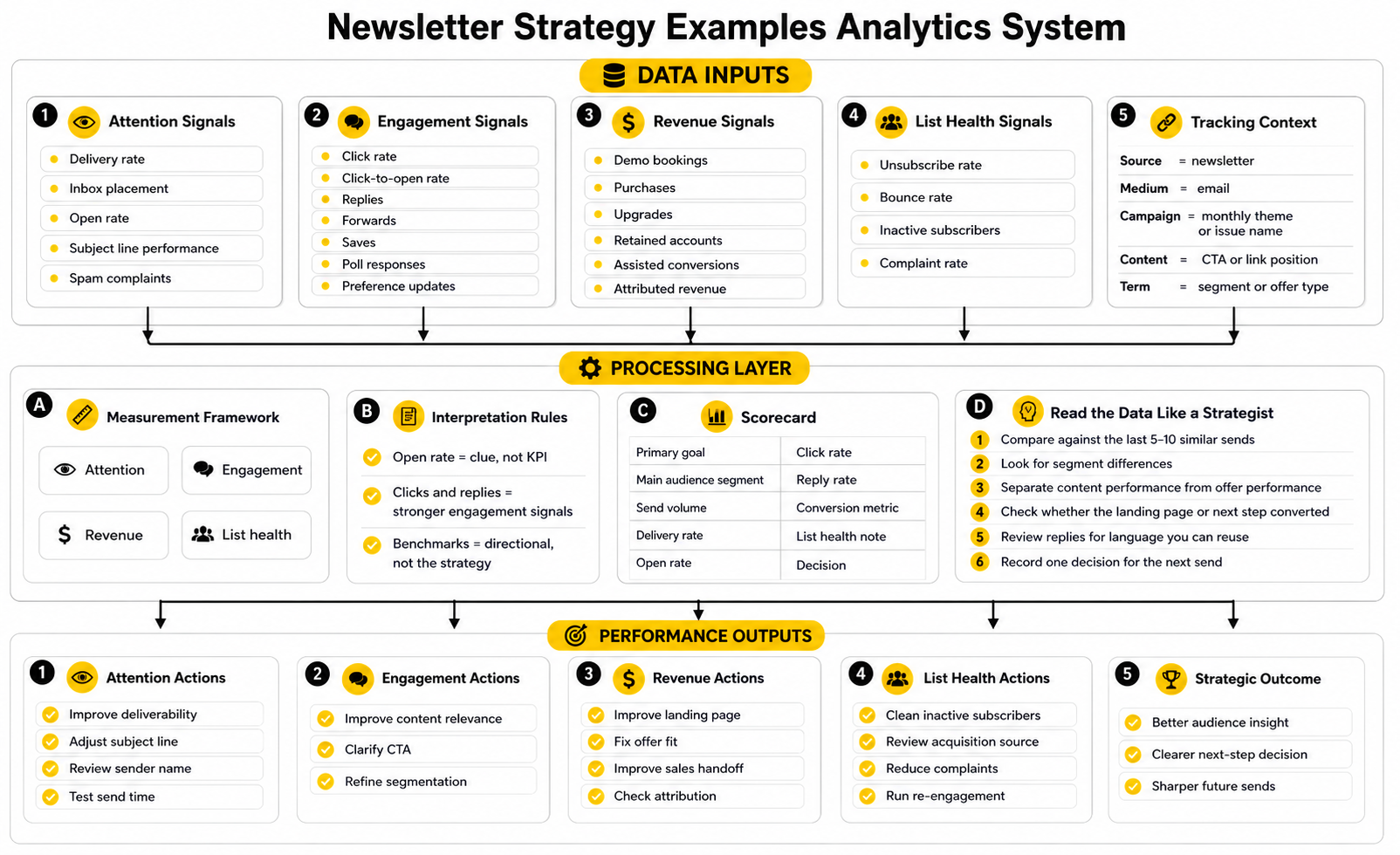
Before closing, it is worth making the system practical. If you are building from scratch, start with one newsletter promise, one core audience, one repeatable format, one clear CTA path, and one simple scorecard. Once that works, add segmentation, automation, monetization, and deeper reporting.
If you already have a newsletter, audit it against the same system. Is the promise still clear? Does every issue have a job? Are the CTAs aligned with reader intent? Are you measuring business outcomes or only email activity? Are you protecting trust as the list grows?
That is the play. Not hacks. Not random templates. Not copying someone else’s cadence because it worked for them. Build the system around your reader, then let the data make it sharper.
What Are Newsletter Strategy Examples?
Newsletter strategy examples are real or practical models that show how a newsletter can support a specific business goal. They might include a curated media newsletter, a customer education newsletter, a founder-led letter, a product update digest, or a revenue-focused campaign newsletter. The useful part is not copying the exact format; it is understanding why that format works for that audience.
For example, a B2B SaaS newsletter may use educational issues to increase product adoption, while a creator newsletter may use personality and perspective to build loyalty. An ecommerce newsletter may focus more on product education, offers, replenishment timing, and customer stories. The strategy is the relationship between audience, promise, content, CTA, and measurement.
What Makes A Newsletter Strategy Good?
A good newsletter strategy has a clear reader promise, a repeatable format, and a measurable business purpose. The reader should know why they are subscribed, and the business should know what the newsletter is supposed to support. If neither side can explain the value, the strategy is too vague.
A strong strategy also protects trust. It does not treat every send as an excuse to sell. It gives readers enough useful value that the occasional CTA feels natural instead of forced.
How Often Should A Business Send A Newsletter?
The right frequency depends on the newsletter promise and the quality you can sustain. A daily briefing can work when readers expect daily updates and the content is genuinely useful. A weekly newsletter usually fits many businesses because it gives enough consistency without overwhelming the team or the audience.
Do not increase frequency just because more sends might create more short-term clicks. Yahoo’s sender guidance specifically warns senders to honor the frequency people signed up for and not turn a weekly or monthly list into a daily list without clear consent in its sender best practices. Frequency should match expectation, value, and list health.
What Metrics Matter Most For A Newsletter?
The most useful newsletter metrics are delivery rate, click rate, replies, conversions, unsubscribe rate, spam complaints, and performance by segment. Open rate can still be useful as a directional attention signal, but it should not be treated as the final proof of success. Privacy changes have made open tracking less reliable, so stronger engagement and business signals matter more.
The best metric depends on the newsletter’s job. A revenue newsletter should track purchases, bookings, pipeline, or attributed revenue. A customer newsletter should track adoption, education clicks, retention signals, and customer replies.
What Is A Good Newsletter Open Rate?
There is no universal “good” open rate because benchmarks vary by industry, list source, audience relationship, and tracking method. MailerLite’s 2025 benchmark report covers open rate, click rate, click-to-open rate, and unsubscribe rate across over 3.6 million campaigns from 181,000 approved accounts, which makes it useful for directional comparison rather than a rigid target in its benchmark report. Your own 90-day trend is usually more valuable than someone else’s average.
A high open rate does not automatically mean the newsletter worked. It may show subject line strength, sender trust, or privacy-inflated tracking. Always compare open rate with clicks, replies, conversions, and list health before making decisions.
How Do I Measure Newsletter Revenue?
Start by defining what revenue means for your newsletter. It could be direct purchases, demo bookings, paid subscriptions, affiliate commissions, sponsorships, upgrades, or assisted sales. Then use tagged links, CRM tracking, and campaign reporting to connect sends to outcomes.
A simple setup uses consistent UTM parameters on important links, conversion tracking on landing pages, and a CRM note for leads or customers influenced by the newsletter. For teams that need email activity connected to pipelines, appointments, and follow-up, GoHighLevel can help centralize more of that journey. The goal is not perfect attribution; the goal is a reliable enough view to make better decisions.
Should A Newsletter Be Educational Or Promotional?
It should usually be both, but not in the same proportion every time. Educational content builds trust, teaches the reader how to think, and creates demand. Promotional content captures demand when the reader is ready to act.
The mistake is turning every issue into a pitch. A better approach is to make the main value useful on its own, then add a CTA that fits the topic and reader stage. That way the newsletter can sell without feeling like it only exists to sell.
How Do I Grow A Newsletter Without Buying A List?
Grow a newsletter by improving the reason to subscribe and putting that reason in front of the right audience. Useful lead magnets, referral programs, creator partnerships, webinars, social content, SEO pages, communities, and product touchpoints can all work when they attract the right people. Buying lists usually creates weak engagement, spam complaints, and deliverability problems.
Google tells bulk senders to keep user-reported spam rates below 0.1% and avoid 0.3% or higher in its sender requirements. That is why permission-based growth matters. A smaller list that wants the newsletter will almost always beat a bigger list that never asked for it.
What Should Be In A Newsletter Welcome Sequence?
A welcome sequence should confirm the promise, set expectations, and help the subscriber get value quickly. It should explain what they will receive, how often they will receive it, and why it is worth paying attention. It can also guide them to a useful resource, ask a preference question, or introduce a relevant next step.
A practical welcome sequence might include three to five emails. The first delivers the promised resource or welcome message. The next emails can share the best content, teach one key framework, introduce proof, and invite the reader to take the next logical action.
How Do I Know If My Newsletter Needs Segmentation?
Your newsletter needs segmentation when different groups need different messages, offers, or timing. If all subscribers can receive the same issue and still find it relevant, keep the system simple. If leads, customers, beginners, advanced users, or different industries clearly need different content, segmentation becomes useful.
Do not segment just because the software allows it. Segment when it improves the reader experience or the business outcome. A segment only matters when it changes what you send, when you send it, or what CTA you use.
What Is The Biggest Newsletter Strategy Mistake?
The biggest mistake is sending without a clear job. When a newsletter has no defined purpose, it becomes a content dump, a company bulletin, or a random promotion channel. Readers can feel that lack of direction quickly.
The fix is to choose the job before choosing the topic. Decide whether the issue should build trust, educate customers, drive a click, start conversations, support a launch, or retain users. Then write, design, and measure around that purpose.
Can AI Help With Newsletter Strategy?
AI can help with research summaries, outline options, subject line variations, draft editing, repurposing, and performance analysis. It can speed up the production workflow and reduce the blank-page problem. HubSpot’s newsletter research found that 64% of surveyed newsletter professionals agreed newsletters will be AI-generated by 2030, which shows how quickly AI is becoming part of the production layer in its 2025 report.
But AI should not replace the point of view. Readers subscribe because they want useful judgment, taste, experience, and relevance. If AI makes the newsletter faster but more generic, it is not helping.
What Tools Do I Need To Run A Newsletter?
At minimum, you need an email platform, a clean signup process, basic segmentation, authentication, a content workflow, and a way to measure clicks and conversions. Many teams can start with a simple platform and only add more tools when the workflow demands it. The tool stack should follow the strategy, not the other way around.
For straightforward campaigns and segmentation, Brevo or Moosend may be enough. If the newsletter connects to funnels, forms, appointments, pipelines, and automated follow-up, GoHighLevel, ClickFunnels, or Systeme.io can make sense depending on the business model.
How Long Should A Newsletter Be?
A newsletter should be as long as it needs to be to deliver the promise, and no longer. A briefing might be short because the value is speed. A founder letter, analysis piece, or expert teardown may need more depth because the value is insight.
Length is not the real issue. Relevance is. A short newsletter can feel too long if it says nothing useful, and a long newsletter can feel easy to read if every section earns attention.
How Do I Make A Newsletter Feel Less Corporate?
Write like one clear person is helping one specific reader. Use direct language, real observations, sharp examples, and practical next steps. Remove internal language, committee-approved fluff, and vague claims that nobody would say out loud.
A newsletter does not need to be casual to feel human. It needs to be specific. When the reader feels like the writer understands their problem, the email immediately becomes more believable.
Build a stronger local presence with BAAM AI
Turn your website, Google profile, social channels, and AI visibility into one growth engine
Most businesses do not need more random marketing activity. They need a consistent presence system that helps the right people find them, trust them, and take action. BAAM AI brings strategy, local SEO, website updates, Google Maps visibility, social content, AI-search readiness, media production, and reporting into one practical monthly engine.
If you want your marketing to keep working after the campaign ends, start with a free BAAM AI presence audit. See how your business shows up today and where the fastest visibility wins are at BAAM AI.