
BAAM AI Blog
Social Media Strategy Proposal: A Practical Framework for Winning Approval and Turning Ideas Into Action
A strong social media strategy proposal does more than describe what you want to post. It shows why the strategy matters, how it connects to business goals, what will be executed, and how success will be measured...

A strong social media strategy proposal does more than describe what you want to post. It shows why the strategy matters, how it connects to business goals, what will be executed, and how success will be measured. That is the difference between a document that sounds creative and a proposal that gets approved.
Most weak proposals fail because they jump straight into tactics. They list platforms, content formats, posting schedules, and campaign ideas before explaining the real problem. A professional proposal starts with the business context, then builds a clear case for the strategy, the workflow, the resources, and the expected outcomes.
this guide will walk through a complete social media strategy proposal from the first strategic argument to the final implementation plan. The structure is designed for marketers, agencies, consultants, founders, and internal teams that need to present social media as a serious growth channel instead of a loose collection of posts.
this guide is split into six parts so each stage of the proposal can be developed clearly. The sections below are the real section names the article will continue using, and each one builds on the previous part. By the end, the proposal will feel like one complete business document rather than a random list of social media recommendations.
Why a Social Media Strategy Proposal Matters
A social media strategy proposal matters because social media is no longer a side activity that can be managed through guesswork. Brands use social channels for awareness, trust, customer education, community, lead generation, hiring, support, and retention. When the channel touches that many business outcomes, the strategy needs to be presented with the same seriousness as any other growth plan.
The proposal also protects the work from becoming reactive. Without a written strategy, teams often chase trends, copy competitors, overpost on the wrong platforms, or measure success by whatever metric looks good that week. A clear proposal creates alignment before execution starts, which makes every later decision easier.
The real value is not just approval. A good social media strategy proposal gives decision-makers confidence that the plan has structure, tradeoffs, and accountability. It shows what will be done, what will not be done, why the chosen approach makes sense, and how progress will be reviewed.
The Proposal Framework at a Glance
A useful proposal framework moves from business problem to practical execution. It should begin with context, define the opportunity, explain the strategy, break down the operating plan, and finish with measurement, budget, and next steps. This flow helps the reader understand the logic before they are asked to approve resources.
The framework should also separate strategy from tactics. Strategy explains the audience, positioning, platforms, content pillars, and success metrics. Tactics explain the actual posting schedule, campaigns, creative formats, tools, and responsibilities that bring the strategy to life.
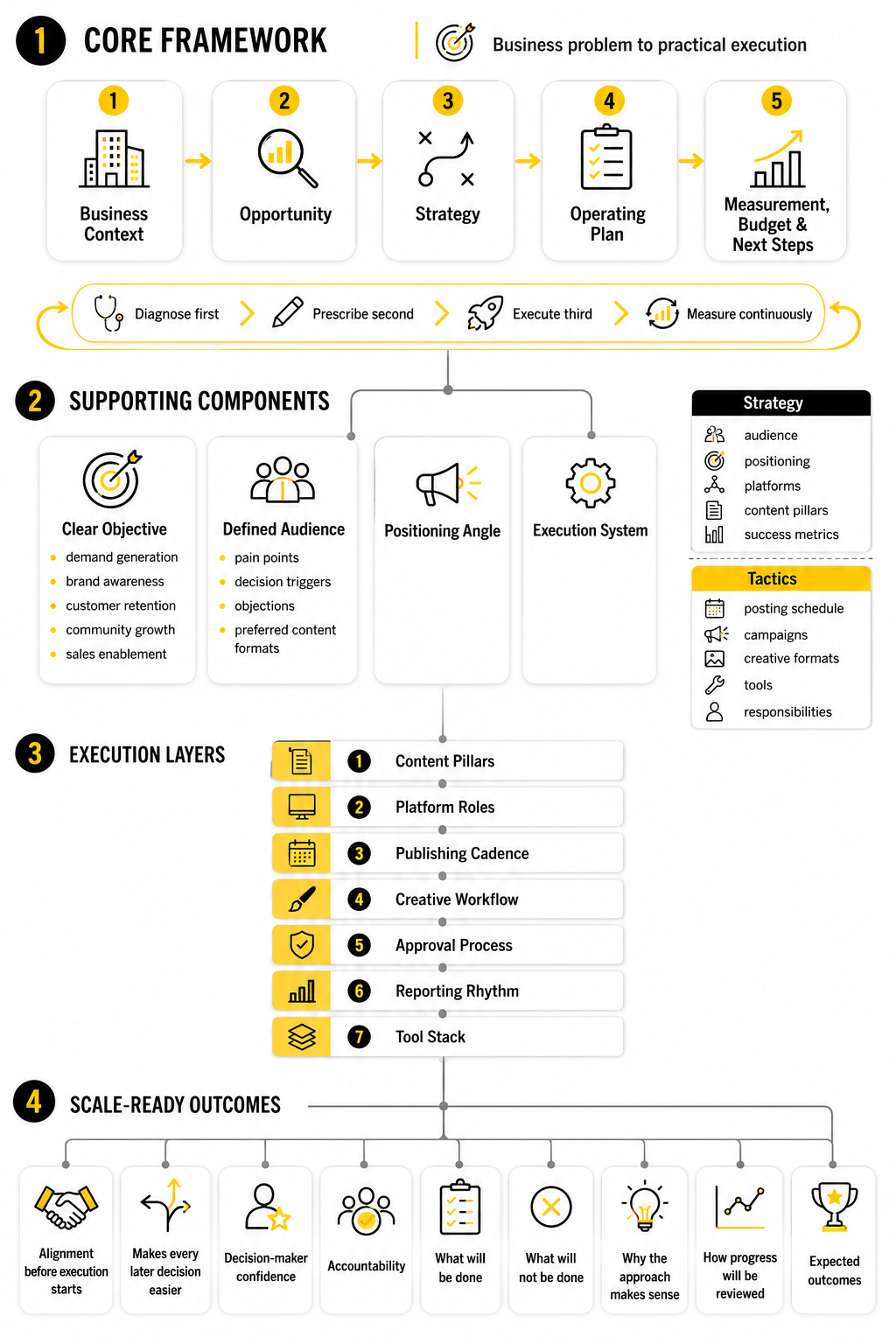
A simple way to think about the framework is this: diagnose first, prescribe second, execute third, measure continuously. That sequence keeps the proposal grounded in business reality. It also prevents the common mistake of making the document feel like a content calendar with a few goals added on top.
Core Components of a Strong Proposal
Every strong proposal needs a clear objective. The objective should connect social media activity to a business result, such as demand generation, brand awareness, customer retention, community growth, or sales enablement. If the objective is vague, the entire proposal becomes hard to judge.
The proposal also needs a defined audience and positioning angle. Social media works best when the brand knows who it is speaking to, what those people care about, and why the brand deserves attention. This is where the proposal should explain the customer’s pain points, decision triggers, objections, and preferred content formats.
Finally, the proposal needs an execution system. That includes content pillars, platform roles, publishing cadence, creative workflow, approval process, reporting rhythm, and tool stack. For example, a team that needs simple scheduling and collaboration may use a platform like Buffer, while a brand using conversations and automation heavily may consider ManyChat where messaging fits the strategy. The tool should support the strategy, not become the strategy itself.
Turning the Proposal Into a Business Case
The next job of a social media strategy proposal is to make the business case impossible to misunderstand. This is where you move beyond “we should post more” and explain what the company is trying to improve. The proposal should connect social activity to a real commercial problem, such as weak brand awareness, inconsistent lead flow, low retention, poor content distribution, or a lack of trust before sales conversations.
This matters because social media can look deceptively simple from the outside. Everyone sees the posts, but not everyone sees the research, creative planning, positioning, production, testing, reporting, and community management behind them. Your proposal needs to make that hidden work visible without overwhelming the reader.
The strongest business case usually starts with a simple contrast. Show where the brand is now, show what is limiting growth, and show what a better social media system could build. That gives the proposal tension, and tension is useful because decision-makers need to understand why doing nothing is also a decision.
Define the Current Situation Clearly
A proposal becomes more persuasive when it names the current situation with precision. Maybe the brand has an audience but no clear content pillars. Maybe it has good creative but weak conversion paths. Maybe it has strong product knowledge internally, but that knowledge never becomes useful public content.
This section should be honest, not dramatic. You are not trying to embarrass the company or make the current team look bad. You are trying to show the gap between the brand’s potential and the way social media is currently being used.
The best way to write this is with plain language. Explain what is happening, why it matters, and what it is costing the brand in missed attention, weaker trust, slower sales cycles, or lower content efficiency. Keep it calm and practical, because confidence beats hype.
Separate Business Goals From Social Goals
A social media strategy proposal should not treat every metric as equally important. Business goals and social goals are connected, but they are not the same thing. Business goals might include revenue growth, pipeline creation, retention, recruitment, or category leadership, while social goals might include reach, engagement, saves, shares, profile visits, follower quality, or message volume.
The proposal should show how the social goals support the business goals. For example, if the business goal is lead generation, the social goal may be to increase qualified content-driven conversations, not simply to grow followers. If the business goal is trust, the social goal may be to publish more proof-led content, founder perspectives, customer education, and objection-handling posts.
This distinction matters because it prevents the proposal from becoming metric soup. A post can get engagement and still do nothing useful for the business. A smaller campaign can generate fewer likes and still create better sales conversations if it reaches the right people with the right message.
Building the Strategic Logic
Once the business case is clear, the proposal needs a strategic logic that readers can follow. This is the bridge between the problem and the execution plan. It explains why the recommended approach is the right one, not just one of many possible content ideas.
A practical strategic logic usually has four layers: audience, message, platform, and conversion path. The audience defines who the brand must reach. The message defines what the brand needs to be known for. The platform choice defines where the brand should focus. The conversion path defines what should happen after attention is earned.
This is where many proposals become too soft. They say things like “build community” or “increase engagement” without showing the mechanism behind the result. Your proposal should be more specific: what kind of audience, what kind of content, what kind of trust, what kind of action, and what kind of follow-up.
Clarify the Audience Before Choosing Platforms
Platform decisions should come after audience decisions. A brand should not choose TikTok, LinkedIn, Instagram, YouTube, Facebook, or X just because the platform is popular. It should choose platforms because the right audience is active there, the content format fits the brand’s strengths, and the channel can realistically support the business goal.
A social media strategy proposal should describe the audience in useful terms. Go beyond age, job title, or location. Include what they are trying to solve, what they already believe, what they are skeptical about, what content they trust, and what would make them take the next step.
This gives the platform strategy a stronger foundation. If the audience needs education before buying, long-form video, carousels, newsletters, and founder-led posts may matter more than fast trend content. If the audience needs fast product discovery, short-form video, creator collaborations, and social proof may carry more weight.
Define the Brand’s Point of View
A strong proposal should explain what the brand will consistently stand for in the feed. This is not a slogan. It is the point of view that makes the content recognizable, useful, and worth following.
The point of view should connect the brand’s expertise with the audience’s real problem. A software company might stand for operational simplicity. A consultant might stand for clearer decision-making. An ecommerce brand might stand for better product education and fewer bad purchases.
Without this point of view, content becomes generic. The brand posts tips, trends, product updates, memes, and announcements, but none of it compounds. With a clear point of view, even different content formats start to feel connected because they are all supporting the same strategic position.
Making the Proposal Operational
A proposal becomes more credible when it shows how the work will actually happen. Decision-makers do not only approve ideas; they approve systems. They want to know who will do the work, how often it will happen, how quality will be controlled, and how results will be reviewed.
This section should translate strategy into an operating model. That does not mean dumping a giant task list into the document. It means showing the repeatable rhythm behind the work: research, planning, production, approval, publishing, engagement, reporting, and optimization.
A clean operating model also makes the proposal feel safer. It reduces the fear that social media will become chaotic, expensive, or dependent on one overworked person. When the process is clear, the strategy feels more realistic.
Map the Workflow
The workflow should explain how content moves from idea to publication. Start with research and insight gathering, then move into planning, creative development, review, scheduling, community management, and reporting. This gives the reader a practical view of what the monthly or weekly rhythm will look like.
Keep the workflow simple enough to understand but detailed enough to trust. For many teams, a basic workflow could include a monthly strategy review, weekly content planning, batch production, scheduled publishing, daily engagement checks, and a reporting review at the end of each cycle. That is enough structure for most proposals without making the plan feel heavy.
Tools can support this workflow when they match the team’s actual needs. A simple publishing and collaboration setup can be handled through Buffer, while teams that need broader CRM, pipeline, and campaign automation may look at GoHighLevel. The important point is simple: choose tools because they remove friction, not because they look impressive in a proposal.
Set Decision Rules
A professional proposal should include decision rules so the team knows how choices will be made after approval. These rules help prevent subjective debates about every post, caption, format, or trend. They also make the strategy easier to defend when opinions start flying around.
Decision rules can be simple. Prioritize content that supports the main business objective. Give more weight to formats that match the audience’s buying journey. Avoid trends that weaken the brand’s credibility. Review performance by content role, not by vanity metrics alone.
This is especially useful when multiple stakeholders are involved. Social media often attracts opinions from every corner of a company because everyone uses it personally. Decision rules bring the conversation back to strategy instead of personal taste.
Audience, Positioning, and Platform Strategy
Once the proposal has made the business case, the next section should sharpen the strategy around audience, positioning, and platform choice. This is where the social media strategy proposal starts to feel tangible. The reader should be able to see who the brand is trying to reach, what the brand will become known for, and where the strategy will focus first.
Do not treat this as a generic marketing exercise. A useful audience and platform section should make clear choices. The goal is not to be everywhere, speak to everyone, or publish every format possible; the goal is to build a focused system that can earn attention from the right people repeatedly.
This is also where the proposal should reduce risk. When you define the audience clearly, positioning becomes easier. When positioning becomes easier, platform decisions become more logical. When platform decisions are logical, the execution plan is much easier to approve.
Build the Audience Profile Around Buying Context
A strong audience profile explains more than who the buyer is. It explains the situation they are in before they care about the brand. That includes their pain, urgency, objections, information gaps, decision process, and the kind of proof they need before taking action.
This is especially important in a social media strategy proposal because social content often reaches people before they are actively ready to buy. They may be problem-aware but not solution-aware. They may know the category but not trust the brand yet. Your proposal should show how social media will move people from passive awareness to active consideration.
The audience profile should also separate primary and secondary audiences. The primary audience is the person the strategy must influence most directly. The secondary audience may include partners, employees, creators, investors, recruiters, or existing customers who help amplify trust. This keeps the strategy focused while acknowledging that social media rarely influences only one group.
Turn Positioning Into Content Direction
Positioning becomes useful when it can guide content decisions. It should answer one simple question: what should the audience consistently understand about this brand after seeing its content for three months? If that answer is unclear, the proposal is not ready yet.
The content direction should translate the brand’s point of view into repeatable themes. For example, a brand might focus on practical education, behind-the-scenes expertise, customer proof, founder perspective, industry commentary, or product-led problem solving. Each theme should have a role, not just a name.
This makes the social media strategy proposal stronger because it shows how consistency will be created. The brand is not relying on random inspiration. It has a clear editorial lane, and every post should either build trust, create demand, answer objections, show proof, or move people toward a meaningful next step.
Choosing Platforms With Intent
Platform strategy should never start with the question, “Where should we post?” It should start with, “Where can this brand earn attention from the right people in a format it can sustain?” That difference matters because a platform is not just a distribution channel; it shapes the type of content, conversation, and trust the brand can build.
The proposal should explain the role of each selected platform. LinkedIn may be used for authority, founder-led thinking, recruiting, and B2B demand creation. Instagram may be used for visual identity, short-form education, community signals, and product discovery. TikTok may be used for reach, creator-style storytelling, and trend-adjacent education. YouTube may be used for long-term search, trust, and deeper explanation.
Avoid recommending too many platforms in the first version of the plan. A focused strategy usually wins because execution quality compounds. It is better to do two platforms well than six platforms badly, especially when the team is still building its workflow, content standards, and measurement rhythm.
Define the Role of Each Channel
Each channel in the proposal should have a job. One channel may be the main awareness engine. Another may be the trust-building channel. Another may support retargeting, community, or customer education. When channels have clear roles, reporting becomes more useful because you are not judging every platform by the same metric.
This also helps the team avoid lazy republishing. Repurposing is smart, but copying the same asset everywhere without context usually weakens performance. The same idea can travel across platforms, but the format, hook, length, caption, and call to action should fit the platform’s behavior.
A practical proposal might describe each channel using a simple structure: audience fit, content role, primary formats, publishing rhythm, engagement approach, and success indicators. That gives the reader enough detail to trust the recommendation without turning the proposal into a bloated platform manual.
Prioritize Sustainable Execution
Sustainability is underrated. A proposal can look exciting on paper and collapse in three weeks because the team cannot keep up with filming, editing, writing, approvals, reporting, and community management. A serious social media strategy proposal should be honest about capacity.
This does not mean thinking small. It means designing a system the team can actually run. A lean team may start with fewer content pillars, batch production, simpler creative templates, and a tighter approval process. A larger team may support more platform-specific assets, creator partnerships, paid amplification, and deeper reporting.
This is where workflow tools can genuinely help. Scheduling and collaboration tools like Buffer can reduce publishing friction, while content research or creative support tools like Flick Social may help teams move from ideas to platform-ready content faster. The point is not to stack software; the point is to protect consistency.
Creating the Implementation Process
After audience, positioning, and platform strategy are clear, the proposal should show the execution process step by step. This is the part where strategy stops being theoretical. The reader should understand how ideas become assets, how assets become posts, how posts become conversations, and how conversations become measurable business progress.
A good implementation process creates confidence because it shows control. It makes the work feel repeatable instead of chaotic. It also gives the team a shared operating language, which matters when multiple people are involved in planning, creative production, approvals, and reporting.
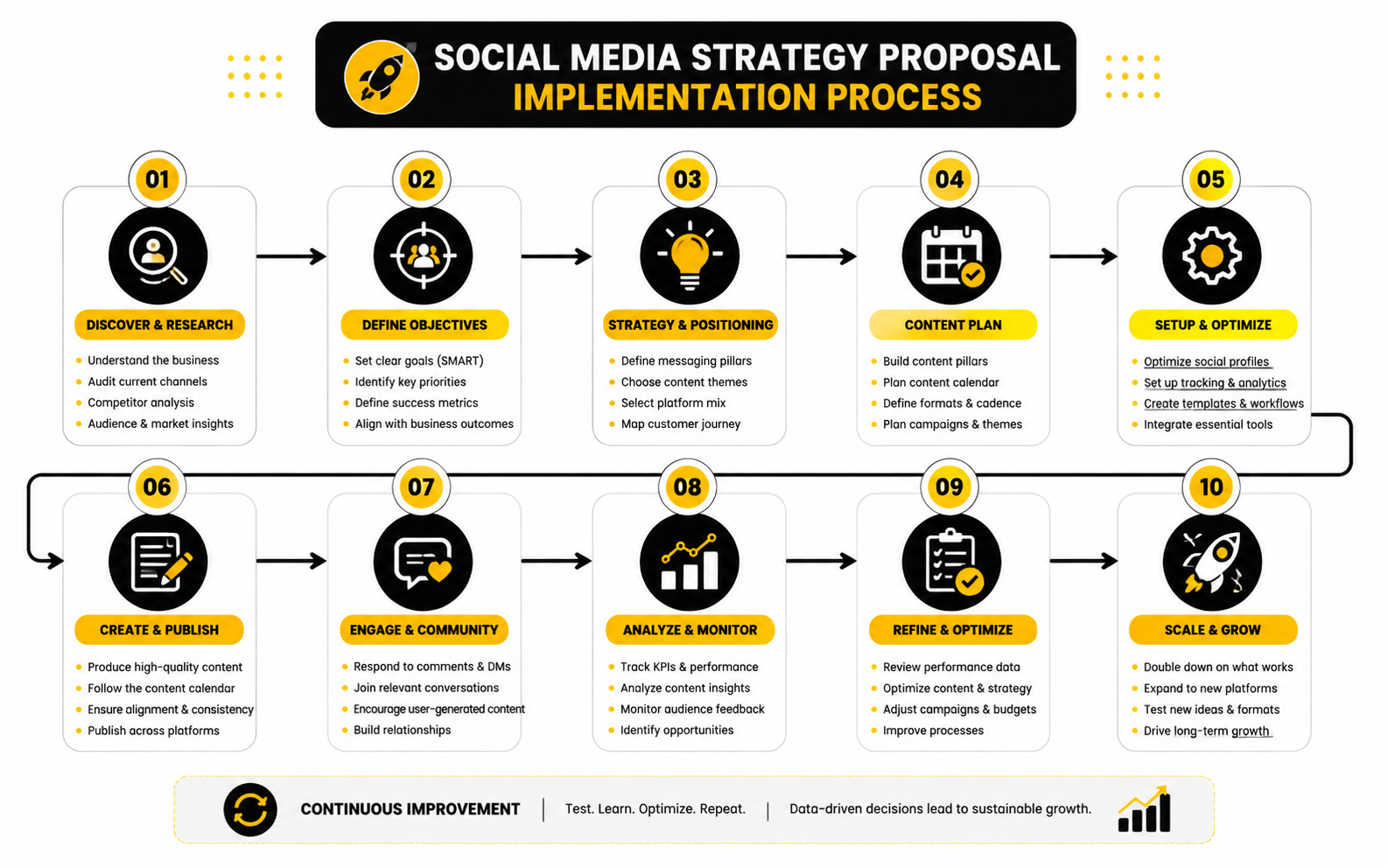
The implementation process should be simple enough to remember and detailed enough to manage. A practical sequence could look like this:
This process gives the proposal a real operating backbone. It also helps decision-makers see that social media is not just publishing. The value comes from the full loop: insight, creation, distribution, conversation, learning, and improvement.
Start With Research Inputs
The implementation process should begin with research, not brainstorming. Useful inputs can include customer questions, sales call notes, support tickets, competitor content, search behavior, platform trends, creator activity, product updates, and campaign priorities. These inputs keep the content tied to real demand.
This is where the proposal can show practical discipline. Instead of promising endless fresh ideas, it explains where ideas will come from and how they will be filtered. That makes the strategy more reliable because the team is not depending on random creativity every week.
Research inputs also help the brand avoid content that sounds internally impressive but externally irrelevant. The audience does not care what the team wants to announce unless it connects to their own problems, ambitions, or decisions. Good research keeps the proposal honest.
Build a Monthly Planning Rhythm
A monthly planning rhythm gives the strategy enough structure without making it rigid. The team can define the main theme for the month, decide which campaigns or launches need support, choose the content pillars to emphasize, and map out the major assets before production begins. This makes the weekly work faster because the strategic decisions are already made.
The proposal should describe how planning meetings will work. Keep them focused on priorities, not endless idea dumping. A useful monthly planning session should confirm the business focus, review recent performance, identify audience insights, choose content angles, and assign ownership.
This rhythm also makes optimization easier. If every month has a clear plan, performance can be reviewed against intent. The team can ask sharper questions: did this pillar build trust, did this format create saves or shares, did this campaign generate qualified conversations, and did this platform deserve more or less effort next month?
Create a Clear Approval System
Approval is where many social media systems slow down. The proposal should define who reviews content, what they are reviewing for, how feedback is given, and when approval must happen. Without this, content gets trapped in vague comments, late edits, and personal preferences.
A strong approval system separates strategic review from cosmetic feedback. Strategic review checks accuracy, brand fit, compliance, offer clarity, and audience relevance. Cosmetic feedback should be limited to issues that genuinely affect quality, clarity, or consistency.
This part is especially important for teams in regulated, technical, or founder-led industries. Social content often needs speed, but speed should not mean carelessness. The proposal should make clear that quality control exists, but it should also protect the team from approval bottlenecks that kill momentum.
Statistics and Data
Measurement is where a social media strategy proposal becomes accountable. This section should not be a pile of impressive numbers thrown into the document to make it look researched. The real job is to show which numbers matter, what they mean, and what action the team should take when those numbers move.
Start with context. Social media is massive, but size alone does not prove strategy. The latest global data shows that social media user identities reached 5.79 billion in April 2026, which means the opportunity is broad, but the competition for attention is brutal. That is why the proposal should focus less on “being active” and more on building a measurement system that separates useful signals from noise.
Benchmarks can help, but only when they are used properly. Industry benchmark data from Rival IQ showed that engagement rates fell across major platforms in 2025, including declines of 36% on Facebook, 16% on Instagram, 34% on TikTok, and 48% on X. That does not mean social media is failing. It means average engagement is getting harder to earn, so a proposal needs sharper content strategy, stronger creative judgment, and better performance interpretation.
Use Benchmarks as Context, Not Targets
Benchmarks are useful for orientation. They help the team understand whether performance is unusually weak, healthy, or exceptional compared with similar brands. But benchmarks should not become the entire goal, because every brand has a different audience, offer, budget, content quality, creative history, and platform mix.
A social media strategy proposal should explain that benchmarks are a starting point, not a ceiling. If a brand is early in its content maturity, the first target may be consistency, message clarity, and audience learning. If the brand already has a mature presence, the target may shift toward higher-quality engagement, stronger conversion paths, or better content efficiency.
The proposal should also make clear that platform averages can hide important differences. A strong LinkedIn post for a niche B2B company may not look impressive next to a viral entertainment post, but it can still create valuable sales conversations. That is the key: judge performance against the content’s job, not against generic internet applause.
Separate Leading and Lagging Indicators
A useful analytics section should separate leading indicators from lagging indicators. Leading indicators show whether the strategy is gaining traction early. Lagging indicators show whether that traction is turning into business outcomes later.
Leading indicators can include reach from the right audience, saves, shares, comments with buying intent, profile visits, direct messages, content completion, click-through rate, follower quality, and repeat engagement from target accounts. These signals do not always prove revenue, but they show whether the strategy is earning attention and trust.
Lagging indicators include qualified leads, booked calls, attributed pipeline, assisted conversions, customer acquisition cost, retention impact, referral traffic quality, and revenue influenced by social. These matter because social media should eventually connect to business performance. The proposal should not pretend every post will convert directly, but it should show how social activity will be traced through the buyer journey.
Build a Simple Analytics System
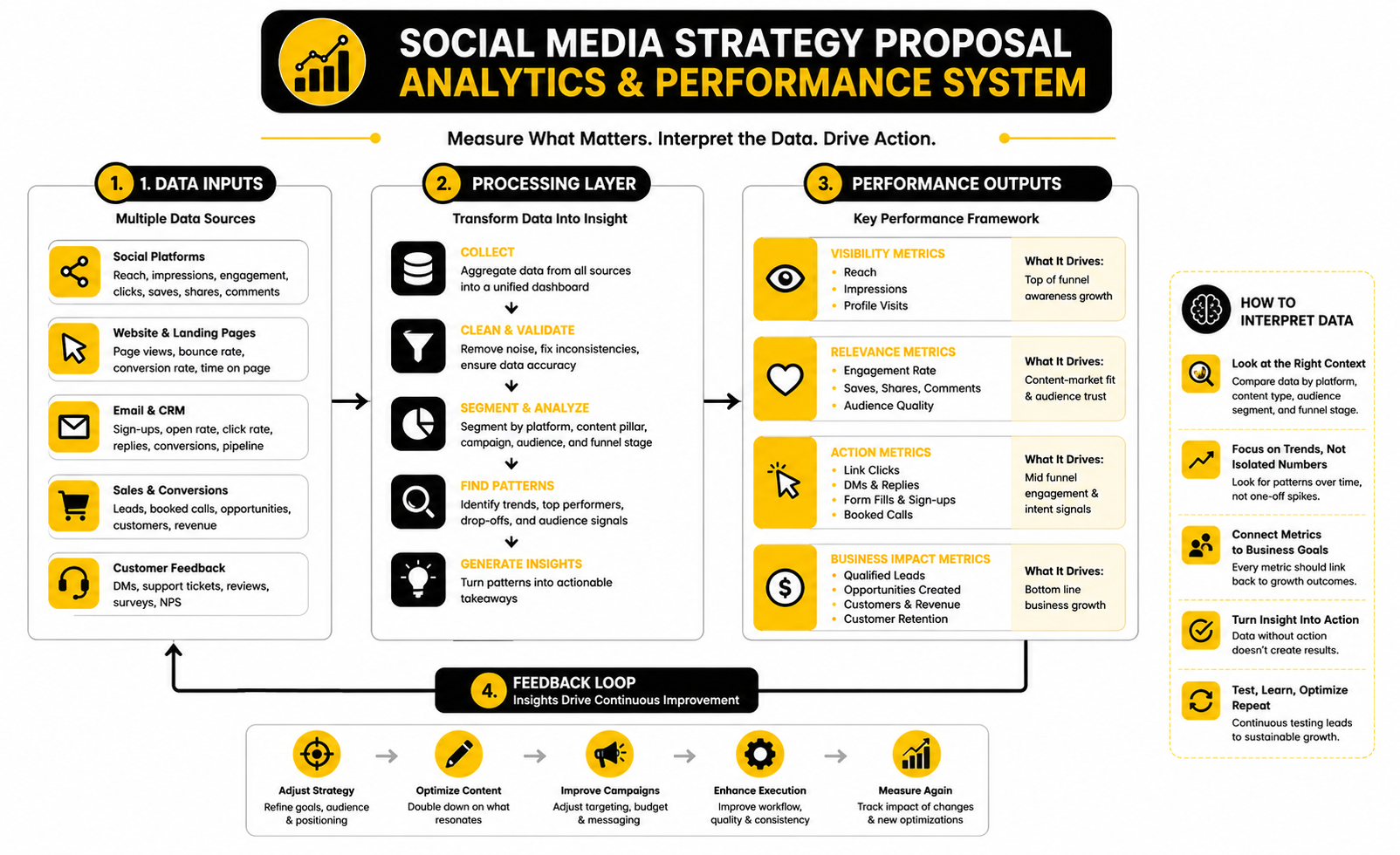
The analytics system should be easy enough to run every month. If measurement is too complicated, the team will stop using it. If it is too shallow, the data will not guide decisions. The proposal should sit in the middle: clear, practical, and connected to action.
A simple analytics system can group metrics into four layers:
This structure works because it prevents the team from obsessing over one number. Reach without relevance can mean the content is broad but weak. Engagement without action can mean the audience likes the content but does not see the next step. Conversions without brand lift can mean the funnel is working today but the market is not being warmed for tomorrow.
What the Numbers Actually Mean
A good proposal does not just report numbers; it interprets them. If reach is rising but engagement is falling, the content may be getting broader distribution without enough audience fit. If engagement is strong but clicks are weak, the content may be valuable but the offer or call to action may not be clear enough.
If saves and shares are growing, the audience may see the content as useful or identity-relevant. That usually means the topic deserves more depth, more variations, or a campaign built around it. If comments are increasing but they are low quality, the content may be attracting attention without attracting the right people.
This is where many teams get measurement wrong. They treat every increase as good and every decrease as bad. A professional social media strategy proposal should be more mature than that. Sometimes a smaller audience with higher intent is better than a larger audience that never buys, subscribes, applies, or books a call.
Interpret Reach Carefully
Reach is one of the easiest metrics to misunderstand. High reach means content was distributed widely, but it does not automatically mean the brand reached the right people. The proposal should explain how reach will be evaluated alongside audience quality and downstream behavior.
For awareness campaigns, reach may be a primary success signal. For demand generation, reach matters only when the right audience takes the right next step. For community or retention, reach may be less important than depth of response from existing customers or high-value followers.
This is why platform-level reporting should be paired with business context. A post that reaches 100,000 people but produces no relevant action may be less valuable than a post that reaches 5,000 highly relevant people and produces qualified conversations. The proposal should make that logic clear before reporting starts.
Read Engagement by Intent
Engagement is not one thing. A like, save, share, comment, click, and direct message all mean different things. Treating them equally creates lazy reporting and weak decisions.
A like may show quick approval. A save may show practical value. A share may show social relevance. A thoughtful comment may show trust or disagreement worth exploring. A direct message may show buying intent, support need, partnership interest, or community momentum.
The proposal should define which engagement signals matter most for each content pillar. Educational content may be judged by saves and shares. Opinion content may be judged by comments and quality of discussion. Product-led content may be judged by clicks, replies, and assisted conversions. That is how measurement becomes useful instead of decorative.
Connect Content Performance to Decisions
The point of analytics is action. Every reporting cycle should answer what to keep, what to improve, what to stop, and what to test next. If the data does not lead to decisions, the report is just a dashboard screenshot.
A strong social media strategy proposal should explain how performance reviews will guide the next cycle. Winning topics can become deeper posts, short videos, carousels, webinars, email sequences, or landing pages. Weak topics can be rewritten, repositioned, or removed from the content plan. Strong comments and questions can become future content because the audience is literally telling the brand what it cares about.
This is also where tools can support the process. Publishing and reporting tools like Buffer can help teams track channel performance consistently, while broader customer systems like GoHighLevel can help connect campaign activity with leads, conversations, and pipeline. The tool choice should make measurement easier, not bury the team in dashboards.
Reporting Rhythm and Review Process
Reporting should have a rhythm. Weekly reviews can focus on quick signals like publishing consistency, comments, replies, and early content performance. Monthly reviews should focus on patterns across platforms, pillars, formats, and campaigns. Quarterly reviews should connect social media performance to bigger business goals.
This rhythm keeps the team from overreacting to one post. Social media data can be noisy, especially when algorithms change, creative tests vary, or one topic suddenly gets unusual distribution. A proposal should make clear that individual posts matter, but patterns matter more.
The monthly report should be short enough to read and strong enough to guide decisions. It should include the main objective, top-performing content, weakest content, audience insights, platform-level trends, conversion signals, lessons learned, and recommendations for the next cycle. That is far more useful than a long report full of numbers nobody acts on.
Define Success Before Launch
Success should be defined before the strategy launches. If the team waits until after the campaign to decide what mattered, the reporting will become political. People will cherry-pick the metrics that make their preferred idea look good.
The proposal should define success by objective. If the goal is awareness, success may include qualified reach, follower growth from the right segment, share rate, and branded search lift where available. If the goal is lead generation, success may include landing page visits, form fills, direct inquiries, booked calls, and lead quality. If the goal is trust, success may include saves, comments from target buyers, sales team feedback, and stronger performance from proof-led assets.
This does not mean the team cannot learn and adjust. It means the strategy starts with clear expectations. Clear expectations make the proposal easier to approve and the work easier to manage.
Avoid Vanity Metric Traps
Vanity metrics are not useless, but they become dangerous when they are treated as proof of business value. Followers, likes, and impressions can matter, but only when they connect to the strategy. A follower count that grows with the wrong audience can weaken performance over time because the content is being shown to people who do not care.
A social media strategy proposal should be direct about this. The goal is not to look popular for a week. The goal is to build a repeatable system that earns attention, creates trust, and moves the right people closer to action.
That is why the proposal should include both performance metrics and quality checks. The team should look at who is engaging, what they are saying, what questions they ask, whether they match the target audience, and whether social activity is creating useful business conversations. Numbers tell part of the story; interpretation turns that story into strategy.
Advanced Strategy Decisions
At this stage, the social media strategy proposal should move from basic planning into sharper strategic choices. This is where the document earns trust from experienced decision-makers. They do not only want to know what the brand will do; they want to know what tradeoffs the team is making and why those tradeoffs are worth it.
Good strategy always includes sacrifice. If the proposal says the brand will post on every platform, speak to every audience, chase every trend, and optimize for every metric, it is not a strategy. It is a wishlist. A stronger proposal explains where the brand will focus, what it will ignore, and how those choices support the business goal.
This section should feel practical, not theoretical. The reader should come away thinking, “This team has thought through the hard parts.” That matters because approval usually depends less on whether the idea sounds exciting and more on whether the plan feels controlled, realistic, and worth the investment.
Organic Reach Versus Paid Amplification
One of the biggest decisions in a social media strategy proposal is how much the strategy will rely on organic reach versus paid amplification. Organic content is valuable because it builds trust, audience memory, and proof over time. Paid amplification is valuable because it gives the brand more control over distribution, especially when organic reach is inconsistent.
The proposal should not frame this as a battle between organic and paid. The stronger approach is usually a system where organic content reveals what resonates, and paid distribution pushes the best-performing assets to a more specific audience. This protects budget because the brand is not guessing blindly; it is using real audience response to decide what deserves more reach.
Be clear about the role of each. Organic is often best for testing ideas, building authority, creating community, and showing the brand’s human side. Paid is often best for scaling proven messages, supporting launches, retargeting warm audiences, and making sure important campaigns do not depend entirely on algorithmic luck.
Brand Building Versus Direct Response
Another important tradeoff is brand building versus direct response. Brand-building content makes the company more familiar, trusted, and memorable. Direct-response content pushes the audience toward a specific action, such as booking a call, joining a list, downloading a resource, starting a trial, or buying a product.
A weak proposal overuses one side. If everything is brand content, the audience may like the company but never take action. If everything is direct response, the feed starts to feel desperate, repetitive, and easy to ignore.
The proposal should define a healthy balance. For many brands, the content mix should include education, proof, perspective, personality, product relevance, and clear conversion moments. When direct-response campaigns need dedicated landing pages or funnels, tools like ClickFunnels or Systeme.io can fit naturally if the team needs a focused path from attention to action.
Managing Strategic Risks
A serious proposal should name the risks instead of pretending they do not exist. Social media has real upside, but it also comes with creative, operational, reputational, and measurement risks. Naming those risks makes the proposal stronger because it shows maturity.
The goal is not to scare the reader. The goal is to show that the team has a plan for avoiding predictable problems. That is exactly what professional implementation looks like: not perfection, but preparation.
Risk management also helps protect the team after approval. If stakeholders already understand the risks, they are less likely to panic when one post underperforms, one platform changes behavior, or one campaign needs adjustment. The proposal becomes the reference point for calm decision-making.
Avoid Content Dilution
Content dilution happens when the brand produces more than it can make well. The team starts publishing because the calendar says something must go live, not because the content has a clear purpose. Over time, the feed becomes busy but forgettable.
The proposal should define quality standards before volume targets. It should explain what every post needs to do: teach something useful, sharpen the brand’s point of view, support a campaign, answer an objection, show proof, create conversation, or move the audience toward a next step. If a post does none of those things, it should not be published just to fill space.
This is where discipline matters. More content is not always more strategy. Sometimes the best decision is to publish less, improve the thinking, and make each asset easier to repurpose across formats without losing the core idea.
Protect Authenticity in an AI-Heavy Feed
AI can help with research, ideation, drafting, repurposing, and workflow speed. But it can also flatten the brand’s voice if the team uses it carelessly. Research on generative AI in social media environments has found that AI assistance can increase content volume while reducing perceived discussion quality and authenticity, which is exactly the kind of tradeoff a proposal should address directly.
The proposal should define where AI is allowed and where human judgment must stay in control. AI can support first drafts, topic clustering, caption variations, content repurposing, and reporting summaries. Human judgment should control positioning, final voice, sensitive topics, customer insight, creative taste, and strategic decisions.
This is not anti-AI. It is pro-trust. A brand can use AI and still sound human if the process includes real expertise, original opinions, customer language, behind-the-scenes context, and a clear editorial standard.
Prepare for Platform Dependency
Platform dependency is one of the most underestimated risks in social media strategy. A brand can build a large audience and still have limited control if it depends entirely on rented platforms. Algorithm changes, account restrictions, shifting formats, and changing user behavior can all affect performance.
A smart social media strategy proposal should include a plan for owned audience capture. That can mean email, SMS where appropriate, community, CRM, webinars, events, or customer lists. Social media should create attention, but the business should not leave all of that attention trapped inside a platform it does not control.
This is where the conversion path becomes important. If the strategy includes lead magnets, newsletters, workshops, or booked calls, the proposal should explain how social traffic will move into owned systems. Tools like Brevo or Moosend can support that step when email follow-up is part of the operating model.
Scaling the Strategy Without Breaking It
Scaling social media is not just doing more. It means increasing output, reach, quality, learning speed, or business impact without making the system messy. A proposal should explain what scaling will look like only after the foundation is working.
The first stage is usually consistency. The team proves that it can publish good content on schedule, review performance, and learn from audience response. The next stage is expansion, where the brand tests new formats, adds campaign layers, introduces creators, or increases paid amplification. The final stage is optimization, where the system becomes more efficient and predictable.
This staged approach is important because premature scaling creates waste. If the message is unclear, more distribution only spreads confusion faster. If the workflow is weak, more platforms only create more pressure. If measurement is shallow, more content only creates more data without better decisions.
Scale Content Pillars Before Platforms
A common mistake is expanding to new platforms before the core content strategy is strong. It feels productive, but it often multiplies the same weak message across more places. A better move is to scale the strongest content pillars first.
Scaling a pillar means finding more angles inside a proven theme. One strong idea can become a short-form video, carousel, founder post, email, sales enablement asset, webinar topic, landing page section, and customer education piece. That is leverage.
The proposal should make this process clear. The brand is not creating more work for the sake of output. It is building a content engine where strong ideas are developed deeply, adapted intelligently, and connected to business goals.
Add Creators and Partners Carefully
Creators, partners, and collaborators can help a brand reach new audiences and add credibility. But they should not be added randomly. The proposal should define what makes a creator or partner a good fit before outreach begins.
Good fit can include audience overlap, trust level, content quality, brand safety, category relevance, engagement quality, and ability to explain the product or problem clearly. A creator with a smaller but highly relevant audience may be more valuable than a larger creator whose audience does not match the buyer. This is where judgment beats surface-level numbers.
The proposal should also define how creator content will be used. It may support awareness, education, social proof, launch momentum, or paid amplification. If the creator strategy has no role, it becomes expensive decoration.
Build a Feedback Loop With Sales and Support
Social media should not operate in a vacuum. Sales teams hear objections, buying triggers, competitor comparisons, and decision language every day. Support teams hear confusion, friction, product gaps, and customer wins. That information is gold for content strategy.
A stronger proposal includes a feedback loop between social, sales, customer success, and support. The social team can use those insights to create objection-handling posts, proof assets, onboarding content, comparison content, and clearer campaign messaging. In return, social media can send useful content back to sales and support so those teams are not always starting from scratch.
This makes social media more than a publishing function. It becomes part of the company’s learning system. That is when the strategy starts compounding.
Budget, Resources, and Capacity Planning
The budget section should not feel like an afterthought. It should explain what resources are needed and why each one supports the strategy. This is especially important when the proposal asks for creative production, paid media, tools, contractors, creators, or additional team capacity.
Break the budget into practical categories. Common categories include strategy, content production, design, video editing, copywriting, scheduling and reporting tools, community management, paid amplification, creator partnerships, and campaign landing pages. The reader should be able to see how the money turns into execution.
The proposal should also define what happens at different resource levels. A lean budget might prioritize organic content, simple reporting, and one or two core platforms. A growth budget might add paid amplification, creators, stronger production, and conversion assets. An aggressive budget might add platform expansion, content series, paid testing, and deeper analytics.
Show What Is Included and What Is Not
Scope clarity protects the relationship. Whether the proposal is for an internal team, a client, or an agency engagement, it should state what is included and what is not included. This prevents silent assumptions from turning into frustration later.
Included work might cover monthly strategy, content planning, copywriting, creative direction, scheduling, reporting, and performance review. Excluded work might include full video production, influencer management, paid ad buying, landing page development, customer support, or crisis communications unless those are specifically part of the engagement.
This is not being difficult. It is being professional. Clear scope gives everyone a cleaner working relationship because the proposal defines the boundaries before the pressure starts.
Plan for Bottlenecks Before They Happen
Every social media system has bottlenecks. It might be founder approvals, lack of video assets, slow design turnaround, unclear product messaging, missing customer proof, limited subject matter expert access, or no one responsible for community replies. The proposal should identify likely bottlenecks and explain how they will be handled.
For example, if founder input is critical, schedule a recurring capture session instead of asking for comments at the last minute. If video production is the bottleneck, batch recordings monthly. If approvals slow everything down, define a review window and a default publishing rule.
This is the kind of detail that makes a proposal feel experienced. It shows that the team understands the difference between a clean strategy document and the messy reality of execution. Strategy wins when it survives the real workflow.
Professional Implementation, Budget, and Final System
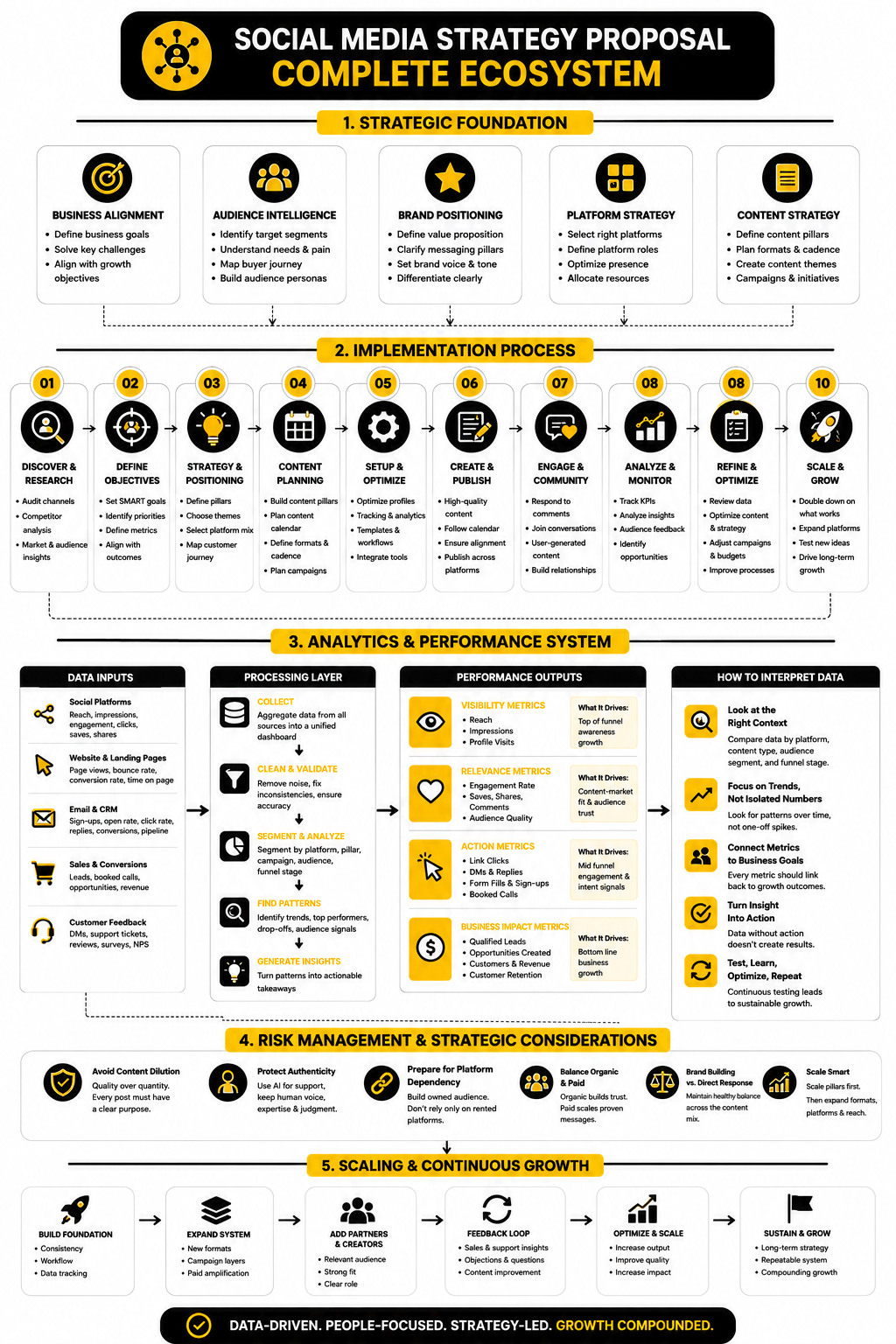
The final version of a social media strategy proposal should make the whole system easy to understand. By this point, the reader has seen the business case, audience logic, platform strategy, implementation process, measurement model, risks, and scaling plan. Now the proposal needs to pull those pieces together into one professional operating system.
This is where you make the strategy feel finished. Not “finished” as in rigid or unable to change, but finished as in clear enough to approve, assign, launch, and improve. The reader should understand what happens first, who owns the work, how quality is protected, how results are reviewed, and how the strategy will evolve.
The final system should also make one thing obvious: social media is not just content output. It is a loop of market insight, creative production, distribution, engagement, conversion, and learning. When that loop is designed properly, the brand is not guessing every week. It is building a repeatable growth asset.
Turn the Proposal Into a Launch Plan
A proposal should end with a launch plan that feels realistic. The first 30 days should focus on setup, research, message refinement, workflow, templates, and the first content cycle. This gives the team enough structure to move quickly without pretending that everything will be perfect on day one.
The next 60 days should focus on consistency and signal gathering. The team should publish, engage, track early patterns, compare content pillars, and identify which formats deserve more attention. This stage is less about declaring winners and more about learning what the audience responds to.
By 90 days, the proposal should expect clearer decisions. The team can decide which platforms deserve more investment, which content pillars are carrying the strategy, which conversion paths are working, and which workflow issues need to be fixed. A 90-day review is useful because it gives the strategy enough time to produce patterns without waiting so long that problems become expensive.
Make Ownership Clear
Ownership is one of the most important details in the final proposal. If nobody owns the strategy, the strategy will drift. If too many people own it, the work will slow down.
The proposal should define clear roles for strategy, content planning, copywriting, design, video, scheduling, community management, reporting, paid amplification, and approvals. One person or team can own multiple roles, especially in smaller companies, but the responsibility still needs to be named. Ambiguity kills momentum.
This does not need to become a complicated org chart. A simple ownership table inside the proposal can do the job. The point is to make sure every important part of the social media system has someone accountable for moving it forward.
Keep the Final Recommendation Direct
The final recommendation should be confident. After all the research and planning, the proposal should not end with vague language like “we could maybe try this.” It should state the recommended strategy, the reason behind it, the expected operating rhythm, and the next step required for approval.
That does not mean overpromising results. A professional proposal should be clear about what the team can control and what it cannot. The team can control strategy, quality, consistency, responsiveness, testing, and learning. It cannot fully control algorithms, audience mood, competitor behavior, or every conversion outcome.
Strong proposals are confident because they are honest. They do not need hype. They show a thoughtful system and ask for the resources needed to run it properly.
What is a social media strategy proposal?
A social media strategy proposal is a structured document that explains how a brand should use social media to support specific business goals. It usually covers the current situation, target audience, positioning, platform strategy, content direction, workflow, measurement, budget, and next steps. The goal is to make the strategy clear enough for decision-makers to approve and for the team to execute.
What should be included in a social media strategy proposal?
A strong proposal should include the business objective, audience profile, brand positioning, platform recommendations, content pillars, campaign approach, publishing workflow, approval process, reporting plan, budget, and implementation timeline. It should also explain why each recommendation matters. The best proposals do not just list tasks; they show the logic behind the plan.
How long should a social media strategy proposal be?
The length depends on the complexity of the business and the size of the project. A simple internal proposal may be 5 to 10 pages, while an agency or enterprise-level proposal may be much longer. The key is not length; the key is clarity. Every section should help the reader make a better decision.
How do you start a social media strategy proposal?
Start with the business context. Explain the current situation, the main problem or opportunity, and why social media is relevant to solving it. This gives the proposal a stronger foundation than opening with platform ideas or content examples.
How do you choose platforms for a social media proposal?
Choose platforms based on audience behavior, content fit, business goals, and execution capacity. Do not recommend a platform only because it is popular. A focused strategy on two strong platforms usually beats a thin presence across six platforms.
What metrics should a social media strategy proposal include?
The proposal should include visibility metrics, relevance metrics, action metrics, and business impact metrics. Visibility metrics include reach and impressions. Relevance metrics include saves, shares, comments, and engagement from the right audience. Action metrics include clicks, messages, form fills, and booked calls. Business impact metrics include qualified leads, pipeline, assisted conversions, and customer retention signals.
How often should social media performance be reviewed?
Weekly reviews are useful for quick checks on publishing, engagement, and early performance signals. Monthly reviews are better for identifying patterns across content pillars, platforms, and campaigns. Quarterly reviews should connect social media performance to broader business goals and resource decisions.
Should a proposal include paid social media?
Yes, if paid amplification supports the strategy. Paid social should not be added just to make the proposal look bigger. It should have a clear role, such as scaling proven organic content, supporting a launch, retargeting warm audiences, or driving traffic to a specific conversion path.
How do you present budget in a social media strategy proposal?
Present the budget by category and explain what each category enables. Common categories include strategy, content production, design, video editing, scheduling tools, reporting, paid media, creator partnerships, and landing page support. It also helps to show different budget levels so decision-makers can see what changes at each investment level.
What is the biggest mistake in a social media strategy proposal?
The biggest mistake is jumping into tactics before explaining the strategy. A proposal that starts with posting frequency, platform names, and content ideas can feel shallow if it does not explain the business goal, audience logic, positioning, and measurement system. Decision-makers approve plans they understand, not just ideas that sound busy.
How can agencies make a proposal more persuasive?
Agencies should make the proposal specific to the client’s business instead of using generic social media language. That means naming the client’s current challenge, audience opportunity, content gaps, workflow needs, and likely bottlenecks. A persuasive proposal feels like it was built for one company, not copied from a template.
How should a proposal handle content examples?
Content examples can help, but they should support the strategy rather than replace it. Use examples to show how the content pillars, brand voice, platform behavior, and campaign direction will look in practice. Avoid making the proposal feel like a mood board with no operating plan behind it.
How do you connect social media to sales?
Connect social media to sales by defining the path from attention to action. That path may include profile visits, direct messages, lead magnets, email sequences, webinars, landing pages, booked calls, retargeting, or sales enablement content. Tools such as GoHighLevel, ClickFunnels, or Systeme.io can support this when the business needs stronger follow-up and conversion infrastructure.
How do you keep the proposal from sounding generic?
Use specific audience insights, business goals, platform roles, content pillars, workflow details, and measurement logic. Generic proposals rely on phrases like “increase engagement” and “build brand awareness” without explaining how. A strong proposal uses plain language and makes clear decisions.
What should happen after the proposal is approved?
After approval, the team should move into setup and launch. That means confirming ownership, finalizing the content calendar, preparing creative templates, setting up tools, defining reporting dashboards, and starting the first publishing cycle. The first phase should prioritize consistency, learning, and workflow stability before aggressive scaling.
Build a stronger local presence with BAAM AI
Turn your website, Google profile, social channels, and AI visibility into one growth engine
Most businesses do not need more random marketing activity. They need a consistent presence system that helps the right people find them, trust them, and take action. BAAM AI brings strategy, local SEO, website updates, Google Maps visibility, social content, AI-search readiness, media production, and reporting into one practical monthly engine.
If you want your marketing to keep working after the campaign ends, start with a free BAAM AI presence audit. See how your business shows up today and where the fastest visibility wins are at BAAM AI.