
BAAM AI Blog
Social Media Strategy Agency: How to Choose the Right Partner and Build a Strategy That Actually Converts
A social media strategy agency is not just a team that posts content for you. The right agency helps define who you are trying to reach, what you should say, where you should show up, how each platform supports the...
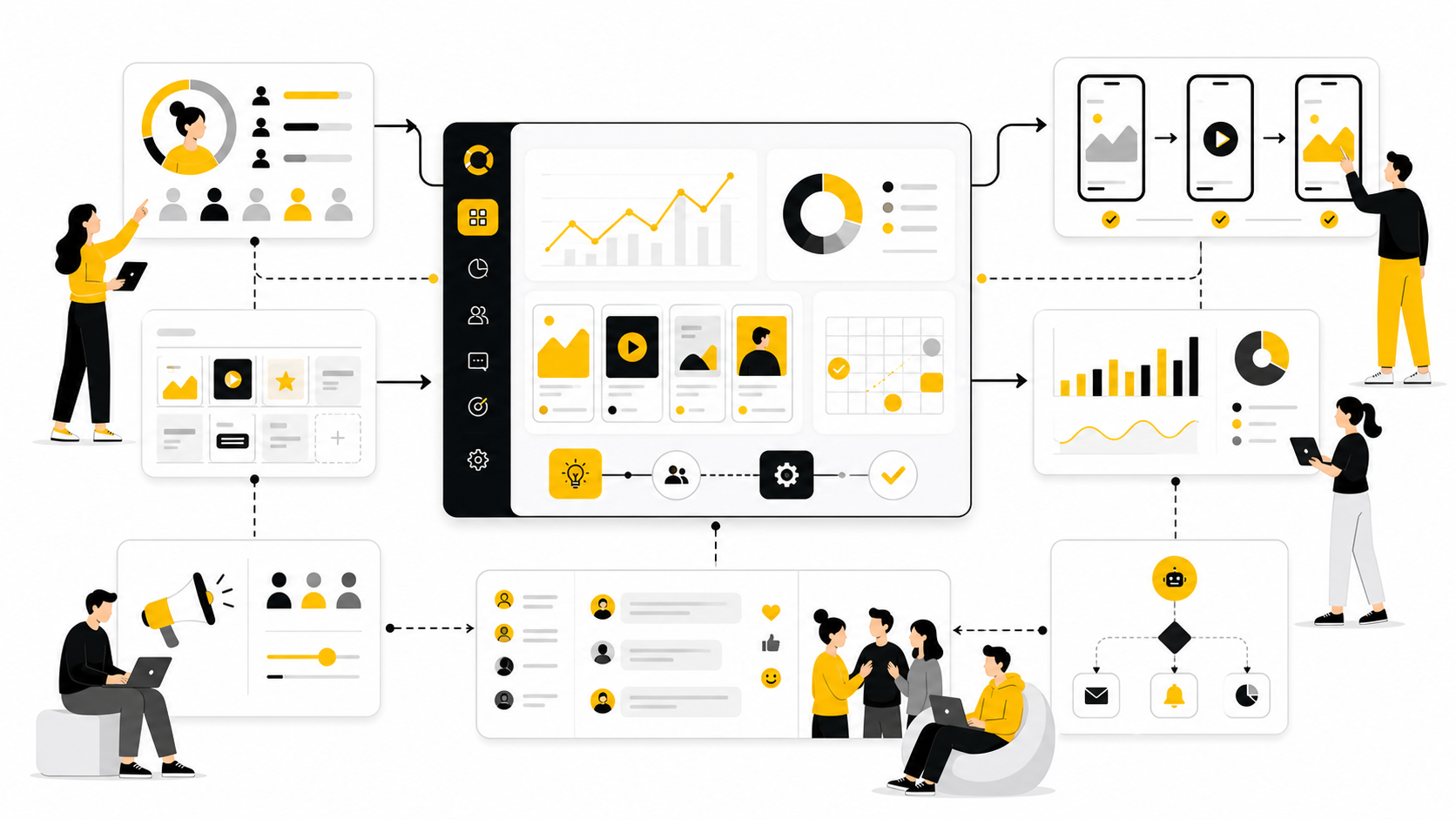
A social media strategy agency is not just a team that posts content for you. The right agency helps define who you are trying to reach, what you should say, where you should show up, how each platform supports the customer journey, and how social activity turns into measurable business outcomes.
That distinction matters because social media has become too complex for random posting. Global social media adoption keeps expanding, with the Digital 2026 Global Overview Report showing how deeply social platforms now shape discovery, communication, shopping, and brand trust. At the same time, the 2025 Sprout Social Index shows that consumers expect brands to be culturally aware, responsive, and genuinely useful rather than simply louder.
A strong social media strategy agency brings structure to that chaos. It connects audience research, positioning, content planning, creative production, paid distribution, community management, reporting, and optimization into one system. Without that system, brands often end up publishing more content while learning very little about what actually moves revenue, retention, or reputation.
Why a Social Media Strategy Agency Matters Now
Social media used to be treated like a visibility channel. Brands posted updates, shared campaigns, replied to comments when they had time, and hoped the algorithm would reward consistency. That version of social media is gone.
Today, social platforms influence how people discover products, compare brands, ask support questions, judge credibility, join communities, and decide whether a company feels relevant. Research from HubSpot’s 2025 social media marketing report points to the continued importance of community, creator partnerships, and platform-specific content, which means brands need more than a publishing calendar. They need a strategy that explains what each activity is supposed to achieve.
A social media strategy agency becomes valuable when internal teams are busy, reactive, or too close to the brand to see what the audience actually cares about. The agency’s job is not to make social media feel busy. Its job is to make social media feel intentional.
The Strategy Framework Behind High-Performing Social Media
A useful social media strategy starts with the business goal, not the content idea. Before anyone talks about captions, reels, carousels, creators, or ad budgets, the agency should understand what the company is trying to improve. That could be pipeline quality, direct sales, retention, recruitment, event attendance, product education, brand trust, or customer support efficiency.
From there, the strategy should define the audience, message, channel role, content system, conversion path, and measurement model. Each platform should have a purpose. LinkedIn might support authority and B2B demand generation, TikTok might support discovery and cultural relevance, Instagram might support brand affinity and product storytelling, and YouTube might support long-form education.
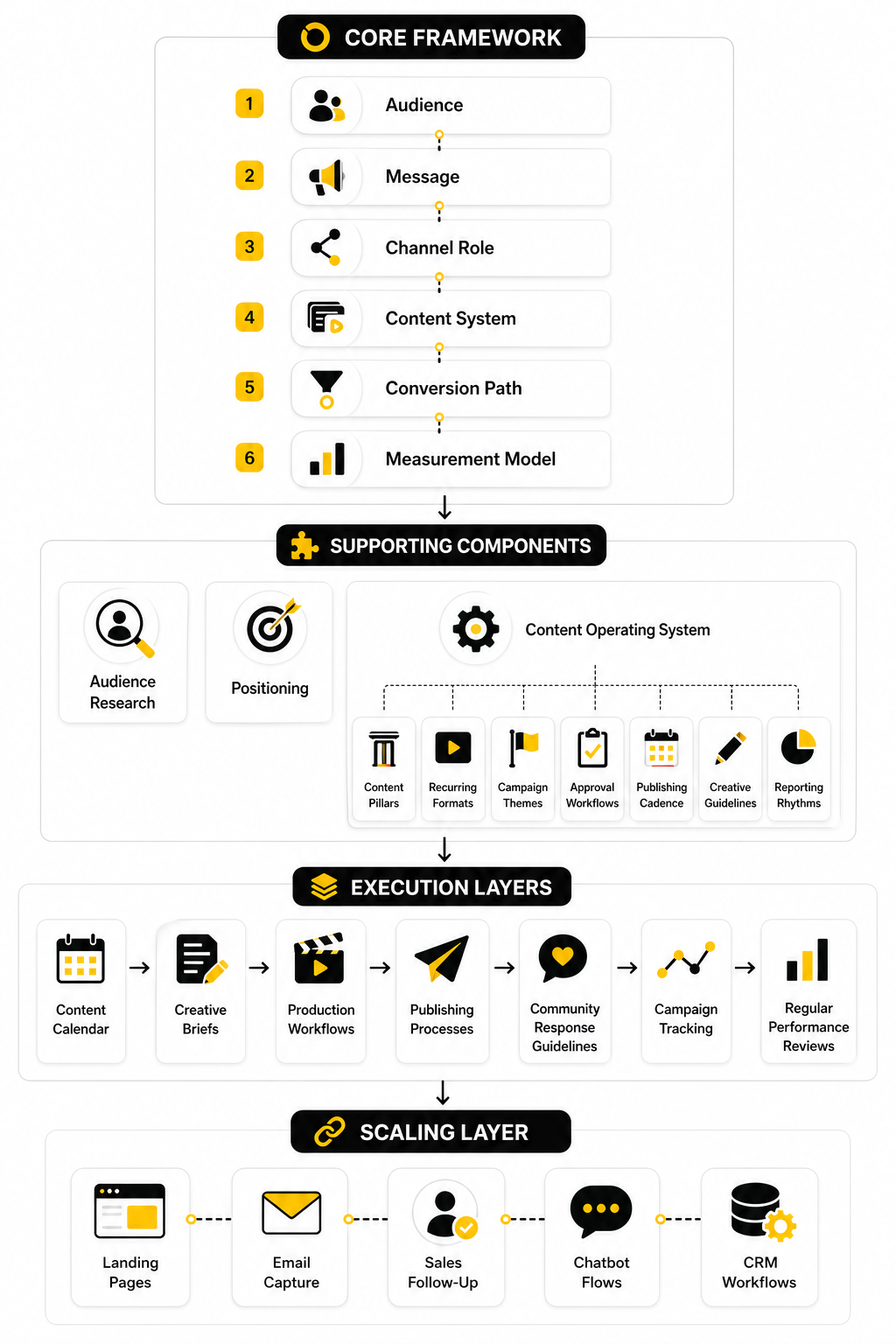
The best agencies make this framework simple enough to use every week. If the strategy only looks good in a slide deck, it will fail once the team has to produce content under pressure. A practical framework gives the brand clear choices: what to create, what to ignore, what to test, what to scale, and what to stop doing.
Core Components of a Strong Social Media Strategy
A serious strategy has several connected parts. Audience research comes first because social media performance depends on relevance, not volume. The agency should study customer pain points, buying triggers, objections, competitor positioning, search behavior, platform conversations, and the content formats people already engage with.
Positioning comes next. This is where the agency clarifies what the brand should be known for and how that message should sound across platforms. A weak agency jumps straight into content themes; a strong agency makes sure the brand has a point of view before building the calendar.
Then comes the content operating system. This includes content pillars, recurring formats, campaign themes, approval workflows, publishing cadence, creative guidelines, and reporting rhythms. Tools can help here, especially when teams need cleaner scheduling and workflow management through platforms like Buffer, social DM automation through ManyChat, or CRM-connected follow-up through GoHighLevel.
What Professional Implementation Should Look Like
Professional implementation means the agency can turn strategy into repeatable execution without making the brand dependent on guesswork. That usually includes a content calendar, creative briefs, production workflows, publishing processes, community response guidelines, campaign tracking, and regular performance reviews. The work should feel organized, but not rigid.
A good social media strategy agency also knows when not to post. That sounds simple, but it matters. If every trend becomes a brand moment, the account starts to feel desperate, and the audience notices.
Implementation should also connect social media to the rest of the marketing system. Landing pages, email capture, sales follow-up, chatbot flows, and CRM workflows often determine whether attention turns into revenue. For example, a brand running social campaigns to product pages might need stronger landing page testing with Replo, while a service business may need appointment routing through Cal.com or form-based lead capture through Fillout.
How the Rest of This Guide Will Help You Choose Better
The next sections will go deeper into what a social media strategy agency should actually do, how to separate real strategy from vague content retainers, and how to judge whether an agency is built for your business model. The goal is not to make every agency look bad. The goal is to help you recognize the difference between a partner that creates activity and a partner that creates momentum.
That difference shows up in the questions they ask before selling. It shows up in whether they talk about business outcomes or only platform tactics. It also shows up in whether they can explain how social media will support your customer journey from first impression to conversion and beyond.
By the end, you should have a practical way to evaluate agencies, understand their proposals, ask sharper questions, and avoid paying for content that looks active but does not build anything meaningful.
The Strategy Framework Behind High-Performing Social Media
A social media strategy agency should not start by asking, “How many posts do you want per week?” That question is tactical, and tactics are only useful after the strategy is clear. The better question is, “What business outcome should social media support, and what role should each platform play in getting there?”
This matters because social media now touches almost every stage of the customer journey. People use platforms to discover brands, validate claims, compare options, ask questions, follow creators, watch product demos, and decide whether a company feels trustworthy enough to buy from. The 2025 Sprout Social Index shows how much pressure brands are under to be responsive, culturally aware, and useful in real time, which is exactly why random posting is not a strategy.
A practical framework gives the agency and the client a shared operating system. It explains who the content is for, what the brand wants to become known for, how platforms should be prioritized, what content formats should be produced, and how performance should be measured. Without that structure, social media becomes a constant stream of disconnected ideas.
Start With the Business Goal
Every strong social strategy starts with the business model. An ecommerce brand, a SaaS company, a local service business, a B2B consultancy, and a creator-led offer do not need the same social media system. They may use some of the same platforms, but the path from attention to revenue is different.
A social media strategy agency should define the main commercial goal before building the content plan. That goal might be qualified leads, booked calls, product sales, community growth, newsletter subscribers, customer retention, recruiting, brand lift, or customer support efficiency. Once the goal is clear, it becomes easier to decide which metrics matter and which ones are just noise.
This is where many weak retainers fall apart. They report likes, impressions, and follower growth without explaining how those numbers connect to a business result. Engagement can be useful, but only when it helps diagnose audience interest, message quality, distribution strength, or buying intent.
Define the Audience Beyond Demographics
Audience research cannot stop at age, location, job title, and income level. Those details may help with targeting, but they rarely explain why someone stops scrolling, trusts a brand, or takes action. A good agency digs into motivations, objections, frustrations, language patterns, buying triggers, and the content people already consume.
This is especially important because audiences behave differently across platforms. Someone may use LinkedIn to evaluate expertise, TikTok to discover new ideas, Instagram to follow a brand’s personality, and YouTube to research in depth. The same person can have different expectations depending on where they are and what they are trying to do.
The agency should translate that research into practical creative direction. That means identifying the questions the audience keeps asking, the misconceptions they believe, the outcomes they want, and the proof they need before moving forward. This is how social content starts sounding like it was made for real people instead of a generic content calendar.
Build a Clear Positioning Point of View
A social media strategy agency should help the brand answer a hard question: why should anyone pay attention to this company instead of the dozens of other voices saying something similar? The answer cannot be “we post valuable content.” Everyone says that.
Positioning gives the brand a clear angle. It defines the audience, the problem, the promise, the belief system, and the difference between the brand’s approach and the market’s default approach. This does not mean being controversial for attention. It means having a point of view strong enough to make content recognizable.
This is where strategy becomes more than scheduling. A brand with weak positioning needs constant brainstorming because every post starts from zero. A brand with sharp positioning can create faster because the team knows what it believes, what it teaches, what it challenges, and what it refuses to sound like.
Assign a Job to Each Platform
Not every platform deserves equal effort. A strong social media strategy agency should know how to prioritize channels based on audience behavior, creative fit, buying journey, and operational capacity. Being everywhere badly is usually worse than being focused and consistent in the places that matter.
Each platform should have a specific job. LinkedIn can support authority, trust, partnerships, hiring, and B2B demand. Instagram can support visual storytelling, product education, lifestyle association, and community warmth. TikTok can support discovery, speed, cultural participation, and creator-style education. YouTube can support deeper trust through long-form explanations, product demos, search-driven education, and evergreen content.
This platform role matters because the same content idea should not always be copied and pasted everywhere. The core message can stay consistent, but the format, hook, pacing, proof, and call to action should match the platform. That is what separates a channel strategy from basic repurposing.
Connect Content Pillars to Customer Questions
Content pillars are useful only when they are specific. Generic pillars like education, inspiration, promotion, and community are too broad to guide real execution. They sound organized in a strategy deck, but they do not help a writer, designer, or founder know what to publish on Tuesday.
Better content pillars map directly to the customer journey. One pillar may address problem awareness, another may explain solutions, another may handle objections, another may show proof, and another may deepen loyalty after purchase. This gives the agency a clear way to create content that moves people forward instead of simply filling slots.
The content system should also include recurring formats. These might be teardown posts, founder notes, customer questions, myth-busting posts, product walkthroughs, market observations, short tutorials, comparison posts, or community prompts. Recurring formats make quality easier to repeat because the team is not reinventing the structure every time.
Design the Conversion Path Before Publishing
Content does not convert well when the next step is unclear. A person might like the post, trust the idea, and still do nothing because the path forward is vague. That is why a social strategy should define what happens after attention is earned.
For some brands, the next step may be a lead magnet, webinar, email sequence, consultation, product page, free trial, DM conversation, community invite, or booked call. The important part is that the call to action matches the audience’s level of awareness. Cold audiences usually need education and trust first, while warmer audiences may be ready for a direct offer.
This is also where marketing tools can support the strategy without replacing it. A team might use ManyChat for DM-based follow-up, ClickFunnels for campaign funnels, or GoHighLevel for CRM, automation, and pipeline visibility. The tool is not the strategy, but it can make the strategy easier to execute once the path is clear.
Measure Learning, Not Just Activity
Reporting should help the brand make better decisions. A dashboard full of numbers is not useful if nobody can explain what changed, why it changed, and what the team should do next. A strong agency turns performance data into learning.
The agency should separate platform metrics from business metrics. Reach, watch time, saves, shares, comments, click-through rate, profile visits, cost per lead, booked calls, assisted conversions, and retention signals all tell different parts of the story. The goal is not to worship one metric; the goal is to understand which signals matter at each stage.
The 2025 HubSpot social media report highlights how marketers are investing across AI, creators, short-form video, and social commerce, but the practical lesson is simple: more channels and formats create more room for confusion. Measurement keeps the system honest. It shows what deserves more budget, what needs a better hook, what should be repackaged, and what should be stopped.
Turn the Framework Into a Weekly Operating Rhythm
A strategy only works if it becomes part of the team’s normal rhythm. That means the agency should create a process for planning, production, review, publishing, engagement, reporting, and optimization. If everything depends on last-minute inspiration, the system will eventually break.
A weekly rhythm might include a short performance review, content planning session, creative production window, approval deadline, publishing schedule, community management block, and experiment log. The exact process can vary, but the principle is the same. Everyone should know what is being created, why it matters, who owns it, and how success will be judged.
This is where a social media strategy agency can become a serious growth partner. The value is not just in ideas. The value is in helping the brand make better decisions every week, produce with less chaos, and build a social presence that compounds instead of constantly resetting.
Core Services a Social Media Strategy Agency Should Provide
Once the framework is clear, the next question is execution. This is where a social media strategy agency either becomes useful or starts hiding behind vague deliverables. A real agency should be able to show how research turns into content, how content turns into conversations, and how conversations turn into measurable business outcomes.
The service list does not need to be huge, but it does need to be connected. Strategy, creative, publishing, community management, paid amplification, reporting, and optimization should not feel like separate departments passing files around. They should feel like one operating system built around the same goals.
This is also where you can spot the difference between a content vendor and a strategic partner. A vendor asks for assets and posts them. A strategy agency builds the process that decides what should be created, why it should exist, where it should go, and what the team should learn from it.
Discovery and Research
The first implementation layer is discovery. The agency should understand the business model, offer, margins, sales cycle, audience segments, competitors, existing assets, historical performance, and internal team capacity. Without this step, the strategy will be based on assumptions, and assumptions get expensive fast.
Good discovery looks at both qualitative and quantitative signals. That can include customer interviews, sales call patterns, support questions, review mining, social listening, competitor content analysis, paid campaign data, website analytics, and CRM insights. The point is not to collect research for the sake of it. The point is to find the friction and desire that should shape the content.
This matters even more now because social media teams are under pressure to prove impact. The 2025 Impact of Social Media Marketing Report found that marketing leaders are focused on connecting social activity to business value, which means agencies cannot survive on surface-level engagement reports forever. The research phase gives the work a stronger commercial foundation.
Strategy Translation
After discovery, the agency should translate findings into a practical strategy document. This should not be a 90-page deck that nobody opens again. It should be a working guide that helps the team make better decisions every week.
The strategy should define audience segments, platform priorities, content pillars, recurring formats, campaign themes, brand voice, creative rules, conversion paths, reporting metrics, and testing priorities. It should also explain what the brand will not do. That part is underrated because focus is usually created by saying no.
A strong strategy translation also makes trade-offs clear. If the team has limited bandwidth, the agency should prioritize the channels and formats most likely to matter. If the brand has a long sales cycle, the agency should not pretend every post needs to generate immediate leads. If the company needs trust before conversion, the strategy should build authority before it pushes too hard for sales.
Content Planning
Content planning turns the strategy into a calendar, but the calendar is not the strategy. This distinction matters. A calendar tells you what is going live; a strategy tells you why it deserves to go live.
A good social media strategy agency plans content around campaigns, customer questions, product moments, industry timing, platform behavior, and internal capacity. The agency should balance evergreen content with timely content, educational content with proof, and brand-building content with conversion-focused assets. That mix keeps the account useful without making it feel like a nonstop sales pitch.
Planning should also include repurposing logic. One customer insight can become a LinkedIn post, a short video, a carousel, a newsletter section, a sales enablement asset, and a paid ad angle. The best agencies do not simply produce more; they squeeze more value out of the strongest ideas.
Creative Production
Creative production is where strategy becomes visible. Hooks, scripts, graphics, captions, thumbnails, edits, carousels, and calls to action all need to reflect the same positioning and audience insight. If the creative team does not understand the strategy, the output may look polished but still miss the point.
The agency should have a clear production workflow. That workflow should include briefs, drafts, feedback, approvals, revisions, scheduling, and performance review. The process does not need to be complicated, but it does need to prevent chaos.
Short-form video deserves special attention because many teams underestimate how much structure it needs. The 2025 HubSpot social media marketing report shows continued marketer investment in short-form video, AI-assisted creation, and creator-led formats, but those formats only work when the idea, hook, pacing, and audience fit are strong. A social media strategy agency should help make that production repeatable instead of random.
Publishing and Workflow Management
Publishing looks simple from the outside. In reality, it is where many teams lose consistency. Posts get delayed, approvals stall, captions change too late, assets get misplaced, and nobody knows which version is final.
The agency should create a workflow that removes those bottlenecks. That can include shared calendars, approval deadlines, asset folders, naming conventions, platform-specific checklists, and role clarity. Tools like Buffer can help teams schedule and organize publishing, but the tool only works if the process behind it is clear.
A strong workflow also protects quality. The point is not to publish at all costs. The point is to make publishing consistent while still leaving room for timely ideas, platform shifts, and useful experiments.
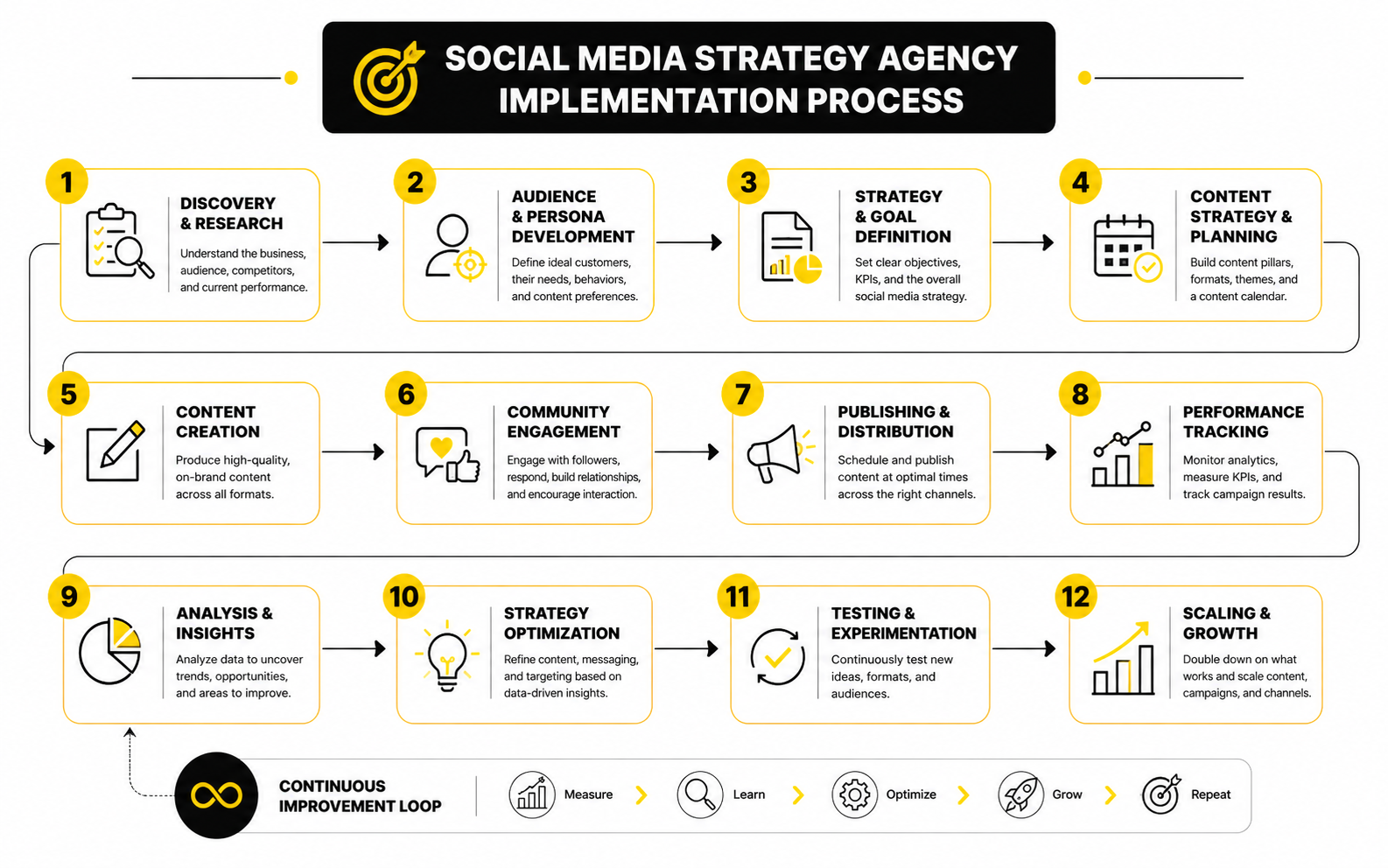
The Practical Execution Process
A professional implementation process should be easy to understand. If an agency cannot explain how work moves from idea to published asset to performance insight, that is a problem. The process should feel structured enough to trust and flexible enough to adapt.
A simple version looks like this:
This process should repeat continuously. Social media strategy is not something you finish once and admire. It is a living system that gets sharper as the agency learns what the audience responds to and what the business can actually support.
Community Management
Community management is often treated like a small add-on, but it can make or break the strategy. Comments, DMs, mentions, reposts, and customer questions are not just engagement signals. They are moments where the brand can build trust or lose it.
A social media strategy agency should define how the brand responds. That includes tone, escalation rules, response windows, common questions, sensitive topics, and handoff processes for sales or support. This is especially important for brands that receive product questions, complaints, booking requests, or pre-sale objections through social channels.
The 2025 Sprout Social Index reinforces how much consumers expect from brands on social, especially around responsiveness and relevance. That does not mean every brand needs to reply to everything instantly. It does mean community management should be planned instead of improvised.
Lead Capture and Follow-Up
Attention is useful, but follow-up is where many brands waste the opportunity. A person may comment on a post, reply to a story, click a profile link, download a resource, or ask a question in DMs. If there is no next step, the brand loses momentum.
The agency should map the follow-up system before campaigns go live. For some brands, that may mean DM automation through ManyChat. For others, it may mean a landing page, email sequence, booking flow, or CRM pipeline inside GoHighLevel.
The important part is continuity. The social post should not feel disconnected from the landing page, form, email, sales call, or offer. Every step should confirm the same promise and move the person forward without creating confusion.
Paid Amplification
Organic content can reveal what the audience cares about, but paid amplification helps scale what is already working. A social media strategy agency should know when to put budget behind proven content, when to test new angles, and when to stop spending because the message is not converting. Paid social should not be used to rescue weak positioning.
The agency should connect paid campaigns to the broader strategy. That means using organic performance to identify hooks, comments to identify objections, and landing page data to understand where interest drops off. When organic and paid teams operate separately, brands often end up with inconsistent messaging and wasted budget.
Paid amplification also needs a clean conversion path. If the campaign drives traffic to a weak page, the media spend will expose the weakness faster. For ecommerce and campaign-specific pages, tools like Replo can support faster landing page iteration, while funnel-based businesses may prefer ClickFunnels or Systeme.io depending on their setup.
Reporting and Optimization
Reporting should not be a monthly screenshot parade. A useful report explains what happened, why it likely happened, what the team learned, and what should change next. That is the difference between data presentation and strategic guidance.
The agency should report on the metrics that match the strategy. If the goal is awareness, reach quality and content resonance matter. If the goal is demand generation, clicks, conversion rate, qualified leads, booked calls, and pipeline contribution matter more. If the goal is retention, comments, community participation, support themes, and repeat engagement may be more useful.
The 2025 Content Benchmarks Report shows how performance varies by network and industry, which is a useful reminder that benchmarks should guide context, not replace judgment. A strong social media strategy agency uses benchmarks to ask better questions. It does not use them as an excuse for generic recommendations.
Statistics and Data
Measurement is where a social media strategy agency proves whether the strategy is working or just creating motion. The numbers should not be treated like decoration for a monthly report. They should explain what the audience is doing, where the message is strong, where the funnel is leaking, and what the team should change next.
This is why context matters so much. A post with low likes might still drive qualified clicks. A video with high views might attract the wrong audience. A campaign with strong engagement might fail if the landing page or follow-up system does not match the promise made in the content.
Good analytics turn social media from opinion into decision-making. They do not remove creative judgment, but they make the judgment sharper. A social media strategy agency should help you understand what the data means, not just hand you a dashboard and expect you to be impressed.
Why Social Media Data Needs Interpretation
Raw metrics can be misleading. Reach tells you how many people saw something, but not whether the right people cared. Engagement shows interaction, but not whether the interaction came from buyers, peers, bots, existing fans, or people who will never buy. Follower growth can look exciting while the account quietly attracts an audience that does not match the business.
That is why the agency should interpret numbers through the strategy. If the goal is awareness, then reach quality, video retention, share rate, and profile visits may matter most. If the goal is lead generation, then click-through rate, conversion rate, cost per lead, booked calls, and pipeline quality deserve more attention.
The current market makes this even more important. The 2025 Sprout Social Index is based on surveys of more than 4,000 consumers, 900 social practitioners, and 300 marketing leaders, and it frames social as a central business channel rather than a side activity. That means social reporting has to move beyond vanity metrics and show how the channel supports real decisions.
The Core Metrics That Actually Matter
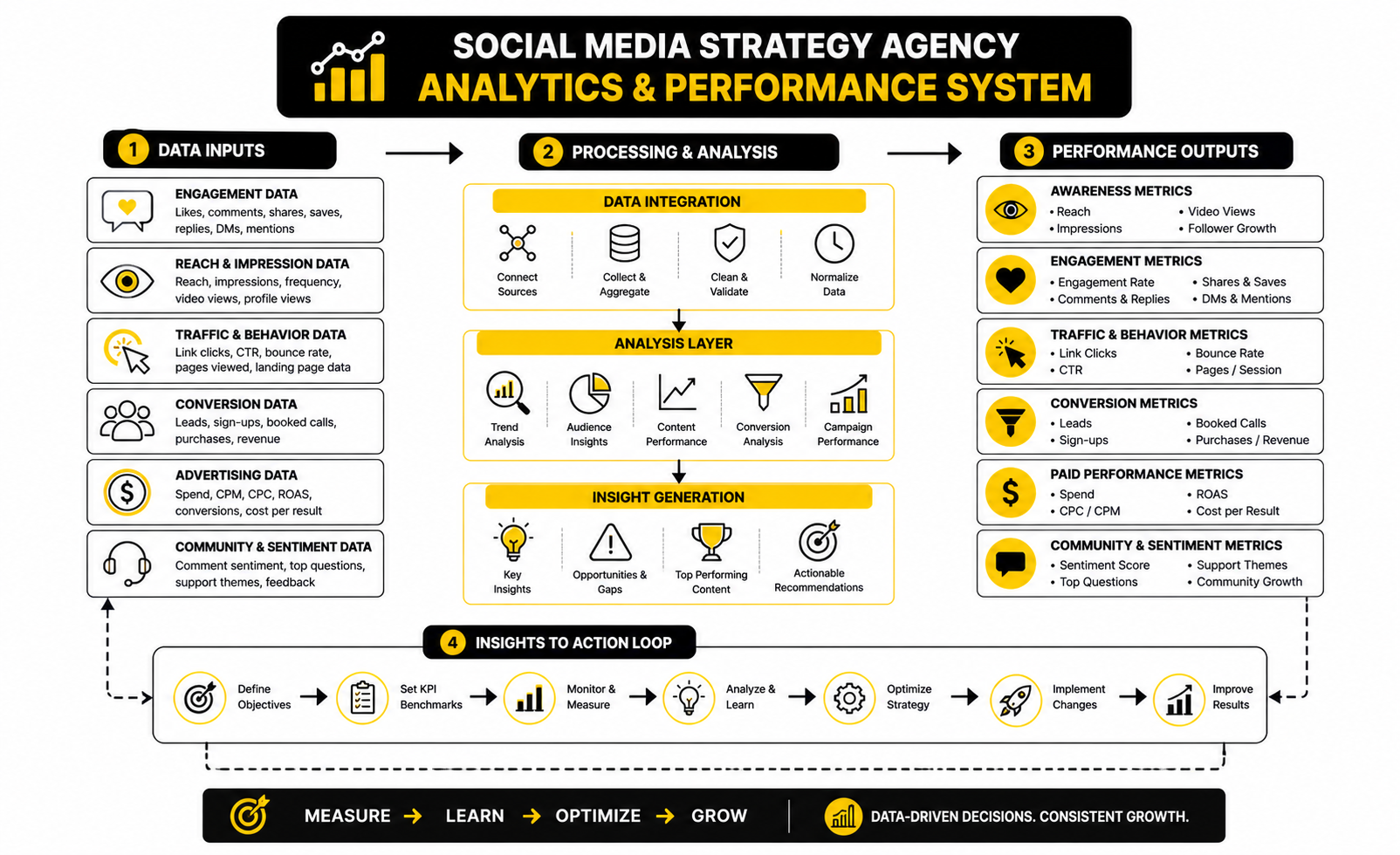
A useful measurement system usually tracks four layers: attention, engagement, conversion, and learning. Each layer answers a different question. When those layers are separated, the team can see whether the problem is distribution, creative quality, offer clarity, or follow-up.
Attention metrics show whether the content is reaching people. These include impressions, reach, video views, watch time, hook retention, and follower growth. They matter because content cannot create business results if it never reaches enough relevant people.
Engagement metrics show whether people care enough to interact. These include comments, shares, saves, replies, profile visits, direct messages, and link clicks. Engagement matters most when it signals trust, intent, education, or willingness to continue the conversation.
Conversion metrics show whether social attention turns into business movement. These include form submissions, booked calls, trial starts, purchases, newsletter signups, demo requests, CRM stage movement, and revenue influenced by social campaigns. This is where tools like GoHighLevel, ClickFunnels, or Systeme.io can help when the business needs clearer funnel tracking after the click.
Learning metrics show what the team should do next. These include winning hooks, strongest content themes, best-performing formats, audience objections, comment patterns, creator performance, drop-off points, and offer feedback. This layer is often the most valuable because it improves the whole system, not just one campaign.
Benchmarks Are Useful, But They Are Not the Goal
Benchmarks help you understand whether performance is unusually weak, average, or strong for your category. They are especially helpful when a brand is entering a new platform, testing a new format, or trying to understand whether its expectations are realistic. But benchmarks should guide interpretation, not replace strategic thinking.
The 2025 Sprout Social Content Benchmarks Report analyzed 3 billion messages across 1 million active public profiles, which makes it useful for understanding broad performance patterns by industry and network. The action here is not to copy the average. The action is to compare your performance against your own baseline, your direct competitors, and your business goal.
A social media strategy agency should use three kinds of benchmarks. Industry benchmarks show the broader category. Competitive benchmarks show who is winning attention in your market. Personal benchmarks show whether your own account is improving over time. Personal benchmarks are usually the most important because they show whether the strategy is compounding.
Engagement Rates Need Platform Context
Engagement rate is one of the most misunderstood social metrics. A strong engagement rate on one platform may be normal on another. A low engagement rate may still be acceptable if the content is reaching a broader audience and producing qualified traffic. A high engagement rate may be meaningless if it comes from the wrong people.
The 2025 Rival IQ Social Media Industry Benchmark Report found that TikTok continued to generate higher engagement than Instagram, Facebook, and X across many brand categories, even while engagement trends shifted year over year. That matters because platform expectations should not be blended into one generic target. A social media strategy agency should judge each platform by its role in the strategy.
For example, a LinkedIn post that drives five serious sales conversations may be more valuable than a TikTok video with thousands of passive views. An Instagram carousel with many saves may signal strong educational value, while a reel with high reach but poor retention may need a better opening hook. The metric only becomes useful when it is tied to the job that platform is supposed to do.
Reach Without Relevance Is a Trap
Reach can feel impressive because the number is easy to understand. More people saw the content, so the campaign must be working. Not always.
A broad reach spike can come from controversy, curiosity, entertainment, giveaways, trend-jacking, or algorithmic luck. Some of that can be useful, but only if the audience overlaps with the people the business actually wants to reach. If the wrong audience floods the account, future content performance and conversion quality can suffer.
A smart agency looks at what happens after reach. Did profile visits increase? Did people follow for the right reason? Did they click? Did they ask better questions? Did the post attract comments from the target market? Did it create content ideas, sales objections, or retargeting audiences that can be used later?
Conversion Tracking Needs a Clean Path
If a brand wants social media to support revenue, the measurement system has to follow the user beyond the platform. That means using UTMs, landing pages, forms, CRM stages, booking links, attribution windows, and campaign-specific follow-up where appropriate. Without that structure, the team ends up guessing which posts created demand.
This does not mean every social post needs to produce immediate revenue. Many posts build trust before someone is ready to act. But when campaigns are designed for conversion, the path should be measurable enough to understand what happened.
For lead generation, this may include a social post, a link click, a landing page, a form, an email sequence, a booking page, and a CRM pipeline. For ecommerce, it may include product discovery, landing page behavior, cart activity, checkout completion, remarketing, and repeat purchase signals. A social media strategy agency should make these paths visible so creative and commercial decisions can improve together.
ROI Is Harder Than It Looks
Social media ROI is not always simple because social influence is not always linear. Someone may discover a brand on TikTok, check Instagram, search the company on Google, watch a YouTube video, join an email list, and convert weeks later after seeing a retargeting ad. If the analytics system only credits the final click, social may look less valuable than it really is.
That said, “social is hard to measure” should not become an excuse for weak reporting. The 2025 Sprout Social ROI statistics highlight a major gap: many leaders want clearer connections between social campaigns and business goals, while many marketers still struggle to measure social ROI confidently. That gap is exactly where a strong agency should bring discipline.
The practical answer is to use multiple signals. Track direct conversions where possible, but also track assisted conversions, branded search movement, CRM source notes, customer survey responses, content-influenced sales conversations, and audience quality. ROI becomes clearer when the agency combines platform data with business data instead of pretending one dashboard can explain everything.
Qualitative Signals Are Part of the Data
Not all valuable data is numerical. Comments, DMs, sales questions, customer objections, review language, creator feedback, and support conversations can reveal what the market actually thinks. These signals often explain why the quantitative metrics moved.
For example, repeated comments about pricing may show that the offer needs better value framing. DMs asking how implementation works may show that the content has created interest but not enough clarity. Saves on educational posts may show that people find the content useful but need a stronger next step.
A social media strategy agency should capture these patterns and feed them back into content, sales, product, and customer success. This is one of the most underrated benefits of social media. It gives the business a live feedback loop from the market.
Reporting Should Drive Decisions
A strong report should not simply say what performed best. It should explain what to do next. That means every reporting cycle should end with clear decisions about what to scale, what to test, what to revise, and what to stop.
A useful report might identify that educational carousels generate saves, founder-led videos generate comments, comparison posts drive clicks, and DM prompts create the highest-intent conversations. Those findings should directly shape the next content plan. Otherwise, the report is just a record of activity.
The agency should also avoid overreacting to one post. Social media data is noisy. One piece of content can underperform for reasons outside the strategy, including timing, distribution, platform volatility, creative execution, or audience fatigue. The best decisions come from patterns across enough posts, campaigns, and weeks to make the signal believable.
The Measurement System Should Match the Maturity Stage
A new brand does not need the same analytics setup as a mature company spending heavily on paid media. Early on, the priority may be learning which messages, formats, and platforms produce signs of relevance. Later, the priority may shift toward attribution, funnel efficiency, CAC, LTV, and pipeline influence.
This maturity view keeps measurement realistic. If a brand has no consistent publishing rhythm, it should not obsess over advanced attribution yet. If a brand already has strong reach and engagement, it should probably improve conversion tracking, offer testing, and CRM visibility.
A social media strategy agency should meet the brand where it is while still building toward a more serious system. Start with the metrics that support the next decision. Then add complexity only when the business can actually use it.
How to Evaluate and Compare Social Media Strategy Agencies
By this point, the agency’s work should look less like “posting on social” and more like a complete growth system. That is the standard you should use when comparing partners. A social media strategy agency should be judged by how clearly it thinks, how well it connects social activity to business outcomes, and how consistently it can turn strategy into execution.
The danger is that many agencies sound similar during the sales process. They all talk about strategy, content, analytics, community, and growth. The difference shows up when you ask sharper questions and force the proposal to get specific.
A strong agency will welcome that pressure. A weak one will hide behind vague phrases like brand awareness, full-service management, viral content, or monthly optimization without explaining what those words actually mean for your business.
Strategy Depth Versus Content Volume
One of the biggest tradeoffs is strategy depth versus content volume. More content can help if the ideas are strong, the audience is clear, and the publishing system is disciplined. But more content can also expose weak positioning faster.
A serious agency will not sell volume as the main value. It will explain how much content is needed to test the right ideas, support the platform mix, maintain consistency, and create enough data for decision-making. That is different from promising a fixed number of posts because it looks good in a package.
This matters because social feeds are already saturated. The 2025 Sprout Social Content Benchmarks Report frames content quality, audience relevance, and network-specific behavior as central to performance, not just publishing frequency. The action is simple: choose the agency that can explain why each content type exists, not the one that gives you the biggest calendar.
Specialist Agency Versus Full-Service Agency
A specialist agency can be powerful when your problem is focused. If you need executive LinkedIn content, short-form video production, creator partnerships, paid social, or community management, a specialist may move faster because the team has repeated the same motion many times. That depth can be useful when the business already has a strong strategy and needs expert execution.
A full-service agency can make more sense when your social media system is fragmented. If positioning, content, paid campaigns, landing pages, CRM follow-up, and reporting are disconnected, one coordinated partner may reduce complexity. The risk is that “full-service” sometimes means average at everything, so you need to inspect the actual team and process.
The right answer depends on your bottleneck. If the bottleneck is clarity, hire for strategy. If the bottleneck is production, hire for creative operations. If the bottleneck is conversion, hire for funnel thinking and measurement. Do not buy a bigger scope just because it sounds safer.
Creative Freedom Versus Brand Control
Social media rewards speed, personality, and platform-native creativity. Brand teams often reward polish, safety, and control. The tension between those two forces is real, and a good social media strategy agency knows how to manage it.
Too much creative freedom can make the brand inconsistent. Too much control can make the content slow, stiff, and forgettable. The goal is not chaos or corporate perfection. The goal is a clear creative boundary that lets the agency move quickly without drifting away from the brand’s voice, offer, and reputation.
This is where brand guidelines need to become practical. The agency should know what the brand can joke about, what it should avoid, how bold it can be, what claims need approval, and who signs off on sensitive topics. If those rules are unclear, every post becomes a negotiation.
Organic Growth Versus Paid Acceleration
Organic social is useful for learning what people care about, building trust, creating community, and developing content assets that can compound over time. Paid social is useful for accelerating proven messages, reaching defined audiences, retargeting interest, and scaling campaigns that already show promise. They work best when they inform each other.
The mistake is treating paid media as a shortcut around weak strategy. If the organic content does not resonate, paid spend may simply distribute a weak message to more people. That can produce traffic without trust, clicks without conversion, and reports that look active while the business stays stuck.
A good agency will separate testing from scaling. It may use organic content to identify hooks, objections, formats, and messages before putting budget behind the best performers. It may also use paid campaigns to test offers faster when the business needs clearer conversion data. Either way, the logic should be visible.
In-House Team Versus Agency Support
Hiring a social media strategy agency does not mean your internal team disappears. In fact, the best results usually happen when the agency and internal team have clear roles. The agency brings outside perspective, systems, creative capacity, and cross-market pattern recognition. The internal team brings product knowledge, customer context, speed of access, and brand judgment.
The tradeoff is control versus leverage. An in-house team may understand the business more deeply, but it can become reactive or overloaded. An agency may bring stronger process and creative range, but it needs access to the right information to avoid shallow work.
A smart setup defines ownership early. The agency might own strategy, creative production, publishing, reporting, and optimization, while the internal team owns approvals, subject matter expertise, customer insights, sales feedback, and executive input. Without that division, both sides wait on each other and momentum dies.
AI Assistance Versus Human Judgment
AI can speed up research, ideation, scripting, editing, repurposing, and reporting. It can help teams produce more variations and spot patterns faster. That does not mean it should replace strategic judgment.
The 2025 HubSpot social media marketing report notes that marketers are already using AI for short-form video, image generation, and other content workflows. The opportunity is efficiency. The risk is sameness.
A good agency should have a clear view on where AI helps and where humans need to lead. AI can draft options, summarize audience research, generate hooks, or speed up internal workflows. Humans still need to decide what is true, what is differentiated, what fits the brand, what is legally safe, and what the audience will actually trust.
The Hidden Risk of Trend Chasing
Trends can help brands enter relevant conversations, but trend chasing can also weaken positioning. When every post is built around the trend of the week, the brand starts borrowing attention instead of building memory. That may create short spikes, but it rarely creates durable trust.
A strong social media strategy agency should know when a trend fits the brand and when it does not. The test is simple: does this trend help the brand express its point of view, educate the right audience, show product relevance, or strengthen community? If not, it is probably noise.
This is especially important as platforms reward speed and imitation. The pressure to move fast can push teams into shallow content. The agency’s job is to move quickly without making the brand look like it has no filter.
The Hidden Risk of Over-Optimization
Optimization is useful until it makes the brand predictable. If every creative decision is based only on last month’s top-performing format, the account can slowly become narrow and repetitive. Performance data should sharpen creativity, not suffocate it.
A good agency protects room for experimentation. Some content should be designed to perform reliably. Some content should test a new angle, format, story, creator, or offer. If every post has to be justified by past data, the brand will eventually miss new opportunities.
The key is to separate proven plays from experiments. Proven plays create stability. Experiments create learning. A healthy strategy needs both because social platforms, audience preferences, and competitor behavior keep shifting.
Scaling Without Losing the Brand
Scaling social media is not just publishing more. It usually means more stakeholders, more formats, more campaigns, more creators, more reporting needs, and more approval complexity. Without a system, scale creates drag.
The agency should help the brand scale through templates, playbooks, creative briefs, platform rules, asset libraries, approval processes, and reporting standards. These systems reduce friction while keeping the output consistent. They also make it easier to onboard new creators, editors, strategists, or internal reviewers.
Tools can support this stage, but they should match the workflow. Scheduling might live in Buffer, lead capture might run through Fillout, customer conversations might connect to Chatbase, and CRM follow-up might sit inside GoHighLevel. The stack should reduce operational weight, not add another layer of confusion.
Questions to Ask Before Hiring
The best way to compare agencies is to ask questions that reveal how they think. You are not just buying deliverables. You are buying judgment, process, and the ability to make better decisions under uncertainty.
Ask questions like:
The answers should be specific. If the agency responds with generic language, ask for the actual process. You want to hear how they diagnose, plan, execute, measure, and adapt.
Red Flags That Should Slow You Down
Some warning signs are obvious. Guaranteed virality, fake followers, copied content, vague reporting, and no discovery process should immediately raise concerns. But the more dangerous red flags are quieter.
Be careful when an agency talks about content volume before business goals. Be careful when it cannot explain how platform roles differ. Be careful when every case study focuses on impressions but not quality of audience, conversion path, or business impact.
Also watch for agencies that agree with everything you say. A strategic partner should challenge unclear thinking. If your positioning is weak, your offer is confusing, your landing page is not ready, or your expectations are unrealistic, the agency should say so. That honesty may feel uncomfortable, but it is far more valuable than polite execution of a broken plan.
What a Strong Proposal Should Include
A strong proposal should make the agency’s thinking visible. It should not just list deliverables and prices. It should explain the problem, the opportunity, the strategic approach, the scope of work, the implementation process, the reporting rhythm, and the responsibilities on both sides.
The proposal should also explain what happens in the first 30, 60, and 90 days. Early work should usually include discovery, audit, strategy, workflow setup, content planning, initial production, publishing, and first learning cycles. If the agency jumps straight into posting without a diagnostic phase, the work may be fast but fragile.
Finally, the proposal should make measurement realistic. It should define leading indicators, lagging indicators, and the expected learning timeline. A good social media strategy agency does not need to promise instant results. It needs to show that it knows how results are built.
FAQs and Final Decision Checklist
At this stage, the big picture should be clear. A social media strategy agency is not valuable because it posts for you. It is valuable because it helps turn social media into a system that can create attention, earn trust, capture demand, and improve over time.
The final decision should come down to fit. The right agency for a founder-led B2B company may not be the right agency for a fast-moving ecommerce brand. The right agency for paid social scale may not be the right agency for organic community building. Fit matters more than hype.
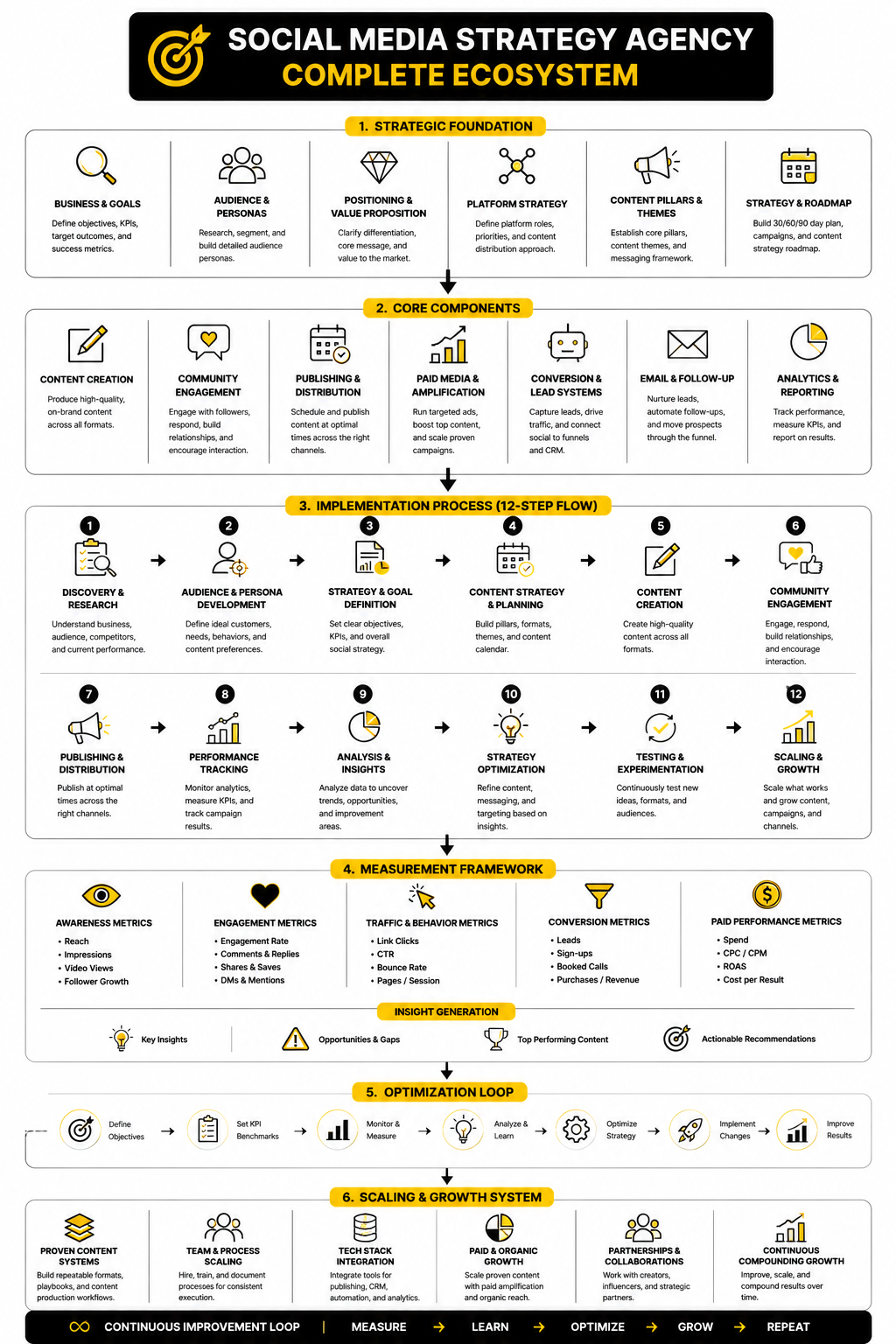
Before signing anything, look at the full ecosystem. Strategy, creative, publishing, community, paid media, analytics, landing pages, CRM, and follow-up all affect the outcome. If one part is weak, the whole system can underperform, even when the content looks good.
Final Decision Checklist
Use this checklist before choosing a social media strategy agency. It will not make the decision for you, but it will make weak proposals easier to spot. The best agencies should be able to answer these points without getting vague.
What does a social media strategy agency do?
A social media strategy agency helps a business plan, create, manage, measure, and improve its presence across social platforms. The work usually includes audience research, positioning, platform strategy, content planning, creative production, publishing workflows, community management, reporting, and optimization. The best agencies also connect social activity to the rest of the marketing system, including landing pages, email follow-up, sales pipelines, and customer feedback.
How is a social media strategy agency different from a social media management agency?
A social media management agency often focuses on day-to-day execution, such as scheduling posts, writing captions, responding to comments, and maintaining consistency. A social media strategy agency should go deeper into why the content exists, which audience it serves, how each platform supports the customer journey, and how success will be measured. Some agencies do both, but the difference is whether strategy drives execution or execution happens by habit.
When should a business hire a social media strategy agency?
A business should consider hiring one when social media activity feels busy but disconnected from business results. It may also be the right move when internal teams are overloaded, content quality is inconsistent, platform priorities are unclear, or reporting does not explain what to do next. If social media is becoming important to revenue, hiring, reputation, or customer trust, it deserves a more structured approach.
What should be included in a social media strategy?
A strong strategy should include the business goal, target audience, positioning, platform roles, content pillars, recurring formats, campaign themes, publishing rhythm, community guidelines, conversion paths, and measurement model. It should also explain what the brand will avoid, because focus is part of strategy. If the document does not help the team make weekly decisions, it is probably too abstract.
How much does a social media strategy agency cost?
Pricing varies because the scope can be very different from one agency to another. A strategy-only project may cost less than a full monthly retainer that includes research, creative production, publishing, community management, paid media, and reporting. The better question is whether the agency’s scope matches the business outcome you need, because a cheap retainer that creates low-quality activity can become more expensive than a focused partner that improves the whole system.
How long does it take to see results from social media strategy?
Some signals can appear quickly, especially improvements in content clarity, engagement quality, profile visits, link clicks, or DM conversations. Business outcomes usually take longer because trust, audience learning, conversion paths, and optimization need time to compound. A good agency should define early indicators for the first 30 to 90 days while also being honest about which results require a longer runway.
What metrics should a social media strategy agency report on?
The agency should report on metrics that match the goal. Awareness work may focus on reach, impressions, video retention, share rate, and follower quality. Demand generation may focus on clicks, landing page conversion, leads, booked calls, pipeline, and revenue influence. Community or retention work may focus on comments, DMs, sentiment, support themes, repeat engagement, and customer participation.
Should a social media strategy agency handle paid ads too?
It depends on the agency’s capability and your bottleneck. Paid ads can be useful when the message, offer, and conversion path are ready to scale. If those pieces are weak, paid media may simply push more people into a broken system. A strong agency will know whether paid amplification should start immediately or wait until organic insights, landing pages, and follow-up are stronger.
What platforms should my business prioritize?
The right platforms depend on your audience, offer, buying journey, creative capacity, and business model. B2B companies often get value from LinkedIn, YouTube, and niche community channels, while consumer brands may lean more heavily on Instagram, TikTok, YouTube Shorts, and creator partnerships. The agency should not recommend platforms by habit. It should explain what job each platform will do.
How do I know if an agency is actually strategic?
Listen to the questions it asks. A strategic agency asks about business goals, customer segments, positioning, offer clarity, sales process, content history, conversion paths, internal resources, and measurement. A less strategic agency jumps straight into deliverables, posting frequency, and package pricing before understanding the problem.
What are the biggest red flags when hiring a social media strategy agency?
Guaranteed virality, vague reporting, no discovery process, fake follower tactics, copied content, and weak case study detail are obvious red flags. A more subtle red flag is an agency that never challenges your assumptions. If your offer, positioning, approval process, or conversion path is weak, a real partner should say so before taking your money.
Should startups hire a social media strategy agency early?
Startups can benefit from strategic help early, but they need the right scope. If the offer, market, or audience is still changing quickly, a heavy retainer may be premature. A focused strategy sprint, positioning review, content testing plan, or founder-led content system may be more useful than a large production package.
Can AI replace a social media strategy agency?
AI can support research, ideation, drafting, repurposing, reporting, and workflow speed. It cannot fully replace judgment, taste, customer understanding, positioning, creative direction, or accountability. The best agencies use AI to move faster while keeping humans responsible for strategy, brand voice, accuracy, and decisions.
What should happen in the first 90 days with an agency?
The first 90 days should usually include discovery, audit, strategy development, workflow setup, content planning, initial production, publishing, community handling, reporting, and optimization. The agency should use this period to build the operating system and learn what the audience responds to. By the end of that window, you should have clearer platform priorities, stronger content direction, and better performance signals.
How do I compare two agencies that both seem good?
Compare their thinking, not just their deliverables. Look at how they diagnose the problem, how specific their strategy is, how they measure success, how they handle tradeoffs, and how clearly they define responsibilities. The better agency will usually make you feel more clarity before you even sign.
Build a stronger local presence with BAAM AI
Turn your website, Google profile, social channels, and AI visibility into one growth engine
Most businesses do not need more random marketing activity. They need a consistent presence system that helps the right people find them, trust them, and take action. BAAM AI brings strategy, local SEO, website updates, Google Maps visibility, social content, AI-search readiness, media production, and reporting into one practical monthly engine.
If you want your marketing to keep working after the campaign ends, start with a free BAAM AI presence audit. See how your business shows up today and where the fastest visibility wins are at BAAM AI.