
BAAM AI Blog
Social Media Promotion Agency: A Practical Guide To Strategy, Systems, And Growth
A social media promotion agency is not just a team that posts content for you. At its best, it helps a business turn attention into measurable growth by connecting content, distribution, community, paid promotion...
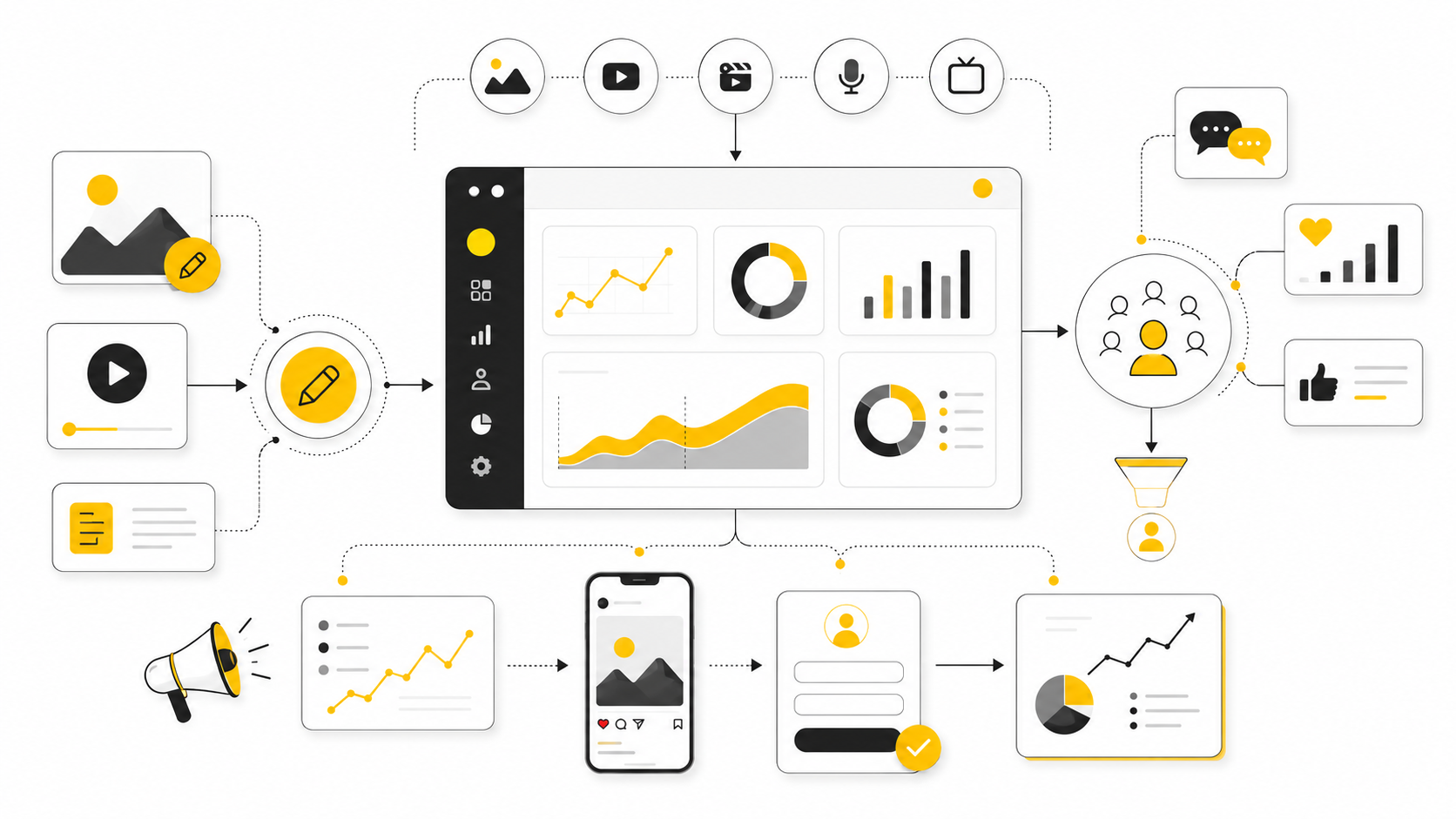
A social media promotion agency is not just a team that posts content for you. At its best, it helps a business turn attention into measurable growth by connecting content, distribution, community, paid promotion, creator partnerships, tracking, and follow-up. That matters because social media is no longer a side channel; global social media user identities reached 5.66 billion in October 2025, equal to 68.7% of the global population, based on DataReportal’s Digital 2026 global overview.
The hard part is not opening an Instagram, TikTok, LinkedIn, YouTube, or Facebook account. The hard part is building a repeatable system that attracts the right people, earns trust, captures demand, and proves what is working. A good social media promotion agency brings structure to that mess so growth does not depend on random viral posts, founder energy, or a content calendar nobody wants to follow.
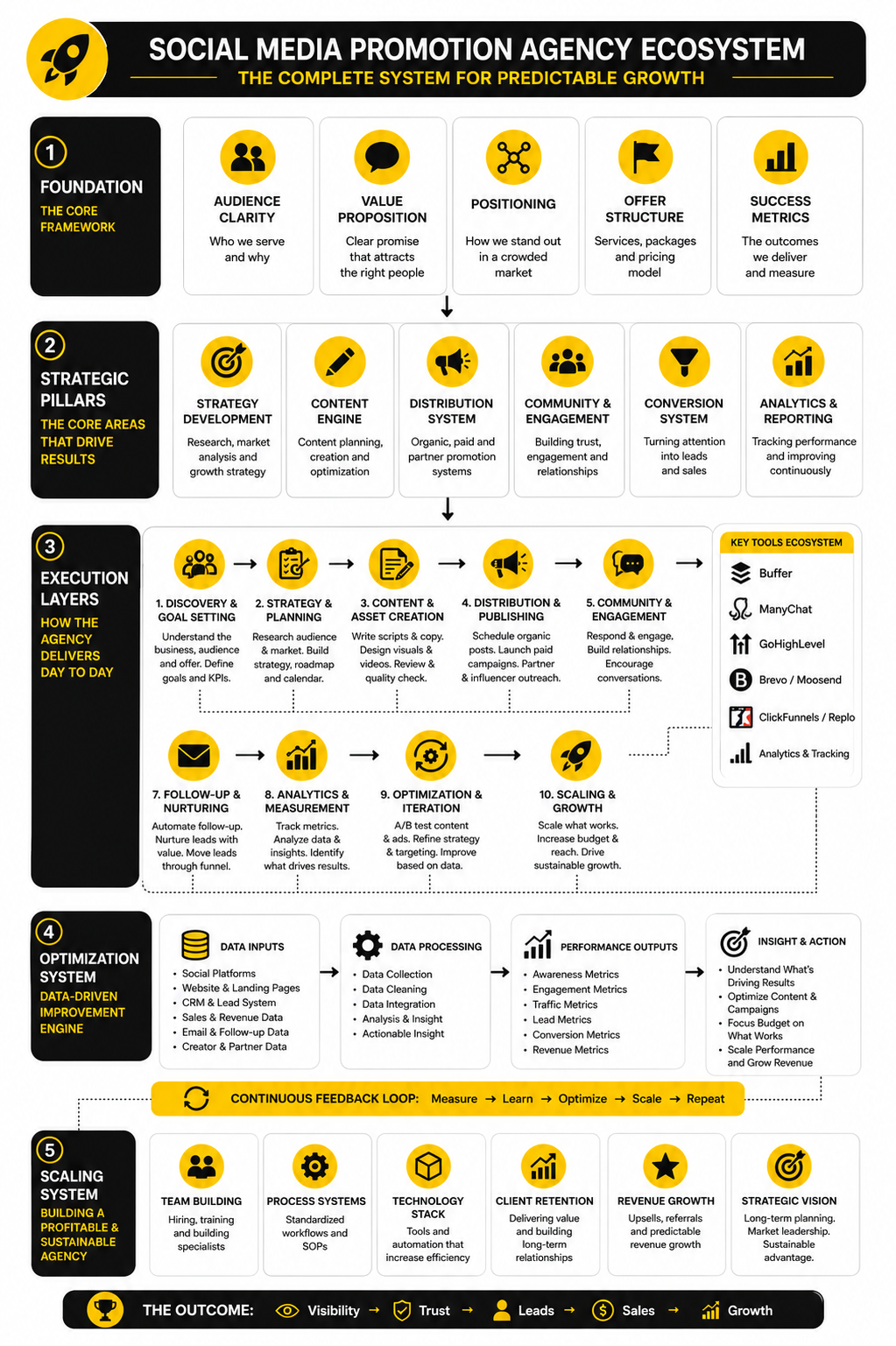
This guide breaks the topic into six parts so you can understand what an agency should actually do, how to evaluate one, and how to avoid paying for activity that does not move the business forward. The goal is practical: you should be able to look at an agency proposal, spot weak strategy, ask better questions, and build a promotion system that connects social content to revenue.
Why A Social Media Promotion Agency Matters
A social media promotion agency matters because most businesses do not have a content problem first. They have a positioning, consistency, distribution, and measurement problem. Posting more does not fix weak offers, unclear audience targeting, slow response times, poor creative testing, or a missing conversion path.
The modern social feed is crowded, fast, and unforgiving. Brands are competing with creators, customers, competitors, entertainment accounts, news cycles, private communities, and paid ads at the same time. That is why promotion has to be treated as a system, not a pile of posts.
There is also a trust gap. People may discover a brand through a short video, but they often need more proof before they buy, book, subscribe, or request a demo. A strong agency understands that social media promotion includes awareness, education, retargeting, lead capture, conversation, and follow-up, not just likes and impressions.
The Social Media Promotion Framework
The simplest way to understand a social media promotion agency is to see it as a bridge between attention and business outcomes. On one side, you have content, creators, comments, ads, trends, and distribution. On the other side, you have leads, sales calls, purchases, email subscribers, community growth, and customer retention.
A useful framework starts with the market, not the platform. The agency needs to know who the buyer is, what they already believe, what problem is urgent, what proof they need, and what offer makes action feel obvious. Only then does it make sense to decide whether the campaign belongs on TikTok, Instagram, LinkedIn, YouTube Shorts, Facebook, Pinterest, X, or a mix of channels.
The framework also needs feedback loops. Content performance should influence landing pages, paid ads should reveal which angles convert, comments should expose objections, and customer conversations should feed the next round of creative. Without that loop, social promotion becomes guesswork dressed up as strategy.
Core Components Of A Strong Agency Strategy
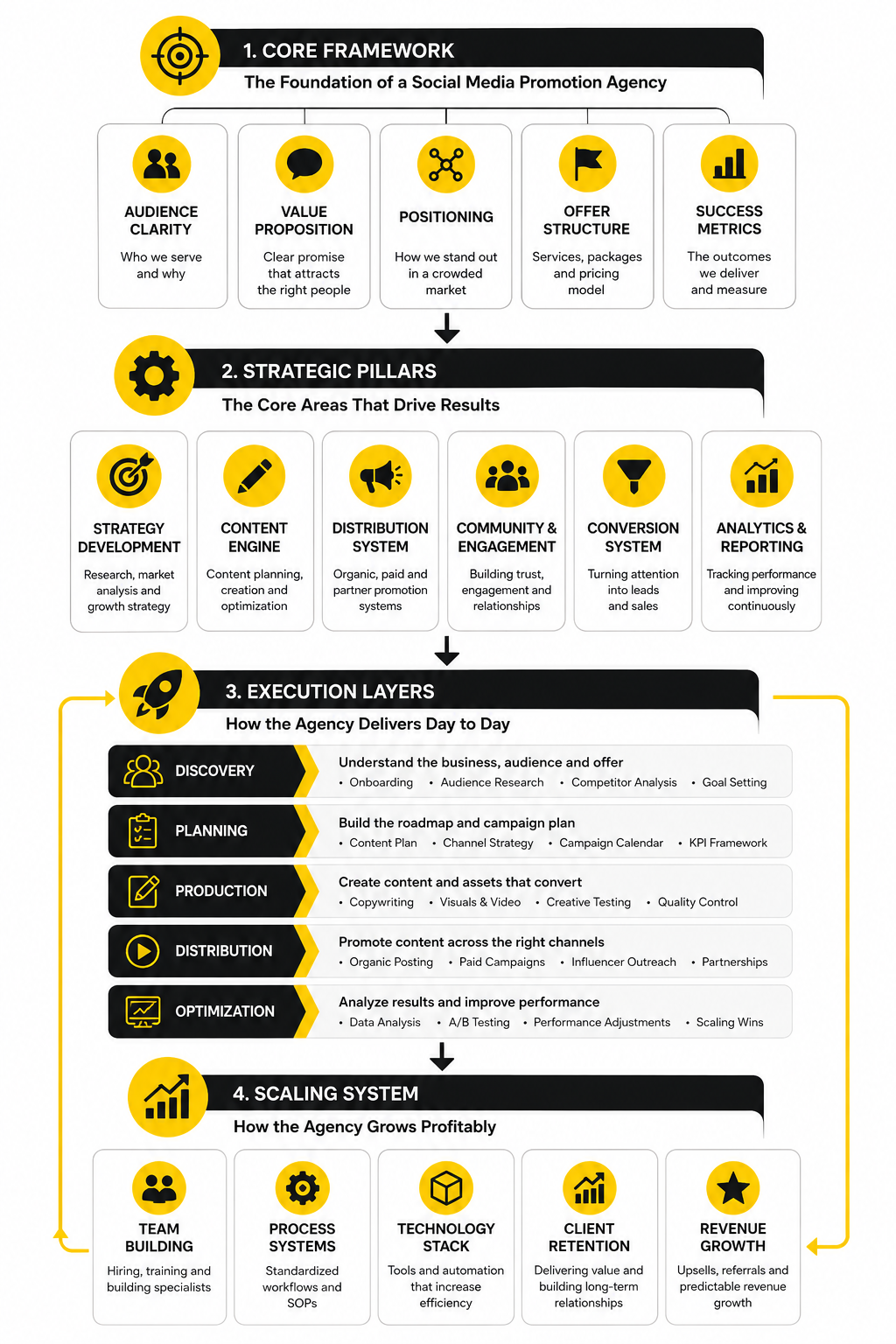
A strong agency strategy usually combines four things: positioning, content, distribution, and conversion. Positioning defines what the brand should be known for and why the audience should care. Content turns that positioning into useful, entertaining, persuasive, or trust-building assets.
Distribution makes sure the right people actually see the content. That can include organic posting, paid amplification, influencer partnerships, community engagement, social SEO, newsletter repurposing, and employee advocacy. For many businesses, this is where the difference between a content agency and a true social media promotion agency becomes obvious.
Conversion connects social activity to a next step. That might be a landing page, quiz, consultation form, DM automation, email sequence, webinar, product page, or calendar booking flow. Tools such as ManyChat, Buffer, and GoHighLevel can support parts of that system when they fit the business model, but the tool is never the strategy.
Professional Implementation And Workflow
Professional implementation is where many agencies separate themselves from freelancers who simply create content. A real workflow includes research, campaign planning, creative production, approvals, publishing, engagement management, reporting, and optimization. Each step should have an owner, a deadline, and a clear reason for existing.
The best agencies also protect speed without sacrificing quality. Social media moves quickly, but rushed content can still damage trust if it is off-brand, inaccurate, or disconnected from the offer. A practical workflow makes room for planned campaigns and timely reactions, so the brand can stay consistent while still participating in relevant conversations.
Measurement should be built into the workflow from day one. The agency should know which metrics matter at each stage, from reach and watch time to saves, clicks, leads, cost per acquisition, pipeline value, and retention signals. If reporting only shows vanity metrics, the business is not really learning whether social media promotion is creating growth.
From Attention To Revenue
The first job of a social media promotion agency is to connect attention to a business result. That sounds obvious, but it is where many campaigns fall apart. A post can get views, comments, and shares while still doing almost nothing for pipeline, product sales, bookings, or customer retention.
The connection usually happens in stages. Someone sees a useful post, watches more content, checks the profile, clicks through, joins a list, sends a message, books a call, or comes back later through retargeting. That path is rarely instant, so the agency has to design for movement instead of treating every post like it should close the sale by itself.
This is why the best agencies think beyond individual platforms. Recent research on e-commerce social strategy found that brands using a more diversified social media approach saw 2% to 5% higher total web sales, with repeated exposure across platforms helping reinforce purchase intent through overlapping impressions in the multi-platform social media strategy study. The practical takeaway is simple: one channel can start the relationship, but a coordinated system is what usually turns interest into action.
The Audience Comes Before The Content
A social media promotion agency should not begin with “how many posts per week?” That question matters later, but it is not the foundation. The real starting point is who the content is for, what they already care about, and what would make them stop scrolling long enough to pay attention.
This includes obvious details like industry, role, age range, location, and buying power. More importantly, it includes the emotional and practical context behind the purchase. A founder looking for booked sales calls, a local service business trying to get more appointments, and an e-commerce brand trying to improve repeat purchases may all need social media promotion, but they do not need the same message.
Audience research also protects the brand from copying competitors blindly. If a competitor is growing because of founder-led storytelling, that does not mean every brand should suddenly post confession-style videos. The agency needs to understand why the content works, who it attracts, and whether that audience matches the client’s actual business model.
The Offer Shapes The Promotion Strategy
Promotion gets easier when the offer is clear. If the audience cannot quickly understand what is being sold, who it is for, why it is different, and what happens next, even strong content will leak attention. A good agency will usually challenge the offer before scaling the campaign, because weak offers make every marketing channel look worse than it really is.
For service businesses, this might mean sharpening the promise, clarifying the qualification process, or creating a lower-friction entry point. For e-commerce brands, it may mean improving product education, bundling, landing pages, reviews, or post-purchase follow-up. For SaaS companies, it often means translating features into use cases that buyers can recognize quickly.
This is also where social media promotion becomes more strategic than simply “getting the word out.” The agency should know which content introduces the problem, which content builds trust, which content handles objections, and which content asks for the next step. When the offer and the content work together, promotion feels natural instead of pushy.
Channel Selection Should Be Intentional
Every platform has a different job. TikTok and Instagram Reels can be strong for discovery, YouTube can compound through search and long-form trust, LinkedIn can work well for B2B credibility, and Facebook can still matter for groups, local businesses, communities, and paid retargeting. The wrong move is treating every channel like the same content distribution box.
A social media promotion agency should choose channels based on the buyer, the offer, the creative format, and the conversion path. A visual consumer product may need short-form video, creator content, and shoppable landing pages. A high-ticket B2B service may need founder-led LinkedIn content, proof-based posts, webinar promotion, and retargeting that supports a longer buying cycle.
The agency should also be honest about capacity. It is better to run two channels well than six channels badly. More platforms create more production needs, more moderation, more reporting, and more creative variation, so channel expansion should happen when the system can support it.
Organic And Paid Promotion Need Different Roles
Organic social is useful for trust, testing, community signals, and long-term audience building. Paid promotion is useful for controlled distribution, faster learning, retargeting, and scaling messages that already show promise. They are not enemies, and treating them as separate worlds is a common mistake.
The smart sequence is usually to test angles organically, identify which messages earn attention or action, then use paid promotion to amplify the strongest creative. That does not mean every organic winner will become a profitable ad. It means organic performance can reveal hooks, objections, language patterns, and audience reactions before money is spent at scale.
Paid promotion also needs discipline. Platform algorithms can find pockets of demand, but they cannot fix a weak landing page, confusing offer, poor follow-up, or bad tracking. A serious agency will look at the entire path from impression to conversion instead of blaming the ad account every time results are inconsistent.
Content Needs A Clear Job
Content should never exist just because the calendar has an empty slot. Every asset should have a job, even when the tone is light, entertaining, or educational. Some posts attract new people, some deepen trust, some show proof, some answer objections, and some drive action.
A useful content mix usually includes educational posts, opinion-led posts, proof-based content, behind-the-scenes material, offer-focused posts, customer questions, and timely commentary. The balance depends on the business. A new brand may need more awareness and trust-building, while a brand with strong demand may need better conversion content and stronger retargeting.
This is where a social media promotion agency should bring creative judgment. The goal is not to make every post sound like an ad. The goal is to make the brand easier to understand, easier to trust, and easier to buy from over time.
Professional Implementation And Workflow
Once the strategy is clear, implementation is where the real work starts. A social media promotion agency should turn the big idea into a repeatable operating system, not a vague promise to “increase visibility.” That means the client should know what is being created, why it is being created, when it goes live, who approves it, and how performance will be reviewed.
The workflow should also reduce friction for the business. A founder, marketing manager, or sales team should not have to chase the agency every week just to understand what is happening. Strong implementation creates momentum because the process is visible, documented, and easy to improve.
This is especially important as social media teams are expected to do more than publish content. The 2025 Sprout Social Index is built around surveys of more than 4,000 consumers and 1,200 marketers, which reflects how central social has become to brand perception, customer care, and business communication. In plain English, social media is not just a marketing channel anymore; it is often where people judge whether a brand is responsive, credible, and worth trusting.
Step One: Audit The Current Position
The first implementation step is a proper audit. This should cover current channels, content quality, posting consistency, audience engagement, profile positioning, competitor activity, conversion paths, and tracking. A surface-level audit that only counts followers and engagement rate is not enough.
The agency should look for gaps between what the brand wants to be known for and what the audience actually sees. Maybe the profile says the company serves enterprise buyers, but the content feels too basic. Maybe the offer is strong, but the call to action is buried. Maybe the content gets attention, but the landing page does not continue the same message.
A useful audit ends with priorities, not a giant list of random observations. The business needs to know what should be fixed first, what can wait, and what is already working. That gives the social media promotion agency a practical starting point instead of forcing the team to rebuild everything at once.
Step Two: Build The Campaign Plan
After the audit, the agency should build a campaign plan around business goals. A campaign is different from a content calendar. A calendar says what gets posted; a campaign explains what the brand is trying to make happen.
The plan should define the audience, offer, message angles, creative formats, channels, publishing rhythm, paid support, conversion path, and reporting schedule. It should also explain what success looks like at each stage. Awareness campaigns, lead generation campaigns, event promotion, product launches, and retargeting campaigns all need different measurement logic.
This is where clarity matters. If the goal is booked calls, the campaign should not be judged mainly on likes. If the goal is brand awareness, the agency should not pretend every post must create immediate revenue. Good planning prevents weak reporting later.
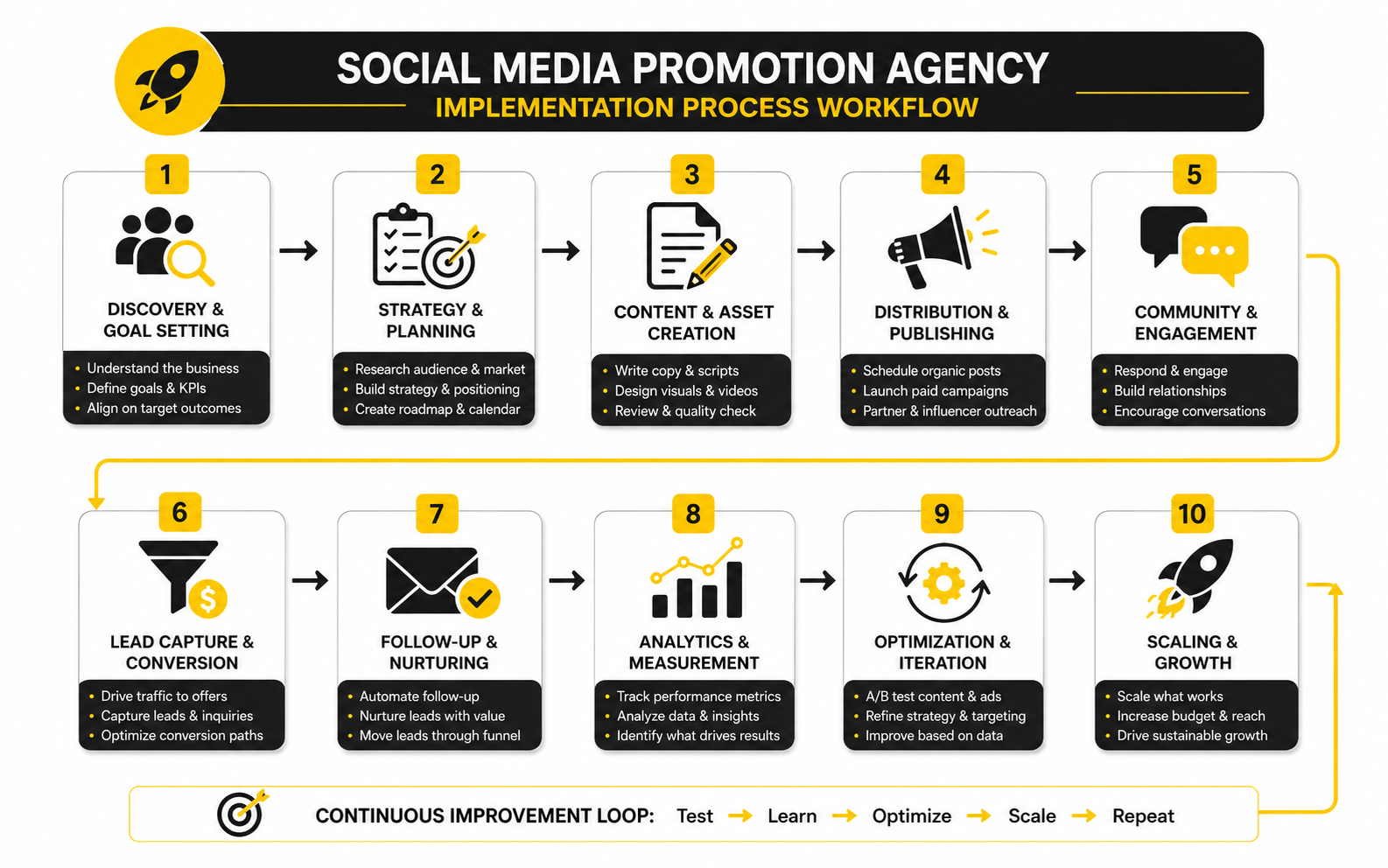
Step Three: Create The Content System
A content system gives the agency and client a shared way to produce without starting from zero every week. It usually includes content pillars, recurring formats, creative briefs, hooks, scripts, captions, visual guidelines, approval rules, and repurposing logic. The point is not to make content feel formulaic; the point is to make quality easier to repeat.
For many brands, short-form video will be part of the system. HubSpot’s 2025 marketing research notes that short-form video remains one of the top-performing content formats, which explains why agencies keep building workflows around Reels, TikToks, Shorts, and short LinkedIn clips. Still, video only works when the message is sharp enough to earn attention quickly.
The system should also include written content, carousels, static posts, community replies, case-led posts, and offer-focused assets where they fit. Not every brand needs to dance on TikTok, and not every campaign needs a talking-head video. The right content system matches the brand’s strengths with the audience’s buying behavior.
Step Four: Set Up Publishing And Approval
Publishing sounds simple until multiple people are involved. Without a clean approval process, content gets delayed, edited into blandness, or published with avoidable mistakes. A professional agency should make the approval workflow clear before volume increases.
The process should define who reviews strategy, who reviews accuracy, who reviews brand voice, and who gives final approval. It should also set deadlines so posts do not sit in limbo for days. If the client needs too many internal approvals, the agency should flag that as a growth constraint because social media rewards speed and consistency.
Scheduling tools can help once the process is clear. A platform like Buffer can support planning, scheduling, and organizing posts across channels, but it will not solve unclear ownership by itself. Tools work best when they support a workflow that already makes sense.
Step Five: Manage Engagement And Conversations
Publishing is only half the job. The other half is what happens after the post goes live. Comments, DMs, replies, mentions, and tagged content can reveal objections, buying signals, customer frustration, product questions, and content ideas.
A social media promotion agency should define how engagement will be handled. Some brands need fast customer-care escalation. Others need lead qualification through direct messages. Some need community management that makes the brand feel present without sounding forced.
This part can have a direct commercial impact. A DM that gets answered quickly can become a call, a sale, or a long-term relationship. A comment that gets ignored can make the brand look asleep. Social media promotion is not only about reach; it is also about how the brand behaves when people respond.
Step Six: Connect Social To Follow-Up
The best campaigns do not leave interested people stranded. When someone clicks, comments, sends a message, downloads something, or books a call, the follow-up should feel intentional. That is where many businesses lose money they already worked hard to earn.
For lead generation, the agency may connect social campaigns to forms, calendars, email sequences, CRM pipelines, or automated message flows. For e-commerce, the follow-up may include product education, abandoned cart recovery, post-purchase content, review requests, and retention campaigns. For communities, it may involve onboarding, reminders, discussion prompts, and event promotion.
This is where tools like GoHighLevel, ManyChat, Brevo, or Moosend can become useful. The point is not to automate everything. The point is to make sure valuable attention does not disappear because nobody followed up.
Step Seven: Review, Learn, And Improve
A proper review is not a screenshot of impressions. It should explain what happened, why it probably happened, and what the team will change next. The agency should separate platform noise from real learning so the client does not overreact to every spike or dip.
The review should include both quantitative and qualitative signals. Numbers show patterns, but comments, DMs, sales feedback, and customer questions explain why those patterns may be happening. A post with moderate reach but strong buying questions may be more valuable than a viral post that attracts the wrong audience.
This is the loop that makes the whole process better. The audit creates direction, the campaign creates focus, the content system creates consistency, engagement creates insight, and reporting turns the insight into the next move. That is how a social media promotion agency becomes a growth partner instead of just another vendor posting on the internet.
Statistics And Data
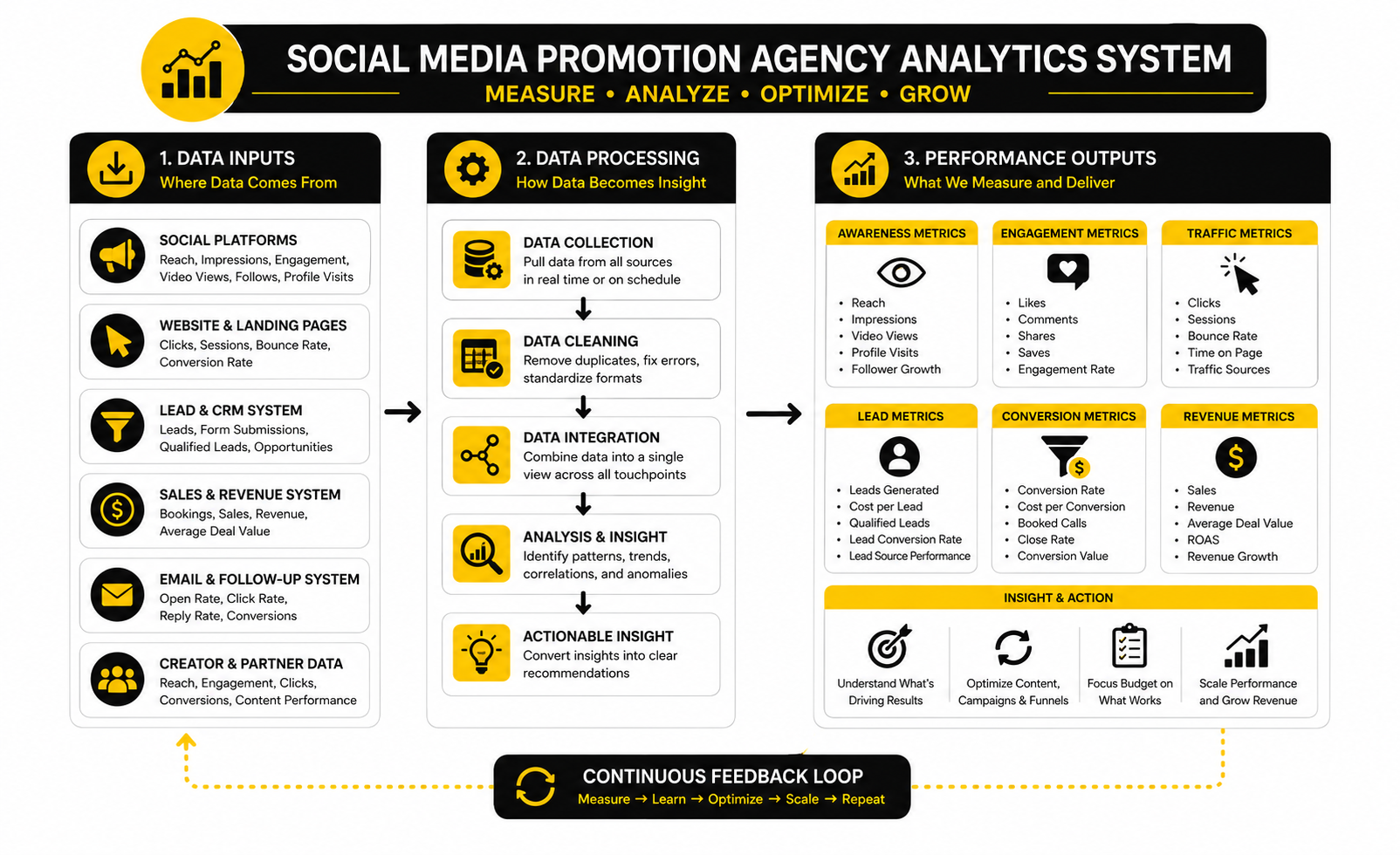
Measurement is where a social media promotion agency proves whether the work is creating momentum or just making noise. The mistake is treating analytics like a scoreboard after the campaign is over. Good measurement is a steering system, and it should influence what gets produced, promoted, paused, repeated, or rebuilt.
The numbers matter because social media performance can look impressive while hiding weak business impact. A post can reach thousands of people and still attract the wrong audience. An ad can generate cheap clicks and still produce low-quality leads. A campaign can increase followers and still fail to create sales conversations.
That is why the data has to be interpreted in layers. The agency should look at visibility, engagement quality, traffic, conversion, cost, and retention signals together. No single metric tells the whole story, but the right combination can show whether attention is moving toward revenue.
The Metrics That Actually Matter
The first layer is reach and impressions. These show how much exposure the content is getting, but they do not prove that people care. Reach is useful when the goal is awareness, but it becomes shallow when it is used as the main success metric for lead generation or sales.
The second layer is attention quality. Watch time, completion rate, saves, shares, profile visits, meaningful comments, and repeat engagement usually tell a better story than likes alone. If people save a post, send it to someone else, or ask a detailed question in the comments, the content is doing more than filling the feed.
The third layer is action. Click-through rate, landing page conversion rate, form starts, booked calls, direct messages, purchases, email signups, and cost per qualified lead show whether the campaign is moving people to the next step. A social media promotion agency should connect these actions to the campaign goal instead of reporting every number with the same weight.
Benchmarks Are Useful, But They Are Not The Strategy
Benchmarks help you spot whether performance is unusually weak, average, or strong. They are useful for context, especially when a business has no historical data. But benchmarks should never replace judgment because different industries, offers, audiences, and creative formats produce different numbers.
The 2025 Rival IQ benchmark report found that engagement rates fell across major platforms, including a 36% drop on Facebook, 16% on Instagram, 34% on TikTok, and 48% on X, in its 2025 Social Media Industry Benchmark Report. That matters because a flat engagement rate may not always mean the agency is failing. In some categories, the whole environment is getting more competitive, so the better question is whether the brand is improving against its own baseline and converting the attention it does earn.
Ad benchmarks need the same careful reading. WordStream’s 2025 Facebook Ads benchmark data reported an average $1.92 cost per click for Facebook Lead Ads, while broader Facebook ad benchmarks put average CPC around $1.68 across industries in its Facebook advertising benchmark analysis. Those numbers are helpful, but they do not tell you whether your campaign is profitable. A higher CPC can still be excellent if the leads are qualified, the close rate is strong, and the customer value supports the cost.
Build A Measurement System Before Scaling
A clean measurement system starts with one question: what decision will this data help us make? If the answer is unclear, the metric probably belongs in a secondary report, not the main dashboard. The best dashboards are not overloaded; they show the few numbers that help the team act faster.
For a lead generation campaign, the agency may track impressions, hook rate, click-through rate, cost per lead, booked-call rate, show-up rate, close rate, and revenue per lead. For e-commerce, the system may track content engagement, product page clicks, add-to-cart rate, conversion rate, average order value, repeat purchase rate, and revenue from retargeting. For brand awareness, the focus may be reach, frequency, branded search lift, profile growth quality, share of voice, and direct traffic trends.
The important part is connecting the stages. If reach is strong but clicks are weak, the message may be interesting but not commercially clear. If clicks are strong but conversions are weak, the landing page, offer, audience, or follow-up may be the problem. If leads are cheap but sales are poor, the campaign may be attracting curiosity instead of buying intent.
Read Platform Data With Context
Every platform rewards different behavior, so the same number can mean different things in different places. A high save rate on Instagram may suggest practical value, while strong average watch duration on YouTube may suggest deeper trust. On LinkedIn, the quality of commenters can matter more than the raw number of reactions.
This is why a social media promotion agency should never copy one reporting template across every client. A B2B consulting firm, local clinic, SaaS company, e-commerce store, and creator-led brand all need different signal weighting. The dashboard should reflect the business model, not the agency’s convenience.
Context also matters when comparing formats. A quick meme-style post may earn comments but not conversions. A detailed carousel may earn fewer views but produce stronger saves and profile visits. A founder video may get modest reach but create the trust needed for higher-ticket buyers.
Separate Vanity Metrics From Diagnostic Metrics
Vanity metrics are not useless, but they are dangerous when they are treated as proof of growth. Followers, likes, impressions, and views can be useful signals when they are tied to audience quality and business movement. They become vanity metrics when they are reported without context.
Diagnostic metrics help explain what to change. Hook rate can show whether the opening of a video is strong enough. Hold rate can show whether the content keeps attention. Click-through rate can show whether the message creates enough intent. Conversion rate can show whether the offer and landing page are doing their job.
The agency’s role is to translate those diagnostics into action. If saves are high but clicks are low, the content may be educational but missing a clear next step. If comments are high but negative, the content may be attracting attention for the wrong reason. If paid ads generate leads but sales rejects them, the qualification criteria need to be tightened.
Measure Creative, Not Just Channels
A channel-level report can tell you that Instagram, TikTok, LinkedIn, or Facebook performed better, but it may not explain why. Creative-level analysis is usually more useful because it shows which hooks, topics, formats, visuals, offers, and calls to action are actually driving behavior. This is where campaign improvement gets practical.
The agency should tag content by message angle, funnel stage, format, audience segment, and offer. Over time, patterns become visible. Maybe objection-handling posts drive better sales conversations. Maybe comparison content brings in higher-intent traffic. Maybe founder-led videos create better leads than polished brand graphics.
That kind of learning compounds. Instead of asking, “What should we post next week?” the team can ask, “Which proven message should we adapt next?” That is a much better question, and it is one of the biggest reasons to hire a social media promotion agency with a real analytics process.
Reporting Should Lead To Decisions
A report that does not change behavior is just documentation. Each reporting cycle should end with decisions about what to stop, what to continue, what to test, and what to scale. This keeps the relationship focused on improvement instead of performance theater.
Monthly reports should usually cover trendlines, campaign results, best-performing assets, weak points in the funnel, audience insights, and next actions. Weekly reviews can be lighter and more tactical, especially during launches or paid campaigns. The agency should explain what the numbers mean in plain language so the client can make decisions without decoding marketing jargon.
This is where discipline matters. The goal is not to chase every spike, panic over every dip, or reinvent the strategy every Monday. The goal is to collect enough signal to make better moves with more confidence. A good social media promotion agency uses data to sharpen the system, not to bury the client in dashboards.
How To Choose, Manage, And Measure An Agency
Choosing a social media promotion agency is not just about finding the team with the best-looking portfolio. You are choosing an operating partner that will influence how people discover, understand, question, and trust your brand. That means the decision should be based on strategy, execution discipline, reporting quality, and fit with your business model.
The wrong agency can make a busy marketing calendar look productive while quietly wasting months. The right agency will make tradeoffs visible, explain what they are testing, challenge weak assumptions, and help your team focus on the few actions that actually move the business. This is where advanced evaluation matters.
A good agency relationship should feel clear, not magical. You should understand what is being done, why it matters, what the risks are, and how success will be judged. If everything sounds vague, overconfident, or dependent on “going viral,” slow down.
Strategic Tradeoffs To Understand Before Hiring
Every social media strategy involves tradeoffs. A campaign built for speed may sacrifice depth. A campaign built for brand polish may move too slowly for real-time trends. A campaign built for reach may not attract buyers with strong intent.
The agency should be able to explain those tradeoffs before the work begins. If the goal is demand generation, the content may need more proof, sharper offers, stronger calls to action, and better follow-up. If the goal is category awareness, the content may need broader ideas, bigger creative swings, and more patience before direct conversions show up.
Budget also creates tradeoffs. A smaller budget may require fewer channels, tighter creative focus, and more organic testing before paid amplification. A larger budget can support creators, production, ads, testing, and analytics, but it also increases the cost of poor decision-making. More money does not fix unclear strategy; it only makes unclear strategy more expensive.
The Risk Of Outsourcing The Brand Voice
A social media promotion agency can run the process, but it should not erase the brand’s point of view. This is a real risk. When an agency takes over completely without enough access to leadership, customers, sales insights, and product knowledge, the content often becomes polished but generic.
The strongest content usually comes from close collaboration. The agency brings structure, creative direction, production skill, and distribution knowledge. The client brings lived experience, customer language, product truth, founder perspective, and market nuance.
This matters even more in markets where trust is hard to earn. If the brand sells a high-ticket service, complex software, financial product, health-related solution, or professional expertise, shallow content will not be enough. The audience needs to feel that there is real judgment behind the message.
Creator Partnerships Need Control And Flexibility
Creator partnerships can help a brand borrow trust, reach new audiences, and produce content that feels native to the platform. But creators are not just media placements. They are people with their own audience, tone, strengths, limits, and reputation.
A social media promotion agency should help manage the balance between control and flexibility. Too much control can make creator content sound like a scripted ad. Too little control can create brand safety issues, inaccurate claims, or content that gets attention for the wrong reason.
Creator investment is becoming more serious. U.S. creator ad spend is projected to reach $37 billion in 2025, growing 26% year over year, in the IAB 2025 Creator Economy Ad Spend and Strategy Report. That matters because creator campaigns are no longer experimental side projects for many brands; they are becoming a core part of paid and organic social strategy.
Paid Amplification Changes The Creator Game
Organic creator posts can work, but relying only on organic reach is risky. Platforms decide distribution, audiences behave unpredictably, and even strong content can underperform if it does not get enough initial traction. Paid amplification gives the brand more control over who sees the creative and how often they see it.
This changes how agencies should evaluate creator content. The question is not only, “Did the creator’s post perform well on their own account?” The better question is, “Can this creative be used, tested, retargeted, and scaled across the paid media system?” That is a much more useful lens for performance-focused brands.
The agency should negotiate usage rights, whitelisting or partnership ad permissions, approval timelines, disclosure requirements, and reporting expectations before content goes live. These details sound boring until they are missing. Then they become expensive.
Compliance Is Not Optional
Social media promotion moves fast, but legal and ethical basics still matter. If creators, affiliates, employees, or partners are promoting a brand, the relationship should be disclosed clearly. Hidden endorsements can damage trust and create regulatory risk.
The FTC’s endorsement guidance explains that material connections between advertisers and endorsers need to be disclosed clearly and conspicuously in social media and influencer marketing through its endorsement and influencer guidance. This is not a detail to leave until after a campaign is already live. It should be built into briefs, contracts, captions, video scripts, approvals, and creator instructions.
Compliance also includes claims. An agency should be careful with performance promises, health claims, financial claims, customer results, testimonials, before-and-after content, AI-generated assets, and review requests. The fastest way to create short-term attention is often the same way to create long-term problems, so the agency needs judgment.
Scaling Requires More Than More Content
Scaling social media promotion does not mean posting twice as much. It means improving the system so more output does not lower quality, confuse the audience, or overwhelm the team. Growth creates operational pressure, and the agency should be honest about that.
As campaigns expand, the brand may need more creative variants, stronger asset management, clearer approval rules, better landing pages, faster response handling, and cleaner CRM data. It may also need stronger internal collaboration between marketing, sales, product, customer support, and leadership. Social media exposes gaps that were already there.
This is where tools can support the workflow. GoHighLevel can help agencies and service businesses connect funnels, CRM, follow-up, and automation. ClickFunnels can support offer pages and funnel testing when the campaign needs a dedicated conversion path. Replo can be useful for e-commerce landing pages where creative testing needs to connect tightly with product storytelling.
Red Flags In Agency Proposals
A weak proposal often hides behind volume. It promises a large number of posts, vague engagement, generic reporting, and “brand awareness” without explaining the actual path to business value. More deliverables can look impressive, but volume without direction usually creates noise.
Be careful when an agency guarantees viral results, avoids talking about conversion paths, refuses to define responsibilities, or cannot explain how it will learn from the data. Also watch for agencies that use the same strategy for every client. Templates are fine for process, but they are dangerous when they replace thinking.
A strong proposal should make the work feel concrete. It should show the strategic focus, campaign structure, creative approach, channel logic, measurement plan, communication rhythm, and assumptions behind the recommendation. You do not need a 70-page document. You need clarity.
What A Strong Agency Relationship Looks Like
A strong agency relationship has honest communication. The agency tells you what is working, what is not working, and what needs to change. The client gives the agency access to real business context instead of expecting them to guess from the outside.
There should also be healthy tension. The agency should challenge the client when approvals are too slow, the offer is unclear, the landing page is weak, or the requested content does not match the goal. The client should challenge the agency when reporting is vague, strategy feels recycled, or creative quality slips.
That partnership is the real advantage. A social media promotion agency can bring expertise, but the best results come when both sides treat promotion as a serious growth system. Not a content chore. Not a vanity project. A system.
Tools, Systems, And Final Recommendations
At this stage, the full picture should be clear. A social media promotion agency is not valuable because it can publish posts for you. It is valuable when it can connect strategy, creative, distribution, analytics, follow-up, and decision-making into one working system.
The stack behind that system should be simple enough to use and strong enough to support growth. Most businesses do not need twenty tools. They need a clear content workflow, reliable scheduling, clean landing pages, accurate tracking, fast follow-up, and a reporting rhythm that leads to better decisions.
For many agencies and service businesses, a practical stack might include Buffer for planning and scheduling, ManyChat for social messaging flows, GoHighLevel for CRM and automation, Brevo or Moosend for email follow-up, and ClickFunnels or Replo for conversion pages. The right tools depend on the business model, but the principle stays the same: every tool should support a specific job in the promotion system.
What does a social media promotion agency do?
A social media promotion agency helps businesses turn social media attention into measurable growth. That can include strategy, content planning, creative production, paid promotion, creator partnerships, community management, analytics, and follow-up systems. The best agencies do not just post content; they build a process that moves people from discovery to action.
How is a social media promotion agency different from a social media management agency?
A social media management agency often focuses on maintaining a brand’s presence through posting, scheduling, and basic engagement. A social media promotion agency should go further by actively building campaigns around reach, traffic, leads, sales, and audience growth. There is overlap, but promotion usually implies a stronger focus on distribution, conversion, and performance.
When should a business hire a social media promotion agency?
A business should consider hiring an agency when social media has clear growth potential but the internal team lacks time, strategy, creative capacity, or execution discipline. It also makes sense when the business already has a proven offer and needs more consistent demand. If the offer, audience, or conversion path is still unclear, the agency should help clarify those pieces before scaling activity.
What should I look for in a strong agency proposal?
A strong proposal should explain the audience, campaign strategy, content approach, channel plan, reporting structure, and expected decision points. It should show how the agency will learn from performance instead of simply delivering a fixed number of posts. Be cautious if the proposal is mostly about volume, vague awareness, or guaranteed viral results.
How much should a social media promotion agency cost?
Costs vary depending on strategy depth, content volume, production quality, paid media management, creator coordination, analytics, and the number of platforms involved. A small local campaign may require a very different budget than a multi-channel campaign with video production and paid amplification. The better question is whether the agency can explain what each part of the budget is meant to accomplish.
Which platforms should an agency focus on first?
The best platforms depend on the audience, offer, content format, and buying journey. A B2B company may prioritize LinkedIn and YouTube, while a consumer product brand may focus more on TikTok, Instagram, and paid social. A strong agency will usually start with the channels most likely to create useful learning, not the channels that are simply popular.
How long does social media promotion take to work?
Some campaigns can create fast signals through paid traffic, creator partnerships, or launch promotion. Organic trust-building usually takes longer because the brand needs repeated exposure, better content, and stronger audience recognition. A good agency should separate early indicators from long-term outcomes so the business does not judge the whole strategy too soon.
What metrics should I ask an agency to report?
Ask for metrics that match the campaign goal. For awareness, that may include reach, frequency, video retention, profile visits, and branded search movement. For lead generation or sales, it should include clicks, conversion rate, cost per qualified lead, booked calls, sales quality, revenue, and follow-up performance.
Are followers still important?
Followers can matter, but they are not the main goal by themselves. A smaller audience of real buyers, partners, customers, and advocates is usually more valuable than a large audience that never takes action. A serious social media promotion agency should care about audience quality, not just audience size.
Should an agency handle paid ads too?
It often helps when the agency understands paid amplification, even if a separate media buyer manages the ad account. Organic and paid social are connected because content insights can inform ads, and ad data can reveal which messages drive action. If the agency handles paid ads, make sure reporting connects spend to business outcomes, not just clicks and impressions.
Should the agency create all content for the brand?
The agency can create a lot of the content, but the brand should still contribute insight. Customer questions, sales objections, founder perspective, product knowledge, and real market experience make the content stronger. The best setup is usually collaborative: the agency owns the process, while the client provides the truth that makes the content credible.
How do I know if an agency is underperforming?
Underperformance is not always one bad month or one weak campaign. The bigger warning signs are vague reporting, repeated excuses, no clear testing plan, poor communication, slow execution, and content that does not match the business goal. If the agency cannot explain what it is learning or what it will change next, the relationship probably needs to be reset.
Can automation help with social media promotion?
Automation can help with scheduling, lead capture, message routing, email follow-up, reminders, and CRM updates. It should not replace human judgment, brand voice, or real customer conversations. Tools like ManyChat, GoHighLevel, and Brevo work best when they support a clear strategy instead of becoming a shortcut for lazy marketing.
What is the biggest mistake businesses make with social media promotion?
The biggest mistake is confusing activity with progress. Posting every day, chasing trends, or boosting random content can feel productive, but it does not automatically create demand. Social media promotion works best when every part of the system has a job: attract the right people, build trust, create action, and improve based on data.
Build a stronger local presence with BAAM AI
Turn your website, Google profile, social channels, and AI visibility into one growth engine
Most businesses do not need more random marketing activity. They need a consistent presence system that helps the right people find them, trust them, and take action. BAAM AI brings strategy, local SEO, website updates, Google Maps visibility, social content, AI-search readiness, media production, and reporting into one practical monthly engine.
If you want your marketing to keep working after the campaign ends, start with a free BAAM AI presence audit. See how your business shows up today and where the fastest visibility wins are at BAAM AI.