
BAAM AI Blog
Social Media Pricing: A Practical Framework For Charging, Buying, And Scaling Social Media Work
Social media pricing is messy because “social media” is not one service. It can mean posting three times a week, producing short-form video, managing comments, building funnels, running paid ads, reporting on...
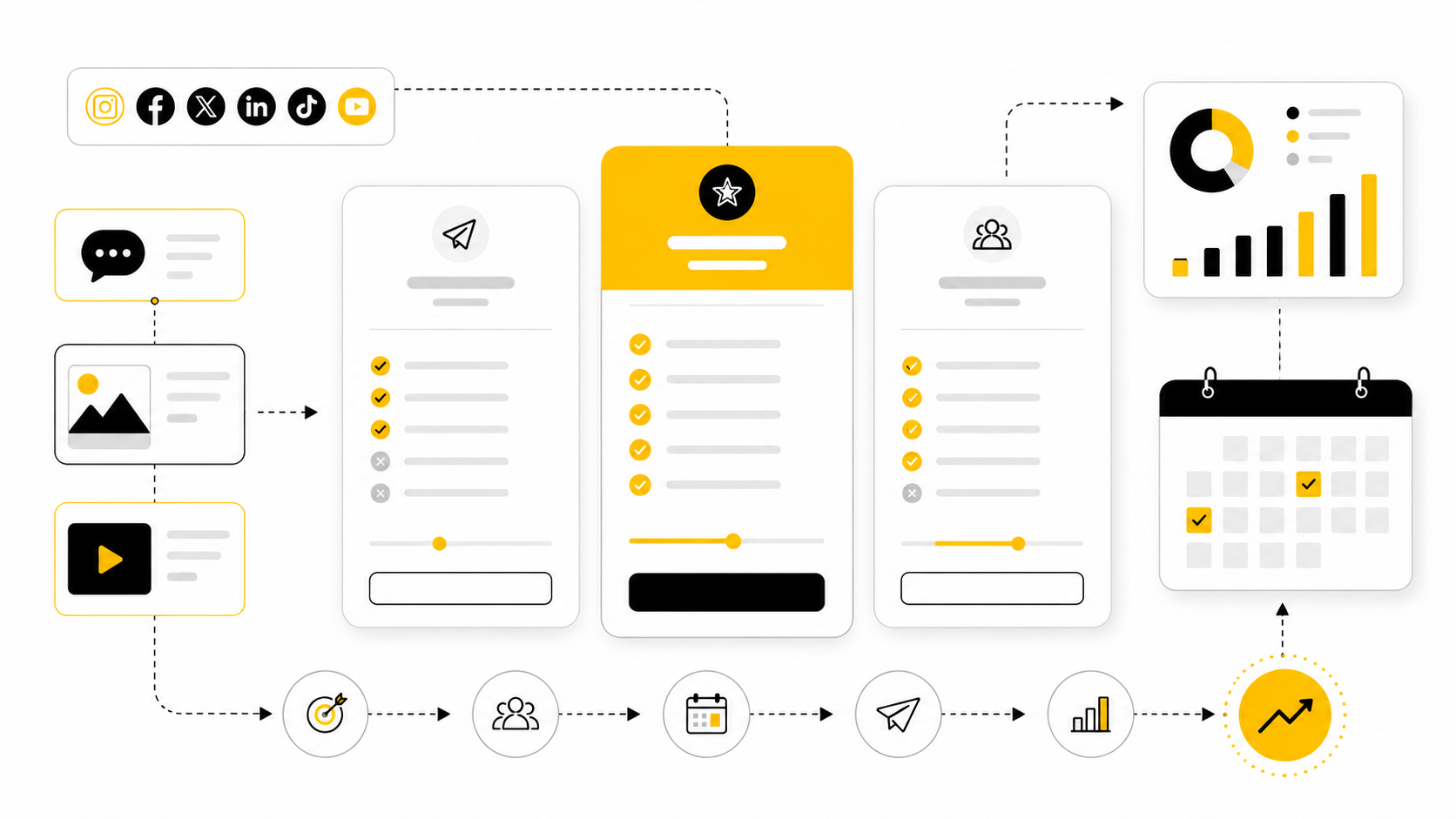
Social media pricing is messy because “social media” is not one service. It can mean posting three times a week, producing short-form video, managing comments, building funnels, running paid ads, reporting on revenue, coordinating creators, or doing all of that at once. That is why two proposals can both say “social media management” while one costs $750 per month and the other costs $7,500 per month.
The real question is not “what should social media cost?” The better question is “what outcome, workload, risk, and level of expertise are actually being priced?” Once you see the moving parts clearly, social media pricing stops feeling random and starts becoming a business decision.
That matters because social is no longer a side channel. Global social media user identities reached 5.79 billion in April 2026, equal to 69.9% of the global population, based on DataReportal’s 2026 global update. Brands are also spending heavily in the channel, with social ads projected to represent 32.1% of total digital ad spend in 2025, as shown in DataReportal’s Digital 2026 overview.
this guide breaks down social media pricing from both sides: how service providers should price their work and how businesses should evaluate what they are buying. The goal is not to hand you one magic number. The goal is to help you understand the pricing logic behind retainers, packages, hourly rates, project fees, content production, paid social, automation, reporting, and performance-based models.
Why Social Media Pricing Matters
Social media pricing matters because cheap work often becomes expensive later. A low monthly fee can look attractive until the posts are generic, the reporting is weak, the strategy is vague, and nobody knows whether the work is producing business value. On the other side, a premium quote can also be wasteful if the scope is bloated, the brand does not need that much production, or the provider cannot connect activity to outcomes.
The gap between “posting content” and “building a social media growth system” is huge. Posting content is execution. A growth system includes positioning, creative direction, production workflows, analytics, customer response, campaign planning, paid distribution, conversion paths, and decision-making based on performance.
That is why social media pricing should never be based only on the number of posts. Post count is easy to understand, but it is a weak pricing anchor by itself. Ten simple Canva posts are not the same as ten platform-native videos with hooks, scripts, edits, captions, community management, and performance analysis.
Current market benchmarks show how wide the range can be. Upwork lists social media managers at a typical range of $14 to $35 per hour, with a $20 median hourly rate, on its social media manager cost page. WebFX places social media management services at roughly $500 to $5,000 per month, with hourly rates around $35 to $150, in its 2026 social media pricing guide.
Those numbers are useful, but they are only a starting point. A freelancer scheduling posts for a local business is not priced like an agency managing strategy, creative, paid campaigns, reporting, and customer care for a multi-location brand. The more responsibility a provider takes for revenue, brand risk, creative quality, and operational complexity, the more the pricing needs to reflect that.
Framework Overview
A practical social media pricing framework starts with four layers: strategy, production, distribution, and optimization. Strategy defines what the brand is trying to accomplish and how social supports the business model. Production turns that strategy into content assets that can actually compete in the feed.
Distribution decides how the content gets seen. That may include organic posting, creator collaboration, paid ads, email follow-up, community engagement, or landing pages. Optimization then closes the loop by looking at performance data, identifying what worked, and improving the next round of execution.
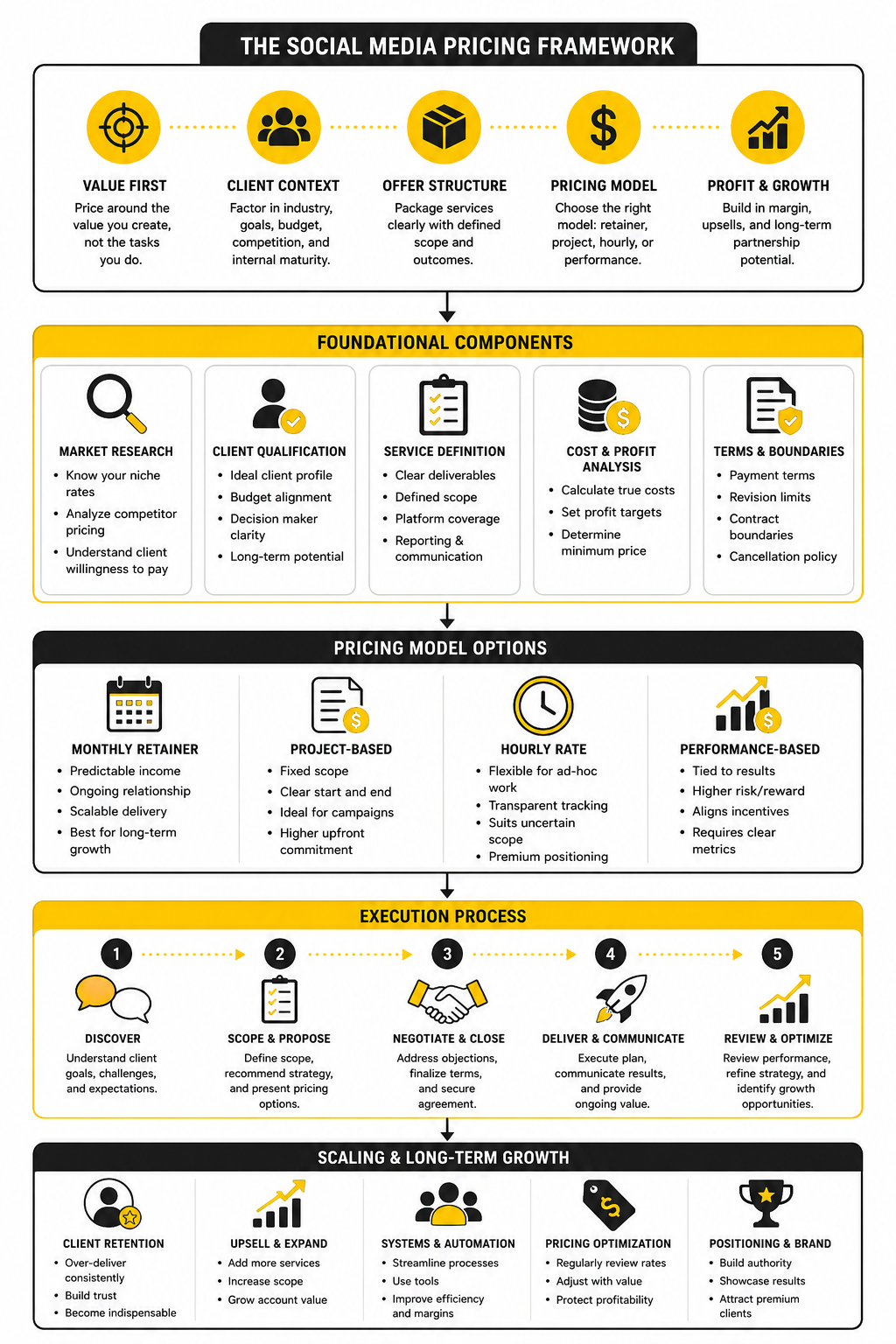
This framework matters because most pricing problems happen when these layers are mixed together without clear boundaries. A client may think they are buying “content,” while the provider is also expected to create strategy, edit videos, manage DMs, report on analytics, and advise on campaigns. That is not a content package anymore; that is an operating system.
The cleanest way to price social media is to separate deliverables from responsibilities. Deliverables are the visible outputs: posts, videos, captions, graphics, reports, calendars, and campaigns. Responsibilities are the invisible burdens: research, planning, judgment, communication, approvals, revisions, brand safety, performance interpretation, and accountability.
That distinction is where better pricing begins. A provider can charge more when they own more thinking, more risk, and more business impact. A buyer can make more carefully decisions when they understand what is included, what is excluded, and what level of support the price actually covers.
Core Components Of Social Media Pricing
The first component is platform scope. Managing Instagram alone is different from managing Instagram, TikTok, LinkedIn, YouTube Shorts, Facebook, Pinterest, and X at the same time. Each platform has different formats, creative norms, publishing rhythms, analytics, and audience expectations.
The second component is content complexity. Static graphics, carousels, short-form videos, long-form clips, founder-led content, UGC-style ads, product demos, and thought leadership posts all require different levels of planning and production. Video-heavy work usually costs more because it involves scripting, filming guidance, editing, hooks, captions, pacing, thumbnails, and repurposing.
The third component is strategic depth. A basic package may include scheduling and light captions. A serious package may include audience research, positioning, campaign planning, competitor analysis, conversion mapping, offer testing, and reporting tied to leads or sales.
The fourth component is engagement and customer care. Responding to comments and DMs is not a small add-on when a brand has active demand, complaints, sales questions, or support issues coming through social. The 2025 Sprout Social Index found that 73% of consumers say they will buy from a competitor next time when a brand does not respond on social, as cited in Sprout Social’s guide to building a social media scorecard.
The fifth component is tooling and workflow. A small creator may manage everything manually, but a growing business often needs scheduling, approvals, analytics, CRM connections, automation, and lead capture. For example, a lean team might use Buffer for publishing, ManyChat for social messaging automation, and GoHighLevel when social leads need to move into a CRM, pipeline, and follow-up system.
Professional Implementation
Professional social media pricing starts with scope discipline. Before a price is quoted, the provider needs to define platforms, posting frequency, content types, revision limits, approval process, reporting cadence, meeting rhythm, and response expectations. Without those boundaries, the project becomes a moving target.
A strong proposal should also explain what the price does not include. Paid ad spend, influencer payments, professional shoots, advanced video editing, landing page builds, giveaway prizes, community management after hours, and crisis communications should not be silently bundled into a basic management fee. Clear exclusions protect both sides.
For businesses buying social media services, the best move is to compare proposals by responsibility, not just price. One provider may charge $1,000 per month for scheduling and basic graphics, while another charges $4,000 per month for strategy, content production, reporting, and campaign management. The second option is not automatically better, but it is also not the same product.
For freelancers and agencies, the best move is to stop pricing only from effort and start pricing from operational value. If your work saves the client time, improves creative consistency, protects brand reputation, supports sales, and creates measurable learning, your pricing should not look like a task list. It should look like a professional service with clear outcomes, clear systems, and clear limits.
That is the foundation for the rest of the article. Next, the pricing models themselves need to be separated: hourly, monthly retainers, per-platform pricing, project pricing, performance pricing, and hybrid structures. Each model can work, but each one creates different incentives, risks, and profit margins.
The Main Social Media Pricing Models
The first mistake people make with social media pricing is assuming there is one “normal” way to charge. There is not. Social media work can be priced hourly, monthly, by project, by platform, by content volume, by campaign, by performance, or through a hybrid model that blends several of those together.
The right model depends on the shape of the work. A one-time audit should not be priced like an ongoing management retainer. A paid social campaign should not be priced like organic content scheduling. A full-service growth system should not be priced like a simple posting calendar.
This is where clarity saves everyone. A pricing model is not just a billing method; it sets expectations for speed, scope, accountability, communication, and risk. Choose the wrong model, and even a fair price can turn into a frustrating engagement.
Hourly Pricing
Hourly pricing is the simplest model to understand. The client pays for time, and the provider tracks the hours used for strategy, writing, design, editing, scheduling, reporting, meetings, and revisions. It works best when the scope is flexible, unclear, experimental, or likely to change.
This model is common for freelancers, consultants, and part-time social media support. Upwork lists social media managers at $14 to $35 per hour, with a $20 median hourly rate, on its social media manager cost page. That range is useful for market context, but it should not be treated as the ceiling for experienced specialists who own strategy, creative direction, paid social, analytics, or revenue systems.
Hourly pricing is clean, but it has a built-in problem. It rewards time spent, not necessarily outcomes created. A faster, more experienced person may produce better work in fewer hours, while a slower person may appear more profitable simply because the clock keeps running.
Hourly pricing works best when:
The danger is that hourly pricing can make clients nervous. They may hesitate to ask for important work because every message feels like a meter is running. If you use this model, define what counts as billable time and give the client a clear estimated range before work begins.
Monthly Retainers
Monthly retainers are the most common model for ongoing social media pricing because they create predictability. The provider gets stable revenue, and the client gets a defined set of services every month. That makes retainers especially useful for social media management, where consistency matters more than one-off bursts of activity.
A retainer might include strategy, content calendars, captions, graphics, scheduling, community management, reporting, and monthly planning calls. The exact mix depends on the offer. Sprout Social places many platform management costs around $500 to $5,000 per month, depending on profile count, message volume, community size, and feature needs, in its social media management cost guide.
Retainers work because social media is rarely a single task. Good execution requires rhythm. Someone has to plan the calendar, create assets, publish consistently, monitor responses, learn from results, and adjust the next cycle.
A strong retainer should include:
The biggest retainer mistake is selling unlimited support. That sounds attractive during the sales process, but it creates scope creep fast. A professional retainer should feel generous, not vague.
Package Pricing
Package pricing turns social media services into clear tiers. This is usually easier for buyers because they can compare options without decoding a custom proposal from scratch. It is also easier for providers because it makes sales, delivery, onboarding, and fulfillment more repeatable.
A basic package might cover one or two platforms with a light posting schedule. A growth package might include more content, deeper reporting, engagement, and campaign planning. A premium package might add short-form video, paid social support, founder content, influencer coordination, or funnel integration.
Package pricing works especially well when the provider serves a specific type of client. For example, local service businesses, ecommerce brands, coaches, restaurants, SaaS companies, and creators all need different social media systems. The tighter the niche, the easier it becomes to package the work in a way that feels obvious.
Good packages are not just “small, medium, large.” They should represent real levels of business need. A brand that only needs visibility does not need the same package as a brand trying to generate booked calls, ecommerce sales, or franchise leads.
A simple package ladder could look like this:
That last point matters. Once social media is tied to leads and sales, the package usually needs tools beyond publishing. A team may use ManyChat for comment-to-DM automation, GoHighLevel for CRM and follow-up, or ClickFunnels when campaigns need dedicated landing pages and offer flows.
Per-Platform Pricing
Per-platform pricing charges based on the number of social channels being managed. This model is easy to explain because each platform adds planning, formatting, publishing, monitoring, and reporting work. Managing one Instagram account is not the same as managing Instagram, TikTok, LinkedIn, Facebook, YouTube Shorts, and Pinterest.
The catch is that platform count alone does not tell the full story. One quiet LinkedIn page may require less work than one active TikTok account with daily video production and heavy comment volume. A brand with two platforms and high creative standards can easily require more work than a brand with five platforms and simple repurposed posts.
Per-platform pricing is strongest when paired with content-type limits. For example, the price may include one platform, three posts per week, one monthly report, and light engagement. Additional platforms can then be added at a fixed amount, but only if the content expectations are clearly defined.
This model is useful for clients who want to grow gradually. They can start with the channel that matters most, prove the workflow, then expand without renegotiating the entire relationship. For providers, it keeps expansion clean because more platforms mean more cost.
Per-Post Or Per-Asset Pricing
Per-post pricing is attractive because it feels concrete. The client pays for a specific number of posts, graphics, captions, reels, carousels, or videos. This can work well for content production shops, designers, editors, copywriters, and brands that already have strategy handled internally.
The problem is that per-post pricing can reduce social media to output. A post is not valuable just because it exists. It needs the right idea, angle, timing, format, creative quality, and relationship to the brand’s bigger goals.
Per-asset pricing makes more sense when the deliverable is clearly production-based. For example, a provider might charge per short-form video edit, per carousel, per ad creative batch, or per caption set. That is cleaner than pretending a strategy-heavy management engagement is just a pile of posts.
This model works best when:
The key is to avoid giving away strategy for free. If the client wants ideas, hooks, research, positioning, platform recommendations, and performance analysis, that is not just per-post production anymore. That should be priced separately or moved into a higher-level package.
Project-Based Pricing
Project-based pricing is best for defined deliverables with a clear start and finish. This could include a social media audit, content strategy, launch campaign, profile refresh, influencer campaign setup, short-form video batch, analytics dashboard, or 90-day content plan. The client pays for the project, not the hours.
This model works well because it focuses on the result. A client does not usually care whether an audit took six hours or sixteen hours if the final recommendations are sharp and useful. The provider also gets rewarded for expertise, not just time spent.
Project pricing needs a tight scope. The proposal should define deliverables, timeline, revision rounds, access requirements, meeting schedule, and what happens if the client delays feedback. Without those details, a project can quietly turn into a retainer without retainer pricing.
Project-based social media pricing is especially useful before a retainer. A paid audit or strategy project lets both sides test the relationship. The provider gets paid for thinking, and the client gets a roadmap before committing to ongoing management.
Paid Social Management Pricing
Paid social pricing is different because ad spend enters the picture. The provider is not only creating or managing content; they are handling budget allocation, campaign structure, testing, optimization, reporting, and sometimes landing page feedback. That carries more responsibility because poor decisions can waste real media dollars quickly.
Paid social management is often priced as a flat monthly fee, a percentage of ad spend, or a hybrid of both. A common structure is a minimum management fee plus a percentage once spend passes a certain threshold. This protects the provider from undercharging small accounts while allowing compensation to scale with complexity.
For example, a business spending $2,000 per month on ads may pay a flat management fee because a percentage alone would be too low to cover the work. A business spending $100,000 per month may pay a lower percentage because the absolute fee becomes larger. The point is not the percentage itself; the point is whether the fee reflects the amount of strategy, testing, creative coordination, and reporting required.
Paid social pricing should also separate media spend from management fees. If a client has a $10,000 monthly budget, that should not automatically mean the provider receives $10,000. The ad platform gets the media spend, while the provider gets the management fee.
Performance-Based Pricing
Performance-based pricing sounds exciting because it connects payment to results. The provider might earn based on leads, booked calls, sales, revenue, ROAS, or another agreed metric. In theory, this aligns incentives beautifully.
In practice, it is complicated. Social media performance depends on more than social media work. Offer strength, pricing, website conversion, sales follow-up, product quality, customer reviews, market timing, and brand trust all affect results.
That does not mean performance pricing is bad. It means it should be used carefully. The cleanest version is usually a base fee plus performance upside, not pure commission from zero.
A performance model needs clear answers to these questions:
Without those answers, performance pricing turns into arguments. With those answers, it can work well for experienced teams that control enough of the funnel to influence the outcome.
Hybrid Pricing
Hybrid pricing is often the most realistic model for serious social media work. It combines a stable base fee with additional pricing for variable work. For example, a client may pay a monthly retainer for strategy and management, then pay separately for video shoots, ad creative batches, influencer sourcing, landing pages, or paid media management.
This model reflects how social media actually works. Some tasks repeat every month, while others happen only during launches, campaigns, promotions, events, or seasonal pushes. A hybrid structure keeps the core relationship stable without forcing every possible service into one bloated monthly fee.
A practical hybrid model might include:
Hybrid pricing also helps clients buy what they need now without overcommitting. A brand can start with organic management, add automation through ManyChat, then connect leads into GoHighLevel when the volume justifies a stronger follow-up system.
How To Choose The Right Pricing Model
The right model depends on how much certainty exists before the work begins. If the scope is unclear, hourly or consulting-based pricing may be safest. If the work is ongoing and repeatable, a monthly retainer or package usually makes more sense.
If the client only needs assets, per-post or per-asset pricing can work. If the client needs business outcomes, a strategic retainer, project fee, or hybrid model is usually better. If the provider influences the full funnel and tracking is clean, performance upside can be added.
The simplest rule is this: price stable work with stable fees, and price variable work with variable fees. Do not bury unpredictable demands inside a fixed retainer unless the price is high enough to absorb them. Do not charge hourly for work that has clear strategic value if the client is really buying judgment, not time.
For buyers, the model should match your risk tolerance. Hourly pricing gives flexibility but less predictability. Retainers give consistency but require clear scope. Performance pricing sounds attractive but requires clean attribution and strong operational control.
For providers, the model should protect your margins and your energy. A pricing structure that looks good on paper but creates constant revisions, urgent messages, vague expectations, and unpaid strategy is not a good structure. Social media pricing should support better work, not just more work.
What Actually Drives The Cost Of Social Media
Once the pricing model is clear, the next question is scope. This is where social media pricing becomes practical, because most budget problems do not come from the monthly fee itself. They come from misunderstood workload.
A client may think they are paying for “a few posts.” The provider may actually be handling research, creative planning, copywriting, design, video editing, scheduling, reporting, inbox checks, campaign ideas, and performance reviews. Those are very different expectations, and they should not be priced the same way.
The cleanest way to understand cost is to break social media into the work that happens before publishing, during publishing, and after publishing. The post is only the visible part. The real cost lives in the process around it.
Strategy And Positioning
Strategy is the first major cost driver because it determines what the content is supposed to do. A brand that only wants to stay visible needs a lighter strategy than a brand trying to reposition itself, launch a new offer, enter a new market, or turn social into a lead source. The more business-critical the channel becomes, the more expensive the strategic layer becomes.
This includes audience research, competitive analysis, offer positioning, content pillars, campaign planning, platform selection, and measurement structure. None of that is busywork. It prevents the team from publishing random content just because the calendar needs to be filled.
Strong strategy also reduces wasted production. When the team knows the audience, offer, angles, and desired action, the creative work becomes sharper. Without that foundation, social media pricing usually looks cheaper upfront but gets more expensive through revisions, weak performance, and constant second-guessing.
Platform Mix
The number of platforms matters, but the type of platforms matters more. LinkedIn, Instagram, TikTok, YouTube Shorts, Facebook, Pinterest, and X all have different norms. A caption that works on LinkedIn may feel stiff on TikTok, and a vertical video that works on Instagram Reels may need a different hook for YouTube Shorts.
That means multi-platform management is not just copying and pasting. Each channel may require different formatting, posting times, creative angles, hashtag use, thumbnail choices, comment strategy, and reporting views. Repurposing is useful, but it still needs judgment.
This is why a one-platform package can be lean while a five-platform package becomes operationally heavy. More platforms mean more planning, more quality control, more analytics, more approvals, and more chances for mistakes. Social media pricing should reflect that added complexity instead of treating every channel like an extra checkbox.
Content Format
Content format is one of the biggest pricing variables. Static posts are usually simpler than carousels. Carousels are usually simpler than short-form videos. Short-form videos are often simpler than founder-led content that needs scripting, filming direction, editing, captions, and multiple revisions.
Video changes the economics because it adds more steps. Someone has to plan the idea, write the hook, structure the talking points, manage raw footage, cut the edit, add captions, choose music or pacing, export correctly, and adapt the asset for different platforms. Even a simple video can become time-consuming when the standard is high.
This is why content-heavy brands often need a production budget separate from social media management. Management keeps the machine running. Production creates the assets the machine needs. When those are bundled together, the price has to rise or quality eventually drops.
Posting Frequency
Posting frequency affects price because every post adds planning, creation, approval, publishing, and review. A brand publishing twice per week has a very different operational load than a brand publishing twice per day. Frequency sounds simple until you multiply it across platforms, formats, and approval cycles.
Higher frequency also increases the need for stronger systems. Without a clear calendar, asset library, approval process, and reporting rhythm, frequent posting turns chaotic quickly. The team starts rushing, quality slips, and the content stops feeling intentional.
That does not mean every brand needs to post constantly. In many cases, fewer stronger pieces beat more average pieces. Social media pricing should be based on the level of consistency required to reach the goal, not on pressure to look busy.
Creative Direction
Creative direction is the layer that makes content feel like a brand instead of a template. It covers visual style, tone, hooks, storytelling angles, editing pace, design standards, and the overall feel of the account. This is especially important when the brand is premium, founder-led, personality-driven, or selling something that requires trust.
A low-cost package may use basic branded graphics and simple captions. A higher-cost package may include creative concepts, campaign themes, visual systems, recurring series, video direction, and platform-native ideas. Those are not small differences.
Creative direction also creates consistency across the team. Designers, editors, copywriters, media buyers, and founders can all work faster when the creative system is clear. That saves time later, but it requires thinking upfront, and that thinking belongs in the price.
Community Management
Community management can be light or intense depending on the brand. Light management might mean checking comments a few times per week. Heavy management might mean responding to daily messages, escalating support issues, handling complaints, qualifying leads, and protecting brand reputation in real time.
This work is easy to underestimate because it does not always look like “content.” But for many businesses, the comments and DMs are where trust, objections, and sales conversations happen. Ignoring that layer can make social look active on the surface while real opportunities slip away.
Community management should be priced based on volume, response time, complexity, and responsibility. A few friendly replies are one thing. Managing angry customers, product questions, lead qualification, and sensitive conversations is another.
Paid Social And Promotion
Paid social adds another cost layer because the stakes are higher. Organic content can underperform quietly. Paid campaigns spend money every day, which means weak strategy, poor creative, or messy tracking can become expensive quickly.
Paid social pricing usually depends on ad spend, campaign complexity, testing volume, reporting depth, and whether the provider is also responsible for creative. A simple boosted post is not the same as a structured campaign with cold audiences, retargeting, creative testing, landing pages, and conversion tracking.
The budget should separate ad spend from management fees. Media dollars go to the platform. Strategy, setup, optimization, reporting, and creative direction belong to the provider. Mixing those together creates confusion and makes it harder to evaluate profitability.
Funnel And Follow-Up Requirements
Social media gets more valuable when it connects to a next step. That next step might be a DM conversation, email signup, booked call, webinar registration, ecommerce purchase, or application form. Once social starts feeding a funnel, the pricing should account for the extra strategy and technical work.
This may involve landing pages, forms, CRM pipelines, automations, email sequences, tracking links, or sales notifications. A brand can use ClickFunnels for campaign funnels, Systeme.io for a simpler all-in-one setup, or GoHighLevel when social leads need to move into a CRM and automated follow-up.
This is where many pricing conversations become too narrow. The client asks for social media management, but the real business need is lead generation and conversion. If the provider is expected to influence that full path, the price should reflect the full path.
The Implementation Process
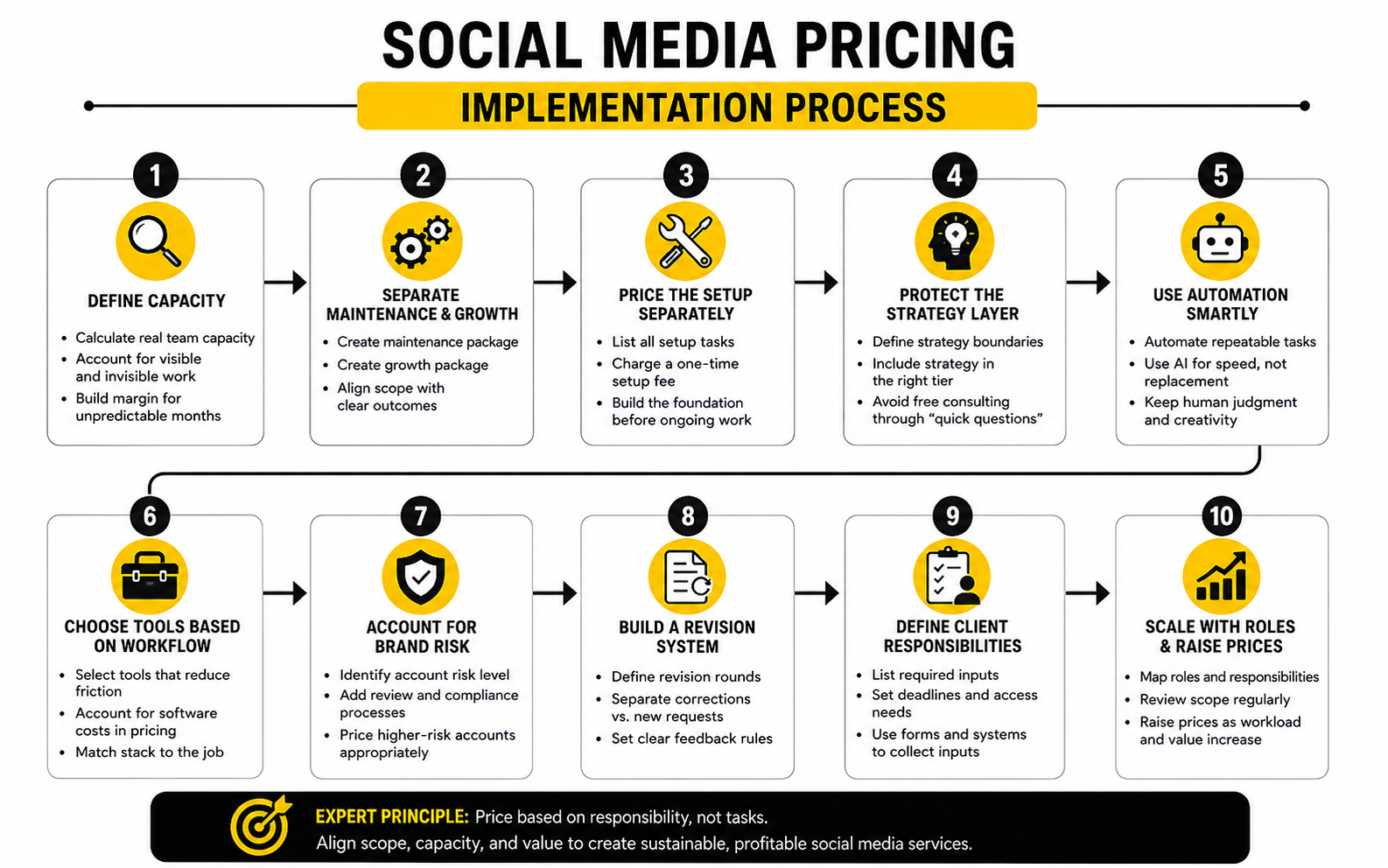
A strong implementation process turns social media pricing from a guess into a system. It gives the provider a repeatable way to scope the work, and it gives the client a clear reason behind the fee. That makes the sales conversation more professional and the delivery process much easier.
The process should be simple enough to use, but detailed enough to prevent scope creep. You do not need a 40-page pricing manual. You need a reliable sequence that connects goals, workload, resources, and responsibility.
Step 1: Define The Business Goal
Start with the business goal before discussing deliverables. A brand trying to build awareness needs a different plan than a brand trying to book sales calls, recruit employees, grow a personal brand, or support ecommerce promotions. The goal shapes the strategy, and the strategy shapes the price.
This step also prevents the provider from selling random activity. If the client wants revenue, the offer may need paid traffic, landing pages, automation, and sales follow-up. If the client wants credibility, the work may lean more toward thought leadership, case studies, founder content, and platform consistency.
The goal should be written in plain language. For example, “increase qualified local leads,” “support a product launch,” or “build trust with enterprise buyers.” The more specific the goal, the easier it becomes to choose the right pricing model.
Step 2: Audit The Current Social Presence
The next step is to review what already exists. Look at profiles, bios, content quality, posting consistency, engagement patterns, audience fit, brand voice, offers, links, and analytics access. This gives the pricing conversation a real baseline.
An audit also reveals hidden work. Maybe the brand’s visuals are outdated. Maybe the bio does not explain the offer. Maybe the content has no clear call to action. Maybe the account has an audience, but the funnel is broken.
That matters because fixing a messy foundation costs more than maintaining a clean one. A brand with strong assets and clear positioning is easier to manage. A brand with no strategy, no content library, no offers, and no approvals process needs setup work before ongoing management makes sense.
Step 3: Map The Deliverables
After the goal and audit, map the actual deliverables. This includes platforms, posting frequency, content formats, monthly campaigns, reporting, meetings, engagement, and any additional support. The goal is to remove ambiguity before the price is presented.
Deliverables should be specific but not suffocating. “Twelve Instagram posts per month” is clear. “Social media support” is not. “Two short-form videos, four carousels, six static posts, and one monthly report” is much easier to price than a vague promise to “grow the brand online.”
This is also where buyers can compare proposals fairly. If one proposal includes strategy, video editing, engagement, and reporting while another includes only scheduling, the lower price may not actually be cheaper. It may simply include less.
Step 4: Assign Responsibility
Responsibility is different from deliverables, and this is where pricing often breaks. Who writes the captions? Who designs the graphics? Who edits the videos? Who approves posts? Who responds to comments? Who handles complaints? Who owns paid ads? Who reports on performance?
Every unanswered responsibility becomes a future disagreement. If the client assumes the provider handles DMs but the provider assumed the client handles them, the relationship gets messy. If the provider needs assets every week but the client never sends them, deadlines fall apart.
A strong scope document should make ownership obvious. The provider should own the work they are charging for. The client should own the inputs only they can provide, such as product details, approvals, brand access, subject-matter expertise, and internal decision-making.
Step 5: Build The Workflow
Workflow is what keeps the plan alive after the first week. It includes the content calendar, approval process, asset handoff, publishing schedule, reporting cadence, and communication rules. Without workflow, even good strategy becomes scattered.
A simple workflow might run like this:
This is where tools can make the process smoother. Buffer can help with scheduling and publishing workflows, Fillout can collect content requests or client inputs, and Cal.com can reduce back-and-forth when recurring planning sessions are part of the service.
Step 6: Price The Labor, Risk, And Value
Once the scope is clear, the price should account for three things: labor, risk, and value. Labor is the time required to do the work. Risk is the responsibility the provider carries for deadlines, brand reputation, performance, and complexity. Value is the business impact the work can create.
Most beginners price only labor. That is why they undercharge. They count the time to make posts but forget meetings, revisions, reporting, strategy, research, admin, quality control, tool costs, and mental load.
Experienced providers price the whole engagement. They understand that a $3,000 monthly retainer is not just payment for posts. It is payment for a working system that keeps the brand consistent, organized, and moving toward a clear goal.
Step 7: Set Review Points
Social media pricing should not be frozen forever. The work changes as the account grows, campaigns become more complex, or the business shifts priorities. Review points keep the agreement healthy.
A review point can happen after the first 30, 60, or 90 days, then quarterly after that. The goal is not to renegotiate constantly. The goal is to check whether the scope, workload, and results still match the price.
This is especially important when a client starts small and then adds more platforms, more videos, more campaigns, more reporting, or faster response expectations. Those changes may be reasonable, but they are still changes. A professional process makes it easy to adjust without making the conversation awkward.
Turning Scope Into A Real Quote
A real quote should read like a business decision, not a random number. It should explain what is included, why it is included, how delivery works, and what the client can expect. The price should feel connected to the work.
A clean quote usually includes the objective, recommended package, monthly deliverables, workflow, reporting cadence, client responsibilities, exclusions, timeline, and payment terms. That may sound basic, but it instantly separates a professional provider from someone who is just guessing. It also helps the buyer understand what they are actually purchasing.
The best quotes do not oversell. They are direct. They show the plan, the boundaries, and the next step. That kind of clarity makes social media pricing easier to defend, easier to buy, and easier to deliver.
Statistics And Data
Good social media pricing needs measurement, but not in the shallow “look at the likes” way. Data should explain whether the work is creating attention, trust, traffic, leads, sales, or learning. If it does not help the next decision, it is noise.
The numbers matter because social media has become too expensive and too competitive to manage by instinct alone. Global social media user identities reached 5.79 billion in April 2026, based on DataReportal’s global social media statistics, but that scale does not mean every brand automatically gets reach. More users also means more content, more competition, more ad inventory pressure, and more need for a clear measurement system.
This is where social media pricing should become more disciplined. A low-priced service may only report basic visibility metrics. A serious service should explain what the metrics mean, what changed, why it changed, and what action the team should take next.
The Metrics That Actually Matter
The right metrics depend on the job social media is supposed to do. Awareness campaigns should be judged differently from lead generation campaigns. Community-building work should be judged differently from paid conversion campaigns.
For awareness, the useful metrics include reach, impressions, video views, watch time, profile visits, and follower growth quality. These numbers show whether the brand is getting seen, but they do not prove that people are ready to buy. That is why awareness metrics should be treated as early signals, not final proof of business impact.
For engagement, the useful metrics include comments, saves, shares, replies, DMs, and meaningful reactions. A like is easy. A save or share usually shows stronger intent because the person found the content useful enough to keep or pass along.
For conversion, the useful metrics include link clicks, landing page visits, form fills, booked calls, qualified leads, purchases, cost per lead, cost per acquisition, and revenue. These numbers sit closer to the business outcome, so they usually require stronger tracking and more serious reporting. That is one reason conversion-focused social media pricing should usually be higher than simple content publishing.
Why Engagement Rate Needs Context
Engagement rate is useful, but only when it is interpreted carefully. A small account can have a high engagement rate because the audience is tight and loyal. A large account can have a lower engagement rate while still driving more total reach, traffic, and sales.
Industry benchmarks help create context, but they should not become a lazy scoreboard. Sprout Social’s 2025 benchmark report shows that engagement varies widely by platform and industry, with Facebook and Instagram engagements growing while platform behavior continues to shift across sectors in its social media benchmarks by industry. That means a “good” number for one category may be weak for another.
The better question is not “is our engagement rate high?” The better question is “is the right audience engaging in the right way?” Ten comments from qualified buyers may matter more than 500 reactions from people who will never purchase.
Reach And Impressions Are Not The Same Thing
Reach tells you how many people saw the content. Impressions tell you how many times the content was displayed. Both matter, but they answer different questions.
If reach is growing, the content is finding more people. If impressions are growing faster than reach, the same people may be seeing the content multiple times. That can be useful for reminders, launches, and retargeting, but it can also suggest that the brand is not expanding its audience enough.
This distinction affects pricing because reach growth usually requires stronger creative testing, platform understanding, and distribution strategy. A provider who is expected to grow reach cannot only schedule content. They need to study hooks, topics, timing, formats, audience behavior, and platform feedback.
Clicks, Leads, And Sales Need Better Tracking
Clicks are where social media starts moving from attention to action. A click shows that someone was interested enough to leave the platform or open a next step. But clicks alone still do not prove commercial value.
A campaign can get many clicks and few leads if the landing page is weak. It can get many leads and few sales if the offer is unclear or the sales process is slow. This is why social media reporting should not stop at the platform dashboard.
A practical analytics setup connects social content to the next business step. That might mean using UTM links, landing pages, forms, CRM stages, booked-call tracking, and revenue reporting. Tools like GoHighLevel, ClickFunnels, and Systeme.io become more relevant when the goal is not just publishing, but turning attention into measurable pipeline.
The Analytics System Behind Better Pricing
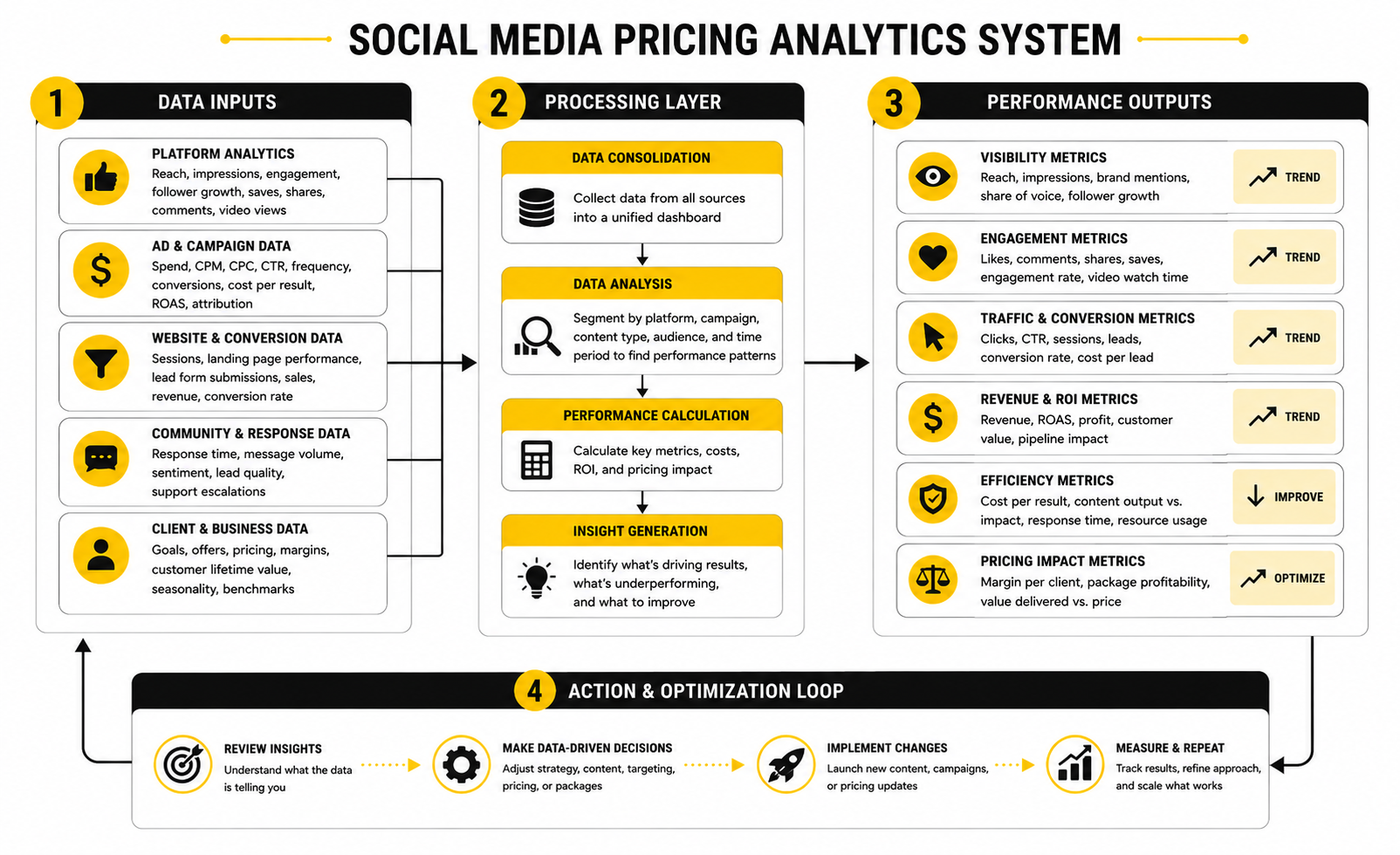
A good analytics system has three layers: platform performance, funnel performance, and business performance. Platform performance shows how the content behaved inside the social network. Funnel performance shows what happened after someone clicked, replied, opted in, or booked.
Business performance shows whether the activity created value that the company actually cares about. That could mean sales revenue, qualified leads, booked appointments, lower acquisition cost, stronger retention, or better customer conversations. This is the layer that makes premium social media pricing easier to justify.
The system does not need to be complicated. It does need to be consistent. If every campaign uses different links, different naming, different reports, and different definitions of success, the data becomes hard to trust.
Organic Benchmarks Should Guide Decisions, Not Excuses
Organic social benchmarks are useful because they show what is realistic. They can help a brand understand whether its content is underperforming, average, or unusually strong. They can also help a provider explain why a strategy needs more time, more production quality, or a different platform mix.
But benchmarks should never become an excuse for weak thinking. If a brand’s engagement is below the industry range, the answer is not always “the algorithm changed.” It may be that the hooks are weak, the content is too promotional, the audience is wrong, or the posting rhythm is inconsistent.
The real value of benchmarks is comparison plus diagnosis. Compare the account against industry norms, then compare the account against its own previous performance. The second comparison is often more useful because it shows whether the work is improving over time.
Paid Social Benchmarks Should Protect The Budget
Paid social benchmarks matter because ad costs can move quickly. Meta ads, TikTok ads, LinkedIn ads, and other paid channels all have different auction dynamics, audience quality, and conversion behavior. A cheap click is not always a good click, and an expensive lead is not always a bad lead.
Triple Whale’s 2026 analysis of Meta advertising performance found that 2025 CPMs rose 20.03% overall, with the platform becoming more expensive to reach audiences in its Facebook ads benchmark report. That kind of cost pressure changes how social media pricing should be evaluated because better creative, stronger landing pages, and tighter follow-up can matter as much as media buying.
Paid benchmarks should push teams to ask better questions. Is the cost high because the audience is competitive? Is the click-through rate weak because the creative is tired? Is the cost per lead acceptable if the close rate is strong? Numbers only help when they lead to sharper decisions.
Response Time Is A Performance Metric Too
Social media is not only a broadcasting channel. It is also a customer interaction channel. Comments, DMs, mentions, and replies can influence trust, urgency, and buying decisions.
The 2025 Sprout Social Index surveyed more than 4,000 consumers, 900 social practitioners, and 300 marketing leaders for its latest index, and the research continues to show that consumers expect brands to be present and responsive on social. That matters because engagement is not just a vanity metric when people are asking questions, raising objections, or comparing providers.
If community management is included in the service, it should be measured. Response time, response quality, escalation rate, lead handoff speed, and unresolved issues all affect the value of the work. A package that includes real customer interaction should cost more than a package that only publishes posts.
Reporting Should Explain What To Do Next
A report is not valuable because it has charts. It is valuable because it helps the client make a better decision. That is the standard.
A weak report lists numbers without interpretation. A strong report explains what worked, what underperformed, what changed, what should be tested next, and what the client needs to provide. This is where analytics becomes strategy instead of admin.
A useful monthly report should answer five questions:
That final question is the most important. If the report does not change the next action, the report is probably too shallow.
How Measurement Changes Social Media Pricing
Measurement affects pricing because deeper reporting requires more skill and more time. Basic reporting may only pull platform numbers. Advanced reporting may connect content, campaigns, ads, CRM data, landing pages, and revenue.
That difference should be visible in the price. A $700 monthly package should not be expected to deliver the same level of analysis as a $5,000 strategic retainer. The buyer can ask for deeper measurement, but deeper measurement has to be paid for.
For providers, analytics can also protect your pricing. When you show the client what is happening and why it matters, the conversation becomes less emotional. You are no longer defending a monthly fee based on effort; you are showing how the system is performing and where the next opportunity is.
The Signals That Justify Higher Investment
Some signals show that a brand should invest more in social media. If posts are already generating qualified comments, DMs, profile visits, saves, shares, or link clicks, the channel may be ready for stronger production or paid amplification. That is a good time to increase the budget carefully.
Other signals show that the brand should fix the foundation before spending more. If the offer is unclear, the profile is confusing, the landing page does not convert, or the sales follow-up is slow, more content may not solve the problem. In that case, the smartest pricing recommendation may be a strategy project or funnel cleanup before a larger management retainer.
This is the practical way to use data. Do not chase numbers for their own sake. Use them to decide whether to improve creative, change the offer, adjust the platform mix, increase posting quality, add automation, test paid distribution, or tighten the sales process.
The Numbers Should Lead To Better Decisions
Social media pricing becomes easier when the numbers are tied to decisions. If the goal is visibility, measure whether the brand is reaching more of the right people. If the goal is authority, measure whether the content is earning saves, shares, replies, and meaningful conversations.
If the goal is sales, measure the path from content to lead to customer. That may require better tracking, stronger landing pages, CRM visibility, and a cleaner follow-up system. It also requires honesty, because social media cannot fix a broken offer or a weak sales process by itself.
The point is simple: data should make the work more carefully. It should help the provider price responsibly and help the buyer invest confidently. When measurement is clear, social media pricing stops being a debate about posts and becomes a conversation about value.
Professional Implementation For Agencies, Freelancers, And In-House Teams
At this stage, social media pricing becomes less about picking a number and more about building a delivery model that can survive real work. Strategy, content, reporting, and tools all sound simple when they are written in a proposal. They become harder when approvals are late, campaigns overlap, ad costs change, platforms shift, and the client wants “just one more thing” every week.
That is why professional implementation needs structure. Not heavy bureaucracy. Not endless meetings. Just enough system to protect quality, profit, and momentum.
The advanced work is knowing what to include, what to separate, what to automate, what to charge extra for, and what to say no to. That is where a provider becomes a partner instead of a content vendor.
Build Pricing Around Capacity, Not Hope
The fastest way to break a social media service is to price it as if every month will go perfectly. It will not. Some months will include more revisions, more meetings, more platform changes, more campaign pressure, and more client questions than expected.
Capacity-based pricing starts with the real amount of work your team can deliver without quality dropping. If a package includes strategy, content creation, scheduling, engagement, reporting, and client communication, that package needs enough margin to cover the visible and invisible labor. Otherwise, the business grows on paper while the team gets crushed in practice.
This matters for agencies, freelancers, and in-house teams. An agency needs profitable delivery. A freelancer needs time protection. An in-house team needs leadership to understand that “more content” is not free just because salaries are already being paid.
Separate Maintenance From Growth
One of the most useful distinctions in social media pricing is maintenance versus growth. Maintenance keeps the brand active, consistent, and professional. Growth pushes the channel harder through testing, campaigns, stronger creative, paid amplification, funnel work, and deeper analytics.
Both are valid, but they are not the same offer. A maintenance package might be perfect for a local business that needs credibility and consistency. A growth package is better for a brand that wants leads, launches, audience expansion, or measurable revenue impact.
The mistake is selling growth outcomes at maintenance prices. That creates pressure fast because growth requires more thinking, testing, creative iteration, and performance review. If the client wants growth, the pricing needs to support growth-level work.
Price The Setup Separately
Setup work is often where providers undercharge. Before ongoing management can run smoothly, someone may need to clean up profiles, define content pillars, create brand templates, build a reporting dashboard, organize assets, set up scheduling workflows, connect tracking links, and create approval systems.
That work is not the same as monthly management. It is the foundation that makes monthly management possible. If it gets buried inside the first month of a low retainer, the provider starts the relationship already behind.
A separate setup fee also helps the client understand that implementation has stages. First, the system gets built. Then, the system gets operated. That makes the ongoing fee cleaner and keeps the first month from becoming a chaotic mix of strategy, cleanup, production, and delivery.
Protect The Strategy Layer
Strategy is one of the easiest things to give away accidentally. A client asks a “quick question” about platform direction. Then another about hooks. Then another about their offer. Then another about a launch. Suddenly, the provider is consulting for free while only being paid for content execution.
That is not sustainable. Strategic judgment is often the most valuable part of the work, especially when the provider understands positioning, customer behavior, creative patterns, and conversion paths. If that thinking influences business decisions, it belongs in the price.
This does not mean every conversation needs to feel transactional. It means the offer should clearly define where strategy lives. A basic package may include light guidance. A premium package may include monthly strategy sessions, campaign planning, and performance interpretation.
Use Automation Without Letting It Flatten The Brand
Automation can make social media delivery much more efficient. Scheduling tools reduce manual posting. Intake forms reduce messy handoffs. CRM automations improve lead follow-up. AI can help with drafts, repurposing, research prompts, and workflow speed.
But automation should support judgment, not replace it. The danger is that automated content starts to sound generic, especially when every brand is using similar prompts, templates, and tools. A 2026 analysis in TechRadar warned that AI-generated ads are becoming more uniform when brands use AI as a shortcut instead of anchoring it in clear positioning and creative direction, in its piece on AI-generated ads becoming indistinguishable.
The better approach is simple: automate the repeatable parts, protect the human parts. Use tools to speed up scheduling, reporting, routing, and first drafts. Keep positioning, taste, editing judgment, cultural fit, and offer strategy in human hands.
Choose Tools Based On Workflow, Not Hype
Tools should reduce friction, not create another layer of work. A small business does not need a complex stack if it only publishes a few times per week. A high-volume agency does need stronger systems because manual delivery becomes expensive quickly.
The best stack depends on the job. Buffer can be useful when scheduling and publishing need to stay simple. ManyChat makes sense when comments and DMs are part of the conversion path. GoHighLevel fits better when social leads need CRM tracking, pipelines, appointments, and automated follow-up.
The pricing lesson is that tooling should be accounted for. If the provider is paying for software, configuring workflows, maintaining automations, and training the client, that is not free. It is part of the delivery system and should be built into the offer.
Account For Brand Risk
Social media has brand risk baked into it. A wrong caption, careless reply, off-brand joke, poor timing, or unapproved claim can create problems quickly. That risk increases when the provider handles regulated industries, health claims, finance, legal topics, politics, hiring, customer complaints, or crisis-sensitive categories.
Higher-risk accounts need more review, more documentation, and clearer approval processes. They may also require legal review, compliance guidelines, escalation rules, and stricter content boundaries. That extra care should affect the price.
This is also why real-time engagement is not always a simple add-on. Commenting on trends can create visibility, but it can also backfire when the brand voice does not fit the moment. Vogue recently covered how brands are increasingly entering viral comment sections, while experts warned that forced participation can create reputational risk in its analysis of brand behavior in comments.
Know When Not To Offer Performance Pricing
Performance pricing is tempting because it can sound like the provider is confident and the client has less risk. But it only works when the provider has enough control over the outcome. If the provider cannot influence the offer, landing page, sales process, follow-up speed, tracking, or fulfillment, pure performance pricing is dangerous.
The cleanest structure is usually a base fee plus upside. The base fee pays for the work. The upside rewards performance when the system produces measurable results. This keeps both sides aligned without pretending social media alone controls the whole business.
Pure performance pricing can work in specific cases, but the conditions need to be tight. Attribution must be clear. Data access must be available. The offer must be proven. The client must respond to leads quickly. Without that foundation, the provider is taking responsibility for variables they cannot control.
Build A Revision System Before You Need One
Revisions are normal. Endless revisions are a pricing problem. If the approval process is vague, every draft can turn into a long back-and-forth that destroys margins.
A revision system should define how many rounds are included, who gives feedback, where feedback is submitted, and what counts as a new request. This prevents three different stakeholders from giving conflicting notes in three different places. It also keeps the work moving.
A good rule is to separate corrections from changes in direction. Fixing a typo or adjusting a brand detail is one thing. Rewriting an entire campaign because the client changed the offer is another. The second one should usually trigger a scope adjustment.
Make Client Inputs Part Of The Agreement
Social media work depends on inputs. A provider may need product updates, photos, videos, founder opinions, testimonials, event details, promotions, customer questions, or internal context. If the client does not provide those inputs, content quality suffers.
That is why client responsibilities should be written into the agreement. The client needs to know when assets are due, who approves content, what access is required, and how delays affect publishing. This keeps missed deadlines from becoming the provider’s fault automatically.
Input collection can also be systemized. A simple form through Fillout, a recurring planning call booked through Cal.com, or a shared asset workflow can save hours every month. Better inputs usually create better content, and better content makes the pricing easier to defend.
Scale With Roles, Not Chaos
As social media services grow, one person cannot keep doing everything forever. Strategy, copywriting, design, video editing, scheduling, engagement, reporting, paid ads, and client management are different skills. At some point, scaling requires role clarity.
For agencies, this means delivery should be mapped before hiring. Who owns the calendar? Who writes? Who designs? Who edits video? Who checks analytics? Who communicates with the client? If those responsibilities are fuzzy, adding more clients will only add more confusion.
For in-house teams, the same principle applies. Leadership may assume one social media manager can handle strategy, creative, production, community, reporting, and paid campaigns. Sometimes they can for a while. But if social becomes a serious growth channel, the team structure needs to match the ambition.
Raise Prices When The Scope Evolves
A client may start with one platform and later ask for more videos, more engagement, more reporting, more campaigns, or faster turnaround. That is not a problem. It is often a sign that the relationship is working.
The problem is failing to update the price. Social media pricing should evolve when workload, responsibility, complexity, or business value increases. Otherwise, the provider quietly absorbs the growth until the account becomes unprofitable.
Price increases are easier when the scope has been measured clearly. If the provider can show that the account moved from twelve monthly assets to twenty, from one platform to three, or from basic reporting to funnel reporting, the conversation becomes practical. It is not “I want more money.” It is “the service has expanded.”
Do Not Let Benchmarks Replace Positioning
Benchmarks are helpful, but they should not become the whole strategy. A brand can hit average engagement and still be forgettable. A campaign can have a low cost per click and still attract the wrong audience.
Positioning is what makes the numbers meaningful. Who is the brand for? Why should that audience care? What belief, problem, desire, or moment does the content speak to? Without those answers, even efficient execution can become empty activity.
This is especially important as more brands use similar tools, templates, and AI-assisted workflows. The brands that win will not be the ones that simply publish more. They will be the ones with sharper angles, clearer offers, stronger creative taste, and better follow-up.
Treat Social As Part Of The Revenue System
The most advanced way to think about social media pricing is to stop isolating social from the rest of the business. Social creates attention, but attention needs somewhere to go. That could be a DM flow, email list, sales page, booked call, ecommerce product page, or community.
When social connects to the revenue system, the work becomes more valuable and more complex. The provider may need to think about landing pages, lead magnets, email sequences, CRM stages, ad retargeting, and sales enablement. That is no longer basic social media management.
For example, Replo can make sense for ecommerce landing pages, Brevo can support email follow-up, and Copper can help relationship-driven teams manage leads and customer conversations. The important point is not the tool itself. The important point is that social pricing should rise when the work expands into the systems that turn attention into revenue.
The Expert-Level Pricing Question
The expert-level question is not “how many posts are included?” That question still matters, but it is not enough. The better question is “what level of responsibility is the provider taking for the business outcome?”
If the provider is responsible for showing up consistently, the price can stay closer to content management. If the provider is responsible for growth, analytics, campaigns, automation, creative testing, lead flow, or revenue support, the price should move into strategic service territory. That difference is the whole game.
Social media pricing becomes much easier when the offer is honest about responsibility. Do not sell a growth engine and price it like a posting service. Do not buy a posting service and expect a growth engine. The clearer that distinction becomes, the healthier the engagement will be.
Social Media Pricing Benchmarks, Mistakes, And FAQ
Social media pricing should end with a practical reality check. Benchmarks help, but they are not a replacement for scope. A $750 monthly package, a $3,000 retainer, and a $15,000 strategic engagement can all be reasonable if the workload, responsibility, and business impact are different.
The mistake is comparing prices without comparing the service behind them. A basic posting package is not the same as strategy, content production, community management, paid campaign support, funnel tracking, and executive reporting. The buyer needs to know what they are actually purchasing, and the provider needs to know what they are actually responsible for.
The best pricing is not the cheapest or the most expensive. It is the pricing that matches the system being built.
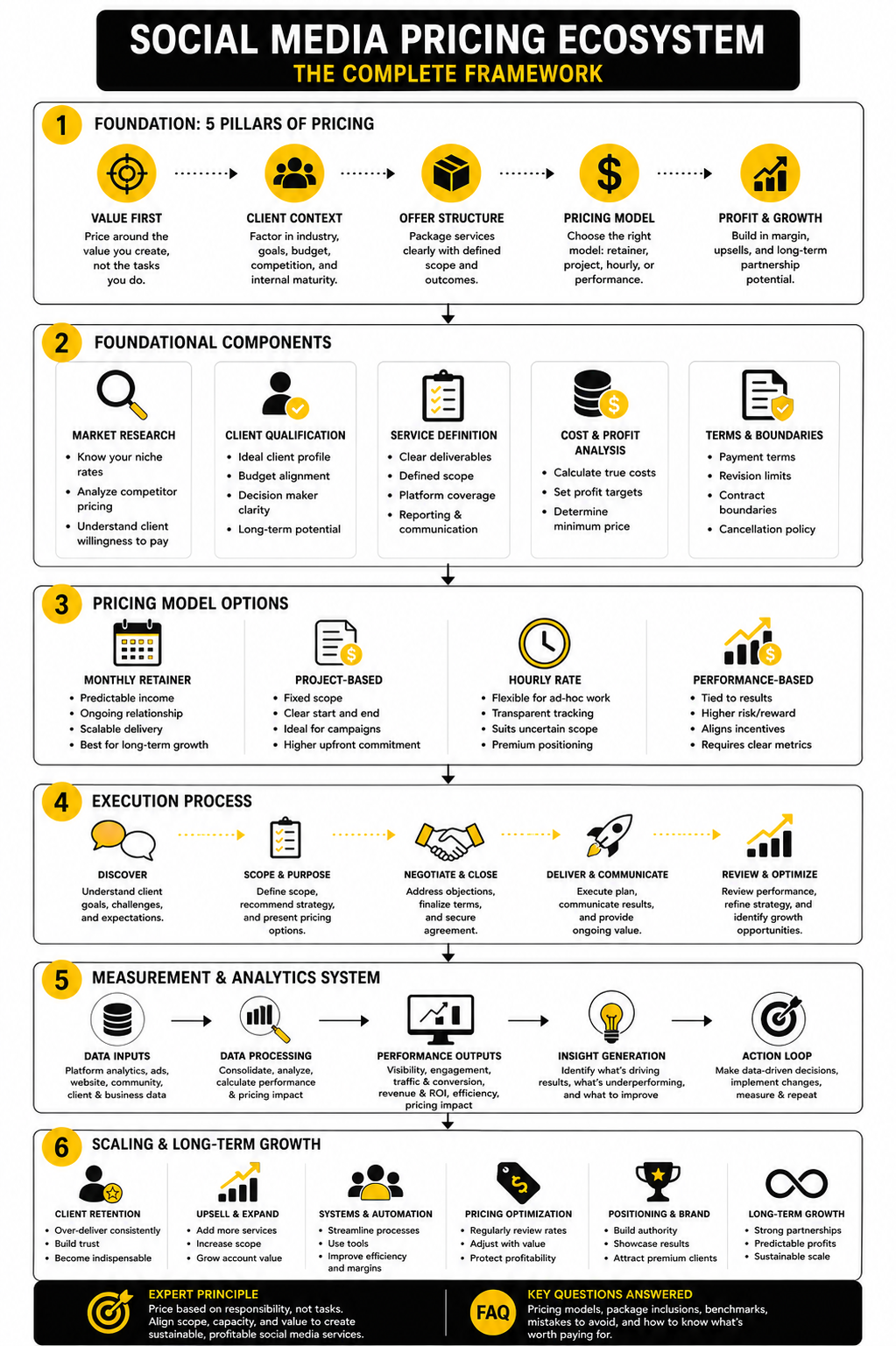
Common Pricing Benchmarks
Most small businesses looking for basic social media management will usually see entry-level monthly pricing somewhere around the low hundreds to a few thousand dollars. Sprout Social places common platform management costs around $500 to $5,000 per month in its social media management cost guide, while newer 2026 agency guides often show higher full-service ranges when strategy, community, analytics, and production are included.
Freelance pricing usually has a wider spread because experience levels vary so much. A beginner may charge hourly for scheduling and simple content help, while a senior consultant may charge much more for strategy, positioning, paid social guidance, or growth planning. Upwork’s market data lists social media managers around a $20 median hourly rate, with a typical range of $14 to $35 per hour, on its social media manager cost page.
Agency pricing can rise quickly when the work includes multi-platform management, video production, paid social, community response, reporting, and meetings. Some 2026 agency pricing guides place starter services around $2,000 to $6,000 per month, with more strategic programs moving into five figures when deeper execution and analytics are required, as shown in Fresh Content Society’s 2026 pricing guide.
Pricing Mistakes To Avoid
The first mistake is charging based only on post count. Post count is visible, so it feels easy to price. But it ignores strategy, research, creative direction, reporting, approvals, revisions, and engagement.
The second mistake is including too much inside a fixed monthly fee. If the client gets unlimited revisions, unlimited meetings, unlimited platform support, and unlimited “quick asks,” the package will eventually lose money. Unlimited offers are rarely professional; they are usually unclear.
The third mistake is failing to separate organic, paid, and funnel work. Organic management, ad management, landing pages, CRM automation, and email follow-up are connected, but they are not the same service. If social media pricing includes all of them, the fee needs to reflect that complete system.
The fourth mistake is reporting numbers without interpretation. A dashboard full of metrics does not help if nobody explains what to change next. Reporting should create decisions, not just decoration.
The fifth mistake is keeping prices the same after the scope expands. When the client adds more platforms, more videos, more engagement, more campaigns, or more strategy calls, the price should be reviewed. Growth is good, but unpaid growth slowly breaks the service.
What Buyers Should Look For
A buyer should look for clarity before creativity. A beautiful portfolio matters, but the proposal should still explain platforms, deliverables, timelines, approvals, reporting, responsibilities, exclusions, and pricing logic. If those details are missing, the engagement may become messy later.
A strong provider should be able to explain why the price fits the goal. If the goal is visibility, the plan may focus on consistent content and brand presence. If the goal is lead generation, the plan should include stronger conversion paths, tracking, and follow-up.
Buyers should also check whether the provider understands the difference between activity and outcomes. More posts do not automatically mean better marketing. Better targeting, sharper creative, faster response, stronger offers, and cleaner tracking often matter more.
What Providers Should Do Next
Providers should package their services around responsibility, not just tasks. A task list makes the offer feel like a commodity. Responsibility makes the offer feel like a professional system.
Start by defining the exact level of support you are willing to own. Are you managing presence, growth, campaigns, community, paid social, or revenue support? Each level needs different pricing because each level carries different work and risk.
Then build your proposal around outcomes, scope, workflow, and boundaries. The more clearly you explain the work, the easier it becomes to charge fairly. Better clients do not usually object to clear pricing; they object to vague pricing.
How much should social media pricing be per month?
Social media pricing can range from a few hundred dollars per month for very basic support to several thousand dollars per month for professional management. A simple package might include light scheduling and basic graphics, while a serious retainer may include strategy, content production, reporting, and community management. The right price depends on platforms, content format, posting frequency, response expectations, and business goals.
Why do social media management prices vary so much?
Prices vary because “social media management” can mean many different things. One provider may only schedule posts, while another handles strategy, video editing, community response, reporting, paid campaigns, and funnel integration. The more thinking, production, responsibility, and risk included, the higher the price should be.
Is hourly or monthly pricing better for social media?
Hourly pricing works well when the scope is flexible or unclear. Monthly pricing works better when the work is ongoing, repeatable, and tied to a defined service package. For most professional social media management, a monthly retainer is cleaner because it gives both sides more predictability.
Should social media pricing be based on the number of posts?
Post count can be part of the pricing, but it should not be the whole pricing model. Ten simple static posts are not the same as ten short-form videos with scripting, editing, captions, and performance review. A better pricing structure considers workload, strategy, production complexity, reporting, and responsibility.
How much should a freelancer charge for social media management?
A freelancer should charge based on experience, scope, and the value of the work. Basic scheduling and content support will usually sit at the lower end of the market, while strategy, creative direction, paid social, analytics, and funnel support justify higher rates. Freelancers should also account for admin time, meetings, revisions, software, taxes, and non-billable work.
How much should an agency charge for social media management?
An agency should charge enough to cover strategy, delivery, account management, creative production, reporting, tools, overhead, and profit. Basic agency retainers may start in the low thousands, while full-service programs can move much higher when the scope includes multiple platforms, video, community management, paid social, and analytics. The more specialized and outcome-focused the agency is, the more important it becomes to price around value instead of tasks.
What should be included in a social media package?
A good package should define platforms, content formats, posting frequency, revision limits, reporting cadence, communication rules, and response expectations. It should also explain what is not included, such as paid ad spend, influencer fees, advanced video production, landing pages, or crisis communications. Clear inclusions and exclusions prevent confusion later.
When should paid social be priced separately?
Paid social should usually be priced separately when the provider is responsible for campaign setup, audience testing, creative testing, budget management, optimization, and reporting. Ad spend should also be separated from the management fee. The platform receives the media budget, while the provider is paid for strategy and execution.
Should community management cost extra?
Community management should cost extra when it requires meaningful time, judgment, or responsibility. Light comment monitoring may fit inside a basic package, but active DMs, lead qualification, customer support escalation, complaint handling, and fast response windows require more work. If the provider is managing conversations that affect trust or sales, that should be reflected in the price.
How often should social media pricing be reviewed?
Pricing should be reviewed whenever the scope changes and at planned checkpoints such as 30, 60, or 90 days after launch. After that, quarterly reviews are usually enough for stable accounts. The goal is not to renegotiate constantly; it is to make sure the workload, responsibility, and fee still match.
What is the biggest red flag in a cheap social media package?
The biggest red flag is a package that promises too much for too little without explaining the process. If a provider offers unlimited content, unlimited revisions, strategy, engagement, reporting, and growth for a very low price, something will probably break. The quality may be weak, the service may be rushed, or the scope may be unclear.
How can a business know whether social media pricing is worth it?
A business should judge pricing against the job social media is supposed to do. If the goal is brand presence, look for consistency and professionalism. If the goal is leads or sales, look for tracking, conversion paths, response speed, and pipeline impact. The service is worth it when the work supports a clear business goal and the reporting shows what is improving.
Can social media pricing include automation tools?
Yes, automation tools can be included when they are part of the delivery system. A team might use Buffer for publishing, ManyChat for social messaging, and GoHighLevel for CRM and follow-up. If the provider configures, manages, or maintains those systems, the pricing should account for that work.
What is the best social media pricing model overall?
There is no single best model for every situation. Retainers are usually best for ongoing management, project fees are best for defined deliverables, hourly pricing is useful for flexible support, and hybrid pricing works well when the scope includes both recurring work and variable campaigns. The best model is the one that matches the responsibility, workload, and desired outcome.
Build a stronger local presence with BAAM AI
Turn your website, Google profile, social channels, and AI visibility into one growth engine
Most businesses do not need more random marketing activity. They need a consistent presence system that helps the right people find them, trust them, and take action. BAAM AI brings strategy, local SEO, website updates, Google Maps visibility, social content, AI-search readiness, media production, and reporting into one practical monthly engine.
If you want your marketing to keep working after the campaign ends, start with a free BAAM AI presence audit. See how your business shows up today and where the fastest visibility wins are at BAAM AI.