
BAAM AI Blog
Social Media Marketing World: A Practical Guide To Turning The Event Into A Real Growth System
Social Media Marketing World is not just another marketing conference name people throw around when they want to sound plugged in. It has become a useful reference point for how modern social media marketing is...
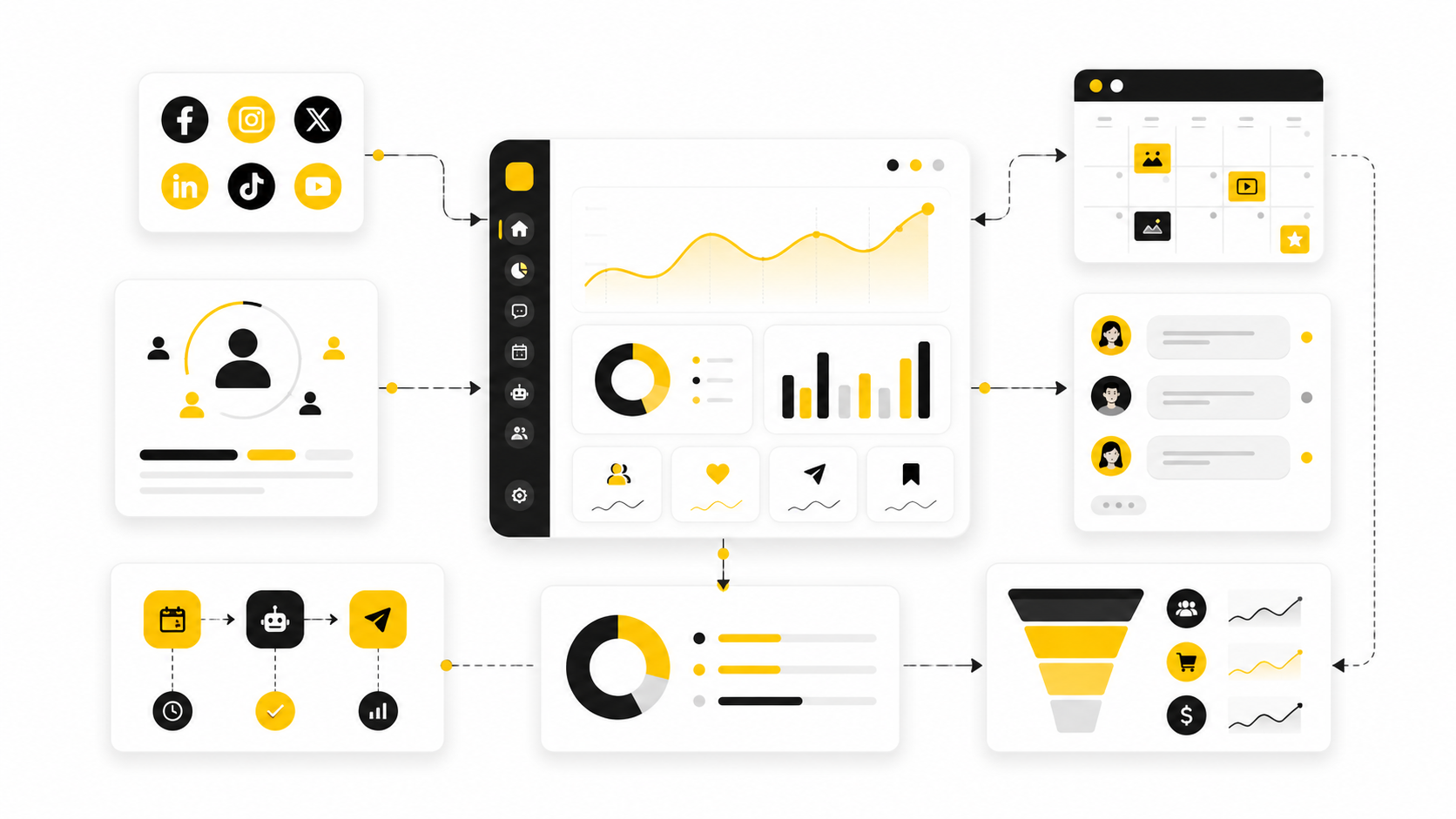
Social Media Marketing World is not just another marketing conference name people throw around when they want to sound plugged in. It has become a useful reference point for how modern social media marketing is changing: more AI, more creator-led content, more platform fragmentation, more paid amplification, and a much stronger need to connect social activity to revenue.
That matters because most brands are not struggling from a lack of content ideas anymore. They are struggling from a lack of structure. They post, test, boost, automate, reply, report, and repeat, but the pieces often live in different tools, different teams, and different mental models.
The real value of studying Social Media Marketing World is not simply knowing who speaks there or what sessions are trending. The bigger opportunity is using the event as a lens for building a better social media operating system. When you look at the topics that keep showing up around the conference, the pattern is clear: winning teams are not treating social as a posting calendar. They are treating it as a strategy, content, community, automation, and conversion engine.
this guide will walk through that engine in six parts. The goal is practical, not theoretical. By the end, you should be able to look at your own social media marketing world and see what is working, what is missing, and what needs to become a repeatable system.
Why Social Media Marketing World Matters Now
Social media used to reward consistency more generously. If you posted often, understood your audience, and stayed native to each platform, you had a fair shot at building organic reach. That world still exists in pieces, but it is no longer enough for serious growth.
Today, a brand has to think in layers. The content has to earn attention, the offer has to make sense, the community has to feel real, the follow-up has to be fast, and the analytics have to prove what is actually moving the business. That is why Social Media Marketing World is useful as a strategic benchmark: the event sits at the intersection of social content, AI, paid media, creators, messaging, and business growth.
The important shift is this: social media is no longer just a visibility channel. It is where people discover brands, evaluate trust, compare options, ask questions, join communities, and decide whether they are ready to take the next step. If your strategy only covers what to post this week, you are missing most of the money.
The New Social Media Marketing Reality
The social media marketing world has become more demanding because the platforms are more crowded and the audience is more selective. People can smell generic content instantly. They ignore posts that feel like recycled advice, over-polished ads, or AI content with no human point of view.
That does not mean AI is the enemy. It means AI needs direction. Used well, AI can help with research, repurposing, scripting, testing hooks, summarizing customer feedback, and speeding up production. Used lazily, it creates the same bland content everyone else is publishing.
This is where professional implementation starts to matter. A strong social media system does not begin with “What should we post?” It begins with “Who are we trying to move, what do they need to believe, and what should happen after they engage?”
The Framework Overview
A useful Social Media Marketing World framework has four connected layers. Each layer supports the next one, and none of them works properly in isolation. When one layer is weak, the whole system starts to feel random.
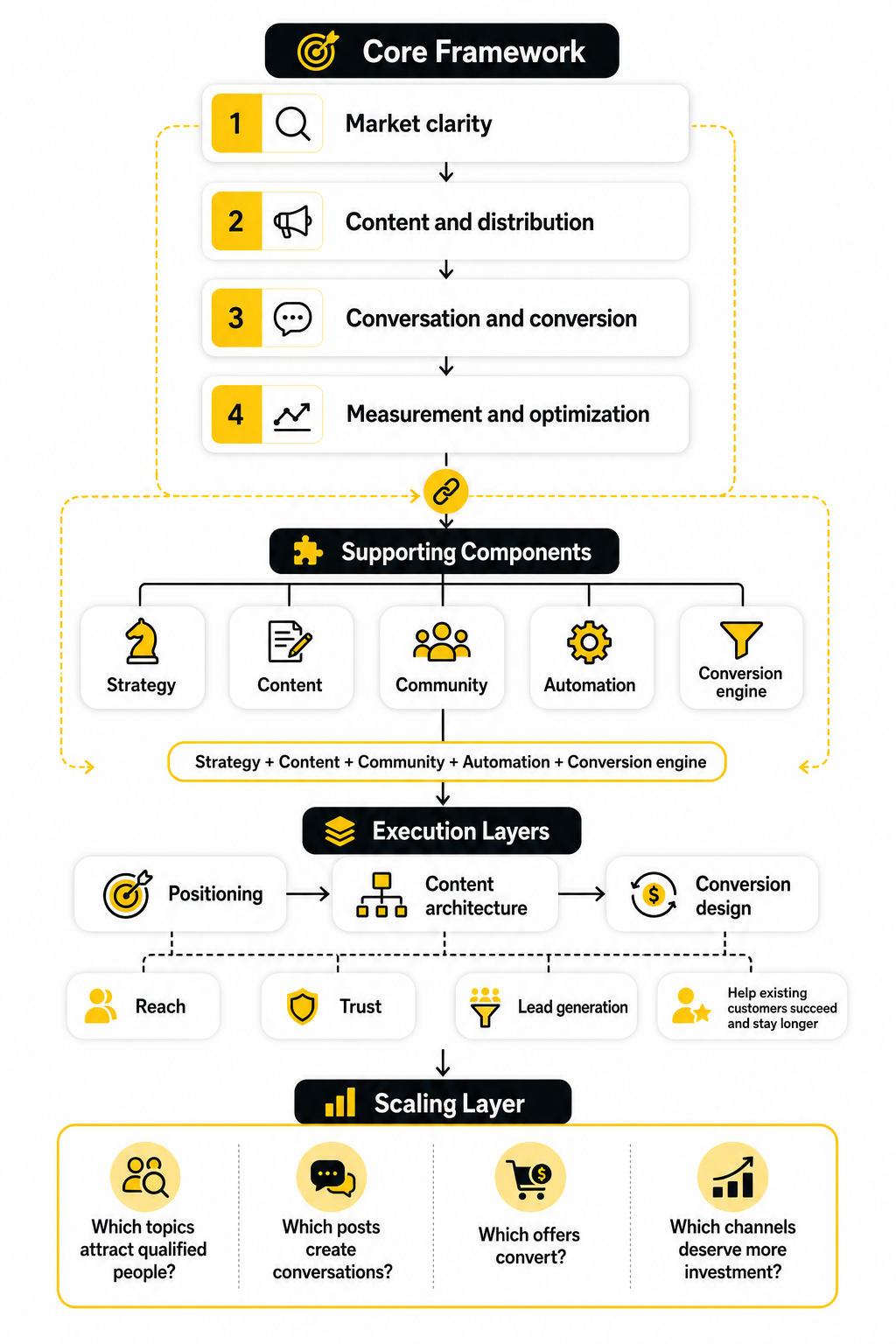
This is the foundation. You need a clear audience, a sharp point of view, and a real understanding of the problems your buyers are trying to solve. Without this, content becomes noise.
This is where your ideas become visible. Short-form video, carousels, posts, live content, newsletters, podcasts, and creator collaborations all sit here. The goal is not to be everywhere. The goal is to show up where your audience already pays attention.
This is where attention becomes pipeline. Comments, direct messages, lead magnets, webinars, booking pages, email sequences, and sales conversations need to connect smoothly. Tools like ManyChat can help when message-based follow-up is a genuine part of the customer journey.
This is where the system improves. You look beyond likes and ask better questions: which topics attract qualified people, which posts create conversations, which offers convert, and which channels deserve more investment?
Core Components Of A Serious Social Media System
A serious system starts with positioning. Your audience needs to understand what you do, who it is for, and why your approach is different. This sounds obvious, but many brands skip it and try to solve a positioning problem with more content volume.
Next comes content architecture. You need recurring themes, not random ideas. Strong social teams usually build around a few core pillars: education, proof, point of view, behind-the-scenes trust, product demand, and community interaction.
Then comes conversion design. This is where many teams leak opportunity. A post performs well, people comment, a few prospects send direct messages, and then the follow-up is slow or inconsistent. That is why social media should connect to a CRM, email platform, booking flow, or funnel instead of ending at engagement.
For teams that need a broader marketing and sales backend, GoHighLevel can fit naturally when the goal is to manage leads, campaigns, automations, and client communication in one place. For teams focused on publishing discipline and scheduling, Buffer is a cleaner fit. The point is not to collect tools. The point is to remove friction from the system.
Professional Implementation Starts With Better Decisions
Professional social media marketing is not about chasing every new platform feature. It is about deciding what matters before the algorithm decides for you. That means setting priorities, building repeatable workflows, and knowing which numbers actually deserve attention.
A good team does not treat every post equally. Some content is built for reach. Some content is built for trust. Some content is built for lead generation. Some content is built to help existing customers succeed and stay longer.
That distinction changes how you plan. It also changes how you judge performance. A post that creates five serious sales conversations may be more valuable than a post that gets thousands of passive views.
Where this guide Goes Next
The next part will turn the framework into a working model. We will break down how the pieces connect, where most brands overcomplicate the process, and how to build a social media marketing system that can actually be managed week after week.
That is the key. Social media marketing should not feel like a daily scramble. When the strategy is clear and the system is built properly, the work becomes easier to prioritize, easier to measure, and much easier to improve.
The Social Media Marketing World Framework
The best way to think about Social Media Marketing World is as a model for how social media actually works when it is tied to business growth. It is not one tactic, one platform, or one clever content format. It is a connected system where audience insight, content, conversation, conversion, and measurement all support each other.
That distinction matters because many teams still manage social media like a publishing checklist. They ask what to post, when to post, and how often to post, but they do not always ask what the post is supposed to change. A stronger framework starts with the outcome, then works backward into the message, format, channel, and follow-up.
The practical goal is simple: build a system that turns attention into trust, trust into action, and action into measurable growth. When you use the social media marketing world this way, it stops being a vague industry phrase and becomes a working map. You can see where your current process is strong, where it is fragile, and where you are leaving money on the table.
Layer 1: Market Clarity
Market clarity comes before content because content cannot fix a blurry offer. If your audience does not understand who you help, what problem you solve, and why your point of view is worth listening to, more posting will only create more noise. This is the first place to slow down because it affects every decision that follows.
A clear market layer answers a few uncomfortable questions. Who is the content really for? What does that person already believe? What are they tired of hearing? What problem are they actively trying to solve, not just casually interested in?
This is also where positioning becomes practical. You are not trying to sound different for the sake of being different. You are trying to make your audience feel, “This was made for someone like me.” That is the moment social content starts to work harder.
Layer 2: Message And Content Architecture
Once the market is clear, the next layer is message architecture. This is where you decide what your brand will talk about consistently, what it will avoid, and how each content theme supports the buyer journey. Without this layer, teams end up creating isolated posts instead of building momentum.
A strong content architecture usually includes a small set of repeatable themes. You might have one theme for education, one for belief-shifting, one for proof, one for product demand, and one for community interaction. The exact categories can change, but the principle stays the same: every post should have a job.
This is where many brands misunderstand consistency. Consistency does not mean saying the same thing every day. It means returning to the same strategic ideas from different angles until the market starts associating your brand with those ideas.
Layer 3: Platform Fit And Distribution
Platform fit is not about being everywhere. It is about knowing where your audience is already paying attention and adapting your message to how that platform behaves. A LinkedIn post, TikTok video, Instagram Reel, YouTube Short, and email newsletter can all carry the same idea, but they should not feel like lazy copies of each other.
Distribution also needs a real workflow. Someone has to decide what gets created, what gets repurposed, what gets scheduled, what gets boosted, and what gets retired. Tools like Buffer can help when the biggest bottleneck is planning, publishing, and keeping the team consistent across channels.
The key is to separate platform strategy from platform panic. New features will always appear. Algorithms will always shift. Your job is not to react to every change, but to understand which changes affect your audience, your content format, and your route to revenue.
Layer 4: Conversation Design
Social media becomes much more valuable when engagement turns into conversation. A comment, reply, share, or direct message is not just a vanity signal. It is often the first visible sign that someone has moved from passive attention to active interest.
That is why conversation design belongs inside the framework, not as an afterthought. You need to know what should happen when someone asks a question, comments with intent, clicks a link, replies to a story, or joins a live session. If the response depends entirely on whoever happens to be online that day, the system is too fragile.
For brands that use direct messages as part of the journey, ManyChat can be useful when the interaction is clear and helpful. The mistake is using automation to fake a relationship. The better move is using automation to make the next step faster, cleaner, and easier for someone who already raised their hand.
Layer 5: Conversion Pathways
A conversion pathway is the bridge between social attention and business results. It can be a lead magnet, webinar, discovery call, checkout page, free trial, quiz, consultation form, or email sequence. The format matters less than the logic behind it.
The pathway should match the level of intent. Someone watching a short educational video may not be ready to book a call, but they may be ready to download a useful resource. Someone asking detailed questions in direct messages may be much closer to a buying decision and should not be pushed into a generic newsletter signup.
This is where tools can either simplify the system or make it messy. If your business needs landing pages, follow-up automation, pipeline tracking, and client communication in one place, GoHighLevel can fit that kind of operating model. If the offer is simpler and the team only needs a lightweight funnel, a focused builder like ClickFunnels or Systeme.io may be enough.
Layer 6: Measurement And Learning
Measurement is the layer that keeps the framework honest. It shows whether your social activity is creating the type of attention that can become revenue. Without it, teams often optimize for the most visible numbers instead of the most useful ones.
The right metrics depend on the purpose of the content. Reach matters when you are testing awareness. Saves and shares can matter when you are testing usefulness. Comments and direct messages matter when you are testing resonance. Leads, booked calls, sales, retention, and customer quality matter when you are testing business impact.
The real win is not building a giant dashboard. The win is building a simple learning loop. You publish, observe, interpret, improve, and repeat. Over time, that loop becomes one of the strongest assets in the business because it teaches you what your market actually responds to.
How The Framework Works In Practice
The framework is easiest to understand as a sequence. First, you clarify the market. Then you shape the message. Then you distribute the content in platform-native ways. Then you create conversations. Then you guide qualified people into the right conversion pathway. Then you measure what happened and improve the next cycle.
This sequence prevents random execution. It keeps the team from jumping straight into content production before the strategy is clear. It also keeps the team from celebrating engagement that has no path to anything useful.
That is the core lesson from studying the social media marketing world through a professional lens. The best marketers are not just better at posting. They are better at connecting the pieces so every part of the system makes the next part easier.
The Biggest Shift: From Campaign Thinking To System Thinking
Campaigns still matter, but they are not enough on their own. A campaign can create a spike in attention, but a system turns repeated attention into compounding trust. That is a huge difference.
System thinking changes the way you plan content. Instead of asking, “What can we launch this month?” you start asking, “What should our audience understand better every month?” That question creates better content because it forces you to build belief over time.
It also changes how you use tools. A tool should support the system, not replace the strategy. When the strategy is weak, tools only help you move faster in the wrong direction.
What This Framework Prepares You To Do Next
With the framework in place, the next step is to go deeper into strategy, positioning, and audience intelligence. This is where the article moves from the map to the foundation. If this part is rushed, every later part becomes harder.
The next section will focus on how to understand the audience behind the metrics. That means looking at problems, objections, buying triggers, language patterns, and trust gaps. Once those pieces are clear, content becomes much easier to create and much more likely to convert.
Strategy, Positioning, And Audience Intelligence
This is where the social media marketing world becomes much more practical. The framework from the previous section gives you the map, but strategy gives you the direction. Without that direction, content production becomes busywork dressed up as marketing.
A strong strategy begins with one decision: who are you trying to move? Not who could technically buy from you. Not who follows similar accounts. The real question is who has the problem, motivation, budget, and urgency to take action when your content lands at the right time.
That is why positioning and audience intelligence belong together. Positioning tells the market why you matter. Audience intelligence tells you what the market already cares about, what it doubts, what it repeats, and what it needs to believe before it trusts you.
Start With The Buyer, Not The Platform
A lot of social media plans begin with the wrong question. They start with “Should we focus on Instagram, LinkedIn, TikTok, YouTube, Facebook, or X?” That question matters, but it should not come first.
The better starting point is the buyer’s decision process. What triggers their search? What do they compare? What scares them away? What do they need to see before they believe your offer is credible?
Once you understand that, platform decisions become easier. LinkedIn may be better for expertise and B2B authority. Instagram may be stronger for visual trust, creators, and lifestyle-led demand. YouTube may help when the buyer needs depth before they act. The platform is the container. The buyer journey is the strategy.
Define The Problem In The Customer’s Language
Audience intelligence is not about inventing a persona with a cute name and a stock photo. It is about capturing the real language people use when they describe their problems, objections, goals, and frustrations. That language is the raw material for better hooks, better offers, better content, and better sales conversations.
You can find it in sales calls, support tickets, reviews, comments, community posts, direct messages, competitor content, search queries, and customer interviews. The important part is to look for patterns, not isolated opinions. One comment is a clue. Repeated language is a signal.
When you use the customer’s words, your content immediately feels more relevant. You stop saying “optimize your digital presence” and start saying what the buyer actually feels: “I’m posting every day, but I still don’t know what is turning into leads.” That difference is massive.
Build A Positioning Spine
Your positioning spine is the short internal logic that keeps the brand consistent. It does not need to be clever. It needs to be clear enough that your content, offers, landing pages, and sales conversations all point in the same direction.
A useful positioning spine includes five parts:
This spine protects you from random content. If a post does not support the audience, problem, promise, mechanism, or proof, it may still be interesting, but it probably does not belong in the core strategy. That filter saves time and keeps the brand sharper.
Turn Audience Research Into Content Decisions
Research only matters if it changes what you do. The point is not to create a huge document nobody opens again. The point is to turn what you learn into content themes, hooks, formats, offers, and follow-up paths.
For example, if prospects keep saying they are overwhelmed by tools, your content should not simply recommend more tools. It should explain how to choose the right tool based on the job it performs inside the system. That is a more carefully angle because it meets the audience where they are.
If prospects keep saying they do not trust agencies or consultants, your content needs more process transparency. Show how decisions are made, what the workflow looks like, what inputs are required, and what a realistic outcome looks like. Trust grows when the audience can see the thinking behind the promise.
The Implementation Process
Now the strategy needs to become something your team can actually use. This is where the process becomes tangible. You are turning audience intelligence into a repeatable workflow, not a one-time planning exercise.
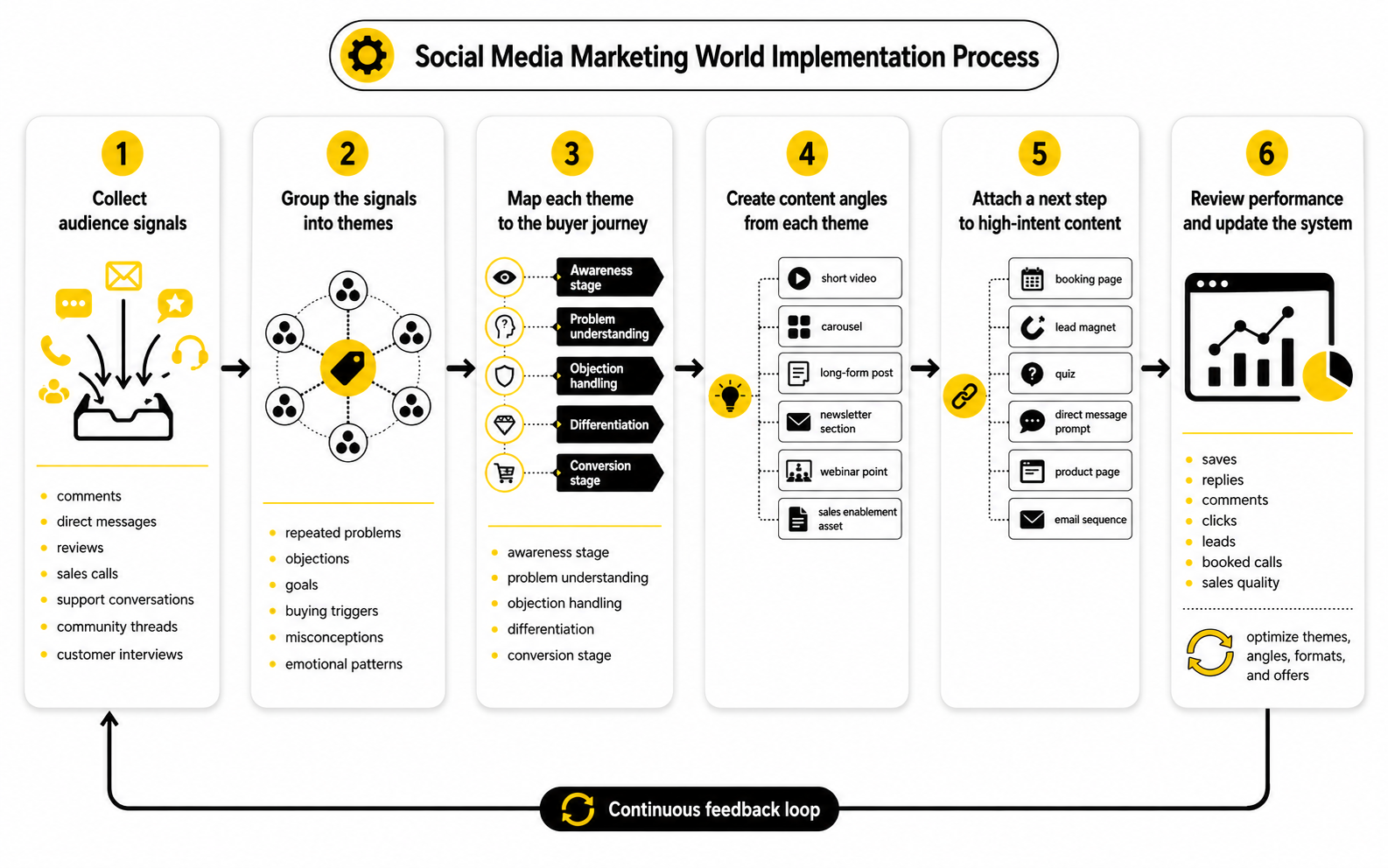
A simple implementation process looks like this:
Pull language from comments, direct messages, reviews, sales calls, support conversations, community threads, and customer interviews. Do not clean it up too early. The messy wording is often where the best content angles live.
Look for repeated problems, objections, goals, buying triggers, misconceptions, and emotional patterns. These groups become the foundation for your content pillars. If a theme keeps showing up in different places, pay attention.
Some themes belong at the awareness stage because they help people understand the problem. Others belong closer to conversion because they answer objections or explain why your approach is different. This step keeps content from becoming random.
Turn every theme into multiple angles. One problem can become a short video, a carousel, a long-form post, a newsletter section, a webinar point, or a sales enablement asset. This is how you get more output without inventing new ideas every day.
Not every post needs a hard call to action, but high-intent content should lead somewhere useful. That could be a booking page, lead magnet, quiz, direct message prompt, product page, or email sequence. Attention without a next step is wasted potential.
Look for patterns in saves, replies, comments, clicks, leads, booked calls, and sales quality. Then adjust the themes, angles, formats, and offers. The system should get more carefully every month.
Choose Content Pillars That Actually Support Revenue
Content pillars are often treated like broad categories. Brands choose things like education, inspiration, promotion, and entertainment, then wonder why the content still feels vague. Those categories are too generic to guide serious execution.
Better content pillars are tied to the beliefs and decisions your audience must move through before they buy. One pillar might challenge a false belief. Another might teach the method. Another might prove the cost of inaction. Another might show what changes when the system is implemented correctly.
This approach makes content more persuasive without making it pushy. You are not forcing the sale into every post. You are building the mental pathway that makes the next step feel logical.
Create A Weekly Operating Rhythm
A strategy is only useful if it survives the week. That means the team needs a simple operating rhythm for planning, creating, publishing, engaging, and reviewing. Complicated workflows look impressive in a document, but they usually collapse when the calendar gets busy.
A practical weekly rhythm can be simple. Spend one block reviewing audience signals and performance. Spend one block choosing angles and assigning formats. Spend one block producing and scheduling. Spend daily time responding to meaningful engagement. Spend one final block reviewing what changed.
Publishing tools can help here, but they should not become the center of the strategy. A planner like Buffer is useful when it keeps the content calendar visible and the publishing workflow consistent. The strategic decisions still need to come from your audience intelligence and business goals.
Make The Strategy Useful For Sales And Support
Social media strategy should not live in a marketing bubble. Sales teams hear objections before marketers see them in analytics. Support teams hear confusion before it becomes churn. Customer success teams hear the moments where people finally understand the value.
Those insights should feed the content system. If sales keeps hearing the same objection, create content that addresses it before the call. If support keeps explaining the same feature, create content that makes the concept easier to understand. If customers keep praising one unexpected benefit, turn that into proof.
This is where the social media marketing world becomes more than public-facing content. It becomes a shared intelligence system for the whole business. Marketing listens better, sales enters warmer conversations, and customers get clearer communication.
Keep The System Human
The more tools you add, the more important the human layer becomes. AI can help summarize research, organize themes, draft rough ideas, and repurpose content, but it cannot replace judgment. It does not know what your audience has been quietly telling you for months unless you feed it the right inputs and review the output carefully.
Human judgment is especially important in positioning. A tool can generate options, but it cannot decide what your brand should stand for. It can suggest hooks, but it cannot know which claim your company can honestly defend. It can draft posts, but it cannot build trust on your behalf.
That is why the best implementation process is part system, part taste. Use tools to move faster. Use customer insight to stay relevant. Use human judgment to keep the work credible.
Statistics And Data That Actually Matter
Data is useful only when it changes a decision. That is especially true in the social media marketing world, where it is easy to drown in dashboards and still have no idea what to do next. Likes, views, reach, saves, shares, clicks, comments, leads, cost per result, and revenue can all matter, but they do not matter in the same way.
The mistake is treating every number as a performance score. A low click-through rate may mean the creative is weak, but it may also mean the content was built for awareness, not traffic. A post with fewer views may still produce better pipeline if it attracts the right people and starts stronger conversations.
So the goal is not to collect more metrics. The goal is to understand what each metric is trying to tell you. Once you do that, social media reporting becomes a decision tool instead of a monthly ritual.
Start With The Job Of The Content
Before you judge a post, decide what job it was supposed to do. A reach post should be judged differently from a lead-generation post. A trust-building post should be judged differently from a direct offer.
This sounds basic, but most reporting breaks right here. Teams put every post into the same spreadsheet, rank them by engagement, and then assume the highest-engagement content is the best content. That is not always true.
A simple way to fix this is to tag content by intent before it goes live. Use categories like awareness, education, proof, conversation, conversion, and retention. Then compare each post against other posts with the same job, not against everything in the calendar.
The Four Levels Of Social Measurement
A clean analytics system should move from surface-level signals to business outcomes. You do not need a complicated model to do this. You need a clear hierarchy that keeps the team from confusing activity with progress.
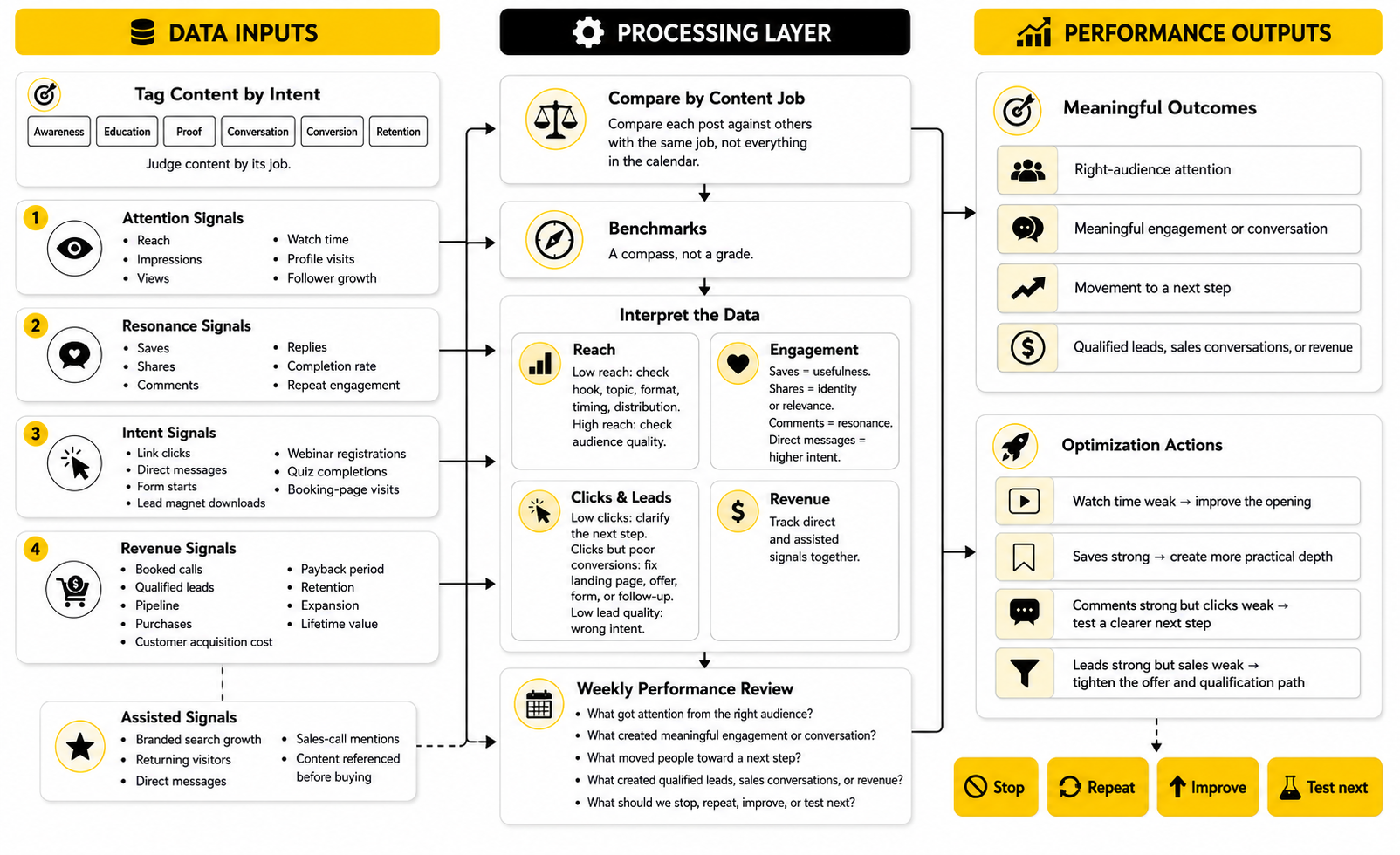
These include reach, impressions, views, watch time, profile visits, and follower growth. They show whether the content is getting seen, but they do not prove the audience is qualified. Treat these numbers as visibility indicators, not business results.
These include saves, shares, comments, replies, completion rate, and repeat engagement. They show whether the message is landing with enough force for people to react. These metrics are especially useful when testing topics, hooks, formats, and point-of-view content.
These include link clicks, direct messages, form starts, lead magnet downloads, webinar registrations, quiz completions, and booking-page visits. They show that someone is moving from passive attention to active consideration. This is where social media starts to connect with sales.
These include booked calls, qualified leads, pipeline, purchases, customer acquisition cost, payback period, retention, expansion, and lifetime value. These numbers tell you whether the system is producing the kind of growth the business actually wants. They are harder to attribute perfectly, but they are too important to ignore.
Benchmarks Are A Compass, Not A Grade
Benchmarks are useful because they give you context. If your engagement rate, click-through rate, or cost per lead is far outside the normal range, you should investigate. But benchmarks are dangerous when teams treat them like universal truth.
Performance varies by industry, audience size, content format, platform, market maturity, offer strength, and brand trust. A small niche account can have a higher engagement rate than a massive consumer brand because the audience is tighter and more emotionally invested. That does not automatically mean the small account has a better business.
Use benchmarks to ask better questions. If your reach is weak, your hook or distribution may need work. If reach is strong but comments are poor, the content may be too passive. If engagement is strong but leads are weak, the message may be interesting without creating buying intent.
What Current Data Says About The Market
The scale of social media is no longer the interesting part by itself, but it still matters. The latest global digital reporting shows billions of social media user identities worldwide, which means the opportunity is obvious. The harder question is how to earn attention inside that scale without becoming generic.
Consumer behavior also keeps moving toward social-led discovery. Recent social media research from Sprout Social shows that thousands of consumers and marketers now see social as central to brand discovery, trust, and customer relationships. That matters because social content is not only competing with competitors. It is competing with creators, communities, entertainment, friends, news, and every other signal in the feed.
Benchmark reports also show why format-level analysis matters. Social performance studies such as Emplifi’s 2025 social media benchmarks and industry benchmark resources from Hootsuite point to the same practical lesson: performance depends heavily on platform, format, and sector. You should not compare an educational LinkedIn post, a TikTok trend, an Instagram Reel, and a paid lead ad as if they are the same asset.
How To Interpret Reach
Reach tells you how many people had a chance to see the content. It is useful because social media cannot influence people who never encounter the message. But reach is not proof that the right people cared.
When reach is low, look first at the hook, topic, format, timing, and distribution. The content may be too slow to start, too familiar, too broad, or too disconnected from what the platform rewards. It may also be posted on a channel where your audience is not active enough.
When reach is high, do not celebrate too early. Ask what kind of audience the reach attracted. Broad attention can be useful, but if it does not create resonance, intent, or memory, it may not be worth repeating in the same way.
How To Interpret Engagement
Engagement shows whether people responded to the content, but the type of engagement matters. A quick like is not the same as a thoughtful comment. A save is not the same as a share. A direct reply is not the same as a passive view.
Saves often suggest usefulness. Shares often suggest identity, relevance, or social value. Comments can suggest resonance, disagreement, curiosity, or community energy. Direct messages often signal higher intent, especially when the person asks about a problem, offer, price, process, or next step.
This is why raw engagement rate can be misleading. A controversial post may generate comments without attracting buyers. A practical post may get fewer reactions but drive better leads. Do not only count engagement. Read it.
How To Interpret Clicks And Leads
Clicks are a bridge metric. They show that someone was interested enough to leave the platform or take the next step. That makes them more valuable than passive engagement, but still not the final answer.
If content gets engagement but few clicks, the next step may be unclear, weak, or mismatched with the reader’s intent. If content gets clicks but poor conversions, the landing page, offer, form, or follow-up may be the problem. If leads come in but sales quality is low, the content may be attracting curiosity instead of real buying intent.
This is where your tools need to connect. A scheduler cannot tell the full story by itself. A CRM, email system, funnel builder, and analytics workflow help you understand what happens after the click. For teams that need the social lead journey connected to pipeline and follow-up, GoHighLevel can make more sense than stitching together disconnected tools.
How To Interpret Revenue
Revenue is the clearest metric, but attribution is rarely perfect. Someone may discover you on Instagram, watch a YouTube video, read a newsletter, click a retargeting ad, and book a call two weeks later. If your reporting only gives credit to the final click, social media may look less valuable than it really is.
That does not mean you should accept vague reporting. It means you need a more carefully view. Track direct conversions, but also track assisted signals like branded search growth, returning visitors, direct messages, sales-call mentions, and content that prospects reference before buying.
The best sales teams often know which content is working before the dashboard does. If prospects keep saying, “I saw your post about this,” that is data. Capture it in the CRM, discuss it in weekly reviews, and use it to shape future content.
Build A Weekly Performance Review
A weekly review keeps measurement practical. It should not become a long meeting where everyone reads numbers out loud. It should produce decisions.
A useful review asks five questions:
This rhythm creates a learning loop. The team stops arguing from opinions and starts improving from evidence. That is where data becomes powerful.
Avoid Vanity Metrics Without Ignoring Top-Of-Funnel Signals
Vanity metrics are not bad because they are visible. They are bad when they are disconnected from strategy. Reach, views, and likes can be useful if you know what role they play.
The problem starts when teams chase big numbers without asking who those numbers represent. A viral post that attracts the wrong audience can confuse the algorithm, weaken positioning, and waste follow-up effort. A smaller post that reaches decision-makers, buyers, or high-fit prospects may be much more valuable.
So do not ignore top-of-funnel data. Just keep it in its place. Attention is the beginning of the system, not the proof that the system is working.
Turn Data Into Action
Every metric should have an action attached to it. If watch time is weak, improve the opening. If saves are strong, create more practical depth around that topic. If comments are strong but clicks are weak, test a clearer next step. If leads are strong but sales are weak, tighten the offer and qualification path.
This is the difference between reporting and optimization. Reporting tells you what happened. Optimization tells you what to change next. In the social media marketing world, the teams that win are usually not the teams with the prettiest dashboards. They are the teams that learn faster.
The next part moves from measurement into the engine that makes those numbers easier to improve: content, creators, AI, and community. Once you know what the data is telling you, the next question becomes obvious. What should you create, who should create it, and how do you make it feel human enough to matter?
Content, Creators, AI, And Community
Once the measurement system is clear, the next question is execution. What do you actually create, who creates it, how much should be automated, and where does community fit into the social media marketing world? This is where advanced teams separate themselves because they stop treating content as isolated output and start treating it as a growth asset.
The hard part is that every lever has a tradeoff. AI can speed up production, but it can also flatten your voice. Creators can increase trust, but they can also create brand risk if the fit is weak. Community can deepen loyalty, but it takes real moderation and consistency. Scaling social media is not about doing more of everything. It is about knowing which levers deserve more weight.
This part is about those strategic tradeoffs. The goal is to help you scale without losing the things that make social work in the first place: relevance, trust, timing, and human connection.
The Content Scaling Problem
At a small scale, content quality often depends on one or two sharp people. They know the audience, understand the offer, have good taste, and can spot weak ideas quickly. That works for a while, but it becomes fragile as the company grows.
At a larger scale, more people touch the content. You may have strategists, editors, designers, creators, paid media buyers, community managers, salespeople, and founders all shaping the message. Without a clear system, the brand starts sounding inconsistent.
The solution is not to over-document every sentence. The solution is to build creative constraints that keep the work focused. Your team needs clear content pillars, examples of strong angles, rules for claims, rules for proof, and a shared understanding of what the brand will never say just to get attention.
Build A Content Engine, Not A Content Factory
A content factory produces volume. A content engine produces learning. That difference matters because social media rewards useful patterns, not random output.
A factory mindset asks, “How many posts can we publish this week?” An engine mindset asks, “What are we trying to learn from this week’s content?” That shift changes the quality of the work immediately.
A good content engine has inputs, production, distribution, engagement, and review. Inputs come from audience research, sales conversations, search demand, product updates, customer questions, and market shifts. Production turns those inputs into assets. Distribution gets them in front of the right people. Engagement captures reactions. Review turns those reactions into better decisions.
The Role Of AI In Serious Social Media Work
AI is now part of the modern social media workflow, but it should not become the strategist. Its best role is acceleration. It can help organize research, draft variations, summarize customer language, generate angle options, repurpose long-form material, and pressure-test hooks.
The risk is sameness. When everyone uses similar prompts, similar models, and similar inspiration sources, the output starts to feel familiar. That is why AI-assisted content needs stronger human inputs, not weaker ones.
Use AI for speed, but keep humans in charge of taste, judgment, claims, examples, and final voice. This is especially important when the content involves positioning, customer pain, pricing, comparison, or proof. Those are not places to sound generic.
Where AI Should And Should Not Be Used
AI works well when the task has structure. It can turn a webinar transcript into content angles, summarize repeated objections from sales calls, create first drafts from a clear brief, or generate variations for a testing plan. These uses save time without asking AI to invent the strategy from nothing.
AI is weaker when the task requires lived experience, emotional nuance, brand courage, or original point of view. It can imitate confidence, but it cannot decide what your company truly believes. It can make a weak idea sound polished, but polish is not the same as insight.
A practical rule is simple: use AI before and after the creative decision, not instead of it. Use it to prepare the material and expand the options. Then let a human choose the angle, sharpen the message, and decide whether the content deserves to exist.
Creator Partnerships Require More Than Reach
Creators can be powerful because they bring trust, style, and audience context that brands often struggle to build alone. But creator marketing gets messy when teams choose partners only by follower count. Reach is useful, but fit is the real multiplier.
A strong creator partnership should match the audience, category, tone, values, and buying context. A creator who deeply influences a smaller niche may outperform a larger account with weak relevance. That is especially true when the product requires explanation, trust, or a meaningful behavior change.
The best partnerships also give creators enough room to communicate naturally. Over-scripted creator content often feels like an ad wearing a costume. Give clear guardrails, required claims, and compliance rules, but do not drain the creator’s voice out of the work.
Paid Amplification Changes The Game
Organic content is excellent for learning because it shows what earns attention without forcing distribution. But organic reach alone can be unpredictable. If a message is proven to attract the right audience and move people toward action, paid amplification can help it travel further.
The mistake is boosting content just because it performed well on the surface. A post with high engagement is not automatically a good paid asset. Before adding spend, ask whether the content attracts the right people, supports a business objective, and has a clear next step.
This is where organic and paid should work together. Organic helps you test topics, hooks, proof points, and audience response. Paid helps you scale the winners with more control. When those two teams operate separately, money gets wasted and learning slows down.
Community Is Not Just Engagement
Community is deeper than comments. Comments can be part of community, but real community requires repeated interaction, shared language, trust, and a reason for people to return. That takes more than posting prompts and hoping people talk.
A strong community strategy gives people something useful to gather around. It might be a shared goal, a professional identity, a learning journey, a challenge, a product ecosystem, or access to expertise. The point is that members should feel there is a reason to participate beyond reacting to brand content.
Community also needs boundaries. Moderation, tone, expectations, and response standards matter because the quality of the space determines whether good people stay. A community that becomes noisy, spammy, or hostile will quietly lose the people you most wanted to attract.
The Risk Of Platform Dependence
One of the biggest scaling risks in the social media marketing world is building too much of your business on rented attention. Platforms change rules, algorithms shift, accounts get restricted, ad costs move, and formats rise and fall. If your entire growth system depends on one channel, you are exposed.
This does not mean you should avoid platforms. It means you should use them intelligently. Social media is excellent for discovery, trust-building, conversation, and demand creation. But the relationship should not end there.
Move high-intent people into channels you can control more directly. Email lists, communities, CRM records, customer databases, and owned content libraries give your business more resilience. Social creates the spark, but owned systems protect the asset.
Brand Safety And Reputation Risk
As social teams move faster, reputation risk increases. A careless post, weak approval process, unclear creator brief, badly timed trend, or poorly handled comment can create problems quickly. Speed is useful only when the judgment behind it is strong.
This is where governance matters. Not corporate bureaucracy. Practical governance. Teams need clear rules for claims, sensitive topics, customer privacy, regulated language, competitor comparisons, creator disclosure, and escalation.
The best approval process is not the slowest one. It is the clearest one. People should know what they can publish freely, what needs review, and what should never go live without legal, leadership, or compliance input.
Tool Sprawl Becomes A Hidden Cost
As the system grows, teams often add tools for every small problem. One tool for scheduling, another for analytics, another for DMs, another for landing pages, another for email, another for CRM, another for reporting, another for AI writing. Each tool may make sense alone, but together they can create friction.
Tool sprawl creates hidden costs. Data gets fragmented. Teams duplicate work. Attribution becomes confusing. Campaigns take longer to launch. Nobody knows which system is the source of truth.
Before adding another platform, ask what job it performs in the operating system. If you need publishing discipline, use a focused tool like Buffer. If you need connected funnels, CRM, automations, and follow-up, GoHighLevel may reduce the number of disconnected pieces. If you need a simple funnel path for a specific offer, ClickFunnels or Systeme.io can be the cleaner choice.
Scaling Without Losing The Brand
The biggest danger of scaling is not lower quality. It is losing distinctiveness. The brand starts sounding like everyone else because processes reward safe content, tools reward templates, and teams avoid strong opinions.
To avoid that, protect the core voice. Keep a living bank of strong posts, approved claims, customer language, founder perspectives, sales objections, and proof points. Make it easy for anyone creating content to understand what good looks like.
You also need a clear editorial standard. The question should not be “Is this post acceptable?” The better question is “Would this make the right person trust us more, understand us faster, or take the next step with more confidence?” That standard forces better work.
Advanced Social Media Tradeoffs
Every mature social strategy has tradeoffs. You cannot maximize reach, authority, intimacy, speed, polish, and conversion all at once. You have to decide what matters most for the stage of the business.
Some tradeoffs are worth making deliberately:
The point is not to avoid tradeoffs. The point is to choose them consciously. When you do not choose, the platform, the algorithm, or the loudest internal opinion chooses for you.
Prepare The System For The Final Step
At this stage, the article has covered the full operating logic: the framework, the audience strategy, the implementation process, the measurement system, and the advanced scaling decisions. What remains is turning all of that into a practical roadmap. That is where most teams need the most help.
The final part will bring everything together with an implementation plan, common mistakes to avoid, and a focused FAQ. The goal is to make the social media marketing world feel less chaotic and more manageable. Not easy. Manageable.
Implementation Roadmap, Mistakes To Avoid, And FAQ
The final step is turning the whole system into a working roadmap. At this point, the strategy is clear, the audience intelligence has a role, the content process has structure, the measurement layer is defined, and the scaling tradeoffs are visible. Now the question is execution.
This is where many teams get stuck. They understand the theory, but the day-to-day work still feels scattered. Someone wants more short-form video, someone else wants a better funnel, the founder wants stronger thought leadership, sales wants better leads, and the content team wants clearer priorities.
The answer is not another giant plan. The answer is a simple sequence that lets you improve the social media marketing world around your business without trying to rebuild everything at once.
The Final System
A strong social media system should feel connected from first touch to final outcome. The audience sees useful content, recognizes the point of view, engages when the message lands, moves into a clear next step, and receives follow-up that matches their level of intent. Nothing feels random.
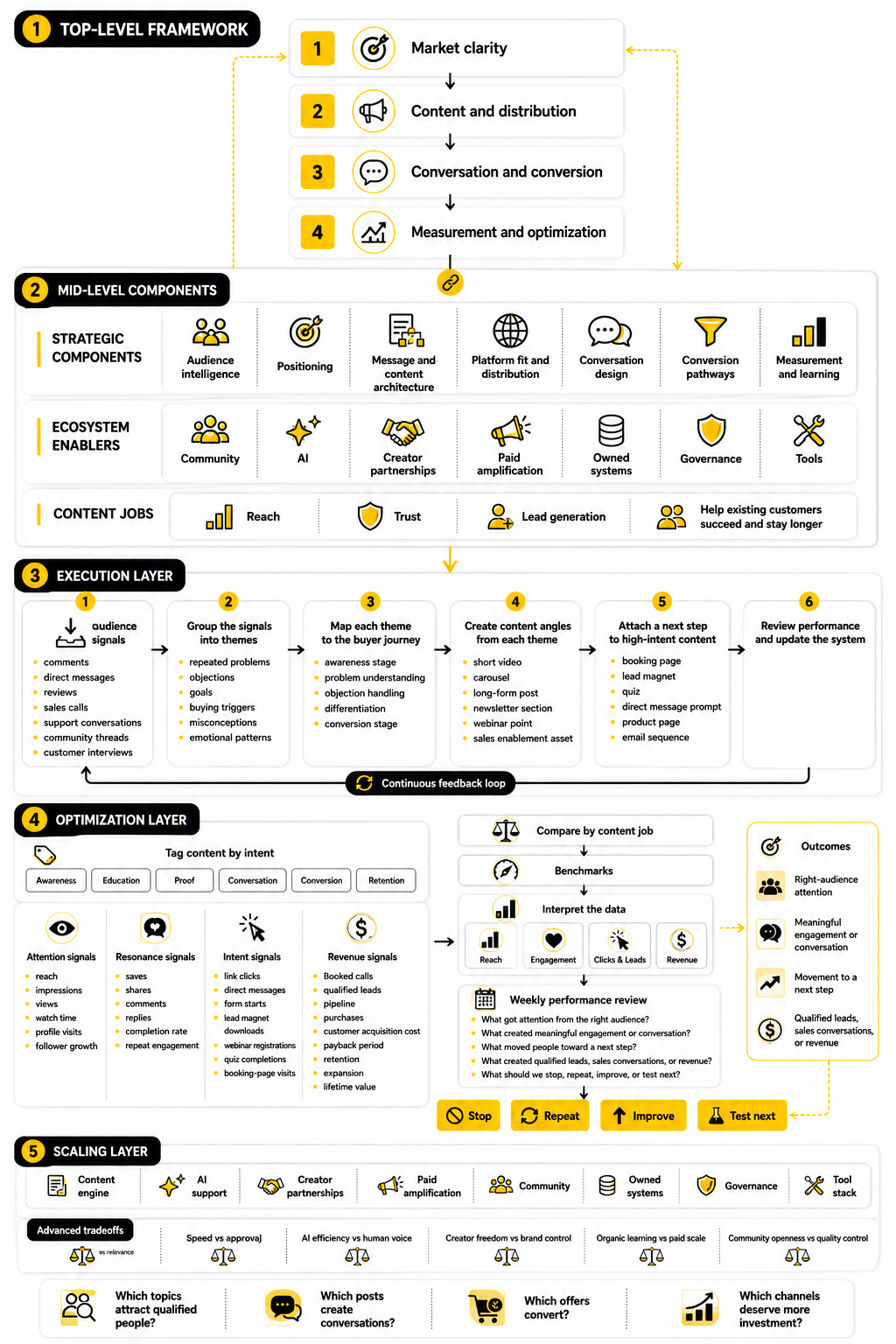
That final system has five practical parts. First, audience intelligence keeps the message grounded in real problems. Second, content turns those problems into useful ideas, proof, and demand. Third, conversation captures the signals people give when they are interested. Fourth, conversion paths guide the right people into the next step. Fifth, measurement shows what to improve.
This is the full operating model. Not a posting calendar. Not a pile of tools. Not a vague brand awareness effort. A system that helps the right people understand why you matter and gives them a clear path to act.
Build The First 30 Days Around Clarity
The first 30 days should not be about publishing as much as possible. They should be about sharpening the foundation. You want to understand the audience, audit the current content, clarify the offer, and decide which signals matter.
Start by reviewing your last 60 to 90 days of content. Look for topics that created qualified comments, direct messages, saves, shares, clicks, leads, or sales conversations. Ignore the temptation to crown the biggest post as the winner before checking what it actually attracted.
Then create a simple strategy brief. Define the audience, problem, promise, mechanism, proof, content pillars, primary platforms, and conversion paths. This brief should be short enough for the team to use. If nobody opens it after the meeting, it is not a strategy asset.
Use Days 31 To 60 To Build The Operating Rhythm
The second 30 days should focus on rhythm. This is where you turn the strategy into a repeatable weekly process. The team needs a practical cadence for research, production, publishing, engagement, and review.
Choose a small number of core formats first. You might use short-form video for reach, carousels or text posts for education, long-form content for depth, and direct response posts for conversion. The exact mix depends on your audience and offer, but the principle is the same: fewer formats executed well usually beat too many formats executed inconsistently.
This is also the right time to clean up the tool stack. If publishing is messy, use Buffer to keep scheduling organized. If lead follow-up, CRM, and automation are fragmented, GoHighLevel can help centralize the backend. If you only need a focused funnel for one offer, ClickFunnels or Systeme.io may be enough.
Use Days 61 To 90 To Optimize What Is Working
By the final 30 days of the first cycle, you should have enough signal to improve. Not perfect data. Useful data. That means you can start making sharper decisions about topics, hooks, formats, channels, and offers.
Look for content that creates movement, not just attention. Which posts make people ask better questions? Which topics lead to direct messages? Which offers get clicks from the right audience? Which content do prospects mention on calls?
Then improve the system in small but meaningful ways. Rewrite weak calls to action. Turn strong posts into longer assets. Build follow-up sequences for high-intent topics. Cut formats that create work but no learning. This is how the system starts compounding.
Common Mistakes To Avoid
The first mistake is chasing trends before fixing positioning. Trends can create reach, but reach does not help much if the audience does not understand what you do or why it matters. Fix the message before chasing more attention.
The second mistake is treating AI as a replacement for strategy. AI can help you move faster, but it cannot decide what your brand should stand for. If you feed it vague inputs, it will usually give you polished vagueness.
The third mistake is measuring every post the same way. A proof post, an awareness post, and a conversion post have different jobs. Judge each asset against its intended role or the reporting will push you toward bad decisions.
The fourth mistake is letting engagement die in the comments. If people ask real questions, reply with care. If people show buying intent, give them a clear next step. Conversation is where a lot of the hidden value in social media appears.
The fifth mistake is building on one platform only. Social media platforms are powerful, but they are rented environments. Use them to create discovery and trust, then move serious prospects into channels and systems you can manage more directly.
What To Prioritize If You Have A Small Team
Small teams should not copy big-company social media operations. You do not need a massive content calendar, 12 platforms, daily video shoots, and a complicated reporting stack. You need focus.
Pick one or two primary platforms where your audience is already active. Build three to five content pillars that directly support the buying journey. Create a weekly rhythm that your team can actually sustain.
Then connect the highest-intent content to a simple conversion path. That might be a form, booking page, free resource, webinar, or direct message workflow. The system does not need to be fancy. It needs to be clear and reliable.
What To Prioritize If You Are Scaling
Scaling teams need stronger governance. More people means more output, but also more risk. Without clear standards, the brand can become inconsistent fast.
Create shared rules for positioning, voice, proof, claims, approvals, creator partnerships, and customer privacy. Build a bank of strong examples so new contributors understand what good looks like. Keep weekly reviews focused on decisions, not just reporting.
Scaling also requires better integration between marketing, sales, and customer success. Social content should reflect real buyer objections, actual customer wins, and the questions people ask before they trust you. When those teams share insight, the content gets sharper.
What is Social Media Marketing World?
Social Media Marketing World is a major marketing conference created for marketers who want to improve social strategy, content, AI usage, paid media, community, and business growth. In this guide, the phrase also works as a broader lens for understanding the modern social media marketing environment. That wider meaning is useful because the industry now requires a connected system, not just better posting habits.
Is Social Media Marketing World only for social media managers?
No, it is relevant for more than social media managers. Founders, creators, agencies, consultants, content marketers, paid media specialists, community builders, and sales teams can all learn from the themes around it. Social media now touches positioning, lead generation, trust, customer experience, and revenue, so the work is bigger than one job title.
What should a business focus on first?
Start with audience clarity and positioning. Before choosing platforms or formats, define who you serve, what problem you solve, why your approach is different, and what the audience needs to believe before they act. Once that foundation is clear, content and tools become much easier to choose.
Which social media metrics matter most?
The most useful metrics depend on the job of the content. Reach and views matter for awareness, saves and shares matter for usefulness, comments and replies matter for resonance, and clicks or direct messages can show intent. For business decisions, leads, qualified conversations, pipeline, sales, retention, and customer quality matter most.
How often should a brand post?
There is no universal posting frequency that works for every brand. A small team is better off publishing fewer strong assets than forcing daily content that teaches the market nothing. The better question is whether your publishing rhythm gives you enough signal to learn and enough consistency to stay visible.
Should AI be used for social media marketing?
Yes, but it should support the process instead of replacing judgment. AI is useful for organizing research, drafting variations, repurposing content, summarizing customer language, and speeding up production. Humans still need to own strategy, taste, claims, proof, and final voice.
How do creator partnerships fit into the system?
Creator partnerships work best when the creator has audience trust and category relevance. Follower count alone is not enough. The best partnerships give creators clear guardrails while still letting them communicate in their own voice, because over-controlled creator content usually feels fake.
What is the biggest mistake brands make with social media?
The biggest mistake is treating social media as a content calendar instead of a business system. Posting consistently is useful, but it is not enough. The content needs to connect to audience insight, conversation, conversion paths, and measurement.
How should businesses handle direct messages and comments?
Treat them as market signals, not interruptions. Comments can reveal objections, confusion, interest, and emotional resonance. Direct messages often show stronger intent, so the team should have a clear process for responding, qualifying, and guiding people to the right next step.
Do businesses need a funnel for social media to work?
Not always, but they need a next step. That could be a booking page, email signup, webinar, product page, free resource, consultation form, community, or direct message workflow. Without a next step, attention often disappears before it becomes useful.
How do you know if social media is producing revenue?
Track both direct and assisted signals. Direct signals include leads, purchases, booked calls, and pipeline from tracked links or forms. Assisted signals include sales-call mentions, branded search, returning visitors, direct messages, and prospects referencing specific content before buying.
What tools are best for managing the system?
The best tool depends on the bottleneck. If the problem is publishing consistency, a scheduler like Buffer can help. If the problem is lead management, automations, funnels, and follow-up, GoHighLevel may fit better. If the problem is a simple offer funnel, ClickFunnels or Systeme.io can be a cleaner starting point.
How long does it take to see results?
It depends on the offer, audience, budget, platform, content quality, and existing brand trust. Some teams see early signals within weeks, such as better comments, more direct messages, stronger saves, or clearer sales conversations. Revenue results usually become easier to judge after the system has run long enough to test content, follow-up, and conversion paths together.
Is organic social still worth it?
Yes, but it should not be treated as the whole strategy. Organic social is excellent for learning what the audience responds to, building trust, and testing ideas. Once a message proves it can attract the right people, paid amplification, email, funnels, community, and sales follow-up can help turn that signal into a stronger growth system.
Build a stronger local presence with BAAM AI
Turn your website, Google profile, social channels, and AI visibility into one growth engine
Most businesses do not need more random marketing activity. They need a consistent presence system that helps the right people find them, trust them, and take action. BAAM AI brings strategy, local SEO, website updates, Google Maps visibility, social content, AI-search readiness, media production, and reporting into one practical monthly engine.
If you want your marketing to keep working after the campaign ends, start with a free BAAM AI presence audit. See how your business shows up today and where the fastest visibility wins are at BAAM AI.