
BAAM AI Blog
Social Media Marketing TikTok: A Practical Framework For Growth
Social media marketing TikTok strategy is no longer just about posting short videos and hoping the algorithm notices. TikTok has become a discovery engine, a creator marketplace, a search behavior platform, and a...
Social media marketing TikTok strategy is no longer just about posting short videos and hoping the algorithm notices. TikTok has become a discovery engine, a creator marketplace, a search behavior platform, and a performance channel at the same time. TikTok ads reached 1.59 billion users in January 2025, which gives brands a huge opportunity, but only if the content actually fits how people use the platform: fast, participatory, creator-led, and brutally honest about what feels interesting.
The mistake most brands make is treating TikTok like a smaller version of Instagram Reels or YouTube Shorts. That is usually where weak hooks, over-polished ads, random trend chasing, and inconsistent posting come from. TikTok’s own 2025 trend work points toward a more mature model: brands need to build relevance with creators, communities, personality, and content systems instead of relying on one-off viral moments.
this guide breaks social media marketing on TikTok into a practical six-part system. The goal is simple: understand why TikTok matters, build the right strategy, create content people actually watch, turn engagement into leads or sales, measure what matters, and implement it professionally without burning out your team.
Why Social Media Marketing On TikTok Matters Now
TikTok matters because attention on the platform behaves differently. People do not open TikTok only to check updates from friends; they open it to discover what to watch, buy, try, learn, visit, and talk about next. That makes TikTok especially powerful for brands that can teach, entertain, demonstrate, or simplify something in a way that feels native to the feed.
The platform is also moving deeper into the full marketing funnel. TikTok has highlighted newer business tools around search, automation, AI-assisted creative, and full-funnel measurement, including the point that 1 in 4 TikTok users starts searching within the first 30 seconds of opening the app. That changes the strategy: brands should not only think about viral reach, but also about search intent, product education, retargeting, conversion paths, and repeatable content operations.
The professional opportunity is not “post more TikToks.” The opportunity is to build a TikTok system that connects audience insight, creative testing, creator partnerships, community engagement, and conversion infrastructure. Tools can help with that system when they fit the job, whether that means managing publishing with Buffer, automating DM conversations with ManyChat, or building follow-up funnels with GoHighLevel. The tool is not the strategy, but the right stack makes the strategy easier to execute.
The TikTok Marketing Framework
A strong TikTok strategy starts with a simple idea: TikTok is not one channel doing one job. It can create awareness, explain problems, build trust, answer objections, collect leads, drive purchases, and strengthen retention. The framework has to reflect that, otherwise the team ends up measuring every video by views and missing the bigger business value.
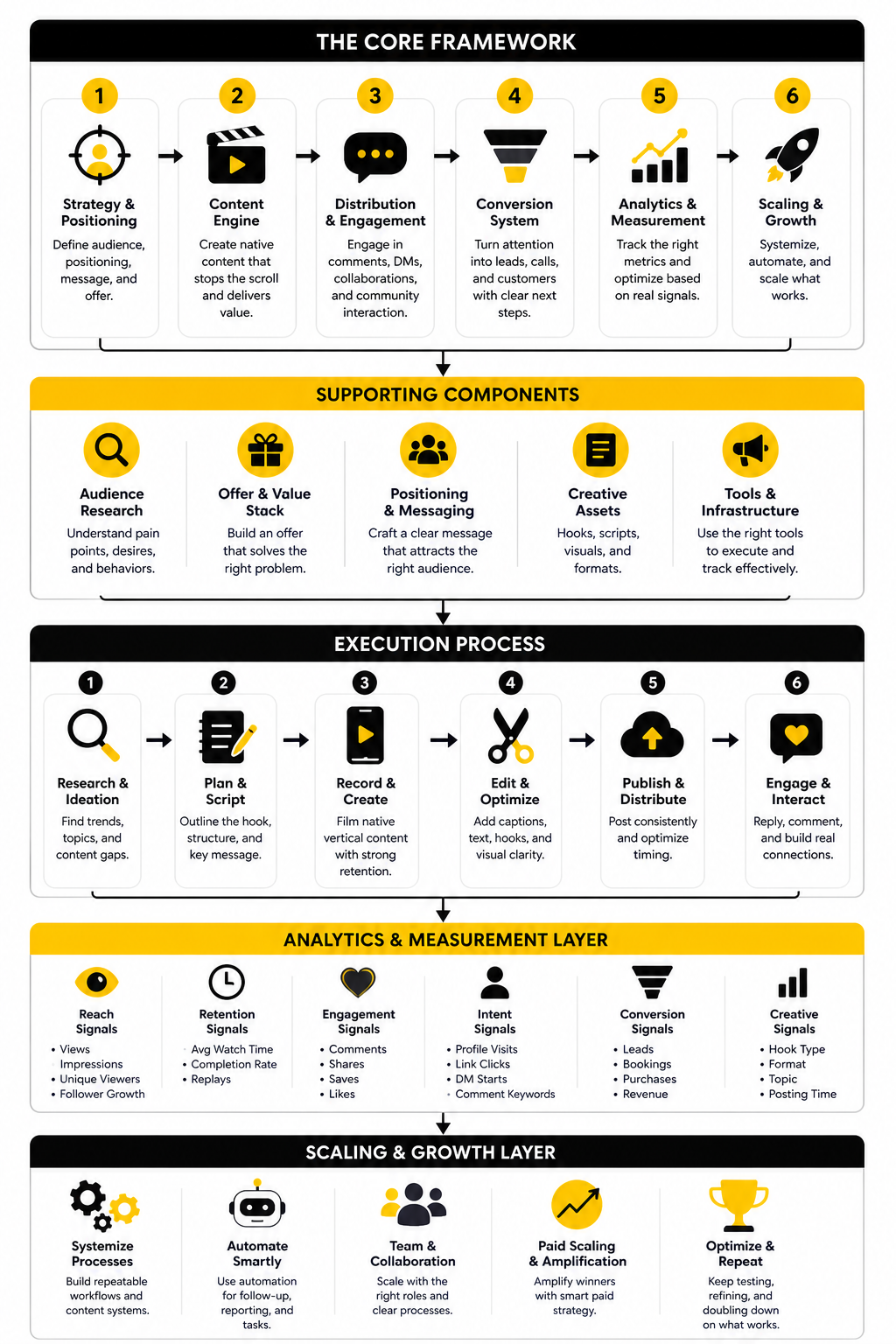
The framework used throughout this guide has four layers: audience, content, conversion, and learning. Audience defines who you are speaking to and what they already care about. Content turns those insights into repeatable formats. Conversion connects attention to a next step. Learning uses performance data to improve the next round instead of guessing.
This matters because TikTok rewards speed, but businesses need direction. A creator can post from instinct; a brand needs a system that preserves creativity without becoming chaotic. The rest of the article will show how to build that system step by step, starting with the strategic foundation and ending with implementation, optimization, and practical answers to common TikTok marketing questions.
The TikTok Marketing Framework
The TikTok marketing framework starts with one uncomfortable truth: reach is not the same as strategy. A video can get attention and still do nothing for the business. A smaller video can attract the right buyer, answer a real objection, and move someone closer to action.
That is why social media marketing TikTok planning needs a full-funnel view. TikTok itself has been pushing business solutions around creative scale, search, automation, and performance because brands now need more than entertainment clips. They need a system that connects content to outcomes without killing the native feel that makes TikTok work.
A practical TikTok framework has four layers:
Each layer supports the next one. If the audience is vague, the content becomes generic. If the content has no conversion path, attention leaks. If there is no learning loop, the team keeps guessing instead of improving.
Audience Clarity
Audience clarity means knowing who the content is for before deciding what to post. This sounds basic, but it is where many brands get lazy. They define the audience by demographics, then wonder why their videos feel flat.
On TikTok, behavior matters more than age alone. You need to understand what your audience watches when they are relaxed, what questions they search for, what creators they trust, what objections they repeat, and what language they use when talking about the problem you solve. TikTok’s 2025 trend work describes a shift toward brands working more closely with creators and communities, which is a useful reminder that relevance is built from the inside of the culture, not from a boardroom.
Start by mapping your audience into practical segments. For example, a fitness brand should not only target “women aged 25 to 40.” It should understand the beginner who feels intimidated, the busy parent who needs short workouts, the ex-athlete who wants structure again, and the buyer comparing programs before committing.
The stronger your audience clarity, the easier every creative decision becomes. Hooks get sharper. Examples feel more specific. Offers sound less forced because they connect to problems people already recognize.
Content Strategy
Content strategy is where audience insight turns into repeatable formats. This is important because TikTok punishes boring consistency and chaotic creativity in different ways. Posting the same thing every day becomes predictable, but chasing every trend with no strategy makes the brand forgettable.
A strong TikTok content strategy usually includes a mix of education, proof, personality, entertainment, product context, and community response. The balance depends on the business model. A software company might lean into tutorials, workflow breakdowns, objections, and founder-led commentary, while a consumer brand may need demonstrations, creator reactions, lifestyle use cases, and social proof.
This is also where social media marketing TikTok execution becomes easier to manage. Instead of asking “What should we post today?”, the team works from defined content pillars and proven formats. A scheduling tool like Buffer can help organize publishing, but the real leverage comes from knowing what each post is supposed to do before it goes live.
The best content strategy does not remove creativity. It gives creativity a track to run on. That is the difference between random posting and a system that can improve over time.
Conversion Path
A conversion path is the next step after attention. It might be a profile visit, a comment trigger, a lead magnet, a product page, a booked call, a TikTok Shop purchase, an email signup, or a retargeting audience. The point is that the viewer should not have to guess what to do next.
This matters because TikTok is often treated as a top-of-funnel channel only. That leaves money on the table. TikTok’s own business content has increasingly framed the platform around full-funnel growth, with brands needing to scale creative, optimize with automation, prove ROI, and activate first-party data.
For service businesses, the conversion path might be a simple comment-to-DM flow. Someone comments a keyword, receives a useful resource, answers a few qualifying questions, and then gets routed to a booking page. For that kind of workflow, ManyChat can be useful because it turns engagement into a structured conversation instead of letting leads disappear in the comments.
For agencies, coaches, local businesses, and high-ticket offers, the follow-up system matters even more. A platform like GoHighLevel can help connect forms, calendars, CRM stages, automations, and nurture campaigns so TikTok leads do not sit untouched. Again, the software is not magic. It simply protects the opportunity that good content creates.
Learning Loop
The learning loop is the part most brands skip. They post, check views, feel good or bad, and move on. That is not analysis.
A useful learning loop looks at patterns across hooks, retention, comments, shares, saves, profile visits, search traffic, lead quality, and revenue. One video might have average views but excellent buyer intent in the comments. Another might go viral with the wrong audience and produce nothing. You need to know the difference.
The loop should answer four questions every week:
This is where TikTok becomes less mysterious. You are not trying to “beat the algorithm.” You are trying to understand the relationship between audience, creative, and business outcome. That mindset is more useful, more professional, and much easier to scale.
How The Framework Works In Practice
The framework works best when each layer is connected before content production starts. Audience clarity decides the pain points and desires. Content strategy turns those into repeatable formats. The conversion path captures demand. The learning loop improves the next batch of ideas.
For example, a brand might identify that its audience keeps searching for beginner-friendly ways to solve a specific problem. The content team creates short tutorials, mistake-based videos, comparison clips, and objection answers around that problem. Each video sends interested viewers toward a simple next step, such as a guide, quiz, product page, or consultation.
Then the team studies what happened. If tutorials bring saves but no leads, the call to action may be too soft. If objection videos bring better leads, that content deserves more volume. If creator-led videos outperform polished brand videos, the brand should shift production resources instead of defending the old style.
This is the core of professional TikTok marketing. You make the system clear enough to repeat, flexible enough to adapt, and honest enough to show what is actually working.
Core Components Of A Strong TikTok Strategy
Once the framework is clear, the next step is implementation. This is where social media marketing TikTok work becomes real: research, planning, production, publishing, engagement, tracking, and improvement. The process does not need to be complicated, but it does need to be consistent.
The goal is not to create a rigid machine that removes personality. The goal is to remove avoidable confusion so the creative work can move faster. TikTok rewards speed and relevance, but a professional team still needs a repeatable process behind the scenes.
A strong TikTok strategy has five core components:
Each component has a job. When one is missing, the whole system gets weaker. That is why brands often feel like they are “doing TikTok” but not actually building traction.
Market And Audience Research
Research starts with listening. Before creating another video, study what your audience is already watching, searching, saving, sharing, and questioning. TikTok has leaned further into search behavior, with 57% of users using TikTok search and 23% searching within 30 seconds of opening the app, which means your research should include both feed behavior and search intent.
This does not mean copying competitors. It means finding patterns. Look for repeated questions, emotional triggers, product objections, content formats, language choices, comments, and gaps nobody is explaining well.
A practical research process includes:
This step gives the strategy substance. Without it, your content calendar becomes a guessing game. With it, every video has a clearer reason to exist.
Content Pillars And Formats
Content pillars are the main themes your brand will talk about consistently. Formats are the repeatable ways those themes become videos. This distinction matters because a pillar gives direction, while a format gives structure.
For example, a TikTok marketing agency might use pillars like strategy, creative testing, lead generation, creator partnerships, and analytics. Those pillars could become formats such as “3 mistakes,” “before and after,” “what I would do if,” “myth versus reality,” “comment response,” or “step-by-step breakdown.” The pillar decides the topic. The format decides the delivery.
TikTok’s 2025 trend reporting emphasizes brands working with creators and communities rather than simply broadcasting messages. That should shape your pillars. Instead of only posting what the brand wants to say, build pillars around what the audience wants to understand, challenge, compare, and participate in.
Good pillars keep your account focused without making it repetitive. Good formats help you publish faster without starting from scratch every time. Together, they create a content system that can scale.
The Execution Process
The execution process is where the strategy becomes a weekly operating rhythm. This is the practical layer most teams need because TikTok can quickly become messy. Ideas live in random notes, drafts pile up, approvals slow everything down, and nobody knows which posts are connected to which goal.
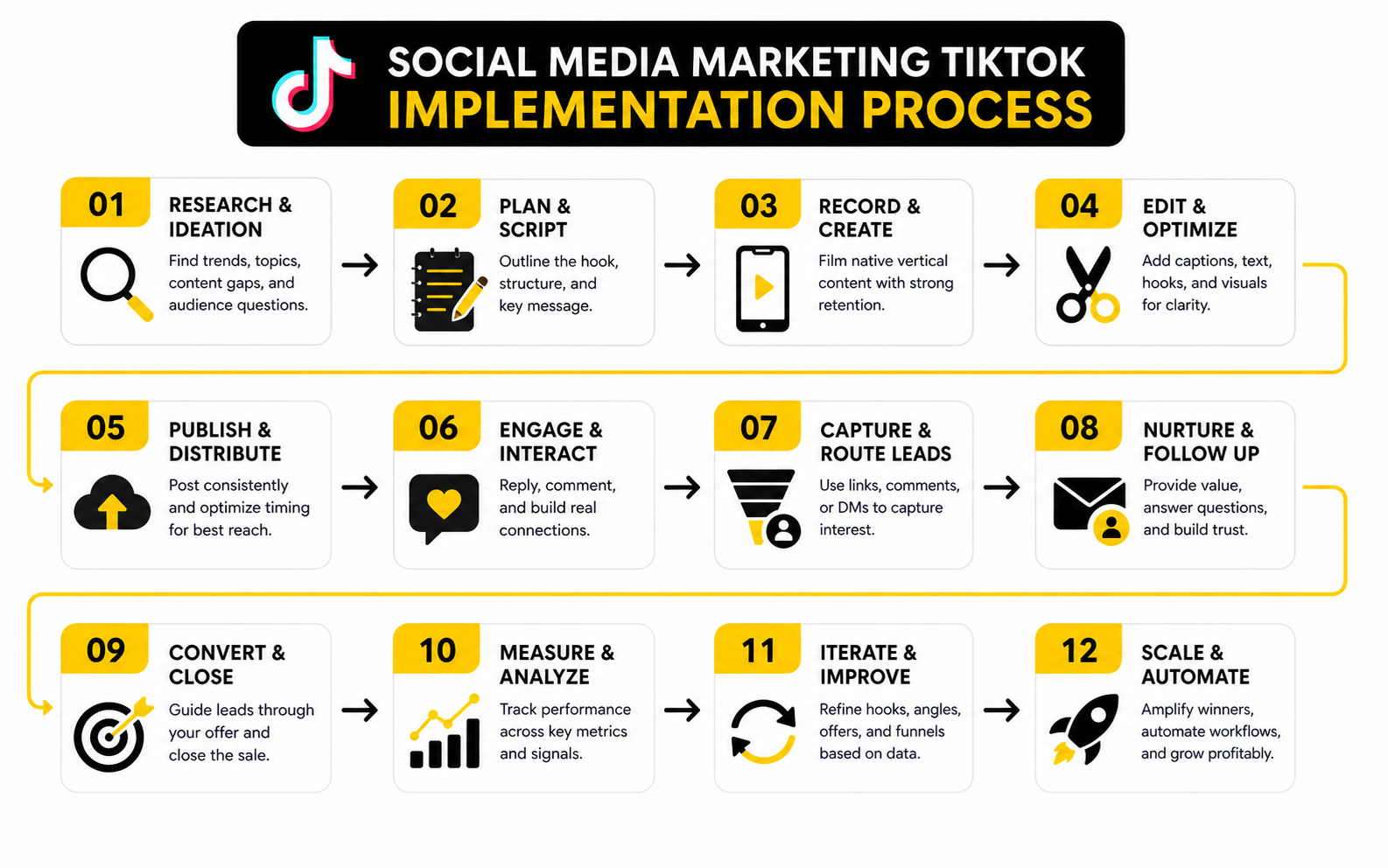
A simple execution process looks like this:
This process keeps momentum alive. It also makes social media marketing TikTok execution less dependent on mood, inspiration, or one overloaded person. The team still needs creative judgment, but the workflow gives that judgment a place to operate.
For publishing and planning, a tool like Buffer can help keep the calendar organized. For teams that capture leads from comments, DMs, or profile links, ManyChat can support the handoff from viewer interest to conversation. The key is to keep the tool stack simple enough that it supports execution instead of slowing it down.
Production Workflow
Production should be built around speed, clarity, and native feel. TikTok content does not need to look like a television commercial. In many cases, overproduction makes the video feel less trustworthy because the platform rewards content that feels immediate and human.
A practical production workflow separates creative decisions into stages. First, define the idea and the goal. Then write the hook, angle, and key points. After that, record in batches, edit for pace, add captions, check the first few seconds, and publish with a clear caption or call to action.
The first few seconds matter because users decide quickly whether to keep watching. That does not mean every hook needs fake drama. It means the opening should make the value obvious, whether the video promises a useful answer, a surprising insight, a strong opinion, or a relatable problem.
Strong production is not about making every video perfect. It is about making every video understandable. If the viewer instantly knows why they should care, the content has a chance.
Publishing And Engagement Rhythm
Publishing rhythm should match your capacity. Posting three strong videos per week with consistent review is better than posting twice a day for two weeks and disappearing. TikTok likes volume, but business growth likes sustainability.
A good rhythm includes planned posts and responsive posts. Planned posts come from your pillars and campaign priorities. Responsive posts come from comments, trends, audience questions, creator conversations, and new market shifts.
Engagement is part of the strategy, not an afterthought. Replying to comments, turning good comments into videos, and watching how people phrase their questions gives you more content intelligence. It also signals that the brand is present, not just broadcasting.
This is especially important for brands trying to build trust. People can feel when an account is managed like a billboard. They can also feel when there is a real person paying attention.
Measurement And Optimization
Measurement should connect TikTok activity to business goals. Views matter, but they are not enough. A video with fewer views can be more valuable if it brings qualified profile visits, saves, comments from buyers, leads, booked calls, purchases, or useful audience insight.
The most useful metrics depend on the objective. Awareness content might focus on reach, completion rate, shares, and follower growth. Education content might focus on saves, comments, and profile visits. Conversion content should be judged by clicks, leads, sales, cost per result, and lead quality.
TikTok’s business updates around creative scaling, search, automation, and full-funnel growth show where the platform is heading. Brands that measure only surface-level engagement will miss the bigger picture. Brands that connect creative performance to funnel outcomes will learn faster.
Optimization does not mean changing everything after one post. It means looking for patterns across batches of content. Keep what works, cut what does not, and test the next version with a clear reason.
Statistics And Data
Measurement is where social media marketing TikTok becomes honest. Ideas are useful, creative instincts matter, and trends can help, but the numbers show whether the content is creating the right kind of attention. The key is to avoid treating every metric like it means the same thing.
TikTok has real scale, with TikTok ads reaching 1.59 billion users in January 2025. That number matters because it confirms the platform is not a niche experiment. But reach alone does not tell you whether your account is reaching buyers, earning trust, or creating action.
The better question is not “Did this video get views?” The better question is “What did this video move?” That shift changes how you read analytics, how you report performance, and how you decide what to make next.
The Metrics That Actually Matter
TikTok analytics should be grouped by intent. A video built for awareness should not be judged the same way as a video built to generate leads. A creator collaboration should not be judged only by direct clicks if its main role is trust and social proof.
For awareness content, watch reach, impressions, new viewers, follower growth, shares, and audience expansion. These metrics tell you whether the content is getting discovered and whether people find it worth passing along. Shares are especially useful because they show that the content has social value, not just passive views.
For education content, watch average watch time, completion rate, saves, comments, and profile visits. These signals show whether the viewer is learning, considering, or coming back later. A save often means the content created practical value, which is very different from a quick like.
For conversion content, watch link clicks, comment triggers, DM starts, form submissions, booked calls, purchases, cost per lead, and revenue. This is where a CRM or funnel system becomes important. If TikTok creates interest but the follow-up is weak, the analytics will look confusing because the content did its job and the backend failed.
How To Read Performance Signals
A high-view video with weak engagement may mean the hook was strong but the substance was thin. That is not a failure; it is a signal. Keep the angle, improve the payoff, and test a tighter version.
A low-view video with strong saves and buyer comments may mean the topic is valuable but the packaging needs work. Do not kill that idea too quickly. Improve the hook, change the opening line, make the promise clearer, and repost the concept in a new format.
A video with strong profile visits but weak clicks usually points to a profile problem. The viewer cared enough to investigate, but the profile did not make the next step obvious. Fix the bio, pinned videos, link destination, and call to action before blaming the content.
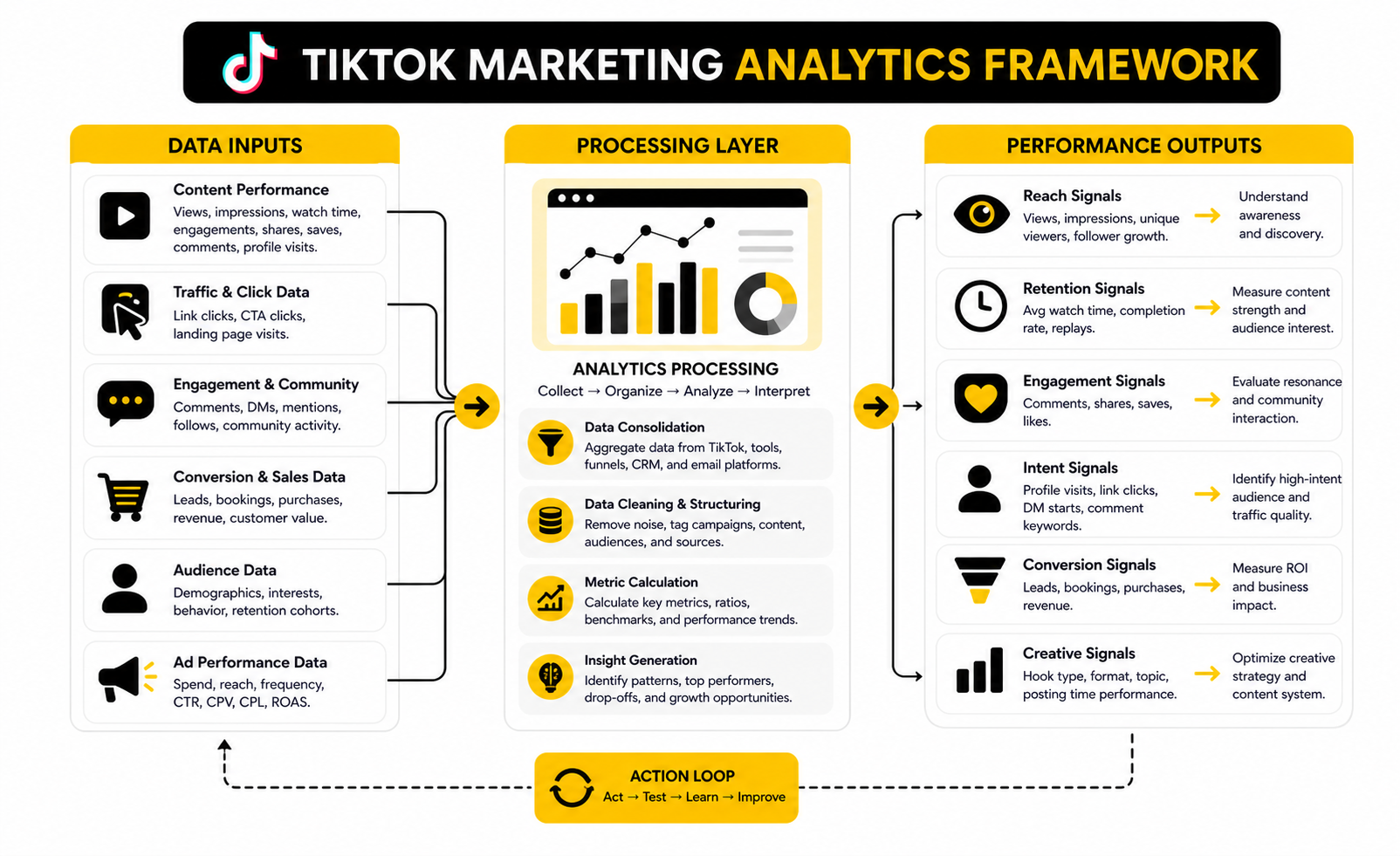
The most useful analytics system connects content signals to funnel signals. Watch time tells you whether the opening and pacing worked. Comments tell you what people are thinking. Profile visits show deeper curiosity. Leads, calls, and purchases show whether attention turned into business value.
Benchmarks Without The Trap
Benchmarks can help, but they can also make you lazy. A general engagement benchmark does not know your niche, offer, audience size, creative style, price point, or funnel maturity. Use benchmarks as orientation, not judgment.
Industry benchmark reports often place TikTok engagement ahead of older social platforms, with some 2025 benchmark summaries showing TikTok around the low single digits for average engagement and stronger rates for smaller accounts. That matters because smaller brands should not assume they are too late. A focused account with a clear niche can still outperform a larger account that posts generic content.
The trap is comparing your early account to a mature creator, a celebrity, or a brand with a massive paid media budget. That comparison usually leads to bad decisions. Your first benchmark should be your own account over time.
Track performance by content type instead of only by account average. Compare tutorials against tutorials, opinion videos against opinion videos, creator clips against creator clips, and offer videos against offer videos. That gives you a cleaner read on what is improving.
A Practical TikTok Reporting Dashboard
A useful reporting dashboard should be simple enough to review weekly. If it takes hours to understand, nobody will use it consistently. The dashboard should show what happened, why it probably happened, and what action the team should take next.
Track these categories:
This is where tools can support the process. A publishing tool like Buffer can help keep content organized, while GoHighLevel can help track what happens after someone becomes a lead. For comment-to-DM campaigns, ManyChat can make the first conversion step easier to measure.
The dashboard should not become a vanity report. It should drive decisions. If the numbers do not change what you do next, you are collecting data for decoration.
What The Data Should Make You Do
Good analytics should create specific actions. If completion rate is weak, tighten the opening, remove slow setup, and test a clearer promise. If saves are strong but shares are weak, the content may be useful but not emotionally or socially interesting enough.
If comments are strong but leads are weak, add a better next step. The audience is reacting, but you have not given them a clean path forward. That might mean a stronger profile link, a pinned explainer, a comment keyword, a lead magnet, or a simpler offer page.
If leads are coming in but quality is poor, the content may be attracting the wrong audience. This is common when brands lean too hard into broad viral topics. The fix is not always more traffic; sometimes it is more specific language, clearer positioning, and stronger qualification.
If paid TikTok campaigns get clicks but weak conversions, review the landing page before blaming the ad. TikTok traffic often needs fast context, clear proof, and a smooth mobile experience. For product or offer pages, tools like ClickFunnels or Systeme.io can help build cleaner conversion paths when the current website is too slow or confusing.
The Weekly Optimization Rhythm
Weekly optimization keeps TikTok performance from becoming emotional. Instead of celebrating one spike or panicking after one weak post, review patterns across the week. TikTok performance is noisy, so decisions should come from clusters of signals.
A practical weekly review should answer five questions:
This rhythm makes the strategy sharper over time. The team stops guessing and starts building a feedback loop. That is the real advantage of measurement: not prettier reports, but better decisions.
Funnels, Automation, And Performance Tracking
At this stage, the TikTok strategy has moved beyond posting and reporting. The bigger question is how the system scales without becoming messy, expensive, or disconnected from revenue. This is where advanced social media marketing TikTok work becomes more strategic.
Scaling TikTok is not just doing more of everything. More videos can create more learning, but they can also create more noise. More creators can bring more angles, but they can also dilute the brand. More automation can improve speed, but it can also make the customer experience feel cold if the follow-up is badly designed.
The goal is controlled scale. You want more output, more testing, and more conversion opportunities without losing the human feel that makes TikTok work in the first place.
The Tradeoff Between Volume And Quality
TikTok rewards volume because more posts create more chances to learn. But volume only helps when the content is based on clear patterns. If the team simply publishes more weak ideas, the account becomes busy instead of effective.
Quality does not mean cinematic production. Quality means the video has a clear point, a strong opening, useful substance, and a reason for the right viewer to care. A simple talking-head video can outperform an expensive edit if it speaks directly to the audience’s real problem.
The smart tradeoff is to batch production without batching thought. Prepare hooks, angles, and outlines carefully, then record efficiently. That gives you speed without turning your content into a factory of generic clips.
Creator Partnerships At Scale
Creators can help brands move faster because they bring platform fluency, audience trust, and native storytelling. TikTok’s 2025 trend reporting highlights a shift toward brands working with creators and communities instead of simply broadcasting brand messages. That is important because the best creator partnerships usually feel like collaboration, not outsourced ad placement.
The risk is choosing creators only by follower count. A large audience does not guarantee fit, trust, or conversion. For many brands, smaller creators with a specific audience and strong comment quality can be more useful than big accounts with broad reach and weak buyer intent.
A strong creator system should define:
Do not over-script creators. Give them the strategy, the guardrails, and the proof points, then let them speak in the style their audience already trusts. That balance is where creator content usually becomes useful instead of stiff.
Paid Amplification Without Killing The Content
Paid TikTok campaigns work best when they are built from content that already understands the platform. The wrong move is to take a traditional ad, crop it vertically, and call it TikTok creative. People can feel that instantly.
TikTok’s 2025 business updates focus heavily on full-funnel growth, AI-assisted creative scaling, search, and automation. That direction matters because paid success is increasingly tied to creative variety and signal quality. The platform can optimize delivery, but it cannot save weak messaging.
A practical paid strategy starts with organic learning. Identify videos that already show strong retention, useful comments, saves, shares, or conversion intent. Then adapt those angles into paid variations with clearer calls to action, landing pages, and audience testing.
Automation can help when the inputs are clean. TikTok’s Smart Performance Campaigns are designed to maximize delivery outcomes with less manual input, but the system still needs strong creative and conversion data. Automation is not a replacement for strategy; it is a way to scale a strategy that is already producing signals.
Search, Social Commerce, And The Shift Toward Intent
TikTok is no longer only a passive discovery feed. People use it to search, compare, learn, and shop. That changes how brands should think about content because some videos need to be built for intent, not just interruption.
Search-focused TikTok content should answer specific questions clearly. Use the words your audience actually searches for, especially around comparisons, tutorials, product use, mistakes, pricing concerns, and beginner questions. This is one of the cleanest ways to make social media marketing TikTok content more durable because search-friendly videos can keep working after the first feed push.
Social commerce adds another layer. Recent retail coverage has shown major brands moving into TikTok Shop as the platform becomes more serious about in-app shopping, with U.S. TikTok Shop sales reported at $4.9 billion in Q1 2026 and consumer spending up 46%. That does not mean every business should rush into TikTok Shop, but it does prove that TikTok is becoming a deeper buying environment, not just an awareness channel.
The strategic question is simple: does your audience want to buy inside the platform, or do they need a longer decision path? Low-friction products may fit social commerce. Higher-ticket services, B2B offers, and complex products usually need education, retargeting, email, calls, demos, or a stronger funnel after the first touch.
Building A Backend That Matches The Frontend
TikTok can create demand quickly, but the backend has to catch it. If a video sends people to a slow page, unclear offer, weak form, or messy follow-up process, the campaign will look worse than it really is. This is a backend problem, not always a content problem.
For lead generation, the flow should be painfully simple. The viewer sees the content, understands the next step, clicks or comments, gets the promised resource, and receives follow-up that matches their intent. A tool like ManyChat can support comment and DM flows, while GoHighLevel can help manage the CRM, calendar, pipeline, and automated follow-up.
For direct-response funnels, the landing page needs to continue the same conversation started by the video. Do not send a casual TikTok viewer into a generic corporate page with ten menu options. A focused funnel built with ClickFunnels or Systeme.io can make sense when the goal is to guide one specific action.
Email and SMS also matter because not every TikTok lead buys immediately. For email follow-up, Brevo or Moosend can help turn first interest into a longer relationship. The main thing is message match: the follow-up should feel like a natural continuation, not a sudden sales blast.
Risks That Get Bigger As You Scale
The first risk is creative fatigue. Audiences get tired of repeated hooks, repeated formats, and repeated claims. Paid campaigns also fatigue when the same creative runs too long, which is why a scaling system needs constant new angles, not just higher spend.
The second risk is brand dilution. When too many creators, freelancers, or internal team members produce content without clear positioning, the account starts sounding inconsistent. The fix is not more approval layers. The fix is clearer creative briefs, stronger examples, and sharper brand guardrails.
The third risk is compliance. This matters especially in finance, health, supplements, legal, employment, and any category where claims can create real consequences. TikTok moves fast, but regulated brands cannot afford casual claims, misleading transformations, hidden sponsorships, or unsupported results.
The fourth risk is over-automation. Automated DMs, AI-written replies, and CRM sequences can improve speed, but they should never make people feel trapped in a machine. Use automation to route, qualify, remind, and deliver value. Keep human review for nuanced questions, complaints, high-intent leads, and anything emotionally sensitive.
Advanced Testing Priorities
Once the basics are working, test bigger strategic variables instead of tiny cosmetic changes. Changing the caption rarely matters as much as changing the angle, audience, offer, creator, hook, or landing page. Test what can actually move the result.
Strong advanced tests include:
Each test should have a clear reason. Do not test randomly just because the dashboard has options. The point is to learn what kind of message, format, and funnel creates the most valuable action from the right audience.
Scaling Without Losing The Human Edge
The brands that scale TikTok well usually protect the human edge. They still sound like people. They still respond to comments. They still let creators bring personality. They still make content around real audience questions instead of turning everything into campaign language.
This is the part many brands miss. TikTok rewards relevance, but relevance comes from listening. The more you scale, the more intentional you need to be about staying close to the audience.
A mature TikTok system should feel organized behind the scenes and natural on the front end. That is the balance. Build the workflow, use the tools, track the numbers, and automate the repetitive parts, but keep the voice human.
Professional Implementation And Optimization
The final layer of social media marketing TikTok is not another tactic. It is the ecosystem. Content, creators, paid media, search, funnels, automation, reporting, and follow-up all need to work together, or the strategy will always feel heavier than it should.
The strongest TikTok systems are simple on the surface and disciplined underneath. The audience sees useful, entertaining, relevant content. Behind the scenes, the team is tracking patterns, refining offers, testing creative, improving follow-up, and turning attention into measurable business outcomes.
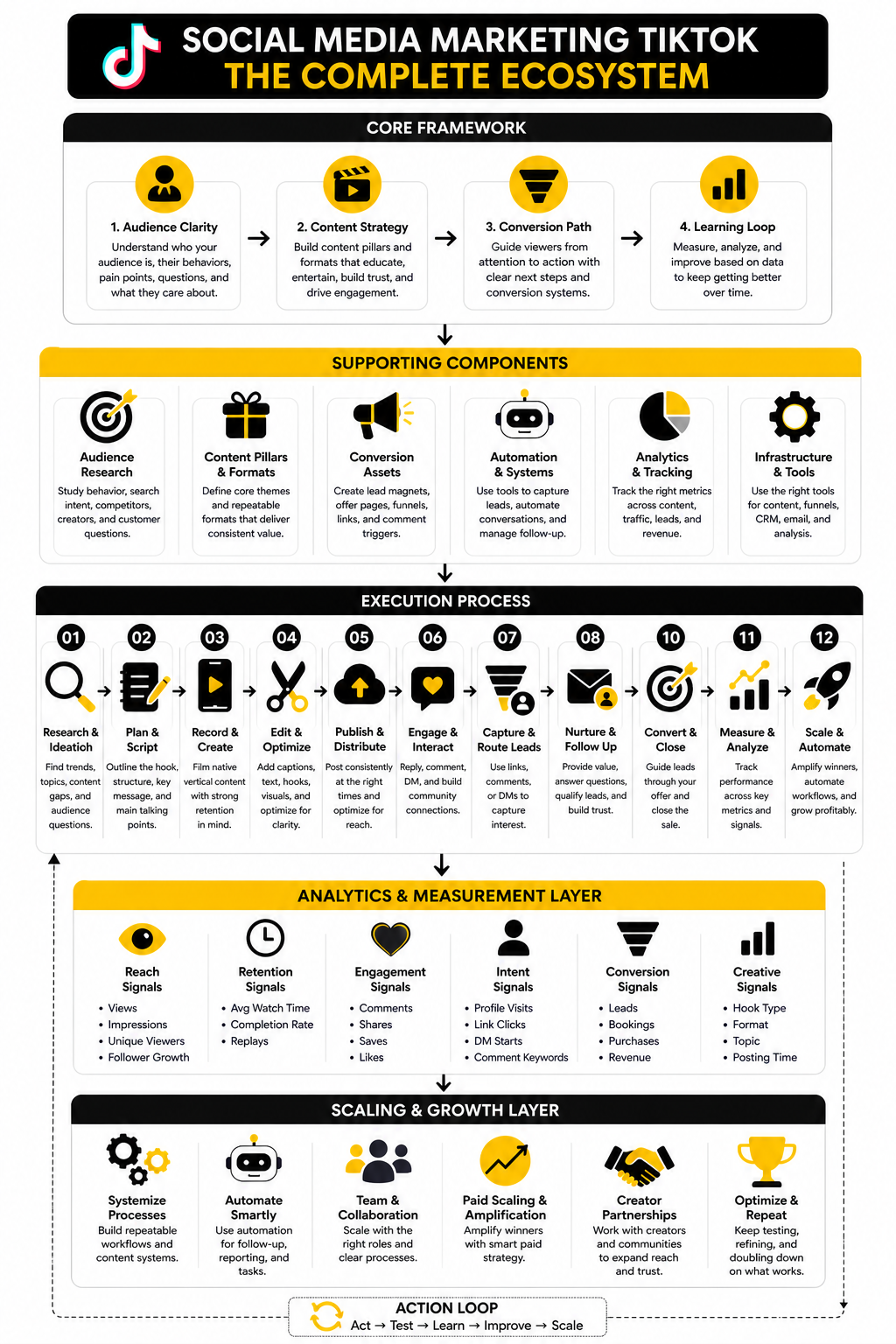
This is the point where many brands need to decide whether TikTok is a side activity or a serious acquisition channel. If it is a side activity, occasional posting is fine. If it is a serious channel, it needs ownership, process, creative volume, analytics, and a backend that can actually handle demand.
Building The Final TikTok Ecosystem
A complete TikTok ecosystem starts with positioning. The brand needs to know what it wants to be known for, who it wants to attract, and what action matters after someone pays attention. Without that, every other piece becomes harder.
The next layer is content operations. This includes research, ideation, scripting, recording, editing, scheduling, engagement, and creator coordination. A tool like Buffer can help keep publishing organized, but the real value comes from having a repeatable content rhythm.
The final layer is conversion and retention. TikTok can spark interest quickly, but the business needs to capture it, qualify it, follow up, and keep the relationship alive. For many teams, that means connecting comment automation through ManyChat, CRM and pipeline tracking through GoHighLevel, and email nurture through Brevo or Moosend.
When To Bring In Professional Help
Professional help makes sense when TikTok has clear upside but the internal team lacks time, creative skill, technical setup, or strategic experience. This is common for founders, agencies, ecommerce brands, local businesses, and service companies that know TikTok matters but cannot keep the system moving consistently. The problem is not always talent; it is usually bandwidth and focus.
A professional TikTok marketer should not only promise views. They should understand positioning, content strategy, creator sourcing, paid amplification, tracking, funnel design, and reporting. If they cannot explain how attention becomes pipeline or sales, they are only managing content, not growth.
The right specialist can also protect the brand from costly mistakes. That includes weak creator briefs, poor landing pages, messy lead capture, unsupported claims, unclear reporting, and over-automation. TikTok moves fast, but professional implementation keeps the business from chasing every trend at random.
Is TikTok still worth using for social media marketing?
Yes, TikTok is still worth using when your audience is active there and your brand can create useful, native content. The platform has massive ad reach, growing search behavior, and increasingly serious commerce infrastructure. The key is to treat TikTok as a strategic channel, not just a place to repost short videos.
How often should a brand post on TikTok?
A realistic starting point is three to five strong posts per week. More volume can help, but only if the team can maintain quality, review performance, and keep testing new angles. Consistency matters more than short bursts of activity followed by silence.
What kind of TikTok content works best for marketing?
The best content usually explains, demonstrates, compares, reacts, challenges, or entertains around a real audience problem. Tutorials, mistake breakdowns, objection-handling videos, product demos, creator-led clips, and comment replies can all work. The right mix depends on your offer, audience, and funnel.
Should TikTok content be polished or casual?
TikTok content should be clear before it is polished. Some brands benefit from high-quality editing, but overproduced content can feel disconnected from the platform. A direct, useful, human video often performs better than a glossy ad that feels like it belongs somewhere else.
How do I measure TikTok marketing success?
Measure success by matching metrics to intent. Awareness content should be judged by reach, retention, shares, and audience growth. Conversion content should be judged by clicks, leads, booked calls, purchases, revenue, and lead quality.
Are views important on TikTok?
Views matter, but they are not the whole story. A video with high views and no buyer intent may be less valuable than a smaller video that drives qualified leads. Use views as one signal, not the final verdict.
How do I turn TikTok engagement into leads?
Give viewers a clear next step. That can be a profile link, lead magnet, quiz, booking page, comment keyword, DM flow, or TikTok Shop product path. Tools like ManyChat can help when comments and DMs are part of the conversion process.
Should I use TikTok ads or focus on organic content first?
Start with organic learning whenever possible. Organic content helps you discover hooks, topics, objections, and formats before spending money. Once you see strong signals, paid amplification can help scale the best ideas faster.
Is TikTok good for B2B marketing?
Yes, TikTok can work for B2B when the content speaks to real professional problems in a simple, human way. The platform is especially useful for founder-led education, expert commentary, software walkthroughs, hiring content, agency positioning, and niche problem-solving. B2B TikTok usually needs a stronger follow-up system because the buying journey is longer.
What is the biggest mistake brands make on TikTok?
The biggest mistake is treating TikTok like a dumping ground for repurposed content. The platform has its own culture, pacing, search behavior, and creative expectations. Brands that ignore that usually sound stiff, promotional, and forgettable.
How long should TikTok videos be for marketing?
The right length depends on the idea. Short videos can work well for punchy hooks, quick tips, and direct demonstrations. Longer videos can work when the topic needs explanation, proof, or storytelling, but the pacing has to stay tight.
Do I need creators for TikTok marketing?
You do not always need creators, but they can help a lot. Creators bring trust, native delivery, and fresh angles that brand teams often miss. The best partnerships give creators clear strategy and proof points without forcing them into robotic scripts.
What tools help with TikTok marketing?
Use tools only when they support the system. Buffer can support scheduling, ManyChat can support DM automation, GoHighLevel can support CRM and follow-up, and ClickFunnels or Systeme.io can support funnel pages. Keep the stack lean and make sure every tool has a clear job.
How long does it take to see results from TikTok marketing?
Some videos can create fast attention, but reliable business results usually come from consistent testing over time. You need enough content to see patterns across topics, hooks, formats, and calls to action. The goal is not one lucky viral post; the goal is a repeatable system.
Can TikTok replace other marketing channels?
TikTok can become a major acquisition channel, but it should not be the only one. The smartest approach is to connect TikTok with email, retargeting, landing pages, CRM follow-up, creator partnerships, and customer education. That gives the business more control than relying on one platform alone.
Build a stronger local presence with BAAM AI
Turn your website, Google profile, social channels, and AI visibility into one growth engine
Most businesses do not need more random marketing activity. They need a consistent presence system that helps the right people find them, trust them, and take action. BAAM AI brings strategy, local SEO, website updates, Google Maps visibility, social content, AI-search readiness, media production, and reporting into one practical monthly engine.
If you want your marketing to keep working after the campaign ends, start with a free BAAM AI presence audit. See how your business shows up today and where the fastest visibility wins are at BAAM AI.