
BAAM AI Blog
Social Media Marketing Strategy For Small Business
A social media marketing strategy for small business should not start with “post more.” That is where most owners get trapped. They open five accounts, chase trends, copy bigger brands, burn time on content, and...
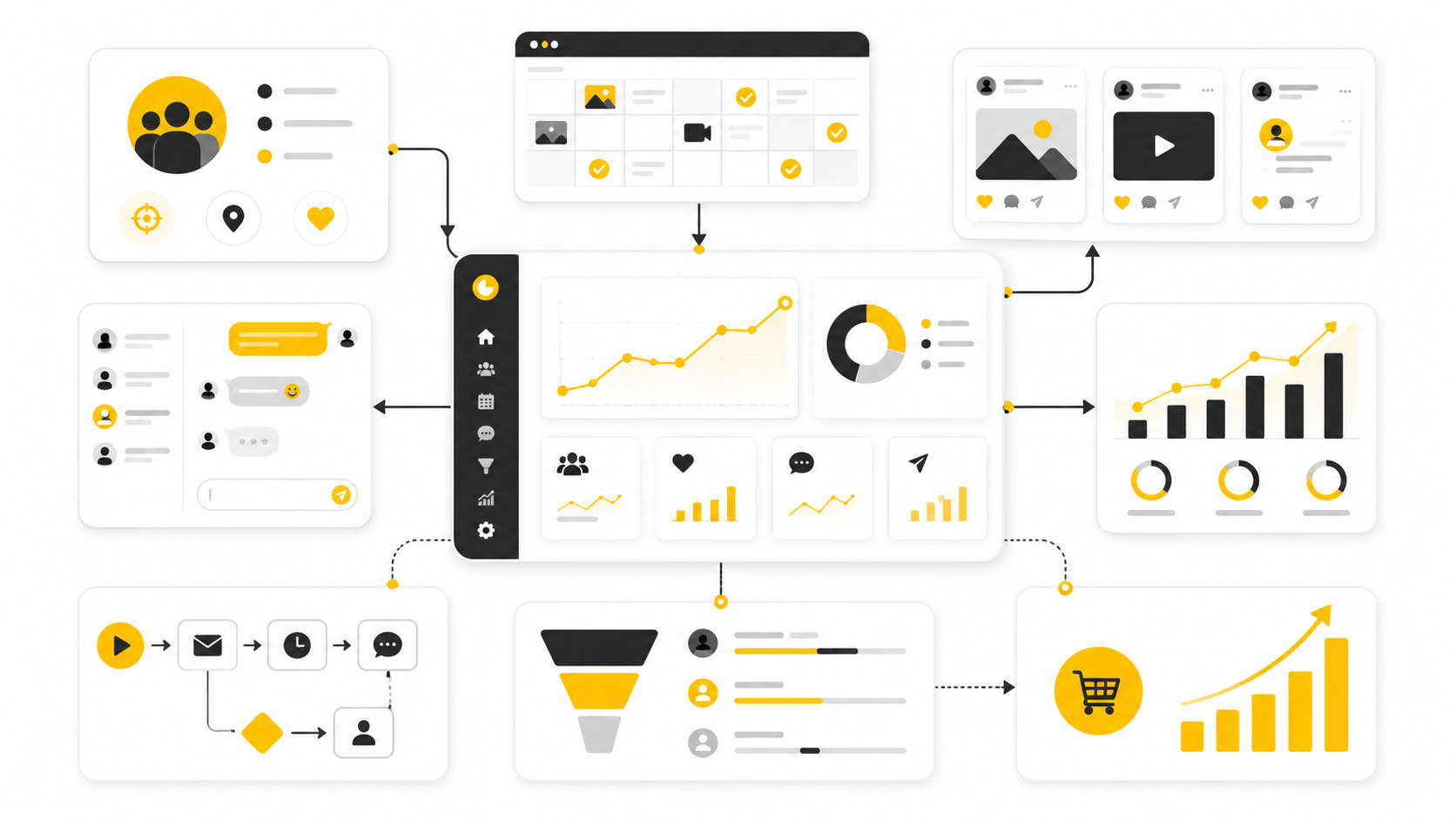
A social media marketing strategy for small business should not start with “post more.” That is where most owners get trapped. They open five accounts, chase trends, copy bigger brands, burn time on content, and still cannot clearly explain which posts are creating leads, sales, bookings, referrals, or repeat customers.
The better starting point is simple: social media has to support the business model. A bakery, local dentist, online coach, boutique agency, ecommerce store, and home services company should not all use the same posting plan. The platforms may look similar from the outside, but the strategy should be built around who buys, why they buy, how long they take to decide, and what they need to see before they trust you.
That matters even more now because social media is crowded, fast, and less forgiving than it used to be. Global social media user identities reached 5.24 billion in 2025, while benchmark data from Rival IQ showed engagement rates falling across major platforms, including Facebook, Instagram, TikTok, and X in its 2025 Social Media Industry Benchmark Report. Small businesses cannot rely on random reach anymore. They need a system that turns attention into measurable business outcomes.
At the same time, social is still one of the most practical growth channels a small business can use. Constant Contact reported that early-stage entrepreneurs are more than twice as likely to use social media than tactics like email or SMS, and 73% say paid and unpaid social posts are their biggest revenue drivers in its Small Business Now 2025 research. That does not mean social media replaces email, SEO, referrals, sales calls, or a website. It means social media often becomes the front door where people first notice you, check your credibility, and decide whether to take the next step.
this guide will build the full system in six parts. The goal is not to give you a motivational list of content ideas. The goal is to give you a practical framework you can use to make better decisions about platforms, content, offers, automation, measurement, and execution.
Why A Social Media Marketing Strategy Matters For Small Businesses
A small business does not have the margin for vanity marketing. A big brand can post for awareness, culture, recruiting, investor perception, customer support, and market positioning all at once. A small business usually needs social media to do something more direct: create trust, start conversations, drive traffic, capture leads, book appointments, sell products, or keep existing customers engaged.
This is where a strategy changes everything. Without one, every post feels urgent, every platform looks important, and every trend feels like a missed opportunity. With one, you can decide what matters, ignore what does not, and build a repeatable workflow that fits your actual capacity.
The pressure is real because small business owners are already stretched. Intuit’s 2025 small business advertising research found that 96% of surveyed small businesses planned to advertise, with many owners directly involved in advertising decisions. That means social media is rarely handled in a clean, isolated marketing department. It is often handled by the founder, a tiny team, a freelancer, or someone who already has ten other responsibilities.
That is exactly why “just be consistent” is incomplete advice. Consistency only helps when the content is aimed at the right audience, tied to a clear offer, distributed on the right platforms, and measured against useful numbers. Posting consistently without strategy can simply make you more efficient at wasting time.
Framework Overview
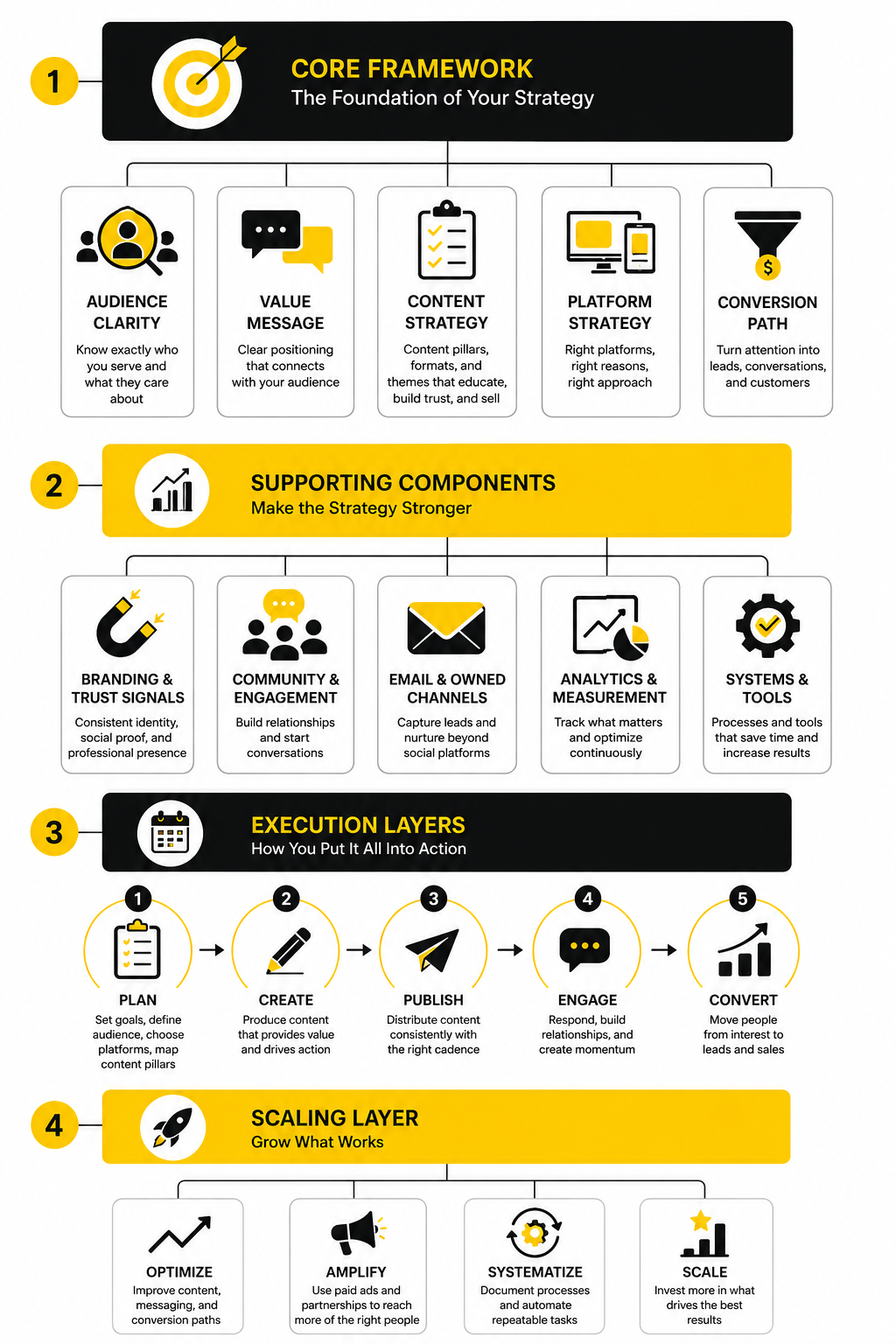
A strong social media marketing strategy for small business has four jobs. It must clarify who you are trying to reach, what you want them to do, what content will move them closer to that action, and how you will follow up when they show interest. Everything else is secondary.
The framework here uses a simple path: audience, offer, content, distribution, conversion, follow-up, measurement. That path works because it follows how people actually buy. They notice you, understand what you do, build trust through repeated signals, respond to something relevant, and then need a clear next step.
This is also where tools can help, but only after the strategy is clear. A scheduling tool like Buffer can make publishing easier, a conversation tool like ManyChat can help automate social DMs, and a CRM or automation platform like GoHighLevel can support follow-up after someone becomes a lead. But tools do not fix unclear positioning, weak offers, generic content, or missing follow-up. They amplify the system you already have.
Core Components
The first component is positioning. People should quickly understand who you help, what problem you solve, and why your business is a credible choice. This does not mean every post has to be a sales pitch. It means your profile, content themes, proof, and calls to action should all point in the same direction.
The second component is content design. Small businesses need content that does more than fill a calendar. Good content should educate buyers, answer objections, show proof, make the offer easier to understand, and create enough familiarity that a stranger can become a warm prospect over time.
The third component is conversion. Social media attention is fragile, so the next step has to be obvious. That might be a booking link, a lead magnet, a product page, a message prompt, a consultation form, a local offer, a quote request, or a simple “send us a DM” path.
The fourth component is follow-up. This is where many small businesses lose the money. Someone comments, clicks, messages, downloads, books, or asks a question, and then the business has no reliable process to respond quickly, segment the lead, continue the conversation, or bring the person back later.
Professional Implementation
Professional implementation does not mean making your small business look like a Fortune 500 brand. It means building a simple system that can survive busy weeks, staff changes, slow seasons, and platform updates. The best strategy is the one your business can actually run.
Start by choosing the primary business outcome for social media. For one business, that may be local awareness and walk-ins. For another, it may be booked calls. For another, it may be ecommerce sales, newsletter growth, event registrations, or inbound partnership opportunities.
Then choose the smallest set of platforms that can realistically support that outcome. The U.S. Small Business Administration has long advised small businesses to focus their effort instead of trying to manage every network at once in its social media guidance for small businesses. That advice is even more useful now because content expectations are higher, formats change faster, and owners have less room for scattered execution.
A good small business social media strategy is not about being everywhere. It is about being clear, useful, visible, and easy to buy from in the places your best customers already pay attention.
The Small Business Social Media Strategy Framework
The next step is to turn the idea of strategy into something usable. A social media marketing strategy for small business should not be a 40-page document that nobody opens after the first week. It should be a working system that helps you decide what to post, where to post it, what action to drive, and how to know whether it is working.
Think of the framework as a chain. If one link is weak, the whole system underperforms. You can have beautiful content with no offer, a strong offer with the wrong audience, or plenty of engagement with no follow-up process, and the result is the same: activity without dependable growth.
The framework has seven parts:
Each part has a job. The goal keeps the strategy focused, the audience defines who you are speaking to, the offer gives people a reason to act, the message makes the value clear, the content earns attention, distribution gets that content seen, and follow-up turns interest into revenue.
Start With One Primary Business Goal
Most social media plans fail because they try to serve too many goals at once. The business wants more followers, more traffic, more bookings, more sales, more brand awareness, better retention, stronger hiring, and more community engagement. Those are all valid goals, but they do not all require the same content or the same measurement.
A local service business that wants quote requests should not build its strategy around follower count. An ecommerce store with a low-ticket product may care more about product discovery, repeat exposure, and conversion rate. A consultant or agency may need social media to create trust before a sales call, which means education, proof, and point-of-view content matter more than viral entertainment.
Choose one primary goal for the next 90 days. That goal could be booked appointments, inbound messages, email subscribers, direct sales, website visits, event registrations, or repeat customer engagement. You can still track other numbers, but one goal should drive the strategy so your content is not pulling the business in five directions at once.
Define The Audience Beyond Demographics
Demographics are useful, but they are not enough. “Women aged 25 to 45” or “small business owners” does not tell you what content to create. You need to understand the customer’s situation, pressure, objections, buying triggers, and level of awareness.
A better audience definition answers practical questions. What problem are they trying to solve right now? What have they already tried? What are they afraid of wasting money on? What would make them trust a business like yours faster?
This matters because people do not respond to content just because they technically match your target market. They respond when the content reflects a real problem they recognize. If your content sounds like it could be written for anyone, it usually connects deeply with no one.
Match The Offer To The Buying Moment
Your offer is not only the product or service you sell. It is also the next step you ask someone to take after they see your content. That could be a free estimate, a booking call, a limited local promotion, a product bundle, a downloadable guide, a webinar, a demo, a quiz, or a direct message conversation.
The mistake is asking for the wrong level of commitment too early. A cold prospect may not be ready to book a sales call after one Instagram Reel. But they might save the post, follow the account, ask a question, click to compare options, or join an email list if the next step feels low-friction.
This is why every small business needs more than one conversion path. Some people are ready to buy now, but many are still researching, comparing, or waiting for the right timing. A simple funnel builder like ClickFunnels or an all-in-one platform like Systeme.io can help create these paths, but the offer logic has to come first.
Build The Message Before The Content Calendar
A content calendar is useful only when the message is clear. Otherwise, it becomes a list of random post ideas. Before deciding whether to post a Reel, carousel, short video, long caption, story, poll, or testimonial, define the core message you want the market to remember.
Your message should connect three things: the customer’s problem, your point of view, and the outcome your business helps create. For example, a fitness studio might not simply say, “We offer group classes.” A sharper message might be, “Busy adults can rebuild strength without spending two hours a day in the gym.”
That kind of message gives your content direction. Educational posts can explain the problem, proof-based posts can show the outcome, behind-the-scenes content can build trust, and direct-response posts can invite the next step. The calendar becomes easier because each post has a role instead of just filling space.
Turn The Message Into Content Pillars
Content pillars are the recurring themes your social media presence is built around. They keep your feed from becoming repetitive while still making the brand easy to understand. For most small businesses, four to six pillars are enough.
A practical set of pillars could include:
Each pillar should support the buying journey. Problem education helps people understand what they need. Proof reduces doubt. Offer explanation makes the next step clearer. Behind-the-scenes content humanizes the business and gives people a reason to trust the people behind the brand.
Choose Distribution Based On Customer Behavior
Platform choice should follow the customer, not the trend. A B2B consultant may get more value from LinkedIn and YouTube than from trying to dance on TikTok. A restaurant, salon, boutique, gym, or local event business may rely heavily on Instagram, Facebook, TikTok, Google Business Profile, and community groups.
Recent platform data shows why this decision needs nuance. Pew Research Center’s 2025 social media research found that YouTube and Facebook remained widely used in the U.S., while Instagram, TikTok, Reddit, WhatsApp, and other networks reflected more fragmented behavior across age groups and use cases in its social media fact sheet. That fragmentation means “everyone is on social” is not a strategy. You still need to know where your specific buyers spend attention and how they use each platform.
Distribution also includes repurposing. One strong idea can become a short video, a carousel, a LinkedIn post, a story sequence, an email, a blog section, and a sales page FAQ. A scheduling workflow through Buffer can make that easier, but the real leverage comes from building around reusable ideas instead of constantly inventing from scratch.
Connect Social Activity To A Follow-Up System
Social media creates moments of interest. Follow-up turns those moments into business. This is one of the biggest differences between a casual posting plan and a serious social media marketing strategy for small business.
When someone comments, replies, clicks, downloads, books, or sends a message, the business needs a clear next step. That might mean a DM automation, a saved reply, a booking page, a tagged CRM contact, an email sequence, or a reminder for a human follow-up. Without that process, leads leak out of the business quietly.
A DM automation tool like ManyChat can help capture and route conversations from platforms like Instagram or Facebook. A CRM and automation system like GoHighLevel can help manage leads after they raise their hand. The point is not to overcomplicate the setup. The point is to stop treating engagement as the finish line.
Measure The Few Numbers That Actually Matter
Small businesses do not need a giant reporting dashboard at the beginning. They need a small set of numbers that reveal whether social media is helping the business. The right metrics depend on the goal, but the wrong metrics are easy to spot: they look impressive and do not change decisions.
For awareness, track reach, profile visits, saves, shares, and follower quality. For lead generation, track clicks, form fills, DMs, booked calls, and cost per lead if you use paid social. For sales, track conversion rate, revenue, average order value, repeat purchases, and the content or campaign that assisted the sale.
Benchmarks can help you interpret performance, but they should not replace business judgment. Industry reports like Sprout Social’s 2025 Content Benchmarks Report and Hootsuite’s 2025 engagement rate benchmarks are useful for context, but your own trendline matters more. If your reach is modest but your posts generate qualified inquiries every week, that is more valuable than viral content that attracts the wrong audience.
Keep The Framework Simple Enough To Use
A strategy that looks smart but never gets implemented is not a strategy. It is decoration. The best framework is simple enough that the owner, marketer, or assistant can use it on a busy Tuesday without needing a two-hour meeting.
For most small businesses, the weekly workflow can be very straightforward. Pick the business goal, choose the content pillars, create posts that support the offer, publish on the most relevant platforms, respond to engagement, move interested people into a follow-up path, and review the numbers once a week.
That is not glamorous, but it works because it creates a loop. You publish, learn, refine, and improve. Over time, the strategy becomes less about guessing what to post and more about understanding what moves real people closer to buying.
Core Components Of A Profitable Social Media System
Once the framework is clear, the strategy needs structure. This is where a social media marketing strategy for small business becomes less abstract and more operational. You are no longer asking, “What should we post today?” You are building a system that connects customer problems, content ideas, platform behavior, calls to action, and follow-up.
The core components are not complicated, but they do need to work together. A small business can have strong content and still lose sales if there is no clear next step. It can have a good offer and still struggle if the content does not build enough trust before asking people to act.
This is why implementation matters. Strategy is the thinking. Implementation is the rhythm that makes the thinking useful every week.
Component 1: A Clear Customer Problem
Every profitable social media system starts with a problem your customer already cares about. Not a vague problem. Not a problem you wish they cared about. A real pain, desire, frustration, question, or decision point that shows up before they buy.
For a small business, this might be convenience, price anxiety, confusion, lack of trust, urgency, risk, status, time, or comparison. A local roofer may need to address storm damage fears and insurance confusion. A skincare clinic may need to address safety, results, and whether a treatment is right for a specific skin type.
The more specific the problem, the easier the content becomes. Instead of posting generic tips, you can create content around the exact doubts and buying triggers that move someone from passive follower to serious prospect. That is how social media starts supporting revenue instead of just visibility.
Component 2: A Simple Offer Ladder
A small business should not rely on one hard sales pitch. Different people are at different stages of awareness, so your strategy needs an offer ladder. This means you give people a few logical ways to move closer to buying without forcing everyone into the same step.
The bottom of the ladder might be a helpful post, checklist, short video, guide, quiz, or direct message prompt. The middle might be an email signup, quote request, webinar, sample, consultation, or product comparison. The top might be the purchase, booking, membership, package, subscription, or signed contract.
This matters because many buyers need more than one touch before they act. Social media often creates the first moment of attention, but email, retargeting, reviews, landing pages, and personal follow-up often help finish the job. If you use a funnel tool like ClickFunnels, keep the ladder simple first. The funnel should support the offer, not make the offer harder to understand.
Component 3: Content Roles
Not every post should do the same job. Some posts should attract new people. Some should educate. Some should build proof. Some should start conversations. Some should make a direct offer.
A practical small business content system usually needs these roles:
The balance depends on the business. A new local business may need more awareness and trust. A business with an established audience may need clearer offers and stronger conversion content. An ecommerce brand may need more product education, comparison content, and repeat-purchase reminders.
Component 4: A Repeatable Weekly Workflow
This is the part most people skip, and it is where execution falls apart. A strategy that depends on inspiration will eventually break. You need a weekly workflow that keeps content moving without making social media consume the entire business.
The workflow should be boring on purpose. Decide what needs to be created, who creates it, who approves it, where it gets published, how engagement is handled, and when results are reviewed. If those steps are unclear, the business will keep restarting the strategy every time things get busy.
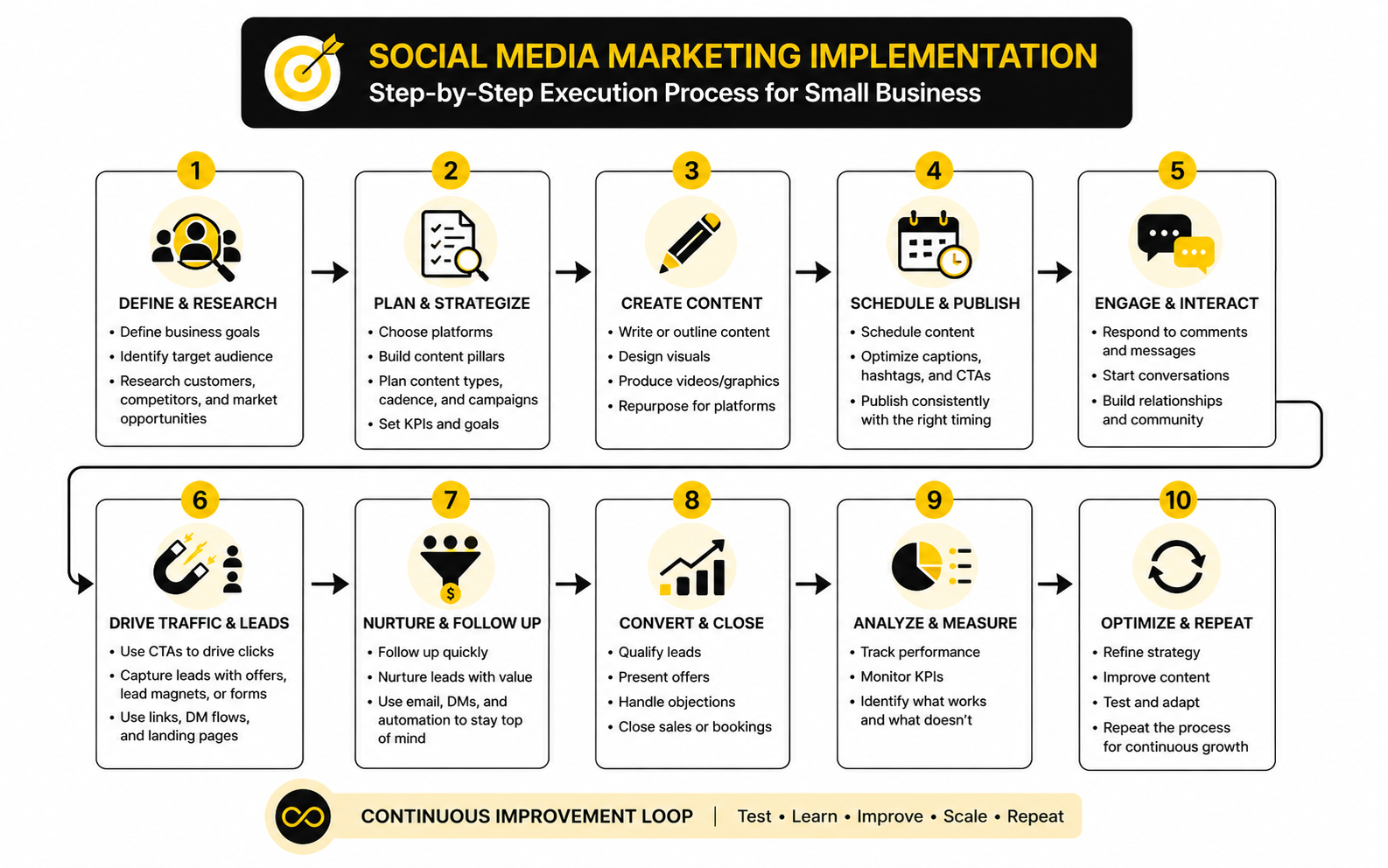
A simple weekly process can look like this:
This does not need to be fancy. A scheduling tool like Buffer can help keep publishing consistent, especially when one person manages multiple platforms. But the real win is the habit of reviewing content against a business goal instead of judging everything by likes.
Component 5: A Response System For Engagement
Engagement is not the finish line. It is a signal. When someone comments, shares, saves, replies, clicks, or sends a direct message, they are showing interest at some level.
The business needs a response system for those signals. That can include saved replies, DM keywords, lead forms, booking links, email capture, CRM tags, or reminders for manual follow-up. The goal is not to automate every human interaction. The goal is to make sure good opportunities do not disappear because nobody had a process.
For example, a post that says “comment GUIDE and I’ll send you the checklist” should connect to a real delivery system. A tool like ManyChat can help automate that kind of conversation, while a platform like GoHighLevel can help track the lead after the conversation starts. Used well, this makes social media feel less like noise and more like a predictable front-end for the business.
Component 6: Proof That Reduces Risk
People rarely buy from a small business just because the content looks nice. They buy when the perceived value is higher than the perceived risk. Proof helps reduce that risk.
Proof can come from reviews, testimonials, before-and-after content, customer questions, process walkthroughs, certifications, founder expertise, press mentions, user-generated content, or clear explanations of how the service works. The point is not to brag. The point is to make the buyer feel safer choosing you.
This is especially important because small businesses often compete with larger brands that have more awareness and bigger budgets. Constant Contact’s consumer research found that many people misjudge the scale of small businesses, while still saying small businesses positively affect their lives in its Small Business Now consumer report. That creates a useful opening. If your content shows the human side, the quality of the work, and the customer outcome clearly, you can turn smallness into trust instead of weakness.
Component 7: A Measurement Loop
A profitable social media system needs feedback. Otherwise, you are guessing. The goal is not to obsess over every metric, but to understand what is moving people closer to the business outcome.
The measurement loop should answer four questions. What content reached the right people? What content created meaningful engagement? What content produced leads or sales? What should be repeated, improved, or stopped?
Industry benchmarks can provide context, especially when engagement rates are changing across platforms. Rival IQ’s 2025 Social Media Industry Benchmark Report found engagement declines across Facebook, Instagram, TikTok, and X, which makes it even more important to measure business outcomes instead of chasing surface-level numbers. A post with fewer likes but more qualified inquiries can be more valuable than a post that travels widely to the wrong audience.
Component 8: A Content Library
A content library keeps the system from becoming chaotic. It gives you a place to store ideas, hooks, captions, testimonials, customer questions, offers, objections, images, short videos, and high-performing posts. Over time, this becomes one of the most valuable assets in the business.
The easiest way to build it is to capture content from daily operations. Save customer questions. Record short explanations. Screenshot approved reviews. Document your process. Turn sales objections into posts.
This is where small businesses have an advantage. You are close to the customer, close to the product, and close to the real problems people care about. Big brands often need research teams to find those insights. A small business can find them by paying attention to conversations happening every day.
Component 9: A Practical Approval Process
Many small businesses slow down because nobody knows who has the final say. One person writes the post, another edits it, the owner rewrites everything, and then the content gets published too late or not at all. That is not a creativity problem. It is an approval problem.
Keep approval simple. Decide who owns the idea, who checks accuracy, who approves brand-sensitive claims, and who publishes. If a post is educational or low-risk, it should not need the same review process as a legal, medical, financial, pricing, or promotional claim.
This becomes more important as the business grows. A clean approval process protects quality without killing momentum. Social media moves quickly, but your brand still needs to sound consistent, credible, and human.
Component 10: A Repurposing System
Repurposing is how small businesses get more value from each idea. One strong idea should not die after one post. It can become a Reel, carousel, short LinkedIn post, email section, FAQ answer, blog paragraph, sales page block, story, or ad angle.
The key is to repurpose the idea, not just copy and paste the same caption everywhere. A TikTok video, Instagram carousel, Facebook post, YouTube Short, and LinkedIn update may all come from the same insight, but each format should match how people use that platform. This keeps the message consistent while making the content feel native.
Repurposing also protects your time. Small business marketing is not about producing infinite new ideas. It is about finding the ideas that matter and presenting them in enough useful formats that more of the right people see them.
Statistics And Data
The numbers in a social media marketing strategy for small business should help you make decisions. They should not become a monthly ritual where someone exports charts, says “engagement is up,” and then nothing changes. Data matters only when it tells you what to keep doing, what to improve, what to stop, and where the next bottleneck is.
This is especially important because social media performance is not evenly distributed. A post can reach thousands of people and produce no serious buyers. Another post can look quiet in public but generate qualified DMs, booked calls, quote requests, or repeat purchases.
The job of measurement is not to prove that every post was perfect. The job is to understand which signals are connected to business outcomes and which signals are just noise.
Start With The Business Question
Every useful report starts with a business question. If the goal is awareness, the question might be, “Are more of the right people seeing us?” If the goal is lead generation, the question might be, “Which content is creating qualified conversations?” If the goal is sales, the question might be, “Which posts, offers, and follow-up steps are actually producing revenue?”
This keeps the analytics simple. You do not need to track every metric on every platform with equal importance. You need to track the numbers that connect social media activity to the goal you chose earlier in the strategy.
For example, a local business trying to increase bookings should care about profile visits, clicks, calls, messages, form fills, booked appointments, no-show rate, and closed revenue. A creator-led ecommerce brand may care more about reach, product page clicks, add-to-cart rate, conversion rate, average order value, and repeat purchases. Same channel, different business model, different scorecard.
Understand The Difference Between Platform Metrics And Business Metrics
Platform metrics tell you how content performed inside the social network. Business metrics tell you whether that attention helped the company. Both matter, but they are not the same thing.
Platform metrics include reach, impressions, watch time, engagement rate, saves, shares, comments, profile visits, follower growth, and click-through rate. These numbers help you understand what the algorithm and audience are responding to. They can show whether your hooks are strong, whether the topic is relevant, and whether people are willing to interact.
Business metrics include leads, bookings, sales, revenue, cost per lead, customer acquisition cost, repeat purchase rate, lifetime value, and close rate. These numbers show whether your social media system is creating value outside the platform. A serious strategy needs both layers because attention without conversion is not enough, and conversion data without content context does not tell you what to create next.
Use Benchmarks As Context, Not As The Goal
Benchmarks are useful because raw numbers can be misleading. If your Instagram engagement rate is 1.5%, is that good or bad? The answer depends on the platform, industry, audience size, content format, objective, and how the engagement is calculated.
Recent benchmark data also shows why small businesses should be careful about expecting old performance levels to continue forever. Rival IQ’s 2025 benchmark research reported that engagement rates declined across several major platforms, including Facebook, Instagram, TikTok, and X, in its 2025 Social Media Industry Benchmark Report. That does not mean social media is dead. It means surface-level engagement is harder to earn, so your strategy has to be sharper.
Use benchmarks to understand the environment, then compare yourself against your own trendline. If your reach is flat but your lead quality is improving, that may be a win. If your engagement is high but your sales team says the inquiries are weak, the content may be attracting the wrong audience.
Track The Full Path From Post To Purchase
The most useful analytics system follows the customer journey. Someone sees a post, visits the profile, clicks a link, sends a message, joins a list, books a call, buys, or comes back later. If you only measure the first step, you cannot see where the money is leaking.
This does not require enterprise-level attribution. A small business can start with clean links, UTM parameters, platform insights, CRM tags, booking source fields, coupon codes, intake questions, and a weekly review. The point is to connect social activity to real outcomes as clearly as possible.
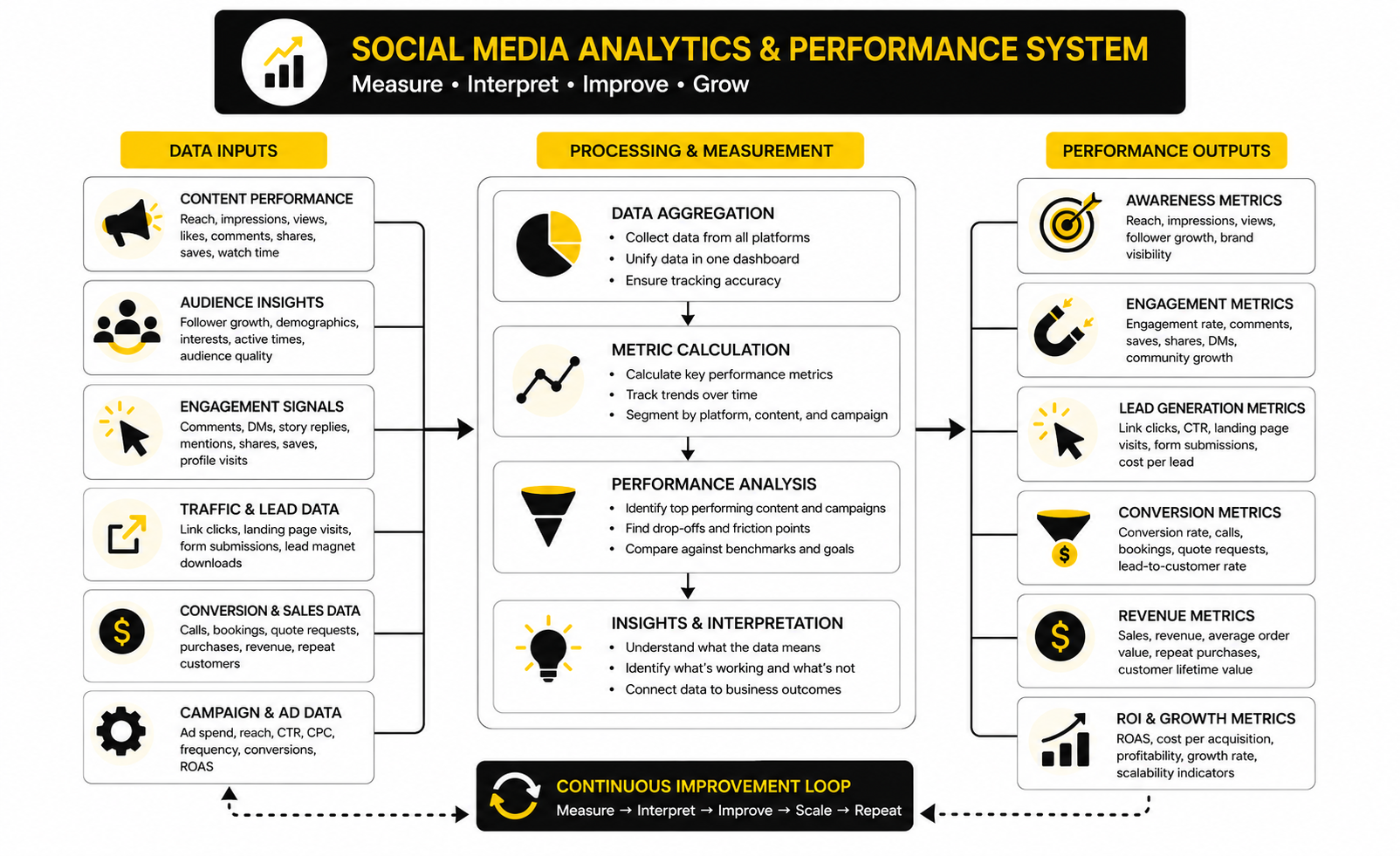
A simple measurement path can look like this:
This kind of setup forces honest thinking. If content gets reach but no intent, the topic may be too broad or the call to action may be weak. If intent is strong but conversion is poor, the landing page, offer, pricing, follow-up, or sales process may be the issue. If sales happen but retention is weak, social media is not the main bottleneck anymore.
Measure Content By Job, Not Just By Format
A common mistake is comparing every post against the same metric. That makes no sense. A trust-building post, a direct offer, an educational carousel, a founder video, and a customer review do different jobs.
Attraction content should be judged by reach quality, shares, profile visits, and new relevant followers. Education content should be judged by saves, watch time, comments, clicks, and repeat engagement. Proof content should be judged by profile visits, DMs, clicks, and assisted conversions. Offer content should be judged by direct responses, leads, bookings, sales, and revenue.
This matters because some of the most valuable posts will not always be the most viral. A clear offer post may get fewer likes than a funny trend, but it may produce better buyers. A detailed educational post may not explode, but it may help a warm prospect finally trust you enough to act.
Watch For Quality Signals
Not all engagement is equal. A comment from someone who fits your target customer and asks a buying question is more valuable than 50 generic reactions from people who will never buy. A share inside a local community group may matter more than a viral spike from an irrelevant audience.
Quality signals often show up in the details. Look at who is engaging, what they are saying, what they click, how they enter the pipeline, and whether they become real opportunities. For small businesses, this can be more useful than a broad engagement rate.
This is also why audience fit matters more than vanity growth. Pew Research Center’s 2025 platform data showed that U.S. social media usage remains fragmented by platform and age group in its Americans’ Social Media Use 2025 research. A small business does not need every demographic. It needs enough of the right buyers on the right platform with the right message.
Read Declines Correctly
A drop in performance is not always a crisis. Reach can fall because the platform changed distribution, the topic was weaker, the hook was unclear, the posting cadence changed, the audience became less responsive, or the content format no longer matches behavior. The data should start a diagnosis, not trigger panic.
When performance drops, compare the post against similar posts instead of judging it in isolation. Look at the hook, topic, format, timing, creative quality, audience fit, and call to action. Then separate platform-wide trends from business-specific problems.
For example, if engagement is down across a platform but DMs and booked calls are stable, the business may not need a major change. If reach is strong but qualified inquiries are declining, the strategy may be attracting attention from the wrong people. If both attention and conversion are falling, it is time to revisit the audience, offer, and content pillars together.
Use A Weekly Scorecard
A weekly scorecard keeps measurement practical. It gives the business a rhythm for reviewing performance without drowning in dashboards. The goal is to spot patterns quickly and make small improvements before problems compound.
A useful weekly scorecard can include:
This should take minutes, not hours. If the scorecard becomes too complicated, people stop using it. Keep the review focused on decisions: what to repeat, what to adjust, what to remove, and what to test next.
Use A Monthly Strategy Review
Weekly reviews help with tactics. Monthly reviews help with strategy. This is where you zoom out and ask whether the whole system is moving the business forward.
Look at the relationship between content volume, reach, engagement quality, leads, sales, and follow-up performance. If content production increased but leads did not, the issue may be message-market fit or conversion path. If leads increased but revenue did not, the issue may be lead quality, response time, offer clarity, or sales process.
Small businesses should also compare social media with other channels. Constant Contact’s 2025 Small Business Now research found that marketing confidence remained low for many SMBs even as effort increased, with fewer than one in five feeling very confident about their marketing impact in its 2025 small business marketing report. That is exactly why monthly reviews matter. More activity does not automatically mean better marketing.
Turn Data Into Action
The final step is translating numbers into decisions. A dashboard is useless if nobody changes anything after reading it. The best analytics system creates clear next actions.
If saves are high but clicks are low, strengthen the call to action. If comments are high but leads are weak, tighten the audience and offer. If clicks are high but conversions are low, improve the landing page, form, or booking flow. If leads are good but sales are weak, review response time, follow-up, pricing, and sales conversations.
Tools can help organize this, but the thinking still matters most. A CRM like GoHighLevel can track leads and follow-up, a scheduler like Buffer can simplify publishing, and a landing page or funnel tool like ClickFunnels can support conversion paths. But no tool should replace the basic question: what did the data teach us, and what are we changing because of it?
Build Around Learning, Not Perfection
Social media measurement should make the business calmer, not more reactive. One weak post does not mean the strategy failed. One viral post does not mean the strategy is working.
What matters is the pattern over time. Are the right people paying attention? Are more of them taking meaningful steps? Are those steps turning into revenue, retention, or stronger customer relationships? Is the team learning faster each month?
That is the real purpose of data in a social media marketing strategy for small business. It turns social media from a guessing game into a feedback loop. The more clearly you read the signals, the easier it becomes to make practical decisions that move the business forward.
Turning Social Media Attention Into Leads, Sales, And Follow-Up
At this stage, the strategy has a clear goal, a practical framework, a weekly execution process, and a measurement loop. Now the question becomes sharper: how do you turn social media attention into business without becoming pushy, scattered, or dependent on one platform? This is where the strategy gets more advanced.
A social media marketing strategy for small business has to balance two things at the same time. It has to earn attention in a public feed, and it has to move the right people into a more controlled environment where follow-up is possible. If all the value stays inside the platform, the business is exposed every time reach drops, algorithms change, or an account issue appears.
That does not mean social media is risky by default. It means social should be treated as the front-end of the relationship, not the whole relationship. The serious work starts when someone raises their hand.
Build A Bridge From Social To Owned Channels
Social platforms are rented attention. Your email list, SMS list, CRM, customer database, website, and booking system are closer to owned assets. You still rely on tools and platforms, but you have more control over the relationship than you do with a follower count.
This is why a small business should use social media to move interested people toward an owned or trackable next step. That could be a newsletter, quote request, calendar booking, downloadable guide, product quiz, waitlist, loyalty offer, consultation form, or private community. The point is not to drag everyone off social immediately. The point is to avoid building the entire growth engine on a channel you do not control.
The bridge should feel natural. If someone watches several posts about solving a specific problem, the next step should help them solve that problem faster. A landing page builder or funnel tool like ClickFunnels can support that handoff, and a CRM like GoHighLevel can help organize the relationship after the person opts in or books. But the bridge only works when the offer matches the intent created by the content.
Treat Direct Messages Like A Sales Channel
Direct messages are often where social media becomes real. Comments are public, likes are light, and shares are indirect. A DM usually means the person is willing to have a more focused conversation.
That does not mean every DM should become a hard pitch. It means the business should respond quickly, ask useful questions, and guide the person toward the next logical step. A good DM process feels helpful, not scripted.
There are three common DM paths:
Each path needs a different response. Support should remove friction. Lead handling should qualify and route the person. Nurture should continue the relationship without pressure. A tool like ManyChat can help with the first response and delivery of resources, but the conversation still has to sound like a real business run by real people.
Use Automation Without Killing Trust
Automation is useful when it removes delays, organizes information, and helps people get what they asked for. It becomes a problem when it pretends to be human, ignores context, or pushes everyone into the same sequence. Small businesses should automate the repetitive parts and keep judgment in the important parts.
Good automation can send a guide, confirm a booking, tag a lead source, notify the team, follow up after a form fill, or remind someone about an abandoned checkout. Bad automation sends irrelevant messages, repeats the same offer too often, or keeps talking after the person has clearly moved on. The difference is not the tool. The difference is the strategy behind it.
This matters because consumer trust is fragile. Edelman’s 2025 brand trust research emphasized that brands now have to meet people in culture and in their own world, not just broadcast polished messages through official channels in its 2025 special report on brands. For small businesses, that is an advantage if automation supports real service instead of replacing it.
Know When To Use Paid Social
Organic content is valuable because it teaches you what people respond to. Paid social is valuable because it gives you control over distribution. The mistake is using paid ads to compensate for a weak offer, unclear message, or broken follow-up process.
Before spending meaningfully on ads, make sure the basics work. You should know which audience you are trying to reach, which offer creates interest, which landing page or booking path converts, and how you will follow up. If those pieces are missing, paid traffic often just makes the leak more expensive.
Paid social can make sense when:
This is where small businesses need discipline. Global marketers spent close to $1.1 trillion on advertising in 2024, with digital advertising responsible for much of the increase, based on DataReportal’s Digital 2025 advertising analysis. That level of competition means paid reach is not automatically cheap or easy. You need a conversion system before you scale spend.
Decide What To Keep Human
The more a small business grows, the more tempting it becomes to automate everything. But not every interaction should be automated. Some moments need human attention because they carry trust, complexity, emotion, or high purchase intent.
A high-ticket consultation request should probably get human follow-up. A frustrated customer comment should not be dumped into a generic workflow. A detailed product question may need a real answer from someone who understands the offer. These moments are not interruptions. They are where the brand becomes believable.
The rule is simple: automate delivery, routing, reminders, and simple answers; keep trust-heavy moments human. This is especially important for businesses where the purchase involves personal risk, health, finance, home, family, status, or a meaningful amount of money. The more the buyer has to trust you, the more careful you should be with automation.
Protect The Brand While Moving Faster
Small businesses often need more content, faster decisions, and quicker responses. That speed can create risk if the team has no boundaries. One careless claim, insensitive joke, misleading offer, or sloppy response can create problems that take far longer to fix than the original post took to publish.
Brand protection does not require a corporate rulebook. It requires a few clear standards. Decide what claims need proof, what topics are off-limits, how customer privacy is handled, how reviews and testimonials are used, and who responds to sensitive comments or complaints.
This is especially important when using customer stories, before-and-after content, financial claims, health claims, or professional advice. If proof is not strong enough, do not use the claim. If a testimonial needs permission, get permission. If a post could mislead someone, rewrite it before publishing.
Use Creators And Partnerships Carefully
Creators, affiliates, and local partners can expand reach faster than a small business can do alone. They can also damage trust if the partnership feels fake or mismatched. The best partnerships work because the creator or partner already has credibility with the exact audience the business wants to reach.
For small businesses, smaller creators can often be more practical than huge influencers. A local food creator, fitness instructor, neighborhood parent account, niche B2B educator, or industry-specific micro-creator may drive more qualified attention than a broad lifestyle account. The goal is not fame. The goal is audience fit and trust transfer.
The creator economy keeps growing, but the market is also becoming more complex. A 2025 systematic literature review of influencer marketing research found that the field still needs better measurement, context, compliance, and standardization in its review of computational studies in influencer marketing. That is a useful reminder for small businesses: do not buy creator exposure blindly. Define the goal, agree on deliverables, track the result, and make sure the partnership is clearly disclosed.
Prepare For Platform Risk
Platform risk is real. Accounts can be restricted, reach can change, ad costs can rise, formats can shift, and audience behavior can move. A strategy that depends entirely on one platform is vulnerable even when it is working today.
This does not mean you need to be everywhere. It means you should know what you would do if your primary platform became less effective. The safest setup is usually one primary social channel, one secondary discovery channel, and one owned follow-up channel. That gives the business focus without making it fragile.
For example, a small business might use Instagram as the primary relationship channel, TikTok or YouTube Shorts for discovery, and email or SMS for follow-up. Another might use LinkedIn for authority, YouTube for education, and a CRM-driven email sequence for lead nurturing. The exact mix depends on the customer, but the principle stays the same: do not let one algorithm control the whole pipeline.
Scale The System In Stages
Scaling social media does not mean simply posting more. More posts can create more work, more noise, and more confusion if the core system is not working. Scale should happen in stages.
Start by proving that the message and offer create meaningful response. Then improve the content workflow so the team can produce consistently. Then strengthen follow-up so leads do not leak. Only after that should you increase content volume, expand platforms, add paid campaigns, or bring in creators.
A practical scaling sequence looks like this:
This order matters. If you scale before the foundation is working, you scale confusion. If you scale after the system is working, you create leverage.
Build A Team Without Losing The Voice
As the business grows, social media may move from the founder to an employee, freelancer, agency, or internal marketing team. That can create more capacity, but it can also dilute the voice that made the business relatable in the first place. Small businesses need systems, but they should not sound like committees.
The best handoff starts with documentation. Capture the brand voice, customer language, common objections, approved claims, offer details, content pillars, examples of strong posts, and examples of what not to do. This gives the team freedom
Measuring Performance, Improving The System, And FAQ
At this point, the strategy should no longer feel like a collection of social media tactics. It should feel like an operating system. The audience is clear, the offer has a path, the content has a job, the platforms have a purpose, and the data tells you what to improve next.
That is the real goal of a social media marketing strategy for small business. It should make marketing easier to manage, not harder. When the system is working, you are not waking up every morning wondering what to post. You are running a loop: publish, listen, respond, convert, measure, improve.
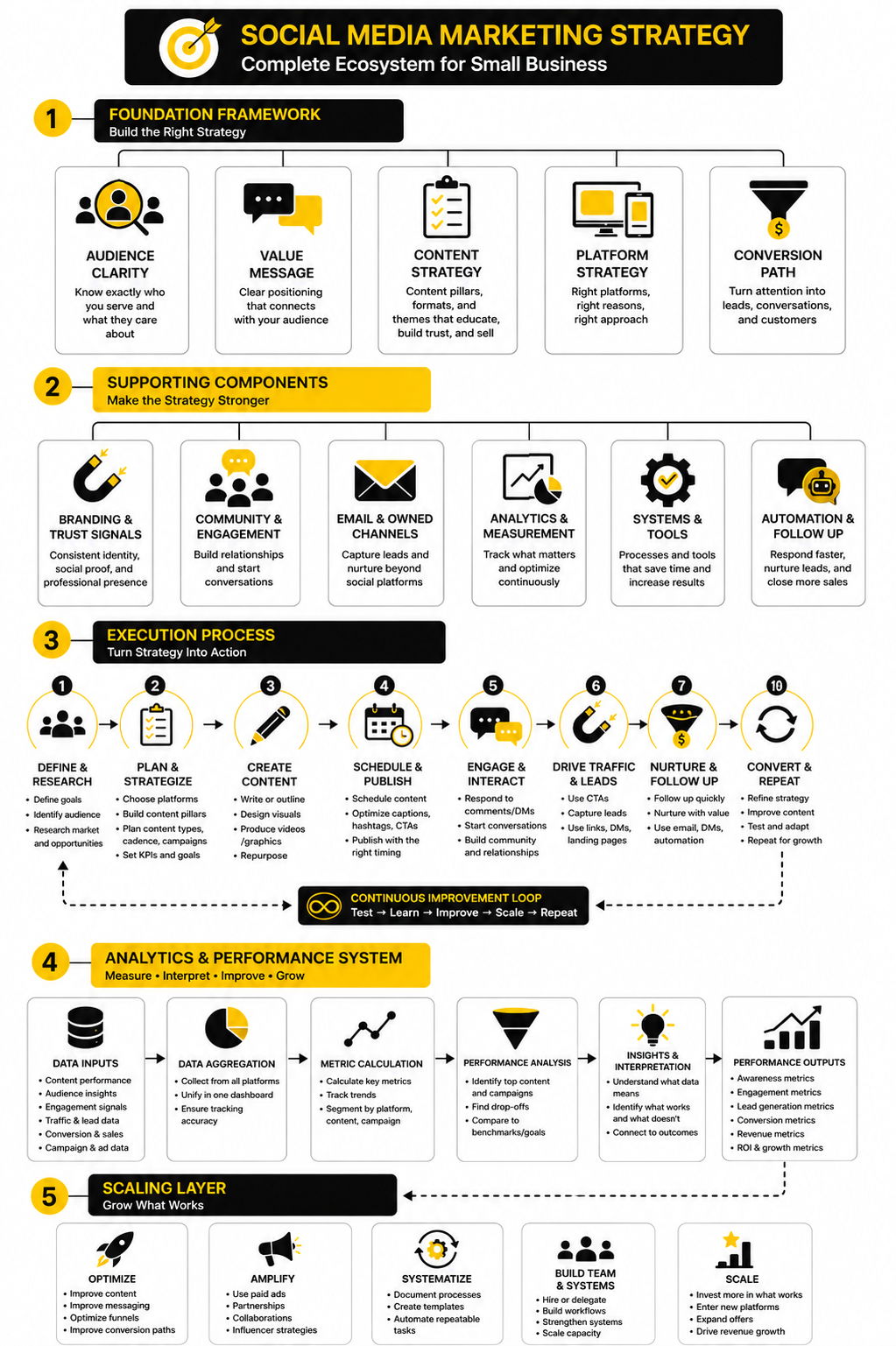
The final layer is discipline. Small businesses often lose momentum because they change the plan too quickly, chase trends too aggressively, or ignore the follow-up work that turns social attention into actual revenue. Stay focused long enough to learn what your market responds to, but stay honest enough to change what is not working.
Know When To Scale
Scaling social media does not mean posting more everywhere. It means increasing what is already working without breaking the system. If one platform is producing qualified leads, scale that before opening three new channels.
Start by scaling the strongest content themes. If posts about customer objections generate better conversations, create more content around those objections. If product comparison posts lead to better clicks, turn that pattern into a recurring series.
Then scale the conversion path. More reach will not help if the landing page is weak, the booking flow is clunky, or the follow-up process is slow. Before adding more content volume or paid ads, make sure the business can handle the attention it already gets.
Avoid The Most Expensive Mistakes
The biggest mistake is treating social media like a content calendar instead of a revenue system. A calendar keeps you organized, but it does not guarantee the right message, audience, offer, or follow-up. A profitable system needs all of those pieces working together.
Another mistake is copying bigger brands. Large companies often use social media for awareness, culture, PR, recruitment, and brand memory. A small business usually needs a more direct connection to leads, sales, bookings, customer trust, or retention.
The third mistake is ignoring response time. When someone asks a question, comments with intent, or sends a message, they are warm in that moment. If the business waits too long, the interest cools, the person compares other options, or the opportunity disappears.
Build A System You Can Actually Maintain
The best strategy is the one your business can execute consistently without burning out. That may mean three strong posts per week instead of daily filler. It may mean focusing on two platforms instead of six. It may mean using automation carefully so the team can respond faster without sounding robotic.
For many small businesses, the practical setup is simple. Use Buffer or a similar scheduler for publishing, ManyChat for simple social DM flows, and GoHighLevel for CRM, pipeline, and follow-up when the business needs a more complete sales system.
Tools are useful, but they should support the strategy. Do not buy software because you feel behind. Buy it when it removes a real bottleneck, saves time, improves follow-up, or helps you measure the path from attention to revenue.
What is a social media marketing strategy for small business?
A social media marketing strategy for small business is a plan for using social platforms to support a real business goal. It defines who you want to reach, what message they need to hear, what content will help them trust you, and what action they should take next.
It should also include platform priorities, posting rhythm, conversion paths, follow-up systems, and measurement. Without those pieces, social media becomes random activity. With them, it becomes a practical growth channel.
How is a small business social media strategy different from a big brand strategy?
A small business usually needs social media to create more direct business outcomes. That might mean calls, bookings, quote requests, store visits, product sales, newsletter signups, or local awareness. Big brands can often afford broader campaigns that are harder to connect to immediate revenue.
Small businesses also have tighter limits on time, budget, and staff. That means the strategy has to be focused. The goal is not to look like a massive brand; the goal is to communicate clearly, build trust, and make it easy for the right people to buy.
Which social media platform is best for small businesses?
There is no single best platform for every small business. The best platform is the one where your target customers already spend attention and where your content can support the buying journey. A local restaurant may rely heavily on Instagram, Facebook, TikTok, and Google Business Profile, while a B2B service provider may get better results from LinkedIn, YouTube, or X.
The wrong approach is trying to be everywhere from day one. Start with one or two platforms that match your audience and capacity. Once the content, conversion, and follow-up system is working, then consider expanding.
How often should a small business post on social media?
A small business should post as often as it can maintain quality, relevance, and follow-up. Three strong posts per week can outperform daily content if the daily content is generic. Consistency matters, but only when the content supports the strategy.
A practical starting point is three to five posts per week on the primary platform, plus stories or short updates when they make sense. The exact number should depend on your resources, audience behavior, content format, and business goal. Posting more is not automatically better.
What should small businesses post on social media?
Small businesses should post content that helps the customer understand the problem, trust the business, compare options, and take the next step. That usually includes educational content, proof, behind-the-scenes content, customer questions, offer explanations, product or service demos, and direct calls to action.
The best content is connected to real customer conversations. Use questions from prospects, objections from sales calls, reviews, service details, process explanations, and common mistakes as content sources. This keeps the strategy grounded in what buyers actually care about.
How do you measure whether social media is working?
Start with the business goal. If the goal is awareness, track reach, profile visits, shares, saves, and audience quality. If the goal is lead generation, track clicks, DMs, form fills, quote requests, and booked calls.
If the goal is sales, track revenue, conversion rate, average order value, repeat purchases, and which content or campaign helped create the sale. Do not judge every post by likes. Measure each piece of content by the job it was meant to do.
Should small businesses use paid ads or organic social first?
Organic social is often the better starting point because it helps test the message, content, offer, and audience without immediately spending on distribution. If people do not respond organically at all, paid ads may only make the problem more expensive. Organic content gives you early feedback.
Paid ads make more sense once you know what message gets attention and what offer converts. Then you can use ads to scale proven content, retarget warm audiences, or drive traffic to a tested landing page. Paid social should amplify what works, not rescue a weak strategy.
What is the biggest social media mistake small businesses make?
The biggest mistake is posting without a conversion path. Many businesses create content, get some engagement, and then leave interested people with no obvious next step. That creates attention without momentum.
Every strategy should answer one simple question: what should the person do after they care? That might be message the business, book a call, claim an offer, download a guide, visit a product page, request a quote, or join an email list. Without that step, the business is leaving money on the table.
How can a small business turn followers into customers?
Followers become customers when trust and timing meet a clear offer. The content should help people understand the value, remove objections, show proof, and create repeated familiarity. Then the business needs a simple path for the person to act.
This is where follow-up matters. A follower might not buy the first time they see an offer. But if they join an email list, reply to a story, ask a question, or enter a CRM pipeline, the business can continue the conversation instead of hoping they come back later.
Do small businesses need automation for social media?
Automation is useful when it saves time or improves response speed. For example, DM automation can deliver a guide, ask a qualifying question, or send someone to the right booking link. CRM automation can help make sure leads are followed up with instead of forgotten.
But automation should not replace human judgment. People can feel when a business is hiding behind bots. Use automation to handle repeatable steps, then bring in a human when the conversation needs trust, nuance, or a real sales conversation.
How long does it take for a social media strategy to work?
A small business can often see early signals within weeks, but stronger patterns usually take longer. Early signals include better comments, more profile visits, higher saves, more DMs, and clearer audience feedback. Business outcomes like sales, bookings, and repeat purchases depend on the offer, buying cycle, follow-up, and price point.
Give the strategy enough time to produce useful data before changing everything. A 90-day cycle is a practical starting point. It gives you enough time to test content pillars, platform fit, calls to action, and follow-up quality.
Should a small business hire a social media marketer?
A small business should consider hiring help when social media is important but the owner or team cannot execute consistently. The right marketer can help with strategy, content planning, creative production, scheduling, analytics, paid ads, community management, or funnel support. The key is hiring for the bottleneck, not just hiring someone to “post stuff.”
Before hiring, define what success looks like. Do you need more leads, better content quality, stronger reporting, faster publishing, or a full campaign system? Clear expectations make the relationship better for both sides.
What tools are useful for a small business social media strategy?
The most useful tools depend on the system you are building. A scheduler like Buffer can help with publishing. A DM automation tool like ManyChat can support social conversations. A CRM and automation platform like GoHighLevel can help manage leads and follow-up.
For landing pages and simple funnel paths, ClickFunnels or Systeme.io can be useful depending on the business model. But the tool stack should stay lean. Choose tools that remove friction, not tools that create more work.
How do you keep social media from taking too much time?
The answer is batching, repurposing, and clear priorities. Do not create every post from scratch. Turn customer questions, sales objections, reviews, product details, service explanations, and high-performing posts into reusable content assets.
Set a weekly workflow and protect it. Choose the content themes, create in batches, schedule what can be scheduled, respond to engagement daily, and review performance once a week. A simple rhythm beats scattered effort.
Build a stronger local presence with BAAM AI
Turn your website, Google profile, social channels, and AI visibility into one growth engine
Most businesses do not need more random marketing activity. They need a consistent presence system that helps the right people find them, trust them, and take action. BAAM AI brings strategy, local SEO, website updates, Google Maps visibility, social content, AI-search readiness, media production, and reporting into one practical monthly engine.
If you want your marketing to keep working after the campaign ends, start with a free BAAM AI presence audit. See how your business shows up today and where the fastest visibility wins are at BAAM AI.