
BAAM AI Blog
Social Media Management Services List: A Practical Framework for Choosing the Right Help
A good social media management services list should do more than name random tasks like posting, scheduling, or replying to comments. It should help you understand what a business actually needs, what can be...
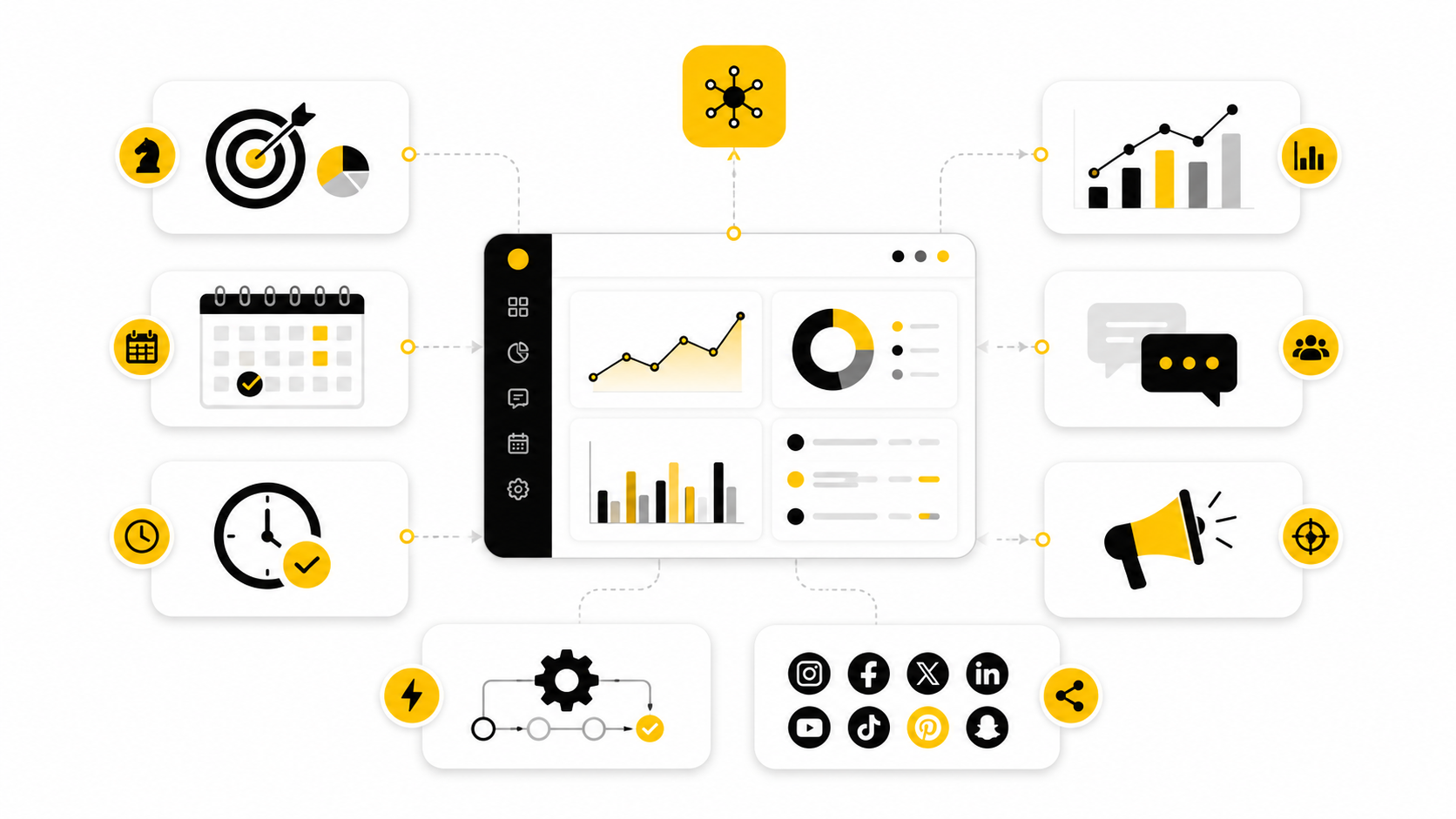
A good social media management services list should do more than name random tasks like posting, scheduling, or replying to comments. It should help you understand what a business actually needs, what can be outsourced, what should stay strategic, and how each service connects to revenue, retention, trust, and brand visibility.
That matters because social media is no longer just a place to “stay active.” Global social media user identities reached 5.79 billion in April 2026, which means most customers now discover, judge, compare, message, and revisit brands through social platforms before they ever book a call or buy something from a website. The brands that win are not always the loudest; they are usually the ones with a clear system behind the content, community, offers, analytics, and follow-up.
this guide breaks down the full social media management services list in a practical way. The goal is simple: help you see which services matter, when they matter, and how to combine them into a professional operating system instead of a messy collection of disconnected posts.
Why Social Media Management Services Matter
Social media management matters because attention has become fragmented, expensive, and harder to earn with generic content. A business can post every day and still get nothing if the message, audience, offer, and follow-up process are weak. That is why professional social media management services are not just about content volume; they are about building a repeatable system that turns attention into useful business outcomes.
The market is moving in that direction. The global social media management market was estimated at $29.93 billion in 2025 and projected to grow sharply through 2033, which shows that companies are treating social management as infrastructure, not a side task. At the same time, the social media management outsourcing market was estimated at $7.26 billion in 2024, with continued growth expected as brands look for specialist execution without hiring full in-house teams.
The real reason businesses look for a social media management services list is usually not curiosity. They are trying to solve a specific problem: inconsistent posting, weak engagement, low-quality leads, no reporting, poor content quality, slow responses, unclear strategy, or wasted ad spend. Once you identify the actual problem, the right service category becomes much easier to choose.
The Social Media Management Services Framework
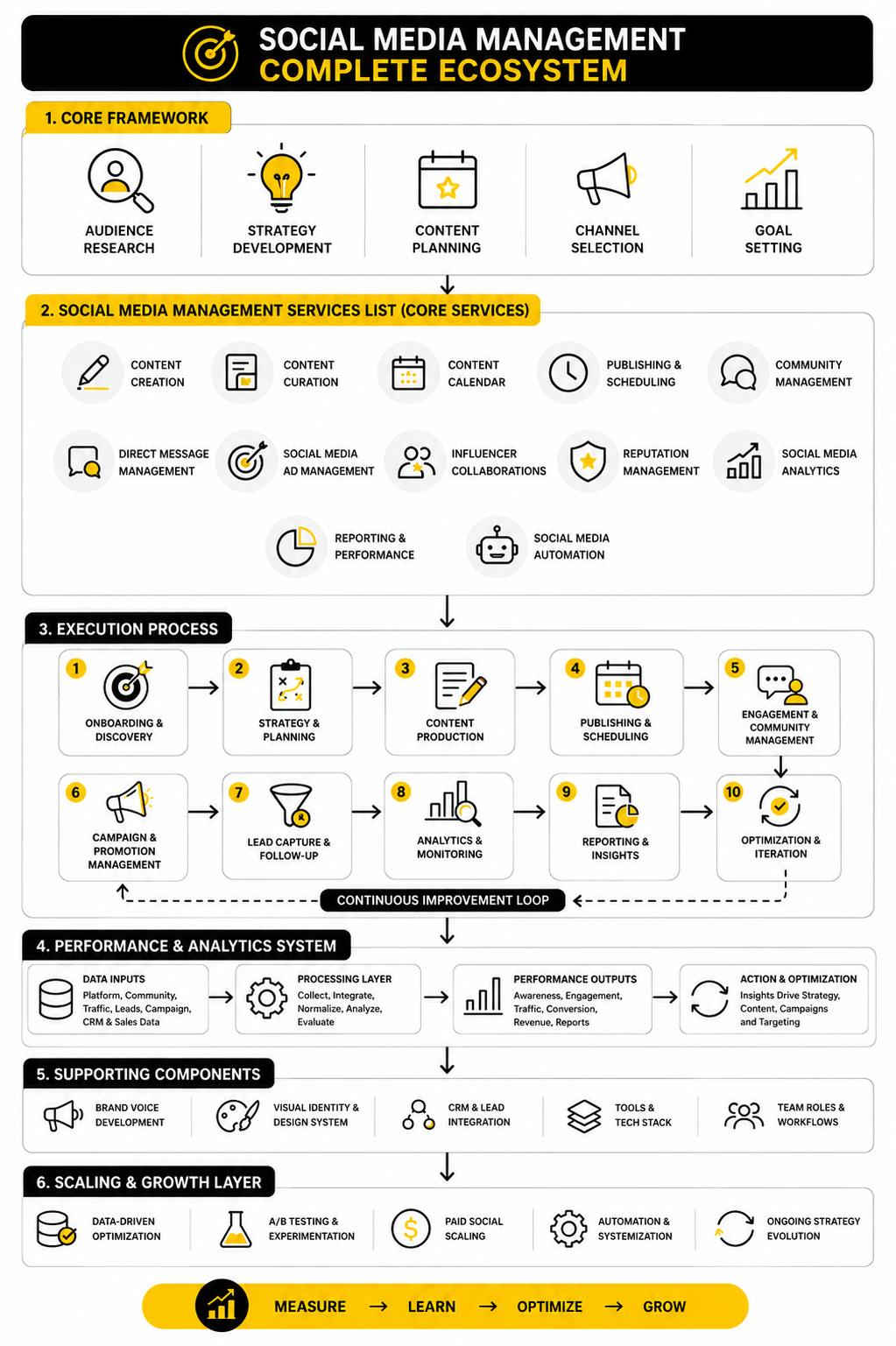
A useful framework starts with one idea: social media management is not one service. It is a stack of services that work together across strategy, production, distribution, engagement, conversion, and measurement. When one layer is missing, the whole system becomes weaker.
For example, content creation without strategy becomes noise. Community management without clear brand guidelines becomes risky. Paid social without landing pages, CRM follow-up, or automation often turns into expensive traffic that never converts.
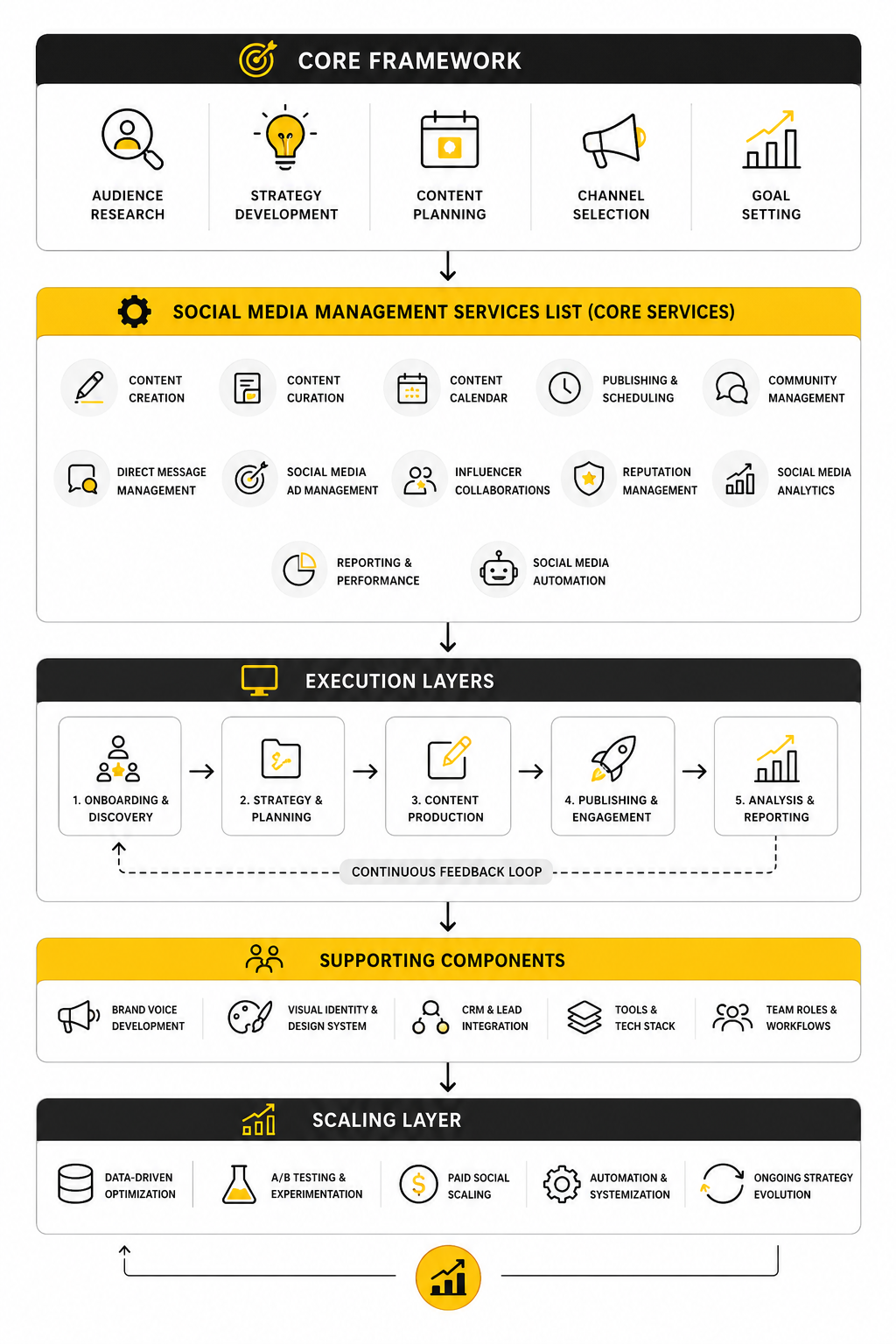
The framework used here separates social media management services into practical categories. Each category answers a different business question, so you can decide whether you need a strategist, content team, community manager, paid ads specialist, automation builder, analytics partner, or a full-service agency.
Core Components of a Social Media Management Services List
The core services usually begin with strategy. This includes audience research, competitor research, platform selection, content pillars, campaign planning, tone of voice, posting frequency, and performance goals. Without this foundation, even great videos, captions, and graphics can feel random.
The next layer is content execution. This includes short-form video, graphics, carousels, captions, scheduling, repurposing, social SEO, creator coordination, and platform-native formatting. Tools like Buffer can support scheduling and publishing, but the tool is only useful when the content plan behind it is strong.
The third layer is interaction and conversion. This includes comment management, inbox replies, lead qualification, review response, community building, chatbot flows, CRM handoff, and campaign follow-up. For businesses that generate leads through Instagram, Facebook, or Messenger, a platform like ManyChat can fit naturally when the goal is to turn engagement into conversations and qualified leads.
Professional Implementation
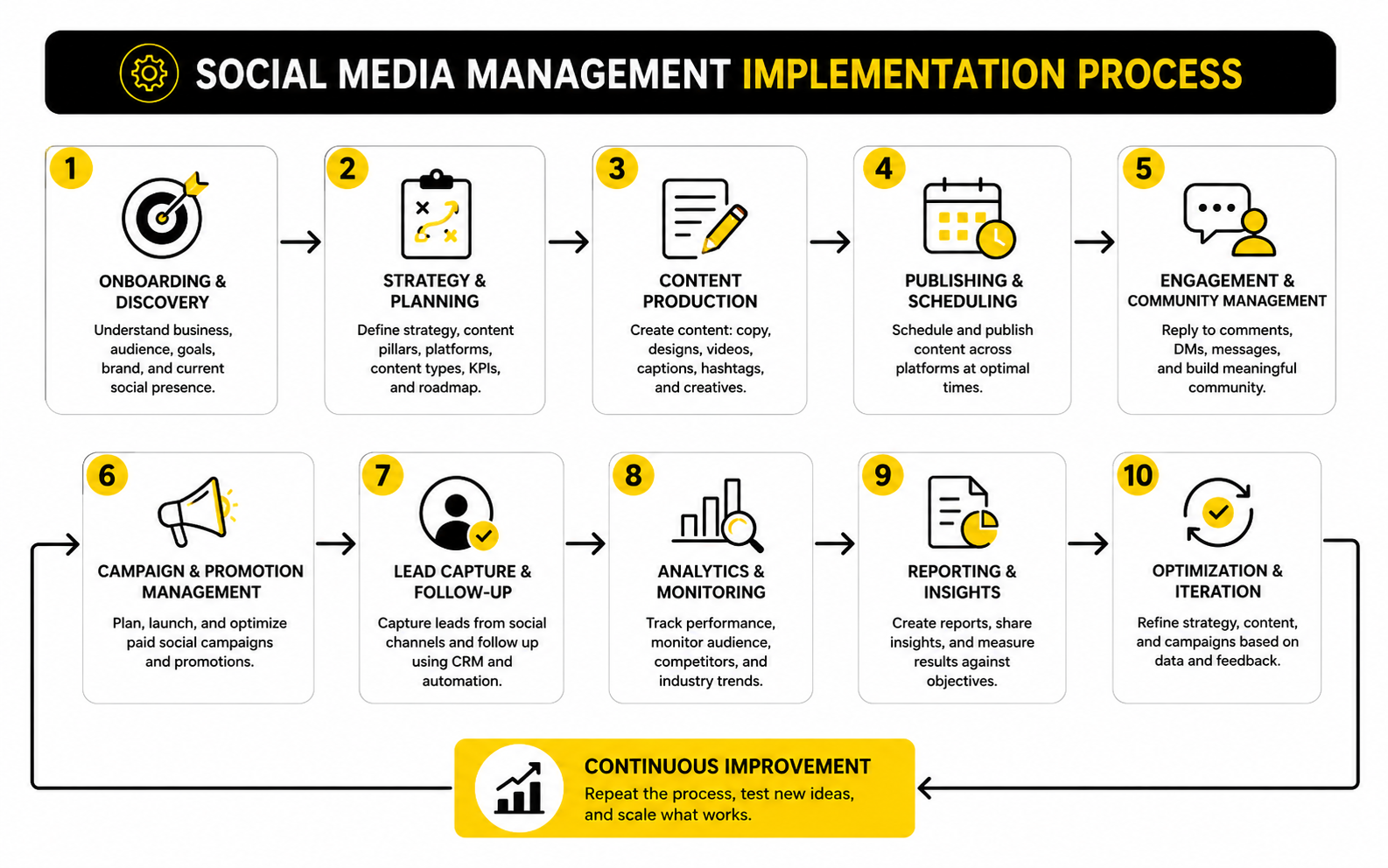
Professional implementation is where most businesses either create leverage or waste money. Hiring someone to “manage social media” is too vague unless you define the exact services, deliverables, approval process, reporting rhythm, and success metrics. A better approach is to choose services based on the business bottleneck.
If the bottleneck is visibility, prioritize strategy, content production, platform optimization, and posting consistency. If the bottleneck is lead generation, prioritize offers, paid social, landing pages, automation, and CRM follow-up through a system like GoHighLevel. If the bottleneck is trust, prioritize community management, reviews, founder-led content, case studies, and response quality.
The mistake is buying everything at once before the foundation is clear. A lean business may only need strategy, scheduling, basic analytics, and engagement support at first. A scaling business may need a full operating system with content production, paid campaigns, landing pages, automations, reporting, and sales handoff.
Strategy and Planning Services
Strategy is the first real service on any serious social media management services list because it decides what the brand should say, who it should say it to, and why anyone should care. Without strategy, the business is just feeding platforms with content and hoping the algorithm does something generous. That is not a system; that is a lottery ticket with a Canva subscription.
A strong strategy service usually includes audience research, competitor review, content pillars, platform priorities, brand voice, campaign themes, posting cadence, and measurable goals. The point is not to create a pretty document that sits in a folder. The point is to make daily decisions easier, faster, and more consistent.
This is also where the business needs to be honest. A local service business, ecommerce brand, SaaS company, coach, agency, and creator-led brand do not need the same social media plan. They may use the same platforms, but their content angles, conversion paths, sales cycles, and follow-up systems are completely different.
Audience Research
Audience research defines who the content is actually for. This includes customer pain points, buying triggers, objections, language patterns, preferred platforms, content habits, and decision-making behavior. Good social media managers do not guess these things from vibes; they study comments, reviews, competitor posts, search behavior, customer calls, sales conversations, and support questions.
This service matters because many brands create content for themselves instead of their buyers. They post what they want to announce, not what the market wants to understand. Audience research fixes that by turning social content into a response to real demand.
The practical output should be simple enough to use every week. A business should walk away knowing what its audience wants to learn, what they are skeptical about, what keeps them stuck, what makes them take action, and which content formats are most likely to earn attention.
Competitor and Market Research
Competitor research helps a brand understand what is already working in its space and where the gaps are. This includes reviewing competitor positioning, content formats, engagement patterns, offers, hooks, posting frequency, comments, paid ads, and influencer collaborations. The goal is not to copy competitors; the goal is to find openings.
A useful competitor analysis shows what the market is overusing, underexplaining, or ignoring. Sometimes every competitor is posting the same polished educational content, which creates an opportunity for more direct founder-led opinions. Other times the category is full of jokes and memes, but nobody is building trust with proof, comparisons, tutorials, or customer education.
This service is especially valuable before investing in content production. It prevents the business from spending money on assets that look good internally but fail to stand out externally. That one distinction can save months of wasted posting.
Brand Voice and Messaging
Brand voice is the difference between sounding recognizable and sounding replaceable. It defines how the brand speaks, what it avoids, how direct it can be, how technical it should sound, and what emotional tone fits the audience. This becomes more important as multiple people begin writing captions, replying to comments, editing videos, or managing inboxes.
Messaging goes deeper than tone. It clarifies the main promises, proof points, objections, angles, offers, and calls to action that should appear across the content. When messaging is weak, the brand may post consistently but still fail to create demand.
A professional social media management service should turn brand voice into usable guidelines. That usually means examples of approved phrases, banned phrases, caption styles, hook patterns, response templates, and platform-specific tone adjustments. The best version feels natural, not corporate.
Content Pillars
Content pillars are the repeatable themes that keep a brand focused. They help the team avoid random posting while still giving enough variety to stay interesting. Common pillars include education, proof, opinion, behind-the-scenes content, product use cases, customer stories, culture, community, and direct offers.
The mistake is creating too many pillars or making them too vague. “Value” is not a pillar. “Education” is better, but still broad. “How local gym owners can turn trial members into recurring clients” is much more useful because it points directly to audience, outcome, and content direction.
Content pillars also help with delegation. Once the pillars are clear, a writer, designer, editor, or social media manager can produce ideas without needing constant direction. That is where social media starts becoming an operating system instead of a daily scramble.
Platform Selection
Platform selection is not about being everywhere. It is about choosing the platforms where the brand can realistically create strong content, reach the right people, and support the buyer journey. For most businesses, spreading weak content across six channels is worse than building serious momentum on two or three.
Each platform has a different job. LinkedIn can support authority, B2B trust, founder-led content, recruiting, and professional relationships. Instagram can support visual branding, short-form video, community, DMs, and social proof. TikTok can support discovery and culture-led content, while YouTube can support deeper education, search visibility, and long-term authority.
The right social media management services list should include platform selection because platform choices affect every other service. They change content format, production workflow, approval timelines, reporting metrics, and even the type of person you need to hire.
Content Creation and Publishing Services
Content creation is the visible part of social media management, but it is only effective when it is connected to the strategy underneath. This service turns the brand’s ideas, offers, stories, expertise, and proof into platform-ready assets. It is where research becomes posts, videos, captions, carousels, graphics, scripts, and campaigns.
A professional content service should not only ask, “What should we post?” It should ask, “What does this post need to do?” Some content should attract new people. Some should build trust. Some should handle objections. Some should move warm prospects toward a booking page, trial, checkout, newsletter, or conversation.
The best content teams understand both creativity and commercial intent. They know that social media should feel human, but they also know the business needs outcomes. That balance is what separates content that looks busy from content that actually compounds.
Short-Form Video
Short-form video is one of the most requested services in modern social media management because it fits how people consume content on TikTok, Instagram Reels, YouTube Shorts, Facebook, and LinkedIn. It can be used for education, quick opinions, product demonstrations, founder commentary, customer reactions, and repurposed long-form content. Done well, it gives the brand a face, voice, and rhythm that static content often cannot match.
The service usually includes idea development, hooks, scripting, filming guidance, editing, captions, formatting, and publishing. For founder-led or expert-led businesses, the strongest workflow is often simple: record raw insights in batches, then let the content team edit them into usable short-form clips. That keeps the content authentic while still making it professional.
Short-form video should not be treated as magic. Weak positioning, boring hooks, unclear delivery, and no follow-up path will still underperform. The format is powerful, but the message still has to earn attention.
Graphic and Carousel Content
Graphic and carousel content is still useful because not every idea needs to be a video. Carousels can explain frameworks, compare options, break down mistakes, summarize steps, and teach concepts in a way people can save and revisit. Static graphics can support announcements, testimonials, offers, quotes, reminders, and visual brand consistency.
This service usually includes design direction, copywriting, layout, brand formatting, platform resizing, and publishing support. The work should be clean, readable, and easy to understand quickly. A beautiful carousel that requires too much effort to follow will usually lose people before the final slide.
For service businesses and B2B brands, carousels can be especially useful for turning expertise into structured content. They allow the brand to show how it thinks. That matters because buyers often choose the provider that explains the problem most clearly.
Caption Writing
Caption writing is not just filling space under a post. A good caption can frame the idea, deepen the message, create context, invite a response, or move the reader toward the next step. A weak caption can make even a strong visual feel flat.
A caption writing service should include hooks, body copy, calls to action, tone matching, platform adaptation, and sometimes hashtag support. The best captions sound like they were written by the brand, not by someone trying to impress a marketing manager. Clear beats clever almost every time.
Captions also need variety. Some should be short and direct. Others should tell a longer argument. Some should ask for comments, while others should push to a link, DM, booking page, lead magnet, or offer.
Scheduling and Publishing
Scheduling and publishing services make social media more consistent and less chaotic. They include uploading content, formatting posts, checking links, choosing publish times, tagging accounts, adding platform-specific details, and making sure the calendar actually goes live. This sounds basic until a business misses launches, duplicates posts, forgets approvals, or publishes with broken assets.
A scheduling tool can help, but the real value is process. A platform like Buffer can support planning and publishing across channels, but the business still needs clear ownership, review timelines, and content quality control. Tools reduce friction; they do not replace judgment.
Publishing should also be connected to campaign timing. If a launch, webinar, product drop, seasonal push, or promotion is coming up, the social calendar should build toward it instead of randomly mentioning it at the last minute. That is where operational discipline starts to show.
Community, Engagement, and Reputation Services
Community management is where social media stops being a broadcast channel and becomes a relationship channel. This part of the social media management services list covers the work that happens after the post goes live: comments, replies, direct messages, mentions, tags, reviews, user-generated content, and public conversations around the brand. It is less glamorous than content creation, but it is often where trust is either built or lost.
This service matters because people watch how brands behave in public. A helpful reply under a complaint, a smart answer to a question, or a natural comment in the right conversation can make the brand feel alive. A slow, robotic, defensive, or careless response can do the opposite very quickly.
Community management also creates useful feedback. Comments and DMs reveal objections, content ideas, product confusion, customer language, and demand signals. A good social media manager does not just reply; they listen, categorize, escalate, and turn repeated patterns into better marketing.
Comment Management
Comment management includes monitoring comments, replying to questions, liking relevant responses, hiding spam, escalating issues, and keeping conversations aligned with the brand voice. It sounds simple, but it requires judgment. The wrong tone can make a brand look desperate, arrogant, cold, or out of touch.
Not every comment deserves the same response. Some comments need a quick answer, some need a friendly acknowledgment, some need support escalation, and some should not be fed at all. Professional comment management creates rules for these situations before they become urgent.
This is especially important when posts start getting more reach. More visibility brings more opportunity, but it also brings criticism, confusion, trolls, complaints, and off-topic debates. A prepared team handles that calmly instead of improvising in public.
Direct Message Management
Direct message management is one of the most underrated services because DMs often sit closer to revenue than likes or impressions. People ask about pricing, availability, shipping, booking, product fit, support issues, refunds, partnerships, and next steps in private messages. If nobody handles those messages quickly and clearly, the brand leaks opportunities.
A strong DM process includes response templates, qualification questions, escalation rules, saved replies, CRM handoff, and follow-up timing. The goal is not to make every reply sound automated. The goal is to make sure the person gets a useful answer without waiting days.
For brands that receive high message volume, automation can help with the first layer of sorting. A tool like ManyChat can support comment-to-message flows, lead capture, FAQs, and basic routing, but the best setup still leaves room for human judgment when the conversation becomes specific.
Review and Reputation Management
Review and reputation management covers public feedback across social platforms, business profiles, app stores, marketplaces, and review sites. It includes monitoring mentions, responding to positive and negative reviews, escalating serious issues, and identifying recurring complaints. This service protects the brand’s public trust layer.
The key is to respond like a real operator, not like a legal department trapped inside a template. Positive reviews deserve acknowledgment that feels specific. Negative reviews deserve calm, clear, useful responses that show the brand is paying attention.
Reputation work also connects back to content. Repeated praise can become proof points. Repeated complaints can become product, service, or onboarding improvements. If the same issue appears again and again, the answer is not better copy; the answer is fixing the actual experience.
User-Generated Content Management
User-generated content management helps brands collect, organize, request permission for, and repurpose content created by customers, creators, employees, or community members. This can include product photos, video testimonials, unboxing clips, tagged posts, before-and-after content, reviews, and real customer reactions. It works because people often trust real usage more than polished brand claims.
The service should include a permission process. Just because someone tags a brand does not mean the brand should automatically reuse the content in ads, emails, landing pages, or posts. A professional workflow keeps approvals clean and avoids messy rights issues.
UGC also gives the content calendar more texture. Instead of every post coming from the brand’s own perspective, the audience gets to see proof from the outside. That makes the brand feel less like it is constantly selling itself.
Paid Social, Funnels, Automation, and Analytics Services
Paid social, funnels, automation, and analytics belong together because they turn social activity into a measurable growth system. Organic content can build awareness and trust, but paid campaigns can amplify what is working, test offers faster, and bring the right people into a structured conversion path. Without the funnel and analytics layer, though, ad spend becomes very easy to waste.
This is where the social media management services list becomes more commercial. The work is no longer only about posting and engagement. It now includes campaign architecture, landing pages, tracking, lead capture, retargeting, CRM workflows, attribution, reporting, and optimization.
The important thing is sequence. Do not scale a broken message with ads. Do not send traffic to a weak landing page. Do not collect leads without follow-up. The entire process has to connect.
Paid Social Campaign Management
Paid social campaign management includes campaign planning, audience targeting, creative testing, budget allocation, pixel setup, retargeting, offer testing, and performance optimization. It can support lead generation, ecommerce sales, webinar registrations, app installs, booked calls, local promotions, and brand awareness. The service should always be tied to a specific business objective.
The biggest mistake is treating paid social like a boost button. Boosting posts can have a place, but serious paid social management needs creative testing, clear conversion events, audience logic, and reporting discipline. Otherwise, the business may get reach without learning anything useful.
Good paid social teams also use organic performance as a signal. If a post earns strong saves, shares, comments, or qualified DMs, it may deserve paid amplification. That is one of the cleanest ways to reduce guesswork.
Landing Pages and Conversion Paths
Landing pages turn social attention into action. A social campaign should not always send people to a generic homepage because homepages are usually built for many audiences at once. A landing page can focus on one offer, one audience, one problem, and one next step.
This service includes page strategy, copywriting, design, offer framing, form setup, proof placement, mobile optimization, and conversion tracking. For ecommerce teams building campaign-specific product pages, a tool like Replo can fit when the goal is to create landing pages without slowing down the creative testing cycle. For service businesses and creators, funnel builders like ClickFunnels or Systeme.io can support lead magnets, webinars, sales pages, and simple checkout flows.
The page should match the promise that brought the person there. If the post talks about a free checklist, the landing page should not suddenly pitch a $5,000 package without context. Message match is boring until it is missing, then conversions fall apart.
Lead Capture and CRM Follow-Up
Lead capture and CRM follow-up make sure social media leads do not disappear into spreadsheets, inboxes, or someone’s memory. This service includes forms, booking links, pipeline stages, lead notifications, email follow-ups, SMS reminders, tagging, segmentation, and sales handoff. It is where social activity becomes operational.
For agencies, consultants, local businesses, and service providers, GoHighLevel can be useful because it combines funnels, calendars, CRM, automation, messaging, and pipeline management in one place. That matters when leads come from multiple social channels and the business needs one clear follow-up process. For teams that need more traditional relationship tracking, Copper can fit better when Gmail and pipeline visibility are central to the sales workflow.
The key is speed and clarity. A lead who asks a question today should not receive a generic reply next week. Social media creates moments of intent, and follow-up systems protect those moments.
Email and Message Automation
Email and message automation supports the middle of the buyer journey. Not everyone who finds a brand on social is ready to buy immediately. Some people need education, reminders, comparison content, proof, objections answered, or a simple reason to come back.
This service includes welcome sequences, abandoned booking follow-ups, post-download nurture emails, launch reminders, promotional campaigns, onboarding messages, and reactivation flows. Tools like Brevo or Moosend can support email marketing workflows when social is being used to grow a list or nurture prospects after the first interaction.
Automation should not feel like punishment for showing interest. Keep it relevant, useful, and tied to the action the person actually took. The best automation feels timely, not pushy.
Analytics and Reporting
Analytics and reporting explain what is working, what is not, and what should change next. This includes platform metrics, campaign performance, engagement quality, follower growth, reach, saves, shares, clicks, conversion rates, lead quality, cost per result, and revenue attribution where possible. Reporting should create decisions, not just screenshots.
The right metrics depend on the goal. Awareness campaigns need different reporting than lead generation campaigns. Community building needs different reporting than direct-response ads. A useful report connects the numbers to the business objective.
This is where many social media management services become either valuable or decorative. If the report only says “likes went up,” it is not enough. A professional report should explain what changed, why it likely changed, what was learned, and what the team will do next.
Statistics and Data
Statistics only matter when they change decisions. A dashboard full of numbers is not a strategy, and a monthly report full of screenshots does not prove that social media is working. The point of measurement is to understand what deserves more investment, what needs to be fixed, and what should be stopped.
This is especially important when comparing services from a social media management services list. A content creator, community manager, paid ads specialist, strategist, and analytics partner should not be judged by the same numbers. Each service has a different job, so each one needs a different measurement system.
The cleanest way to think about social media data is simple: measure attention, trust, action, and business impact. Attention tells you whether people are seeing the content. Trust tells you whether they care enough to engage, save, share, reply, or come back. Action tells you whether they click, message, book, subscribe, or buy. Business impact tells you whether the whole system is producing pipeline, customers, retention, or revenue.
Why Benchmarks Are Useful but Dangerous
Benchmarks are useful because they give context. If your engagement rate is 0.3%, that number means very little until you compare it against platform, industry, content type, audience size, and objective. A niche B2B brand on LinkedIn should not judge itself the same way as a consumer beauty brand on TikTok.
Benchmarks become dangerous when teams use them as excuses or trophies. A brand can beat the average engagement rate and still generate no leads. Another brand can have modest engagement and still produce strong revenue because the audience is smaller, warmer, and more commercially relevant.
That is why benchmarks should start conversations, not end them. Reports like Rival IQ’s 2025 Social Media Industry Benchmark Report show that engagement rates can shift sharply by platform, with Facebook, Instagram, TikTok, and X all seeing declines in the 2025 dataset. The action is not to panic; the action is to inspect which formats, topics, and channels still produce meaningful responses for your specific audience.
The Four-Layer Analytics System
A professional analytics setup should separate metrics into layers. This prevents the team from obsessing over easy numbers while ignoring the ones that actually show progress. It also makes reporting easier because every metric has a job.
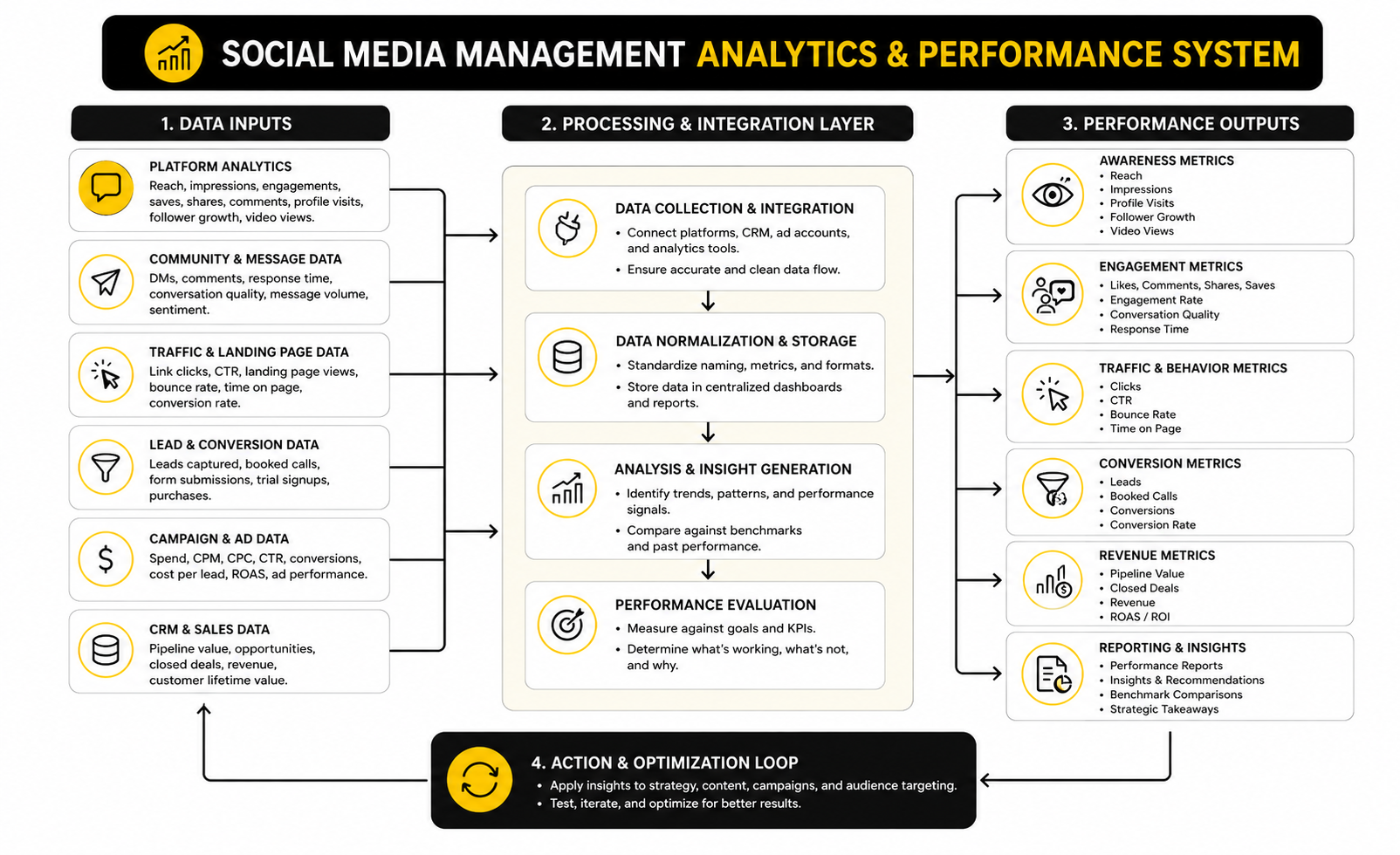
The first layer is visibility. This includes reach, impressions, profile views, video views, follower growth, and audience growth by platform. These numbers show whether the content is getting distribution, but they do not prove that the audience is qualified.
The second layer is engagement quality. This includes comments, shares, saves, replies, direct messages, average watch time, completion rate, and meaningful reactions. A save, share, or detailed comment usually tells you more than a passive like because it signals stronger intent or usefulness.
The third layer is conversion behavior. This includes link clicks, landing page visits, form fills, email signups, booking starts, completed bookings, cart additions, checkout starts, and purchases. This is where social media starts connecting to funnels, CRM, email, and sales systems.
The fourth layer is commercial impact. This includes cost per lead, cost per acquisition, pipeline value, booked call quality, close rate, average order value, customer acquisition cost, retention, and revenue influenced by social activity. Not every business can attribute this perfectly, but ignoring it completely is a mistake.
What Engagement Actually Means
Engagement is not one thing. A like, comment, share, save, profile visit, DM, and click all mean different things. Treating them as equal makes reporting look cleaner than reality.
Likes are light signals. They can show that the post was noticed, but they rarely prove deep interest by themselves. Comments can show stronger involvement, but the quality matters more than the count because ten serious buyer questions are more valuable than fifty low-effort reactions.
Shares and saves are often stronger content signals. A share suggests the content was useful, entertaining, identity-driven, or relevant enough to pass along. A save suggests the person may want to revisit the idea, which is especially valuable for educational, tactical, checklist-style, comparison, and framework content.
How to Read Reach and Impressions
Reach tells you how many unique people saw the content. Impressions tell you how many total times the content was displayed. Both matter, but neither should be treated as the final goal unless the campaign is specifically built for awareness.
High reach with weak engagement usually means the hook or distribution worked, but the content did not create enough interest. Low reach with strong engagement can mean the content resonated with a small group and may deserve a stronger repost, repurpose, paid test, or platform adjustment. High impressions with low action can also suggest that people saw the content multiple times but did not feel enough urgency to move forward.
This is why social media reporting should never stop at “reach went up.” The better question is what the reach produced. Did it attract the right audience, create profile visits, generate messages, improve remarketing pools, or support a launch?
How to Measure Content Quality
Content quality is not just design quality. A post can look beautiful and still fail because the idea is weak. Another post can look simple and still perform because the insight, timing, or message is sharp.
A practical content quality review should look at hooks, retention, saves, shares, comments, profile visits, and downstream action. For video, watch time and completion rate are especially useful because they show whether the opening and pacing held attention. For carousel or educational content, saves and shares often matter more than likes.
The best content teams review patterns instead of judging one post emotionally. If three posts about pricing objections create qualified DMs, that is a signal. If five polished brand posts get compliments but no action, that is also a signal.
How to Measure Community Management
Community management should be measured with both speed and substance. Response time matters because customers expect brands to be available, but response quality matters just as much. Fast, useless replies do not build trust.
Sprout Social’s research on social response expectations shows that most consumers want brands to respond within 24 hours or sooner. That does not mean every business needs a huge support team. It means social inboxes and comments need ownership, escalation rules, and realistic coverage.
Useful community metrics include average response time, response rate, resolved conversations, escalated issues, sentiment themes, repeated questions, lead-related DMs, and customer feedback patterns. This turns community management from “replying to people” into a feedback and revenue support function.
How to Measure Paid Social
Paid social should be judged by the stage of the campaign. A new creative test should not be judged the same way as a mature retargeting campaign. Prospecting, retargeting, lead generation, conversion campaigns, and awareness campaigns all need different expectations.
Early tests should focus on creative signal, click quality, cost per meaningful action, and landing page behavior. Once the campaign has enough data, the focus should move toward lead quality, booked calls, cost per acquisition, return on ad spend, payback period, and revenue. The metric gets stricter as the campaign gets closer to the money.
This is where funnel tools and CRM systems become important. If a business uses GoHighLevel, ClickFunnels, or Systeme.io, the reporting should connect ad traffic to the next step instead of stopping at clicks. Clicks are only interesting if they lead somewhere useful.
How to Build a Simple Monthly Report
A useful monthly report should be short enough to read and clear enough to act on. Nobody needs a 40-page PDF full of platform screenshots unless there is a very specific reason. The report should explain what happened, why it likely happened, and what changes next.
A simple report can follow this structure:
This format keeps the conversation focused on decisions. It also makes vendors easier to evaluate because you can see whether they understand the business or are just exporting metrics.
What the Data Should Make You Do
Good analytics should create action. If saves are strong but clicks are weak, the content may be useful but the call to action may need work. If clicks are strong but conversions are weak, the landing page, offer, form, or follow-up may be the bottleneck.
If DMs are increasing but response time is poor, the business may need better inbox management, saved replies, routing, or automation. If reach is declining but lead quality is improving, the strategy may still be working because the audience is becoming more focused. Bigger is not always better.
The real win is building a measurement loop. Publish, observe, interpret, decide, adjust, and repeat. That loop is what turns a basic social media management services list into a professional growth system.
Platform-Specific Social Media Management Services
Platform-specific management matters because each social network has its own culture, formats, search behavior, buying intent, and content rhythm. A post that feels natural on LinkedIn can feel stiff on TikTok. A polished Instagram carousel may work well for visual authority, but it may not create the same depth as a YouTube tutorial or the same immediacy as a strong Facebook community post.
This is where many businesses make the wrong hire. They look for one person to “handle social” when they actually need platform-specific judgment. A good social media management services list should separate the channels clearly so the business does not expect one workflow to fit every audience.
The goal is not to chase every platform. The goal is to understand which platform deserves which role in the customer journey. Some platforms are better for discovery, some for credibility, some for community, some for search, and some for direct response.
Instagram Management
Instagram management usually includes Reels, Stories, carousels, feed posts, profile optimization, highlights, DMs, comment management, collaborations, and social proof. It is a strong platform for visual brands, creator-led businesses, service providers, ecommerce products, local businesses, coaches, and personal brands. The service works best when the brand has a clear visual identity and a strong reason for people to follow beyond occasional promotions.
Instagram content needs variety. Reels can bring reach, carousels can teach, Stories can create daily intimacy, and DMs can move warm prospects into conversation. A manager who only posts graphics is not really managing Instagram at a serious level.
The advanced play is connecting Instagram activity to a backend system. Comments can trigger conversations, Stories can push to booking links, DMs can qualify leads, and saved content can reveal what the audience wants more of. That is when Instagram becomes more than a portfolio.
TikTok Management
TikTok management is built around fast creative testing, native editing, trend awareness, strong hooks, and a willingness to sound less polished. The platform rewards content that feels immediate and specific, not overly approved by a committee. That makes TikTok powerful, but also uncomfortable for brands that want every post to feel perfectly controlled.
A TikTok management service may include ideation, scripting, filming direction, editing, trend filtering, creator coordination, posting, comment handling, and performance review. The important word there is filtering. Not every trend fits the brand, and forcing a serious business into the wrong trend can make it look desperate.
TikTok is especially useful when the business can teach quickly, demonstrate visually, show personality, or participate in culture without sounding fake. The risk is chasing views that do not match the buyer. The win is finding repeatable formats that bring both reach and relevance.
LinkedIn Management
LinkedIn management is strongest for B2B companies, consultants, agencies, SaaS teams, recruiters, executives, founders, and expert-led brands. It can support authority, trust, partnerships, hiring, investor visibility, lead generation, and long sales cycles. The content does not need to be boring, but it does need to be credible.
A LinkedIn service often includes founder posts, company page content, thought leadership, employee advocacy, comment strategy, connection support, newsletter content, and repurposing from webinars, podcasts, events, or sales conversations. The best LinkedIn content usually comes from real expertise, not generic business motivation. People can feel the difference.
The tradeoff is time. Founder-led LinkedIn works best when the person has strong opinions, specific experience, and a willingness to be visible. A social media manager can structure and polish the ideas, but they cannot invent lived expertise from nothing.
YouTube Management
YouTube management is different because the platform behaves more like a search and discovery engine than a pure social feed. Videos can keep working long after they are published, especially when they answer durable questions. That makes YouTube valuable for education-heavy businesses, software companies, coaches, consultants, product brands, and experts with deep knowledge.
The service may include channel strategy, topic research, scripting, thumbnails, titles, editing, publishing, descriptions, playlists, Shorts repurposing, analytics, and content refreshes. YouTube also needs patience because the payoff often compounds over time. A rushed 30-day test is usually too short to judge the channel properly.
The advanced move is using YouTube as the source asset. One strong long-form video can become Shorts, LinkedIn posts, newsletter content, Instagram carousels, sales enablement material, and FAQ content. That creates leverage instead of forcing the team to start from zero every week.
Facebook Management
Facebook management still matters for local businesses, groups, communities, events, older demographics, marketplace activity, and paid social campaigns. It may not feel as exciting as newer platforms, but it can still be commercially useful when the audience is there. Ignoring it just because it feels less trendy is not strategy.
A Facebook service can include page posts, group management, event promotion, Messenger management, review responses, local content, community moderation, and ad campaign support. For businesses that rely on appointments, consultations, local promotions, or community trust, Facebook can still play a serious role. The key is matching the service to the audience, not to marketing hype.
Facebook also connects naturally with Messenger automation. If the brand uses comment-based lead capture or message follow-up, ManyChat can support simple conversion flows. The setup should still feel helpful, not like a bot is trying to trap the user.
Pinterest Management
Pinterest management is useful for brands with strong visual, search-driven, or evergreen content. This can include ecommerce, home decor, fashion, beauty, food, travel, weddings, parenting, fitness, digital products, and educational content. Pinterest is often less about daily conversation and more about discovery that can keep sending traffic over time.
A Pinterest service usually includes keyword research, board strategy, pin design, descriptions, scheduling, product pins, blog content repurposing, and performance tracking. It rewards consistency, clarity, and useful visual packaging. The content needs to be easy to understand and easy to click.
The mistake is treating Pinterest like Instagram with different dimensions. Pinterest users are often planning, researching, saving, and comparing. That means the content should lead somewhere useful, such as a product page, guide, checklist, recipe, article, or landing page.
Professional Implementation: How to Choose the Right Services
Choosing from a social media management services list is really a prioritization exercise. The business does not need every service at the same time. It needs the services that solve the current bottleneck without creating unnecessary complexity.
A new brand may need positioning, content pillars, profile optimization, and a simple publishing rhythm before it needs advanced automation. A growing service business may need DM management, booking flows, follow-up sequences, and CRM visibility before it needs more content volume. An ecommerce brand may need creative testing, landing pages, paid social, and product-specific analytics before it needs community expansion.
The right question is not “What services can we buy?” The right question is “What is currently stopping social from producing the next business result?” That answer should drive the package, team, tools, and budget.
In-House, Freelancer, Agency, or Hybrid
There are four common ways to implement social media management: in-house, freelancer, agency, or hybrid. None is automatically best. The right model depends on budget, speed, complexity, approval needs, volume, and how close the work needs to be to the leadership team.
An in-house person can be close to the brand, move quickly, and understand internal context. The risk is expecting one person to be strategist, copywriter, designer, editor, analyst, community manager, ads buyer, and automation specialist at the same time. That expectation burns people out and usually lowers quality.
A freelancer can be excellent for a specific service, such as video editing, LinkedIn ghostwriting, carousel design, or paid ads. An agency can bring more structure and multiple specialists, but it may cost more and require stronger communication. A hybrid setup often works best: internal ownership of strategy and voice, external support for specialized execution.
What to Outsource First
The best services to outsource first are usually the ones that are important, repeatable, and clearly defined. Video editing, scheduling, graphic design, reporting setup, community response templates, landing page builds, and email sequence implementation can often be outsourced effectively. Strategy can also be outsourced, but only if the business gives the strategist real context.
Do not outsource the soul of the brand too early. Founder opinions, customer insight, product truth, and market point of view should not be fully delegated to someone who barely understands the business. A strong external partner can shape those ideas, but the raw material should come from inside.
A practical first step is to document the current workflow. List who creates ideas, who approves content, who edits, who publishes, who replies, who tracks results, and who owns follow-up. The gaps will usually show you what to outsource next.
What Should Stay Internal
Some work should stay internal, even when the business hires strong outside help. Final strategic direction, sensitive customer issues, product claims, legal approvals, pricing decisions, crisis response, and founder-level point of view usually need internal ownership. Outsourcing these without guardrails creates risk.
Internal teams should also own customer truth. Social media partners can monitor comments and DMs, but the business should still review recurring objections, complaints, praise, and sales questions. Those insights affect product, offers, support, and positioning.
The best external teams do not replace internal judgment. They make execution easier, clearer, and more consistent. That distinction matters because social media is too close to the customer to run on autopilot.
Budget Tradeoffs
Budget decisions should follow the bottleneck. If the brand has no clear strategy, spending heavily on daily content may create more noise. If the content is strong but nobody replies to leads, spending more on production will not fix the leak.
A lean budget should focus on strategy, a realistic content cadence, basic scheduling, and simple reporting. A moderate budget can add short-form video editing, community management, email follow-up, and campaign landing pages. A larger budget can support paid social, creator partnerships, analytics, automation, and multi-platform content systems.
The wrong move is spreading a small budget across too many services. It is better to do fewer things properly than to buy a thin version of everything. Thin execution looks active, but it rarely compounds.
Approval Workflows and Quality Control
Approval workflows protect speed and quality at the same time. Without a workflow, content gets stuck in random Slack threads, last-minute edits, unclear ownership, and missed publishing dates. With too much approval, the brand becomes slow, cautious, and boring.
A good workflow defines who owns ideas, drafts, edits, compliance checks, final approval, publishing, and reporting. It also defines what can be published without senior approval and what must be reviewed carefully. This is especially important for regulated industries, technical products, healthcare-adjacent topics, finance-adjacent claims, or high-visibility executives.
Quality control should not mean sanding off every sharp edge. It should mean checking accuracy, clarity, brand fit, formatting, links, captions, claims, and calls to action. The content should still sound human when it goes live.
Scaling Without Losing the Brand
Scaling social media is not just posting more. It means increasing output without losing clarity, personality, quality, or strategic focus. This is where systems matter.
A scaling setup usually needs documented content pillars, brand voice guidelines, asset libraries, approval rules, reporting templates, response playbooks, campaign calendars, and a clear tool stack. Scheduling tools like Buffer can help organize publishing, while CRM and automation systems like GoHighLevel can help keep leads from slipping through the cracks. The tools are not the strategy, but they make the strategy easier to run.
The biggest scaling risk is generic content. As more people touch the process, the brand can start sounding safer, flatter, and more interchangeable. To avoid that, keep the strongest ideas close to the people who understand the customer best.
Risks to Watch Before Hiring
The first risk is vague deliverables. “Social media management” can mean almost anything, so the scope must be specific. Define platforms, number of posts, formats, revisions, engagement duties, reporting frequency, meeting cadence, response expectations, and what is not included.
The second risk is vanity reporting. If a provider only talks about followers, likes, and impressions, ask how those metrics connect to the business goal. Some campaigns do need awareness metrics, but awareness should still be interpreted with context.
The third risk is tool-first thinking. Buying ClickFunnels, Systeme.io, Brevo, or any other platform does not automatically create a working growth system. The offer, message, content, traffic, follow-up, and reporting still need to be built properly.
The Simple Decision Rule
The simplest decision rule is to buy the next service that removes the biggest constraint. If nobody knows what to post, buy strategy. If ideas are clear but execution is slow, buy production. If engagement is happening but leads are lost, buy inbox management and CRM follow-up.
If traffic is the issue, test paid social only after the message and landing path are good enough to learn from. If reporting is unclear, fix tracking before making aggressive budget decisions. If the brand is growing but quality is slipping, invest in workflow, guidelines, and editorial control.
That is the practical way to use a social media management services list. Do not treat it like a menu where more items automatically mean better marketing. Treat it like a diagnostic tool that tells you what to fix next.
What services are included in social media management?
Social media management can include strategy, content planning, content creation, publishing, community management, direct message handling, paid social, analytics, reporting, influencer coordination, reputation management, and automation. The exact mix depends on the business model and the goal. A local service business may need inbox management and booking follow-up, while an ecommerce brand may need creative testing, landing pages, paid campaigns, and product-focused reporting.
What is the most important service in a social media management services list?
Strategy is usually the most important service because it controls the direction of everything else. Without strategy, content creation becomes random, paid ads become expensive guesswork, and reporting becomes a pile of disconnected numbers. A good strategy defines the audience, offer, platform priorities, content pillars, conversion path, and success metrics before the team starts producing at volume.
How do I know which social media services my business needs first?
Start with the bottleneck. If nobody knows what to post, you need strategy and content planning. If the strategy is clear but publishing is inconsistent, you need production and scheduling support. If content gets engagement but leads are not converting, you need better DMs, landing pages, CRM follow-up, and automation.
Should I hire a full-service agency or individual specialists?
A full-service agency can work well when you need strategy, production, paid media, reporting, and operations handled together. Individual specialists can work better when you already have a clear system and only need help with one area, such as video editing, LinkedIn content, paid ads, or community management. A hybrid model is often the strongest option because the business keeps strategic ownership while specialists handle execution.
How much should social media management focus on content creation?
Content creation should be a major part of the system, but it should not be the only part. Posting more content does not fix weak positioning, slow follow-up, poor offers, or unclear reporting. The best social media management setup connects content with engagement, conversion paths, analytics, and customer feedback.
What platforms should a business prioritize?
A business should prioritize the platforms where its audience already spends time and where the company can create strong native content consistently. LinkedIn may be better for B2B authority, Instagram may be better for visual trust and DMs, TikTok may be better for discovery, YouTube may be better for search-driven education, and Facebook may still matter for local businesses, groups, Messenger, and community activity. The right answer is not “be everywhere”; the right answer is “be strong where it matters.”
How often should a business post on social media?
Posting frequency should match quality, capacity, and platform expectations. A business that can publish three strong posts per week with good engagement and follow-up is often in a better position than a business posting every day with weak ideas. Consistency matters, but consistency only helps when the content is relevant.
What metrics should social media managers report?
Social media managers should report metrics that connect to the goal. Awareness campaigns may track reach, impressions, video views, and profile visits. Engagement-focused work should track comments, shares, saves, DMs, and response quality. Lead generation and sales campaigns should track clicks, landing page conversions, qualified leads, bookings, pipeline, acquisition cost, and revenue where possible.
Are likes and followers still useful metrics?
Likes and followers can be useful context, but they should not be treated as the whole story. A growing follower count can help with credibility, and likes can show light interest, but they do not automatically prove buyer intent. Saves, shares, meaningful comments, DMs, clicks, booked calls, and sales usually tell a deeper story.
What is the role of automation in social media management?
Automation helps with speed, routing, consistency, and follow-up. It can support comment-to-DM flows, lead capture, email sequences, booking reminders, customer tagging, and CRM updates. Tools like ManyChat and GoHighLevel can be useful, but automation should support real conversations instead of replacing common sense.
When should paid social be added?
Paid social should be added when the business has a clear offer, a defined audience, strong creative angles, tracking, and a conversion path. Running ads before those pieces are ready usually creates expensive learning with limited upside. Once the message and funnel are strong enough, paid campaigns can help scale reach, test creative faster, and bring more qualified people into the system.
What tools are useful for managing social media services?
The right tool depends on the job. Buffer can help with publishing and scheduling, ManyChat can support social messaging automation, GoHighLevel can support CRM, funnels, calendars, and follow-up, and ClickFunnels or Systeme.io can support campaign landing pages and sales funnels. The tool stack should make the process simpler, not heavier.
How do I avoid hiring the wrong social media manager?
Avoid vague scopes. Ask exactly what is included, which platforms are covered, how many posts are created, who writes captions, who designs assets, who handles comments and DMs, how approvals work, and what reporting looks like. A good provider should be able to explain the process clearly without hiding behind buzzwords.
What should be included in a professional social media management proposal?
A professional proposal should include goals, platforms, deliverables, content formats, posting cadence, community management expectations, reporting frequency, revision limits, timelines, responsibilities, tools, and pricing. It should also define what is not included. That protects both sides and prevents the classic problem where “social media management” means one thing to the client and something completely different to the provider.
Can one person manage everything?
One person can manage a simple social media system, especially for a smaller brand. But as the business grows, the work usually separates into strategy, copywriting, design, video editing, paid media, community management, automation, and analytics. Expecting one person to do all of that at a high level forever is not realistic.
How long does it take for social media management to work?
It depends on the starting point, offer, content quality, audience, platform, budget, and follow-up system. Some improvements, like faster response times or better publishing consistency, can happen quickly. Bigger outcomes like authority, pipeline, brand demand, and compounding organic reach usually require sustained execution.
What is the biggest mistake businesses make with social media management?
The biggest mistake is treating social media like a task list instead of a business system. Posting, replying, scheduling, designing, reporting, and running ads all matter, but they need to work together. When the system is disconnected, the business stays busy without getting meaningful results.
How should I use this social media management services list?
Use it as a diagnostic tool. Do not buy every service because it sounds useful. Identify the current bottleneck, choose the service that removes it, measure the result, and then add the next layer when the business is ready.
Build a stronger local presence with BAAM AI
Turn your website, Google profile, social channels, and AI visibility into one growth engine
Most businesses do not need more random marketing activity. They need a consistent presence system that helps the right people find them, trust them, and take action. BAAM AI brings strategy, local SEO, website updates, Google Maps visibility, social content, AI-search readiness, media production, and reporting into one practical monthly engine.
If you want your marketing to keep working after the campaign ends, start with a free BAAM AI presence audit. See how your business shows up today and where the fastest visibility wins are at BAAM AI.