
BAAM AI Blog
Social Media Creative Agency: A Practical Guide To Building Content That Actually Moves People
A social media creative agency is no longer just the team that “makes posts.” That version of social marketing is too slow, too shallow, and too disconnected from how people actually discover, judge, and buy from...
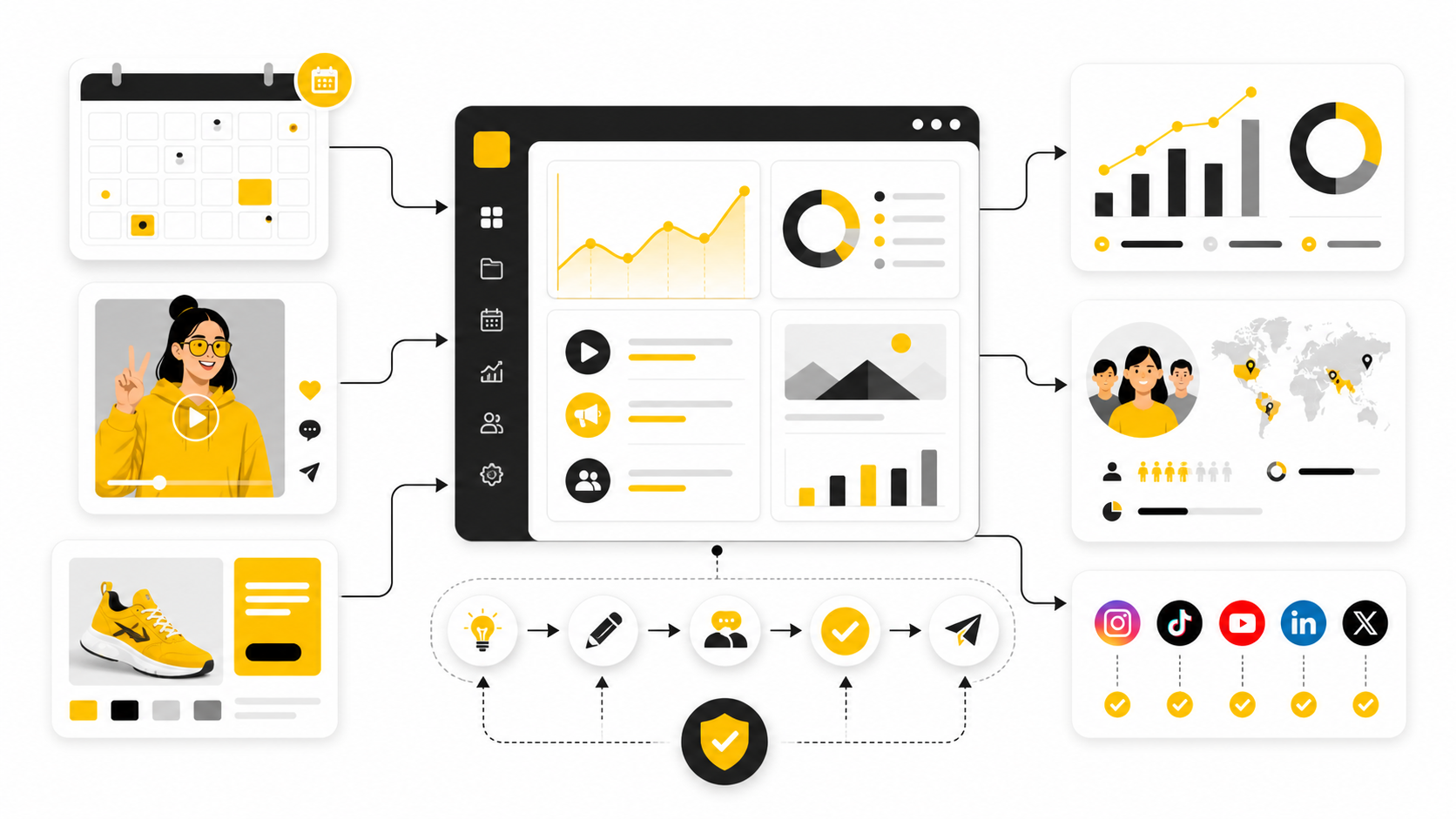
A social media creative agency is no longer just the team that “makes posts.” That version of social marketing is too slow, too shallow, and too disconnected from how people actually discover, judge, and buy from brands today.
The modern job is bigger. A strong agency has to understand culture, platform behavior, creative strategy, production systems, paid distribution, community signals, creator collaboration, and performance data. That matters because social media now sits close to the center of digital life, with the Digital 2026 Global Overview Report showing billions of active social media user identities worldwide and continued growth in how people use platforms for discovery, entertainment, research, and communication.
This is where many brands get stuck. They post often, but the work feels generic. They hire creators, but the campaigns do not ladder up to a clear brand system. They run ads, but the creative does not earn attention before the algorithm decides whether to give it reach. A social media creative agency solves that by turning scattered activity into a repeatable creative engine.
Why A Social Media Creative Agency Matters Now
Social media has become one of the main places where people form opinions about brands before they ever visit a website, book a call, or compare pricing. That does not mean every brand needs to chase every trend. It means the creative has to be sharp enough to earn attention and structured enough to support real business goals.
The challenge is that social platforms reward a very specific mix of speed, relevance, originality, and consistency. The 2025 Sprout Social Index is based on surveys of more than 4,000 consumers and 1,200 marketers, and it points to a clear tension: consumers expect brands to understand culture, respond quickly, and still show up with substance instead of noise. That is hard to do when social is treated as a side task or a last-minute content calendar.
A good social media creative agency gives the brand a system for making better decisions faster. It connects audience insight with creative direction, then turns that direction into assets built for each platform. The real value is not just prettier design or more videos. The value is sharper judgment, stronger execution, and a repeatable process that helps social creative compound over time.
Framework Overview
The simplest way to understand a social media creative agency is as a bridge between brand strategy and platform-native execution. Brand strategy gives the work a point of view. Platform-native execution makes that point of view feel natural inside the feed, the story, the short-form video swipe, the comment section, and the creator partnership.
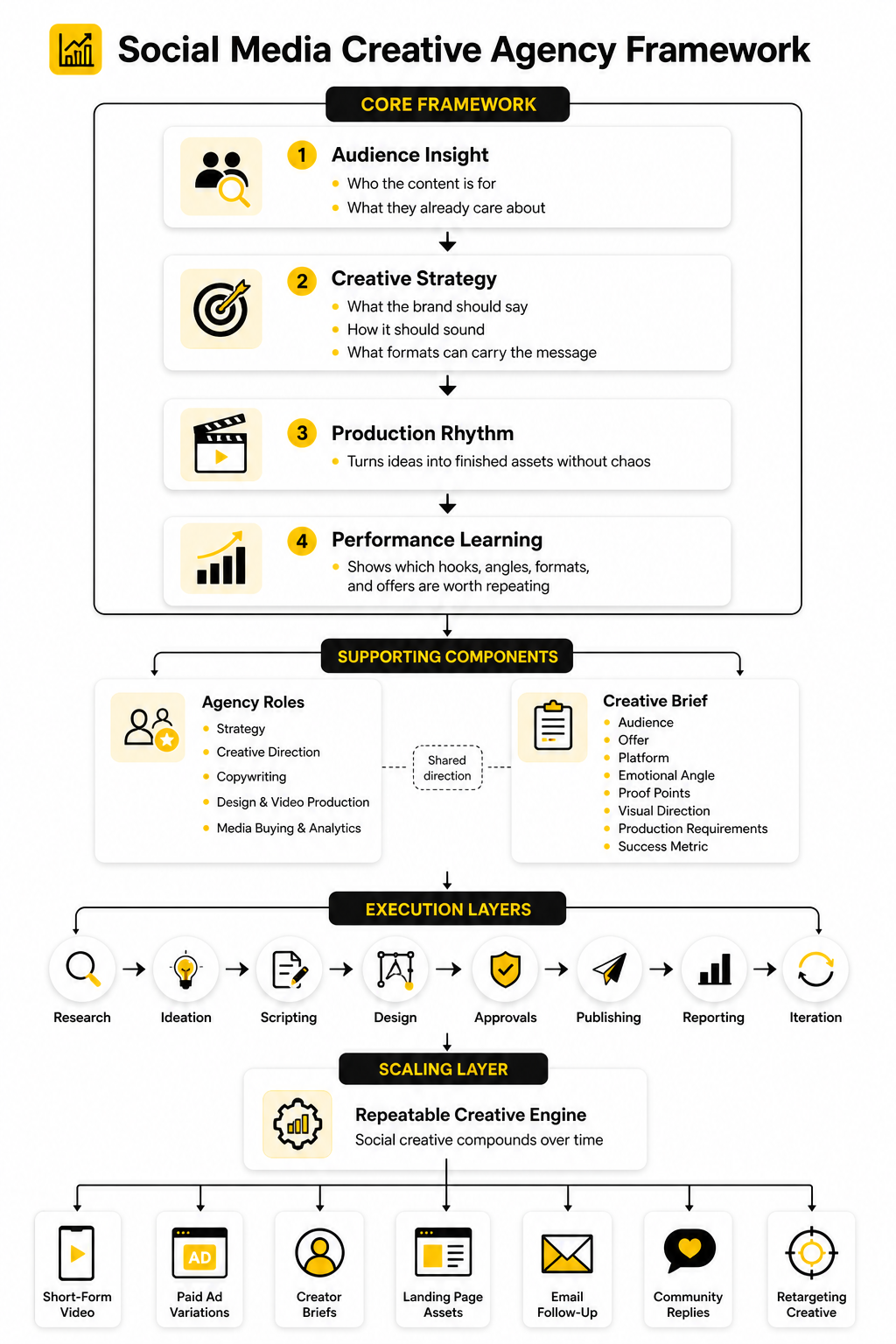
The framework used throughout this guide has four layers: audience insight, creative strategy, production rhythm, and performance learning. Audience insight answers who the content is for and what they already care about. Creative strategy decides what the brand should say, how it should sound, and what formats can carry the message. Production rhythm turns ideas into finished assets without chaos. Performance learning closes the loop by showing which hooks, angles, formats, and offers are worth repeating.
This matters because social creative is not one asset anymore. One campaign may need short-form video, paid ad variations, creator briefs, landing page assets, email follow-up, community replies, and retargeting creative. Tools can help manage the machine, but they do not replace the thinking. For example, a brand might use Buffer for scheduling, ManyChat for social automation, or GoHighLevel for pipeline follow-up, but the creative system still needs a clear strategy behind it.
Core Components
A social media creative agency usually combines several roles that used to sit in separate departments. Strategy shapes the message. Creative direction defines the concept. Copywriting turns the idea into hooks, captions, scripts, and calls to action. Design and video production make the work visible. Media buying and analytics help the team understand what is actually performing.
The best agencies do not treat those roles as disconnected services. They make them work together around a shared creative brief. That brief should define the audience, offer, platform, emotional angle, proof points, visual direction, production requirements, and success metric before the team starts making assets. Without that alignment, brands often end up with content that looks active but does not build momentum.
This is also where specialization matters. A social media creative agency for ecommerce may care deeply about product demos, user-generated content, offer testing, landing pages, and conversion flows. A B2B agency may focus more on founder-led content, authority-building, thought leadership, webinar promotion, and sales enablement. A local service brand may need reputation content, lead capture, appointment follow-up, and community trust signals. The agency model should fit the business model, not the other way around.
Professional Implementation
Professional implementation is where the difference between “posting content” and running a creative operation becomes obvious. The agency needs a clear workflow for research, ideation, scripting, design, approvals, publishing, reporting, and iteration. If that workflow is vague, every campaign becomes a scramble and every revision feels personal.
A strong implementation process also protects creative quality. Teams need enough structure to move quickly, but not so much structure that every idea gets flattened into safe, forgettable content. This is especially important now that AI tools can generate large volumes of acceptable-looking material. The edge is not volume alone. The edge is taste, relevance, timing, and the ability to connect creative output to a real audience response.
The most practical agencies build a stack around the client’s actual workflow instead of forcing one generic system on everyone. A lean team may combine content planning, scheduling, automation, and reporting with tools like Flick Social, Brevo, or Fillout when those tools genuinely support the campaign. But tools are only useful when the agency already knows what it is trying to build. The system comes first, then the software.
The Strategy Behind High-Performing Social Creative
Strategy is where a social media creative agency earns its keep. Anyone can publish more content, but more content does not automatically create more trust, more demand, or more revenue. The real work is deciding what the brand should become known for, which audience signals matter, and how each piece of creative moves the relationship forward.
This is why social strategy has to start before production. If the team jumps straight into filming, designing, or scheduling, the content usually becomes a pile of disconnected assets. A stronger agency slows down at the beginning so the work can move faster later. It defines the audience, the message, the proof, the platform behavior, and the conversion path before anyone argues about fonts, hooks, or posting times.
A practical strategy also accepts the reality of modern feeds. People are not waiting for brands to interrupt them. They are comparing your content against creators, friends, entertainment, news, memes, reviews, and competitors in the same scroll. That means the creative has to be useful, emotionally clear, and easy to understand quickly.
Start With The Audience Situation
Good social creative starts with the situation the audience is already in. What are they trying to solve? What are they tired of hearing? What do they believe that makes them hesitate? What would make them stop scrolling because it feels immediately relevant?
A social media creative agency should not treat audience research as a persona exercise that gets filed away in a deck. It should turn research into creative decisions. The audience’s language should influence hooks. Their objections should influence proof. Their buying context should influence the call to action. Their platform habits should influence format and pacing.
This matters because social platforms are increasingly used for active research, not just passive entertainment. The Digital 2026 Global Overview Report shows how deeply social behavior is connected with discovery, communication, and commerce across global internet users. For brands, that means the audience may meet you through a short video, validate you through comments, check your profile, read reviews, and only then visit your site. Strategy has to respect that full path.
Build Around One Clear Brand Point Of View
A brand point of view is not a slogan. It is the consistent belief behind the content. It tells the audience what the brand stands for, what it rejects, and why its way of solving the problem is different.
Without a point of view, social content becomes reactive. The team copies trends, fills the calendar, and hopes something lands. That creates activity, but it rarely creates memory. The audience may see the post, but they do not learn what the brand is about.
A strong social media creative agency helps the brand sharpen its point of view into repeatable creative angles. For example, one angle might challenge an outdated belief in the market. Another might explain a better process. Another might show proof that the product or service works in a specific use case. The goal is not to say the same thing every day. The goal is to create a recognizable world of ideas around the brand.
Match The Message To The Platform
Platform-native content does not mean blindly copying whatever is trending. It means understanding how people behave on each platform and shaping the creative so it feels natural there. A LinkedIn carousel, a TikTok video, an Instagram Reel, a YouTube Short, and a paid Meta ad can all come from the same strategy, but they should not feel like the same file resized five different ways.
The message also needs to fit the level of intent. A cold audience may need a sharp hook, a relatable problem, or a useful insight. A warm audience may respond better to proof, comparison, behind-the-scenes content, or a stronger offer. A high-intent audience may need a clean landing page, a direct demo, or a simple way to start a conversation.
This is where creative and distribution have to work together. If the agency knows that short-form video is the main discovery layer, it should design stronger hooks and faster story structure. If the campaign depends on retargeting, it should produce proof assets, objection-handling content, and offer-led variations. If the brand relies on appointments or consultations, the social content should connect naturally into scheduling, forms, follow-up, and CRM workflows.
Turn Creative Angles Into A Testing System
High-performing social creative is not guessed once and then protected forever. It is tested, improved, and expanded. The agency should build a system where each creative angle can produce multiple hooks, formats, visuals, captions, and calls to action without losing the core message.
This is especially important because social performance is uneven by nature. Some ideas that look strong in a meeting will underperform in the feed. Some simple ideas will outperform the polished concept because they speak more directly to the audience. A professional team does not panic when that happens. It uses the data to make the next round better.
A useful testing system usually separates variables. One test might compare hooks. Another might compare formats. Another might compare proof points or offers. The point is not to create endless random variations. The point is to learn what the market responds to and then make the winning patterns easier to repeat.
Use Creative Briefs To Prevent Random Work
The creative brief is one of the most underrated tools in a social media creative agency. It turns strategy into instructions the team can actually use. Without it, the strategist, copywriter, designer, editor, media buyer, and client may all be working from different assumptions.
A strong brief should explain the campaign goal, target audience, platform, core message, creative angle, proof, desired emotion, format requirements, and success metric. It should also define what the content should not do. That second part matters because bad creative often comes from unclear boundaries. When the team knows what to avoid, the work gets cleaner.
The brief should be practical, not bloated. Nobody needs a 40-page document to make a 30-second video. But the team does need enough direction to avoid generic content. If the agency uses tools like Buffer for publishing or Flick Social for planning and social workflow support, the brief still has to carry the strategic thinking. Software can organize the work, but it cannot decide the message for you.
Connect Social Creative To The Next Step
The biggest strategic mistake is treating social content as the whole funnel. It is not. Social can create attention, trust, demand, and intent, but the next step has to be clear enough for people to act.
That next step depends on the business. An ecommerce brand may send traffic to a product page, landing page, or offer page. A service business may push people toward a booking page, lead form, direct message, or consultation. A B2B brand may guide people toward a newsletter, webinar, demo, or founder-led conversation.
This is where a social media creative agency needs commercial discipline. The content should not feel like a hard pitch every time, but the overall system must support revenue. If the agency creates great awareness content but ignores follow-up, lead capture, and conversion assets, the brand ends up with attention that leaks. Tools like GoHighLevel, ManyChat, and Fillout can help connect the dots when they are used with a clear campaign structure.
Balance Consistency With Creative Freshness
Consistency does not mean publishing the same style forever. It means the audience can recognize the brand’s voice, taste, and point of view even as formats change. That balance is important because social platforms reward novelty, but brands build trust through repetition.
A strong agency protects the brand while still experimenting. It might keep the same core message pillars, but test different hooks, creators, visual treatments, editing rhythms, or content lengths. It might keep the same strategic position, but translate it differently for paid ads, organic posts, founder content, and creator collaborations.
This is the practical middle ground. Do not chase every trend. Do not freeze the brand into a rigid template either. The best social creative feels alive, but not random. That is the standard a serious agency should be working toward.
The Core Components Of A Strong Social Media Creative Agency
Once the strategy is clear, the agency needs the right operating parts. This is where a social media creative agency becomes more than a group of creative people making assets. It becomes a structured team that can understand the market, shape the message, produce consistently, and learn from the response.
The strongest agencies usually have five core components: research, strategy, creative development, production, and optimization. These components do not have to be five separate departments. In smaller agencies, one person may cover multiple functions. What matters is that each function exists and has a clear role in the workflow.
This is also where many agencies accidentally expose their weakness. They may have strong design but weak research. They may have fast production but no strategic discipline. They may have analytics dashboards but no creative interpretation. A serious agency needs the full chain, because social performance breaks when one link is missing.
Research That Finds Real Audience Signals
Research is not just a kickoff call and a quick look at competitors. A good agency studies the audience, the category, the product, the offer, the comments, the sales objections, the reviews, and the language people already use. The goal is to find signals that can become creative angles.
This type of research should be practical. The team should be looking for repeated problems, emotional triggers, buying objections, proof gaps, category myths, and moments where the audience feels misunderstood. Those signals help the agency create content that feels specific instead of generic.
The agency should also study platform behavior. A message that works in a long LinkedIn post may need a completely different opening in a short-form video. A product benefit that performs in paid ads may need more context in organic content. Research gives the team the raw material to make those decisions with confidence.
Strategy That Turns Signals Into Direction
Strategy takes the research and turns it into choices. It decides which audience matters most, which message deserves priority, which platforms are worth the effort, and which content pillars should guide production. Without that filter, every idea can sound equally valid, and the team ends up chasing noise.
A strong social media creative agency should be able to explain the strategy in plain language. The client should know what the agency is trying to make the brand known for, what type of demand it is trying to create, and how the social content supports the broader customer journey. If the explanation sounds vague, the execution will usually be vague too.
Good strategy also creates creative constraints. That may sound limiting, but it is actually useful. Constraints help the team decide what belongs in the content and what does not. They make the work faster, sharper, and easier to judge.
Creative Development That Produces Useful Ideas
Creative development is where strategy becomes content concepts. This includes hooks, scripts, post ideas, visual directions, creator briefs, campaign themes, ad angles, and variations for testing. The agency should not be brainstorming randomly. It should be developing ideas from the strategic direction already agreed on.
The best creative ideas usually have a clear job. Some are designed to stop the scroll. Some are designed to explain the problem. Some are designed to prove the product works. Some are designed to handle objections. Some are designed to make the brand feel more human.
A practical agency builds idea banks around these jobs. That way, production does not start from zero every week. The team can keep developing fresh creative while still staying inside a consistent brand system.
Production That Matches The Speed Of Social
Production is where the process becomes tangible. This is the part clients often see most clearly because it turns strategy into visible assets. But production is not just filming, editing, designing, and writing captions. It is the system that keeps quality high while the volume stays realistic.
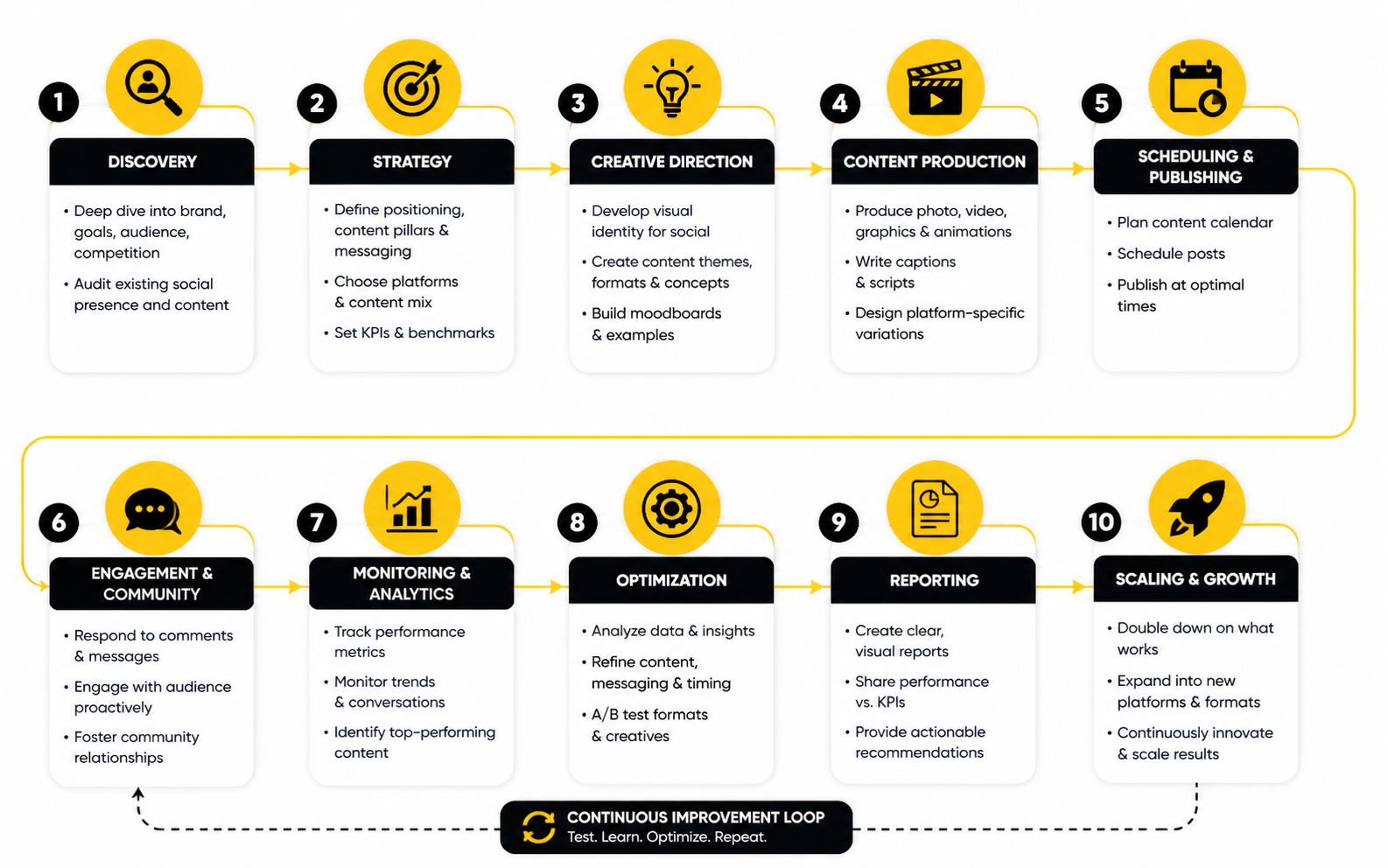
A reliable production process usually follows a clear sequence:
That sequence prevents the most common production problem: making content before knowing what the content is supposed to do. It also gives the team a shared language for feedback. Instead of saying “I do not like it,” the conversation becomes “this hook does not match the audience signal” or “this proof point is too weak for the claim.”
Distribution That Gives Creative A Fair Shot
Creative does not perform in a vacuum. The same asset can behave differently depending on the platform, audience, placement, timing, and budget behind it. That is why a social media creative agency needs to understand distribution, even when it is not managing every channel directly.
Organic distribution rewards relevance, consistency, and audience response. Paid distribution adds another layer, because the creative has to survive auction pressure, targeting limitations, and fatigue. Creator distribution is different again, because the message has to fit the creator’s trust with their audience.
A good agency does not treat distribution as an afterthought. It plans for it during creative development. If the content will be used in ads, the agency should think about hooks, proof, variations, and landing page continuity. If the content will be used organically, the agency should think about shareability, comments, profile flow, and how the piece supports the broader content library.
Community And Conversation Management
Social media is not only a publishing channel. It is also a live feedback loop. Comments, direct messages, saves, shares, reposts, and replies all show what the audience cares about. A strong agency knows how to use those signals without turning every comment into a crisis or every viral post into a strategy pivot.
Community management should be connected to creative learning. If the same question appears under multiple posts, that question may deserve its own content angle. If people keep challenging a claim, the proof may need to be clearer. If a specific phrase from the audience keeps repeating, the copy should probably reflect that language.
This is especially important for service businesses, coaches, creators, local brands, and B2B companies where trust builds through conversation. Tools like ManyChat can help automate parts of the direct message flow, but the tone still needs to feel human. Automation should remove friction, not make the brand feel colder.
Reporting That Leads To Better Creative
Reporting should not be a monthly screenshot parade. The point of reporting is to make better decisions. A useful report explains what happened, why it likely happened, what the team learned, and what should change next.
The agency should separate vanity metrics from useful signals. Reach can matter, but only in context. Engagement can matter, but not all engagement is equal. Saves, shares, watch time, qualified comments, click behavior, lead quality, and conversion movement often say more about creative strength than a single surface-level number.
A serious social media creative agency turns reporting into the beginning of the next creative cycle. The report should influence hooks, formats, offers, proof points, content pillars, and production priorities. If the agency reports performance but keeps making the same type of content anyway, it is not really optimizing. It is just documenting.
The Team Structure Behind The Work
The exact team structure depends on the size of the agency and the complexity of the client. A lean team might include a strategist, copywriter, designer, video editor, and account lead. A larger agency may add creative directors, producers, paid media specialists, community managers, data analysts, and creator partnership managers.
What matters most is role clarity. Someone has to own the strategy. Someone has to own the creative direction. Someone has to own production quality. Someone has to own performance interpretation. When nobody owns these areas, the client usually ends up managing the agency instead of being served by it.
This is why the best agencies feel organized without feeling corporate. They have enough process to prevent chaos, but enough creative flexibility to respond to what is happening in the market. That balance is hard to fake, and it is one of the clearest signs that the agency can handle serious execution.
Statistics And Data
Measurement is where a social media creative agency proves whether the work is creating momentum or just filling a calendar. The numbers matter, but only when they are connected to decisions. A dashboard full of reach, likes, comments, and impressions is not strategy unless the team knows what those signals mean and what to change because of them.
The useful question is not “did this post perform well?” The useful question is “what did this result teach us about the audience, the message, the offer, the platform, or the creative format?” That is a different level of thinking. It turns reporting from a monthly recap into a practical creative advantage.
This is also where brands need to be careful with benchmarks. A benchmark can give context, but it should not become the goal by itself. Your best benchmark is still your own previous performance, because your audience, category, offer, budget, and creative system are specific to you.
Why Social Metrics Need Context
Social metrics are easy to misread. A post with high reach may have attracted the wrong people. A post with low reach may have created high-quality sales conversations. A video with weak likes may still have strong retention, saves, or click behavior. The number alone is not the insight.
That is why a social media creative agency should group metrics by their job. Awareness metrics show whether the creative is earning distribution. Engagement metrics show whether people care enough to react. Consideration metrics show whether the content creates deeper interest. Conversion metrics show whether the campaign moves people toward a business outcome.
The mistake is treating every metric as equal. They are not. A funny top-of-funnel video should not be judged the same way as a retargeting ad or a booking-page campaign. Each asset needs to be measured against the job it was created to do.
The Numbers That Actually Deserve Attention
Global social usage gives the big picture first. The Digital 2026 Global Overview Report shows that social media remains one of the largest digital attention environments in the world, which explains why brands keep investing in content, community, creators, and paid distribution. But that scale also creates the problem: attention is abundant in theory and brutally competitive in practice.
Platform benchmarks make the picture more practical. The 2025 Rival IQ Social Media Industry Benchmark Report found that TikTok continued to outperform Instagram, Facebook, and X on engagement rate across the industries it studied, even as engagement pressure remained a broader theme. That does not mean every brand should blindly move everything to TikTok. It means the agency should understand where attention is easier to earn, where the audience actually buys, and where the brand can produce native creative consistently.
Content benchmarks add another layer. The 2025 Sprout Social benchmarks research analyzed billions of messages across public profiles and emphasizes the difference between industry benchmarks, competitive benchmarks, and personal benchmarks. That distinction matters because “good” performance is not universal. A niche B2B consulting brand, a local clinic, and an ecommerce skincare brand should not be judged with the same yardstick.
The Analytics System
A useful analytics system should connect four layers: creative input, platform response, audience signal, and business result. Creative input tracks what the team actually made, including hooks, angles, formats, offers, creators, and visual styles. Platform response tracks how the algorithm and audience reacted through reach, watch time, engagement, saves, shares, comments, clicks, and frequency. Audience signal looks at what people said, asked, challenged, or repeated. Business result connects the creative to leads, sales, booked calls, pipeline, retention, or another meaningful outcome.
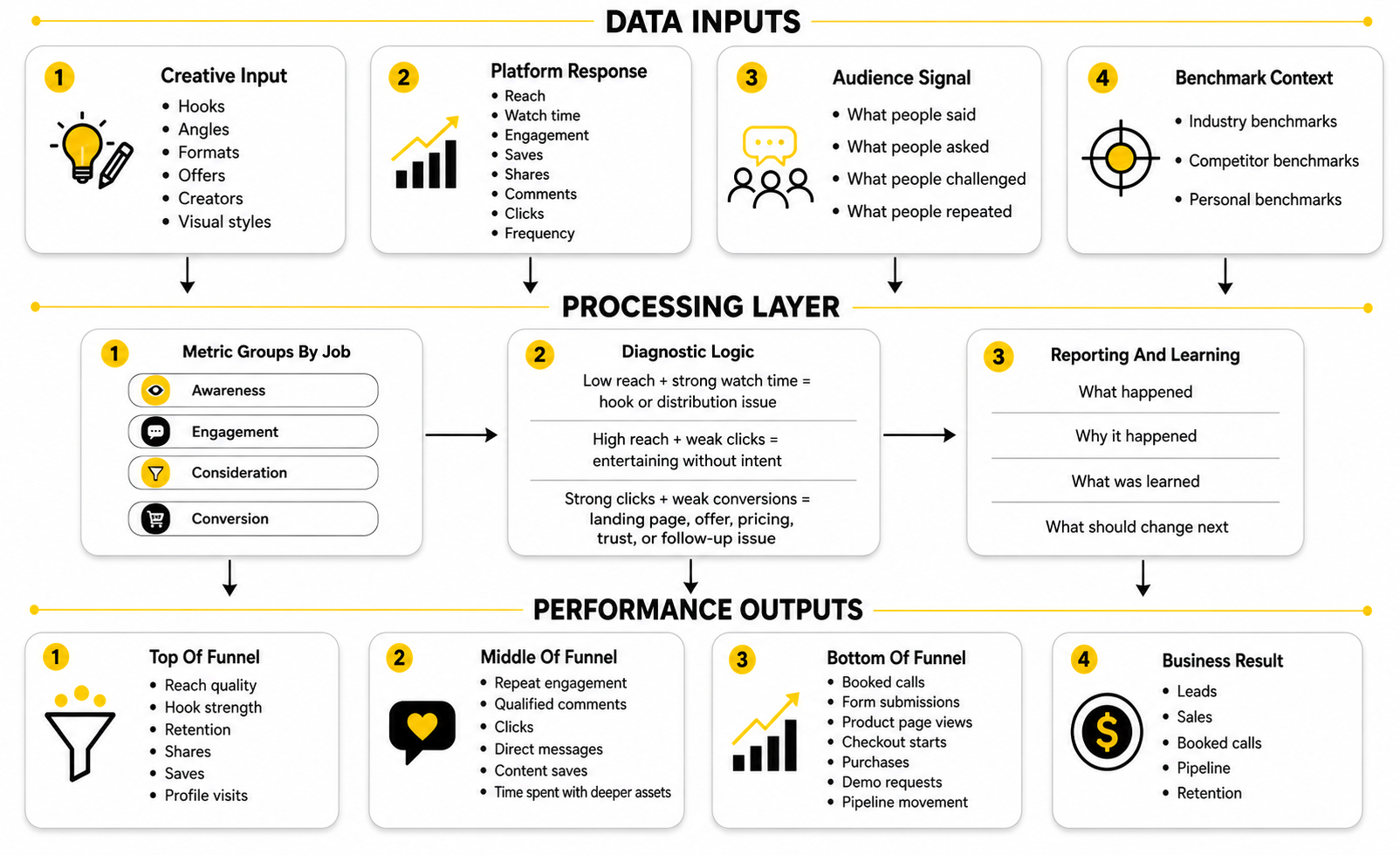
This system works because it stops the team from blaming or praising creative too quickly. If reach is low but watch time is strong, the hook or distribution may need work, not the whole concept. If reach is high but clicks are weak, the content may be entertaining without creating intent. If clicks are strong but conversions are weak, the issue may sit on the landing page, offer, pricing, trust layer, or follow-up flow.
The goal is not to overcomplicate reporting. The goal is to diagnose the right problem. A serious social media creative agency should be able to look at the data and say, “Here is what we learned, here is what we are changing, and here is why that change should matter.”
Benchmarks Should Guide, Not Control
Benchmarks are useful when they prevent emotional decision-making. If an agency knows the typical engagement range in a category, it can avoid panicking over normal volatility. If it knows a platform’s average behavior, it can spot when a campaign is genuinely breaking pattern. That is helpful.
But benchmarks become dangerous when they replace judgment. A brand can beat the industry average and still fail commercially if the content attracts the wrong audience. A campaign can underperform a public benchmark and still be valuable if it drives qualified pipeline, customer conversations, or repeat purchase behavior.
The more carefully approach is to use three benchmark types at once. Industry benchmarks show the wider market. Competitor benchmarks show the category context. Personal benchmarks show whether the brand is improving against itself. Personal benchmarks usually deserve the most weight because they reflect the actual audience, offer, and creative system.
Performance Signals By Funnel Stage
Top-of-funnel content should be measured by reach quality, hook strength, retention, shares, saves, and profile visits. These signals show whether the creative can earn attention and create enough interest for someone to take a small next step. If the content reaches many people but nobody watches, saves, comments, or visits the profile, the creative may be too broad.
Middle-of-funnel content should be measured by repeat engagement, qualified comments, clicks, direct messages, content saves, and time spent with deeper assets. This is where people are deciding whether the brand is credible. The content should answer objections, show proof, explain the process, compare options, and make the audience feel more confident.
Bottom-of-funnel content should be measured by conversion behavior. That can include booked calls, form submissions, product page views, checkout starts, purchases, demo requests, or pipeline movement. If the content creates interest but does not move people forward, the agency should inspect the offer, call to action, landing page, follow-up, and trust assets before assuming the creative failed.
Creative Fatigue And What It Tells You
Creative fatigue happens when an asset stops producing the same response after repeated exposure. In paid campaigns, this can show up as rising costs, lower click-through rates, weaker conversion rates, or frequency problems. In organic content, it can show up as declining engagement, weaker retention, or audience comments that suggest the message feels repetitive.
Fatigue is not always bad news. It can mean the angle worked long enough to deserve a new variation. The agency can refresh the hook, change the opening visual, use a different proof point, adjust the format, or move the same idea to another stage of the funnel.
The mistake is abandoning a winning concept too early. If an angle performs, the next move is usually not to start from zero. The next move is to expand the angle intelligently so the brand keeps the learning while giving the audience a fresh reason to pay attention.
What Reporting Should Change
Reporting should change the next round of creative. If it does not, it is not useful. A strong report should tell the team which hooks pulled attention, which topics created conversation, which formats held retention, which offers drove action, and which audience segments responded with quality.
It should also change production priorities. If short-form educational videos are generating saves and qualified comments, the agency may build more around that format. If creator-style product demos are outperforming polished studio assets, the team should shift budget and production time accordingly. If direct-response ads are getting clicks but weak conversion, the agency should work on the landing page and follow-up path instead of simply making more ads.
This is where tools can support the process without becoming the process. A team might use Buffer for publishing visibility, Flick Social for planning and social workflow support, GoHighLevel for lead tracking, or Fillout for campaign forms. But the real advantage comes from interpretation. Data does not tell you what to do by itself. A good agency turns it into better creative decisions.
The Metrics That Should Raise A Red Flag
Some numbers are warning signs. If content volume is high but profile growth, saves, shares, clicks, or qualified conversations are flat, the agency may be producing activity without resonance. If paid ads need constant budget increases to maintain the same output, creative fatigue or weak offer alignment may be the issue. If engagement looks healthy but leads are poor, the content may be attracting attention from the wrong audience.
Another red flag is reporting that avoids business outcomes completely. Not every post needs to sell directly, but the overall system should connect to something meaningful. A brand should know whether social is helping awareness, demand, trust, pipeline, retention, recruitment, or customer support. Otherwise, the channel becomes hard to defend when budgets get tighter.
The most important red flag is a lack of learning. If the agency cannot explain what changed from last month to this month, the reporting is too shallow. Measurement should create sharper decisions over time. That is the whole point.
Scaling Creative Without Losing The Strategy
Scaling social creative is not just a volume problem. It is a judgment problem. A social media creative agency can usually make more assets, but the harder question is whether those assets still carry the right message, reach the right audience, and support the right business outcome.
This is where brands often get excited too early. A few posts work, a few ads convert, and suddenly everyone wants to multiply the output. That can work, but only if the agency has a system for protecting the original insight. If the winning idea gets stretched into shallow variations, performance usually drops because the creative loses the reason it worked in the first place.
The goal is controlled scale. More content should mean more learning, more useful variations, and more opportunities to reach the market from different angles. It should not mean more noise.
Scale Angles Before You Scale Assets
The best thing to scale is not the asset. It is the angle behind the asset. If one post works because it challenges a belief, the agency should explore that belief from multiple angles instead of simply copying the layout or hook.
This is an important distinction. Copying the visible format may create a few extra posts, but it rarely creates a durable creative system. Scaling the underlying angle gives the team more room. It can become a short video, a founder post, a creator brief, a carousel, a retargeting ad, a sales email, or a landing page section.
A smart social media creative agency builds creative families around winning ideas. Each family has a core audience insight, a message, a proof point, and multiple executions. That way, the brand can scale without making every piece feel like a clone.
Build A Content Library, Not Just A Calendar
A content calendar is useful for planning. A content library is useful for compounding. The calendar tells the team what goes out this week. The library tells the team what has been learned, what assets exist, which angles worked, which proof points are available, and which ideas deserve another round.
This matters because social teams waste a lot of time rediscovering what they already know. A strong library prevents that. It keeps top-performing hooks, scripts, visuals, customer language, testimonials, creator clips, objections, and offer variations organized so the next campaign starts from evidence instead of memory.
The content library should also include context, not just files. An asset without notes is only half useful. The agency should know why it was made, what audience it targeted, where it ran, how it performed, and what the next version should test.
Protect The Brand While Testing Aggressively
Testing is necessary, but not every test is worth running. A brand can move fast and still protect its voice, credibility, and positioning. That balance becomes more important as more people, creators, freelancers, editors, and tools touch the creative process.
The agency should define the non-negotiables. These might include claims the brand will not make, visual styles it will not use, topics it will avoid, compliance limits, tone boundaries, or standards for proof. These boundaries do not slow the team down. They make fast decisions safer.
At the same time, the agency should leave room for creative risk. Safe content is often invisible content. The strongest teams know which parts of the system need discipline and which parts need experimentation. Strategy, claims, and offer alignment need discipline. Hooks, formats, edits, visuals, and storytelling angles need room to breathe.
Know When To Separate Organic And Paid Creative
Organic and paid creative can share the same strategic foundation, but they should not always use the same execution. Organic content often earns attention through usefulness, personality, timing, and conversation. Paid creative has to survive repetition, audience targeting, cost pressure, and conversion expectations.
A post that works organically may fail as an ad because it depends on context the paid audience does not have. A direct-response ad may feel too aggressive as an organic post because the audience expects value before the pitch. A social media creative agency needs to understand that distinction before it starts repurposing everything.
The better approach is to build from shared insights, then adapt for the channel. The same audience objection might become an educational organic post, a creator-style ad, a landing page proof section, and a direct response follow-up message. The message stays connected, but the execution changes based on the job.
Manage Creator Partnerships With Clear Direction
Creators can bring trust, speed, and cultural fluency that brand-owned content often lacks. But creator partnerships fall apart when the brief is either too vague or too controlling. Too vague, and the creator misses the business goal. Too controlling, and the content loses the natural voice that made the creator valuable in the first place.
The creator brief should focus on the strategic essentials. It should explain the audience, product truth, key message, proof point, required disclosure, and desired action. It should not script every word unless the format truly requires it. Creators understand their audiences, and the agency should use that intelligence instead of flattening it.
Creator strategy is becoming more important as brands expand their partnerships. The Sprout Social creator economy research found that many brands still work with relatively small creator benches while marketers continue planning more creator partnerships. That matters because the operational challenge is not just finding creators. It is briefing, approving, measuring, repurposing, and learning from creator content without making the process messy.
Prepare For AI Without Letting It Flatten The Work
AI can help a social media creative agency move faster. It can support research summaries, first-draft scripts, content variations, transcript repurposing, customer review analysis, and internal workflow. Used well, it removes friction from the creative process.
But AI can also make content more generic. When every brand uses the same prompts, the same structures, and the same safe phrasing, the feed gets crowded with polished sameness. The HubSpot 2025 social media marketing research makes the point clearly: AI may make content easier to produce, but originality is what makes it matter.
The practical rule is simple. Use AI to speed up the work around the idea, not to replace the idea. Human judgment still has to own the point of view, taste, cultural context, customer nuance, and final creative decision. If AI helps the agency produce more distinctive work, it is useful. If it helps the agency produce more average work, it is a trap.
Avoid The Biggest Scaling Risks
The first scaling risk is creative dilution. This happens when the agency increases output but weakens the insight, message, or production quality behind the work. The content looks active, but the audience stops caring because the work feels thinner.
The second risk is operational drag. More assets mean more approvals, more feedback, more files, more deadlines, and more chances for miscommunication. If the agency does not improve the workflow as volume grows, the client experience gets worse even when the output looks bigger.
The third risk is measurement confusion. As campaigns expand across organic, paid, creator, email, landing pages, and automation, it becomes easier to lose track of what is actually driving results. This is why the agency needs clean naming conventions, campaign tracking, asset libraries, and reporting discipline before scale gets serious.
Connect Creative Scale To Revenue Infrastructure
Social creative creates demand, but demand needs somewhere to go. If the next step is unclear, the brand leaks opportunity. That is why scaling creative often requires improving the infrastructure around it.
For ecommerce, that might mean better product pages, landing pages, post-click offers, email flows, and retargeting assets. For service businesses, it might mean lead forms, booking pages, direct message automation, sales pipelines, and follow-up sequences. For B2B brands, it might mean stronger nurture content, demo paths, webinars, case studies, and founder-led trust assets.
This is where tools can matter when they are chosen for the workflow instead of the hype. A brand might use Replo for conversion-focused landing pages, ClickFunnels for funnel builds, Systeme.io for simpler funnel and email setups, or GoHighLevel for lead management and follow-up. The key is not the tool itself. The key is making sure the creative system and the revenue system are connected.
Decide What Should Stay In-House
Not every part of social should be outsourced forever. Some things may be better inside the company because they require constant access, deep product knowledge, or fast internal judgment. Founder posts, customer conversations, product updates, internal culture, and subject-matter expertise often work best when the brand stays closely involved.
A strong social media creative agency should not be threatened by that. In fact, the best agencies often help clients become better collaborators. They may create the strategy, systems, templates, briefs, and production rhythm while the internal team supplies expertise, access, and fast feedback.
The decision should be based on leverage. Outsource the parts where the agency brings sharper skill, speed, or perspective. Keep the parts where the brand has irreplaceable knowledge or relationships. The best setup is rarely all agency or all in-house. It is usually a smart blend.
Build For Compounding, Not Campaign Spikes
Campaign spikes are useful, but compounding is better. A spike gives the brand a temporary lift. Compounding builds an asset base, a clearer message, a stronger audience relationship, and a more carefully creative machine over time.
This is the real expert-level view of social creative. The agency is not just making posts for this month. It is building a system that gets better because every cycle produces learning. The hooks improve. The proof gets stronger. The audience language becomes clearer. The production process gets smoother. The conversion path gets tighter.
That is what separates a serious social media creative agency from a vendor that simply delivers files. The serious agency helps the brand become more known, more trusted, and more effective with every round of work. That is the standard to aim for.
Choosing The Right Agency Model
The right social media creative agency is not always the biggest one, the trendiest one, or the one with the nicest pitch deck. The right agency is the one whose model matches your business, your internal team, your speed, your offer, and your growth stage. That sounds obvious, but it is where many brands make the wrong choice.
Some brands need a strategic partner that can rebuild the whole social system. Others need a production team that can turn an existing strategy into strong assets. Some need paid creative, some need creator management, some need community and direct message workflows, and some need a tighter connection between content and sales. The agency model should fit the job, not the other way around.
A practical way to choose is to start with the gap. If your team has ideas but cannot execute fast enough, you need production depth. If your team posts often but nothing compounds, you need strategy and measurement. If you get attention but not leads or sales, you need better conversion infrastructure around the creative.
Full-Service Agency
A full-service agency can be useful when the brand needs strategy, production, publishing, paid creative, reporting, and campaign management under one roof. This model reduces coordination work because one partner owns more of the system. It can also help when the internal team is small and needs outside leadership.
The tradeoff is cost and complexity. Full-service agencies can be expensive, and not every full-service agency is equally strong in every area. Some are excellent at production but weaker at analytics. Others are strong in paid media but average at organic creative. You still need to inspect the actual team, not just the service list.
This model works best when the agency has a clear operating process. Ask how research becomes creative strategy. Ask how briefs become assets. Ask how reporting changes the next production cycle. If they cannot explain that clearly, the full-service label does not mean much.
Specialized Creative Studio
A specialized creative studio is often the better choice when the brand already has strategy, media buying, or internal marketing leadership but needs stronger creative output. This type of agency may focus on short-form video, paid ad creative, creator-style production, social design, or campaign concepts. The value is depth.
The tradeoff is that the client usually needs to manage more of the surrounding system. A studio may make excellent assets but may not own the funnel, CRM, analytics, or publishing workflow. That is fine if the brand has those pieces covered. It becomes a problem if the brand expects the studio to solve strategic issues outside its lane.
This model is strong when the creative bottleneck is obvious. If the strategy is solid but the assets are slow, inconsistent, or not native to the platform, a specialized studio can lift performance quickly. The key is giving them a clear brief and enough context to make smart creative decisions.
Paid Social Creative Partner
A paid social creative partner focuses on assets built for advertising. This model is useful when the brand already spends money on Meta, TikTok, YouTube, LinkedIn, or other paid channels and needs a stronger pipeline of testable creative. The work usually includes hooks, UGC-style ads, direct response angles, offer variations, and landing page alignment.
The tradeoff is that paid creative can become too conversion-heavy if the team ignores brand and audience trust. Not every asset should feel like an ad, even inside paid distribution. The best paid creative partners understand how to make ads that feel native, useful, and credible before they ask for action.
This agency type should be judged by its testing discipline. Ask how many angles they produce, how they define a winning test, how they handle fatigue, and how creative learnings are documented. If they only talk about volume, be careful. Volume without interpretation gets expensive fast.
Creator And Influencer Agency
A creator-focused agency helps brands source, brief, manage, and measure creator partnerships. This can be powerful because creator content often carries a level of trust that brand-owned content struggles to earn. It also gives brands more creative variety without building every asset internally.
The tradeoff is control. Creator content works because it feels like the creator, not because it sounds like a corporate script. The agency needs to protect brand requirements while giving creators enough room to communicate naturally. That balance is everything.
This model is becoming more important as creator marketing matures. The 2025 IAB Creator Economy report highlights measurement, standards, and operational playbooks as major areas brands are trying to improve, which is exactly where a strong creator agency can help. The brands that win here usually treat creators as partners in communication, not just rented distribution.
In-House Team With Agency Support
For many brands, the best model is a hybrid. The internal team owns the product knowledge, customer insight, approvals, and founder perspective. The agency adds strategy, creative direction, production capacity, platform expertise, or performance interpretation.
This setup works especially well when speed matters. The brand can capture real moments, product updates, customer questions, and internal expertise quickly. The agency can then turn those raw inputs into stronger content systems, campaigns, and testable assets.
The risk is unclear ownership. If nobody knows who owns strategy, posting, approvals, reporting, or optimization, the hybrid model gets messy. Define the workflow before the work begins. A hybrid model can be excellent, but only when responsibilities are sharp.
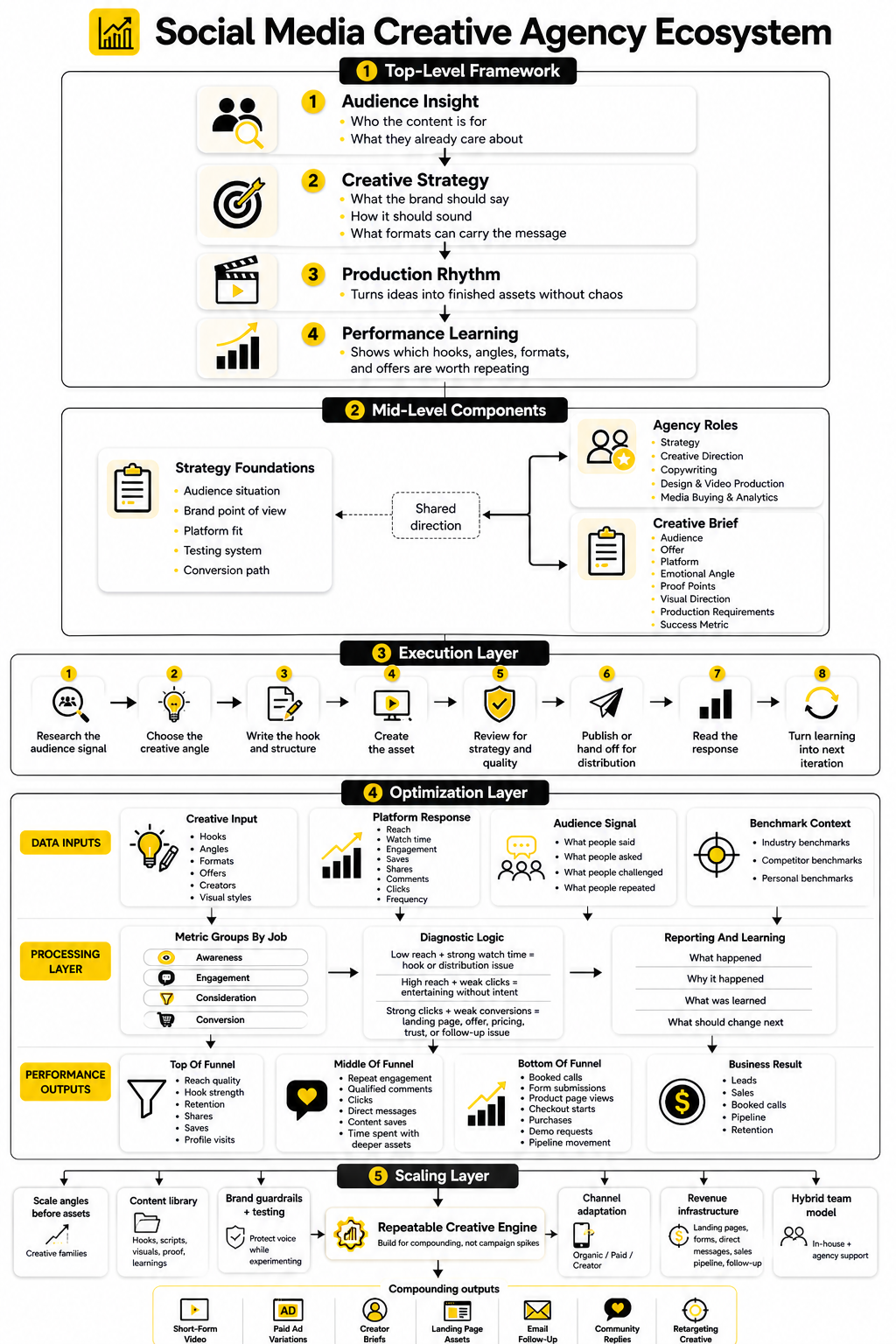
The Final Social Creative Ecosystem
At this point, the full system should be clear. A social media creative agency is not just a design vendor, a posting service, or a video team. It is part of a wider ecosystem that connects insight, creative, distribution, conversation, measurement, and revenue.
The best ecosystem has clean handoffs. Audience research feeds strategy. Strategy feeds creative briefs. Briefs feed production. Production feeds publishing and paid distribution. Distribution creates audience signals. Those signals feed reporting. Reporting shapes the next creative cycle. That loop is where social starts to compound.
When the ecosystem works, social becomes easier to defend as a business investment. The brand can see what is being made, why it is being made, what the market is saying back, and how the next round will improve. That is the difference between a brand that “does social” and a brand that builds a real creative machine.
What does a social media creative agency do?
A social media creative agency helps brands plan, produce, publish, and improve creative content for social platforms. The work can include strategy, short-form video, copywriting, design, paid ad creative, creator briefs, campaign concepts, reporting, and optimization. The best agencies connect the creative to a business goal instead of treating content as decoration.
How is a social media creative agency different from a social media marketing agency?
A social media marketing agency may focus broadly on strategy, publishing, community management, ads, and reporting. A social media creative agency is usually more focused on the creative assets themselves, including ideas, hooks, scripts, visuals, videos, and platform-native execution. In practice, the two can overlap, but the creative agency should bring stronger taste, production discipline, and content strategy.
When should a brand hire a social media creative agency?
A brand should consider hiring one when social content is inconsistent, generic, slow to produce, or disconnected from sales and brand goals. It also makes sense when the internal team has strategy but lacks production capacity. If the brand already gets attention but cannot turn it into qualified leads, sales, or trust, an agency can help tighten the system.
What should I look for before hiring an agency?
Look for clear thinking before pretty visuals. A good agency should be able to explain its research process, creative strategy, production workflow, reporting method, and how it learns from performance. You should also ask who will actually work on the account, because the pitch team is not always the delivery team.
How much does a social media creative agency cost?
Costs vary widely based on scope, volume, strategy depth, production complexity, paid creative needs, and creator management. A small production-focused engagement may be relatively lean, while a full-service strategy and execution partnership can cost much more. The important question is not just price. It is whether the agency can create a system that improves output, learning, and business results.
How long does it take to see results?
Some early signals can appear quickly, especially around hooks, engagement, retention, comments, and click behavior. Business outcomes usually need more time because the agency has to test angles, build trust, improve conversion paths, and learn what the audience responds to. A serious agency should set expectations around learning cycles instead of promising instant wins.
What platforms should a social media creative agency cover?
The right platforms depend on the audience and business model. Many brands use Instagram, TikTok, LinkedIn, YouTube Shorts, Facebook, X, Pinterest, or platform-specific communities, but being everywhere is not automatically smart. A good agency chooses platforms based on audience behavior, content fit, production capacity, and commercial intent.
Should social creative be made differently for each platform?
Yes, in most cases. The same message can travel across platforms, but the execution should match the behavior of each environment. A LinkedIn post, Instagram Reel, TikTok video, YouTube Short, and paid ad all need different pacing, framing, context, and calls to action.
What metrics matter most for social creative?
The most useful metrics depend on the job of the content. Awareness content should be judged by reach quality, retention, shares, saves, profile visits, and audience response. Consideration content should be judged by clicks, direct messages, qualified comments, repeat engagement, and proof consumption. Conversion content should be judged by leads, booked calls, purchases, pipeline, or another business outcome.
Can AI replace a social media creative agency?
AI can help with research, drafts, repurposing, variations, and workflow, but it does not replace strategy, taste, customer understanding, or creative judgment. A good agency may use AI to move faster, but the strongest work still needs a human point of view. If AI makes the content more generic, it is hurting the brand instead of helping it.
Should I use tools with a social media creative agency?
Tools can make the system easier to manage, but they should support the strategy rather than define it. For example, Buffer can support scheduling, ManyChat can support direct message automation, GoHighLevel can support follow-up workflows, and Replo can support landing page execution. The tool stack should match the campaign, not the other way around.
Is it better to hire an agency or build an in-house team?
It depends on the brand’s stage, budget, and internal skill set. An agency can bring speed, external perspective, production systems, and specialized creative skill. An in-house team can bring deeper product knowledge, faster access, and stronger day-to-day context. Many brands get the best result from a hybrid model where the agency builds the system and the internal team supplies insight, access, and expertise.
What makes a social media creative agency worth keeping long term?
The agency should make the brand more carefully over time. That means better creative decisions, clearer audience insight, stronger production workflows, sharper reporting, and more useful campaign learning. If every month feels like starting from zero, the agency is not compounding value.
Build a stronger local presence with BAAM AI
Turn your website, Google profile, social channels, and AI visibility into one growth engine
Most businesses do not need more random marketing activity. They need a consistent presence system that helps the right people find them, trust them, and take action. BAAM AI brings strategy, local SEO, website updates, Google Maps visibility, social content, AI-search readiness, media production, and reporting into one practical monthly engine.
If you want your marketing to keep working after the campaign ends, start with a free BAAM AI presence audit. See how your business shows up today and where the fastest visibility wins are at BAAM AI.